Multi-Stakeholder Workshop on the United Nations Convention against Corruption and its Review Mechanism Saly, Senegal 8-11 May 2018 Mirella Dummar Frahi Civil Society Team Leader, UNODC CIVIL SOCIETY PARTICIPATION IN THE UNCAC The UN
"Multi-Stakeholder Workshop on the United Nations" is the property of its rightful owner. Permission is granted to
download and print the materials on this website for personal, non-commercial use only, and to display it
on your personal computer provided you do not modify the materials and that you retain all copyright
notices contained in the materials. By downloading content from our website, you accept the terms of this
agreement.
Presentation Transcript
01
Multi-Stakeholder Workshop on the United Nations Convention against Corruption and its Review Mechanism Saly, Senegal
8-11 May 2018 Mirella Dummar Frahi
Civil Society Team Leader, UNODC<br>
02
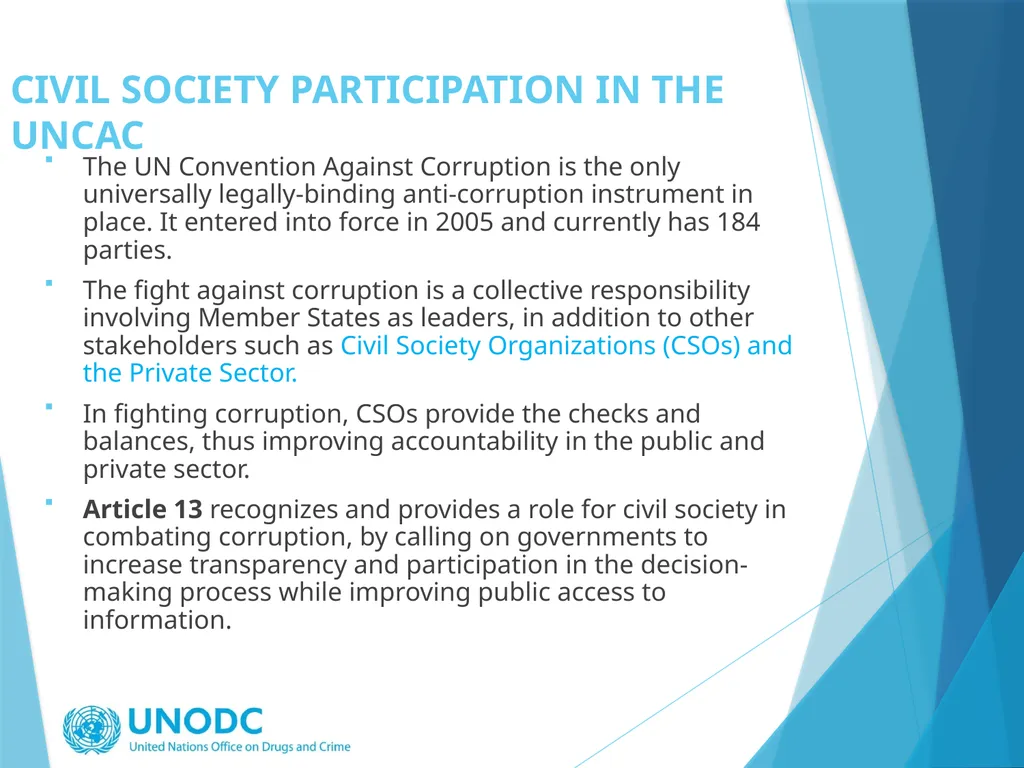
CIVIL SOCIETY PARTICIPATION IN THE UNCAC The UN Convention Against Corruption is the only universally legally-binding anti-corruption instrument in place. It entered into force in 2005 and currently has 184 parties.
The fight against corruption is a collective responsibility involving Member States as leaders, in addition to other stakeholders such as Civil Society Organizations (CSOs) and the Private Sector.
In fighting corruption, CSOs provide the checks and balances, thus improving accountability in the public and private sector.
Article 13 recognizes and provides a role for civil society in combating corruption, by calling on governments to increase transparency and participation in the decision-making process while improving public access to information.<br>
03
The Uncac review mechanism – how it works The UNCAC review mechanism was adopted in 2009 at COSP3 in Doha The review process comprises two five-year cycles
1st cycle (2010–2015): Chapter III on Criminalisation and Law Enforcement and Chapter IV on International Cooperation.
2nd cycle (2016–2021): Chapter II on Preventive Measures and Chapter V on asset recovery. Implementation Review Group
Drawing of lots to select States Parties participating in
the review process in selected year.
Appointment by Reviewed country of focal point to
coordinate State review.<br>
04
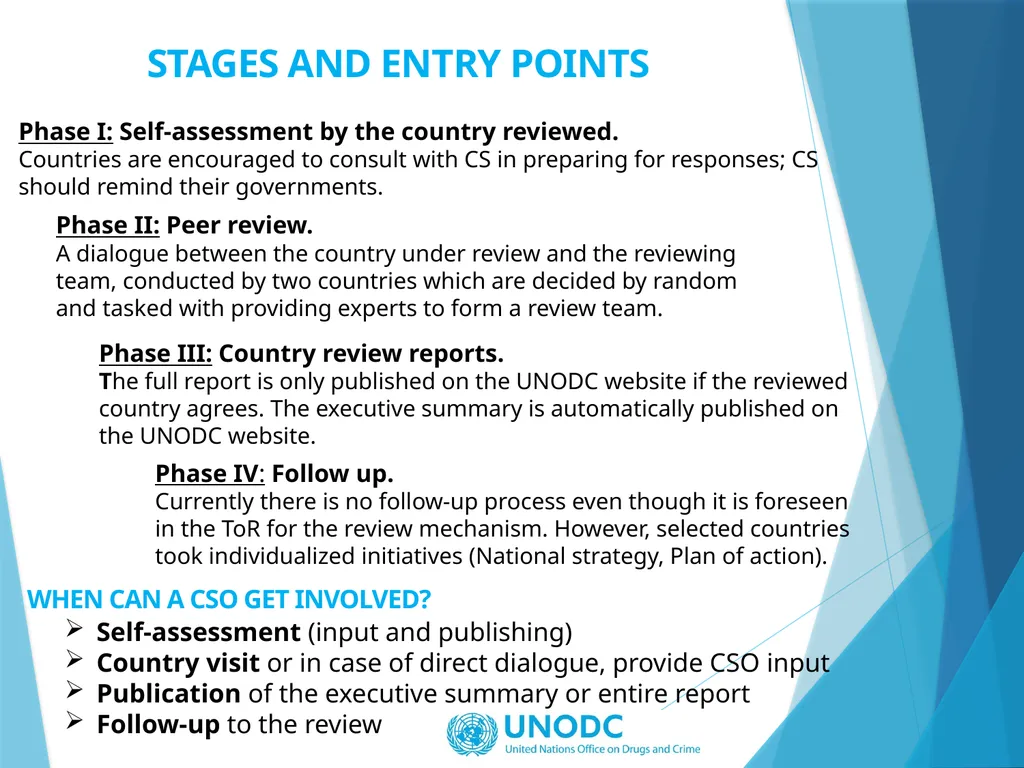
Self-assessment (input and publishing)
Country visit or in case of direct dialogue, provide CSO input
Publication of the executive summary or entire report
Follow-up to the review Stages and entry points When can a cso get involved? Phase I: Self-assessment by the country reviewed.
Countries are encouraged to consult with CS in preparing for responses; CS should remind their governments. Phase II: Peer review.
A dialogue between the country under review and the reviewing team, conducted by two countries which are decided by random and tasked with providing experts to form a review team. Phase III: Country review reports.
The full report is only published on the UNODC website if the reviewed country agrees. The executive summary is automatically published on the UNODC website. Phase IV: Follow up.
Currently there is no follow-up process even though it is foreseen in the ToR for the review mechanism. However, selected countries took individualized initiatives (National strategy, Plan of action).<br>
05
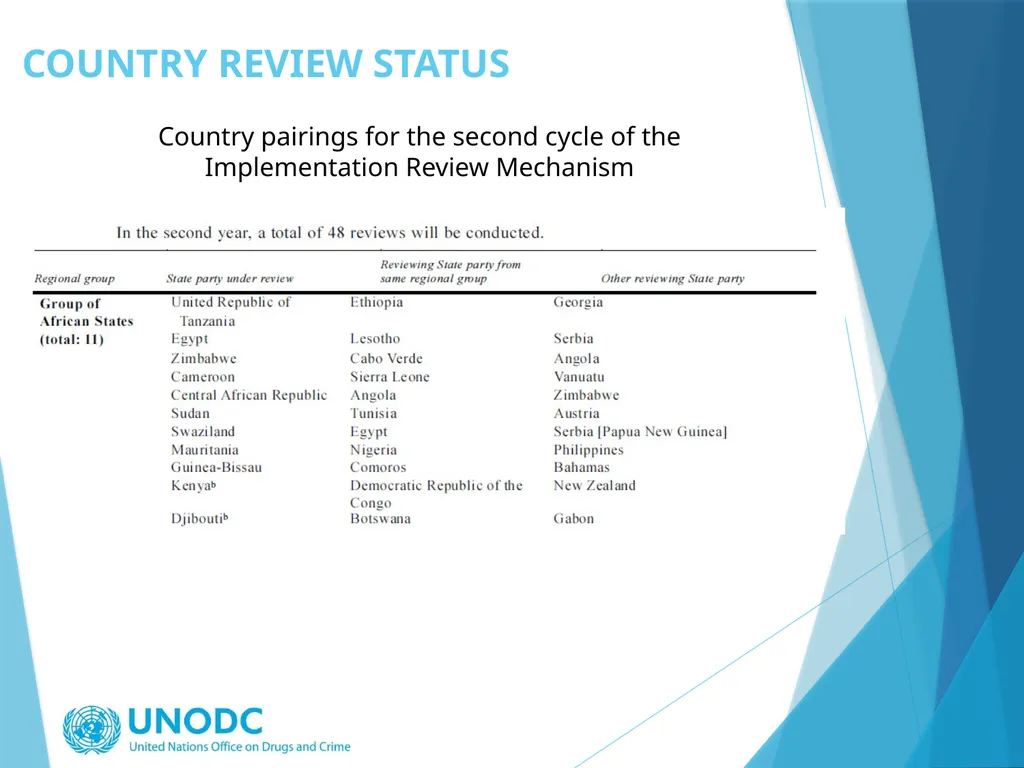
COUNTRY REVIEW STATUS Country pairings for the second cycle of the Implementation Review Mechanism<br>
06
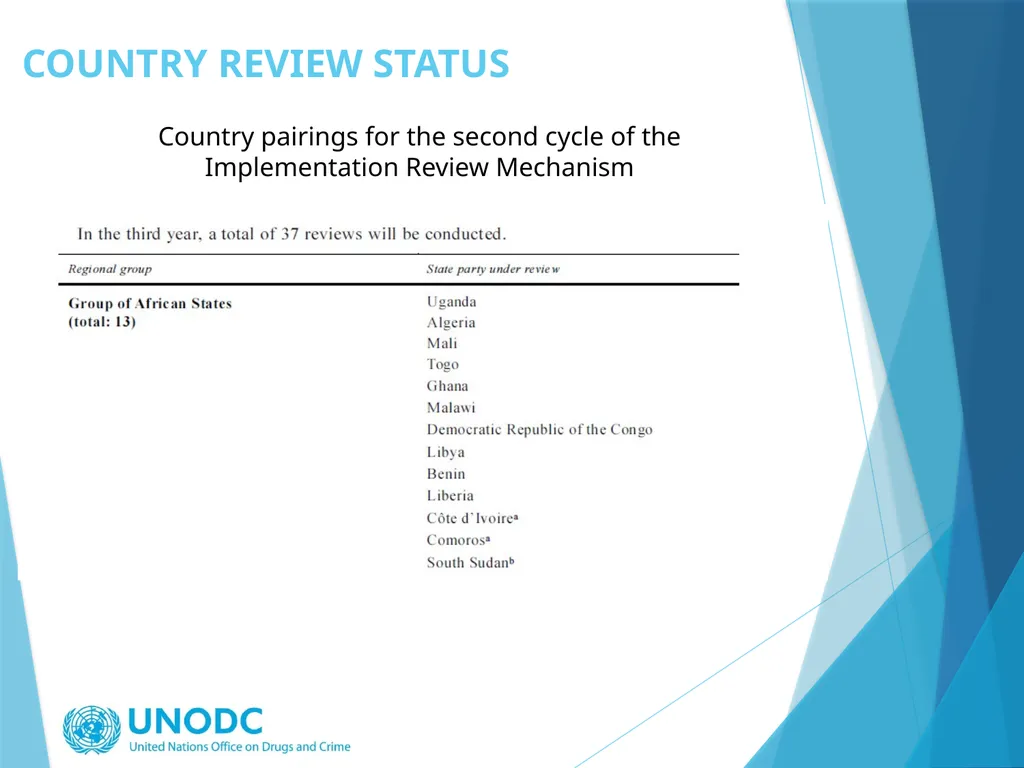
COUNTRY REVIEW STATUS Country pairings for the second cycle of the Implementation Review Mechanism<br>
07
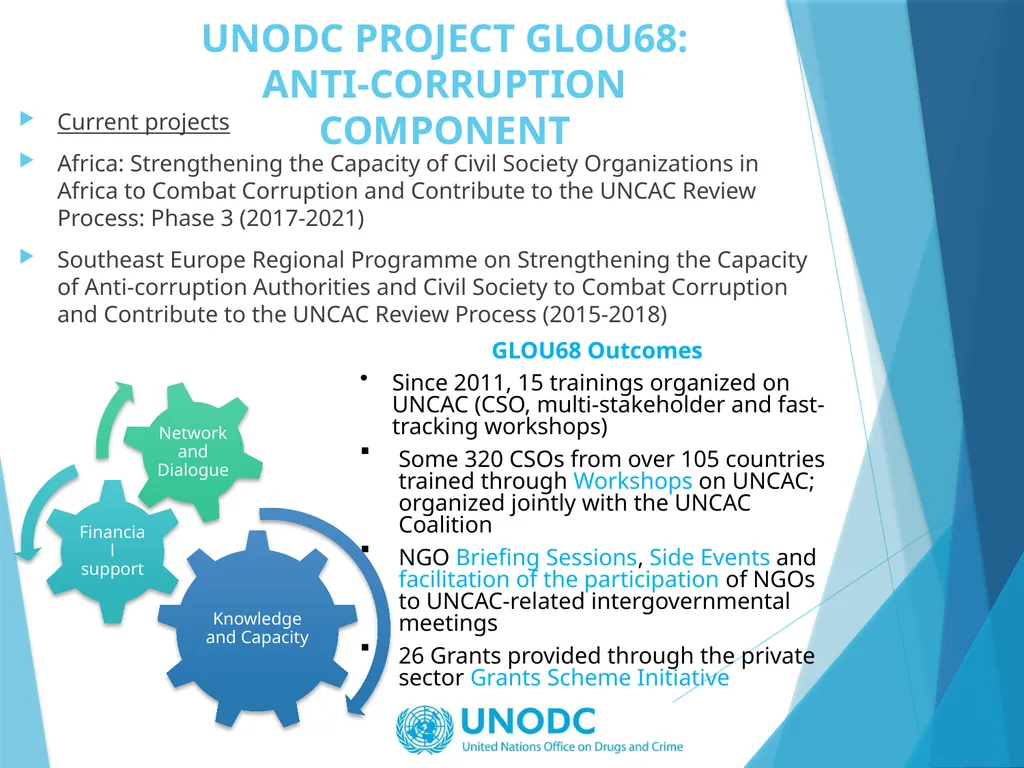
UNODC PROJECT GLOU68: ANTI-CORRUPTION COMPONENT Current projects
Africa: Strengthening the Capacity of Civil Society Organizations in Africa to Combat Corruption and Contribute to the UNCAC Review Process: Phase 3 (2017-2021)
Southeast Europe Regional Programme on Strengthening the Capacity of Anti-corruption Authorities and Civil Society to Combat Corruption and Contribute to the UNCAC Review Process (2015-2018) GLOU68 Outcomes
Since 2011, 15 trainings organized on UNCAC (CSO, multi-stakeholder and fast-tracking workshops)
Some 320 CSOs from over 105 countries trained through Workshops on UNCAC; organized jointly with the UNCAC Coalition
NGO Briefing Sessions, Side Events and facilitation of the participation of NGOs to UNCAC-related intergovernmental meetings
26 Grants provided through the private sector Grants Scheme Initiative<br>
08
unodc-ngounit@un.org +43 1 26060 5582 Thank you for your attention! Civil Society TEAM<br>