
Multilevel Intervention Training Institute Module
DP
Published · 41 slides · 0 views
1 / 1




Description
Multilevel Intervention Training Institute Module 20 Economic Analysis is MLIs Michael Halpern, M.D., Ph.D. National Cancer Institute Economic Studies in Health Care Goal: Inform decision making to help prioritizing use of limited resources
Related Topics
Share
Embed code
Download this presentation From Below
"Multilevel Intervention Training Institute Module" is the property of its rightful owner. Permission is granted to download and print the materials on this website for personal, non-commercial use only, and to display it on your personal computer provided you do not modify the materials and that you retain all copyright notices contained in the materials. By downloading content from our website, you accept the terms of this agreement.
Presentation Transcript
01
Multilevel Intervention Training Institute
Module 20<br>
02
Economic Analysis is MLIs Michael Halpern, M.D., Ph.D.
National Cancer Institute<br>
03
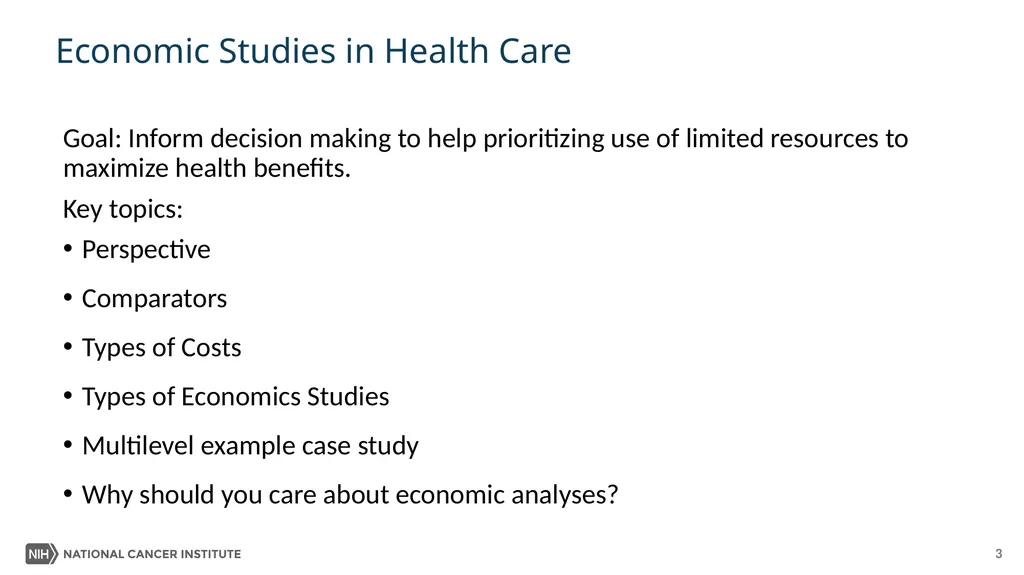
Economic Studies in Health Care Goal: Inform decision making to help prioritizing use of limited resources to maximize health benefits.
Key topics:
Perspective
Comparators
Types of Costs
Types of Economics Studies
Multilevel example case study
Why should you care about economic analyses?<br>
Key topics:
Perspective
Comparators
Types of Costs
Types of Economics Studies
Multilevel example case study
Why should you care about economic analyses?<br>
04
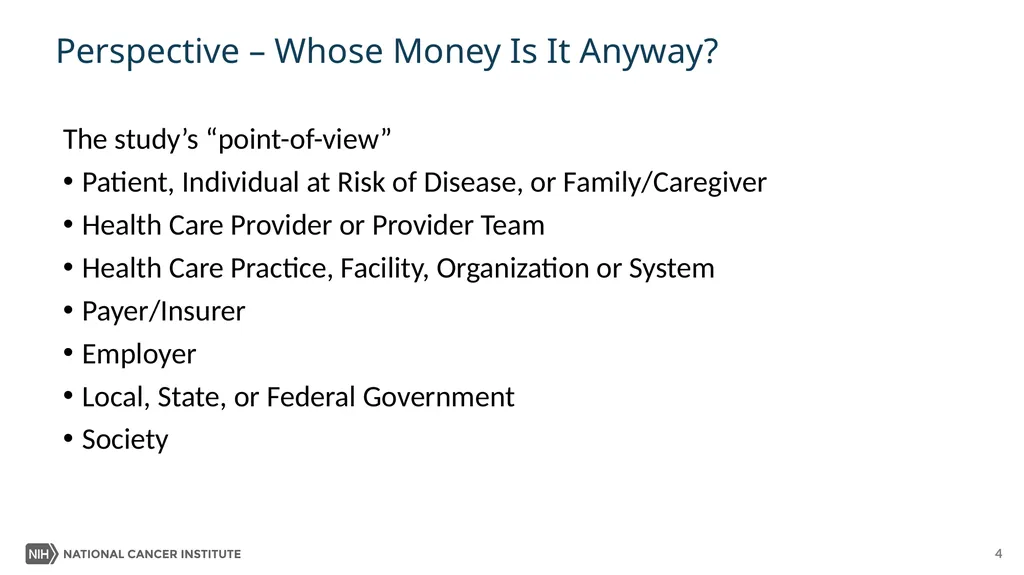
Perspective – Whose Money Is It Anyway? The study’s “point-of-view”
Patient, Individual at Risk of Disease, or Family/Caregiver
Health Care Provider or Provider Team
Health Care Practice, Facility, Organization or System
Payer/Insurer
Employer
Local, State, or Federal Government
Society<br>
Patient, Individual at Risk of Disease, or Family/Caregiver
Health Care Provider or Provider Team
Health Care Practice, Facility, Organization or System
Payer/Insurer
Employer
Local, State, or Federal Government
Society<br>
05
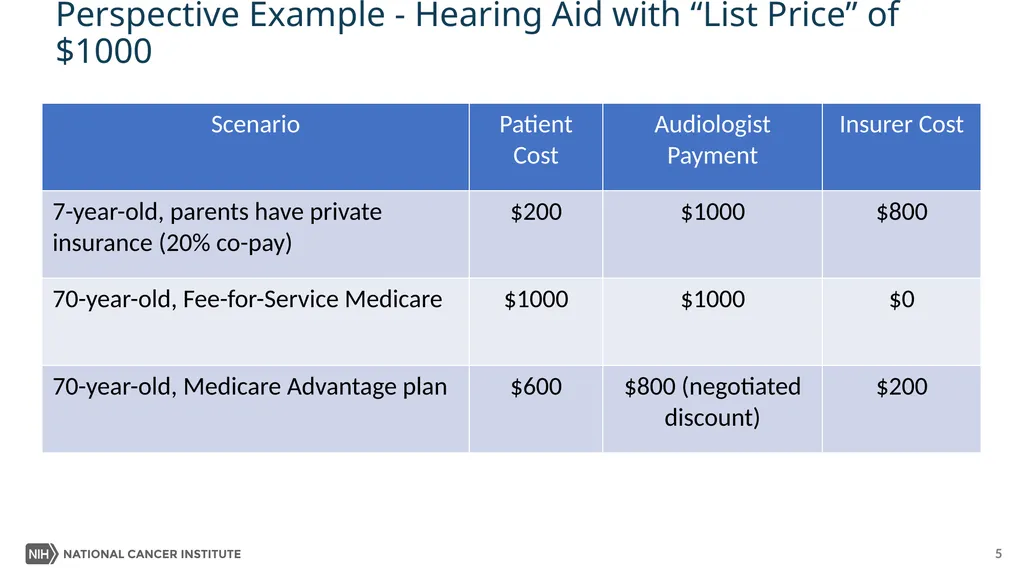
Perspective Example - Hearing Aid with “List Price” of $1000<br>
06
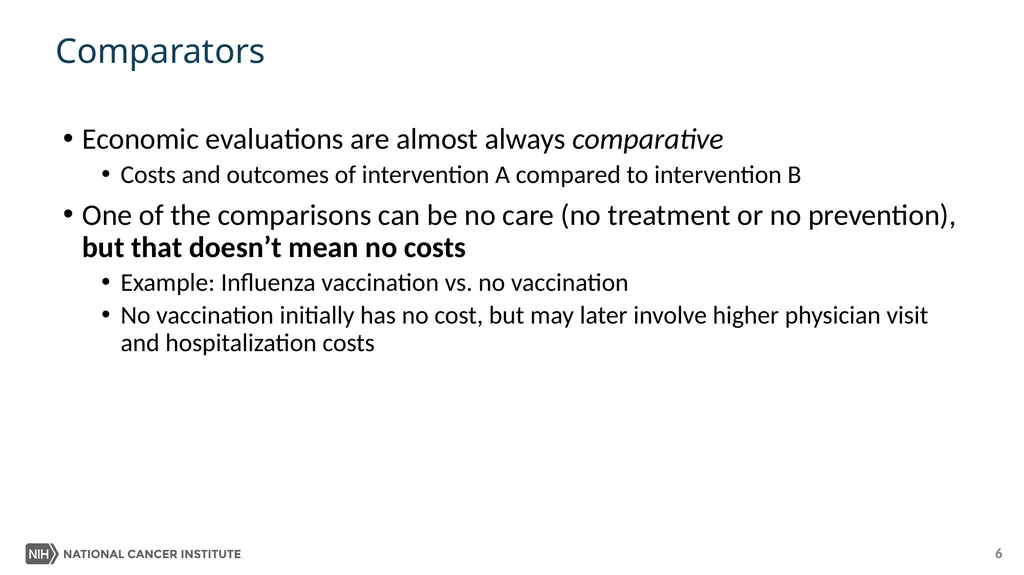
Comparators Economic evaluations are almost always comparative
Costs and outcomes of intervention A compared to intervention B
One of the comparisons can be no care (no treatment or no prevention), but that doesn’t mean no costs
Example: Influenza vaccination vs. no vaccination
No vaccination initially has no cost, but may later involve higher physician visit and hospitalization costs<br>
Costs and outcomes of intervention A compared to intervention B
One of the comparisons can be no care (no treatment or no prevention), but that doesn’t mean no costs
Example: Influenza vaccination vs. no vaccination
No vaccination initially has no cost, but may later involve higher physician visit and hospitalization costs<br>
07
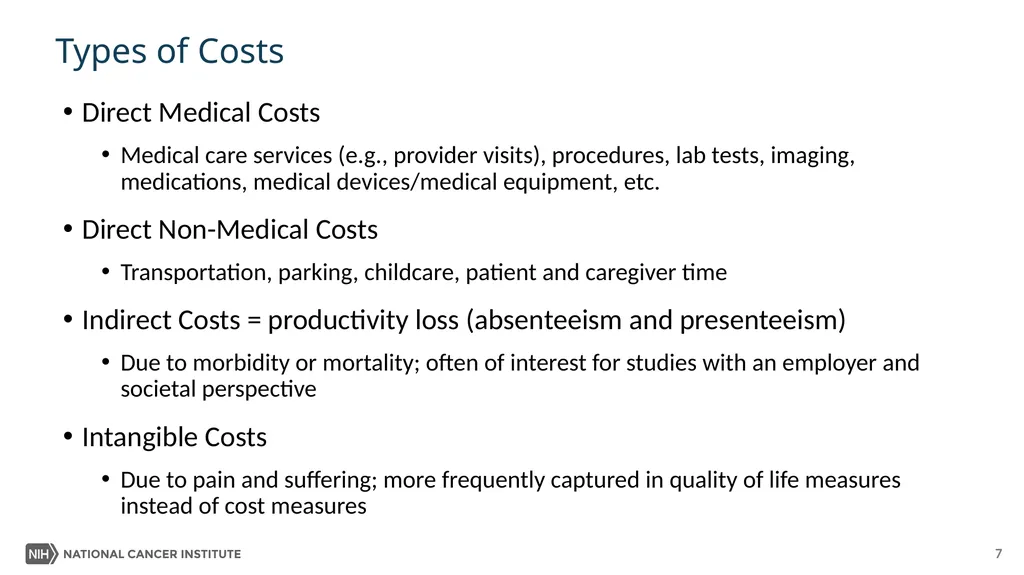
Types of Costs Direct Medical Costs
Medical care services (e.g., provider visits), procedures, lab tests, imaging, medications, medical devices/medical equipment, etc.
Direct Non-Medical Costs
Transportation, parking, childcare, patient and caregiver time
Indirect Costs = productivity loss (absenteeism and presenteeism)
Due to morbidity or mortality; often of interest for studies with an employer and societal perspective
Intangible Costs
Due to pain and suffering; more frequently captured in quality of life measures instead of cost measures<br>
Medical care services (e.g., provider visits), procedures, lab tests, imaging, medications, medical devices/medical equipment, etc.
Direct Non-Medical Costs
Transportation, parking, childcare, patient and caregiver time
Indirect Costs = productivity loss (absenteeism and presenteeism)
Due to morbidity or mortality; often of interest for studies with an employer and societal perspective
Intangible Costs
Due to pain and suffering; more frequently captured in quality of life measures instead of cost measures<br>
08
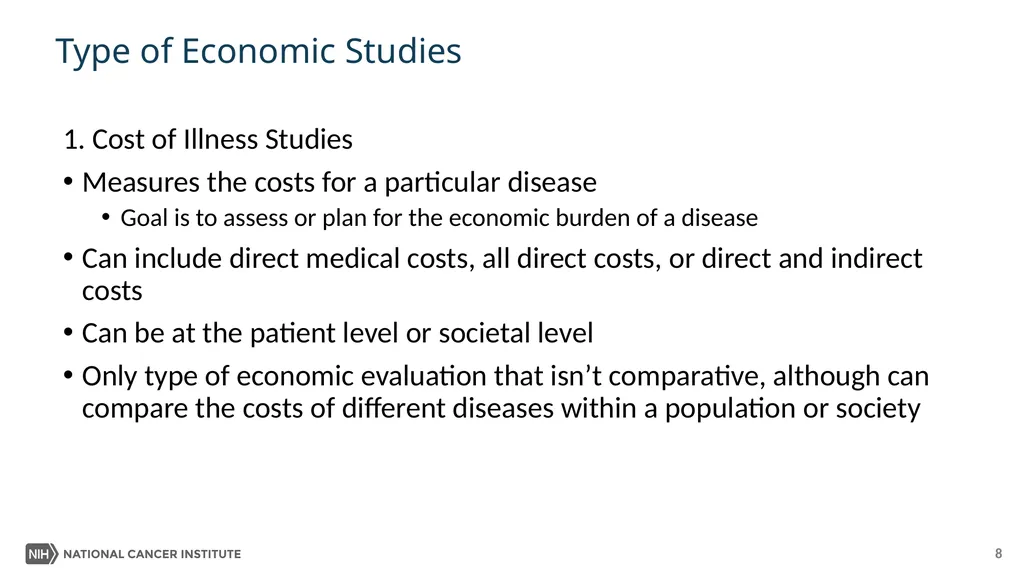
Type of Economic Studies 1. Cost of Illness Studies
Measures the costs for a particular disease
Goal is to assess or plan for the economic burden of a disease
Can include direct medical costs, all direct costs, or direct and indirect costs
Can be at the patient level or societal level
Only type of economic evaluation that isn’t comparative, although can compare the costs of different diseases within a population or society<br>
Measures the costs for a particular disease
Goal is to assess or plan for the economic burden of a disease
Can include direct medical costs, all direct costs, or direct and indirect costs
Can be at the patient level or societal level
Only type of economic evaluation that isn’t comparative, although can compare the costs of different diseases within a population or society<br>
09
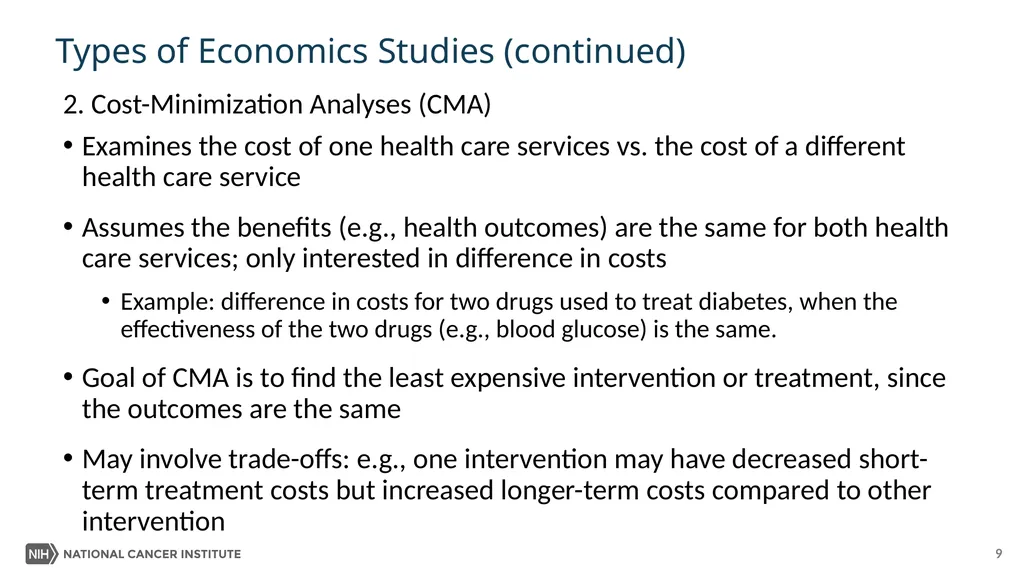
Types of Economics Studies (continued) 2. Cost-Minimization Analyses (CMA)
Examines the cost of one health care services vs. the cost of a different health care service
Assumes the benefits (e.g., health outcomes) are the same for both health care services; only interested in difference in costs
Example: difference in costs for two drugs used to treat diabetes, when the effectiveness of the two drugs (e.g., blood glucose) is the same.
Goal of CMA is to find the least expensive intervention or treatment, since the outcomes are the same
May involve trade-offs: e.g., one intervention may have decreased short-term treatment costs but increased longer-term costs compared to other intervention<br>
Examines the cost of one health care services vs. the cost of a different health care service
Assumes the benefits (e.g., health outcomes) are the same for both health care services; only interested in difference in costs
Example: difference in costs for two drugs used to treat diabetes, when the effectiveness of the two drugs (e.g., blood glucose) is the same.
Goal of CMA is to find the least expensive intervention or treatment, since the outcomes are the same
May involve trade-offs: e.g., one intervention may have decreased short-term treatment costs but increased longer-term costs compared to other intervention<br>
10
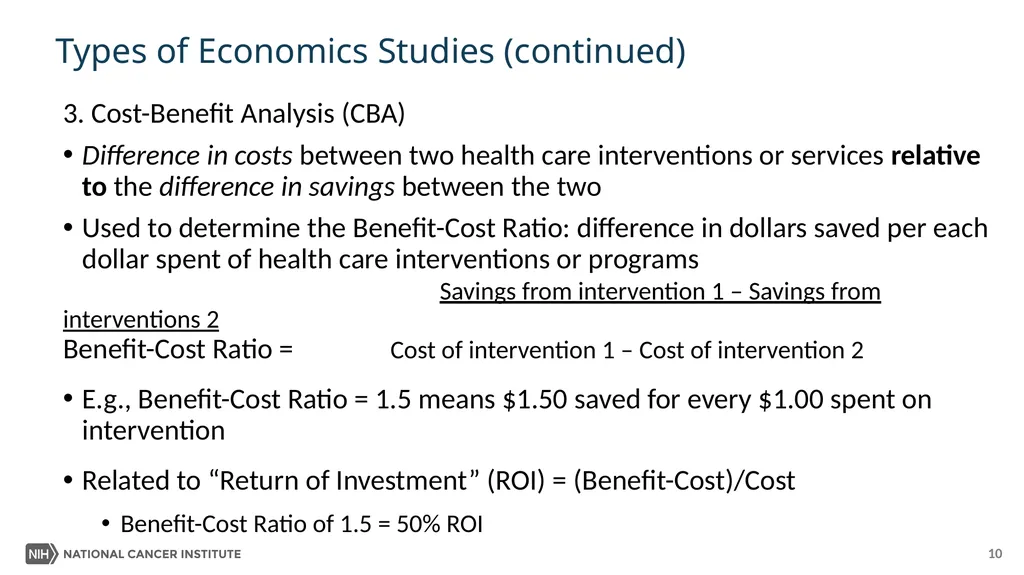
Types of Economics Studies (continued) 3. Cost-Benefit Analysis (CBA)
Difference in costs between two health care interventions or services relative to the difference in savings between the two
Used to determine the Benefit-Cost Ratio: difference in dollars saved per each dollar spent of health care interventions or programs
Savings from intervention 1 – Savings from interventions 2
Benefit-Cost Ratio = Cost of intervention 1 – Cost of intervention 2
E.g., Benefit-Cost Ratio = 1.5 means $1.50 saved for every $1.00 spent on intervention
Related to “Return of Investment” (ROI) = (Benefit-Cost)/Cost
Benefit-Cost Ratio of 1.5 = 50% ROI<br>
Difference in costs between two health care interventions or services relative to the difference in savings between the two
Used to determine the Benefit-Cost Ratio: difference in dollars saved per each dollar spent of health care interventions or programs
Savings from intervention 1 – Savings from interventions 2
Benefit-Cost Ratio = Cost of intervention 1 – Cost of intervention 2
E.g., Benefit-Cost Ratio = 1.5 means $1.50 saved for every $1.00 spent on intervention
Related to “Return of Investment” (ROI) = (Benefit-Cost)/Cost
Benefit-Cost Ratio of 1.5 = 50% ROI<br>
11
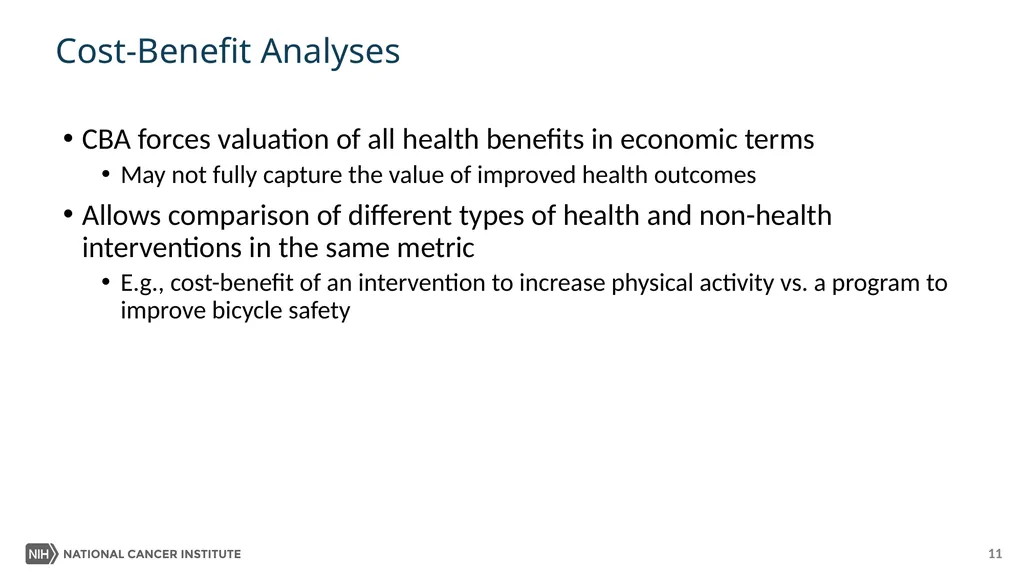
Cost-Benefit Analyses CBA forces valuation of all health benefits in economic terms
May not fully capture the value of improved health outcomes
Allows comparison of different types of health and non-health interventions in the same metric
E.g., cost-benefit of an intervention to increase physical activity vs. a program to improve bicycle safety<br>
May not fully capture the value of improved health outcomes
Allows comparison of different types of health and non-health interventions in the same metric
E.g., cost-benefit of an intervention to increase physical activity vs. a program to improve bicycle safety<br>
12
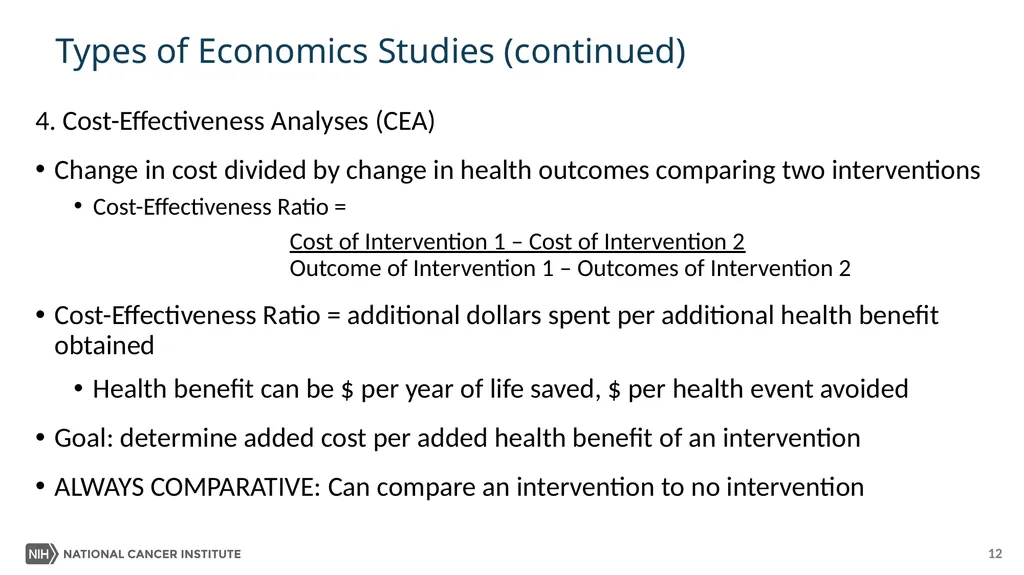
Types of Economics Studies (continued) 4. Cost-Effectiveness Analyses (CEA)
Change in cost divided by change in health outcomes comparing two interventions
Cost-Effectiveness Ratio =
Cost of Intervention 1 – Cost of Intervention 2
Outcome of Intervention 1 – Outcomes of Intervention 2
Cost-Effectiveness Ratio = additional dollars spent per additional health benefit obtained
Health benefit can be $ per year of life saved, $ per health event avoided
Goal: determine added cost per added health benefit of an intervention
ALWAYS COMPARATIVE: Can compare an intervention to no intervention<br>
Change in cost divided by change in health outcomes comparing two interventions
Cost-Effectiveness Ratio =
Cost of Intervention 1 – Cost of Intervention 2
Outcome of Intervention 1 – Outcomes of Intervention 2
Cost-Effectiveness Ratio = additional dollars spent per additional health benefit obtained
Health benefit can be $ per year of life saved, $ per health event avoided
Goal: determine added cost per added health benefit of an intervention
ALWAYS COMPARATIVE: Can compare an intervention to no intervention<br>
13
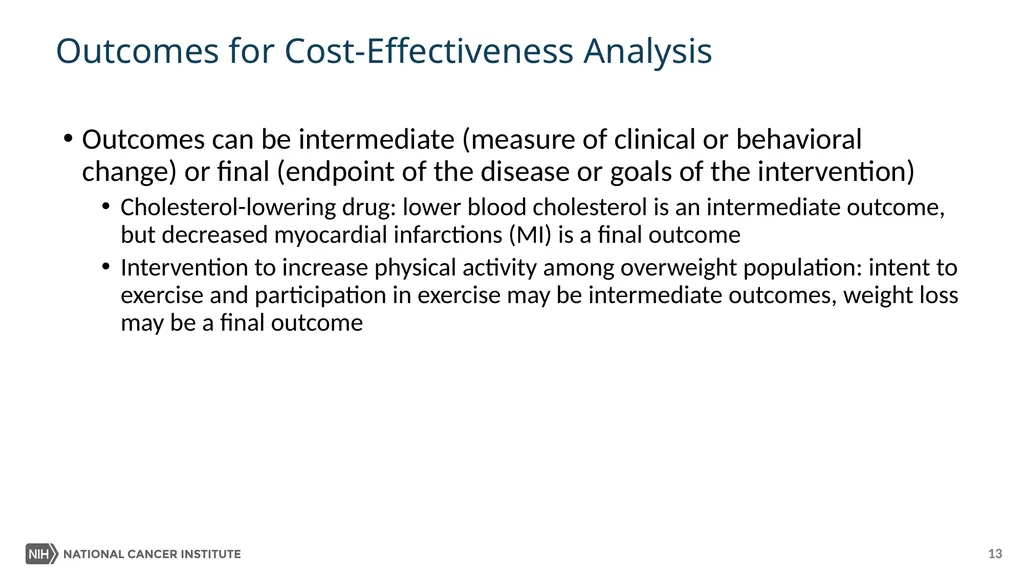
Outcomes for Cost-Effectiveness Analysis Outcomes can be intermediate (measure of clinical or behavioral change) or final (endpoint of the disease or goals of the intervention)
Cholesterol-lowering drug: lower blood cholesterol is an intermediate outcome, but decreased myocardial infarctions (MI) is a final outcome
Intervention to increase physical activity among overweight population: intent to exercise and participation in exercise may be intermediate outcomes, weight loss may be a final outcome<br>
Cholesterol-lowering drug: lower blood cholesterol is an intermediate outcome, but decreased myocardial infarctions (MI) is a final outcome
Intervention to increase physical activity among overweight population: intent to exercise and participation in exercise may be intermediate outcomes, weight loss may be a final outcome<br>
14
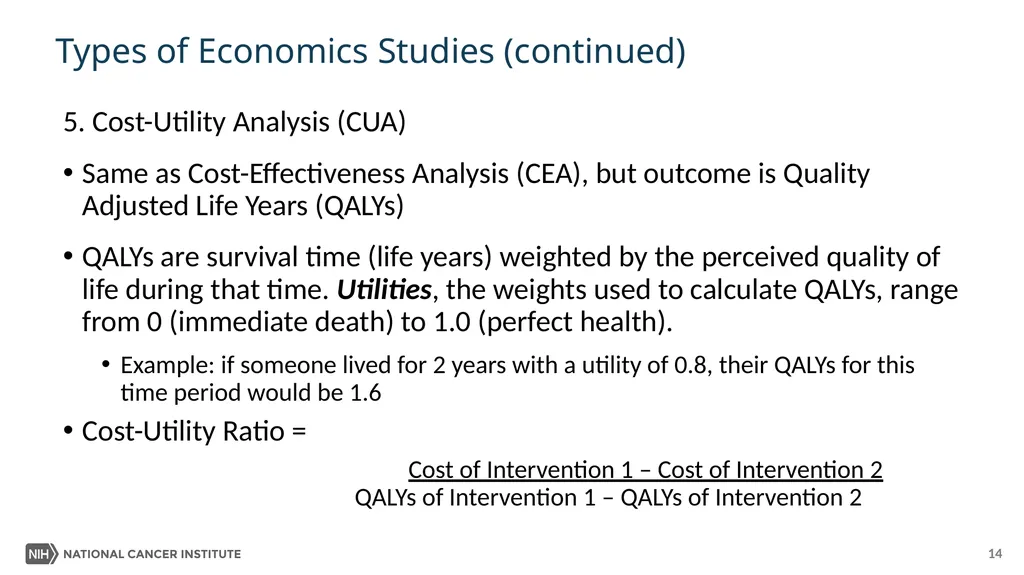
Types of Economics Studies (continued) 5. Cost-Utility Analysis (CUA)
Same as Cost-Effectiveness Analysis (CEA), but outcome is Quality Adjusted Life Years (QALYs)
QALYs are survival time (life years) weighted by the perceived quality of life during that time. Utilities, the weights used to calculate QALYs, range from 0 (immediate death) to 1.0 (perfect health).
Example: if someone lived for 2 years with a utility of 0.8, their QALYs for this time period would be 1.6
Cost-Utility Ratio =
Cost of Intervention 1 – Cost of Intervention 2
QALYs of Intervention 1 – QALYs of Intervention 2<br>
Same as Cost-Effectiveness Analysis (CEA), but outcome is Quality Adjusted Life Years (QALYs)
QALYs are survival time (life years) weighted by the perceived quality of life during that time. Utilities, the weights used to calculate QALYs, range from 0 (immediate death) to 1.0 (perfect health).
Example: if someone lived for 2 years with a utility of 0.8, their QALYs for this time period would be 1.6
Cost-Utility Ratio =
Cost of Intervention 1 – Cost of Intervention 2
QALYs of Intervention 1 – QALYs of Intervention 2<br>
15
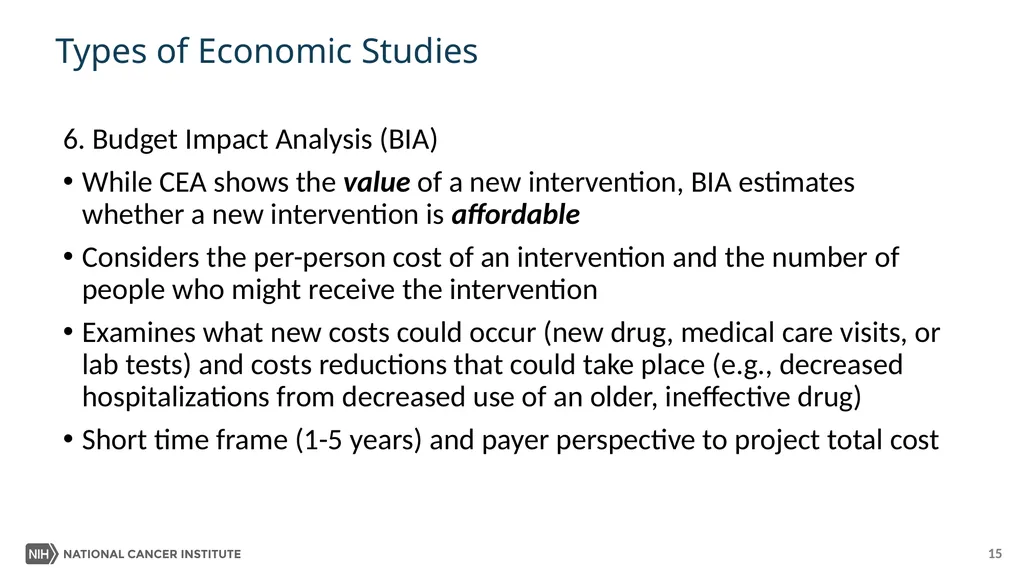
Types of Economic Studies 6. Budget Impact Analysis (BIA)
While CEA shows the value of a new intervention, BIA estimates whether a new intervention is affordable
Considers the per-person cost of an intervention and the number of people who might receive the intervention
Examines what new costs could occur (new drug, medical care visits, or lab tests) and costs reductions that could take place (e.g., decreased hospitalizations from decreased use of an older, ineffective drug)
Short time frame (1-5 years) and payer perspective to project total cost<br>
While CEA shows the value of a new intervention, BIA estimates whether a new intervention is affordable
Considers the per-person cost of an intervention and the number of people who might receive the intervention
Examines what new costs could occur (new drug, medical care visits, or lab tests) and costs reductions that could take place (e.g., decreased hospitalizations from decreased use of an older, ineffective drug)
Short time frame (1-5 years) and payer perspective to project total cost<br>
16
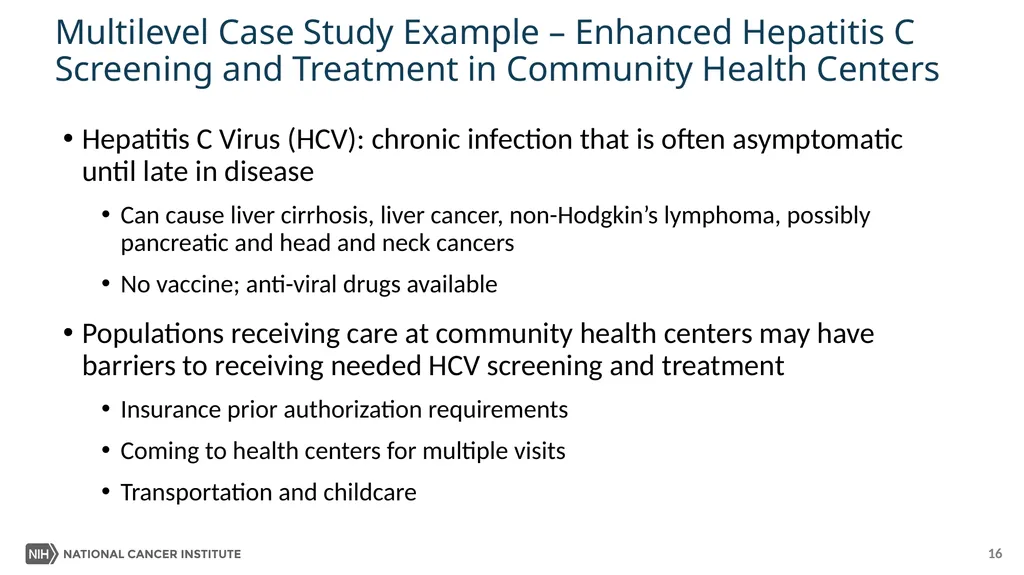
Multilevel Case Study Example – Enhanced Hepatitis C Screening and Treatment in Community Health Centers Hepatitis C Virus (HCV): chronic infection that is often asymptomatic until late in disease
Can cause liver cirrhosis, liver cancer, non-Hodgkin’s lymphoma, possibly pancreatic and head and neck cancers
No vaccine; anti-viral drugs available
Populations receiving care at community health centers may have barriers to receiving needed HCV screening and treatment
Insurance prior authorization requirements
Coming to health centers for multiple visits
Transportation and childcare<br>
Can cause liver cirrhosis, liver cancer, non-Hodgkin’s lymphoma, possibly pancreatic and head and neck cancers
No vaccine; anti-viral drugs available
Populations receiving care at community health centers may have barriers to receiving needed HCV screening and treatment
Insurance prior authorization requirements
Coming to health centers for multiple visits
Transportation and childcare<br>
17
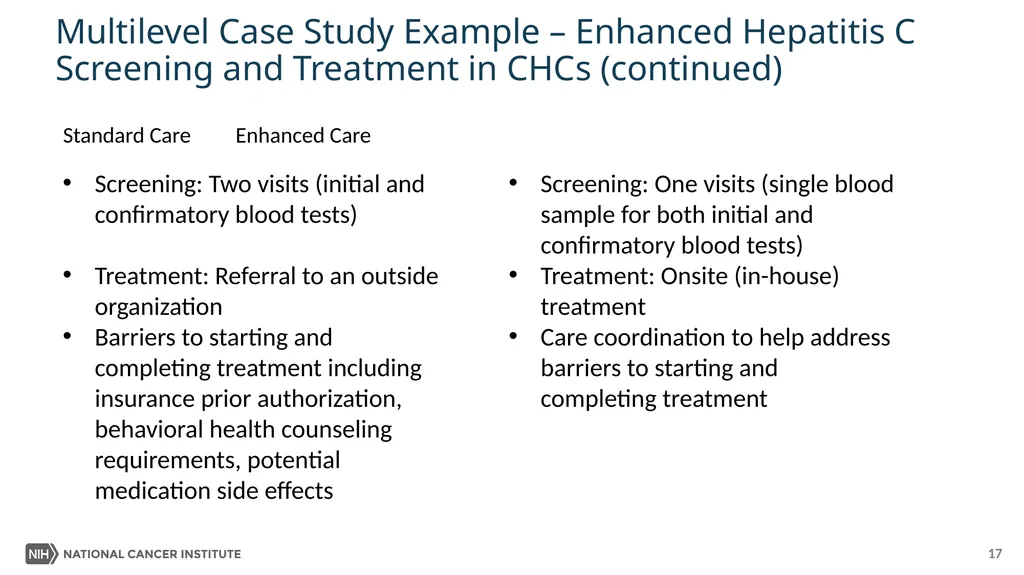
Multilevel Case Study Example – Enhanced Hepatitis C Screening and Treatment in CHCs (continued) Standard Care Enhanced Care Screening: Two visits (initial and confirmatory blood tests)
Treatment: Referral to an outside organization
Barriers to starting and completing treatment including insurance prior authorization, behavioral health counseling requirements, potential medication side effects Screening: One visits (single blood sample for both initial and confirmatory blood tests)
Treatment: Onsite (in-house) treatment
Care coordination to help address barriers to starting and completing treatment<br>
Treatment: Referral to an outside organization
Barriers to starting and completing treatment including insurance prior authorization, behavioral health counseling requirements, potential medication side effects Screening: One visits (single blood sample for both initial and confirmatory blood tests)
Treatment: Onsite (in-house) treatment
Care coordination to help address barriers to starting and completing treatment<br>
18
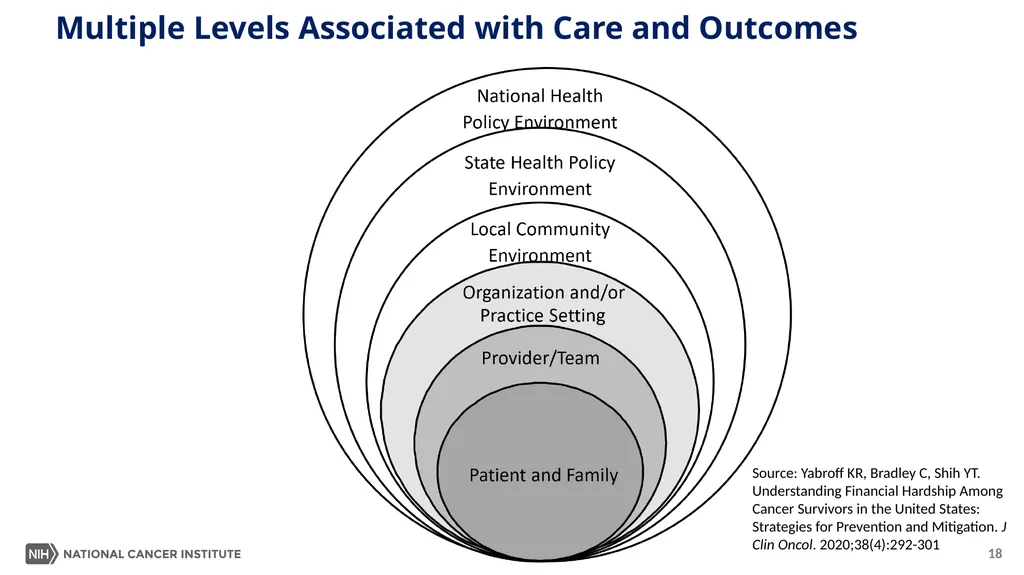
Multiple Levels Associated with Care and Outcomes Source: Yabroff KR, Bradley C, Shih YT. Understanding Financial Hardship Among Cancer Survivors in the United States:
Strategies for Prevention and Mitigation. J Clin Oncol. 2020;38(4):292-301<br>
Strategies for Prevention and Mitigation. J Clin Oncol. 2020;38(4):292-301<br>
19
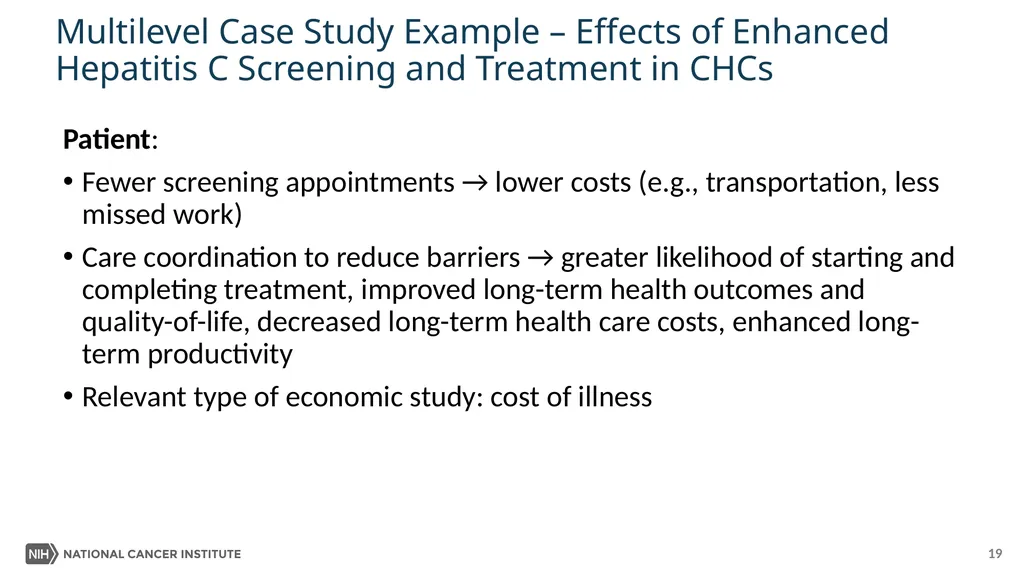
Multilevel Case Study Example – Effects of Enhanced Hepatitis C Screening and Treatment in CHCs Patient:
Fewer screening appointments → lower costs (e.g., transportation, less missed work)
Care coordination to reduce barriers → greater likelihood of starting and completing treatment, improved long-term health outcomes and quality-of-life, decreased long-term health care costs, enhanced long-term productivity
Relevant type of economic study: cost of illness<br>
Fewer screening appointments → lower costs (e.g., transportation, less missed work)
Care coordination to reduce barriers → greater likelihood of starting and completing treatment, improved long-term health outcomes and quality-of-life, decreased long-term health care costs, enhanced long-term productivity
Relevant type of economic study: cost of illness<br>
20
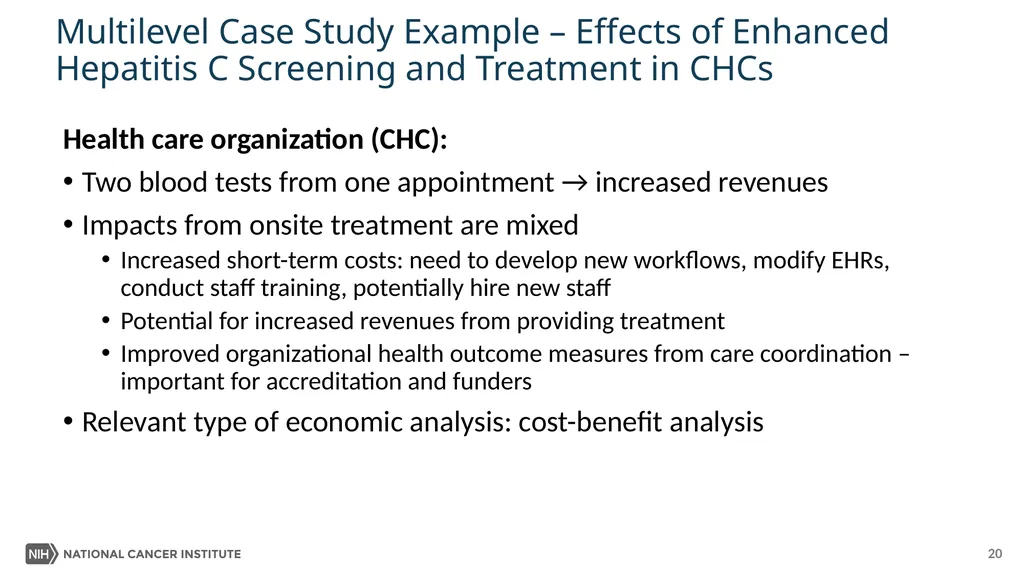
Multilevel Case Study Example – Effects of Enhanced Hepatitis C Screening and Treatment in CHCs Health care organization (CHC):
Two blood tests from one appointment → increased revenues
Impacts from onsite treatment are mixed
Increased short-term costs: need to develop new workflows, modify EHRs, conduct staff training, potentially hire new staff
Potential for increased revenues from providing treatment
Improved organizational health outcome measures from care coordination – important for accreditation and funders
Relevant type of economic analysis: cost-benefit analysis<br>
Two blood tests from one appointment → increased revenues
Impacts from onsite treatment are mixed
Increased short-term costs: need to develop new workflows, modify EHRs, conduct staff training, potentially hire new staff
Potential for increased revenues from providing treatment
Improved organizational health outcome measures from care coordination – important for accreditation and funders
Relevant type of economic analysis: cost-benefit analysis<br>
21
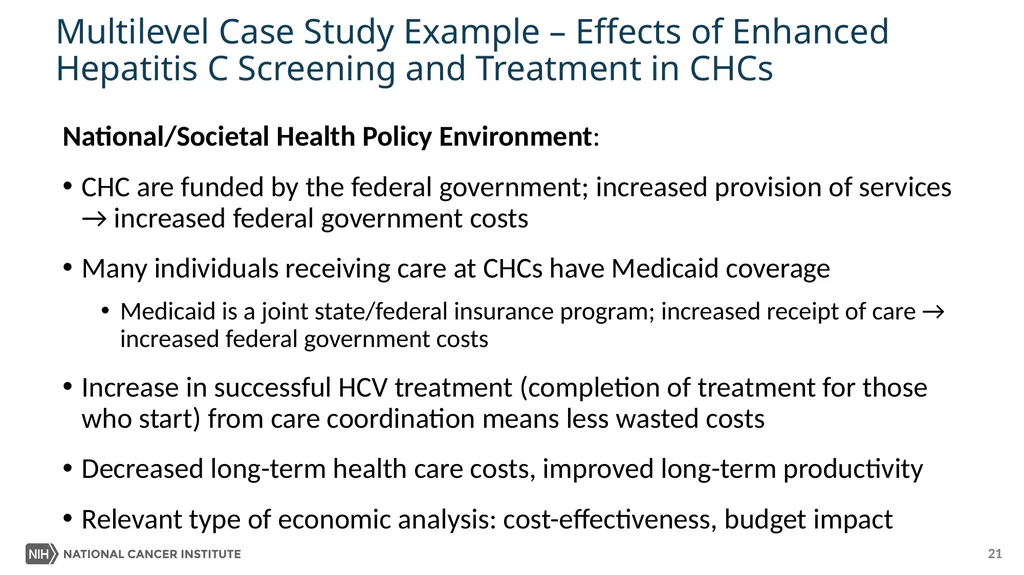
Multilevel Case Study Example – Effects of Enhanced Hepatitis C Screening and Treatment in CHCs National/Societal Health Policy Environment:
CHC are funded by the federal government; increased provision of services → increased federal government costs
Many individuals receiving care at CHCs have Medicaid coverage
Medicaid is a joint state/federal insurance program; increased receipt of care → increased federal government costs
Increase in successful HCV treatment (completion of treatment for those who start) from care coordination means less wasted costs
Decreased long-term health care costs, improved long-term productivity
Relevant type of economic analysis: cost-effectiveness, budget impact<br>
CHC are funded by the federal government; increased provision of services → increased federal government costs
Many individuals receiving care at CHCs have Medicaid coverage
Medicaid is a joint state/federal insurance program; increased receipt of care → increased federal government costs
Increase in successful HCV treatment (completion of treatment for those who start) from care coordination means less wasted costs
Decreased long-term health care costs, improved long-term productivity
Relevant type of economic analysis: cost-effectiveness, budget impact<br>
22
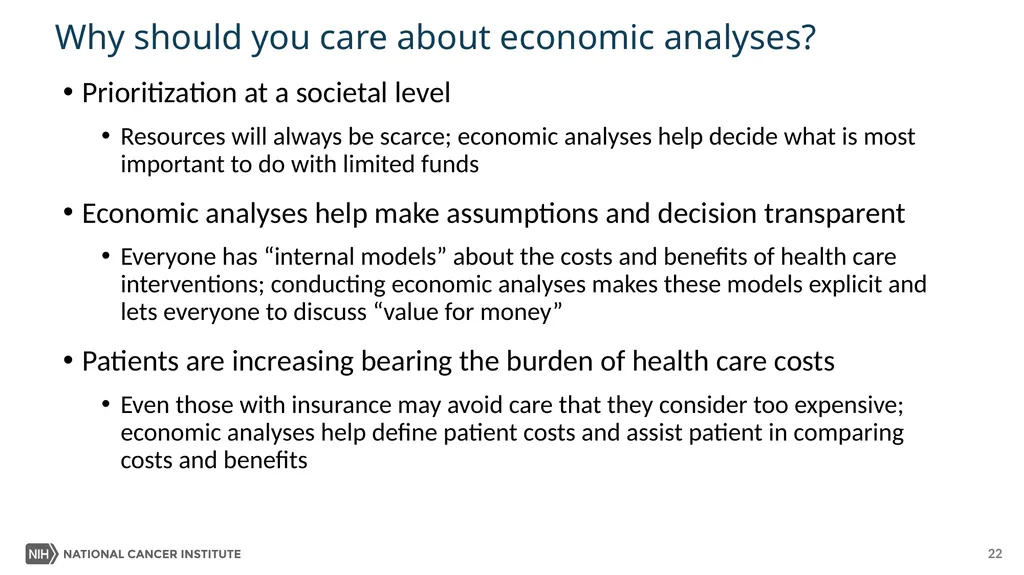
Why should you care about economic analyses? Prioritization at a societal level
Resources will always be scarce; economic analyses help decide what is most important to do with limited funds
Economic analyses help make assumptions and decision transparent
Everyone has “internal models” about the costs and benefits of health care interventions; conducting economic analyses makes these models explicit and lets everyone to discuss “value for money”
Patients are increasing bearing the burden of health care costs
Even those with insurance may avoid care that they consider too expensive; economic analyses help define patient costs and assist patient in comparing costs and benefits<br>
Resources will always be scarce; economic analyses help decide what is most important to do with limited funds
Economic analyses help make assumptions and decision transparent
Everyone has “internal models” about the costs and benefits of health care interventions; conducting economic analyses makes these models explicit and lets everyone to discuss “value for money”
Patients are increasing bearing the burden of health care costs
Even those with insurance may avoid care that they consider too expensive; economic analyses help define patient costs and assist patient in comparing costs and benefits<br>
23
Questions?
Thank you very much.
michael.halpern@nih.gov
@DrMichaelHSR<br>
24
Sustainability and Spread of MLIs Wynne E. Norton, Ph.D.
National Cancer Institute<br>
25
Sustainability and Spread of MLIs
Multilevel Intervention Training Institute (MLTI) Wynne E. Norton, PhD
National Cancer Institute<br>
National Cancer Institute<br>
26
Disclosures I have no financial relationships to disclose.
Opinions are mine and are not official positions of the National Cancer Institute, National Institutes of Health, or the U.S. federal government.<br>
Opinions are mine and are not official positions of the National Cancer Institute, National Institutes of Health, or the U.S. federal government.<br>
27
Sustainability & Scale-up: Readings, Project Planning Readings:
Shelton, Cooper, & Stirman. (2018). The sustainability of evidence-based interventions and practices in public health and health care. Annual Review of Public Health, 39:55-76.
Greenhalgh & Papoutsi. (2019). Spreading and scaling up innovation and improvement. BMJ, 365: I2068. https://www.bmj.com/content/365/bmj.l2068.
Project Planning:
F2. Sustainability and sustainment analysis
F3. Analysis of scale-up/spread potential<br>
Shelton, Cooper, & Stirman. (2018). The sustainability of evidence-based interventions and practices in public health and health care. Annual Review of Public Health, 39:55-76.
Greenhalgh & Papoutsi. (2019). Spreading and scaling up innovation and improvement. BMJ, 365: I2068. https://www.bmj.com/content/365/bmj.l2068.
Project Planning:
F2. Sustainability and sustainment analysis
F3. Analysis of scale-up/spread potential<br>
28
Sustainability What is sustainability? How it is defined and operationalized?
What frameworks and tools are available to plan for and understand sustainability?
What are some areas for future research on sustainability?<br>
What frameworks and tools are available to plan for and understand sustainability?
What are some areas for future research on sustainability?<br>
29
Sustainability Continued benefits after funding or support have been withdrawn, continuation or program elements, and continued capacity
Continued use of program components and activities for the continued achievement of desirable program and population outcomes.
Routinization, institutionalization, durability
Time frame: Approx. 6 months-6 years
Scheirer & Dearing, 2011; Shediac-Rizkallah & Bone, 1998; Stirman et al., 2012<br>
Continued use of program components and activities for the continued achievement of desirable program and population outcomes.
Routinization, institutionalization, durability
Time frame: Approx. 6 months-6 years
Scheirer & Dearing, 2011; Shediac-Rizkallah & Bone, 1998; Stirman et al., 2012<br>
30
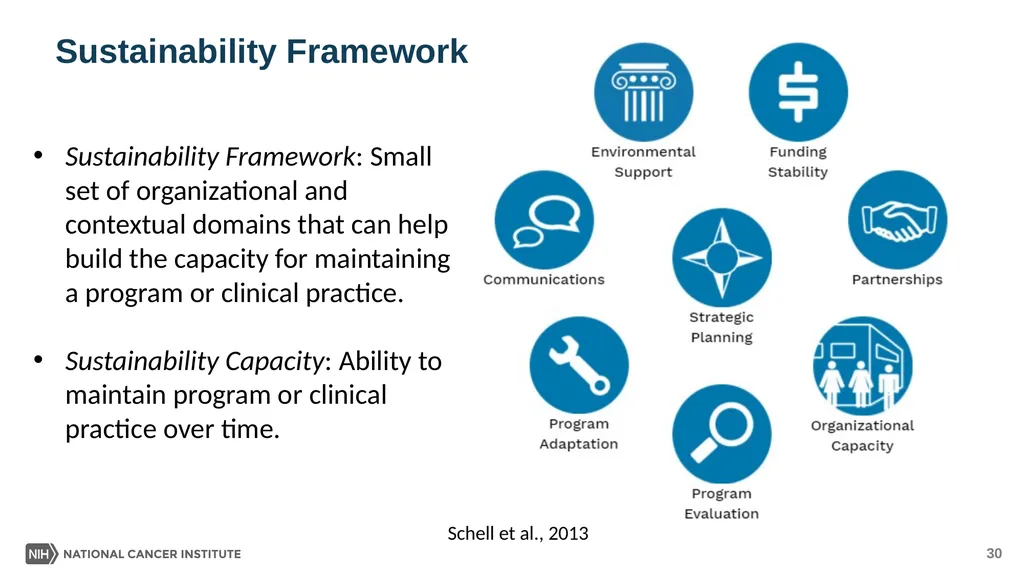
Sustainability Framework Schell et al., 2013 Sustainability Framework: Small set of organizational and contextual domains that can help build the capacity for maintaining a program or clinical practice.
Sustainability Capacity: Ability to maintain program or clinical practice over time.<br>
Sustainability Capacity: Ability to maintain program or clinical practice over time.<br>
31
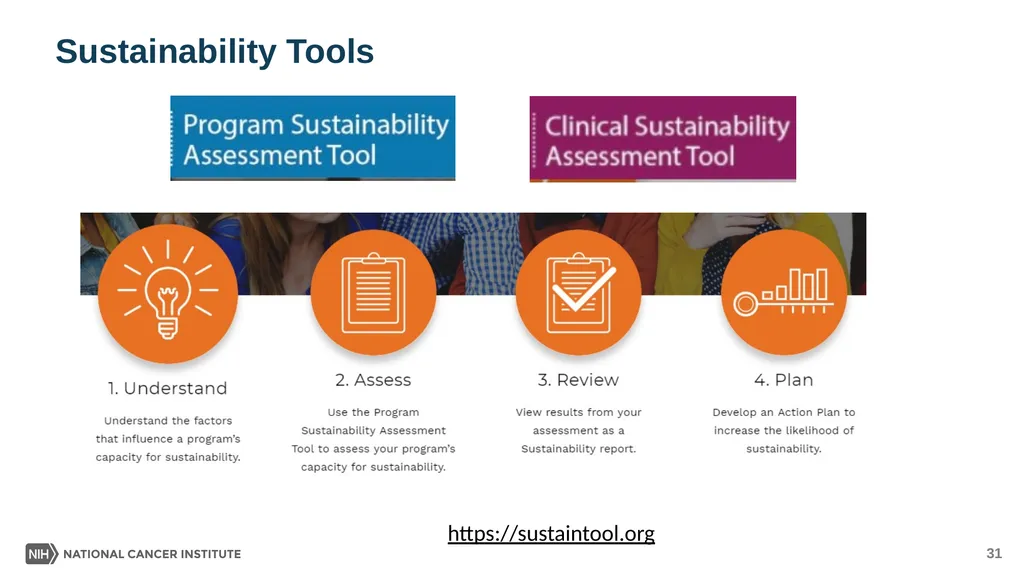
Sustainability Tools https://sustaintool.org<br>
32
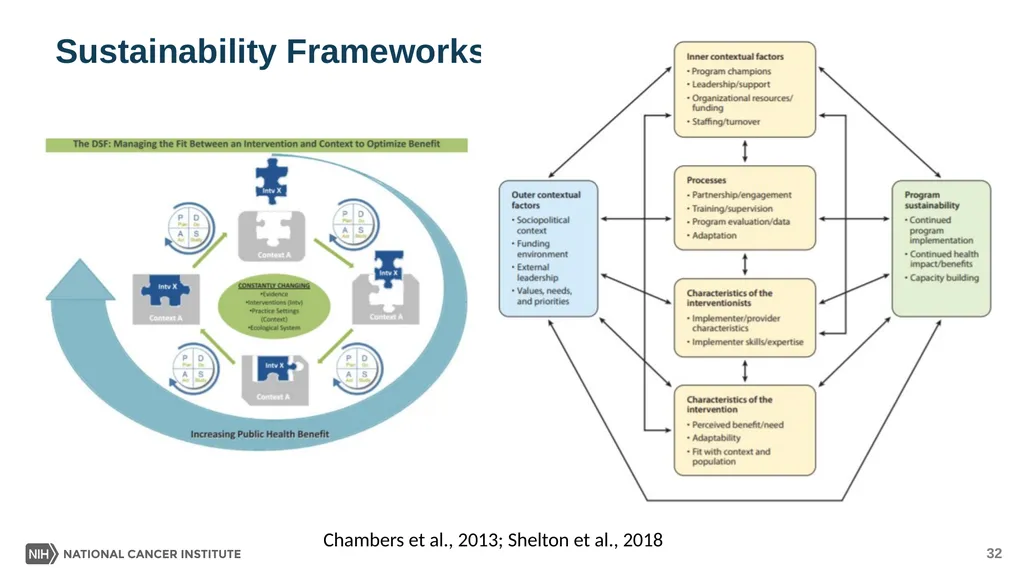
Sustainability Frameworks Chambers et al., 2013; Shelton et al., 2018<br>
33
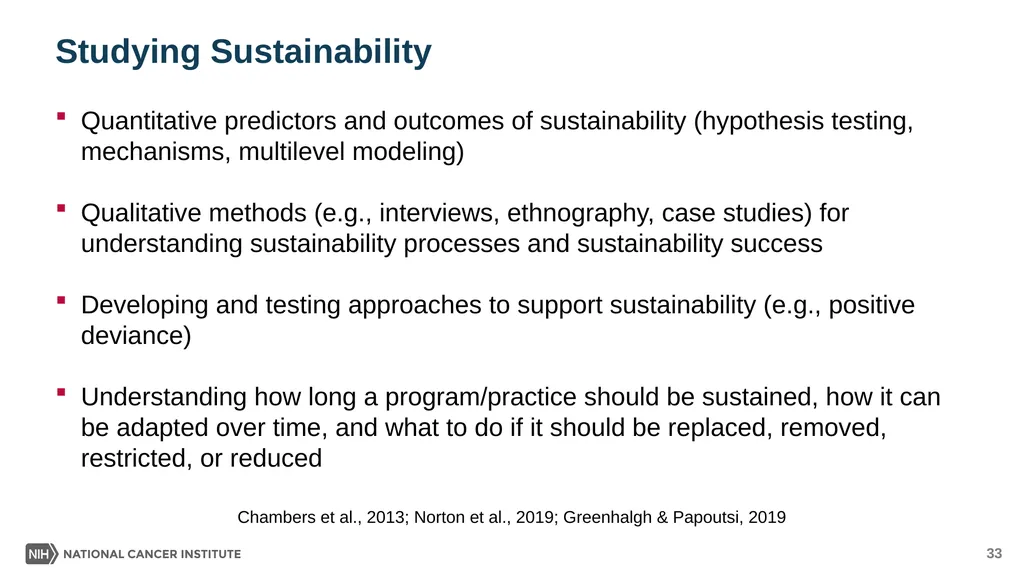
Studying Sustainability Quantitative predictors and outcomes of sustainability (hypothesis testing, mechanisms, multilevel modeling)
Qualitative methods (e.g., interviews, ethnography, case studies) for understanding sustainability processes and sustainability success
Developing and testing approaches to support sustainability (e.g., positive deviance)
Understanding how long a program/practice should be sustained, how it can be adapted over time, and what to do if it should be replaced, removed, restricted, or reduced
Chambers et al., 2013; Norton et al., 2019; Greenhalgh & Papoutsi, 2019<br>
Qualitative methods (e.g., interviews, ethnography, case studies) for understanding sustainability processes and sustainability success
Developing and testing approaches to support sustainability (e.g., positive deviance)
Understanding how long a program/practice should be sustained, how it can be adapted over time, and what to do if it should be replaced, removed, restricted, or reduced
Chambers et al., 2013; Norton et al., 2019; Greenhalgh & Papoutsi, 2019<br>
34
Scale-Up How is scale-up defined and operationalized? How many sites or how broad of an area constitutes scale-up?
What are some factors affecting scale-up?
What are some examples of scale-up studies?
What additional research is needed on scale-up?<br>
What are some factors affecting scale-up?
What are some examples of scale-up studies?
What additional research is needed on scale-up?<br>
35
Scale-Up Deliberate efforts to increase the impact of health service innovations successfully tested in pilot or experimental projects to benefit more people and to foster policy and program development on a lasting basis (Simmons et al., 2007).
Variations in definition and operationalizations:
Scale-up to dozens, hundreds, or even thousands of organizations (e.g., clinics, hospitals)
Scale-up to larger geographic region (e.g., state, national, or international)<br>
Variations in definition and operationalizations:
Scale-up to dozens, hundreds, or even thousands of organizations (e.g., clinics, hospitals)
Scale-up to larger geographic region (e.g., state, national, or international)<br>
36
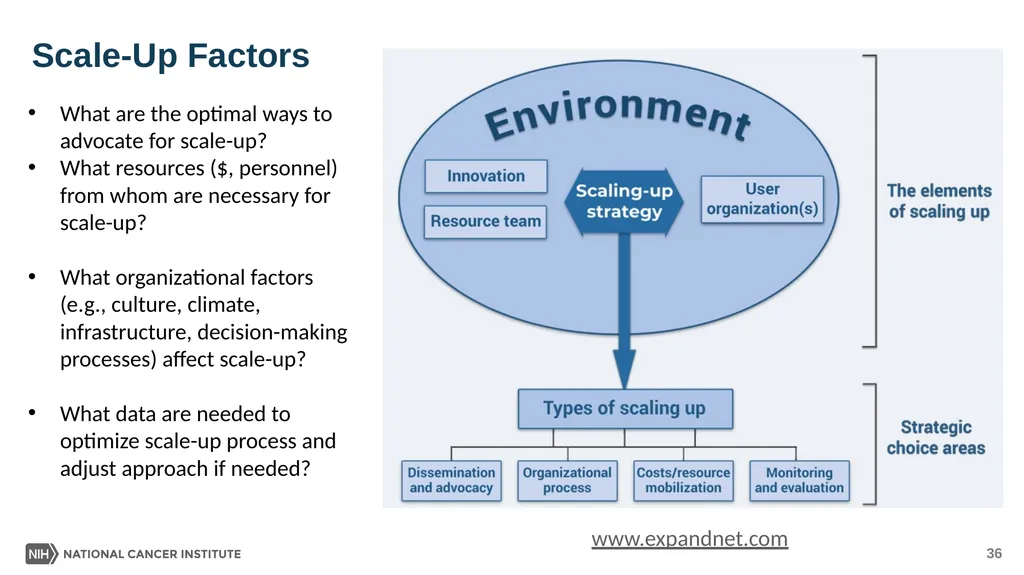
Scale-Up Factors www.expandnet.com What are the optimal ways to advocate for scale-up?
What resources ($, personnel) from whom are necessary for scale-up?
What organizational factors (e.g., culture, climate, infrastructure, decision-making processes) affect scale-up?
What data are needed to optimize scale-up process and adjust approach if needed?<br>
What resources ($, personnel) from whom are necessary for scale-up?
What organizational factors (e.g., culture, climate, infrastructure, decision-making processes) affect scale-up?
What data are needed to optimize scale-up process and adjust approach if needed?<br>
37
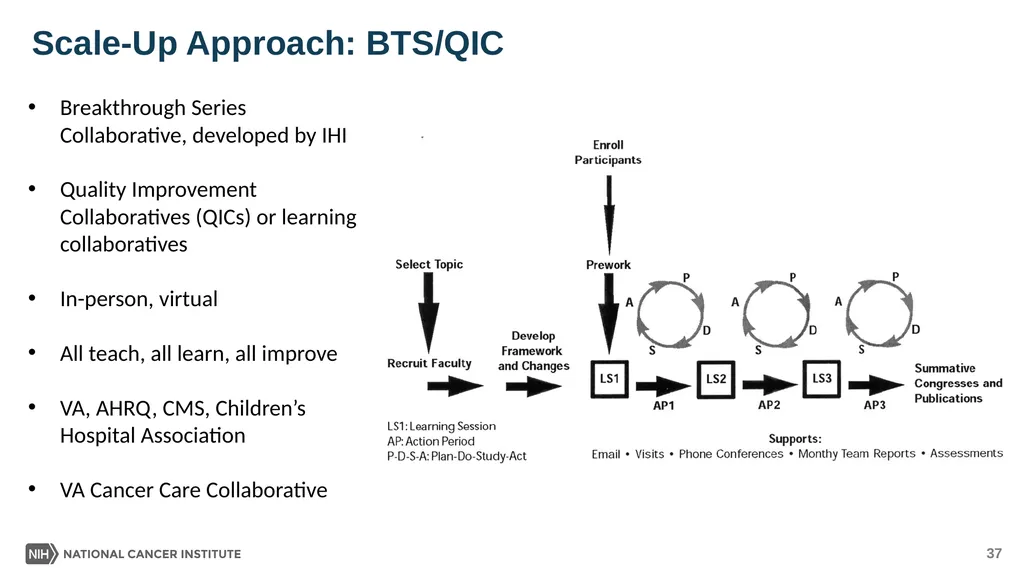
Scale-Up Approach: BTS/QIC Breakthrough Series Collaborative, developed by IHI
Quality Improvement Collaboratives (QICs) or learning collaboratives
In-person, virtual
All teach, all learn, all improve
VA, AHRQ, CMS, Children’s Hospital Association
VA Cancer Care Collaborative<br>
Quality Improvement Collaboratives (QICs) or learning collaboratives
In-person, virtual
All teach, all learn, all improve
VA, AHRQ, CMS, Children’s Hospital Association
VA Cancer Care Collaborative<br>
38
Scale-Up Studies IHI’s 100,000 Lives Campaign
National initiative with goal of saving 100,000 lives of patients in hospitals
Support hospitals in implementing 6 interventions: medication reconciliation, acute MI, rapid response teams, prevent central line infections, surgical site infections, and ventilator-associated pneumonia
Saved 122,300 lives across more than 3,000 participating hospitals
Door-to-Balloon Alliance
Increase likelihood of patients receiving PCI for STEMI
Over 900 participating hospitals<br>
National initiative with goal of saving 100,000 lives of patients in hospitals
Support hospitals in implementing 6 interventions: medication reconciliation, acute MI, rapid response teams, prevent central line infections, surgical site infections, and ventilator-associated pneumonia
Saved 122,300 lives across more than 3,000 participating hospitals
Door-to-Balloon Alliance
Increase likelihood of patients receiving PCI for STEMI
Over 900 participating hospitals<br>
39
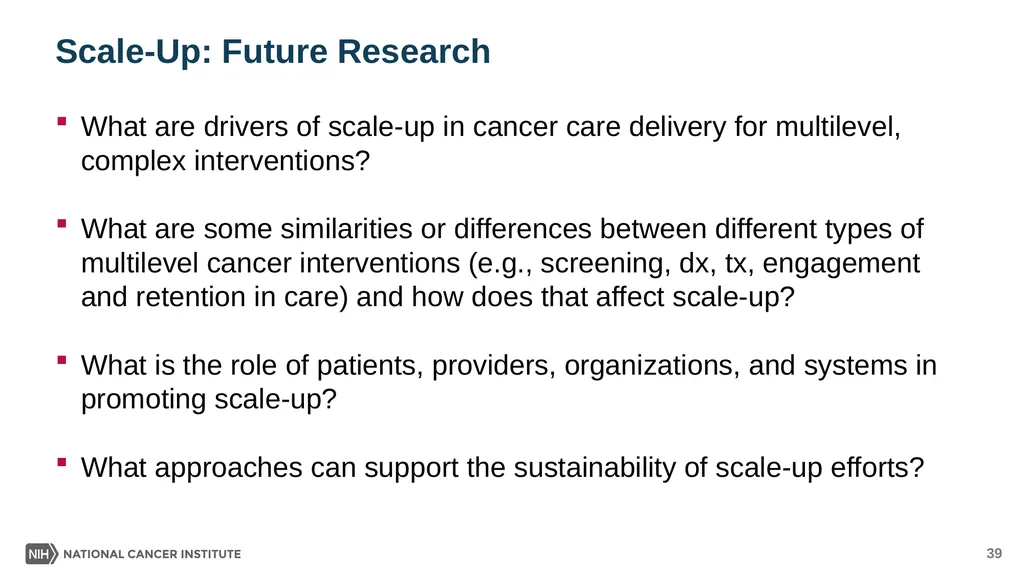
Scale-Up: Future Research What are drivers of scale-up in cancer care delivery for multilevel, complex interventions?
What are some similarities or differences between different types of multilevel cancer interventions (e.g., screening, dx, tx, engagement and retention in care) and how does that affect scale-up?
What is the role of patients, providers, organizations, and systems in promoting scale-up?
What approaches can support the sustainability of scale-up efforts?<br>
What are some similarities or differences between different types of multilevel cancer interventions (e.g., screening, dx, tx, engagement and retention in care) and how does that affect scale-up?
What is the role of patients, providers, organizations, and systems in promoting scale-up?
What approaches can support the sustainability of scale-up efforts?<br>
40
Multilevel Intervention Training Institute
Module 20<br>