
Name -Dr Meeran Rani Department -Physics


Description: Name -Dr Meeran Rani Department -Physics Designation -Associate Professor Academic Qualification -M.Sc Physics M.Phil PhD Research Topic- Study of low cost high performance permanent magnetic material by Gamma Ray resonance Florescence
Related Topics
Download Presentation
"Name -Dr Meeran Rani Department -Physics" is the property of its rightful owner. Permission is granted to download and print the materials on this website for personal, non-commercial use only, and to display it on your personal computer provided you do not modify the materials and that you retain all copyright notices contained in the materials. By downloading content from our website, you accept the terms of this agreement.
Presentation Transcript
slide1. Name -Dr Meeran Rani
Department -Physics
Designation -Associate Professor
Academic Qualification -M.Sc Physics M.Phil PhD
Research Topic- Study of low cost high performance permanent magnetic material by Gamma Ray resonance Florescence Technique
No. Of Research Publication- 7
Other activities – Convener Admission Committee B.Sc 1,Convener of Red Cross Committee ,Convener of Swachh Bharat Abhiyan Committee ,
In charge UGC Network Resource Centre Govt. College Ropar, Member of Research Committee of College and Member of Science Society Personal Profile<br>
slide2. Magnetism History of Magnetism
Magnetic Field (Definition, Lorentz Force equation and Special cases of the equation)
Biot Savart’s Law
Ampere’s Law Index<br>
slide3. History of Magnetism Magnetic phenomena were first observed at least 2500 years ago in fragments of magnetized iron ore found near ancient city of Magnesia, now in Turkey.
These fragments were examples of what are now called permanent magnets.
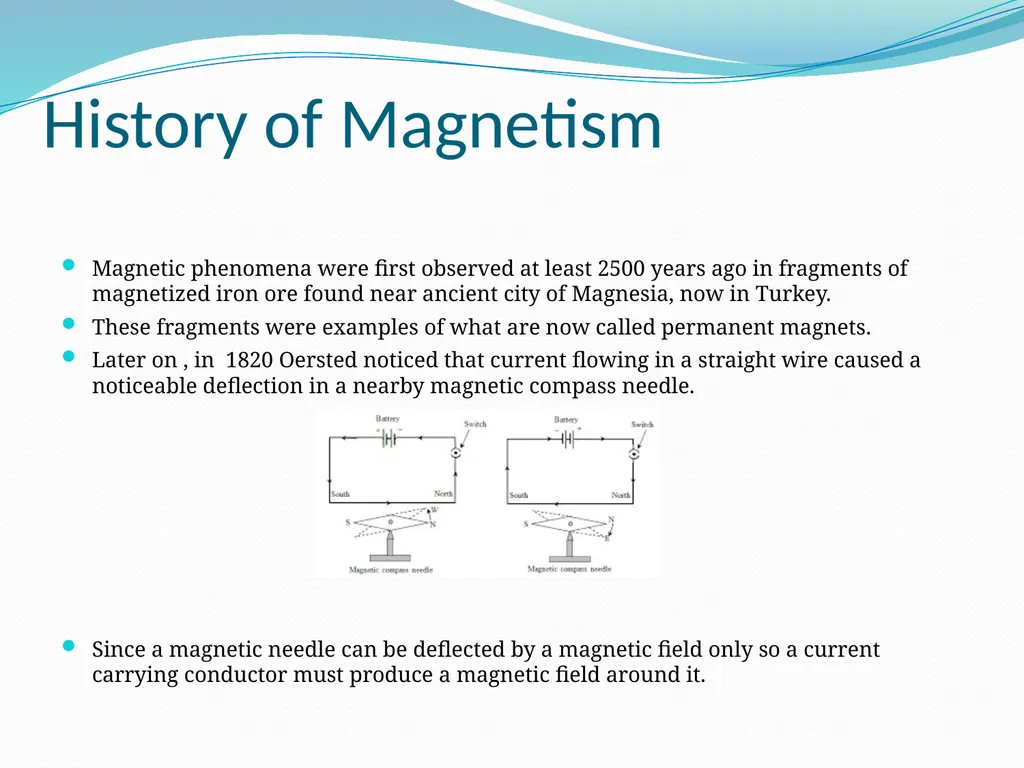
Later on , in 1820 Oersted noticed that current flowing in a straight wire caused a noticeable deflection in a nearby magnetic compass needle.
Since a magnetic needle can be deflected by a magnetic field only so a current carrying conductor must produce a magnetic field around it.<br>
slide4. Magnetic Field Like electric field magnetic field is the space around a magnet or a conductor carrying current within which it’s magnetic influence can be detected.
Cause of magnetic field : It is due to the motion of the electrons which constitute current in the conductor. In other words moving charge is the cause of magnetic field .
Behavior of certain materials as permanent magnets is due to microscopic atomic current in these materials.<br>
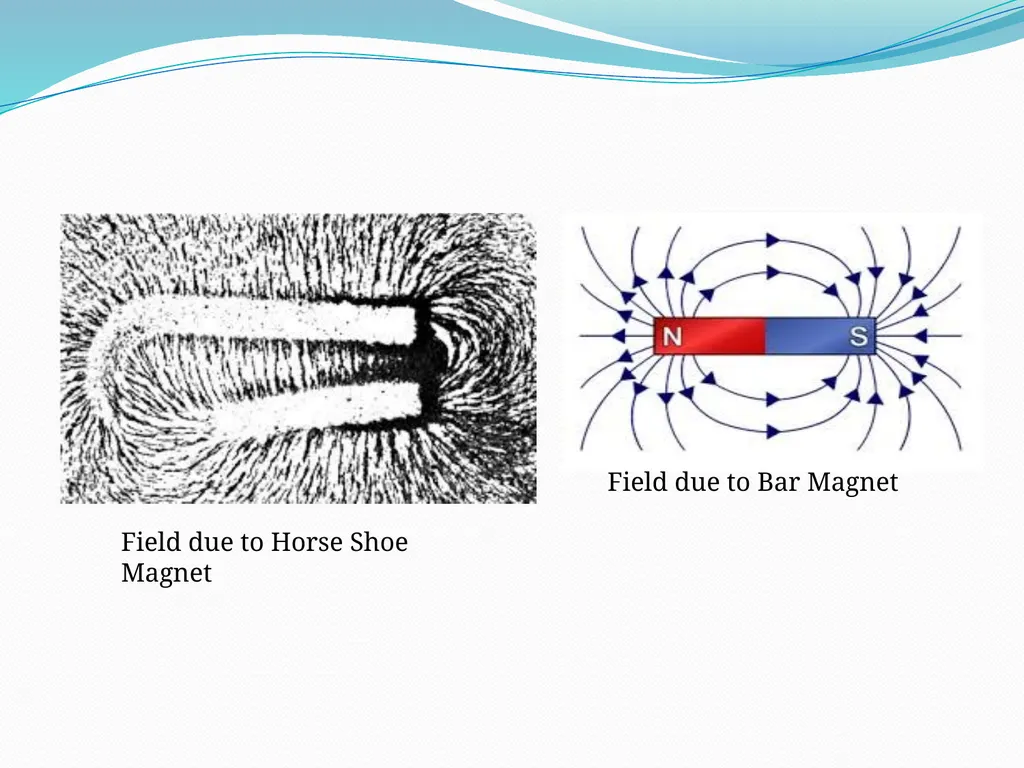
slide5. Field due to Horse Shoe Magnet Field due to Bar Magnet<br>
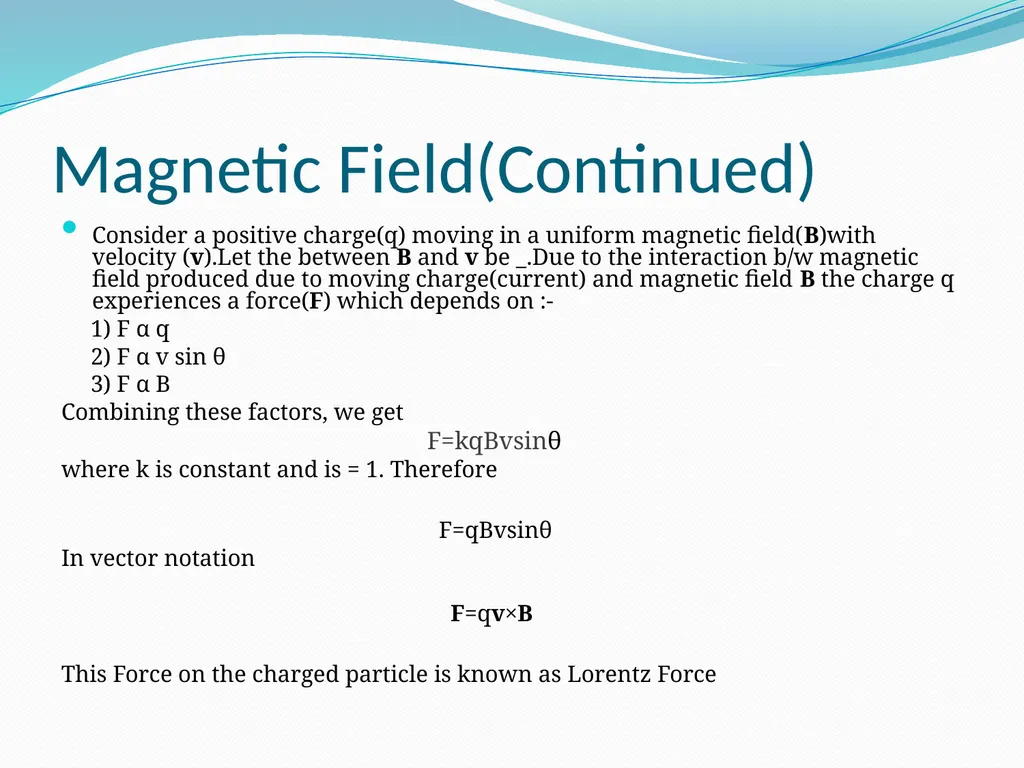
slide6. Magnetic Field(Continued) Consider a positive charge(q) moving in a uniform magnetic field(B)with velocity (v).Let the between B and v be _.Due to the interaction b/w magnetic field produced due to moving charge(current) and magnetic field B the charge q experiences a force(F) which depends on :-
1) F α q
2) F α v sin θ
3) F α B
Combining these factors, we get
F=kqBvsinθ
where k is constant and is = 1. Therefore
F=qBvsinθ
In vector notation
F=qv×B
This Force on the charged particle is known as Lorentz Force<br>
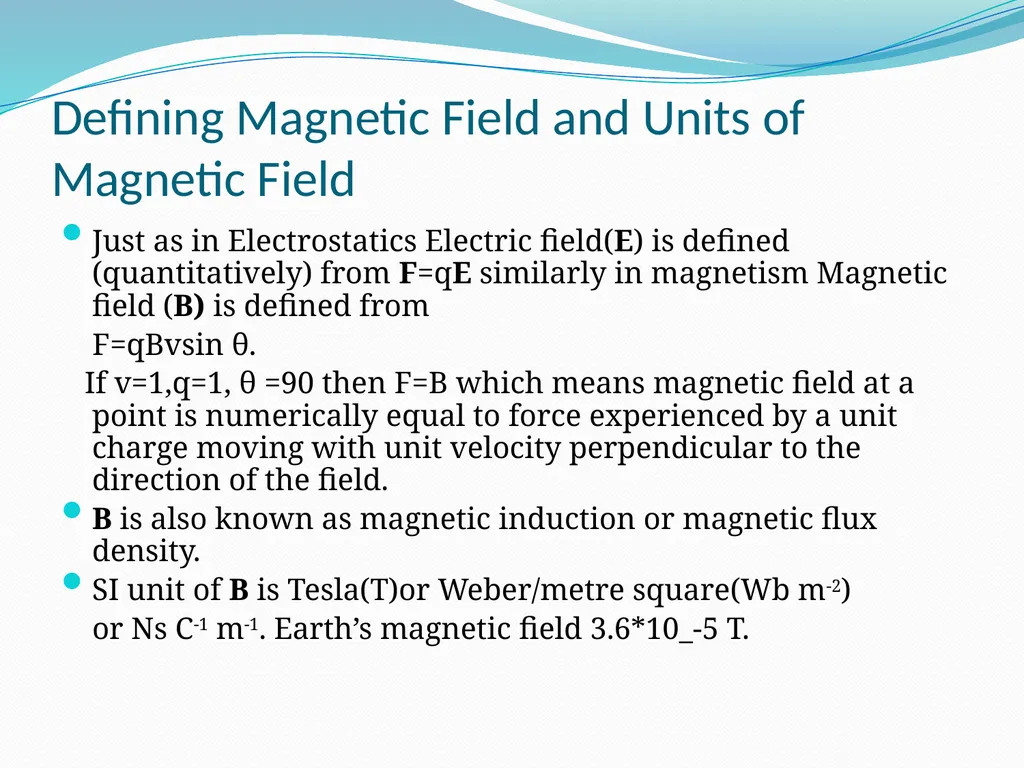
slide7. Defining Magnetic Field and Units of Magnetic Field Just as in Electrostatics Electric field(E) is defined (quantitatively) from F=qE similarly in magnetism Magnetic field (B) is defined from
F=qBvsin θ.
If v=1,q=1, θ =90 then F=B which means magnetic field at a point is numerically equal to force experienced by a unit charge moving with unit velocity perpendicular to the direction of the field.
B is also known as magnetic induction or magnetic flux density.
SI unit of B is Tesla(T)or Weber/metre square(Wb m-2)
or Ns C-1 m-1. Earth’s magnetic field 3.6*10_-5 T.<br>
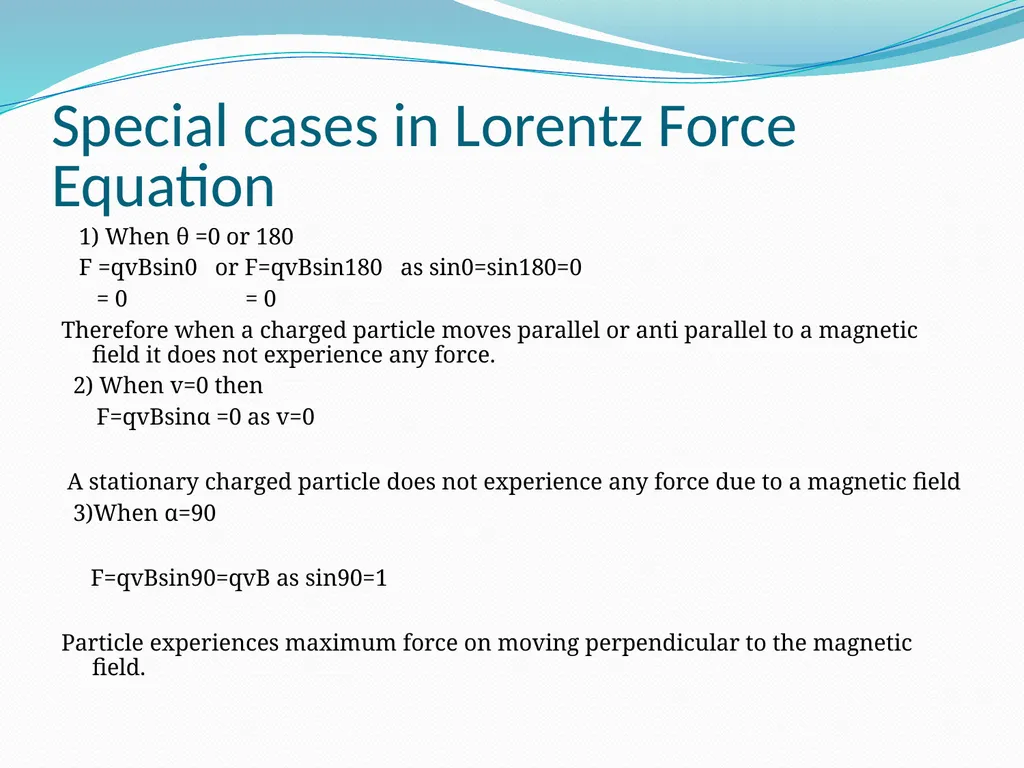
slide8. Special cases in Lorentz Force Equation 1) When θ =0 or 180
F =qvBsin0 or F=qvBsin180 as sin0=sin180=0
= 0 = 0
Therefore when a charged particle moves parallel or anti parallel to a magnetic field it does not experience any force.
2) When v=0 then
F=qvBsinα =0 as v=0
A stationary charged particle does not experience any force due to a magnetic field
3)When α=90
F=qvBsin90=qvB as sin90=1
Particle experiences maximum force on moving perpendicular to the magnetic field.<br>
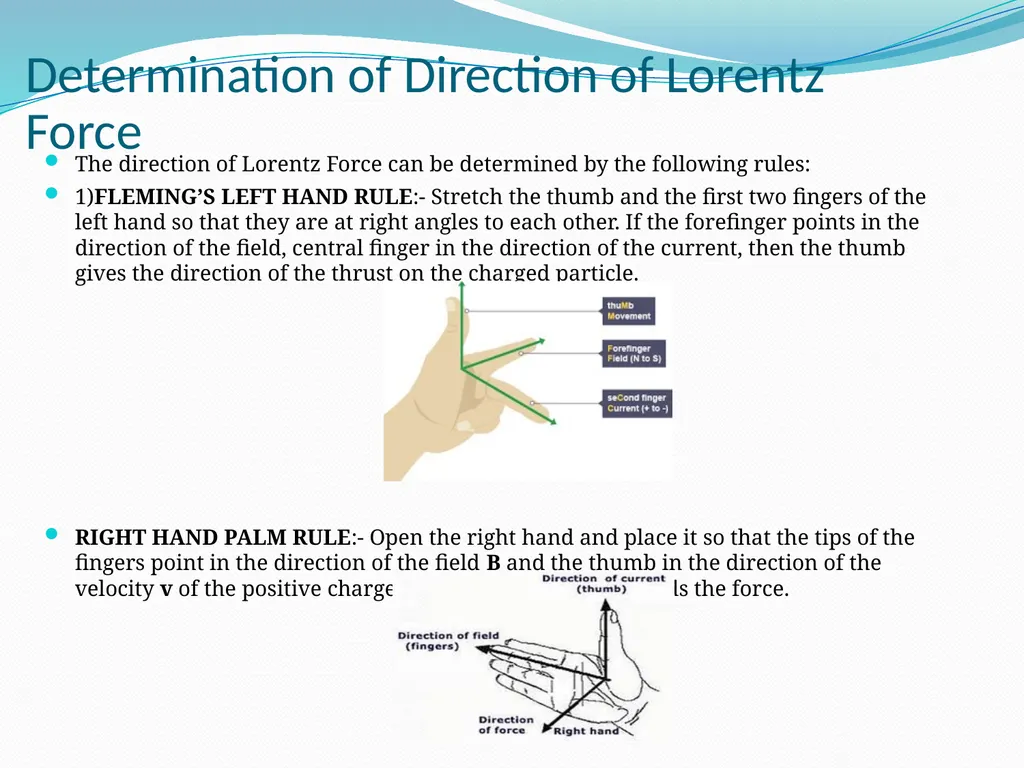
slide9. Determination of Direction of Lorentz Force The direction of Lorentz Force can be determined by the following rules:
1)FLEMING’S LEFT HAND RULE:- Stretch the thumb and the first two fingers of the left hand so that they are at right angles to each other. If the forefinger points in the direction of the field, central finger in the direction of the current, then the thumb gives the direction of the thrust on the charged particle.
RIGHT HAND PALM RULE:- Open the right hand and place it so that the tips of the fingers point in the direction of the field B and the thumb in the direction of the velocity v of the positive charge then the palm faces towards the force.<br>
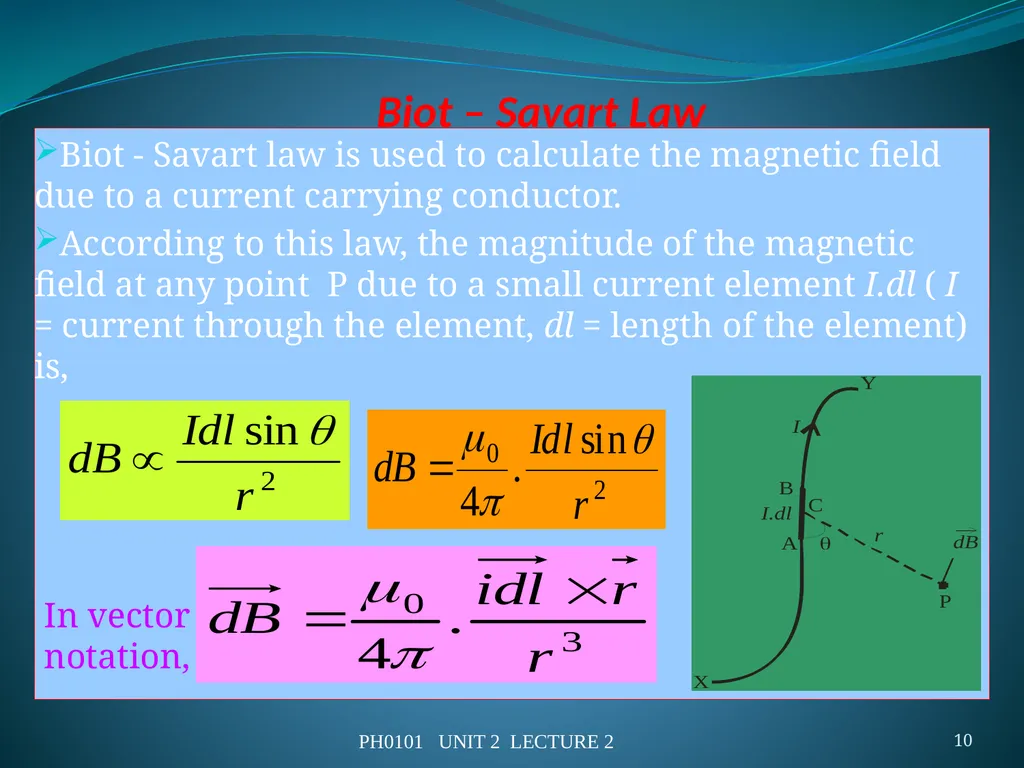
slide10. Biot – Savart Law Biot - Savart law is used to calculate the magnetic field due to a current carrying conductor.
According to this law, the magnitude of the magnetic field at any point P due to a small current element I.dl ( I = current through the element, dl = length of the element) is, PH0101 UNIT 2 LECTURE 2 10 In vector notation,<br>
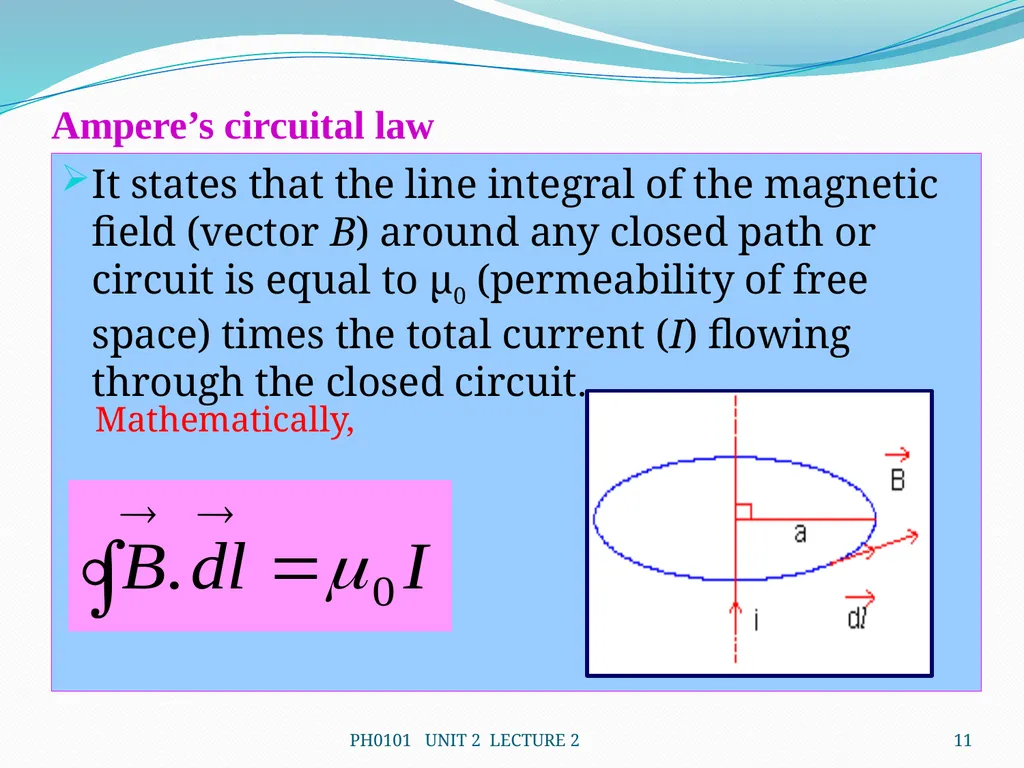
slide11. PH0101 UNIT 2 LECTURE 2 11 Ampere’s circuital law It states that the line integral of the magnetic field (vector B) around any closed path or circuit is equal to μ0 (permeability of free space) times the total current (I) flowing through the closed circuit. Mathematically,<br>
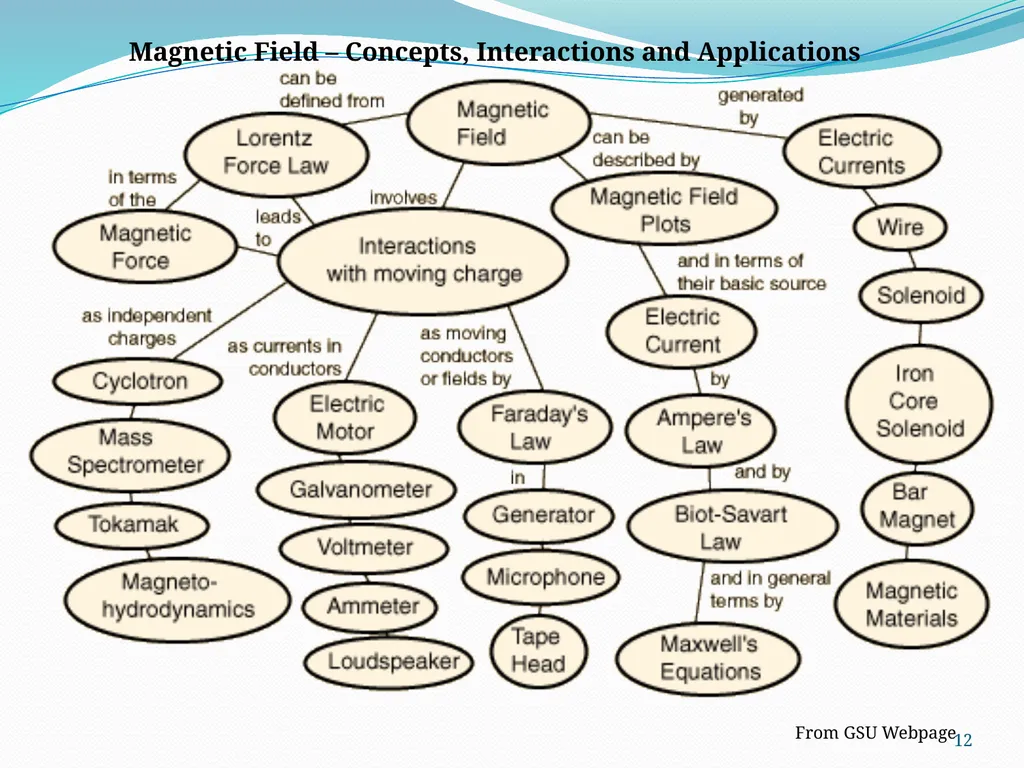
slide12. 12 From GSU Webpage Magnetic Field – Concepts, Interactions and Applications<br>
Department -Physics
Designation -Associate Professor
Academic Qualification -M.Sc Physics M.Phil PhD
Research Topic- Study of low cost high performance permanent magnetic material by Gamma Ray resonance Florescence Technique
No. Of Research Publication- 7
Other activities – Convener Admission Committee B.Sc 1,Convener of Red Cross Committee ,Convener of Swachh Bharat Abhiyan Committee ,
In charge UGC Network Resource Centre Govt. College Ropar, Member of Research Committee of College and Member of Science Society Personal Profile<br>
slide2. Magnetism History of Magnetism
Magnetic Field (Definition, Lorentz Force equation and Special cases of the equation)
Biot Savart’s Law
Ampere’s Law Index<br>
slide3. History of Magnetism Magnetic phenomena were first observed at least 2500 years ago in fragments of magnetized iron ore found near ancient city of Magnesia, now in Turkey.
These fragments were examples of what are now called permanent magnets.
Later on , in 1820 Oersted noticed that current flowing in a straight wire caused a noticeable deflection in a nearby magnetic compass needle.
Since a magnetic needle can be deflected by a magnetic field only so a current carrying conductor must produce a magnetic field around it.<br>
slide4. Magnetic Field Like electric field magnetic field is the space around a magnet or a conductor carrying current within which it’s magnetic influence can be detected.
Cause of magnetic field : It is due to the motion of the electrons which constitute current in the conductor. In other words moving charge is the cause of magnetic field .
Behavior of certain materials as permanent magnets is due to microscopic atomic current in these materials.<br>
slide5. Field due to Horse Shoe Magnet Field due to Bar Magnet<br>
slide6. Magnetic Field(Continued) Consider a positive charge(q) moving in a uniform magnetic field(B)with velocity (v).Let the between B and v be _.Due to the interaction b/w magnetic field produced due to moving charge(current) and magnetic field B the charge q experiences a force(F) which depends on :-
1) F α q
2) F α v sin θ
3) F α B
Combining these factors, we get
F=kqBvsinθ
where k is constant and is = 1. Therefore
F=qBvsinθ
In vector notation
F=qv×B
This Force on the charged particle is known as Lorentz Force<br>
slide7. Defining Magnetic Field and Units of Magnetic Field Just as in Electrostatics Electric field(E) is defined (quantitatively) from F=qE similarly in magnetism Magnetic field (B) is defined from
F=qBvsin θ.
If v=1,q=1, θ =90 then F=B which means magnetic field at a point is numerically equal to force experienced by a unit charge moving with unit velocity perpendicular to the direction of the field.
B is also known as magnetic induction or magnetic flux density.
SI unit of B is Tesla(T)or Weber/metre square(Wb m-2)
or Ns C-1 m-1. Earth’s magnetic field 3.6*10_-5 T.<br>
slide8. Special cases in Lorentz Force Equation 1) When θ =0 or 180
F =qvBsin0 or F=qvBsin180 as sin0=sin180=0
= 0 = 0
Therefore when a charged particle moves parallel or anti parallel to a magnetic field it does not experience any force.
2) When v=0 then
F=qvBsinα =0 as v=0
A stationary charged particle does not experience any force due to a magnetic field
3)When α=90
F=qvBsin90=qvB as sin90=1
Particle experiences maximum force on moving perpendicular to the magnetic field.<br>
slide9. Determination of Direction of Lorentz Force The direction of Lorentz Force can be determined by the following rules:
1)FLEMING’S LEFT HAND RULE:- Stretch the thumb and the first two fingers of the left hand so that they are at right angles to each other. If the forefinger points in the direction of the field, central finger in the direction of the current, then the thumb gives the direction of the thrust on the charged particle.
RIGHT HAND PALM RULE:- Open the right hand and place it so that the tips of the fingers point in the direction of the field B and the thumb in the direction of the velocity v of the positive charge then the palm faces towards the force.<br>
slide10. Biot – Savart Law Biot - Savart law is used to calculate the magnetic field due to a current carrying conductor.
According to this law, the magnitude of the magnetic field at any point P due to a small current element I.dl ( I = current through the element, dl = length of the element) is, PH0101 UNIT 2 LECTURE 2 10 In vector notation,<br>
slide11. PH0101 UNIT 2 LECTURE 2 11 Ampere’s circuital law It states that the line integral of the magnetic field (vector B) around any closed path or circuit is equal to μ0 (permeability of free space) times the total current (I) flowing through the closed circuit. Mathematically,<br>
slide12. 12 From GSU Webpage Magnetic Field – Concepts, Interactions and Applications<br>