04
Introduction SCTP Services STCP Features Packet Format An SCTP Association State Transition Diagram Flow Control Error Control Congestion Control<br>
05
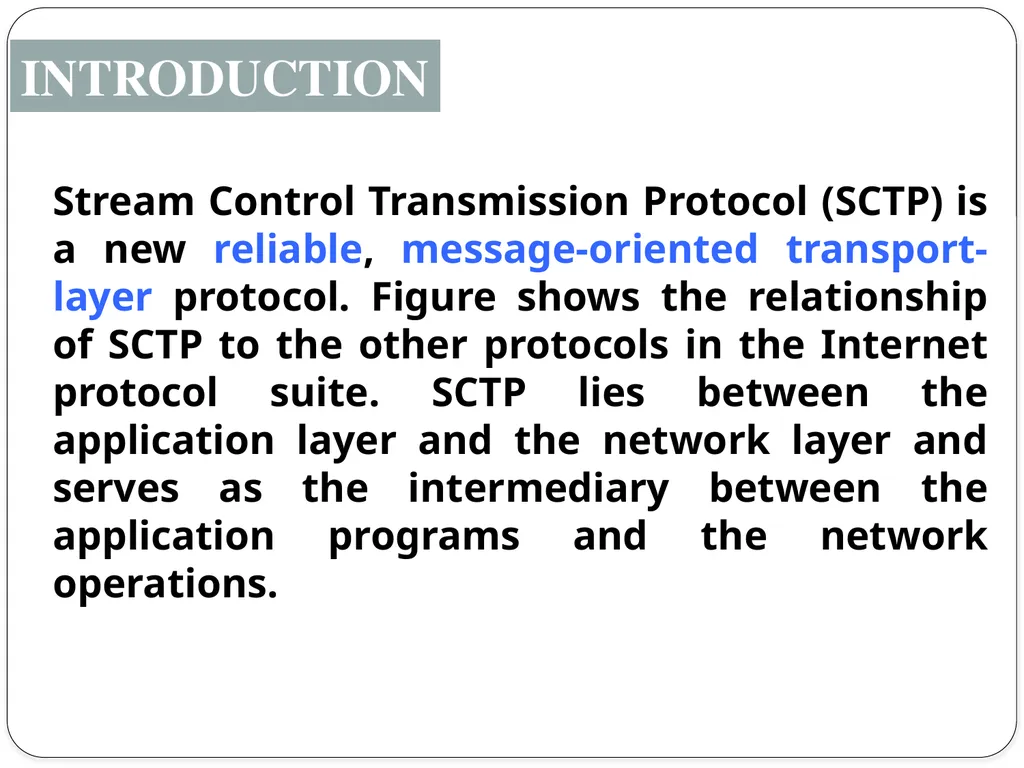
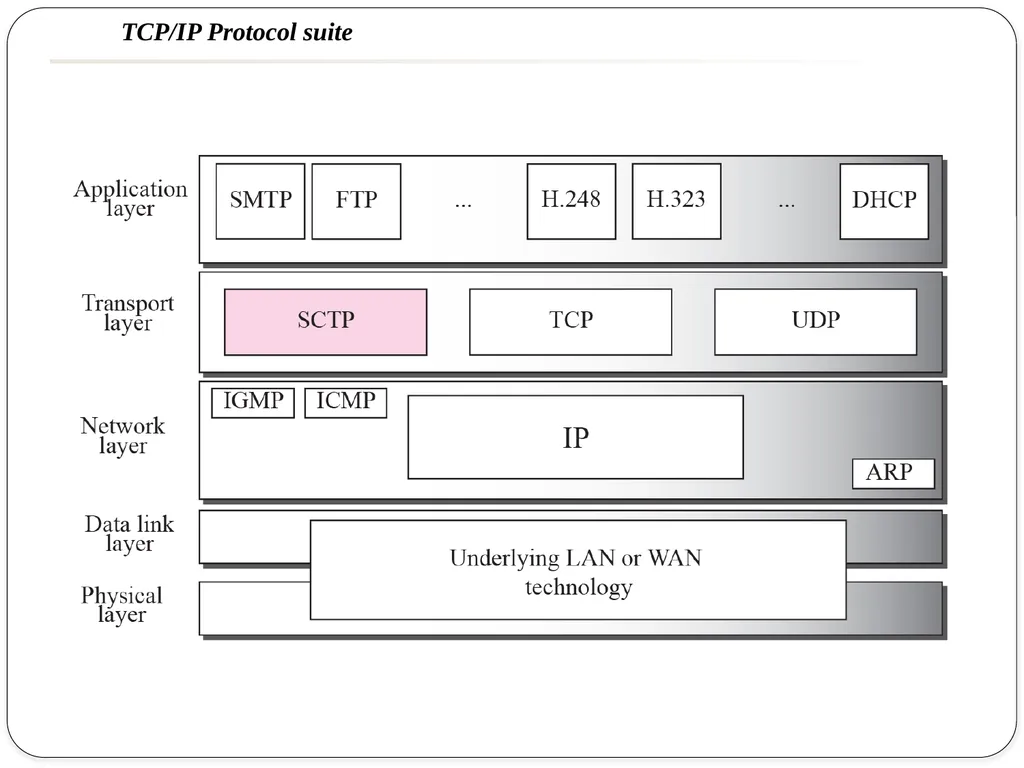
INTRODUCTION Stream Control Transmission Protocol (SCTP) is a new reliable, message-oriented transport-layer protocol. Figure shows the relationship of SCTP to the other protocols in the Internet protocol suite. SCTP lies between the application layer and the network layer and serves as the intermediary between the application programs and the network operations.<br>
06
TCP/IP Protocol suite<br>
07
SCTP SERVICES Before discussing the operation of SCTP, let us explain the services offered by SCTP to the application layer processes.<br>
08
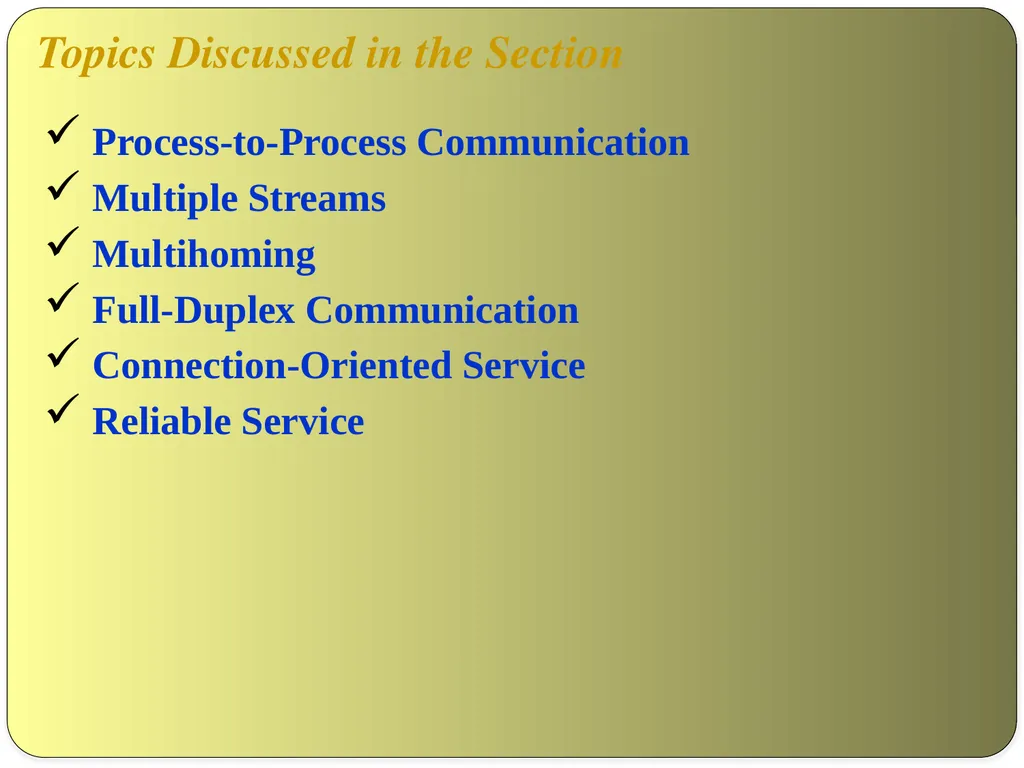
Topics Discussed in the Section Process-to-Process Communication
Multiple Streams
Multihoming
Full-Duplex Communication
Connection-Oriented Service
Reliable Service<br>
09
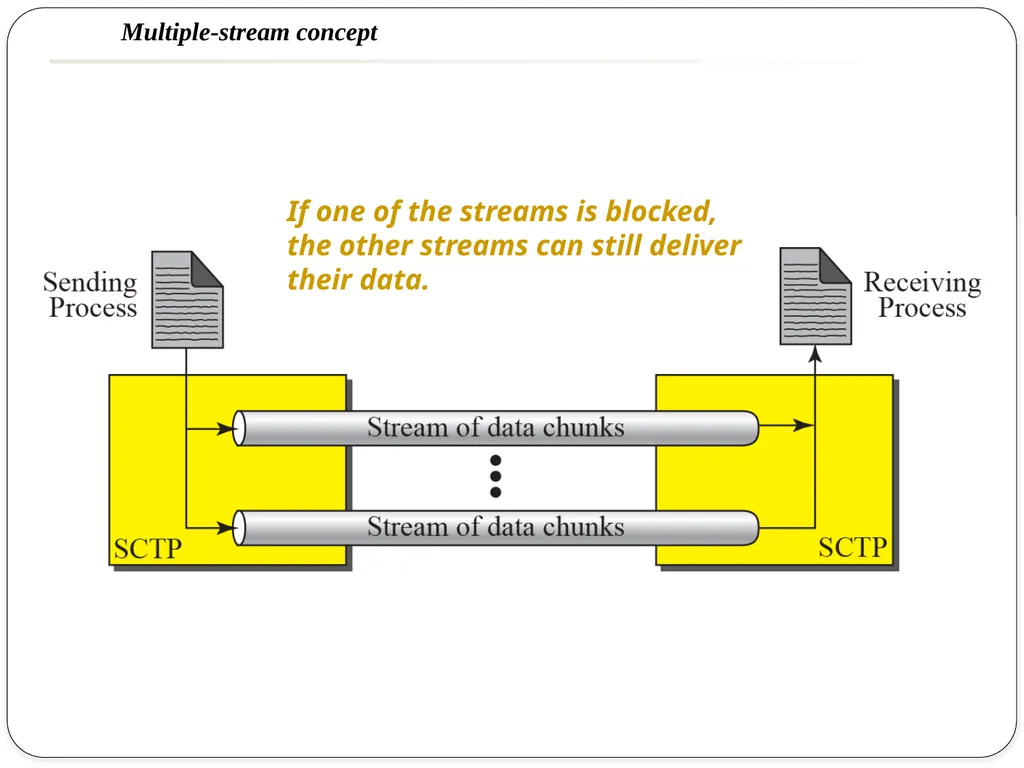
Multiple-stream concept If one of the streams is blocked,
the other streams can still deliver
their data.<br>
10
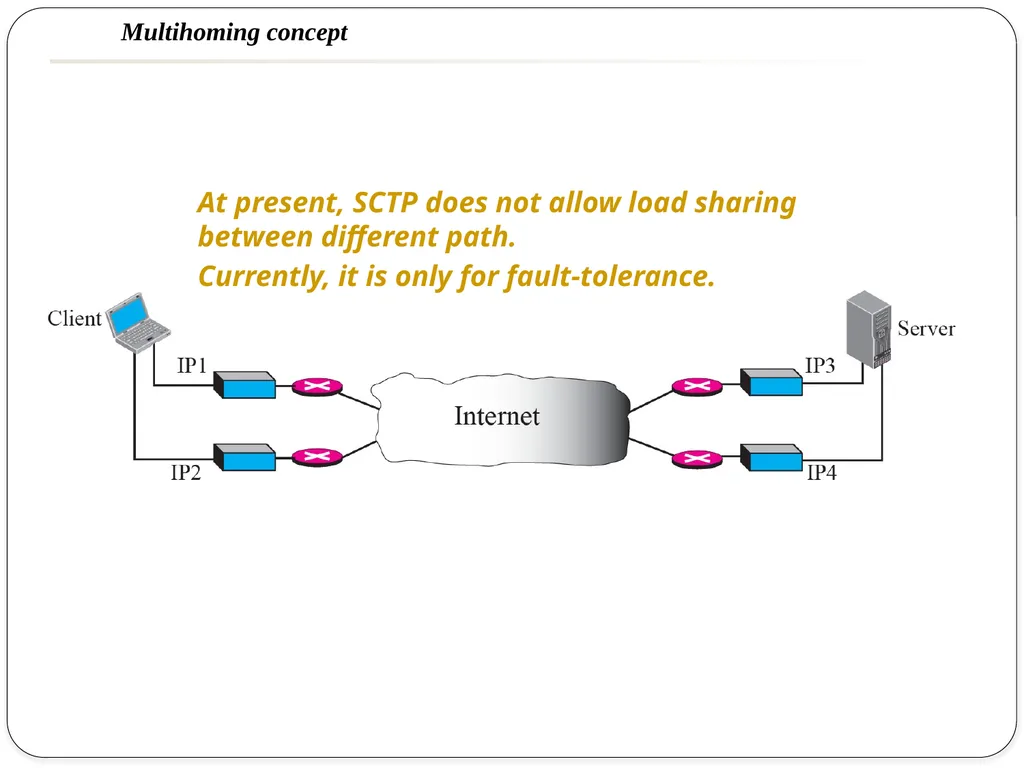
Multihoming concept At present, SCTP does not allow load sharing between different path.
Currently, it is only for fault-tolerance.<br>
11
Topics Discussed in the Section Transmission Sequence Number (TSN)
Stream Identifier (SI)
Stream Sequence Number (SSN)
Packets
Acknowledgment Number
Flow Control
Error Control
Congestion Control<br>
12
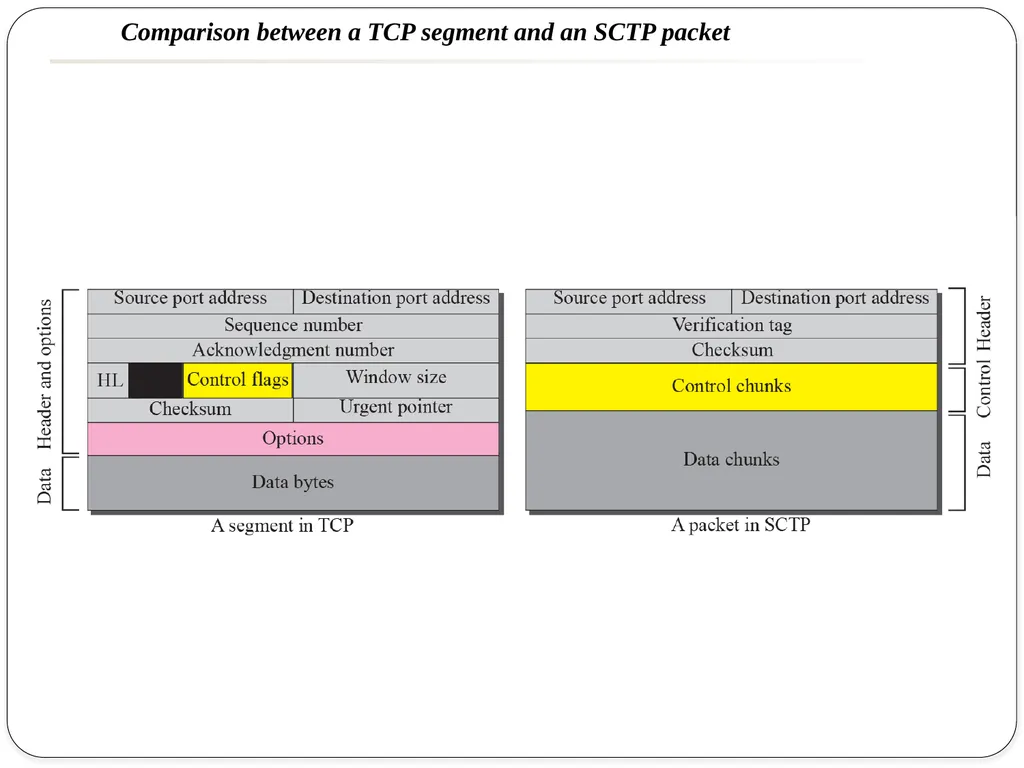
Comparison between a TCP segment and an SCTP packet<br>
13
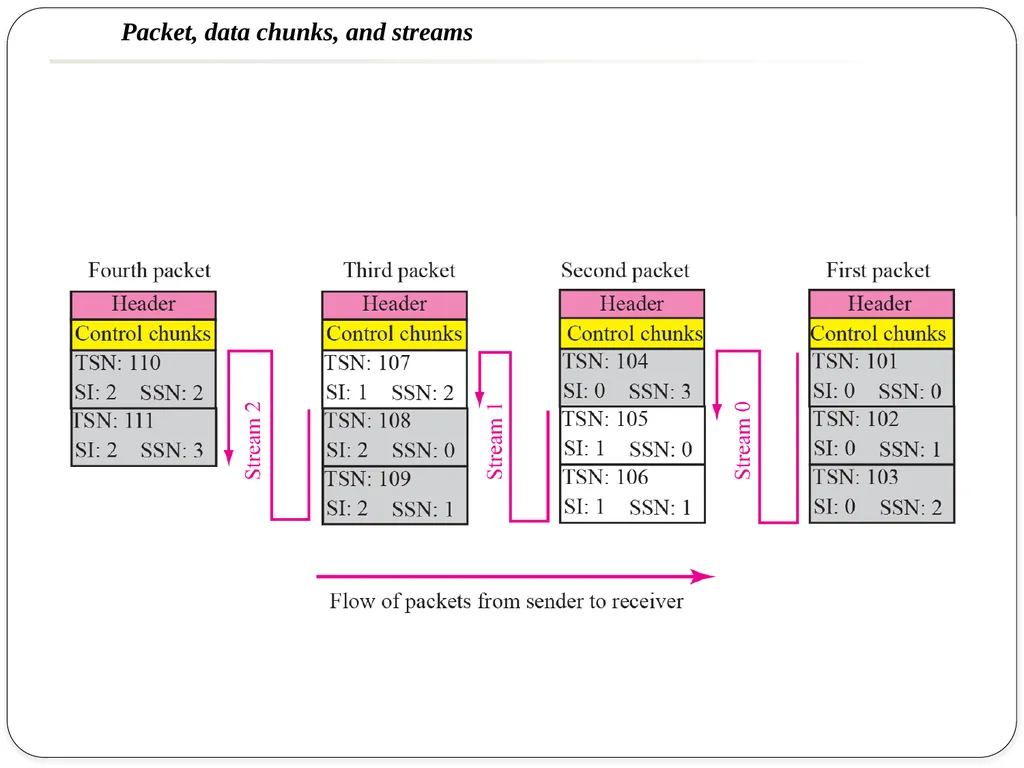
Packet, data chunks, and streams<br>
14
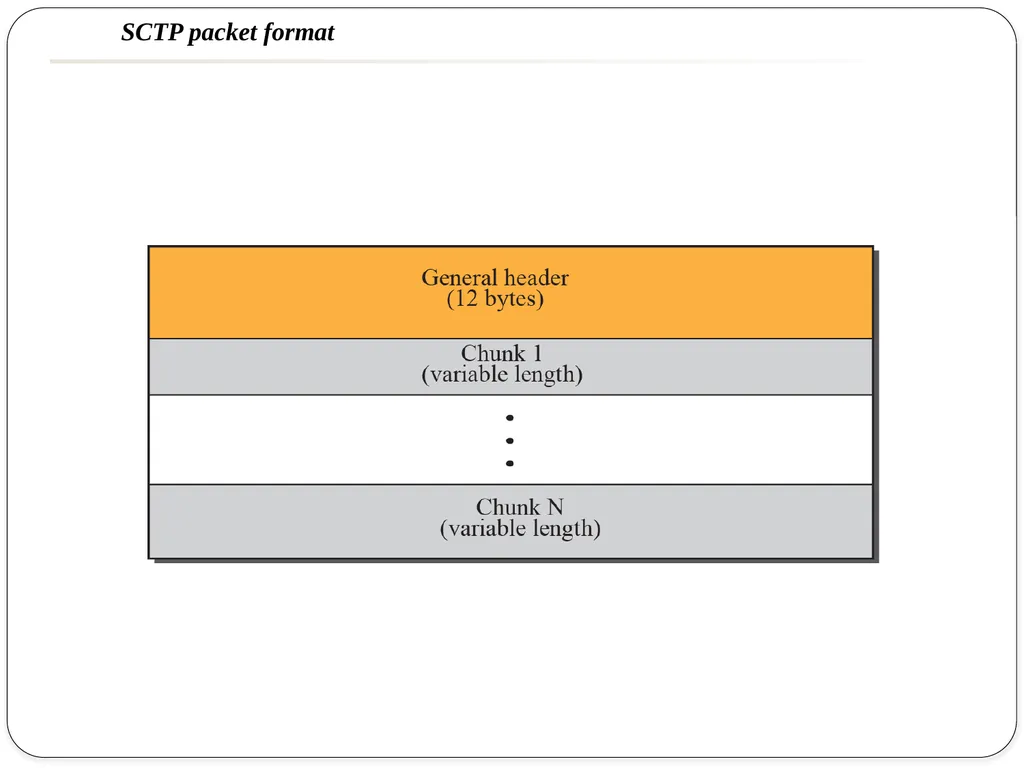
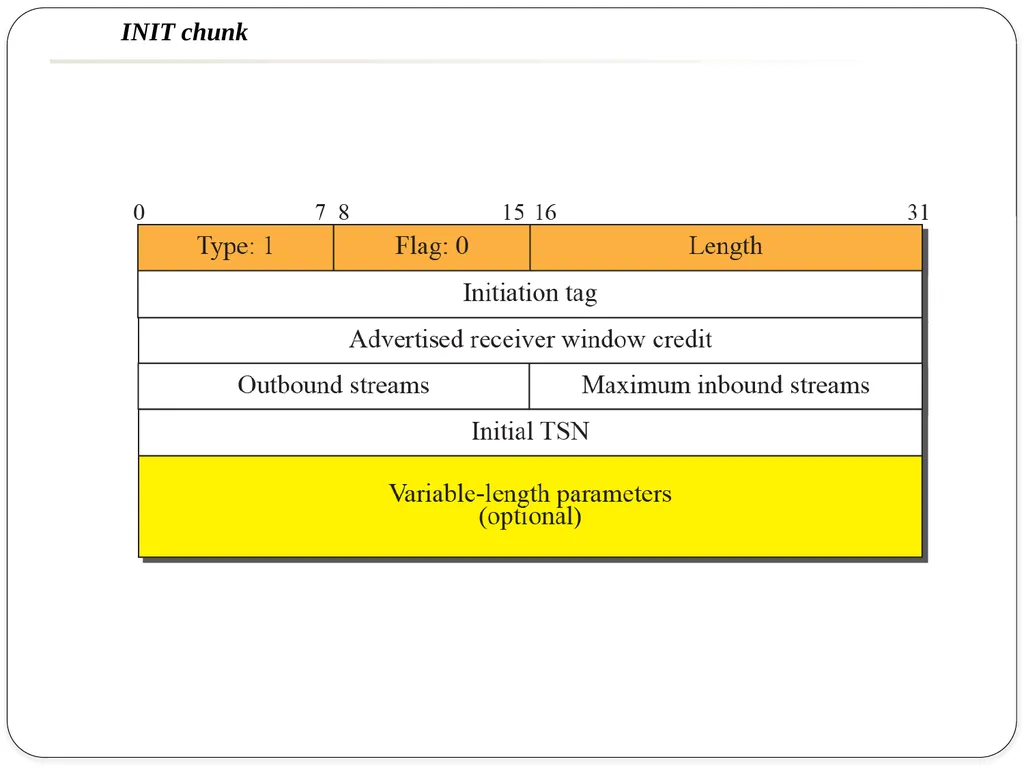
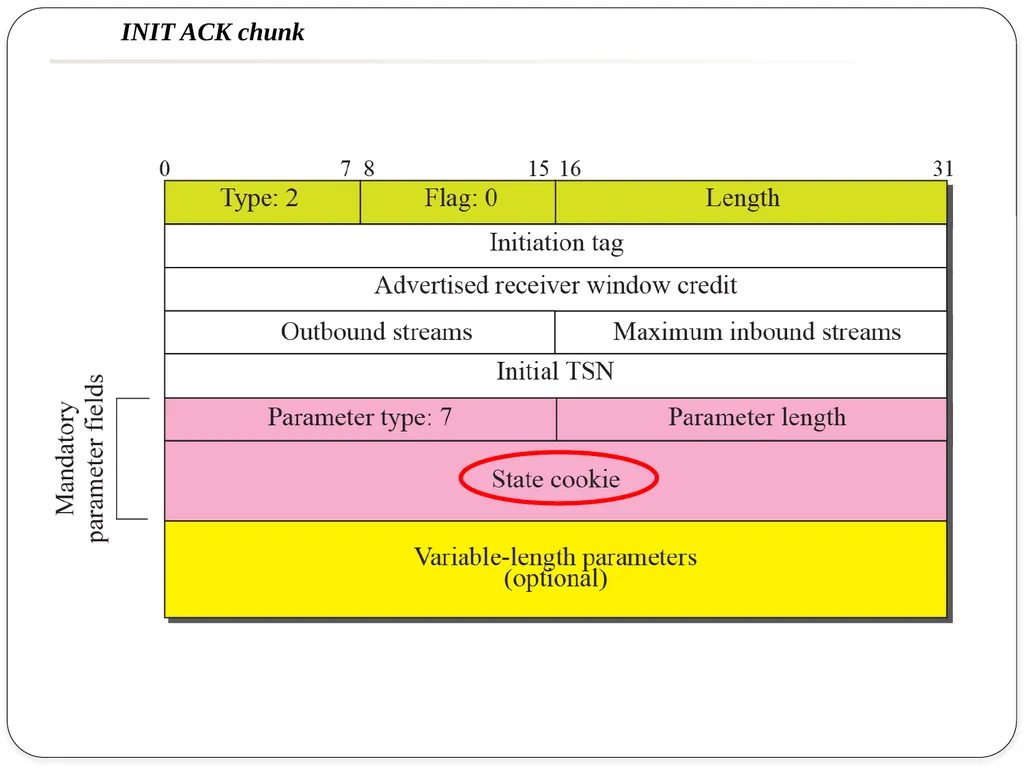
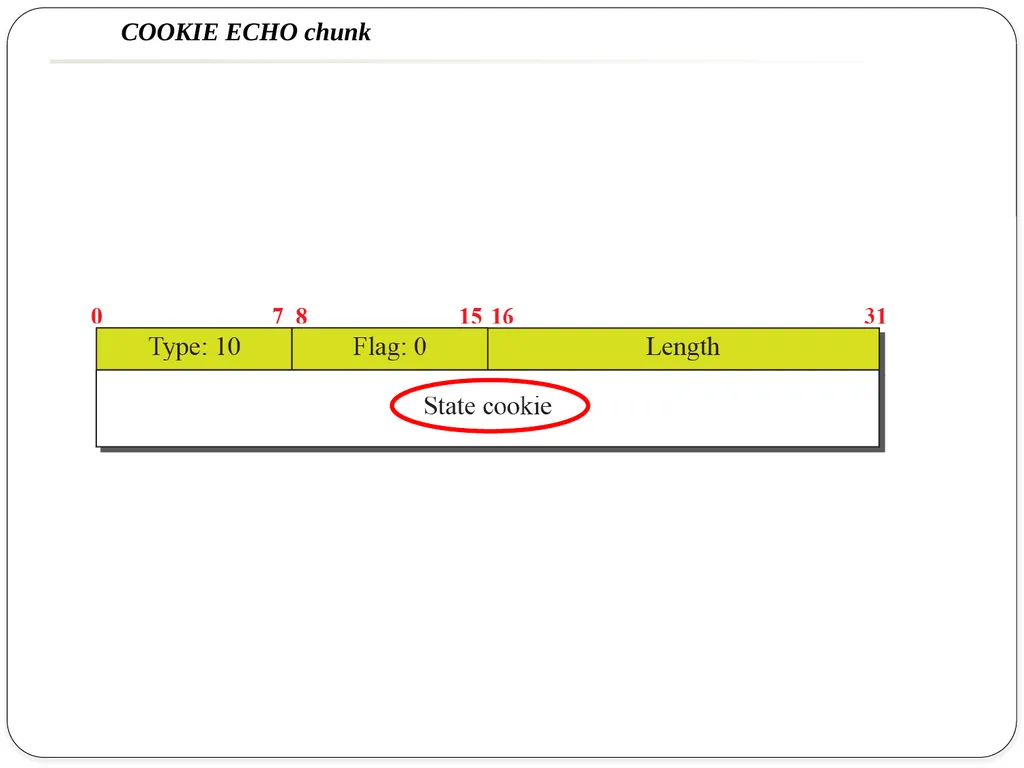
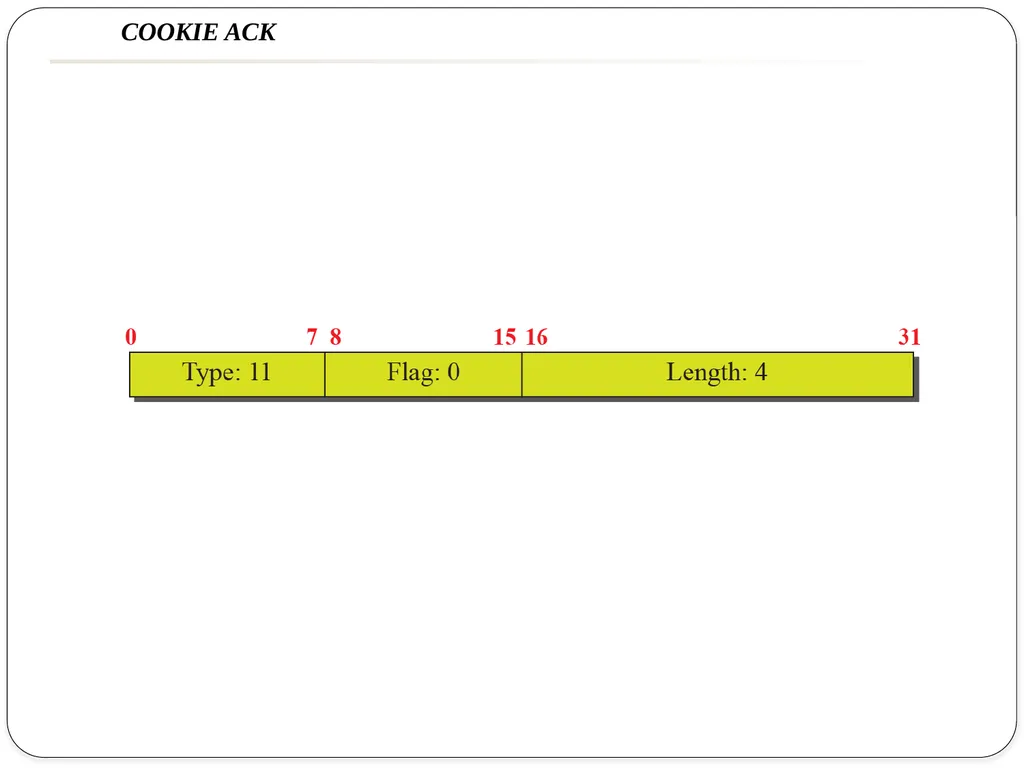
PACKET FORMAT In this section, we show the format of a packet and different types of chunks. Most of the information presented in this section will become clear later; this section can be skipped in the first reading or used only as the reference. An SCTP packet has a mandatory general header and a set of blocks called chunks. There are two types of chunks: control chunks and data chunks.<br>
15
Topics Discussed in the Section General Header
Chunks<br>
16
SCTP packet format<br>
17
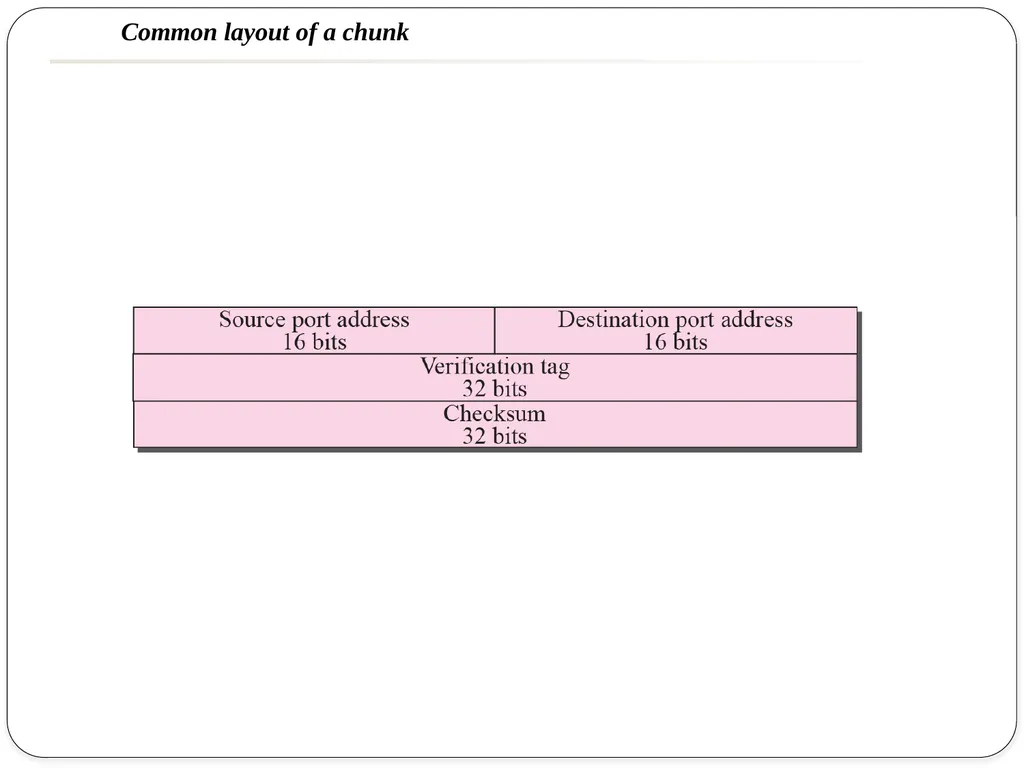
Common layout of a chunk<br>
18
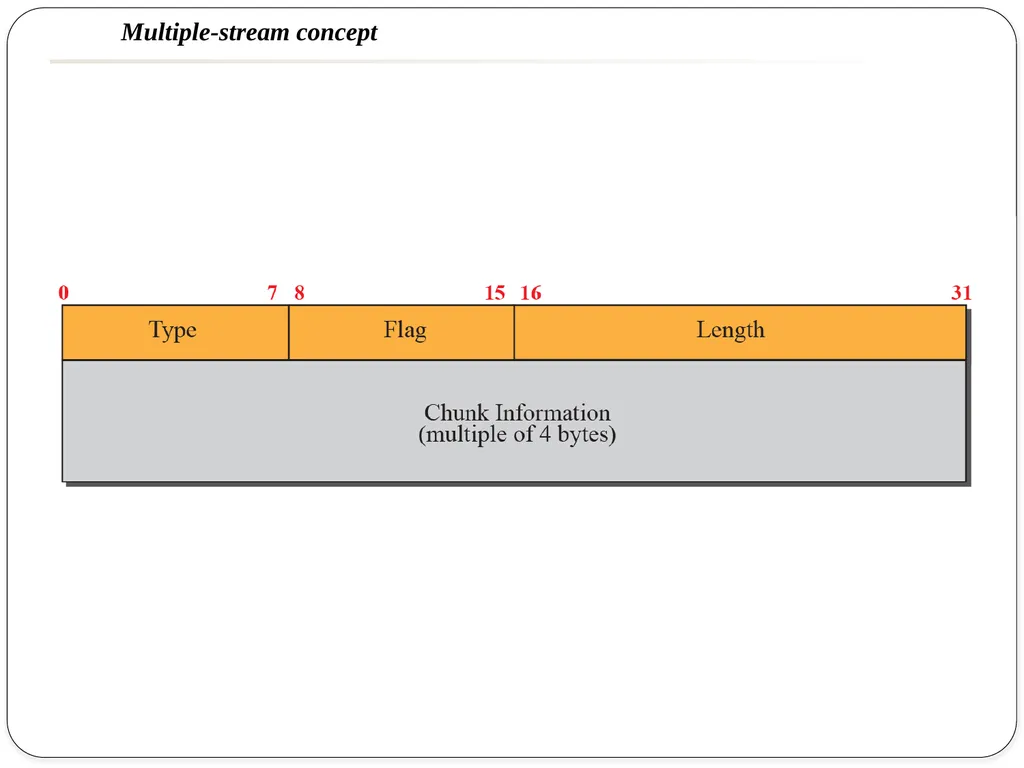
Multiple-stream concept<br>
24
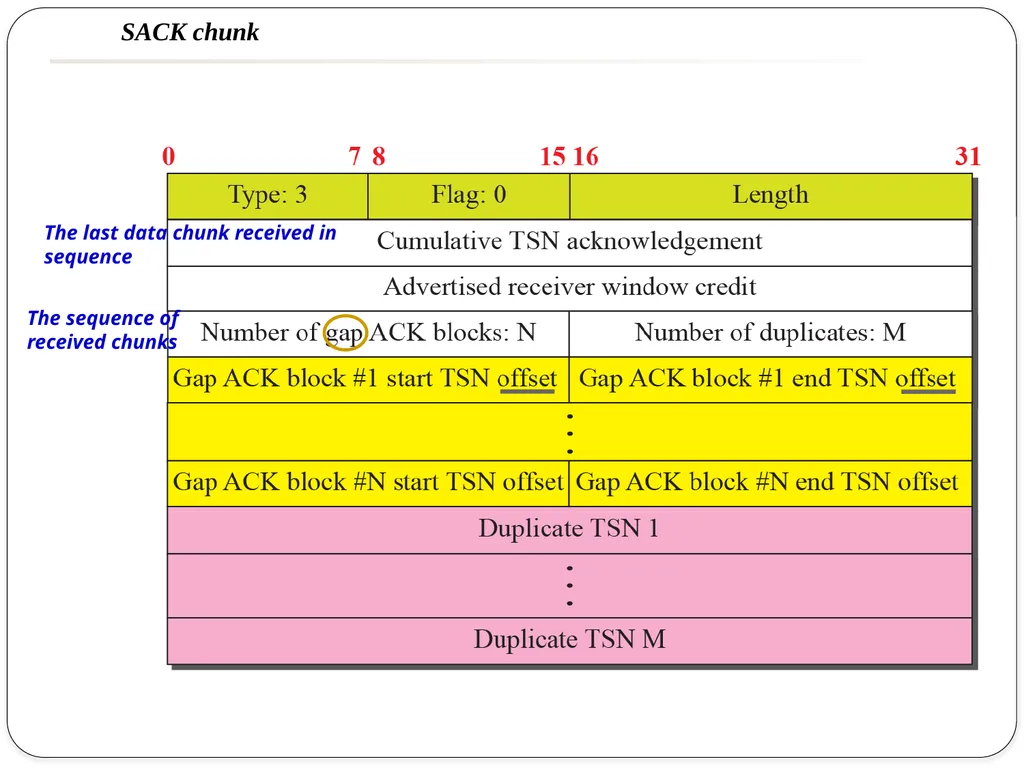
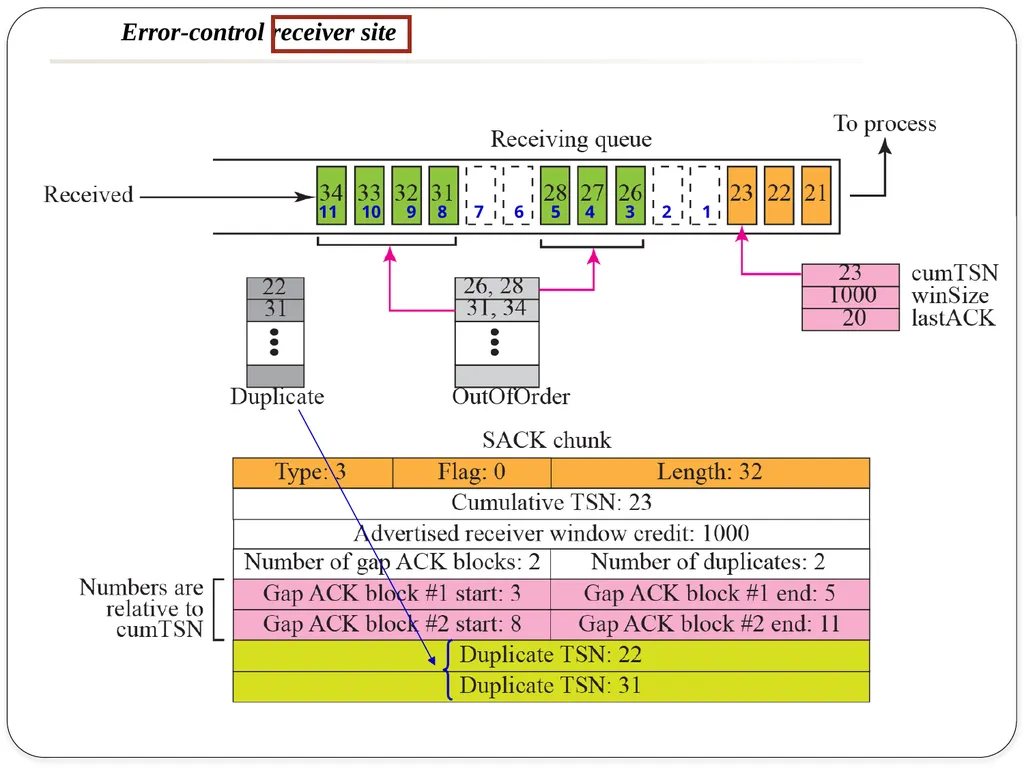
SACK chunk The last data chunk received in sequence The sequence of received chunks<br>
25
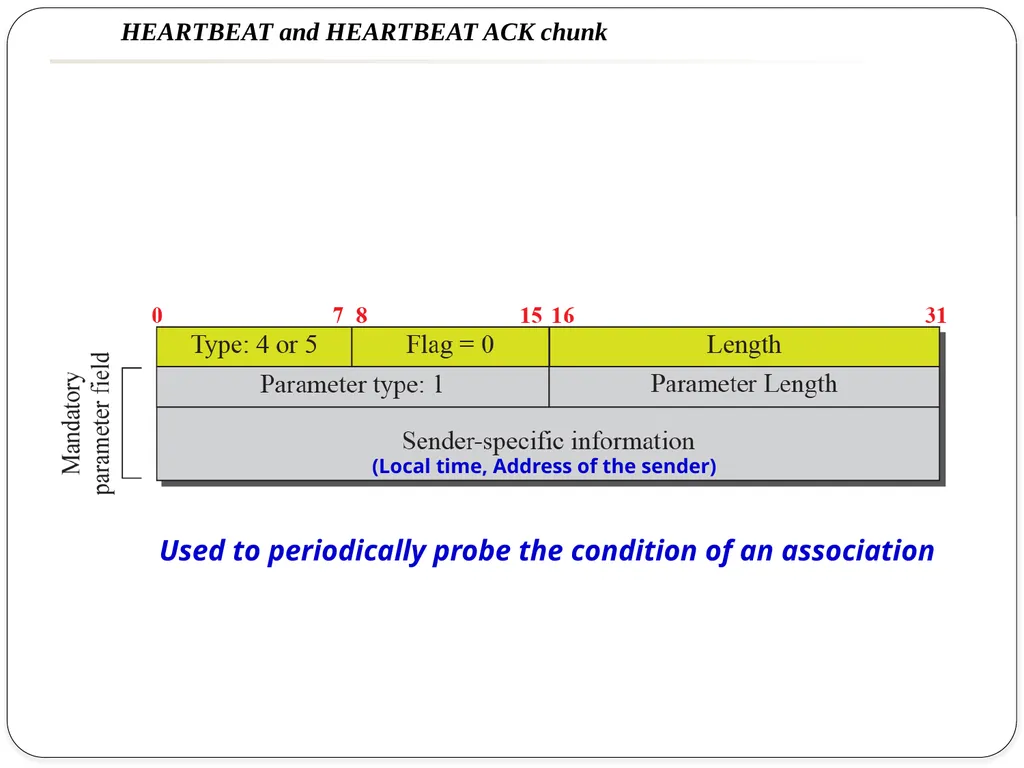
HEARTBEAT and HEARTBEAT ACK chunk Used to periodically probe the condition of an association (Local time, Address of the sender)<br>
27
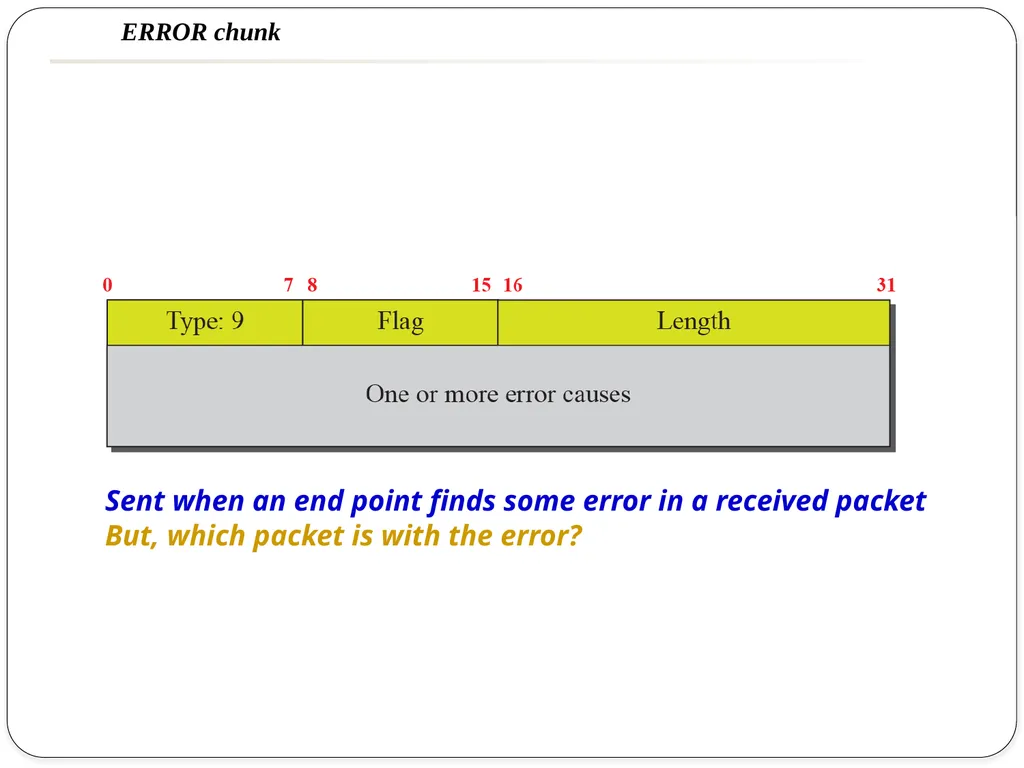
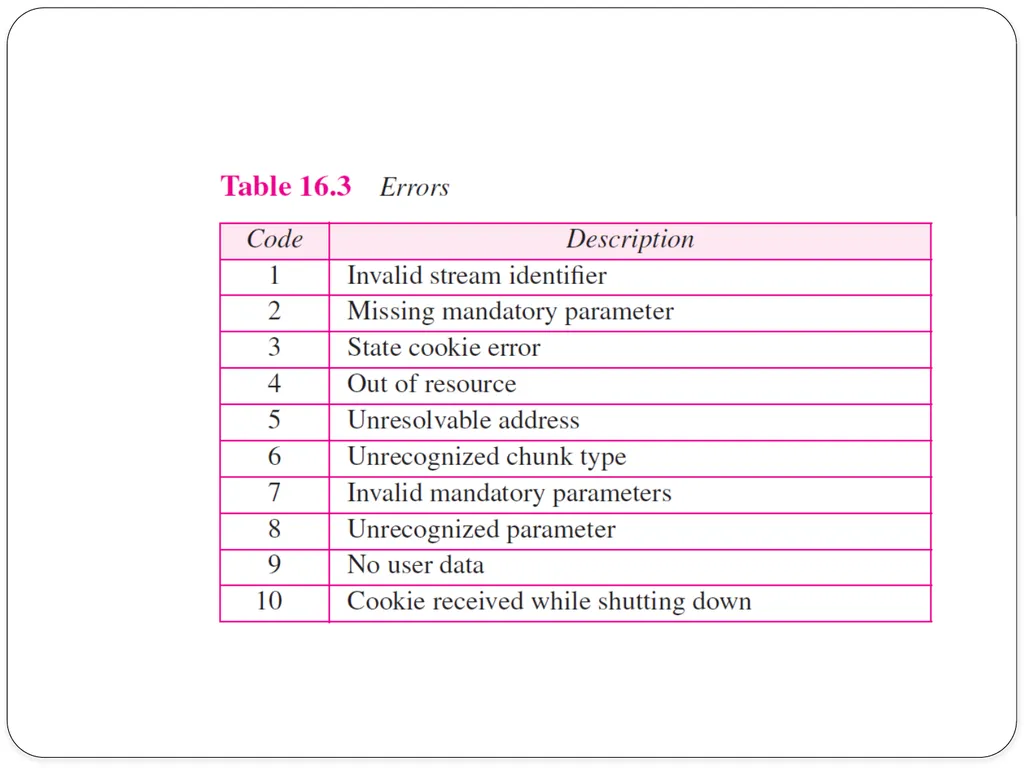
ERROR chunk Sent when an end point finds some error in a received packet
But, which packet is with the error?<br>
29
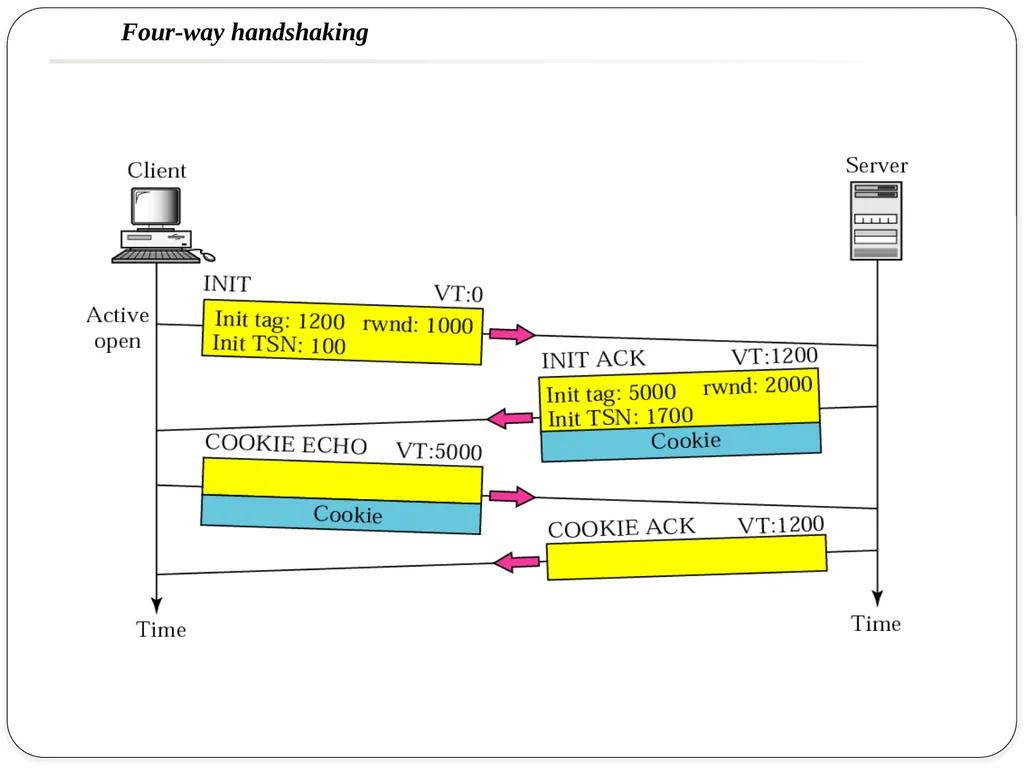
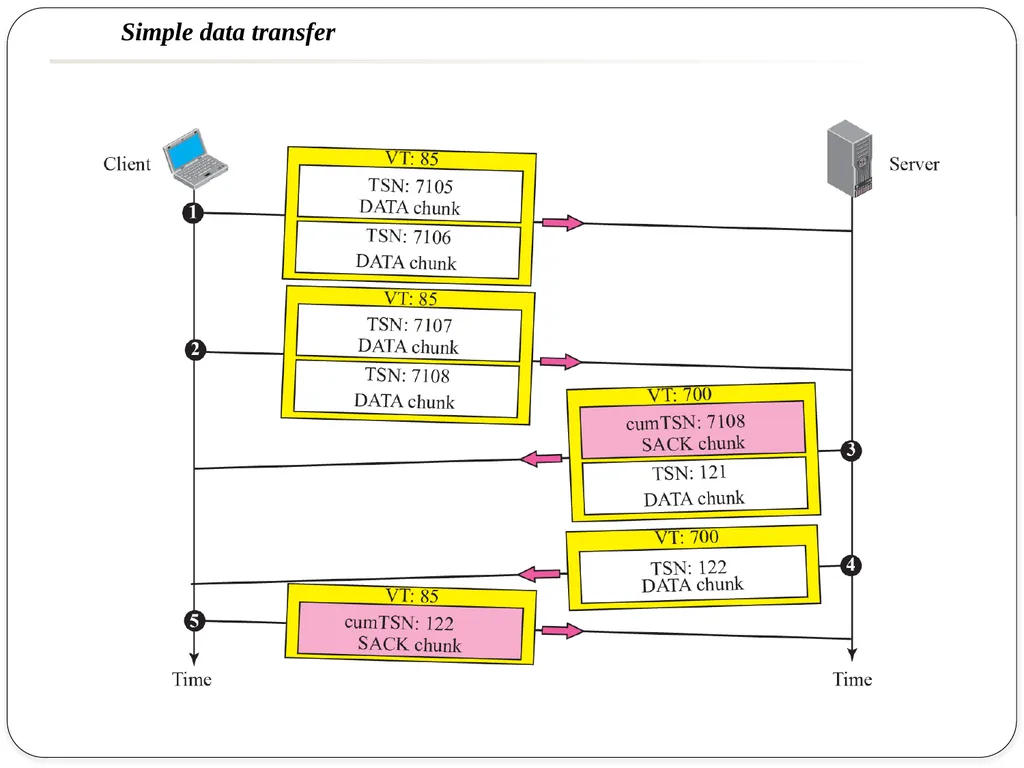
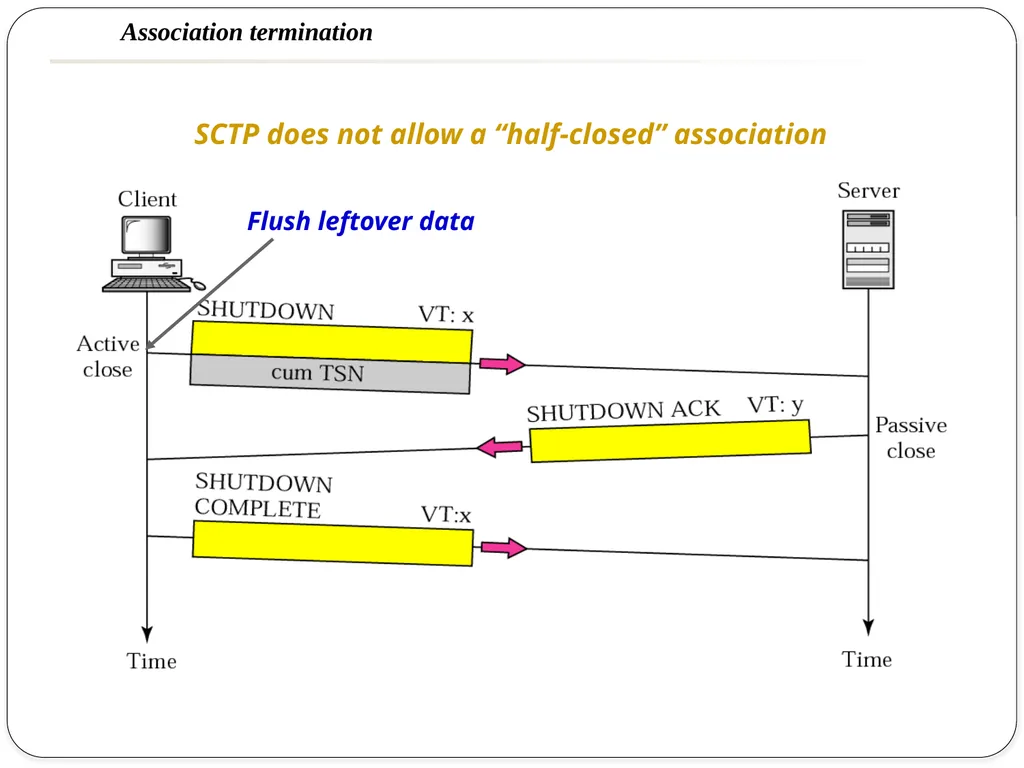
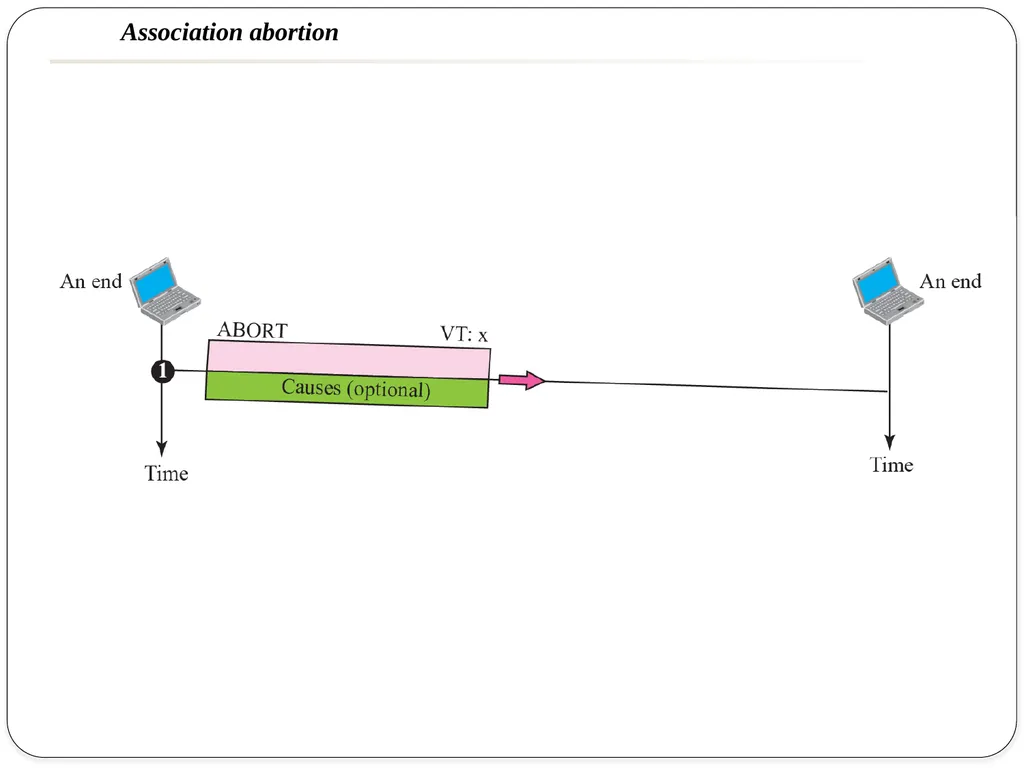
AN SCTP ASSOCIATION SCTP, like TCP, is a connection-oriented protocol. However, a connection in SCTP is called an association to emphasize multihoming.<br>
30
Topics Discussed in the Section Association Establishment
Data Transfer
Association Termination
Association Abortion<br>
31
Four-way handshaking<br>
32
Simple data transfer<br>
33
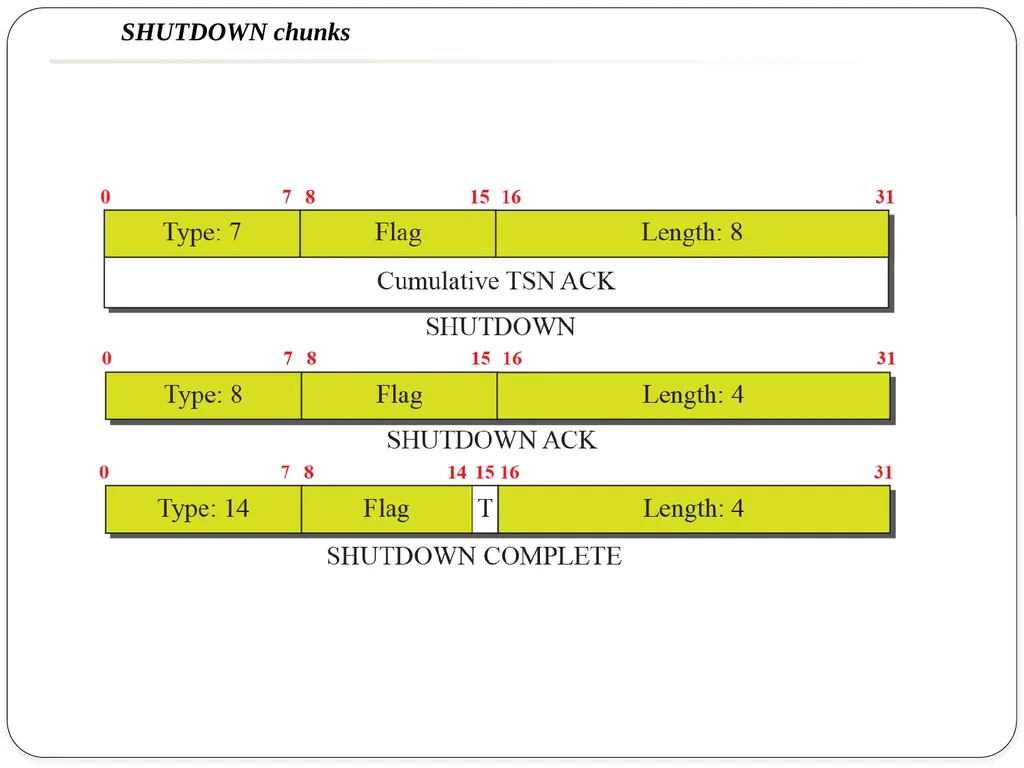
Association termination SCTP does not allow a “half-closed” association Flush leftover data<br>
34
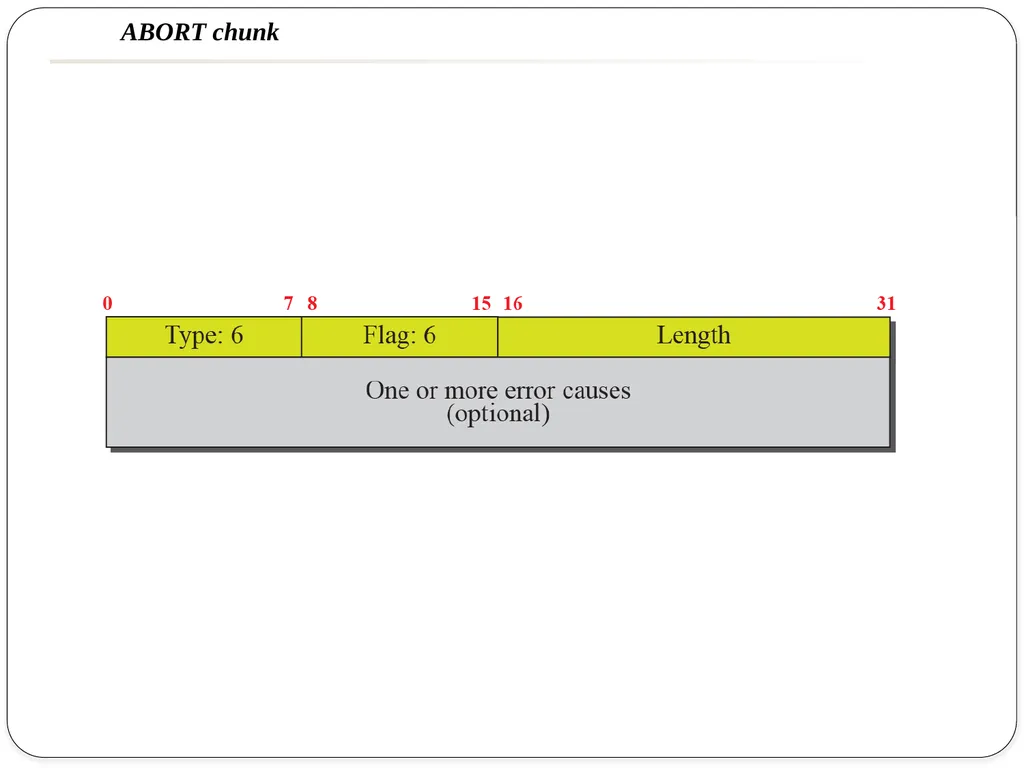
Association abortion<br>
35
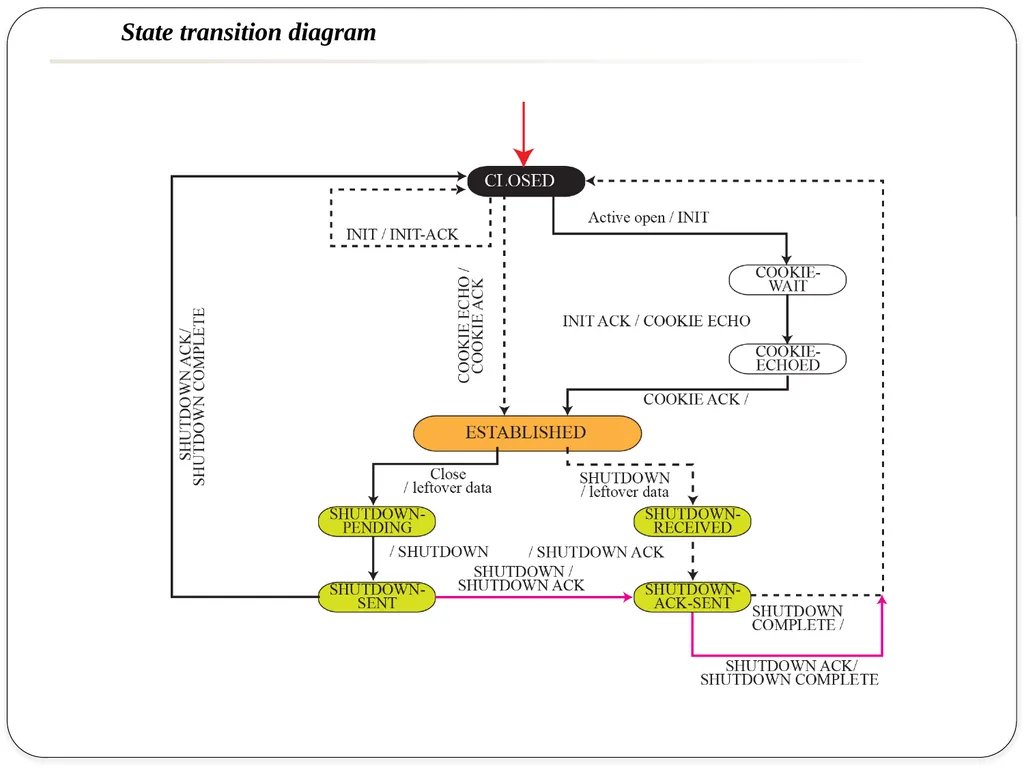
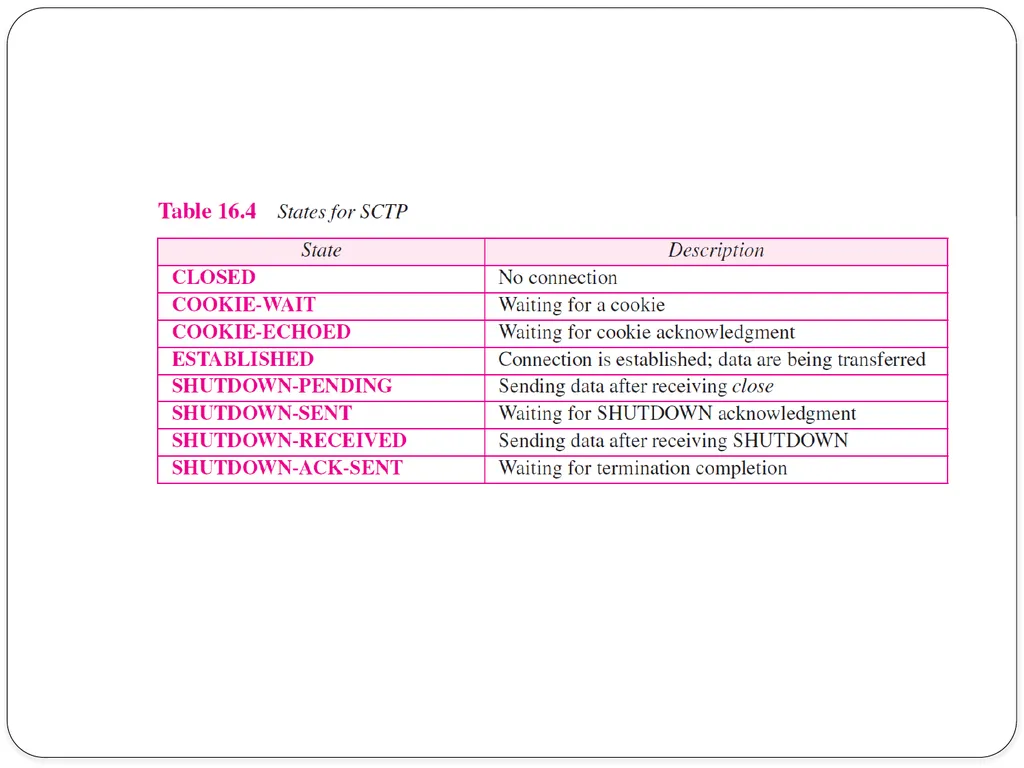
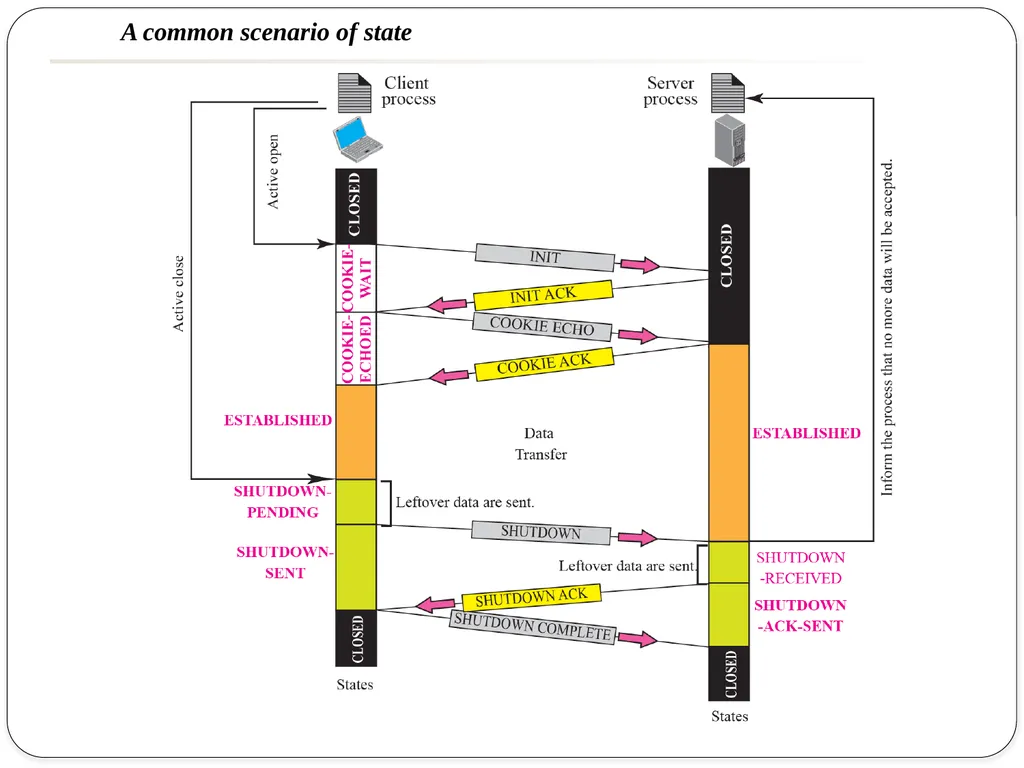
STATE TRANSITION DIAGRAM To keep track of all the different events happening during association establishment, association termination, and data transfer, the SCTP software, like TCP, is implemented as a finite state machine. Figure 16.23 shows the state transition diagram for both client and server.<br>
36
Topics Discussed in the Section Scenarios<br>
37
State transition diagram<br>
38
A common scenario of state<br>
39
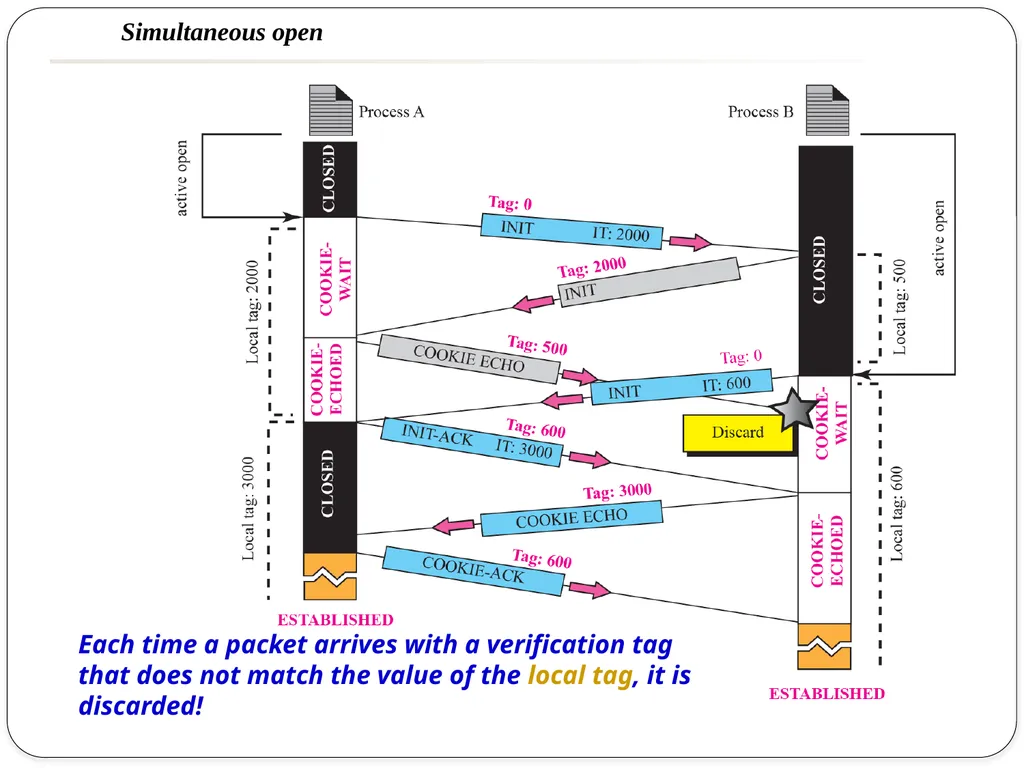
Simultaneous open Each time a packet arrives with a verification tag that does not match the value of the local tag, it is discarded!<br>
40
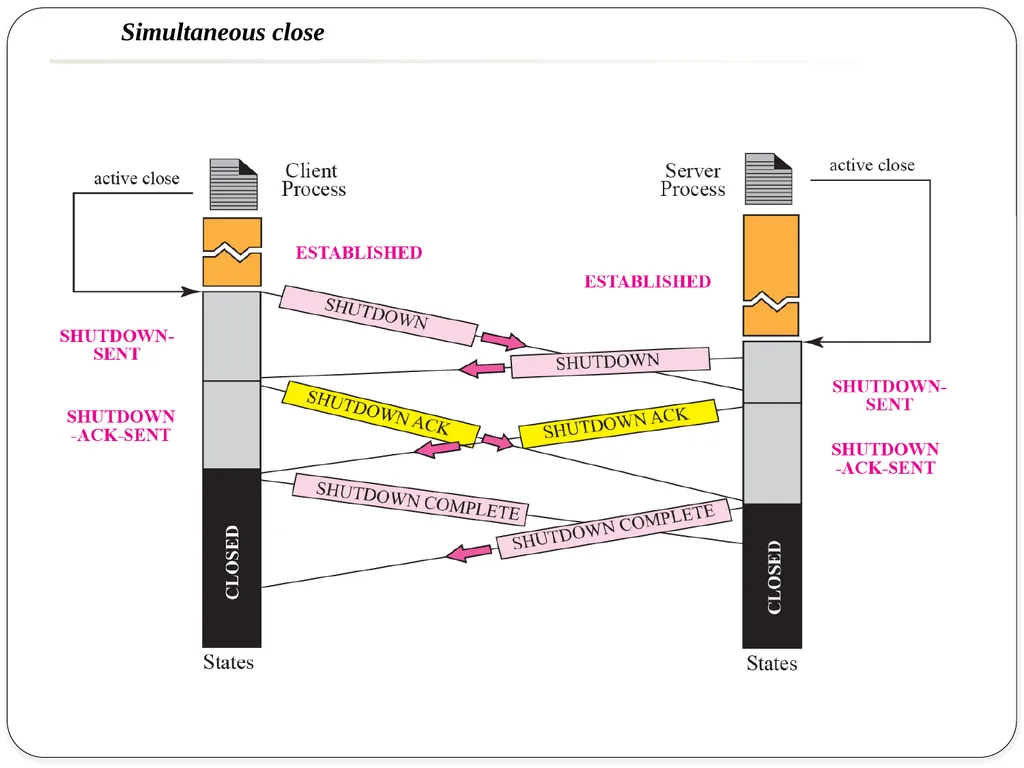
Simultaneous close<br>
41
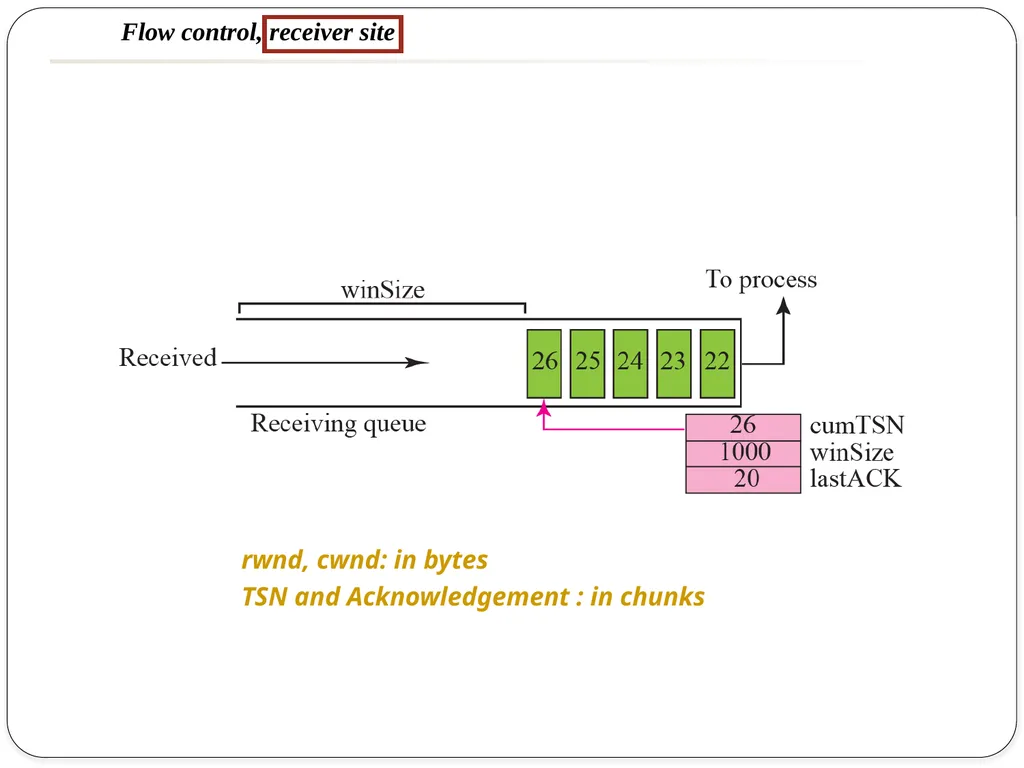
FLOW CONTROL Flow control in SCTP is similar to that in TCP. In TCP, we need to deal with only one unit of data, the byte. In SCTP, we need to handle two units of data, the byte and the chunk. The values of rwnd and cwnd are expressed in bytes; the values of TSN and acknowledgments are expressed in chunks.<br>
42
Topics Discussed in the Section Receiver Site
Sender Site
A Scenario<br>
43
Flow control, receiver site rwnd, cwnd: in bytes�TSN and Acknowledgement : in chunks<br>
44
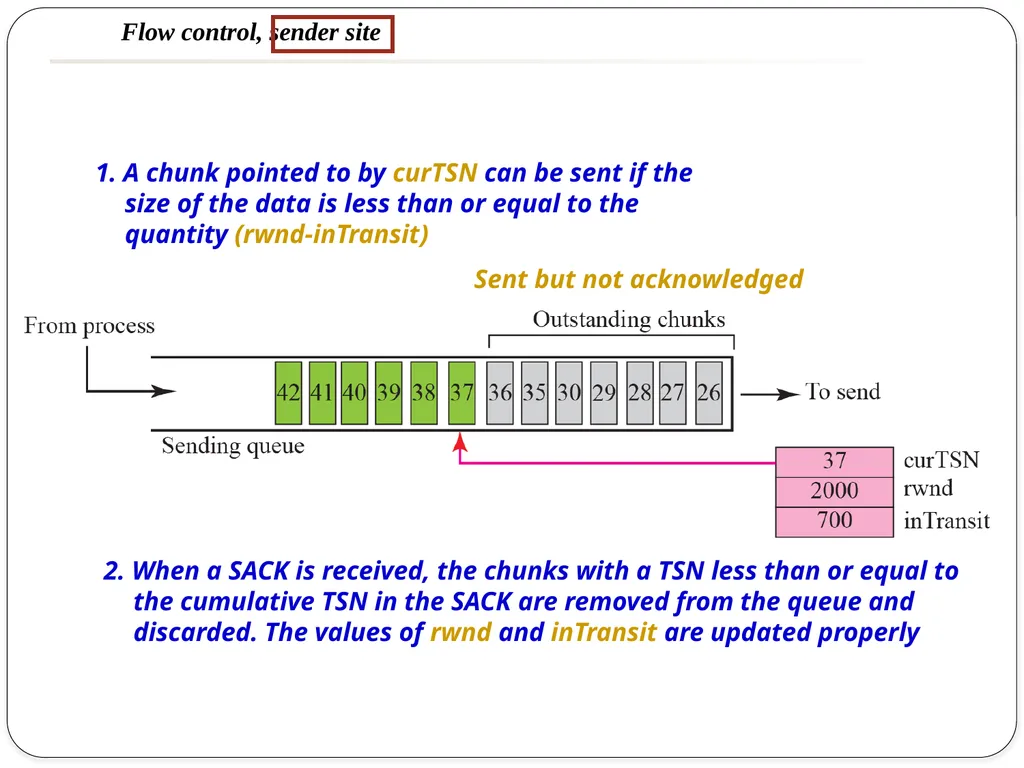
Flow control, sender site Sent but not acknowledged 1. A chunk pointed to by curTSN can be sent if the size of the data is less than or equal to the quantity (rwnd-inTransit) 2. When a SACK is received, the chunks with a TSN less than or equal to the cumulative TSN in the SACK are removed from the queue and discarded. The values of rwnd and inTransit are updated properly<br>
45
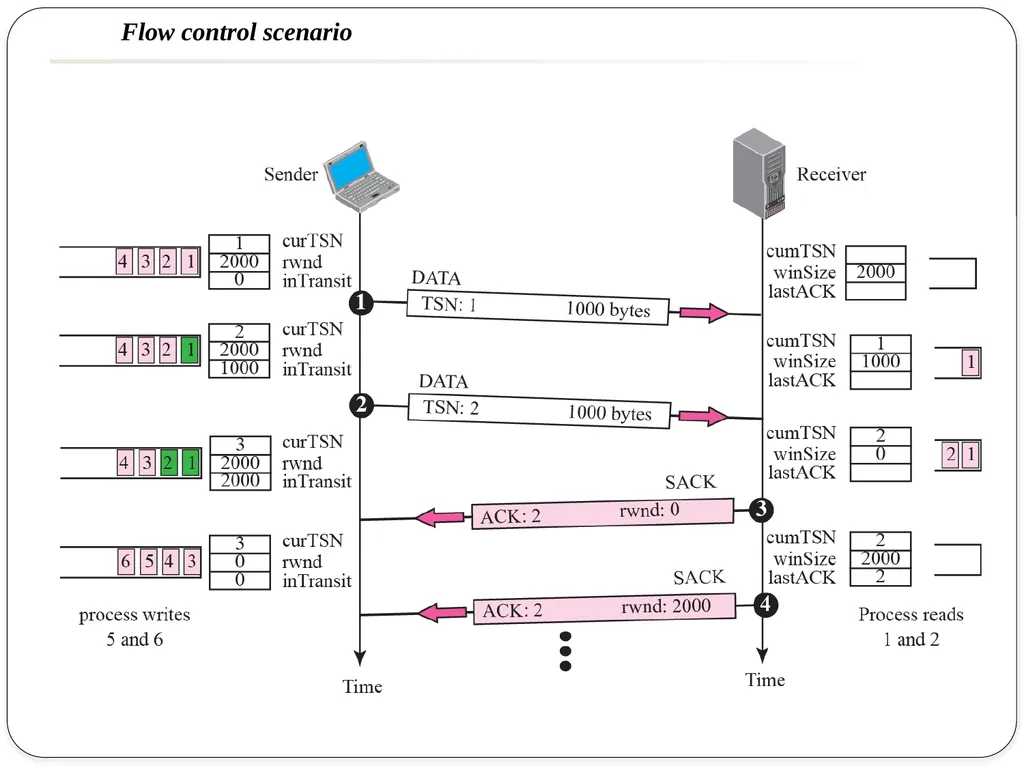
Flow control scenario<br>
46
ERROR CONTROL SCTP, like TCP, is a reliable transport-layer protocol. It uses a SACK chunk to report the state of the receiver buffer to the sender. Each implementation uses a different set of entities and timers for the receiver and sender sites. We use a very simple design to convey the concept to the reader.<br>
47
Topics Discussed in the Section Receiver Site
Sender Site
Sending Data Chunks
Generating SANK Chunks<br>
48
Error-control receiver site 1 2 3 4 5 6 7 8 9 10 11<br>
49
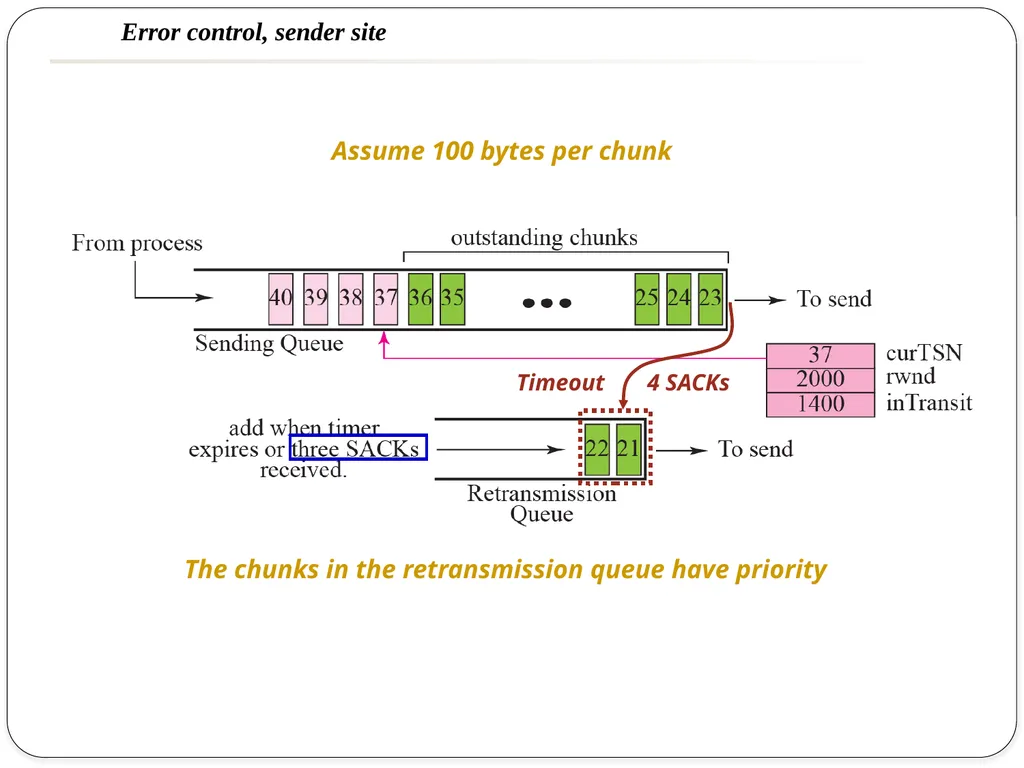
Error control, sender site Assume 100 bytes per chunk The chunks in the retransmission queue have priority Timeout 4 SACKs<br>
50
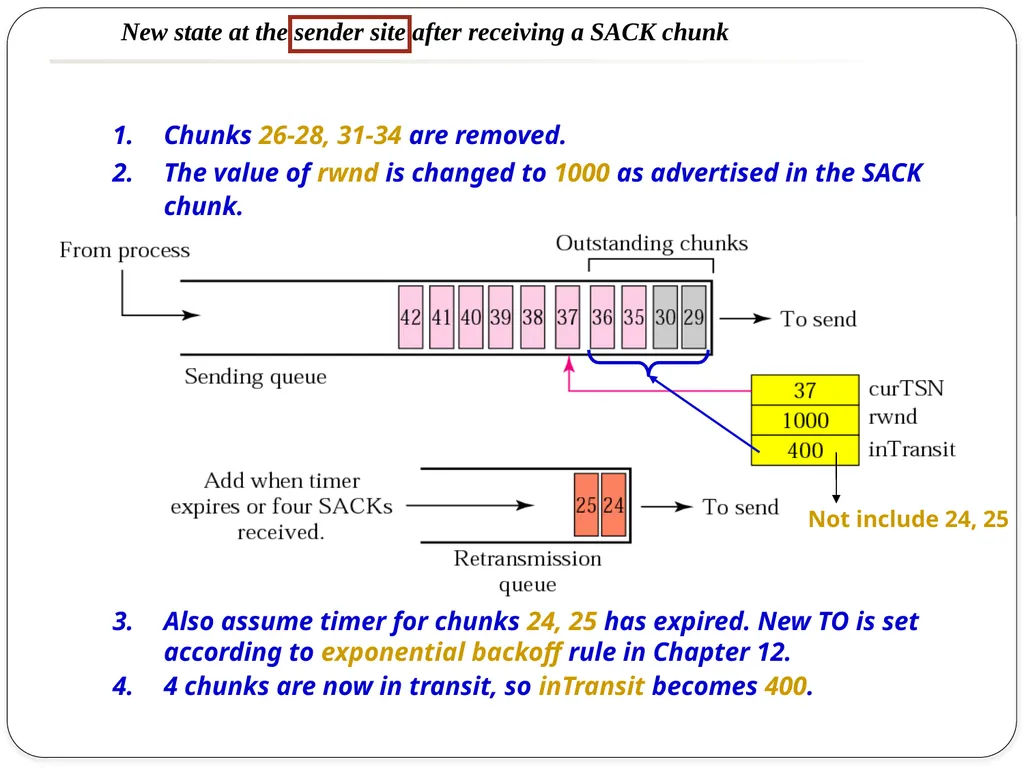
New state at the sender site after receiving a SACK chunk Chunks 26-28, 31-34 are removed.
The value of rwnd is changed to 1000 as advertised in the SACK chunk. Also assume timer for chunks 24, 25 has expired. New TO is set according to exponential backoff rule in Chapter 12.
4 chunks are now in transit, so inTransit becomes 400. Not include 24, 25<br>
51
CONGESTION CONTROL SCTP, like TCP, is a transport layer protocol with packets subject to congestion in the network. The SCTP designers have used the same strategies we described for congestion control in Chapter 15 for TCP. SCTP has slow start, congestion avoidance, and congestion detection phases. Like TCP, SCTP also uses fast retransmission and fast recovery.<br>
52
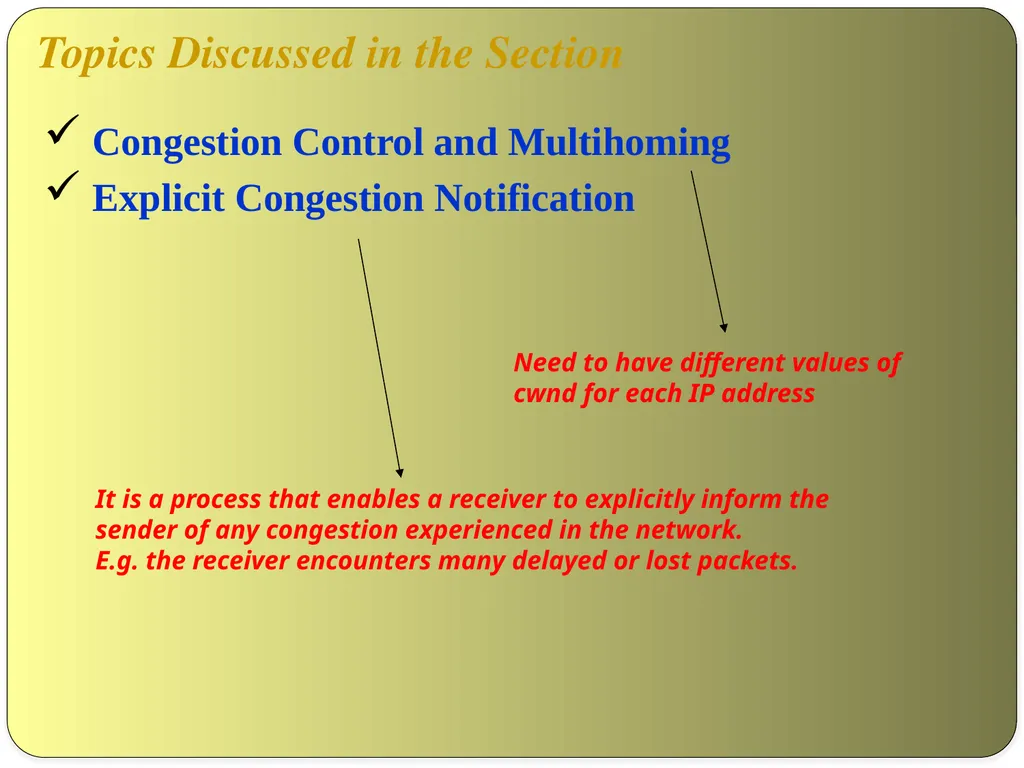
Topics Discussed in the Section Congestion Control and Multihoming
Explicit Congestion Notification Need to have different values of cwnd for each IP address It is a process that enables a receiver to explicitly inform the sender of any congestion experienced in the network.
E.g. the receiver encounters many delayed or lost packets.<br>