
NASA Science Mission Directorate Core Data and
CS
Published · 26 slides · 0 views

1 / 1

Description
NASA Science Mission Directorate Core Data and Computing Services Program Cloud Analysis and Migration (CAM) Study Kitty Sedam, Aerospace Study Lead Lea Carter, Technical Lead Kern Witcher, Sr. Technical SME Dr. Clyde Moseberry, Sr.
Related Topics
Share
Embed code
Download this presentation From Below
"NASA Science Mission Directorate Core Data and" is the property of its rightful owner. Permission is granted to download and print the materials on this website for personal, non-commercial use only, and to display it on your personal computer provided you do not modify the materials and that you retain all copyright notices contained in the materials. By downloading content from our website, you accept the terms of this agreement.
Presentation Transcript
01
NASA Science Mission Directorate
Core Data and Computing Services Program Cloud Analysis and Migration (CAM) Study Kitty Sedam, Aerospace Study Lead
Lea Carter, Technical Lead
Kern Witcher, Sr. Technical SME
Dr. Clyde Moseberry, Sr. Technical SME
Eugene Legg, Sr. Technical SME
Sheryl Olguin, Technical Consultant Raymond Woods, Sr. Cost SME
Dr. Nicholas Perlongo, Technical SME
Richard DesLonde, Technical SME
Amanda Dean, Technical Team
Anatoliy Zaremba, Technical Team
Jonathan Serdinski, Technical Team Authors from The Aerospace Corporation are as follows:<br>
Lea Carter, Technical Lead
Kern Witcher, Sr. Technical SME
Dr. Clyde Moseberry, Sr. Technical SME
Eugene Legg, Sr. Technical SME
Sheryl Olguin, Technical Consultant Raymond Woods, Sr. Cost SME
Dr. Nicholas Perlongo, Technical SME
Richard DesLonde, Technical SME
Amanda Dean, Technical Team
Anatoliy Zaremba, Technical Team
Jonathan Serdinski, Technical Team Authors from The Aerospace Corporation are as follows:<br>
02
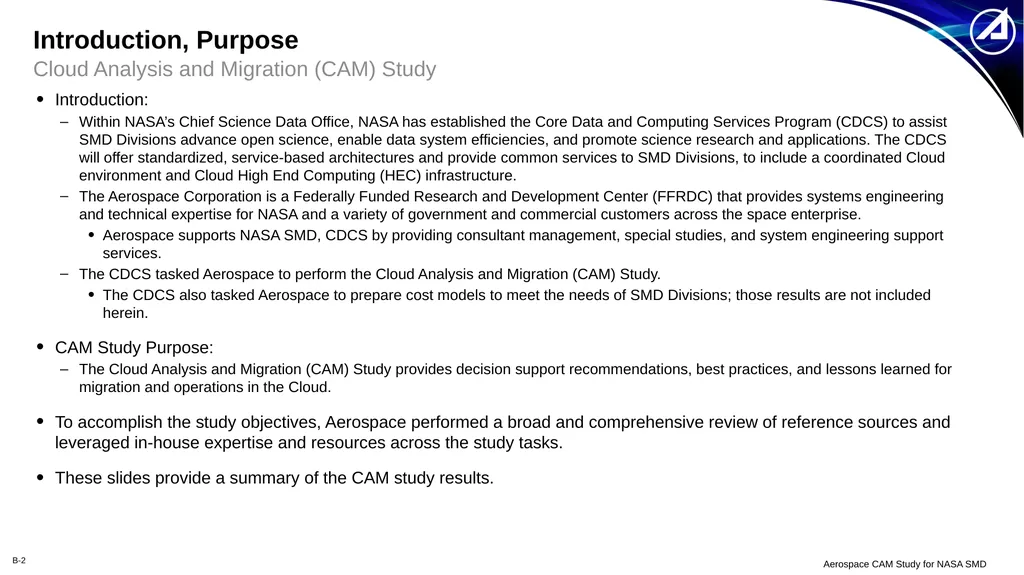
Introduction, Purpose Cloud Analysis and Migration (CAM) Study Introduction:
Within NASA’s Chief Science Data Office, NASA has established the Core Data and Computing Services Program (CDCS) to assist SMD Divisions advance open science, enable data system efficiencies, and promote science research and applications. The CDCS will offer standardized, service-based architectures and provide common services to SMD Divisions, to include a coordinated Cloud environment and Cloud High End Computing (HEC) infrastructure.
The Aerospace Corporation is a Federally Funded Research and Development Center (FFRDC) that provides systems engineering and technical expertise for NASA and a variety of government and commercial customers across the space enterprise.
Aerospace supports NASA SMD, CDCS by providing consultant management, special studies, and system engineering support services.
The CDCS tasked Aerospace to perform the Cloud Analysis and Migration (CAM) Study.
The CDCS also tasked Aerospace to prepare cost models to meet the needs of SMD Divisions; those results are not included herein.
CAM Study Purpose:
The Cloud Analysis and Migration (CAM) Study provides decision support recommendations, best practices, and lessons learned for migration and operations in the Cloud.
To accomplish the study objectives, Aerospace performed a broad and comprehensive review of reference sources and leveraged in-house expertise and resources across the study tasks.
These slides provide a summary of the CAM study results.<br>
Within NASA’s Chief Science Data Office, NASA has established the Core Data and Computing Services Program (CDCS) to assist SMD Divisions advance open science, enable data system efficiencies, and promote science research and applications. The CDCS will offer standardized, service-based architectures and provide common services to SMD Divisions, to include a coordinated Cloud environment and Cloud High End Computing (HEC) infrastructure.
The Aerospace Corporation is a Federally Funded Research and Development Center (FFRDC) that provides systems engineering and technical expertise for NASA and a variety of government and commercial customers across the space enterprise.
Aerospace supports NASA SMD, CDCS by providing consultant management, special studies, and system engineering support services.
The CDCS tasked Aerospace to perform the Cloud Analysis and Migration (CAM) Study.
The CDCS also tasked Aerospace to prepare cost models to meet the needs of SMD Divisions; those results are not included herein.
CAM Study Purpose:
The Cloud Analysis and Migration (CAM) Study provides decision support recommendations, best practices, and lessons learned for migration and operations in the Cloud.
To accomplish the study objectives, Aerospace performed a broad and comprehensive review of reference sources and leveraged in-house expertise and resources across the study tasks.
These slides provide a summary of the CAM study results.<br>
03
Reference Material Review, Assessment, and Summary
Technical Library
Policies Reference Material Review and Assessment<br>
Technical Library
Policies Reference Material Review and Assessment<br>
04
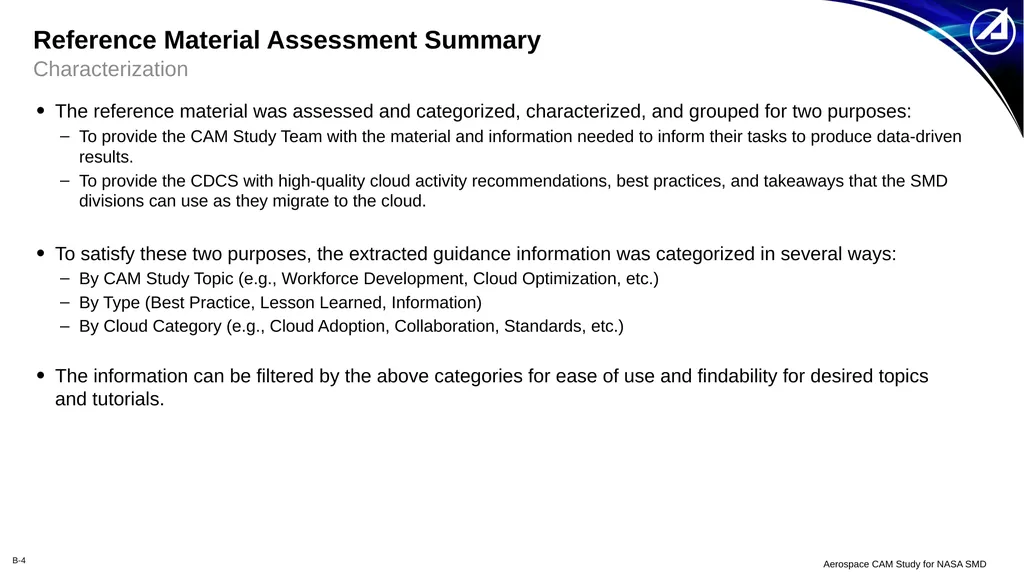
Reference Material Assessment Summary Characterization The reference material was assessed and categorized, characterized, and grouped for two purposes:
To provide the CAM Study Team with the material and information needed to inform their tasks to produce data-driven results.
To provide the CDCS with high-quality cloud activity recommendations, best practices, and takeaways that the SMD divisions can use as they migrate to the cloud.
To satisfy these two purposes, the extracted guidance information was categorized in several ways:
By CAM Study Topic (e.g., Workforce Development, Cloud Optimization, etc.)
By Type (Best Practice, Lesson Learned, Information)
By Cloud Category (e.g., Cloud Adoption, Collaboration, Standards, etc.)
The information can be filtered by the above categories for ease of use and findability for desired topics and tutorials.<br>
To provide the CAM Study Team with the material and information needed to inform their tasks to produce data-driven results.
To provide the CDCS with high-quality cloud activity recommendations, best practices, and takeaways that the SMD divisions can use as they migrate to the cloud.
To satisfy these two purposes, the extracted guidance information was categorized in several ways:
By CAM Study Topic (e.g., Workforce Development, Cloud Optimization, etc.)
By Type (Best Practice, Lesson Learned, Information)
By Cloud Category (e.g., Cloud Adoption, Collaboration, Standards, etc.)
The information can be filtered by the above categories for ease of use and findability for desired topics and tutorials.<br>
05
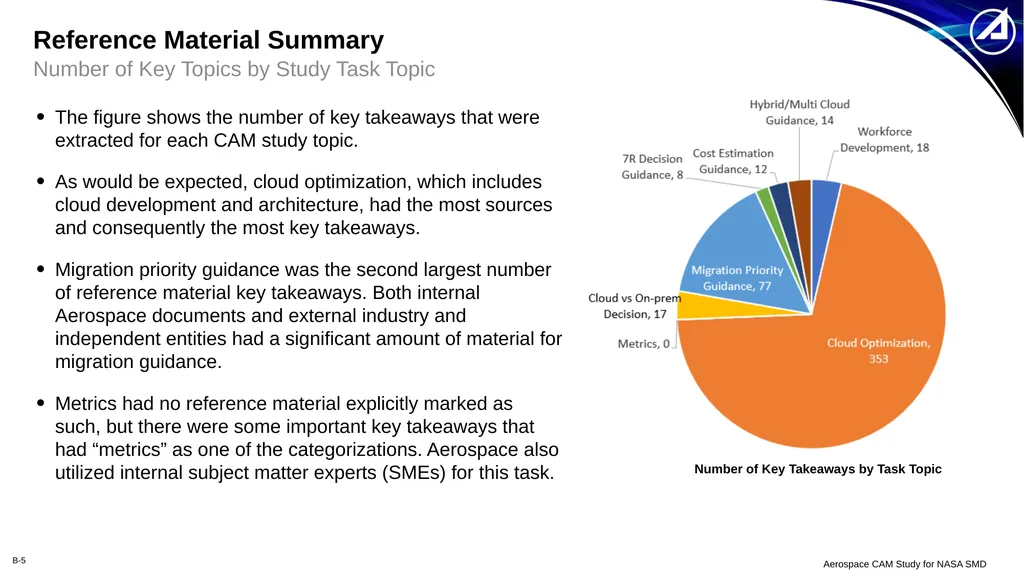
Reference Material Summary Number of Key Topics by Study Task Topic The figure shows the number of key takeaways that were extracted for each CAM study topic.
As would be expected, cloud optimization, which includes cloud development and architecture, had the most sources and consequently the most key takeaways.
Migration priority guidance was the second largest number of reference material key takeaways. Both internal Aerospace documents and external industry and independent entities had a significant amount of material for migration guidance.
Metrics had no reference material explicitly marked as such, but there were some important key takeaways that had “metrics” as one of the categorizations. Aerospace also utilized internal subject matter experts (SMEs) for this task. Number of Key Takeaways by Task Topic<br>
As would be expected, cloud optimization, which includes cloud development and architecture, had the most sources and consequently the most key takeaways.
Migration priority guidance was the second largest number of reference material key takeaways. Both internal Aerospace documents and external industry and independent entities had a significant amount of material for migration guidance.
Metrics had no reference material explicitly marked as such, but there were some important key takeaways that had “metrics” as one of the categorizations. Aerospace also utilized internal subject matter experts (SMEs) for this task. Number of Key Takeaways by Task Topic<br>
06
Policies Survey for Cloud Analysis and Migration Introduction:
As part of the CAM study, Aerospace was tasked to research and assess policies that may be of interest to NASA SMD and the CDCS for Cloud migration and operations.
Aerospace performed a survey of cloud migration and operations policies and reviewed and assessed the material to identify key takeaways.
Sources:
Federal:
CIO.gov: Federal IT policies and guidelines for ensuring compliance and standardization in cloud migration projects.
Go-Fair.org: Data management principles (FAIR) that are crucial for maintaining data integrity and accessibility during and after migration.
White House:
Guides on federal IT infrastructure and shared services, which help streamline cloud adoption across different government agencies.
Digital Government: Building a 21st Century Platform to Better Serve the American people
NASA:
Highlights security controls and best practices that are critical for protecting sensitive information in the cloud.
SMD Policy Document SPD-41a
NASA OIG - Security of NASA's Cloud Computing Services IG-17-010)
Commercial:
Architectural best practices for designing and operating secure, reliable, efficient, cost-effective, and sustainable workloads in the AWS Cloud.
Amazon Web Services: Well Architected Framework<br>
As part of the CAM study, Aerospace was tasked to research and assess policies that may be of interest to NASA SMD and the CDCS for Cloud migration and operations.
Aerospace performed a survey of cloud migration and operations policies and reviewed and assessed the material to identify key takeaways.
Sources:
Federal:
CIO.gov: Federal IT policies and guidelines for ensuring compliance and standardization in cloud migration projects.
Go-Fair.org: Data management principles (FAIR) that are crucial for maintaining data integrity and accessibility during and after migration.
White House:
Guides on federal IT infrastructure and shared services, which help streamline cloud adoption across different government agencies.
Digital Government: Building a 21st Century Platform to Better Serve the American people
NASA:
Highlights security controls and best practices that are critical for protecting sensitive information in the cloud.
SMD Policy Document SPD-41a
NASA OIG - Security of NASA's Cloud Computing Services IG-17-010)
Commercial:
Architectural best practices for designing and operating secure, reliable, efficient, cost-effective, and sustainable workloads in the AWS Cloud.
Amazon Web Services: Well Architected Framework<br>
07
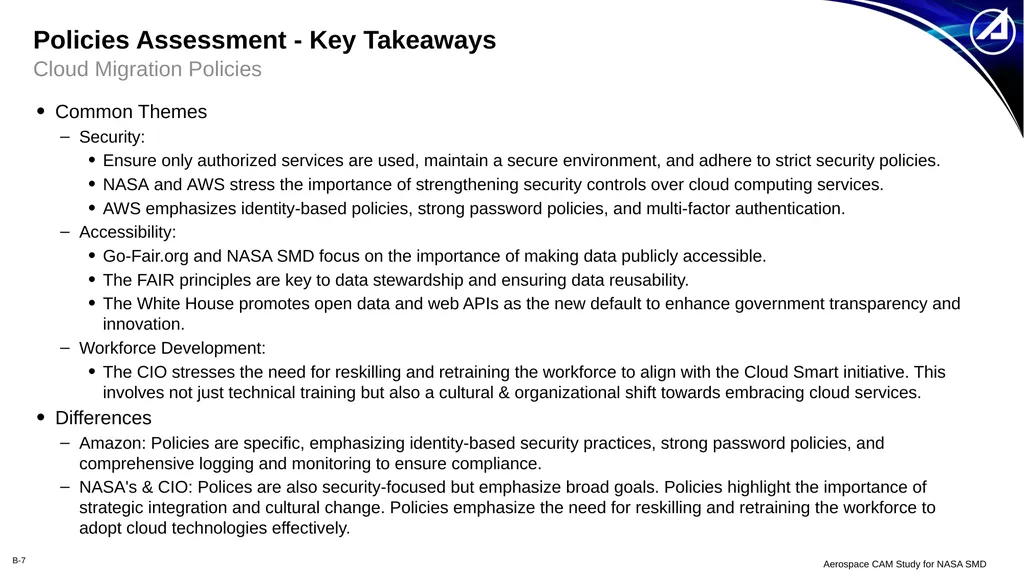
Policies Assessment - Key Takeaways Cloud Migration Policies Common Themes
Security:
Ensure only authorized services are used, maintain a secure environment, and adhere to strict security policies.
NASA and AWS stress the importance of strengthening security controls over cloud computing services.
AWS emphasizes identity-based policies, strong password policies, and multi-factor authentication.
Accessibility:
Go-Fair.org and NASA SMD focus on the importance of making data publicly accessible.
The FAIR principles are key to data stewardship and ensuring data reusability.
The White House promotes open data and web APIs as the new default to enhance government transparency and innovation.
Workforce Development:
The CIO stresses the need for reskilling and retraining the workforce to align with the Cloud Smart initiative. This involves not just technical training but also a cultural & organizational shift towards embracing cloud services.
Differences
Amazon: Policies are specific, emphasizing identity-based security practices, strong password policies, and comprehensive logging and monitoring to ensure compliance.
NASA's & CIO: Polices are also security-focused but emphasize broad goals. Policies highlight the importance of strategic integration and cultural change. Policies emphasize the need for reskilling and retraining the workforce to adopt cloud technologies effectively.<br>
Security:
Ensure only authorized services are used, maintain a secure environment, and adhere to strict security policies.
NASA and AWS stress the importance of strengthening security controls over cloud computing services.
AWS emphasizes identity-based policies, strong password policies, and multi-factor authentication.
Accessibility:
Go-Fair.org and NASA SMD focus on the importance of making data publicly accessible.
The FAIR principles are key to data stewardship and ensuring data reusability.
The White House promotes open data and web APIs as the new default to enhance government transparency and innovation.
Workforce Development:
The CIO stresses the need for reskilling and retraining the workforce to align with the Cloud Smart initiative. This involves not just technical training but also a cultural & organizational shift towards embracing cloud services.
Differences
Amazon: Policies are specific, emphasizing identity-based security practices, strong password policies, and comprehensive logging and monitoring to ensure compliance.
NASA's & CIO: Polices are also security-focused but emphasize broad goals. Policies highlight the importance of strategic integration and cultural change. Policies emphasize the need for reskilling and retraining the workforce to adopt cloud technologies effectively.<br>
08
Introduction
Migration Planning Scorecard
Observations, Best Practices, Recommendations Cloud Migration Rubric<br>
Migration Planning Scorecard
Observations, Best Practices, Recommendations Cloud Migration Rubric<br>
09
Introduction Cloud Migration Rubric Aerospace was tasked with developing a migration Rubric for deciding when to move to the Cloud and when to stay on-prem. Aerospace was asked to provide guidance and not develop a fully functional tool.
A Cloud Migration Rubric tool, designed and implemented properly, can be an effective means to help determine cloud readiness, opportunities, areas needing attention and available resources to support a cloud migration initiative.
It’s important to clearly define what the tool’s intent, capabilities and limitations are:
Supports initial assessments of candidate capabilities for migration to the cloud.
Supports potential cloud users or Subject Matter Experts (SME’s), with a minimal amount of experience, to perform migration refactor or optimization assessments.
Support more detailed system architectural decisions and/or design; the tool focuses on the what, not the how.
Provides feedback on areas where the organization is cloud “mature” as well as those areas of cloud migration that need attention.
Provides a reference back into other Community of Practice resources including best practices, technical tutorials, and training material.<br>
A Cloud Migration Rubric tool, designed and implemented properly, can be an effective means to help determine cloud readiness, opportunities, areas needing attention and available resources to support a cloud migration initiative.
It’s important to clearly define what the tool’s intent, capabilities and limitations are:
Supports initial assessments of candidate capabilities for migration to the cloud.
Supports potential cloud users or Subject Matter Experts (SME’s), with a minimal amount of experience, to perform migration refactor or optimization assessments.
Support more detailed system architectural decisions and/or design; the tool focuses on the what, not the how.
Provides feedback on areas where the organization is cloud “mature” as well as those areas of cloud migration that need attention.
Provides a reference back into other Community of Practice resources including best practices, technical tutorials, and training material.<br>
10
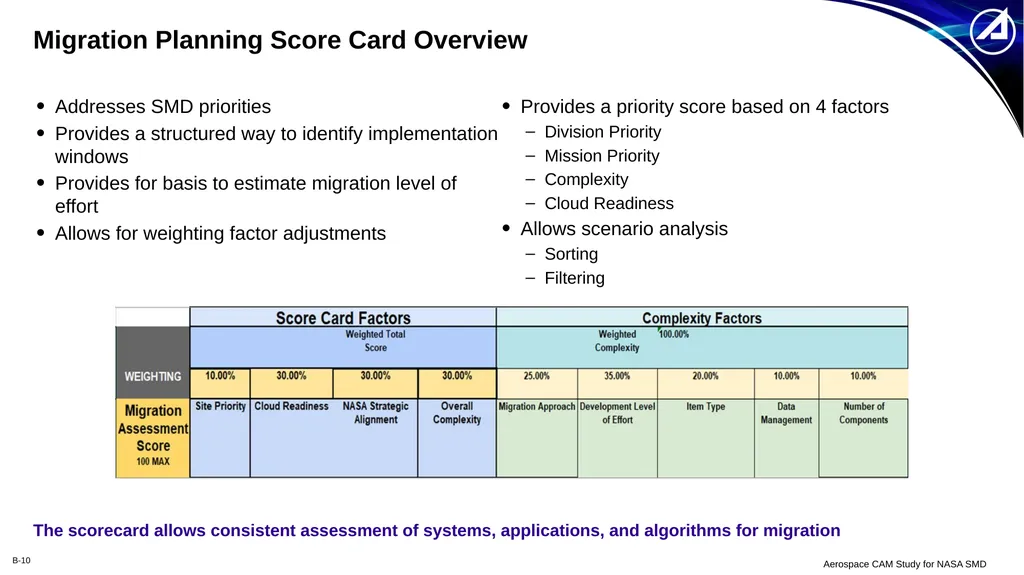
Migration Planning Score Card Overview The scorecard allows consistent assessment of systems, applications, and algorithms for migration Addresses SMD priorities
Provides a structured way to identify implementation windows
Provides for basis to estimate migration level of effort
Allows for weighting factor adjustments
Provides a priority score based on 4 factors
Division Priority
Mission Priority
Complexity
Cloud Readiness
Allows scenario analysis
Sorting
Filtering<br>
Provides a structured way to identify implementation windows
Provides for basis to estimate migration level of effort
Allows for weighting factor adjustments
Provides a priority score based on 4 factors
Division Priority
Mission Priority
Complexity
Cloud Readiness
Allows scenario analysis
Sorting
Filtering<br>
11
Rubric – Recommendations Recommendations for developing and applying a Cloud Migration Rubric Establish clear goals and success metrics. Prioritizing apps and workloads for migration depends on a thorough understanding of what the organization hopes to gain from the move.
Migrate and implement common services first as these need to be addressed in order to support the migration of all the other inventory items.
Prioritize inventory items that are determined to be critical in the systems baseline first, then essential for the preliminary roadmap. Critical items are those needed to meet the organization's mission and essential items are needed to prevent severe degradation of the mission.
When developing a quantitative decision tool to prioritize and balance the work of cloud migration, use the following criteria with adjustable weighting for a total score:
Products and services that maximize impact to mission service areas and maximize the value of data and information.
Stakeholder expectations (e.g., what have we committed to sponsors and partners, including new partner capabilities)
Partner/user readiness to migrate to the cloud.
Risk to continuity of services (e.g., sustainment and tech refreshes necessary to provide continuity)
Dependencies (e.g., predecessor activities on which other activities are dependent, spacecraft design)<br>
Migrate and implement common services first as these need to be addressed in order to support the migration of all the other inventory items.
Prioritize inventory items that are determined to be critical in the systems baseline first, then essential for the preliminary roadmap. Critical items are those needed to meet the organization's mission and essential items are needed to prevent severe degradation of the mission.
When developing a quantitative decision tool to prioritize and balance the work of cloud migration, use the following criteria with adjustable weighting for a total score:
Products and services that maximize impact to mission service areas and maximize the value of data and information.
Stakeholder expectations (e.g., what have we committed to sponsors and partners, including new partner capabilities)
Partner/user readiness to migrate to the cloud.
Risk to continuity of services (e.g., sustainment and tech refreshes necessary to provide continuity)
Dependencies (e.g., predecessor activities on which other activities are dependent, spacecraft design)<br>
12
Introduction
Cloud Optimization Domain
Cloud Development
Cloud Migration Strategy Cloud Optimization, Cloud Development and Migration Strategy Guidance<br>
Cloud Optimization Domain
Cloud Development
Cloud Migration Strategy Cloud Optimization, Cloud Development and Migration Strategy Guidance<br>
13
Introduction Cloud Optimization Cloud Optimization is comprised of three areas: Performance, Availability, and Cost.
Additional information is contained in Appendix F. Aerospace was tasked with providing recommendations for Cloud Optimization.
The task requested best practices for, “If you’re in the cloud, consider these things.”
One example noted by the customer: Identify and describe the benefits of operating in the same region for all division data (avoiding transfer cost, interoperability with other divisions, institutions or ground systems)
Optimization of Performance, Availability, and Cost
Every system owner must balance performance, availability, and costs to meet requirements and reliability within budget constraints.
In the program management domain, this is called the triple constraint. Any adjustment in one will affect the other two. A system owner is challenged to constantly adjust these constraints to maintain a balanced capability.
Cloud optimization is the ability to make a capability, in balance, operate as efficiently and effectively as possible by implementing techniques and services to get “the most bang for the buck”.
Performance and availability drive costs.
Critical to optimization is a solid set of performance and availability requirements that will establish the performance baseline.
Cloud monitoring and optimization tools are necessary to achieve optimal efficiency and effectiveness. Reference: https://www.gartner.com/en/documents/4001072<br>
Additional information is contained in Appendix F. Aerospace was tasked with providing recommendations for Cloud Optimization.
The task requested best practices for, “If you’re in the cloud, consider these things.”
One example noted by the customer: Identify and describe the benefits of operating in the same region for all division data (avoiding transfer cost, interoperability with other divisions, institutions or ground systems)
Optimization of Performance, Availability, and Cost
Every system owner must balance performance, availability, and costs to meet requirements and reliability within budget constraints.
In the program management domain, this is called the triple constraint. Any adjustment in one will affect the other two. A system owner is challenged to constantly adjust these constraints to maintain a balanced capability.
Cloud optimization is the ability to make a capability, in balance, operate as efficiently and effectively as possible by implementing techniques and services to get “the most bang for the buck”.
Performance and availability drive costs.
Critical to optimization is a solid set of performance and availability requirements that will establish the performance baseline.
Cloud monitoring and optimization tools are necessary to achieve optimal efficiency and effectiveness. Reference: https://www.gartner.com/en/documents/4001072<br>
14
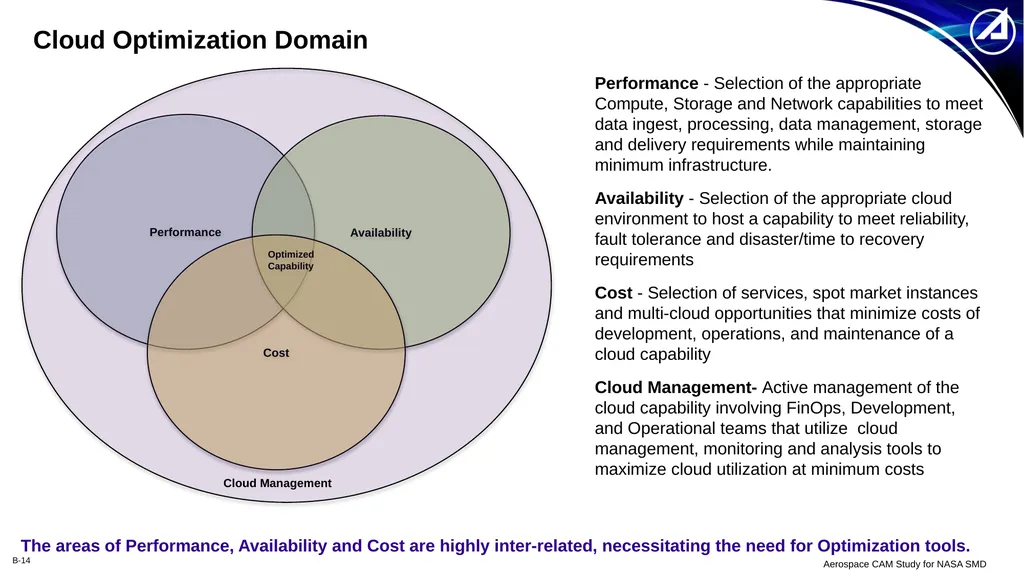
Cloud Optimization Domain The areas of Performance, Availability and Cost are highly inter-related, necessitating the need for Optimization tools. Performance Availability Cost Optimized Capability Cloud Management Performance - Selection of the appropriate Compute, Storage and Network capabilities to meet data ingest, processing, data management, storage and delivery requirements while maintaining minimum infrastructure.
Availability - Selection of the appropriate cloud environment to host a capability to meet reliability, fault tolerance and disaster/time to recovery requirements
Cost - Selection of services, spot market instances and multi-cloud opportunities that minimize costs of development, operations, and maintenance of a cloud capability
Cloud Management- Active management of the cloud capability involving FinOps, Development, and Operational teams that utilize cloud management, monitoring and analysis tools to maximize cloud utilization at minimum costs<br>
Availability - Selection of the appropriate cloud environment to host a capability to meet reliability, fault tolerance and disaster/time to recovery requirements
Cost - Selection of services, spot market instances and multi-cloud opportunities that minimize costs of development, operations, and maintenance of a cloud capability
Cloud Management- Active management of the cloud capability involving FinOps, Development, and Operational teams that utilize cloud management, monitoring and analysis tools to maximize cloud utilization at minimum costs<br>
15
Cloud Development, Migration Strategy Guidance – Introduction Aerospace was tasked to investigate best practices for cloud development activities, i.e., “What factors should be considered when making the decision for “lift and shift” versus “born in the cloud” development?”
Selecting a Cloud Migration Approach
Understanding what you aim to achieve through cloud migration is crucial. Objectives may include cost reduction, improved scalability, enhanced performance, enhanced security, or fostering innovation
Assess the needs of the system and the organization by identifying business objectives and assessing current IT infrastructure.
When considering the migration of an on-premises capability to the cloud, one of the most important decisions to be made is how the capability will utilize cloud services and capabilities.
Evaluate your existing infrastructure to determine what can be moved to the cloud and what may need to be updated or replaced.
Map out how your applications interact and depend on each other. This understanding helps in planning the migration sequence to ensure business continuity, which may constrain the migration strategy selection.<br>
Selecting a Cloud Migration Approach
Understanding what you aim to achieve through cloud migration is crucial. Objectives may include cost reduction, improved scalability, enhanced performance, enhanced security, or fostering innovation
Assess the needs of the system and the organization by identifying business objectives and assessing current IT infrastructure.
When considering the migration of an on-premises capability to the cloud, one of the most important decisions to be made is how the capability will utilize cloud services and capabilities.
Evaluate your existing infrastructure to determine what can be moved to the cloud and what may need to be updated or replaced.
Map out how your applications interact and depend on each other. This understanding helps in planning the migration sequence to ensure business continuity, which may constrain the migration strategy selection.<br>
16
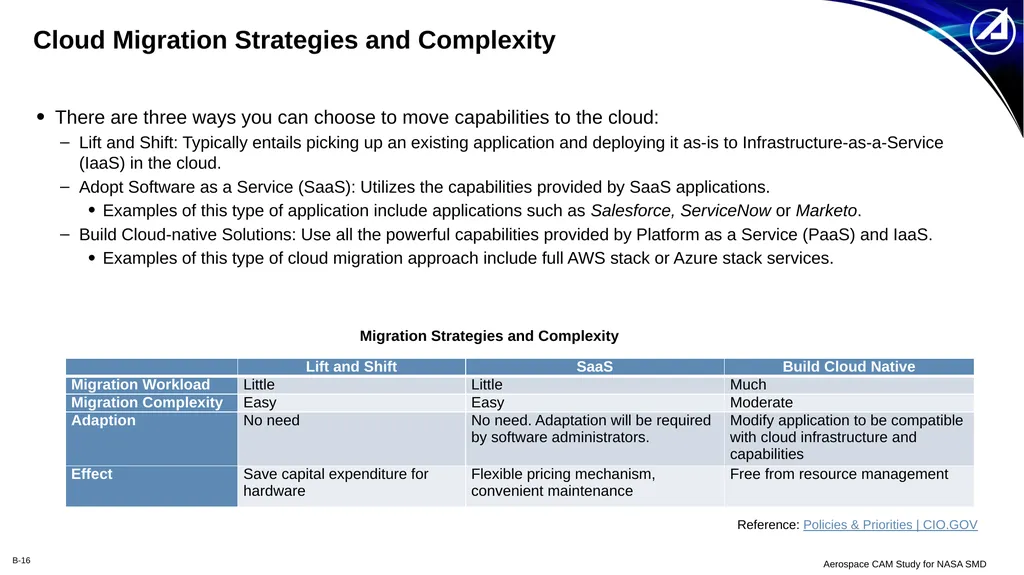
Cloud Migration Strategies and Complexity There are three ways you can choose to move capabilities to the cloud:
Lift and Shift: Typically entails picking up an existing application and deploying it as-is to Infrastructure-as-a-Service (IaaS) in the cloud.
Adopt Software as a Service (SaaS): Utilizes the capabilities provided by SaaS applications.
Examples of this type of application include applications such as Salesforce, ServiceNow or Marketo.
Build Cloud-native Solutions: Use all the powerful capabilities provided by Platform as a Service (PaaS) and IaaS.
Examples of this type of cloud migration approach include full AWS stack or Azure stack services. Reference: Policies & Priorities | CIO.GOV Migration Strategies and Complexity<br>
Lift and Shift: Typically entails picking up an existing application and deploying it as-is to Infrastructure-as-a-Service (IaaS) in the cloud.
Adopt Software as a Service (SaaS): Utilizes the capabilities provided by SaaS applications.
Examples of this type of application include applications such as Salesforce, ServiceNow or Marketo.
Build Cloud-native Solutions: Use all the powerful capabilities provided by Platform as a Service (PaaS) and IaaS.
Examples of this type of cloud migration approach include full AWS stack or Azure stack services. Reference: Policies & Priorities | CIO.GOV Migration Strategies and Complexity<br>
17
Cloud Migration – How Much and What Should be Migrated? Consider whether the entire system needs to be migrated to the cloud, or only parts of it. From this perspective there are three options:
Whole Migration: Whole or overall migration refers to the migration of the entire software stack of the application to the cloud environment.
Hybrid Migration: Refers to the migration of some applications or components, and other parts remain in the original deployment environment.
Cloud-Enabled: This is the highest level of cloud migration, but also the degree of application reconstruction and composition is the highest. It has the highest cost but also the highest return on investment. Features of cloud-enabled include:
Extends the migration scope of applications to every layer.
Can implement multiple migration and deployment methods.
There's opportunity to take advantage of cloud services to more fully adapt the application to the cloud environment.
Can implement different migration and deployment methods for different application layers or different functional components.<br>
Whole Migration: Whole or overall migration refers to the migration of the entire software stack of the application to the cloud environment.
Hybrid Migration: Refers to the migration of some applications or components, and other parts remain in the original deployment environment.
Cloud-Enabled: This is the highest level of cloud migration, but also the degree of application reconstruction and composition is the highest. It has the highest cost but also the highest return on investment. Features of cloud-enabled include:
Extends the migration scope of applications to every layer.
Can implement multiple migration and deployment methods.
There's opportunity to take advantage of cloud services to more fully adapt the application to the cloud environment.
Can implement different migration and deployment methods for different application layers or different functional components.<br>
18
Estimating Storage, Compute, and Network Resources<br>
19
Introduction Projections storage, compute and egress resources Aerospace was tasked with providing a guide for estimating projections of storage, compute, and network (ingress and egress) resources as well as the comprehensive cost of migrating existing, on-premises systems.
Contents:
Overview
Migration Best Practices and Recommendations
Cost Management Best Practices and Recommendations
Right-Sizing Best Practices and Recommendations<br>
Contents:
Overview
Migration Best Practices and Recommendations
Cost Management Best Practices and Recommendations
Right-Sizing Best Practices and Recommendations<br>
20
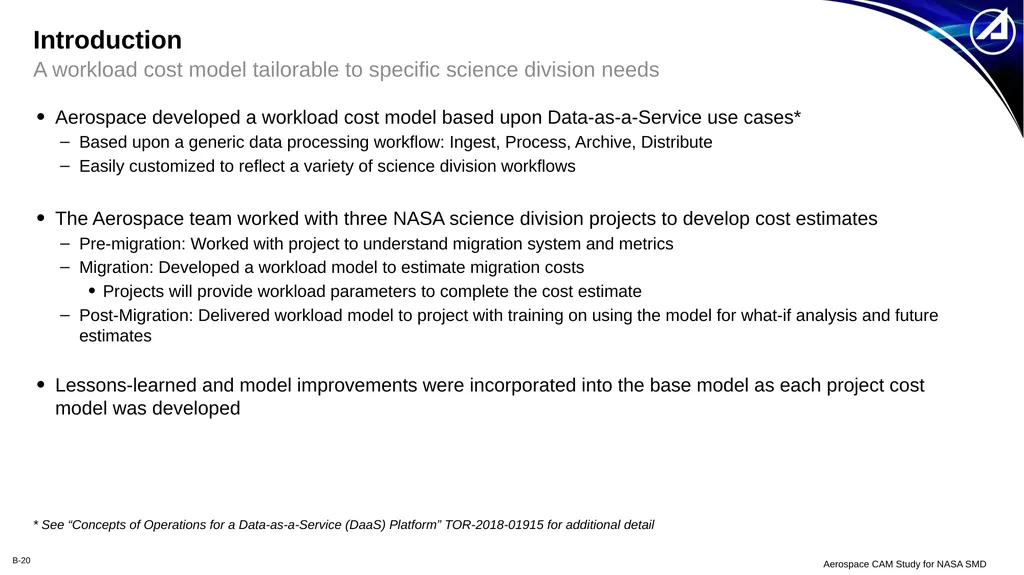
Introduction A workload cost model tailorable to specific science division needs Aerospace developed a workload cost model based upon Data-as-a-Service use cases*
Based upon a generic data processing workflow: Ingest, Process, Archive, Distribute
Easily customized to reflect a variety of science division workflows
The Aerospace team worked with three NASA science division projects to develop cost estimates
Pre-migration: Worked with project to understand migration system and metrics
Migration: Developed a workload model to estimate migration costs
Projects will provide workload parameters to complete the cost estimate
Post-Migration: Delivered workload model to project with training on using the model for what-if analysis and future estimates
Lessons-learned and model improvements were incorporated into the base model as each project cost model was developed * See “Concepts of Operations for a Data-as-a-Service (DaaS) Platform” TOR-2018-01915 for additional detail<br>
Based upon a generic data processing workflow: Ingest, Process, Archive, Distribute
Easily customized to reflect a variety of science division workflows
The Aerospace team worked with three NASA science division projects to develop cost estimates
Pre-migration: Worked with project to understand migration system and metrics
Migration: Developed a workload model to estimate migration costs
Projects will provide workload parameters to complete the cost estimate
Post-Migration: Delivered workload model to project with training on using the model for what-if analysis and future estimates
Lessons-learned and model improvements were incorporated into the base model as each project cost model was developed * See “Concepts of Operations for a Data-as-a-Service (DaaS) Platform” TOR-2018-01915 for additional detail<br>
21
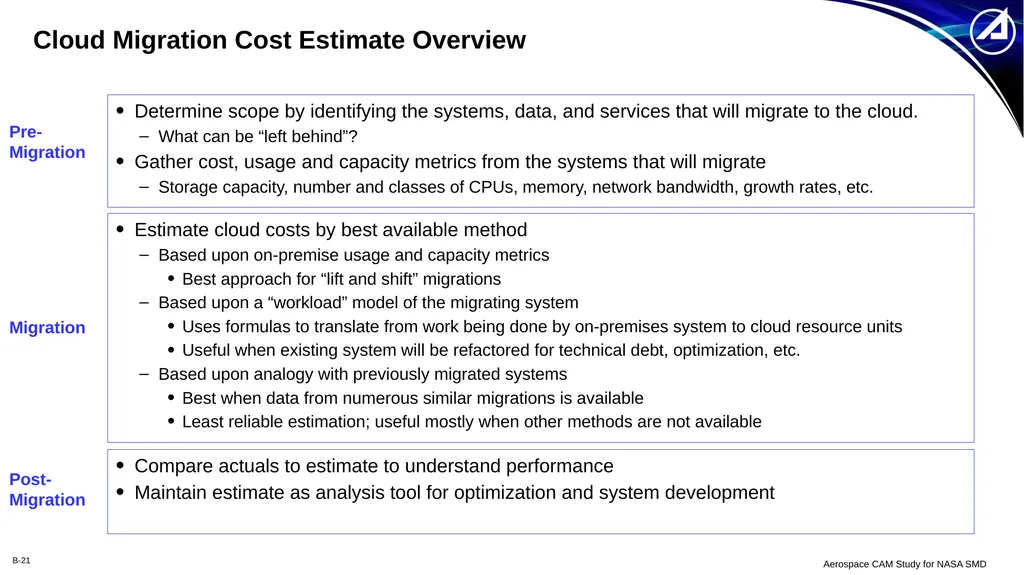
Cloud Migration Cost Estimate Overview Determine scope by identifying the systems, data, and services that will migrate to the cloud.
What can be “left behind”?
Gather cost, usage and capacity metrics from the systems that will migrate
Storage capacity, number and classes of CPUs, memory, network bandwidth, growth rates, etc. Estimate cloud costs by best available method
Based upon on-premise usage and capacity metrics
Best approach for “lift and shift” migrations
Based upon a “workload” model of the migrating system
Uses formulas to translate from work being done by on-premises system to cloud resource units
Useful when existing system will be refactored for technical debt, optimization, etc.
Based upon analogy with previously migrated systems
Best when data from numerous similar migrations is available
Least reliable estimation; useful mostly when other methods are not available Compare actuals to estimate to understand performance
Maintain estimate as analysis tool for optimization and system development Pre-Migration Post-Migration Migration<br>
What can be “left behind”?
Gather cost, usage and capacity metrics from the systems that will migrate
Storage capacity, number and classes of CPUs, memory, network bandwidth, growth rates, etc. Estimate cloud costs by best available method
Based upon on-premise usage and capacity metrics
Best approach for “lift and shift” migrations
Based upon a “workload” model of the migrating system
Uses formulas to translate from work being done by on-premises system to cloud resource units
Useful when existing system will be refactored for technical debt, optimization, etc.
Based upon analogy with previously migrated systems
Best when data from numerous similar migrations is available
Least reliable estimation; useful mostly when other methods are not available Compare actuals to estimate to understand performance
Maintain estimate as analysis tool for optimization and system development Pre-Migration Post-Migration Migration<br>
22
Cloud Migration Best Practices Comprehensive Cloud Cost Estimation Capture all migration costs beyond the initial transition to the cloud Migration cost modeling should consider the entire scope of all the systems to be migrated. Migration costs extend beyond the individual systems to other enterprise areas such as legal, compliance, policies, system dependencies and connections.
The Work Breakdown Structure (WBS) for migrating each system is the primary source for developing the comprehensive cost estimate.
When estimating cloud migration cost, keep in mind the effort to convert the software from the development system to the target system, the target system experience of the development team, the reusability level required of the software after migration, the time and performance constraints on the software, and security requirements.
Migration costs and needs vary across project migrations and should be well defined. It is important to also note that the costs of migration stretch beyond the initial costs, with cloud maintenance and staff training naturally following.
Evaluate cloud services in the context of your requirements. Understand which cloud services best support the architecture and current business requirements.<br>
The Work Breakdown Structure (WBS) for migrating each system is the primary source for developing the comprehensive cost estimate.
When estimating cloud migration cost, keep in mind the effort to convert the software from the development system to the target system, the target system experience of the development team, the reusability level required of the software after migration, the time and performance constraints on the software, and security requirements.
Migration costs and needs vary across project migrations and should be well defined. It is important to also note that the costs of migration stretch beyond the initial costs, with cloud maintenance and staff training naturally following.
Evaluate cloud services in the context of your requirements. Understand which cloud services best support the architecture and current business requirements.<br>
23
Cloud Migration Recommendations Comprehensive Cloud Cost Estimation Gather comprehensive information across the enterprise to create an accurate estimate of migration costs Perform a thorough inventory of all systems and data to be migrated to get an estimated full scope of work to be done and a basis for projecting future cost at the division level. An enterprise-level review of migration requirements will provide a much more accurate picture of the work to be done.
Ensure all on-premises systems have architecture diagrams and technical documentation. If they do not exist, we recommend developing documentation as part of the migration.
Perform an overall analysis of all systems to be migrated. Decomposing all systems leads to identification of shared and reusable common services, speeding up deployment and resulting in cost efficiencies.
When collecting system inventory information, gather only what is needed to perform ROM prioritization, planning, scheduling, and cost estimations. Gathering more information than is needed could significantly delay migration as the project stalls in information collection.
When collecting system inventory information, collect it into a normalized database-like format (e.g., a spreadsheet) that will lend itself to objective data analysis. If the information is gathered haphazardly, it will be difficult to analyze it. For example, record data store volume consistently, such as in GB or TB, and use consistent multiselect or mutually exclusive “options” when recording system properties.<br>
Ensure all on-premises systems have architecture diagrams and technical documentation. If they do not exist, we recommend developing documentation as part of the migration.
Perform an overall analysis of all systems to be migrated. Decomposing all systems leads to identification of shared and reusable common services, speeding up deployment and resulting in cost efficiencies.
When collecting system inventory information, gather only what is needed to perform ROM prioritization, planning, scheduling, and cost estimations. Gathering more information than is needed could significantly delay migration as the project stalls in information collection.
When collecting system inventory information, collect it into a normalized database-like format (e.g., a spreadsheet) that will lend itself to objective data analysis. If the information is gathered haphazardly, it will be difficult to analyze it. For example, record data store volume consistently, such as in GB or TB, and use consistent multiselect or mutually exclusive “options” when recording system properties.<br>
24
Right-Sizing Recommendations Comprehensive Cloud Cost Estimation The key to cost management is to minimize unused resources Establish automated monitoring and alerting mechanisms that can help identify unused or idle resources so they can be reduced or eliminated.
Establish automated scaling and throttling mechanisms that trigger when configured metrics are reached.
Take advantage of cost-saving plans that CSPs offer for things like reserved instances, spot instances, and volume instances.
Optimize storage by implementing data storage lifecycle policies to manage data storage costs effectively.<br>
Establish automated scaling and throttling mechanisms that trigger when configured metrics are reached.
Take advantage of cost-saving plans that CSPs offer for things like reserved instances, spot instances, and volume instances.
Optimize storage by implementing data storage lifecycle policies to manage data storage costs effectively.<br>
25
Questions, Discussion?<br>
26
Thank you<br>