
National Data Analytics Solution July 2021
MT
Published · 24 slides · 0 views
1 / 1
Description
National Data Analytics Solution July 2021 Organised Exploitation Case Studies Ethics Committee Ethics Committee Feedback re OE (January 2021): The suggested major amendment is, in terms of the project proposal papers, a substantive
Related Topics
Share
Embed code
Download this presentation From Below
"National Data Analytics Solution July 2021" is the property of its rightful owner. Permission is granted to download and print the materials on this website for personal, non-commercial use only, and to display it on your personal computer provided you do not modify the materials and that you retain all copyright notices contained in the materials. By downloading content from our website, you accept the terms of this agreement.
Presentation Transcript
01
National Data Analytics Solution July 2021 Organised Exploitation Case Studies
Ethics Committee<br>
Ethics Committee<br>
02
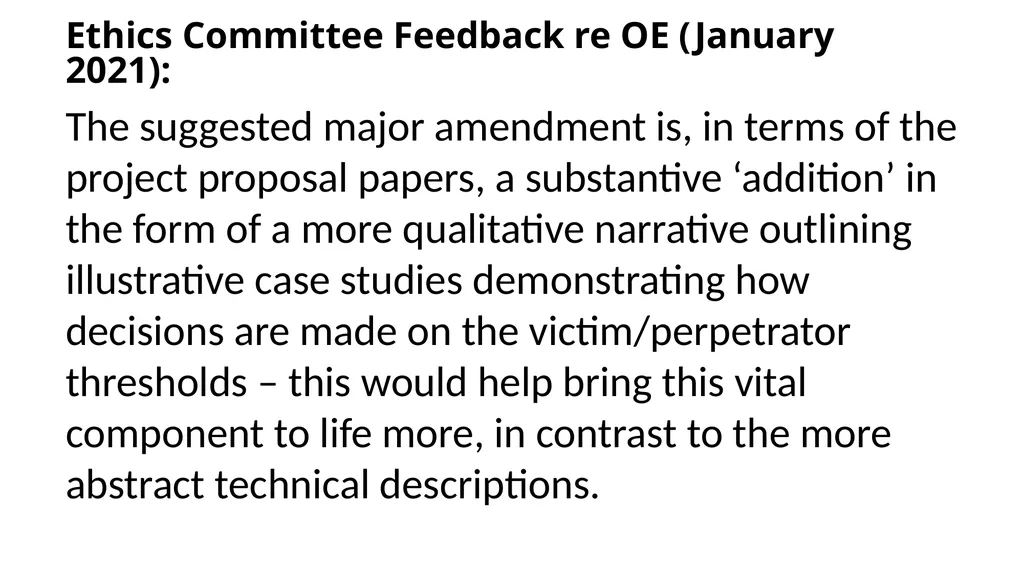
Ethics Committee Feedback re OE (January 2021): The suggested major amendment is, in terms of the project proposal papers, a substantive ‘addition’ in the form of a more qualitative narrative outlining illustrative case studies demonstrating how decisions are made on the victim/perpetrator thresholds – this would help bring this vital component to life more, in contrast to the more abstract technical descriptions.<br>
03
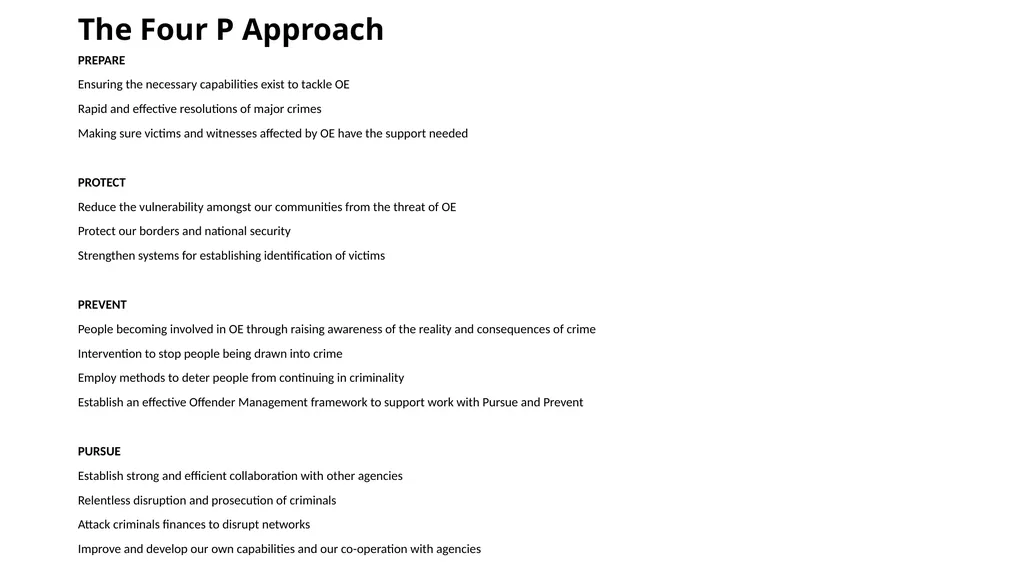
The Four P Approach PREPARE
Ensuring the necessary capabilities exist to tackle OE
Rapid and effective resolutions of major crimes
Making sure victims and witnesses affected by OE have the support needed
PROTECT
Reduce the vulnerability amongst our communities from the threat of OE
Protect our borders and national security
Strengthen systems for establishing identification of victims
PREVENT
People becoming involved in OE through raising awareness of the reality and consequences of crime
Intervention to stop people being drawn into crime
Employ methods to deter people from continuing in criminality
Establish an effective Offender Management framework to support work with Pursue and Prevent
PURSUE
Establish strong and efficient collaboration with other agencies
Relentless disruption and prosecution of criminals
Attack criminals finances to disrupt networks
Improve and develop our own capabilities and our co-operation with agencies<br>
Ensuring the necessary capabilities exist to tackle OE
Rapid and effective resolutions of major crimes
Making sure victims and witnesses affected by OE have the support needed
PROTECT
Reduce the vulnerability amongst our communities from the threat of OE
Protect our borders and national security
Strengthen systems for establishing identification of victims
PREVENT
People becoming involved in OE through raising awareness of the reality and consequences of crime
Intervention to stop people being drawn into crime
Employ methods to deter people from continuing in criminality
Establish an effective Offender Management framework to support work with Pursue and Prevent
PURSUE
Establish strong and efficient collaboration with other agencies
Relentless disruption and prosecution of criminals
Attack criminals finances to disrupt networks
Improve and develop our own capabilities and our co-operation with agencies<br>
04
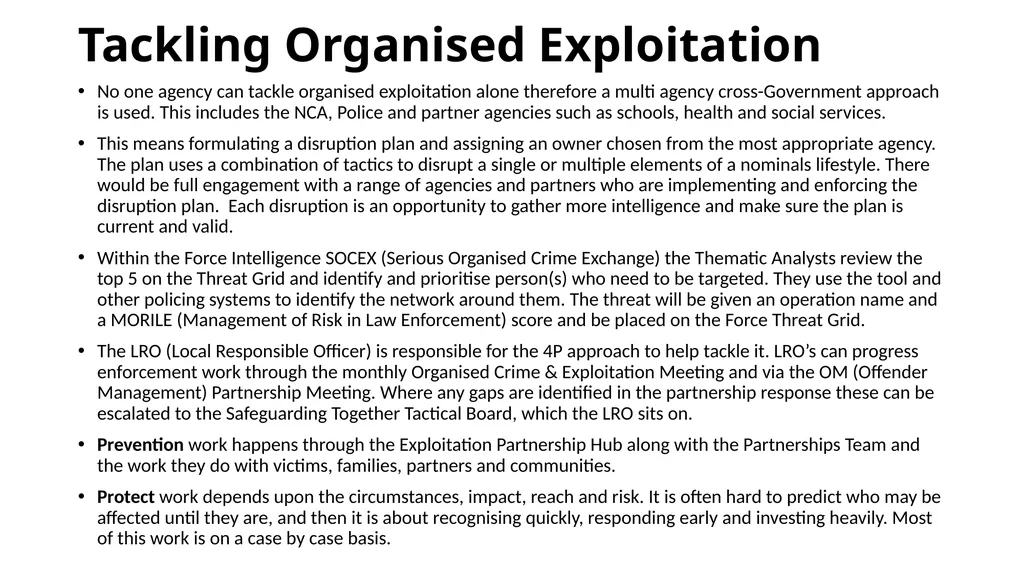
Tackling Organised Exploitation No one agency can tackle organised exploitation alone therefore a multi agency cross-Government approach is used. This includes the NCA, Police and partner agencies such as schools, health and social services.
This means formulating a disruption plan and assigning an owner chosen from the most appropriate agency. The plan uses a combination of tactics to disrupt a single or multiple elements of a nominals lifestyle. There would be full engagement with a range of agencies and partners who are implementing and enforcing the disruption plan. Each disruption is an opportunity to gather more intelligence and make sure the plan is current and valid.
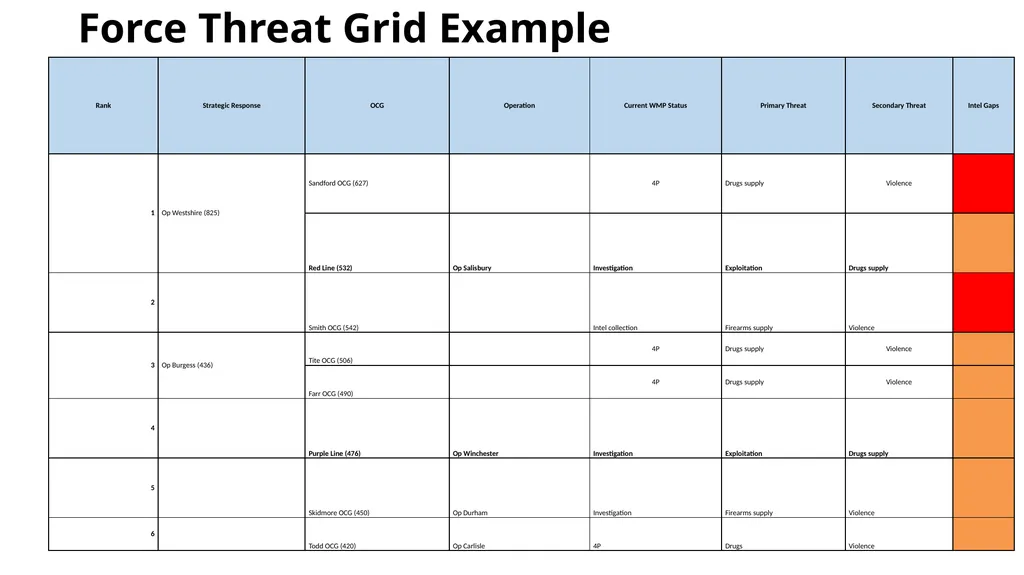
Within the Force Intelligence SOCEX (Serious Organised Crime Exchange) the Thematic Analysts review the top 5 on the Threat Grid and identify and prioritise person(s) who need to be targeted. They use the tool and other policing systems to identify the network around them. The threat will be given an operation name and a MORILE (Management of Risk in Law Enforcement) score and be placed on the Force Threat Grid.
The LRO (Local Responsible Officer) is responsible for the 4P approach to help tackle it. LRO’s can progress enforcement work through the monthly Organised Crime & Exploitation Meeting and via the OM (Offender Management) Partnership Meeting. Where any gaps are identified in the partnership response these can be escalated to the Safeguarding Together Tactical Board, which the LRO sits on.
Prevention work happens through the Exploitation Partnership Hub along with the Partnerships Team and the work they do with victims, families, partners and communities.
Protect work depends upon the circumstances, impact, reach and risk. It is often hard to predict who may be affected until they are, and then it is about recognising quickly, responding early and investing heavily. Most of this work is on a case by case basis.<br>
This means formulating a disruption plan and assigning an owner chosen from the most appropriate agency. The plan uses a combination of tactics to disrupt a single or multiple elements of a nominals lifestyle. There would be full engagement with a range of agencies and partners who are implementing and enforcing the disruption plan. Each disruption is an opportunity to gather more intelligence and make sure the plan is current and valid.
Within the Force Intelligence SOCEX (Serious Organised Crime Exchange) the Thematic Analysts review the top 5 on the Threat Grid and identify and prioritise person(s) who need to be targeted. They use the tool and other policing systems to identify the network around them. The threat will be given an operation name and a MORILE (Management of Risk in Law Enforcement) score and be placed on the Force Threat Grid.
The LRO (Local Responsible Officer) is responsible for the 4P approach to help tackle it. LRO’s can progress enforcement work through the monthly Organised Crime & Exploitation Meeting and via the OM (Offender Management) Partnership Meeting. Where any gaps are identified in the partnership response these can be escalated to the Safeguarding Together Tactical Board, which the LRO sits on.
Prevention work happens through the Exploitation Partnership Hub along with the Partnerships Team and the work they do with victims, families, partners and communities.
Protect work depends upon the circumstances, impact, reach and risk. It is often hard to predict who may be affected until they are, and then it is about recognising quickly, responding early and investing heavily. Most of this work is on a case by case basis.<br>
05
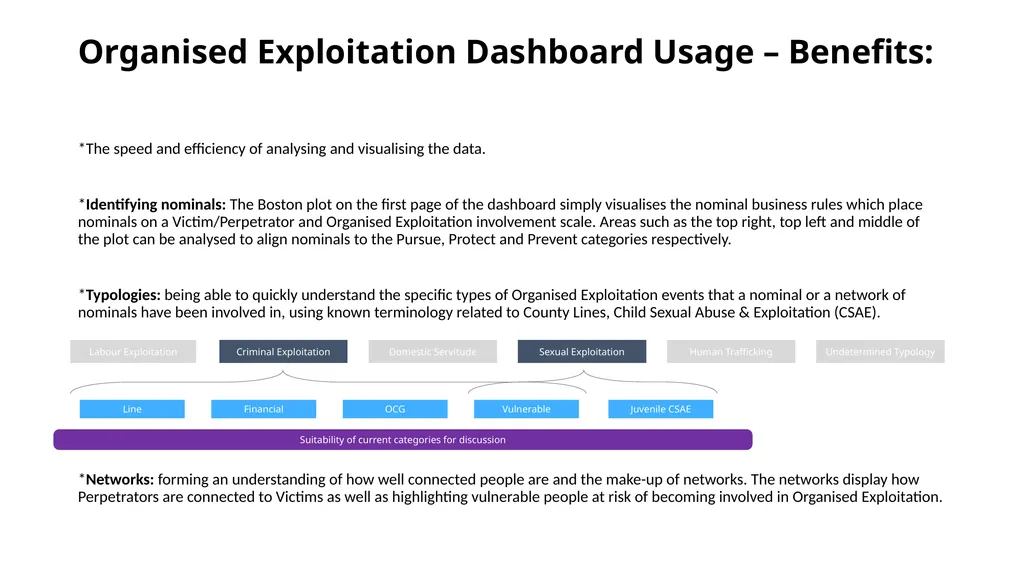
Organised Exploitation Dashboard Usage – Benefits: *The speed and efficiency of analysing and visualising the data.
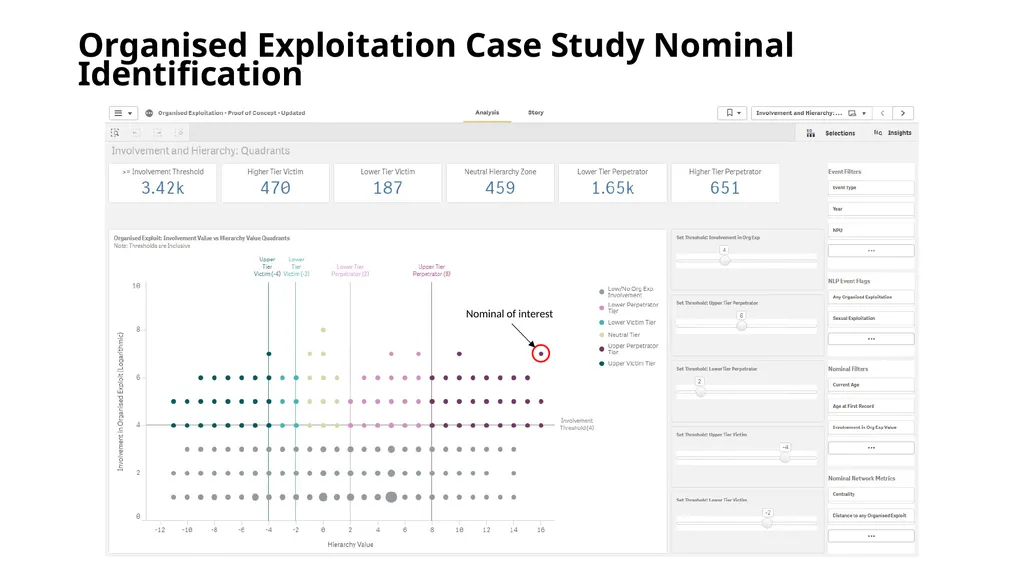
*Identifying nominals: The Boston plot on the first page of the dashboard simply visualises the nominal business rules which place nominals on a Victim/Perpetrator and Organised Exploitation involvement scale. Areas such as the top right, top left and middle of the plot can be analysed to align nominals to the Pursue, Protect and Prevent categories respectively.
*Typologies: being able to quickly understand the specific types of Organised Exploitation events that a nominal or a network of nominals have been involved in, using known terminology related to County Lines, Child Sexual Abuse & Exploitation (CSAE).
*Networks: forming an understanding of how well connected people are and the make-up of networks. The networks display how Perpetrators are connected to Victims as well as highlighting vulnerable people at risk of becoming involved in Organised Exploitation. Criminal Exploitation Sexual Exploitation Domestic Servitude Labour Exploitation Undetermined Typology Human Trafficking Line Financial OCG Juvenile CSAE Vulnerable Suitability of current categories for discussion<br>
*Identifying nominals: The Boston plot on the first page of the dashboard simply visualises the nominal business rules which place nominals on a Victim/Perpetrator and Organised Exploitation involvement scale. Areas such as the top right, top left and middle of the plot can be analysed to align nominals to the Pursue, Protect and Prevent categories respectively.
*Typologies: being able to quickly understand the specific types of Organised Exploitation events that a nominal or a network of nominals have been involved in, using known terminology related to County Lines, Child Sexual Abuse & Exploitation (CSAE).
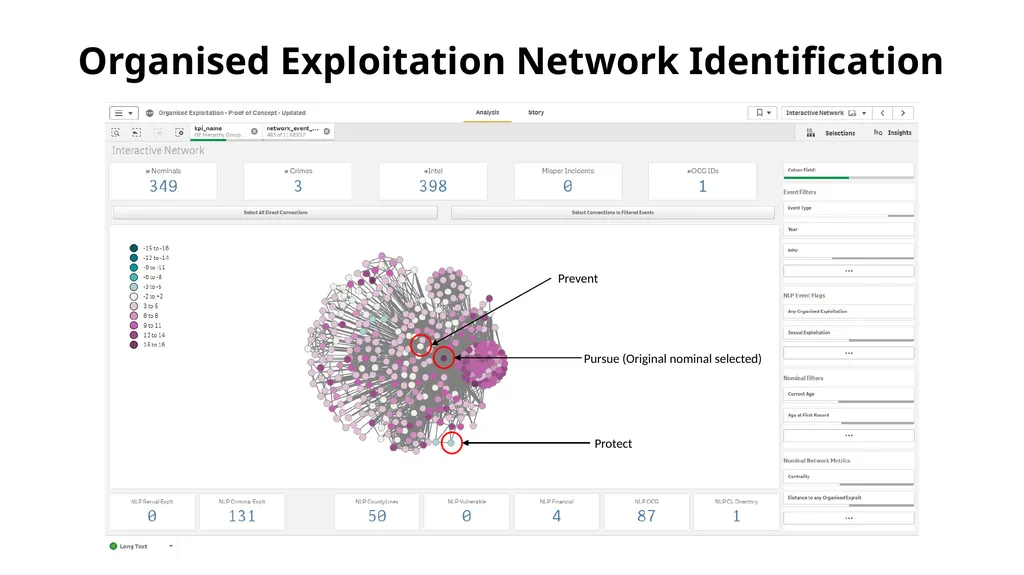
*Networks: forming an understanding of how well connected people are and the make-up of networks. The networks display how Perpetrators are connected to Victims as well as highlighting vulnerable people at risk of becoming involved in Organised Exploitation. Criminal Exploitation Sexual Exploitation Domestic Servitude Labour Exploitation Undetermined Typology Human Trafficking Line Financial OCG Juvenile CSAE Vulnerable Suitability of current categories for discussion<br>
06
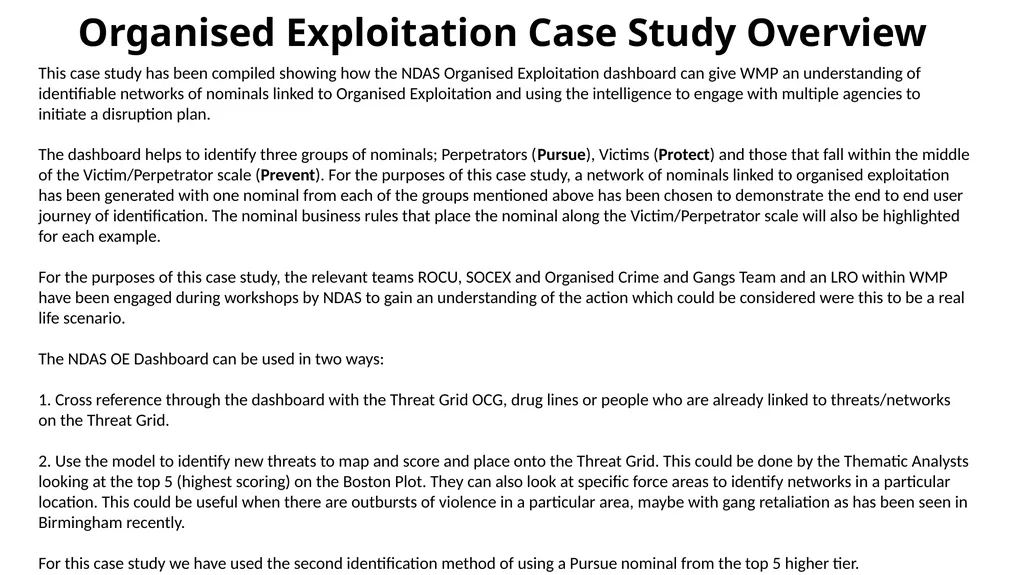
Organised Exploitation Case Study Overview This case study has been compiled showing how the NDAS Organised Exploitation dashboard can give WMP an understanding of identifiable networks of nominals linked to Organised Exploitation and using the intelligence to engage with multiple agencies to initiate a disruption plan.
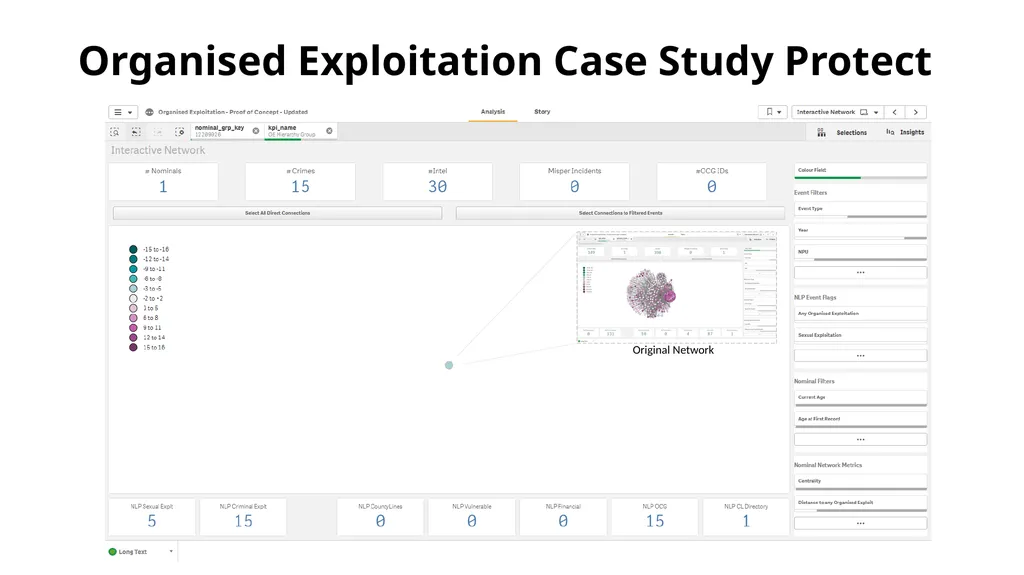
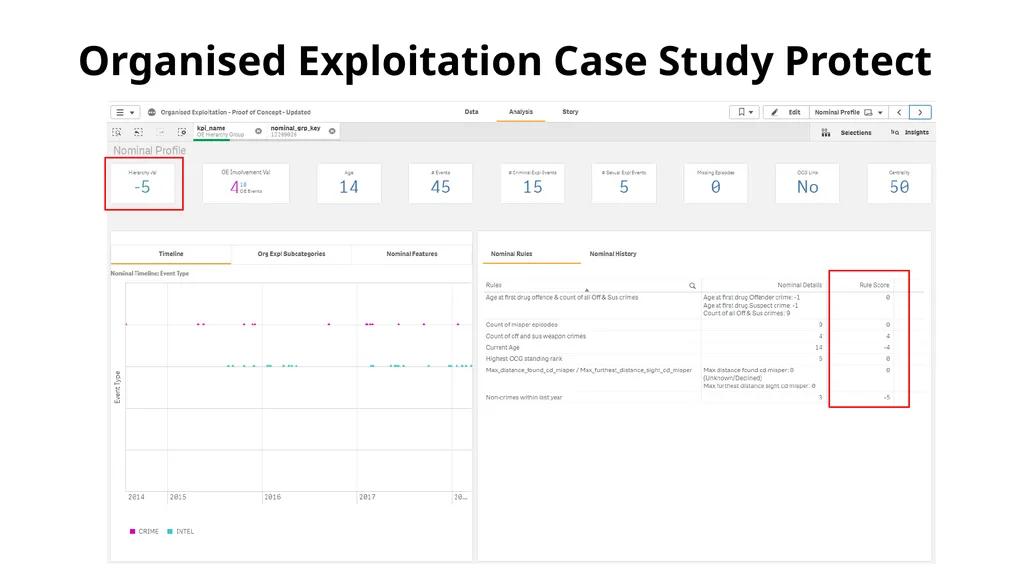
The dashboard helps to identify three groups of nominals; Perpetrators (Pursue), Victims (Protect) and those that fall within the middle of the Victim/Perpetrator scale (Prevent). For the purposes of this case study, a network of nominals linked to organised exploitation has been generated with one nominal from each of the groups mentioned above has been chosen to demonstrate the end to end user journey of identification. The nominal business rules that place the nominal along the Victim/Perpetrator scale will also be highlighted for each example.
For the purposes of this case study, the relevant teams ROCU, SOCEX and Organised Crime and Gangs Team and an LRO within WMP have been engaged during workshops by NDAS to gain an understanding of the action which could be considered were this to be a real life scenario.
The NDAS OE Dashboard can be used in two ways:
1. Cross reference through the dashboard with the Threat Grid OCG, drug lines or people who are already linked to threats/networks on the Threat Grid.
2. Use the model to identify new threats to map and score and place onto the Threat Grid. This could be done by the Thematic Analysts looking at the top 5 (highest scoring) on the Boston Plot. They can also look at specific force areas to identify networks in a particular location. This could be useful when there are outbursts of violence in a particular area, maybe with gang retaliation as has been seen in Birmingham recently.
For this case study we have used the second identification method of using a Pursue nominal from the top 5 higher tier.<br>
The dashboard helps to identify three groups of nominals; Perpetrators (Pursue), Victims (Protect) and those that fall within the middle of the Victim/Perpetrator scale (Prevent). For the purposes of this case study, a network of nominals linked to organised exploitation has been generated with one nominal from each of the groups mentioned above has been chosen to demonstrate the end to end user journey of identification. The nominal business rules that place the nominal along the Victim/Perpetrator scale will also be highlighted for each example.
For the purposes of this case study, the relevant teams ROCU, SOCEX and Organised Crime and Gangs Team and an LRO within WMP have been engaged during workshops by NDAS to gain an understanding of the action which could be considered were this to be a real life scenario.
The NDAS OE Dashboard can be used in two ways:
1. Cross reference through the dashboard with the Threat Grid OCG, drug lines or people who are already linked to threats/networks on the Threat Grid.
2. Use the model to identify new threats to map and score and place onto the Threat Grid. This could be done by the Thematic Analysts looking at the top 5 (highest scoring) on the Boston Plot. They can also look at specific force areas to identify networks in a particular location. This could be useful when there are outbursts of violence in a particular area, maybe with gang retaliation as has been seen in Birmingham recently.
For this case study we have used the second identification method of using a Pursue nominal from the top 5 higher tier.<br>
07
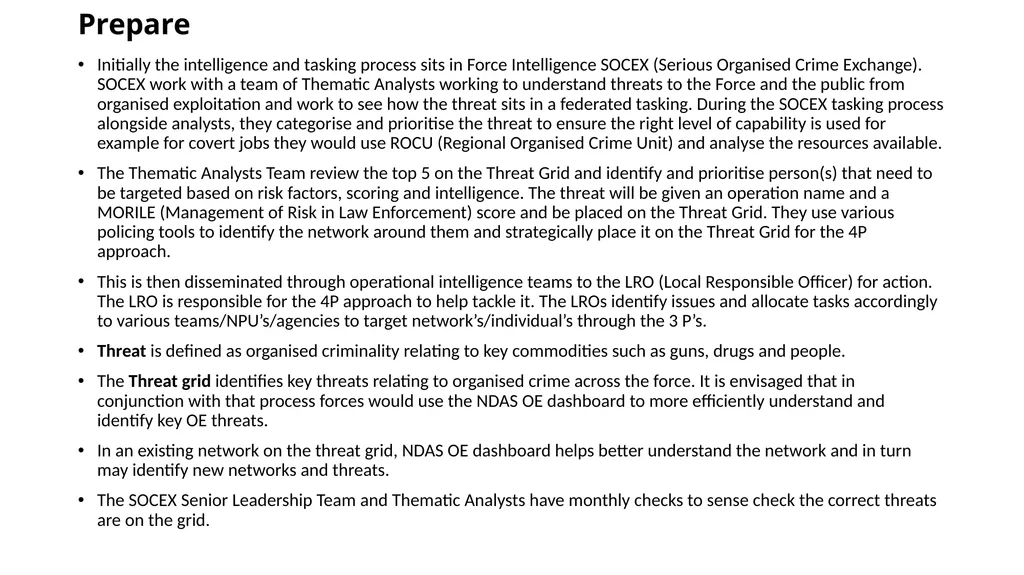
Prepare Initially the intelligence and tasking process sits in Force Intelligence SOCEX (Serious Organised Crime Exchange). SOCEX work with a team of Thematic Analysts working to understand threats to the Force and the public from organised exploitation and work to see how the threat sits in a federated tasking. During the SOCEX tasking process alongside analysts, they categorise and prioritise the threat to ensure the right level of capability is used for example for covert jobs they would use ROCU (Regional Organised Crime Unit) and analyse the resources available.
The Thematic Analysts Team review the top 5 on the Threat Grid and identify and prioritise person(s) that need to be targeted based on risk factors, scoring and intelligence. The threat will be given an operation name and a MORILE (Management of Risk in Law Enforcement) score and be placed on the Threat Grid. They use various policing tools to identify the network around them and strategically place it on the Threat Grid for the 4P approach.
This is then disseminated through operational intelligence teams to the LRO (Local Responsible Officer) for action. The LRO is responsible for the 4P approach to help tackle it. The LROs identify issues and allocate tasks accordingly to various teams/NPU’s/agencies to target network’s/individual’s through the 3 P’s.
Threat is defined as organised criminality relating to key commodities such as guns, drugs and people.
The Threat grid identifies key threats relating to organised crime across the force. It is envisaged that in conjunction with that process forces would use the NDAS OE dashboard to more efficiently understand and identify key OE threats.
In an existing network on the threat grid, NDAS OE dashboard helps better understand the network and in turn may identify new networks and threats.
The SOCEX Senior Leadership Team and Thematic Analysts have monthly checks to sense check the correct threats are on the grid.<br>
The Thematic Analysts Team review the top 5 on the Threat Grid and identify and prioritise person(s) that need to be targeted based on risk factors, scoring and intelligence. The threat will be given an operation name and a MORILE (Management of Risk in Law Enforcement) score and be placed on the Threat Grid. They use various policing tools to identify the network around them and strategically place it on the Threat Grid for the 4P approach.
This is then disseminated through operational intelligence teams to the LRO (Local Responsible Officer) for action. The LRO is responsible for the 4P approach to help tackle it. The LROs identify issues and allocate tasks accordingly to various teams/NPU’s/agencies to target network’s/individual’s through the 3 P’s.
Threat is defined as organised criminality relating to key commodities such as guns, drugs and people.
The Threat grid identifies key threats relating to organised crime across the force. It is envisaged that in conjunction with that process forces would use the NDAS OE dashboard to more efficiently understand and identify key OE threats.
In an existing network on the threat grid, NDAS OE dashboard helps better understand the network and in turn may identify new networks and threats.
The SOCEX Senior Leadership Team and Thematic Analysts have monthly checks to sense check the correct threats are on the grid.<br>
08
Force Threat Grid Example<br>
09
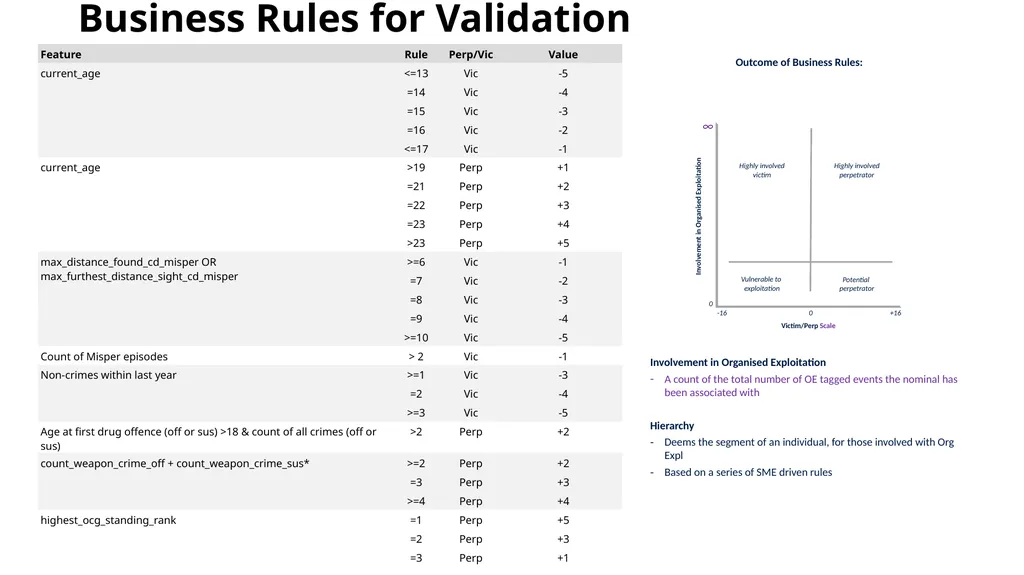
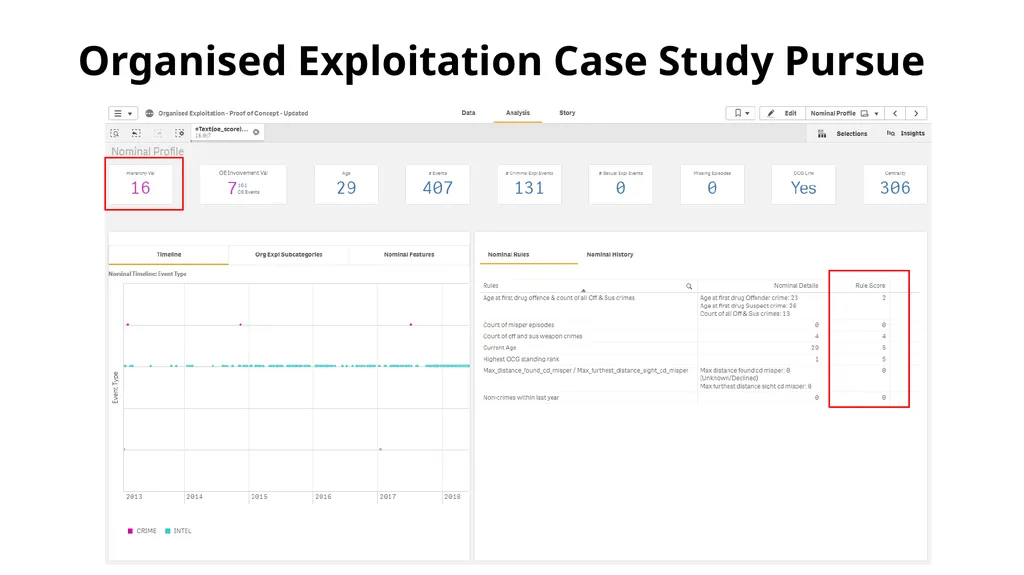
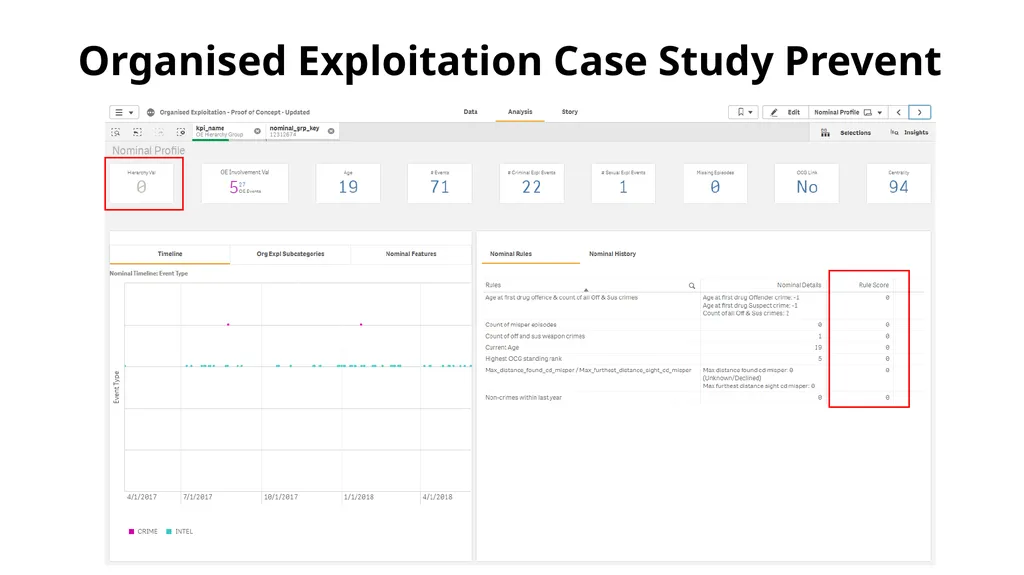
Business Rules for Validation Business Rules to form nominal values: Outcome of Business Rules: Involvement in Organised Exploitation
A count of the total number of OE tagged events the nominal has been associated with
Hierarchy
Deems the segment of an individual, for those involved with Org Expl
Based on a series of SME driven rules<br>
A count of the total number of OE tagged events the nominal has been associated with
Hierarchy
Deems the segment of an individual, for those involved with Org Expl
Based on a series of SME driven rules<br>
10
Organised Exploitation Case Study Nominal Identification Nominal of interest<br>
11
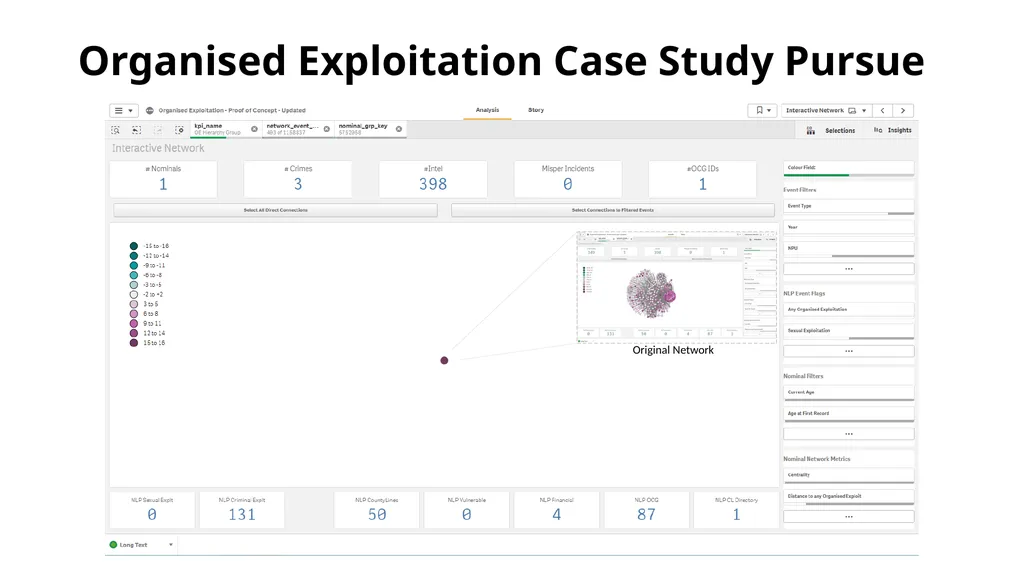
Prevent Pursue (Original nominal selected) Protect Organised Exploitation Network Identification<br>
12
Organised Exploitation Case Study Pursue Original Network<br>
13
Organised Exploitation Case Study Pursue<br>
14
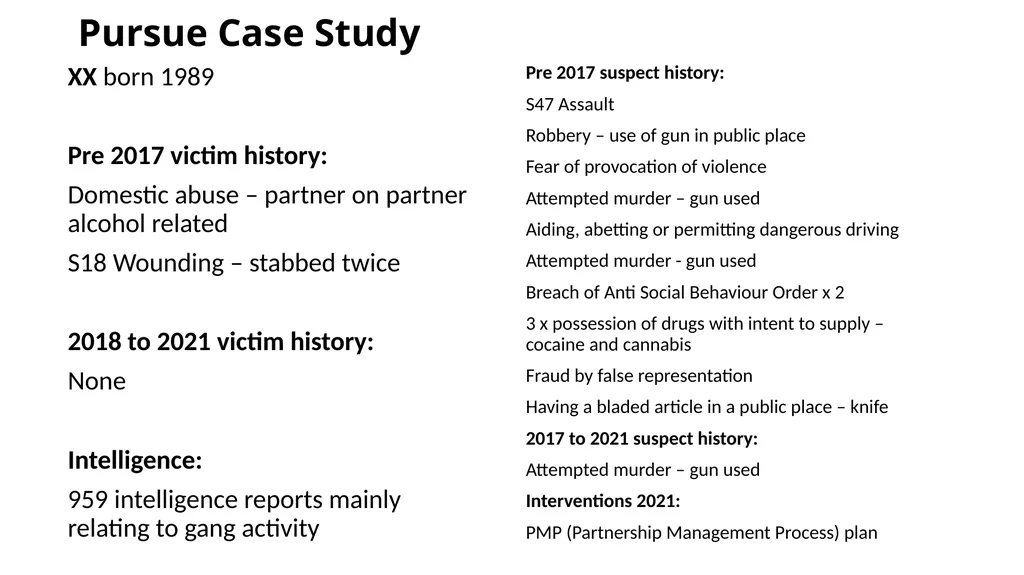
Pursue Case Study XX born 1989
Pre 2017 victim history:
Domestic abuse – partner on partner alcohol related
S18 Wounding – stabbed twice
2018 to 2021 victim history:
None
Intelligence:
959 intelligence reports mainly relating to gang activity Pre 2017 suspect history:
S47 Assault
Robbery – use of gun in public place
Fear of provocation of violence
Attempted murder – gun used
Aiding, abetting or permitting dangerous driving
Attempted murder - gun used
Breach of Anti Social Behaviour Order x 2
3 x possession of drugs with intent to supply – cocaine and cannabis
Fraud by false representation
Having a bladed article in a public place – knife
2017 to 2021 suspect history:
Attempted murder – gun used
Interventions 2021:
PMP (Partnership Management Process) plan<br>
Pre 2017 victim history:
Domestic abuse – partner on partner alcohol related
S18 Wounding – stabbed twice
2018 to 2021 victim history:
None
Intelligence:
959 intelligence reports mainly relating to gang activity Pre 2017 suspect history:
S47 Assault
Robbery – use of gun in public place
Fear of provocation of violence
Attempted murder – gun used
Aiding, abetting or permitting dangerous driving
Attempted murder - gun used
Breach of Anti Social Behaviour Order x 2
3 x possession of drugs with intent to supply – cocaine and cannabis
Fraud by false representation
Having a bladed article in a public place – knife
2017 to 2021 suspect history:
Attempted murder – gun used
Interventions 2021:
PMP (Partnership Management Process) plan<br>
15
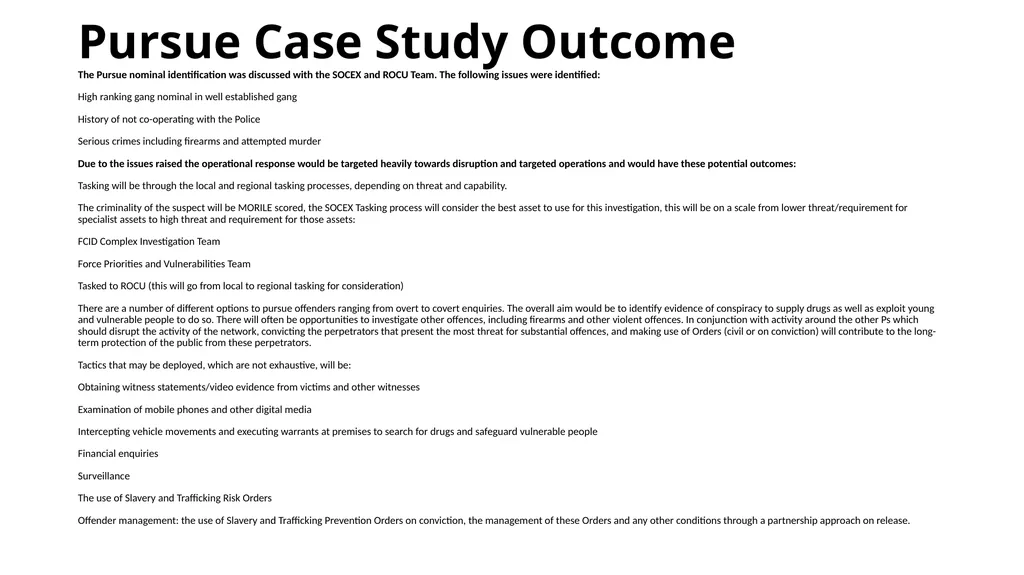
Pursue Case Study Outcome The Pursue nominal identification was discussed with the SOCEX and ROCU Team. The following issues were identified:
High ranking gang nominal in well established gang
History of not co-operating with the Police
Serious crimes including firearms and attempted murder
Due to the issues raised the operational response would be targeted heavily towards disruption and targeted operations and would have these potential outcomes:
Tasking will be through the local and regional tasking processes, depending on threat and capability.
The criminality of the suspect will be MORILE scored, the SOCEX Tasking process will consider the best asset to use for this investigation, this will be on a scale from lower threat/requirement for specialist assets to high threat and requirement for those assets:
FCID Complex Investigation Team
Force Priorities and Vulnerabilities Team
Tasked to ROCU (this will go from local to regional tasking for consideration)
There are a number of different options to pursue offenders ranging from overt to covert enquiries. The overall aim would be to identify evidence of conspiracy to supply drugs as well as exploit young and vulnerable people to do so. There will often be opportunities to investigate other offences, including firearms and other violent offences. In conjunction with activity around the other Ps which should disrupt the activity of the network, convicting the perpetrators that present the most threat for substantial offences, and making use of Orders (civil or on conviction) will contribute to the long-term protection of the public from these perpetrators.
Tactics that may be deployed, which are not exhaustive, will be:
Obtaining witness statements/video evidence from victims and other witnesses
Examination of mobile phones and other digital media
Intercepting vehicle movements and executing warrants at premises to search for drugs and safeguard vulnerable people
Financial enquiries
Surveillance
The use of Slavery and Trafficking Risk Orders
Offender management: the use of Slavery and Trafficking Prevention Orders on conviction, the management of these Orders and any other conditions through a partnership approach on release.<br>
High ranking gang nominal in well established gang
History of not co-operating with the Police
Serious crimes including firearms and attempted murder
Due to the issues raised the operational response would be targeted heavily towards disruption and targeted operations and would have these potential outcomes:
Tasking will be through the local and regional tasking processes, depending on threat and capability.
The criminality of the suspect will be MORILE scored, the SOCEX Tasking process will consider the best asset to use for this investigation, this will be on a scale from lower threat/requirement for specialist assets to high threat and requirement for those assets:
FCID Complex Investigation Team
Force Priorities and Vulnerabilities Team
Tasked to ROCU (this will go from local to regional tasking for consideration)
There are a number of different options to pursue offenders ranging from overt to covert enquiries. The overall aim would be to identify evidence of conspiracy to supply drugs as well as exploit young and vulnerable people to do so. There will often be opportunities to investigate other offences, including firearms and other violent offences. In conjunction with activity around the other Ps which should disrupt the activity of the network, convicting the perpetrators that present the most threat for substantial offences, and making use of Orders (civil or on conviction) will contribute to the long-term protection of the public from these perpetrators.
Tactics that may be deployed, which are not exhaustive, will be:
Obtaining witness statements/video evidence from victims and other witnesses
Examination of mobile phones and other digital media
Intercepting vehicle movements and executing warrants at premises to search for drugs and safeguard vulnerable people
Financial enquiries
Surveillance
The use of Slavery and Trafficking Risk Orders
Offender management: the use of Slavery and Trafficking Prevention Orders on conviction, the management of these Orders and any other conditions through a partnership approach on release.<br>
16
Organised Exploitation Case Study Protect Original Network<br>
17
Organised Exploitation Case Study Protect<br>
18
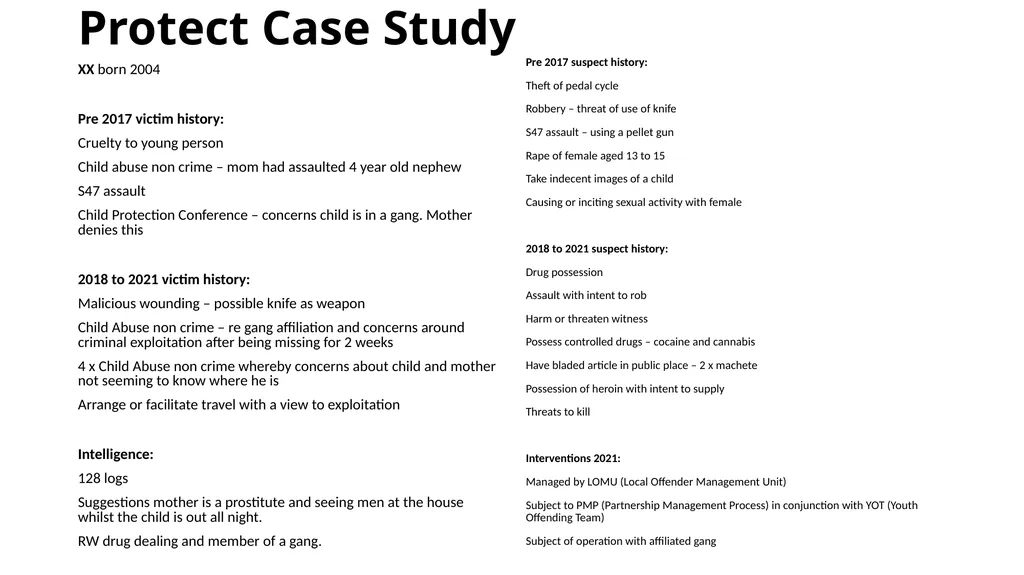
Protect Case Study XX born 2004
Pre 2017 victim history:
Cruelty to young person
Child abuse non crime – mom had assaulted 4 year old nephew
S47 assault
Child Protection Conference – concerns child is in a gang. Mother denies this
2018 to 2021 victim history:
Malicious wounding – possible knife as weapon
Child Abuse non crime – re gang affiliation and concerns around criminal exploitation after being missing for 2 weeks
4 x Child Abuse non crime whereby concerns about child and mother not seeming to know where he is
Arrange or facilitate travel with a view to exploitation
Intelligence:
128 logs
Suggestions mother is a prostitute and seeing men at the house whilst the child is out all night.
RW drug dealing and member of a gang. Pre 2017 suspect history:
Theft of pedal cycle
Robbery – threat of use of knife
S47 assault – using a pellet gun
Rape of female aged 13 to 15
Take indecent images of a child
Causing or inciting sexual activity with female
2018 to 2021 suspect history:
Drug possession
Assault with intent to rob
Harm or threaten witness
Possess controlled drugs – cocaine and cannabis
Have bladed article in public place – 2 x machete
Possession of heroin with intent to supply
Threats to kill
Interventions 2021:
Managed by LOMU (Local Offender Management Unit)
Subject to PMP (Partnership Management Process) in conjunction with YOT (Youth Offending Team)
Subject of operation with affiliated gang<br>
Pre 2017 victim history:
Cruelty to young person
Child abuse non crime – mom had assaulted 4 year old nephew
S47 assault
Child Protection Conference – concerns child is in a gang. Mother denies this
2018 to 2021 victim history:
Malicious wounding – possible knife as weapon
Child Abuse non crime – re gang affiliation and concerns around criminal exploitation after being missing for 2 weeks
4 x Child Abuse non crime whereby concerns about child and mother not seeming to know where he is
Arrange or facilitate travel with a view to exploitation
Intelligence:
128 logs
Suggestions mother is a prostitute and seeing men at the house whilst the child is out all night.
RW drug dealing and member of a gang. Pre 2017 suspect history:
Theft of pedal cycle
Robbery – threat of use of knife
S47 assault – using a pellet gun
Rape of female aged 13 to 15
Take indecent images of a child
Causing or inciting sexual activity with female
2018 to 2021 suspect history:
Drug possession
Assault with intent to rob
Harm or threaten witness
Possess controlled drugs – cocaine and cannabis
Have bladed article in public place – 2 x machete
Possession of heroin with intent to supply
Threats to kill
Interventions 2021:
Managed by LOMU (Local Offender Management Unit)
Subject to PMP (Partnership Management Process) in conjunction with YOT (Youth Offending Team)
Subject of operation with affiliated gang<br>
19
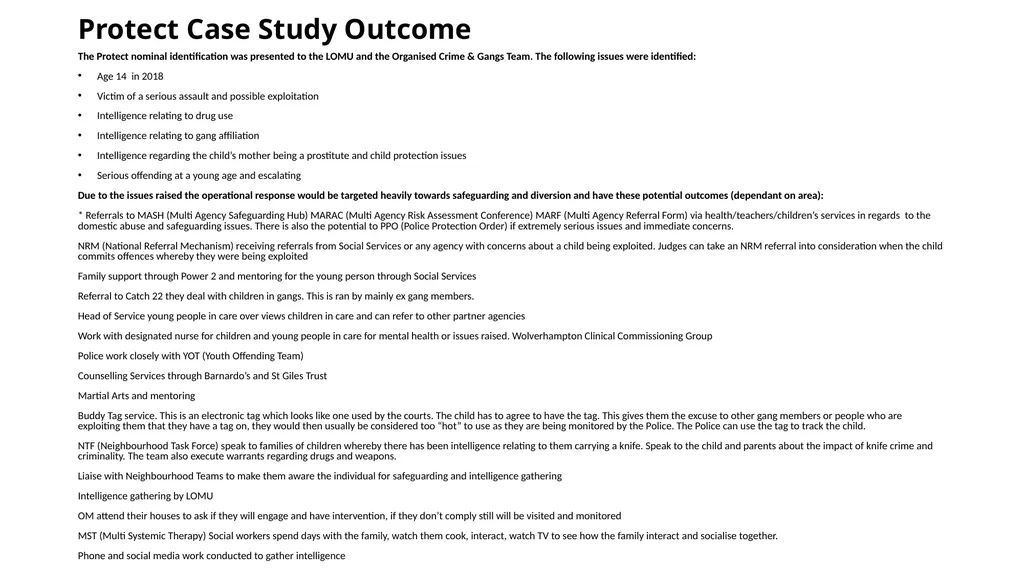
Protect Case Study Outcome The Protect nominal identification was presented to the LOMU and the Organised Crime & Gangs Team. The following issues were identified:
Age 14 in 2018
Victim of a serious assault and possible exploitation
Intelligence relating to drug use
Intelligence relating to gang affiliation
Intelligence regarding the child’s mother being a prostitute and child protection issues
Serious offending at a young age and escalating
Due to the issues raised the operational response would be targeted heavily towards safeguarding and diversion and have these potential outcomes (dependant on area):
* Referrals to MASH (Multi Agency Safeguarding Hub) MARAC (Multi Agency Risk Assessment Conference) MARF (Multi Agency Referral Form) via health/teachers/children’s services in regards to the domestic abuse and safeguarding issues. There is also the potential to PPO (Police Protection Order) if extremely serious issues and immediate concerns.
NRM (National Referral Mechanism) receiving referrals from Social Services or any agency with concerns about a child being exploited. Judges can take an NRM referral into consideration when the child commits offences whereby they were being exploited
Family support through Power 2 and mentoring for the young person through Social Services
Referral to Catch 22 they deal with children in gangs. This is ran by mainly ex gang members.
Head of Service young people in care over views children in care and can refer to other partner agencies
Work with designated nurse for children and young people in care for mental health or issues raised. Wolverhampton Clinical Commissioning Group
Police work closely with YOT (Youth Offending Team)
Counselling Services through Barnardo’s and St Giles Trust
Martial Arts and mentoring
Buddy Tag service. This is an electronic tag which looks like one used by the courts. The child has to agree to have the tag. This gives them the excuse to other gang members or people who are exploiting them that they have a tag on, they would then usually be considered too “hot” to use as they are being monitored by the Police. The Police can use the tag to track the child.
NTF (Neighbourhood Task Force) speak to families of children whereby there has been intelligence relating to them carrying a knife. Speak to the child and parents about the impact of knife crime and criminality. The team also execute warrants regarding drugs and weapons.
Liaise with Neighbourhood Teams to make them aware the individual for safeguarding and intelligence gathering
Intelligence gathering by LOMU
OM attend their houses to ask if they will engage and have intervention, if they don’t comply still will be visited and monitored
MST (Multi Systemic Therapy) Social workers spend days with the family, watch them cook, interact, watch TV to see how the family interact and socialise together.
Phone and social media work conducted to gather intelligence<br>
Age 14 in 2018
Victim of a serious assault and possible exploitation
Intelligence relating to drug use
Intelligence relating to gang affiliation
Intelligence regarding the child’s mother being a prostitute and child protection issues
Serious offending at a young age and escalating
Due to the issues raised the operational response would be targeted heavily towards safeguarding and diversion and have these potential outcomes (dependant on area):
* Referrals to MASH (Multi Agency Safeguarding Hub) MARAC (Multi Agency Risk Assessment Conference) MARF (Multi Agency Referral Form) via health/teachers/children’s services in regards to the domestic abuse and safeguarding issues. There is also the potential to PPO (Police Protection Order) if extremely serious issues and immediate concerns.
NRM (National Referral Mechanism) receiving referrals from Social Services or any agency with concerns about a child being exploited. Judges can take an NRM referral into consideration when the child commits offences whereby they were being exploited
Family support through Power 2 and mentoring for the young person through Social Services
Referral to Catch 22 they deal with children in gangs. This is ran by mainly ex gang members.
Head of Service young people in care over views children in care and can refer to other partner agencies
Work with designated nurse for children and young people in care for mental health or issues raised. Wolverhampton Clinical Commissioning Group
Police work closely with YOT (Youth Offending Team)
Counselling Services through Barnardo’s and St Giles Trust
Martial Arts and mentoring
Buddy Tag service. This is an electronic tag which looks like one used by the courts. The child has to agree to have the tag. This gives them the excuse to other gang members or people who are exploiting them that they have a tag on, they would then usually be considered too “hot” to use as they are being monitored by the Police. The Police can use the tag to track the child.
NTF (Neighbourhood Task Force) speak to families of children whereby there has been intelligence relating to them carrying a knife. Speak to the child and parents about the impact of knife crime and criminality. The team also execute warrants regarding drugs and weapons.
Liaise with Neighbourhood Teams to make them aware the individual for safeguarding and intelligence gathering
Intelligence gathering by LOMU
OM attend their houses to ask if they will engage and have intervention, if they don’t comply still will be visited and monitored
MST (Multi Systemic Therapy) Social workers spend days with the family, watch them cook, interact, watch TV to see how the family interact and socialise together.
Phone and social media work conducted to gather intelligence<br>
20
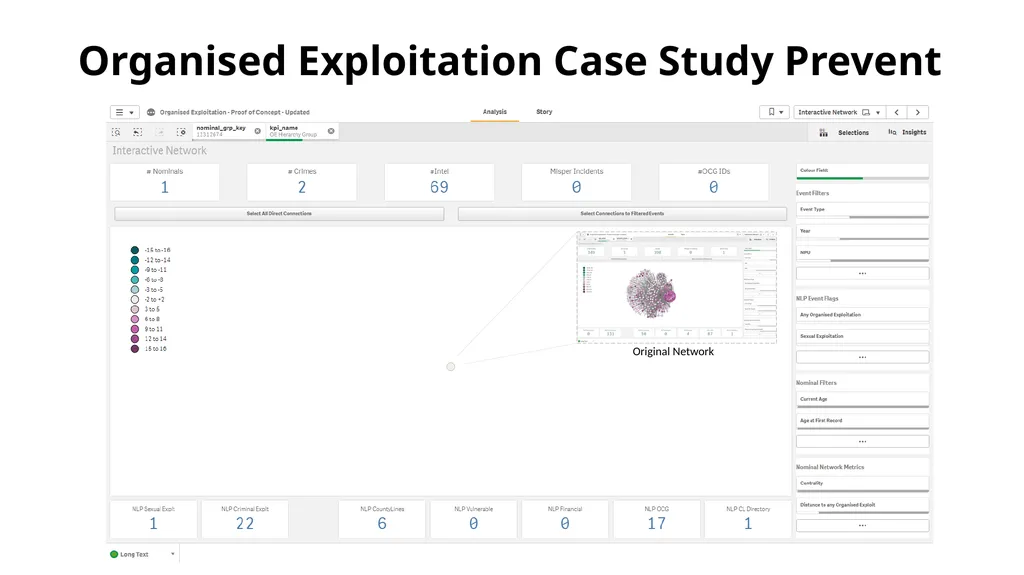
Organised Exploitation Case Study Prevent Original Network<br>
21
Organised Exploitation Case Study Prevent<br>
22
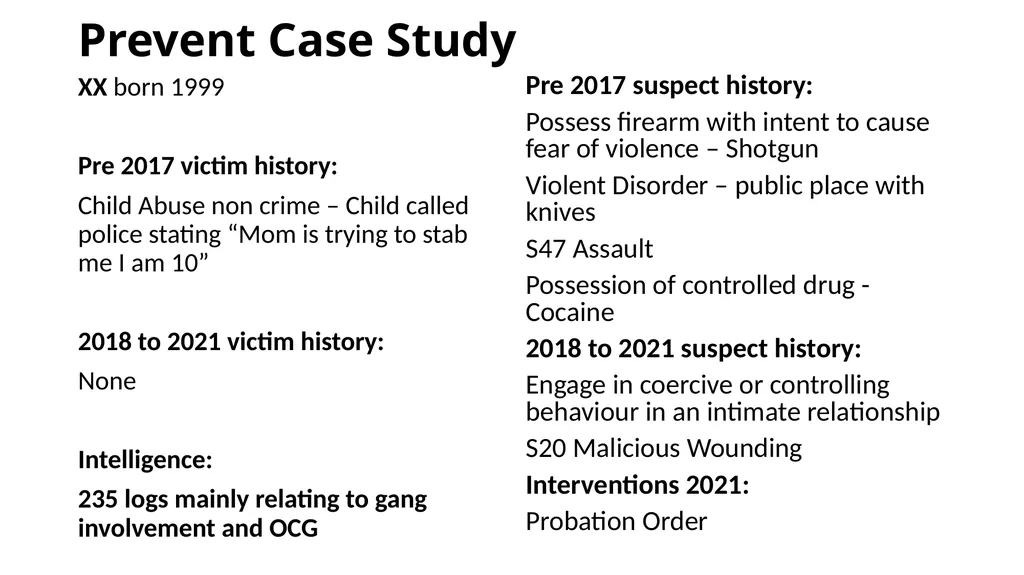
Prevent Case Study XX born 1999
Pre 2017 victim history:
Child Abuse non crime – Child called police stating “Mom is trying to stab me I am 10”
2018 to 2021 victim history:
None
Intelligence:
235 logs mainly relating to gang involvement and OCG Pre 2017 suspect history:
Possess firearm with intent to cause fear of violence – Shotgun
Violent Disorder – public place with knives
S47 Assault
Possession of controlled drug - Cocaine
2018 to 2021 suspect history:
Engage in coercive or controlling behaviour in an intimate relationship
S20 Malicious Wounding
Interventions 2021:
Probation Order<br>
Pre 2017 victim history:
Child Abuse non crime – Child called police stating “Mom is trying to stab me I am 10”
2018 to 2021 victim history:
None
Intelligence:
235 logs mainly relating to gang involvement and OCG Pre 2017 suspect history:
Possess firearm with intent to cause fear of violence – Shotgun
Violent Disorder – public place with knives
S47 Assault
Possession of controlled drug - Cocaine
2018 to 2021 suspect history:
Engage in coercive or controlling behaviour in an intimate relationship
S20 Malicious Wounding
Interventions 2021:
Probation Order<br>
23
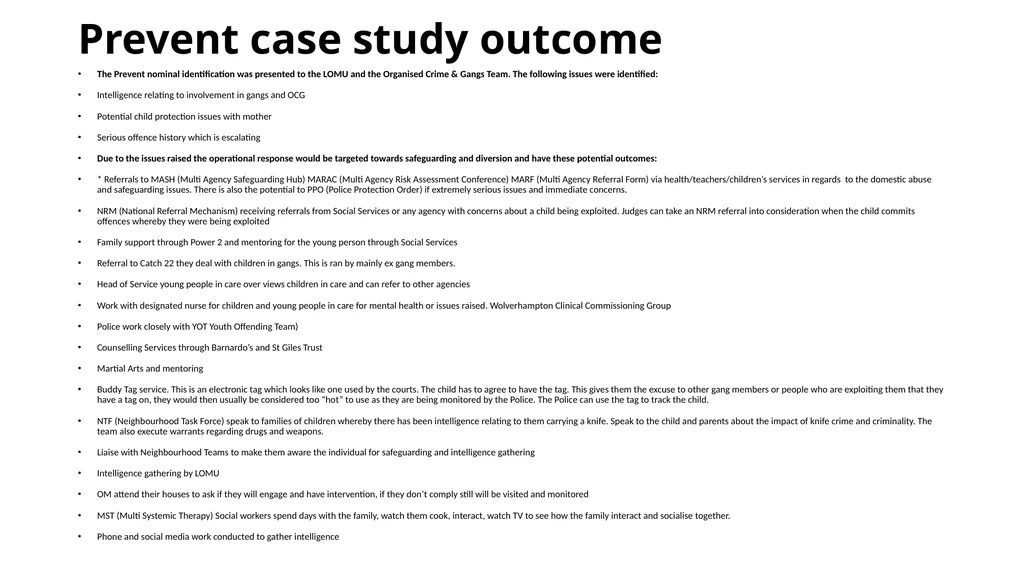
Prevent case study outcome The Prevent nominal identification was presented to the LOMU and the Organised Crime & Gangs Team. The following issues were identified:
Intelligence relating to involvement in gangs and OCG
Potential child protection issues with mother
Serious offence history which is escalating
Due to the issues raised the operational response would be targeted towards safeguarding and diversion and have these potential outcomes:
* Referrals to MASH (Multi Agency Safeguarding Hub) MARAC (Multi Agency Risk Assessment Conference) MARF (Multi Agency Referral Form) via health/teachers/children’s services in regards to the domestic abuse and safeguarding issues. There is also the potential to PPO (Police Protection Order) if extremely serious issues and immediate concerns.
NRM (National Referral Mechanism) receiving referrals from Social Services or any agency with concerns about a child being exploited. Judges can take an NRM referral into consideration when the child commits offences whereby they were being exploited
Family support through Power 2 and mentoring for the young person through Social Services
Referral to Catch 22 they deal with children in gangs. This is ran by mainly ex gang members.
Head of Service young people in care over views children in care and can refer to other agencies
Work with designated nurse for children and young people in care for mental health or issues raised. Wolverhampton Clinical Commissioning Group
Police work closely with YOT Youth Offending Team)
Counselling Services through Barnardo’s and St Giles Trust
Martial Arts and mentoring
Buddy Tag service. This is an electronic tag which looks like one used by the courts. The child has to agree to have the tag. This gives them the excuse to other gang members or people who are exploiting them that they have a tag on, they would then usually be considered too “hot” to use as they are being monitored by the Police. The Police can use the tag to track the child.
NTF (Neighbourhood Task Force) speak to families of children whereby there has been intelligence relating to them carrying a knife. Speak to the child and parents about the impact of knife crime and criminality. The team also execute warrants regarding drugs and weapons.
Liaise with Neighbourhood Teams to make them aware the individual for safeguarding and intelligence gathering
Intelligence gathering by LOMU
OM attend their houses to ask if they will engage and have intervention, if they don’t comply still will be visited and monitored
MST (Multi Systemic Therapy) Social workers spend days with the family, watch them cook, interact, watch TV to see how the family interact and socialise together.
Phone and social media work conducted to gather intelligence<br>
Intelligence relating to involvement in gangs and OCG
Potential child protection issues with mother
Serious offence history which is escalating
Due to the issues raised the operational response would be targeted towards safeguarding and diversion and have these potential outcomes:
* Referrals to MASH (Multi Agency Safeguarding Hub) MARAC (Multi Agency Risk Assessment Conference) MARF (Multi Agency Referral Form) via health/teachers/children’s services in regards to the domestic abuse and safeguarding issues. There is also the potential to PPO (Police Protection Order) if extremely serious issues and immediate concerns.
NRM (National Referral Mechanism) receiving referrals from Social Services or any agency with concerns about a child being exploited. Judges can take an NRM referral into consideration when the child commits offences whereby they were being exploited
Family support through Power 2 and mentoring for the young person through Social Services
Referral to Catch 22 they deal with children in gangs. This is ran by mainly ex gang members.
Head of Service young people in care over views children in care and can refer to other agencies
Work with designated nurse for children and young people in care for mental health or issues raised. Wolverhampton Clinical Commissioning Group
Police work closely with YOT Youth Offending Team)
Counselling Services through Barnardo’s and St Giles Trust
Martial Arts and mentoring
Buddy Tag service. This is an electronic tag which looks like one used by the courts. The child has to agree to have the tag. This gives them the excuse to other gang members or people who are exploiting them that they have a tag on, they would then usually be considered too “hot” to use as they are being monitored by the Police. The Police can use the tag to track the child.
NTF (Neighbourhood Task Force) speak to families of children whereby there has been intelligence relating to them carrying a knife. Speak to the child and parents about the impact of knife crime and criminality. The team also execute warrants regarding drugs and weapons.
Liaise with Neighbourhood Teams to make them aware the individual for safeguarding and intelligence gathering
Intelligence gathering by LOMU
OM attend their houses to ask if they will engage and have intervention, if they don’t comply still will be visited and monitored
MST (Multi Systemic Therapy) Social workers spend days with the family, watch them cook, interact, watch TV to see how the family interact and socialise together.
Phone and social media work conducted to gather intelligence<br>
24
Organised Exploitation Summary The NDAS OE Dashboard will be a powerful tool providing efficient and effective identification of networks and threats. This will save many hours of work for analysts and will assist with prioritisation of the right threat(s) on the Force’s Threat Grid. It gives the ability to identify networks and to target them systematically using the 4 P approach.
Once the identification has been made of a nominal and their tier (using the business rules of the model) on the Boston Plot, this will be cross referenced with Policing Systems such as Connect, PNC and PND. All information would be assessed, graded and scored. This would be then viewed alongside the Threat Grid, with analyst support and professional judgement from the Senior Leadership Team in SOCEX. The dashboard can support a systematic problem solving approach to the disruption of criminals and the robust safeguarding of victims using the breadth of existing law enforcement and other multi agency tactics. This multi layered approach encourages greater focus for understanding the cause of a problem so that tactics can be more effective and efficient in the long term. This approach can assist in developing a coherent, targeted and prioritised disruption plan using a combination of tactics from multiple agencies.<br>
Once the identification has been made of a nominal and their tier (using the business rules of the model) on the Boston Plot, this will be cross referenced with Policing Systems such as Connect, PNC and PND. All information would be assessed, graded and scored. This would be then viewed alongside the Threat Grid, with analyst support and professional judgement from the Senior Leadership Team in SOCEX. The dashboard can support a systematic problem solving approach to the disruption of criminals and the robust safeguarding of victims using the breadth of existing law enforcement and other multi agency tactics. This multi layered approach encourages greater focus for understanding the cause of a problem so that tactics can be more effective and efficient in the long term. This approach can assist in developing a coherent, targeted and prioritised disruption plan using a combination of tactics from multiple agencies.<br>