04
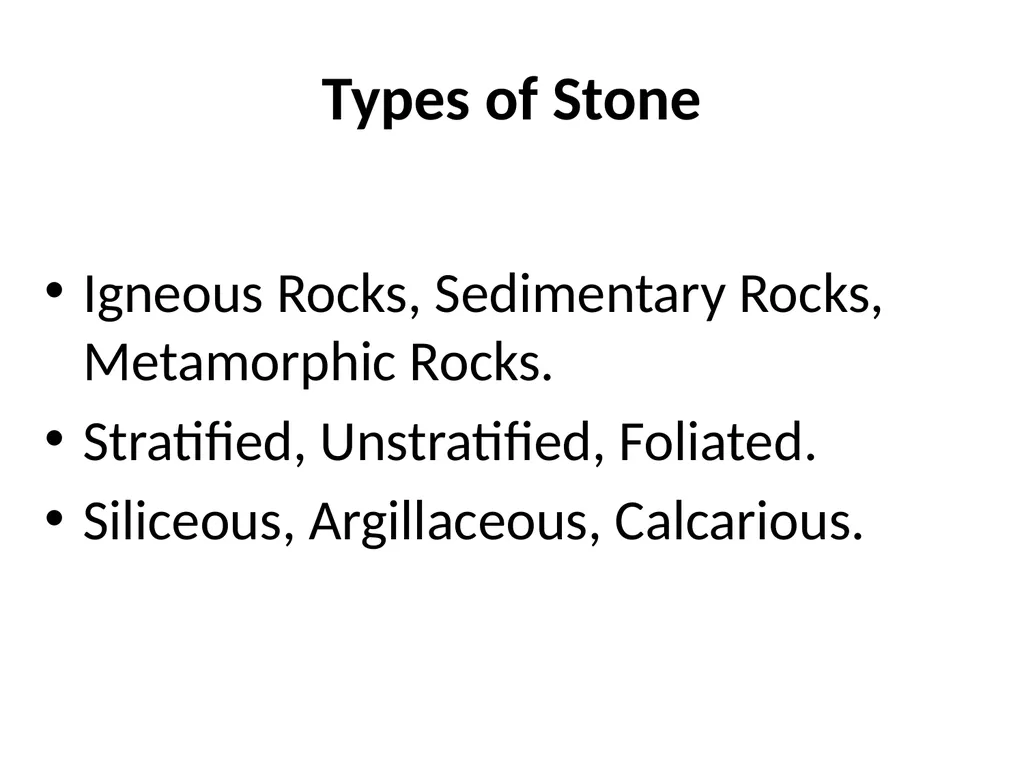
Types of Stone Igneous Rocks, Sedimentary Rocks, Metamorphic Rocks.
Stratified, Unstratified, Foliated.
Siliceous, Argillaceous, Calcarious.<br>
05
Uses of Stone They are used in hydraulic structures like dams and bridges.
They are used in retaining wall masonry to retain soil.
They are used as road metal in road construction.
They are used as ballast for permanent way in railways.
They are used to make concrete in the form of coarse aggregate.<br>
06
Properties of Stone Silicious rocks are hard and durable. They are not easily affected by weathering actions.
Argillaceous rocks may be dense and compact or they may be soft.
The Durability of calareous rocks will depend upon the constituents present in surrounding atmosphere.
Marble and quartzite have compact crystalline structure.
Igneous rocks contain many minerals. Various minerals having wide range of different distinctive characteristics.<br>
07
Lime Requirement of lime
it should set easily.
it should have low shrinkage.
it should not contain impurities.
It should be moisture resistant
It should slake easily with water.<br>
08
Types of lime Fat lime.
Hydraulic lime
1)feebly
2)moderately
3)eminently
Poor lime<br>
09
uses of lime Lime is uses in the treatment of water and waste water.
It is used in the manufacture of glass,refractory,sand lime bricks and paints.
It is used as lime morter for mansonry work of buildings.
It is used for plastering and white washing of buildings.
It is used as lime concreat to make water proof stuctures.<br>
10
uses of lime Lime is uses in the treatment of water and waste water.
It is used in the manufacture of glass,refractory,sand lime bricks and paints.
It is used as lime morter for mansonry work of buildings.
It is used for plastering and white washing of buildings.
It is used as lime concreat to make water proof stuctures.<br>
12
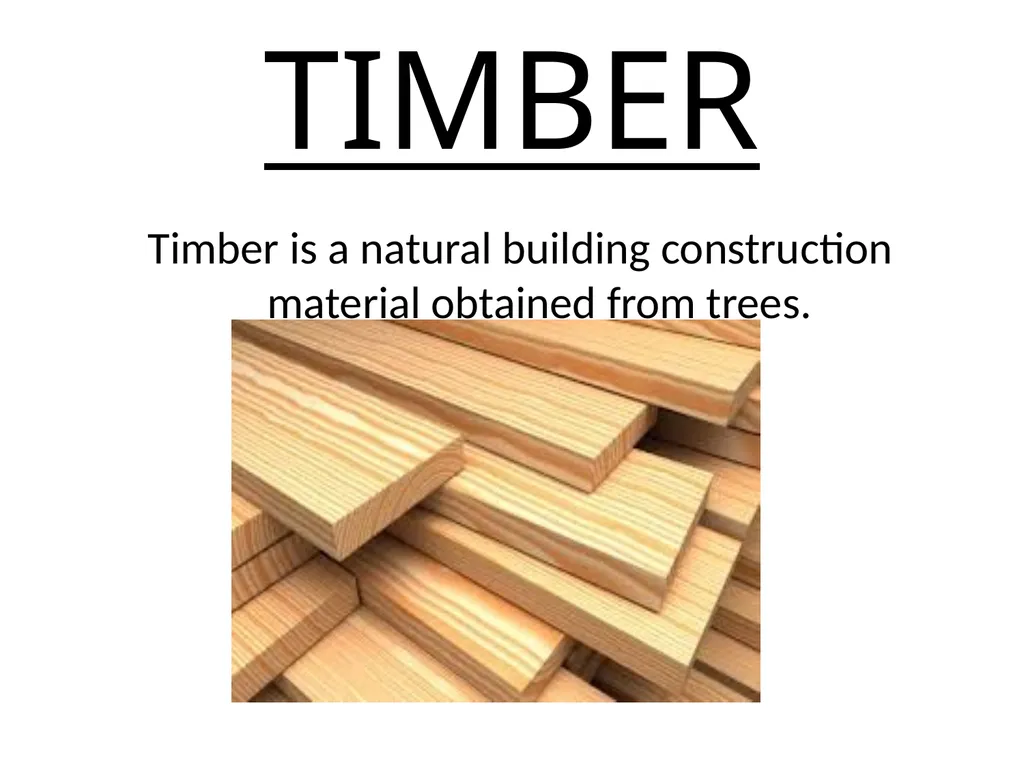
TIMBER Timber is a natural building construction material obtained from trees.<br>
13
Requirements of timber Dark uniform colour.
Dense.
Workable, good machinability.
Uniform texture.
Freshly cut log surface should emit sweet smell.
Free from crakes, splits, warp, etc.
When it is struck, it should produce a sonorous sound.<br>
14
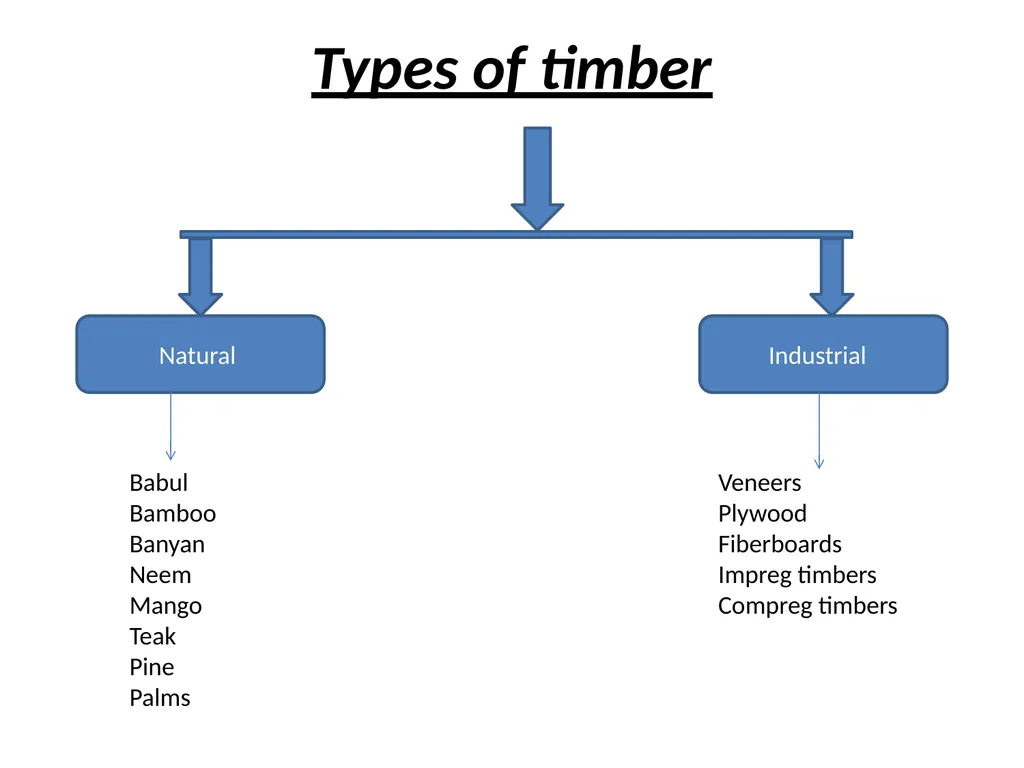
Types of timber Natural Industrial Babul
Bamboo
Banyan
Neem
Mango
Teak
Pine
Palms Veneers
Plywood
Fiberboards
Impreg timbers
Compreg timbers<br>
15
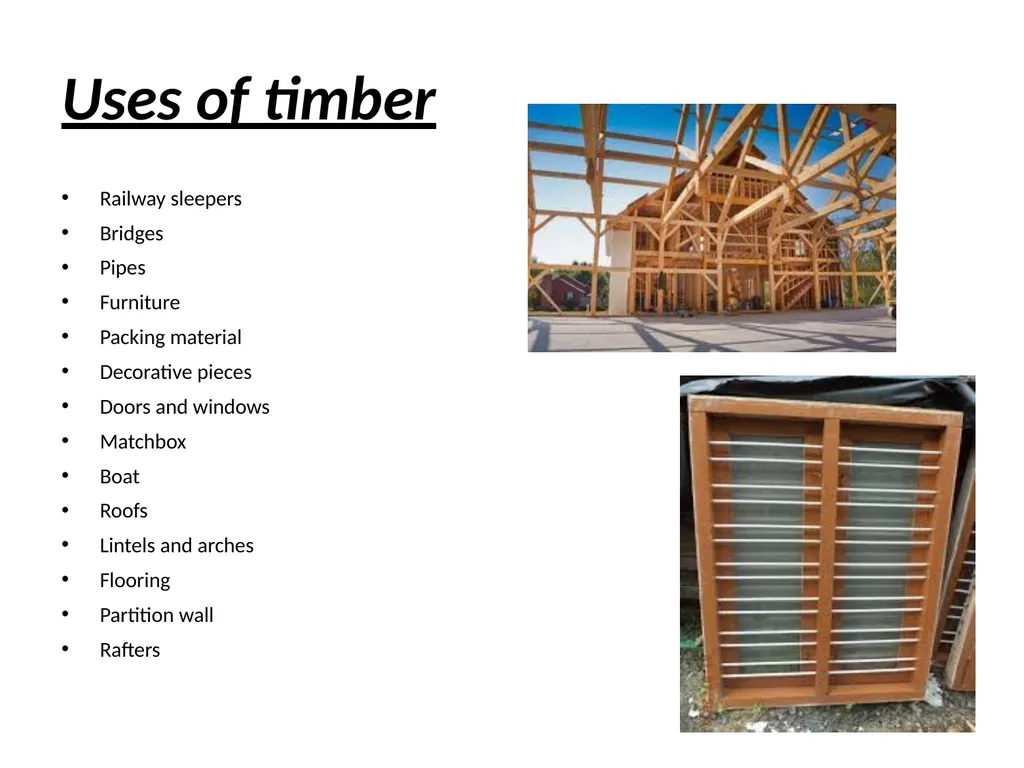
Uses of timber Railway sleepers
Bridges
Pipes
Furniture
Packing material
Decorative pieces
Doors and windows
Matchbox
Boat
Roofs
Lintels and arches
Flooring
Partition wall
Rafters<br>
16
Properties of timber Low heat conductivity.
Small bulk density.
Relatively high strength.
It’s volume changes with moisture content.
Long life. Importance of timber Used as walls, columns, beams, doors and windows in building construction.
Easy to transport due to lesser weight and easy handling.
Used in furniture decoration of buildings.<br>
17
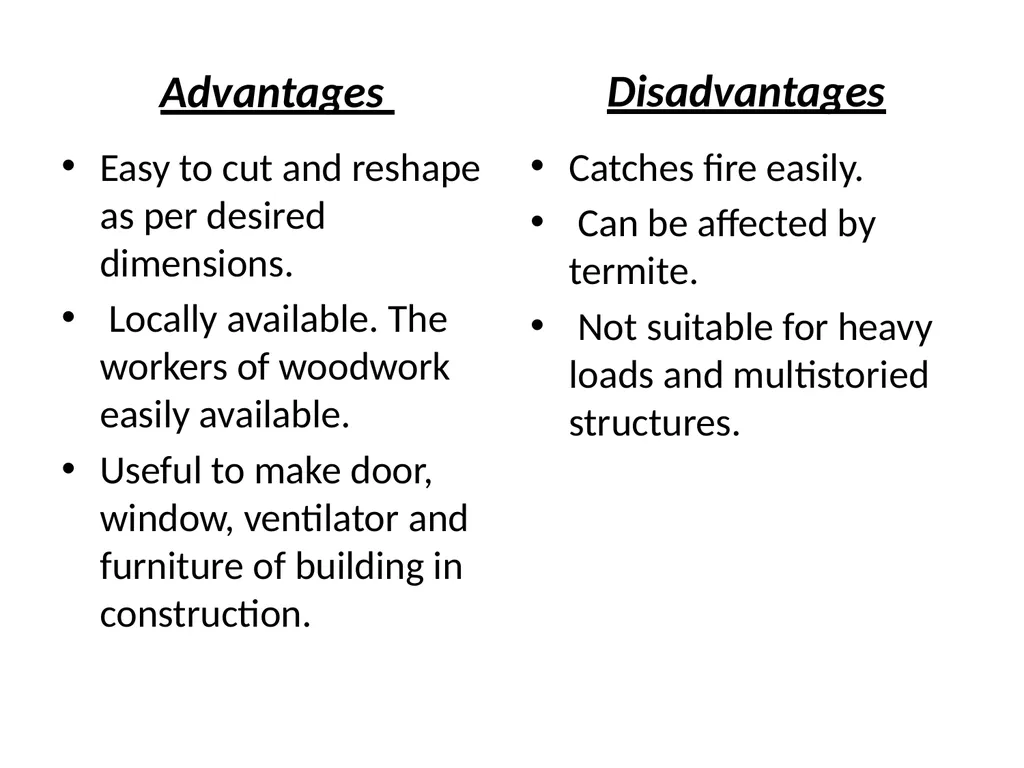
Advantages Disadvantages Easy to cut and reshape as per desired dimensions.
Locally available. The workers of woodwork easily available.
Useful to make door, window, ventilator and furniture of building in construction. Catches fire easily.
Can be affected by termite.
Not suitable for heavy loads and multistoried structures.<br>
18
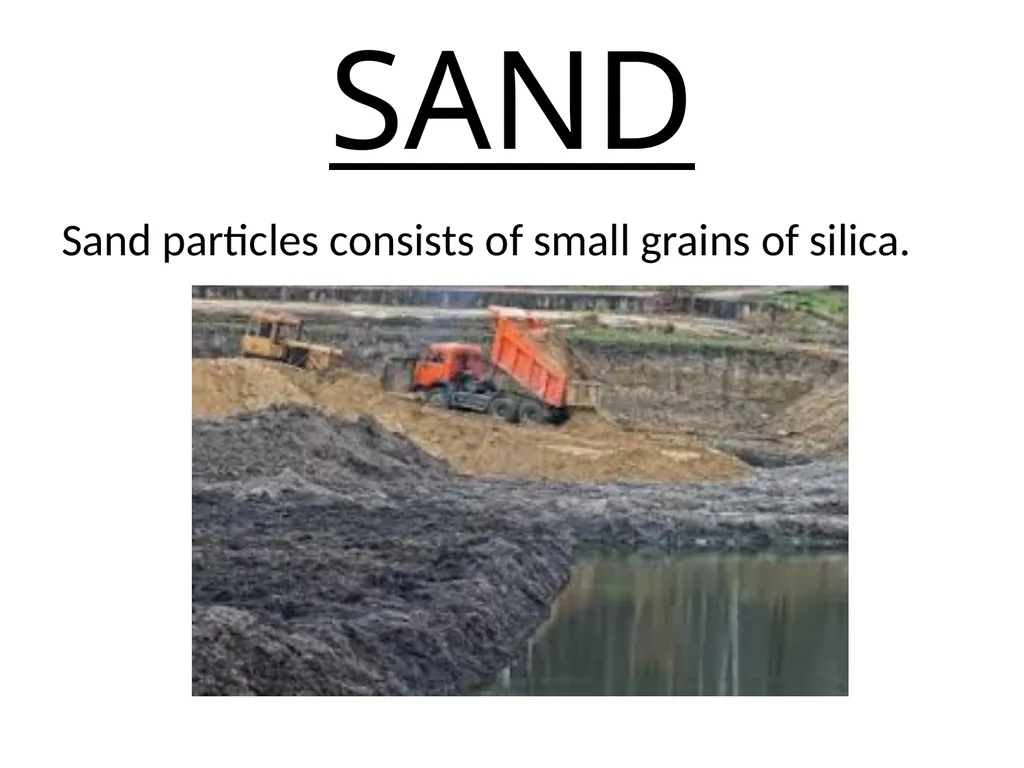
SAND Sand particles consists of small grains of silica.<br>
19
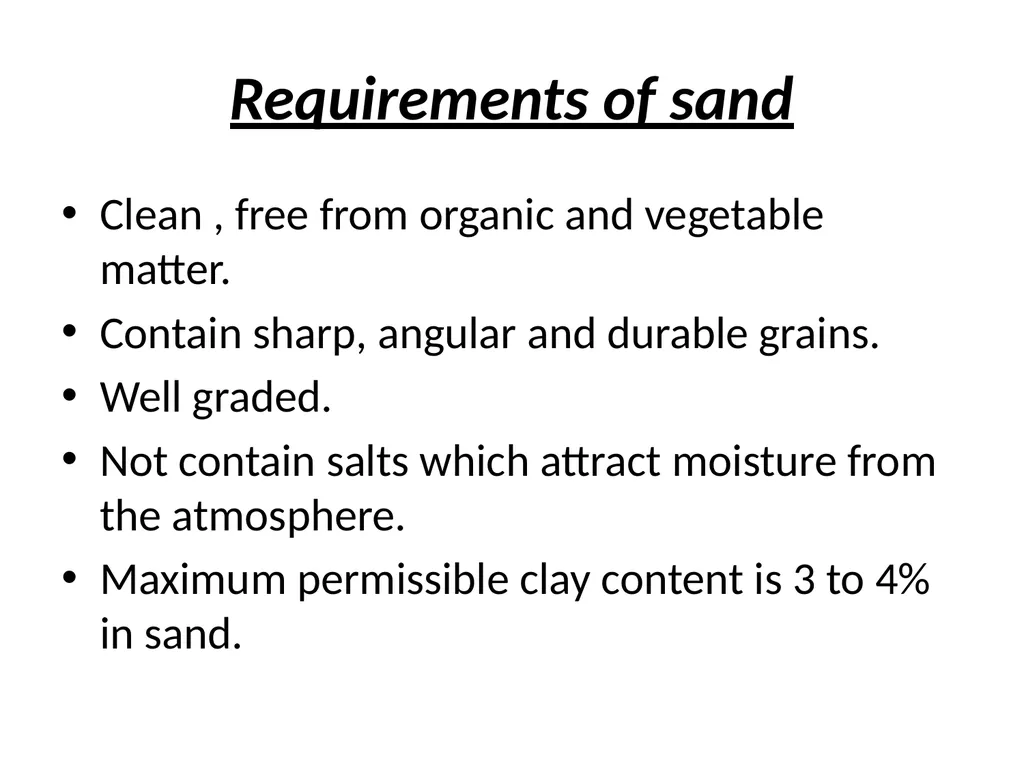
Requirements of sand Clean , free from organic and vegetable matter.
Contain sharp, angular and durable grains.
Well graded.
Not contain salts which attract moisture from the atmosphere.
Maximum permissible clay content is 3 to 4% in sand.<br>
20
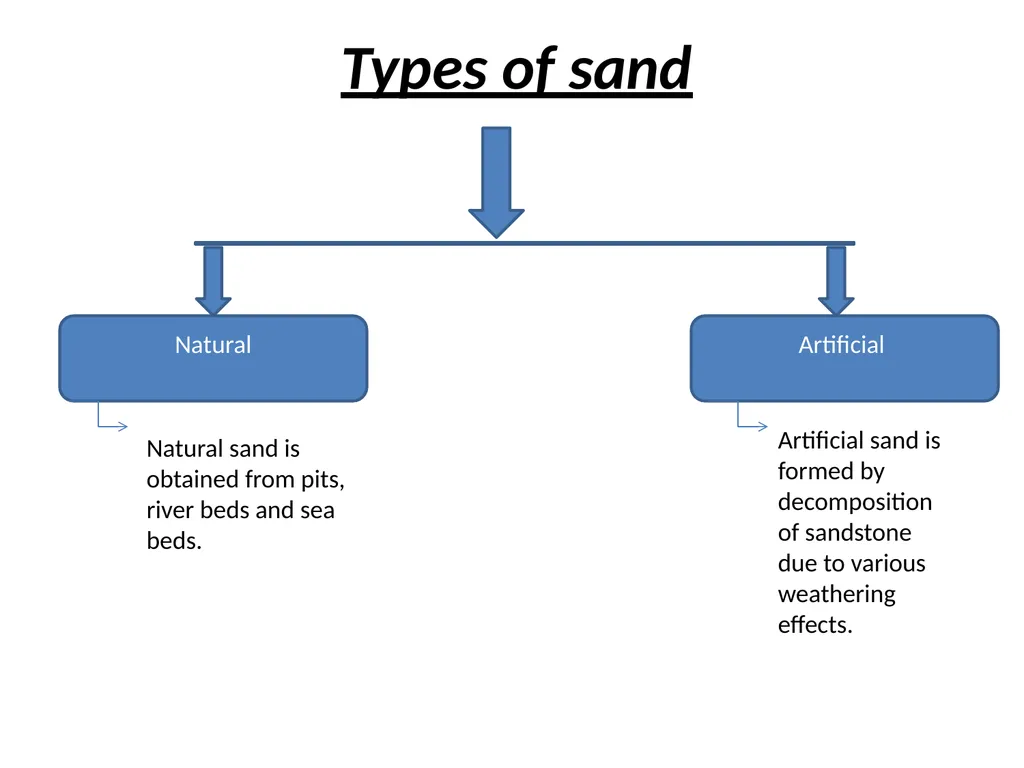
Types of sand Natural Artificial Natural sand is obtained from pits, river beds and sea beds. Artificial sand is formed by decomposition of sandstone due to various weathering effects.<br>
21
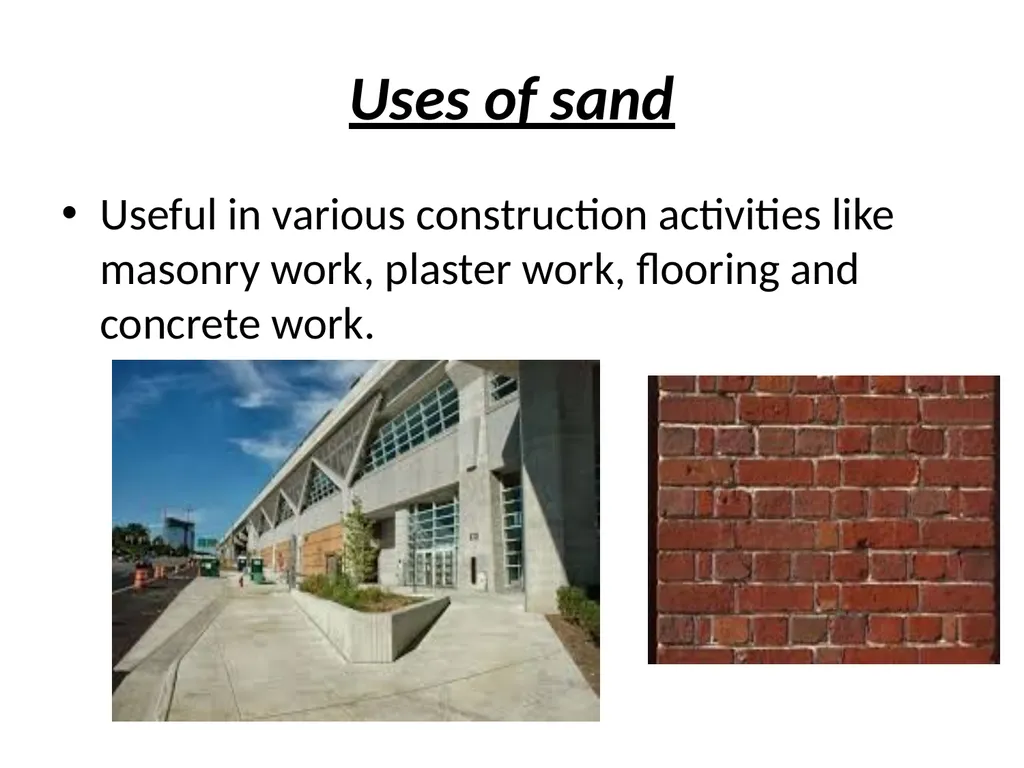
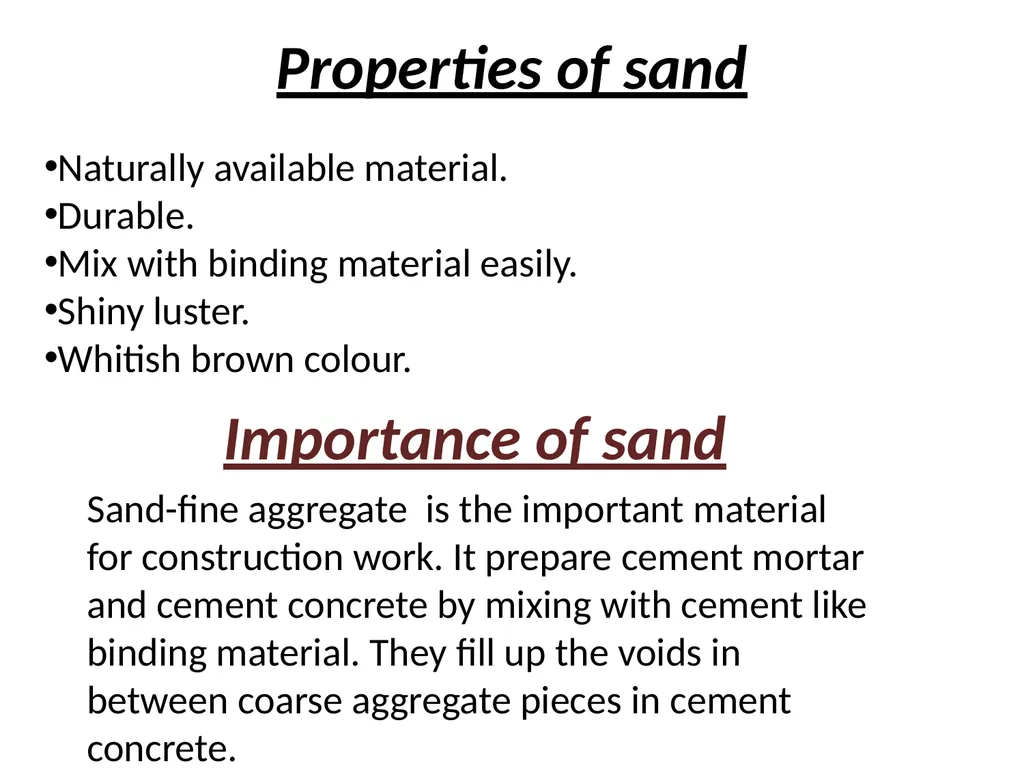
Uses of sand Useful in various construction activities like masonry work, plaster work, flooring and concrete work.<br>
22
Properties of sand Naturally available material.
Durable.
Mix with binding material easily.
Shiny luster.
Whitish brown colour. Importance of sand Sand-fine aggregate is the important material for construction work. It prepare cement mortar and cement concrete by mixing with cement like binding material. They fill up the voids in between coarse aggregate pieces in cement concrete.<br>
23
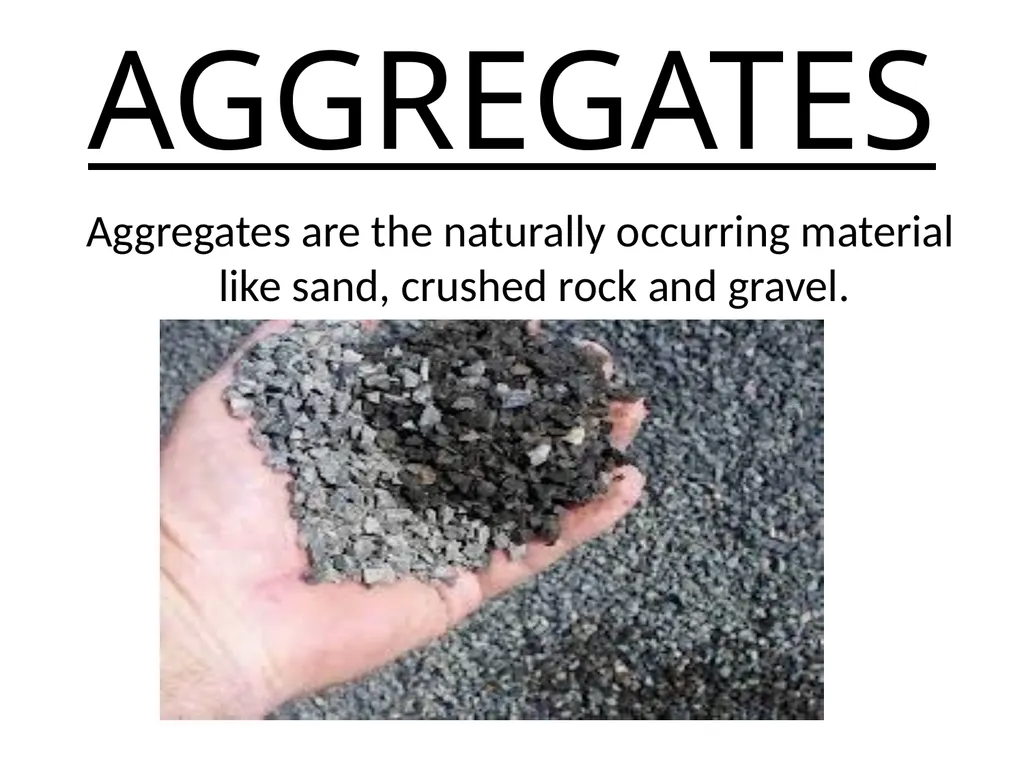
AGGREGATES Aggregates are the naturally occurring material like sand, crushed rock and gravel.<br>
24
Requirements of aggregate Sufficiently strong, hard, tough and durable.
Aggregate surface should be rough and free from cracks.
Good soundness. Uses of aggregate Fine aggregates are used to prepare cement mortar, lime mortar and cement concrete.
Coarse aggregates are used to prepare cement concrete (PCC, RCC) , etc.
Fine aggregates are used in masonry, plaster, flooring, etc. work in building construction. For more detail contact us<br>