Nature v. nurture Work your way through the powerpoint. Some slides have task, this is indicated with this picture - Some slides have videos to watch or information to read this is indicated - Then complete the final task a report. Email
Related Topics
Share
Embed code
Download this presentation From Below
"Nature v. nurture Work your way through the" is the property of its rightful owner. Permission is granted to
download and print the materials on this website for personal, non-commercial use only, and to display it
on your personal computer provided you do not modify the materials and that you retain all copyright
notices contained in the materials. By downloading content from our website, you accept the terms of this
agreement.
Presentation Transcript
01
Nature v. nurture Work your way through the powerpoint. Some slides have task, this is indicated with this picture -
Some slides have videos to watch or information to read this is indicated -
Then complete the final task a report.
Email all tasks and report back to:
Mrs Matthews by 17th July. Start 29th June – Deadline 17th July<br>
02
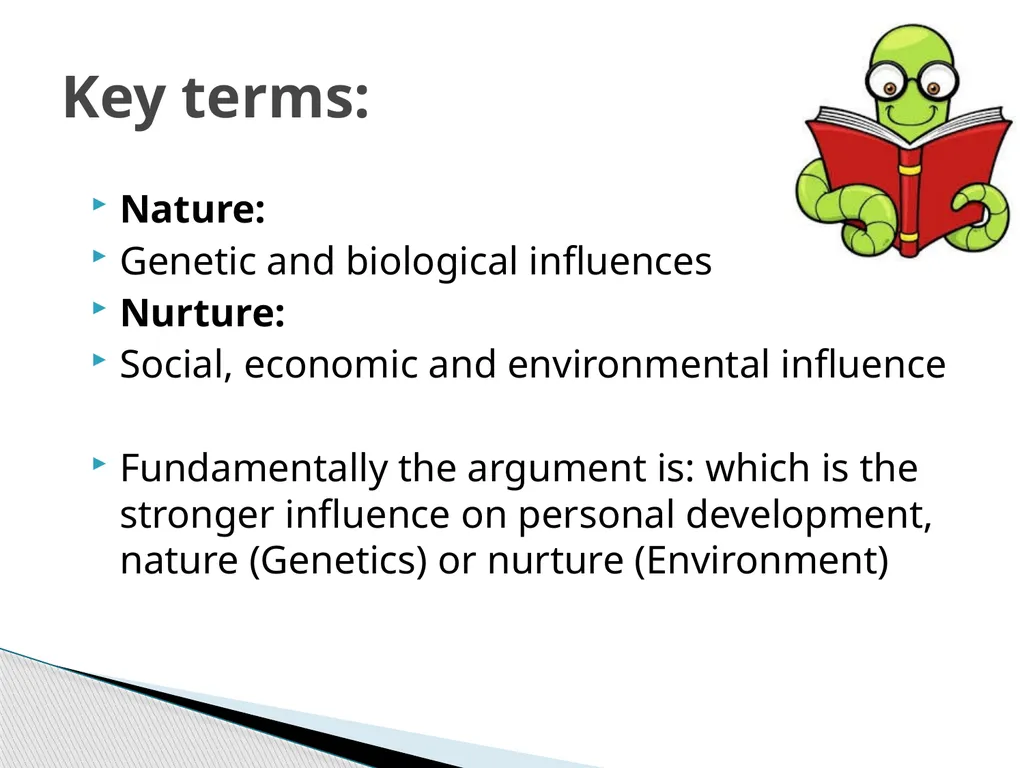
Nature and nurture Individual task
Can you write an explanation of what the difference is between nature and nurture<br>
03
Nature:
Genetic and biological influences
Nurture:
Social, economic and environmental influence
Fundamentally the argument is: which is the stronger influence on personal development, nature (Genetics) or nurture (Environment) Key terms:<br>
04
Nature<br>
05
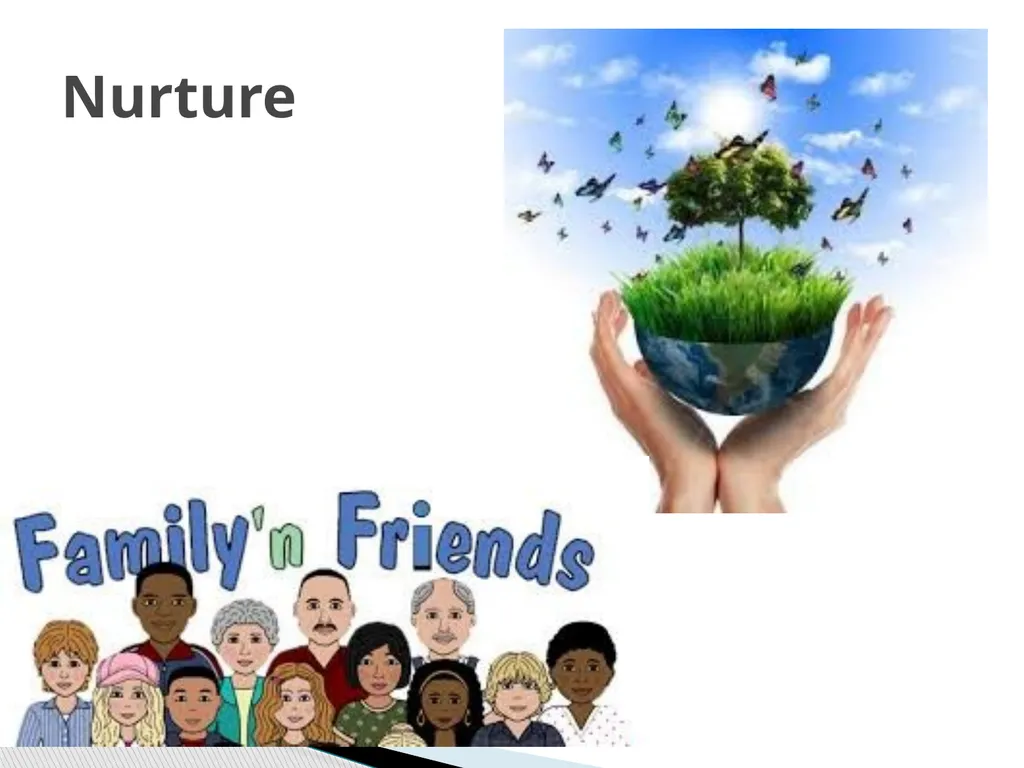
Nurture<br>
06
Observation & Imitation of Role Models<br>
07
Biological programming
Genetics are our blueprint they contain our genetic code.
The question is: do we inherit our intellect, behaviour and diseases?
Behaviour is a result of your genes
It’s down to biology
Can’t help it
Criminals are born that way
Intelligence – born clever/not clever Nature<br>
08
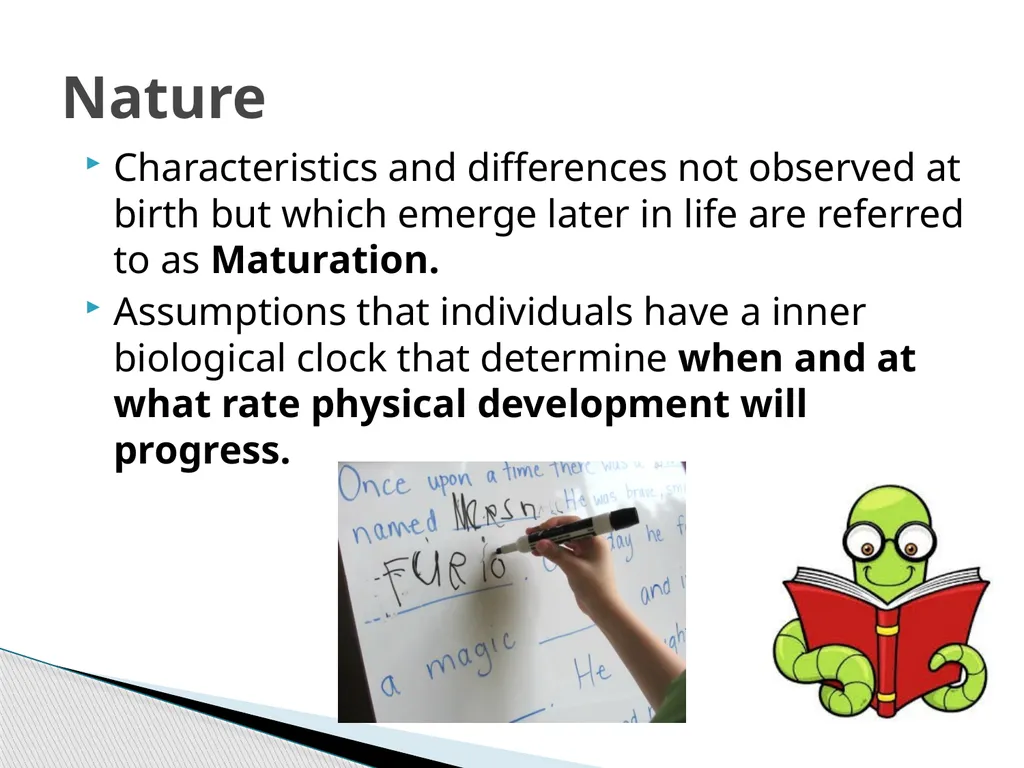
Characteristics and differences not observed at birth but which emerge later in life are referred to as Maturation.
Assumptions that individuals have a inner biological clock that determine when and at what rate physical development will progress. Nature<br>
09
Behaviour is a result of your environment
Genes have little or no effect
Socialisation makes you into the person you are
Intelligence – educational success lies within social environment Nurture<br>
10
Some theorists sees the mind as a ‘blank slate’
Thus: behaviour, knowledge and skills are a result of social learning
BF Skinner was a nurture theorist who argued that language is learned from others Nurture<br>
11
Task
Research the nature v nurture debate
Read about stories related
This will help you with your final task Research<br>
12
Watch the following clips carefully –
Genie Wiley
https://www.youtube.com/watch?v=VjZolHCrC8E
The David Reimer Story
https://www.youtube.com/watch?v=9LQBcAVghu4
If links don’t work, go onto YouTube and search for - David Reimer and Genie Wiley
How do the clips you have just watched compare? Nature v. nurture<br>
13
Your task is to outline both sides of the nature and nurture debate.
Explain what nature means
Explain what nurture means
Summarise what you watch about Genie and David – explain how these link to this debate.
Make a conclusion based on all your research to decided nature / nurture or BOTH. Justify your answer. Task - report<br>
14
Deadline 17th July Once complete email Mrs Matthews<br>