Nature Walk Observations All bite no bark What is happening to the trees? Overview Take walk through almost any wooded area in the New Jersey and Pennsylvania area, and you will likely notice that many of trees are missing their bark. What
"Nature Walk Observations All bite no bark What is" is the property of its rightful owner. Permission is granted to
download and print the materials on this website for personal, non-commercial use only, and to display it
on your personal computer provided you do not modify the materials and that you retain all copyright
notices contained in the materials. By downloading content from our website, you accept the terms of this
agreement.
Presentation Transcript
01
Nature Walk Observations All bite no bark
What is happening to the trees?<br>
02
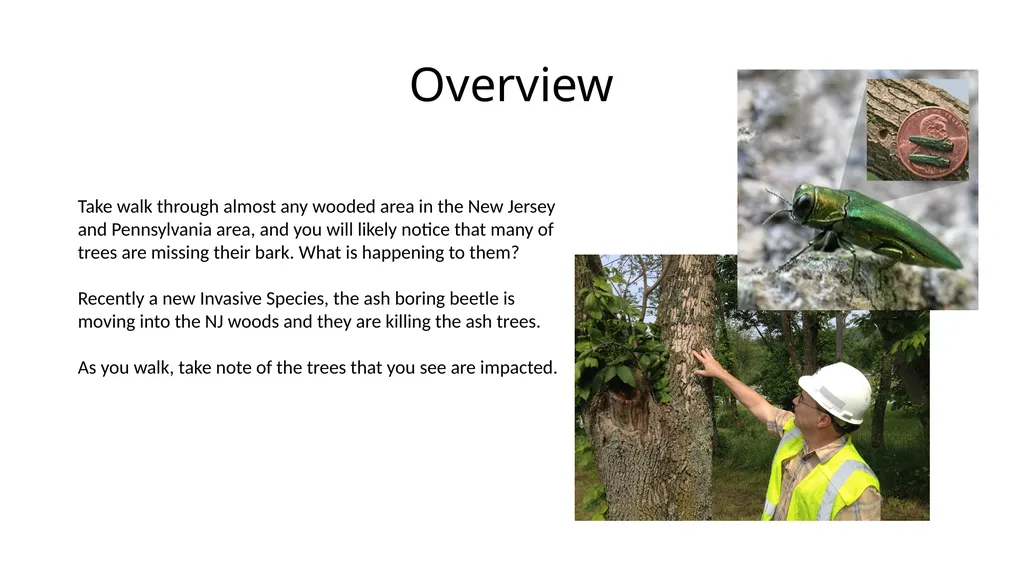
Overview Take walk through almost any wooded area in the New Jersey and Pennsylvania area, and you will likely notice that many of trees are missing their bark. What is happening to them?
Recently a new Invasive Species, the ash boring beetle is moving into the NJ woods and they are killing the ash trees.
As you walk, take note of the trees that you see are impacted.<br>
03
Materials Nature trail
Tree field guide (optional)
Leafsnap app (optional)<br>
04
What to do Go to almost any nature trail or wooded area and observe the trees.
Use a tree field guide or an such as Leafsnap that will allow you to quickly identify trees in the area.
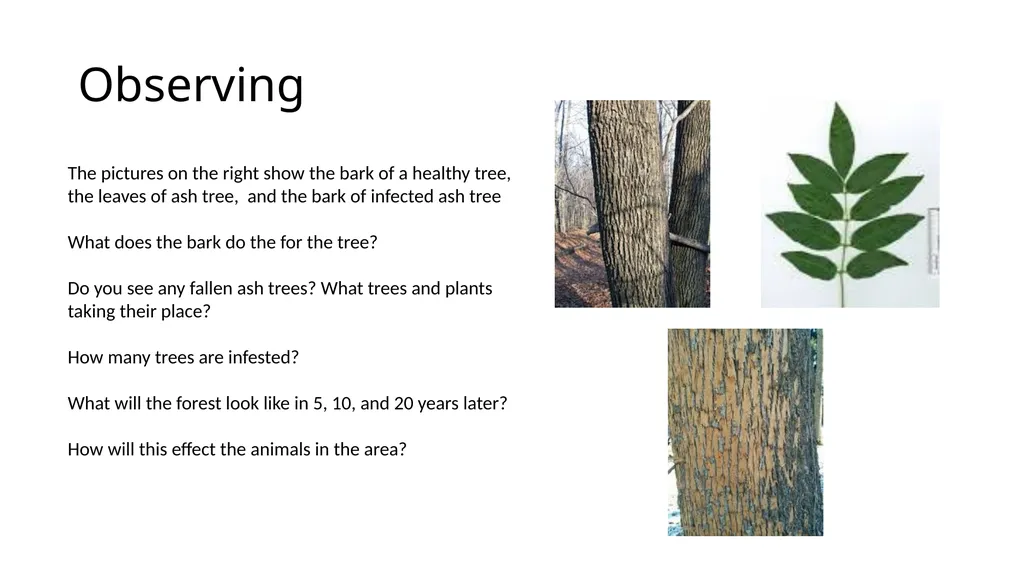
Look for ash trees, particularly ones that have been damaged by the ash boring beetle (easy to spot if you know what your looking for.. See next slide)
Do you see other trees in distress? They will might open bark, dead limbs, fungus growing out of them, split limbs, etc.
Look at and identify the other trees in the area.<br>
05
Observing The pictures on the right show the bark of a healthy tree, the leaves of ash tree, and the bark of infected ash tree
What does the bark do the for the tree?
Do you see any fallen ash trees? What trees and plants taking their place?
How many trees are infested?
What will the forest look like in 5, 10, and 20 years later?
How will this effect the animals in the area?<br>
06
Some answers The bark ultimately provides protection from the tree, especially from fungus getting into the tree. If the bark is severely damaged, the tree cannot protect itself and will likely die. Some parks have been closed to the public due to risk of the ill trees falling on them.
After the tree falls, it will allow sunlight in. Other young ash trees might grow in the spot, but more than likely other species, or types of trees will grow in its place. See if you can identify what tree species are growing in the open spot.
After time, the wooded area will have different trees which will likely effect the number and kinds of animals living there.
Interested for more: look into what happened to the American Chestnut tree or the Elm trees. Look into the PLT.org for more outside science.<br>
07
Vocabulary Invasive Species – Species not from the local ecosystem, with no known predators and disrupts the ecosystem
Ecosystem – A community of interacting organisms (plants, animals, fungi, etc)
Species – a type or organism, capable of reproducing with each other<br>