
NBA and VTU organized Program on Awareness
PT
Published · 122 slides · 0 views

1 / 1




Description
NBA and VTU organized Program on Awareness Workshop on Outcome-based Education and Accreditation for Engineering Colleges in Karnataka Methods of Assessment and Evaluation: Assessment Tools, Assessment of POs, PSOs, PEOs, COs and thoughts
Related Topics
Share
Embed code
Download this presentation From Below
"NBA and VTU organized Program on Awareness" is the property of its rightful owner. Permission is granted to download and print the materials on this website for personal, non-commercial use only, and to display it on your personal computer provided you do not modify the materials and that you retain all copyright notices contained in the materials. By downloading content from our website, you accept the terms of this agreement.
Presentation Transcript
01
NBA and VTU organized Program on
Awareness Workshop on Outcome-based Education and
Accreditation for Engineering Colleges in Karnataka
Methods of Assessment and Evaluation: Assessment Tools, Assessment
of POs, PSOs, PEOs, & COs and thoughts on closing the Loop for Continuous Improvement
Venue BMS college of Engineering, Bengaluru
Date: 16 January, 2023 11:30 -13:00
Prof C R MUTHUKRISHNAN 1<br>
Awareness Workshop on Outcome-based Education and
Accreditation for Engineering Colleges in Karnataka
Methods of Assessment and Evaluation: Assessment Tools, Assessment
of POs, PSOs, PEOs, & COs and thoughts on closing the Loop for Continuous Improvement
Venue BMS college of Engineering, Bengaluru
Date: 16 January, 2023 11:30 -13:00
Prof C R MUTHUKRISHNAN 1<br>
02
PRESENT SCENARIO How do faculty teach?
The course is assigned in advance.
The course description has [L-T-P-C],the syllabus and the curriculum course where the course is positioned.
The syllabus, usually, has 5 units- (in sequence?) content of each unit in phrases, Text book(s), reference book(s)
we collect university/previous-year question papers.
We prepare a lesson plan (lecture wise) 5x 9 = 45 approx
The process for assessment of students in the course is as per guidelines – quizzes/homework/tutorial/assignments/and internal tests with weightages 2<br>
The course is assigned in advance.
The course description has [L-T-P-C],the syllabus and the curriculum course where the course is positioned.
The syllabus, usually, has 5 units- (in sequence?) content of each unit in phrases, Text book(s), reference book(s)
we collect university/previous-year question papers.
We prepare a lesson plan (lecture wise) 5x 9 = 45 approx
The process for assessment of students in the course is as per guidelines – quizzes/homework/tutorial/assignments/and internal tests with weightages 2<br>
03
OBSERVATIONS ON THE APPROACH SO FAR There are no explicitly stated statements why we are teaching the course. What is the purpose from the student standpoint Is it just success in the examination? We need clarity.
We can ask the above question for the program (BE degree in Engineering in a discipline)
In OBE, these are captured by OBE PEO, PO/PSO and COs
Making Outcomes explicit benefits students, teachers, management/ education administrators and industry/employers – all stake holders 3<br>
We can ask the above question for the program (BE degree in Engineering in a discipline)
In OBE, these are captured by OBE PEO, PO/PSO and COs
Making Outcomes explicit benefits students, teachers, management/ education administrators and industry/employers – all stake holders 3<br>
04
About OBE The key concept in OBE is OUTCOMES
course outcomes(COs) and Program outcomes(POs)
NBA has adapted OBE as model and basis for accreditation of PROGRAMS since 2013
OBE is widely-in-use globally for more than 3 decades.
About 20 countries who have accreditation systems for Engineering Programs are members of Washington Accord through a due process. The membership basis is substantial equivalence of the accredited programs
India was a provisional member of the WA for initially and became a full member in 2013 – This status was reviewed by a WA peer committee and has been extended for a further period of 6 years in 2019 4<br>
course outcomes(COs) and Program outcomes(POs)
NBA has adapted OBE as model and basis for accreditation of PROGRAMS since 2013
OBE is widely-in-use globally for more than 3 decades.
About 20 countries who have accreditation systems for Engineering Programs are members of Washington Accord through a due process. The membership basis is substantial equivalence of the accredited programs
India was a provisional member of the WA for initially and became a full member in 2013 – This status was reviewed by a WA peer committee and has been extended for a further period of 6 years in 2019 4<br>
05
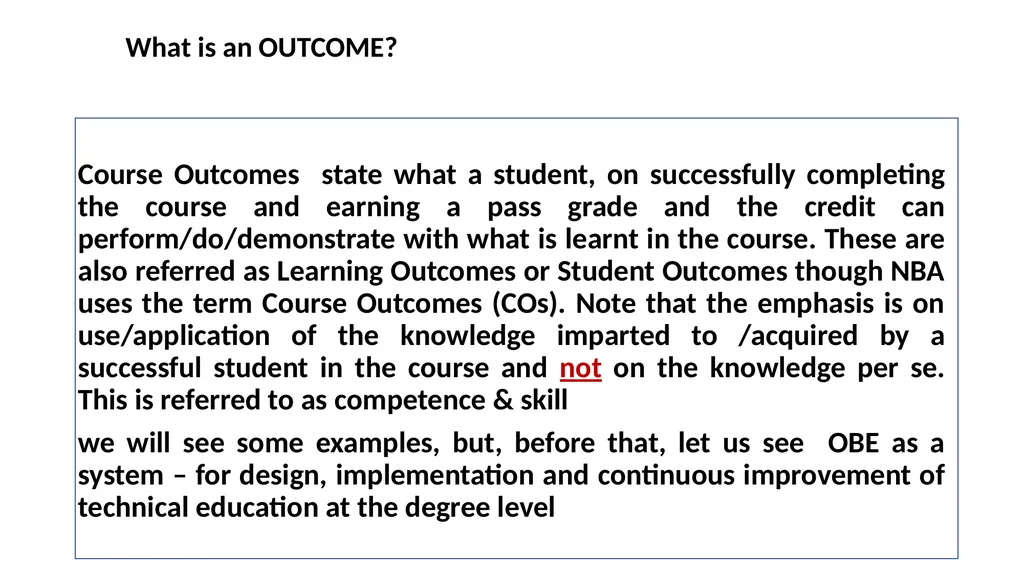
What is an OUTCOME? Course Outcomes state what a student, on successfully completing the course and earning a pass grade and the credit can perform/do/demonstrate with what is learnt in the course. These are also referred as Learning Outcomes or Student Outcomes though NBA uses the term Course Outcomes (COs). Note that the emphasis is on use/application of the knowledge imparted to /acquired by a successful student in the course and not on the knowledge per se. This is referred to as competence & skill
we will see some examples, but, before that, let us see OBE as a system – for design, implementation and continuous improvement of technical education at the degree level 5<br>
we will see some examples, but, before that, let us see OBE as a system – for design, implementation and continuous improvement of technical education at the degree level 5<br>
06
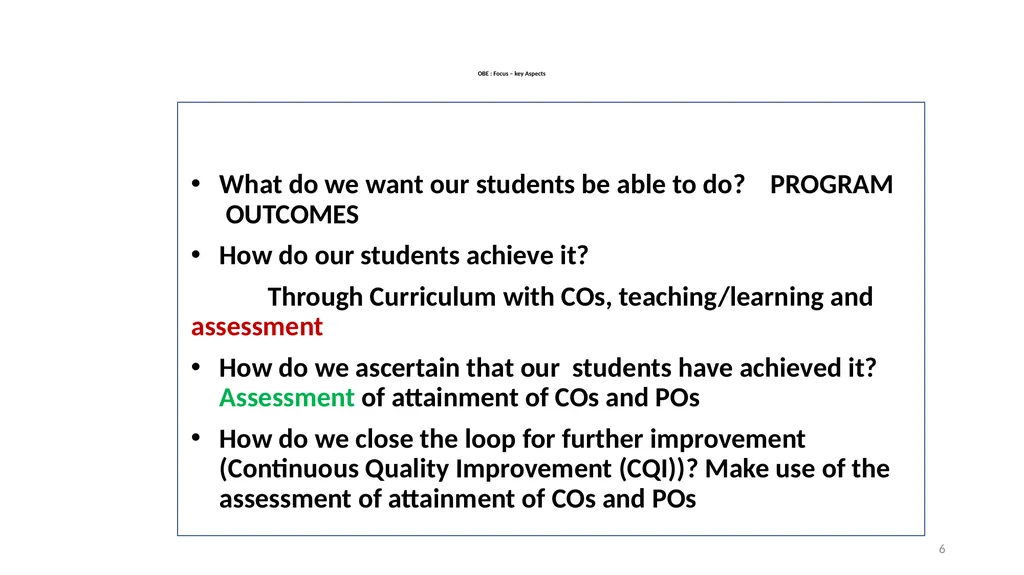
OBE : Focus – key Aspects What do we want our students be able to do? PROGRAM OUTCOMES
How do our students achieve it?
Through Curriculum with COs, teaching/learning and assessment
How do we ascertain that our students have achieved it? Assessment of attainment of COs and POs
How do we close the loop for further improvement (Continuous Quality Improvement (CQI))? Make use of the assessment of attainment of COs and POs 6<br>
How do our students achieve it?
Through Curriculum with COs, teaching/learning and assessment
How do we ascertain that our students have achieved it? Assessment of attainment of COs and POs
How do we close the loop for further improvement (Continuous Quality Improvement (CQI))? Make use of the assessment of attainment of COs and POs 6<br>
07
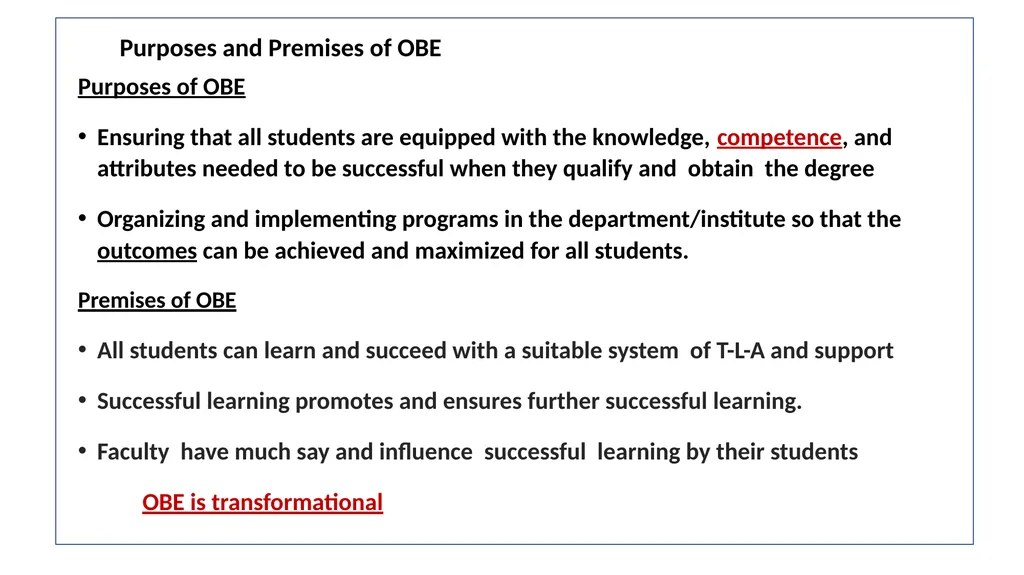
Purposes and Premises of OBE Purposes of OBE
Ensuring that all students are equipped with the knowledge, competence, and attributes needed to be successful when they qualify and obtain the degree
Organizing and implementing programs in the department/institute so that the outcomes can be achieved and maximized for all students.
Premises of OBE
All students can learn and succeed with a suitable system of T-L-A and support
Successful learning promotes and ensures further successful learning.
Faculty have much say and influence successful learning by their students
OBE is transformational<br>
Ensuring that all students are equipped with the knowledge, competence, and attributes needed to be successful when they qualify and obtain the degree
Organizing and implementing programs in the department/institute so that the outcomes can be achieved and maximized for all students.
Premises of OBE
All students can learn and succeed with a suitable system of T-L-A and support
Successful learning promotes and ensures further successful learning.
Faculty have much say and influence successful learning by their students
OBE is transformational<br>
08
SAR – NBA Criteria and Evaluation Scores Grade Y W C D: Y complied, W weakness, C concern, D Deficiency
Vision, Mission, PEOs 50*
Program Curriculum &
Teaching-Learning Processes 100*
Course Outcomes and
Program Outcomes 175*
Students’ Performance 100
Faculty Information and
Contributions 200
Facilities and Technical Support 80
Continuous Improvement 75
*325/780 = 41.7% criterion 8, 9, 10 for 220 marks 8<br>
Vision, Mission, PEOs 50*
Program Curriculum &
Teaching-Learning Processes 100*
Course Outcomes and
Program Outcomes 175*
Students’ Performance 100
Faculty Information and
Contributions 200
Facilities and Technical Support 80
Continuous Improvement 75
*325/780 = 41.7% criterion 8, 9, 10 for 220 marks 8<br>
09
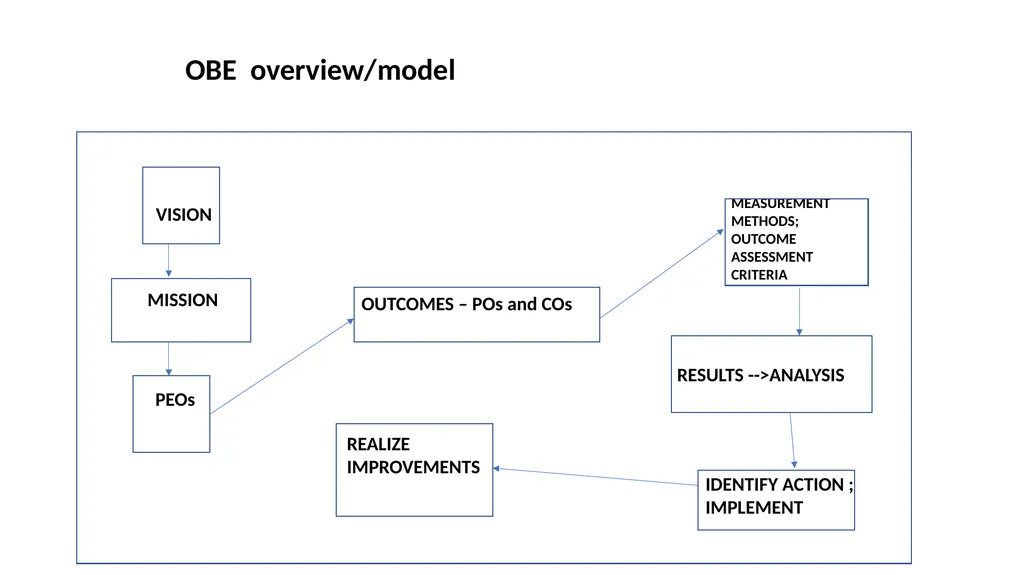
OBE overview/model VISION MISSION PEOs OUTCOMES – POs and COs RESULTS -->ANALYSIS REALIZE IMPROVEMENTS MEASUREMENT METHODS; OUTCOME ASSESSMENT CRITERIA IDENTIFY ACTION ; IMPLEMENT 9<br>
10
Program Educational Objectives - PEOs PEOs are broad statements that describe the career and professional achievements that the program is preparing the graduates to achieve within the first few years after graduation.
PEOs are assessed via interaction with alumni and industry persons associated with the Program/institute. 10<br>
PEOs are assessed via interaction with alumni and industry persons associated with the Program/institute. 10<br>
11
PEO Example – Aeronautical Engineering PEO1. Our graduates will have successful professional careers in industry, government, academia and military as innovative engineers.
PEO2. Our graduates will be successful in solving engineering problems associated with the lifecycle of aircraft systems
PEO3. Our graduates will continue to learn and advance their careers through activities such as participation in professional organizations, attainment of professional certification and seeking higher education.
PEO4. Our graduates will be active members ready to serve the society locally and internationally
Note that PEOs are about what graduates may do after they graduate 11<br>
PEO2. Our graduates will be successful in solving engineering problems associated with the lifecycle of aircraft systems
PEO3. Our graduates will continue to learn and advance their careers through activities such as participation in professional organizations, attainment of professional certification and seeking higher education.
PEO4. Our graduates will be active members ready to serve the society locally and internationally
Note that PEOs are about what graduates may do after they graduate 11<br>
12
PEO EXAMPLE: CIVIL ENGINEERING Our Graduates will demonstrate peer-recognized technical competency in the analysis, design and construction of Civil Engineering structures.
Our Graduates will demonstrate leadership and initiative to advance professional and organizational goals with commitment to ethical standards of profession, teamwork and respect for diverse cultural background.
Our Graduates will be engaged in ongoing learning and professional development through pursuance of higher education and self-study. Graduates will be committed to creative practice of engineering and other professions in a responsible manner contributing to the socio-economic development of the society.<br>
Our Graduates will demonstrate leadership and initiative to advance professional and organizational goals with commitment to ethical standards of profession, teamwork and respect for diverse cultural background.
Our Graduates will be engaged in ongoing learning and professional development through pursuance of higher education and self-study. Graduates will be committed to creative practice of engineering and other professions in a responsible manner contributing to the socio-economic development of the society.<br>
13
PSOs – An Example (Civil Engineering) PSO1: Proficiency in a specialized area: Demonstrate proficiency in one of the following specialized areas of Civil Engineering i) Construction Materials and Management ii) Structural and Geotechnical Engineering iii) Environmental, water resources and Transportation Engineering
PSO2: Ability to apply principles of civil engineering for the entire life cycle of the project ranging from initial design to the closure of the project.
PSO3: Ability to identify and analyse various properties of construction materials and their applications in design and construction of various structures 13<br>
PSO2: Ability to apply principles of civil engineering for the entire life cycle of the project ranging from initial design to the closure of the project.
PSO3: Ability to identify and analyse various properties of construction materials and their applications in design and construction of various structures 13<br>
14
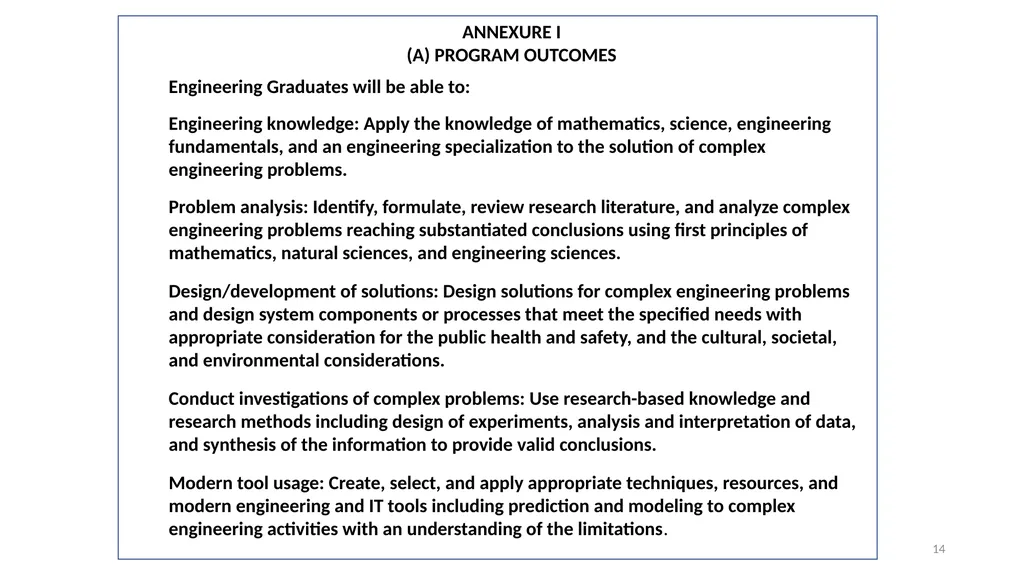
ANNEXURE I
(A) PROGRAM OUTCOMES Engineering Graduates will be able to:
Engineering knowledge: Apply the knowledge of mathematics, science, engineering fundamentals, and an engineering specialization to the solution of complex engineering problems.
Problem analysis: Identify, formulate, review research literature, and analyze complex engineering problems reaching substantiated conclusions using first principles of mathematics, natural sciences, and engineering sciences.
Design/development of solutions: Design solutions for complex engineering problems and design system components or processes that meet the specified needs with appropriate consideration for the public health and safety, and the cultural, societal, and environmental considerations.
Conduct investigations of complex problems: Use research-based knowledge and research methods including design of experiments, analysis and interpretation of data, and synthesis of the information to provide valid conclusions.
Modern tool usage: Create, select, and apply appropriate techniques, resources, and modern engineering and IT tools including prediction and modeling to complex engineering activities with an understanding of the limitations. 14<br>
(A) PROGRAM OUTCOMES Engineering Graduates will be able to:
Engineering knowledge: Apply the knowledge of mathematics, science, engineering fundamentals, and an engineering specialization to the solution of complex engineering problems.
Problem analysis: Identify, formulate, review research literature, and analyze complex engineering problems reaching substantiated conclusions using first principles of mathematics, natural sciences, and engineering sciences.
Design/development of solutions: Design solutions for complex engineering problems and design system components or processes that meet the specified needs with appropriate consideration for the public health and safety, and the cultural, societal, and environmental considerations.
Conduct investigations of complex problems: Use research-based knowledge and research methods including design of experiments, analysis and interpretation of data, and synthesis of the information to provide valid conclusions.
Modern tool usage: Create, select, and apply appropriate techniques, resources, and modern engineering and IT tools including prediction and modeling to complex engineering activities with an understanding of the limitations. 14<br>
15
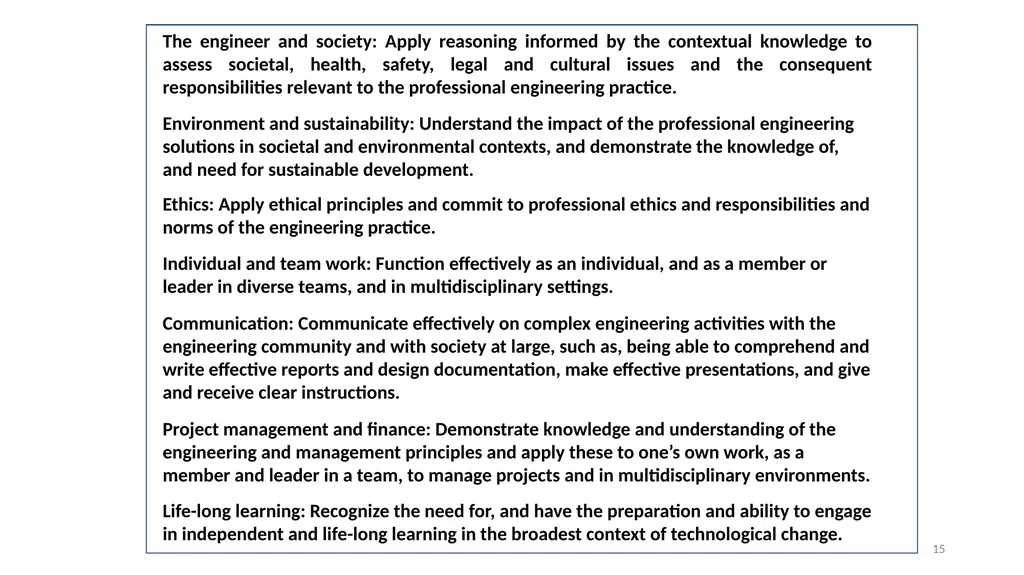
The engineer and society: Apply reasoning informed by the contextual knowledge to assess societal, health, safety, legal and cultural issues and the consequent responsibilities relevant to the professional engineering practice.
Environment and sustainability: Understand the impact of the professional engineering solutions in societal and environmental contexts, and demonstrate the knowledge of, and need for sustainable development.
Ethics: Apply ethical principles and commit to professional ethics and responsibilities and norms of the engineering practice.
Individual and team work: Function effectively as an individual, and as a member or leader in diverse teams, and in multidisciplinary settings.
Communication: Communicate effectively on complex engineering activities with the engineering community and with society at large, such as, being able to comprehend and write effective reports and design documentation, make effective presentations, and give and receive clear instructions.
Project management and finance: Demonstrate knowledge and understanding of the engineering and management principles and apply these to one’s own work, as a member and leader in a team, to manage projects and in multidisciplinary environments.
Life-long learning: Recognize the need for, and have the preparation and ability to engage in independent and life-long learning in the broadest context of technological change. 15<br>
Environment and sustainability: Understand the impact of the professional engineering solutions in societal and environmental contexts, and demonstrate the knowledge of, and need for sustainable development.
Ethics: Apply ethical principles and commit to professional ethics and responsibilities and norms of the engineering practice.
Individual and team work: Function effectively as an individual, and as a member or leader in diverse teams, and in multidisciplinary settings.
Communication: Communicate effectively on complex engineering activities with the engineering community and with society at large, such as, being able to comprehend and write effective reports and design documentation, make effective presentations, and give and receive clear instructions.
Project management and finance: Demonstrate knowledge and understanding of the engineering and management principles and apply these to one’s own work, as a member and leader in a team, to manage projects and in multidisciplinary environments.
Life-long learning: Recognize the need for, and have the preparation and ability to engage in independent and life-long learning in the broadest context of technological change. 15<br>
16
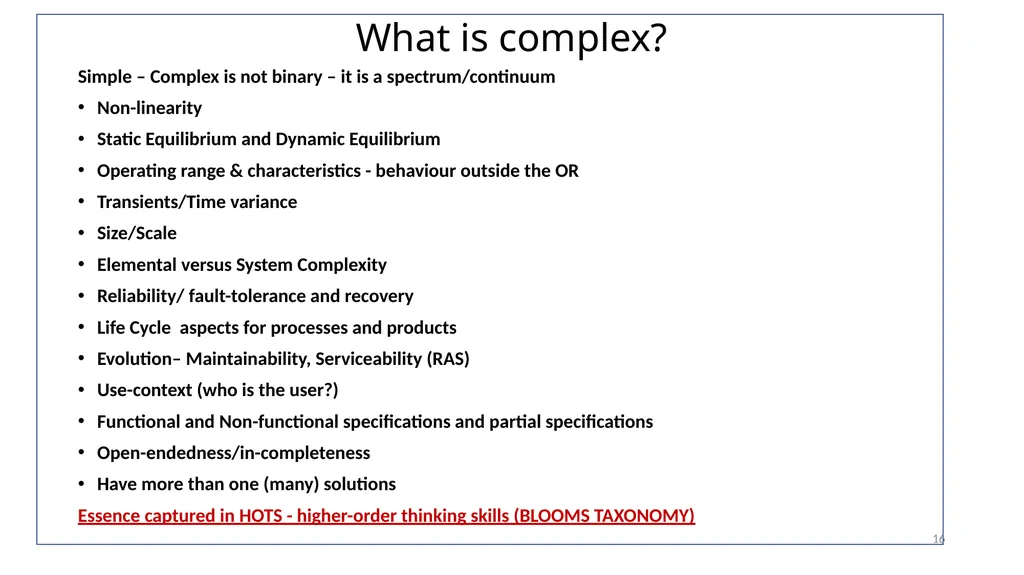
What is complex? Simple – Complex is not binary – it is a spectrum/continuum
Non-linearity
Static Equilibrium and Dynamic Equilibrium
Operating range & characteristics - behaviour outside the OR
Transients/Time variance
Size/Scale
Elemental versus System Complexity
Reliability/ fault-tolerance and recovery
Life Cycle aspects for processes and products
Evolution– Maintainability, Serviceability (RAS)
Use-context (who is the user?)
Functional and Non-functional specifications and partial specifications
Open-endedness/in-completeness
Have more than one (many) solutions
Essence captured in HOTS - higher-order thinking skills (BLOOMS TAXONOMY) 16<br>
Non-linearity
Static Equilibrium and Dynamic Equilibrium
Operating range & characteristics - behaviour outside the OR
Transients/Time variance
Size/Scale
Elemental versus System Complexity
Reliability/ fault-tolerance and recovery
Life Cycle aspects for processes and products
Evolution– Maintainability, Serviceability (RAS)
Use-context (who is the user?)
Functional and Non-functional specifications and partial specifications
Open-endedness/in-completeness
Have more than one (many) solutions
Essence captured in HOTS - higher-order thinking skills (BLOOMS TAXONOMY) 16<br>
17
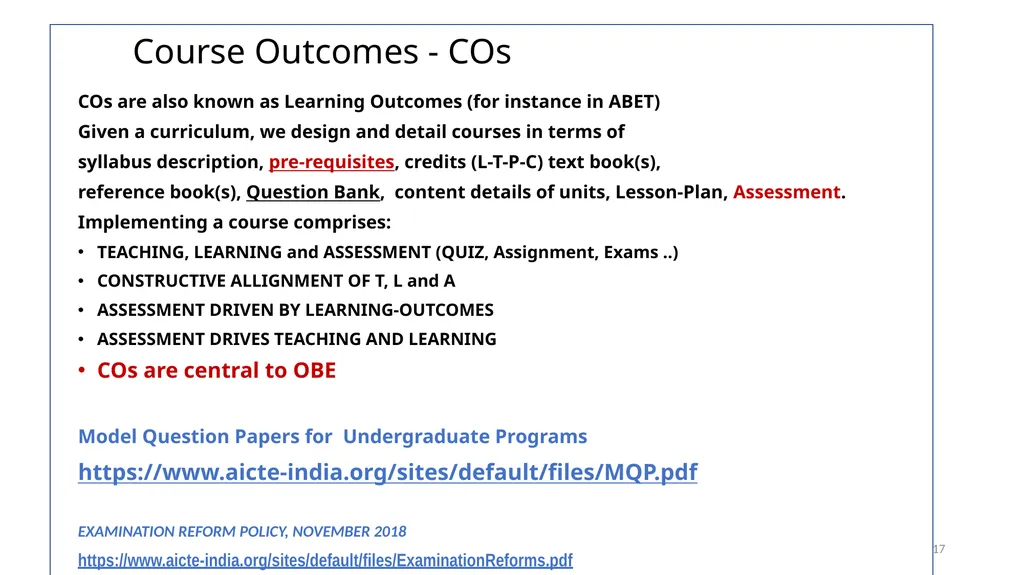
Course Outcomes - COs COs are also known as Learning Outcomes (for instance in ABET)
Given a curriculum, we design and detail courses in terms of
syllabus description, pre-requisites, credits (L-T-P-C) text book(s),
reference book(s), Question Bank, content details of units, Lesson-Plan, Assessment.
Implementing a course comprises:
TEACHING, LEARNING and ASSESSMENT (QUIZ, Assignment, Exams ..)
CONSTRUCTIVE ALLIGNMENT OF T, L and A
ASSESSMENT DRIVEN BY LEARNING-OUTCOMES
ASSESSMENT DRIVES TEACHING AND LEARNING
COs are central to OBE
Model Question Papers for Undergraduate Programs
https://www.aicte-india.org/sites/default/files/MQP.pdf
EXAMINATION REFORM POLICY, NOVEMBER 2018
https://www.aicte-india.org/sites/default/files/ExaminationReforms.pdf 17<br>
Given a curriculum, we design and detail courses in terms of
syllabus description, pre-requisites, credits (L-T-P-C) text book(s),
reference book(s), Question Bank, content details of units, Lesson-Plan, Assessment.
Implementing a course comprises:
TEACHING, LEARNING and ASSESSMENT (QUIZ, Assignment, Exams ..)
CONSTRUCTIVE ALLIGNMENT OF T, L and A
ASSESSMENT DRIVEN BY LEARNING-OUTCOMES
ASSESSMENT DRIVES TEACHING AND LEARNING
COs are central to OBE
Model Question Papers for Undergraduate Programs
https://www.aicte-india.org/sites/default/files/MQP.pdf
EXAMINATION REFORM POLICY, NOVEMBER 2018
https://www.aicte-india.org/sites/default/files/ExaminationReforms.pdf 17<br>
18
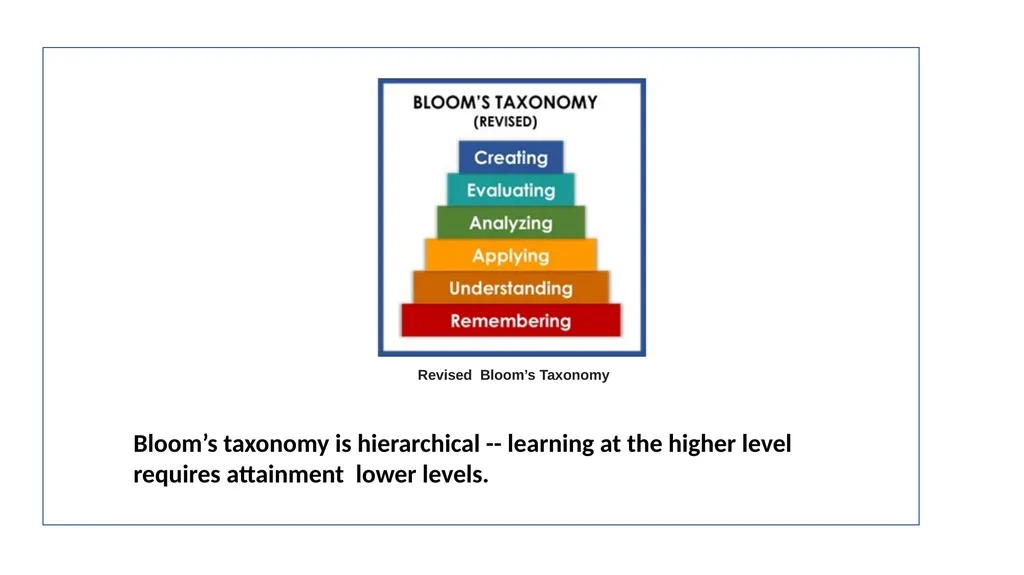
Revised Bloom’s Taxonomy Bloom’s taxonomy is hierarchical -- learning at the higher level
requires attainment lower levels.<br>
requires attainment lower levels.<br>
19
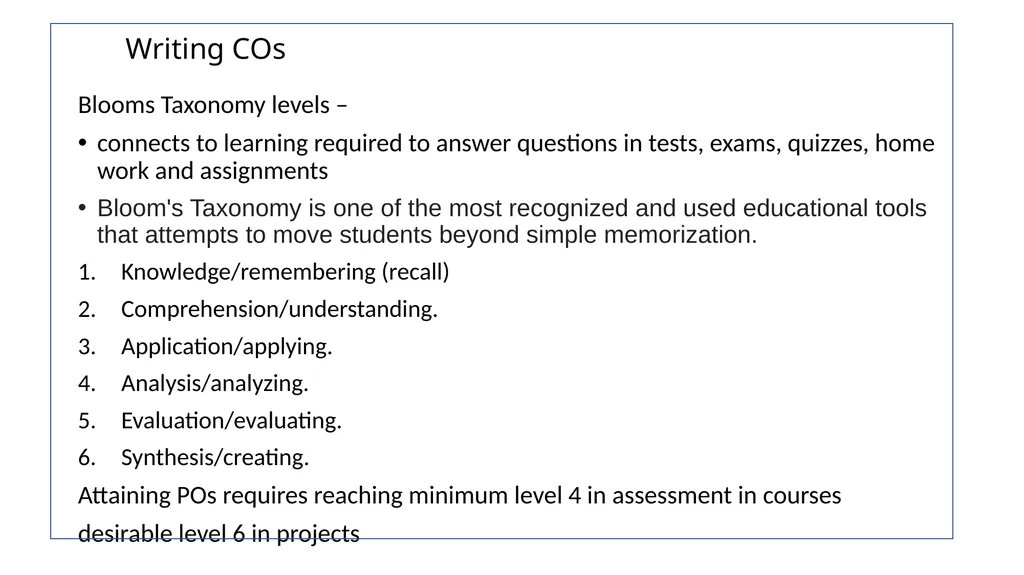
Writing COs Blooms Taxonomy levels –
connects to learning required to answer questions in tests, exams, quizzes, home work and assignments
Bloom's Taxonomy is one of the most recognized and used educational tools that attempts to move students beyond simple memorization.
Knowledge/remembering (recall)
Comprehension/understanding.
Application/applying.
Analysis/analyzing.
Evaluation/evaluating.
Synthesis/creating.
Attaining POs requires reaching minimum level 4 in assessment in courses
desirable level 6 in projects 19<br>
connects to learning required to answer questions in tests, exams, quizzes, home work and assignments
Bloom's Taxonomy is one of the most recognized and used educational tools that attempts to move students beyond simple memorization.
Knowledge/remembering (recall)
Comprehension/understanding.
Application/applying.
Analysis/analyzing.
Evaluation/evaluating.
Synthesis/creating.
Attaining POs requires reaching minimum level 4 in assessment in courses
desirable level 6 in projects 19<br>
20
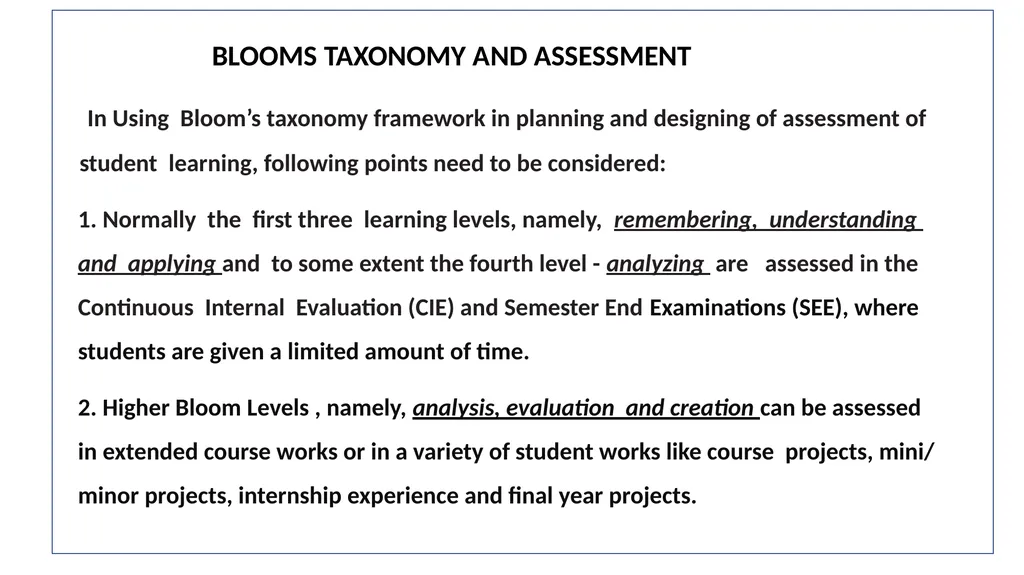
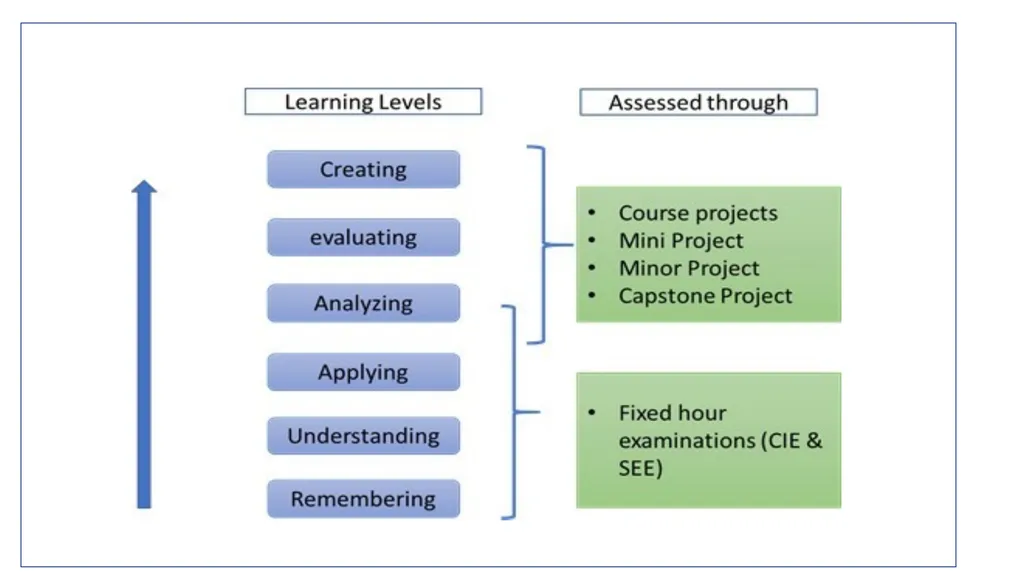
BLOOMS TAXONOMY AND ASSESSMENT In Using Bloom’s taxonomy framework in planning and designing of assessment of student learning, following points need to be considered:
1. Normally the first three learning levels, namely, remembering, understanding and applying and to some extent the fourth level - analyzing are assessed in the Continuous Internal Evaluation (CIE) and Semester End Examinations (SEE), where students are given a limited amount of time.
2. Higher Bloom Levels , namely, analysis, evaluation and creation can be assessed in extended course works or in a variety of student works like course projects, mini/ minor projects, internship experience and final year projects.<br>
1. Normally the first three learning levels, namely, remembering, understanding and applying and to some extent the fourth level - analyzing are assessed in the Continuous Internal Evaluation (CIE) and Semester End Examinations (SEE), where students are given a limited amount of time.
2. Higher Bloom Levels , namely, analysis, evaluation and creation can be assessed in extended course works or in a variety of student works like course projects, mini/ minor projects, internship experience and final year projects.<br>
21
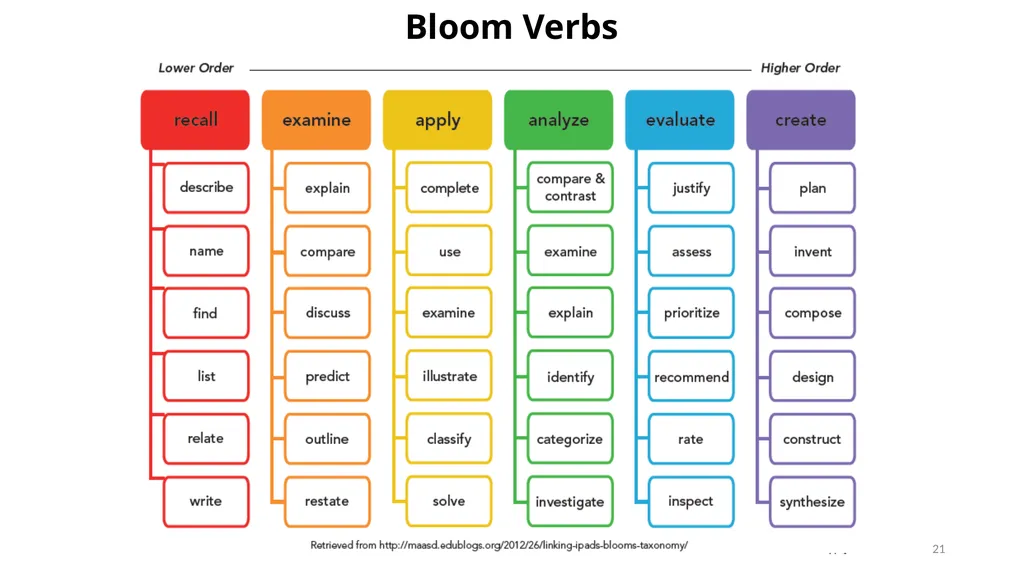
Bloom Verbs 21<br>
22
Examination Reform Policy<br>
23
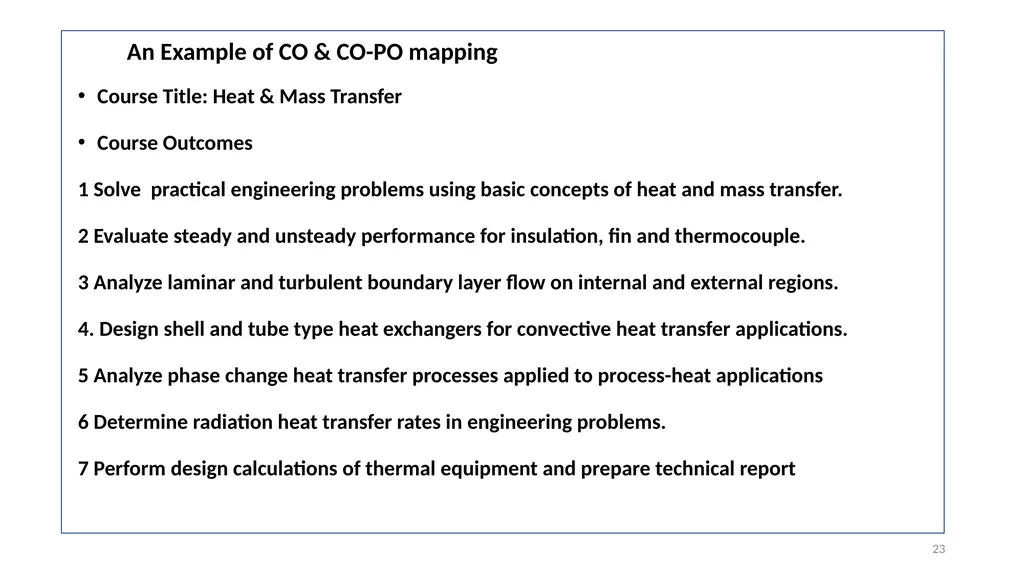
An Example of CO & CO-PO mapping Course Title: Heat & Mass Transfer
Course Outcomes
1 Solve practical engineering problems using basic concepts of heat and mass transfer.
2 Evaluate steady and unsteady performance for insulation, fin and thermocouple.
3 Analyze laminar and turbulent boundary layer flow on internal and external regions.
4. Design shell and tube type heat exchangers for convective heat transfer applications.
5 Analyze phase change heat transfer processes applied to process-heat applications
6 Determine radiation heat transfer rates in engineering problems.
7 Perform design calculations of thermal equipment and prepare technical report 23<br>
Course Outcomes
1 Solve practical engineering problems using basic concepts of heat and mass transfer.
2 Evaluate steady and unsteady performance for insulation, fin and thermocouple.
3 Analyze laminar and turbulent boundary layer flow on internal and external regions.
4. Design shell and tube type heat exchangers for convective heat transfer applications.
5 Analyze phase change heat transfer processes applied to process-heat applications
6 Determine radiation heat transfer rates in engineering problems.
7 Perform design calculations of thermal equipment and prepare technical report 23<br>
24
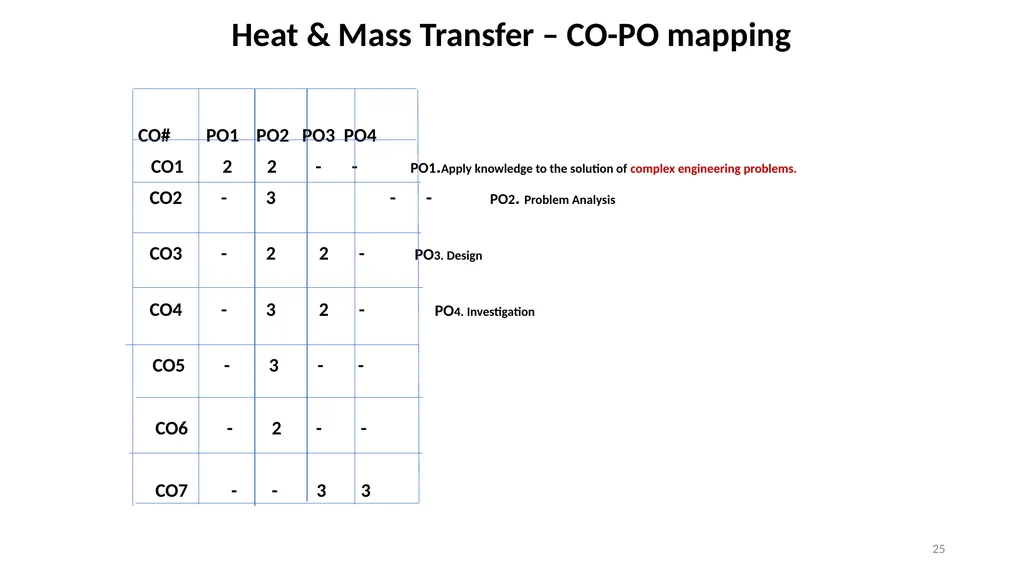
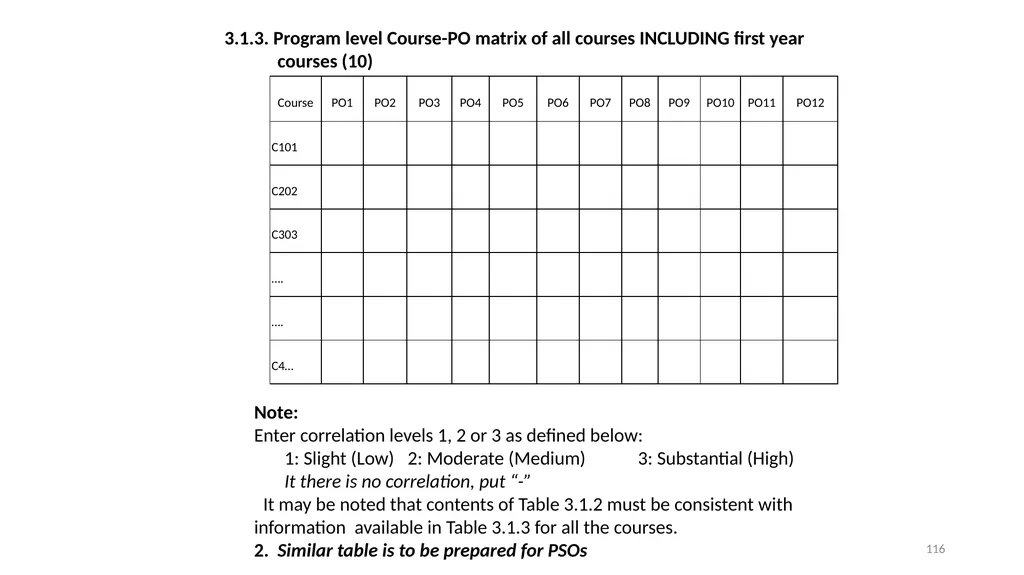
CO-PO mapping (connecting COs with POs) The mapping is a matrix with rows as COs and columns as POs
Each element/cell of the matrix has a value in {--, 1, 2, 3}
The meaning associated with the values are as follows:
-- this CO (row) has nil/very small/insignificant contribution to the PO(column)
1 relevant and small significance 2 medium or moderate and 3 strong
These values have to be justified in the T-L-A of the course, particularly in terms of the BLOOM Level of the questions/Problems 24<br>
Each element/cell of the matrix has a value in {--, 1, 2, 3}
The meaning associated with the values are as follows:
-- this CO (row) has nil/very small/insignificant contribution to the PO(column)
1 relevant and small significance 2 medium or moderate and 3 strong
These values have to be justified in the T-L-A of the course, particularly in terms of the BLOOM Level of the questions/Problems 24<br>
25
Heat & Mass Transfer – CO-PO mapping CO# PO1 PO2 PO3 PO4
CO1 2 2 - - PO1.Apply knowledge to the solution of complex engineering problems.
CO2 - 3 - - PO2. Problem Analysis
CO3 - 2 2 - PO3. Design
CO4 - 3 2 - PO4. Investigation
CO5 - 3 - -
CO6 - 2 - -
CO7 - - 3 3 25<br>
CO1 2 2 - - PO1.Apply knowledge to the solution of complex engineering problems.
CO2 - 3 - - PO2. Problem Analysis
CO3 - 2 2 - PO3. Design
CO4 - 3 2 - PO4. Investigation
CO5 - 3 - -
CO6 - 2 - -
CO7 - - 3 3 25<br>
26
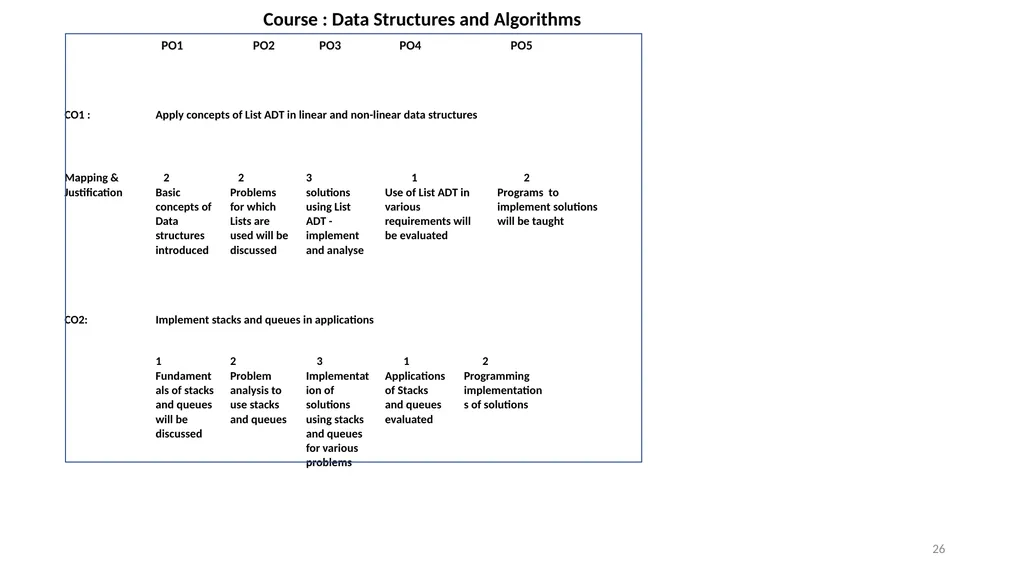
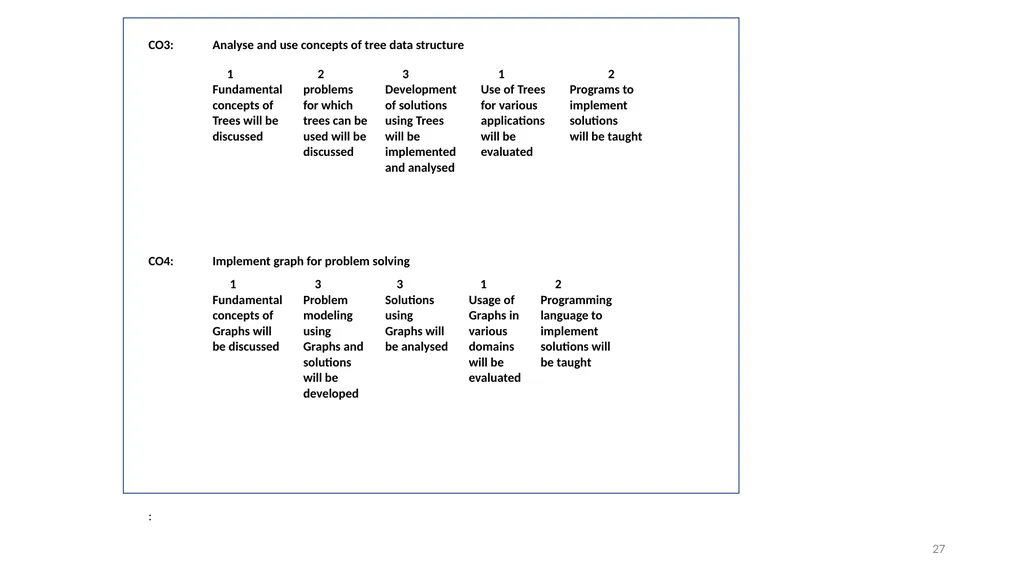
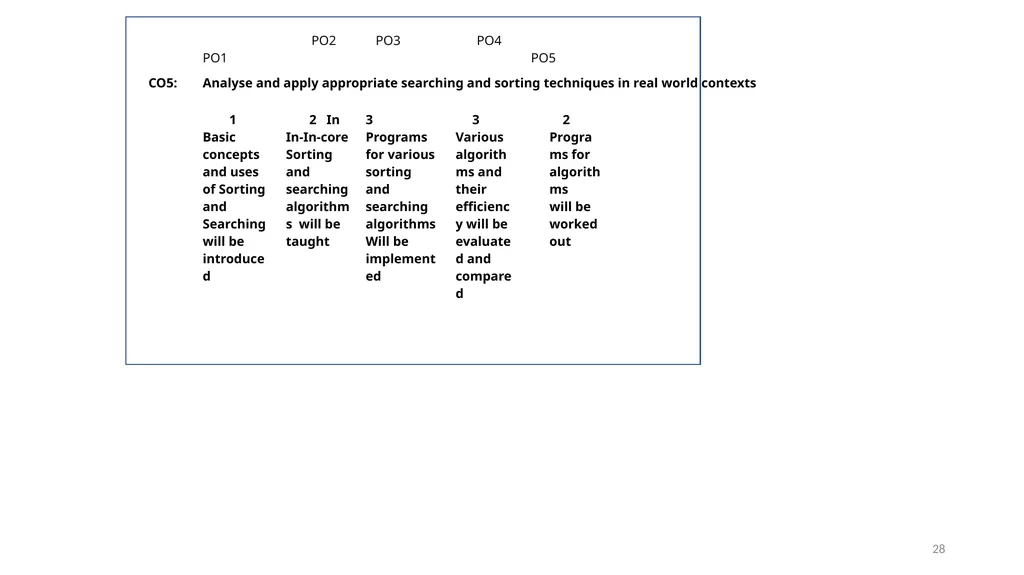
Course : Data Structures and Algorithms 26<br>
27
27<br>
28
28<br>
29
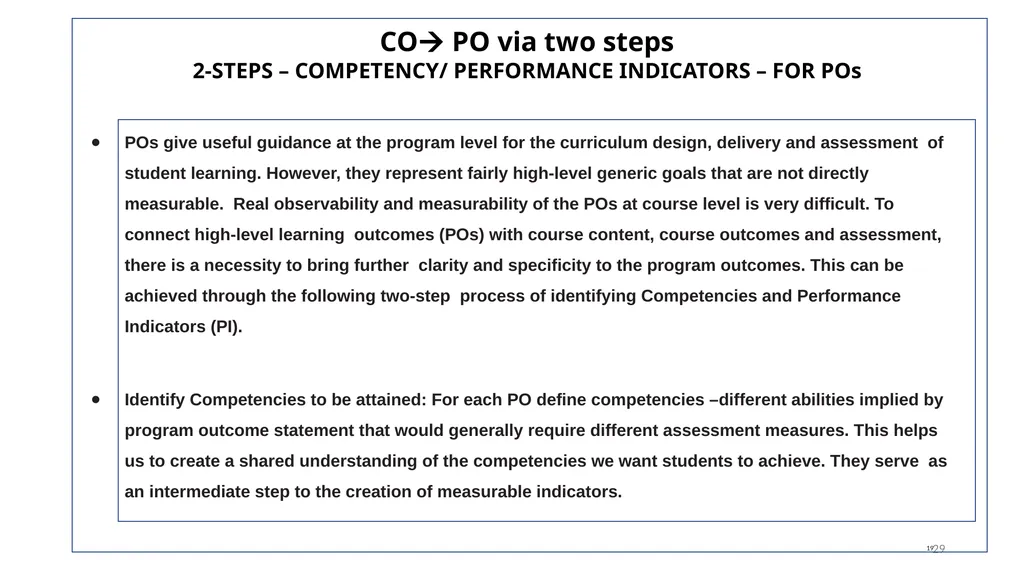
19 POs give useful guidance at the program level for the curriculum design, delivery and assessment of student learning. However, they represent fairly high-level generic goals that are not directly measurable. Real observability and measurability of the POs at course level is very difficult. To connect high-level learning outcomes (POs) with course content, course outcomes and assessment, there is a necessity to bring further clarity and specificity to the program outcomes. This can be achieved through the following two-step process of identifying Competencies and Performance Indicators (PI).
Identify Competencies to be attained: For each PO define competencies –different abilities implied by program outcome statement that would generally require different assessment measures. This helps us to create a shared understanding of the competencies we want students to achieve. They serve as an intermediate step to the creation of measurable indicators. CO PO via two steps 2-STEPS – COMPETENCY/ PERFORMANCE INDICATORS – FOR POs 29<br>
Identify Competencies to be attained: For each PO define competencies –different abilities implied by program outcome statement that would generally require different assessment measures. This helps us to create a shared understanding of the competencies we want students to achieve. They serve as an intermediate step to the creation of measurable indicators. CO PO via two steps 2-STEPS – COMPETENCY/ PERFORMANCE INDICATORS – FOR POs 29<br>
30
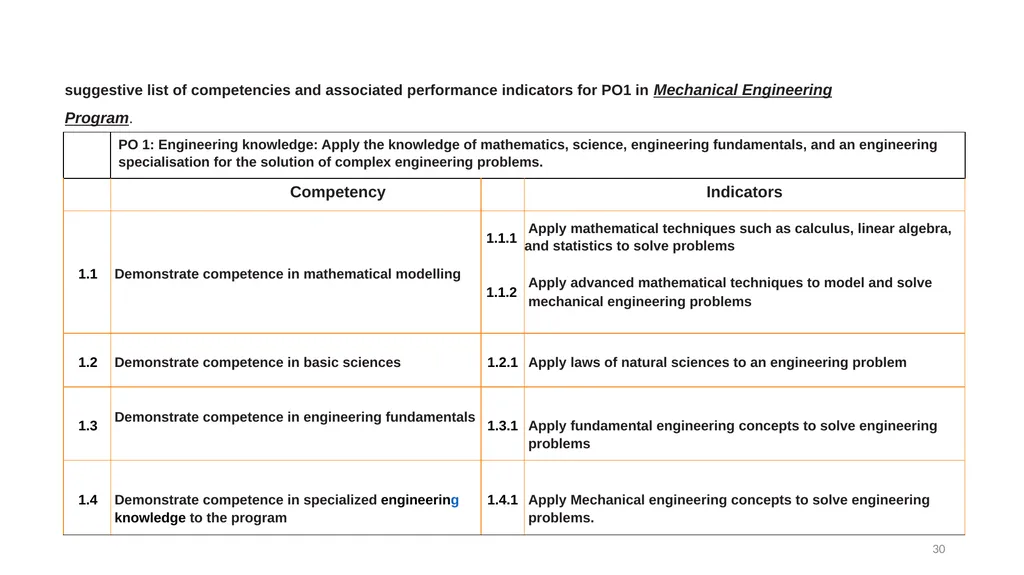
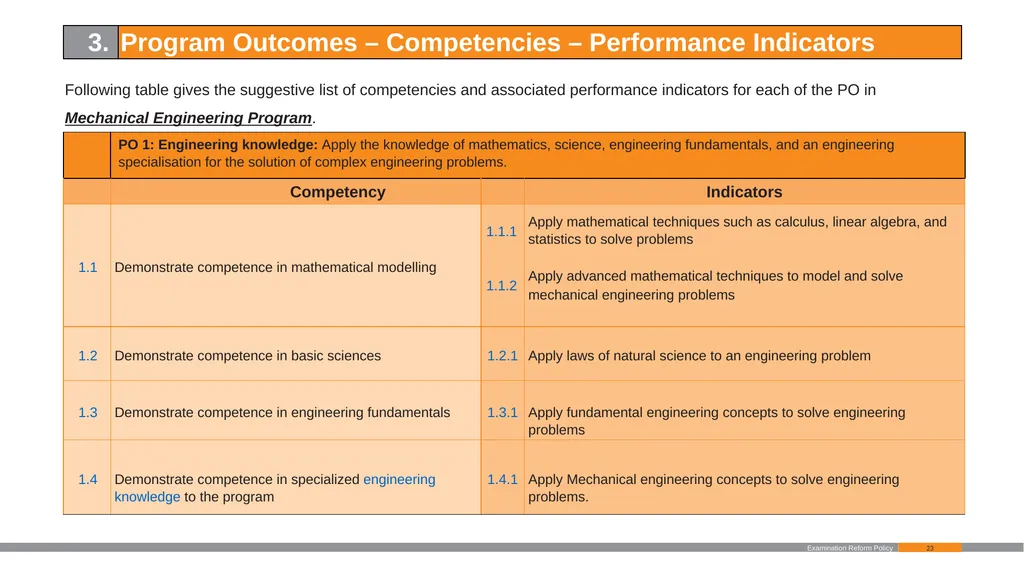
suggestive list of competencies and associated performance indicators for PO1 in Mechanical Engineering Program. 30<br>
31
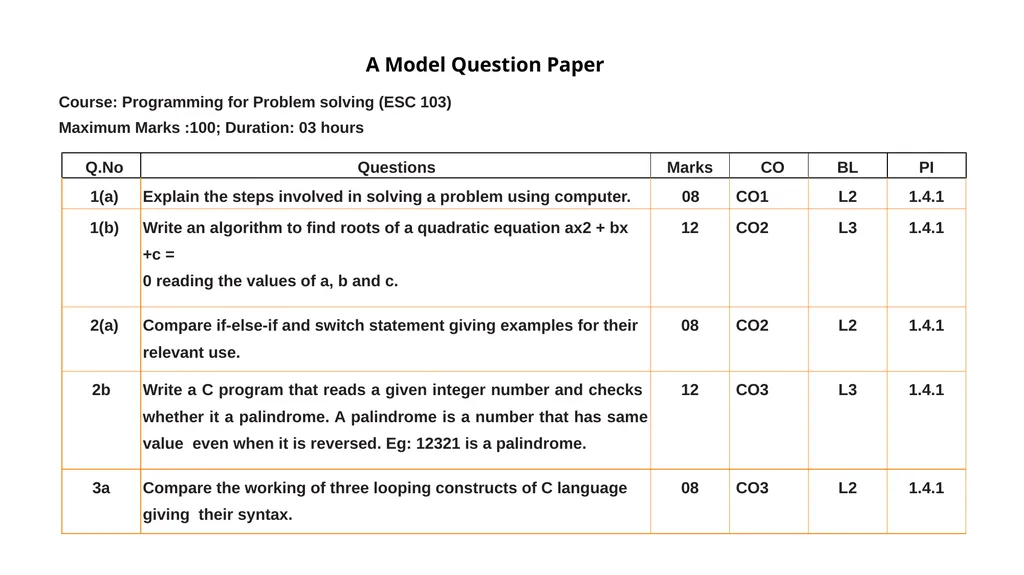
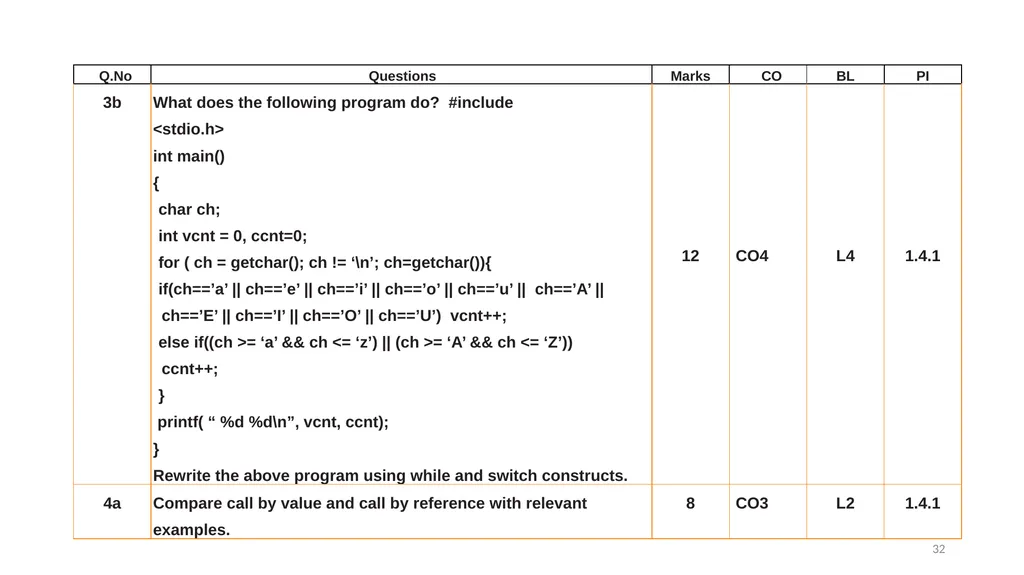
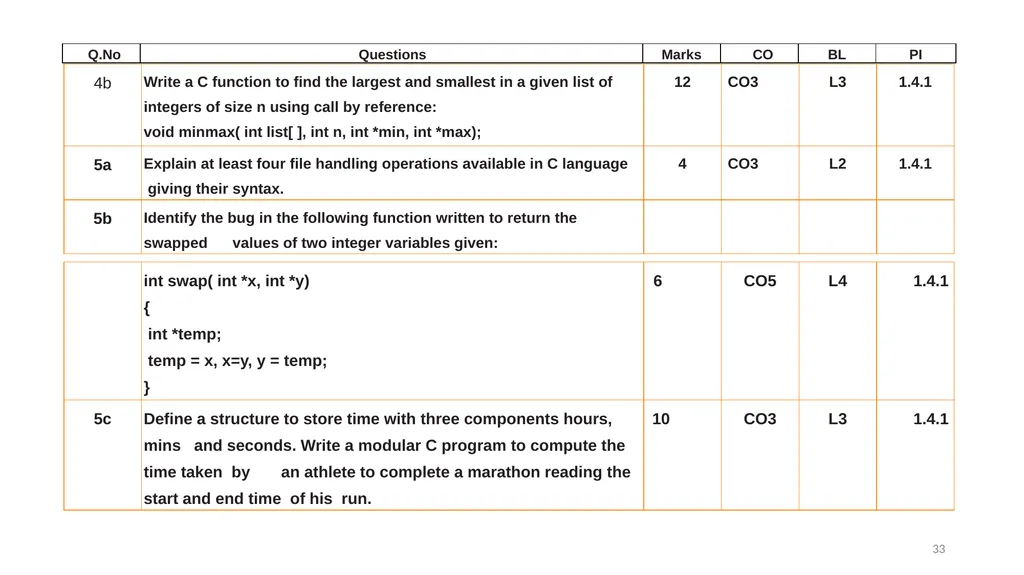
A Model Question Paper Course: Programming for Problem solving (ESC 103)
Maximum Marks :100; Duration: 03 hours Appendix<br>
Maximum Marks :100; Duration: 03 hours Appendix<br>
32
Appendix 32<br>
33
33<br>
34
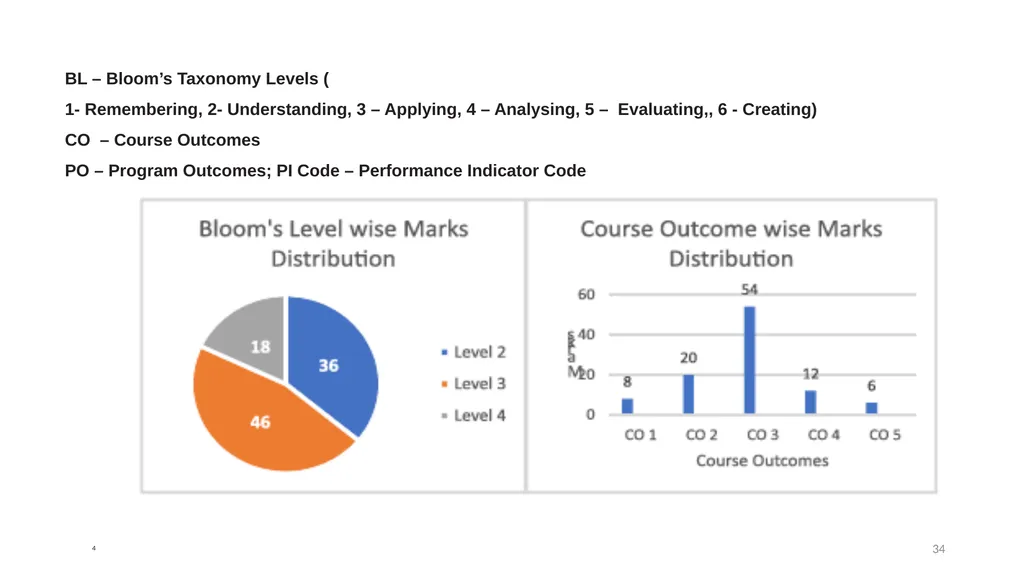
4 BL – Bloom’s Taxonomy Levels (
1- Remembering, 2- Understanding, 3 – Applying, 4 – Analysing, 5 – Evaluating,, 6 - Creating)
CO – Course Outcomes
PO – Program Outcomes; PI Code – Performance Indicator Code 34<br>
1- Remembering, 2- Understanding, 3 – Applying, 4 – Analysing, 5 – Evaluating,, 6 - Creating)
CO – Course Outcomes
PO – Program Outcomes; PI Code – Performance Indicator Code 34<br>
35
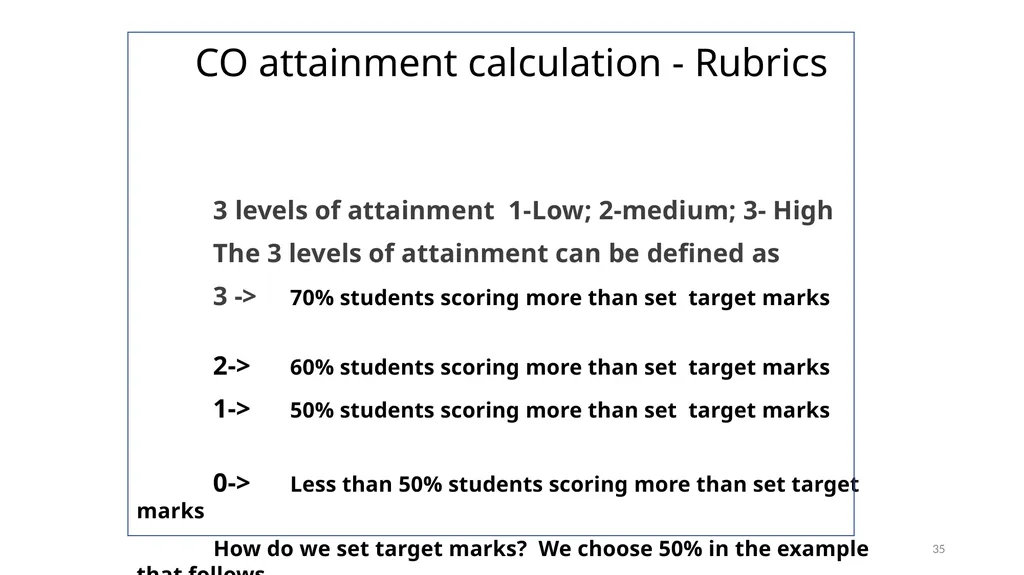
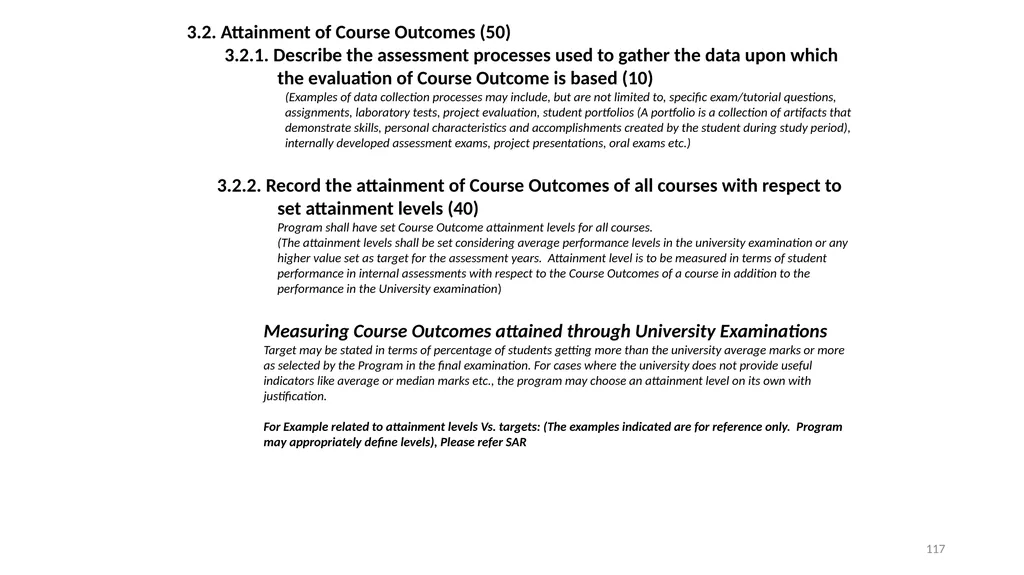
CO attainment calculation - Rubrics 3 levels of attainment 1-Low; 2-medium; 3- High
The 3 levels of attainment can be defined as
3 -> 70% students scoring more than set target marks
2-> 60% students scoring more than set target marks
1-> 50% students scoring more than set target marks
0-> Less than 50% students scoring more than set target marks
How do we set target marks? We choose 50% in the example that follows 35<br>
The 3 levels of attainment can be defined as
3 -> 70% students scoring more than set target marks
2-> 60% students scoring more than set target marks
1-> 50% students scoring more than set target marks
0-> Less than 50% students scoring more than set target marks
How do we set target marks? We choose 50% in the example that follows 35<br>
36
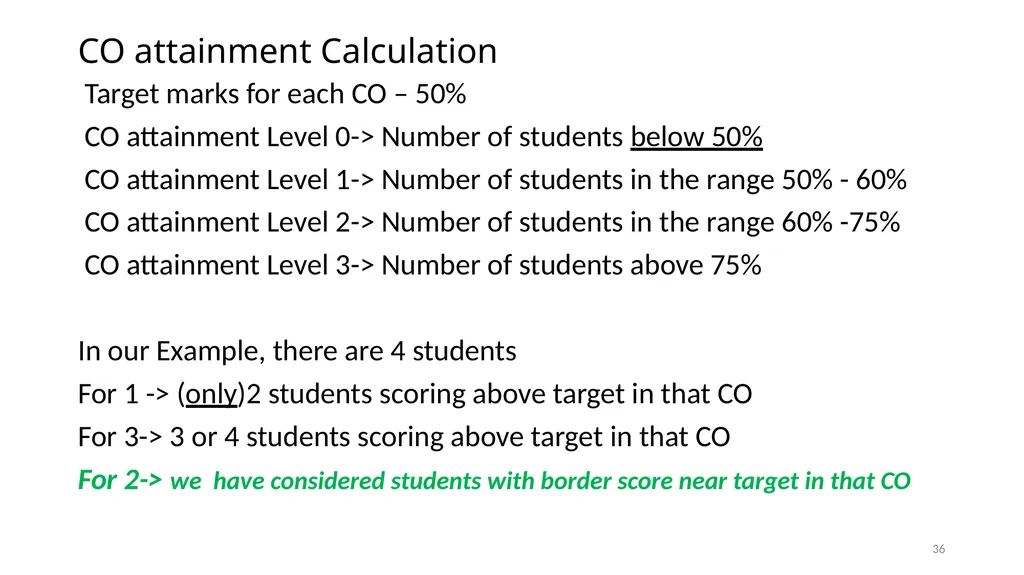
CO attainment Calculation Target marks for each CO – 50%
CO attainment Level 0-> Number of students below 50%
CO attainment Level 1-> Number of students in the range 50% - 60%
CO attainment Level 2-> Number of students in the range 60% -75%
CO attainment Level 3-> Number of students above 75%
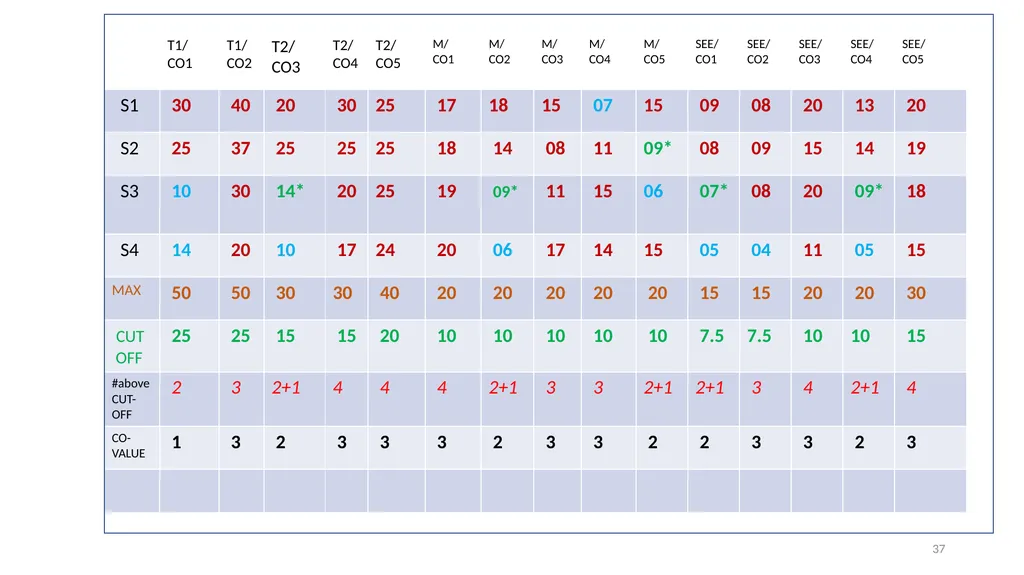
In our Example, there are 4 students
For 1 -> (only)2 students scoring above target in that CO
For 3-> 3 or 4 students scoring above target in that CO
For 2-> we have considered students with border score near target in that CO 36<br>
CO attainment Level 0-> Number of students below 50%
CO attainment Level 1-> Number of students in the range 50% - 60%
CO attainment Level 2-> Number of students in the range 60% -75%
CO attainment Level 3-> Number of students above 75%
In our Example, there are 4 students
For 1 -> (only)2 students scoring above target in that CO
For 3-> 3 or 4 students scoring above target in that CO
For 2-> we have considered students with border score near target in that CO 36<br>
37
37<br>
38
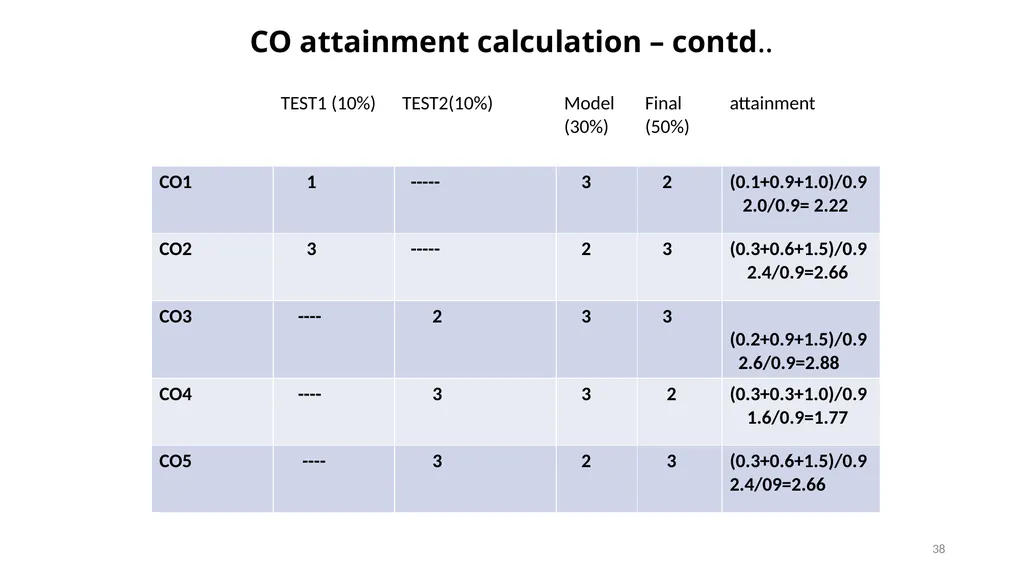
CO attainment calculation – contd.. 38<br>
39
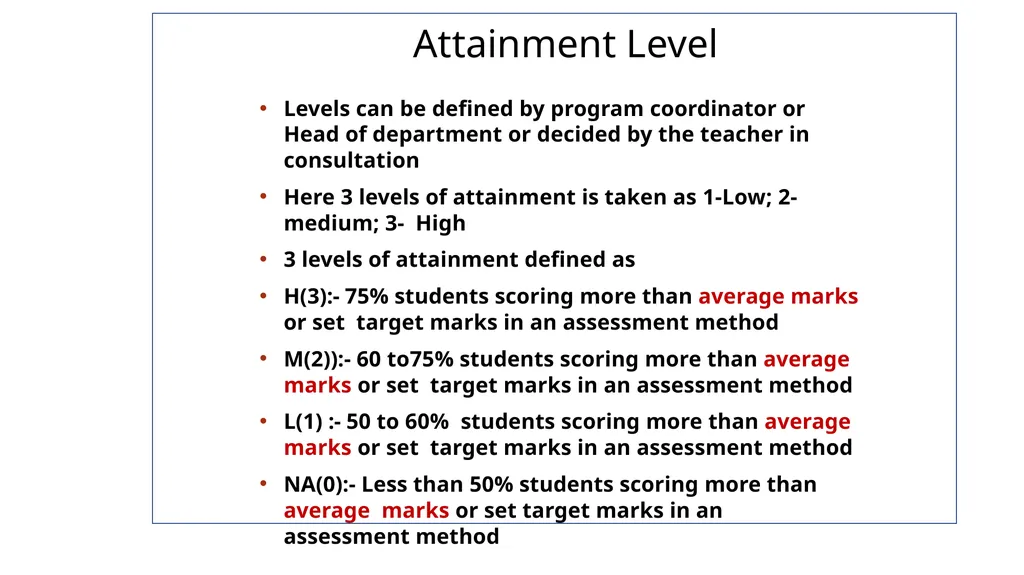
Attainment Level Levels can be defined by program coordinator or Head of department or decided by the teacher in consultation
Here 3 levels of attainment is taken as 1-Low; 2-medium; 3- High
3 levels of attainment defined as
H(3):- 75% students scoring more than average marks or set target marks in an assessment method
M(2)):- 60 to75% students scoring more than average marks or set target marks in an assessment method
L(1) :- 50 to 60% students scoring more than average marks or set target marks in an assessment method
NA(0):- Less than 50% students scoring more than average marks or set target marks in an assessment method 39<br>
Here 3 levels of attainment is taken as 1-Low; 2-medium; 3- High
3 levels of attainment defined as
H(3):- 75% students scoring more than average marks or set target marks in an assessment method
M(2)):- 60 to75% students scoring more than average marks or set target marks in an assessment method
L(1) :- 50 to 60% students scoring more than average marks or set target marks in an assessment method
NA(0):- Less than 50% students scoring more than average marks or set target marks in an assessment method 39<br>
40
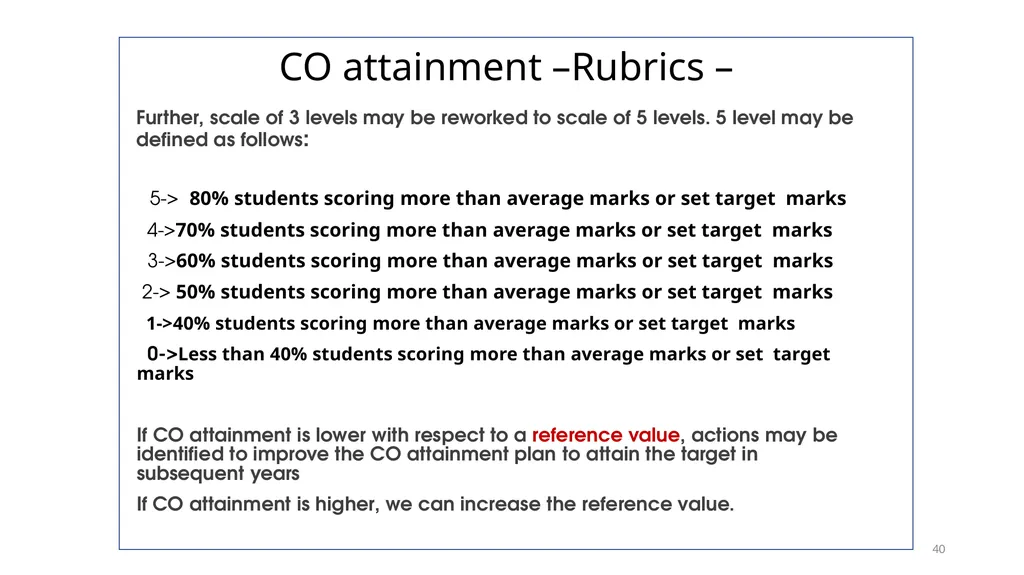
CO attainment –Rubrics – Further, scale of 3 levels may be reworked to scale of 5 levels. 5 level may be defined as follows:
5-> 80% students scoring more than average marks or set target marks
4->70% students scoring more than average marks or set target marks
3->60% students scoring more than average marks or set target marks
2-> 50% students scoring more than average marks or set target marks
1->40% students scoring more than average marks or set target marks
0->Less than 40% students scoring more than average marks or set target marks
If CO attainment is lower with respect to a reference value, actions may be identified to improve the CO attainment plan to attain the target in subsequent years
If CO attainment is higher, we can increase the reference value. 40<br>
5-> 80% students scoring more than average marks or set target marks
4->70% students scoring more than average marks or set target marks
3->60% students scoring more than average marks or set target marks
2-> 50% students scoring more than average marks or set target marks
1->40% students scoring more than average marks or set target marks
0->Less than 40% students scoring more than average marks or set target marks
If CO attainment is lower with respect to a reference value, actions may be identified to improve the CO attainment plan to attain the target in subsequent years
If CO attainment is higher, we can increase the reference value. 40<br>
41
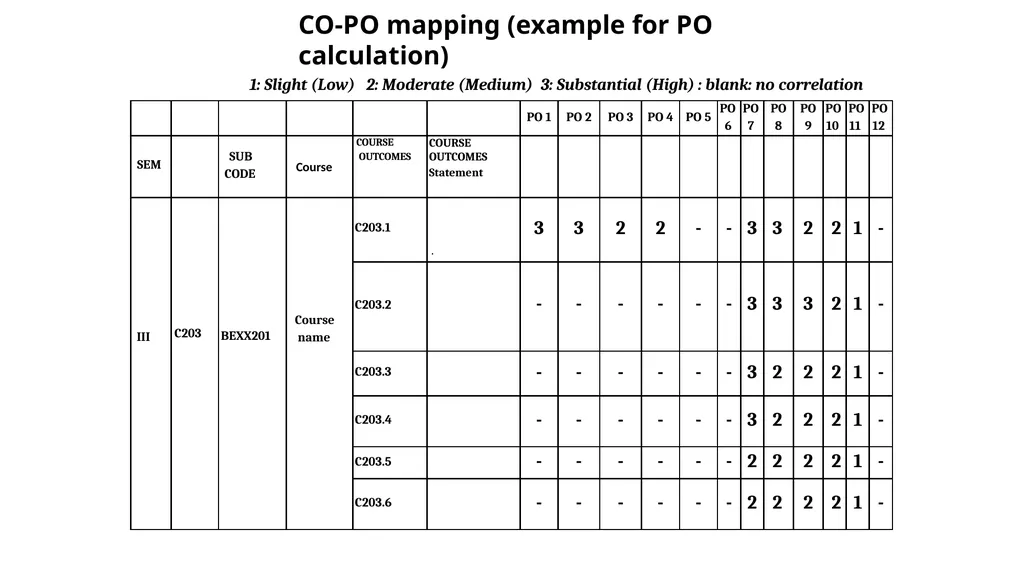
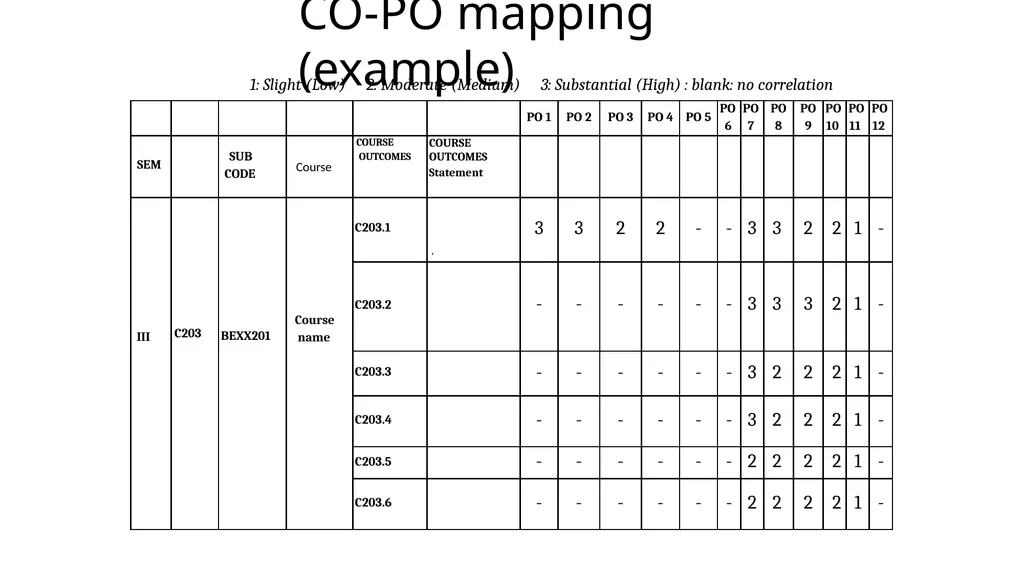
CO-PO mapping (example for PO calculation) 1: Slight (Low) 2: Moderate (Medium) 3: Substantial (High) : blank: no correlation 41<br>
42
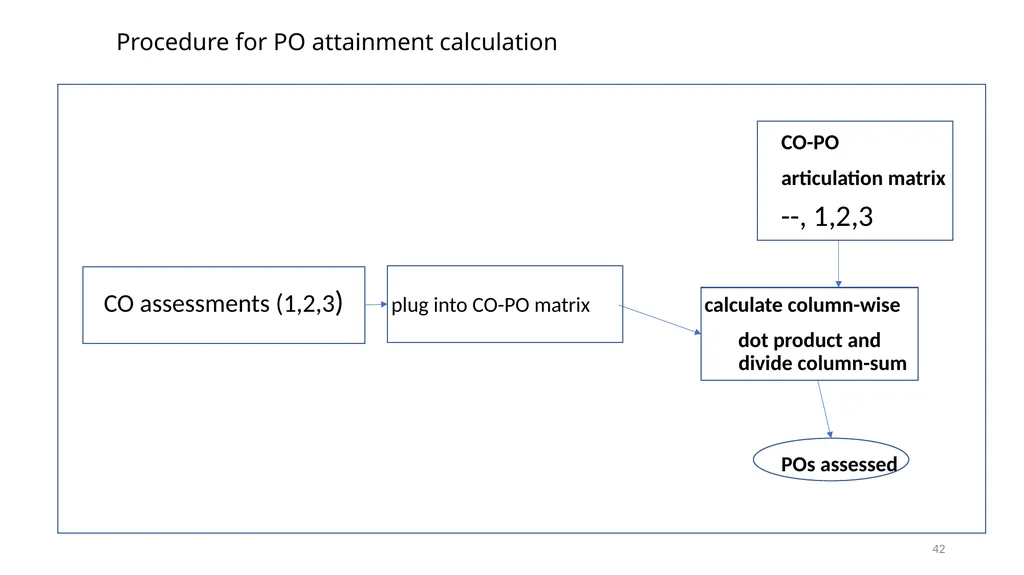
Procedure for PO attainment calculation CO-PO
articulation matrix
--, 1,2,3
CO assessments (1,2,3) plug into CO-PO matrix calculate column-wise
dot product and divide column-sum
POs assessed 42<br>
articulation matrix
--, 1,2,3
CO assessments (1,2,3) plug into CO-PO matrix calculate column-wise
dot product and divide column-sum
POs assessed 42<br>
43
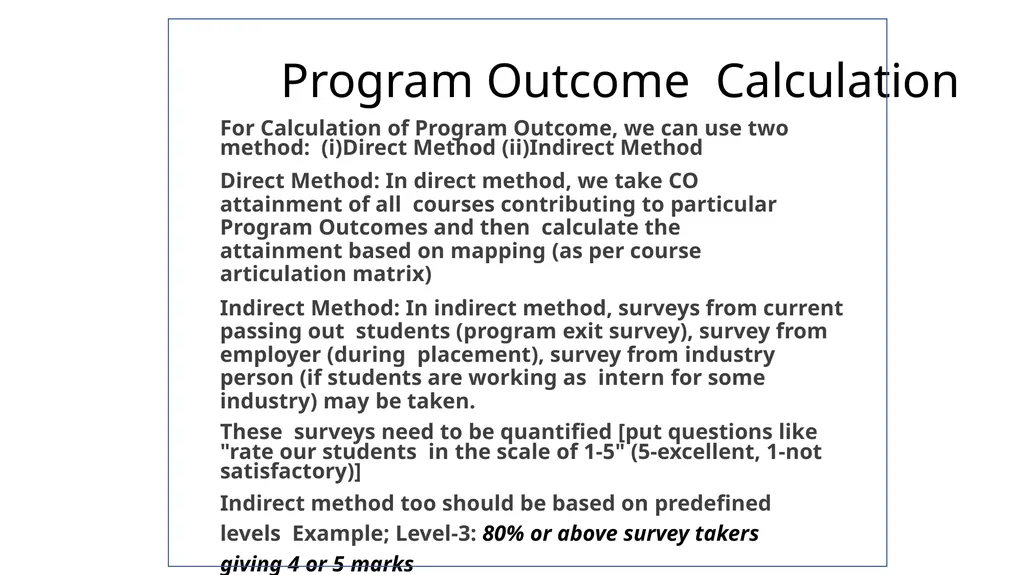
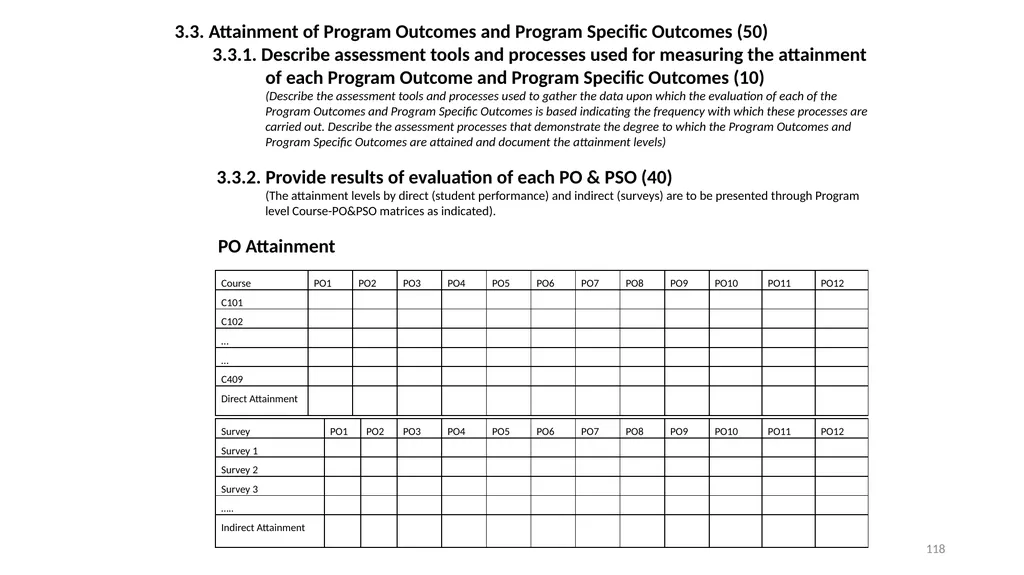
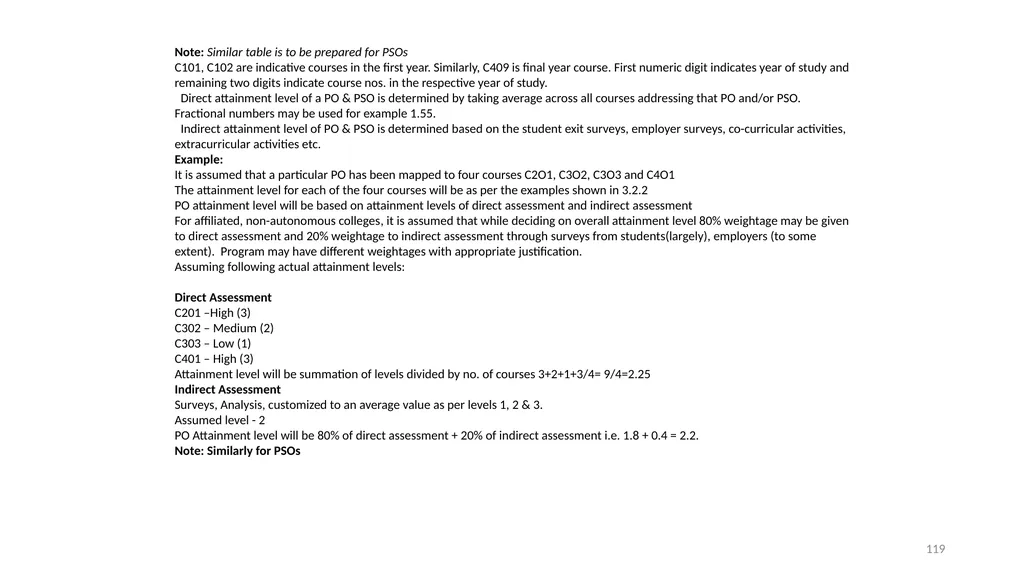
Program Outcome Calculation For Calculation of Program Outcome, we can use two method: (i)Direct Method (ii)Indirect Method
Direct Method: In direct method, we take CO attainment of all courses contributing to particular Program Outcomes and then calculate the attainment based on mapping (as per course articulation matrix)
Indirect Method: In indirect method, surveys from current passing out students (program exit survey), survey from employer (during placement), survey from industry person (if students are working as intern for some industry) may be taken.
These surveys need to be quantified [put questions like "rate our students in the scale of 1-5" (5-excellent, 1-not satisfactory)]
Indirect method too should be based on predefined levels Example; Level-3: 80% or above survey takers giving 4 or 5 marks
Level-2: 70% or above survey takers giving 4 or 5 marks
Level-1: 60% or above survey takers giving 4 or 5 marks 43<br>
Direct Method: In direct method, we take CO attainment of all courses contributing to particular Program Outcomes and then calculate the attainment based on mapping (as per course articulation matrix)
Indirect Method: In indirect method, surveys from current passing out students (program exit survey), survey from employer (during placement), survey from industry person (if students are working as intern for some industry) may be taken.
These surveys need to be quantified [put questions like "rate our students in the scale of 1-5" (5-excellent, 1-not satisfactory)]
Indirect method too should be based on predefined levels Example; Level-3: 80% or above survey takers giving 4 or 5 marks
Level-2: 70% or above survey takers giving 4 or 5 marks
Level-1: 60% or above survey takers giving 4 or 5 marks 43<br>
44
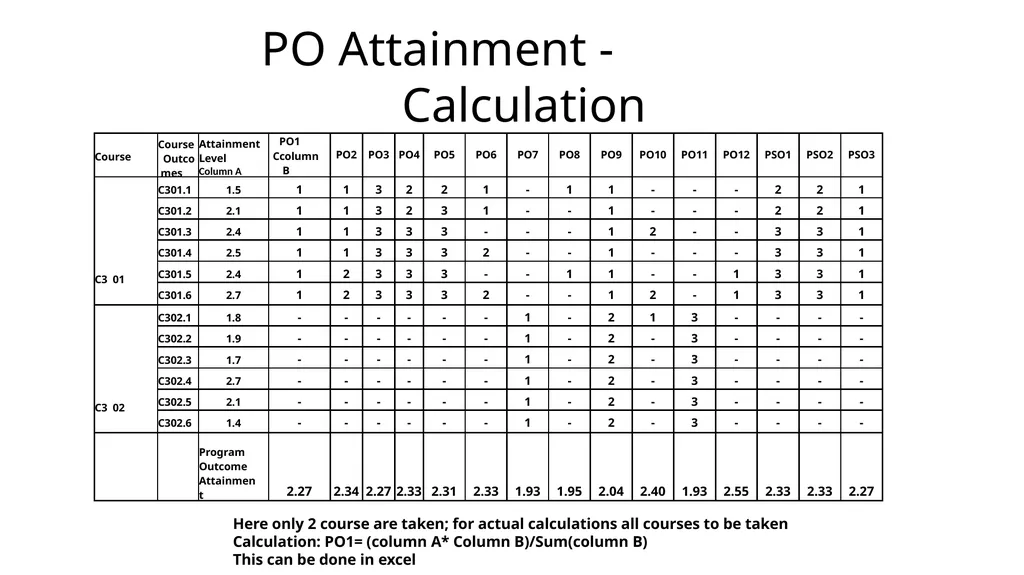
PO Attainment - Calculation Here only 2 course are taken; for actual calculations all courses to be taken Calculation: PO1= (column A* Column B)/Sum(column B)
This can be done in excel 44<br>
This can be done in excel 44<br>
45
CO-PO mapping (example) 1: Slight (Low) 2: Moderate (Medium) 3: Substantial (High) : blank: no correlation 45<br>
46
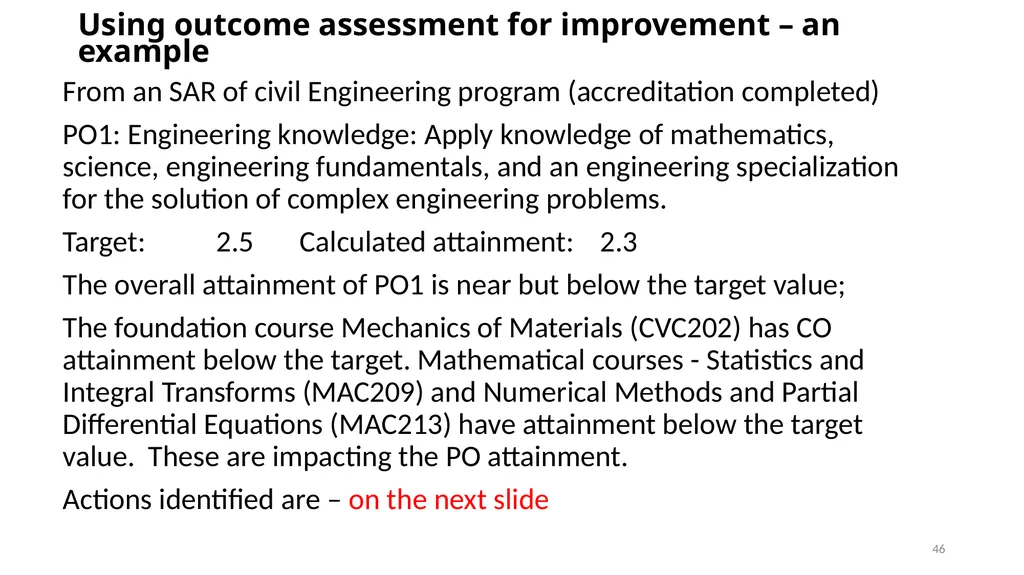
Using outcome assessment for improvement – an example From an SAR of civil Engineering program (accreditation completed)
PO1: Engineering knowledge: Apply knowledge of mathematics, science, engineering fundamentals, and an engineering specialization for the solution of complex engineering problems.
Target: 2.5 Calculated attainment: 2.3
The overall attainment of PO1 is near but below the target value;
The foundation course Mechanics of Materials (CVC202) has CO attainment below the target. Mathematical courses - Statistics and Integral Transforms (MAC209) and Numerical Methods and Partial Differential Equations (MAC213) have attainment below the target value. These are impacting the PO attainment.
Actions identified are – on the next slide 46<br>
PO1: Engineering knowledge: Apply knowledge of mathematics, science, engineering fundamentals, and an engineering specialization for the solution of complex engineering problems.
Target: 2.5 Calculated attainment: 2.3
The overall attainment of PO1 is near but below the target value;
The foundation course Mechanics of Materials (CVC202) has CO attainment below the target. Mathematical courses - Statistics and Integral Transforms (MAC209) and Numerical Methods and Partial Differential Equations (MAC213) have attainment below the target value. These are impacting the PO attainment.
Actions identified are – on the next slide 46<br>
47
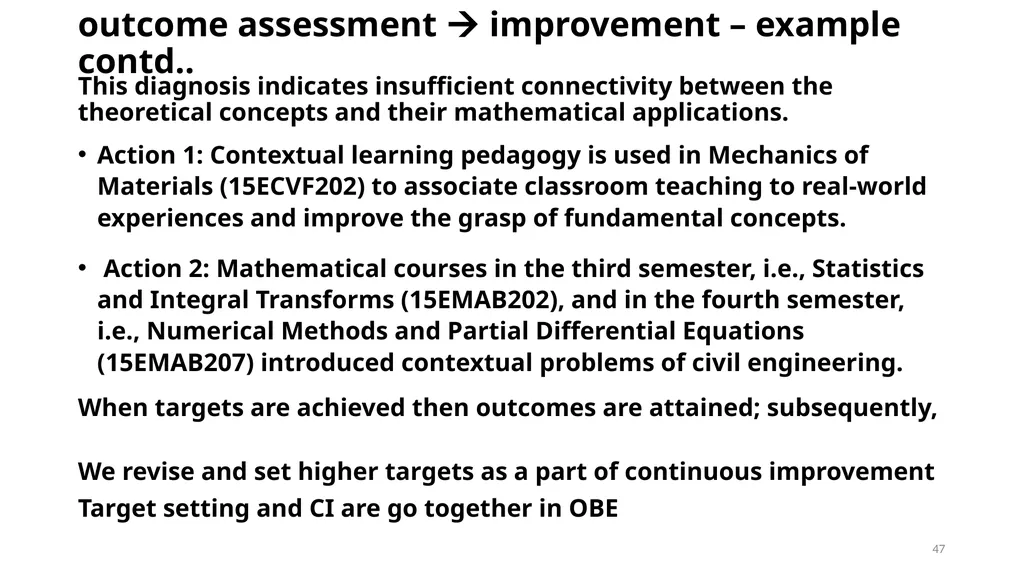
outcome assessment improvement – example contd.. This diagnosis indicates insufficient connectivity between the theoretical concepts and their mathematical applications.
Action 1: Contextual learning pedagogy is used in Mechanics of Materials (15ECVF202) to associate classroom teaching to real-world experiences and improve the grasp of fundamental concepts.
Action 2: Mathematical courses in the third semester, i.e., Statistics and Integral Transforms (15EMAB202), and in the fourth semester, i.e., Numerical Methods and Partial Differential Equations (15EMAB207) introduced contextual problems of civil engineering.
When targets are achieved then outcomes are attained; subsequently,
We revise and set higher targets as a part of continuous improvement
Target setting and CI are go together in OBE 47<br>
Action 1: Contextual learning pedagogy is used in Mechanics of Materials (15ECVF202) to associate classroom teaching to real-world experiences and improve the grasp of fundamental concepts.
Action 2: Mathematical courses in the third semester, i.e., Statistics and Integral Transforms (15EMAB202), and in the fourth semester, i.e., Numerical Methods and Partial Differential Equations (15EMAB207) introduced contextual problems of civil engineering.
When targets are achieved then outcomes are attained; subsequently,
We revise and set higher targets as a part of continuous improvement
Target setting and CI are go together in OBE 47<br>
48
https://www.aicte-india.org/sites/default/files/ExaminationReforms.pdf Examination
Reform Policy November 2018 ALL INDIA COUNCIL FOR TECHNICAL EDUCATION
Nelson Mandela Marg, Vasant Kunj, New Delhi-110070<br>
Reform Policy November 2018 ALL INDIA COUNCIL FOR TECHNICAL EDUCATION
Nelson Mandela Marg, Vasant Kunj, New Delhi-110070<br>
49
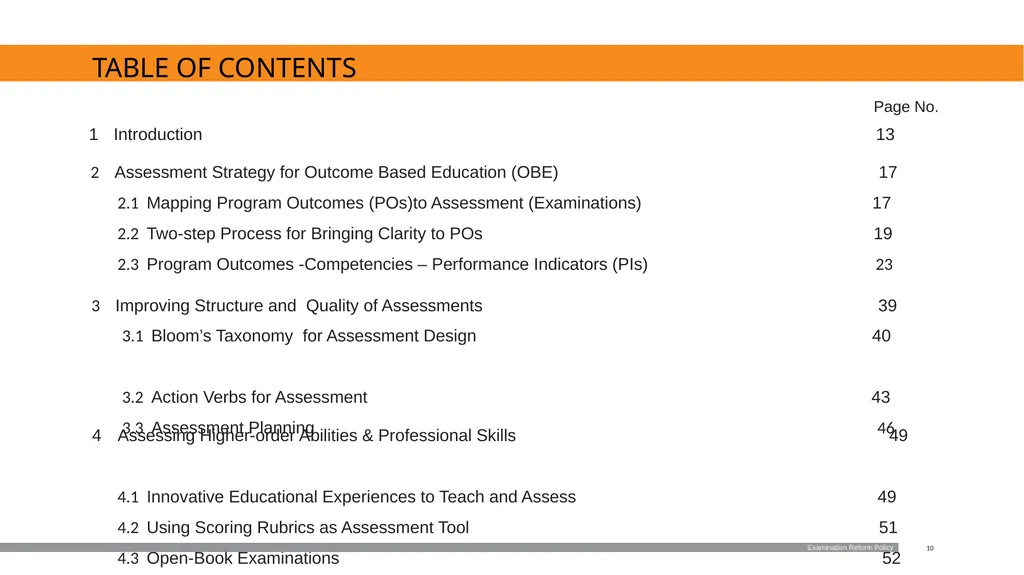
10 Page No. 2 Assessment Strategy for Outcome Based Education (OBE) 17
2.1 Mapping Program Outcomes (POs)to Assessment (Examinations) 17
2.2 Two-step Process for Bringing Clarity to POs 19
2.3 Program Outcomes -Competencies – Performance Indicators (PIs) 23 1 Introduction 13 3 Improving Structure and Quality of Assessments 39
3.1 Bloom’s Taxonomy for Assessment Design 40
3.2 Action Verbs for Assessment 43
3.3 Assessment Planning 46 Assessing Higher-order Abilities & Professional Skills 49
4.1 Innovative Educational Experiences to Teach and Assess 49
4.2 Using Scoring Rubrics as Assessment Tool 51
4.3 Open-Book Examinations 52 TABLE OF CONTENTS Examination Reform Policy<br>
2.1 Mapping Program Outcomes (POs)to Assessment (Examinations) 17
2.2 Two-step Process for Bringing Clarity to POs 19
2.3 Program Outcomes -Competencies – Performance Indicators (PIs) 23 1 Introduction 13 3 Improving Structure and Quality of Assessments 39
3.1 Bloom’s Taxonomy for Assessment Design 40
3.2 Action Verbs for Assessment 43
3.3 Assessment Planning 46 Assessing Higher-order Abilities & Professional Skills 49
4.1 Innovative Educational Experiences to Teach and Assess 49
4.2 Using Scoring Rubrics as Assessment Tool 51
4.3 Open-Book Examinations 52 TABLE OF CONTENTS Examination Reform Policy<br>
50
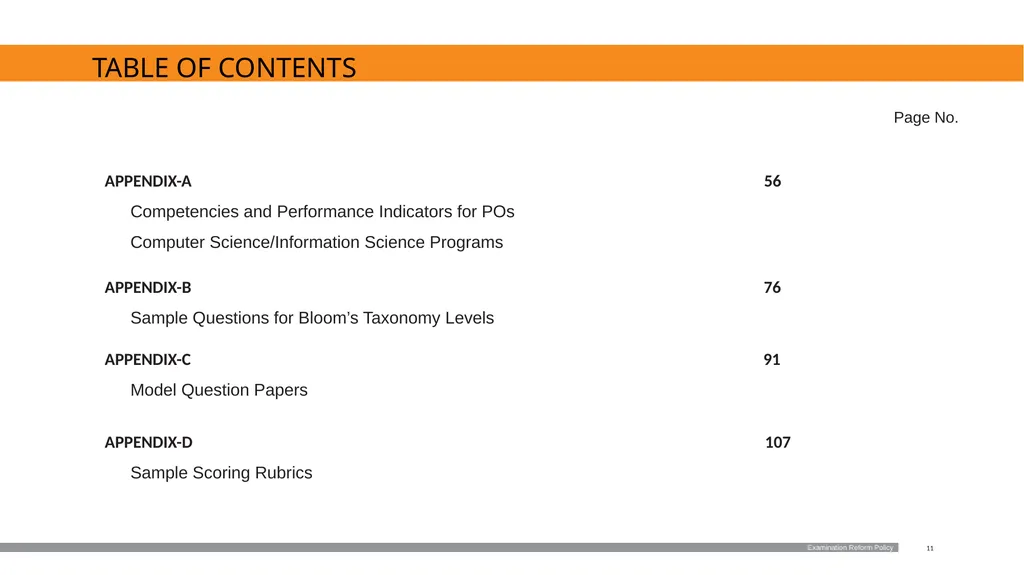
11 Page No. APPENDIX-A 56
Competencies and Performance Indicators for POs
Computer Science/Information Science Programs APPENDIX-B 76
Sample Questions for Bloom’s Taxonomy Levels APPENDIX-C 91
Model Question Papers APPENDIX-D 107
Sample Scoring Rubrics Examination Reform Policy TABLE OF CONTENTS<br>
Competencies and Performance Indicators for POs
Computer Science/Information Science Programs APPENDIX-B 76
Sample Questions for Bloom’s Taxonomy Levels APPENDIX-C 91
Model Question Papers APPENDIX-D 107
Sample Scoring Rubrics Examination Reform Policy TABLE OF CONTENTS<br>
51
19 POs give useful guidance at the program level for the curriculum design, delivery and assessment of student learning. However, they represent fairly high-level generic goals that are not directly measurable. Real observability and measurability of the POs at course level is very difficult. To connect high-level learning outcomes (POs) with course content, course outcomes and assessment, there is a necessity to bring further clarity and specificity to the program outcomes [5]. This can be achieved through the following two-step process of identifying Competencies and Performance Indicators (PI).
(1) Identify Competencies to be attained: For each PO define competencies –different abilities implied by program outcome statement that would generally require different assessment measures. This helps us to create a shared understanding of the competencies we want students to achieve. They serve as an intermediate step to the creation of measurable indicators. ASSESSMENT STRATEGY
FOR OUTCOME-BASED EDUCATION Examination Reform Policy<br>
(1) Identify Competencies to be attained: For each PO define competencies –different abilities implied by program outcome statement that would generally require different assessment measures. This helps us to create a shared understanding of the competencies we want students to achieve. They serve as an intermediate step to the creation of measurable indicators. ASSESSMENT STRATEGY
FOR OUTCOME-BASED EDUCATION Examination Reform Policy<br>
52
20 Example:
Program Outcome (Attribute 3)
Design:
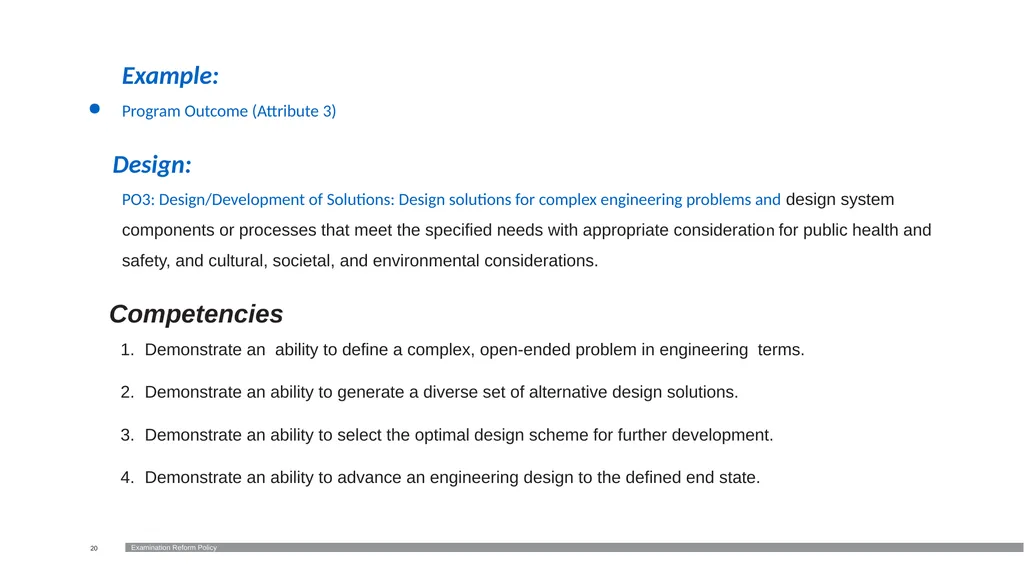
PO3: Design/Development of Solutions: Design solutions for complex engineering problems and design system components or processes that meet the specified needs with appropriate consideration for public health and safety, and cultural, societal, and environmental considerations.
Competencies
Demonstrate an ability to define a complex, open-ended problem in engineering terms.
Demonstrate an ability to generate a diverse set of alternative design solutions.
Demonstrate an ability to select the optimal design scheme for further development.
Demonstrate an ability to advance an engineering design to the defined end state. Examination Reform Policy<br>
Program Outcome (Attribute 3)
Design:
PO3: Design/Development of Solutions: Design solutions for complex engineering problems and design system components or processes that meet the specified needs with appropriate consideration for public health and safety, and cultural, societal, and environmental considerations.
Competencies
Demonstrate an ability to define a complex, open-ended problem in engineering terms.
Demonstrate an ability to generate a diverse set of alternative design solutions.
Demonstrate an ability to select the optimal design scheme for further development.
Demonstrate an ability to advance an engineering design to the defined end state. Examination Reform Policy<br>
53
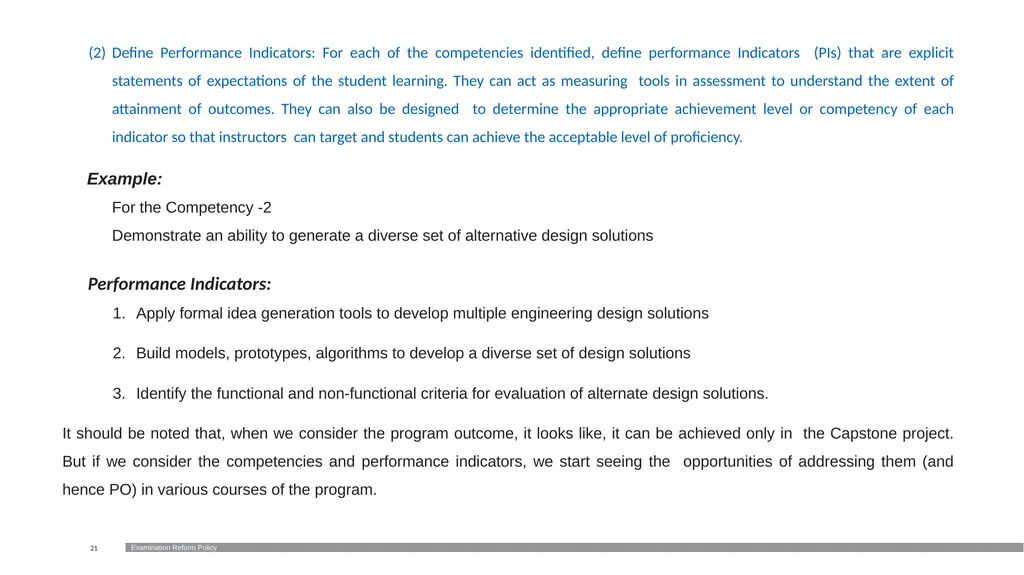
21 Define Performance Indicators: For each of the competencies identified, define performance Indicators (PIs) that are explicit statements of expectations of the student learning. They can act as measuring tools in assessment to understand the extent of attainment of outcomes. They can also be designed to determine the appropriate achievement level or competency of each indicator so that instructors can target and students can achieve the acceptable level of proficiency.
Example:
For the Competency -2
Demonstrate an ability to generate a diverse set of alternative design solutions
Performance Indicators:
Apply formal idea generation tools to develop multiple engineering design solutions
Build models, prototypes, algorithms to develop a diverse set of design solutions
Identify the functional and non-functional criteria for evaluation of alternate design solutions.
It should be noted that, when we consider the program outcome, it looks like, it can be achieved only in the Capstone project. But if we consider the competencies and performance indicators, we start seeing the opportunities of addressing them (and hence PO) in various courses of the program. Examination Reform Policy<br>
Example:
For the Competency -2
Demonstrate an ability to generate a diverse set of alternative design solutions
Performance Indicators:
Apply formal idea generation tools to develop multiple engineering design solutions
Build models, prototypes, algorithms to develop a diverse set of design solutions
Identify the functional and non-functional criteria for evaluation of alternate design solutions.
It should be noted that, when we consider the program outcome, it looks like, it can be achieved only in the Capstone project. But if we consider the competencies and performance indicators, we start seeing the opportunities of addressing them (and hence PO) in various courses of the program. Examination Reform Policy<br>
54
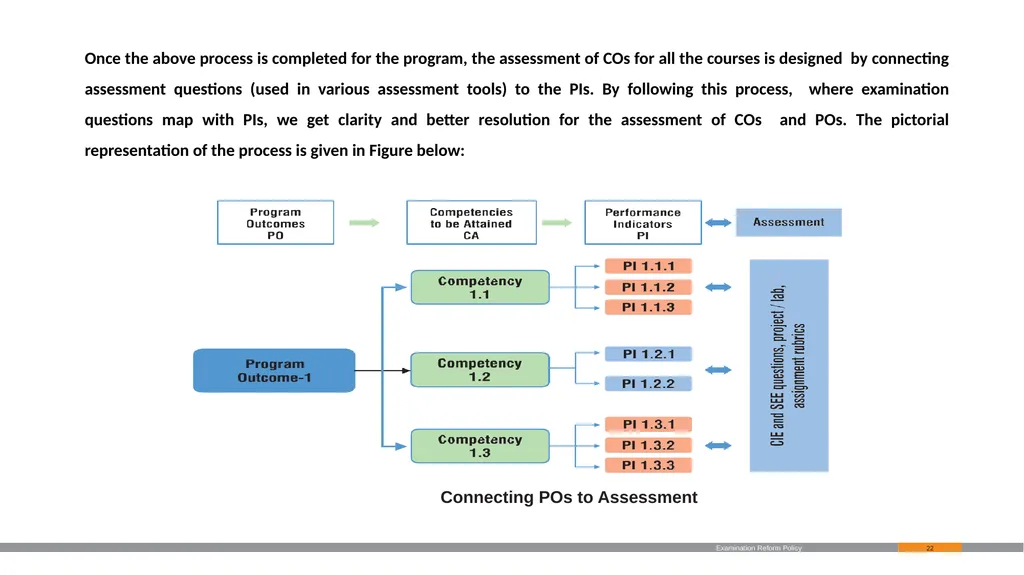
22 Connecting POs to Assessment Examination Reform Policy Once the above process is completed for the program, the assessment of COs for all the courses is designed by connecting assessment questions (used in various assessment tools) to the PIs. By following this process, where examination questions map with PIs, we get clarity and better resolution for the assessment of COs and POs. The pictorial representation of the process is given in Figure below:<br>
55
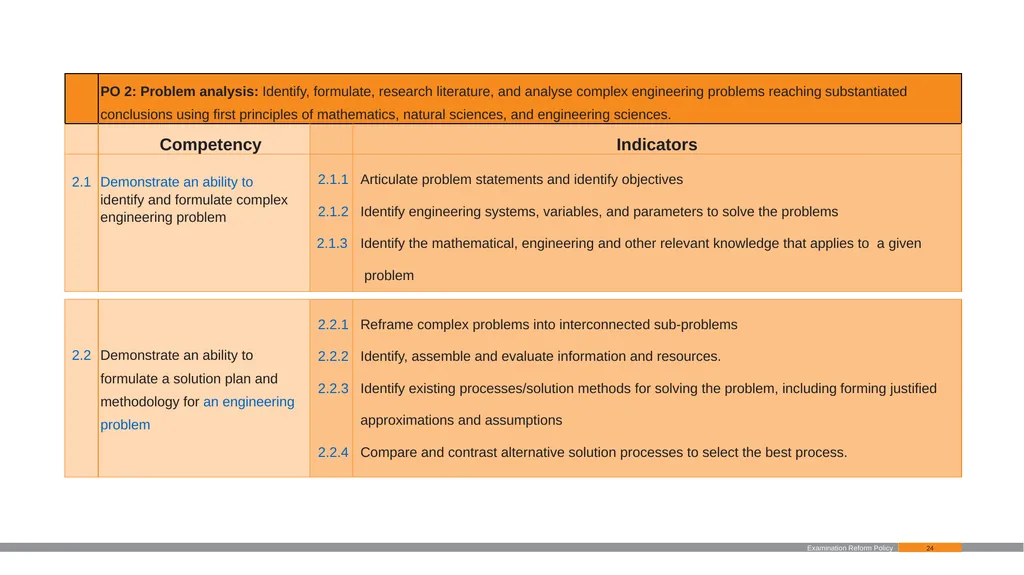
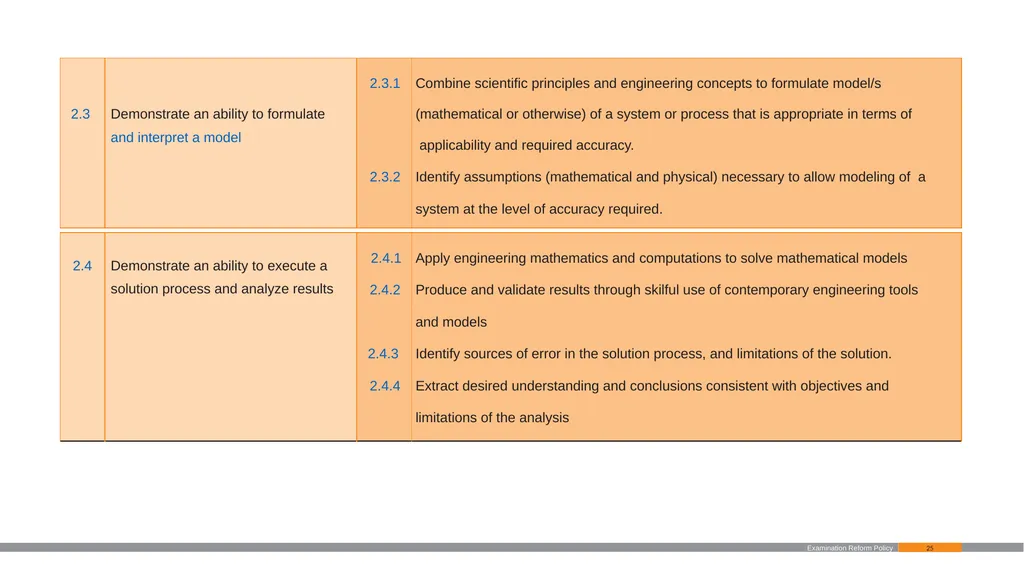
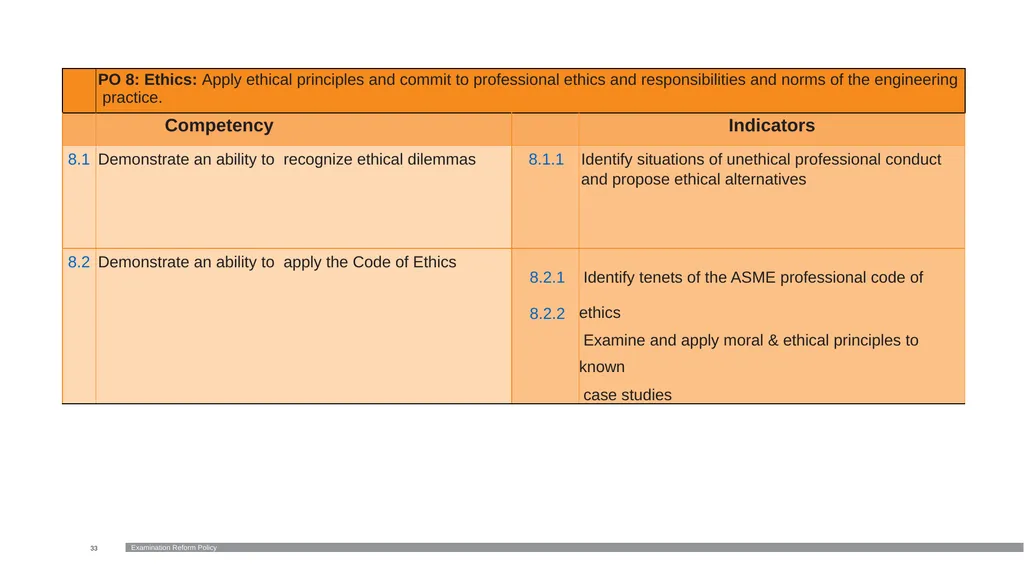
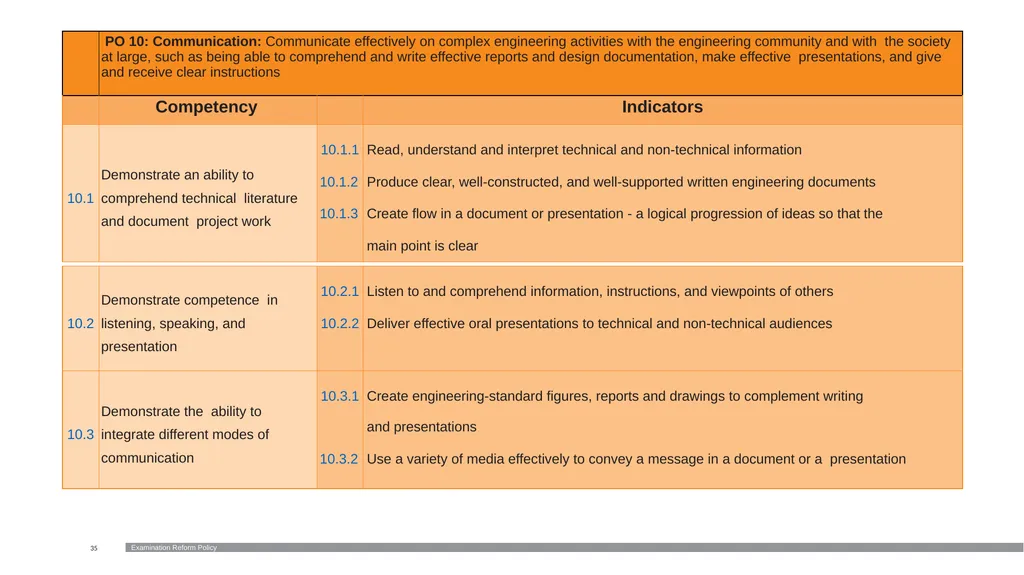
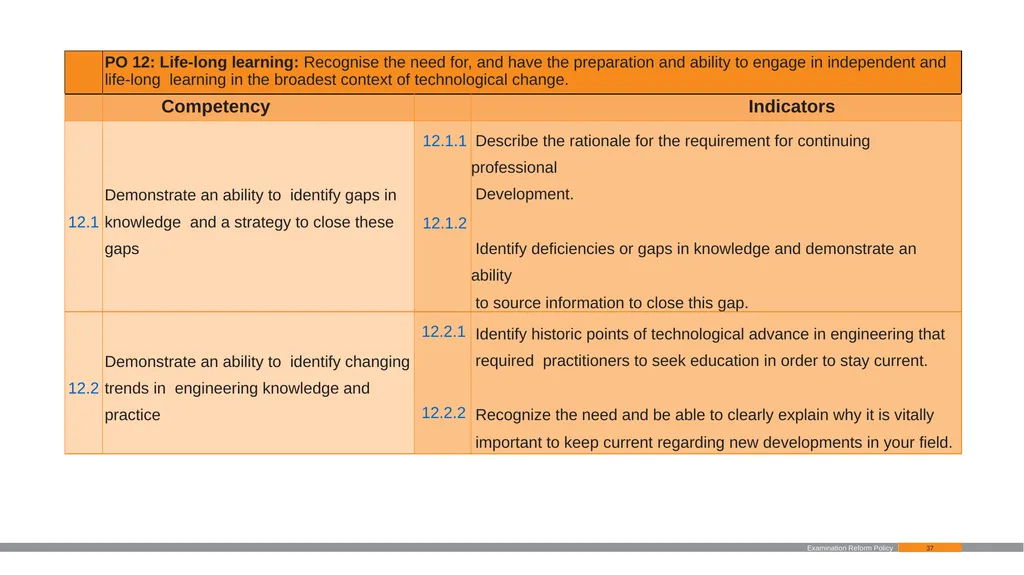
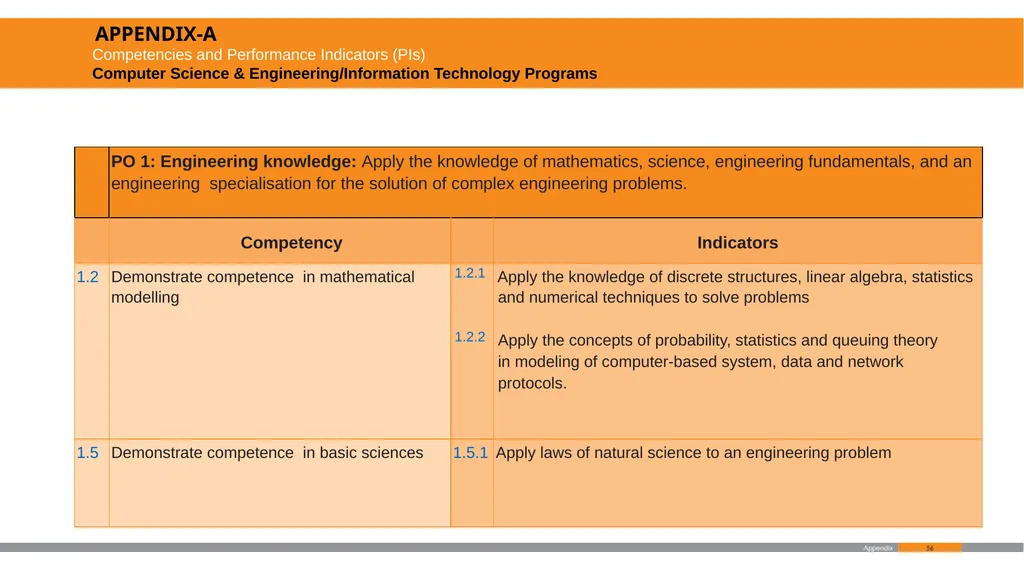
23 Following table gives the suggestive list of competencies and associated performance indicators for each of the PO in Mechanical Engineering Program. Examination Reform Policy<br>
56
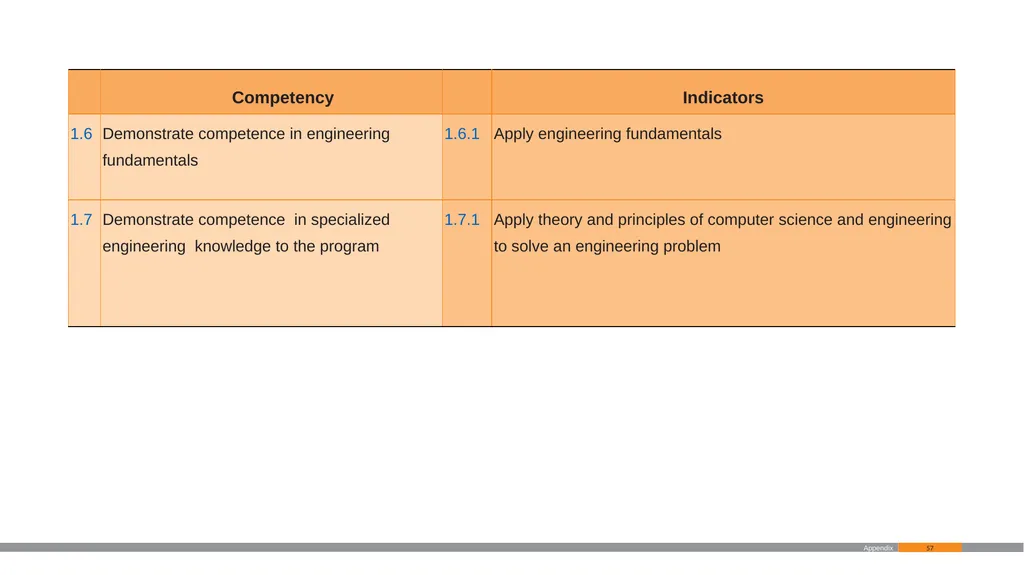
24 Examination Reform Policy<br>
57
25 Examination Reform Policy<br>
58
33 Examination Reform Policy<br>
59
35 Examination Reform Policy<br>
60
37 Examination Reform Policy<br>
61
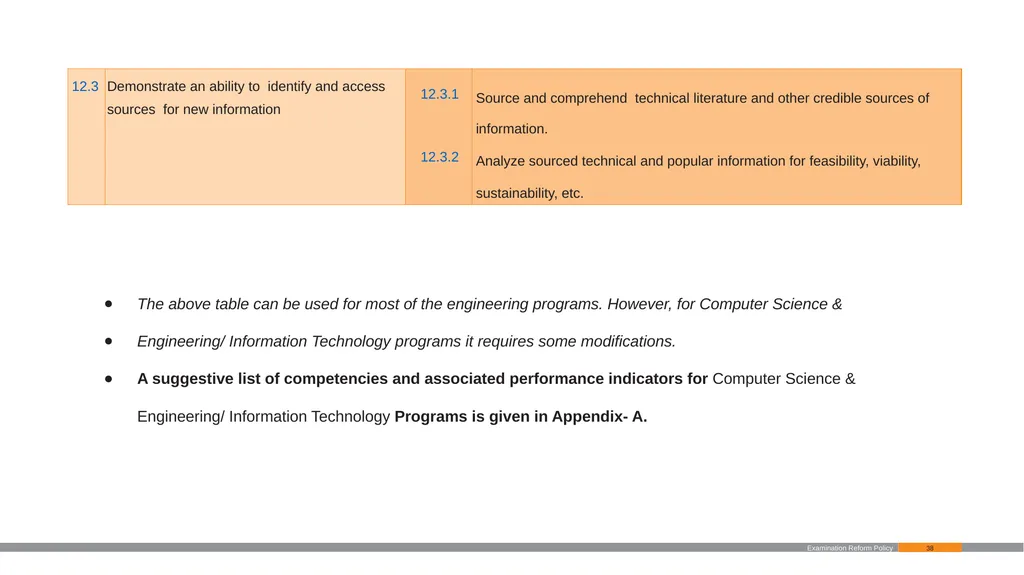
38 The above table can be used for most of the engineering programs. However, for Computer Science &
Engineering/ Information Technology programs it requires some modifications.
A suggestive list of competencies and associated performance indicators for Computer Science & Engineering/ Information Technology Programs is given in Appendix- A. Examination Reform Policy<br>
Engineering/ Information Technology programs it requires some modifications.
A suggestive list of competencies and associated performance indicators for Computer Science & Engineering/ Information Technology Programs is given in Appendix- A. Examination Reform Policy<br>
62
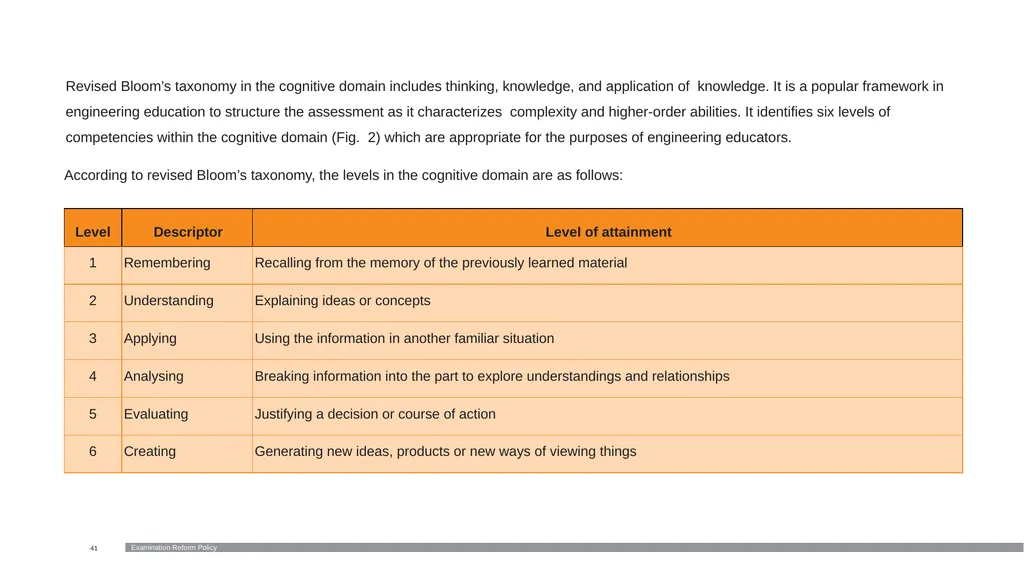
41 Revised Bloom’s taxonomy in the cognitive domain includes thinking, knowledge, and application of knowledge. It is a popular framework in engineering education to structure the assessment as it characterizes complexity and higher-order abilities. It identifies six levels of competencies within the cognitive domain (Fig. 2) which are appropriate for the purposes of engineering educators.
According to revised Bloom’s taxonomy, the levels in the cognitive domain are as follows: Examination Reform Policy<br>
According to revised Bloom’s taxonomy, the levels in the cognitive domain are as follows: Examination Reform Policy<br>
63
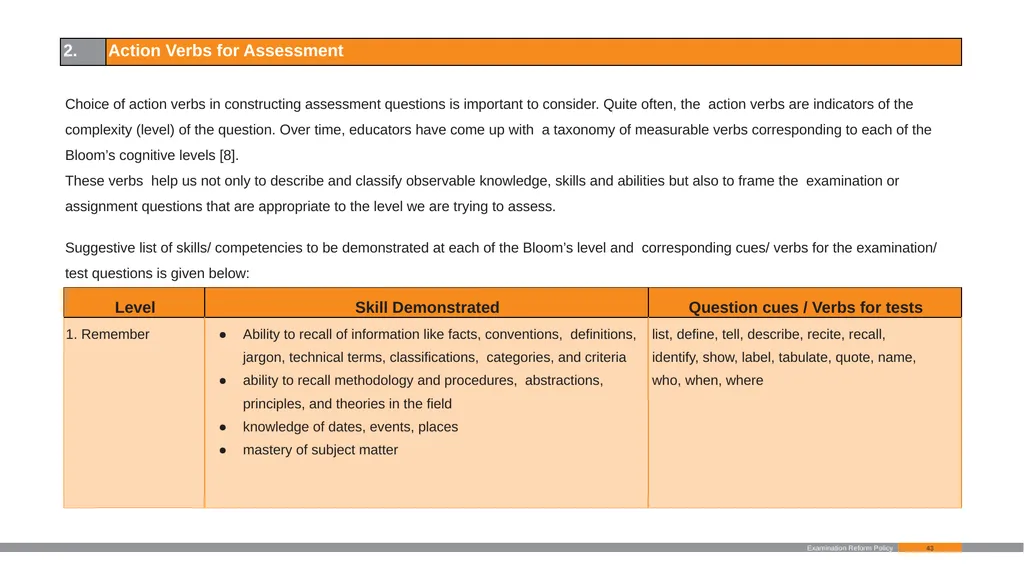
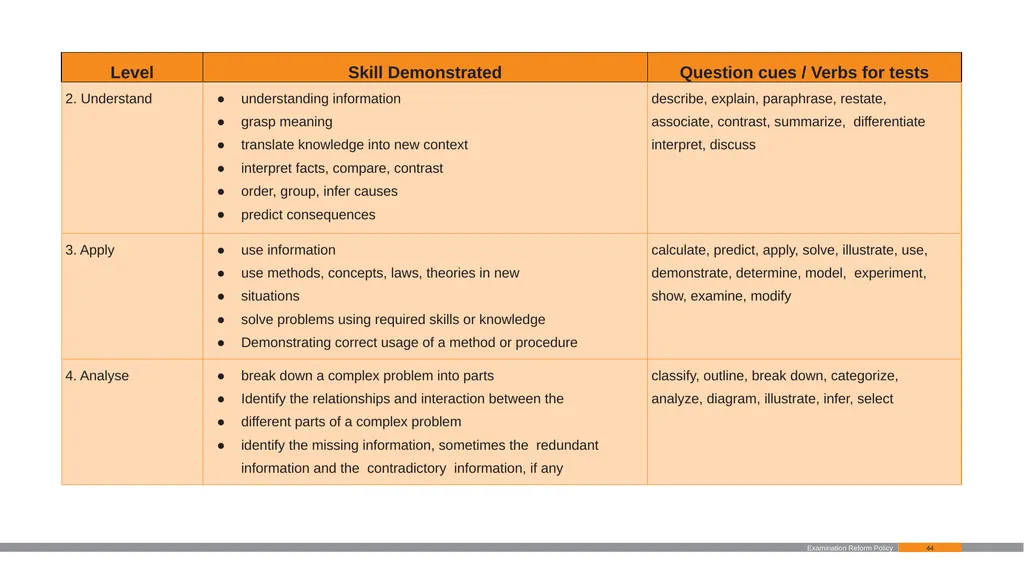
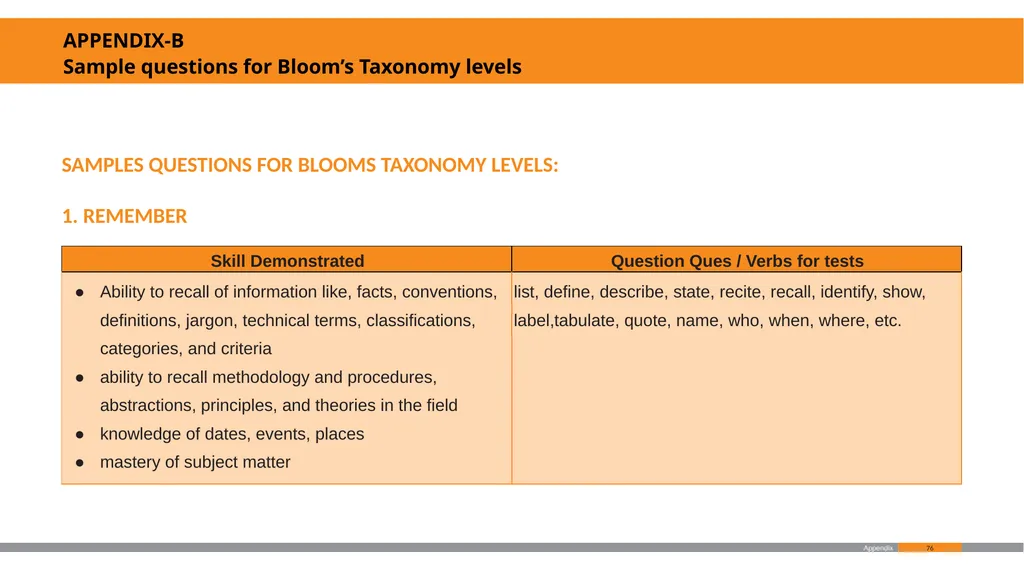
43 Examination Reform Policy Choice of action verbs in constructing assessment questions is important to consider. Quite often, the action verbs are indicators of the complexity (level) of the question. Over time, educators have come up with a taxonomy of measurable verbs corresponding to each of the Bloom’s cognitive levels [8].
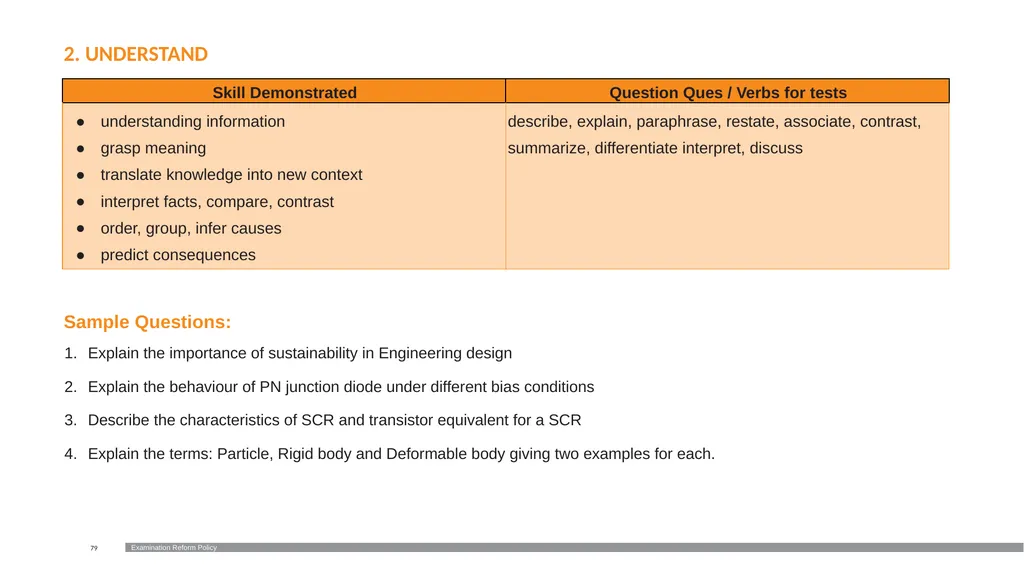
These verbs help us not only to describe and classify observable knowledge, skills and abilities but also to frame the examination or assignment questions that are appropriate to the level we are trying to assess.
Suggestive list of skills/ competencies to be demonstrated at each of the Bloom’s level and corresponding cues/ verbs for the examination/ test questions is given below:<br>
These verbs help us not only to describe and classify observable knowledge, skills and abilities but also to frame the examination or assignment questions that are appropriate to the level we are trying to assess.
Suggestive list of skills/ competencies to be demonstrated at each of the Bloom’s level and corresponding cues/ verbs for the examination/ test questions is given below:<br>
64
44 Examination Reform Policy<br>
65
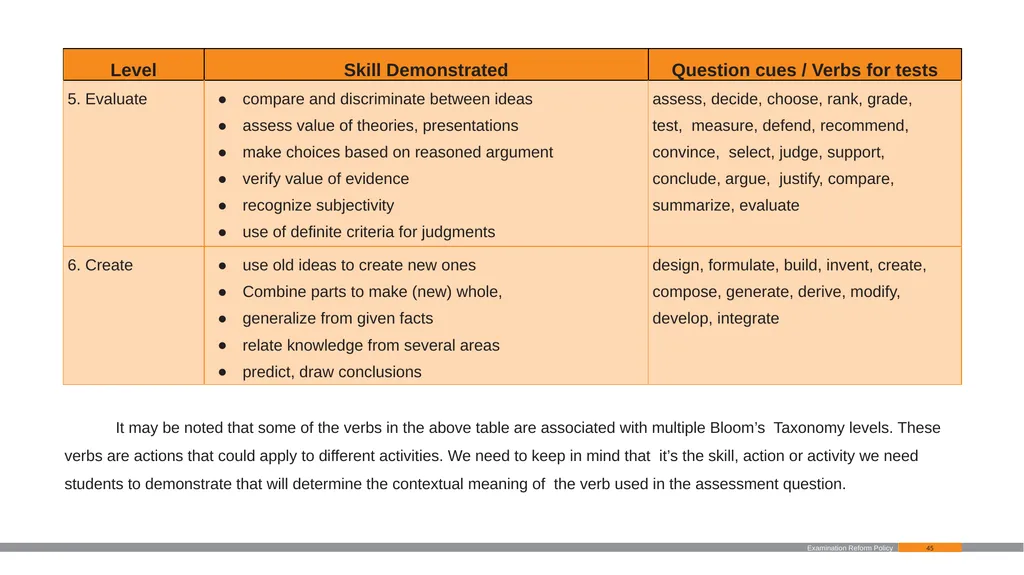
45 Examination Reform Policy It may be noted that some of the verbs in the above table are associated with multiple Bloom’s Taxonomy levels. These verbs are actions that could apply to different activities. We need to keep in mind that it’s the skill, action or activity we need students to demonstrate that will determine the contextual meaning of the verb used in the assessment question.<br>
66
46 While using Bloom’s taxonomy framework in planning and designing of assessment of student learning, following points need to be considered:
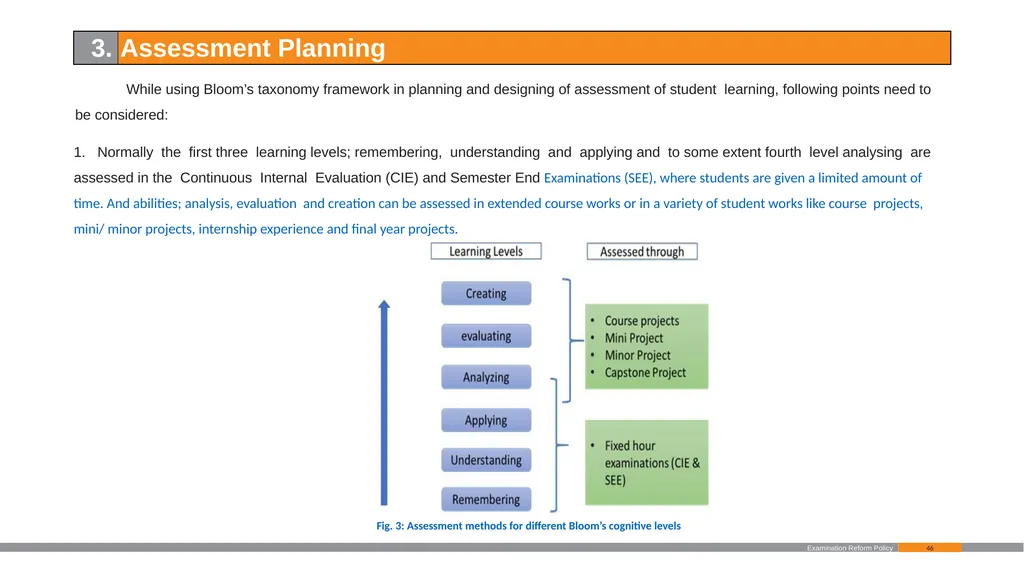
1. Normally the first three learning levels; remembering, understanding and applying and to some extent fourth level analysing are assessed in the Continuous Internal Evaluation (CIE) and Semester End Examinations (SEE), where students are given a limited amount of time. And abilities; analysis, evaluation and creation can be assessed in extended course works or in a variety of student works like course projects, mini/ minor projects, internship experience and final year projects. Examination Reform Policy Fig. 3: Assessment methods for different Bloom’s cognitive levels<br>
1. Normally the first three learning levels; remembering, understanding and applying and to some extent fourth level analysing are assessed in the Continuous Internal Evaluation (CIE) and Semester End Examinations (SEE), where students are given a limited amount of time. And abilities; analysis, evaluation and creation can be assessed in extended course works or in a variety of student works like course projects, mini/ minor projects, internship experience and final year projects. Examination Reform Policy Fig. 3: Assessment methods for different Bloom’s cognitive levels<br>
67
56 Appendix APPENDIX-A Competencies and Performance Indicators (PIs)
Computer Science & Engineering/Information Technology Programs<br>
Computer Science & Engineering/Information Technology Programs<br>
68
57 Appendix<br>
69
76 SAMPLES QUESTIONS FOR BLOOMS TAXONOMY LEVELS:
1. REMEMBER Appendix APPENDIX-B
Sample questions for Bloom’s Taxonomy levels<br>
1. REMEMBER Appendix APPENDIX-B
Sample questions for Bloom’s Taxonomy levels<br>
70
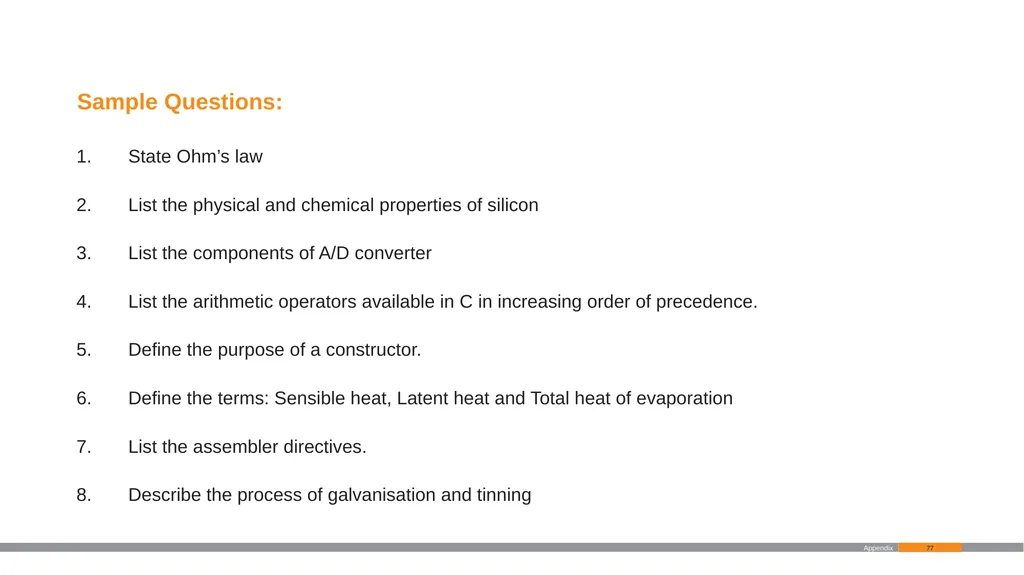
77 Sample Questions:
State Ohm’s law
List the physical and chemical properties of silicon
List the components of A/D converter
List the arithmetic operators available in C in increasing order of precedence.
Define the purpose of a constructor.
Define the terms: Sensible heat, Latent heat and Total heat of evaporation
List the assembler directives.
Describe the process of galvanisation and tinning Appendix<br>
State Ohm’s law
List the physical and chemical properties of silicon
List the components of A/D converter
List the arithmetic operators available in C in increasing order of precedence.
Define the purpose of a constructor.
Define the terms: Sensible heat, Latent heat and Total heat of evaporation
List the assembler directives.
Describe the process of galvanisation and tinning Appendix<br>
71
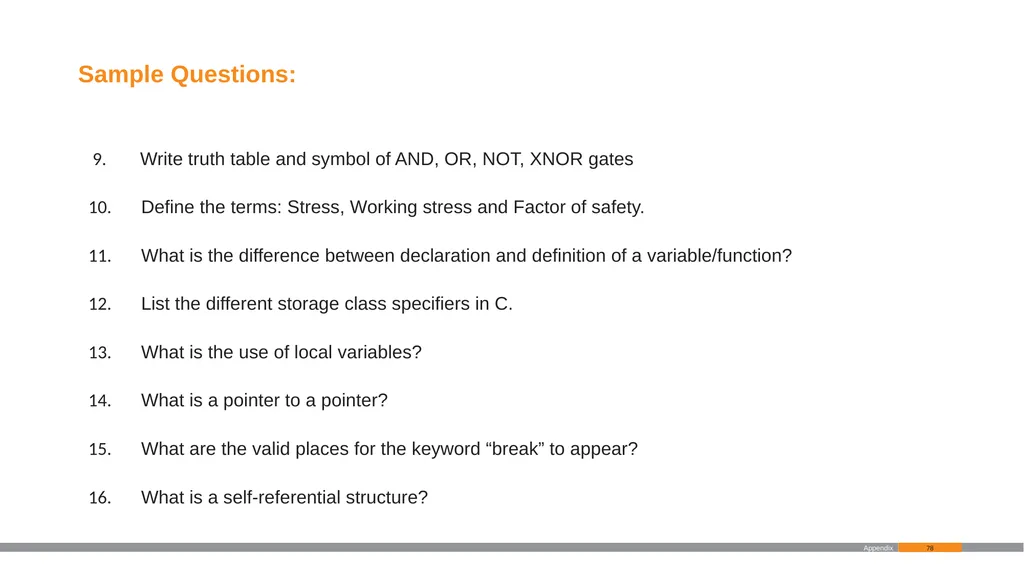
78 Sample Questions:
9. Write truth table and symbol of AND, OR, NOT, XNOR gates
10. Define the terms: Stress, Working stress and Factor of safety.
11. What is the difference between declaration and definition of a variable/function?
12. List the different storage class specifiers in C.
13. What is the use of local variables?
14. What is a pointer to a pointer?
15. What are the valid places for the keyword “break” to appear?
16. What is a self-referential structure? Appendix<br>
9. Write truth table and symbol of AND, OR, NOT, XNOR gates
10. Define the terms: Stress, Working stress and Factor of safety.
11. What is the difference between declaration and definition of a variable/function?
12. List the different storage class specifiers in C.
13. What is the use of local variables?
14. What is a pointer to a pointer?
15. What are the valid places for the keyword “break” to appear?
16. What is a self-referential structure? Appendix<br>
72
79 2. UNDERSTAND Sample Questions:
Explain the importance of sustainability in Engineering design
Explain the behaviour of PN junction diode under different bias conditions
Describe the characteristics of SCR and transistor equivalent for a SCR
Explain the terms: Particle, Rigid body and Deformable body giving two examples for each. Examination Reform Policy<br>
Explain the importance of sustainability in Engineering design
Explain the behaviour of PN junction diode under different bias conditions
Describe the characteristics of SCR and transistor equivalent for a SCR
Explain the terms: Particle, Rigid body and Deformable body giving two examples for each. Examination Reform Policy<br>
73
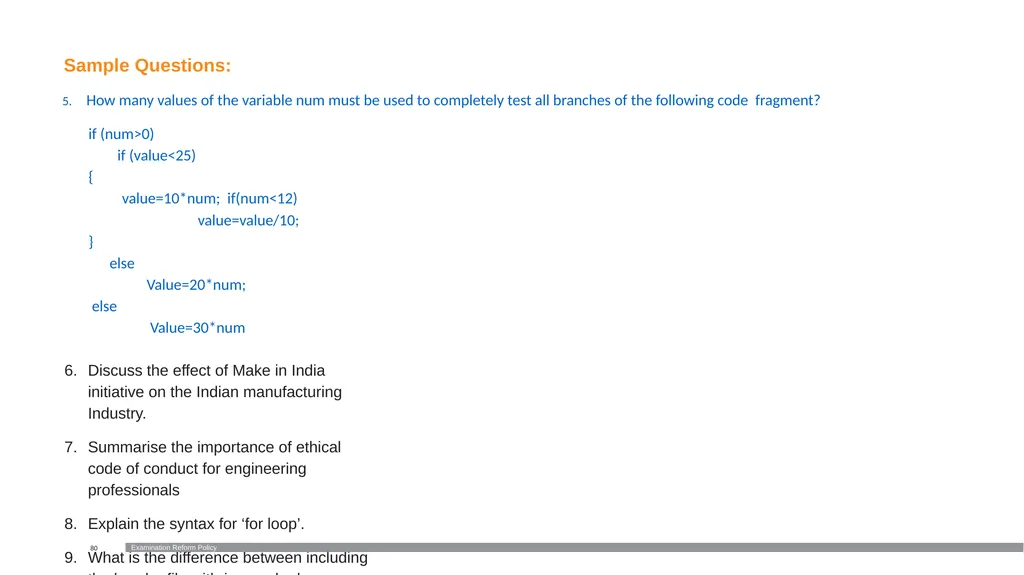
80 Sample Questions:
5. How many values of the variable num must be used to completely test all branches of the following code fragment?
if (num>0)
if (value<25)
{
value=10*num; if(num<12)
value=value/10;
}
else
Value=20*num;
else
Value=30*num
Discuss the effect of Make in India initiative on the Indian manufacturing Industry.
Summarise the importance of ethical code of conduct for engineering professionals
Explain the syntax for ‘for loop’.
What is the difference between including the header file with-in angular braces < > and double quotes “ ”? Examination Reform Policy<br>
5. How many values of the variable num must be used to completely test all branches of the following code fragment?
if (num>0)
if (value<25)
{
value=10*num; if(num<12)
value=value/10;
}
else
Value=20*num;
else
Value=30*num
Discuss the effect of Make in India initiative on the Indian manufacturing Industry.
Summarise the importance of ethical code of conduct for engineering professionals
Explain the syntax for ‘for loop’.
What is the difference between including the header file with-in angular braces < > and double quotes “ ”? Examination Reform Policy<br>
74
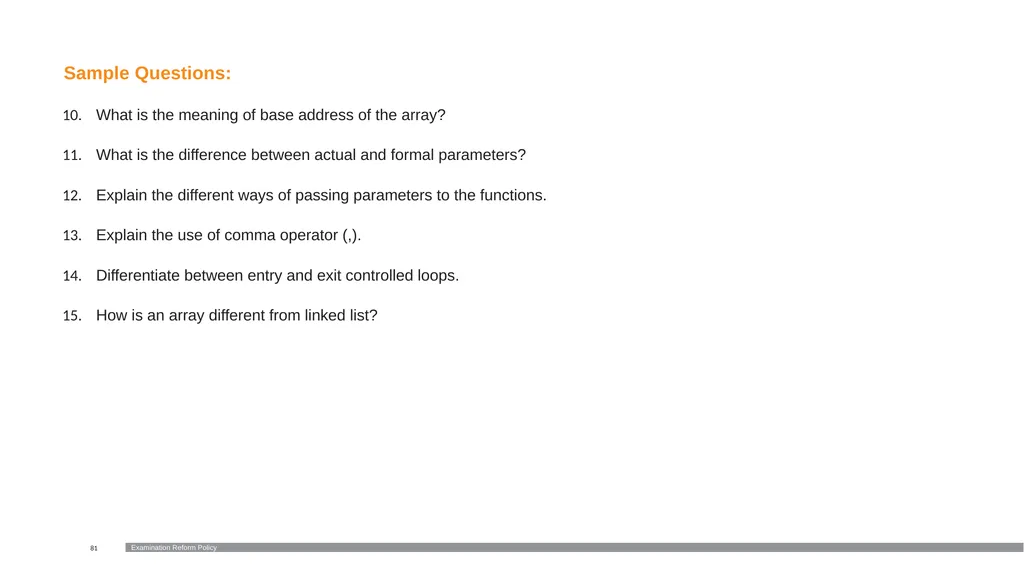
81 Sample Questions:
10. What is the meaning of base address of the array?
11. What is the difference between actual and formal parameters?
12. Explain the different ways of passing parameters to the functions.
13. Explain the use of comma operator (,).
14. Differentiate between entry and exit controlled loops.
15. How is an array different from linked list? Examination Reform Policy<br>
10. What is the meaning of base address of the array?
11. What is the difference between actual and formal parameters?
12. Explain the different ways of passing parameters to the functions.
13. Explain the use of comma operator (,).
14. Differentiate between entry and exit controlled loops.
15. How is an array different from linked list? Examination Reform Policy<br>
75
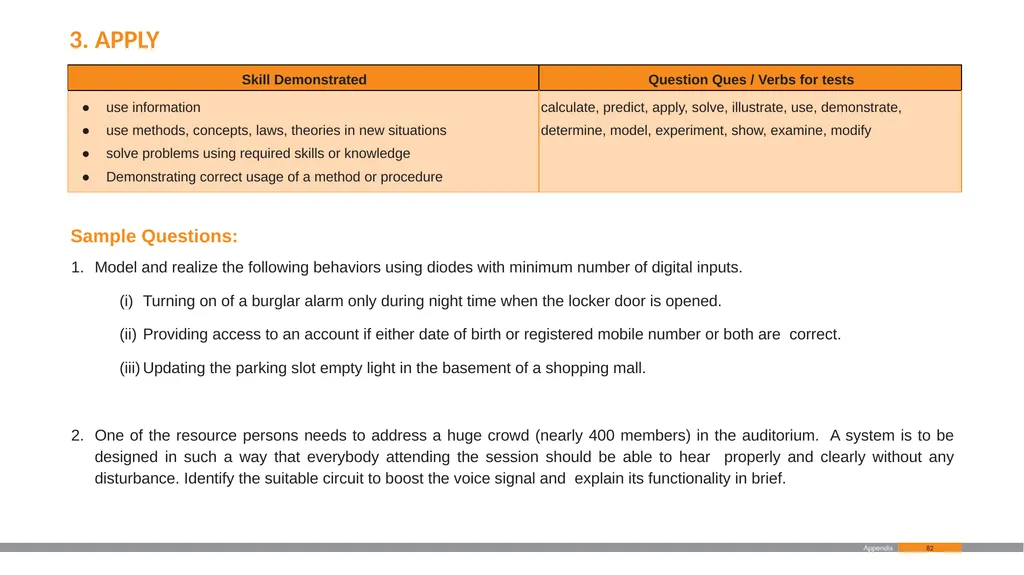
82 3. APPLY Sample Questions:
Model and realize the following behaviors using diodes with minimum number of digital inputs.
Turning on of a burglar alarm only during night time when the locker door is opened.
Providing access to an account if either date of birth or registered mobile number or both are correct.
Updating the parking slot empty light in the basement of a shopping mall.
One of the resource persons needs to address a huge crowd (nearly 400 members) in the auditorium. A system is to be designed in such a way that everybody attending the session should be able to hear properly and clearly without any disturbance. Identify the suitable circuit to boost the voice signal and explain its functionality in brief. Appendix<br>
Model and realize the following behaviors using diodes with minimum number of digital inputs.
Turning on of a burglar alarm only during night time when the locker door is opened.
Providing access to an account if either date of birth or registered mobile number or both are correct.
Updating the parking slot empty light in the basement of a shopping mall.
One of the resource persons needs to address a huge crowd (nearly 400 members) in the auditorium. A system is to be designed in such a way that everybody attending the session should be able to hear properly and clearly without any disturbance. Identify the suitable circuit to boost the voice signal and explain its functionality in brief. Appendix<br>
76
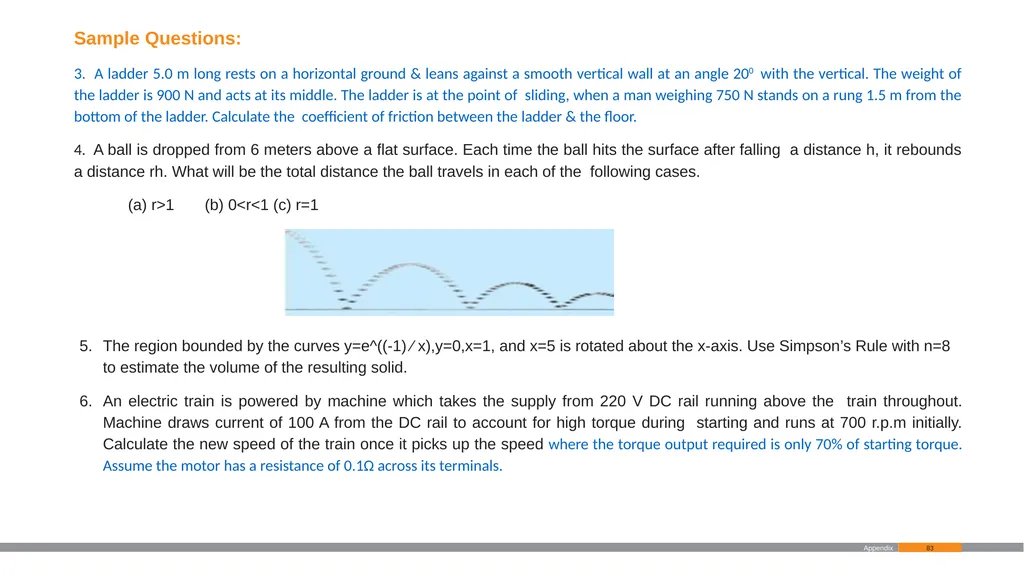
83 Sample Questions:
3. A ladder 5.0 m long rests on a horizontal ground & leans against a smooth vertical wall at an angle 200 with the vertical. The weight of the ladder is 900 N and acts at its middle. The ladder is at the point of sliding, when a man weighing 750 N stands on a rung 1.5 m from the bottom of the ladder. Calculate the coefficient of friction between the ladder & the floor.
4. A ball is dropped from 6 meters above a flat surface. Each time the ball hits the surface after falling a distance h, it rebounds a distance rh. What will be the total distance the ball travels in each of the following cases.
(a) r>1 (b) 0<r<1 (c) r=1 The region bounded by the curves y=e^((-1) ⁄ x),y=0,x=1, and x=5 is rotated about the x-axis. Use Simpson’s Rule with n=8 to estimate the volume of the resulting solid.
An electric train is powered by machine which takes the supply from 220 V DC rail running above the train throughout. Machine draws current of 100 A from the DC rail to account for high torque during starting and runs at 700 r.p.m initially. Calculate the new speed of the train once it picks up the speed where the torque output required is only 70% of starting torque. Assume the motor has a resistance of 0.1Ω across its terminals. Appendix<br>
3. A ladder 5.0 m long rests on a horizontal ground & leans against a smooth vertical wall at an angle 200 with the vertical. The weight of the ladder is 900 N and acts at its middle. The ladder is at the point of sliding, when a man weighing 750 N stands on a rung 1.5 m from the bottom of the ladder. Calculate the coefficient of friction between the ladder & the floor.
4. A ball is dropped from 6 meters above a flat surface. Each time the ball hits the surface after falling a distance h, it rebounds a distance rh. What will be the total distance the ball travels in each of the following cases.
(a) r>1 (b) 0<r<1 (c) r=1 The region bounded by the curves y=e^((-1) ⁄ x),y=0,x=1, and x=5 is rotated about the x-axis. Use Simpson’s Rule with n=8 to estimate the volume of the resulting solid.
An electric train is powered by machine which takes the supply from 220 V DC rail running above the train throughout. Machine draws current of 100 A from the DC rail to account for high torque during starting and runs at 700 r.p.m initially. Calculate the new speed of the train once it picks up the speed where the torque output required is only 70% of starting torque. Assume the motor has a resistance of 0.1Ω across its terminals. Appendix<br>
77
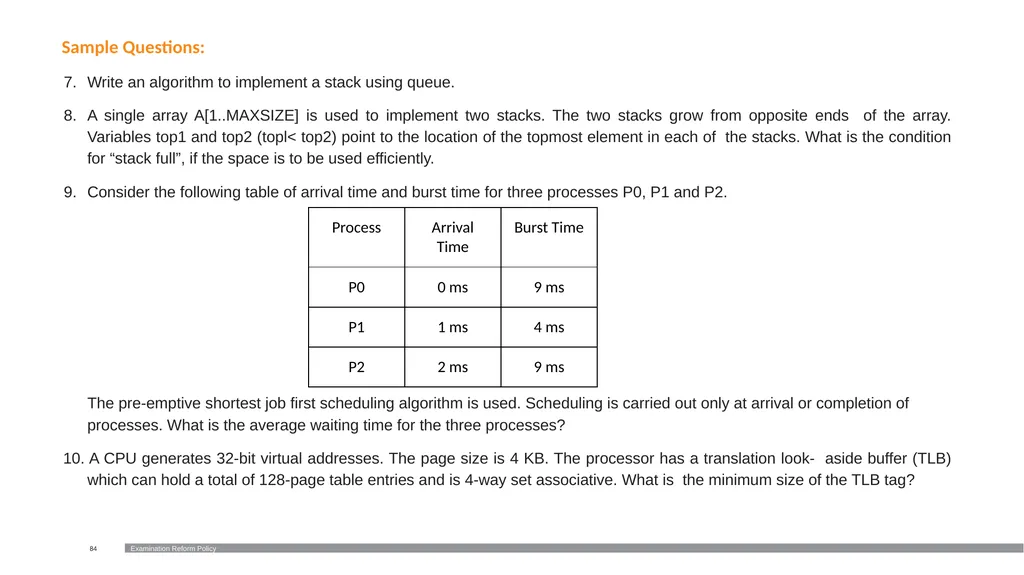
84 Sample Questions:
Write an algorithm to implement a stack using queue.
A single array A[1..MAXSIZE] is used to implement two stacks. The two stacks grow from opposite ends of the array. Variables top1 and top2 (topl< top2) point to the location of the topmost element in each of the stacks. What is the condition for “stack full”, if the space is to be used efficiently.
Consider the following table of arrival time and burst time for three processes P0, P1 and P2. The pre-emptive shortest job first scheduling algorithm is used. Scheduling is carried out only at arrival or completion of processes. What is the average waiting time for the three processes?
10. A CPU generates 32-bit virtual addresses. The page size is 4 KB. The processor has a translation look- aside buffer (TLB) which can hold a total of 128-page table entries and is 4-way set associative. What is the minimum size of the TLB tag? Examination Reform Policy<br>
Write an algorithm to implement a stack using queue.
A single array A[1..MAXSIZE] is used to implement two stacks. The two stacks grow from opposite ends of the array. Variables top1 and top2 (topl< top2) point to the location of the topmost element in each of the stacks. What is the condition for “stack full”, if the space is to be used efficiently.
Consider the following table of arrival time and burst time for three processes P0, P1 and P2. The pre-emptive shortest job first scheduling algorithm is used. Scheduling is carried out only at arrival or completion of processes. What is the average waiting time for the three processes?
10. A CPU generates 32-bit virtual addresses. The page size is 4 KB. The processor has a translation look- aside buffer (TLB) which can hold a total of 128-page table entries and is 4-way set associative. What is the minimum size of the TLB tag? Examination Reform Policy<br>
78
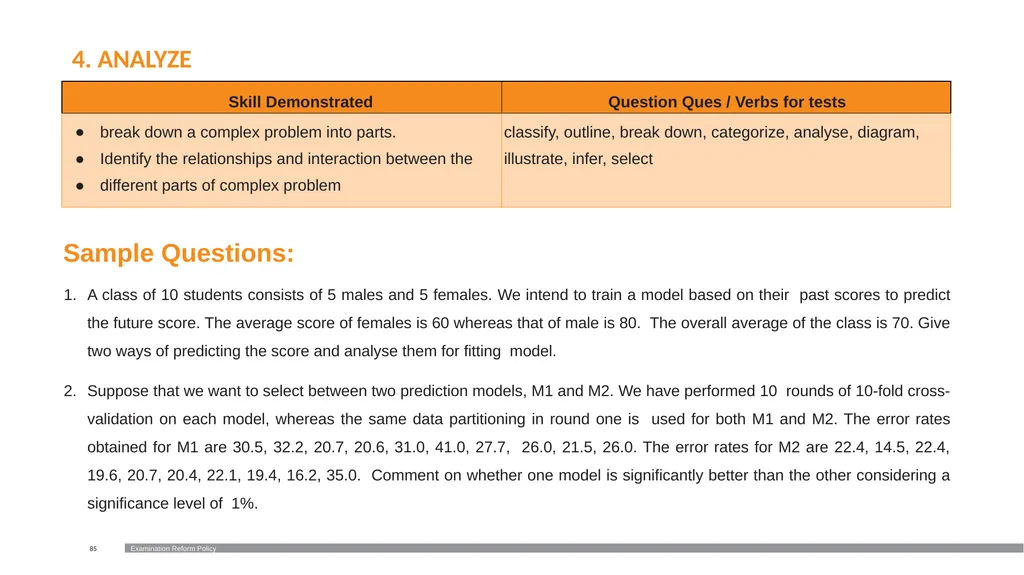
85 Sample Questions:
A class of 10 students consists of 5 males and 5 females. We intend to train a model based on their past scores to predict the future score. The average score of females is 60 whereas that of male is 80. The overall average of the class is 70. Give two ways of predicting the score and analyse them for fitting model.
Suppose that we want to select between two prediction models, M1 and M2. We have performed 10 rounds of 10-fold cross-validation on each model, whereas the same data partitioning in round one is used for both M1 and M2. The error rates obtained for M1 are 30.5, 32.2, 20.7, 20.6, 31.0, 41.0, 27.7, 26.0, 21.5, 26.0. The error rates for M2 are 22.4, 14.5, 22.4, 19.6, 20.7, 20.4, 22.1, 19.4, 16.2, 35.0. Comment on whether one model is significantly better than the other considering a significance level of 1%. Examination Reform Policy 4. ANALYZE<br>
A class of 10 students consists of 5 males and 5 females. We intend to train a model based on their past scores to predict the future score. The average score of females is 60 whereas that of male is 80. The overall average of the class is 70. Give two ways of predicting the score and analyse them for fitting model.
Suppose that we want to select between two prediction models, M1 and M2. We have performed 10 rounds of 10-fold cross-validation on each model, whereas the same data partitioning in round one is used for both M1 and M2. The error rates obtained for M1 are 30.5, 32.2, 20.7, 20.6, 31.0, 41.0, 27.7, 26.0, 21.5, 26.0. The error rates for M2 are 22.4, 14.5, 22.4, 19.6, 20.7, 20.4, 22.1, 19.4, 16.2, 35.0. Comment on whether one model is significantly better than the other considering a significance level of 1%. Examination Reform Policy 4. ANALYZE<br>
79
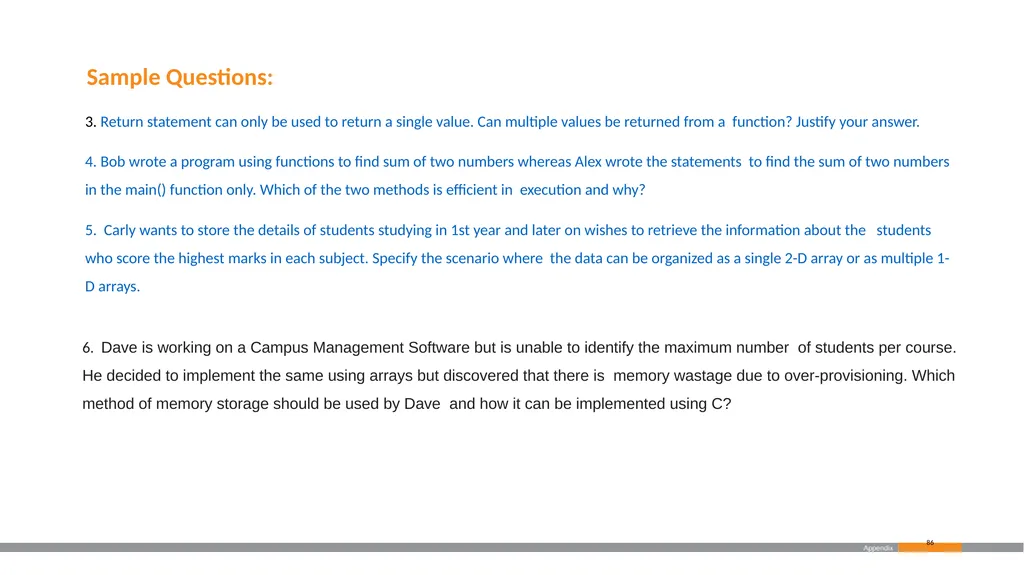
6. Dave is working on a Campus Management Software but is unable to identify the maximum number of students per course. He decided to implement the same using arrays but discovered that there is memory wastage due to over-provisioning. Which method of memory storage should be used by Dave and how it can be implemented using C? Appendix Sample Questions:
3. Return statement can only be used to return a single value. Can multiple values be returned from a function? Justify your answer.
4. Bob wrote a program using functions to find sum of two numbers whereas Alex wrote the statements to find the sum of two numbers in the main() function only. Which of the two methods is efficient in execution and why?
5. Carly wants to store the details of students studying in 1st year and later on wishes to retrieve the information about the students who score the highest marks in each subject. Specify the scenario where the data can be organized as a single 2-D array or as multiple 1-D arrays. 86<br>
3. Return statement can only be used to return a single value. Can multiple values be returned from a function? Justify your answer.
4. Bob wrote a program using functions to find sum of two numbers whereas Alex wrote the statements to find the sum of two numbers in the main() function only. Which of the two methods is efficient in execution and why?
5. Carly wants to store the details of students studying in 1st year and later on wishes to retrieve the information about the students who score the highest marks in each subject. Specify the scenario where the data can be organized as a single 2-D array or as multiple 1-D arrays. 86<br>
80
87 Sample Questions:
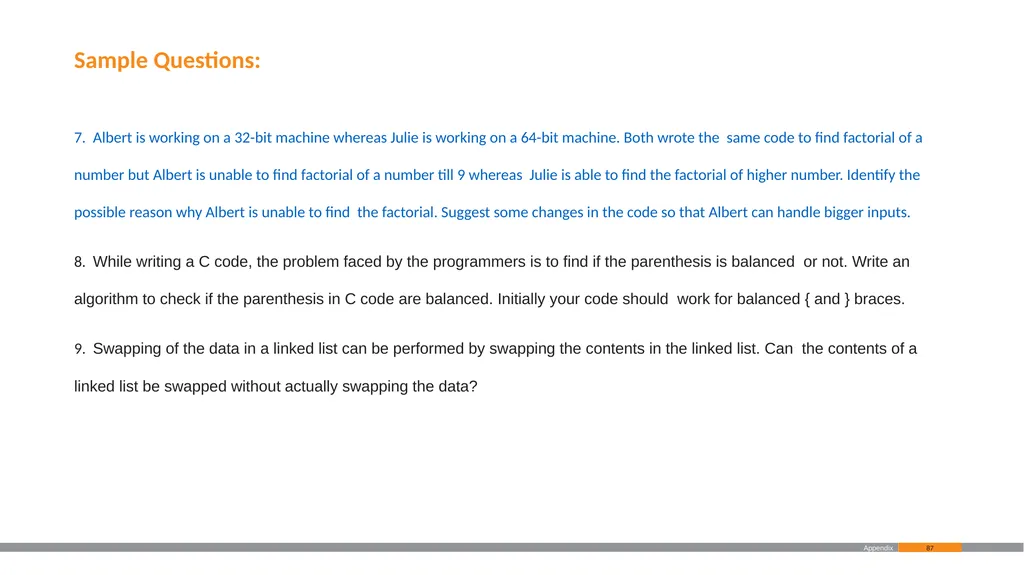
7. Albert is working on a 32-bit machine whereas Julie is working on a 64-bit machine. Both wrote the same code to find factorial of a number but Albert is unable to find factorial of a number till 9 whereas Julie is able to find the factorial of higher number. Identify the possible reason why Albert is unable to find the factorial. Suggest some changes in the code so that Albert can handle bigger inputs.
8. While writing a C code, the problem faced by the programmers is to find if the parenthesis is balanced or not. Write an algorithm to check if the parenthesis in C code are balanced. Initially your code should work for balanced { and } braces.
9. Swapping of the data in a linked list can be performed by swapping the contents in the linked list. Can the contents of a linked list be swapped without actually swapping the data? Appendix<br>
7. Albert is working on a 32-bit machine whereas Julie is working on a 64-bit machine. Both wrote the same code to find factorial of a number but Albert is unable to find factorial of a number till 9 whereas Julie is able to find the factorial of higher number. Identify the possible reason why Albert is unable to find the factorial. Suggest some changes in the code so that Albert can handle bigger inputs.
8. While writing a C code, the problem faced by the programmers is to find if the parenthesis is balanced or not. Write an algorithm to check if the parenthesis in C code are balanced. Initially your code should work for balanced { and } braces.
9. Swapping of the data in a linked list can be performed by swapping the contents in the linked list. Can the contents of a linked list be swapped without actually swapping the data? Appendix<br>
81
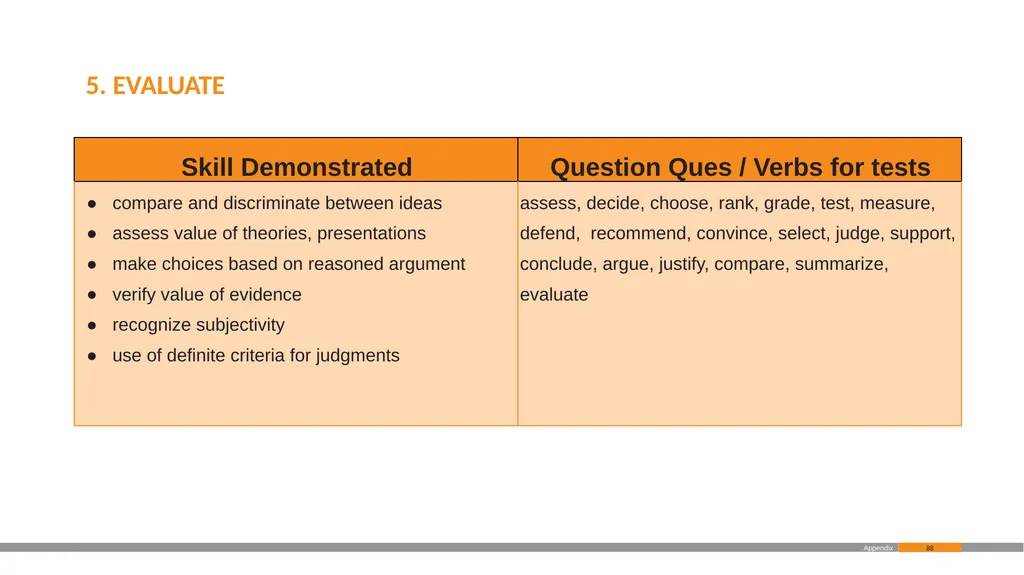
88 Appendix 5. EVALUATE<br>
82
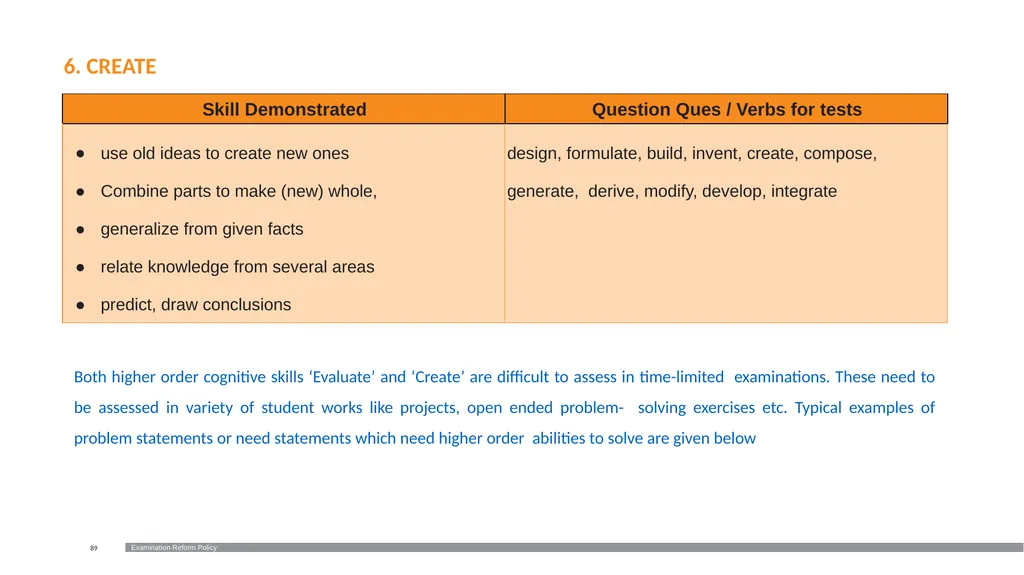
89 Examination Reform Policy Both higher order cognitive skills ‘Evaluate’ and ‘Create’ are difficult to assess in time-limited examinations. These need to be assessed in variety of student works like projects, open ended problem- solving exercises etc. Typical examples of problem statements or need statements which need higher order abilities to solve are given below 6. CREATE<br>
83
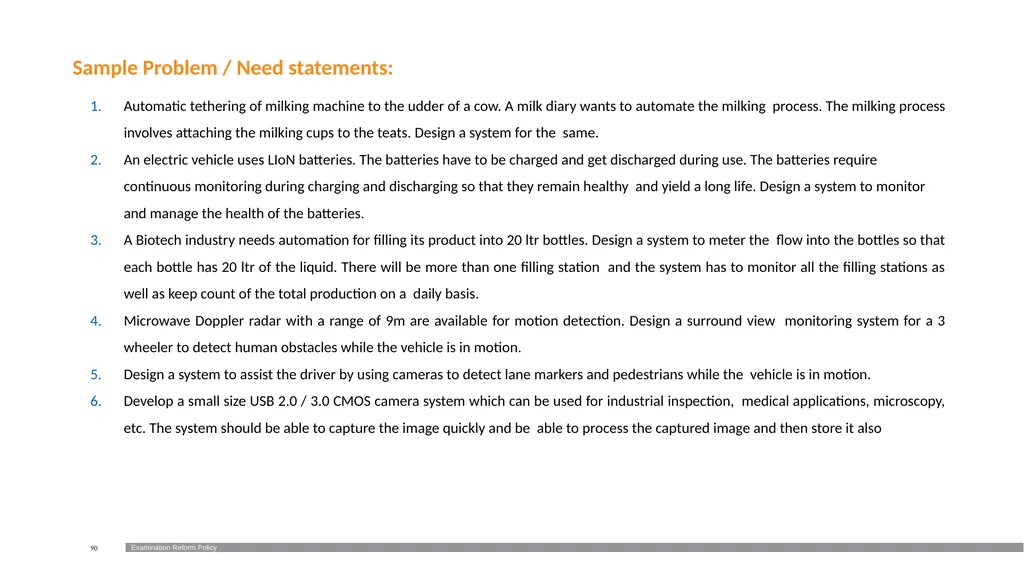
90 Examination Reform Policy Sample Problem / Need statements:
Automatic tethering of milking machine to the udder of a cow. A milk diary wants to automate the milking process. The milking process involves attaching the milking cups to the teats. Design a system for the same.
An electric vehicle uses LIoN batteries. The batteries have to be charged and get discharged during use. The batteries require continuous monitoring during charging and discharging so that they remain healthy and yield a long life. Design a system to monitor and manage the health of the batteries.
A Biotech industry needs automation for filling its product into 20 ltr bottles. Design a system to meter the flow into the bottles so that each bottle has 20 ltr of the liquid. There will be more than one filling station and the system has to monitor all the filling stations as well as keep count of the total production on a daily basis.
Microwave Doppler radar with a range of 9m are available for motion detection. Design a surround view monitoring system for a 3 wheeler to detect human obstacles while the vehicle is in motion.
Design a system to assist the driver by using cameras to detect lane markers and pedestrians while the vehicle is in motion.
Develop a small size USB 2.0 / 3.0 CMOS camera system which can be used for industrial inspection, medical applications, microscopy, etc. The system should be able to capture the image quickly and be able to process the captured image and then store it also<br>
Automatic tethering of milking machine to the udder of a cow. A milk diary wants to automate the milking process. The milking process involves attaching the milking cups to the teats. Design a system for the same.
An electric vehicle uses LIoN batteries. The batteries have to be charged and get discharged during use. The batteries require continuous monitoring during charging and discharging so that they remain healthy and yield a long life. Design a system to monitor and manage the health of the batteries.
A Biotech industry needs automation for filling its product into 20 ltr bottles. Design a system to meter the flow into the bottles so that each bottle has 20 ltr of the liquid. There will be more than one filling station and the system has to monitor all the filling stations as well as keep count of the total production on a daily basis.
Microwave Doppler radar with a range of 9m are available for motion detection. Design a surround view monitoring system for a 3 wheeler to detect human obstacles while the vehicle is in motion.
Design a system to assist the driver by using cameras to detect lane markers and pedestrians while the vehicle is in motion.
Develop a small size USB 2.0 / 3.0 CMOS camera system which can be used for industrial inspection, medical applications, microscopy, etc. The system should be able to capture the image quickly and be able to process the captured image and then store it also<br>
84
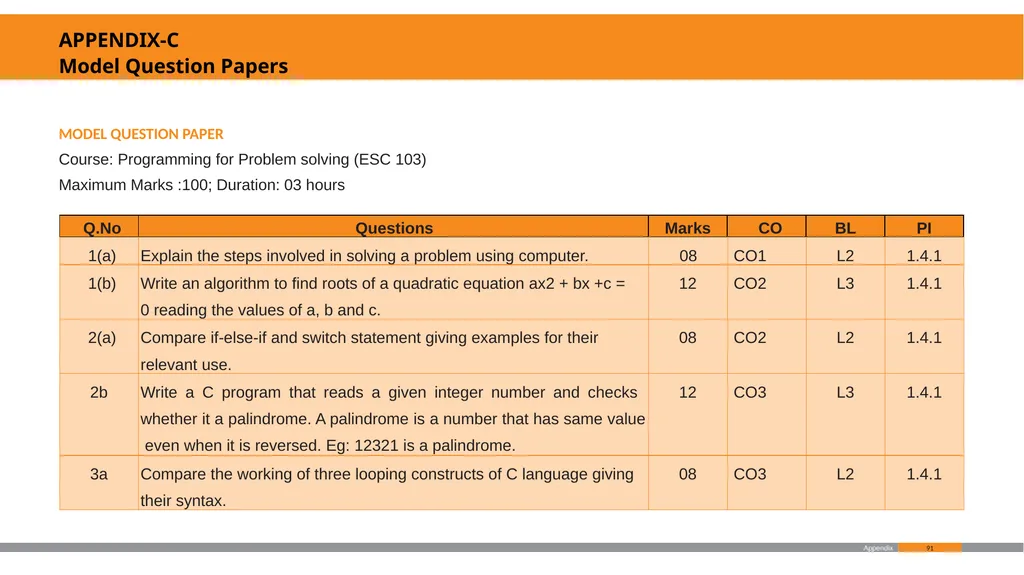
91 APPENDIX-C
Model Question Papers MODEL QUESTION PAPER
Course: Programming for Problem solving (ESC 103)
Maximum Marks :100; Duration: 03 hours Appendix<br>
Model Question Papers MODEL QUESTION PAPER
Course: Programming for Problem solving (ESC 103)
Maximum Marks :100; Duration: 03 hours Appendix<br>
85
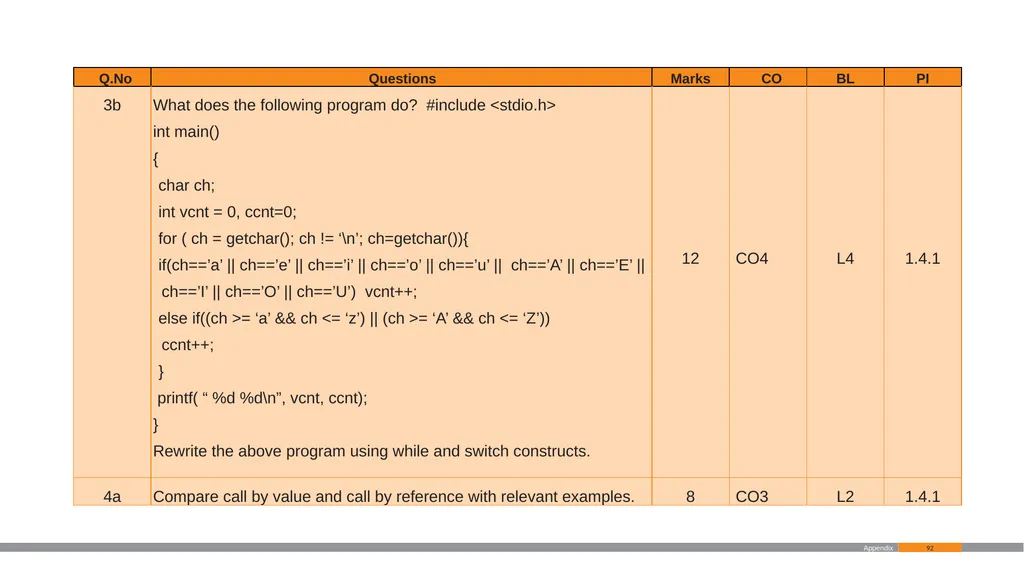
92 Appendix<br>
86
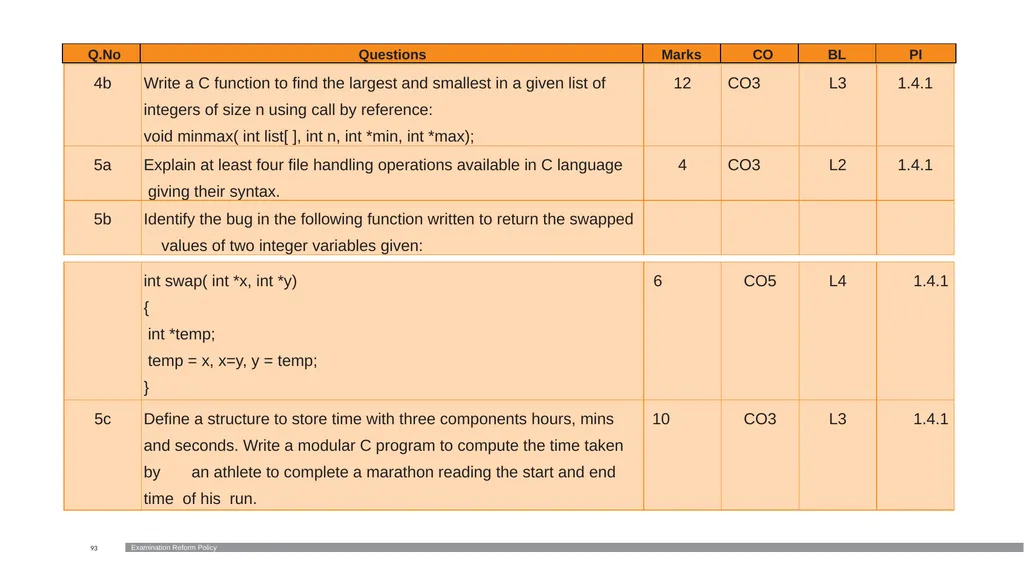
93 Examination Reform Policy<br>
87
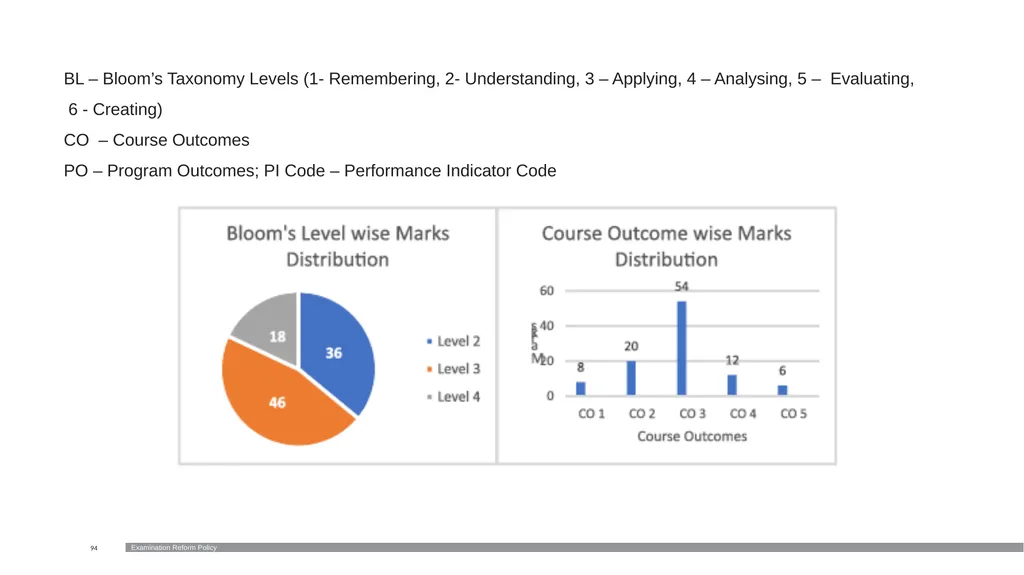
94 BL – Bloom’s Taxonomy Levels (1- Remembering, 2- Understanding, 3 – Applying, 4 – Analysing, 5 – Evaluating,
6 - Creating)
CO – Course Outcomes
PO – Program Outcomes; PI Code – Performance Indicator Code Examination Reform Policy<br>
6 - Creating)
CO – Course Outcomes
PO – Program Outcomes; PI Code – Performance Indicator Code Examination Reform Policy<br>
88
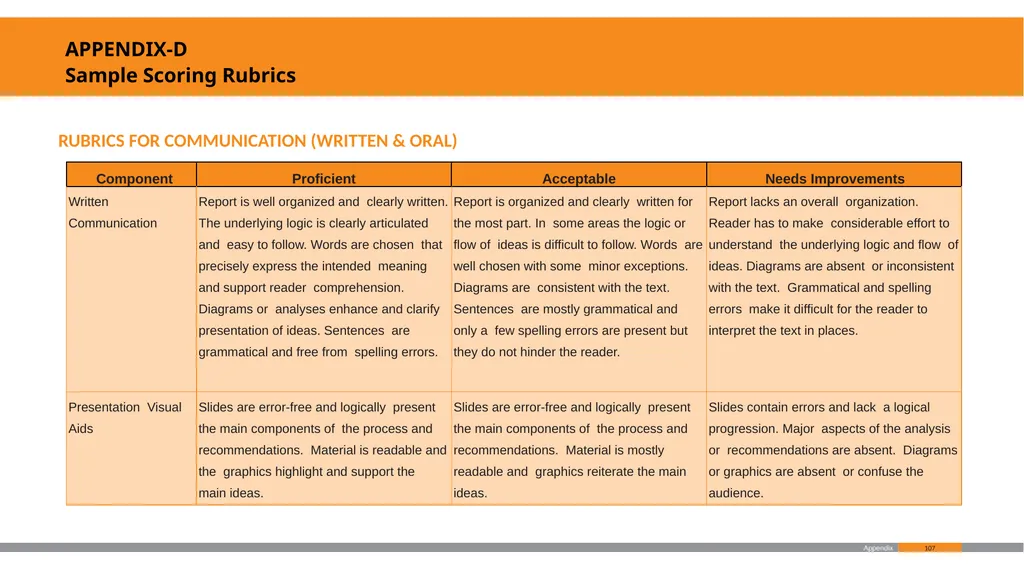
107 APPENDIX-D
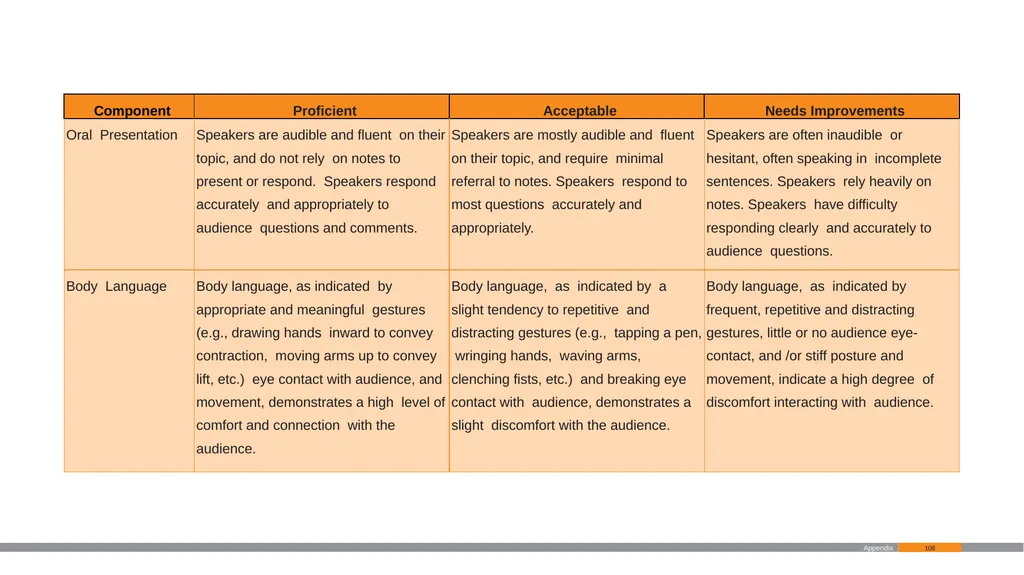
Sample Scoring Rubrics RUBRICS FOR COMMUNICATION (WRITTEN & ORAL) Appendix<br>
Sample Scoring Rubrics RUBRICS FOR COMMUNICATION (WRITTEN & ORAL) Appendix<br>
89
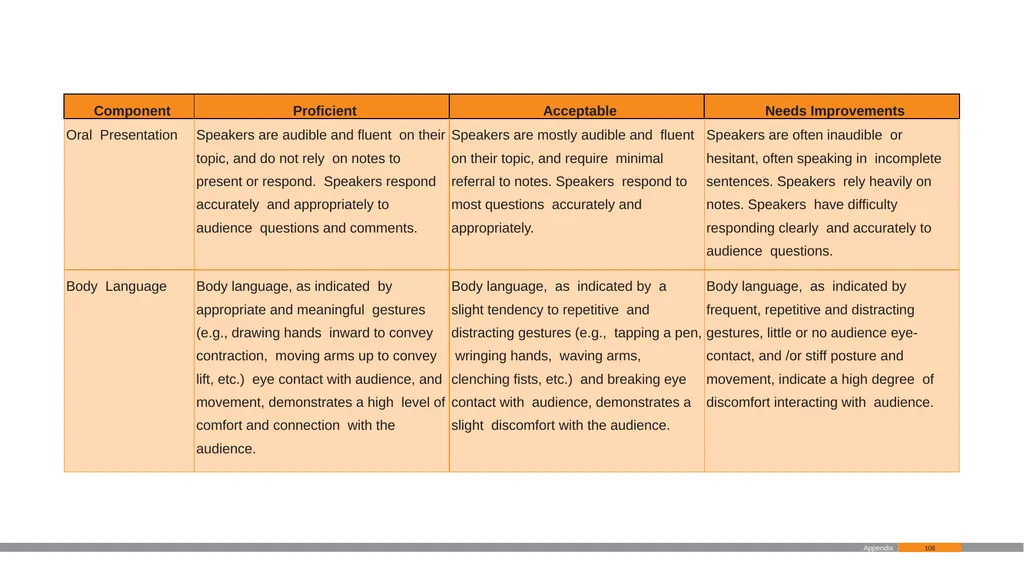
108 Appendix<br>
90
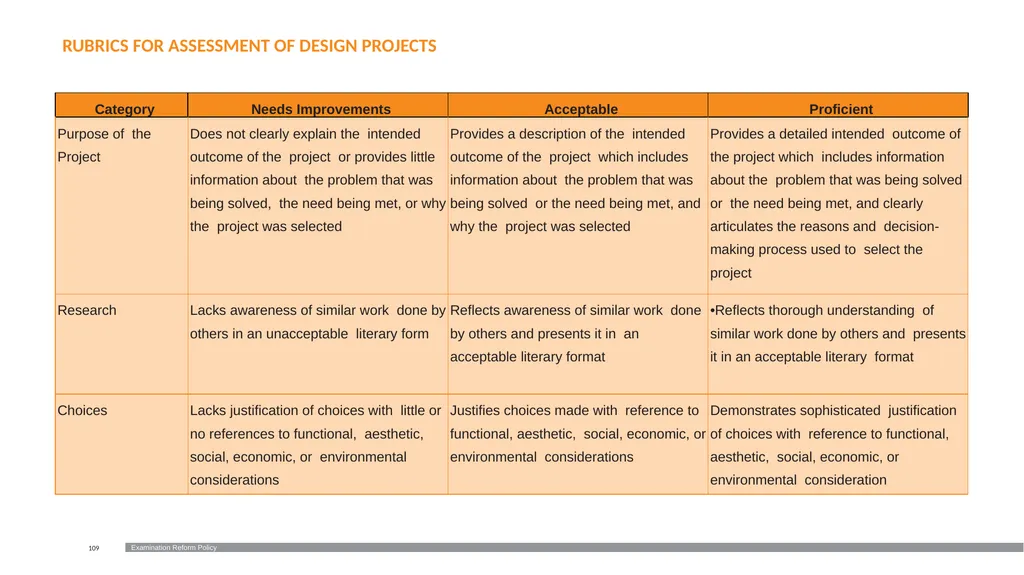
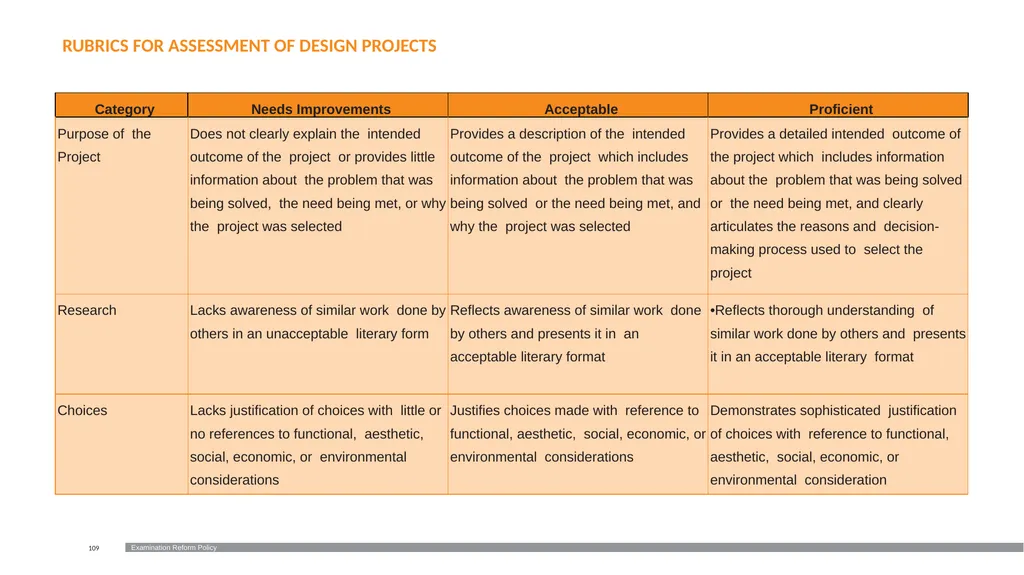
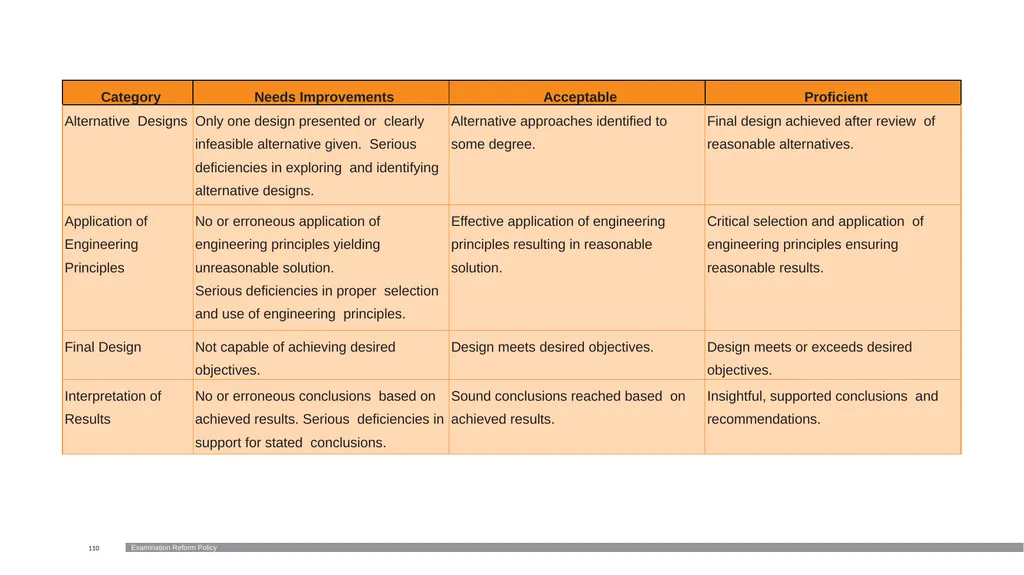
109 RUBRICS FOR ASSESSMENT OF DESIGN PROJECTS Examination Reform Policy<br>
91
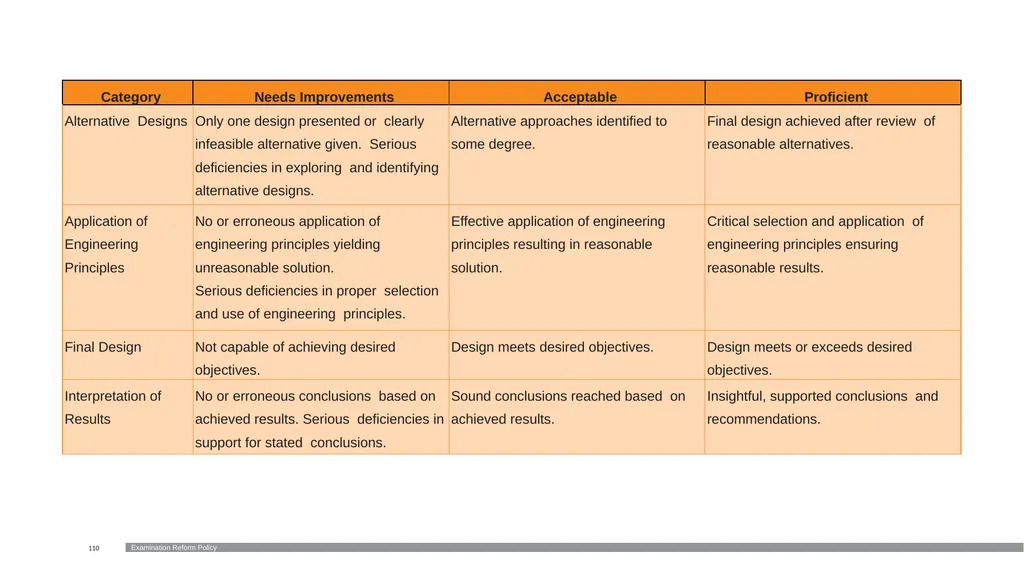
110 Examination Reform Policy<br>
92
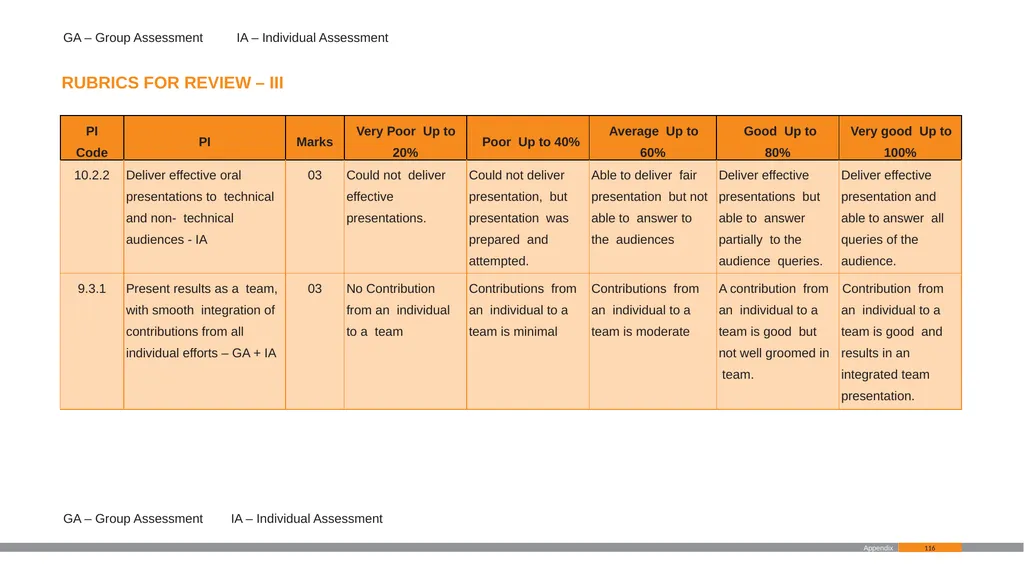
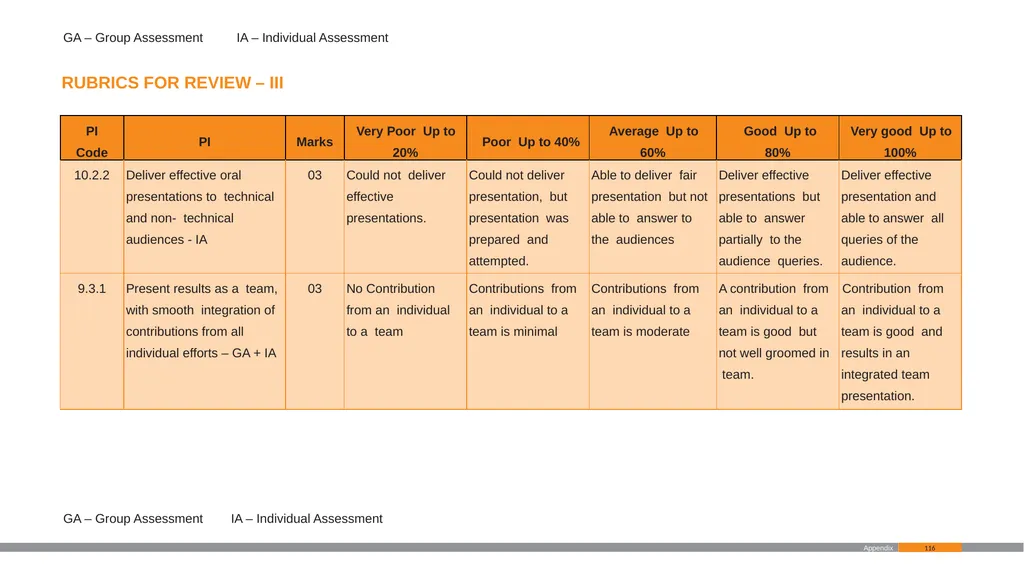
116 RUBRICS FOR REVIEW – III Appendix GA – Group Assessment IA – Individual Assessment GA – Group Assessment IA – Individual Assessment<br>
93
108 Appendix<br>
94
109 RUBRICS FOR ASSESSMENT OF DESIGN PROJECTS Examination Reform Policy<br>
95
110 Examination Reform Policy<br>
96
116 RUBRICS FOR REVIEW – III Appendix GA – Group Assessment IA – Individual Assessment GA – Group Assessment IA – Individual Assessment<br>
97
Model Question Papers For Undergraduate Programs All India Council for Technical Education
Nelson Mandela Marg, Vasant Kunj, New Delhi- 110070<br>
Nelson Mandela Marg, Vasant Kunj, New Delhi- 110070<br>
98
Model Question Papers
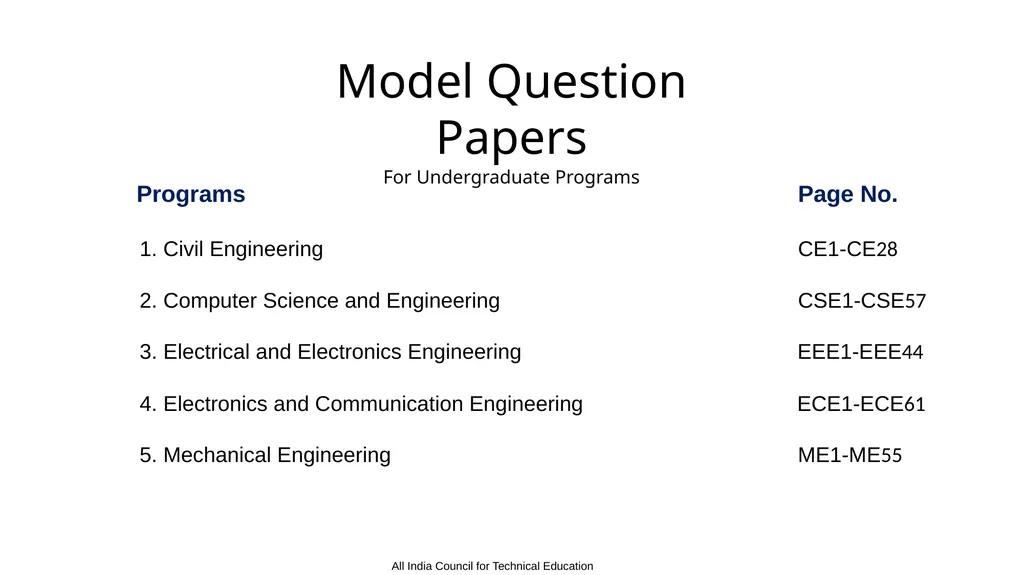
For Undergraduate Programs Programs Page No. 1. Civil Engineering CE1-CE28 2. Computer Science and Engineering CSE1-CSE57 3. Electrical and Electronics Engineering EEE1-EEE44 4. Electronics and Communication Engineering ECE1-ECE61 5. Mechanical Engineering ME1-ME55 All India Council for Technical Education<br>
For Undergraduate Programs Programs Page No. 1. Civil Engineering CE1-CE28 2. Computer Science and Engineering CSE1-CSE57 3. Electrical and Electronics Engineering EEE1-EEE44 4. Electronics and Communication Engineering ECE1-ECE61 5. Mechanical Engineering ME1-ME55 All India Council for Technical Education<br>
99
Civil Engineering
Model Question Papers
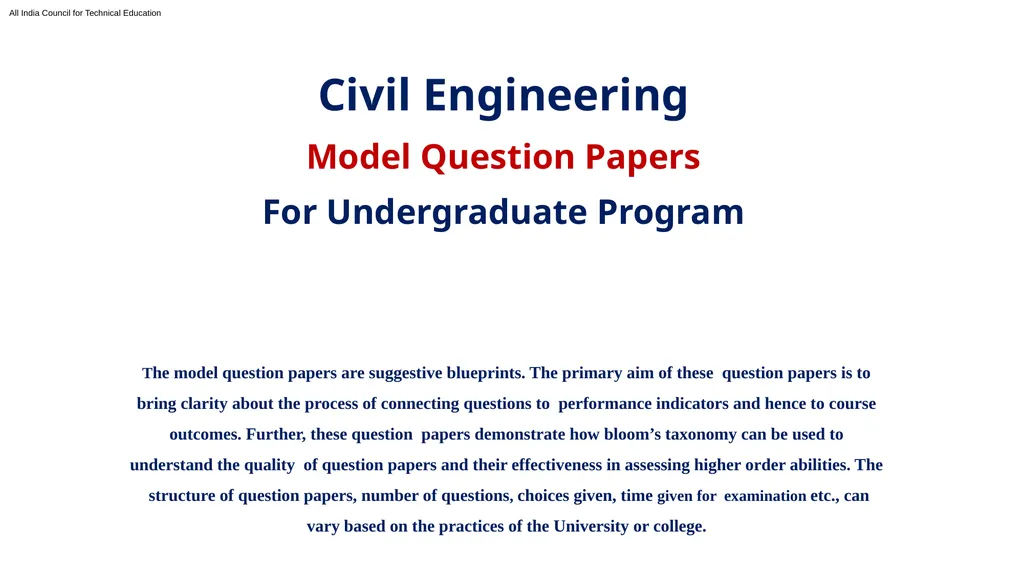
For Undergraduate Program The model question papers are suggestive blueprints. The primary aim of these question papers is to bring clarity about the process of connecting questions to performance indicators and hence to course outcomes. Further, these question papers demonstrate how bloom’s taxonomy can be used to understand the quality of question papers and their effectiveness in assessing higher order abilities. The structure of question papers, number of questions, choices given, time given for examination etc., can vary based on the practices of the University or college. All India Council for Technical Education<br>
Model Question Papers
For Undergraduate Program The model question papers are suggestive blueprints. The primary aim of these question papers is to bring clarity about the process of connecting questions to performance indicators and hence to course outcomes. Further, these question papers demonstrate how bloom’s taxonomy can be used to understand the quality of question papers and their effectiveness in assessing higher order abilities. The structure of question papers, number of questions, choices given, time given for examination etc., can vary based on the practices of the University or college. All India Council for Technical Education<br>
100
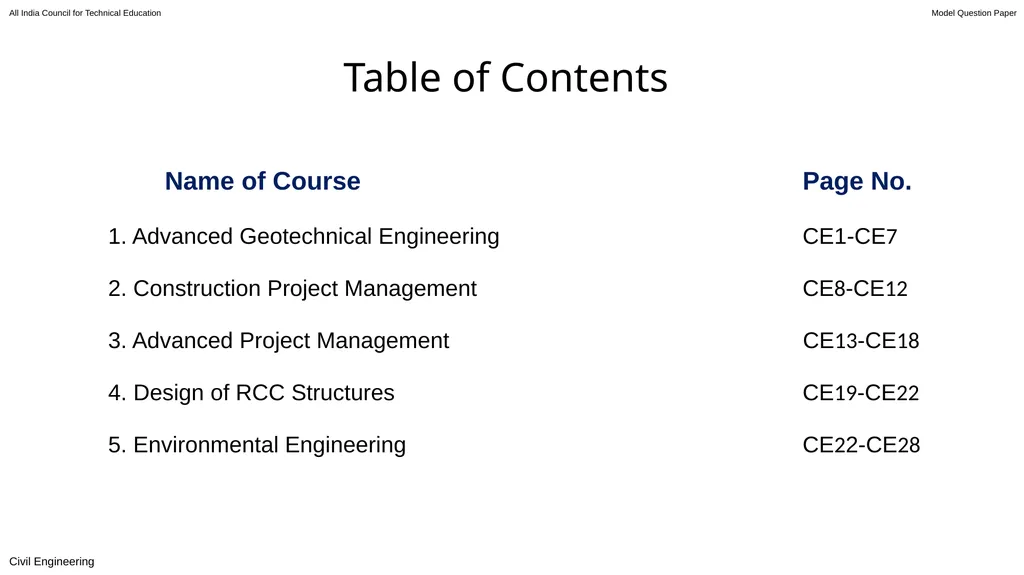
Table of Contents Name of Course Page No. 1. Advanced Geotechnical Engineering CE1-CE7 2. Construction Project Management CE8-CE12 3. Advanced Project Management CE13-CE18 4. Design of RCC Structures CE19-CE22 5. Environmental Engineering CE22-CE28 All India Council for Technical Education Model Question Paper Civil Engineering<br>
101
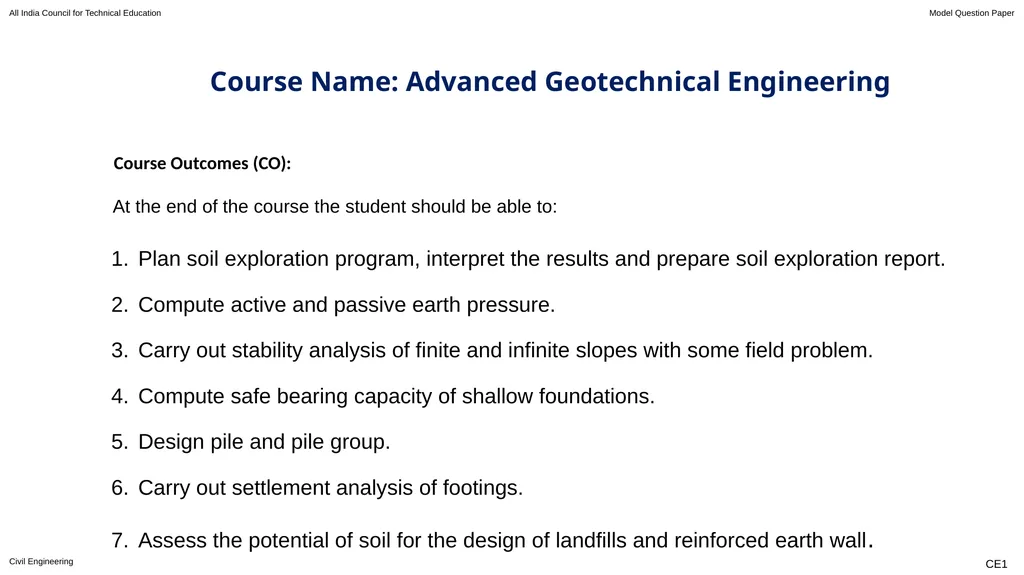
Course Name: Advanced Geotechnical Engineering
Course Outcomes (CO):
At the end of the course the student should be able to: Plan soil exploration program, interpret the results and prepare soil exploration report.
Compute active and passive earth pressure.
Carry out stability analysis of finite and infinite slopes with some field problem.
Compute safe bearing capacity of shallow foundations.
Design pile and pile group.
Carry out settlement analysis of footings.
Assess the potential of soil for the design of landfills and reinforced earth wall. All India Council for Technical Education Model Question Paper Civil Engineering CE1<br>
Course Outcomes (CO):
At the end of the course the student should be able to: Plan soil exploration program, interpret the results and prepare soil exploration report.
Compute active and passive earth pressure.
Carry out stability analysis of finite and infinite slopes with some field problem.
Compute safe bearing capacity of shallow foundations.
Design pile and pile group.
Carry out settlement analysis of footings.
Assess the potential of soil for the design of landfills and reinforced earth wall. All India Council for Technical Education Model Question Paper Civil Engineering CE1<br>
102
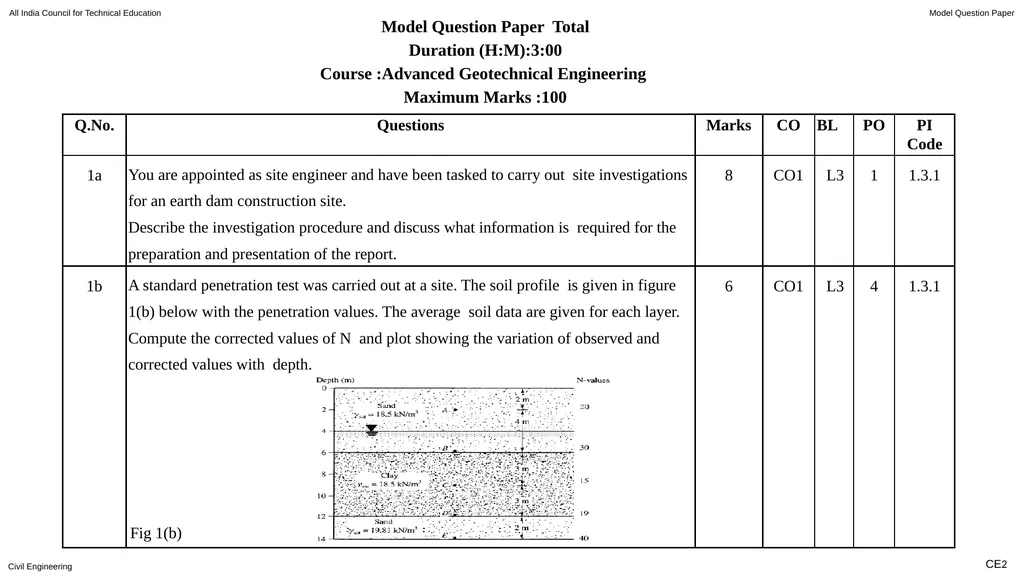
Model Question Paper Total Duration (H:M):3:00
Course :Advanced Geotechnical Engineering Maximum Marks :100 Civil Engineering CE2 All India Council for Technical Education Model Question Paper<br>
Course :Advanced Geotechnical Engineering Maximum Marks :100 Civil Engineering CE2 All India Council for Technical Education Model Question Paper<br>
103
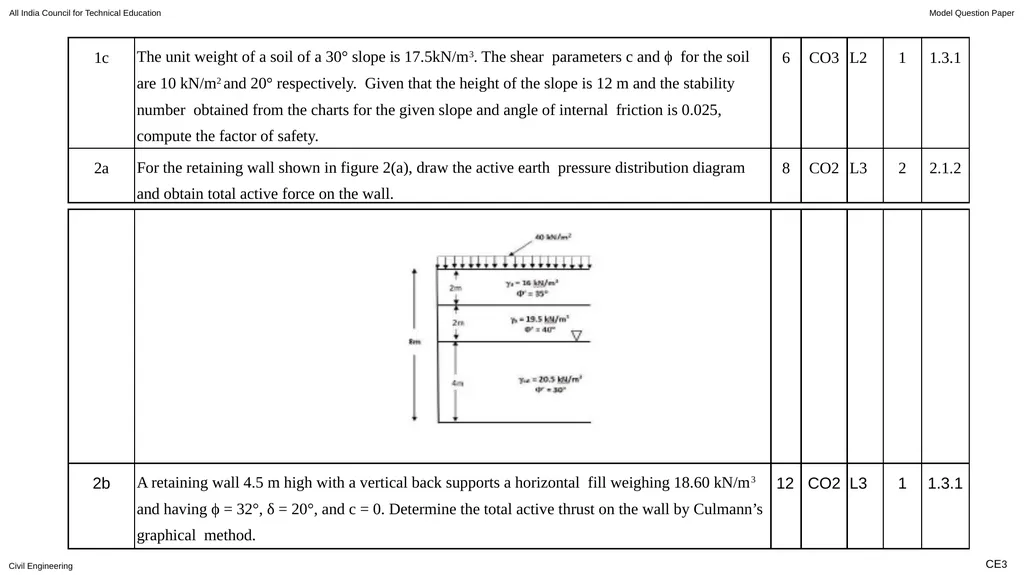
Civil Engineering CE3 All India Council for Technical Education Model Question Paper<br>
104
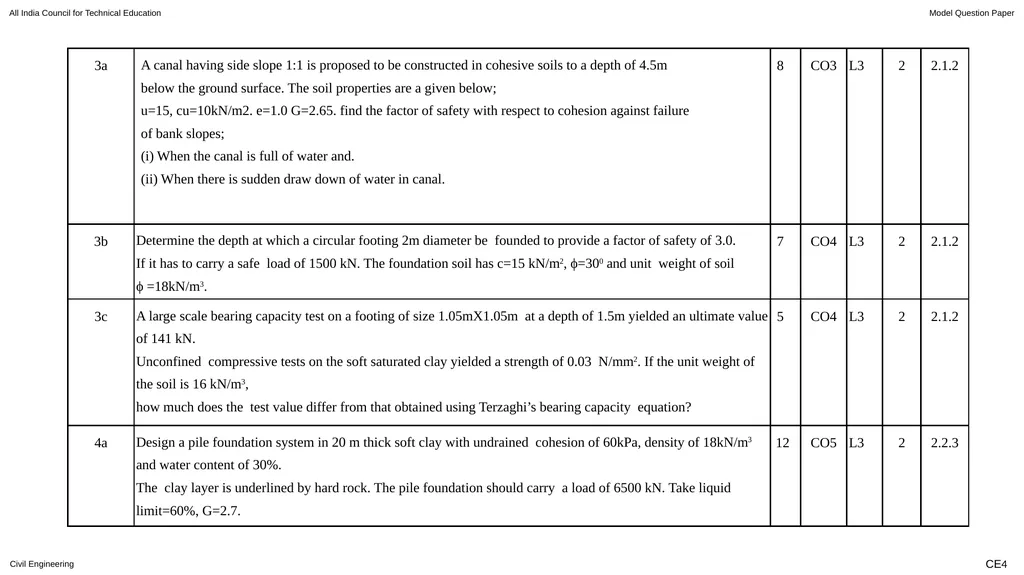
All India Council for Technical Education Model Question Paper Civil Engineering CE4<br>
105
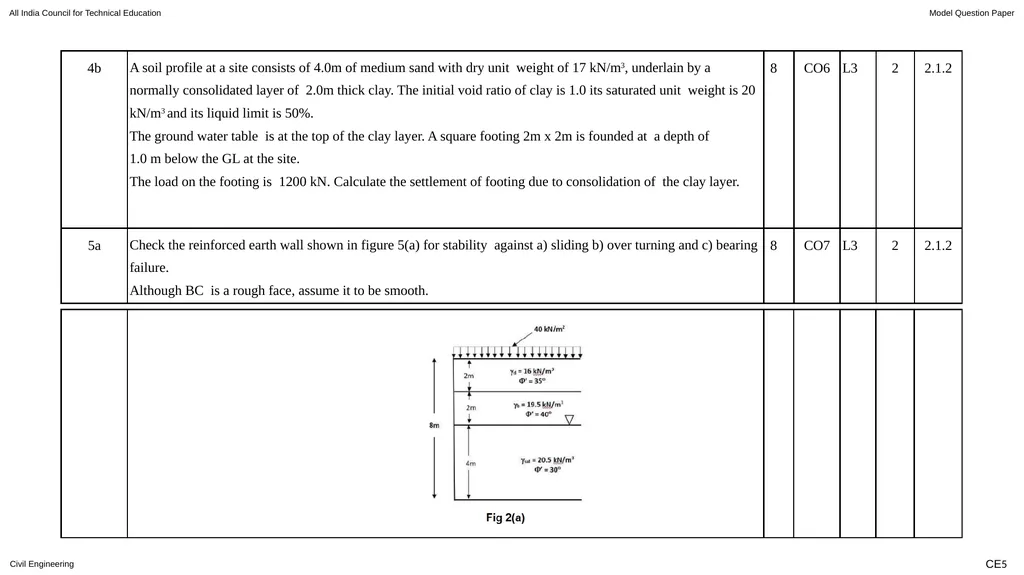
All India Council for Technical Education Model Question Paper Civil Engineering CE5<br>
106
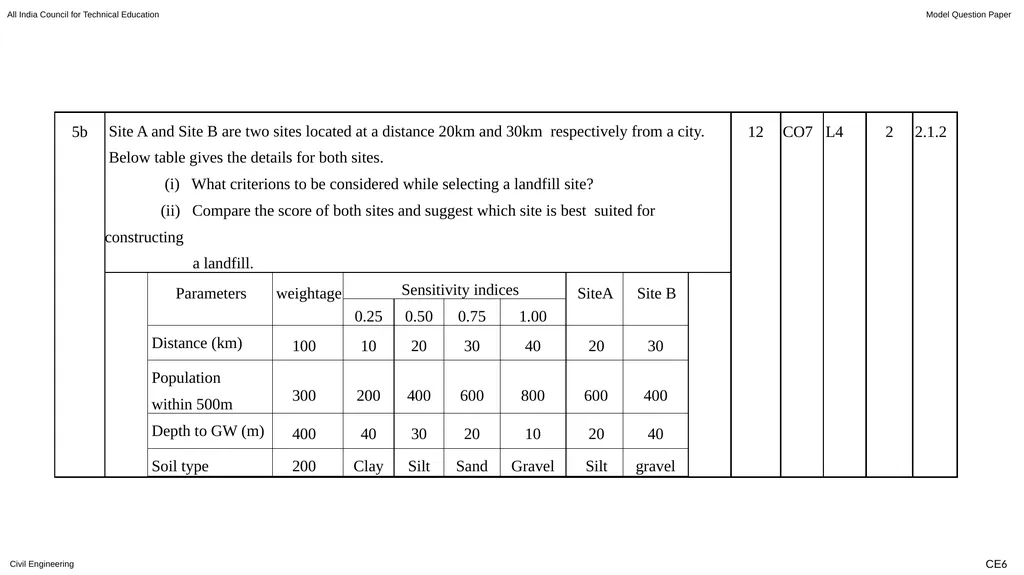
All India Council for Technical Education Model Question Paper CE6 Civil Engineering<br>
107
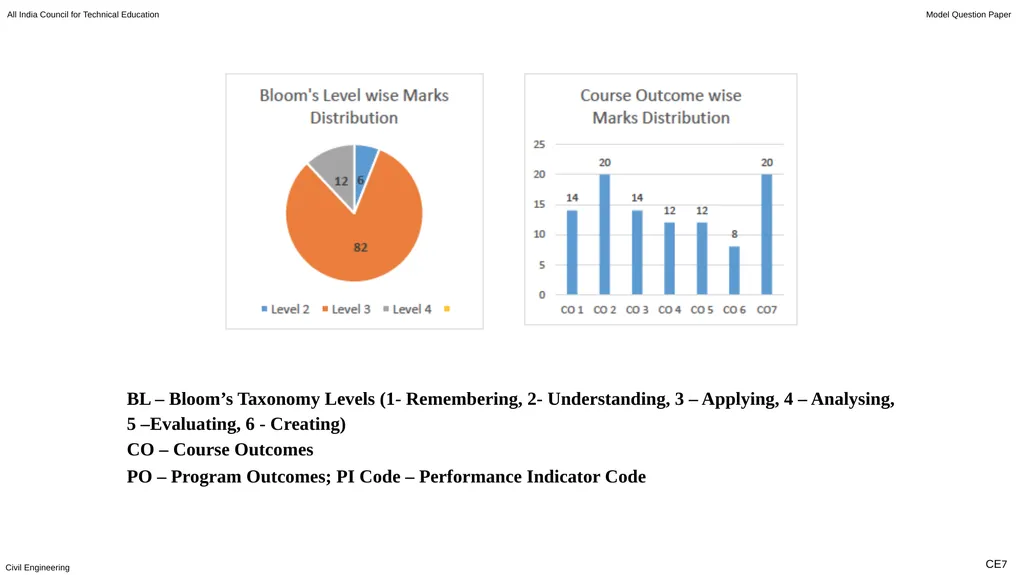
BL – Bloom’s Taxonomy Levels (1- Remembering, 2- Understanding, 3 – Applying, 4 – Analysing,
5 –Evaluating, 6 - Creating)
CO – Course Outcomes
PO – Program Outcomes; PI Code – Performance Indicator Code Civil Engineering CE7 All India Council for Technical Education Model Question Paper<br>
5 –Evaluating, 6 - Creating)
CO – Course Outcomes
PO – Program Outcomes; PI Code – Performance Indicator Code Civil Engineering CE7 All India Council for Technical Education Model Question Paper<br>
108
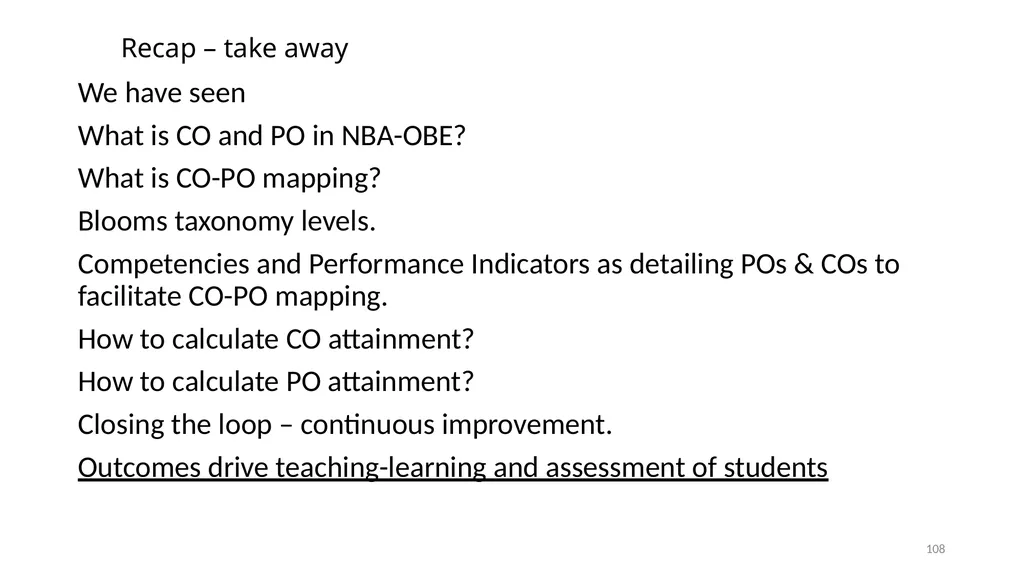
Recap – take away We have seen
What is CO and PO in NBA-OBE?
What is CO-PO mapping?
Blooms taxonomy levels.
Competencies and Performance Indicators as detailing POs & COs to facilitate CO-PO mapping.
How to calculate CO attainment?
How to calculate PO attainment?
Closing the loop – continuous improvement.
Outcomes drive teaching-learning and assessment of students 108<br>
What is CO and PO in NBA-OBE?
What is CO-PO mapping?
Blooms taxonomy levels.
Competencies and Performance Indicators as detailing POs & COs to facilitate CO-PO mapping.
How to calculate CO attainment?
How to calculate PO attainment?
Closing the loop – continuous improvement.
Outcomes drive teaching-learning and assessment of students 108<br>
109
FAQ on OBE How many COs per course?
COs for Lab course? Lab-Integrated courses?
Meaning of CO-> PO mapping and, how to use them in T-L-P?
Logic in CO-> PO mapping? Content connect or T-L-P connect?
Partial PO assessment – why and how used?
Electives, internship, VAC, mini/capstone project in OBE.
PO attainments close to 3 – what it may mean and what to do?
CO attainment and its uses? (CI)
Thresholds (Rubrics) for CO, PO attainments?
Indirect method of assessment – useful always? Weightage?
PEOs – how assessed? At what frequency?
Feedback-based vs Outcome-attainment based improvements
OBE use for design, evaluation of curriculum?<br>
COs for Lab course? Lab-Integrated courses?
Meaning of CO-> PO mapping and, how to use them in T-L-P?
Logic in CO-> PO mapping? Content connect or T-L-P connect?
Partial PO assessment – why and how used?
Electives, internship, VAC, mini/capstone project in OBE.
PO attainments close to 3 – what it may mean and what to do?
CO attainment and its uses? (CI)
Thresholds (Rubrics) for CO, PO attainments?
Indirect method of assessment – useful always? Weightage?
PEOs – how assessed? At what frequency?
Feedback-based vs Outcome-attainment based improvements
OBE use for design, evaluation of curriculum?<br>
110
PRACTICE OF OBE OVERVIEW
AS-IS: some observations on how we are doing it at present
SAR STRUCTURE: criteria and Marks
SAR CONTENTS: Data and its use, process description and application, Continuous Improvement (CI)
TO-BE some guidelines for making SAR and for the visit 110<br>
AS-IS: some observations on how we are doing it at present
SAR STRUCTURE: criteria and Marks
SAR CONTENTS: Data and its use, process description and application, Continuous Improvement (CI)
TO-BE some guidelines for making SAR and for the visit 110<br>
111
OBE PRACTICE: AS-IS Working in spurts
lack of being systematic in data discipline
lack of cohesion in team work
Few do and that too in parts, only prior to submission
Everyone does not go through SAR
Too much printing prior to the NBA team visit
In brief, OBE is not fully integrated into the Academic System 111<br>
lack of being systematic in data discipline
lack of cohesion in team work
Few do and that too in parts, only prior to submission
Everyone does not go through SAR
Too much printing prior to the NBA team visit
In brief, OBE is not fully integrated into the Academic System 111<br>
112
SAR Structure PART-A (Institutional Information) and
PART-B (Program Specific Information)
10 criteria with marks.
Criteria have sub and sub-sub criteria
CAY, CAYm1, CAYm2, CAYm3
Process description, data, process progress snapshots 112<br>
PART-B (Program Specific Information)
10 criteria with marks.
Criteria have sub and sub-sub criteria
CAY, CAYm1, CAYm2, CAYm3
Process description, data, process progress snapshots 112<br>
113
Criteria Summary
Name of the program _______________________________________<br>
Name of the program _______________________________________<br>
114
3.1. Establish the correlation between the courses and the Program Outcomes (POs) & Program Specific Outcomes (20)
(Program Outcomes as mentioned in Annexure I and Program Specific Outcomes as defined by the Program)
3.1.1. Course Outcomes (COs) (SAR should include course outcomes of one course from each semester of study, however, should be prepared for all courses and made available as evidence, if asked) (05)
Note: Number of Outcomes for a Course is expected to be around 6.
Course Name: Ciii Year of Study: YYYY – YY; for ex. C202 Year of study 2013-14 C202 is the second course in second year and ‘.1’ to ‘.6’ are the outcomes of this course 114<br>
(Program Outcomes as mentioned in Annexure I and Program Specific Outcomes as defined by the Program)
3.1.1. Course Outcomes (COs) (SAR should include course outcomes of one course from each semester of study, however, should be prepared for all courses and made available as evidence, if asked) (05)
Note: Number of Outcomes for a Course is expected to be around 6.
Course Name: Ciii Year of Study: YYYY – YY; for ex. C202 Year of study 2013-14 C202 is the second course in second year and ‘.1’ to ‘.6’ are the outcomes of this course 114<br>
115
3.1.2. CO-PO matrices of courses selected in 3.1.1 (six matrices to be mentioned; one per semester from 3rd to 8th semester) (05) Note:
Enter correlation levels 1, 2 or 3 as defined below:
1: Slight (Low) 2: Moderate (Medium) 3: Substantial (High)
It there is no correlation, put “-”
2. Similar table is to be prepared for PSOs 115<br>
Enter correlation levels 1, 2 or 3 as defined below:
1: Slight (Low) 2: Moderate (Medium) 3: Substantial (High)
It there is no correlation, put “-”
2. Similar table is to be prepared for PSOs 115<br>
116
3.1.3. Program level Course-PO matrix of all courses INCLUDING first year courses (10) Note:
Enter correlation levels 1, 2 or 3 as defined below:
1: Slight (Low) 2: Moderate (Medium) 3: Substantial (High)
It there is no correlation, put “-”
It may be noted that contents of Table 3.1.2 must be consistent with information available in Table 3.1.3 for all the courses.
2. Similar table is to be prepared for PSOs 116<br>
Enter correlation levels 1, 2 or 3 as defined below:
1: Slight (Low) 2: Moderate (Medium) 3: Substantial (High)
It there is no correlation, put “-”
It may be noted that contents of Table 3.1.2 must be consistent with information available in Table 3.1.3 for all the courses.
2. Similar table is to be prepared for PSOs 116<br>
117
3.2. Attainment of Course Outcomes (50)
3.2.1. Describe the assessment processes used to gather the data upon which the evaluation of Course Outcome is based (10)
(Examples of data collection processes may include, but are not limited to, specific exam/tutorial questions, assignments, laboratory tests, project evaluation, student portfolios (A portfolio is a collection of artifacts that demonstrate skills, personal characteristics and accomplishments created by the student during study period), internally developed assessment exams, project presentations, oral exams etc.)
3.2.2. Record the attainment of Course Outcomes of all courses with respect to set attainment levels (40)
Program shall have set Course Outcome attainment levels for all courses.
(The attainment levels shall be set considering average performance levels in the university examination or any higher value set as target for the assessment years. Attainment level is to be measured in terms of student performance in internal assessments with respect to the Course Outcomes of a course in addition to the performance in the University examination)
Measuring Course Outcomes attained through University Examinations
Target may be stated in terms of percentage of students getting more than the university average marks or more as selected by the Program in the final examination. For cases where the university does not provide useful indicators like average or median marks etc., the program may choose an attainment level on its own with justification.
For Example related to attainment levels Vs. targets: (The examples indicated are for reference only. Program may appropriately define levels), Please refer SAR 117<br>
3.2.1. Describe the assessment processes used to gather the data upon which the evaluation of Course Outcome is based (10)
(Examples of data collection processes may include, but are not limited to, specific exam/tutorial questions, assignments, laboratory tests, project evaluation, student portfolios (A portfolio is a collection of artifacts that demonstrate skills, personal characteristics and accomplishments created by the student during study period), internally developed assessment exams, project presentations, oral exams etc.)
3.2.2. Record the attainment of Course Outcomes of all courses with respect to set attainment levels (40)
Program shall have set Course Outcome attainment levels for all courses.
(The attainment levels shall be set considering average performance levels in the university examination or any higher value set as target for the assessment years. Attainment level is to be measured in terms of student performance in internal assessments with respect to the Course Outcomes of a course in addition to the performance in the University examination)
Measuring Course Outcomes attained through University Examinations
Target may be stated in terms of percentage of students getting more than the university average marks or more as selected by the Program in the final examination. For cases where the university does not provide useful indicators like average or median marks etc., the program may choose an attainment level on its own with justification.
For Example related to attainment levels Vs. targets: (The examples indicated are for reference only. Program may appropriately define levels), Please refer SAR 117<br>
118
3.3. Attainment of Program Outcomes and Program Specific Outcomes (50)
3.3.1. Describe assessment tools and processes used for measuring the attainment of each Program Outcome and Program Specific Outcomes (10)
(Describe the assessment tools and processes used to gather the data upon which the evaluation of each of the Program Outcomes and Program Specific Outcomes is based indicating the frequency with which these processes are carried out. Describe the assessment processes that demonstrate the degree to which the Program Outcomes and Program Specific Outcomes are attained and document the attainment levels)
3.3.2. Provide results of evaluation of each PO & PSO (40)
(The attainment levels by direct (student performance) and indirect (surveys) are to be presented through Program level Course-PO&PSO matrices as indicated).
PO Attainment 118<br>
3.3.1. Describe assessment tools and processes used for measuring the attainment of each Program Outcome and Program Specific Outcomes (10)
(Describe the assessment tools and processes used to gather the data upon which the evaluation of each of the Program Outcomes and Program Specific Outcomes is based indicating the frequency with which these processes are carried out. Describe the assessment processes that demonstrate the degree to which the Program Outcomes and Program Specific Outcomes are attained and document the attainment levels)
3.3.2. Provide results of evaluation of each PO & PSO (40)
(The attainment levels by direct (student performance) and indirect (surveys) are to be presented through Program level Course-PO&PSO matrices as indicated).
PO Attainment 118<br>
119
Note: Similar table is to be prepared for PSOs
C101, C102 are indicative courses in the first year. Similarly, C409 is final year course. First numeric digit indicates year of study and remaining two digits indicate course nos. in the respective year of study.
Direct attainment level of a PO & PSO is determined by taking average across all courses addressing that PO and/or PSO. Fractional numbers may be used for example 1.55.
Indirect attainment level of PO & PSO is determined based on the student exit surveys, employer surveys, co-curricular activities, extracurricular activities etc.
Example:
It is assumed that a particular PO has been mapped to four courses C2O1, C3O2, C3O3 and C4O1
The attainment level for each of the four courses will be as per the examples shown in 3.2.2
PO attainment level will be based on attainment levels of direct assessment and indirect assessment
For affiliated, non-autonomous colleges, it is assumed that while deciding on overall attainment level 80% weightage may be given to direct assessment and 20% weightage to indirect assessment through surveys from students(largely), employers (to some extent). Program may have different weightages with appropriate justification.
Assuming following actual attainment levels:
Direct Assessment
C201 –High (3)
C302 – Medium (2)
C303 – Low (1)
C401 – High (3)
Attainment level will be summation of levels divided by no. of courses 3+2+1+3/4= 9/4=2.25
Indirect Assessment
Surveys, Analysis, customized to an average value as per levels 1, 2 & 3.
Assumed level - 2
PO Attainment level will be 80% of direct assessment + 20% of indirect assessment i.e. 1.8 + 0.4 = 2.2.
Note: Similarly for PSOs 119<br>
C101, C102 are indicative courses in the first year. Similarly, C409 is final year course. First numeric digit indicates year of study and remaining two digits indicate course nos. in the respective year of study.
Direct attainment level of a PO & PSO is determined by taking average across all courses addressing that PO and/or PSO. Fractional numbers may be used for example 1.55.
Indirect attainment level of PO & PSO is determined based on the student exit surveys, employer surveys, co-curricular activities, extracurricular activities etc.
Example:
It is assumed that a particular PO has been mapped to four courses C2O1, C3O2, C3O3 and C4O1
The attainment level for each of the four courses will be as per the examples shown in 3.2.2
PO attainment level will be based on attainment levels of direct assessment and indirect assessment
For affiliated, non-autonomous colleges, it is assumed that while deciding on overall attainment level 80% weightage may be given to direct assessment and 20% weightage to indirect assessment through surveys from students(largely), employers (to some extent). Program may have different weightages with appropriate justification.
Assuming following actual attainment levels:
Direct Assessment
C201 –High (3)
C302 – Medium (2)
C303 – Low (1)
C401 – High (3)
Attainment level will be summation of levels divided by no. of courses 3+2+1+3/4= 9/4=2.25
Indirect Assessment
Surveys, Analysis, customized to an average value as per levels 1, 2 & 3.
Assumed level - 2
PO Attainment level will be 80% of direct assessment + 20% of indirect assessment i.e. 1.8 + 0.4 = 2.2.
Note: Similarly for PSOs 119<br>
120
Capsule view of SAR contents SAR has data for 3 years (in a few places for 4 years)
e.g., list of equipment in labs, faculty information, faculty publications,
student performance, placement.
SAR describes processes (e.g. how Vision/Mission are made, stake holder
involvement, how CO, PO attainment are calculated)
SAR has calculations, e.g. SFR, FSFR, CO, PO attainment.
calculation by peer visit committee provides scoring with justifications in writing - the scoring may differ from that of the institution/program 120<br>
e.g., list of equipment in labs, faculty information, faculty publications,
student performance, placement.
SAR describes processes (e.g. how Vision/Mission are made, stake holder
involvement, how CO, PO attainment are calculated)
SAR has calculations, e.g. SFR, FSFR, CO, PO attainment.
calculation by peer visit committee provides scoring with justifications in writing - the scoring may differ from that of the institution/program 120<br>
121
Some hints for SAR prep and the visit (TO-BE) Clean, good course files – must include question papers, Answer keys, result analysis.
Use of tools – spread sheets are helpful – saves time, can vary parameters and study
Incrementally maintaining/updating – usually adding data at department/program/institution level on ongoing, continuous basis
Make conscientious effort toward complex problem solving (POs) and higher Bloom level
Questions (HOTS) and manifest them
Many, including First-year Faculty, must be thorough with SAR
Adhere to timings and format for Institute and Department presentations
Standards are useful and help very much. e.g. listing publications
Go digital, fully. Most of SAR can be made with selection, understand-cut-paste-edit.
Share good practices, especially, internally.
Stick to what you are doing - Keep exaggeration to minimum, e.g., use of NPTEL, flipped class room … 121<br>
Use of tools – spread sheets are helpful – saves time, can vary parameters and study
Incrementally maintaining/updating – usually adding data at department/program/institution level on ongoing, continuous basis
Make conscientious effort toward complex problem solving (POs) and higher Bloom level
Questions (HOTS) and manifest them
Many, including First-year Faculty, must be thorough with SAR
Adhere to timings and format for Institute and Department presentations
Standards are useful and help very much. e.g. listing publications
Go digital, fully. Most of SAR can be made with selection, understand-cut-paste-edit.
Share good practices, especially, internally.
Stick to what you are doing - Keep exaggeration to minimum, e.g., use of NPTEL, flipped class room … 121<br>
122
Q &A THANK YOU
ALL THE BEST
WELCOME YOUR FEEDBACK 122<br>
ALL THE BEST
WELCOME YOUR FEEDBACK 122<br>