01
NCBFAA NVOCC Day 2025: Co-Loading – Key Considerations and Best Practices May 22, 2025 Presented by Venable LLP
Elizabeth (Liz) K. Lowe, Partner
Email: EKLowe@Venable.com
Tel: 202.344.4213<br>
02
Co-Loading Overview © 2025 / Confidential / Slide 2 Strategic advantages of co-loading
Operational efficiency (i.e., higher container utilization).
Pricing flexibility and cost savings.
Expanded market access and service reach (e.g., far-flung or low-demand ports can be served by pooling cargo). Definition
Co-loading means the combining of cargo by two or more NVOCCs for tendering to an ocean common carrier under the name of one or more of the NVOCCs<br>
03
Co-Loading Regulations © 2025 / Confidential / Slide 3 Effective February 1, 2024, the Federal Maritime Commission (“FMC”) implemented revised regulations governing co-loading, as set forth in 46 C.F.R. § 520.11(c).
“Shipper-to-carrier” relationships to mean a master NVOCC receives cargo from a tendering NVOCC. The master NVOCC acts as a carrier, issues its house bill of lading to the tendering NVOCC, and assumes legal responsibility as the carrier for the cargo.
In contrast, “carrier-to-carrier” arrangements are when NVOCCs agree to share container space for consolidated cargo. Each NVOCC issues its house bill of lading for its portion of the consolidated cargo and acts as the carrier with respect to its customer.
New rule limits co-loading of Full-Container-Load (“FCL”) cargo to shipper-to-carrier relationships only.
Less-than-Container-Load (“LCL”) co-loading can be done via a shipper-to-carrier or carrier-to-carrier relationship.
A proper rate vehicle must be in place for either relationship.
For both FCL and LCL shipments, the tendering NVOCC must annotate each applicable bill of lading with the identity of any other NVOCC to which the shipment has been tendered for co-loading<br>
04
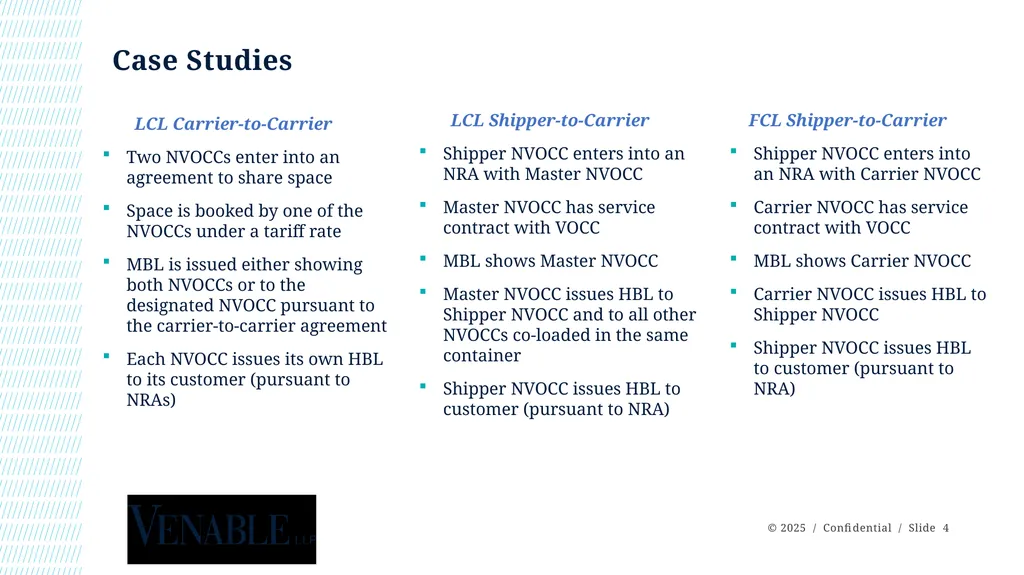
Case Studies © 2025 / Confidential / Slide 4 LCL Shipper-to-Carrier
Shipper NVOCC enters into an NRA with Master NVOCC
Master NVOCC has service contract with VOCC
MBL shows Master NVOCC
Master NVOCC issues HBL to Shipper NVOCC and to all other NVOCCs co-loaded in the same container
Shipper NVOCC issues HBL to customer (pursuant to NRA) FCL Shipper-to-Carrier
Shipper NVOCC enters into an NRA with Carrier NVOCC
Carrier NVOCC has service contract with VOCC
MBL shows Carrier NVOCC
Carrier NVOCC issues HBL to Shipper NVOCC
Shipper NVOCC issues HBL to customer (pursuant to NRA) LCL Carrier-to-Carrier
Two NVOCCs enter into an agreement to share space
Space is booked by one of the NVOCCs under a tariff rate
MBL is issued either showing both NVOCCs or to the designated NVOCC pursuant to the carrier-to-carrier agreement
Each NVOCC issues its own HBL to its customer (pursuant to NRAs)<br>
05
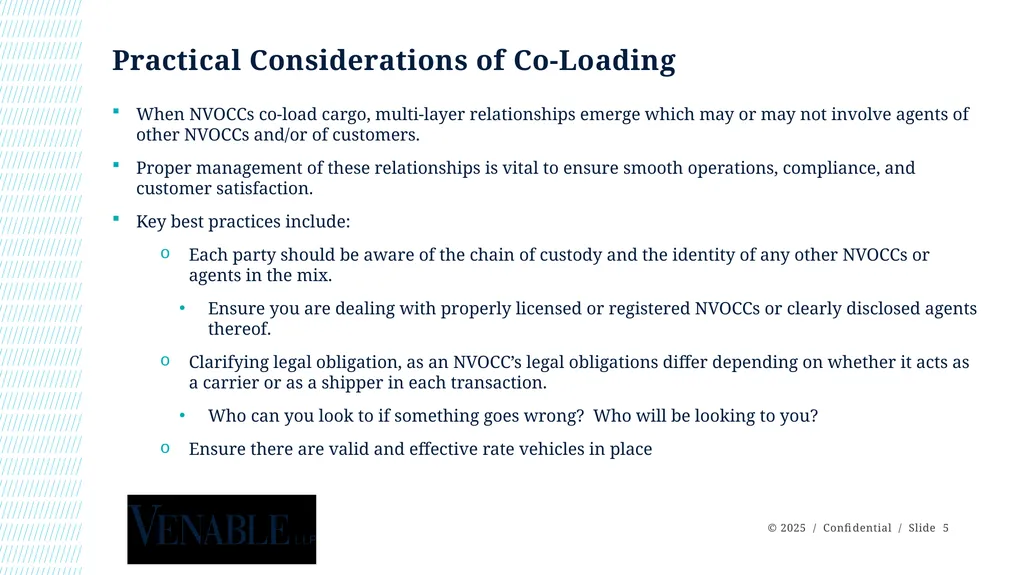
Practical Considerations of Co-Loading © 2025 / Confidential / Slide 5 When NVOCCs co-load cargo, multi-layer relationships emerge which may or may not involve agents of other NVOCCs and/or of customers.
Proper management of these relationships is vital to ensure smooth operations, compliance, and customer satisfaction.
Key best practices include:
Each party should be aware of the chain of custody and the identity of any other NVOCCs or agents in the mix.
Ensure you are dealing with properly licensed or registered NVOCCs or clearly disclosed agents thereof.
Clarifying legal obligation, as an NVOCC’s legal obligations differ depending on whether it acts as a carrier or as a shipper in each transaction.
Who can you look to if something goes wrong? Who will be looking to you?
Ensure there are valid and effective rate vehicles in place<br>
Show all 5 slides