
NCHRP 03-137: Algorithms to Convert Basic Safety
Description: NCHRP 03-137: Algorithms to Convert Basic Safety Messages into Traffic Measures Final Project Presentation National Cooperative Highway Research Program Transportation Research Board of The National Academies NCHRP is sponsored by the
Related Topics
Download Presentation
"NCHRP 03-137: Algorithms to Convert Basic Safety" is the property of its rightful owner. Permission is granted to download and print the materials on this website for personal, non-commercial use only, and to display it on your personal computer provided you do not modify the materials and that you retain all copyright notices contained in the materials. By downloading content from our website, you accept the terms of this agreement.
Presentation Transcript
slide1. NCHRP 03-137: Algorithms to Convert Basic Safety Messages into Traffic Measures
Final Project Presentation National Cooperative Highway Research Program
Transportation Research Board
of
The National Academies<br>
slide2. NCHRP is sponsored by the individual state departments of transportation of the American Association of State Highway and Transportation Officials. NCHRP is administered by the Transportation Research Board (TRB), part of the National Academies of Sciences, Engineering, and Medicine, under a cooperative agreement with the Federal Highway Administration (FHWA). Any opinions and conclusions expressed or implied in resulting research products are those of the individuals and organizations who performed the research and are not necessarily those of TRB; the National Academies of Sciences, Engineering, and Medicine; the FHWA; or NCHRP sponsors.<br>
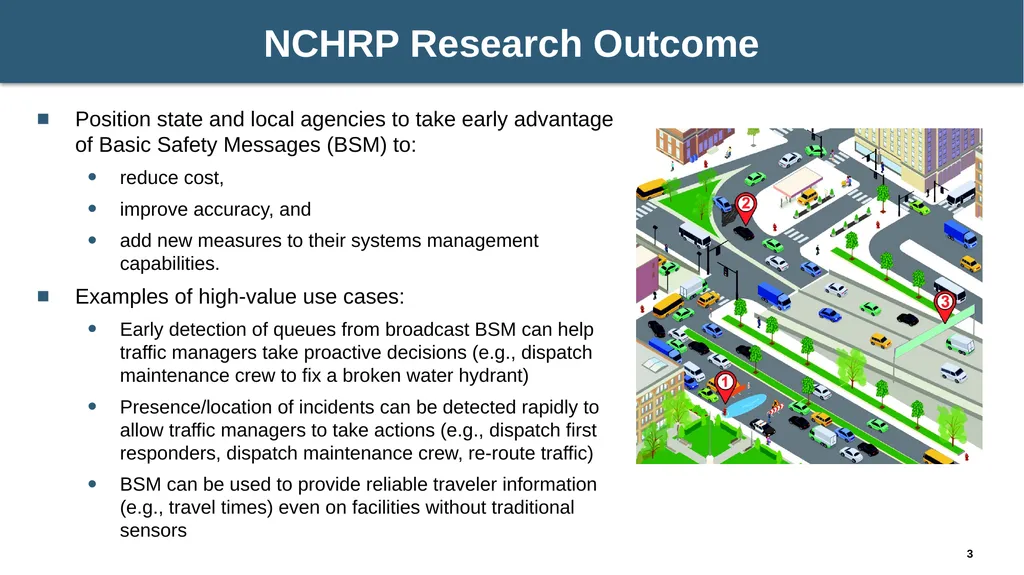
slide3. NCHRP Research Outcome Position state and local agencies to take early advantage of Basic Safety Messages (BSM) to:
reduce cost,
improve accuracy, and
add new measures to their systems management capabilities.
Examples of high-value use cases:
Early detection of queues from broadcast BSM can help traffic managers take proactive decisions (e.g., dispatch maintenance crew to fix a broken water hydrant)
Presence/location of incidents can be detected rapidly to allow traffic managers to take actions (e.g., dispatch first responders, dispatch maintenance crew, re-route traffic)
BSM can be used to provide reliable traveler information (e.g., travel times) even on facilities without traditional sensors<br>
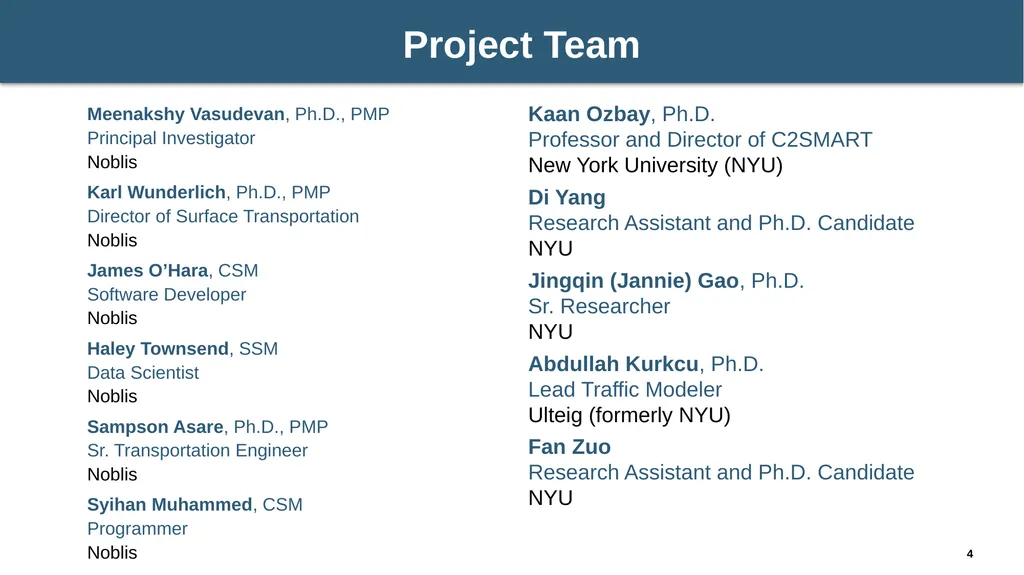
slide4. Meenakshy Vasudevan, Ph.D., PMP
Principal Investigator
Noblis
Karl Wunderlich, Ph.D., PMP
Director of Surface Transportation
Noblis
James O’Hara, CSM
Software Developer
Noblis
Haley Townsend, SSM
Data Scientist
Noblis
Sampson Asare, Ph.D., PMP
Sr. Transportation Engineer
Noblis
Syihan Muhammed, CSM
Programmer
Noblis Project Team Kaan Ozbay, Ph.D.
Professor and Director of C2SMART
New York University (NYU)
Di Yang
Research Assistant and Ph.D. Candidate
NYU
Jingqin (Jannie) Gao, Ph.D.
Sr. Researcher
NYU
Abdullah Kurkcu, Ph.D.
Lead Traffic Modeler
Ulteig (formerly NYU)
Fan Zuo
Research Assistant and Ph.D. Candidate
NYU<br>
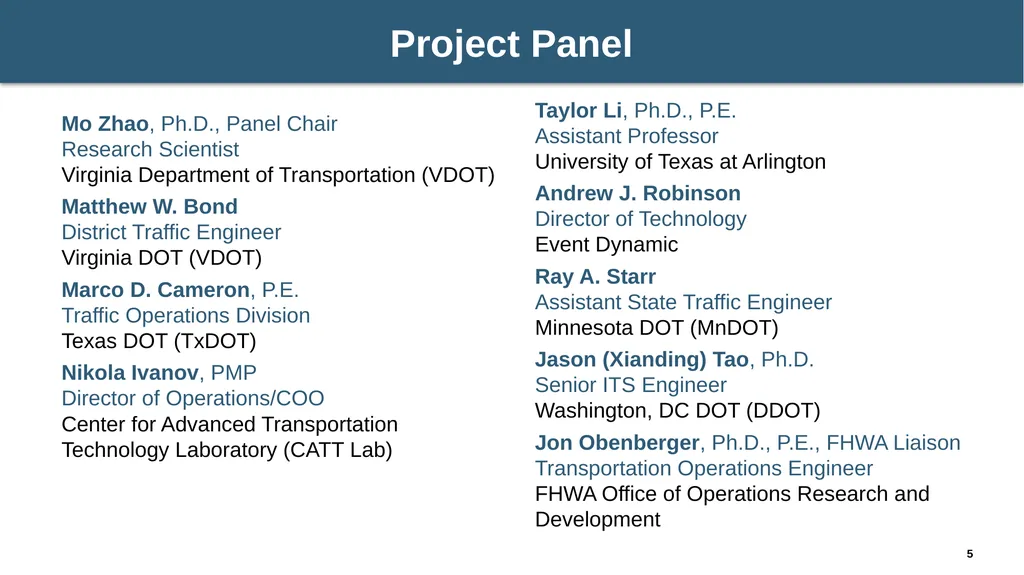
slide5. Mo Zhao, Ph.D., Panel Chair
Research Scientist
Virginia Department of Transportation (VDOT)
Matthew W. Bond
District Traffic Engineer
Virginia DOT (VDOT)
Marco D. Cameron, P.E.
Traffic Operations Division
Texas DOT (TxDOT)
Nikola Ivanov, PMP
Director of Operations/COO
Center for Advanced Transportation Technology Laboratory (CATT Lab) Taylor Li, Ph.D., P.E.
Assistant Professor
University of Texas at Arlington
Andrew J. Robinson
Director of Technology
Event Dynamic
Ray A. Starr
Assistant State Traffic Engineer
Minnesota DOT (MnDOT)
Jason (Xianding) Tao, Ph.D.
Senior ITS Engineer
Washington, DC DOT (DDOT)
Jon Obenberger, Ph.D., P.E., FHWA Liaison
Transportation Operations Engineer
FHWA Office of Operations Research and Development Project Panel<br>
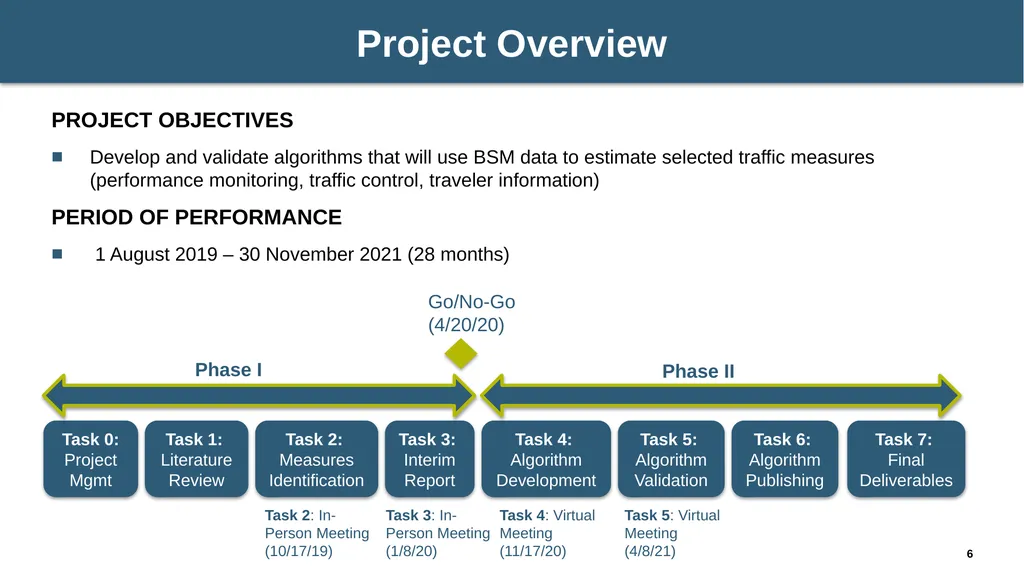
slide6. Project Overview Project Objectives
Develop and validate algorithms that will use BSM data to estimate selected traffic measures (performance monitoring, traffic control, traveler information)
Period of Performance
1 August 2019 – 30 November 2021 (28 months) Task 0: Project Mgmt Task 1:
Literature Review Task 2:
Measures Identification Task 3:
Interim Report Task 4:
Algorithm Development Task 5:
Algorithm Validation Task 6:
Algorithm Publishing Task 7:
Final Deliverables Phase I Phase II Go/No-Go
(4/20/20) Task 3: In-Person Meeting (1/8/20) Task 4: Virtual Meeting (11/17/20) Task 5: Virtual Meeting (4/8/21) Task 2: In-Person Meeting (10/17/19)<br>
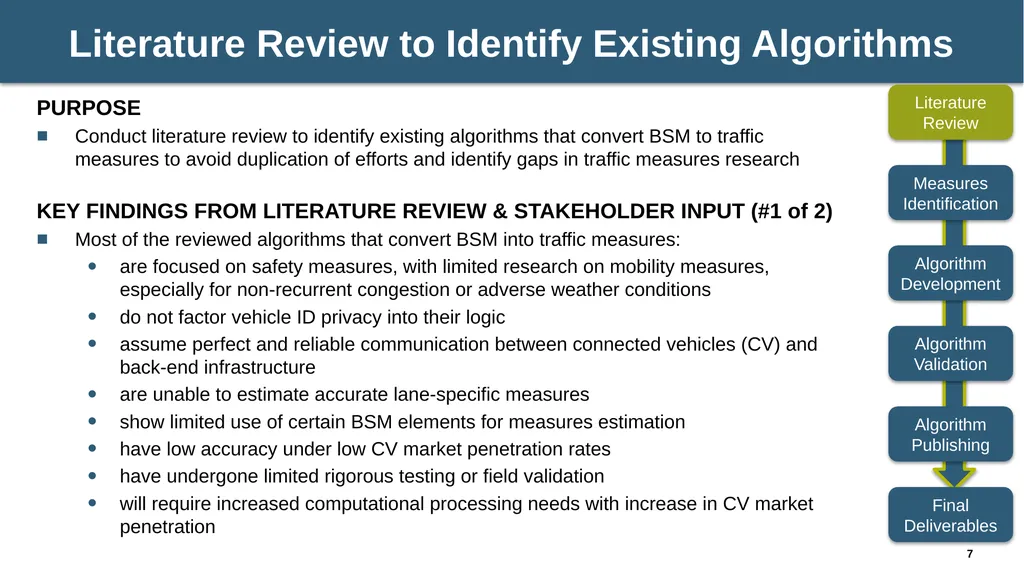
slide7. Literature Review to Identify Existing Algorithms PURPOSE
Conduct literature review to identify existing algorithms that convert BSM to traffic measures to avoid duplication of efforts and identify gaps in traffic measures research
KEY FINDINGS FROM LITERATURE REVIEW & STAKEHOLDER INPUT (#1 of 2)
Most of the reviewed algorithms that convert BSM into traffic measures:
are focused on safety measures, with limited research on mobility measures, especially for non-recurrent congestion or adverse weather conditions
do not factor vehicle ID privacy into their logic
assume perfect and reliable communication between connected vehicles (CV) and back-end infrastructure
are unable to estimate accurate lane-specific measures
show limited use of certain BSM elements for measures estimation
have low accuracy under low CV market penetration rates
have undergone limited rigorous testing or field validation
will require increased computational processing needs with increase in CV market penetration Literature Review Measures Identification Algorithm Development Algorithm Validation Algorithm Publishing Final Deliverables<br>
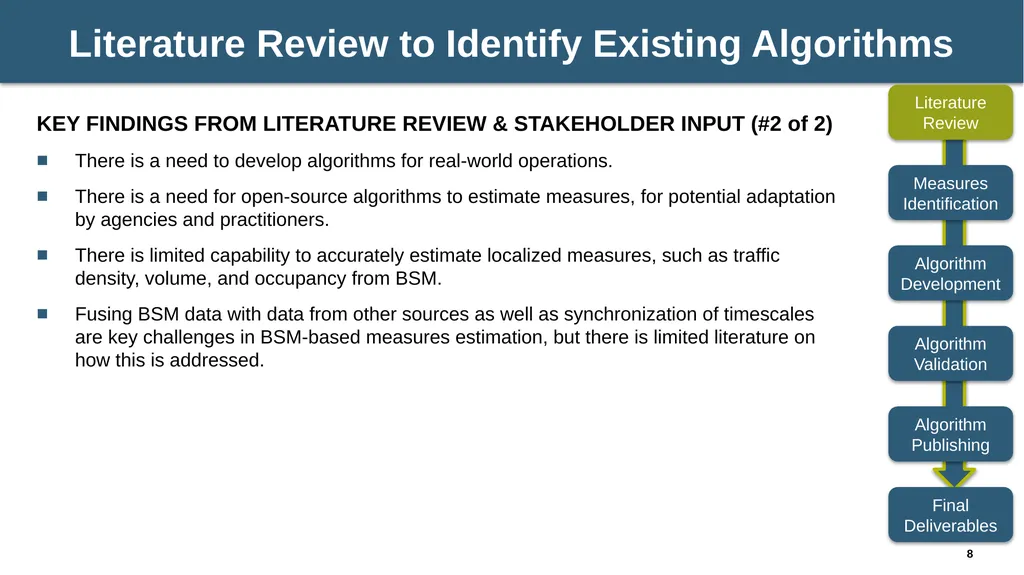
slide8. Literature Review to Identify Existing Algorithms KEY FINDINGS FROM LITERATURE REVIEW & STAKEHOLDER INPUT (#2 of 2)
There is a need to develop algorithms for real-world operations.
There is a need for open-source algorithms to estimate measures, for potential adaptation by agencies and practitioners.
There is limited capability to accurately estimate localized measures, such as traffic density, volume, and occupancy from BSM.
Fusing BSM data with data from other sources as well as synchronization of timescales are key challenges in BSM-based measures estimation, but there is limited literature on how this is addressed. Literature Review Measures Identification Algorithm Development Algorithm Validation Algorithm Publishing Final Deliverables<br>
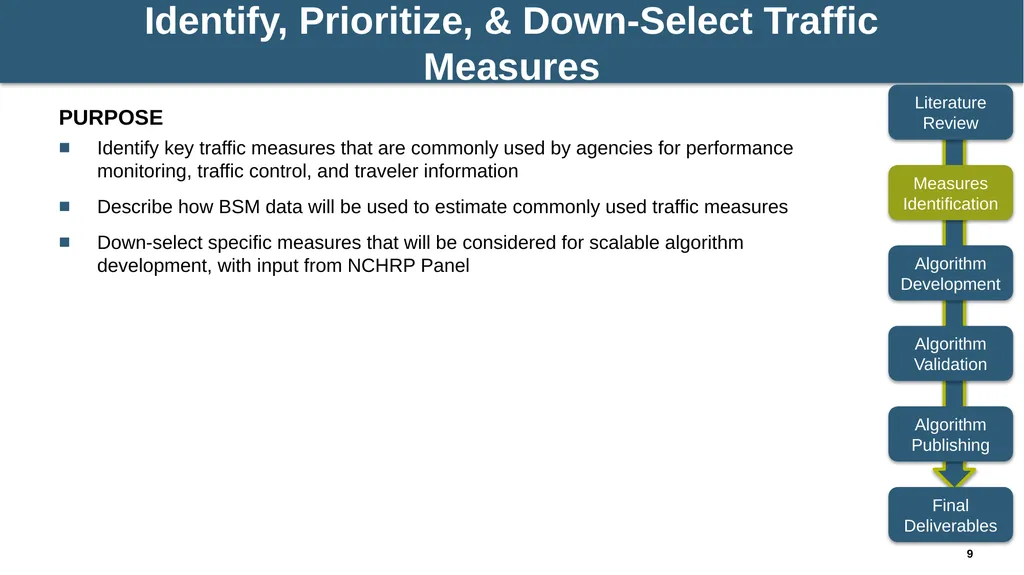
slide9. Identify, Prioritize, & Down-Select Traffic Measures PURPOSE
Identify key traffic measures that are commonly used by agencies for performance monitoring, traffic control, and traveler information
Describe how BSM data will be used to estimate commonly used traffic measures
Down-select specific measures that will be considered for scalable algorithm development, with input from NCHRP Panel Literature Review Measures Identification Algorithm Development Algorithm Validation Algorithm Publishing Final Deliverables<br>
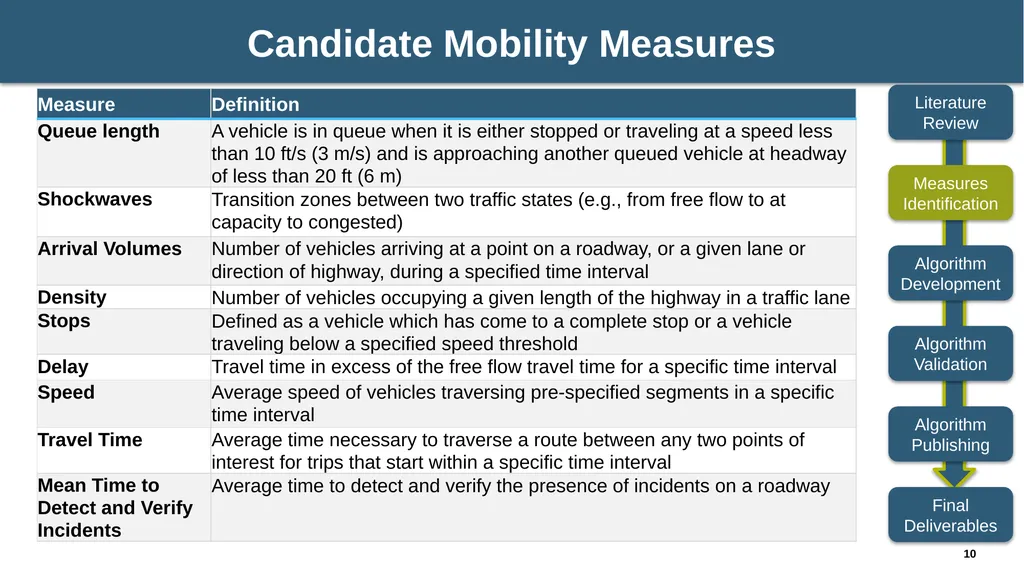
slide10. Candidate Mobility Measures Literature Review Measures Identification Algorithm Development Algorithm Validation Algorithm Publishing Final Deliverables<br>
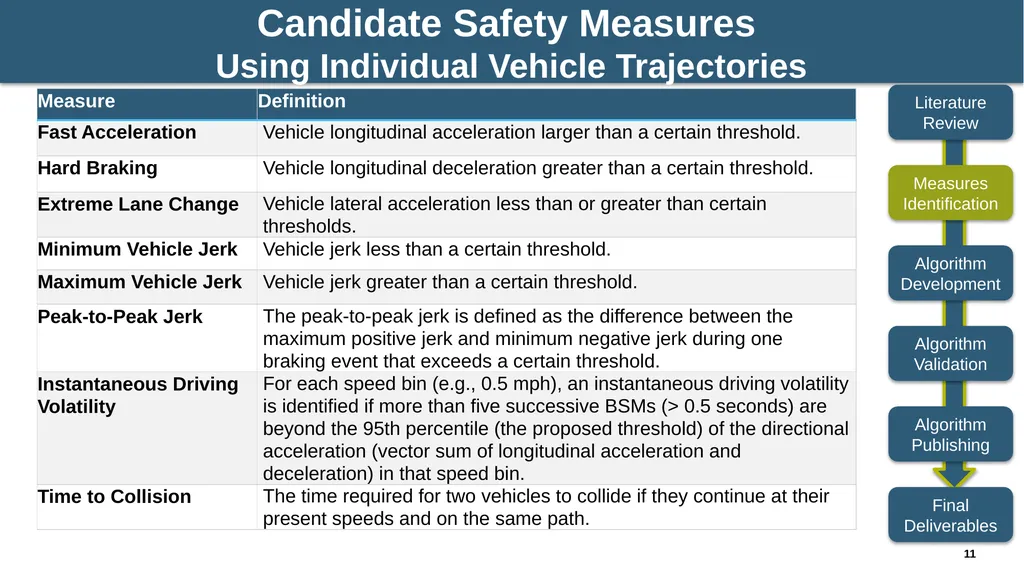
slide11. Candidate Safety Measures Using Individual Vehicle Trajectories Literature Review Measures Identification Algorithm Development Algorithm Validation Algorithm Publishing Final Deliverables<br>
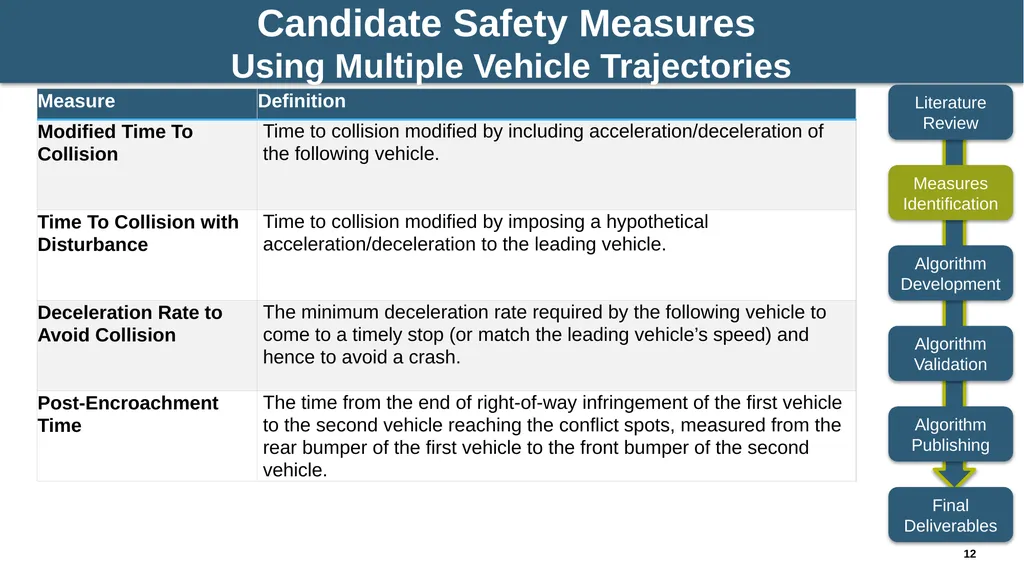
slide12. Candidate Safety Measures Using Multiple Vehicle Trajectories Literature Review Measures Identification Algorithm Development Algorithm Validation Algorithm Publishing Final Deliverables<br>
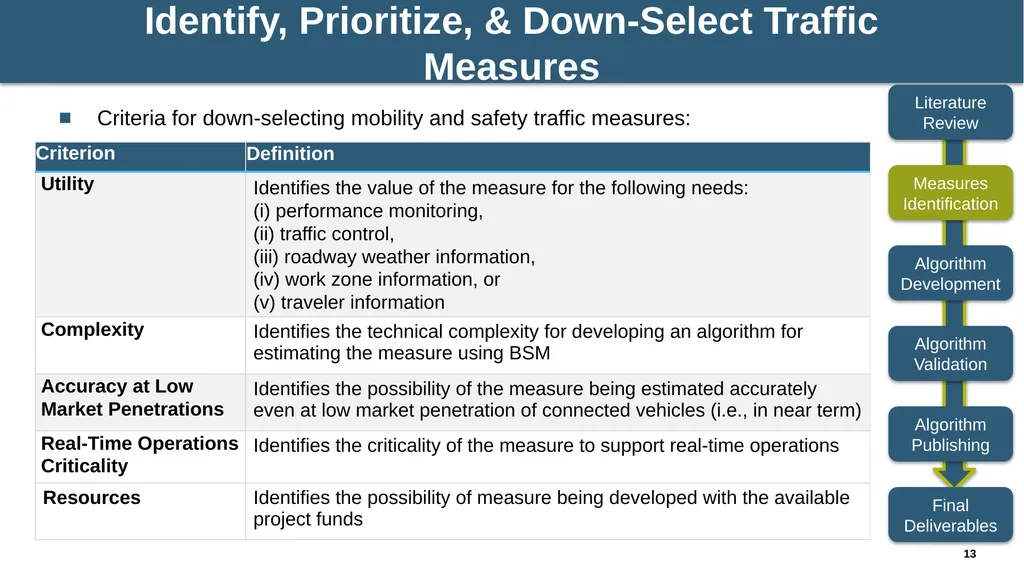
slide13. Identify, Prioritize, & Down-Select Traffic Measures Criteria for down-selecting mobility and safety traffic measures: Literature Review Measures Identification Algorithm Development Algorithm Validation Algorithm Publishing Final Deliverables<br>
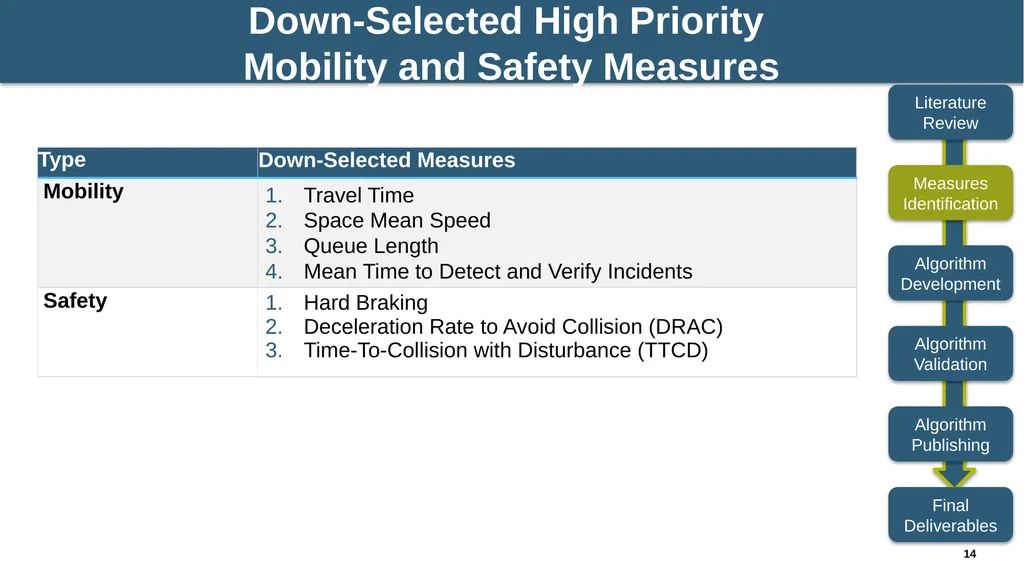
slide14. Down-Selected High Priority Mobility and Safety Measures Literature Review Measures Identification Algorithm Development Algorithm Validation Algorithm Publishing Final Deliverables<br>
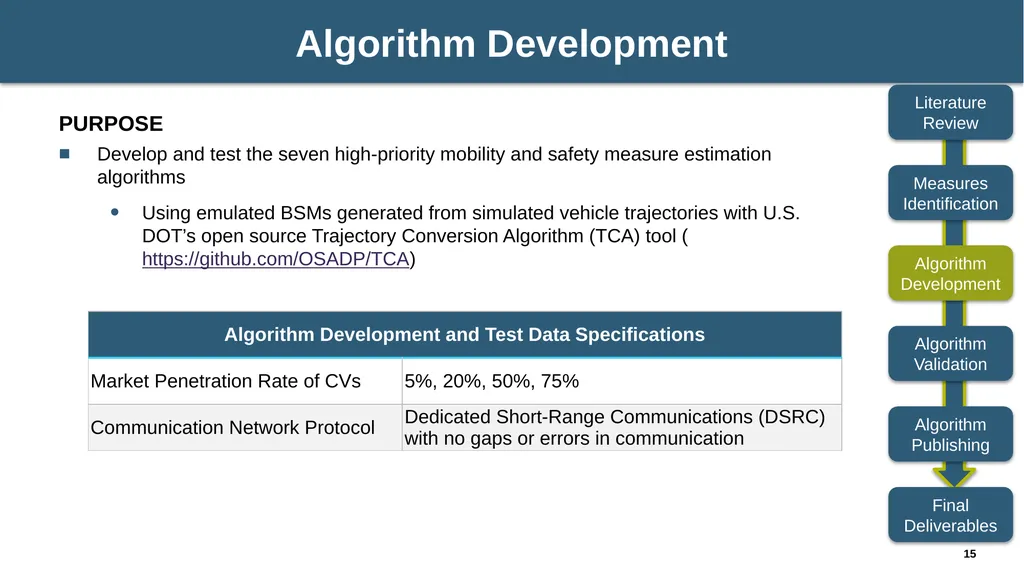
slide15. Algorithm Development PURPOSE
Develop and test the seven high-priority mobility and safety measure estimation algorithms
Using emulated BSMs generated from simulated vehicle trajectories with U.S. DOT’s open source Trajectory Conversion Algorithm (TCA) tool (https://github.com/OSADP/TCA) Literature Review Measures Identification Algorithm Development Algorithm Validation Algorithm Publishing Final Deliverables<br>
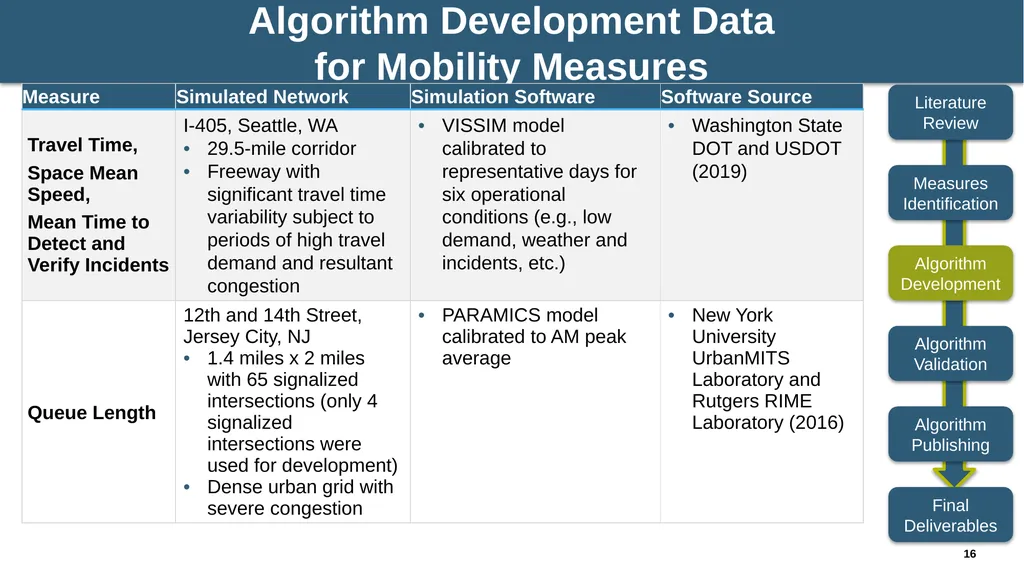
slide16. Algorithm Development Data for Mobility Measures Literature Review Measures Identification Algorithm Development Algorithm Validation Algorithm Publishing Final Deliverables<br>
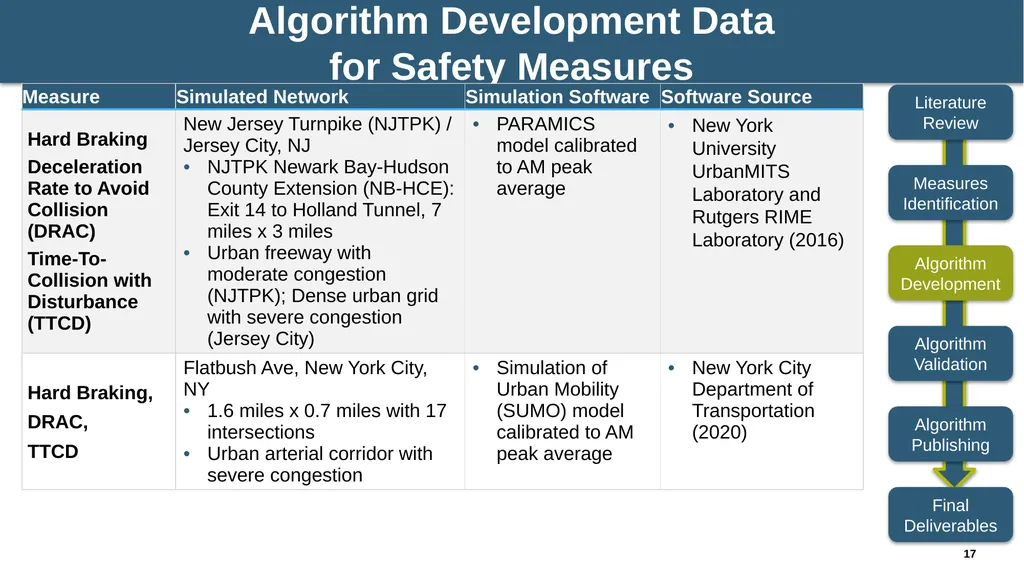
slide17. Algorithm Development Data for Safety Measures Literature Review Measures Identification Algorithm Development Algorithm Validation Algorithm Publishing Final Deliverables<br>
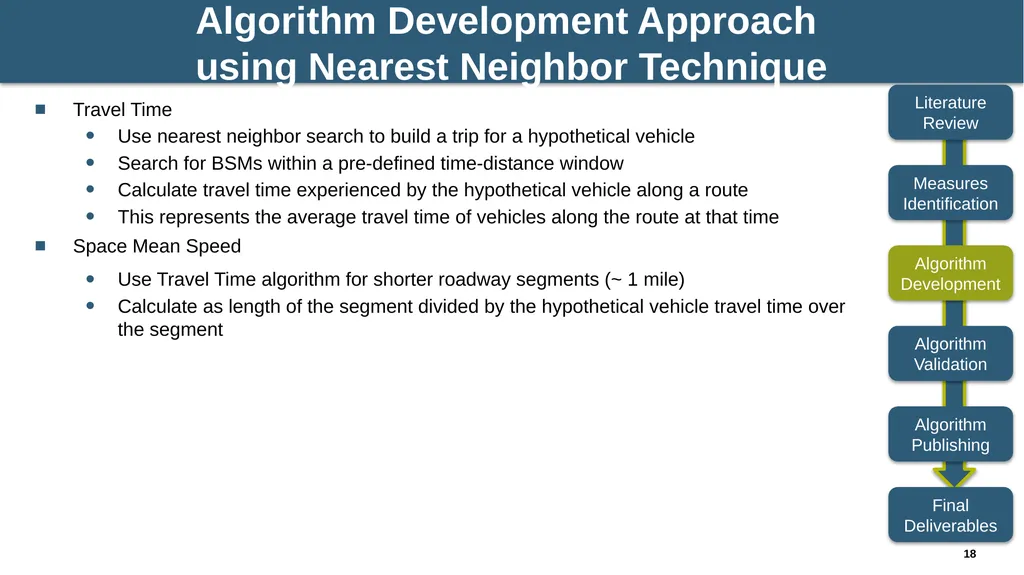
slide18. Algorithm Development Approach using Nearest Neighbor Technique Travel Time
Use nearest neighbor search to build a trip for a hypothetical vehicle
Search for BSMs within a pre-defined time-distance window
Calculate travel time experienced by the hypothetical vehicle along a route
This represents the average travel time of vehicles along the route at that time
Space Mean Speed
Use Travel Time algorithm for shorter roadway segments (~ 1 mile)
Calculate as length of the segment divided by the hypothetical vehicle travel time over the segment Literature Review Measures Identification Algorithm Development Algorithm Validation Algorithm Publishing Final Deliverables<br>
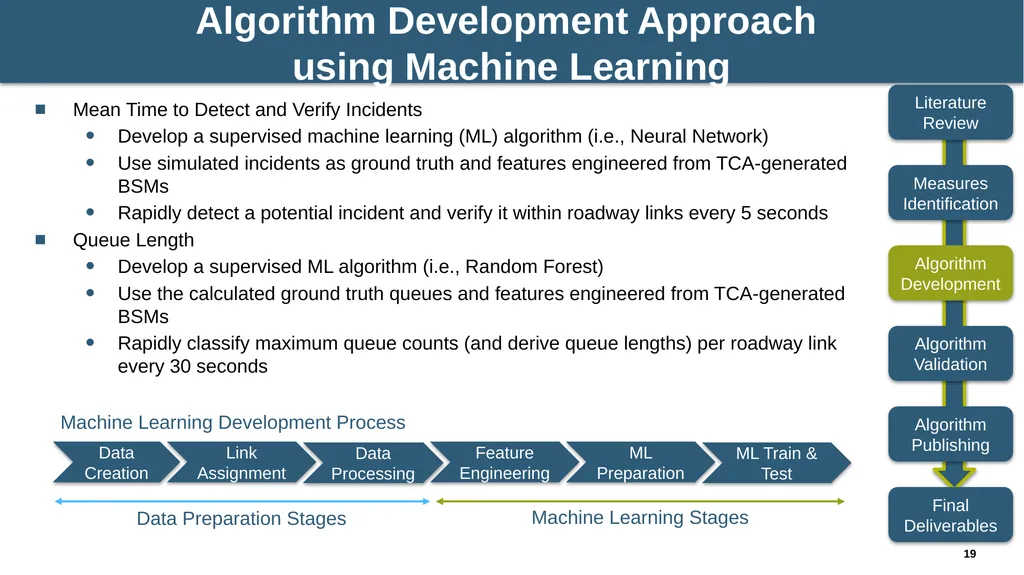
slide19. Algorithm Development Approach using Machine Learning Mean Time to Detect and Verify Incidents
Develop a supervised machine learning (ML) algorithm (i.e., Neural Network)
Use simulated incidents as ground truth and features engineered from TCA-generated BSMs
Rapidly detect a potential incident and verify it within roadway links every 5 seconds
Queue Length
Develop a supervised ML algorithm (i.e., Random Forest)
Use the calculated ground truth queues and features engineered from TCA-generated BSMs
Rapidly classify maximum queue counts (and derive queue lengths) per roadway link every 30 seconds Data Creation Link Assignment Data Processing Feature Engineering ML Preparation ML Train & Test Machine Learning Development Process Data Preparation Stages Machine Learning Stages Literature Review Measures Identification Algorithm Development Algorithm Validation Algorithm Publishing Final Deliverables<br>
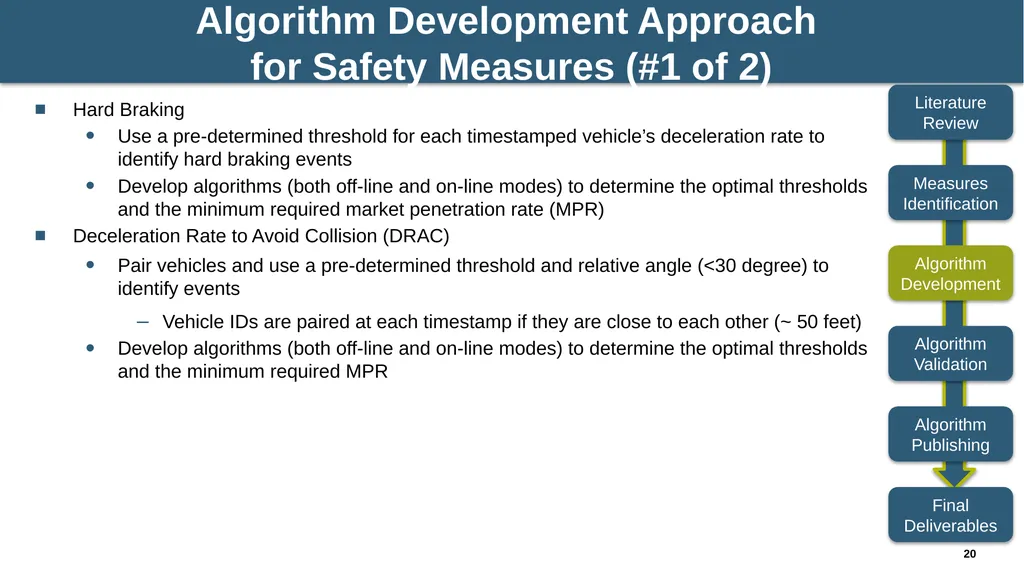
slide20. Algorithm Development Approach for Safety Measures (#1 of 2) Hard Braking
Use a pre-determined threshold for each timestamped vehicle’s deceleration rate to identify hard braking events
Develop algorithms (both off-line and on-line modes) to determine the optimal thresholds and the minimum required market penetration rate (MPR)
Deceleration Rate to Avoid Collision (DRAC)
Pair vehicles and use a pre-determined threshold and relative angle (<30 degree) to identify events
Vehicle IDs are paired at each timestamp if they are close to each other (~ 50 feet)
Develop algorithms (both off-line and on-line modes) to determine the optimal thresholds and the minimum required MPR Literature Review Measures Identification Algorithm Development Algorithm Validation Algorithm Publishing Final Deliverables<br>
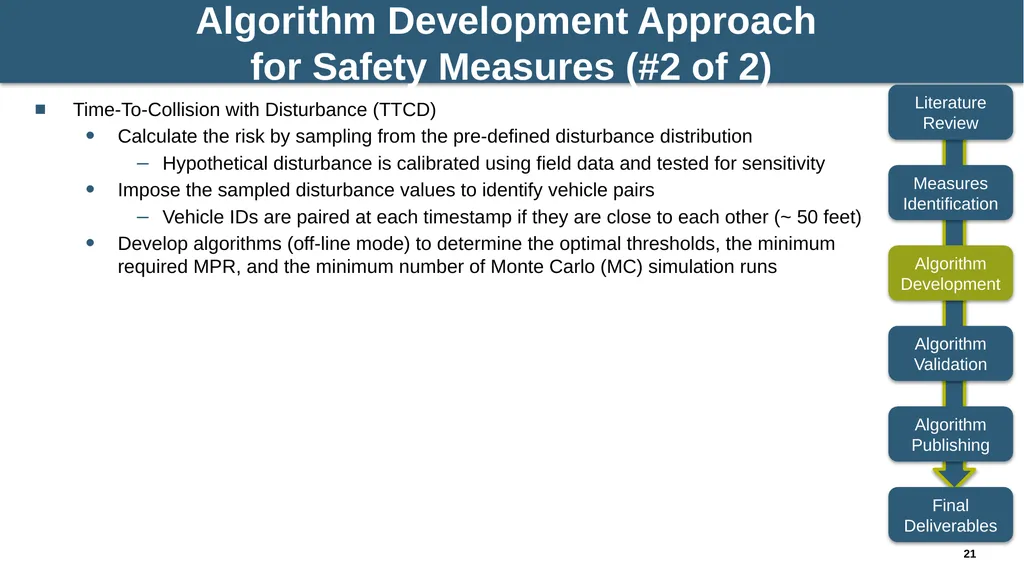
slide21. Algorithm Development Approach for Safety Measures (#2 of 2) Time-To-Collision with Disturbance (TTCD)
Calculate the risk by sampling from the pre-defined disturbance distribution
Hypothetical disturbance is calibrated using field data and tested for sensitivity
Impose the sampled disturbance values to identify vehicle pairs
Vehicle IDs are paired at each timestamp if they are close to each other (~ 50 feet)
Develop algorithms (off-line mode) to determine the optimal thresholds, the minimum required MPR, and the minimum number of Monte Carlo (MC) simulation runs Literature Review Measures Identification Algorithm Development Algorithm Validation Algorithm Publishing Final Deliverables<br>
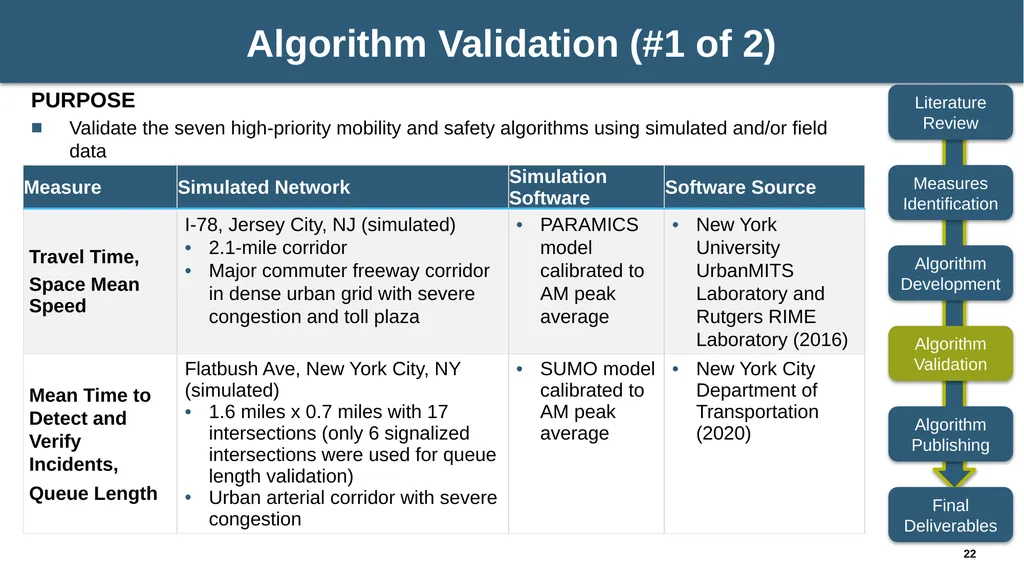
slide22. Algorithm Validation (#1 of 2) PURPOSE
Validate the seven high-priority mobility and safety algorithms using simulated and/or field data Literature Review Measures Identification Algorithm Development Algorithm Validation Algorithm Publishing Final Deliverables<br>
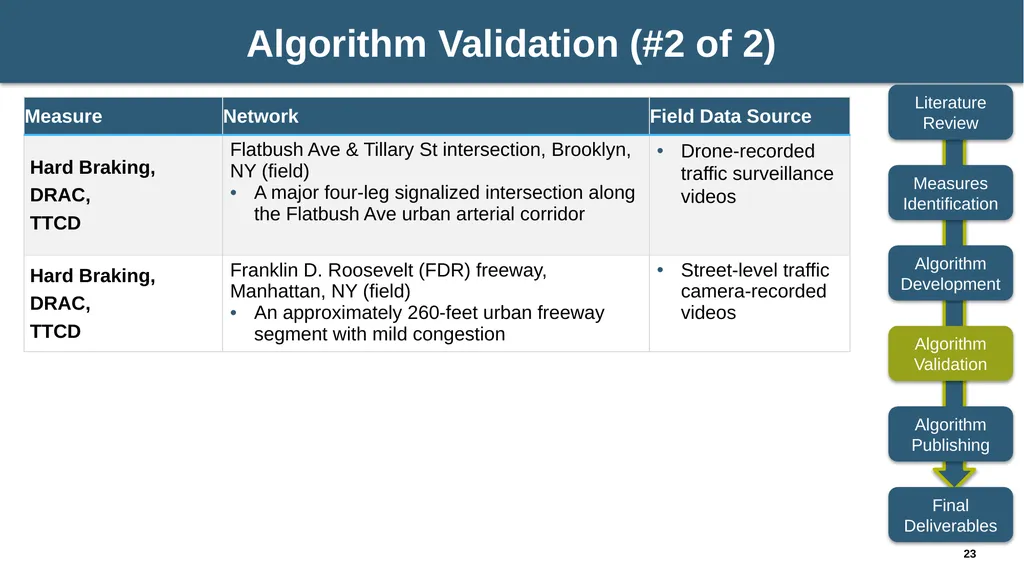
slide23. Algorithm Validation (#2 of 2) Literature Review Measures Identification Algorithm Development Algorithm Validation Algorithm Publishing Final Deliverables<br>
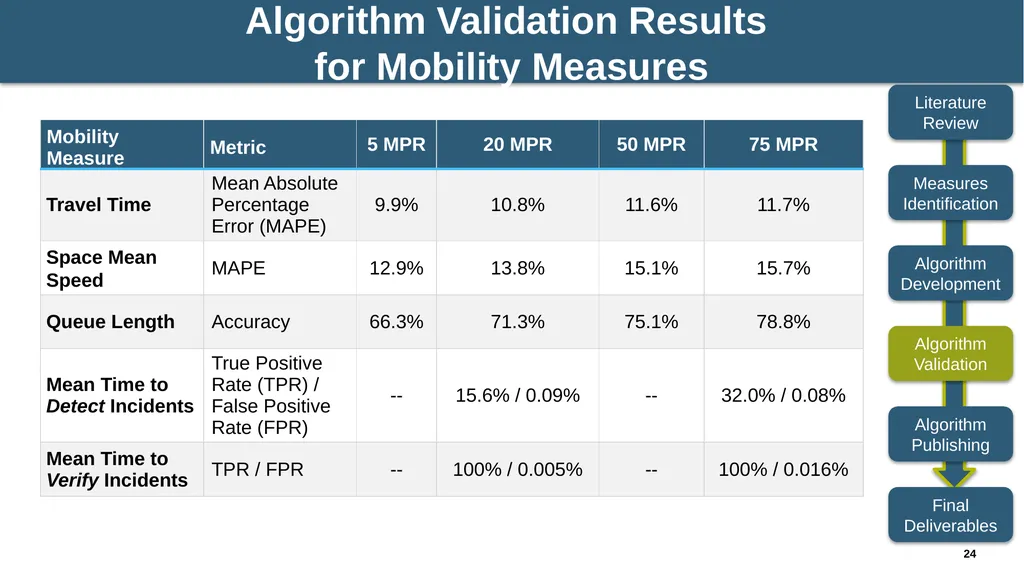
slide24. Algorithm Validation Results for Mobility Measures Literature Review Measures Identification Algorithm Development Algorithm Validation Algorithm Publishing Final Deliverables<br>
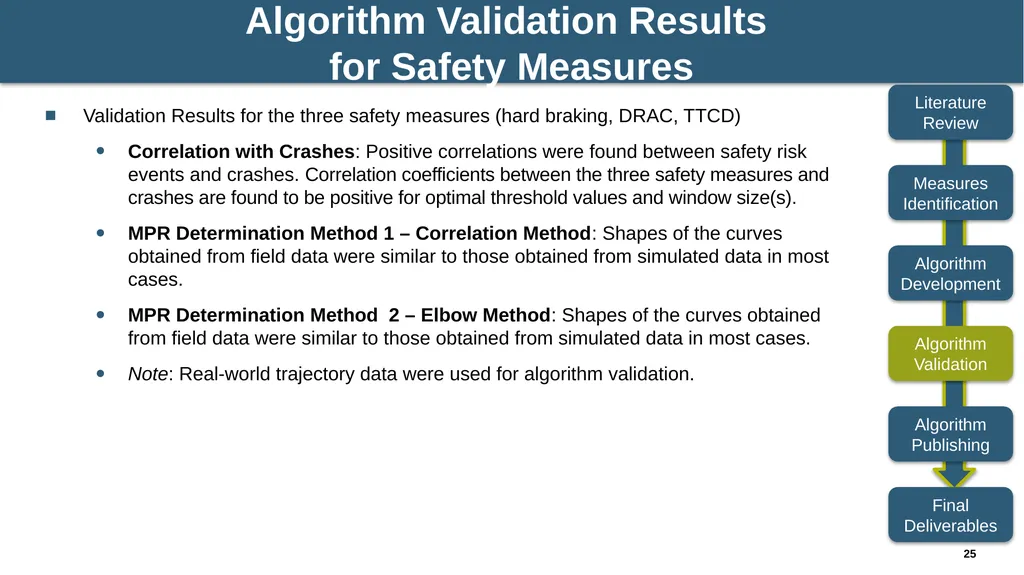
slide25. Algorithm Validation Results for Safety Measures Validation Results for the three safety measures (hard braking, DRAC, TTCD)
Correlation with Crashes: Positive correlations were found between safety risk events and crashes. Correlation coefficients between the three safety measures and crashes are found to be positive for optimal threshold values and window size(s).
MPR Determination Method 1 – Correlation Method: Shapes of the curves obtained from field data were similar to those obtained from simulated data in most cases.
MPR Determination Method 2 – Elbow Method: Shapes of the curves obtained from field data were similar to those obtained from simulated data in most cases.
Note: Real-world trajectory data were used for algorithm validation. Literature Review Measures Identification Algorithm Development Algorithm Validation Algorithm Publishing Final Deliverables<br>
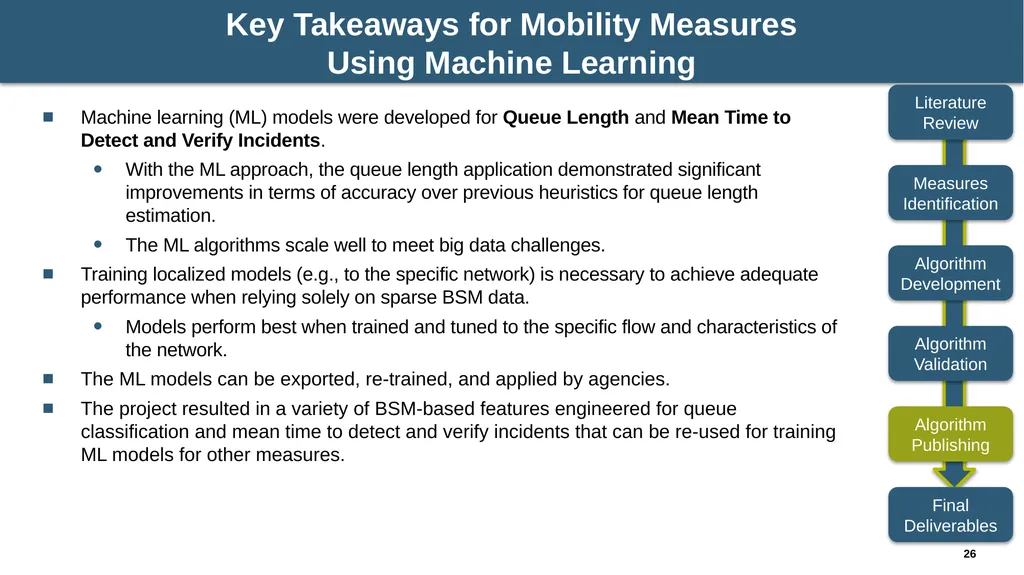
slide26. Key Takeaways for Mobility Measures Using Machine Learning Machine learning (ML) models were developed for Queue Length and Mean Time to Detect and Verify Incidents.
With the ML approach, the queue length application demonstrated significant improvements in terms of accuracy over previous heuristics for queue length estimation.
The ML algorithms scale well to meet big data challenges.
Training localized models (e.g., to the specific network) is necessary to achieve adequate performance when relying solely on sparse BSM data.
Models perform best when trained and tuned to the specific flow and characteristics of the network.
The ML models can be exported, re-trained, and applied by agencies.
The project resulted in a variety of BSM-based features engineered for queue classification and mean time to detect and verify incidents that can be re-used for training ML models for other measures. Literature Review Measures Identification Algorithm Development Algorithm Validation Algorithm Publishing Final Deliverables<br>
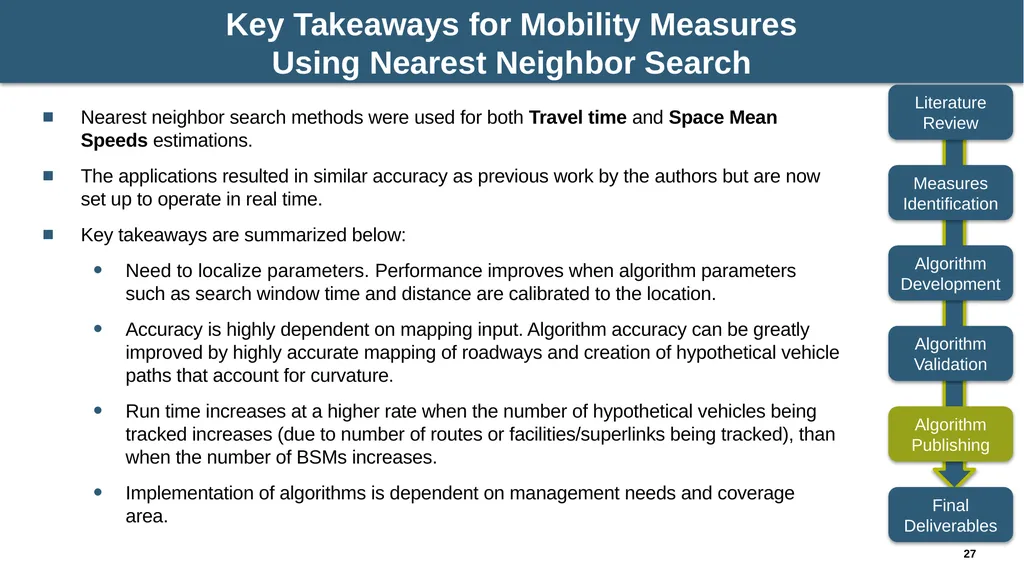
slide27. Key Takeaways for Mobility Measures Using Nearest Neighbor Search Nearest neighbor search methods were used for both Travel time and Space Mean Speeds estimations.
The applications resulted in similar accuracy as previous work by the authors but are now set up to operate in real time.
Key takeaways are summarized below:
Need to localize parameters. Performance improves when algorithm parameters such as search window time and distance are calibrated to the location.
Accuracy is highly dependent on mapping input. Algorithm accuracy can be greatly improved by highly accurate mapping of roadways and creation of hypothetical vehicle paths that account for curvature.
Run time increases at a higher rate when the number of hypothetical vehicles being tracked increases (due to number of routes or facilities/superlinks being tracked), than when the number of BSMs increases.
Implementation of algorithms is dependent on management needs and coverage area. Literature Review Measures Identification Algorithm Development Algorithm Validation Algorithm Publishing Final Deliverables<br>
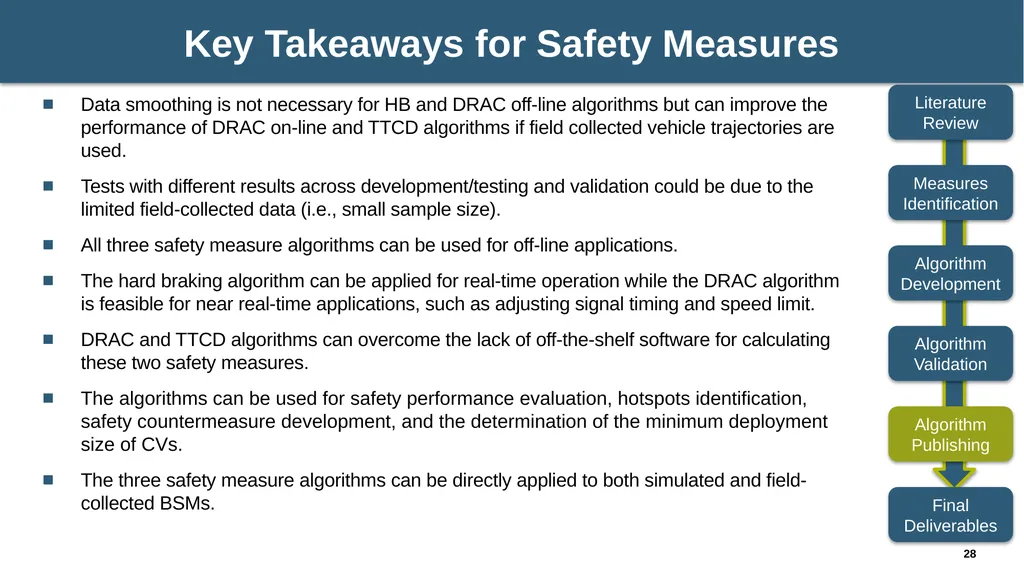
slide28. Key Takeaways for Safety Measures Data smoothing is not necessary for HB and DRAC off-line algorithms but can improve the performance of DRAC on-line and TTCD algorithms if field collected vehicle trajectories are used.
Tests with different results across development/testing and validation could be due to the limited field-collected data (i.e., small sample size).
All three safety measure algorithms can be used for off-line applications.
The hard braking algorithm can be applied for real-time operation while the DRAC algorithm is feasible for near real-time applications, such as adjusting signal timing and speed limit.
DRAC and TTCD algorithms can overcome the lack of off-the-shelf software for calculating these two safety measures.
The algorithms can be used for safety performance evaluation, hotspots identification, safety countermeasure development, and the determination of the minimum deployment size of CVs.
The three safety measure algorithms can be directly applied to both simulated and field-collected BSMs. Literature Review Measures Identification Algorithm Development Algorithm Validation Algorithm Publishing Final Deliverables<br>
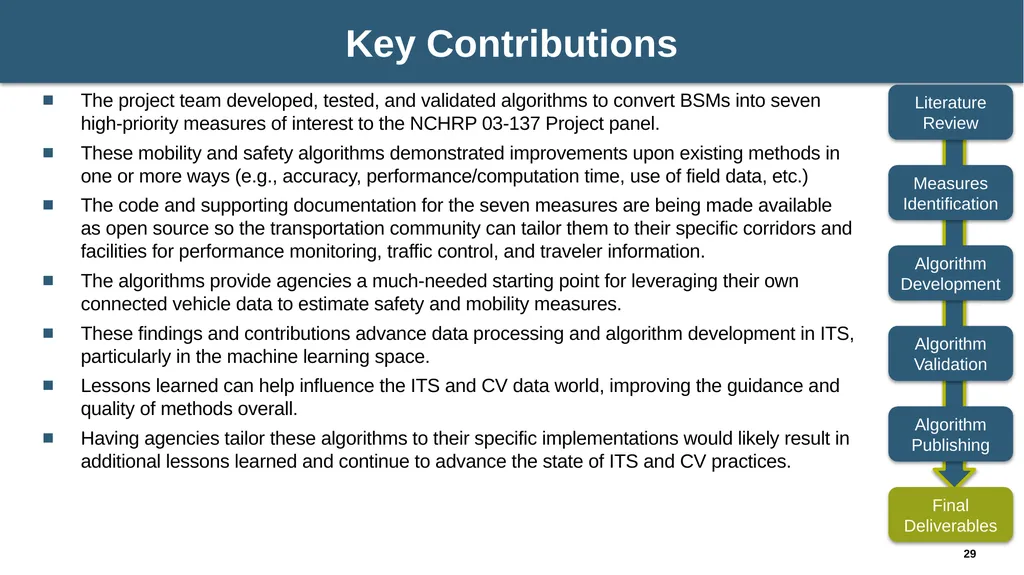
slide29. Key Contributions The project team developed, tested, and validated algorithms to convert BSMs into seven high-priority measures of interest to the NCHRP 03-137 Project panel.
These mobility and safety algorithms demonstrated improvements upon existing methods in one or more ways (e.g., accuracy, performance/computation time, use of field data, etc.)
The code and supporting documentation for the seven measures are being made available as open source so the transportation community can tailor them to their specific corridors and facilities for performance monitoring, traffic control, and traveler information.
The algorithms provide agencies a much-needed starting point for leveraging their own connected vehicle data to estimate safety and mobility measures.
These findings and contributions advance data processing and algorithm development in ITS, particularly in the machine learning space.
Lessons learned can help influence the ITS and CV data world, improving the guidance and quality of methods overall.
Having agencies tailor these algorithms to their specific implementations would likely result in additional lessons learned and continue to advance the state of ITS and CV practices. Literature Review Measures Identification Algorithm Development Algorithm Validation Algorithm Publishing Final Deliverables<br>
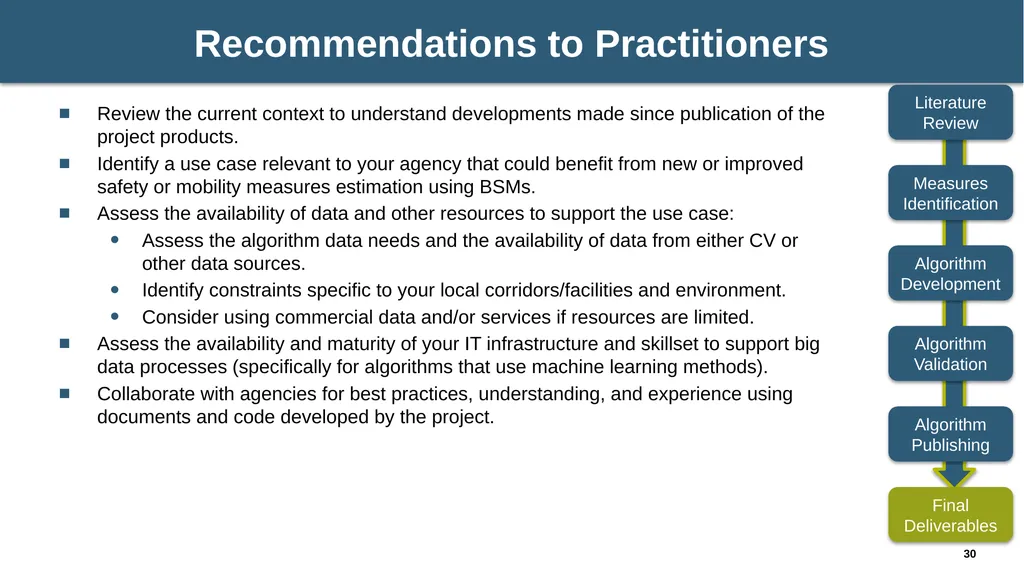
slide30. Recommendations to Practitioners Review the current context to understand developments made since publication of the project products.
Identify a use case relevant to your agency that could benefit from new or improved safety or mobility measures estimation using BSMs.
Assess the availability of data and other resources to support the use case:
Assess the algorithm data needs and the availability of data from either CV or other data sources.
Identify constraints specific to your local corridors/facilities and environment.
Consider using commercial data and/or services if resources are limited.
Assess the availability and maturity of your IT infrastructure and skillset to support big data processes (specifically for algorithms that use machine learning methods).
Collaborate with agencies for best practices, understanding, and experience using documents and code developed by the project. Literature Review Measures Identification Algorithm Development Algorithm Validation Algorithm Publishing Final Deliverables<br>
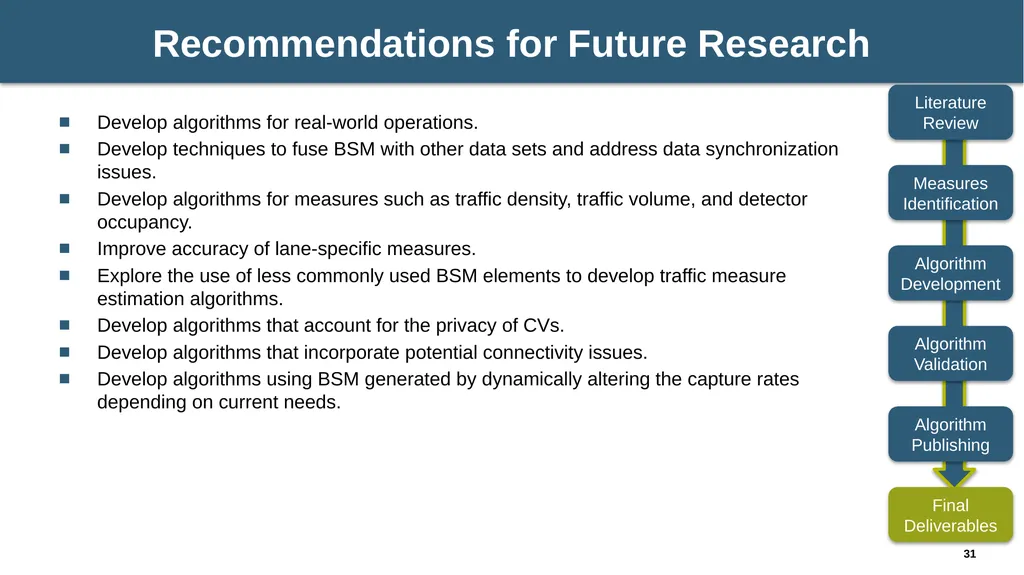
slide31. Recommendations for Future Research Develop algorithms for real-world operations.
Develop techniques to fuse BSM with other data sets and address data synchronization issues.
Develop algorithms for measures such as traffic density, traffic volume, and detector occupancy.
Improve accuracy of lane-specific measures.
Explore the use of less commonly used BSM elements to develop traffic measure estimation algorithms.
Develop algorithms that account for the privacy of CVs.
Develop algorithms that incorporate potential connectivity issues.
Develop algorithms using BSM generated by dynamically altering the capture rates depending on current needs. Literature Review Measures Identification Algorithm Development Algorithm Validation Algorithm Publishing Final Deliverables<br>
slide2. NCHRP is sponsored by the individual state departments of transportation of the American Association of State Highway and Transportation Officials. NCHRP is administered by the Transportation Research Board (TRB), part of the National Academies of Sciences, Engineering, and Medicine, under a cooperative agreement with the Federal Highway Administration (FHWA). Any opinions and conclusions expressed or implied in resulting research products are those of the individuals and organizations who performed the research and are not necessarily those of TRB; the National Academies of Sciences, Engineering, and Medicine; the FHWA; or NCHRP sponsors.<br>
slide3. NCHRP Research Outcome Position state and local agencies to take early advantage of Basic Safety Messages (BSM) to:
reduce cost,
improve accuracy, and
add new measures to their systems management capabilities.
Examples of high-value use cases:
Early detection of queues from broadcast BSM can help traffic managers take proactive decisions (e.g., dispatch maintenance crew to fix a broken water hydrant)
Presence/location of incidents can be detected rapidly to allow traffic managers to take actions (e.g., dispatch first responders, dispatch maintenance crew, re-route traffic)
BSM can be used to provide reliable traveler information (e.g., travel times) even on facilities without traditional sensors<br>
slide4. Meenakshy Vasudevan, Ph.D., PMP
Principal Investigator
Noblis
Karl Wunderlich, Ph.D., PMP
Director of Surface Transportation
Noblis
James O’Hara, CSM
Software Developer
Noblis
Haley Townsend, SSM
Data Scientist
Noblis
Sampson Asare, Ph.D., PMP
Sr. Transportation Engineer
Noblis
Syihan Muhammed, CSM
Programmer
Noblis Project Team Kaan Ozbay, Ph.D.
Professor and Director of C2SMART
New York University (NYU)
Di Yang
Research Assistant and Ph.D. Candidate
NYU
Jingqin (Jannie) Gao, Ph.D.
Sr. Researcher
NYU
Abdullah Kurkcu, Ph.D.
Lead Traffic Modeler
Ulteig (formerly NYU)
Fan Zuo
Research Assistant and Ph.D. Candidate
NYU<br>
slide5. Mo Zhao, Ph.D., Panel Chair
Research Scientist
Virginia Department of Transportation (VDOT)
Matthew W. Bond
District Traffic Engineer
Virginia DOT (VDOT)
Marco D. Cameron, P.E.
Traffic Operations Division
Texas DOT (TxDOT)
Nikola Ivanov, PMP
Director of Operations/COO
Center for Advanced Transportation Technology Laboratory (CATT Lab) Taylor Li, Ph.D., P.E.
Assistant Professor
University of Texas at Arlington
Andrew J. Robinson
Director of Technology
Event Dynamic
Ray A. Starr
Assistant State Traffic Engineer
Minnesota DOT (MnDOT)
Jason (Xianding) Tao, Ph.D.
Senior ITS Engineer
Washington, DC DOT (DDOT)
Jon Obenberger, Ph.D., P.E., FHWA Liaison
Transportation Operations Engineer
FHWA Office of Operations Research and Development Project Panel<br>
slide6. Project Overview Project Objectives
Develop and validate algorithms that will use BSM data to estimate selected traffic measures (performance monitoring, traffic control, traveler information)
Period of Performance
1 August 2019 – 30 November 2021 (28 months) Task 0: Project Mgmt Task 1:
Literature Review Task 2:
Measures Identification Task 3:
Interim Report Task 4:
Algorithm Development Task 5:
Algorithm Validation Task 6:
Algorithm Publishing Task 7:
Final Deliverables Phase I Phase II Go/No-Go
(4/20/20) Task 3: In-Person Meeting (1/8/20) Task 4: Virtual Meeting (11/17/20) Task 5: Virtual Meeting (4/8/21) Task 2: In-Person Meeting (10/17/19)<br>
slide7. Literature Review to Identify Existing Algorithms PURPOSE
Conduct literature review to identify existing algorithms that convert BSM to traffic measures to avoid duplication of efforts and identify gaps in traffic measures research
KEY FINDINGS FROM LITERATURE REVIEW & STAKEHOLDER INPUT (#1 of 2)
Most of the reviewed algorithms that convert BSM into traffic measures:
are focused on safety measures, with limited research on mobility measures, especially for non-recurrent congestion or adverse weather conditions
do not factor vehicle ID privacy into their logic
assume perfect and reliable communication between connected vehicles (CV) and back-end infrastructure
are unable to estimate accurate lane-specific measures
show limited use of certain BSM elements for measures estimation
have low accuracy under low CV market penetration rates
have undergone limited rigorous testing or field validation
will require increased computational processing needs with increase in CV market penetration Literature Review Measures Identification Algorithm Development Algorithm Validation Algorithm Publishing Final Deliverables<br>
slide8. Literature Review to Identify Existing Algorithms KEY FINDINGS FROM LITERATURE REVIEW & STAKEHOLDER INPUT (#2 of 2)
There is a need to develop algorithms for real-world operations.
There is a need for open-source algorithms to estimate measures, for potential adaptation by agencies and practitioners.
There is limited capability to accurately estimate localized measures, such as traffic density, volume, and occupancy from BSM.
Fusing BSM data with data from other sources as well as synchronization of timescales are key challenges in BSM-based measures estimation, but there is limited literature on how this is addressed. Literature Review Measures Identification Algorithm Development Algorithm Validation Algorithm Publishing Final Deliverables<br>
slide9. Identify, Prioritize, & Down-Select Traffic Measures PURPOSE
Identify key traffic measures that are commonly used by agencies for performance monitoring, traffic control, and traveler information
Describe how BSM data will be used to estimate commonly used traffic measures
Down-select specific measures that will be considered for scalable algorithm development, with input from NCHRP Panel Literature Review Measures Identification Algorithm Development Algorithm Validation Algorithm Publishing Final Deliverables<br>
slide10. Candidate Mobility Measures Literature Review Measures Identification Algorithm Development Algorithm Validation Algorithm Publishing Final Deliverables<br>
slide11. Candidate Safety Measures Using Individual Vehicle Trajectories Literature Review Measures Identification Algorithm Development Algorithm Validation Algorithm Publishing Final Deliverables<br>
slide12. Candidate Safety Measures Using Multiple Vehicle Trajectories Literature Review Measures Identification Algorithm Development Algorithm Validation Algorithm Publishing Final Deliverables<br>
slide13. Identify, Prioritize, & Down-Select Traffic Measures Criteria for down-selecting mobility and safety traffic measures: Literature Review Measures Identification Algorithm Development Algorithm Validation Algorithm Publishing Final Deliverables<br>
slide14. Down-Selected High Priority Mobility and Safety Measures Literature Review Measures Identification Algorithm Development Algorithm Validation Algorithm Publishing Final Deliverables<br>
slide15. Algorithm Development PURPOSE
Develop and test the seven high-priority mobility and safety measure estimation algorithms
Using emulated BSMs generated from simulated vehicle trajectories with U.S. DOT’s open source Trajectory Conversion Algorithm (TCA) tool (https://github.com/OSADP/TCA) Literature Review Measures Identification Algorithm Development Algorithm Validation Algorithm Publishing Final Deliverables<br>
slide16. Algorithm Development Data for Mobility Measures Literature Review Measures Identification Algorithm Development Algorithm Validation Algorithm Publishing Final Deliverables<br>
slide17. Algorithm Development Data for Safety Measures Literature Review Measures Identification Algorithm Development Algorithm Validation Algorithm Publishing Final Deliverables<br>
slide18. Algorithm Development Approach using Nearest Neighbor Technique Travel Time
Use nearest neighbor search to build a trip for a hypothetical vehicle
Search for BSMs within a pre-defined time-distance window
Calculate travel time experienced by the hypothetical vehicle along a route
This represents the average travel time of vehicles along the route at that time
Space Mean Speed
Use Travel Time algorithm for shorter roadway segments (~ 1 mile)
Calculate as length of the segment divided by the hypothetical vehicle travel time over the segment Literature Review Measures Identification Algorithm Development Algorithm Validation Algorithm Publishing Final Deliverables<br>
slide19. Algorithm Development Approach using Machine Learning Mean Time to Detect and Verify Incidents
Develop a supervised machine learning (ML) algorithm (i.e., Neural Network)
Use simulated incidents as ground truth and features engineered from TCA-generated BSMs
Rapidly detect a potential incident and verify it within roadway links every 5 seconds
Queue Length
Develop a supervised ML algorithm (i.e., Random Forest)
Use the calculated ground truth queues and features engineered from TCA-generated BSMs
Rapidly classify maximum queue counts (and derive queue lengths) per roadway link every 30 seconds Data Creation Link Assignment Data Processing Feature Engineering ML Preparation ML Train & Test Machine Learning Development Process Data Preparation Stages Machine Learning Stages Literature Review Measures Identification Algorithm Development Algorithm Validation Algorithm Publishing Final Deliverables<br>
slide20. Algorithm Development Approach for Safety Measures (#1 of 2) Hard Braking
Use a pre-determined threshold for each timestamped vehicle’s deceleration rate to identify hard braking events
Develop algorithms (both off-line and on-line modes) to determine the optimal thresholds and the minimum required market penetration rate (MPR)
Deceleration Rate to Avoid Collision (DRAC)
Pair vehicles and use a pre-determined threshold and relative angle (<30 degree) to identify events
Vehicle IDs are paired at each timestamp if they are close to each other (~ 50 feet)
Develop algorithms (both off-line and on-line modes) to determine the optimal thresholds and the minimum required MPR Literature Review Measures Identification Algorithm Development Algorithm Validation Algorithm Publishing Final Deliverables<br>
slide21. Algorithm Development Approach for Safety Measures (#2 of 2) Time-To-Collision with Disturbance (TTCD)
Calculate the risk by sampling from the pre-defined disturbance distribution
Hypothetical disturbance is calibrated using field data and tested for sensitivity
Impose the sampled disturbance values to identify vehicle pairs
Vehicle IDs are paired at each timestamp if they are close to each other (~ 50 feet)
Develop algorithms (off-line mode) to determine the optimal thresholds, the minimum required MPR, and the minimum number of Monte Carlo (MC) simulation runs Literature Review Measures Identification Algorithm Development Algorithm Validation Algorithm Publishing Final Deliverables<br>
slide22. Algorithm Validation (#1 of 2) PURPOSE
Validate the seven high-priority mobility and safety algorithms using simulated and/or field data Literature Review Measures Identification Algorithm Development Algorithm Validation Algorithm Publishing Final Deliverables<br>
slide23. Algorithm Validation (#2 of 2) Literature Review Measures Identification Algorithm Development Algorithm Validation Algorithm Publishing Final Deliverables<br>
slide24. Algorithm Validation Results for Mobility Measures Literature Review Measures Identification Algorithm Development Algorithm Validation Algorithm Publishing Final Deliverables<br>
slide25. Algorithm Validation Results for Safety Measures Validation Results for the three safety measures (hard braking, DRAC, TTCD)
Correlation with Crashes: Positive correlations were found between safety risk events and crashes. Correlation coefficients between the three safety measures and crashes are found to be positive for optimal threshold values and window size(s).
MPR Determination Method 1 – Correlation Method: Shapes of the curves obtained from field data were similar to those obtained from simulated data in most cases.
MPR Determination Method 2 – Elbow Method: Shapes of the curves obtained from field data were similar to those obtained from simulated data in most cases.
Note: Real-world trajectory data were used for algorithm validation. Literature Review Measures Identification Algorithm Development Algorithm Validation Algorithm Publishing Final Deliverables<br>
slide26. Key Takeaways for Mobility Measures Using Machine Learning Machine learning (ML) models were developed for Queue Length and Mean Time to Detect and Verify Incidents.
With the ML approach, the queue length application demonstrated significant improvements in terms of accuracy over previous heuristics for queue length estimation.
The ML algorithms scale well to meet big data challenges.
Training localized models (e.g., to the specific network) is necessary to achieve adequate performance when relying solely on sparse BSM data.
Models perform best when trained and tuned to the specific flow and characteristics of the network.
The ML models can be exported, re-trained, and applied by agencies.
The project resulted in a variety of BSM-based features engineered for queue classification and mean time to detect and verify incidents that can be re-used for training ML models for other measures. Literature Review Measures Identification Algorithm Development Algorithm Validation Algorithm Publishing Final Deliverables<br>
slide27. Key Takeaways for Mobility Measures Using Nearest Neighbor Search Nearest neighbor search methods were used for both Travel time and Space Mean Speeds estimations.
The applications resulted in similar accuracy as previous work by the authors but are now set up to operate in real time.
Key takeaways are summarized below:
Need to localize parameters. Performance improves when algorithm parameters such as search window time and distance are calibrated to the location.
Accuracy is highly dependent on mapping input. Algorithm accuracy can be greatly improved by highly accurate mapping of roadways and creation of hypothetical vehicle paths that account for curvature.
Run time increases at a higher rate when the number of hypothetical vehicles being tracked increases (due to number of routes or facilities/superlinks being tracked), than when the number of BSMs increases.
Implementation of algorithms is dependent on management needs and coverage area. Literature Review Measures Identification Algorithm Development Algorithm Validation Algorithm Publishing Final Deliverables<br>
slide28. Key Takeaways for Safety Measures Data smoothing is not necessary for HB and DRAC off-line algorithms but can improve the performance of DRAC on-line and TTCD algorithms if field collected vehicle trajectories are used.
Tests with different results across development/testing and validation could be due to the limited field-collected data (i.e., small sample size).
All three safety measure algorithms can be used for off-line applications.
The hard braking algorithm can be applied for real-time operation while the DRAC algorithm is feasible for near real-time applications, such as adjusting signal timing and speed limit.
DRAC and TTCD algorithms can overcome the lack of off-the-shelf software for calculating these two safety measures.
The algorithms can be used for safety performance evaluation, hotspots identification, safety countermeasure development, and the determination of the minimum deployment size of CVs.
The three safety measure algorithms can be directly applied to both simulated and field-collected BSMs. Literature Review Measures Identification Algorithm Development Algorithm Validation Algorithm Publishing Final Deliverables<br>
slide29. Key Contributions The project team developed, tested, and validated algorithms to convert BSMs into seven high-priority measures of interest to the NCHRP 03-137 Project panel.
These mobility and safety algorithms demonstrated improvements upon existing methods in one or more ways (e.g., accuracy, performance/computation time, use of field data, etc.)
The code and supporting documentation for the seven measures are being made available as open source so the transportation community can tailor them to their specific corridors and facilities for performance monitoring, traffic control, and traveler information.
The algorithms provide agencies a much-needed starting point for leveraging their own connected vehicle data to estimate safety and mobility measures.
These findings and contributions advance data processing and algorithm development in ITS, particularly in the machine learning space.
Lessons learned can help influence the ITS and CV data world, improving the guidance and quality of methods overall.
Having agencies tailor these algorithms to their specific implementations would likely result in additional lessons learned and continue to advance the state of ITS and CV practices. Literature Review Measures Identification Algorithm Development Algorithm Validation Algorithm Publishing Final Deliverables<br>
slide30. Recommendations to Practitioners Review the current context to understand developments made since publication of the project products.
Identify a use case relevant to your agency that could benefit from new or improved safety or mobility measures estimation using BSMs.
Assess the availability of data and other resources to support the use case:
Assess the algorithm data needs and the availability of data from either CV or other data sources.
Identify constraints specific to your local corridors/facilities and environment.
Consider using commercial data and/or services if resources are limited.
Assess the availability and maturity of your IT infrastructure and skillset to support big data processes (specifically for algorithms that use machine learning methods).
Collaborate with agencies for best practices, understanding, and experience using documents and code developed by the project. Literature Review Measures Identification Algorithm Development Algorithm Validation Algorithm Publishing Final Deliverables<br>
slide31. Recommendations for Future Research Develop algorithms for real-world operations.
Develop techniques to fuse BSM with other data sets and address data synchronization issues.
Develop algorithms for measures such as traffic density, traffic volume, and detector occupancy.
Improve accuracy of lane-specific measures.
Explore the use of less commonly used BSM elements to develop traffic measure estimation algorithms.
Develop algorithms that account for the privacy of CVs.
Develop algorithms that incorporate potential connectivity issues.
Develop algorithms using BSM generated by dynamically altering the capture rates depending on current needs. Literature Review Measures Identification Algorithm Development Algorithm Validation Algorithm Publishing Final Deliverables<br>