
Need for a Global Health Risk Framework Global

Description: Need for a Global Health Risk Framework Global architecture to reduce risk and mitigate next global health crisis Before the outbreak occurs, we need to identify leaders and roles, resources, appropriate times for responding. Successful
Related Topics
Download Presentation
"Need for a Global Health Risk Framework Global" is the property of its rightful owner. Permission is granted to download and print the materials on this website for personal, non-commercial use only, and to display it on your personal computer provided you do not modify the materials and that you retain all copyright notices contained in the materials. By downloading content from our website, you accept the terms of this agreement.
Presentation Transcript
slide2. Need for a Global Health Risk Framework Global architecture to reduce risk and mitigate next global health crisis
Before the outbreak occurs, we need to identify leaders and roles, resources, appropriate times for responding.
Successful containment of future outbreaks requires timeliness.
Coordinated response informed by good planning and evidence, not fear or politics.
Responders need to move as one to avoid mistrust, stigma, or miseducation of communities.
Need to learn now, before memories fade.<br>
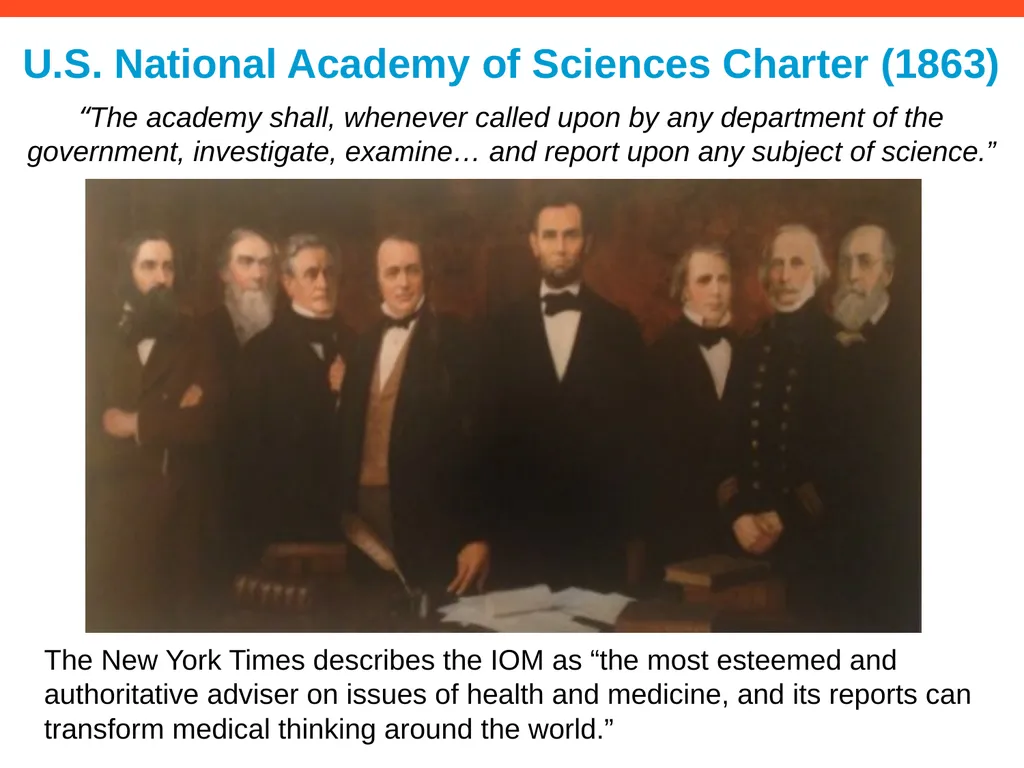
slide3. U.S. National Academy of Sciences Charter (1863) “The academy shall, whenever called upon by any department of the government, investigate, examine… and report upon any subject of science.” The New York Times describes the IOM as “the most esteemed and authoritative adviser on issues of health and medicine, and its reports can transform medical thinking around the world.”<br>
slide4. Global Health Risk Framework Initiative What?
A plan for a global architecture for preparedness and response mitigating the threat of epidemic infectious diseases
How?
Fall 2014: A concerned conversation between Jim Kim, World Bank, and Victor Dzau about the Ebola outbreak;
Support from Judith Rodin ( Rockefeller), and initial planning with World Bank, WHO, Rockefeller
December 2014: “Getting to Zero Ebola Cases in West Africa: A Convening of Leaders” chaired by Margaret Chan
March 2015: Planning meeting for Global Health Risk Framework
Support
Paul Allen Foundation, Ford Foundation, Gates Foundation, Ming Wai Lau, Moore Foundation, Rockefeller Foundation, USAID, Wellcome Trust<br>
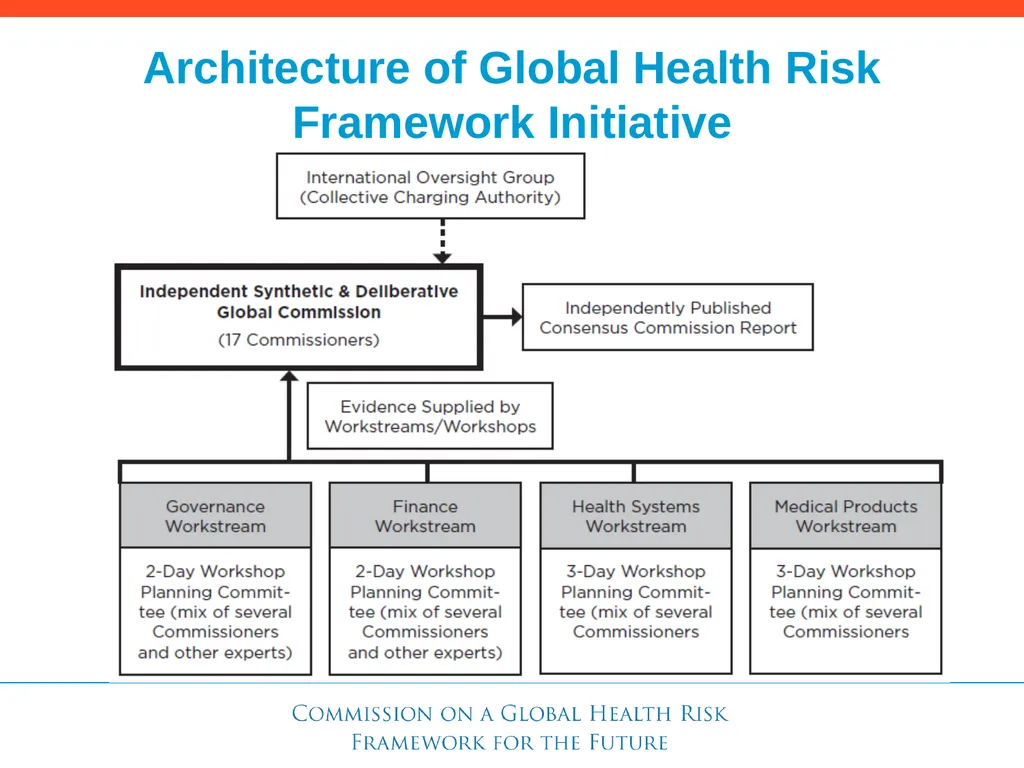
slide5. Architecture of Global Health Risk Framework Initiative<br>
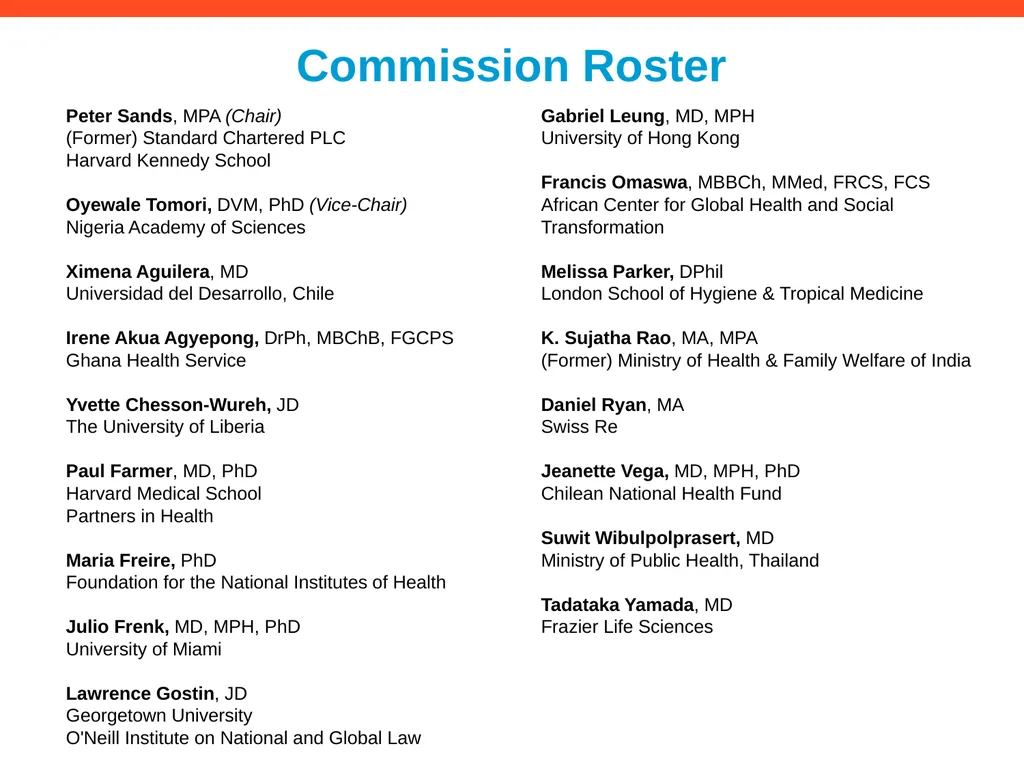
slide6. Commission Roster Peter Sands, MPA (Chair)
(Former) Standard Chartered PLC
Harvard Kennedy School
Oyewale Tomori, DVM, PhD (Vice-Chair)
Nigeria Academy of Sciences
Ximena Aguilera, MD
Universidad del Desarrollo, Chile
Irene Akua Agyepong, DrPh, MBChB, FGCPS
Ghana Health Service
Yvette Chesson-Wureh, JD
The University of Liberia
Paul Farmer, MD, PhD
Harvard Medical School
Partners in Health
Maria Freire, PhD
Foundation for the National Institutes of Health
Julio Frenk, MD, MPH, PhD
University of Miami
Lawrence Gostin, JD
Georgetown University
O'Neill Institute on National and Global Law
Gabriel Leung, MD, MPH
University of Hong Kong
Francis Omaswa, MBBCh, MMed, FRCS, FCS African Center for Global Health and Social Transformation
Melissa Parker, DPhil
London School of Hygiene & Tropical Medicine
K. Sujatha Rao, MA, MPA
(Former) Ministry of Health & Family Welfare of India
Daniel Ryan, MA
Swiss Re
Jeanette Vega, MD, MPH, PhD
Chilean National Health Fund
Suwit Wibulpolprasert, MD
Ministry of Public Health, Thailand
Tadataka Yamada, MD
Frazier Life Sciences<br>
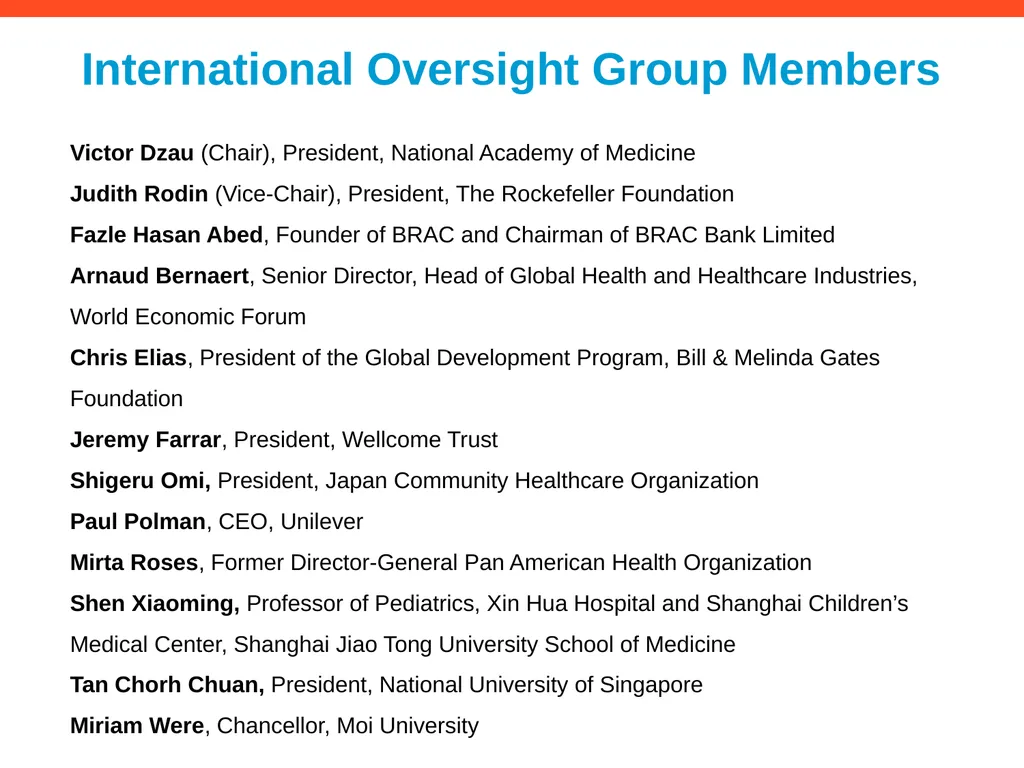
slide7. International Oversight Group Members Victor Dzau (Chair), President, National Academy of Medicine Judith Rodin (Vice-Chair), President, The Rockefeller Foundation Fazle Hasan Abed, Founder of BRAC and Chairman of BRAC Bank Limited Arnaud Bernaert, Senior Director, Head of Global Health and Healthcare Industries, World Economic Forum Chris Elias, President of the Global Development Program, Bill & Melinda Gates Foundation Jeremy Farrar, President, Wellcome Trust Shigeru Omi, President, Japan Community Healthcare Organization
Paul Polman, CEO, Unilever Mirta Roses, Former Director-General Pan American Health Organization
Shen Xiaoming, Professor of Pediatrics, Xin Hua Hospital and Shanghai Children’s Medical Center, Shanghai Jiao Tong University School of Medicine
Tan Chorh Chuan, President, National University of Singapore
Miriam Were, Chancellor, Moi University<br>
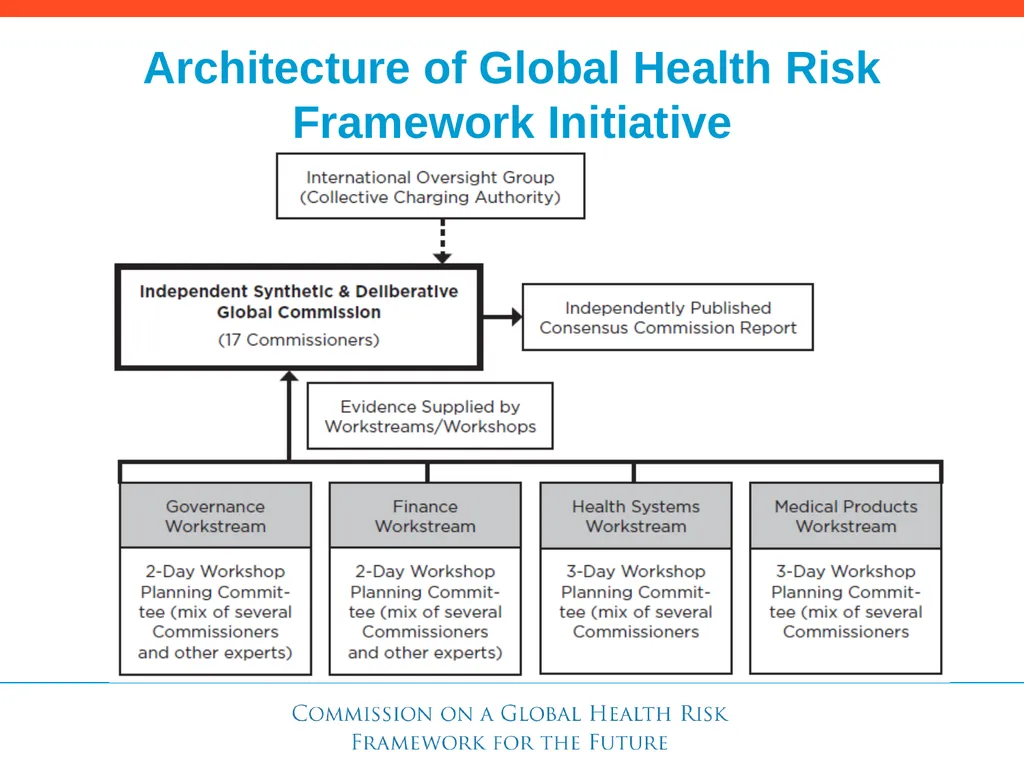
slide8. Architecture of Global Health Risk Framework Initiative<br>
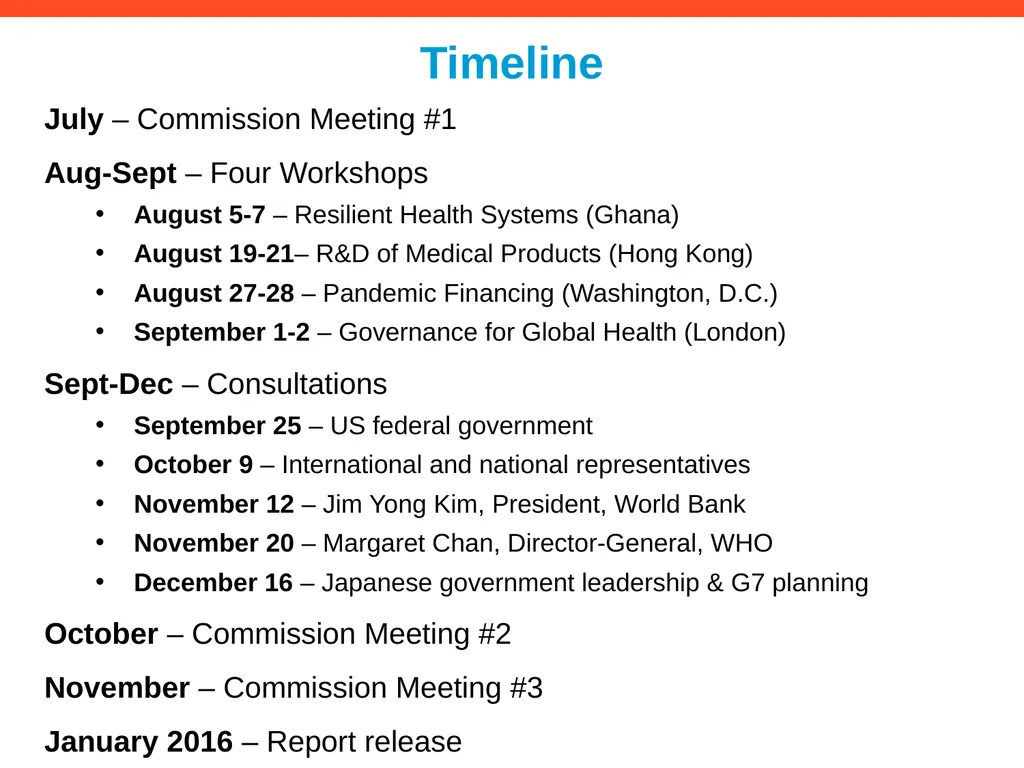
slide9. Timeline July – Commission Meeting #1
Aug-Sept – Four Workshops
August 5-7 – Resilient Health Systems (Ghana)
August 19-21– R&D of Medical Products (Hong Kong)
August 27-28 – Pandemic Financing (Washington, D.C.)
September 1-2 – Governance for Global Health (London)
Sept-Dec – Consultations
September 25 – US federal government
October 9 – International and national representatives
November 12 – Jim Yong Kim, President, World Bank
November 20 – Margaret Chan, Director-General, WHO
December 16 – Japanese government leadership & G7 planning
October – Commission Meeting #2
November – Commission Meeting #3
January 2016 – Report release<br>
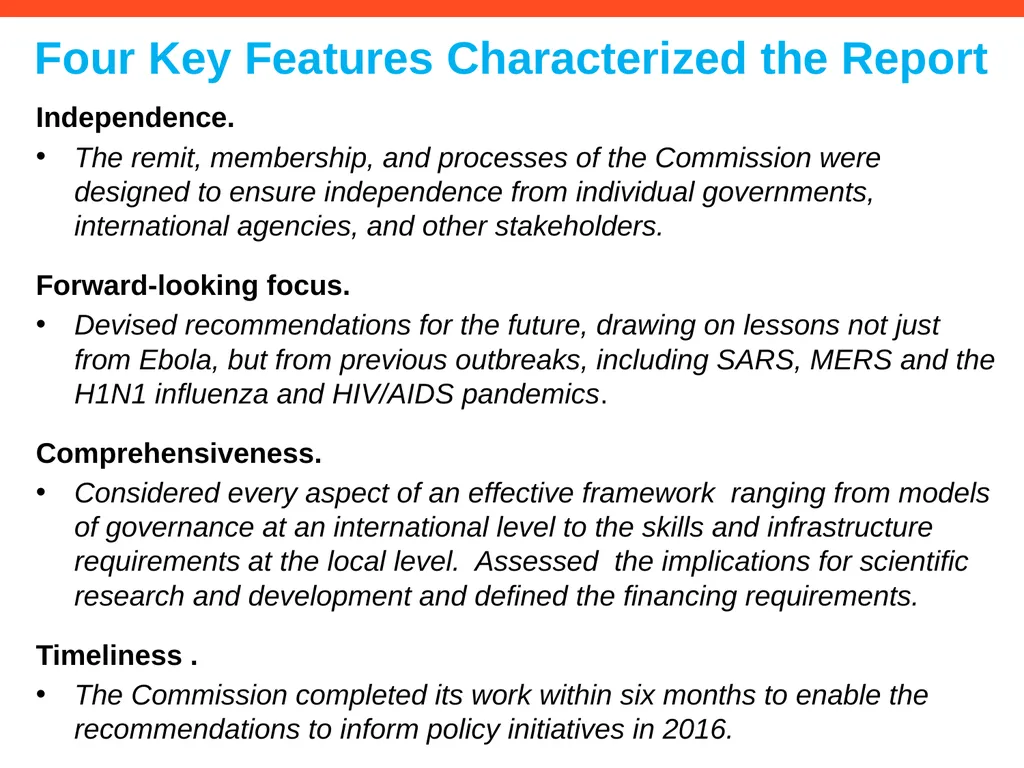
slide10. Four Key Features Characterized the Report Independence.
The remit, membership, and processes of the Commission were designed to ensure independence from individual governments, international agencies, and other stakeholders.
Forward-looking focus.
Devised recommendations for the future, drawing on lessons not just from Ebola, but from previous outbreaks, including SARS, MERS and the H1N1 influenza and HIV/AIDS pandemics.
Comprehensiveness.
Considered every aspect of an effective framework ranging from models of governance at an international level to the skills and infrastructure requirements at the local level. Assessed the implications for scientific research and development and defined the financing requirements.
Timeliness .
The Commission completed its work within six months to enable the recommendations to inform policy initiatives in 2016.<br>
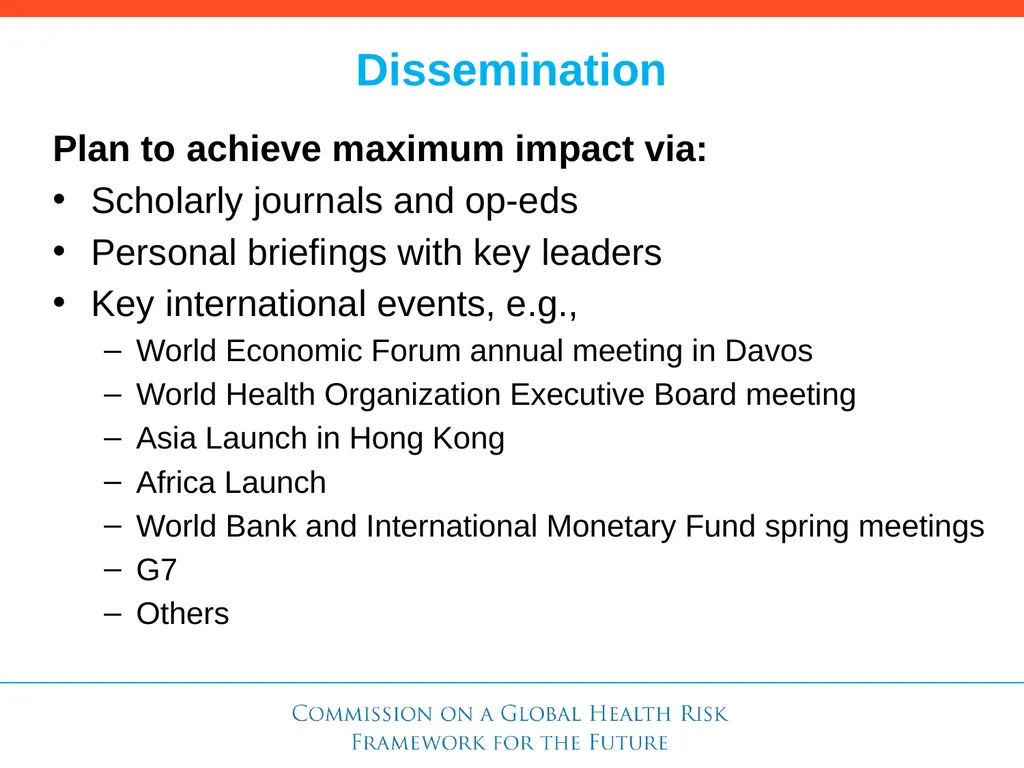
slide11. Dissemination Plan to achieve maximum impact via:
Scholarly journals and op-eds
Personal briefings with key leaders
Key international events, e.g.,
World Economic Forum annual meeting in Davos
World Health Organization Executive Board meeting
Asia Launch in Hong Kong
Africa Launch
World Bank and International Monetary Fund spring meetings
G7
Others<br>
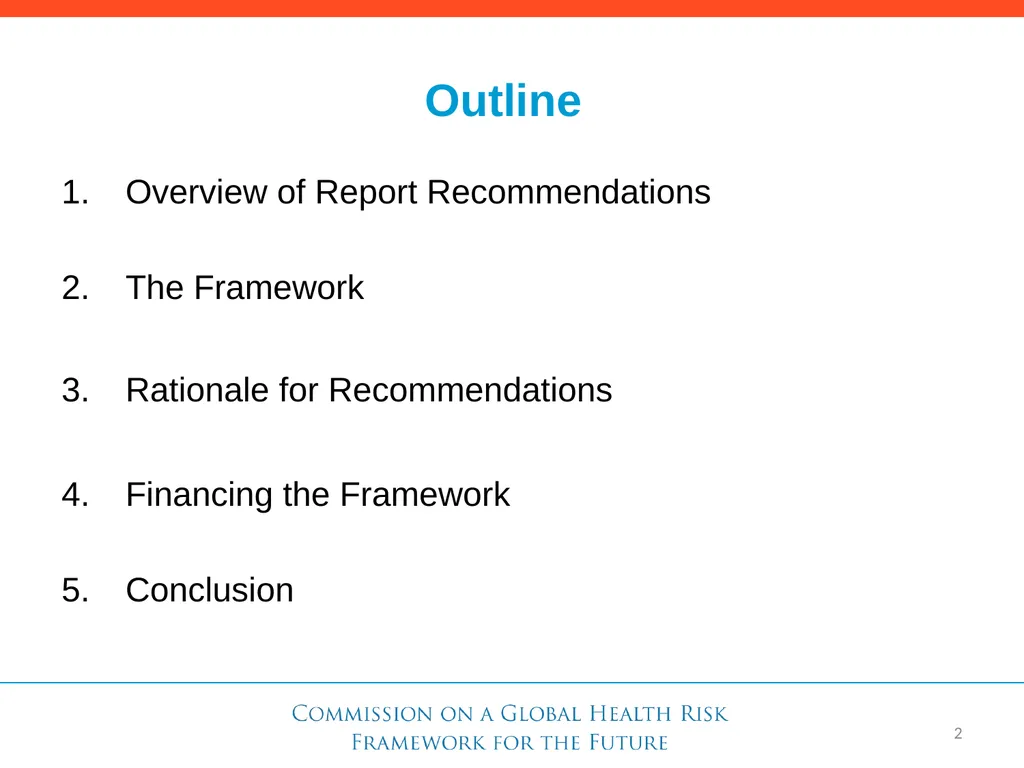
slide13. Outline Overview of Report Recommendations
The Framework
Rationale for Recommendations
Financing the Framework
Conclusion 2<br>
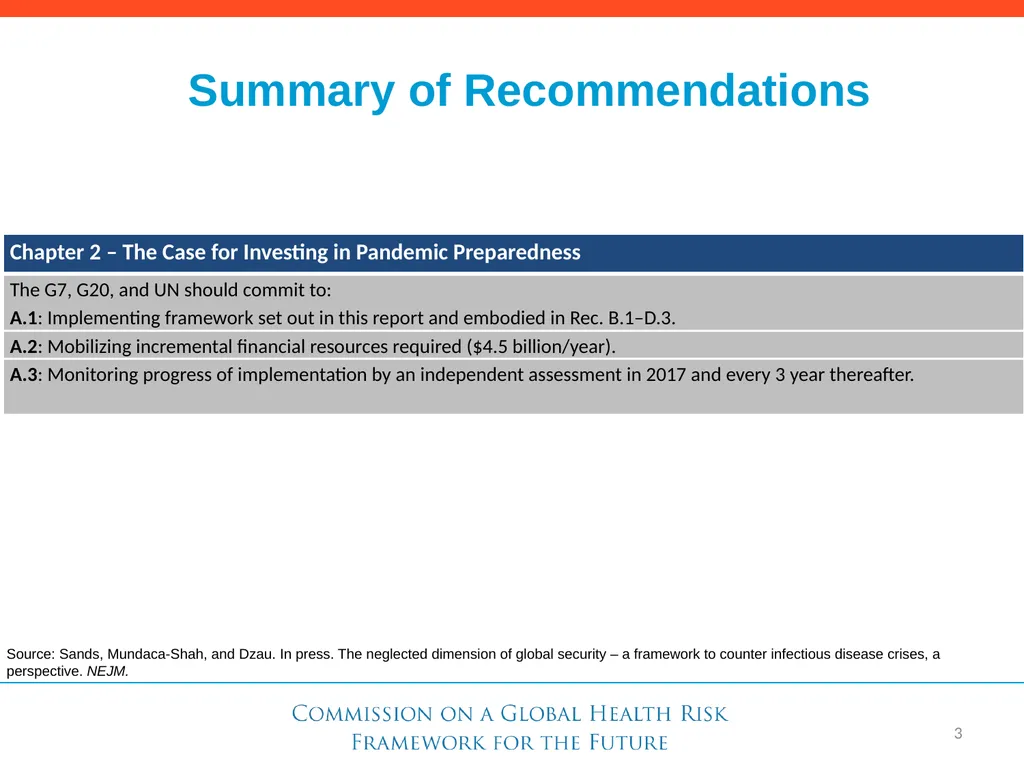
slide14. Summary of Recommendations Source: Sands, Mundaca-Shah, and Dzau. In press. The neglected dimension of global security – a framework to counter infectious disease crises, a perspective. NEJM. 3<br>
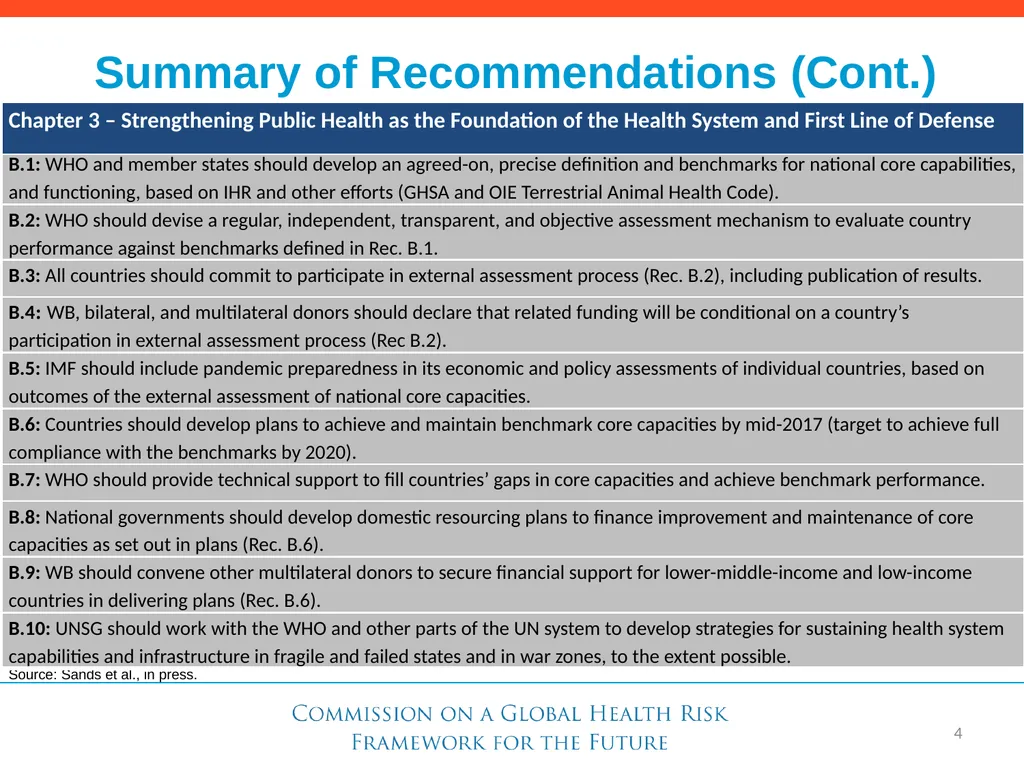
slide15. Summary of Recommendations (Cont.) Source: Sands et al., in press. 4<br>
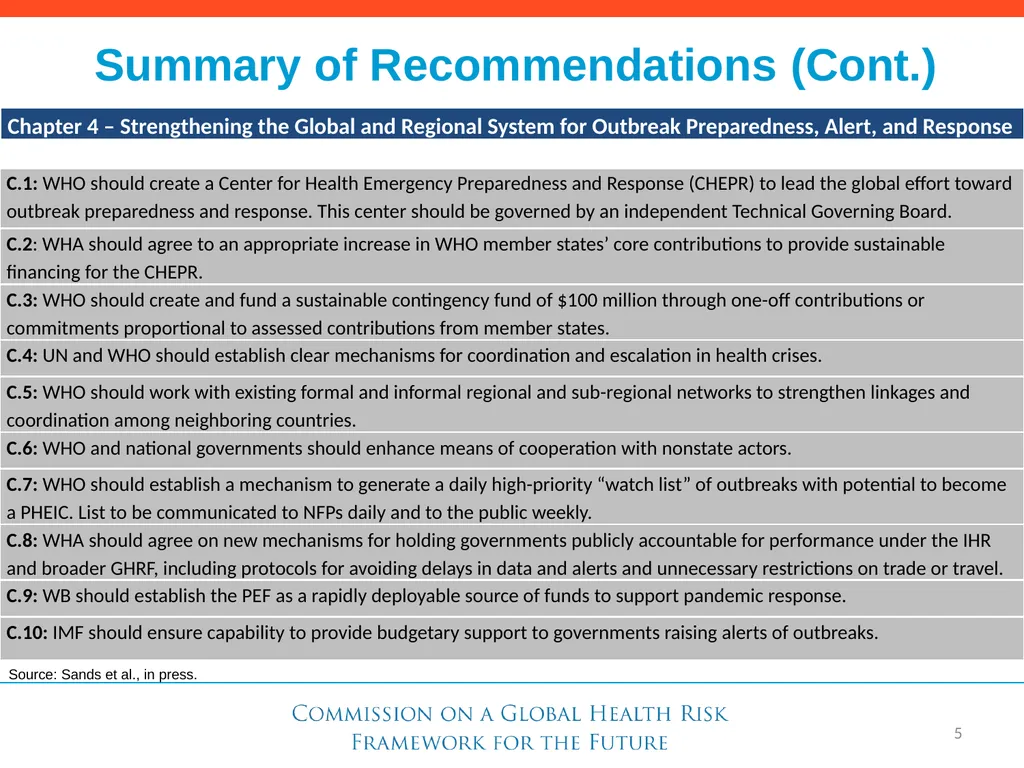
slide16. 5 Source: Sands et al., in press. Summary of Recommendations (Cont.)<br>
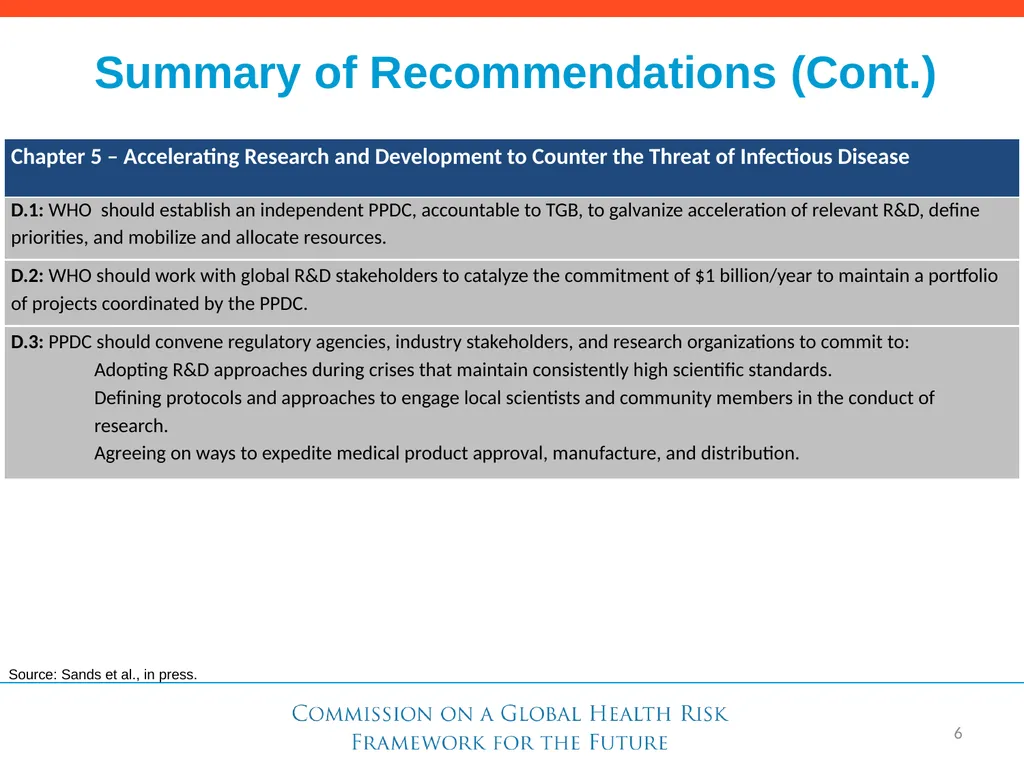
slide17. 6 Source: Sands et al., in press. Summary of Recommendations (Cont.)<br>
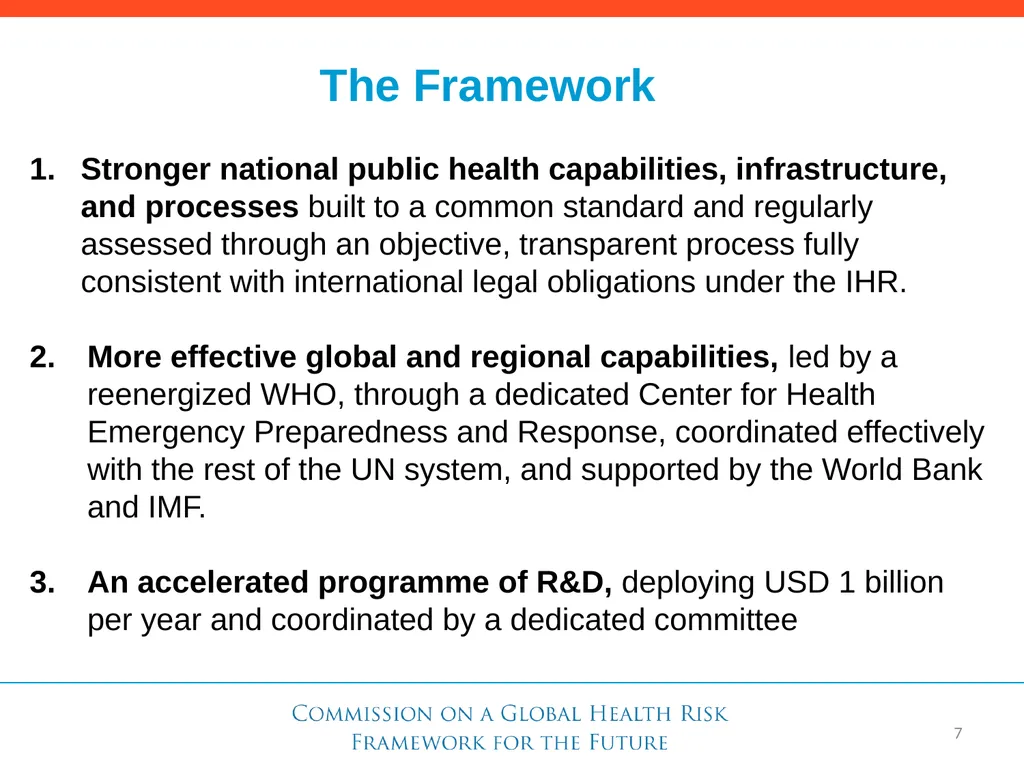
slide18. The Framework Stronger national public health capabilities, infrastructure, and processes built to a common standard and regularly assessed through an objective, transparent process fully consistent with international legal obligations under the IHR.
More effective global and regional capabilities, led by a reenergized WHO, through a dedicated Center for Health Emergency Preparedness and Response, coordinated effectively with the rest of the UN system, and supported by the World Bank and IMF.
An accelerated programme of R&D, deploying USD 1 billion per year and coordinated by a dedicated committee 7<br>
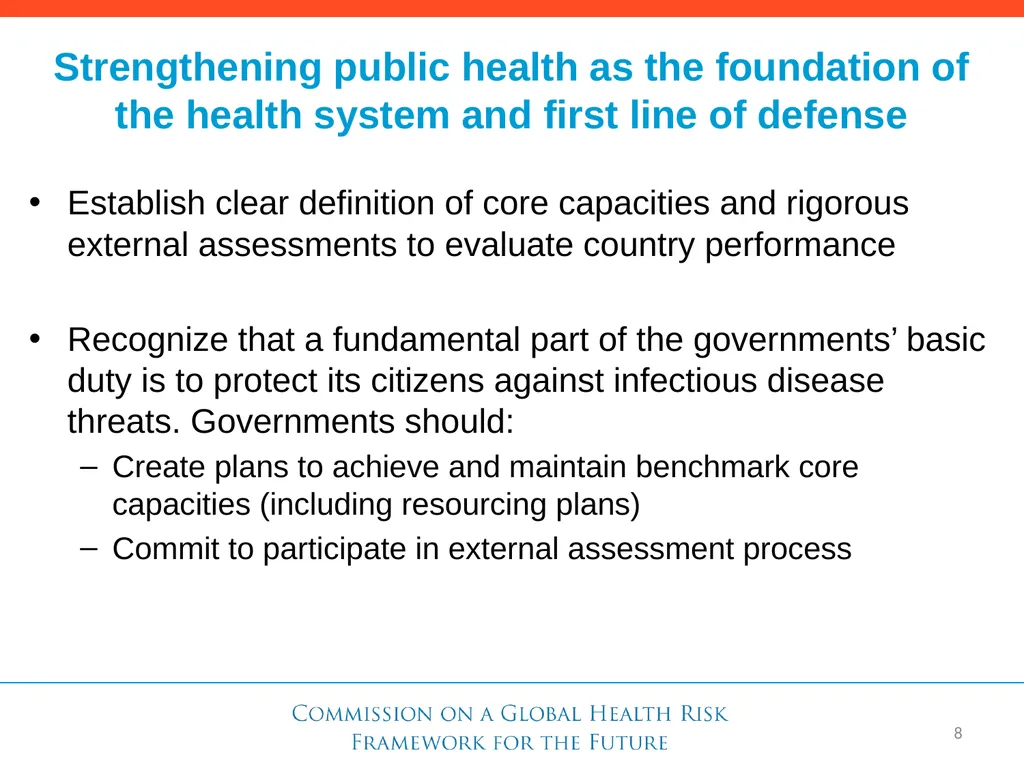
slide19. 8 Strengthening public health as the foundation of the health system and first line of defense Establish clear definition of core capacities and rigorous external assessments to evaluate country performance
Recognize that a fundamental part of the governments’ basic duty is to protect its citizens against infectious disease threats. Governments should:
Create plans to achieve and maintain benchmark core capacities (including resourcing plans)
Commit to participate in external assessment process<br>
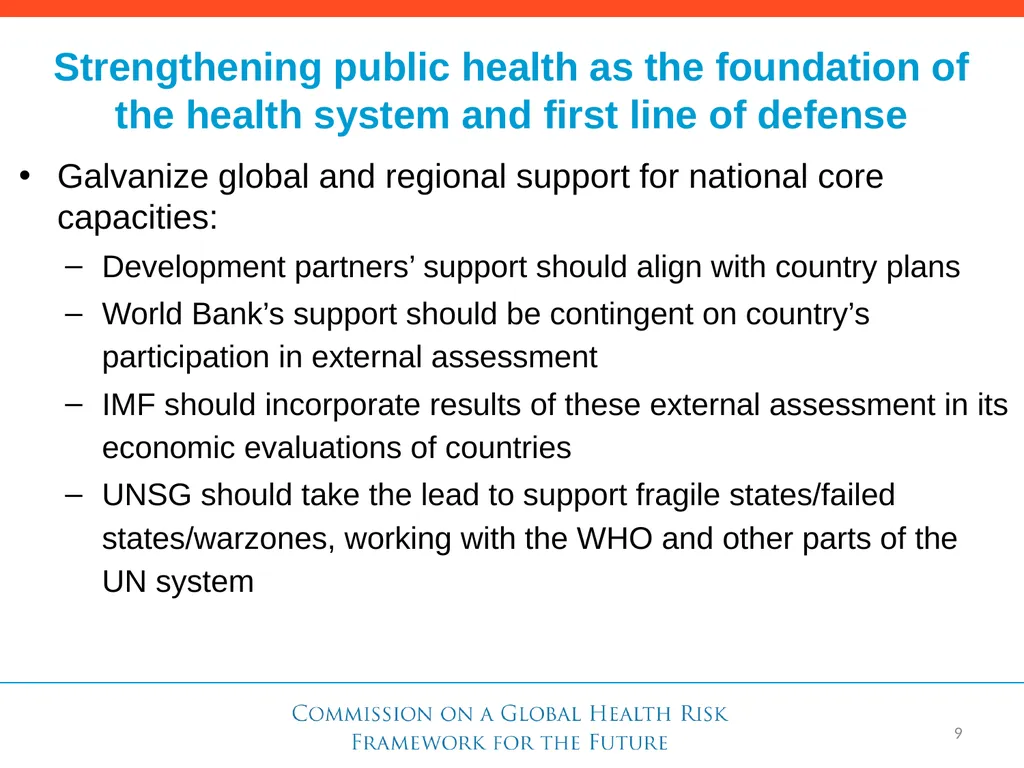
slide20. 9 Strengthening public health as the foundation of the health system and first line of defense Galvanize global and regional support for national core capacities:
Development partners’ support should align with country plans
World Bank’s support should be contingent on country’s participation in external assessment
IMF should incorporate results of these external assessment in its economic evaluations of countries
UNSG should take the lead to support fragile states/failed states/warzones, working with the WHO and other parts of the UN system<br>
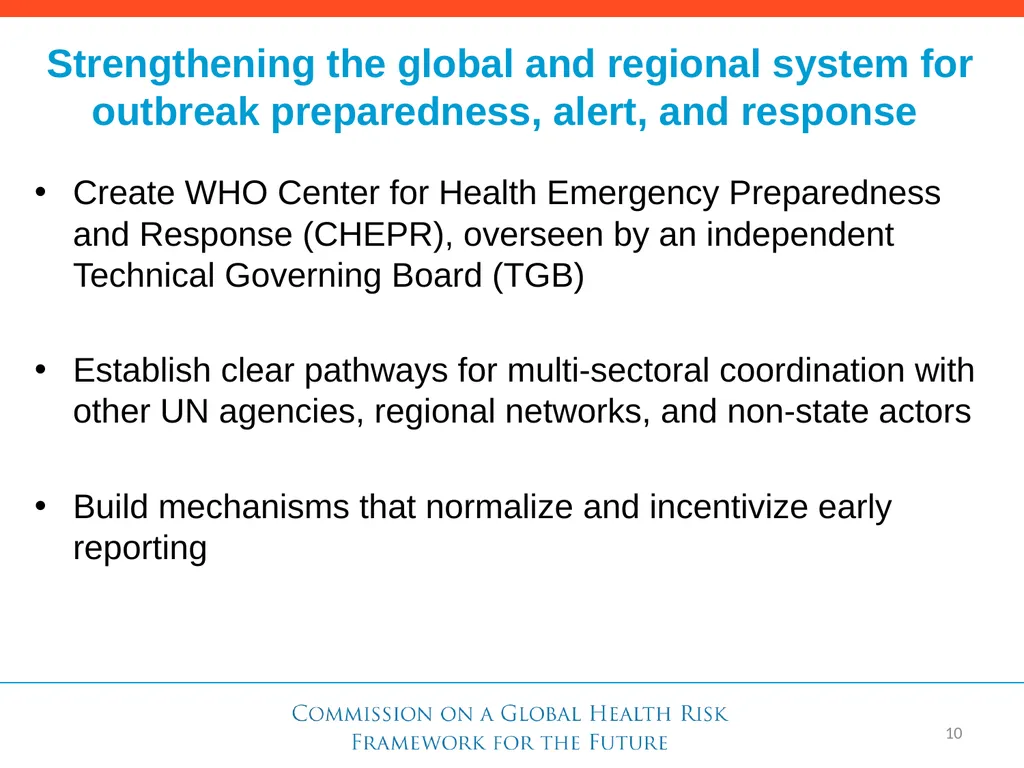
slide21. 10 Strengthening the global and regional system for outbreak preparedness, alert, and response Create WHO Center for Health Emergency Preparedness and Response (CHEPR), overseen by an independent Technical Governing Board (TGB)
Establish clear pathways for multi-sectoral coordination with other UN agencies, regional networks, and non-state actors
Build mechanisms that normalize and incentivize early reporting<br>
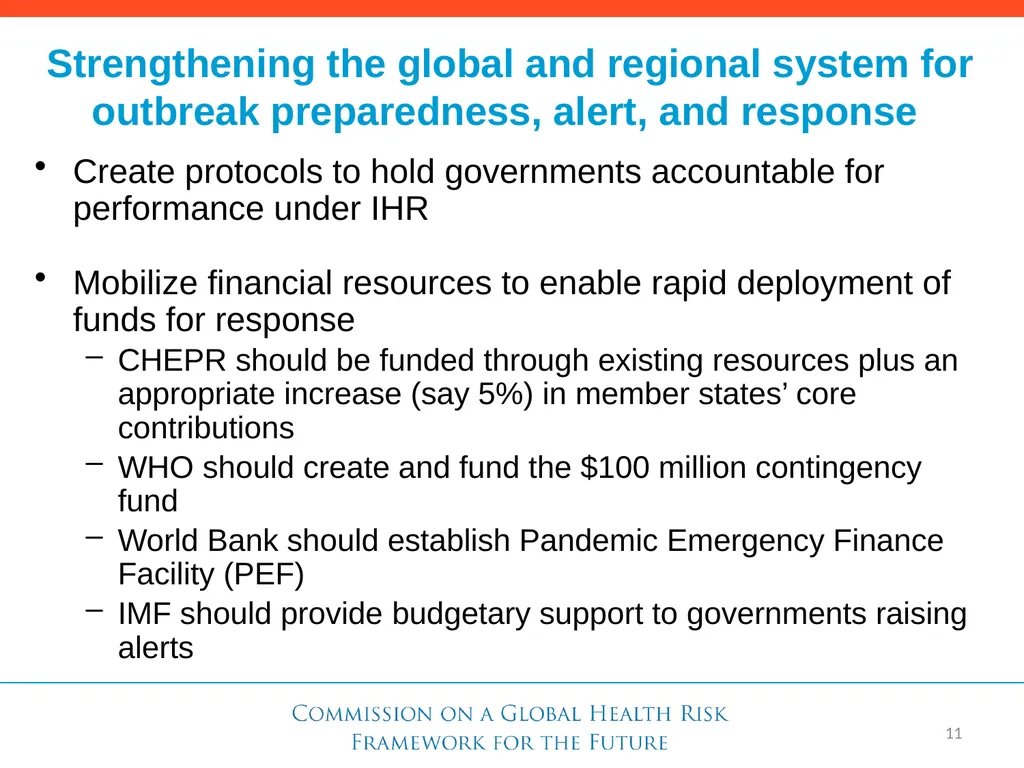
slide22. 11 Strengthening the global and regional system for outbreak preparedness, alert, and response Create protocols to hold governments accountable for performance under IHR
Mobilize financial resources to enable rapid deployment of funds for response
CHEPR should be funded through existing resources plus an appropriate increase (say 5%) in member states’ core contributions
WHO should create and fund the $100 million contingency fund
World Bank should establish Pandemic Emergency Finance Facility (PEF)
IMF should provide budgetary support to governments raising alerts<br>
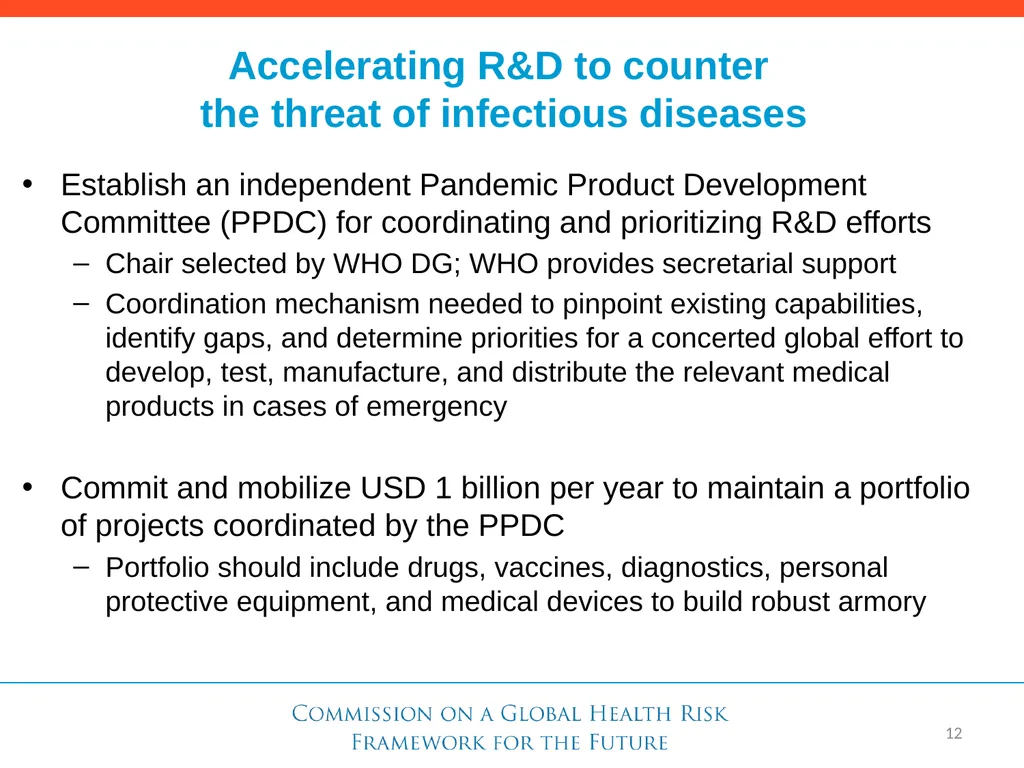
slide23. Accelerating R&D to counter the threat of infectious diseases Establish an independent Pandemic Product Development Committee (PPDC) for coordinating and prioritizing R&D efforts
Chair selected by WHO DG; WHO provides secretarial support
Coordination mechanism needed to pinpoint existing capabilities, identify gaps, and determine priorities for a concerted global effort to develop, test, manufacture, and distribute the relevant medical products in cases of emergency
Commit and mobilize USD 1 billion per year to maintain a portfolio of projects coordinated by the PPDC
Portfolio should include drugs, vaccines, diagnostics, personal protective equipment, and medical devices to build robust armory 12<br>
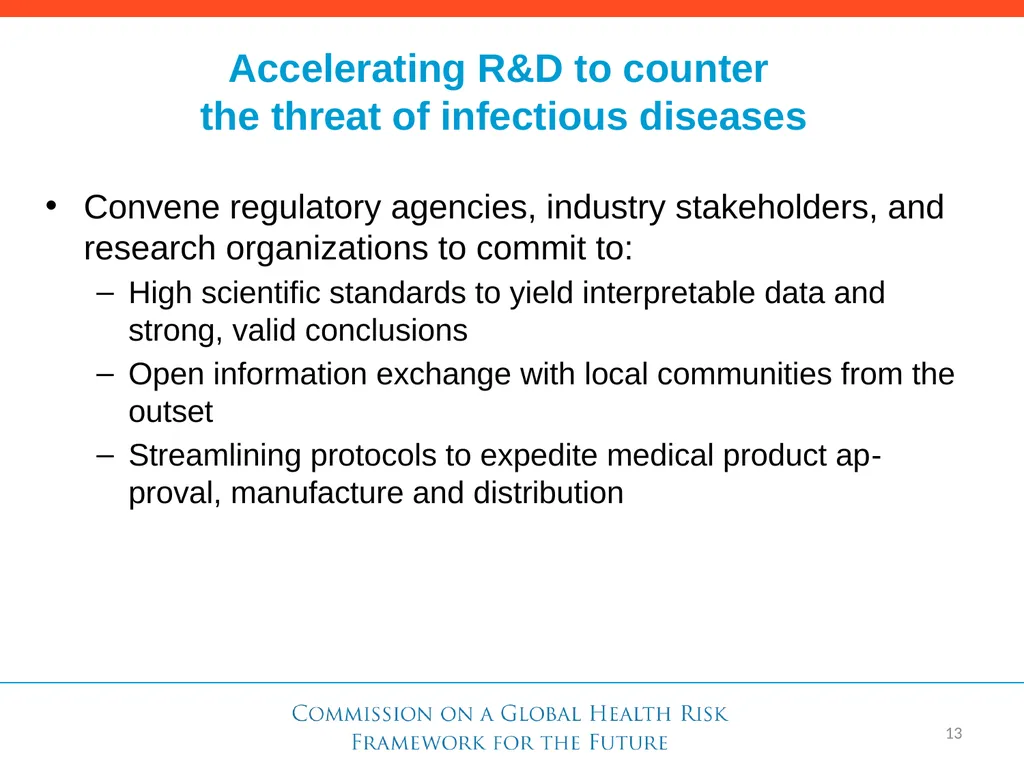
slide24. Accelerating R&D to counter the threat of infectious diseases Convene regulatory agencies, industry stakeholders, and research organizations to commit to:
High scientific standards to yield interpretable data and strong, valid conclusions
Open information exchange with local communities from the outset
Streamlining protocols to expedite medical product approval, manufacture and distribution 13<br>
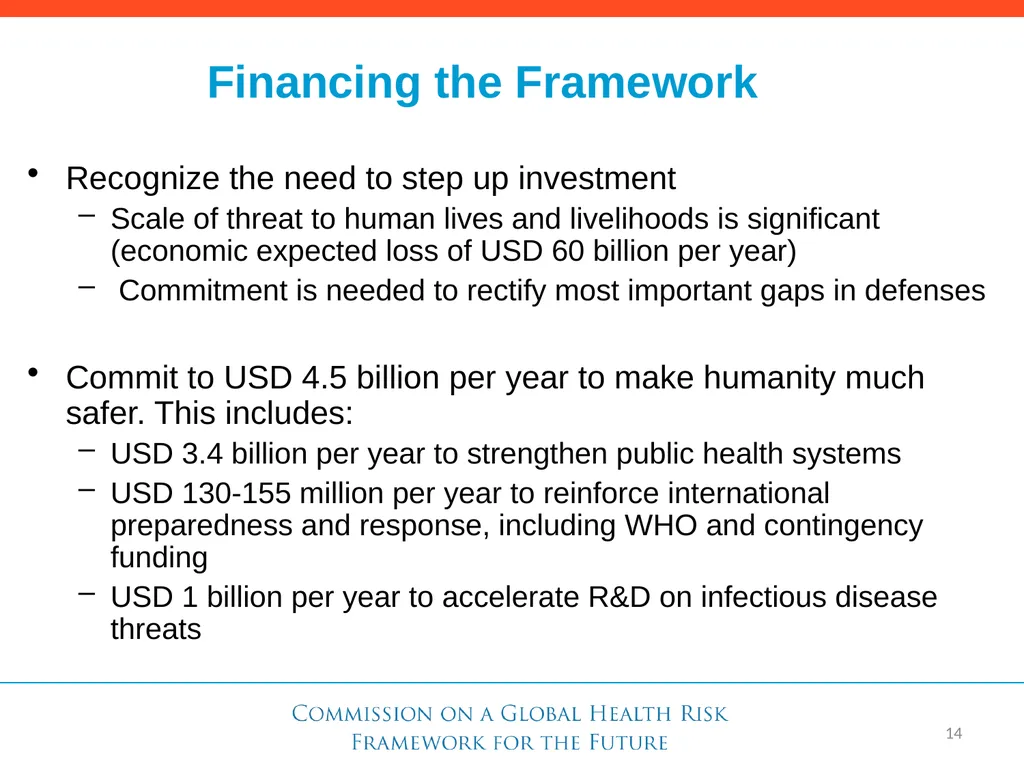
slide25. 14 Financing the Framework Recognize the need to step up investment
Scale of threat to human lives and livelihoods is significant (economic expected loss of USD 60 billion per year)
Commitment is needed to rectify most important gaps in defenses
Commit to USD 4.5 billion per year to make humanity much safer. This includes:
USD 3.4 billion per year to strengthen public health systems
USD 130-155 million per year to reinforce international preparedness and response, including WHO and contingency funding
USD 1 billion per year to accelerate R&D on infectious disease threats<br>
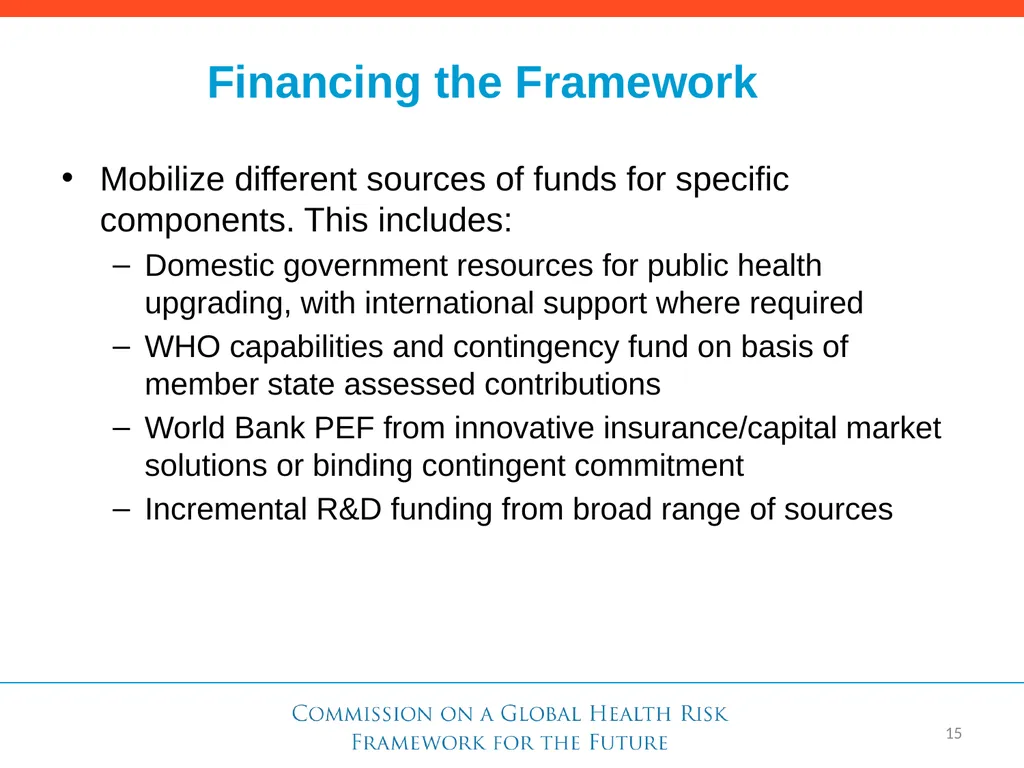
slide26. 15 Financing the Framework Mobilize different sources of funds for specific components. This includes:
Domestic government resources for public health upgrading, with international support where required
WHO capabilities and contingency fund on basis of member state assessed contributions
World Bank PEF from innovative insurance/capital market solutions or binding contingent commitment
Incremental R&D funding from broad range of sources<br>
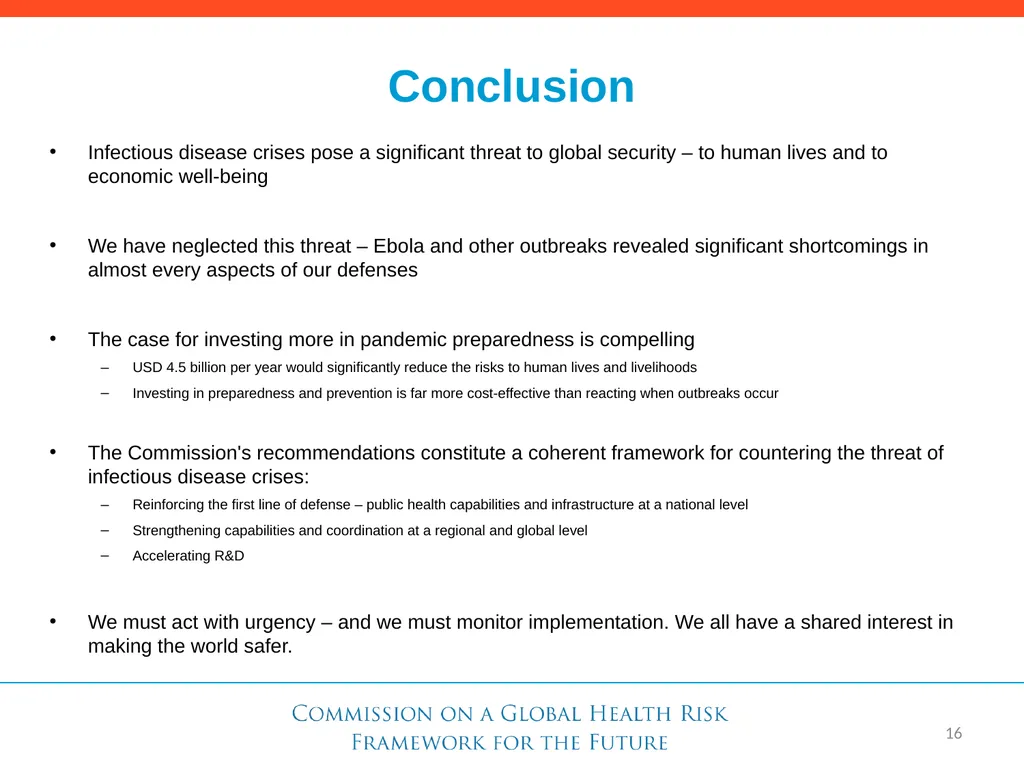
slide27. Conclusion 16 Infectious disease crises pose a significant threat to global security – to human lives and to economic well-being
We have neglected this threat – Ebola and other outbreaks revealed significant shortcomings in almost every aspects of our defenses
The case for investing more in pandemic preparedness is compelling
USD 4.5 billion per year would significantly reduce the risks to human lives and livelihoods
Investing in preparedness and prevention is far more cost-effective than reacting when outbreaks occur
The Commission's recommendations constitute a coherent framework for countering the threat of infectious disease crises:
Reinforcing the first line of defense – public health capabilities and infrastructure at a national level
Strengthening capabilities and coordination at a regional and global level
Accelerating R&D
We must act with urgency – and we must monitor implementation. We all have a shared interest in making the world safer.<br>
slide28. Contact information Email Q&A questions to:
GHRFCommission@nas.edu
@GHRFCommission
#GHRF
Complete report at nam.edu/GHRF 17<br>
slide29. Appendix 18<br>
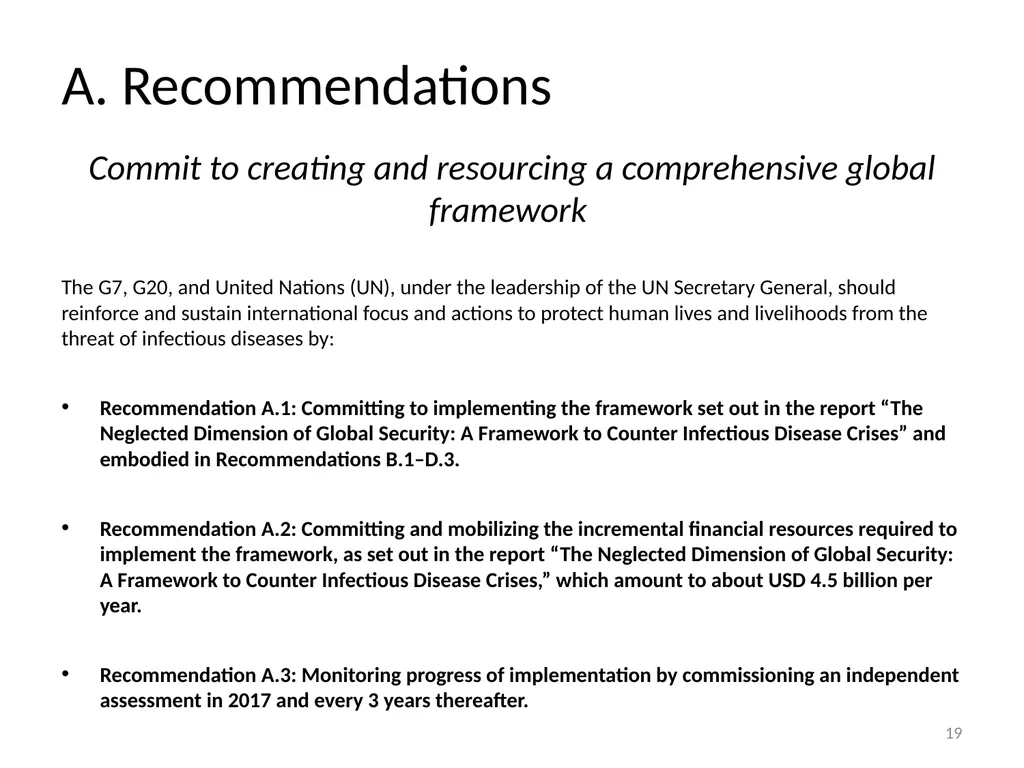
slide30. A. Recommendations Commit to creating and resourcing a comprehensive global framework
The G7, G20, and United Nations (UN), under the leadership of the UN Secretary General, should reinforce and sustain international focus and actions to protect human lives and livelihoods from the threat of infectious diseases by:
Recommendation A.1: Committing to implementing the framework set out in the report “The Neglected Dimension of Global Security: A Framework to Counter Infectious Disease Crises” and embodied in Recommendations B.1–D.3.
Recommendation A.2: Committing and mobilizing the incremental financial resources required to implement the framework, as set out in the report “The Neglected Dimension of Global Security: A Framework to Counter Infectious Disease Crises,” which amount to about USD 4.5 billion per year.
Recommendation A.3: Monitoring progress of implementation by commissioning an independent assessment in 2017 and every 3 years thereafter. 19<br>
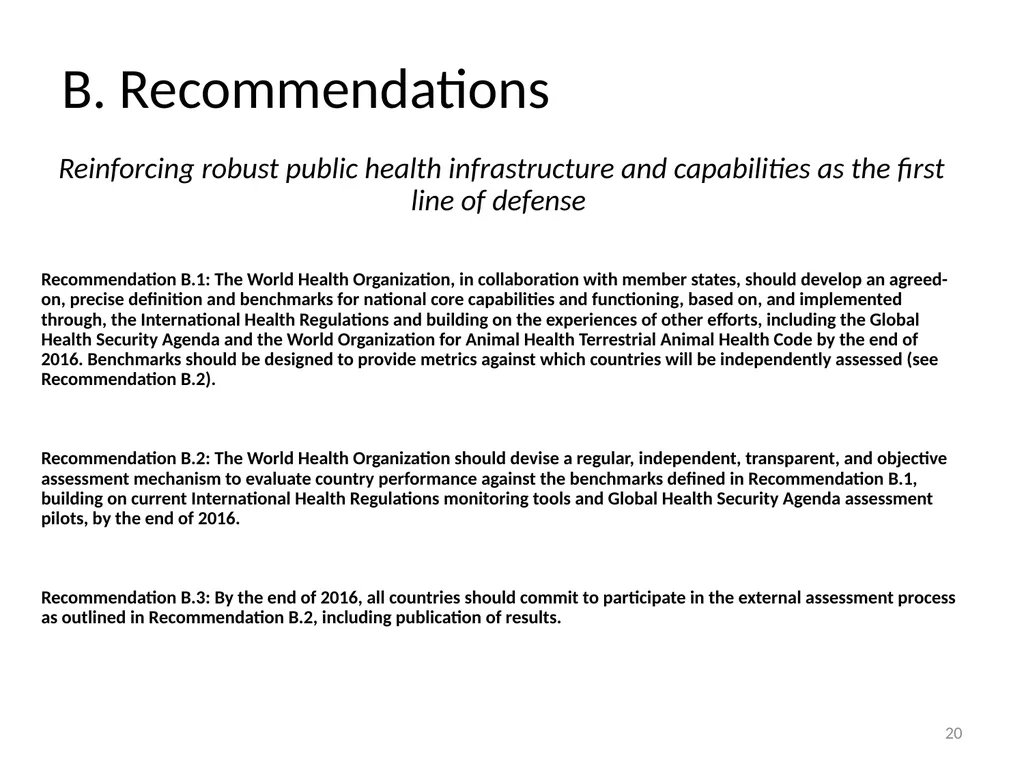
slide31. B. Recommendations Reinforcing robust public health infrastructure and capabilities as the first line of defense
Recommendation B.1: The World Health Organization, in collaboration with member states, should develop an agreed-on, precise definition and benchmarks for national core capabilities and functioning, based on, and implemented through, the International Health Regulations and building on the experiences of other efforts, including the Global Health Security Agenda and the World Organization for Animal Health Terrestrial Animal Health Code by the end of 2016. Benchmarks should be designed to provide metrics against which countries will be independently assessed (see Recommendation B.2).
Recommendation B.2: The World Health Organization should devise a regular, independent, transparent, and objective assessment mechanism to evaluate country performance against the benchmarks defined in Recommendation B.1, building on current International Health Regulations monitoring tools and Global Health Security Agenda assessment pilots, by the end of 2016.
Recommendation B.3: By the end of 2016, all countries should commit to participate in the external assessment process as outlined in Recommendation B.2, including publication of results. 20<br>
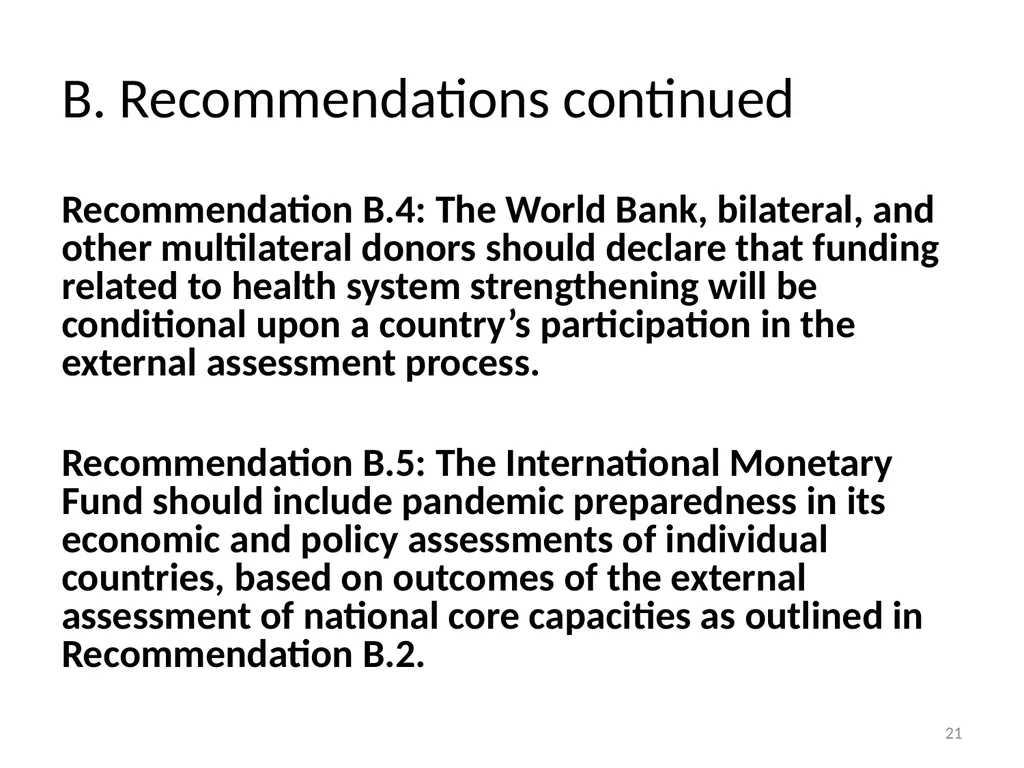
slide32. B. Recommendations continued Recommendation B.4: The World Bank, bilateral, and other multilateral donors should declare that funding related to health system strengthening will be conditional upon a country’s participation in the external assessment process.
Recommendation B.5: The International Monetary Fund should include pandemic preparedness in its economic and policy assessments of individual countries, based on outcomes of the external assessment of national core capacities as outlined in Recommendation B.2. 21<br>
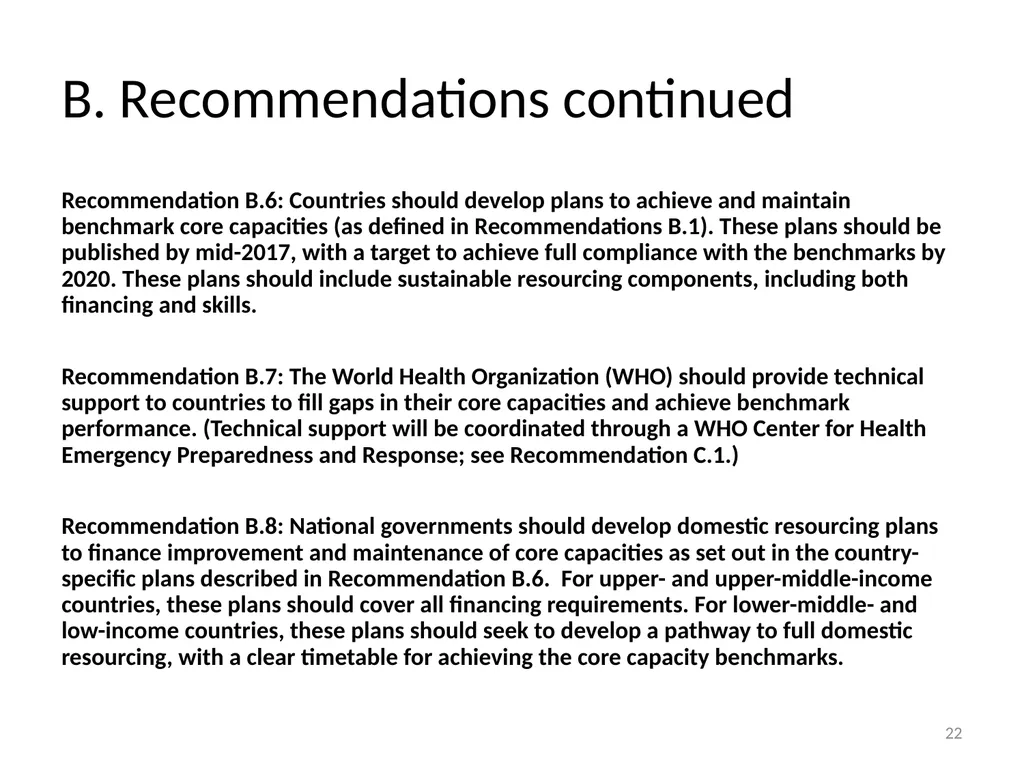
slide33. B. Recommendations continued Recommendation B.6: Countries should develop plans to achieve and maintain benchmark core capacities (as defined in Recommendations B.1). These plans should be published by mid-2017, with a target to achieve full compliance with the benchmarks by 2020. These plans should include sustainable resourcing components, including both financing and skills.
Recommendation B.7: The World Health Organization (WHO) should provide technical support to countries to fill gaps in their core capacities and achieve benchmark performance. (Technical support will be coordinated through a WHO Center for Health Emergency Preparedness and Response; see Recommendation C.1.)
Recommendation B.8: National governments should develop domestic resourcing plans to finance improvement and maintenance of core capacities as set out in the country-specific plans described in Recommendation B.6. For upper- and upper-middle-income countries, these plans should cover all financing requirements. For lower-middle- and low-income countries, these plans should seek to develop a pathway to full domestic resourcing, with a clear timetable for achieving the core capacity benchmarks. 22<br>
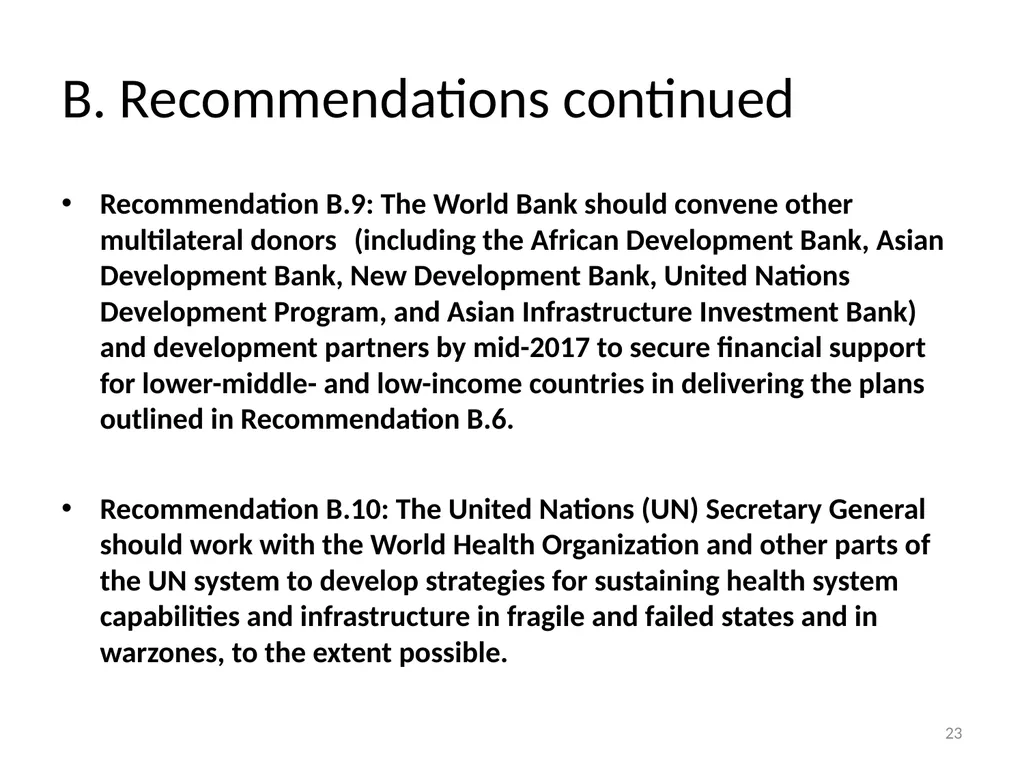
slide34. B. Recommendations continued Recommendation B.9: The World Bank should convene other multilateral donors (including the African Development Bank, Asian Development Bank, New Development Bank, United Nations Development Program, and Asian Infrastructure Investment Bank) and development partners by mid-2017 to secure financial support for lower-middle- and low-income countries in delivering the plans outlined in Recommendation B.6.
Recommendation B.10: The United Nations (UN) Secretary General should work with the World Health Organization and other parts of the UN system to develop strategies for sustaining health system capabilities and infrastructure in fragile and failed states and in warzones, to the extent possible. 23<br>
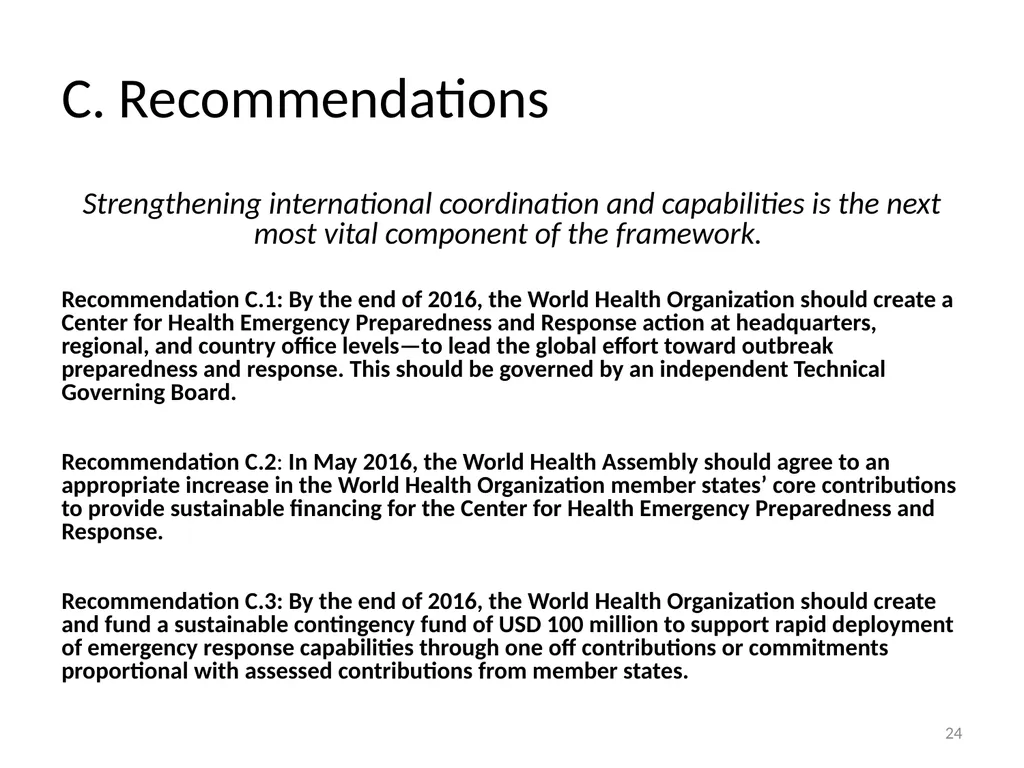
slide35. C. Recommendations Strengthening international coordination and capabilities is the next most vital component of the framework.
Recommendation C.1: By the end of 2016, the World Health Organization should create a Center for Health Emergency Preparedness and Response action at headquarters, regional, and country office levels—to lead the global effort toward outbreak preparedness and response. This should be governed by an independent Technical Governing Board.
Recommendation C.2: In May 2016, the World Health Assembly should agree to an appropriate increase in the World Health Organization member states’ core contributions to provide sustainable financing for the Center for Health Emergency Preparedness and Response.
Recommendation C.3: By the end of 2016, the World Health Organization should create and fund a sustainable contingency fund of USD 100 million to support rapid deployment of emergency response capabilities through one off contributions or commitments proportional with assessed contributions from member states. 24<br>
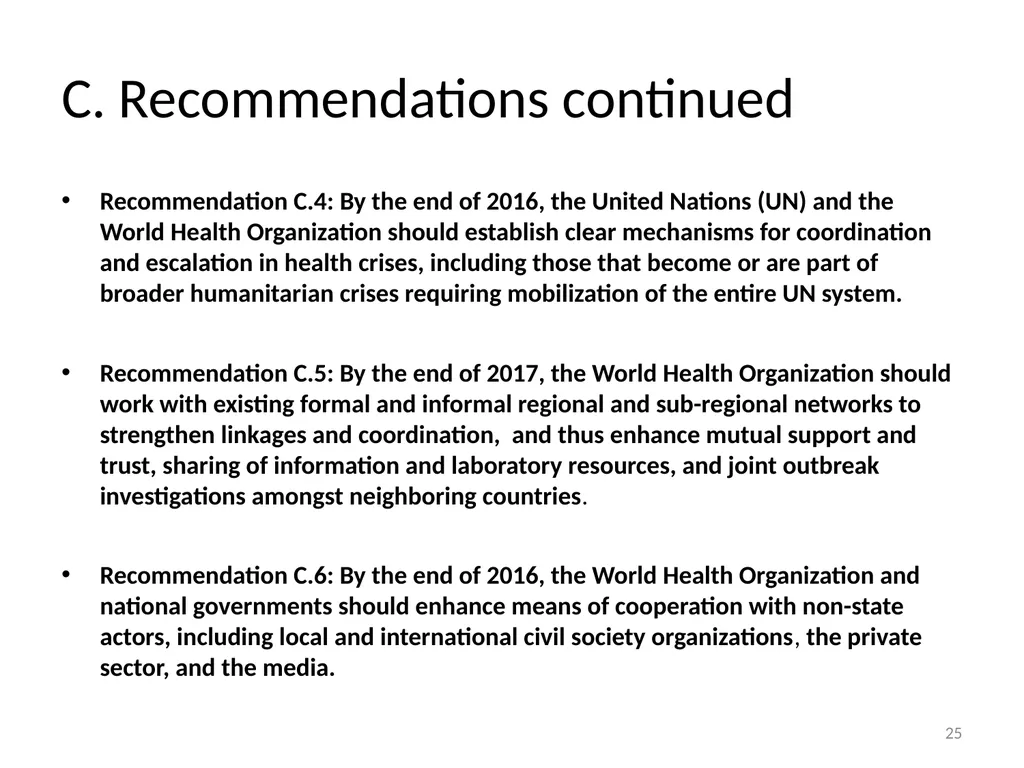
slide36. C. Recommendations continued Recommendation C.4: By the end of 2016, the United Nations (UN) and the World Health Organization should establish clear mechanisms for coordination and escalation in health crises, including those that become or are part of broader humanitarian crises requiring mobilization of the entire UN system.
Recommendation C.5: By the end of 2017, the World Health Organization should work with existing formal and informal regional and sub-regional networks to strengthen linkages and coordination, and thus enhance mutual support and trust, sharing of information and laboratory resources, and joint outbreak investigations amongst neighboring countries.
Recommendation C.6: By the end of 2016, the World Health Organization and national governments should enhance means of cooperation with non-state actors, including local and international civil society organizations, the private sector, and the media. 25<br>
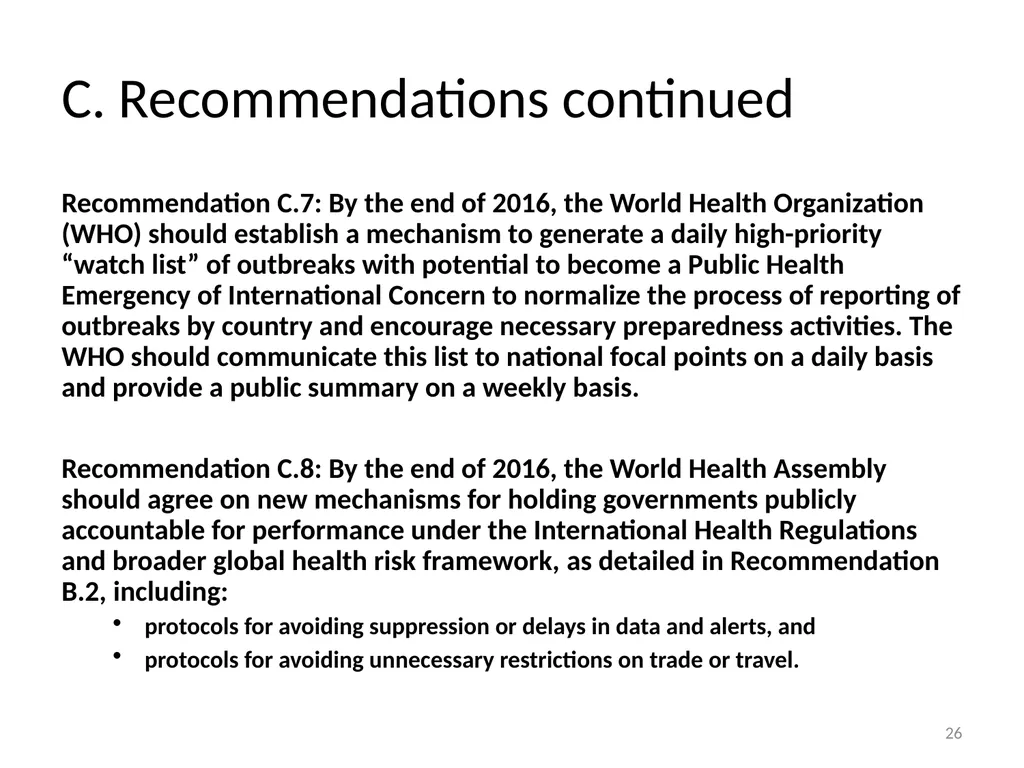
slide37. C. Recommendations continued Recommendation C.7: By the end of 2016, the World Health Organization (WHO) should establish a mechanism to generate a daily high-priority “watch list” of outbreaks with potential to become a Public Health Emergency of International Concern to normalize the process of reporting of outbreaks by country and encourage necessary preparedness activities. The WHO should communicate this list to national focal points on a daily basis and provide a public summary on a weekly basis.
Recommendation C.8: By the end of 2016, the World Health Assembly should agree on new mechanisms for holding governments publicly accountable for performance under the International Health Regulations and broader global health risk framework, as detailed in Recommendation B.2, including:
protocols for avoiding suppression or delays in data and alerts, and
protocols for avoiding unnecessary restrictions on trade or travel. 26<br>
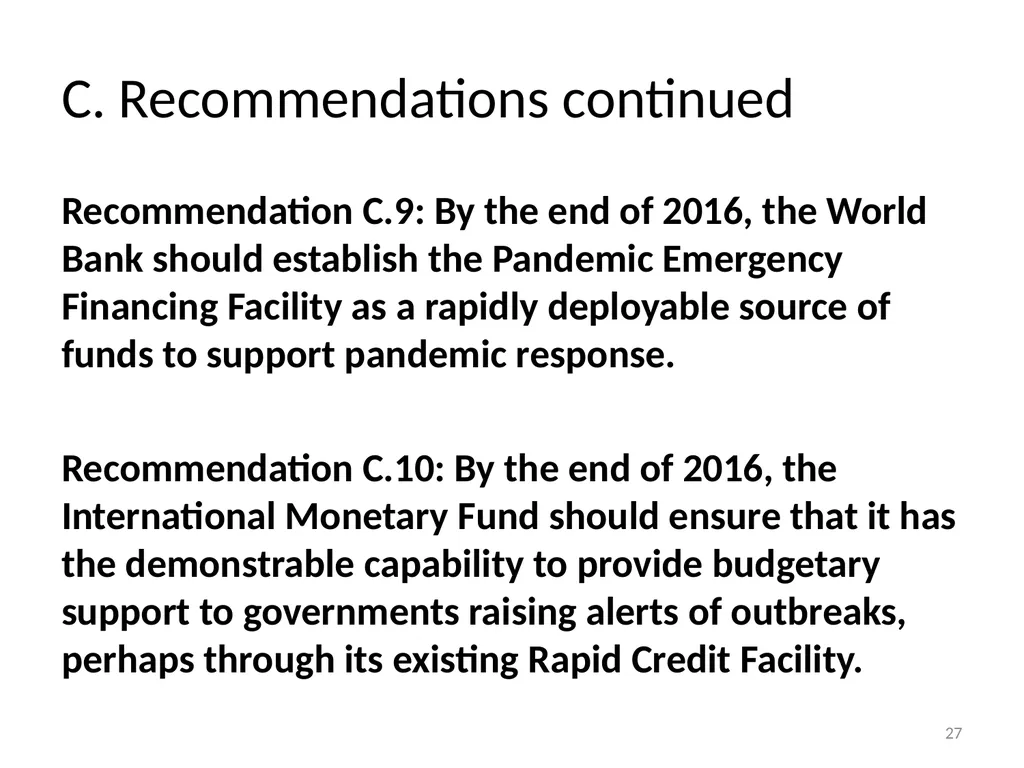
slide38. C. Recommendations continued Recommendation C.9: By the end of 2016, the World Bank should establish the Pandemic Emergency Financing Facility as a rapidly deployable source of funds to support pandemic response.
Recommendation C.10: By the end of 2016, the International Monetary Fund should ensure that it has the demonstrable capability to provide budgetary support to governments raising alerts of outbreaks, perhaps through its existing Rapid Credit Facility. 27<br>
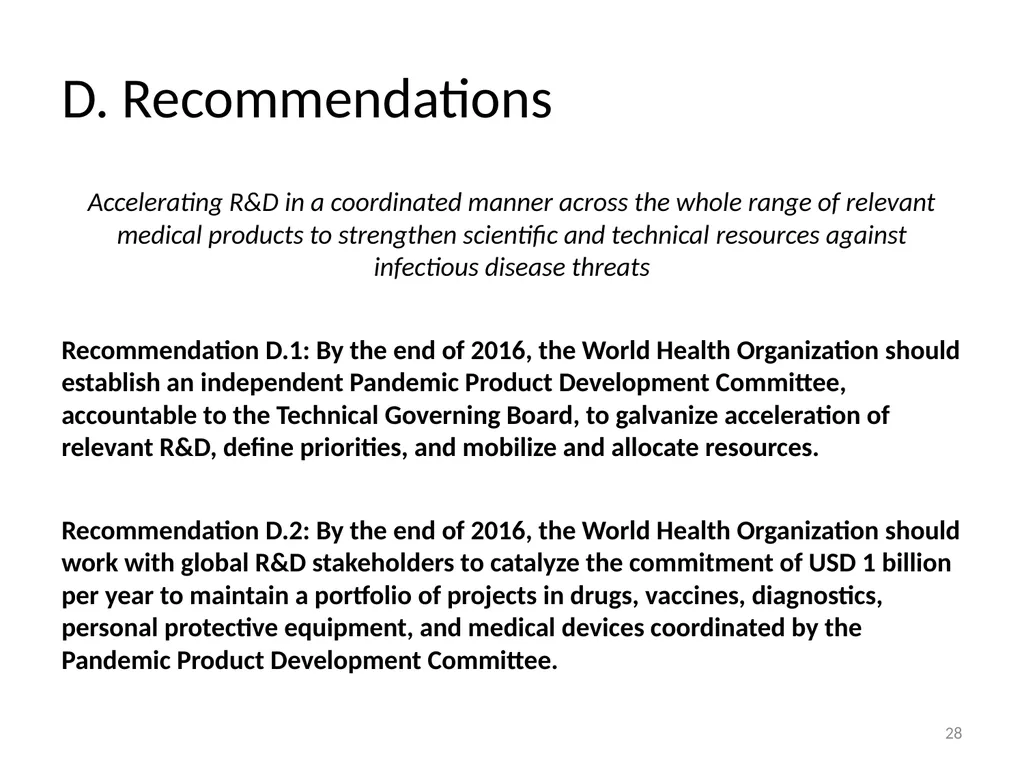
slide39. D. Recommendations Accelerating R&D in a coordinated manner across the whole range of relevant medical products to strengthen scientific and technical resources against infectious disease threats
Recommendation D.1: By the end of 2016, the World Health Organization should establish an independent Pandemic Product Development Committee, accountable to the Technical Governing Board, to galvanize acceleration of relevant R&D, define priorities, and mobilize and allocate resources.
Recommendation D.2: By the end of 2016, the World Health Organization should work with global R&D stakeholders to catalyze the commitment of USD 1 billion per year to maintain a portfolio of projects in drugs, vaccines, diagnostics, personal protective equipment, and medical devices coordinated by the Pandemic Product Development Committee. 28<br>
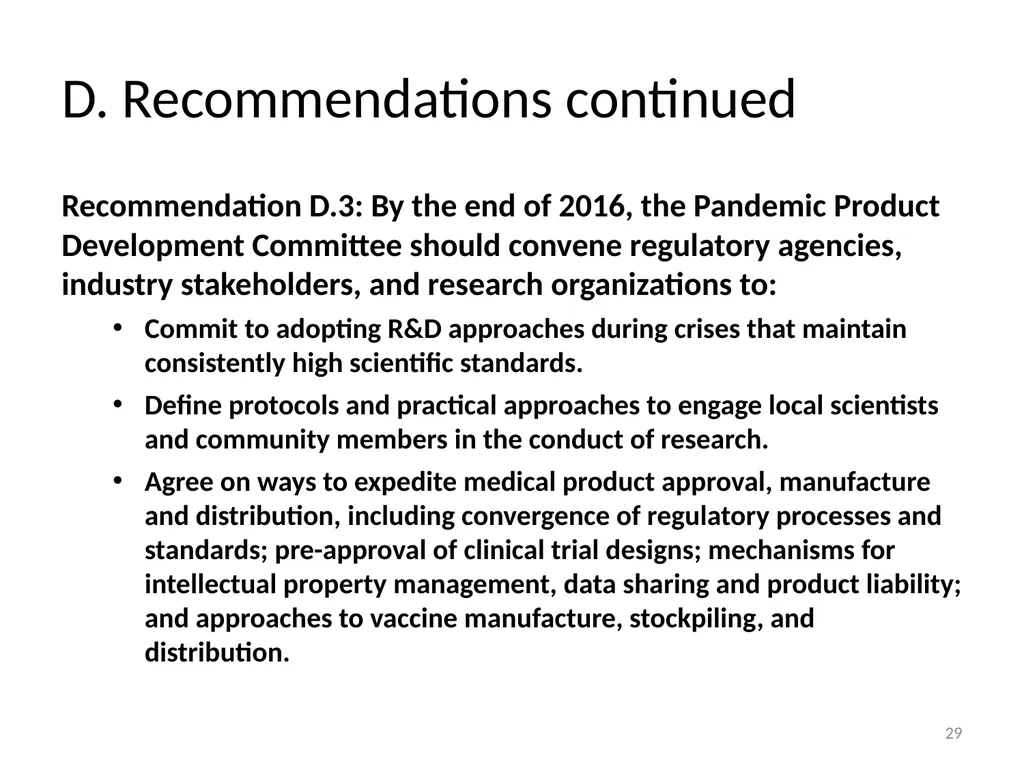
slide40. D. Recommendations continued Recommendation D.3: By the end of 2016, the Pandemic Product Development Committee should convene regulatory agencies, industry stakeholders, and research organizations to:
Commit to adopting R&D approaches during crises that maintain consistently high scientific standards.
Define protocols and practical approaches to engage local scientists and community members in the conduct of research.
Agree on ways to expedite medical product approval, manufacture and distribution, including convergence of regulatory processes and standards; pre-approval of clinical trial designs; mechanisms for intellectual property management, data sharing and product liability; and approaches to vaccine manufacture, stockpiling, and distribution. 29<br>
Before the outbreak occurs, we need to identify leaders and roles, resources, appropriate times for responding.
Successful containment of future outbreaks requires timeliness.
Coordinated response informed by good planning and evidence, not fear or politics.
Responders need to move as one to avoid mistrust, stigma, or miseducation of communities.
Need to learn now, before memories fade.<br>
slide3. U.S. National Academy of Sciences Charter (1863) “The academy shall, whenever called upon by any department of the government, investigate, examine… and report upon any subject of science.” The New York Times describes the IOM as “the most esteemed and authoritative adviser on issues of health and medicine, and its reports can transform medical thinking around the world.”<br>
slide4. Global Health Risk Framework Initiative What?
A plan for a global architecture for preparedness and response mitigating the threat of epidemic infectious diseases
How?
Fall 2014: A concerned conversation between Jim Kim, World Bank, and Victor Dzau about the Ebola outbreak;
Support from Judith Rodin ( Rockefeller), and initial planning with World Bank, WHO, Rockefeller
December 2014: “Getting to Zero Ebola Cases in West Africa: A Convening of Leaders” chaired by Margaret Chan
March 2015: Planning meeting for Global Health Risk Framework
Support
Paul Allen Foundation, Ford Foundation, Gates Foundation, Ming Wai Lau, Moore Foundation, Rockefeller Foundation, USAID, Wellcome Trust<br>
slide5. Architecture of Global Health Risk Framework Initiative<br>
slide6. Commission Roster Peter Sands, MPA (Chair)
(Former) Standard Chartered PLC
Harvard Kennedy School
Oyewale Tomori, DVM, PhD (Vice-Chair)
Nigeria Academy of Sciences
Ximena Aguilera, MD
Universidad del Desarrollo, Chile
Irene Akua Agyepong, DrPh, MBChB, FGCPS
Ghana Health Service
Yvette Chesson-Wureh, JD
The University of Liberia
Paul Farmer, MD, PhD
Harvard Medical School
Partners in Health
Maria Freire, PhD
Foundation for the National Institutes of Health
Julio Frenk, MD, MPH, PhD
University of Miami
Lawrence Gostin, JD
Georgetown University
O'Neill Institute on National and Global Law
Gabriel Leung, MD, MPH
University of Hong Kong
Francis Omaswa, MBBCh, MMed, FRCS, FCS African Center for Global Health and Social Transformation
Melissa Parker, DPhil
London School of Hygiene & Tropical Medicine
K. Sujatha Rao, MA, MPA
(Former) Ministry of Health & Family Welfare of India
Daniel Ryan, MA
Swiss Re
Jeanette Vega, MD, MPH, PhD
Chilean National Health Fund
Suwit Wibulpolprasert, MD
Ministry of Public Health, Thailand
Tadataka Yamada, MD
Frazier Life Sciences<br>
slide7. International Oversight Group Members Victor Dzau (Chair), President, National Academy of Medicine Judith Rodin (Vice-Chair), President, The Rockefeller Foundation Fazle Hasan Abed, Founder of BRAC and Chairman of BRAC Bank Limited Arnaud Bernaert, Senior Director, Head of Global Health and Healthcare Industries, World Economic Forum Chris Elias, President of the Global Development Program, Bill & Melinda Gates Foundation Jeremy Farrar, President, Wellcome Trust Shigeru Omi, President, Japan Community Healthcare Organization
Paul Polman, CEO, Unilever Mirta Roses, Former Director-General Pan American Health Organization
Shen Xiaoming, Professor of Pediatrics, Xin Hua Hospital and Shanghai Children’s Medical Center, Shanghai Jiao Tong University School of Medicine
Tan Chorh Chuan, President, National University of Singapore
Miriam Were, Chancellor, Moi University<br>
slide8. Architecture of Global Health Risk Framework Initiative<br>
slide9. Timeline July – Commission Meeting #1
Aug-Sept – Four Workshops
August 5-7 – Resilient Health Systems (Ghana)
August 19-21– R&D of Medical Products (Hong Kong)
August 27-28 – Pandemic Financing (Washington, D.C.)
September 1-2 – Governance for Global Health (London)
Sept-Dec – Consultations
September 25 – US federal government
October 9 – International and national representatives
November 12 – Jim Yong Kim, President, World Bank
November 20 – Margaret Chan, Director-General, WHO
December 16 – Japanese government leadership & G7 planning
October – Commission Meeting #2
November – Commission Meeting #3
January 2016 – Report release<br>
slide10. Four Key Features Characterized the Report Independence.
The remit, membership, and processes of the Commission were designed to ensure independence from individual governments, international agencies, and other stakeholders.
Forward-looking focus.
Devised recommendations for the future, drawing on lessons not just from Ebola, but from previous outbreaks, including SARS, MERS and the H1N1 influenza and HIV/AIDS pandemics.
Comprehensiveness.
Considered every aspect of an effective framework ranging from models of governance at an international level to the skills and infrastructure requirements at the local level. Assessed the implications for scientific research and development and defined the financing requirements.
Timeliness .
The Commission completed its work within six months to enable the recommendations to inform policy initiatives in 2016.<br>
slide11. Dissemination Plan to achieve maximum impact via:
Scholarly journals and op-eds
Personal briefings with key leaders
Key international events, e.g.,
World Economic Forum annual meeting in Davos
World Health Organization Executive Board meeting
Asia Launch in Hong Kong
Africa Launch
World Bank and International Monetary Fund spring meetings
G7
Others<br>
slide13. Outline Overview of Report Recommendations
The Framework
Rationale for Recommendations
Financing the Framework
Conclusion 2<br>
slide14. Summary of Recommendations Source: Sands, Mundaca-Shah, and Dzau. In press. The neglected dimension of global security – a framework to counter infectious disease crises, a perspective. NEJM. 3<br>
slide15. Summary of Recommendations (Cont.) Source: Sands et al., in press. 4<br>
slide16. 5 Source: Sands et al., in press. Summary of Recommendations (Cont.)<br>
slide17. 6 Source: Sands et al., in press. Summary of Recommendations (Cont.)<br>
slide18. The Framework Stronger national public health capabilities, infrastructure, and processes built to a common standard and regularly assessed through an objective, transparent process fully consistent with international legal obligations under the IHR.
More effective global and regional capabilities, led by a reenergized WHO, through a dedicated Center for Health Emergency Preparedness and Response, coordinated effectively with the rest of the UN system, and supported by the World Bank and IMF.
An accelerated programme of R&D, deploying USD 1 billion per year and coordinated by a dedicated committee 7<br>
slide19. 8 Strengthening public health as the foundation of the health system and first line of defense Establish clear definition of core capacities and rigorous external assessments to evaluate country performance
Recognize that a fundamental part of the governments’ basic duty is to protect its citizens against infectious disease threats. Governments should:
Create plans to achieve and maintain benchmark core capacities (including resourcing plans)
Commit to participate in external assessment process<br>
slide20. 9 Strengthening public health as the foundation of the health system and first line of defense Galvanize global and regional support for national core capacities:
Development partners’ support should align with country plans
World Bank’s support should be contingent on country’s participation in external assessment
IMF should incorporate results of these external assessment in its economic evaluations of countries
UNSG should take the lead to support fragile states/failed states/warzones, working with the WHO and other parts of the UN system<br>
slide21. 10 Strengthening the global and regional system for outbreak preparedness, alert, and response Create WHO Center for Health Emergency Preparedness and Response (CHEPR), overseen by an independent Technical Governing Board (TGB)
Establish clear pathways for multi-sectoral coordination with other UN agencies, regional networks, and non-state actors
Build mechanisms that normalize and incentivize early reporting<br>
slide22. 11 Strengthening the global and regional system for outbreak preparedness, alert, and response Create protocols to hold governments accountable for performance under IHR
Mobilize financial resources to enable rapid deployment of funds for response
CHEPR should be funded through existing resources plus an appropriate increase (say 5%) in member states’ core contributions
WHO should create and fund the $100 million contingency fund
World Bank should establish Pandemic Emergency Finance Facility (PEF)
IMF should provide budgetary support to governments raising alerts<br>
slide23. Accelerating R&D to counter the threat of infectious diseases Establish an independent Pandemic Product Development Committee (PPDC) for coordinating and prioritizing R&D efforts
Chair selected by WHO DG; WHO provides secretarial support
Coordination mechanism needed to pinpoint existing capabilities, identify gaps, and determine priorities for a concerted global effort to develop, test, manufacture, and distribute the relevant medical products in cases of emergency
Commit and mobilize USD 1 billion per year to maintain a portfolio of projects coordinated by the PPDC
Portfolio should include drugs, vaccines, diagnostics, personal protective equipment, and medical devices to build robust armory 12<br>
slide24. Accelerating R&D to counter the threat of infectious diseases Convene regulatory agencies, industry stakeholders, and research organizations to commit to:
High scientific standards to yield interpretable data and strong, valid conclusions
Open information exchange with local communities from the outset
Streamlining protocols to expedite medical product approval, manufacture and distribution 13<br>
slide25. 14 Financing the Framework Recognize the need to step up investment
Scale of threat to human lives and livelihoods is significant (economic expected loss of USD 60 billion per year)
Commitment is needed to rectify most important gaps in defenses
Commit to USD 4.5 billion per year to make humanity much safer. This includes:
USD 3.4 billion per year to strengthen public health systems
USD 130-155 million per year to reinforce international preparedness and response, including WHO and contingency funding
USD 1 billion per year to accelerate R&D on infectious disease threats<br>
slide26. 15 Financing the Framework Mobilize different sources of funds for specific components. This includes:
Domestic government resources for public health upgrading, with international support where required
WHO capabilities and contingency fund on basis of member state assessed contributions
World Bank PEF from innovative insurance/capital market solutions or binding contingent commitment
Incremental R&D funding from broad range of sources<br>
slide27. Conclusion 16 Infectious disease crises pose a significant threat to global security – to human lives and to economic well-being
We have neglected this threat – Ebola and other outbreaks revealed significant shortcomings in almost every aspects of our defenses
The case for investing more in pandemic preparedness is compelling
USD 4.5 billion per year would significantly reduce the risks to human lives and livelihoods
Investing in preparedness and prevention is far more cost-effective than reacting when outbreaks occur
The Commission's recommendations constitute a coherent framework for countering the threat of infectious disease crises:
Reinforcing the first line of defense – public health capabilities and infrastructure at a national level
Strengthening capabilities and coordination at a regional and global level
Accelerating R&D
We must act with urgency – and we must monitor implementation. We all have a shared interest in making the world safer.<br>
slide28. Contact information Email Q&A questions to:
GHRFCommission@nas.edu
@GHRFCommission
#GHRF
Complete report at nam.edu/GHRF 17<br>
slide29. Appendix 18<br>
slide30. A. Recommendations Commit to creating and resourcing a comprehensive global framework
The G7, G20, and United Nations (UN), under the leadership of the UN Secretary General, should reinforce and sustain international focus and actions to protect human lives and livelihoods from the threat of infectious diseases by:
Recommendation A.1: Committing to implementing the framework set out in the report “The Neglected Dimension of Global Security: A Framework to Counter Infectious Disease Crises” and embodied in Recommendations B.1–D.3.
Recommendation A.2: Committing and mobilizing the incremental financial resources required to implement the framework, as set out in the report “The Neglected Dimension of Global Security: A Framework to Counter Infectious Disease Crises,” which amount to about USD 4.5 billion per year.
Recommendation A.3: Monitoring progress of implementation by commissioning an independent assessment in 2017 and every 3 years thereafter. 19<br>
slide31. B. Recommendations Reinforcing robust public health infrastructure and capabilities as the first line of defense
Recommendation B.1: The World Health Organization, in collaboration with member states, should develop an agreed-on, precise definition and benchmarks for national core capabilities and functioning, based on, and implemented through, the International Health Regulations and building on the experiences of other efforts, including the Global Health Security Agenda and the World Organization for Animal Health Terrestrial Animal Health Code by the end of 2016. Benchmarks should be designed to provide metrics against which countries will be independently assessed (see Recommendation B.2).
Recommendation B.2: The World Health Organization should devise a regular, independent, transparent, and objective assessment mechanism to evaluate country performance against the benchmarks defined in Recommendation B.1, building on current International Health Regulations monitoring tools and Global Health Security Agenda assessment pilots, by the end of 2016.
Recommendation B.3: By the end of 2016, all countries should commit to participate in the external assessment process as outlined in Recommendation B.2, including publication of results. 20<br>
slide32. B. Recommendations continued Recommendation B.4: The World Bank, bilateral, and other multilateral donors should declare that funding related to health system strengthening will be conditional upon a country’s participation in the external assessment process.
Recommendation B.5: The International Monetary Fund should include pandemic preparedness in its economic and policy assessments of individual countries, based on outcomes of the external assessment of national core capacities as outlined in Recommendation B.2. 21<br>
slide33. B. Recommendations continued Recommendation B.6: Countries should develop plans to achieve and maintain benchmark core capacities (as defined in Recommendations B.1). These plans should be published by mid-2017, with a target to achieve full compliance with the benchmarks by 2020. These plans should include sustainable resourcing components, including both financing and skills.
Recommendation B.7: The World Health Organization (WHO) should provide technical support to countries to fill gaps in their core capacities and achieve benchmark performance. (Technical support will be coordinated through a WHO Center for Health Emergency Preparedness and Response; see Recommendation C.1.)
Recommendation B.8: National governments should develop domestic resourcing plans to finance improvement and maintenance of core capacities as set out in the country-specific plans described in Recommendation B.6. For upper- and upper-middle-income countries, these plans should cover all financing requirements. For lower-middle- and low-income countries, these plans should seek to develop a pathway to full domestic resourcing, with a clear timetable for achieving the core capacity benchmarks. 22<br>
slide34. B. Recommendations continued Recommendation B.9: The World Bank should convene other multilateral donors (including the African Development Bank, Asian Development Bank, New Development Bank, United Nations Development Program, and Asian Infrastructure Investment Bank) and development partners by mid-2017 to secure financial support for lower-middle- and low-income countries in delivering the plans outlined in Recommendation B.6.
Recommendation B.10: The United Nations (UN) Secretary General should work with the World Health Organization and other parts of the UN system to develop strategies for sustaining health system capabilities and infrastructure in fragile and failed states and in warzones, to the extent possible. 23<br>
slide35. C. Recommendations Strengthening international coordination and capabilities is the next most vital component of the framework.
Recommendation C.1: By the end of 2016, the World Health Organization should create a Center for Health Emergency Preparedness and Response action at headquarters, regional, and country office levels—to lead the global effort toward outbreak preparedness and response. This should be governed by an independent Technical Governing Board.
Recommendation C.2: In May 2016, the World Health Assembly should agree to an appropriate increase in the World Health Organization member states’ core contributions to provide sustainable financing for the Center for Health Emergency Preparedness and Response.
Recommendation C.3: By the end of 2016, the World Health Organization should create and fund a sustainable contingency fund of USD 100 million to support rapid deployment of emergency response capabilities through one off contributions or commitments proportional with assessed contributions from member states. 24<br>
slide36. C. Recommendations continued Recommendation C.4: By the end of 2016, the United Nations (UN) and the World Health Organization should establish clear mechanisms for coordination and escalation in health crises, including those that become or are part of broader humanitarian crises requiring mobilization of the entire UN system.
Recommendation C.5: By the end of 2017, the World Health Organization should work with existing formal and informal regional and sub-regional networks to strengthen linkages and coordination, and thus enhance mutual support and trust, sharing of information and laboratory resources, and joint outbreak investigations amongst neighboring countries.
Recommendation C.6: By the end of 2016, the World Health Organization and national governments should enhance means of cooperation with non-state actors, including local and international civil society organizations, the private sector, and the media. 25<br>
slide37. C. Recommendations continued Recommendation C.7: By the end of 2016, the World Health Organization (WHO) should establish a mechanism to generate a daily high-priority “watch list” of outbreaks with potential to become a Public Health Emergency of International Concern to normalize the process of reporting of outbreaks by country and encourage necessary preparedness activities. The WHO should communicate this list to national focal points on a daily basis and provide a public summary on a weekly basis.
Recommendation C.8: By the end of 2016, the World Health Assembly should agree on new mechanisms for holding governments publicly accountable for performance under the International Health Regulations and broader global health risk framework, as detailed in Recommendation B.2, including:
protocols for avoiding suppression or delays in data and alerts, and
protocols for avoiding unnecessary restrictions on trade or travel. 26<br>
slide38. C. Recommendations continued Recommendation C.9: By the end of 2016, the World Bank should establish the Pandemic Emergency Financing Facility as a rapidly deployable source of funds to support pandemic response.
Recommendation C.10: By the end of 2016, the International Monetary Fund should ensure that it has the demonstrable capability to provide budgetary support to governments raising alerts of outbreaks, perhaps through its existing Rapid Credit Facility. 27<br>
slide39. D. Recommendations Accelerating R&D in a coordinated manner across the whole range of relevant medical products to strengthen scientific and technical resources against infectious disease threats
Recommendation D.1: By the end of 2016, the World Health Organization should establish an independent Pandemic Product Development Committee, accountable to the Technical Governing Board, to galvanize acceleration of relevant R&D, define priorities, and mobilize and allocate resources.
Recommendation D.2: By the end of 2016, the World Health Organization should work with global R&D stakeholders to catalyze the commitment of USD 1 billion per year to maintain a portfolio of projects in drugs, vaccines, diagnostics, personal protective equipment, and medical devices coordinated by the Pandemic Product Development Committee. 28<br>
slide40. D. Recommendations continued Recommendation D.3: By the end of 2016, the Pandemic Product Development Committee should convene regulatory agencies, industry stakeholders, and research organizations to:
Commit to adopting R&D approaches during crises that maintain consistently high scientific standards.
Define protocols and practical approaches to engage local scientists and community members in the conduct of research.
Agree on ways to expedite medical product approval, manufacture and distribution, including convergence of regulatory processes and standards; pre-approval of clinical trial designs; mechanisms for intellectual property management, data sharing and product liability; and approaches to vaccine manufacture, stockpiling, and distribution. 29<br>