03
References Zukerman, “Introduction to Queueing Theory and Stochastic Teletraffic Models”
http://arxiv.org/abs/1307.2968, July 2013.
Advanced (suitable for a whole grad course or two)
I’ll denote this by “Zukerman”
We’ll be picking and choosing a small fraction of the material, note that we don’t have time to go through the derivations. We will, however, verify some results via Discrete Event Simulation in Python.
Wikipedia…<br>
04
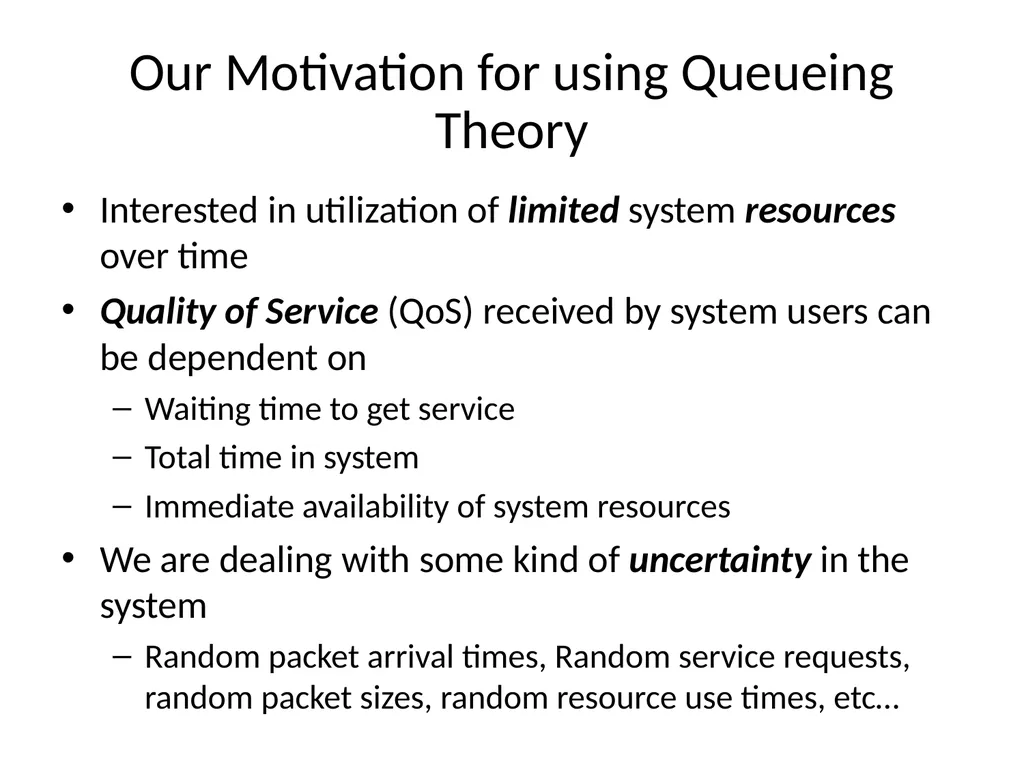
Our Motivation for using Queueing Theory Interested in utilization of limited system resources over time
Quality of Service (QoS) received by system users can be dependent on
Waiting time to get service
Total time in system
Immediate availability of system resources
We are dealing with some kind of uncertainty in the system
Random packet arrival times, Random service requests, random packet sizes, random resource use times, etc…<br>
05
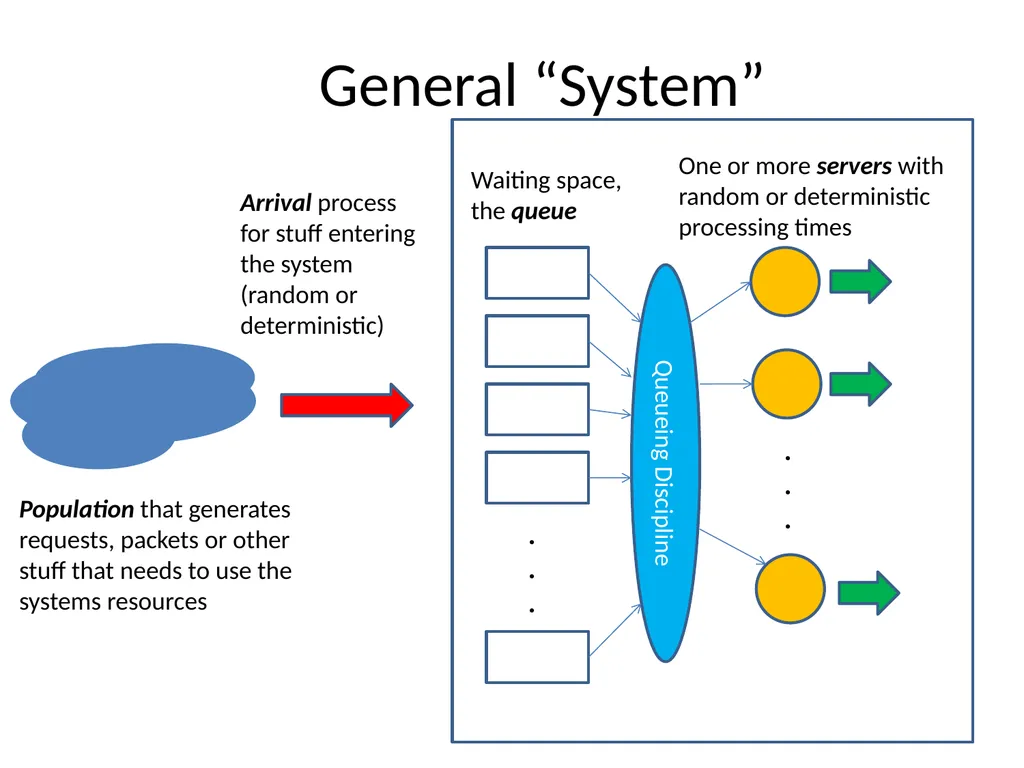
General “System” Population that generates requests, packets or other stuff that needs to use the systems resources Arrival process for stuff entering the system (random or deterministic) Waiting space, the queue One or more servers with random or deterministic processing times<br>
06
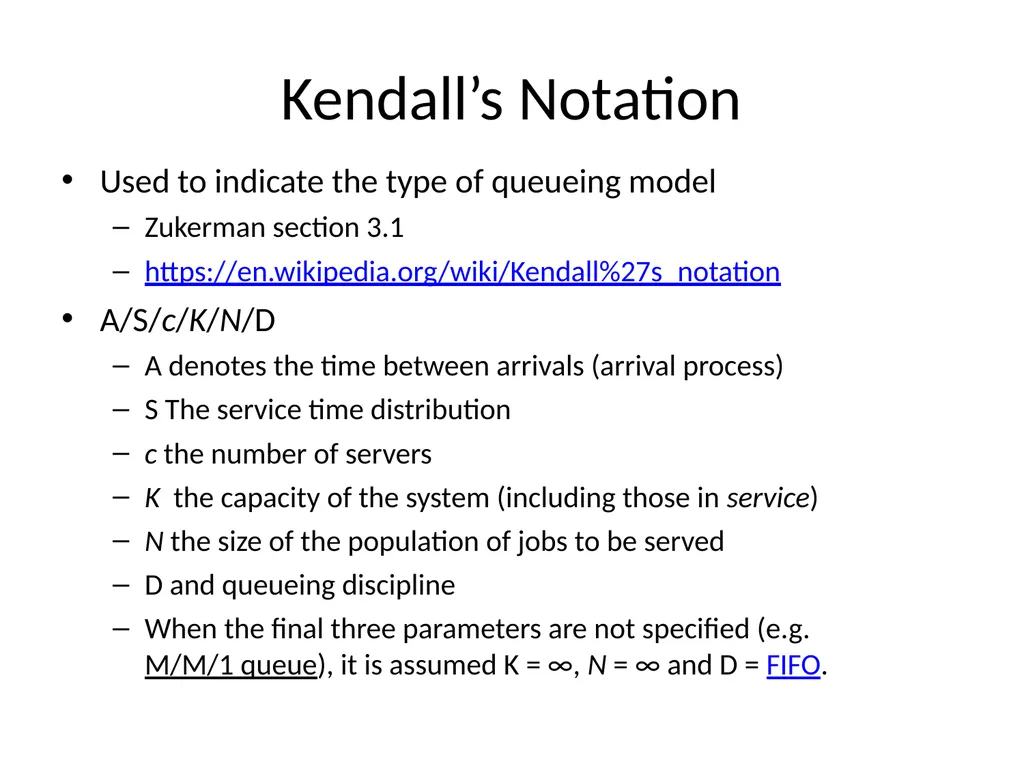
Kendall’s Notation Used to indicate the type of queueing model
Zukerman section 3.1
https://en.wikipedia.org/wiki/Kendall%27s_notation
A/S/c/K/N/D
A denotes the time between arrivals (arrival process)
S The service time distribution
c the number of servers
K the capacity of the system (including those in service)
N the size of the population of jobs to be served
D and queueing discipline
When the final three parameters are not specified (e.g. M/M/1 queue), it is assumed K = ∞, N = ∞ and D = FIFO.<br>
07
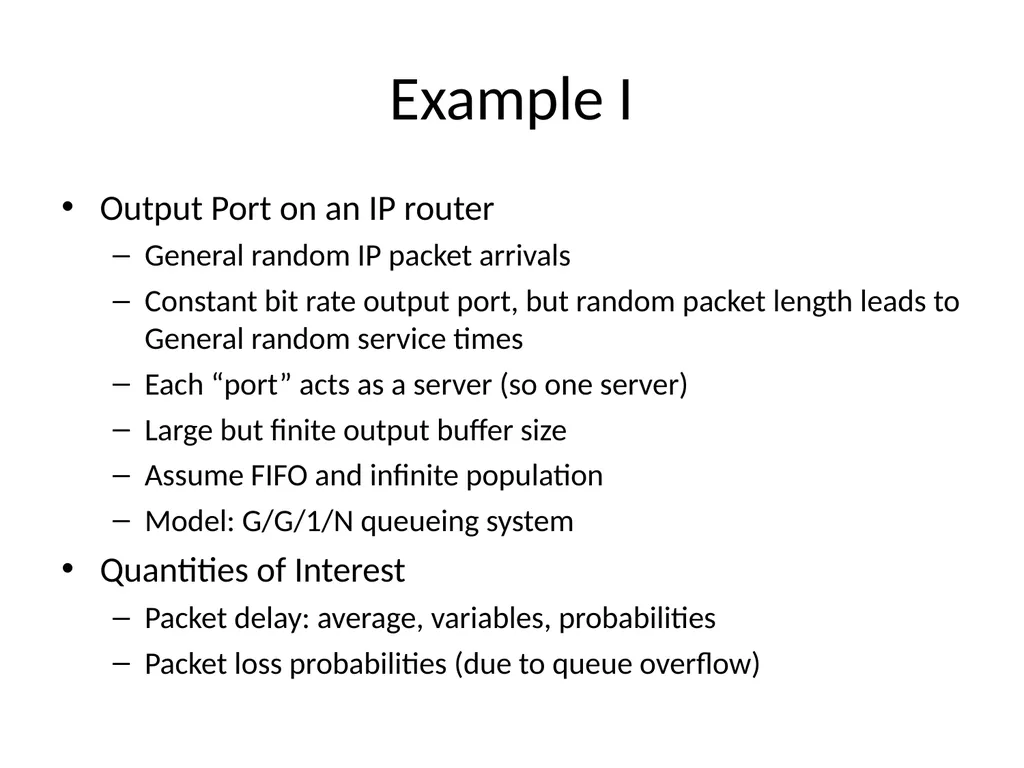
Example I Output Port on an IP router
General random IP packet arrivals
Constant bit rate output port, but random packet length leads to General random service times
Each “port” acts as a server (so one server)
Large but finite output buffer size
Assume FIFO and infinite population
Model: G/G/1/N queueing system
Quantities of Interest
Packet delay: average, variables, probabilities
Packet loss probabilities (due to queue overflow)<br>
08
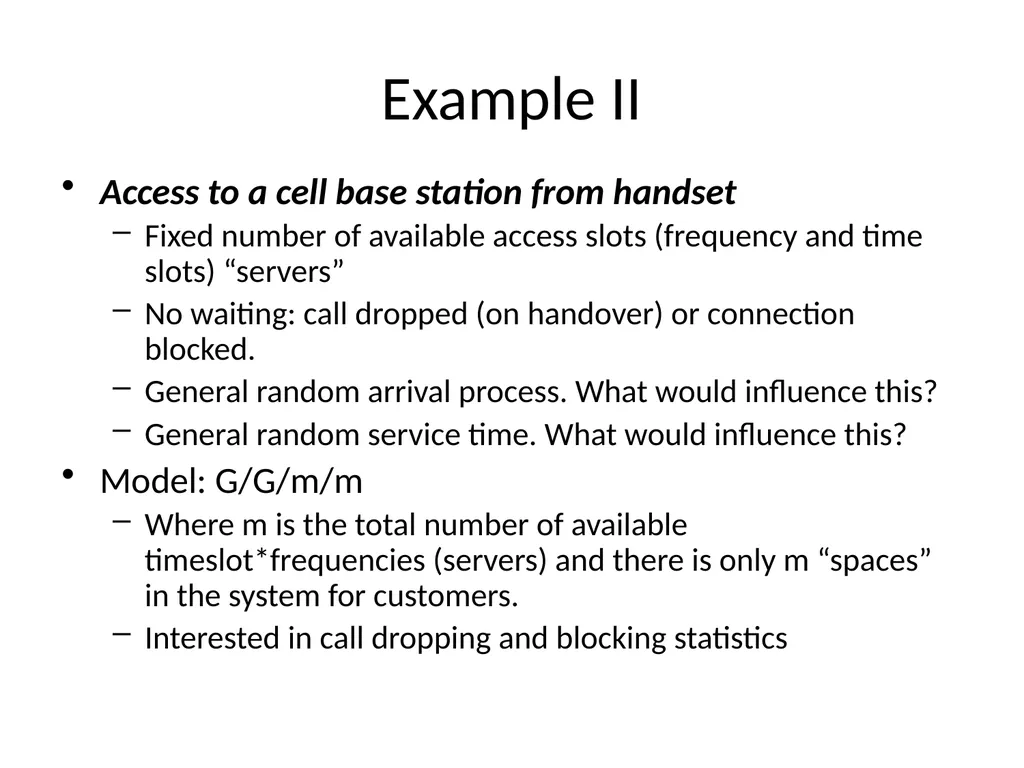
Example II Access to a cell base station from handset
Fixed number of available access slots (frequency and time slots) “servers”
No waiting: call dropped (on handover) or connection blocked.
General random arrival process. What would influence this?
General random service time. What would influence this?
Model: G/G/m/m
Where m is the total number of available timeslot*frequencies (servers) and there is only m “spaces” in the system for customers.
Interested in call dropping and blocking statistics<br>
10
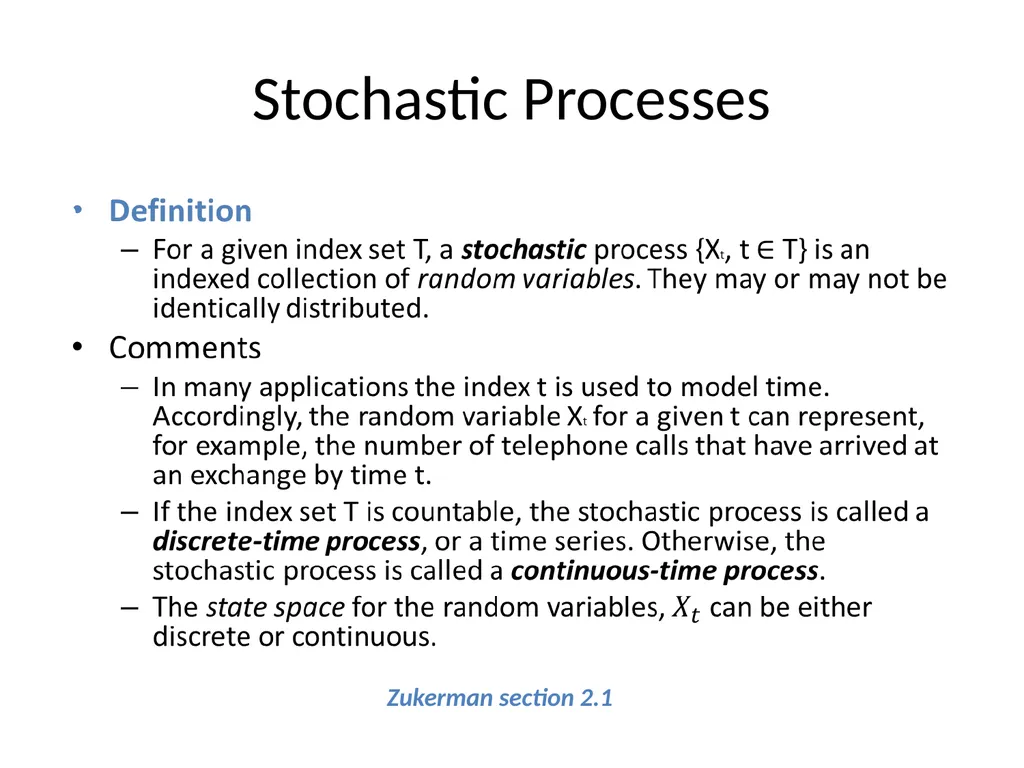
Stochastic Processes Zukerman section 2.1<br>
11
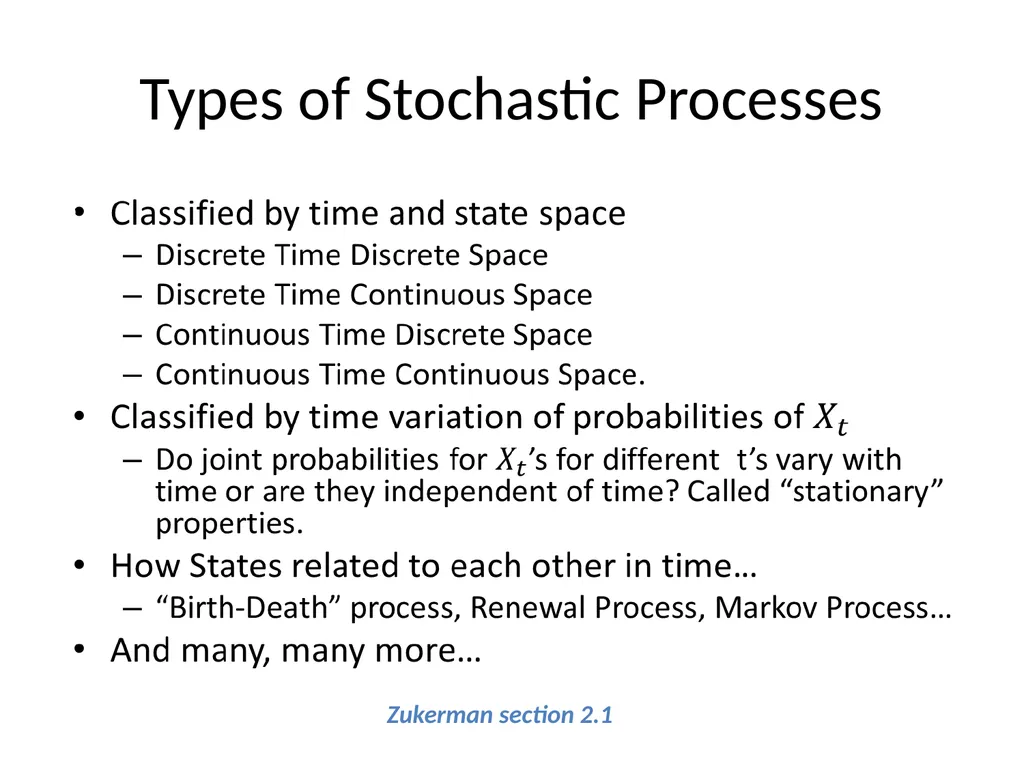
Types of Stochastic Processes Zukerman section 2.1<br>
12
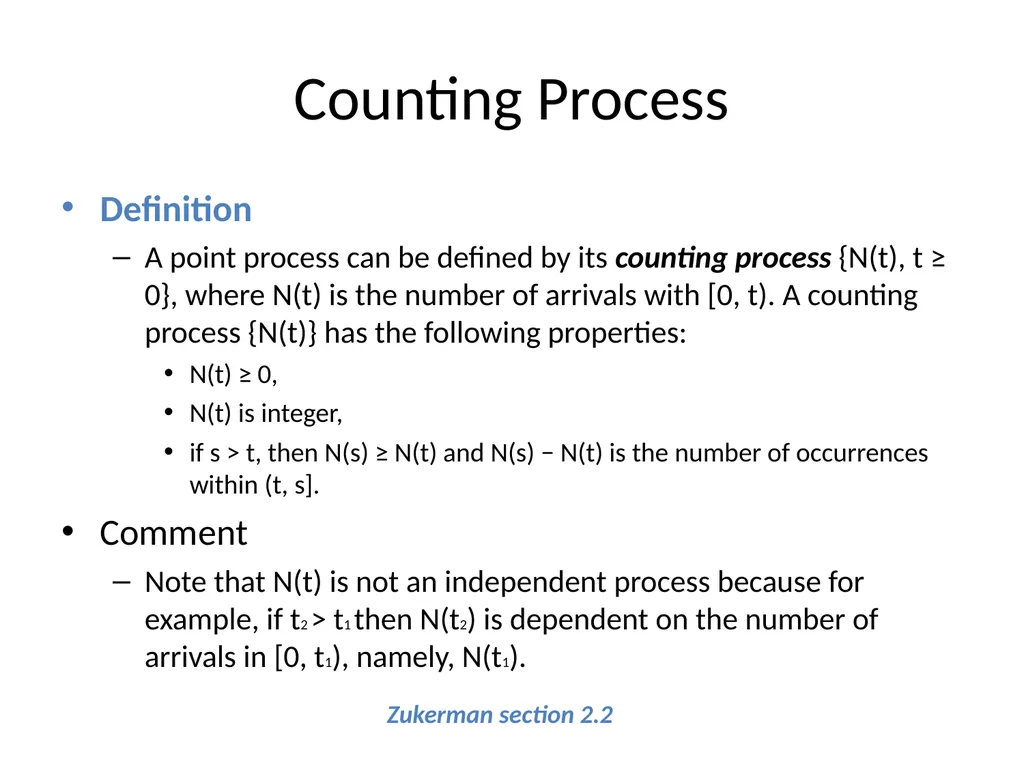
Counting Process Definition
A point process can be defined by its counting process {N(t), t ≥ 0}, where N(t) is the number of arrivals with [0, t). A counting process {N(t)} has the following properties:
N(t) ≥ 0,
N(t) is integer,
if s > t, then N(s) ≥ N(t) and N(s) − N(t) is the number of occurrences within (t, s].
Comment
Note that N(t) is not an independent process because for example, if t2 > t1 then N(t2) is dependent on the number of arrivals in [0, t1), namely, N(t1). Zukerman section 2.2<br>
13
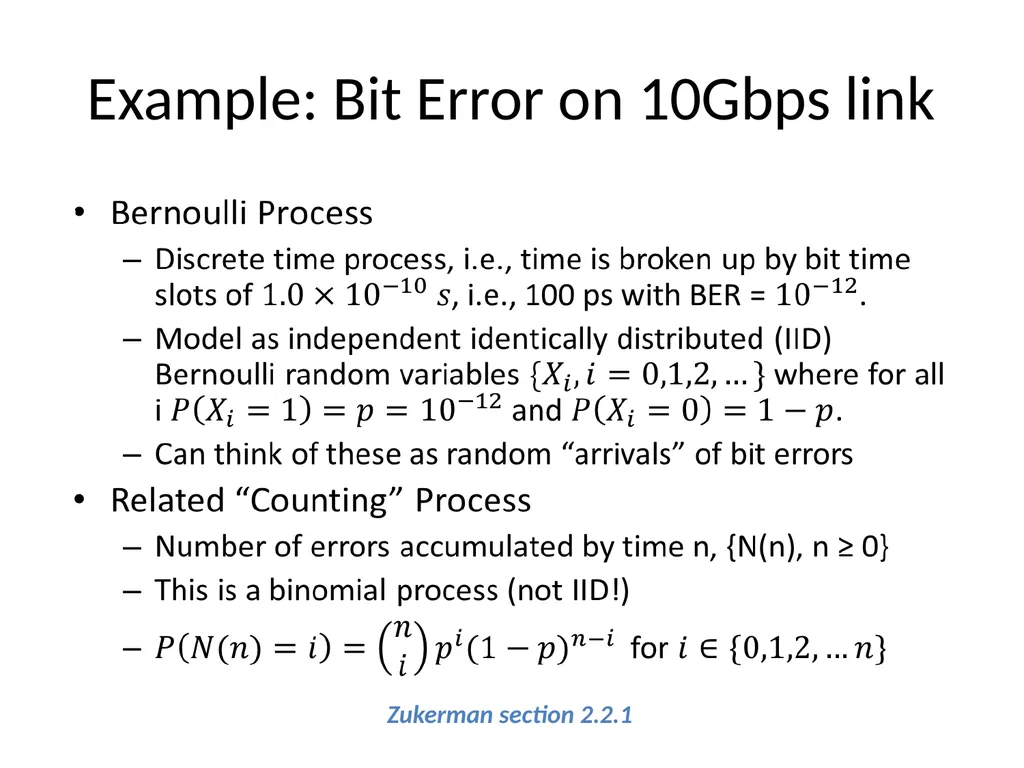
Example: Bit Error on 10Gbps link Zukerman section 2.2.1<br>
14
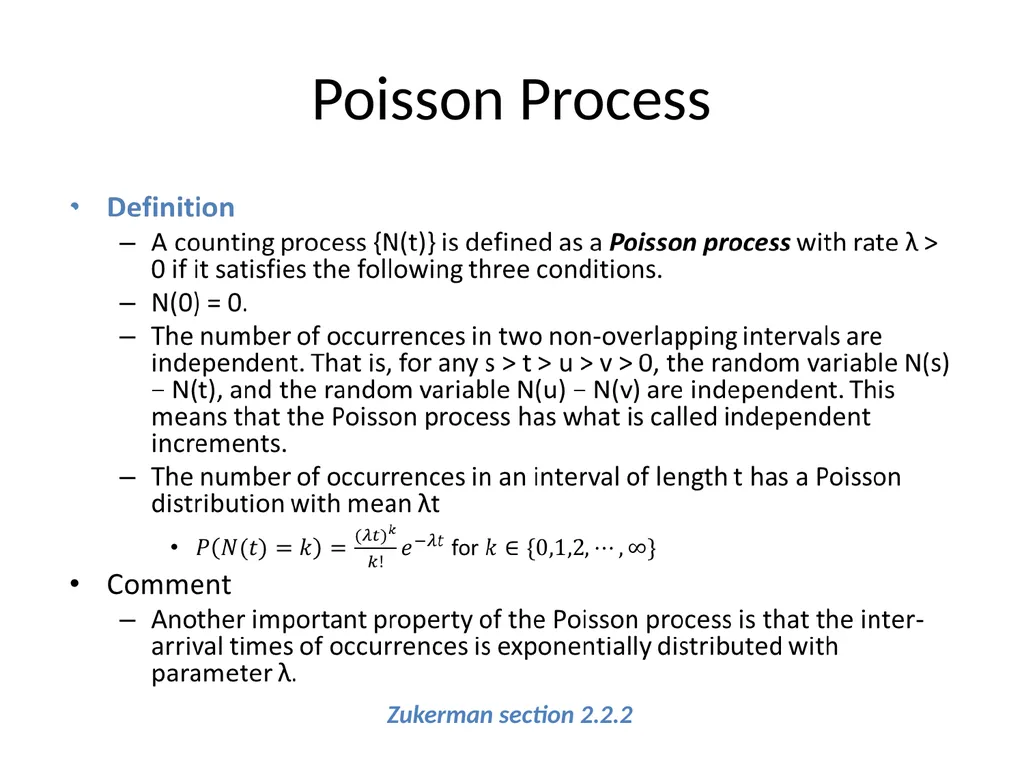
Poisson Process Zukerman section 2.2.2<br>
15
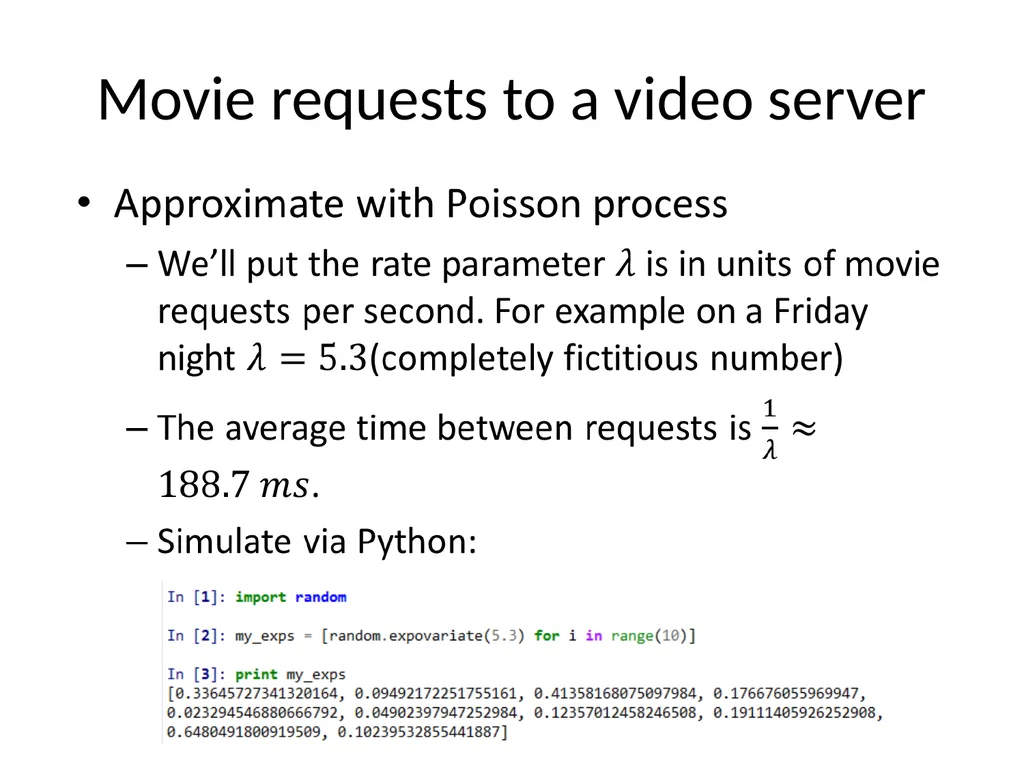
Movie requests to a video server<br>
16
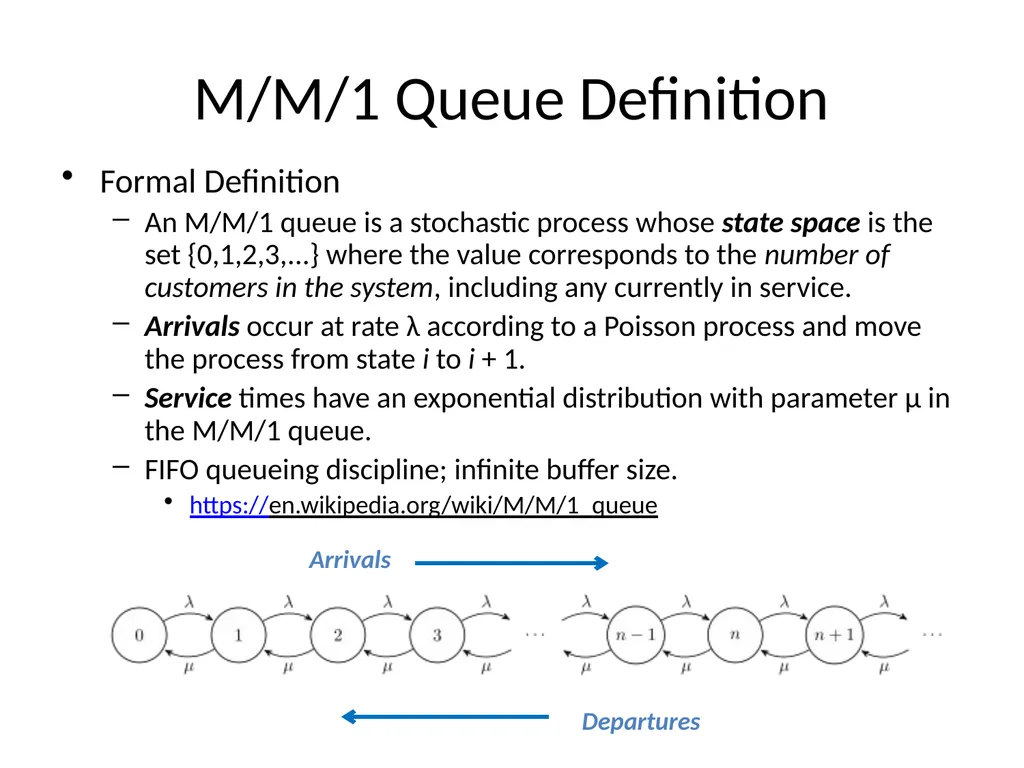
M/M/1 Queue Definition Formal Definition
An M/M/1 queue is a stochastic process whose state space is the set {0,1,2,3,...} where the value corresponds to the number of customers in the system, including any currently in service.
Arrivals occur at rate λ according to a Poisson process and move the process from state i to i + 1.
Service times have an exponential distribution with parameter μ in the M/M/1 queue.
FIFO queueing discipline; infinite buffer size.
https://en.wikipedia.org/wiki/M/M/1_queue Arrivals Departures<br>
17
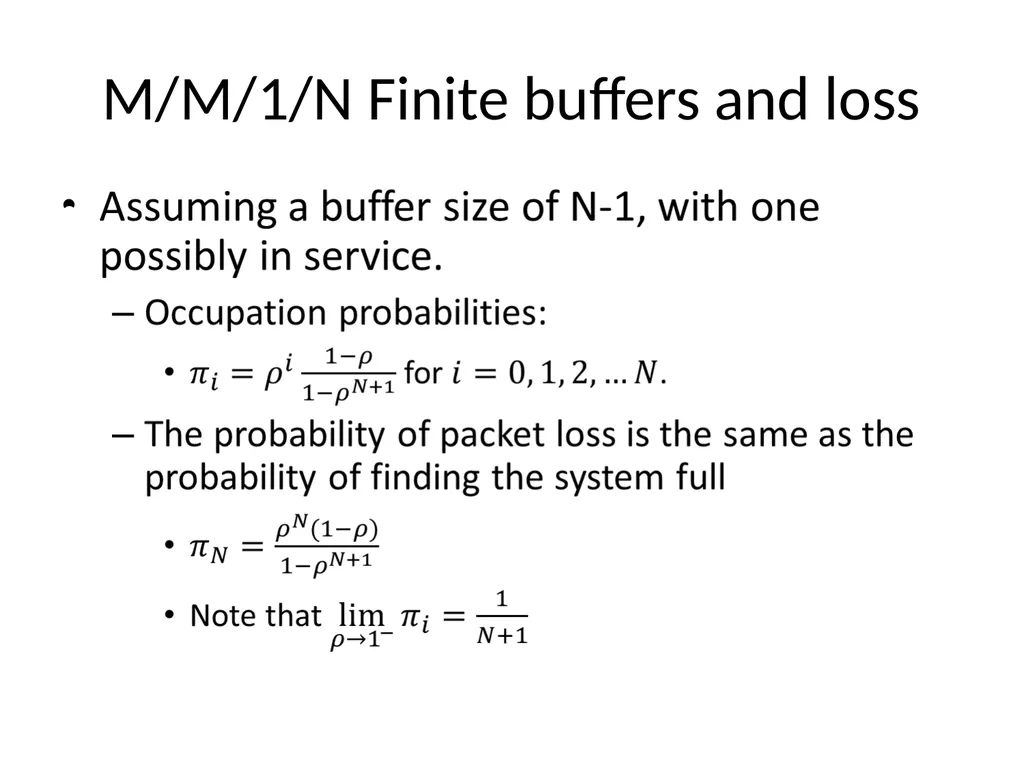
M/M/1/N Finite buffers and loss<br>
19
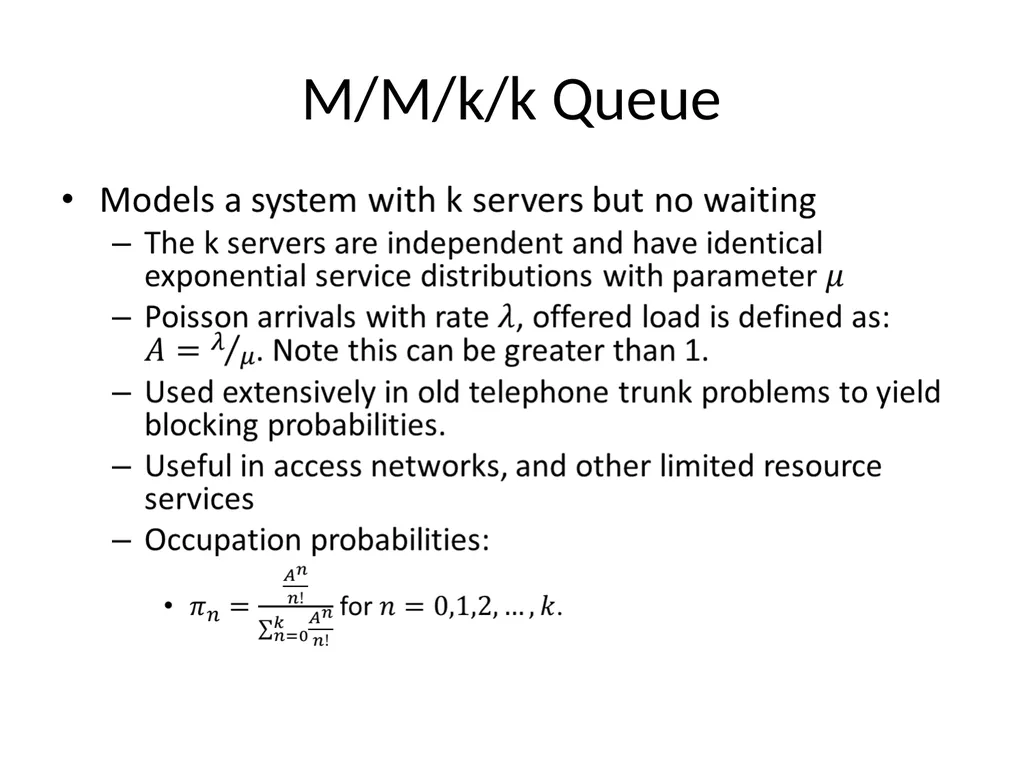
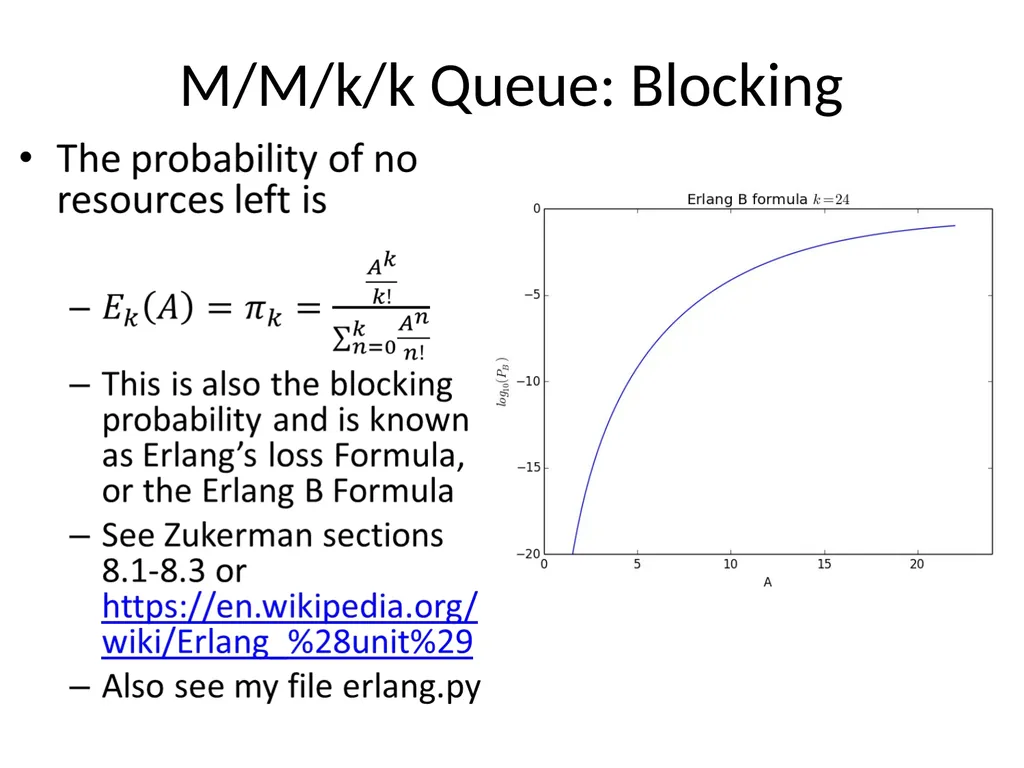
M/M/k/k Queue: Blocking<br>
20
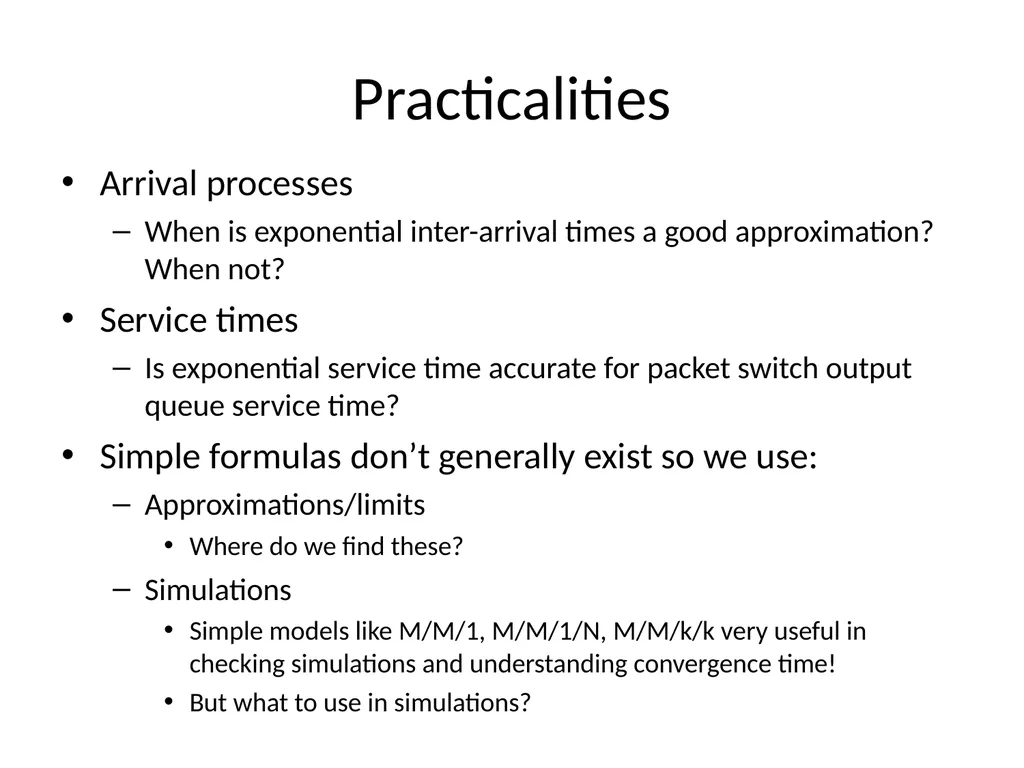
Practicalities Arrival processes
When is exponential inter-arrival times a good approximation? When not?
Service times
Is exponential service time accurate for packet switch output queue service time?
Simple formulas don’t generally exist so we use:
Approximations/limits
Where do we find these?
Simulations
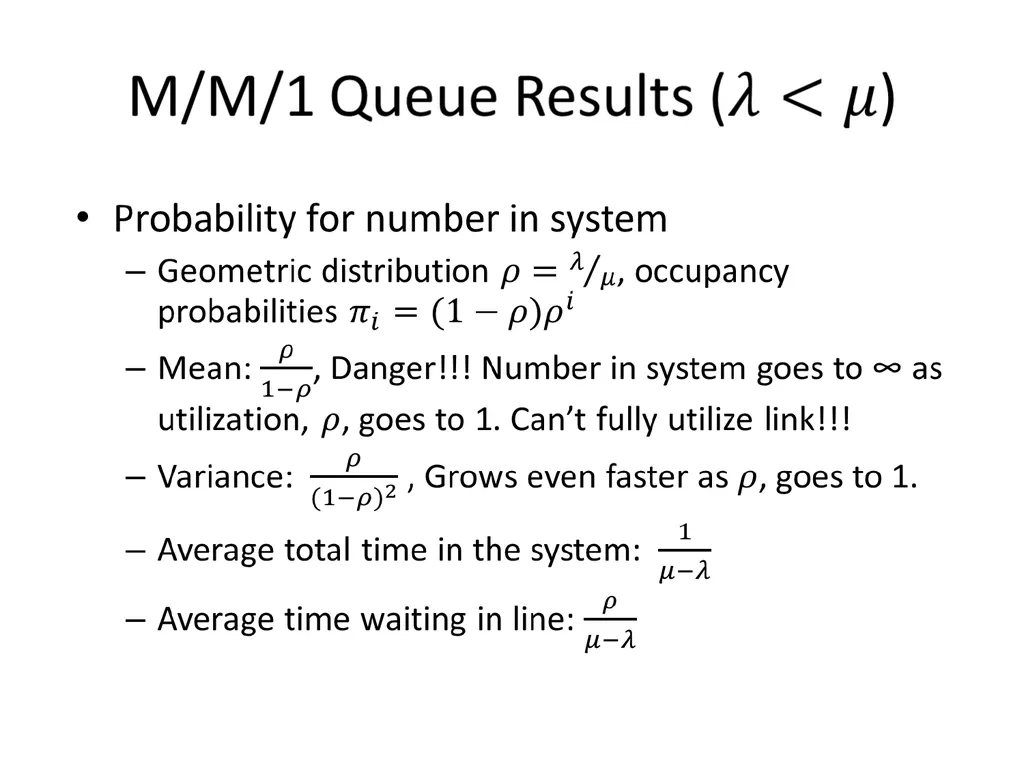
Simple models like M/M/1, M/M/1/N, M/M/k/k very useful in checking simulations and understanding convergence time!
But what to use in simulations?<br>
21
How to Shop for Results I Literature Search
Google, Google Scholar, ACM Digital Library, IEEE Explore
Evaluate and Filter by
Title (needs to sound somewhat relevant)
Abstract
Main way for you to evaluate whether you spend any more time reading the paper.<br>
22
How to Shop for Results II Other considerations before reviewing rest of paper
Journal or conference “quality”
Author or Author institution “reputation”
Specificity of result
If appropriate go to “Introduction”
Should provide a terse context/background on result
Should discuss related work
Can be a good source of more relevant papers via the reference list.<br>
23
How to Shop for Results III Check Reference List
Too few may indicate a problem with paper. Though some journals have strict limits on numbers.
Read the “Conclusion”
Should spell out what they accomplished.
If all the previous check out
Read the “body” of the paper
This may involve extra work such as looking up concepts and such which you may be unfamiliar<br>
24
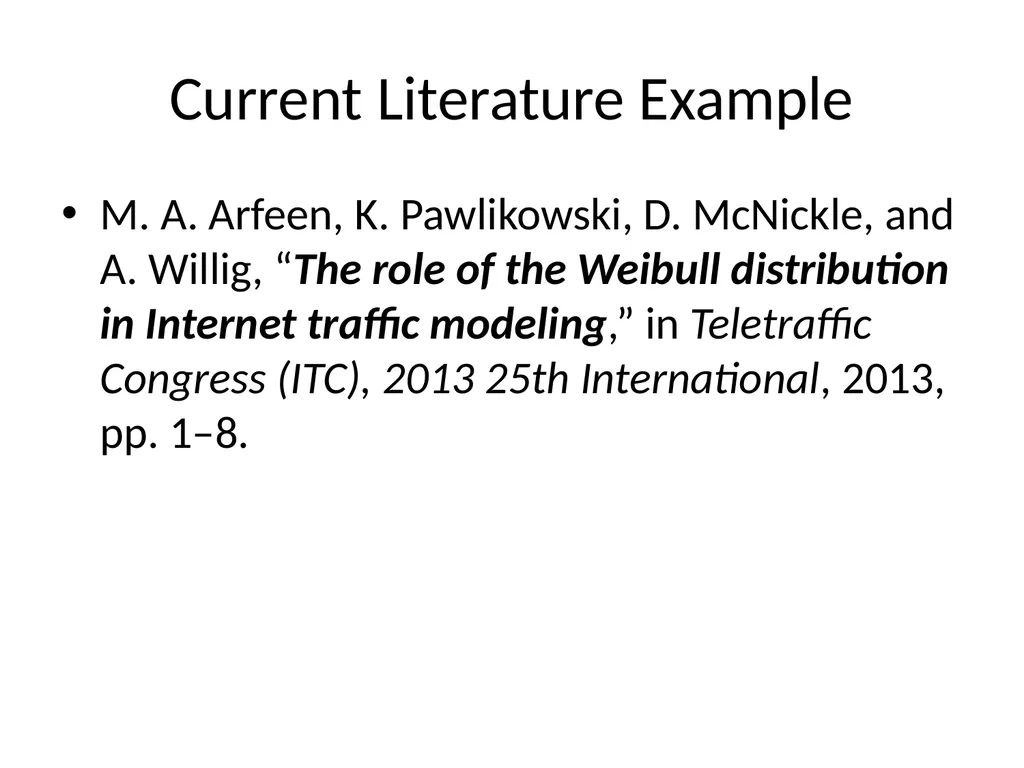
Current Literature Example M. A. Arfeen, K. Pawlikowski, D. McNickle, and A. Willig, “The role of the Weibull distribution in Internet traffic modeling,” in Teletraffic Congress (ITC), 2013 25th International, 2013, pp. 1–8.<br>
25
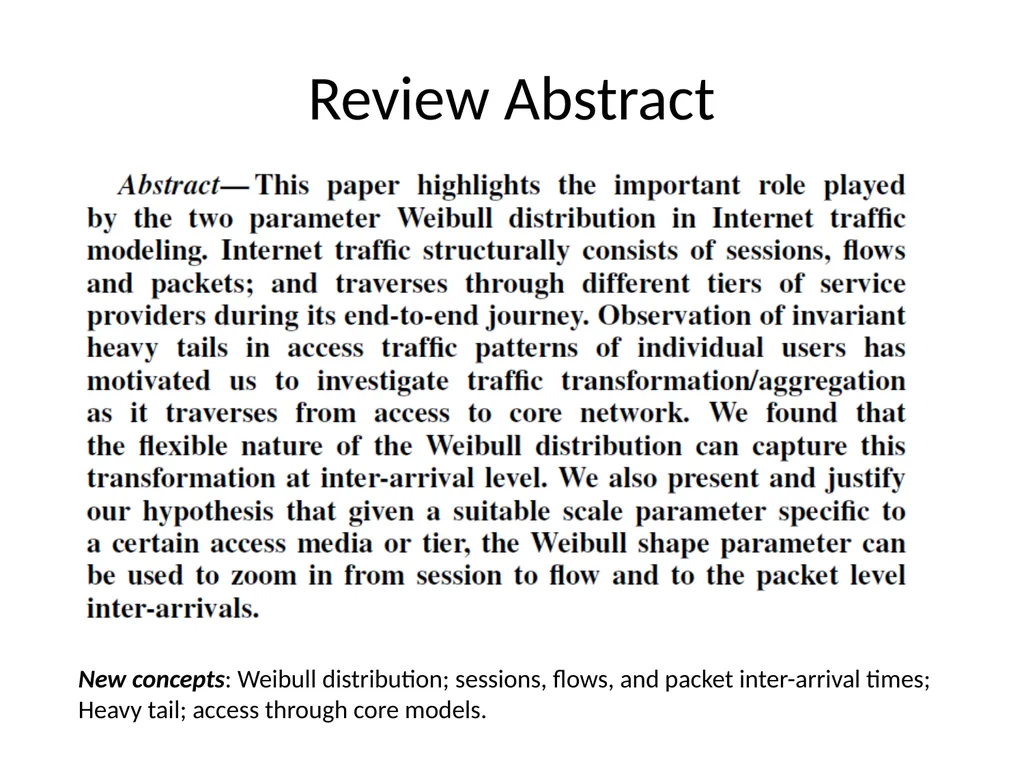
Review Abstract New concepts: Weibull distribution; sessions, flows, and packet inter-arrival times; Heavy tail; access through core models.<br>
26
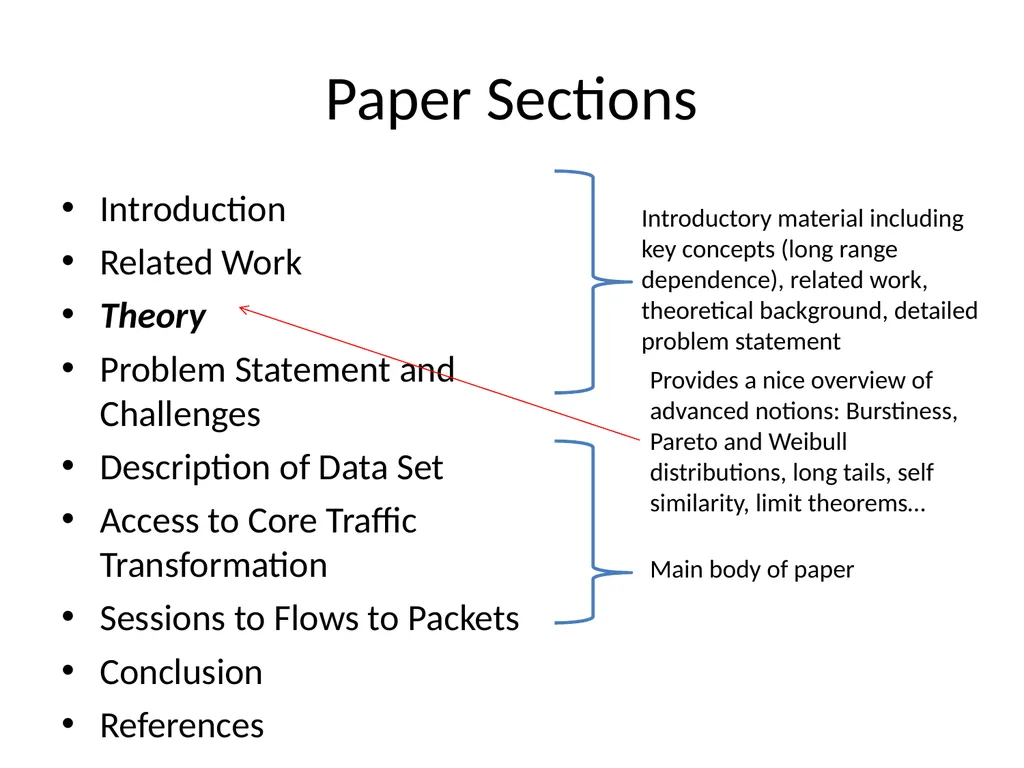
Paper Sections Introduction
Related Work
Theory
Problem Statement and Challenges
Description of Data Set
Access to Core Traffic Transformation
Sessions to Flows to Packets
Conclusion
References Introductory material including key concepts (long range dependence), related work, theoretical background, detailed problem statement Main body of paper Provides a nice overview of advanced notions: Burstiness, Pareto and Weibull distributions, long tails, self similarity, limit theorems…<br>