
Network Layer Chapter 5 CN5E by Tanenbaum &
Description: Network Layer Chapter 5 CN5E by Tanenbaum Wetherall, Pearson Education-Prentice Hall and D. Wetherall, 2011 Design Issues Routing Algorithms Congestion Control Quality of Service Internetworking Network Layer of the Internet Revised:
Related Topics
Download Presentation
"Network Layer Chapter 5 CN5E by Tanenbaum &" is the property of its rightful owner. Permission is granted to download and print the materials on this website for personal, non-commercial use only, and to display it on your personal computer provided you do not modify the materials and that you retain all copyright notices contained in the materials. By downloading content from our website, you accept the terms of this agreement.
Presentation Transcript
slide1. Network Layer
Chapter 5 CN5E by Tanenbaum & Wetherall, © Pearson Education-Prentice Hall and D. Wetherall, 2011 Design Issues
Routing Algorithms
Congestion Control
Quality of Service
Internetworking
Network Layer of the Internet Revised: August 2011<br>
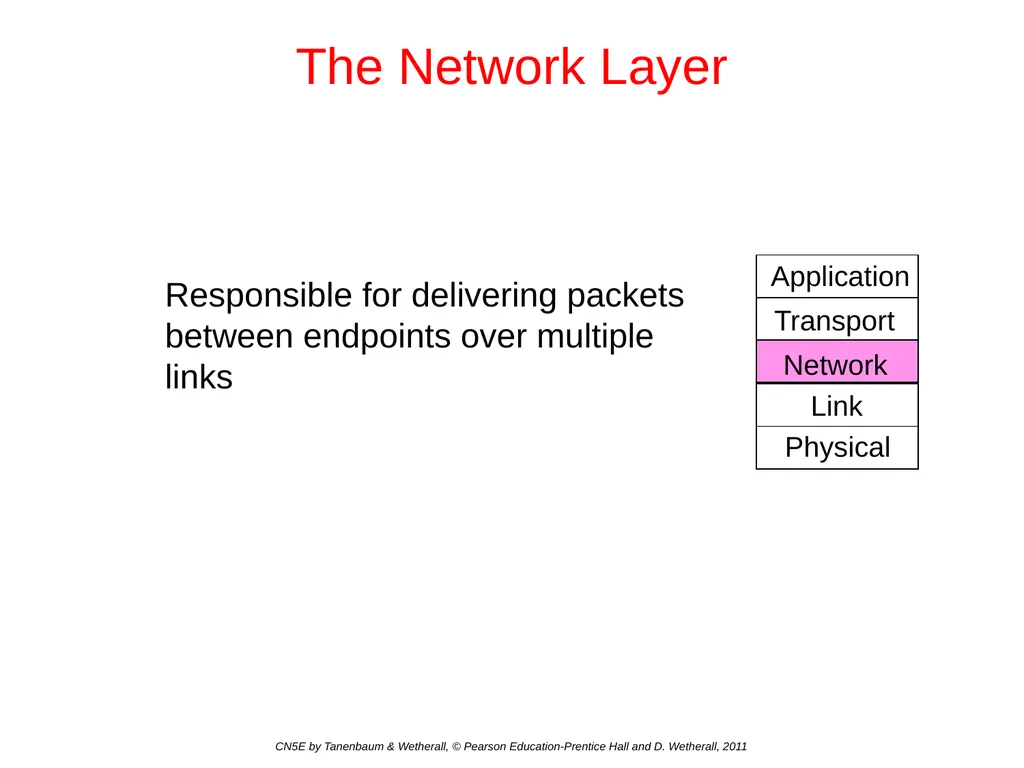
slide2. The Network Layer CN5E by Tanenbaum & Wetherall, © Pearson Education-Prentice Hall and D. Wetherall, 2011 Responsible for delivering packets between endpoints over multiple links<br>
slide3. TUNALI Computer Networks 1 3 Network Layer Functionality Getting packets from the source all the way to the destination
Lowest layer that deals with end-to-end transmission
Must know the topology of the physical network<br>
slide4. Design Issues Store-and-forward packet switching »
Services Provided to the Transport Layer
Connectionless service – datagrams »
Connection-oriented service – virtual circuits »
Comparison of virtual-circuits and datagrams » CN5E by Tanenbaum & Wetherall, © Pearson Education-Prentice Hall and D. Wetherall, 2011<br>
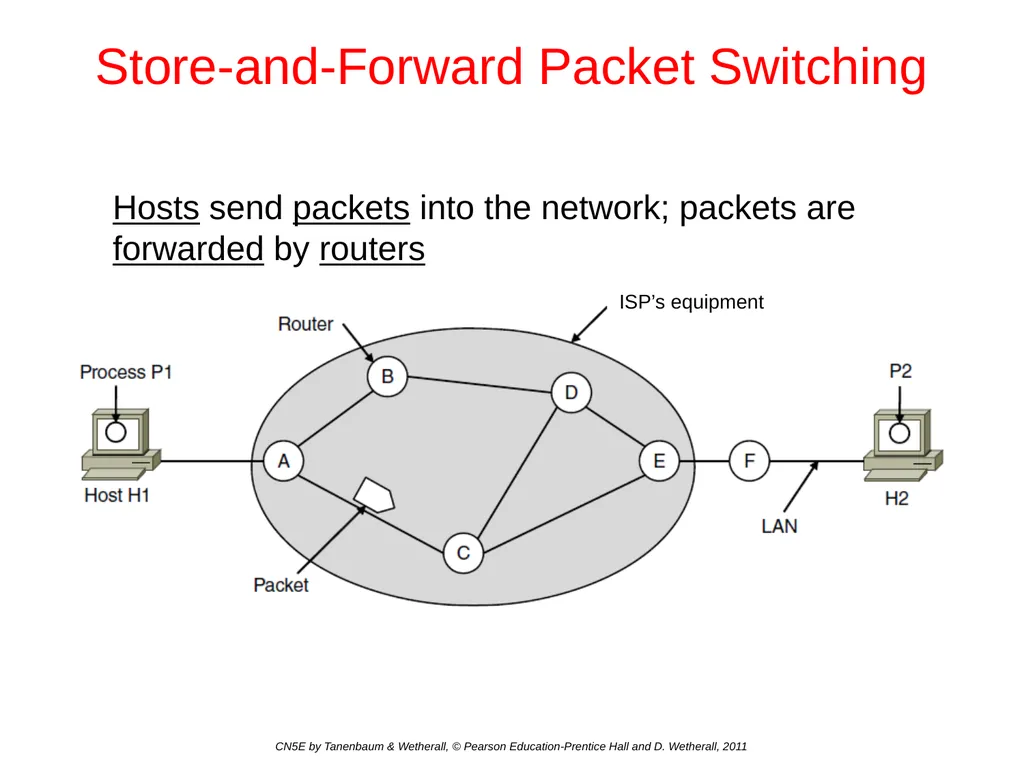
slide5. Store-and-Forward Packet Switching CN5E by Tanenbaum & Wetherall, © Pearson Education-Prentice Hall and D. Wetherall, 2011 Hosts send packets into the network; packets are forwarded by routers<br>
slide6. TUNALI Computer Networks 1 6 Services Provided to the Transport Layer Frequently, network layer is the interface between the carrier and the customer
Services should be independent of the router technology
Transport layer should be shielded from the topology of the routers present
Network Layer addressing should be uniform<br>
slide7. TUNALI Computer Networks 1 7 Unreliable and connectionless Just two primitives
SEND PACKET
RECEIVE PACKET
The complexity is in the transport layer (hosts)<br>
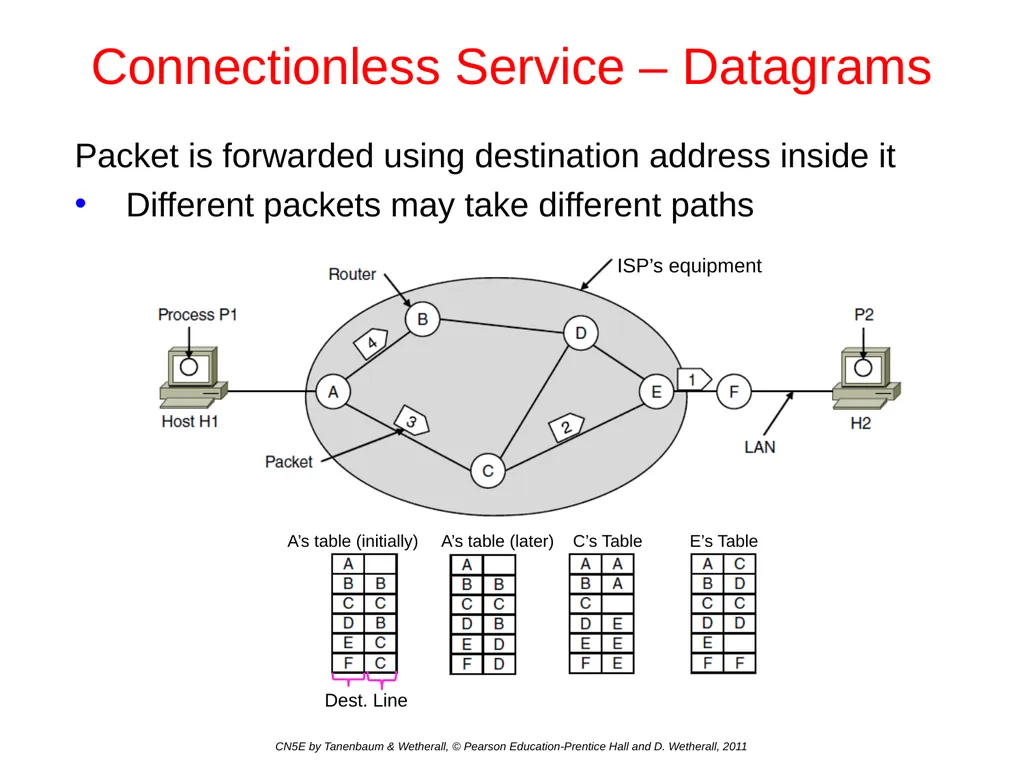
slide8. Connectionless Service – Datagrams Packet is forwarded using destination address inside it
Different packets may take different paths CN5E by Tanenbaum & Wetherall, © Pearson Education-Prentice Hall and D. Wetherall, 2011<br>
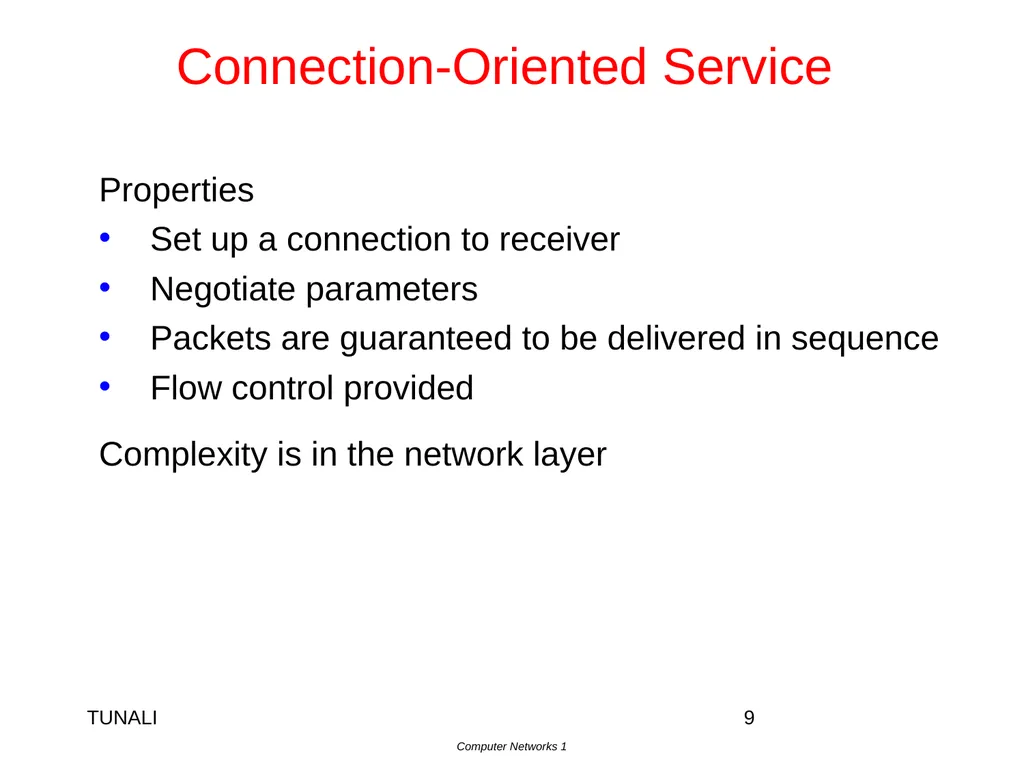
slide9. TUNALI Computer Networks 1 9 Connection-Oriented Service Properties
Set up a connection to receiver
Negotiate parameters
Packets are guaranteed to be delivered in sequence
Flow control provided
Complexity is in the network layer<br>
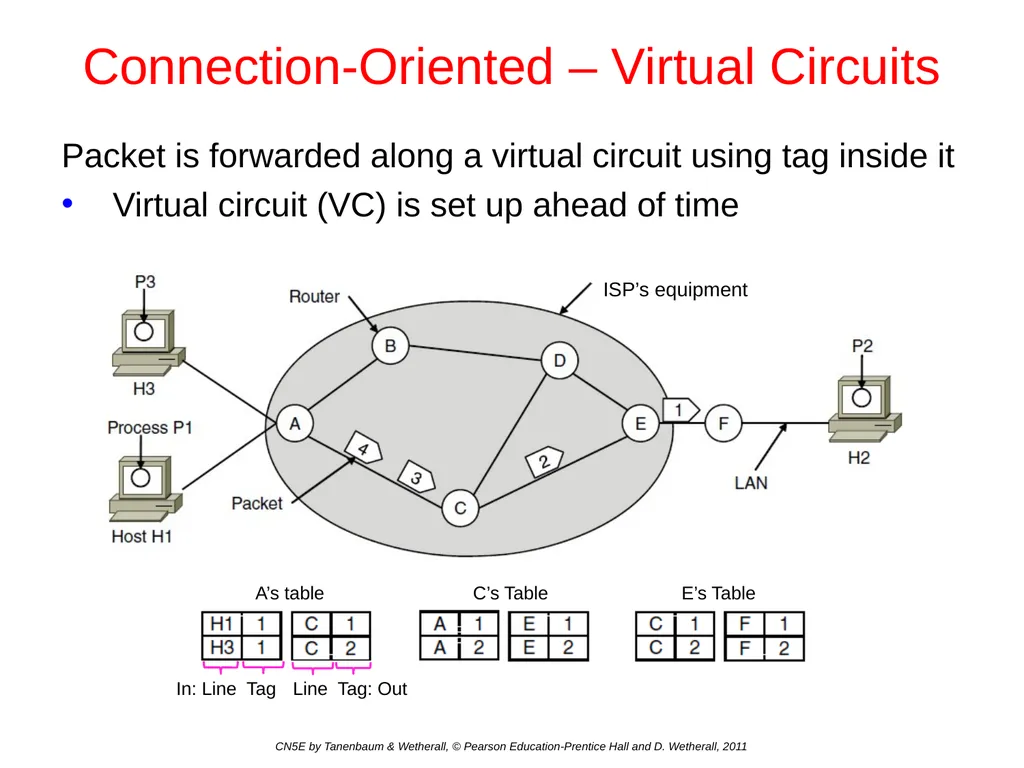
slide10. Connection-Oriented – Virtual Circuits Packet is forwarded along a virtual circuit using tag inside it
Virtual circuit (VC) is set up ahead of time CN5E by Tanenbaum & Wetherall, © Pearson Education-Prentice Hall and D. Wetherall, 2011<br>
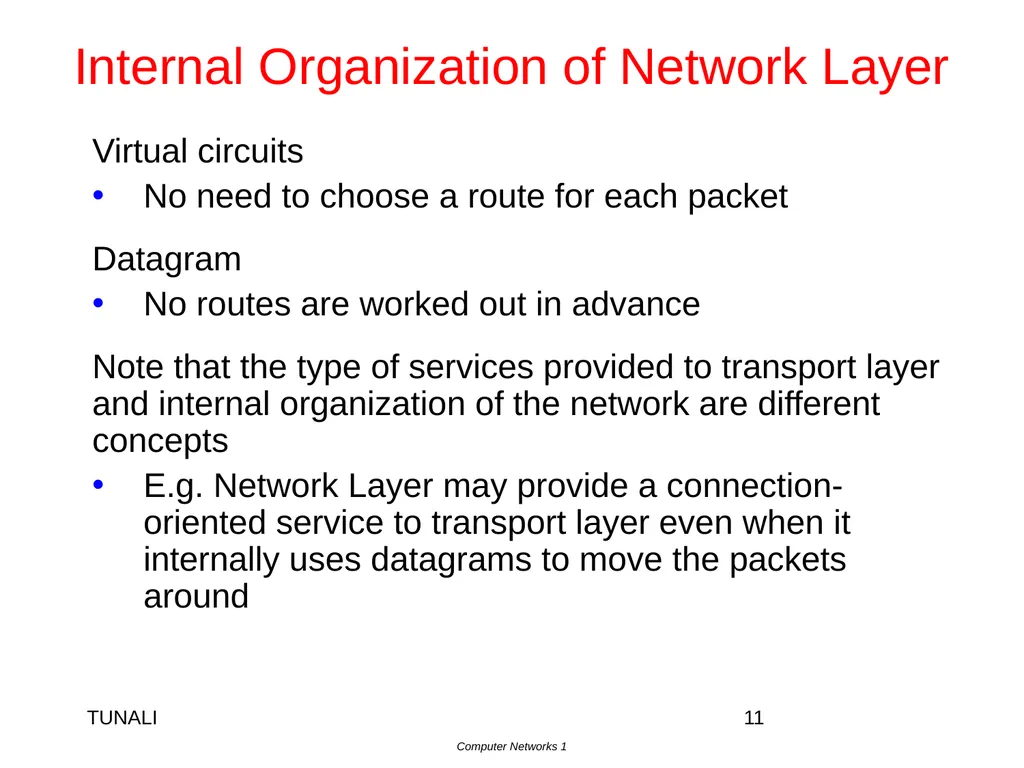
slide11. TUNALI Computer Networks 1 11 Internal Organization of Network Layer Virtual circuits
No need to choose a route for each packet
Datagram
No routes are worked out in advance
Note that the type of services provided to transport layer and internal organization of the network are different concepts
E.g. Network Layer may provide a connection-oriented service to transport layer even when it internally uses datagrams to move the packets around<br>
slide12. TUNALI Computer Networks 1 12 Virtual Circuits Between the source and destination a path is established
All the packets from the source to destination follow the same path
Each router must remember where to forward packets for each of the currently open virtual circuits passing through it
Each packet must contain a virtual circuit number field in the header for identification purposes
Routers assign this number locally and maintain tables to determine which incoming packet with a particular number will be forwarded to which outgoing line<br>
slide13. TUNALI Computer Networks 1 13 Datagrams Each packet must contain full destination address<br>
slide14. TUNALI Computer Networks 1 14 Comparison of VC and Datagrams Router memory space for vc tables vs wasted bandwidth for extra long address in each packet header
Set up time versus address parsing time
Easier to control congestion with vc
Datagram may be more suitable for transaction processing systems
VC is vulnerable to crash of the router<br>
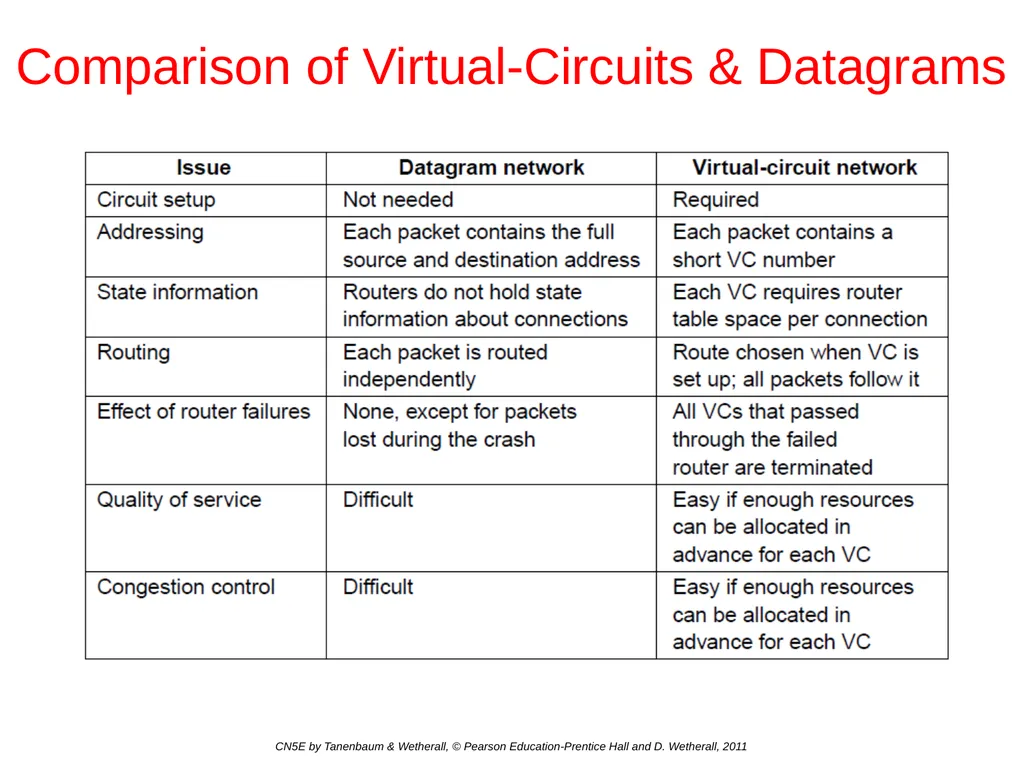
slide15. Comparison of Virtual-Circuits & Datagrams CN5E by Tanenbaum & Wetherall, © Pearson Education-Prentice Hall and D. Wetherall, 2011<br>
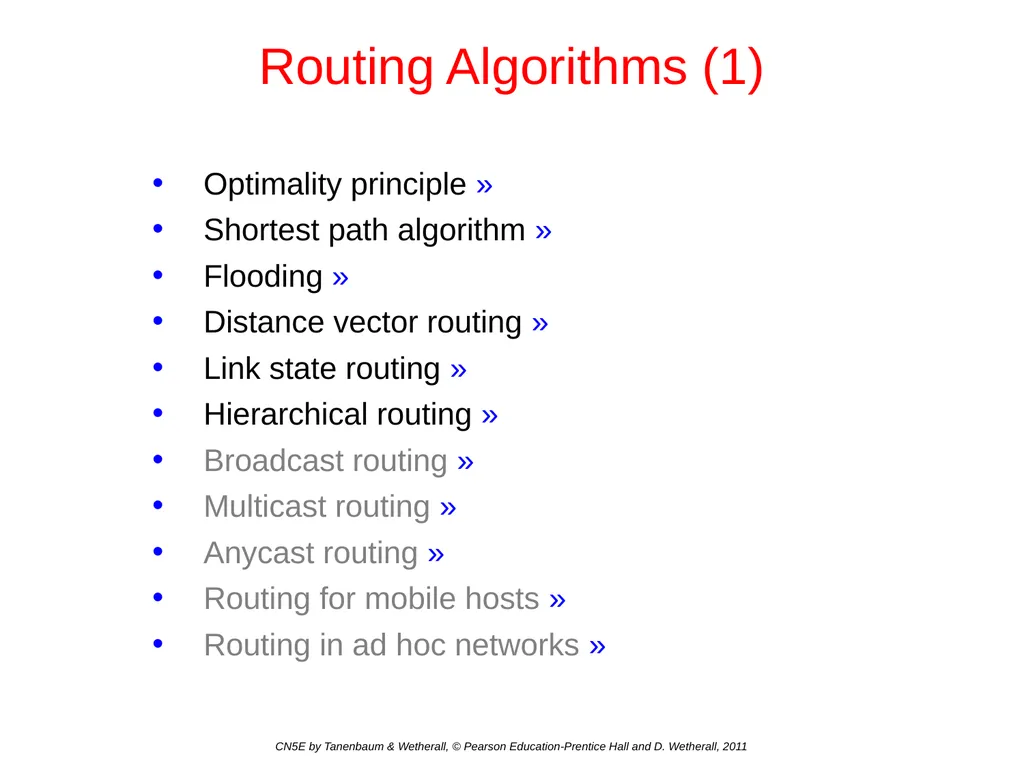
slide16. Routing Algorithms (1) CN5E by Tanenbaum & Wetherall, © Pearson Education-Prentice Hall and D. Wetherall, 2011 Optimality principle »
Shortest path algorithm »
Flooding »
Distance vector routing »
Link state routing »
Hierarchical routing »
Broadcast routing »
Multicast routing »
Anycast routing »
Routing for mobile hosts »
Routing in ad hoc networks »<br>
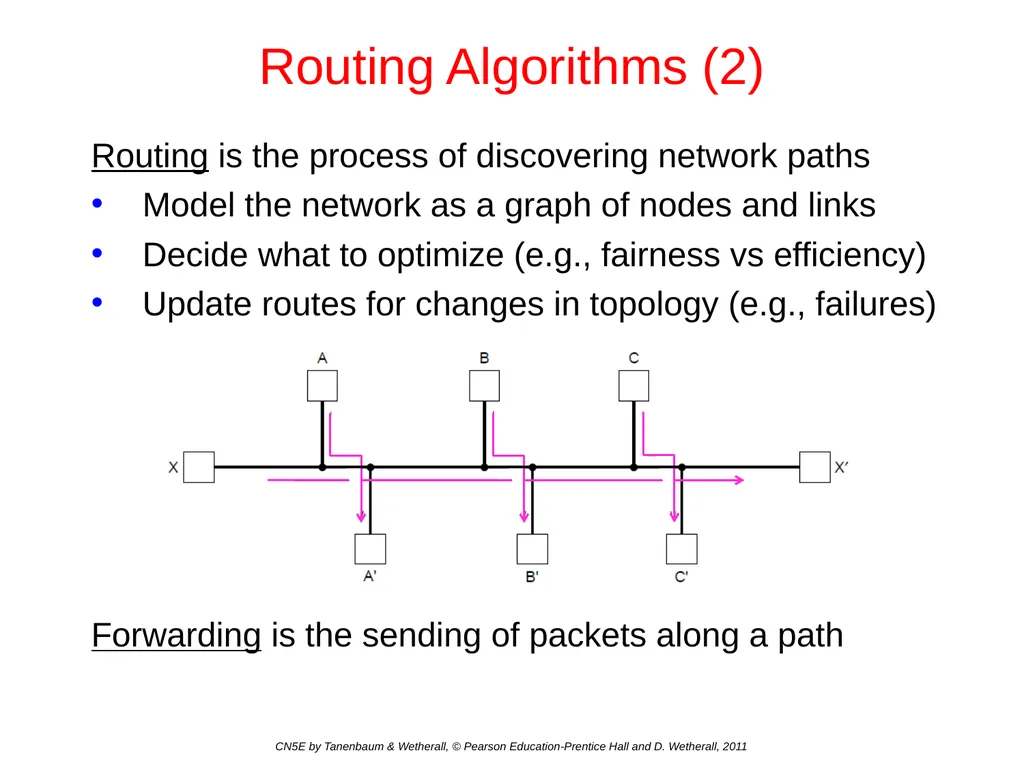
slide17. Routing Algorithms (2) Routing is the process of discovering network paths
Model the network as a graph of nodes and links
Decide what to optimize (e.g., fairness vs efficiency)
Update routes for changes in topology (e.g., failures)
Forwarding is the sending of packets along a path CN5E by Tanenbaum & Wetherall, © Pearson Education-Prentice Hall and D. Wetherall, 2011<br>
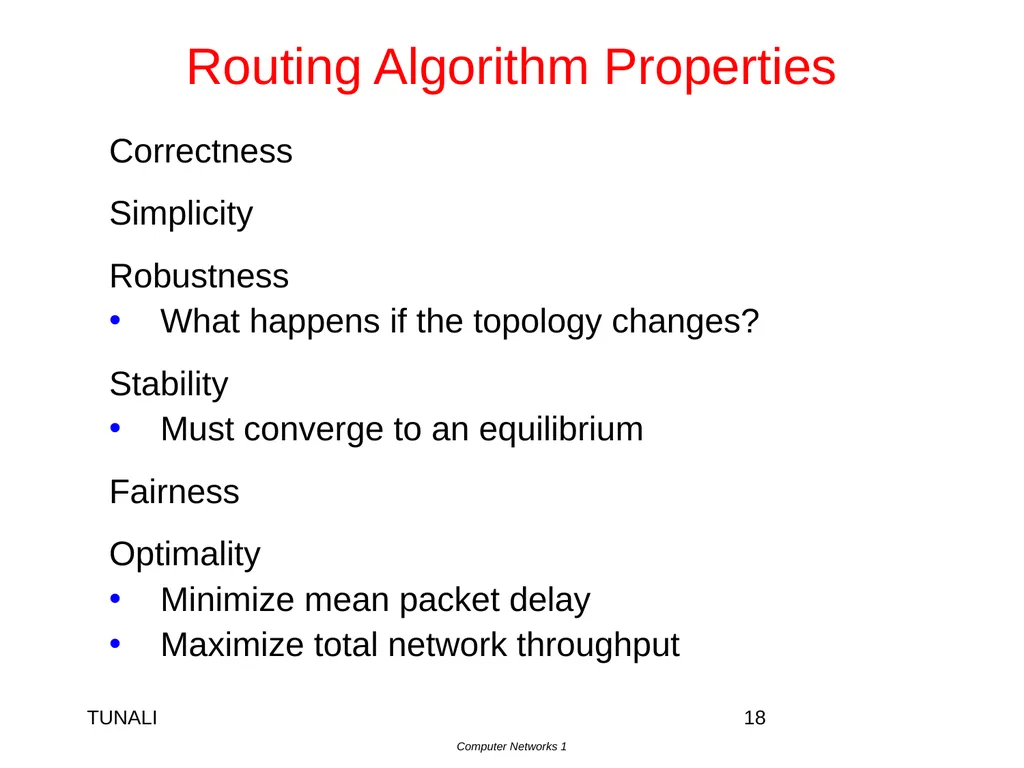
slide18. TUNALI Computer Networks 1 18 Routing Algorithm Properties Correctness
Simplicity
Robustness
What happens if the topology changes?
Stability
Must converge to an equilibrium
Fairness
Optimality
Minimize mean packet delay
Maximize total network throughput<br>
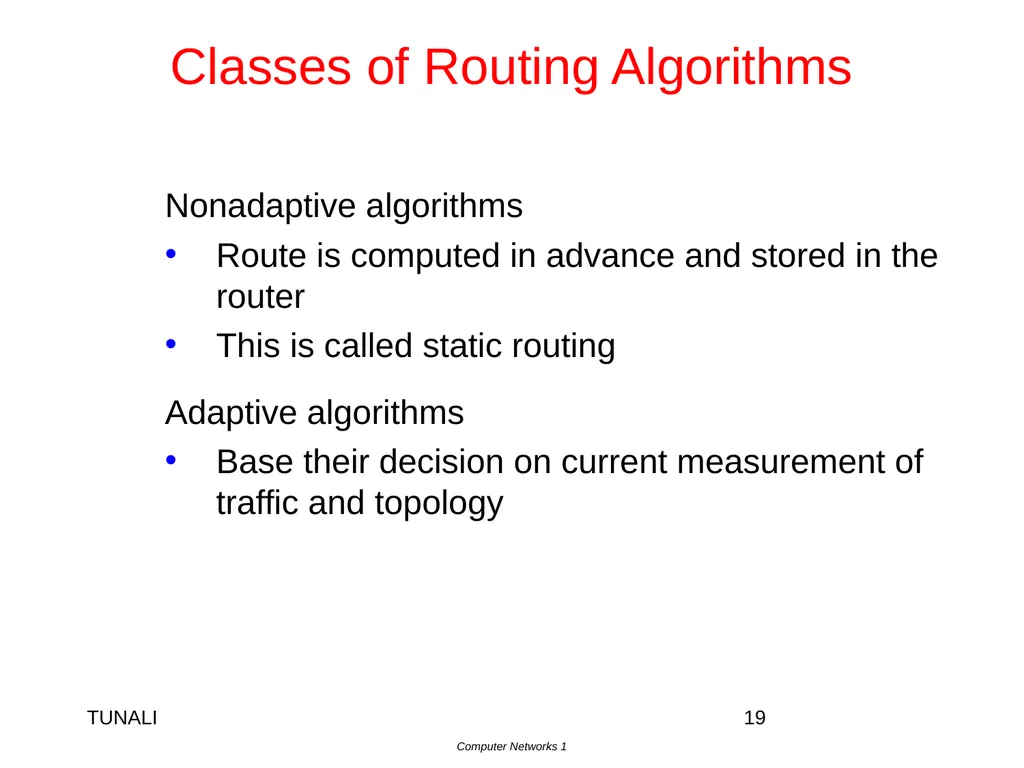
slide19. TUNALI Computer Networks 1 19 Classes of Routing Algorithms Nonadaptive algorithms
Route is computed in advance and stored in the router
This is called static routing
Adaptive algorithms
Base their decision on current measurement of traffic and topology<br>
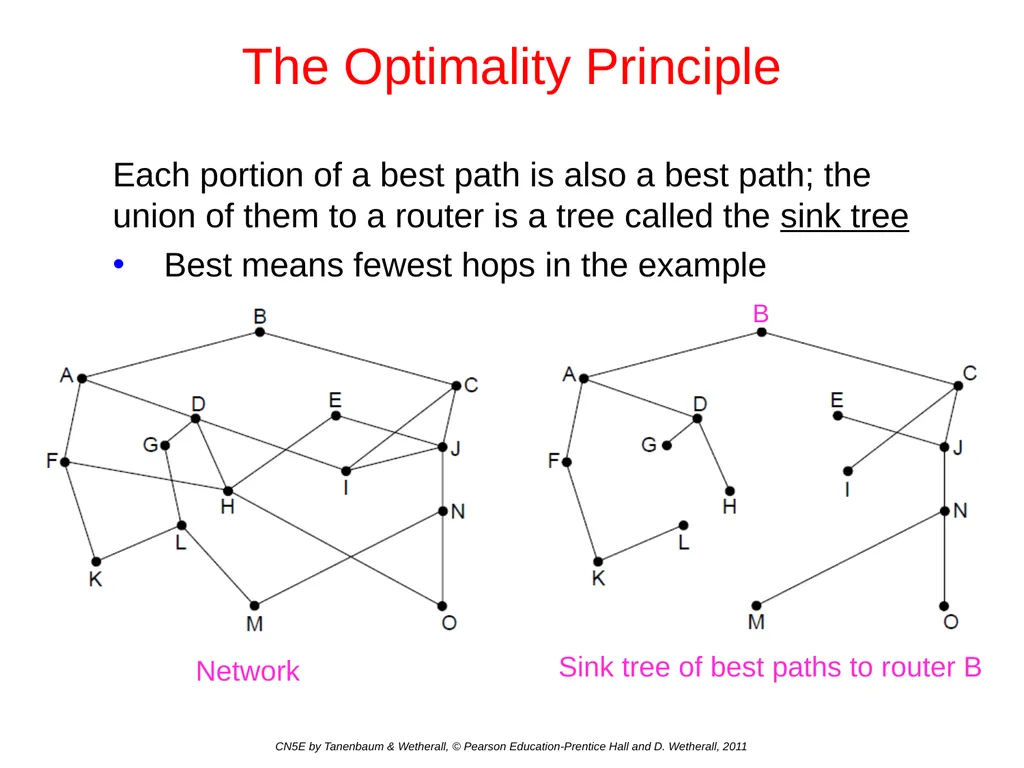
slide20. The Optimality Principle CN5E by Tanenbaum & Wetherall, © Pearson Education-Prentice Hall and D. Wetherall, 2011 Each portion of a best path is also a best path; the union of them to a router is a tree called the sink tree
Best means fewest hops in the example<br>
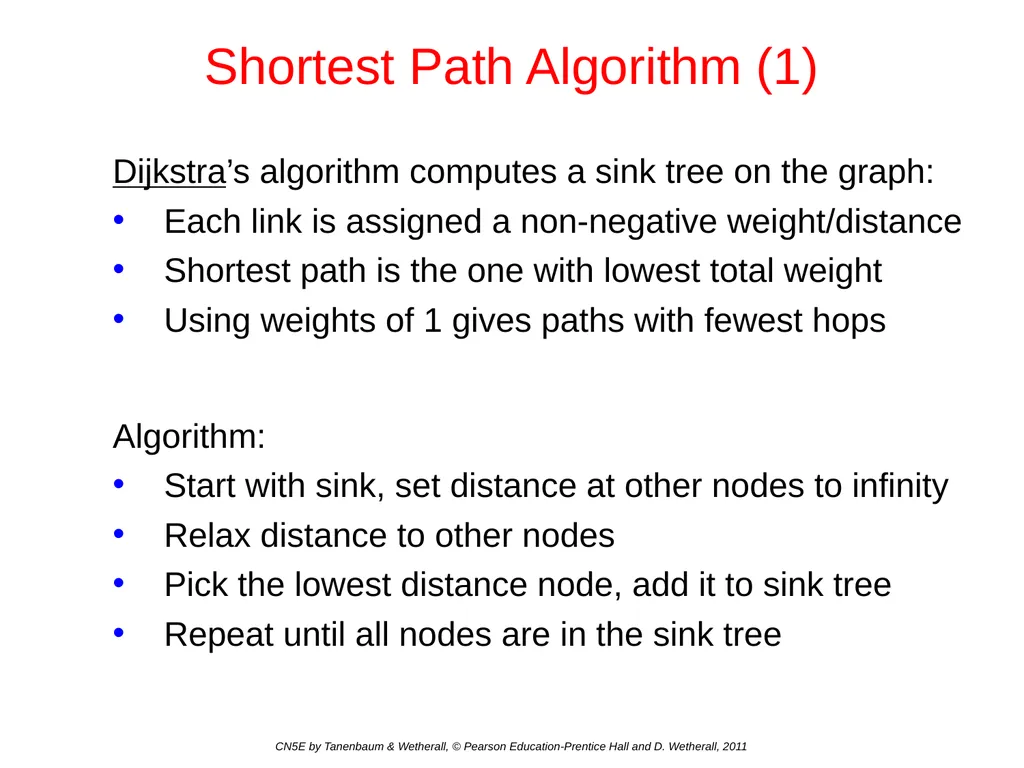
slide21. Shortest Path Algorithm (1) CN5E by Tanenbaum & Wetherall, © Pearson Education-Prentice Hall and D. Wetherall, 2011 Dijkstra’s algorithm computes a sink tree on the graph:
Each link is assigned a non-negative weight/distance
Shortest path is the one with lowest total weight
Using weights of 1 gives paths with fewest hops
Algorithm:
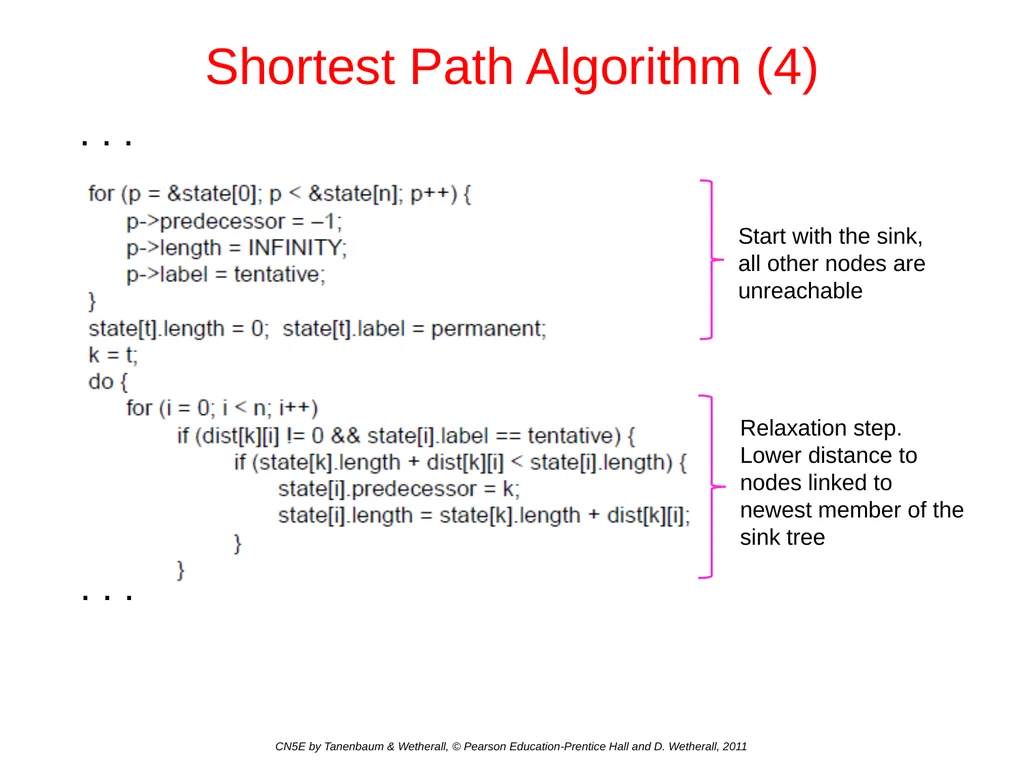
Start with sink, set distance at other nodes to infinity
Relax distance to other nodes
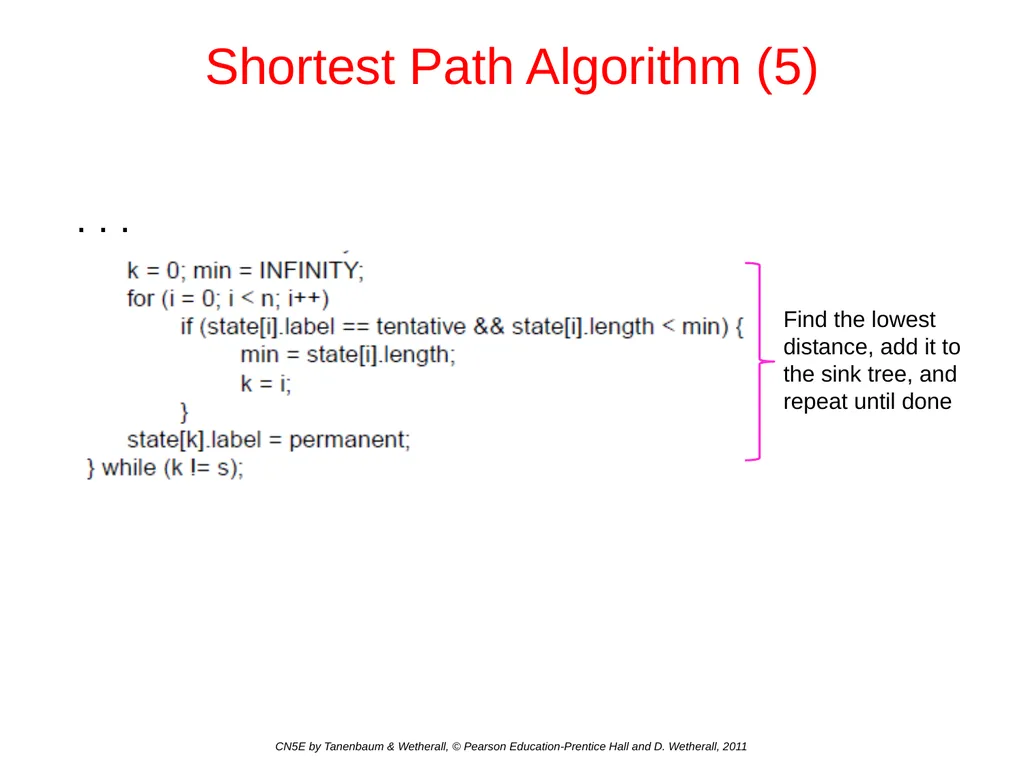
Pick the lowest distance node, add it to sink tree
Repeat until all nodes are in the sink tree<br>
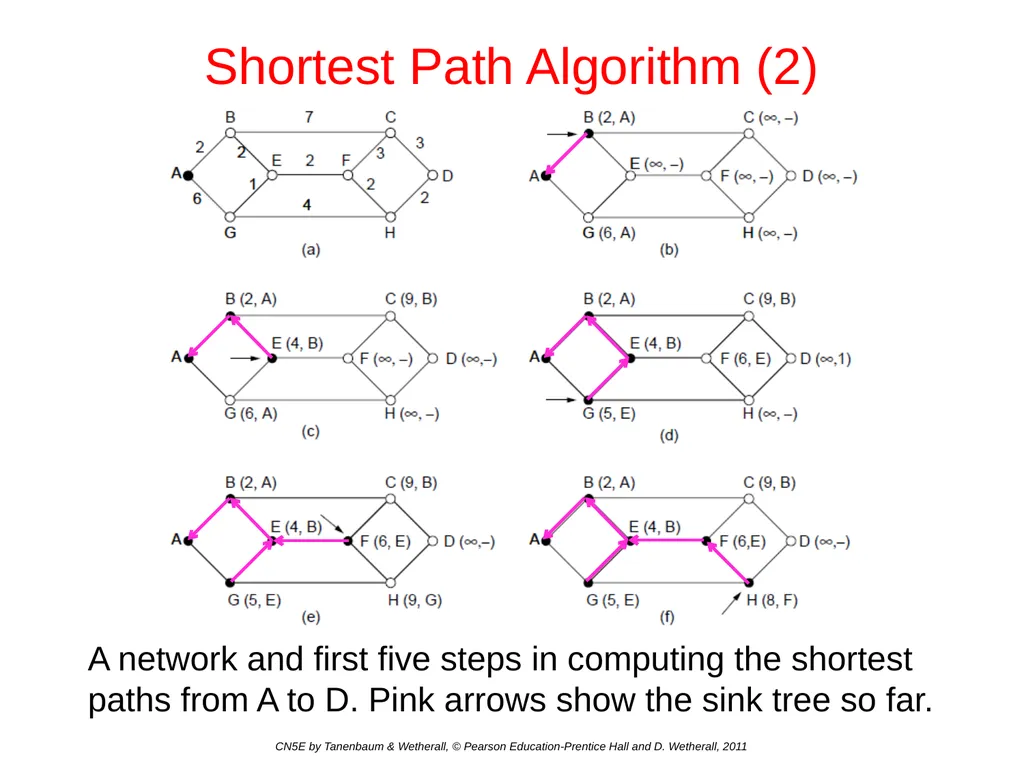
slide22. Shortest Path Algorithm (2) CN5E by Tanenbaum & Wetherall, © Pearson Education-Prentice Hall and D. Wetherall, 2011 A network and first five steps in computing the shortest paths from A to D. Pink arrows show the sink tree so far.<br>
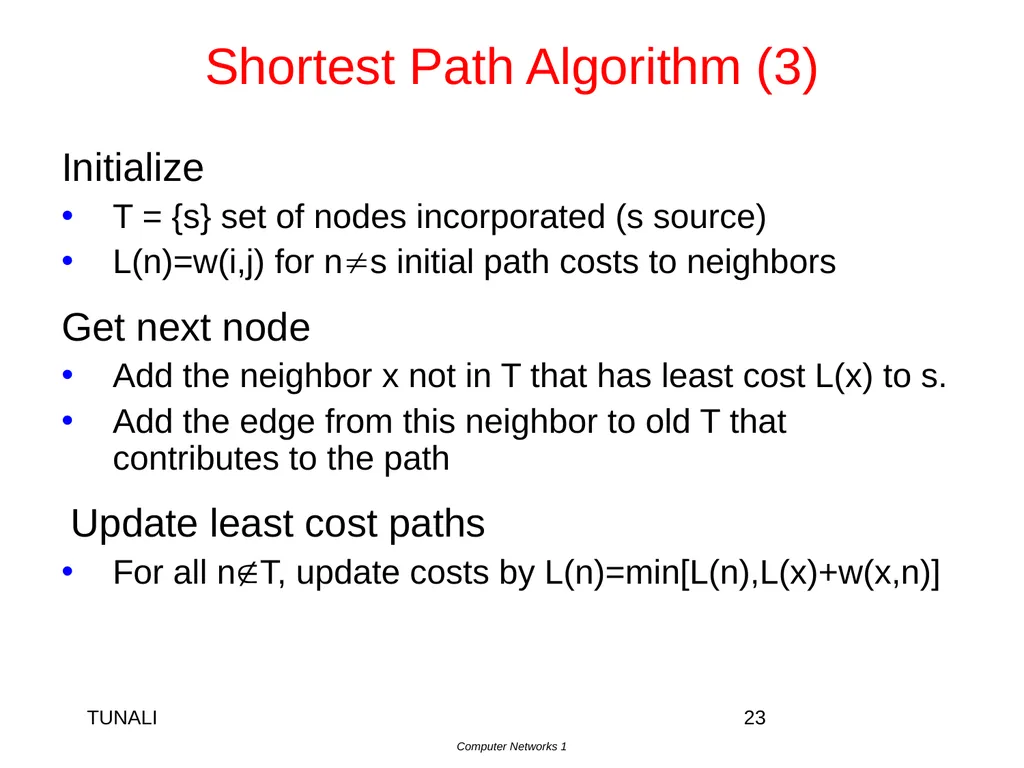
slide23. TUNALI Computer Networks 1 23 Shortest Path Algorithm (3) Initialize
T = {s} set of nodes incorporated (s source)
L(n)=w(i,j) for ns initial path costs to neighbors
Get next node
Add the neighbor x not in T that has least cost L(x) to s.
Add the edge from this neighbor to old T that contributes to the path
Update least cost paths
For all nT, update costs by L(n)=min[L(n),L(x)+w(x,n)]<br>
slide24. Shortest Path Algorithm (4) CN5E by Tanenbaum & Wetherall, © Pearson Education-Prentice Hall and D. Wetherall, 2011 . . . . . . Start with the sink, all other nodes are unreachable Relaxation step. Lower distance to nodes linked to newest member of the sink tree<br>
slide25. Shortest Path Algorithm (5) CN5E by Tanenbaum & Wetherall, © Pearson Education-Prentice Hall and D. Wetherall, 2011 . . . Find the lowest distance, add it to the sink tree, and repeat until done<br>
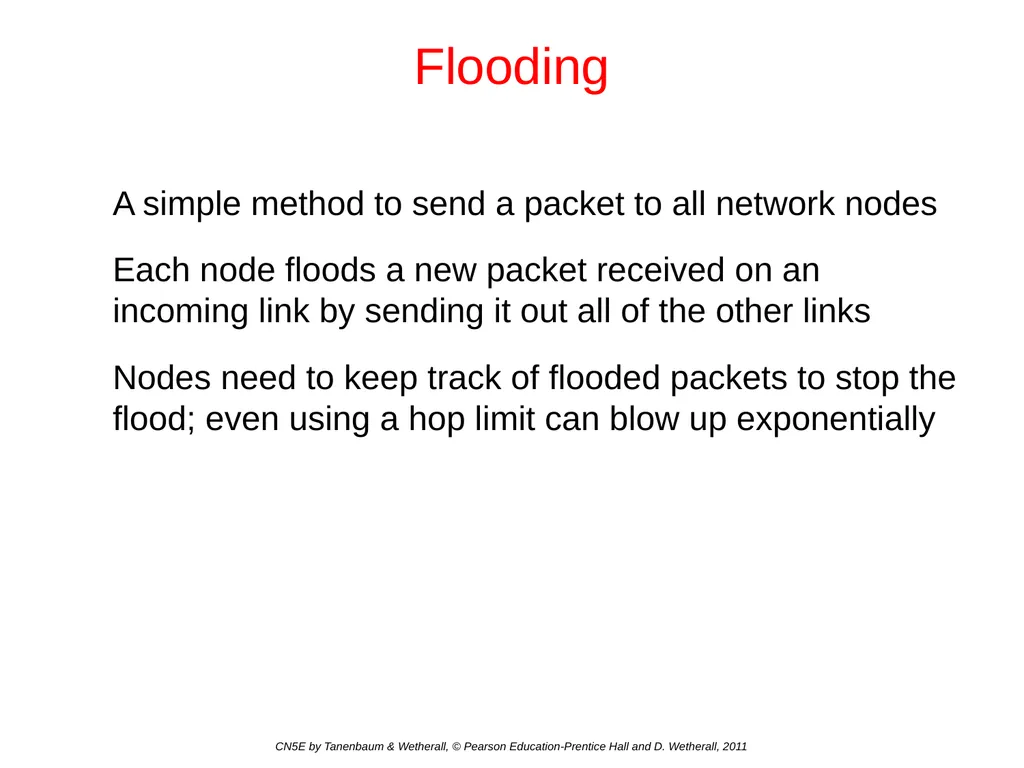
slide26. Flooding CN5E by Tanenbaum & Wetherall, © Pearson Education-Prentice Hall and D. Wetherall, 2011 A simple method to send a packet to all network nodes
Each node floods a new packet received on an incoming link by sending it out all of the other links
Nodes need to keep track of flooded packets to stop the flood; even using a hop limit can blow up exponentially<br>
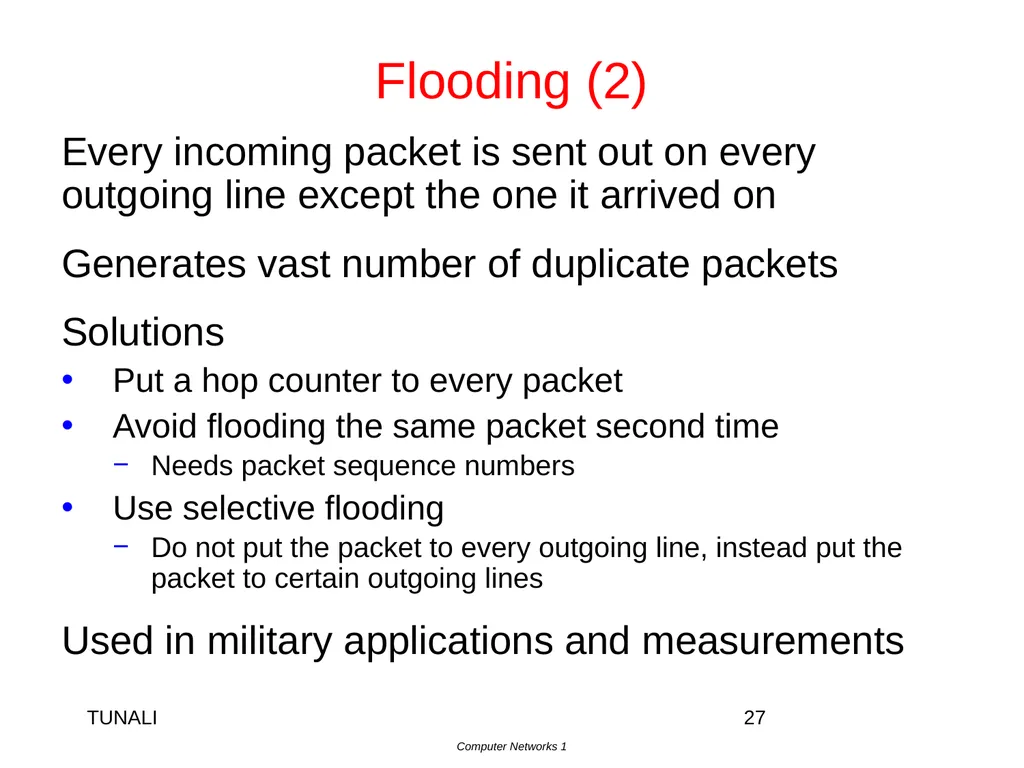
slide27. TUNALI Computer Networks 1 27 Flooding (2) Every incoming packet is sent out on every outgoing line except the one it arrived on
Generates vast number of duplicate packets
Solutions
Put a hop counter to every packet
Avoid flooding the same packet second time
Needs packet sequence numbers
Use selective flooding
Do not put the packet to every outgoing line, instead put the packet to certain outgoing lines
Used in military applications and measurements<br>
slide28. Distance Vector Routing (1) CN5E by Tanenbaum & Wetherall, © Pearson Education-Prentice Hall and D. Wetherall, 2011 Distance vector is a distributed routing algorithm
Shortest path computation is split across nodes
Algorithm:
Each node knows distance of links to its neighbors
Each node advertises vector of lowest known distances to all neighbors
Each node uses received vectors to update its own
Repeat periodically<br>
slide29. TUNALI Computer Networks 1 29 Distance Vector Routing 2 Each router maintains a table that contains the following for each destination
Best known distance to the destination
Number of hops or
Time delay in milliseconds or
Total number of packets queued along the path
Which line to use to get there
Each router is assumed to know the distance to each of its neighbors<br>
slide30. TUNALI Computer Networks 1 30 Distance Vector Routing 3 Once every T msec, each router sends to each neighbor a list of its estimated delays to each destination
A router, knowing the distance to its neighbor, can calculate distances to all destinations via its respective neighbor
Then, it can choose the minimum distance and forward packets via that neighbor<br>
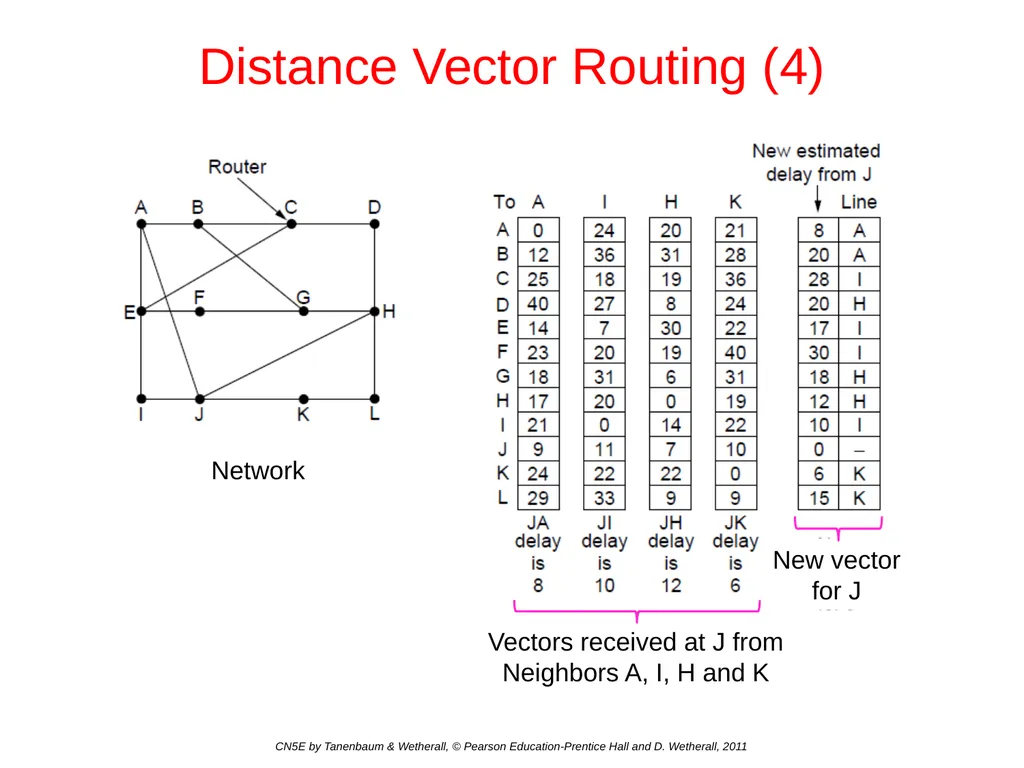
slide31. Distance Vector Routing (4) CN5E by Tanenbaum & Wetherall, © Pearson Education-Prentice Hall and D. Wetherall, 2011 Network Vectors received at J from
Neighbors A, I, H and K New vector for J<br>
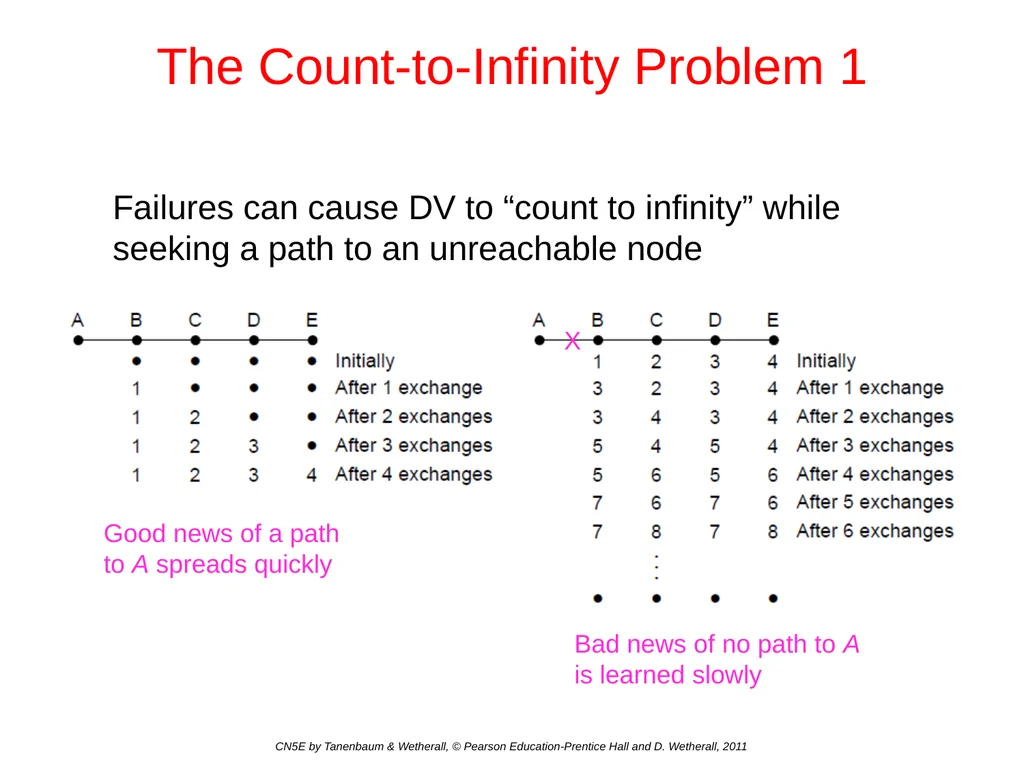
slide32. The Count-to-Infinity Problem 1 CN5E by Tanenbaum & Wetherall, © Pearson Education-Prentice Hall and D. Wetherall, 2011 Failures can cause DV to “count to infinity” while seeking a path to an unreachable node Good news of a path to A spreads quickly X Bad news of no path to A is learned slowly<br>
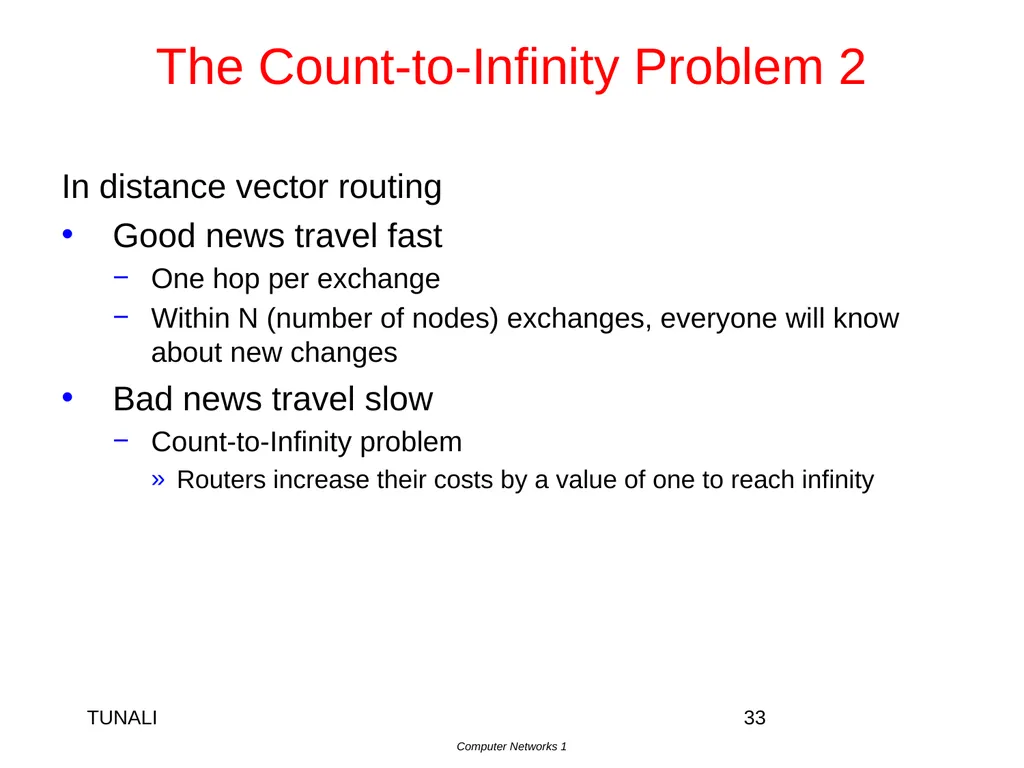
slide33. TUNALI Computer Networks 1 33 The Count-to-Infinity Problem 2 In distance vector routing
Good news travel fast
One hop per exchange
Within N (number of nodes) exchanges, everyone will know about new changes
Bad news travel slow
Count-to-Infinity problem
Routers increase their costs by a value of one to reach infinity<br>
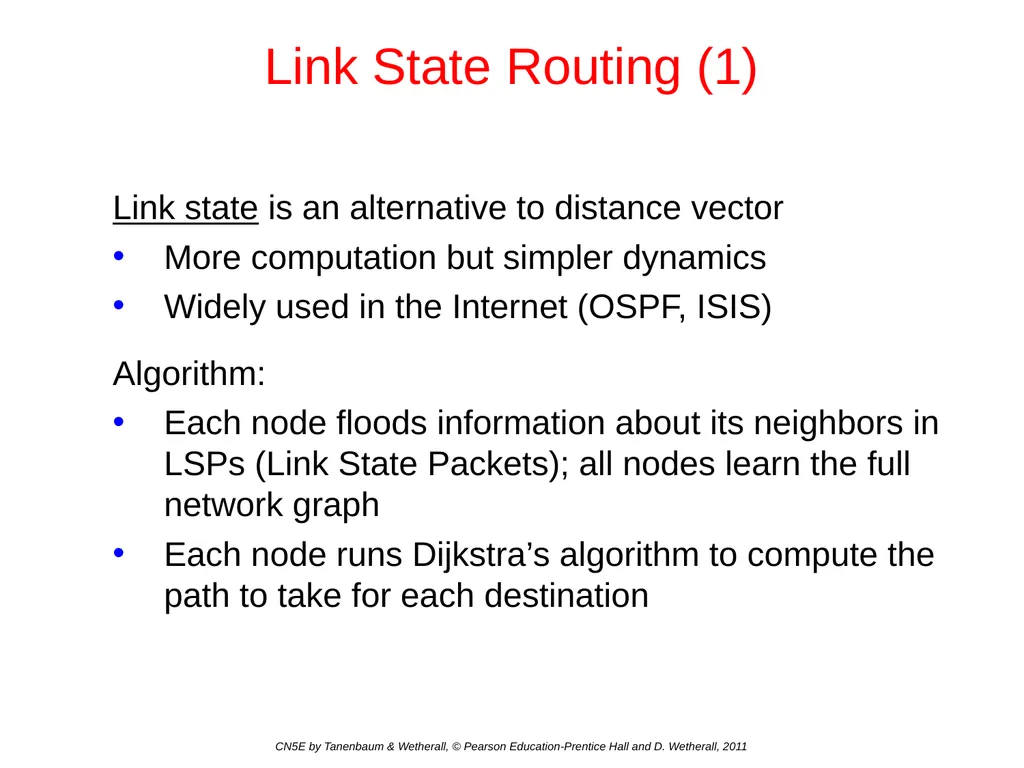
slide34. Link State Routing (1) CN5E by Tanenbaum & Wetherall, © Pearson Education-Prentice Hall and D. Wetherall, 2011 Link state is an alternative to distance vector
More computation but simpler dynamics
Widely used in the Internet (OSPF, ISIS)
Algorithm:
Each node floods information about its neighbors in LSPs (Link State Packets); all nodes learn the full network graph
Each node runs Dijkstra’s algorithm to compute the path to take for each destination<br>
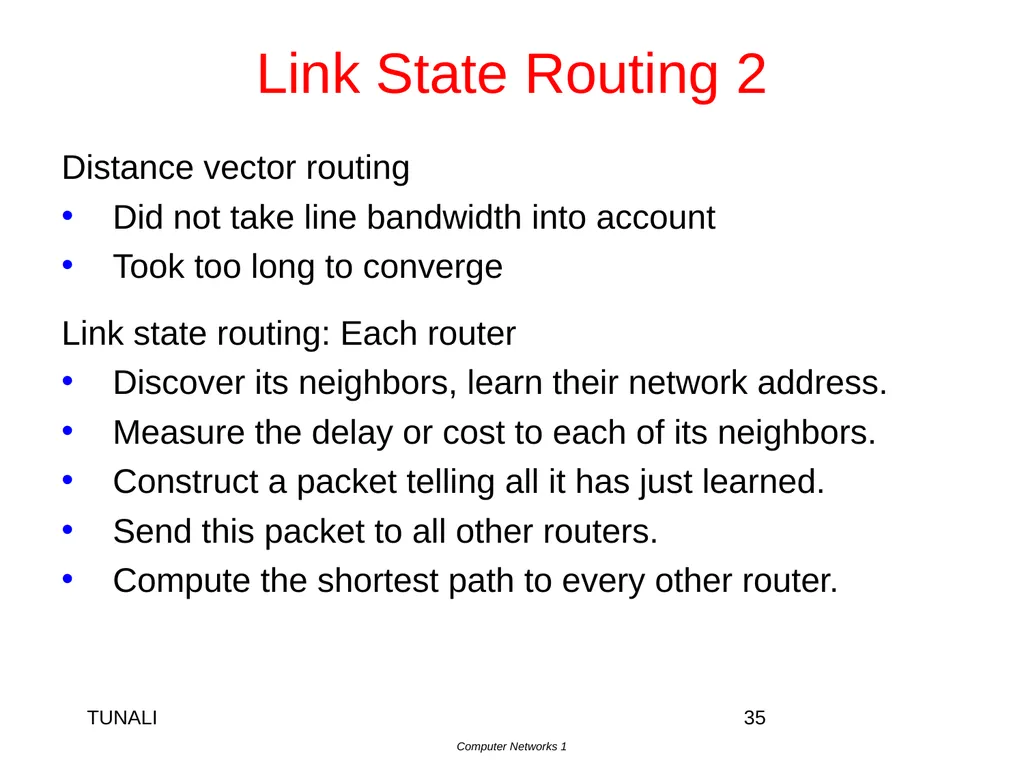
slide35. TUNALI Computer Networks 1 35 Link State Routing 2 Distance vector routing
Did not take line bandwidth into account
Took too long to converge
Link state routing: Each router
Discover its neighbors, learn their network address.
Measure the delay or cost to each of its neighbors.
Construct a packet telling all it has just learned.
Send this packet to all other routers.
Compute the shortest path to every other router.<br>
slide36. TUNALI Computer Networks 1 36 Learning about the Neighbors When a rooter is booted, it sends HELLO packet to all of its neighbors
Neighbors reply by sending their globally unique names
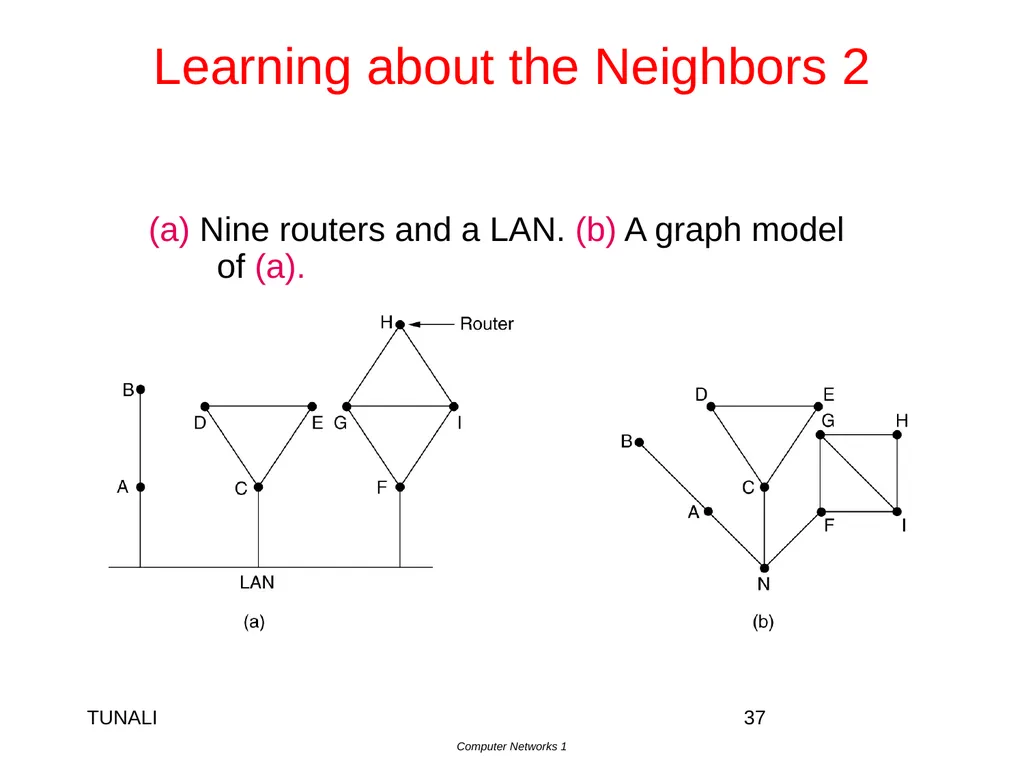
Modeling LANs need extra mechanisms
In the next slide an artificial node N is added to represent the LAN
From A to C, the path is represented as ANC<br>
slide37. TUNALI Computer Networks 1 37 Learning about the Neighbors 2 (a) Nine routers and a LAN. (b) A graph model of (a).<br>
slide38. TUNALI Computer Networks 1 38 Measuring Line Cost Each router should know an estimate of delay to each of its neighbors
To estimate the delay, a router can send an echo packet to its neighbor and measure the time when it receives it back
While measuring time, it is possible to include or exclude the time the echo packet spends on the queues which corresponds to consider load on the line
Including load may cause oscillations in the algorithm<br>
slide39. TUNALI Computer Networks 1 39 Building Link State Packets Packets contain
Identity of the sender
Sequence number
Age
List of neighbors and delays
Packets can be issued
Periodically or
When a significant event occurs<br>
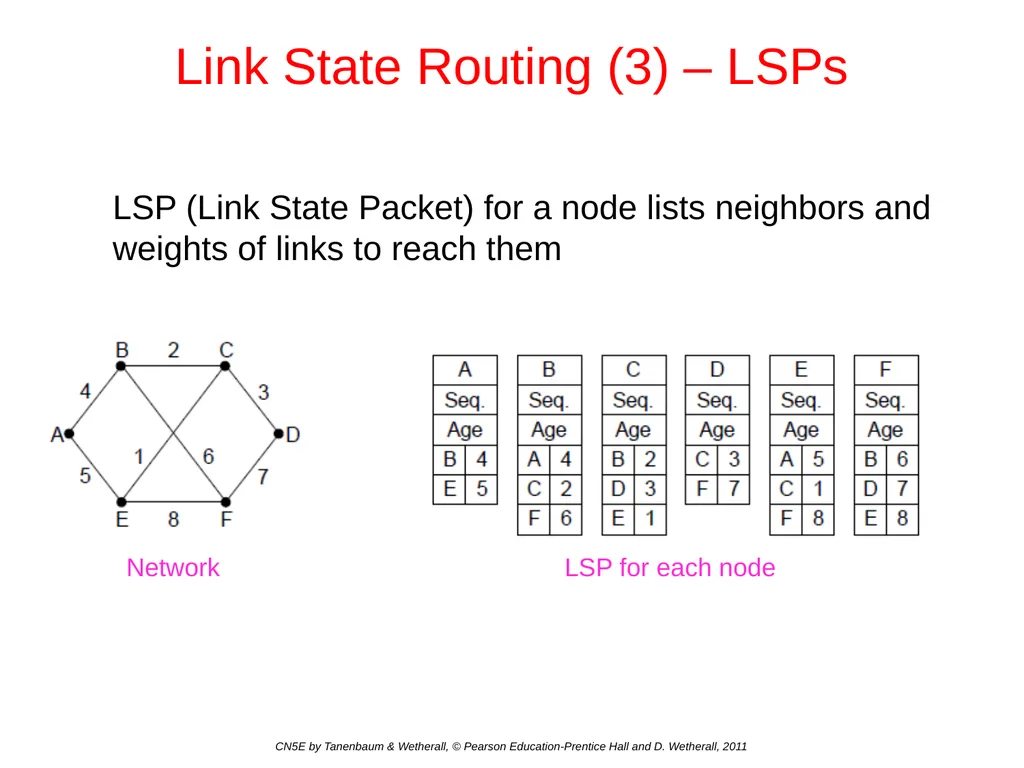
slide40. Link State Routing (3) – LSPs CN5E by Tanenbaum & Wetherall, © Pearson Education-Prentice Hall and D. Wetherall, 2011 LSP (Link State Packet) for a node lists neighbors and weights of links to reach them Network LSP for each node<br>
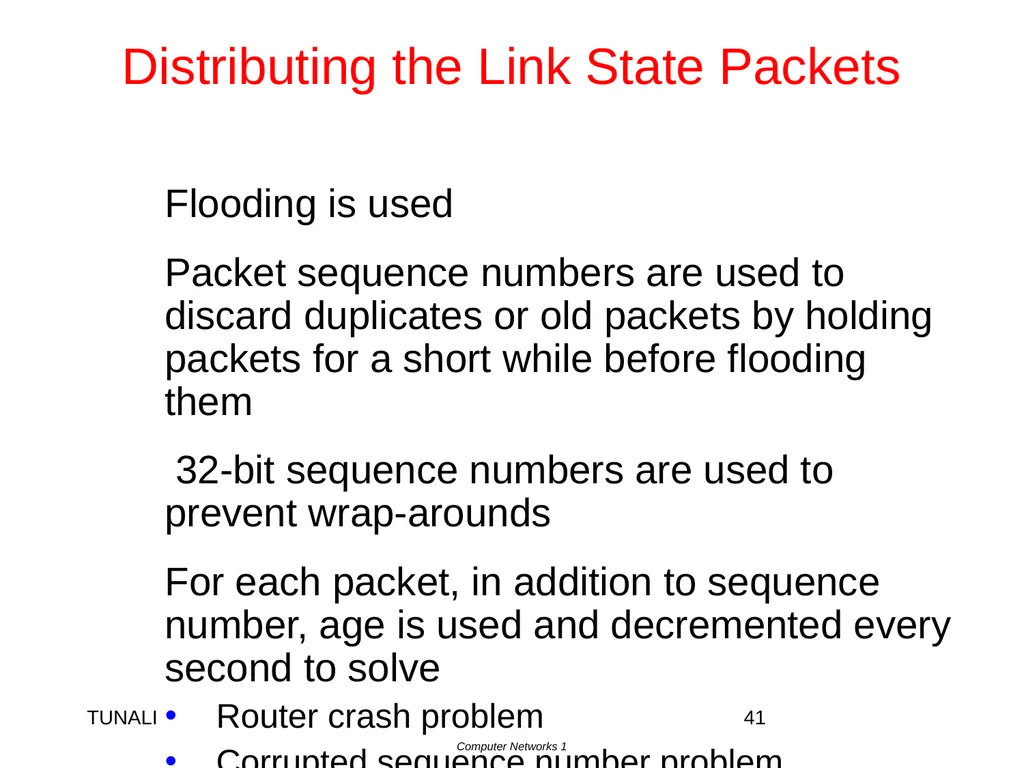
slide41. TUNALI Computer Networks 1 41 Distributing the Link State Packets Flooding is used
Packet sequence numbers are used to discard duplicates or old packets by holding packets for a short while before flooding them
32-bit sequence numbers are used to prevent wrap-arounds
For each packet, in addition to sequence number, age is used and decremented every second to solve
Router crash problem
Corrupted sequence number problem<br>
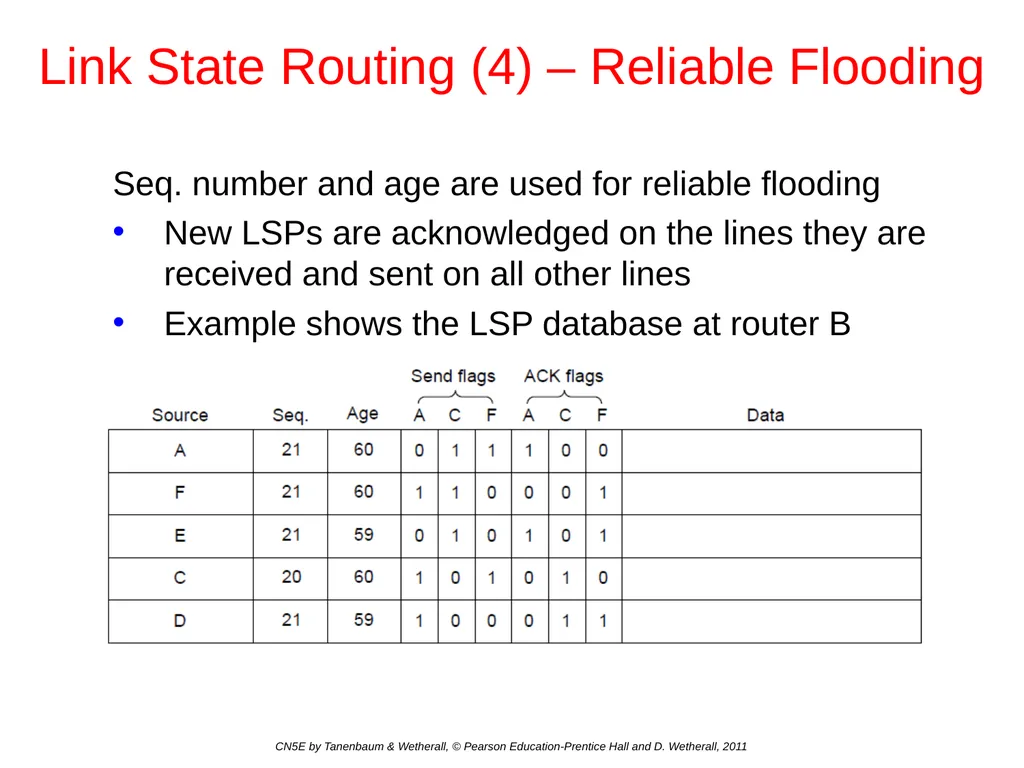
slide42. Link State Routing (4) – Reliable Flooding CN5E by Tanenbaum & Wetherall, © Pearson Education-Prentice Hall and D. Wetherall, 2011 Seq. number and age are used for reliable flooding
New LSPs are acknowledged on the lines they are received and sent on all other lines
Example shows the LSP database at router B<br>
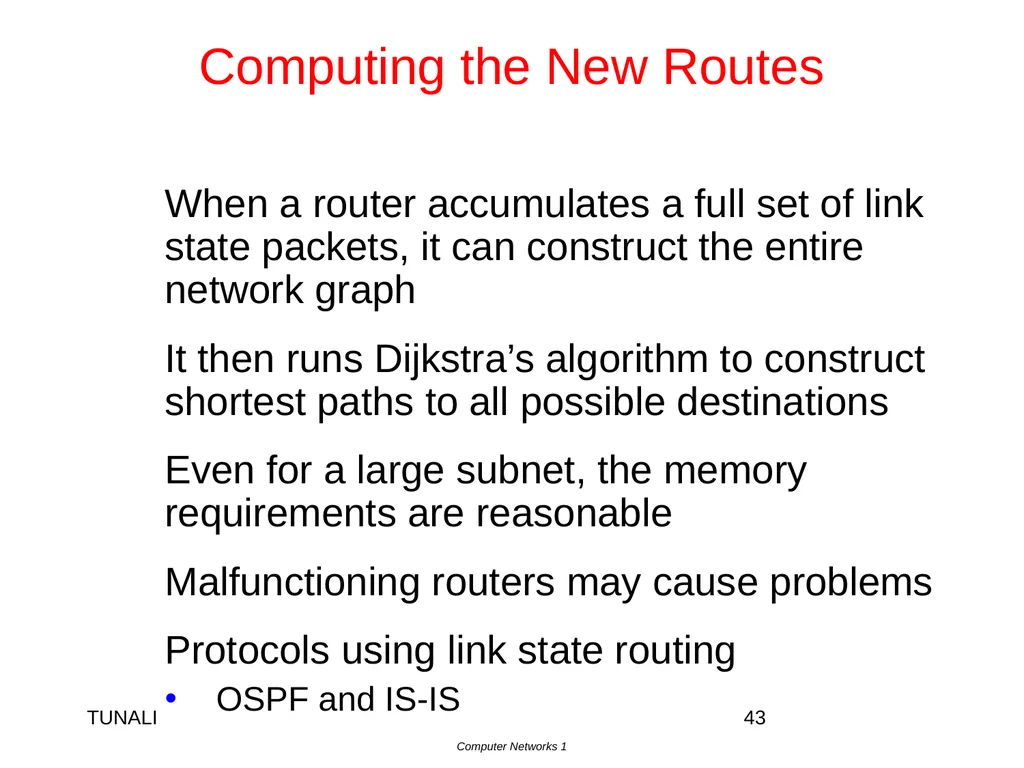
slide43. TUNALI Computer Networks 1 43 Computing the New Routes When a router accumulates a full set of link state packets, it can construct the entire network graph
It then runs Dijkstra’s algorithm to construct shortest paths to all possible destinations
Even for a large subnet, the memory requirements are reasonable
Malfunctioning routers may cause problems
Protocols using link state routing
OSPF and IS-IS<br>
slide44. TUNALI Computer Networks 1 44 Hierarchical Routing As networks grow
Routing table memory requirements increase
CPU time to execute routing algorithm increases
Solution: Use hierarchical routing
Routers are divided into regions
A router knows every detail about its region but knows nothing about other regions
Each region is represented by a “monitor” router
Monitor routers form a higher level in hierarchy<br>
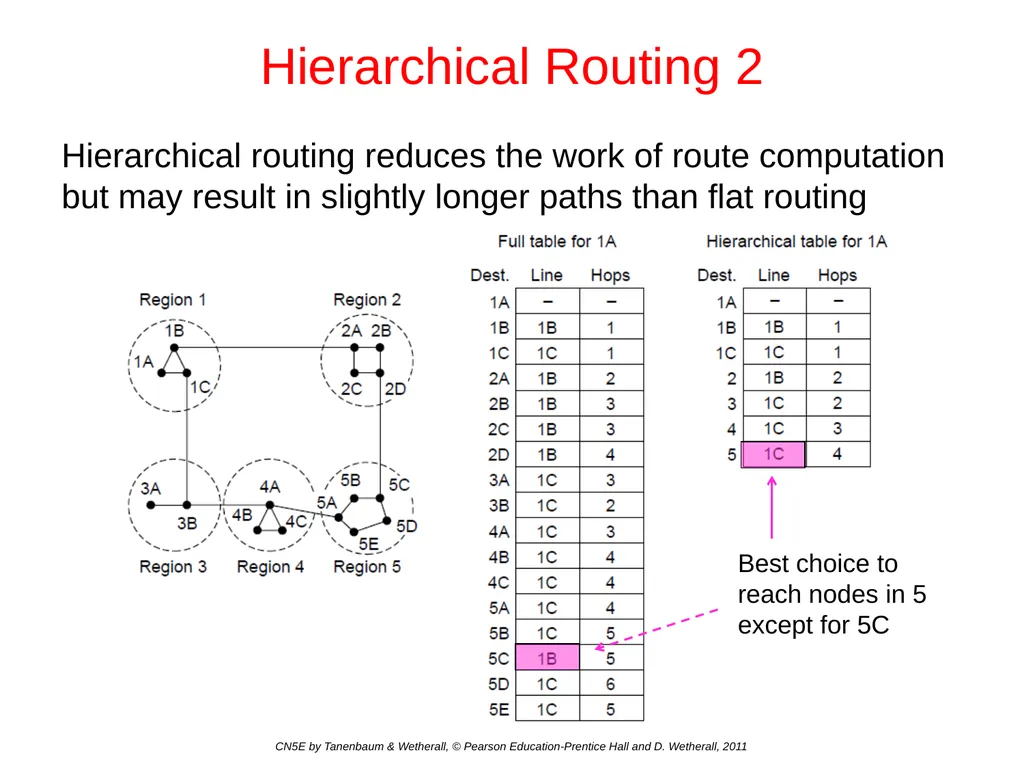
slide45. Hierarchical Routing 2 Hierarchical routing reduces the work of route computation but may result in slightly longer paths than flat routing CN5E by Tanenbaum & Wetherall, © Pearson Education-Prentice Hall and D. Wetherall, 2011 Best choice to reach nodes in 5 except for 5C<br>
slide46. TUNALI Computer Networks 1 46 Hierarchical routing (3) Path length increases
How many levels should the hierarchy have?
If there are N nodes, the optimal number of levels is ln N<br>
slide47. TUNALI Computer Networks 1 47 Broadcast Routing Broadcast
Sending a packet to all destinations simultaneously
Broadcast method 1:
Send a distinct packet to each destination
Needs addresses of destinations and wastes bandwidth
Broadcast method 2:
Flooding<br>
slide48. TUNALI Computer Networks 1 48 Broadcast Routing 2 Broadcast method 3:
Multidestination routing
Each packet contains a list of destinations
A router receiving a packet checks the destinations and determines the output lines needed
The router generates a new packet for each output line and modifies the destination list by including only those destinations that are on that particular line<br>
slide49. TUNALI Computer Networks 1 49 Broadcast Routing (3) Broadcast method 4:
Spanning tree
A subset of network that includes all routers but contains no loops
Each router knows which of its lines belong to the spanning tree (this is an important restriction)
Any incoming packet on a spanning tree line is forwarded to all other spanning tree lines<br>
slide50. TUNALI Computer Networks 1 50 Broadcast Routing (4) Broadcast method 5:
Reverse Path Forwarding
No need to know the spanning tree
When a broadcast packet arrives, the router checks to see if it arrived on the line that it uses forwarding packets to the source node of the broadcast
If yes, it forwards the packets to all other lines except the one it arrived on.
If no, it discards the packet, considering that the packet did not arrive through optimal route.
Simple and efficient<br>
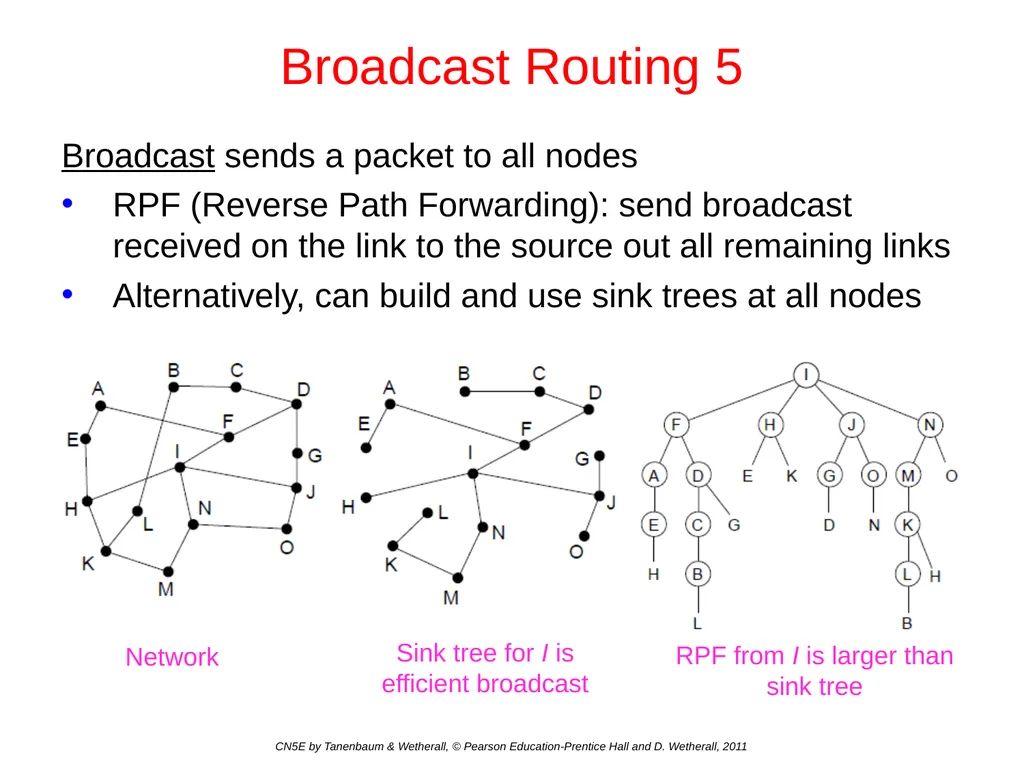
slide51. Broadcast Routing 5 Broadcast sends a packet to all nodes
RPF (Reverse Path Forwarding): send broadcast received on the link to the source out all remaining links
Alternatively, can build and use sink trees at all nodes CN5E by Tanenbaum & Wetherall, © Pearson Education-Prentice Hall and D. Wetherall, 2011 Network Sink tree for I is efficient broadcast RPF from I is larger than sink tree<br>
slide52. TUNALI Computer Networks 1 52 Multicast Routing Process Groups
A set of processes that work in an interactive manner
Multicasting
Sending message to a group
Multicast Routing
Routing of multicast messages
Group Management
Creating and destroying groups
Processes join and leave groups<br>
slide53. TUNALI Computer Networks 1 53 Multicast Routing (2) Routers need to know which host belongs to which group
Each router needs to compute a spanning tree covering all other routers in the group subnet
Multicast messages are forwarded only along the appropriate spanning tree
Link state or distance vector approaches are used to disseminate topology information
Pruning
Forming the spanning tree for a group
Pruning by link state routing
Each router knows the complete topology<br>
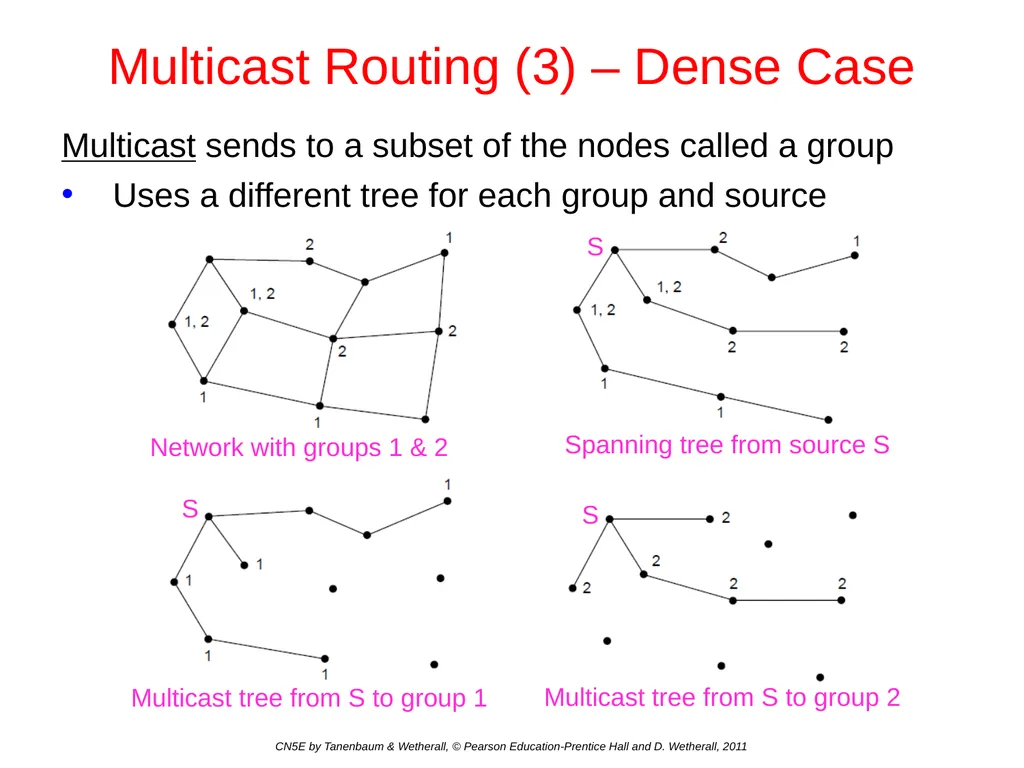
slide54. Multicast Routing (3) – Dense Case Multicast sends to a subset of the nodes called a group
Uses a different tree for each group and source CN5E by Tanenbaum & Wetherall, © Pearson Education-Prentice Hall and D. Wetherall, 2011 Network with groups 1 & 2 Spanning tree from source S S S S Multicast tree from S to group 1 Multicast tree from S to group 2<br>
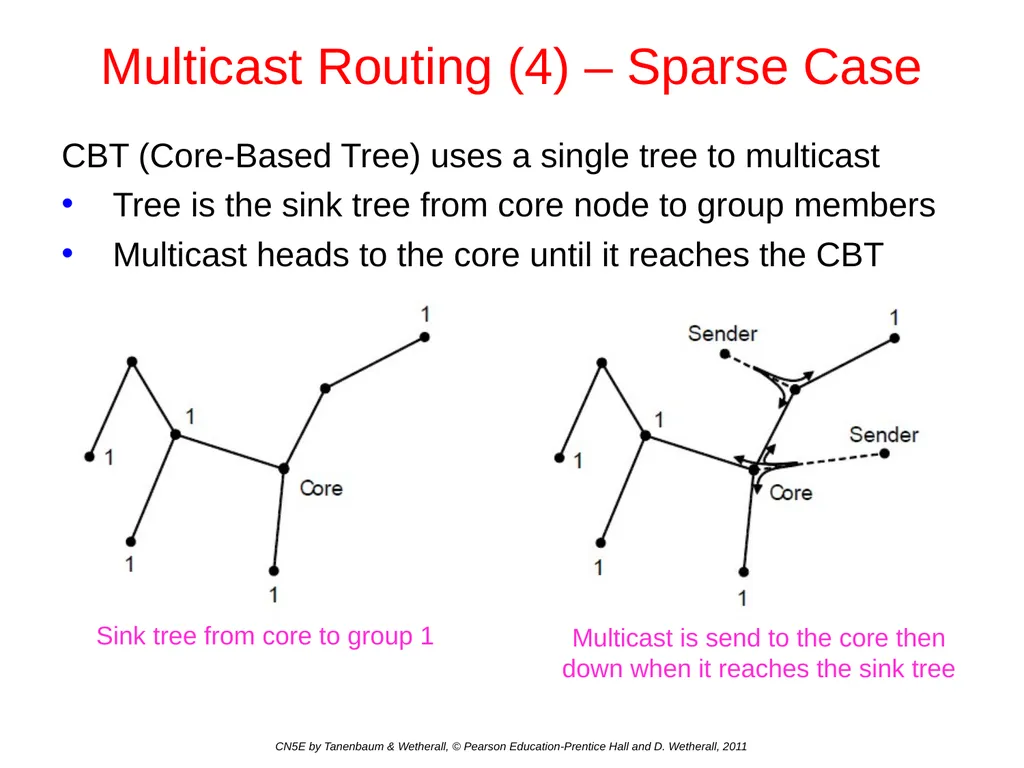
slide55. Multicast Routing (4) – Sparse Case CBT (Core-Based Tree) uses a single tree to multicast
Tree is the sink tree from core node to group members
Multicast heads to the core until it reaches the CBT
p 1. CN5E by Tanenbaum & Wetherall, © Pearson Education-Prentice Hall and D. Wetherall, 2011 Sink tree from core to group 1 Multicast is send to the core then down when it reaches the sink tree<br>
slide56. TUNALI Computer Networks 1 56 Multicast Routing (5) Pruning by distance vector routing
Use reverse path forwarding to eliminate routers that reject that particular group communication
Scales poorly<br>
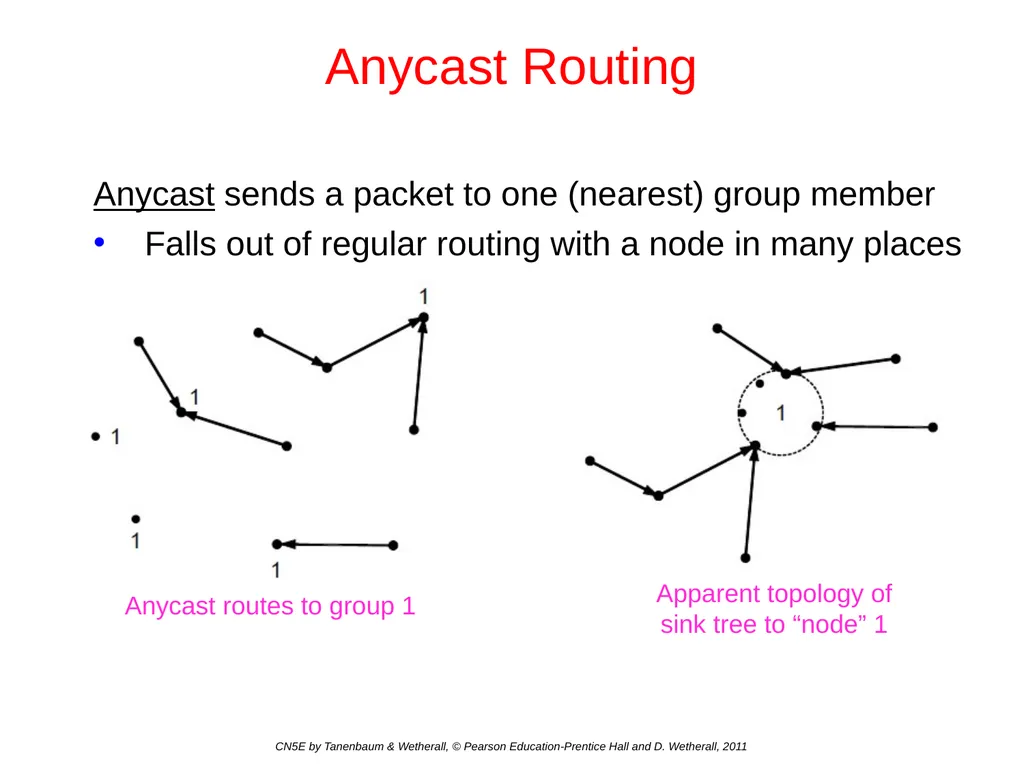
slide57. Anycast Routing CN5E by Tanenbaum & Wetherall, © Pearson Education-Prentice Hall and D. Wetherall, 2011 Anycast sends a packet to one (nearest) group member
Falls out of regular routing with a node in many places Anycast routes to group 1 Apparent topology of sink tree to “node” 1<br>
slide58. TUNALI Computer Networks 1 58 Routing for Mobile Hosts To route a packet to a mobile host, the network first has to find it
Classification of users
Stationary: Never move
Mobile: They move
Migratory: They move but physically connect to network somewhere
Roaming: They maintain connection as they move around
Locations
Home
Foreign<br>
slide59. TUNALI Computer Networks 1 59 Routing for Mobile Hosts (2) Each area has
Home agent
Keeps track of users whose home is in the area
Foreign agent
Keeps track of all mobile users who are visiting the area<br>
slide60. TUNALI Computer Networks 1 60 Routing for Mobile Hosts (3) Each mobile host entering a foreign area must register with the foreign agent of that area as follows
Mobile host provides foreign agent
Its home address
Current data link address
Security information
Foreign agent contacts mobile host’s home agent and report the presence of the mobile host in its region
The home agent confirms security information and permits proceed
Foreign agent registers the mobile host<br>
slide61. TUNALI Computer Networks 1 61 Encapsulation and Tunneling After registration,
Any packet sent to the mobile host is intercepted by the home agent
The packet is encapsulated by the home agent and sent to the foreign agent
The home agent also informs the sender of the packet about the new address of the mobile host
Subsequent packets are directly sent to the mobile host (tunneling)<br>
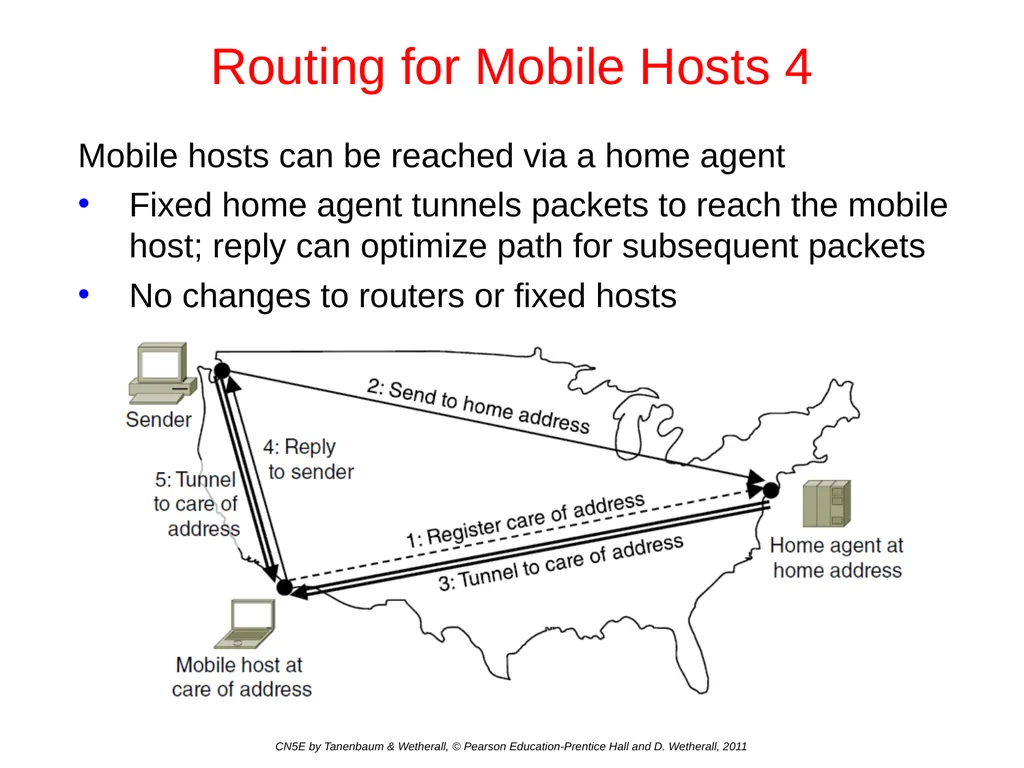
slide62. Routing for Mobile Hosts 4 Mobile hosts can be reached via a home agent
Fixed home agent tunnels packets to reach the mobile host; reply can optimize path for subsequent packets
No changes to routers or fixed hosts CN5E by Tanenbaum & Wetherall, © Pearson Education-Prentice Hall and D. Wetherall, 2011<br>
slide63. TUNALI Computer Networks 1 63 Routing in Ad Hoc Networks Possibilities when the routers are mobile:
Military vehicles on battlefield.
No infrastructure.
A fleet of ships at sea.
All moving all the time
Emergency works at earthquake .
The infrastructure destroyed.
A gathering of people with notebook computers.
In an area lacking 802.11.<br>
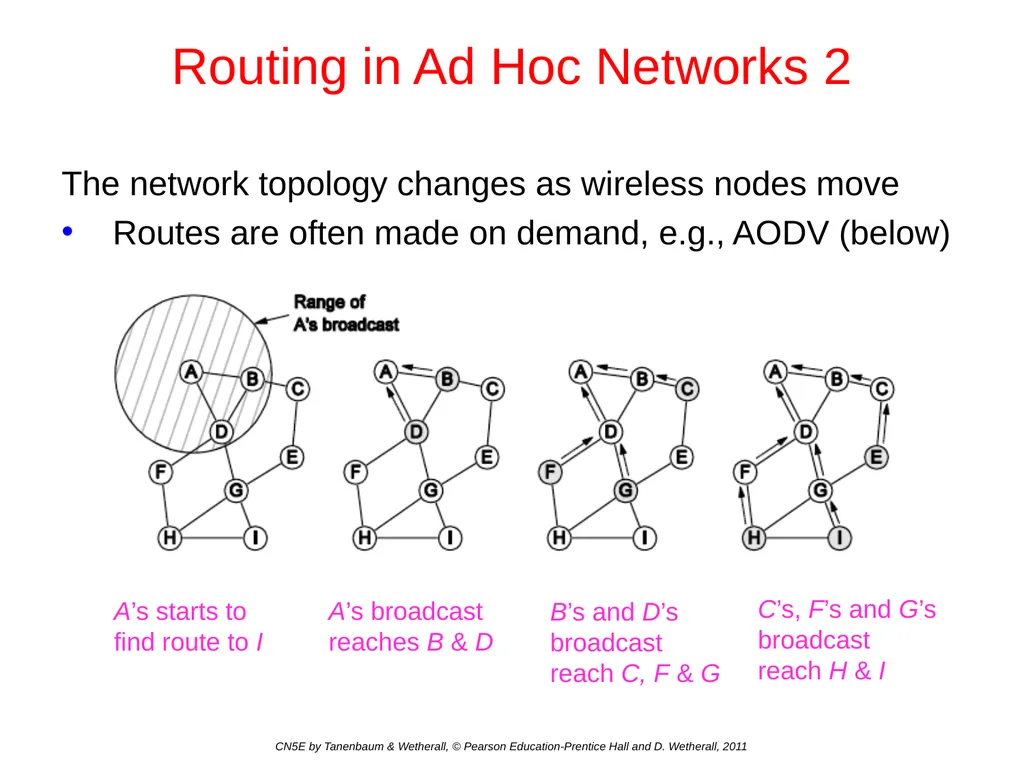
slide64. Routing in Ad Hoc Networks 2 The network topology changes as wireless nodes move
Routes are often made on demand, e.g., AODV (below) CN5E by Tanenbaum & Wetherall, © Pearson Education-Prentice Hall and D. Wetherall, 2011 A’s broadcast reaches B & D B’s and D’s broadcast reach C, F & G C’s, F’s and G’s broadcast reach H & I A’s starts to find route to I<br>
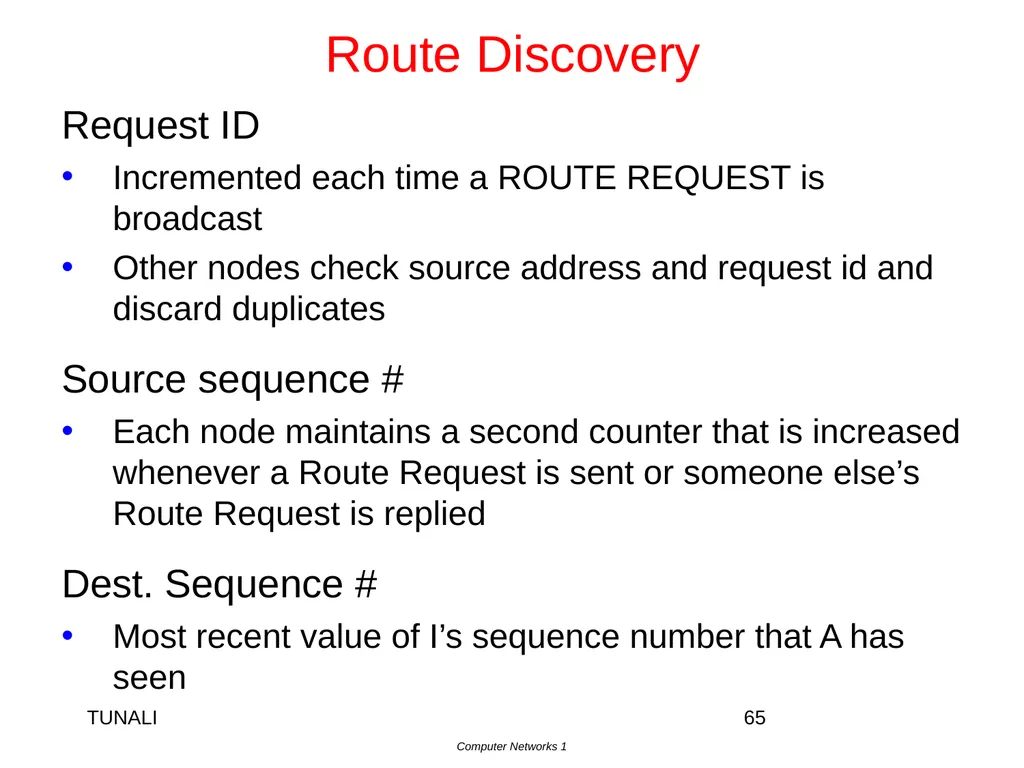
slide65. TUNALI Computer Networks 1 65 Route Discovery Request ID
Incremented each time a ROUTE REQUEST is broadcast
Other nodes check source address and request id and discard duplicates
Source sequence #
Each node maintains a second counter that is increased whenever a Route Request is sent or someone else’s Route Request is replied
Dest. Sequence #
Most recent value of I’s sequence number that A has seen<br>
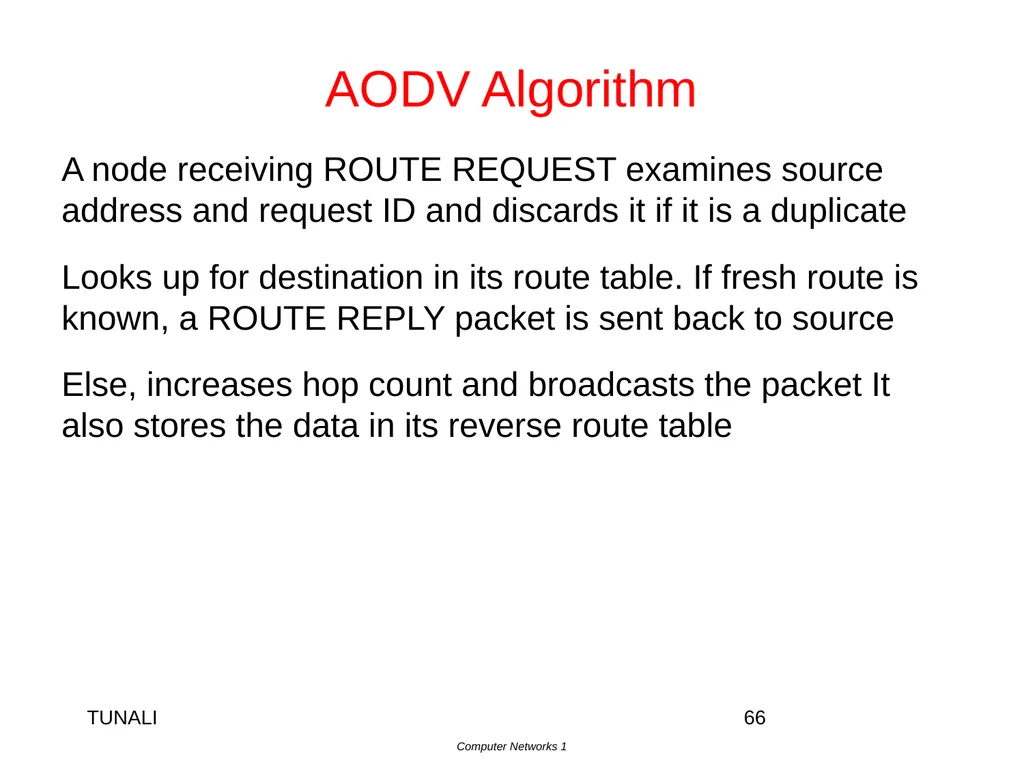
slide66. TUNALI Computer Networks 1 66 AODV Algorithm A node receiving ROUTE REQUEST examines source address and request ID and discards it if it is a duplicate
Looks up for destination in its route table. If fresh route is known, a ROUTE REPLY packet is sent back to source
Else, increases hop count and broadcasts the packet It also stores the data in its reverse route table<br>
slide67. Reading 5-1
5-2 CN5E by Tanenbaum & Wetherall, © Pearson Education-Prentice Hall and D. Wetherall, 2011<br>
slide68. Homework 5 (6)
9 (11) CN5E by Tanenbaum & Wetherall, © Pearson Education-Prentice Hall and D. Wetherall, 2011<br>
Routing Algorithms
Congestion Control
Quality of Service
Internetworking
Network Layer of the Internet Revised: August 2011<br>
slide2. The Network Layer CN5E by Tanenbaum & Wetherall, © Pearson Education-Prentice Hall and D. Wetherall, 2011 Responsible for delivering packets between endpoints over multiple links<br>
slide3. TUNALI Computer Networks 1 3 Network Layer Functionality Getting packets from the source all the way to the destination
Lowest layer that deals with end-to-end transmission
Must know the topology of the physical network<br>
slide4. Design Issues Store-and-forward packet switching »
Services Provided to the Transport Layer
Connectionless service – datagrams »
Connection-oriented service – virtual circuits »
Comparison of virtual-circuits and datagrams » CN5E by Tanenbaum & Wetherall, © Pearson Education-Prentice Hall and D. Wetherall, 2011<br>
slide5. Store-and-Forward Packet Switching CN5E by Tanenbaum & Wetherall, © Pearson Education-Prentice Hall and D. Wetherall, 2011 Hosts send packets into the network; packets are forwarded by routers<br>
slide6. TUNALI Computer Networks 1 6 Services Provided to the Transport Layer Frequently, network layer is the interface between the carrier and the customer
Services should be independent of the router technology
Transport layer should be shielded from the topology of the routers present
Network Layer addressing should be uniform<br>
slide7. TUNALI Computer Networks 1 7 Unreliable and connectionless Just two primitives
SEND PACKET
RECEIVE PACKET
The complexity is in the transport layer (hosts)<br>
slide8. Connectionless Service – Datagrams Packet is forwarded using destination address inside it
Different packets may take different paths CN5E by Tanenbaum & Wetherall, © Pearson Education-Prentice Hall and D. Wetherall, 2011<br>
slide9. TUNALI Computer Networks 1 9 Connection-Oriented Service Properties
Set up a connection to receiver
Negotiate parameters
Packets are guaranteed to be delivered in sequence
Flow control provided
Complexity is in the network layer<br>
slide10. Connection-Oriented – Virtual Circuits Packet is forwarded along a virtual circuit using tag inside it
Virtual circuit (VC) is set up ahead of time CN5E by Tanenbaum & Wetherall, © Pearson Education-Prentice Hall and D. Wetherall, 2011<br>
slide11. TUNALI Computer Networks 1 11 Internal Organization of Network Layer Virtual circuits
No need to choose a route for each packet
Datagram
No routes are worked out in advance
Note that the type of services provided to transport layer and internal organization of the network are different concepts
E.g. Network Layer may provide a connection-oriented service to transport layer even when it internally uses datagrams to move the packets around<br>
slide12. TUNALI Computer Networks 1 12 Virtual Circuits Between the source and destination a path is established
All the packets from the source to destination follow the same path
Each router must remember where to forward packets for each of the currently open virtual circuits passing through it
Each packet must contain a virtual circuit number field in the header for identification purposes
Routers assign this number locally and maintain tables to determine which incoming packet with a particular number will be forwarded to which outgoing line<br>
slide13. TUNALI Computer Networks 1 13 Datagrams Each packet must contain full destination address<br>
slide14. TUNALI Computer Networks 1 14 Comparison of VC and Datagrams Router memory space for vc tables vs wasted bandwidth for extra long address in each packet header
Set up time versus address parsing time
Easier to control congestion with vc
Datagram may be more suitable for transaction processing systems
VC is vulnerable to crash of the router<br>
slide15. Comparison of Virtual-Circuits & Datagrams CN5E by Tanenbaum & Wetherall, © Pearson Education-Prentice Hall and D. Wetherall, 2011<br>
slide16. Routing Algorithms (1) CN5E by Tanenbaum & Wetherall, © Pearson Education-Prentice Hall and D. Wetherall, 2011 Optimality principle »
Shortest path algorithm »
Flooding »
Distance vector routing »
Link state routing »
Hierarchical routing »
Broadcast routing »
Multicast routing »
Anycast routing »
Routing for mobile hosts »
Routing in ad hoc networks »<br>
slide17. Routing Algorithms (2) Routing is the process of discovering network paths
Model the network as a graph of nodes and links
Decide what to optimize (e.g., fairness vs efficiency)
Update routes for changes in topology (e.g., failures)
Forwarding is the sending of packets along a path CN5E by Tanenbaum & Wetherall, © Pearson Education-Prentice Hall and D. Wetherall, 2011<br>
slide18. TUNALI Computer Networks 1 18 Routing Algorithm Properties Correctness
Simplicity
Robustness
What happens if the topology changes?
Stability
Must converge to an equilibrium
Fairness
Optimality
Minimize mean packet delay
Maximize total network throughput<br>
slide19. TUNALI Computer Networks 1 19 Classes of Routing Algorithms Nonadaptive algorithms
Route is computed in advance and stored in the router
This is called static routing
Adaptive algorithms
Base their decision on current measurement of traffic and topology<br>
slide20. The Optimality Principle CN5E by Tanenbaum & Wetherall, © Pearson Education-Prentice Hall and D. Wetherall, 2011 Each portion of a best path is also a best path; the union of them to a router is a tree called the sink tree
Best means fewest hops in the example<br>
slide21. Shortest Path Algorithm (1) CN5E by Tanenbaum & Wetherall, © Pearson Education-Prentice Hall and D. Wetherall, 2011 Dijkstra’s algorithm computes a sink tree on the graph:
Each link is assigned a non-negative weight/distance
Shortest path is the one with lowest total weight
Using weights of 1 gives paths with fewest hops
Algorithm:
Start with sink, set distance at other nodes to infinity
Relax distance to other nodes
Pick the lowest distance node, add it to sink tree
Repeat until all nodes are in the sink tree<br>
slide22. Shortest Path Algorithm (2) CN5E by Tanenbaum & Wetherall, © Pearson Education-Prentice Hall and D. Wetherall, 2011 A network and first five steps in computing the shortest paths from A to D. Pink arrows show the sink tree so far.<br>
slide23. TUNALI Computer Networks 1 23 Shortest Path Algorithm (3) Initialize
T = {s} set of nodes incorporated (s source)
L(n)=w(i,j) for ns initial path costs to neighbors
Get next node
Add the neighbor x not in T that has least cost L(x) to s.
Add the edge from this neighbor to old T that contributes to the path
Update least cost paths
For all nT, update costs by L(n)=min[L(n),L(x)+w(x,n)]<br>
slide24. Shortest Path Algorithm (4) CN5E by Tanenbaum & Wetherall, © Pearson Education-Prentice Hall and D. Wetherall, 2011 . . . . . . Start with the sink, all other nodes are unreachable Relaxation step. Lower distance to nodes linked to newest member of the sink tree<br>
slide25. Shortest Path Algorithm (5) CN5E by Tanenbaum & Wetherall, © Pearson Education-Prentice Hall and D. Wetherall, 2011 . . . Find the lowest distance, add it to the sink tree, and repeat until done<br>
slide26. Flooding CN5E by Tanenbaum & Wetherall, © Pearson Education-Prentice Hall and D. Wetherall, 2011 A simple method to send a packet to all network nodes
Each node floods a new packet received on an incoming link by sending it out all of the other links
Nodes need to keep track of flooded packets to stop the flood; even using a hop limit can blow up exponentially<br>
slide27. TUNALI Computer Networks 1 27 Flooding (2) Every incoming packet is sent out on every outgoing line except the one it arrived on
Generates vast number of duplicate packets
Solutions
Put a hop counter to every packet
Avoid flooding the same packet second time
Needs packet sequence numbers
Use selective flooding
Do not put the packet to every outgoing line, instead put the packet to certain outgoing lines
Used in military applications and measurements<br>
slide28. Distance Vector Routing (1) CN5E by Tanenbaum & Wetherall, © Pearson Education-Prentice Hall and D. Wetherall, 2011 Distance vector is a distributed routing algorithm
Shortest path computation is split across nodes
Algorithm:
Each node knows distance of links to its neighbors
Each node advertises vector of lowest known distances to all neighbors
Each node uses received vectors to update its own
Repeat periodically<br>
slide29. TUNALI Computer Networks 1 29 Distance Vector Routing 2 Each router maintains a table that contains the following for each destination
Best known distance to the destination
Number of hops or
Time delay in milliseconds or
Total number of packets queued along the path
Which line to use to get there
Each router is assumed to know the distance to each of its neighbors<br>
slide30. TUNALI Computer Networks 1 30 Distance Vector Routing 3 Once every T msec, each router sends to each neighbor a list of its estimated delays to each destination
A router, knowing the distance to its neighbor, can calculate distances to all destinations via its respective neighbor
Then, it can choose the minimum distance and forward packets via that neighbor<br>
slide31. Distance Vector Routing (4) CN5E by Tanenbaum & Wetherall, © Pearson Education-Prentice Hall and D. Wetherall, 2011 Network Vectors received at J from
Neighbors A, I, H and K New vector for J<br>
slide32. The Count-to-Infinity Problem 1 CN5E by Tanenbaum & Wetherall, © Pearson Education-Prentice Hall and D. Wetherall, 2011 Failures can cause DV to “count to infinity” while seeking a path to an unreachable node Good news of a path to A spreads quickly X Bad news of no path to A is learned slowly<br>
slide33. TUNALI Computer Networks 1 33 The Count-to-Infinity Problem 2 In distance vector routing
Good news travel fast
One hop per exchange
Within N (number of nodes) exchanges, everyone will know about new changes
Bad news travel slow
Count-to-Infinity problem
Routers increase their costs by a value of one to reach infinity<br>
slide34. Link State Routing (1) CN5E by Tanenbaum & Wetherall, © Pearson Education-Prentice Hall and D. Wetherall, 2011 Link state is an alternative to distance vector
More computation but simpler dynamics
Widely used in the Internet (OSPF, ISIS)
Algorithm:
Each node floods information about its neighbors in LSPs (Link State Packets); all nodes learn the full network graph
Each node runs Dijkstra’s algorithm to compute the path to take for each destination<br>
slide35. TUNALI Computer Networks 1 35 Link State Routing 2 Distance vector routing
Did not take line bandwidth into account
Took too long to converge
Link state routing: Each router
Discover its neighbors, learn their network address.
Measure the delay or cost to each of its neighbors.
Construct a packet telling all it has just learned.
Send this packet to all other routers.
Compute the shortest path to every other router.<br>
slide36. TUNALI Computer Networks 1 36 Learning about the Neighbors When a rooter is booted, it sends HELLO packet to all of its neighbors
Neighbors reply by sending their globally unique names
Modeling LANs need extra mechanisms
In the next slide an artificial node N is added to represent the LAN
From A to C, the path is represented as ANC<br>
slide37. TUNALI Computer Networks 1 37 Learning about the Neighbors 2 (a) Nine routers and a LAN. (b) A graph model of (a).<br>
slide38. TUNALI Computer Networks 1 38 Measuring Line Cost Each router should know an estimate of delay to each of its neighbors
To estimate the delay, a router can send an echo packet to its neighbor and measure the time when it receives it back
While measuring time, it is possible to include or exclude the time the echo packet spends on the queues which corresponds to consider load on the line
Including load may cause oscillations in the algorithm<br>
slide39. TUNALI Computer Networks 1 39 Building Link State Packets Packets contain
Identity of the sender
Sequence number
Age
List of neighbors and delays
Packets can be issued
Periodically or
When a significant event occurs<br>
slide40. Link State Routing (3) – LSPs CN5E by Tanenbaum & Wetherall, © Pearson Education-Prentice Hall and D. Wetherall, 2011 LSP (Link State Packet) for a node lists neighbors and weights of links to reach them Network LSP for each node<br>
slide41. TUNALI Computer Networks 1 41 Distributing the Link State Packets Flooding is used
Packet sequence numbers are used to discard duplicates or old packets by holding packets for a short while before flooding them
32-bit sequence numbers are used to prevent wrap-arounds
For each packet, in addition to sequence number, age is used and decremented every second to solve
Router crash problem
Corrupted sequence number problem<br>
slide42. Link State Routing (4) – Reliable Flooding CN5E by Tanenbaum & Wetherall, © Pearson Education-Prentice Hall and D. Wetherall, 2011 Seq. number and age are used for reliable flooding
New LSPs are acknowledged on the lines they are received and sent on all other lines
Example shows the LSP database at router B<br>
slide43. TUNALI Computer Networks 1 43 Computing the New Routes When a router accumulates a full set of link state packets, it can construct the entire network graph
It then runs Dijkstra’s algorithm to construct shortest paths to all possible destinations
Even for a large subnet, the memory requirements are reasonable
Malfunctioning routers may cause problems
Protocols using link state routing
OSPF and IS-IS<br>
slide44. TUNALI Computer Networks 1 44 Hierarchical Routing As networks grow
Routing table memory requirements increase
CPU time to execute routing algorithm increases
Solution: Use hierarchical routing
Routers are divided into regions
A router knows every detail about its region but knows nothing about other regions
Each region is represented by a “monitor” router
Monitor routers form a higher level in hierarchy<br>
slide45. Hierarchical Routing 2 Hierarchical routing reduces the work of route computation but may result in slightly longer paths than flat routing CN5E by Tanenbaum & Wetherall, © Pearson Education-Prentice Hall and D. Wetherall, 2011 Best choice to reach nodes in 5 except for 5C<br>
slide46. TUNALI Computer Networks 1 46 Hierarchical routing (3) Path length increases
How many levels should the hierarchy have?
If there are N nodes, the optimal number of levels is ln N<br>
slide47. TUNALI Computer Networks 1 47 Broadcast Routing Broadcast
Sending a packet to all destinations simultaneously
Broadcast method 1:
Send a distinct packet to each destination
Needs addresses of destinations and wastes bandwidth
Broadcast method 2:
Flooding<br>
slide48. TUNALI Computer Networks 1 48 Broadcast Routing 2 Broadcast method 3:
Multidestination routing
Each packet contains a list of destinations
A router receiving a packet checks the destinations and determines the output lines needed
The router generates a new packet for each output line and modifies the destination list by including only those destinations that are on that particular line<br>
slide49. TUNALI Computer Networks 1 49 Broadcast Routing (3) Broadcast method 4:
Spanning tree
A subset of network that includes all routers but contains no loops
Each router knows which of its lines belong to the spanning tree (this is an important restriction)
Any incoming packet on a spanning tree line is forwarded to all other spanning tree lines<br>
slide50. TUNALI Computer Networks 1 50 Broadcast Routing (4) Broadcast method 5:
Reverse Path Forwarding
No need to know the spanning tree
When a broadcast packet arrives, the router checks to see if it arrived on the line that it uses forwarding packets to the source node of the broadcast
If yes, it forwards the packets to all other lines except the one it arrived on.
If no, it discards the packet, considering that the packet did not arrive through optimal route.
Simple and efficient<br>
slide51. Broadcast Routing 5 Broadcast sends a packet to all nodes
RPF (Reverse Path Forwarding): send broadcast received on the link to the source out all remaining links
Alternatively, can build and use sink trees at all nodes CN5E by Tanenbaum & Wetherall, © Pearson Education-Prentice Hall and D. Wetherall, 2011 Network Sink tree for I is efficient broadcast RPF from I is larger than sink tree<br>
slide52. TUNALI Computer Networks 1 52 Multicast Routing Process Groups
A set of processes that work in an interactive manner
Multicasting
Sending message to a group
Multicast Routing
Routing of multicast messages
Group Management
Creating and destroying groups
Processes join and leave groups<br>
slide53. TUNALI Computer Networks 1 53 Multicast Routing (2) Routers need to know which host belongs to which group
Each router needs to compute a spanning tree covering all other routers in the group subnet
Multicast messages are forwarded only along the appropriate spanning tree
Link state or distance vector approaches are used to disseminate topology information
Pruning
Forming the spanning tree for a group
Pruning by link state routing
Each router knows the complete topology<br>
slide54. Multicast Routing (3) – Dense Case Multicast sends to a subset of the nodes called a group
Uses a different tree for each group and source CN5E by Tanenbaum & Wetherall, © Pearson Education-Prentice Hall and D. Wetherall, 2011 Network with groups 1 & 2 Spanning tree from source S S S S Multicast tree from S to group 1 Multicast tree from S to group 2<br>
slide55. Multicast Routing (4) – Sparse Case CBT (Core-Based Tree) uses a single tree to multicast
Tree is the sink tree from core node to group members
Multicast heads to the core until it reaches the CBT
p 1. CN5E by Tanenbaum & Wetherall, © Pearson Education-Prentice Hall and D. Wetherall, 2011 Sink tree from core to group 1 Multicast is send to the core then down when it reaches the sink tree<br>
slide56. TUNALI Computer Networks 1 56 Multicast Routing (5) Pruning by distance vector routing
Use reverse path forwarding to eliminate routers that reject that particular group communication
Scales poorly<br>
slide57. Anycast Routing CN5E by Tanenbaum & Wetherall, © Pearson Education-Prentice Hall and D. Wetherall, 2011 Anycast sends a packet to one (nearest) group member
Falls out of regular routing with a node in many places Anycast routes to group 1 Apparent topology of sink tree to “node” 1<br>
slide58. TUNALI Computer Networks 1 58 Routing for Mobile Hosts To route a packet to a mobile host, the network first has to find it
Classification of users
Stationary: Never move
Mobile: They move
Migratory: They move but physically connect to network somewhere
Roaming: They maintain connection as they move around
Locations
Home
Foreign<br>
slide59. TUNALI Computer Networks 1 59 Routing for Mobile Hosts (2) Each area has
Home agent
Keeps track of users whose home is in the area
Foreign agent
Keeps track of all mobile users who are visiting the area<br>
slide60. TUNALI Computer Networks 1 60 Routing for Mobile Hosts (3) Each mobile host entering a foreign area must register with the foreign agent of that area as follows
Mobile host provides foreign agent
Its home address
Current data link address
Security information
Foreign agent contacts mobile host’s home agent and report the presence of the mobile host in its region
The home agent confirms security information and permits proceed
Foreign agent registers the mobile host<br>
slide61. TUNALI Computer Networks 1 61 Encapsulation and Tunneling After registration,
Any packet sent to the mobile host is intercepted by the home agent
The packet is encapsulated by the home agent and sent to the foreign agent
The home agent also informs the sender of the packet about the new address of the mobile host
Subsequent packets are directly sent to the mobile host (tunneling)<br>
slide62. Routing for Mobile Hosts 4 Mobile hosts can be reached via a home agent
Fixed home agent tunnels packets to reach the mobile host; reply can optimize path for subsequent packets
No changes to routers or fixed hosts CN5E by Tanenbaum & Wetherall, © Pearson Education-Prentice Hall and D. Wetherall, 2011<br>
slide63. TUNALI Computer Networks 1 63 Routing in Ad Hoc Networks Possibilities when the routers are mobile:
Military vehicles on battlefield.
No infrastructure.
A fleet of ships at sea.
All moving all the time
Emergency works at earthquake .
The infrastructure destroyed.
A gathering of people with notebook computers.
In an area lacking 802.11.<br>
slide64. Routing in Ad Hoc Networks 2 The network topology changes as wireless nodes move
Routes are often made on demand, e.g., AODV (below) CN5E by Tanenbaum & Wetherall, © Pearson Education-Prentice Hall and D. Wetherall, 2011 A’s broadcast reaches B & D B’s and D’s broadcast reach C, F & G C’s, F’s and G’s broadcast reach H & I A’s starts to find route to I<br>
slide65. TUNALI Computer Networks 1 65 Route Discovery Request ID
Incremented each time a ROUTE REQUEST is broadcast
Other nodes check source address and request id and discard duplicates
Source sequence #
Each node maintains a second counter that is increased whenever a Route Request is sent or someone else’s Route Request is replied
Dest. Sequence #
Most recent value of I’s sequence number that A has seen<br>
slide66. TUNALI Computer Networks 1 66 AODV Algorithm A node receiving ROUTE REQUEST examines source address and request ID and discards it if it is a duplicate
Looks up for destination in its route table. If fresh route is known, a ROUTE REPLY packet is sent back to source
Else, increases hop count and broadcasts the packet It also stores the data in its reverse route table<br>
slide67. Reading 5-1
5-2 CN5E by Tanenbaum & Wetherall, © Pearson Education-Prentice Hall and D. Wetherall, 2011<br>
slide68. Homework 5 (6)
9 (11) CN5E by Tanenbaum & Wetherall, © Pearson Education-Prentice Hall and D. Wetherall, 2011<br>