New Directions in Management Accounting Brussels,
Description: New Directions in Management Accounting Brussels, Belgium December, 2014 Joseph G. Fisher Indiana University jl Musings on Experimental Budgeting Research Some Random Initial Caveats: Mike asked me to comment on Budgeting First, struck by
Related Topics
Download Presentation
"New Directions in Management Accounting Brussels," is the property of its rightful owner. Permission is granted to download and print the materials on this website for personal, non-commercial use only, and to display it on your personal computer provided you do not modify the materials and that you retain all copyright notices contained in the materials. By downloading content from our website, you accept the terms of this agreement.
Presentation Transcript
slide1. New Directions in Management Accounting
Brussels, Belgium
December, 2014
Joseph G. Fisher
Indiana University
jl Musings on Experimental Budgeting Research<br>
slide2. Some Random Initial Caveats:Mike asked me to comment on Budgeting First, struck by how much we don’t know.
As someone who works in the area, rather humbling but an area that is publishable!
As a researcher, I spend most of my time looking at trees rather than the forest
Stream of consciousness exercise (more discussion than definitive).
E.g. I reserve the right to change my mind!!<br>
slide3. Some Basic Thoughts Long literature noting budgeting flaws:
Biased information
Encourages unethical behavior
Extremely costly and time consuming
Improper motivation, etc.
However, even given these issues, an almost ubiquitous firm activity
But, implemented in many different ways<br>
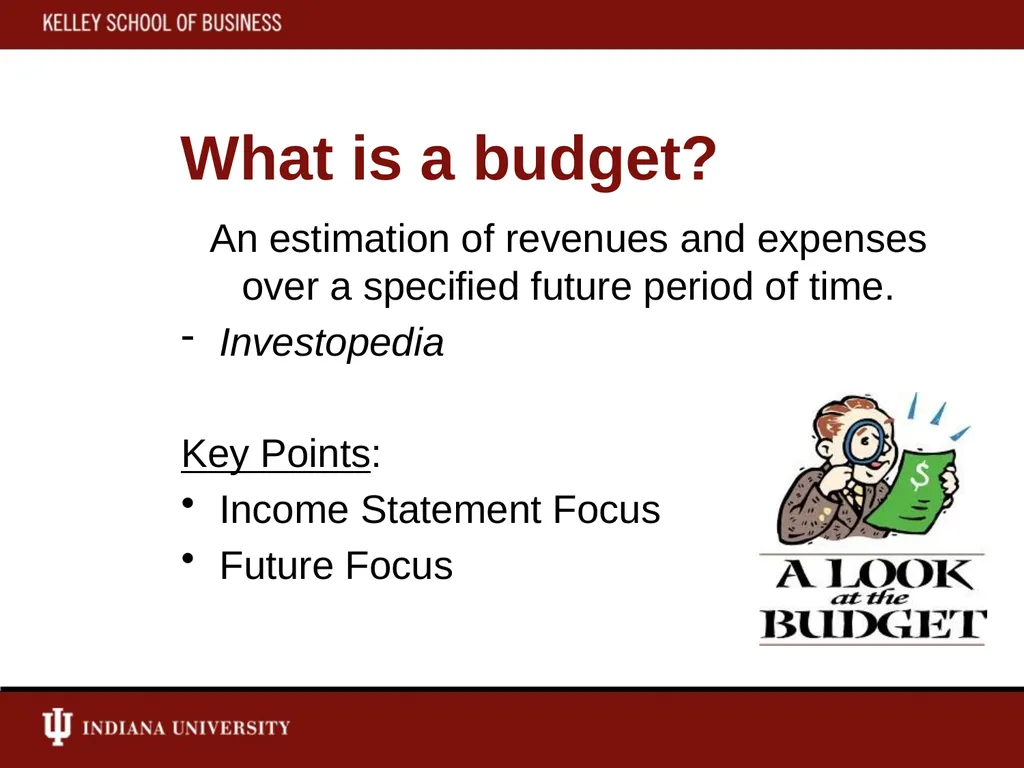
slide4. What is a budget? An estimation of revenues and expenses over a specified future period of time.
Investopedia
Key Points:
Income Statement Focus
Future Focus<br>
slide5. Why the interest in Budgeting? Ubiquitous management activity
Many firms state it is a (the) key management activity
Implementation under (CEO) management control
A living system (always being revised)
Budgeting is always controversial within a firm. Budget flaws are obvious while strengths may be less obvious.<br>
slide6. Why is budgeting controversial? Point estimates of uncertain future events (no consensus on past events).
One estimate used for multiple purposes
In many cases purposes conflicting:
Forward/Backward orientation
Planning/resource allocation/performance evaluation/Other
Adversarial relationships
Ethical/Moral issues
Etc.<br>
slide7. Which methodology?? No easily accessible large database.
Most common methodologies:
Case studies
Field studies
Analytical
Experimental<br>
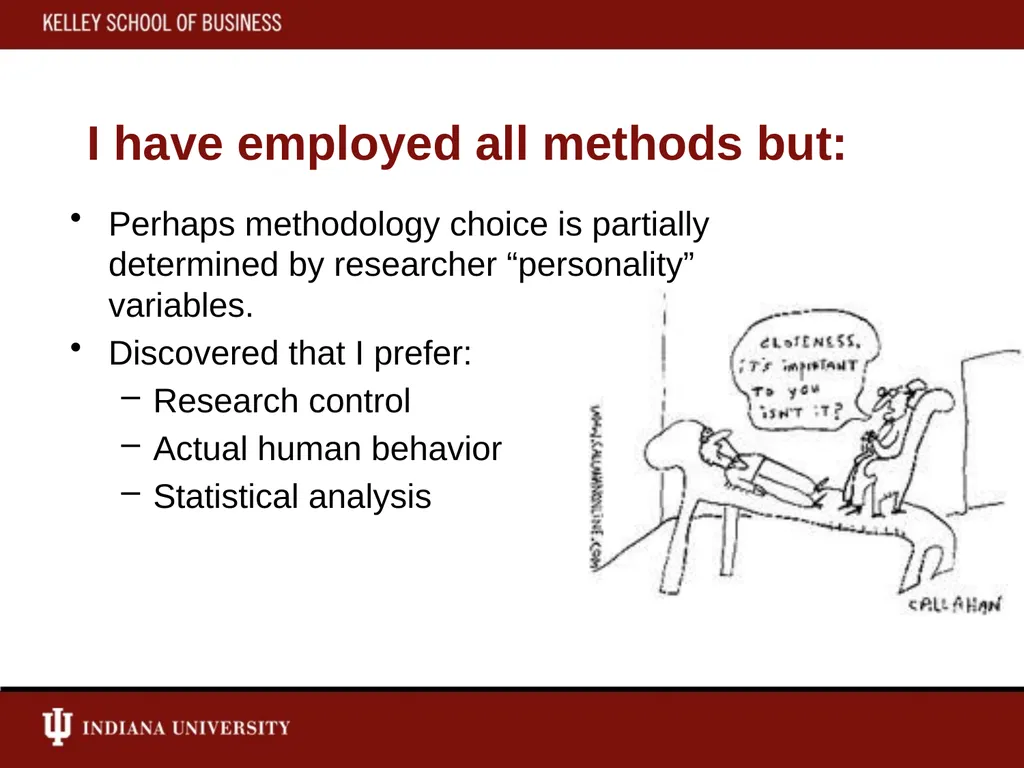
slide8. I have employed all methods but: Perhaps methodology choice is partially determined by researcher “personality” variables.
Discovered that I prefer:
Research control
Actual human behavior
Statistical analysis<br>
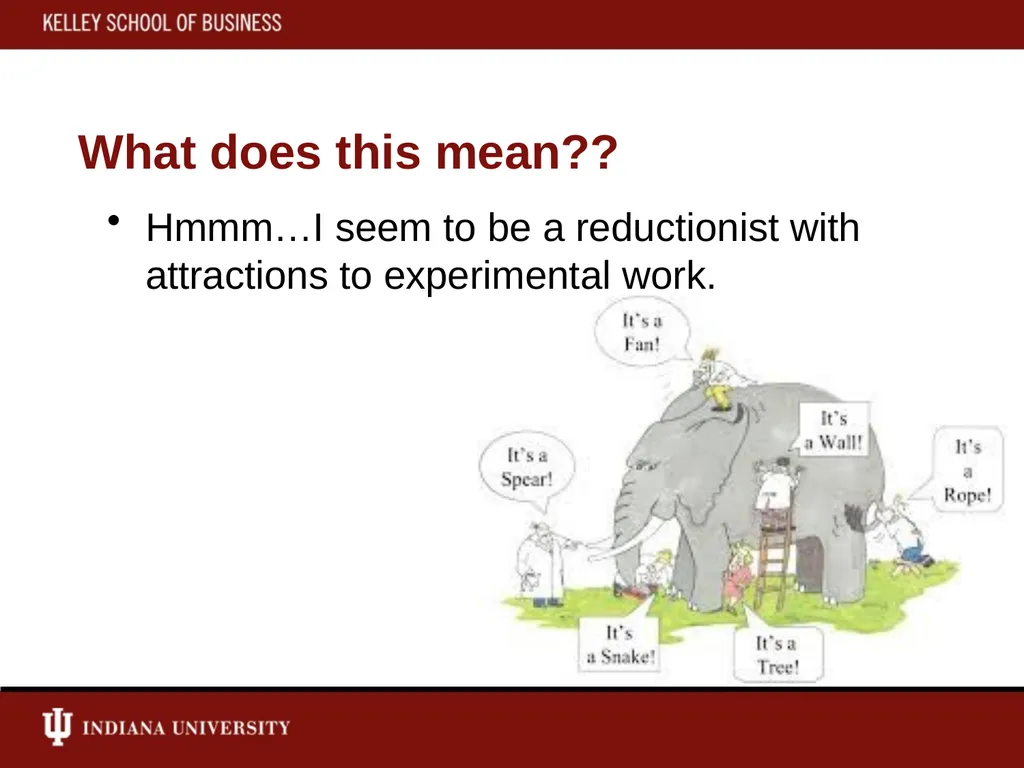
slide9. What does this mean?? Hmmm…I seem to be a reductionist with attractions to experimental work.<br>
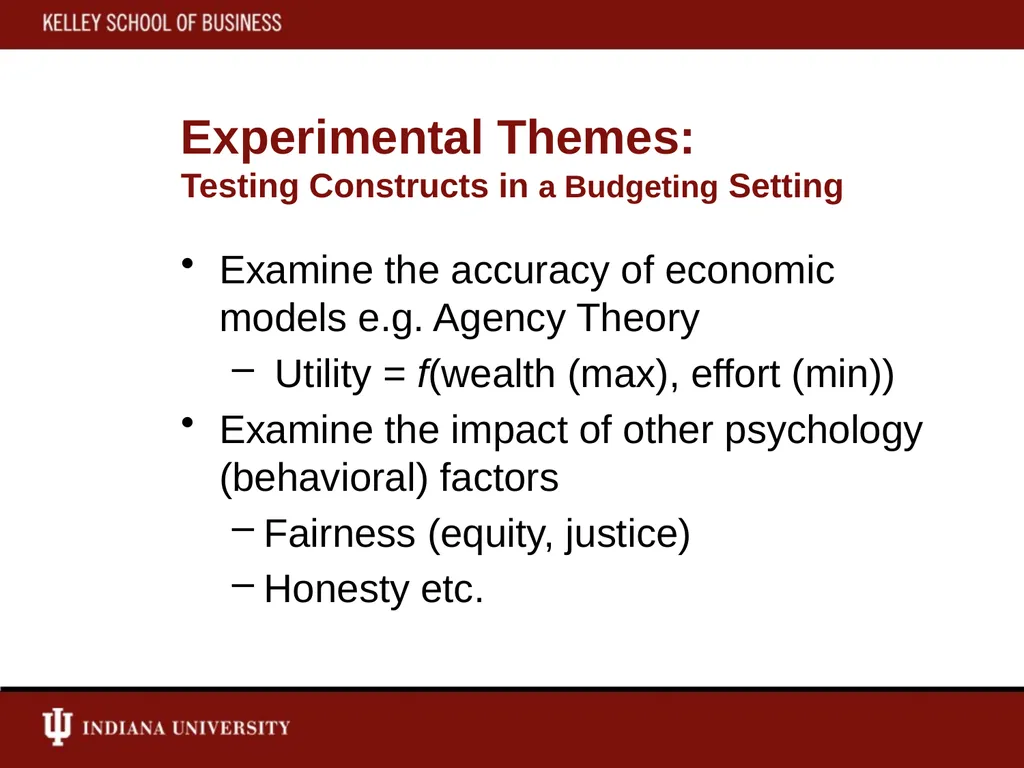
slide10. Experimental Themes:Testing Constructs in a Budgeting Setting Examine the accuracy of economic models e.g. Agency Theory
Utility = f(wealth (max), effort (min))
Examine the impact of other psychology (behavioral) factors
Fairness (equity, justice)
Honesty etc.<br>
slide11. Experimental ThemesTesting Differences Found in the Real World Some examples:
Participation
Centralization/Decentraliztion
Budget Levels<br>
slide12. Typical Outcome (Dependent) Variables (Subordinate) Performance
Compensation
Superior (residual) returns
Message accuracy
Message slack (honesty)<br>
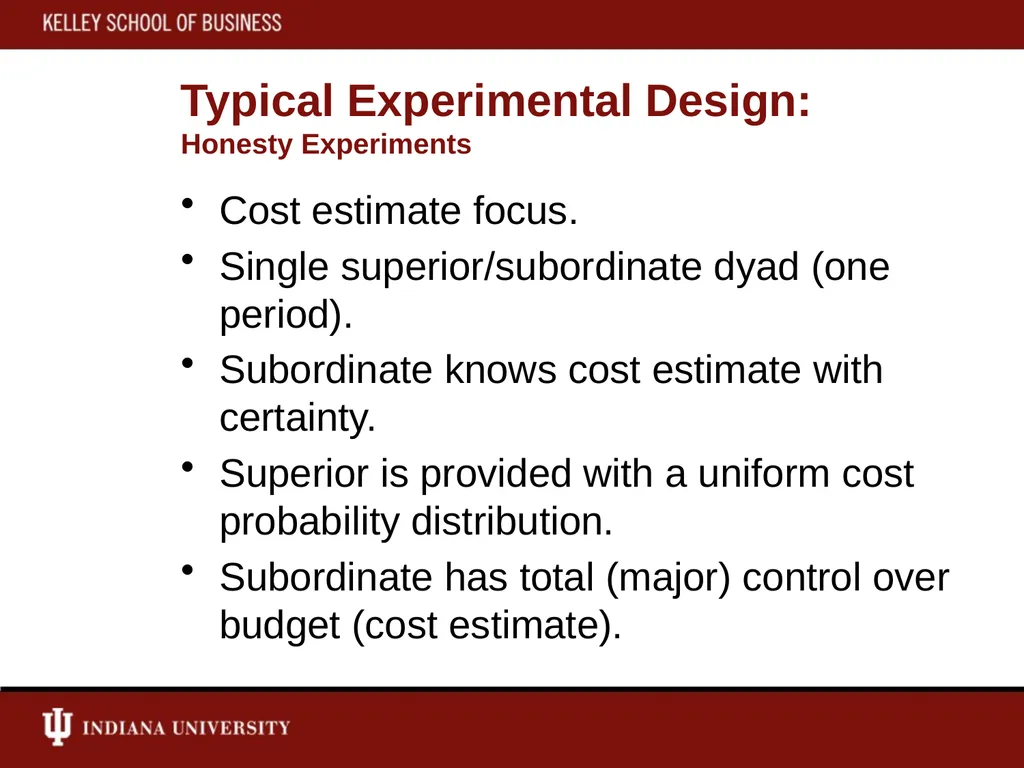
slide13. Typical Experimental Design:Honesty Experiments Cost estimate focus.
Single superior/subordinate dyad (one period).
Subordinate knows cost estimate with certainty.
Superior is provided with a uniform cost probability distribution.
Subordinate has total (major) control over budget (cost estimate).<br>
slide14. My Personal Opinion Most contemporary budgeting experimental designs are well suited for testing economic and psychology theories.
Weak external validity or realism.
Is this ok??<br>
slide15. What we know:Literature Review Part of Presentation Homework assignment:
You should read work completed by experimental budgeting researchers: e.g., Rankin, Young, Towry, Chow, Hannan, Sprinkle, Shields, Evans, Mozer etc.
Be prepared to discuss their work
My take: Much of the work derives “economic” predictions that are not descriptive of experimental results. Importance of other variables.<br>
slide16. My Suggestion for Future Work Move towards experimental research that focuses on real world issues and dilemmas.
Case study and field based work particularly helpful in finding interesting settings.
Perhaps a future conference?<br>
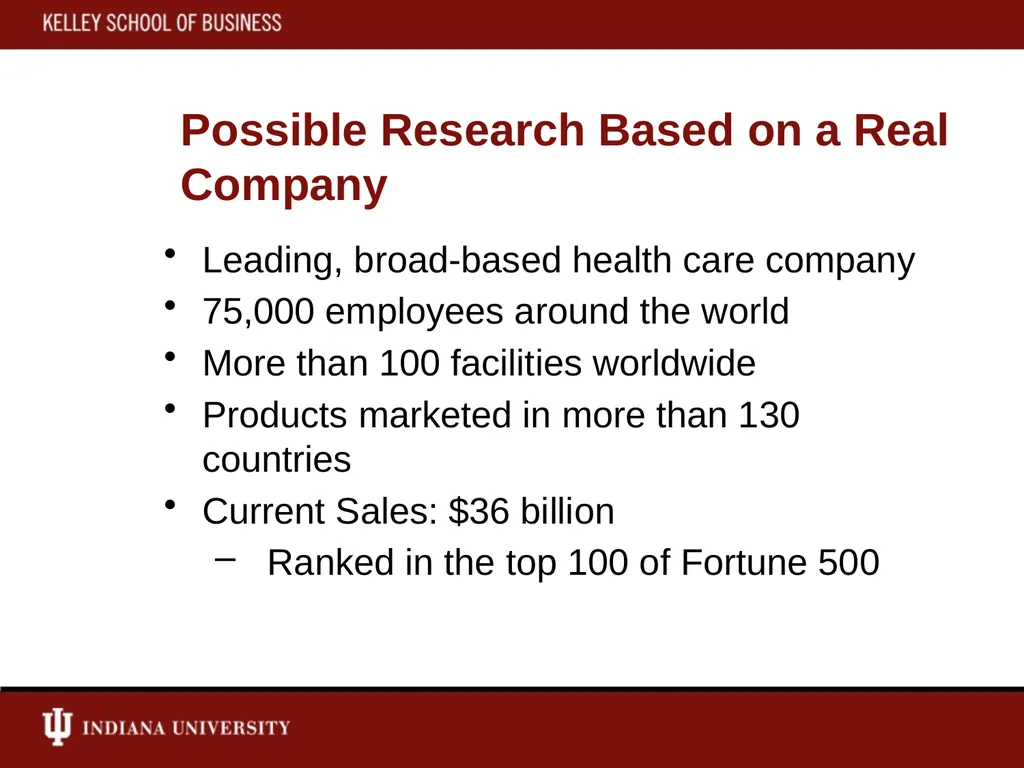
slide17. Possible Research Based on a Real Company Leading, broad-based health care company
75,000 employees around the world
More than 100 facilities worldwide
Products marketed in more than 130 countries
Current Sales: $36 billion
Ranked in the top 100 of Fortune 500<br>
slide18. “Acme” Profit Planning (PP) Profit planning is a very high priority and includes virtually all levels of management.
PP is perceived as the key to our success through history. It is viewed as critical to our future success (consistent, predictable growth)<br>
slide19. What is the Profit Plan? The Acme Profit Planning process is a management tool used to effectively accumulate forecast data by operating group and review performance. The focus is on sales, expenses, income, capital, headcount, and investment responsibility<br>
slide20. Some Details on LRP LRP focuses on the next 5 years of a much deeper lifecyle management approach.
Average time to market for Pharmaceutical product is 12 to 15 years.
Patents expire after 20 years.
1 in 5000 new compound discoveries will achieve FDA approval.
Average cost to reach FDA approval is $800 million.<br>
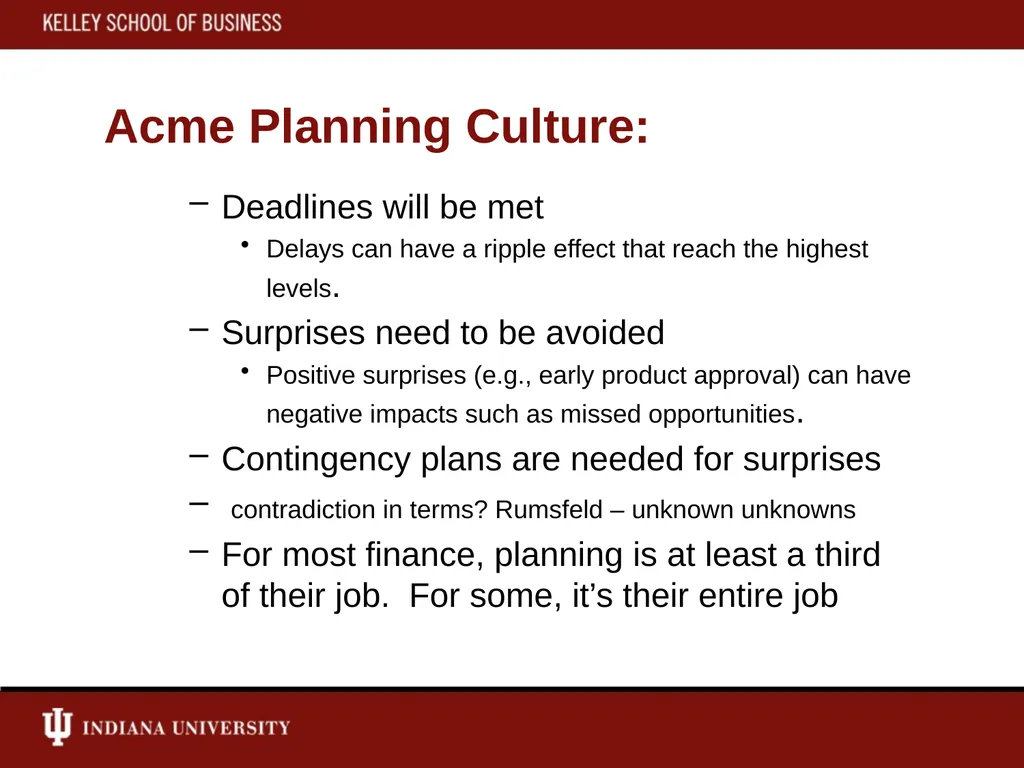
slide21. Acme Planning Culture: Deadlines will be met
Delays can have a ripple effect that reach the highest levels.
Surprises need to be avoided
Positive surprises (e.g., early product approval) can have negative impacts such as missed opportunities.
Contingency plans are needed for surprises
contradiction in terms? Rumsfeld – unknown unknowns
For most finance, planning is at least a third of their job. For some, it’s their entire job<br>
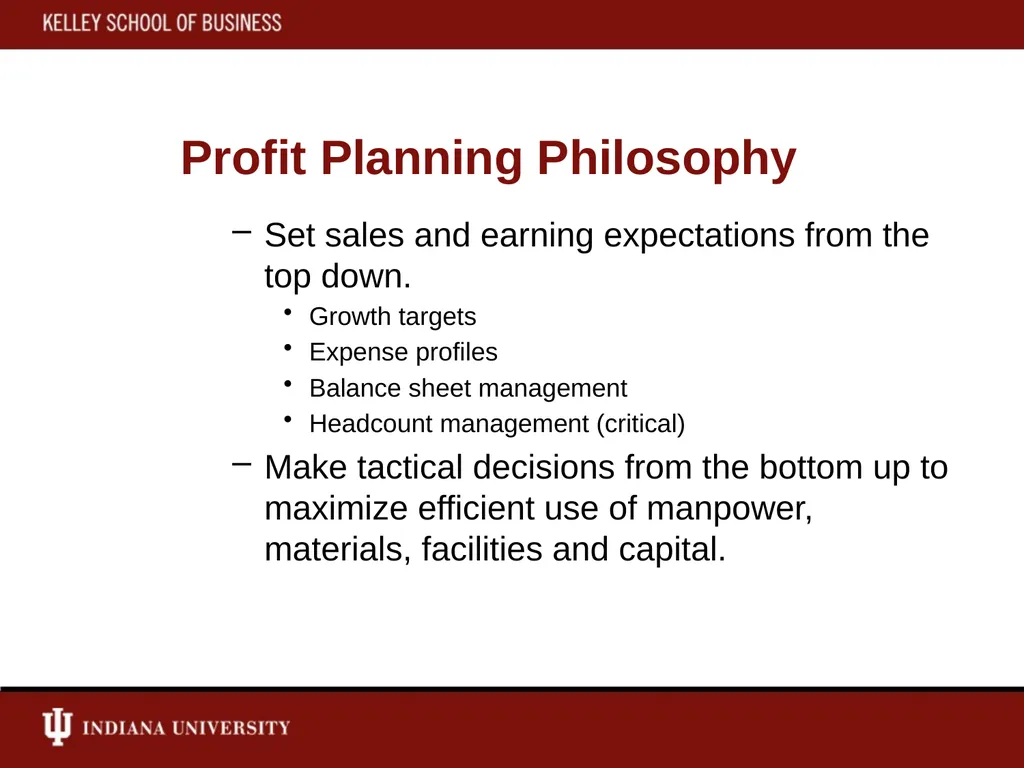
slide22. Profit Planning Philosophy Set sales and earning expectations from the top down.
Growth targets
Expense profiles
Balance sheet management
Headcount management (critical)
Make tactical decisions from the bottom up to maximize efficient use of manpower, materials, facilities and capital.<br>
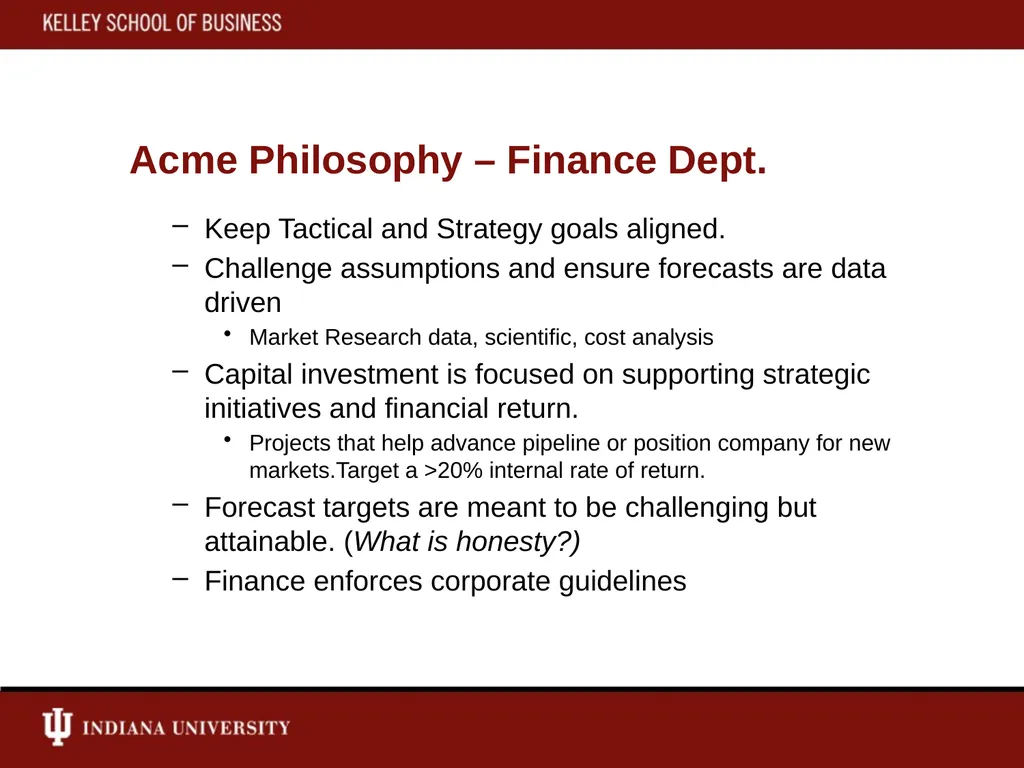
slide23. Acme Philosophy – Finance Dept. Keep Tactical and Strategy goals aligned.
Challenge assumptions and ensure forecasts are data driven
Market Research data, scientific, cost analysis
Capital investment is focused on supporting strategic initiatives and financial return.
Projects that help advance pipeline or position company for new markets.Target a >20% internal rate of return.
Forecast targets are meant to be challenging but attainable. (What is honesty?)
Finance enforces corporate guidelines<br>
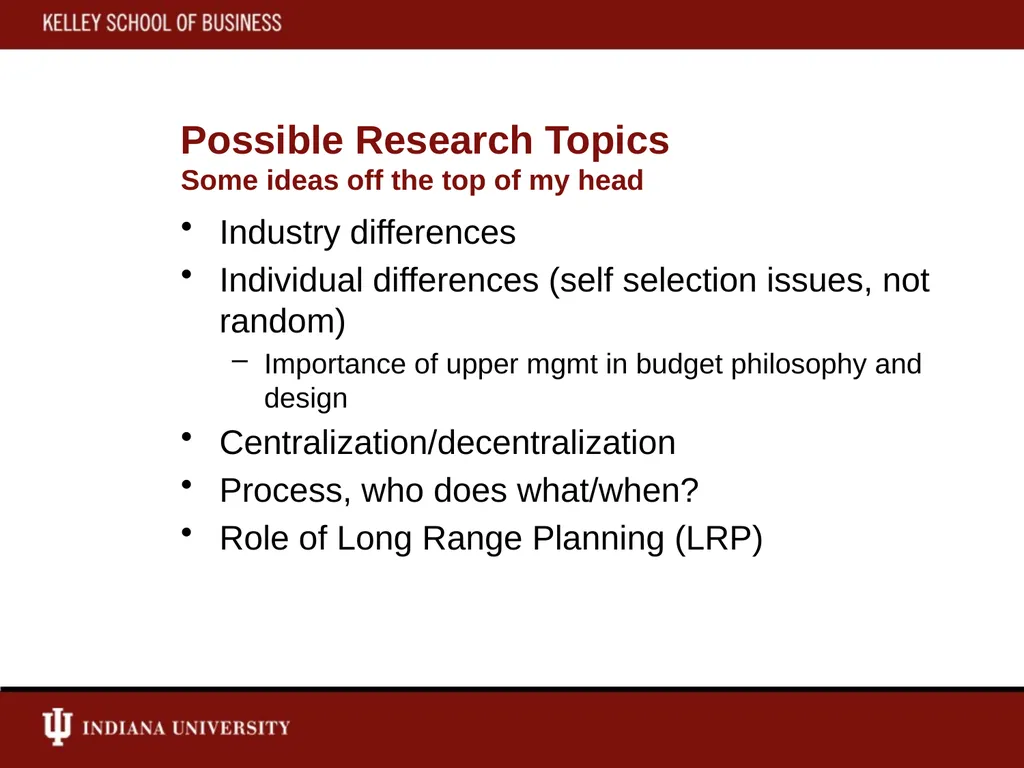
slide24. Possible Research TopicsSome ideas off the top of my head Industry differences
Individual differences (self selection issues, not random)
Importance of upper mgmt in budget philosophy and design
Centralization/decentralization
Process, who does what/when?
Role of Long Range Planning (LRP)<br>
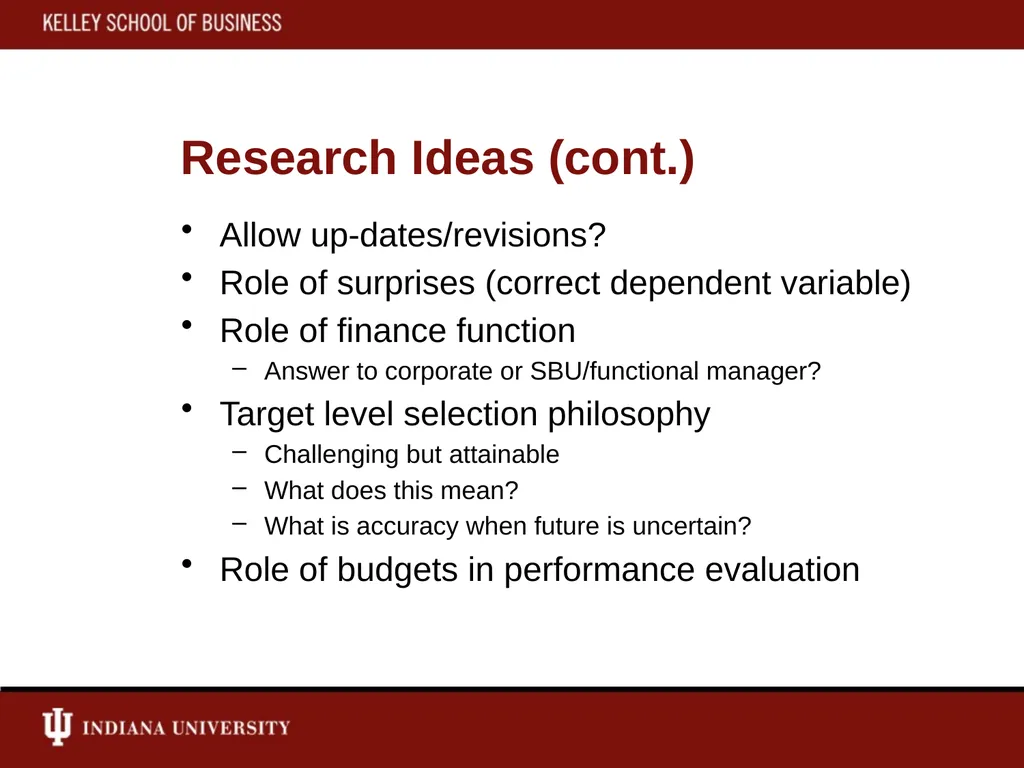
slide25. Research Ideas (cont.) Allow up-dates/revisions?
Role of surprises (correct dependent variable)
Role of finance function
Answer to corporate or SBU/functional manager?
Target level selection philosophy
Challenging but attainable
What does this mean?
What is accuracy when future is uncertain?
Role of budgets in performance evaluation<br>

Brussels, Belgium
December, 2014
Joseph G. Fisher
Indiana University
jl Musings on Experimental Budgeting Research<br>
slide2. Some Random Initial Caveats:Mike asked me to comment on Budgeting First, struck by how much we don’t know.
As someone who works in the area, rather humbling but an area that is publishable!
As a researcher, I spend most of my time looking at trees rather than the forest
Stream of consciousness exercise (more discussion than definitive).
E.g. I reserve the right to change my mind!!<br>
slide3. Some Basic Thoughts Long literature noting budgeting flaws:
Biased information
Encourages unethical behavior
Extremely costly and time consuming
Improper motivation, etc.
However, even given these issues, an almost ubiquitous firm activity
But, implemented in many different ways<br>
slide4. What is a budget? An estimation of revenues and expenses over a specified future period of time.
Investopedia
Key Points:
Income Statement Focus
Future Focus<br>
slide5. Why the interest in Budgeting? Ubiquitous management activity
Many firms state it is a (the) key management activity
Implementation under (CEO) management control
A living system (always being revised)
Budgeting is always controversial within a firm. Budget flaws are obvious while strengths may be less obvious.<br>
slide6. Why is budgeting controversial? Point estimates of uncertain future events (no consensus on past events).
One estimate used for multiple purposes
In many cases purposes conflicting:
Forward/Backward orientation
Planning/resource allocation/performance evaluation/Other
Adversarial relationships
Ethical/Moral issues
Etc.<br>
slide7. Which methodology?? No easily accessible large database.
Most common methodologies:
Case studies
Field studies
Analytical
Experimental<br>
slide8. I have employed all methods but: Perhaps methodology choice is partially determined by researcher “personality” variables.
Discovered that I prefer:
Research control
Actual human behavior
Statistical analysis<br>
slide9. What does this mean?? Hmmm…I seem to be a reductionist with attractions to experimental work.<br>
slide10. Experimental Themes:Testing Constructs in a Budgeting Setting Examine the accuracy of economic models e.g. Agency Theory
Utility = f(wealth (max), effort (min))
Examine the impact of other psychology (behavioral) factors
Fairness (equity, justice)
Honesty etc.<br>
slide11. Experimental ThemesTesting Differences Found in the Real World Some examples:
Participation
Centralization/Decentraliztion
Budget Levels<br>
slide12. Typical Outcome (Dependent) Variables (Subordinate) Performance
Compensation
Superior (residual) returns
Message accuracy
Message slack (honesty)<br>
slide13. Typical Experimental Design:Honesty Experiments Cost estimate focus.
Single superior/subordinate dyad (one period).
Subordinate knows cost estimate with certainty.
Superior is provided with a uniform cost probability distribution.
Subordinate has total (major) control over budget (cost estimate).<br>
slide14. My Personal Opinion Most contemporary budgeting experimental designs are well suited for testing economic and psychology theories.
Weak external validity or realism.
Is this ok??<br>
slide15. What we know:Literature Review Part of Presentation Homework assignment:
You should read work completed by experimental budgeting researchers: e.g., Rankin, Young, Towry, Chow, Hannan, Sprinkle, Shields, Evans, Mozer etc.
Be prepared to discuss their work
My take: Much of the work derives “economic” predictions that are not descriptive of experimental results. Importance of other variables.<br>
slide16. My Suggestion for Future Work Move towards experimental research that focuses on real world issues and dilemmas.
Case study and field based work particularly helpful in finding interesting settings.
Perhaps a future conference?<br>
slide17. Possible Research Based on a Real Company Leading, broad-based health care company
75,000 employees around the world
More than 100 facilities worldwide
Products marketed in more than 130 countries
Current Sales: $36 billion
Ranked in the top 100 of Fortune 500<br>
slide18. “Acme” Profit Planning (PP) Profit planning is a very high priority and includes virtually all levels of management.
PP is perceived as the key to our success through history. It is viewed as critical to our future success (consistent, predictable growth)<br>
slide19. What is the Profit Plan? The Acme Profit Planning process is a management tool used to effectively accumulate forecast data by operating group and review performance. The focus is on sales, expenses, income, capital, headcount, and investment responsibility<br>
slide20. Some Details on LRP LRP focuses on the next 5 years of a much deeper lifecyle management approach.
Average time to market for Pharmaceutical product is 12 to 15 years.
Patents expire after 20 years.
1 in 5000 new compound discoveries will achieve FDA approval.
Average cost to reach FDA approval is $800 million.<br>
slide21. Acme Planning Culture: Deadlines will be met
Delays can have a ripple effect that reach the highest levels.
Surprises need to be avoided
Positive surprises (e.g., early product approval) can have negative impacts such as missed opportunities.
Contingency plans are needed for surprises
contradiction in terms? Rumsfeld – unknown unknowns
For most finance, planning is at least a third of their job. For some, it’s their entire job<br>
slide22. Profit Planning Philosophy Set sales and earning expectations from the top down.
Growth targets
Expense profiles
Balance sheet management
Headcount management (critical)
Make tactical decisions from the bottom up to maximize efficient use of manpower, materials, facilities and capital.<br>
slide23. Acme Philosophy – Finance Dept. Keep Tactical and Strategy goals aligned.
Challenge assumptions and ensure forecasts are data driven
Market Research data, scientific, cost analysis
Capital investment is focused on supporting strategic initiatives and financial return.
Projects that help advance pipeline or position company for new markets.Target a >20% internal rate of return.
Forecast targets are meant to be challenging but attainable. (What is honesty?)
Finance enforces corporate guidelines<br>
slide24. Possible Research TopicsSome ideas off the top of my head Industry differences
Individual differences (self selection issues, not random)
Importance of upper mgmt in budget philosophy and design
Centralization/decentralization
Process, who does what/when?
Role of Long Range Planning (LRP)<br>
slide25. Research Ideas (cont.) Allow up-dates/revisions?
Role of surprises (correct dependent variable)
Role of finance function
Answer to corporate or SBU/functional manager?
Target level selection philosophy
Challenging but attainable
What does this mean?
What is accuracy when future is uncertain?
Role of budgets in performance evaluation<br>