New Media Documentary Digital Technologies and New Media It is unquestionable that the future of media gathering, production, and distribution, be it text, sound, still or motion imagery, is digital. Digital media offers incredible
"New Media Documentary Digital Technologies and New" is the property of its rightful owner. Permission is granted to
download and print the materials on this website for personal, non-commercial use only, and to display it
on your personal computer provided you do not modify the materials and that you retain all copyright
notices contained in the materials. By downloading content from our website, you accept the terms of this
agreement.
Presentation Transcript
01
New Media Documentary<br>
02
Digital Technologies and New Media It is unquestionable that the future of media gathering, production, and distribution, be it text, sound, still or motion imagery, is digital. Digital media offers incredible advantages.
The ability to convert any media item into a digital file offers media makers an incredible tool for the creation and distribution of their work.
These technologies are often dubbed as “New Media.”<br>
03
New Media Documentaries During the 1990’s there was an explosion of experimentation in documentary making utilizing New Media, coinciding with the boom in the internet and other explorations of computer capabilities.
The robust economy made many companies willing to take risks in areas that previously would not have had an easy time securing funding.<br>
04
The internet has, however, proven to be an incredibly rich place for documentary.
The vast network of computers that comprise the world wide web opens up distribution possibilities unheard of in the past.
And the ongoing convergence of text, video, and audio provided media makers with a wide array of compositional tools.<br>
05
The term documentary comes to us from the cinema, and has been around since the creation of the motion picture camera.
John Grierson defined “creative treatment of reality”
With the development of new media, new documentary forms emerged on the Internet. These new forms are labeled such as webdocumentary (web-doc), interactive documentary, database-filmmaking, transmedia, nonlinear documentary, etc.<br>
06
All of these new documentary forms are done by utilizing not only the computational and telecommunication capacities of the Internet through softwares and apps (applications), but the prevailing use of the Internet as one of the major medium of daily life as well (Ersan Ocak)<br>
07
Indeed, there has always been a paradox between two basic genres of cinema, i.e. fiction cinema and documentary cinema.
On the one hand, fiction cinema is always after an “ever-increasing-realism” for its fictive stories, through spectacular effects of cinematic vision, for the sake of making them seem ‘so real’.
On the other hand, documentary cinema always seeks new modes of storytelling and new forms of representation for telling real stories, through the perspective of documentary filmmaker, for the sake of exposing a “reality” (not the real itself).<br>
08
New forms in new media documentary Projects analyzed by Ersan Ocak identified following forms of web-doc
“non-linear storytelling” and mostly have
“open-ended narrative structures.”
This non-linear storytelling and open-ended narrative structure can be possible with different “database structures,” which are basic components of computer culture.
Another common aspect of new media documentary projects is their
3. “interactivity” aspect.
According to Kate Nash, however interactivity is a constant in all new media documentary projects.<br>
09
Almost all of the conventional cinema and TV documentaries are linear stories with a closed-ended narrative structure. However, new media documentary projects are “non-linear” stories mostly with an “open-ended narrative.”<br>
10
Interactivity, as another digital culture component of new media, operates as a representational strategy for new media documentary. In this sense, interactivity in new media documentary challenges conventional forms of cinema and TV documentary.
Through interactivity in new media documentary, “audiences have become users and, although this transition is hardly unique to documentary, its impacts are likely to be significant for documentary theory.”<br>
11
The Database Media Model Scholars such as Lev Manovich and Fabian Wagmister advocate that in the New Media age, the database serves as the greatest model for media works.
Wagmister argues that digital audio-visual databases and interactive techniques offer a major change in the way media works are conceived, produced, and produced, and a viable future that is radically different from the authoritarian bounds of modern cinema.<br>
12
The Database Documentary Process The first step in the process is the definition of the subject area or thesis or whatever else it is that motivates the media maker to undertake the project.
Clearly this definition will vary greatly depending upon the interests and motivations of the creator. This area can be dubbed the “Subject Space.”<br>
13
The database documentary approach seeks to simplify the process of simultaneously creating and compiling as many different forms of media as possible.
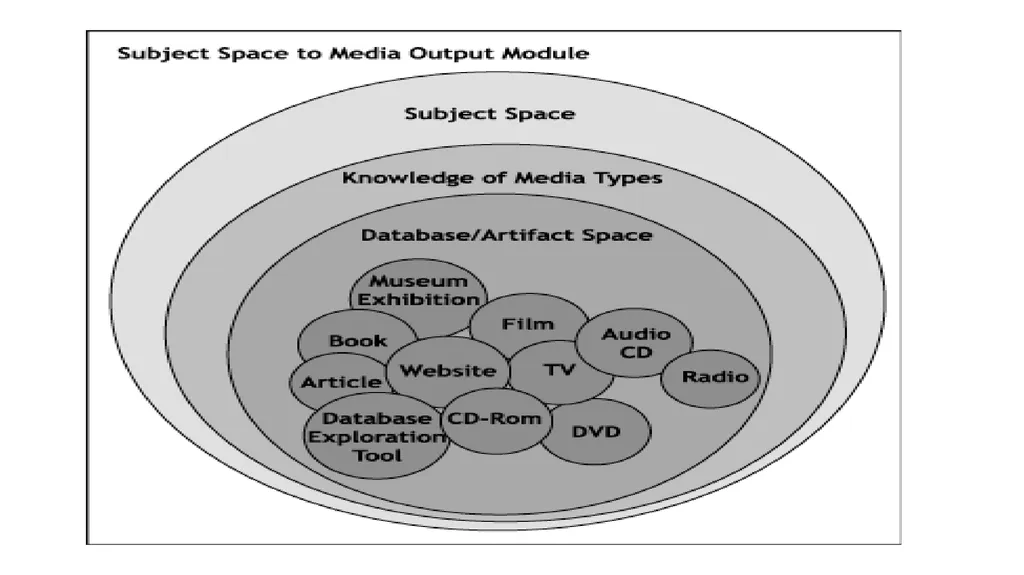
It doesn’t matter whether it’s a scrap of paper from an old newspaper article, an MRI scan of anything, a 3D rendering of the formation of the universe, or video footage, it can all be digitized and put into a form that a database can catalog. This area we will call the Database/Artifact Space.<br>
14
In the diagram, the Subject Space surrounds the remaining knowledge spaces to suggest that complete coverage of any subject is highly unlikely.
One level below the subject space lies Knowledge of Media Types. This knowledge need not be an exhaustive understanding of the means of production of each media type but a basic understanding of what is both possible and obtainable about the subject.<br>
15
Suggested documentaries ‘7 billion others’- “In 2003, after The Earth seen from the Sky, Yann Arthus-Bertrand, with Sybille d’Orgeval and Baptiste Rouget-Luchaire, launched the 7 billion Others project. 6,000 interviews were filmed in 84 countries by about twenty directors who went in search of the Others. From a Brazilian fisherman to a Chinese shopkeeper, from a German performer to an Afghan farmer, all answered the same questions about their fears, dreams, ordeals, hopes: What have you learnt from your parents? What do you want to pass on to your children? What difficult circumstances have you been through? What does love mean to you? Forty-five questions that help us to find out what separates and what unites us.<br>
16
‘Out my window’- “Emmy Award-Winning Out My Window—one of the world’s first interactive 360º documentaries— explores the state of our urban planet told by people who look out on the world from high-rise windows.”<br>