
New Opto-Mechanical Design for Open-Path
Description: New Opto-Mechanical Design for Open-Path Atmospheric Sensor Robert L. Herman Science or Technology Question: How can open-path airborne sensors be improved for greater stability over the wide range of temperatures experienced in flight?
Related Topics
Download Presentation
"New Opto-Mechanical Design for Open-Path" is the property of its rightful owner. Permission is granted to download and print the materials on this website for personal, non-commercial use only, and to display it on your personal computer provided you do not modify the materials and that you retain all copyright notices contained in the materials. By downloading content from our website, you accept the terms of this agreement.
Presentation Transcript
slide1. New Opto-Mechanical Design for Open-Path Atmospheric Sensor
Robert L. Herman Science or Technology Question: How can open-path airborne sensors be improved for greater stability over the wide range of temperatures experienced in flight? In-flight performance is important to address the level of ice supersaturation in the upper troposphere/lower stratosphere (UT/LS).
Data & Results:
UT/LS water vapor from JLH Mk2
Good agreement between JLH Mk2 and commercial WVSS-ii sensor from 500 ppmv down to LOD of WVSS-ii (50 ppmv).
JLH Mk2 extends accurate water vapor measurements down to stratospheric levels (3.82 ppmv) with improved precision of ±0.015 ppmv (±0.39%)
Significance: This improved instrument allows accurate characterization of water vapor in contrails and aircraft induced cirrus clouds, which are the largest net effective radiative forcing term from aircraft. JLH Mark2 – An Improved Opto-Mechanical Approach to Open-Path in situ Water Vapor Measurement in the Upper Troposphere/Lower Stratosphere, Robert L. Herman et al., Atmospheric Measurement Techniques,
https://doi.org/10.5194/amt-18-4593-2025, 2025.
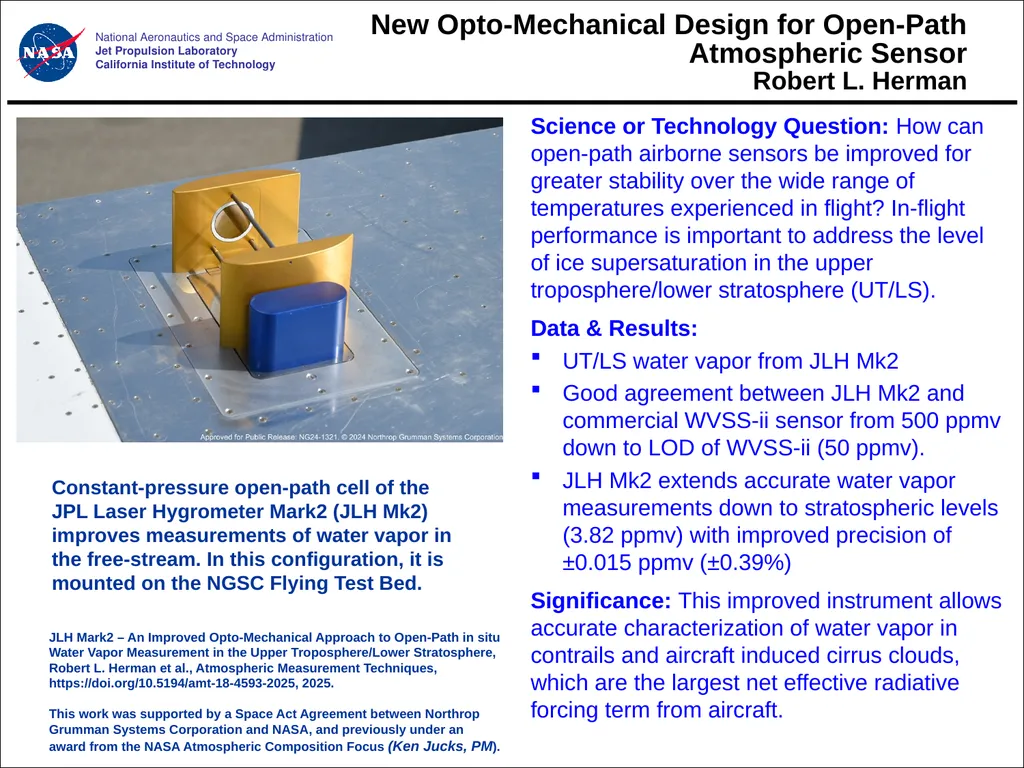
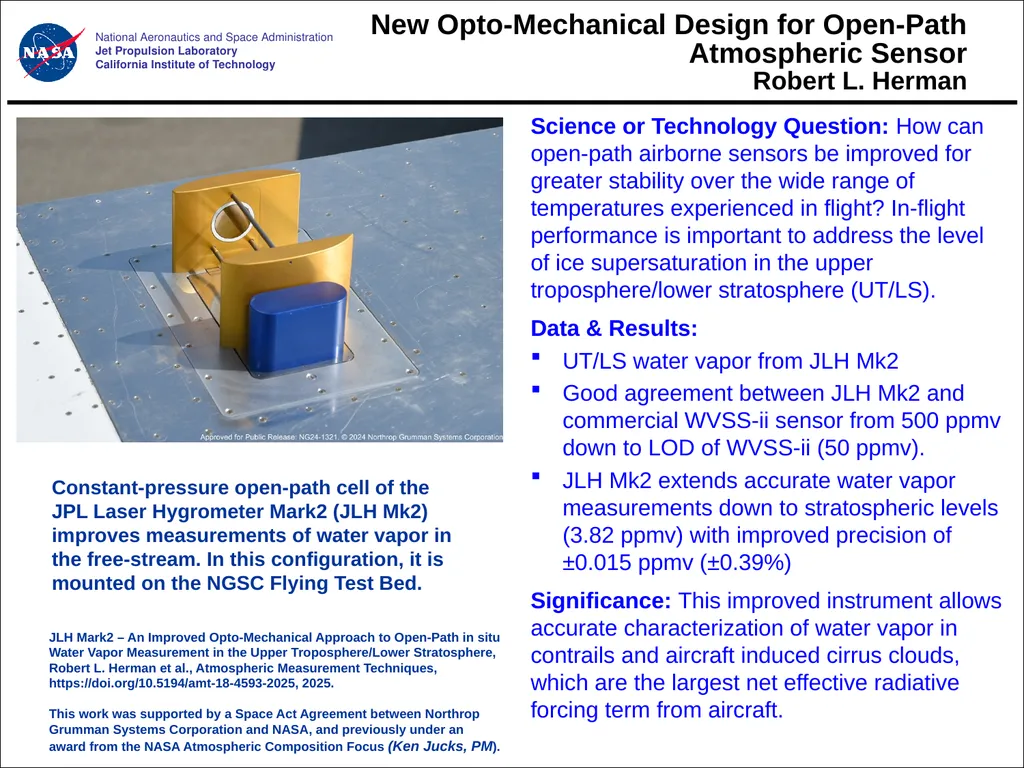
This work was supported by a Space Act Agreement between Northrop Grumman Systems Corporation and NASA, and previously under an award from the NASA Atmospheric Composition Focus (Ken Jucks, PM). Constant-pressure open-path cell of the JPL Laser Hygrometer Mark2 (JLH Mk2) improves measurements of water vapor in the free-stream. In this configuration, it is mounted on the NGSC Flying Test Bed. National Aeronautics and Space Administration
Jet Propulsion Laboratory
California Institute of Technology<br>
slide2. National Aeronautics and Space Administration
Jet Propulsion Laboratory
California Institute of Technology Contact:
Robert L. Herman, Mail Stop 183-601, Jet Propulsion Laboratory, Pasadena, CA 91109
Robert.L.Herman@jpl.nasa.gov
Citation:
R. L. Herman, R. F. Troy, K. M. Aaron, I. Sanders, K. Schwarm, J. E. Klobas, A. Swanson, A. Carpenter, S. Ozog, K. Chin, L. E. Christensen, D. Fu, R. F. Jarnot, R. A. Stachnik, and R. Vasudev, JLH Mark2 – An Improved Opto-Mechanical Approach to Open-Path in situ Water Vapor Measurement in the Upper Troposphere/Lower Stratosphere, Atmospheric Measurement Techniques,
https://doi.org/10.5194/amt-18-4593-2025, 2025.
Data Sources:
The NASA SEAC4RS aircraft data used in the data analysis can be freely downloaded from the following Digital Object Identifier (DOI): https://doi.org/10.5067/ASDC/SUBORBITAL/SEAC4RS_Miscellaneous_ER2_Data_1
We expect the Northrop Grumman (NGSC) data to be publicly released later in 2025.
Technical Description of Figure:
Constant-pressure open-path cell of the JPL Laser Hygrometer Mark2 (JLH Mk2) improves measurements of water vapor in the free-stream. The aerodynamic fairing deflects the airflow around the mirror holders during flight, and minimizes the distortion of airflow between the mirrors where the folded infrared beam measures free-stream water vapor mixing ratios. In the configuration shown in this image, JLH Mk2 is mounted on the NGSC Flying Test Bed, which is a Gulfstream-II aircraft.
Scientific significance, societal relevance, and relationships to future missions:
This improved in situ airborne instrument allows accurate characterization of water vapor in contrails and aircraft induced cirrus clouds. Burkhardt and Kärcher (2011) found that aircraft induced cirrus are the largest net (warming) effective radiative forcing term from aviation, larger even than the radiative forcing from CO2 aircraft emissions. Economically, detection of – and avoidance of creating – contrails is relevant to sustainability goals and the future economic viability of the aviation industry, especially in the European market.
Reference
Burkhardt, U., Kärcher, B.: Global radiative forcing from contrail cirrus, Nature Clim. Change, 1, 54–58, https://doi.org/10.1038/nclimate1068, 2011.<br>
Data & Results:
UT/LS water vapor from JLH Mk2
Good agreement between JLH Mk2 and commercial WVSS-ii sensor from 500 ppmv down to LOD of WVSS-ii (50 ppmv).
JLH Mk2 extends accurate water vapor measurements down to stratospheric levels (3.82 ppmv) with improved precision of ±0.015 ppmv (±0.39%)
Significance: This improved instrument allows accurate characterization of water vapor in contrails and aircraft induced cirrus clouds, which are the largest net effective radiative forcing term from aircraft. JLH Mark2 – An Improved Opto-Mechanical Approach to Open-Path in situ Water Vapor Measurement in the Upper Troposphere/Lower Stratosphere, Robert L. Herman et al., Atmospheric Measurement Techniques,
https://doi.org/10.5194/amt-18-4593-2025, 2025.
This work was supported by a Space Act Agreement between Northrop Grumman Systems Corporation and NASA, and previously under an award from the NASA Atmospheric Composition Focus (Ken Jucks, PM). Constant-pressure open-path cell of the JPL Laser Hygrometer Mark2 (JLH Mk2) improves measurements of water vapor in the free-stream. In this configuration, it is mounted on the NGSC Flying Test Bed. National Aeronautics and Space Administration
Jet Propulsion Laboratory
California Institute of Technology<br>
slide2. National Aeronautics and Space Administration
Jet Propulsion Laboratory
California Institute of Technology Contact:
Robert L. Herman, Mail Stop 183-601, Jet Propulsion Laboratory, Pasadena, CA 91109
Robert.L.Herman@jpl.nasa.gov
Citation:
R. L. Herman, R. F. Troy, K. M. Aaron, I. Sanders, K. Schwarm, J. E. Klobas, A. Swanson, A. Carpenter, S. Ozog, K. Chin, L. E. Christensen, D. Fu, R. F. Jarnot, R. A. Stachnik, and R. Vasudev, JLH Mark2 – An Improved Opto-Mechanical Approach to Open-Path in situ Water Vapor Measurement in the Upper Troposphere/Lower Stratosphere, Atmospheric Measurement Techniques,
https://doi.org/10.5194/amt-18-4593-2025, 2025.
Data Sources:
The NASA SEAC4RS aircraft data used in the data analysis can be freely downloaded from the following Digital Object Identifier (DOI): https://doi.org/10.5067/ASDC/SUBORBITAL/SEAC4RS_Miscellaneous_ER2_Data_1
We expect the Northrop Grumman (NGSC) data to be publicly released later in 2025.
Technical Description of Figure:
Constant-pressure open-path cell of the JPL Laser Hygrometer Mark2 (JLH Mk2) improves measurements of water vapor in the free-stream. The aerodynamic fairing deflects the airflow around the mirror holders during flight, and minimizes the distortion of airflow between the mirrors where the folded infrared beam measures free-stream water vapor mixing ratios. In the configuration shown in this image, JLH Mk2 is mounted on the NGSC Flying Test Bed, which is a Gulfstream-II aircraft.
Scientific significance, societal relevance, and relationships to future missions:
This improved in situ airborne instrument allows accurate characterization of water vapor in contrails and aircraft induced cirrus clouds. Burkhardt and Kärcher (2011) found that aircraft induced cirrus are the largest net (warming) effective radiative forcing term from aviation, larger even than the radiative forcing from CO2 aircraft emissions. Economically, detection of – and avoidance of creating – contrails is relevant to sustainability goals and the future economic viability of the aviation industry, especially in the European market.
Reference
Burkhardt, U., Kärcher, B.: Global radiative forcing from contrail cirrus, Nature Clim. Change, 1, 54–58, https://doi.org/10.1038/nclimate1068, 2011.<br>