
Non-Adaptive vs Adaptive Queries in the Dense
LO
Published · 17 slides · 0 views
1 / 1
Description
Non-Adaptive vs Adaptive Queries in the Dense Graph Testing Model Oded Goldreich and Avi Wigderson Property Testing: Super-fast Approximate Decisions Object to be tested (for membership in a set, having a property) Super-fast alg. run in
Related Topics
Share
Embed code
Download this presentation From Below
"Non-Adaptive vs Adaptive Queries in the Dense" is the property of its rightful owner. Permission is granted to download and print the materials on this website for personal, non-commercial use only, and to display it on your personal computer provided you do not modify the materials and that you retain all copyright notices contained in the materials. By downloading content from our website, you accept the terms of this agreement.
Presentation Transcript
01
Non-Adaptive vs Adaptive Queries
in the Dense Graph Testing Model Oded Goldreich and Avi Wigderson<br>
02
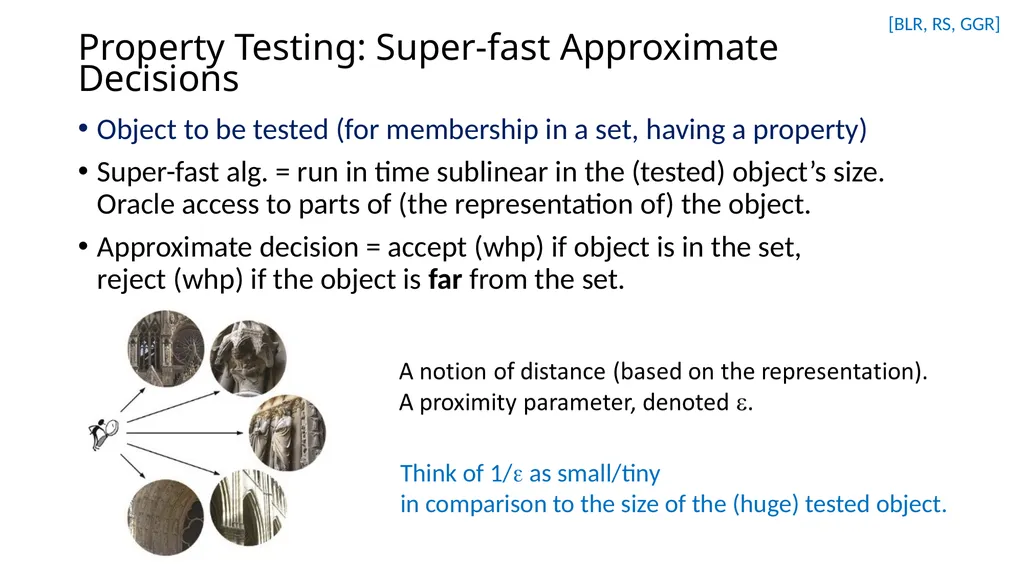
Property Testing: Super-fast Approximate Decisions Object to be tested (for membership in a set, having a property)
Super-fast alg. = run in time sublinear in the (tested) object’s size. Oracle access to parts of (the representation of) the object.
Approximate decision = accept (whp) if object is in the set, reject (whp) if the object is far from the set. [BLR, RS, GGR] Think of 1/ as small/tiny in comparison to the size of the (huge) tested object.<br>
03
PT in the Dense Graph Model (aka Adjacency Predicate Model) Objects = (unlabeled) graphs
Alternatively, graph properties def’ed as closed under isomorphism.
The representation: Adjacency predicate (or matrix). Query (u,v) answered 1 iff {u,v} is an edge in the (tested) graph.
Distance: fraction of entries on which the adjacency matrices differ. (E.g., far = at constant distance, close = o(1) distance.) Sparse graphs are close to the empty graph. (Hence we focus on dense ones.)
All graphs are close to being Hamiltonian. Cliques are far from being triangle-free.
Cliques are far from being bipartite. [GGR]<br>
04
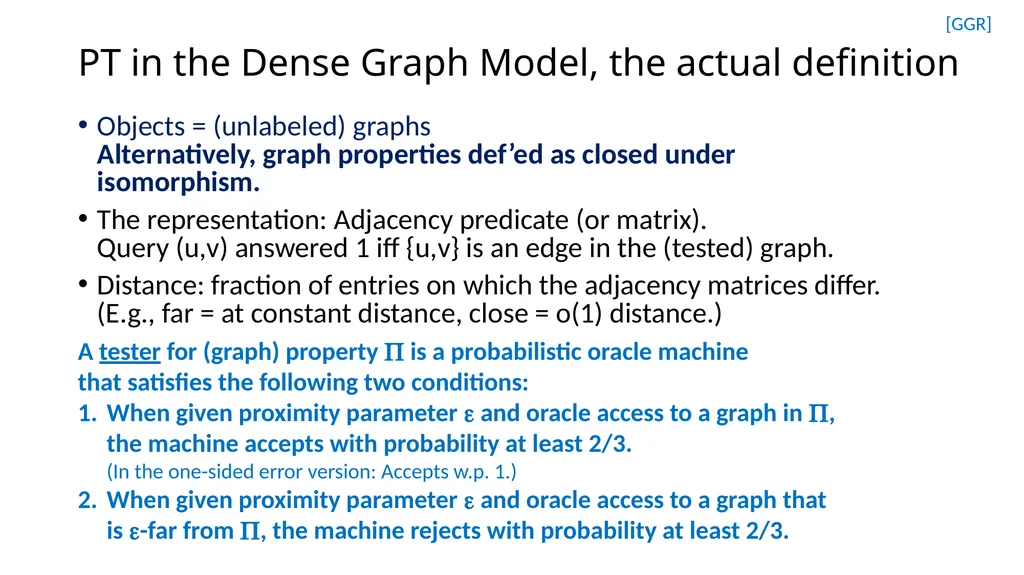
PT in the Dense Graph Model, the actual definition Objects = (unlabeled) graphs
Alternatively, graph properties def’ed as closed under isomorphism.
The representation: Adjacency predicate (or matrix). Query (u,v) answered 1 iff {u,v} is an edge in the (tested) graph.
Distance: fraction of entries on which the adjacency matrices differ. (E.g., far = at constant distance, close = o(1) distance.) [GGR] A tester for (graph) property is a probabilistic oracle machine that satisfies the following two conditions:
When given proximity parameter and oracle access to a graph in , the machine accepts with probability at least 2/3. (In the one-sided error version: Accepts w.p. 1.)
When given proximity parameter and oracle access to a graph that is -far from , the machine rejects with probability at least 2/3.<br>
05
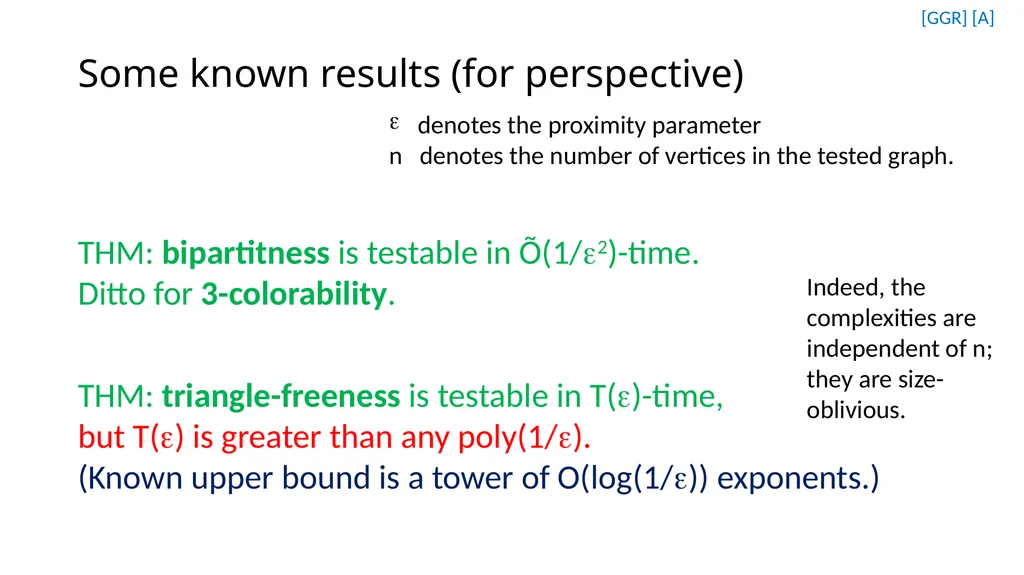
Some known results (for perspective) denotes the proximity parameter
n denotes the number of vertices in the tested graph. THM: triangle-freeness is testable in T()-time,
but T() is greater than any poly(1/).
(Known upper bound is a tower of O(log(1/)) exponents.) THM: bipartitness is testable in Õ(1/2)-time.
Ditto for 3-colorability. Indeed, the complexities are independent of n; they are size-oblivious. [GGR] [A]<br>
06
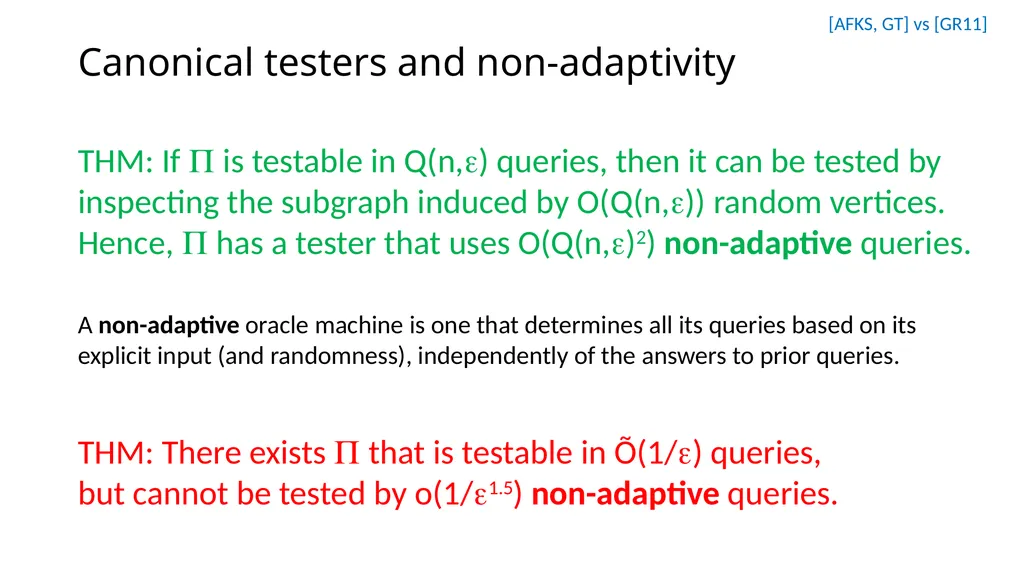
Canonical testers and non-adaptivity THM: If is testable in Q(n,) queries, then it can be tested by inspecting the subgraph induced by O(Q(n,)) random vertices. Hence, has a tester that uses O(Q(n,)2) non-adaptive queries. THM: There exists that is testable in Õ(1/) queries,
but cannot be tested by o(1/1.5) non-adaptive queries. A non-adaptive oracle machine is one that determines all its queries based on its explicit input (and randomness), independently of the answers to prior queries. [AFKS, GT] vs [GR11]<br>
07
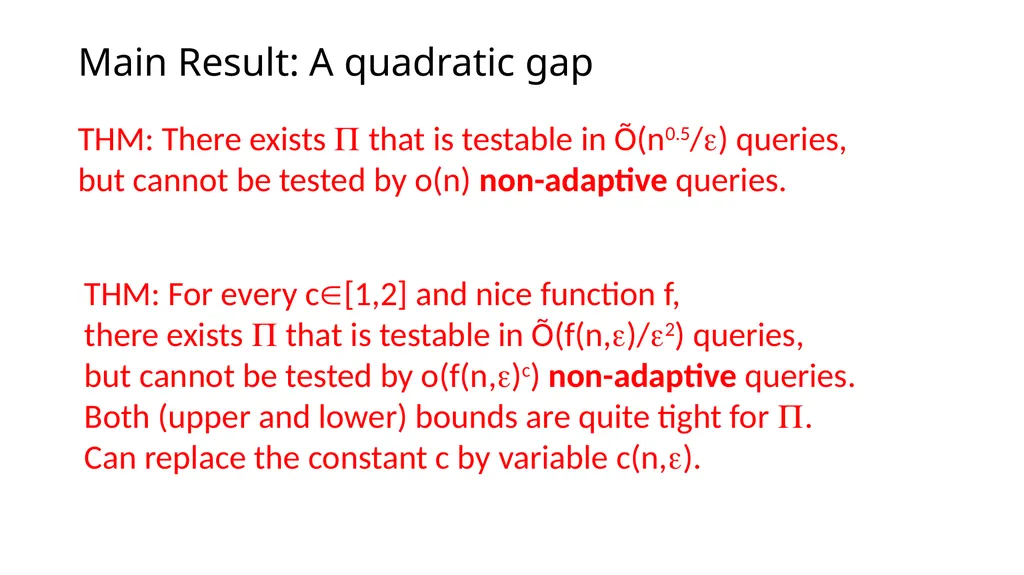
Main Result: A quadratic gap THM: There exists that is testable in Õ(n0.5/) queries,
but cannot be tested by o(n) non-adaptive queries. THM: For every c[1,2] and nice function f,
there exists that is testable in Õ(f(n,)/2) queries,
but cannot be tested by o(f(n,)c) non-adaptive queries.
Both (upper and lower) bounds are quite tight for .
Can replace the constant c by variable c(n,).<br>
Both (upper and lower) bounds are quite tight for .
Can replace the constant c by variable c(n,).<br>
08
Tools: Robustly self-ordered graphs
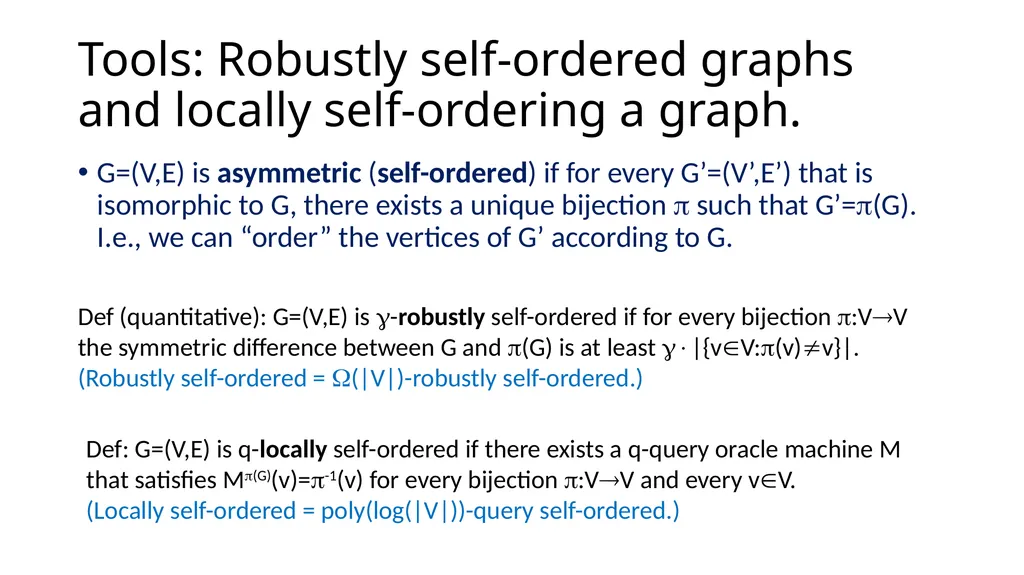
and locally self-ordering a graph. G=(V,E) is asymmetric (self-ordered) if for every G’=(V’,E’) that is isomorphic to G, there exists a unique bijection such that G’=(G).
I.e., we can “order” the vertices of G’ according to G. Def (quantitative): G=(V,E) is -robustly self-ordered if for every bijection :VV the symmetric difference between G and (G) is at least |{vV:(v)v}|.
(Robustly self-ordered = (|V|)-robustly self-ordered.) Def: G=(V,E) is q-locally self-ordered if there exists a q-query oracle machine M that satisfies M(G)(v)=-1(v) for every bijection :VV and every vV.
(Locally self-ordered = poly(log(|V|))-query self-ordered.)<br>
(Robustly self-ordered = (|V|)-robustly self-ordered.) Def: G=(V,E) is q-locally self-ordered if there exists a q-query oracle machine M that satisfies M(G)(v)=-1(v) for every bijection :VV and every vV.
(Locally self-ordered = poly(log(|V|))-query self-ordered.)<br>
09
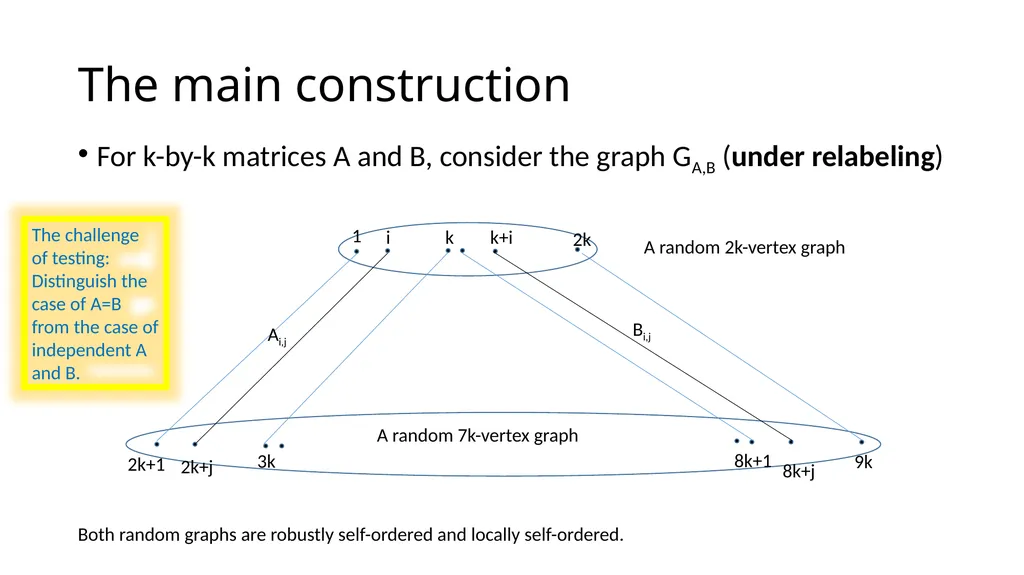
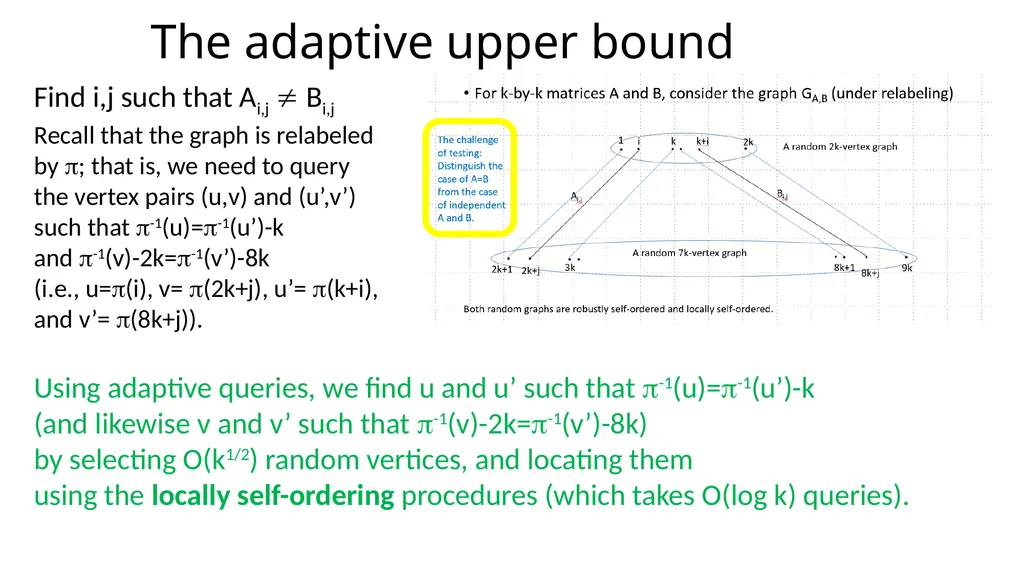
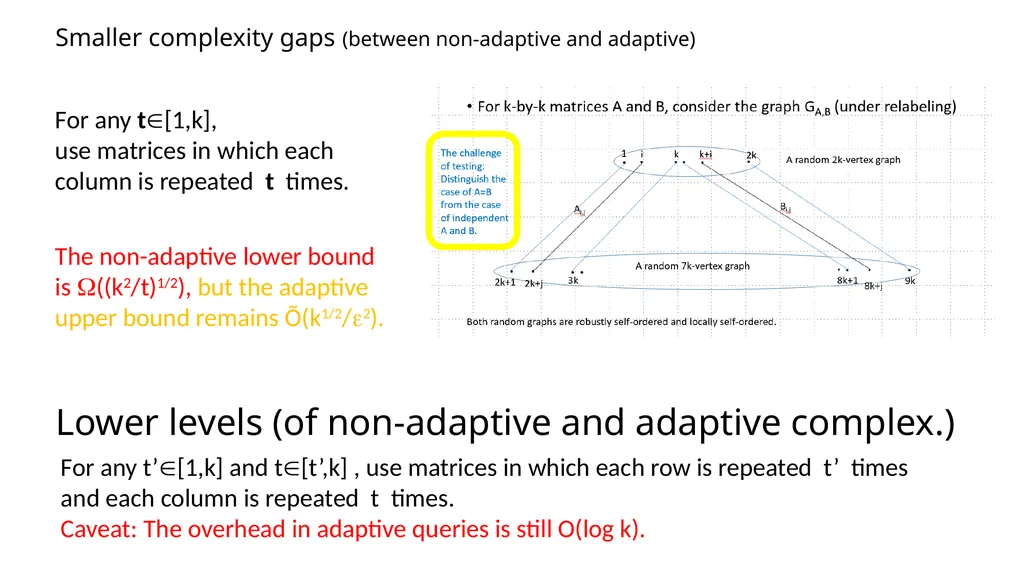
The main construction For k-by-k matrices A and B, consider the graph GA,B (under relabeling) 1 i k k+i 2k 2k+1 2k+j 3k 8k+1 9k 8k+j Ai,j Bi,j A random 2k-vertex graph A random 7k-vertex graph Both random graphs are robustly self-ordered and locally self-ordered. The challenge of testing: Distinguish the case of A=B from the case of independent A and B.<br>
10
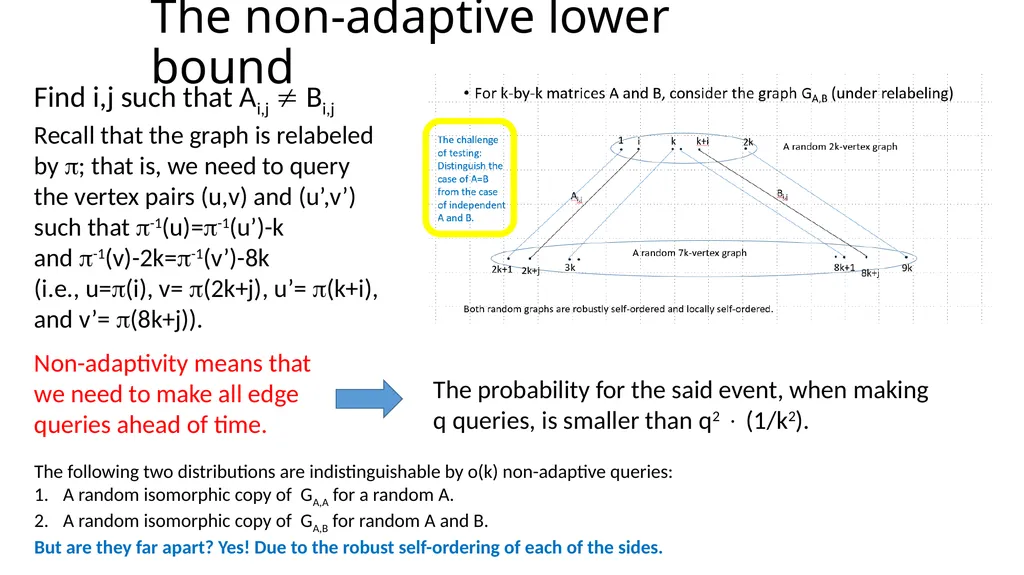
The non-adaptive lower bound Find i,j such that Ai,j Bi,j
Recall that the graph is relabeled by ; that is, we need to query the vertex pairs (u,v) and (u’,v’) such that -1(u)=-1(u’)-k
and -1(v)-2k=-1(v’)-8k
(i.e., u=(i), v= (2k+j), u’= (k+i),
and v’= (8k+j)). Non-adaptivity means that we need to make all edge queries ahead of time. The probability for the said event, when making q queries, is smaller than q2 (1/k2). The following two distributions are indistinguishable by o(k) non-adaptive queries:
A random isomorphic copy of GA,A for a random A.
A random isomorphic copy of GA,B for random A and B.
But are they far apart? Yes! Due to the robust self-ordering of each of the sides.<br>
11
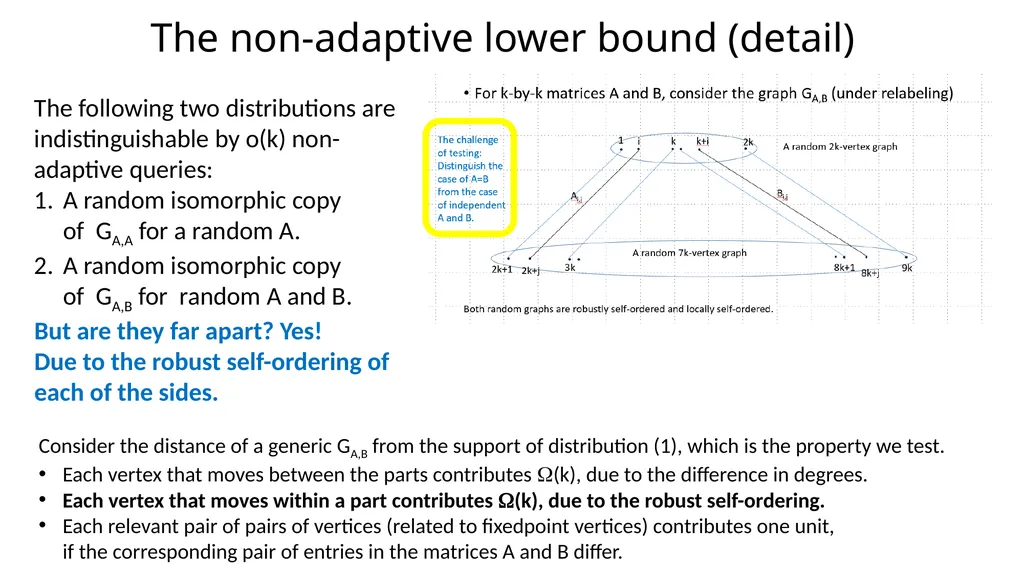
The non-adaptive lower bound (detail) The following two distributions are indistinguishable by o(k) non-adaptive queries:
A random isomorphic copy of GA,A for a random A.
A random isomorphic copy of GA,B for random A and B.
But are they far apart? Yes! Due to the robust self-ordering of each of the sides. Consider the distance of a generic GA,B from the support of distribution (1), which is the property we test.
Each vertex that moves between the parts contributes (k), due to the difference in degrees.
Each vertex that moves within a part contributes (k), due to the robust self-ordering.
Each relevant pair of pairs of vertices (related to fixedpoint vertices) contributes one unit, if the corresponding pair of entries in the matrices A and B differ.<br>
12
The adaptive upper bound Find i,j such that Ai,j Bi,j
Recall that the graph is relabeled by ; that is, we need to query the vertex pairs (u,v) and (u’,v’) such that -1(u)=-1(u’)-k
and -1(v)-2k=-1(v’)-8k
(i.e., u=(i), v= (2k+j), u’= (k+i),
and v’= (8k+j)). Using adaptive queries, we find u and u’ such that -1(u)=-1(u’)-k (and likewise v and v’ such that -1(v)-2k=-1(v’)-8k) by selecting O(k1/2) random vertices, and locating them using the locally self-ordering procedures (which takes O(log k) queries).<br>
13
Smaller complexity gaps (between non-adaptive and adaptive) For any t[1,k],
use matrices in which each column is repeated t times. The non-adaptive lower bound is ((k2/t)1/2), but the adaptive upper bound remains Õ(k1/2/2). Lower levels (of non-adaptive and adaptive complex.) For any t’[1,k] and t[t’,k] , use matrices in which each row is repeated t’ times and each column is repeated t times.
Caveat: The overhead in adaptive queries is still O(log k).<br>
14
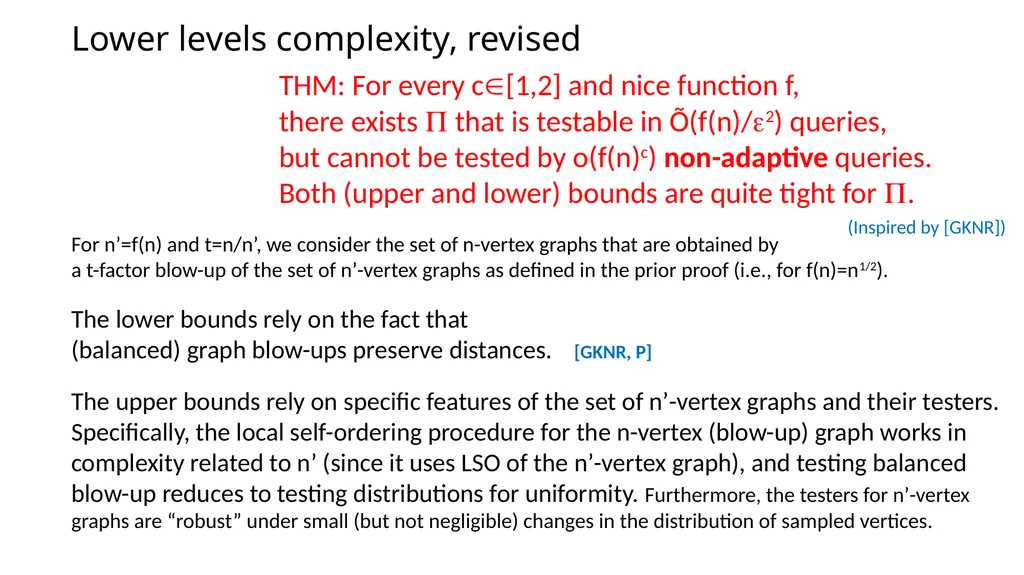
Lower levels complexity, revised THM: For every c[1,2] and nice function f,
there exists that is testable in Õ(f(n)/2) queries,
but cannot be tested by o(f(n)c) non-adaptive queries.
Both (upper and lower) bounds are quite tight for . For n’=f(n) and t=n/n’, we consider the set of n-vertex graphs that are obtained by a t-factor blow-up of the set of n’-vertex graphs as defined in the prior proof (i.e., for f(n)=n1/2). (Inspired by [GKNR]) The lower bounds rely on the fact that (balanced) graph blow-ups preserve distances. [GKNR, P] The upper bounds rely on specific features of the set of n’-vertex graphs and their testers. Specifically, the local self-ordering procedure for the n-vertex (blow-up) graph works in complexity related to n’ (since it uses LSO of the n’-vertex graph), and testing balanced blow-up reduces to testing distributions for uniformity. Furthermore, the testers for n’-vertex graphs are “robust” under small (but not negligible) changes in the distribution of sampled vertices.<br>
Both (upper and lower) bounds are quite tight for . For n’=f(n) and t=n/n’, we consider the set of n-vertex graphs that are obtained by a t-factor blow-up of the set of n’-vertex graphs as defined in the prior proof (i.e., for f(n)=n1/2). (Inspired by [GKNR]) The lower bounds rely on the fact that (balanced) graph blow-ups preserve distances. [GKNR, P] The upper bounds rely on specific features of the set of n’-vertex graphs and their testers. Specifically, the local self-ordering procedure for the n-vertex (blow-up) graph works in complexity related to n’ (since it uses LSO of the n’-vertex graph), and testing balanced blow-up reduces to testing distributions for uniformity. Furthermore, the testers for n’-vertex graphs are “robust” under small (but not negligible) changes in the distribution of sampled vertices.<br>
15
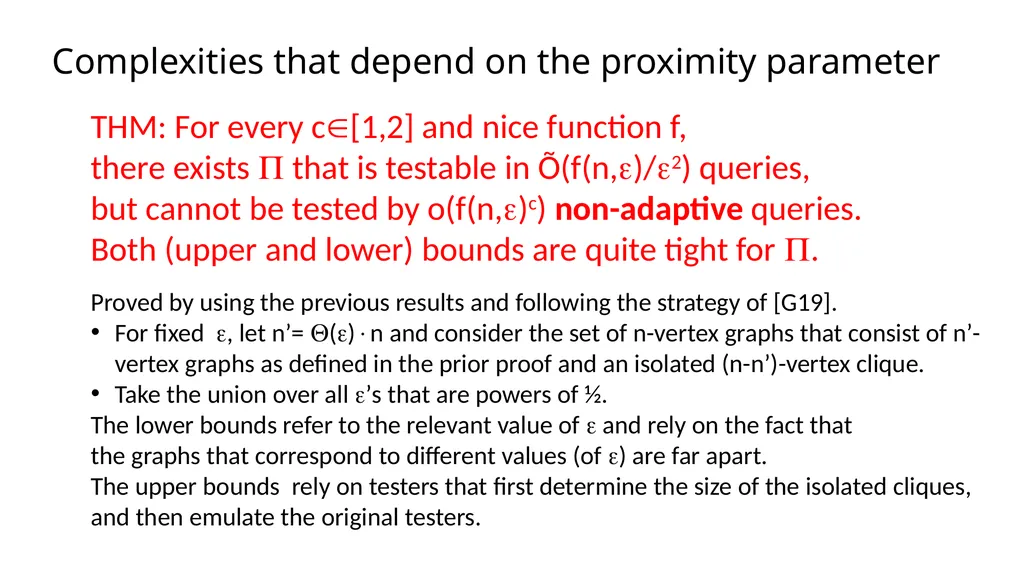
Complexities that depend on the proximity parameter THM: For every c[1,2] and nice function f,
there exists that is testable in Õ(f(n,)/2) queries,
but cannot be tested by o(f(n,)c) non-adaptive queries.
Both (upper and lower) bounds are quite tight for . Proved by using the previous results and following the strategy of [G19].
For fixed , let n’= ()n and consider the set of n-vertex graphs that consist of n’-vertex graphs as defined in the prior proof and an isolated (n-n’)-vertex clique.
Take the union over all ’s that are powers of ½.
The lower bounds refer to the relevant value of and rely on the fact that the graphs that correspond to different values (of ) are far apart.
The upper bounds rely on testers that first determine the size of the isolated cliques, and then emulate the original testers.<br>
16
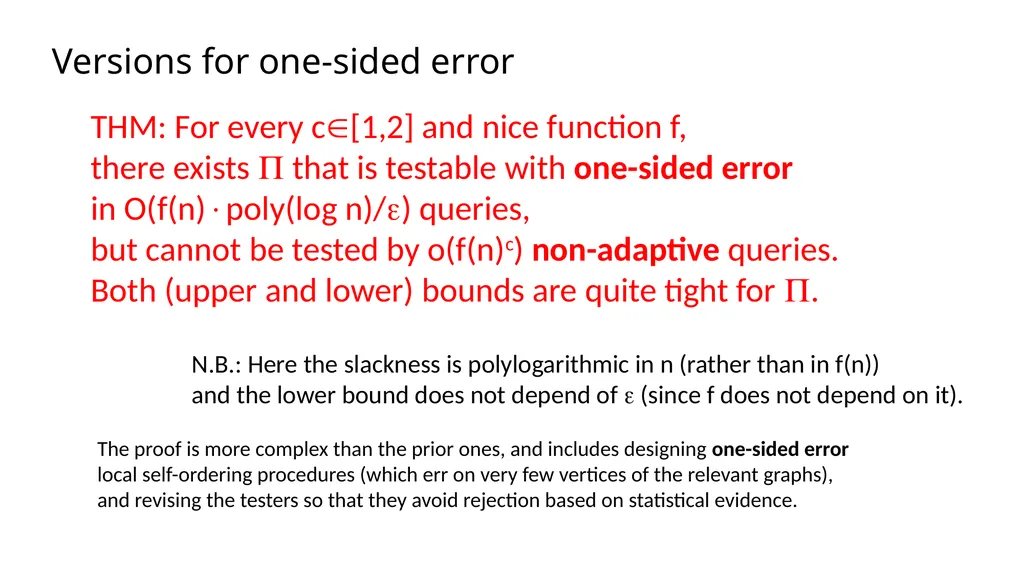
Versions for one-sided error THM: For every c[1,2] and nice function f,
there exists that is testable with one-sided error
in O(f(n)poly(log n)/) queries,
but cannot be tested by o(f(n)c) non-adaptive queries.
Both (upper and lower) bounds are quite tight for . N.B.: Here the slackness is polylogarithmic in n (rather than in f(n)) and the lower bound does not depend of (since f does not depend on it). The proof is more complex than the prior ones, and includes designing one-sided error local self-ordering procedures (which err on very few vertices of the relevant graphs), and revising the testers so that they avoid rejection based on statistical evidence.<br>
Both (upper and lower) bounds are quite tight for . N.B.: Here the slackness is polylogarithmic in n (rather than in f(n)) and the lower bound does not depend of (since f does not depend on it). The proof is more complex than the prior ones, and includes designing one-sided error local self-ordering procedures (which err on very few vertices of the relevant graphs), and revising the testers so that they avoid rejection based on statistical evidence.<br>
17
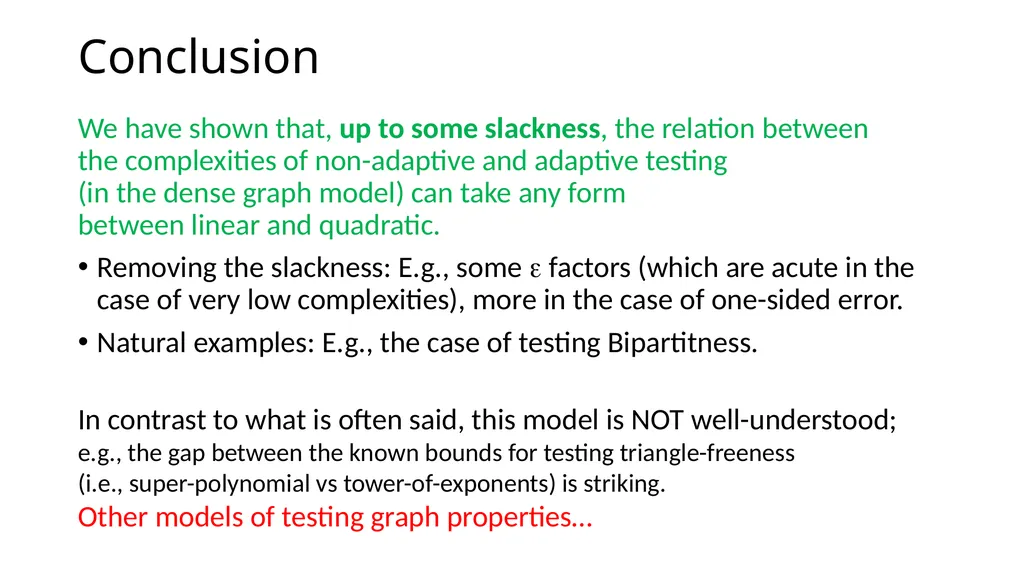
Conclusion We have shown that, up to some slackness, the relation between
the complexities of non-adaptive and adaptive testing
(in the dense graph model) can take any form
between linear and quadratic.
Removing the slackness: E.g., some factors (which are acute in the case of very low complexities), more in the case of one-sided error.
Natural examples: E.g., the case of testing Bipartitness. In contrast to what is often said, this model is NOT well-understood; e.g., the gap between the known bounds for testing triangle-freeness (i.e., super-polynomial vs tower-of-exponents) is striking.
Other models of testing graph properties…<br>