
Non-aqueous solvent Introduction A solvent is a
AS
Published · 26 slides · 0 views
1 / 1




Description
Non-aqueous solvent Introduction A solvent is a substance which has the power of dissolving other substances. Water is a most available solvent. It can be handled safety and can be purified easily. It has high dielectric constant. It has
Related Topics
Share
Embed code
Download this presentation From Below
"Non-aqueous solvent Introduction A solvent is a" is the property of its rightful owner. Permission is granted to download and print the materials on this website for personal, non-commercial use only, and to display it on your personal computer provided you do not modify the materials and that you retain all copyright notices contained in the materials. By downloading content from our website, you accept the terms of this agreement.
Presentation Transcript
01
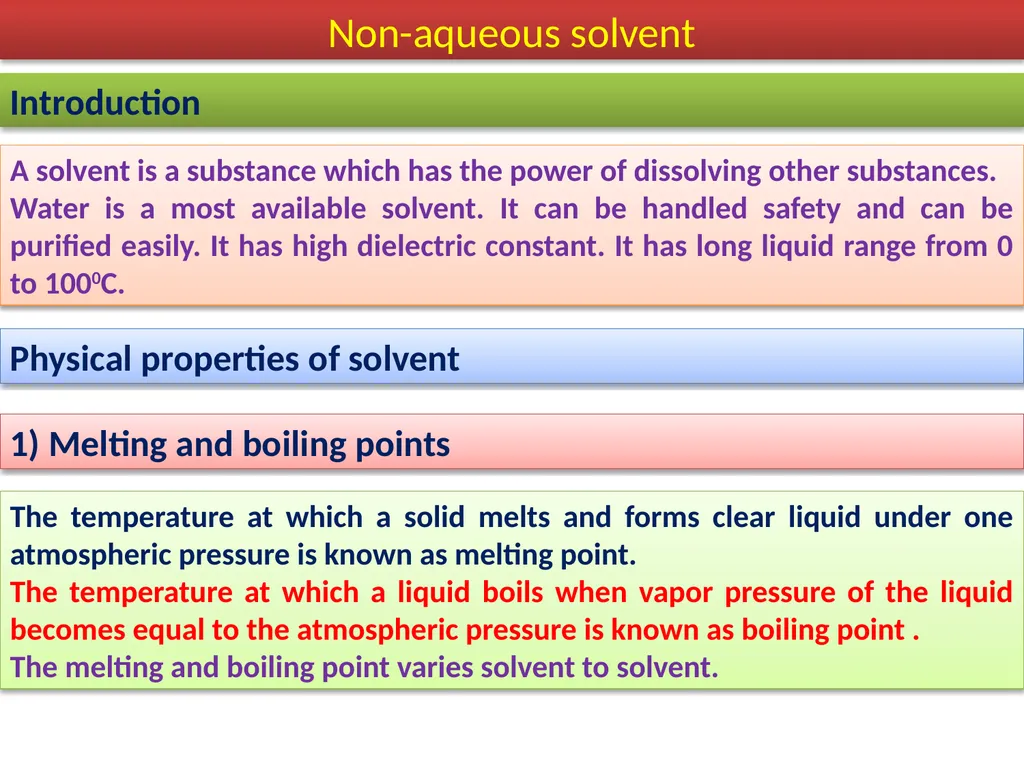
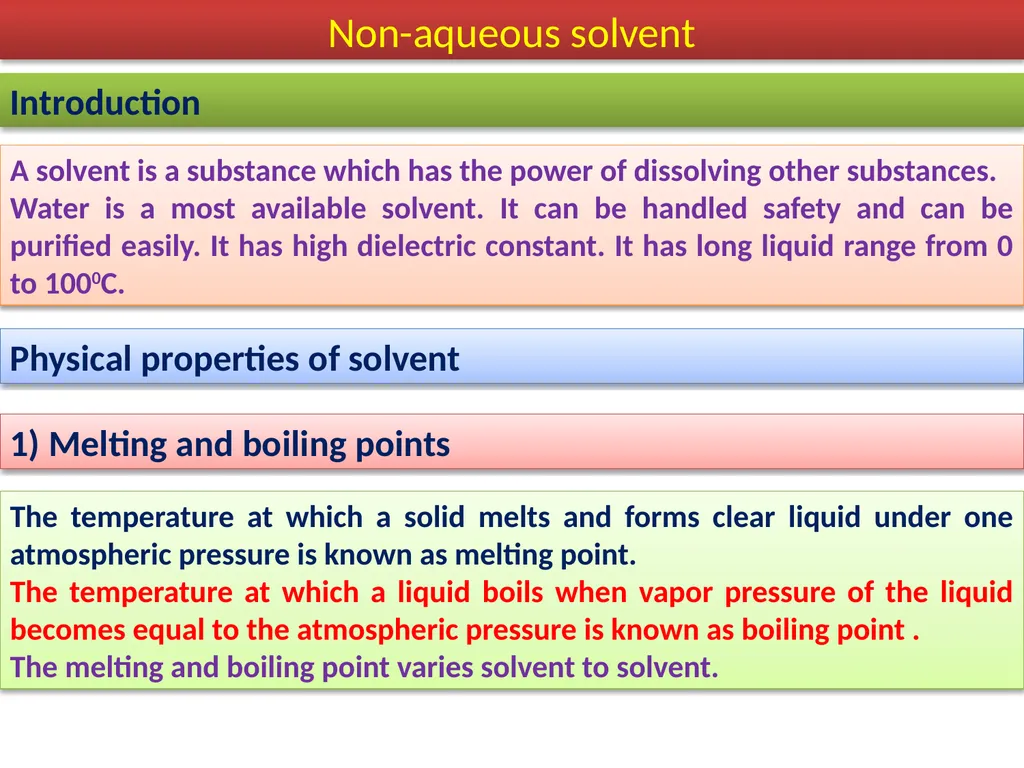
Non-aqueous solvent Introduction A solvent is a substance which has the power of dissolving other substances.
Water is a most available solvent. It can be handled safety and can be purified easily. It has high dielectric constant. It has long liquid range from 0 to 1000C. The temperature at which a solid melts and forms clear liquid under one atmospheric pressure is known as melting point.
The temperature at which a liquid boils when vapor pressure of the liquid becomes equal to the atmospheric pressure is known as boiling point .
The melting and boiling point varies solvent to solvent. Physical properties of solvent 1) Melting and boiling points<br>
Water is a most available solvent. It can be handled safety and can be purified easily. It has high dielectric constant. It has long liquid range from 0 to 1000C. The temperature at which a solid melts and forms clear liquid under one atmospheric pressure is known as melting point.
The temperature at which a liquid boils when vapor pressure of the liquid becomes equal to the atmospheric pressure is known as boiling point .
The melting and boiling point varies solvent to solvent. Physical properties of solvent 1) Melting and boiling points<br>
02
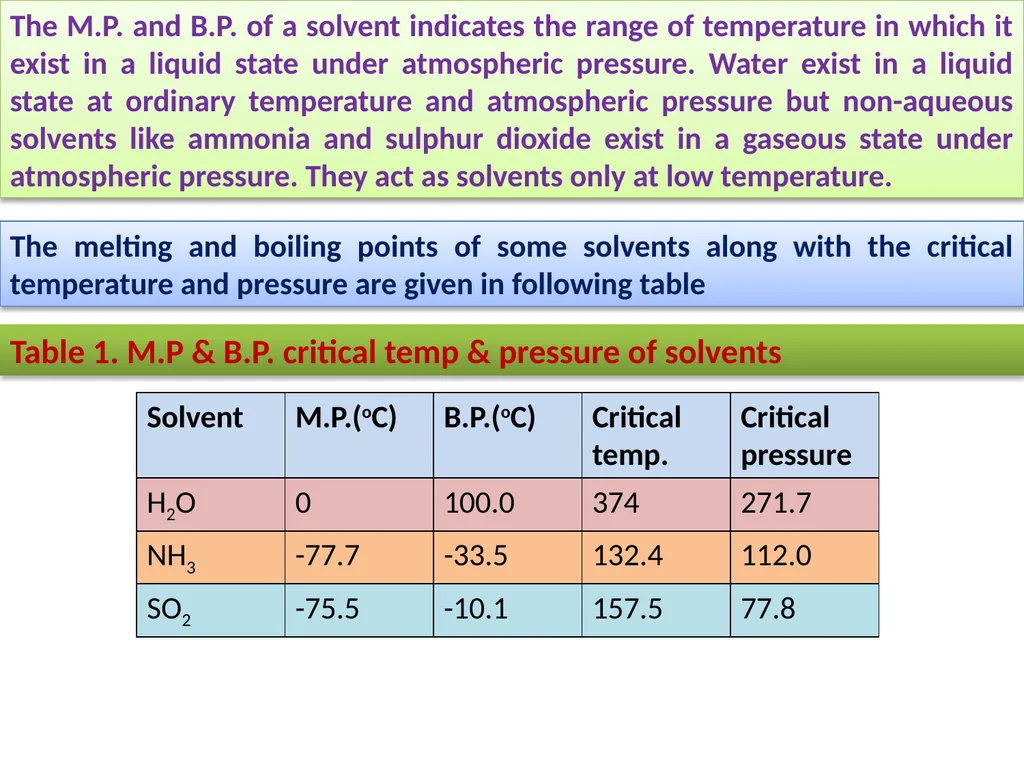
The M.P. and B.P. of a solvent indicates the range of temperature in which it exist in a liquid state under atmospheric pressure. Water exist in a liquid state at ordinary temperature and atmospheric pressure but non-aqueous solvents like ammonia and sulphur dioxide exist in a gaseous state under atmospheric pressure. They act as solvents only at low temperature. The melting and boiling points of some solvents along with the critical temperature and pressure are given in following table Table 1. M.P & B.P. critical temp & pressure of solvents<br>
03
2) Heat of fusion and vaporization The amount of heat absorbed by one mole of a substance to change from solid to liquid is called molar heat of fusion.
Similarly, the amount of heat absorbed by one mole of a substance to change from liquid to vapour state is called heat of vaporisation.
The heat of fusion and vaporisation indicates the nature and strength of forces with which the solvent molecules are held together in the solid or liquid state. The high heat of vaporisation of liquid indicates that the intermolecular binding forces are strong in it. The heat of fusion of water and that of ammonia is nearly same. This means the magnitude of the force which molecules together in water and ammonia is same. Table 2. Molar heat of fusion and vaporisation of solvents<br>
Similarly, the amount of heat absorbed by one mole of a substance to change from liquid to vapour state is called heat of vaporisation.
The heat of fusion and vaporisation indicates the nature and strength of forces with which the solvent molecules are held together in the solid or liquid state. The high heat of vaporisation of liquid indicates that the intermolecular binding forces are strong in it. The heat of fusion of water and that of ammonia is nearly same. This means the magnitude of the force which molecules together in water and ammonia is same. Table 2. Molar heat of fusion and vaporisation of solvents<br>
04
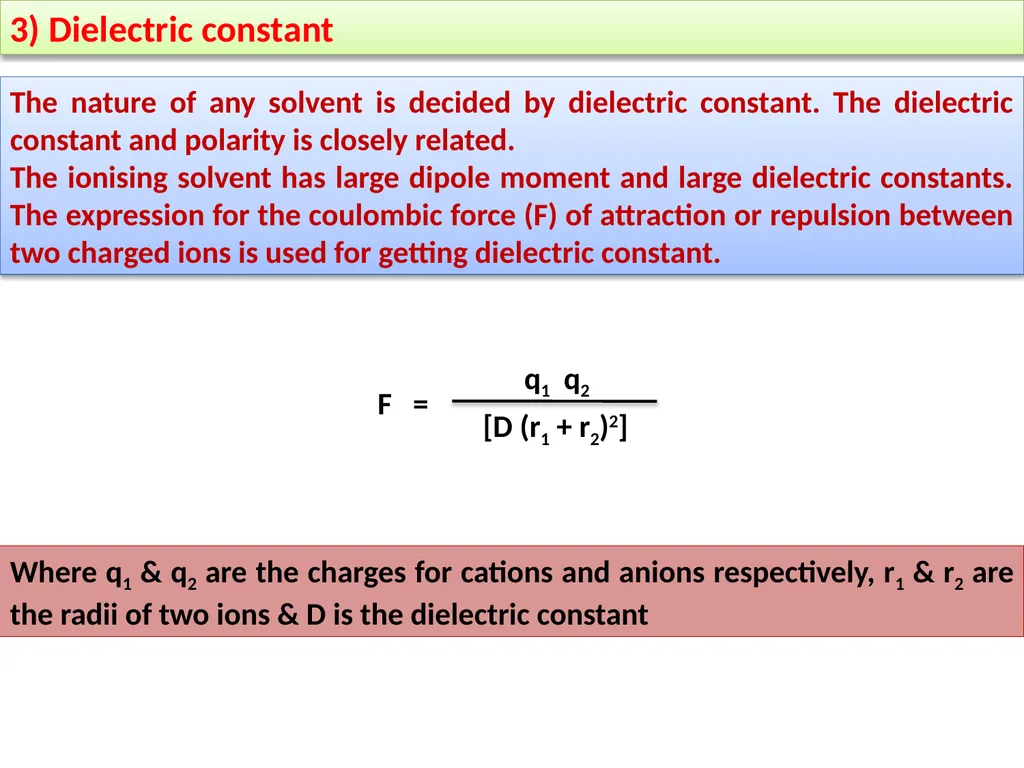
3) Dielectric constant The nature of any solvent is decided by dielectric constant. The dielectric constant and polarity is closely related.
The ionising solvent has large dipole moment and large dielectric constants. The expression for the coulombic force (F) of attraction or repulsion between two charged ions is used for getting dielectric constant. Where q1 & q2 are the charges for cations and anions respectively, r1 & r2 are the radii of two ions & D is the dielectric constant<br>
The ionising solvent has large dipole moment and large dielectric constants. The expression for the coulombic force (F) of attraction or repulsion between two charged ions is used for getting dielectric constant. Where q1 & q2 are the charges for cations and anions respectively, r1 & r2 are the radii of two ions & D is the dielectric constant<br>
05
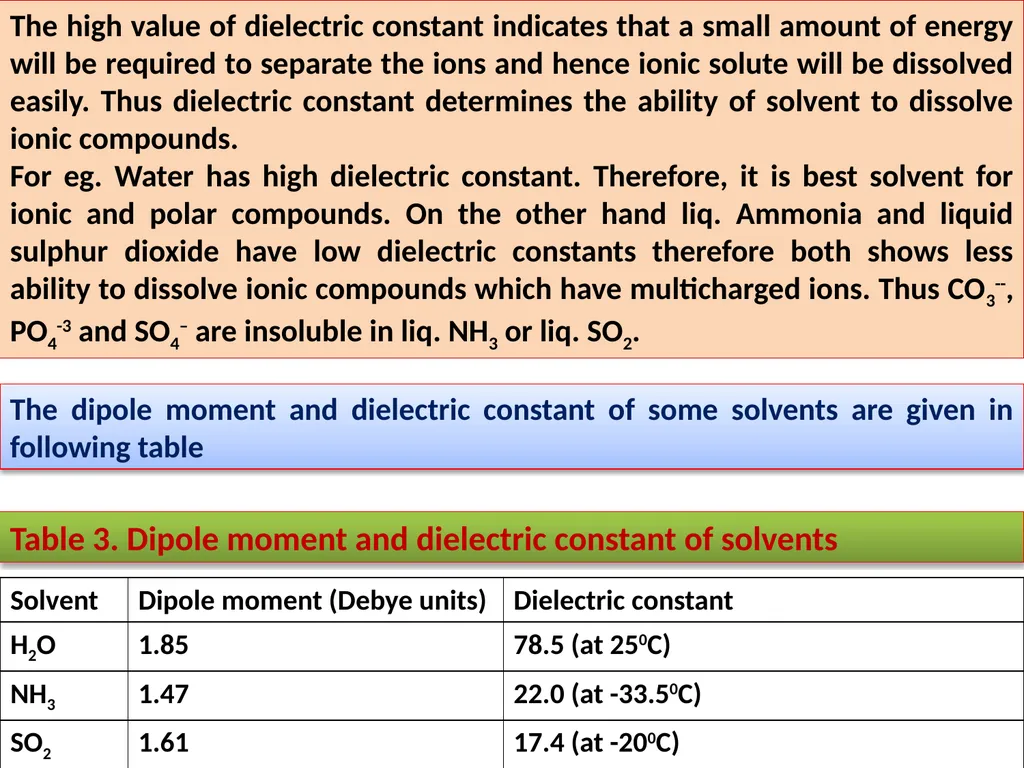
The high value of dielectric constant indicates that a small amount of energy will be required to separate the ions and hence ionic solute will be dissolved easily. Thus dielectric constant determines the ability of solvent to dissolve ionic compounds.
For eg. Water has high dielectric constant. Therefore, it is best solvent for ionic and polar compounds. On the other hand liq. Ammonia and liquid sulphur dioxide have low dielectric constants therefore both shows less ability to dissolve ionic compounds which have multicharged ions. Thus CO3--, PO4-3 and SO4– are insoluble in liq. NH3 or liq. SO2. The dipole moment and dielectric constant of some solvents are given in following table Table 3. Dipole moment and dielectric constant of solvents<br>
For eg. Water has high dielectric constant. Therefore, it is best solvent for ionic and polar compounds. On the other hand liq. Ammonia and liquid sulphur dioxide have low dielectric constants therefore both shows less ability to dissolve ionic compounds which have multicharged ions. Thus CO3--, PO4-3 and SO4– are insoluble in liq. NH3 or liq. SO2. The dipole moment and dielectric constant of some solvents are given in following table Table 3. Dipole moment and dielectric constant of solvents<br>
06
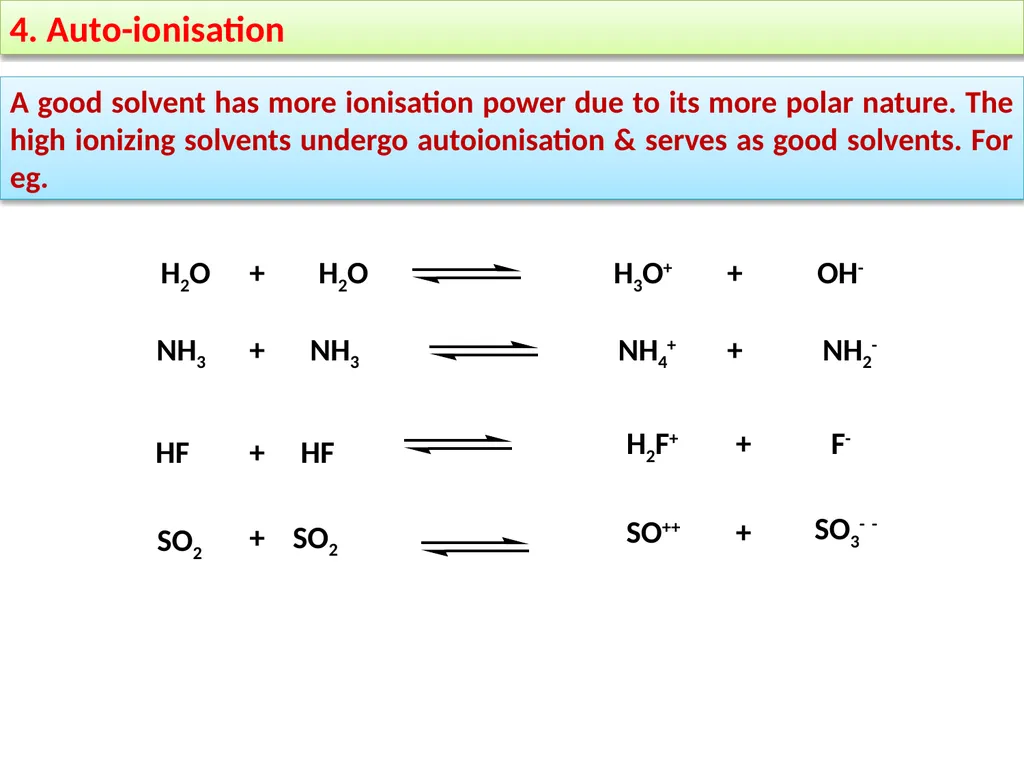
4. Auto-ionisation A good solvent has more ionisation power due to its more polar nature. The high ionizing solvents undergo autoionisation & serves as good solvents. For eg.<br>
07
Types of Solvent Solvents can be classified on the basis of their physical and chemical properties.
The classification of solvents is frequently based on acid-base properties and Lowery-Bronsted concept of acids and bases. The solvents are of two types Protonic and non-protonic solvents
Ionising and non-ionising solvents Protonic solvents
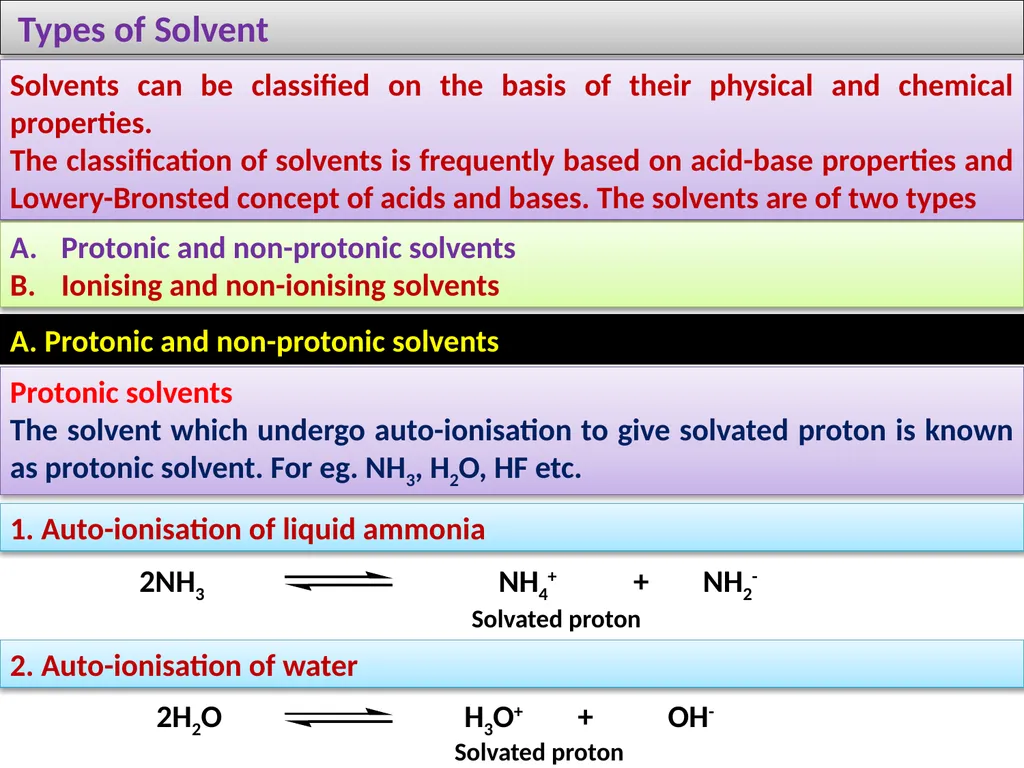
The solvent which undergo auto-ionisation to give solvated proton is known as protonic solvent. For eg. NH3, H2O, HF etc. A. Protonic and non-protonic solvents 1. Auto-ionisation of liquid ammonia 2. Auto-ionisation of water<br>
The classification of solvents is frequently based on acid-base properties and Lowery-Bronsted concept of acids and bases. The solvents are of two types Protonic and non-protonic solvents
Ionising and non-ionising solvents Protonic solvents
The solvent which undergo auto-ionisation to give solvated proton is known as protonic solvent. For eg. NH3, H2O, HF etc. A. Protonic and non-protonic solvents 1. Auto-ionisation of liquid ammonia 2. Auto-ionisation of water<br>
08
1. Acidic solvents Acidic solvents
Basic solvents
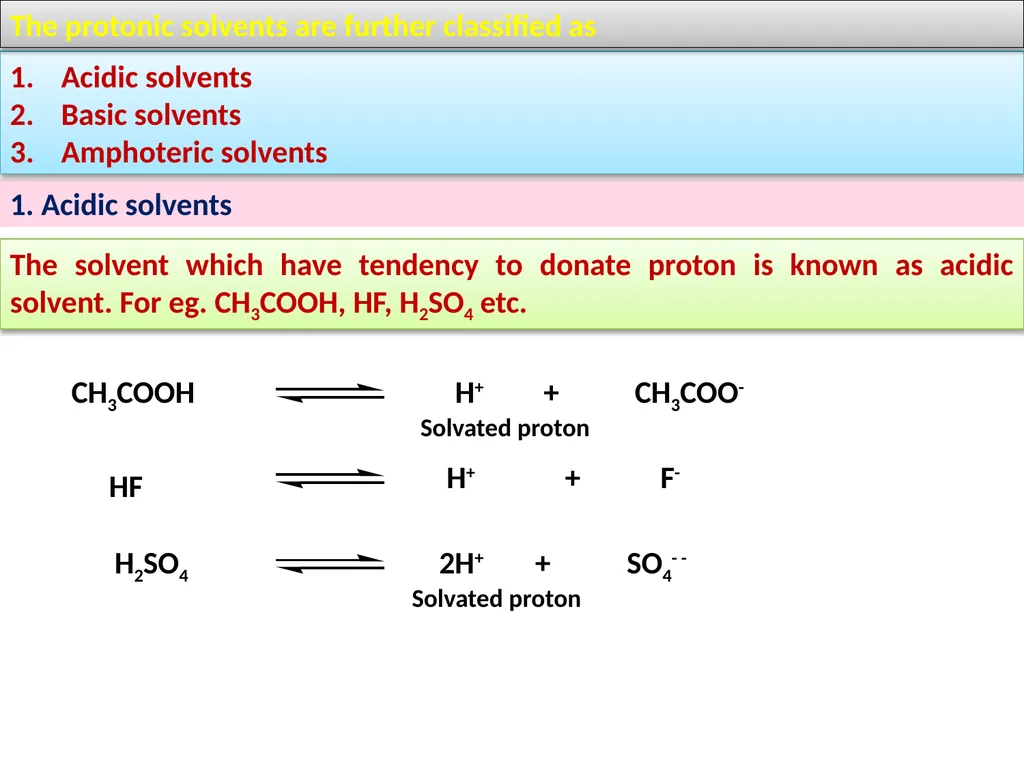
Amphoteric solvents The solvent which have tendency to donate proton is known as acidic solvent. For eg. CH3COOH, HF, H2SO4 etc. The protonic solvents are further classified as<br>
Basic solvents
Amphoteric solvents The solvent which have tendency to donate proton is known as acidic solvent. For eg. CH3COOH, HF, H2SO4 etc. The protonic solvents are further classified as<br>
09
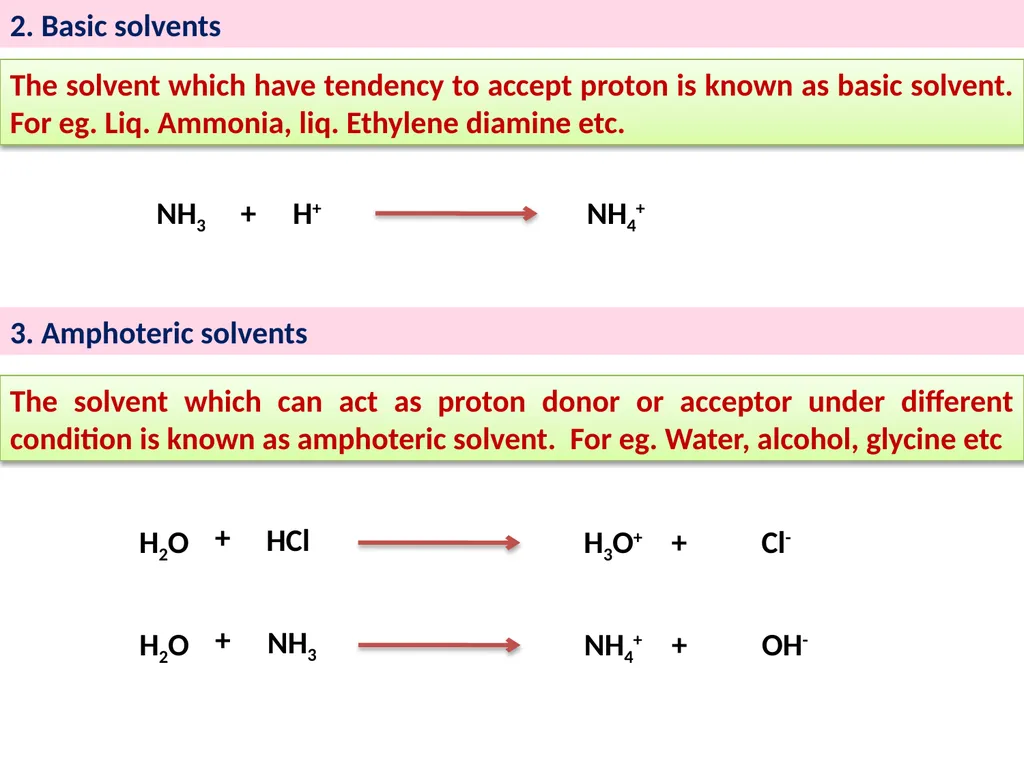
2. Basic solvents The solvent which have tendency to accept proton is known as basic solvent. For eg. Liq. Ammonia, liq. Ethylene diamine etc. 3. Amphoteric solvents The solvent which can act as proton donor or acceptor under different condition is known as amphoteric solvent. For eg. Water, alcohol, glycine etc<br>
10
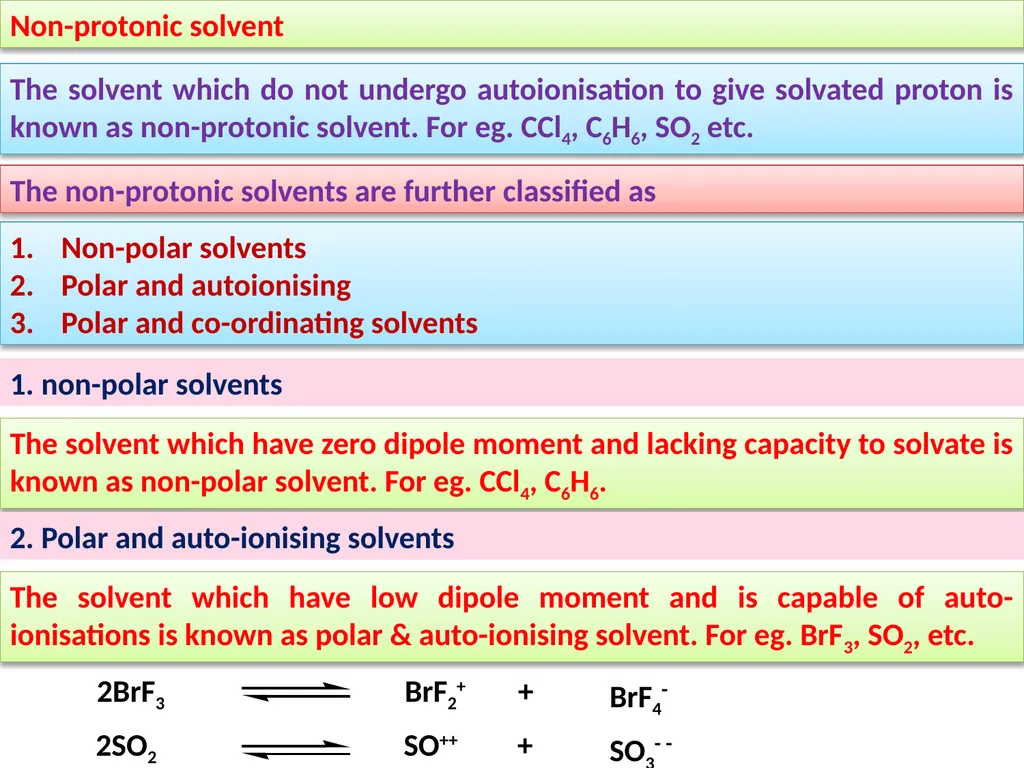
Non-protonic solvent The solvent which do not undergo autoionisation to give solvated proton is known as non-protonic solvent. For eg. CCl4, C6H6, SO2 etc. The non-protonic solvents are further classified as Non-polar solvents
Polar and autoionising
Polar and co-ordinating solvents 1. non-polar solvents The solvent which have zero dipole moment and lacking capacity to solvate is known as non-polar solvent. For eg. CCl4, C6H6. 2. Polar and auto-ionising solvents The solvent which have low dipole moment and is capable of auto-ionisations is known as polar & auto-ionising solvent. For eg. BrF3, SO2, etc.<br>
Polar and autoionising
Polar and co-ordinating solvents 1. non-polar solvents The solvent which have zero dipole moment and lacking capacity to solvate is known as non-polar solvent. For eg. CCl4, C6H6. 2. Polar and auto-ionising solvents The solvent which have low dipole moment and is capable of auto-ionisations is known as polar & auto-ionising solvent. For eg. BrF3, SO2, etc.<br>
11
Polar and co-ordinating solvents The solvent which is highly polar and co-ordinating tendency is known as polar and co-ordinating solvent. For eg. Acetonitrile, dimethyl sulphoxide etc. B. Ionising and non-ionising solvents 1. Ionising solvents They undergo auto-ionisation & bring about ionisation of the solute. These are polar in nature and high dipole moment and dielectric constant. They are good solvents for ionic solutes. For eg. Water, liq. Hydrogen fluoride,NH3 etc. They undergo auto-ionisation & do not ionize the solute. These are non-polar and have low dipole moment. They are suitable for covalent compounds. For eg, CCl4, C6H6 etc. 2. Non-Ionising solvents<br>
12
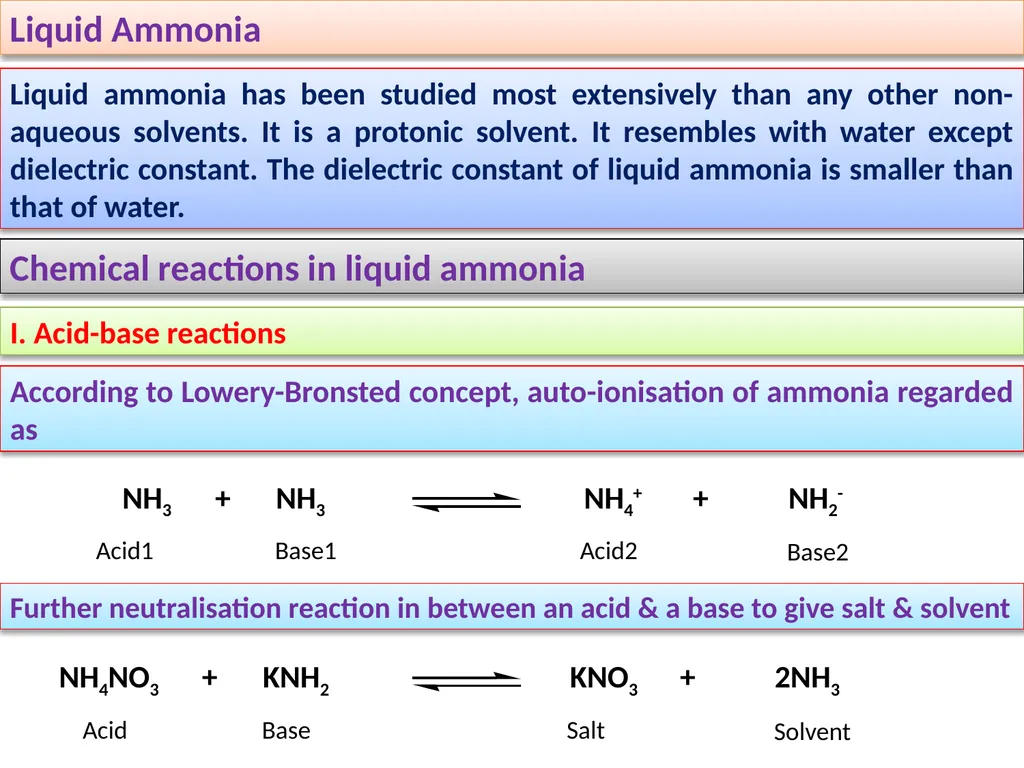
Liquid Ammonia Liquid ammonia has been studied most extensively than any other non-aqueous solvents. It is a protonic solvent. It resembles with water except dielectric constant. The dielectric constant of liquid ammonia is smaller than that of water. Chemical reactions in liquid ammonia I. Acid-base reactions According to Lowery-Bronsted concept, auto-ionisation of ammonia regarded as<br>
13
1. Ammonium salt reacts with metal oxides or hydroxides in liquid ammonia. These reactions are also considered as acid base reactions. 2. Acetic acid is a weak acid but it behave as strong acid in ammonia. 3. Molecule showing no acidic behavior in water at all may behave as acid in ammonia. 4. All acid behave as strong acids in water are leveled in ammonia to form ammonium ion for eg.<br>
14
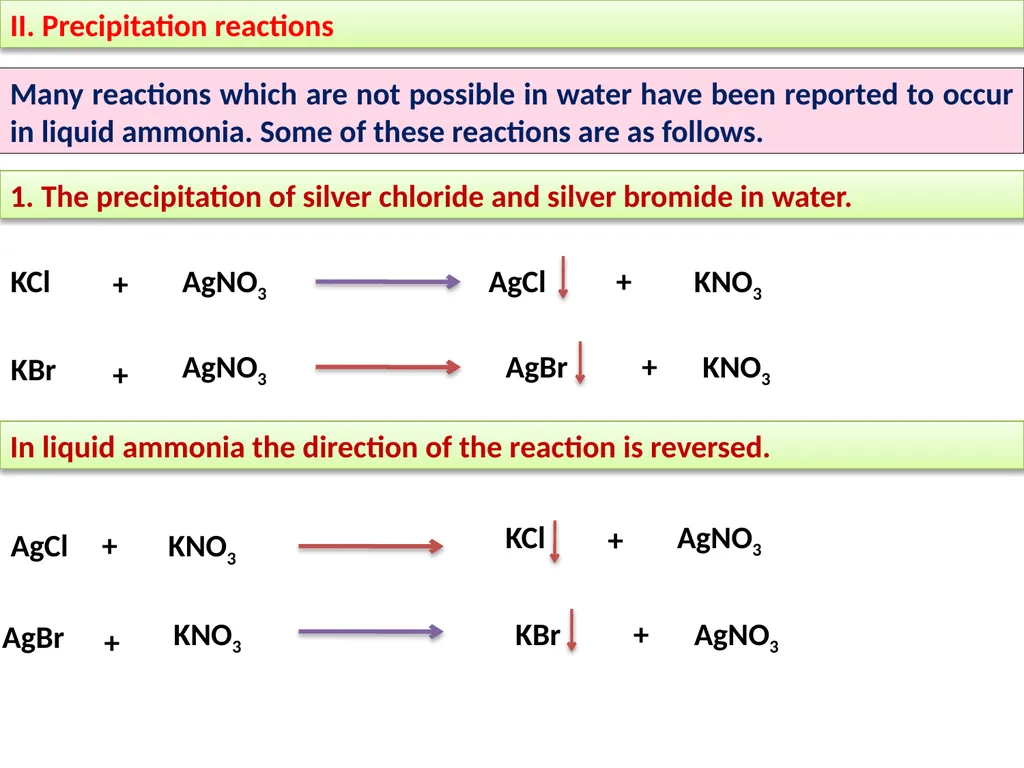
II. Precipitation reactions Many reactions which are not possible in water have been reported to occur in liquid ammonia. Some of these reactions are as follows. 1. The precipitation of silver chloride and silver bromide in water. In liquid ammonia the direction of the reaction is reversed.<br>
15
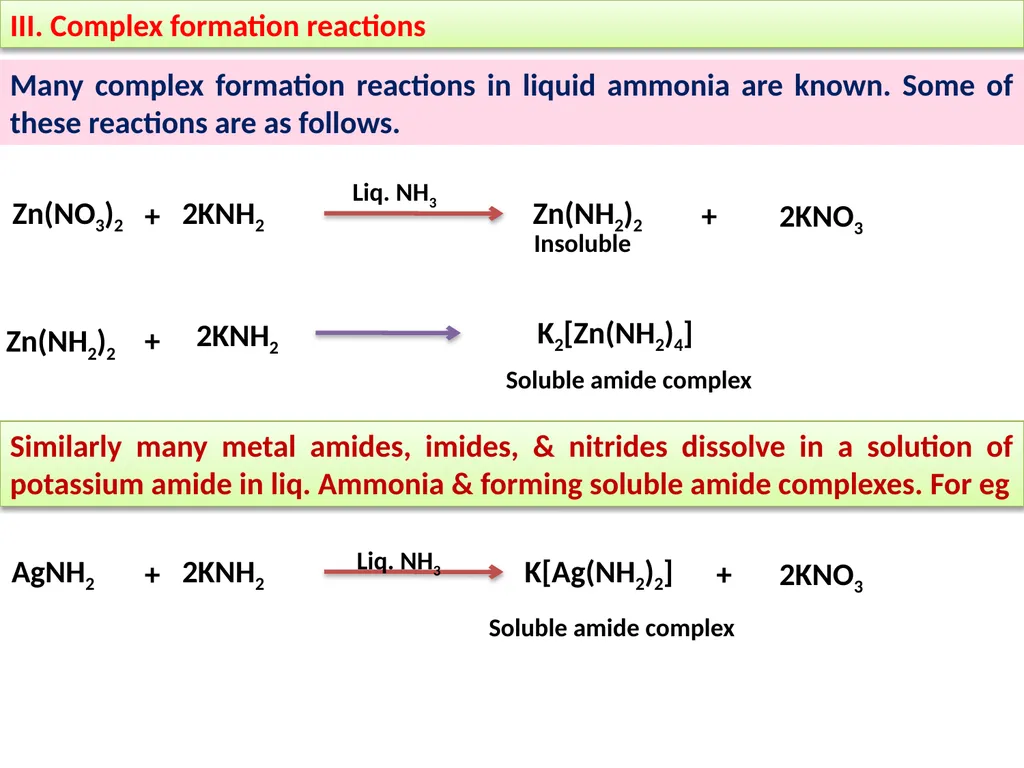
III. Complex formation reactions Many complex formation reactions in liquid ammonia are known. Some of these reactions are as follows. Similarly many metal amides, imides, & nitrides dissolve in a solution of potassium amide in liq. Ammonia & forming soluble amide complexes. For eg<br>
16
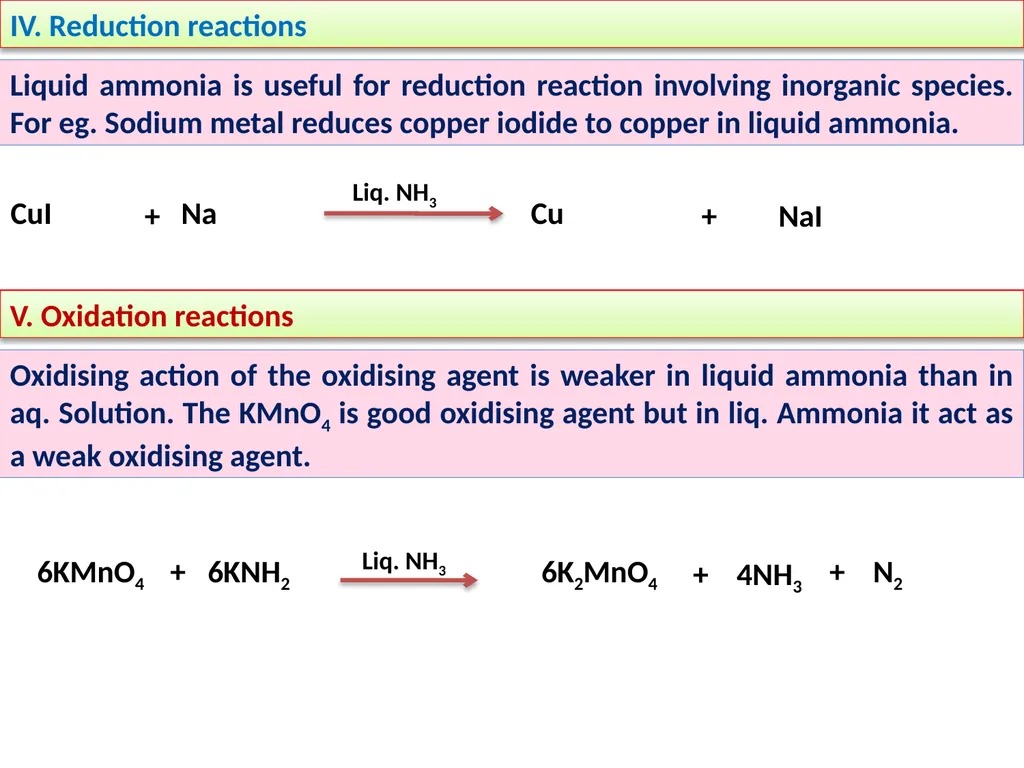
IV. Reduction reactions Liquid ammonia is useful for reduction reaction involving inorganic species. For eg. Sodium metal reduces copper iodide to copper in liquid ammonia. V. Oxidation reactions Oxidising action of the oxidising agent is weaker in liquid ammonia than in aq. Solution. The KMnO4 is good oxidising agent but in liq. Ammonia it act as a weak oxidising agent.<br>
17
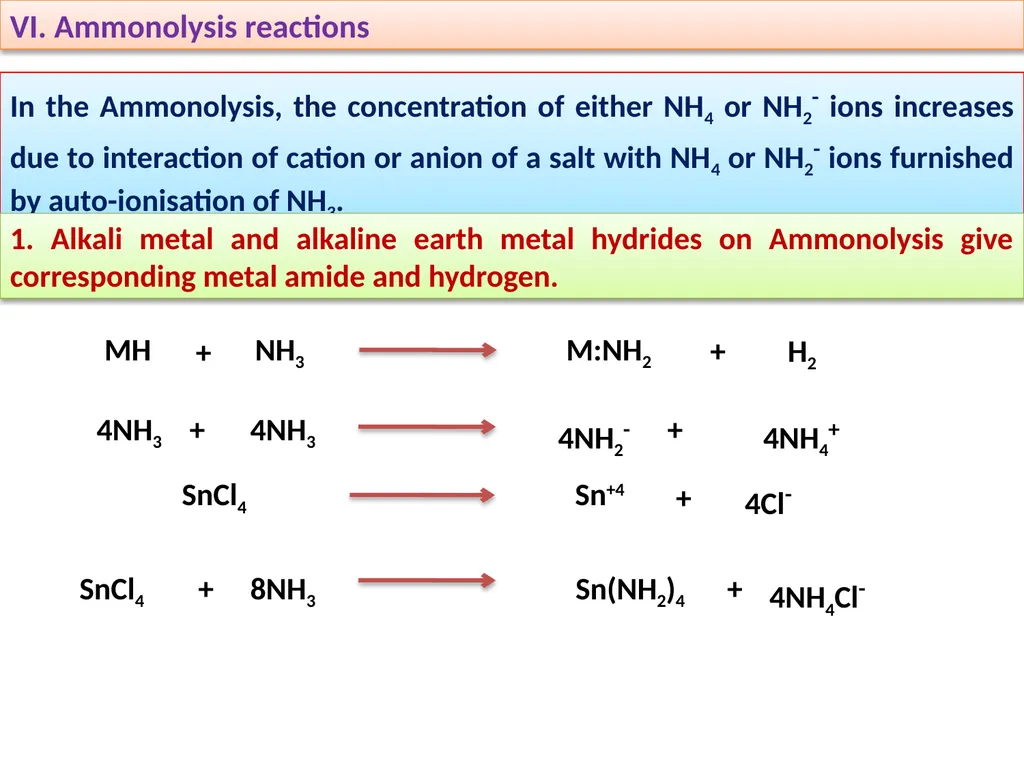
VI. Ammonolysis reactions In the Ammonolysis, the concentration of either NH4 or NH2- ions increases due to interaction of cation or anion of a salt with NH4 or NH2- ions furnished by auto-ionisation of NH3. 1. Alkali metal and alkaline earth metal hydrides on Ammonolysis give corresponding metal amide and hydrogen.<br>
18
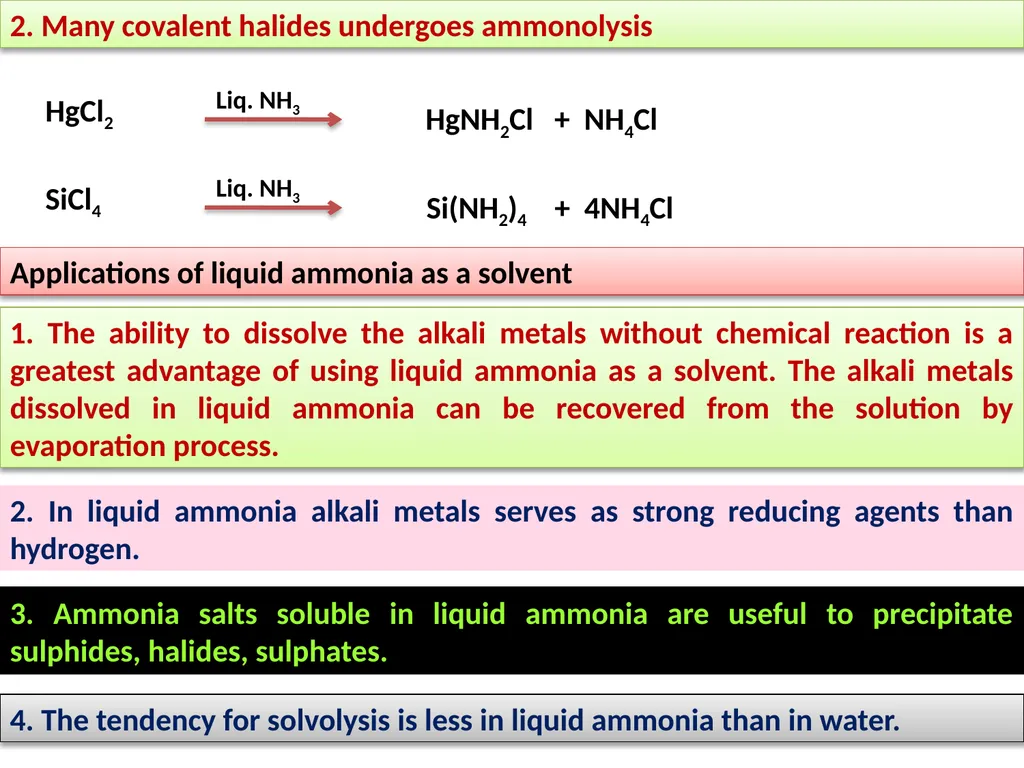
2. Many covalent halides undergoes ammonolysis Applications of liquid ammonia as a solvent 1. The ability to dissolve the alkali metals without chemical reaction is a greatest advantage of using liquid ammonia as a solvent. The alkali metals dissolved in liquid ammonia can be recovered from the solution by evaporation process. 2. In liquid ammonia alkali metals serves as strong reducing agents than hydrogen. 3. Ammonia salts soluble in liquid ammonia are useful to precipitate sulphides, halides, sulphates. 4. The tendency for solvolysis is less in liquid ammonia than in water.<br>
19
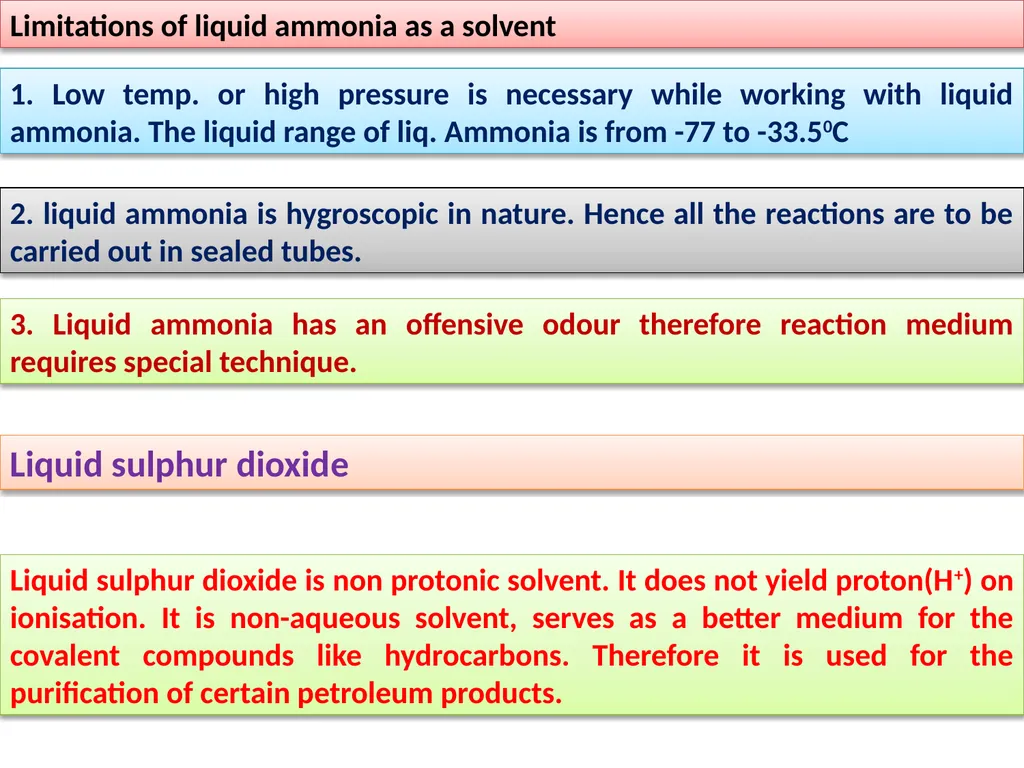
Liquid sulphur dioxide Liquid sulphur dioxide is non protonic solvent. It does not yield proton(H+) on ionisation. It is non-aqueous solvent, serves as a better medium for the covalent compounds like hydrocarbons. Therefore it is used for the purification of certain petroleum products. Limitations of liquid ammonia as a solvent 1. Low temp. or high pressure is necessary while working with liquid ammonia. The liquid range of liq. Ammonia is from -77 to -33.50C 2. liquid ammonia is hygroscopic in nature. Hence all the reactions are to be carried out in sealed tubes. 3. Liquid ammonia has an offensive odour therefore reaction medium requires special technique.<br>
20
Reactions in liquid sulphur dioxide I. Acid-base reactions (neutralisation). On the basis of Lowery-Bronsted concept, auto-ionisation of liquid sulphur dioxide may be regarded as acid-base reaction for eg. Hence thionyl (SO++) ions act as acid while sulphite ions act as a base in liquid sulphur dioxide. Thus a substance which dissociate to produce thionyl ions behave as acid & the substance which dissociate to produce sulphite ions (SO3- -) behave as base in liquid SO2. Some reactions are as follows.<br>
21
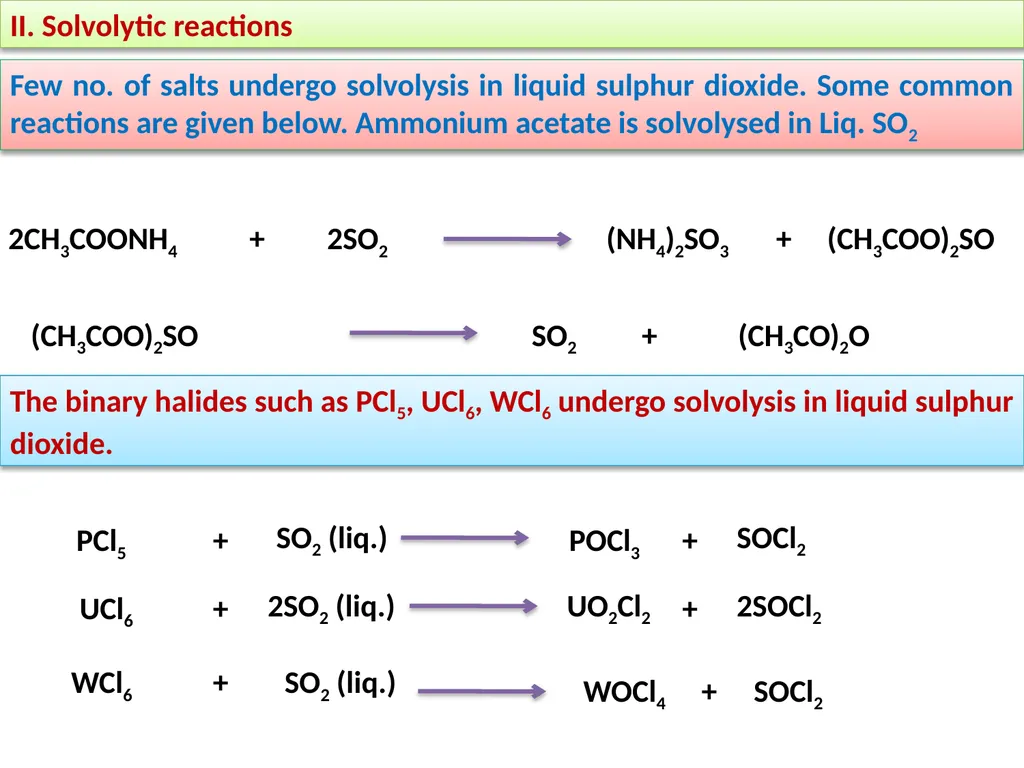
II. Solvolytic reactions Few no. of salts undergo solvolysis in liquid sulphur dioxide. Some common reactions are given below. Ammonium acetate is solvolysed in Liq. SO2 The binary halides such as PCl5, UCl6, WCl6 undergo solvolysis in liquid sulphur dioxide.<br>
22
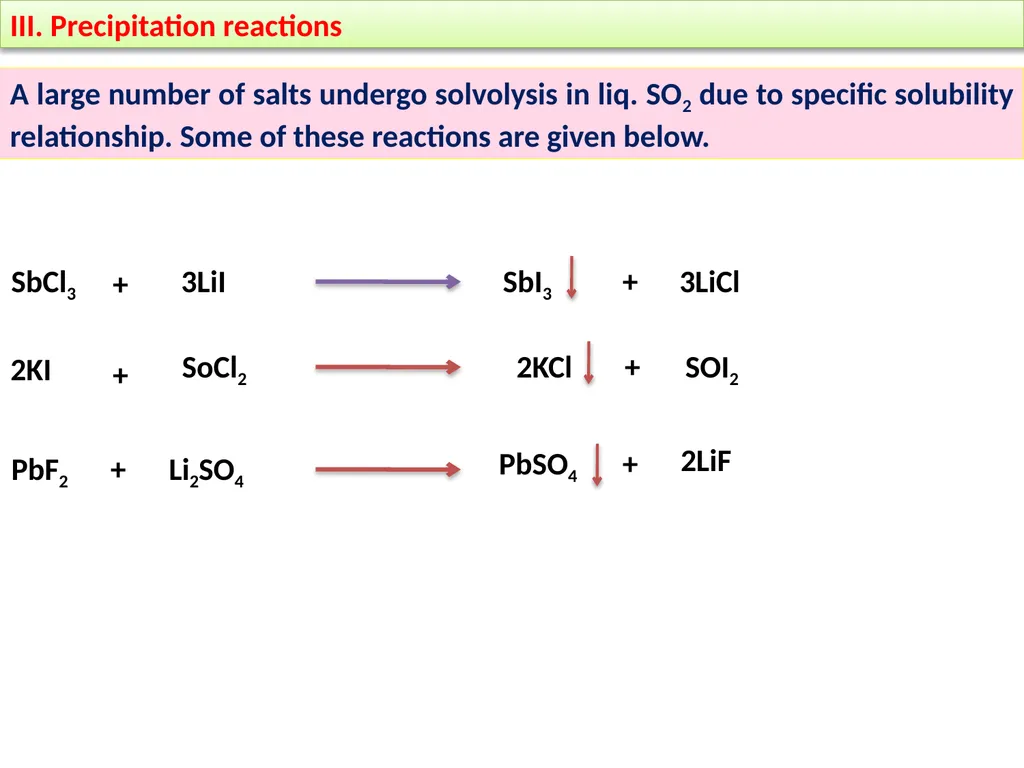
III. Precipitation reactions A large number of salts undergo solvolysis in liq. SO2 due to specific solubility relationship. Some of these reactions are given below.<br>
23
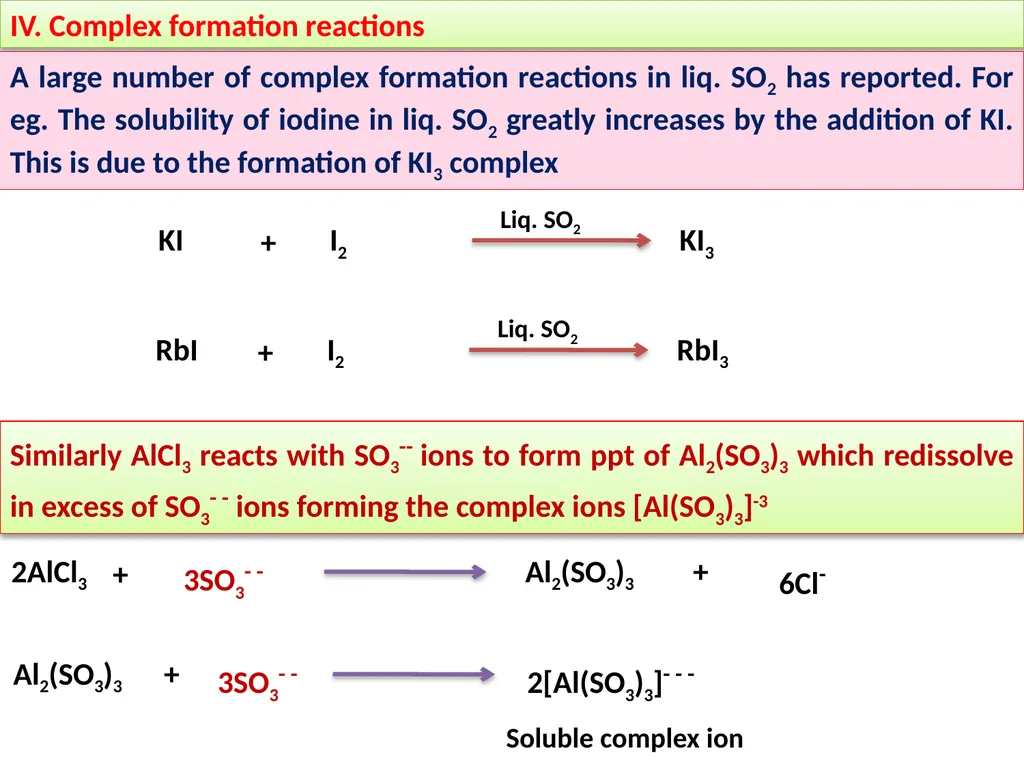
IV. Complex formation reactions Similarly AlCl3 reacts with SO3-- ions to form ppt of Al2(SO3)3 which redissolve in excess of SO3- - ions forming the complex ions [Al(SO3)3]-3 A large number of complex formation reactions in liq. SO2 has reported. For eg. The solubility of iodine in liq. SO2 greatly increases by the addition of KI. This is due to the formation of KI3 complex<br>
24
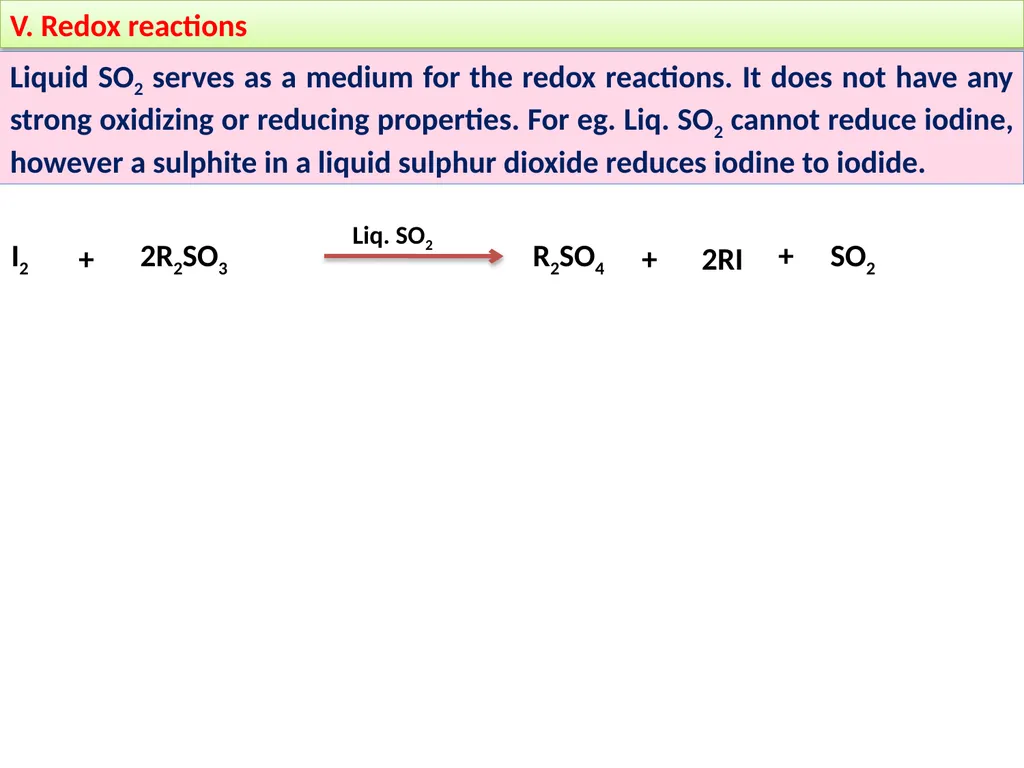
V. Redox reactions Liquid SO2 serves as a medium for the redox reactions. It does not have any strong oxidizing or reducing properties. For eg. Liq. SO2 cannot reduce iodine, however a sulphite in a liquid sulphur dioxide reduces iodine to iodide.<br>
25
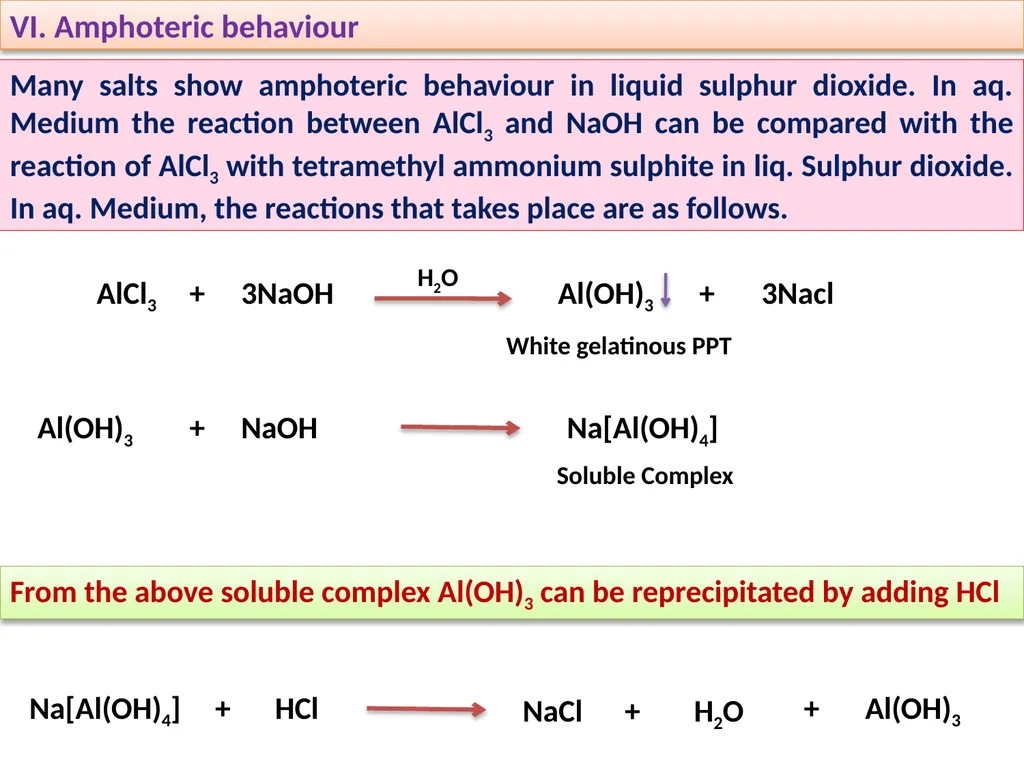
VI. Amphoteric behaviour Many salts show amphoteric behaviour in liquid sulphur dioxide. In aq. Medium the reaction between AlCl3 and NaOH can be compared with the reaction of AlCl3 with tetramethyl ammonium sulphite in liq. Sulphur dioxide. In aq. Medium, the reactions that takes place are as follows. From the above soluble complex Al(OH)3 can be reprecipitated by adding HCl<br>
26
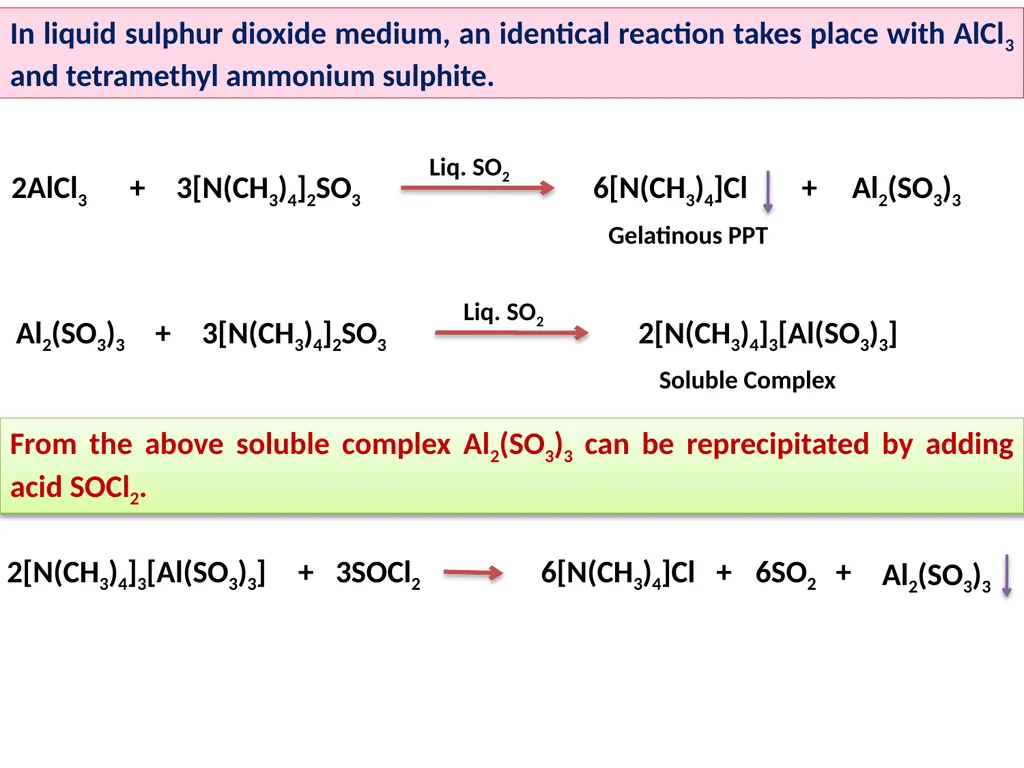
In liquid sulphur dioxide medium, an identical reaction takes place with AlCl3 and tetramethyl ammonium sulphite. From the above soluble complex Al2(SO3)3 can be reprecipitated by adding acid SOCl2.<br>