Non-Fiction Writing Lively Magazine Article ): Whats the subject of this piece of writing? How would you describe the tone of this piece? Challenge: HOW has the writer made this piece lively (try to identify specific techniques)? Do Now:
"Non-Fiction Writing Lively Magazine Article ):" is the property of its rightful owner. Permission is granted to
download and print the materials on this website for personal, non-commercial use only, and to display it
on your personal computer provided you do not modify the materials and that you retain all copyright
notices contained in the materials. By downloading content from our website, you accept the terms of this
agreement.
Presentation Transcript
01
Non-Fiction Writing Lively Magazine Article<br>
02
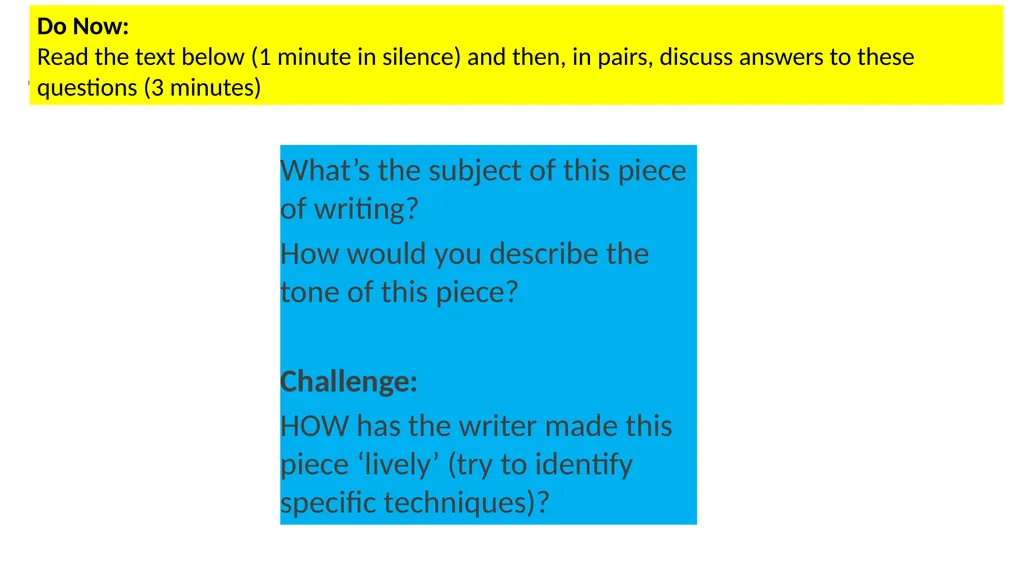
): What’s the subject of this piece of writing?
How would you describe the tone of this piece?
Challenge:
HOW has the writer made this piece ‘lively’ (try to identify specific techniques)? Do Now:
Read the text below (1 minute in silence) and then, in pairs, discuss answers to these questions (3 minutes)<br>
03
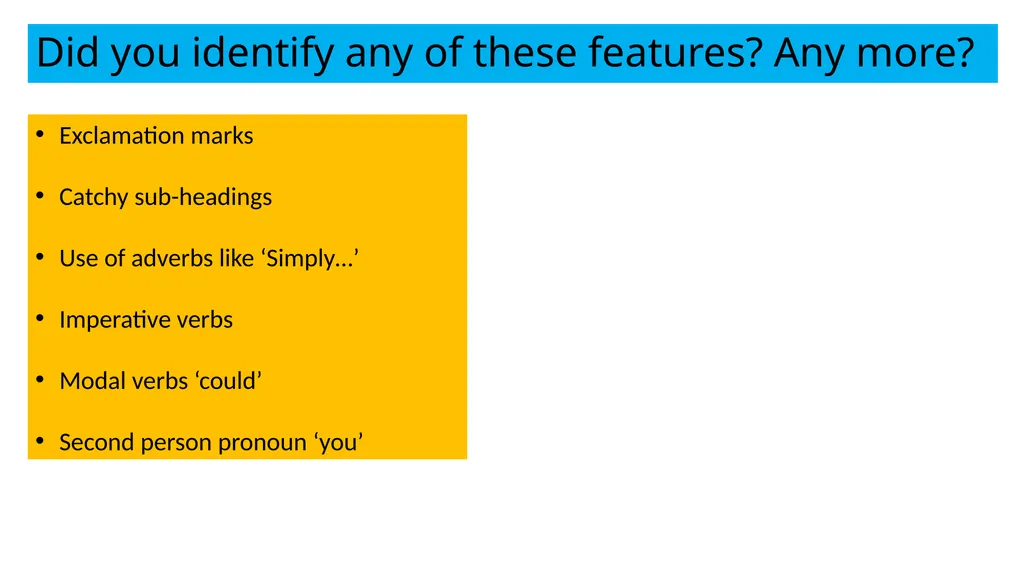
Did you identify any of these features? Any more? Exclamation marks
Catchy sub-headings
Use of adverbs like ‘Simply…’
Imperative verbs
Modal verbs ‘could’
Second person pronoun ‘you’<br>
04
Write a lively article for your school magazine advising GCSE students on revision techniques. Purpose: Why has the text been written?
To advise
Audience: Who has it been written for?
GCSE students
Format:How has the text been organised?
Magazine article
Tone: What is the writer’s attitude?
Lively<br>
05
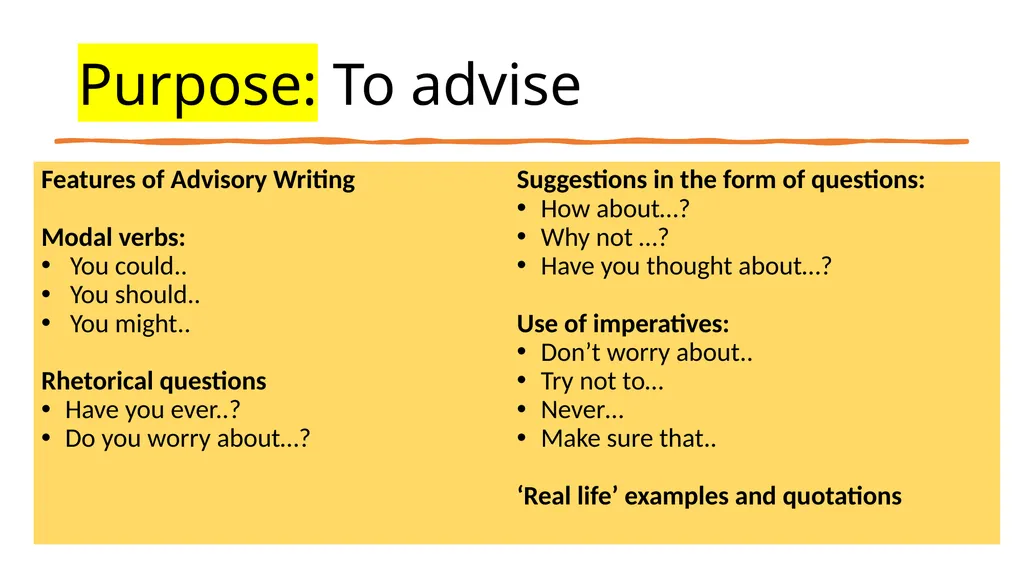
Purpose: To advise Features of Advisory Writing
Modal verbs:
You could..
You should..
You might..
Rhetorical questions
Have you ever..?
Do you worry about…?
Suggestions in the form of questions:
How about…?
Why not …?
Have you thought about…?
Use of imperatives:
Don’t worry about..
Try not to…
Never…
Make sure that..
‘Real life’ examples and quotations<br>
06
Audience: young people/school students If the students are at your school, refer to specific aspects of your own school.
Adopt a friendly, informal tone.
Words and sentences should not be too complex.
Sub-headings might be appropriate.<br>
07
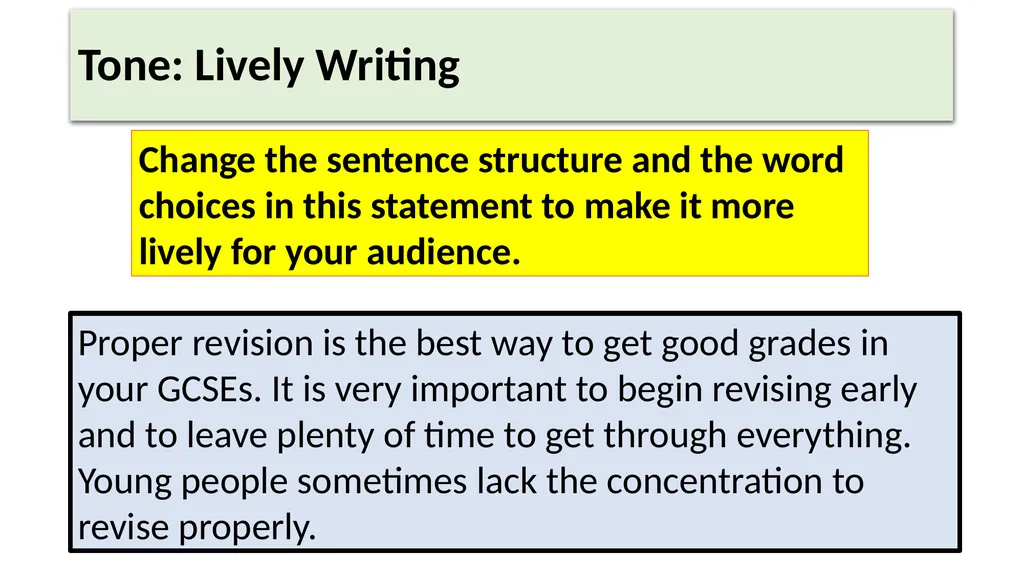
Tone: Lively Writing Change the sentence structure and the word choices in this statement to make it more lively for your audience. Proper revision is the best way to get good grades in your GCSEs. It is very important to begin revising early and to leave plenty of time to get through everything. Young people sometimes lack the concentration to revise properly.<br>
08
What are you going to write about? Discuss for one minute then we will pool your ideas<br>
09
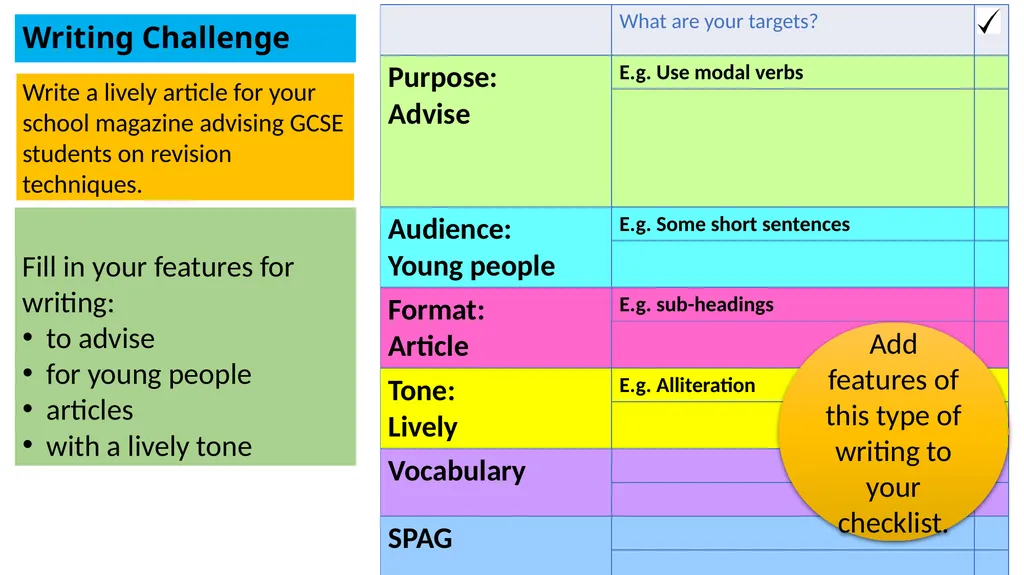
Writing Challenge Write a lively article for your school magazine advising GCSE students on revision techniques. Fill in your features for writing:
to advise
for young people
articles
with a lively tone Add features of this type of writing to your checklist.<br>
10
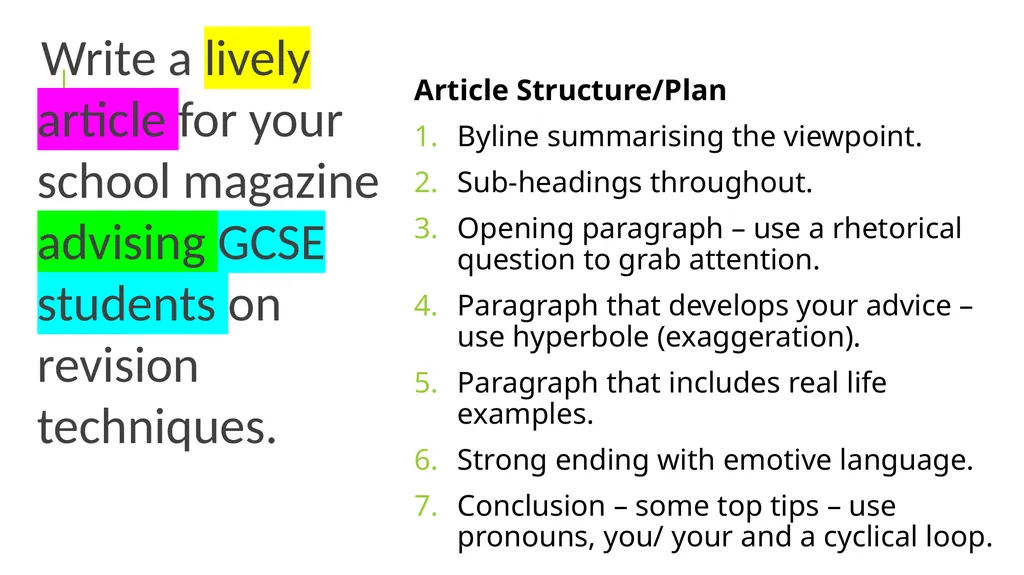
Plan Your Article Article Structure/Plan
Byline summarising the viewpoint.
Sub-headings throughout.
Opening paragraph – use a rhetorical question to grab attention.
Paragraph that develops your advice – use hyperbole (exaggeration).
Paragraph that includes real life examples.
Strong ending with emotive language.
Conclusion – some top tips – use pronouns, you/ your and a cyclical loop. Write a lively article for your school magazine advising GCSE students on revision techniques.<br>