
Non-Functional Requirements Quality attributes and
Description: Non-Functional Requirements Quality attributes and other NF items Types of Requirements Software Requirements, 3rd Edition Types of Requirements Business Requirement: A high-level business objective of the organization that builds a product
Related Topics
Download Presentation
"Non-Functional Requirements Quality attributes and" is the property of its rightful owner. Permission is granted to download and print the materials on this website for personal, non-commercial use only, and to display it on your personal computer provided you do not modify the materials and that you retain all copyright notices contained in the materials. By downloading content from our website, you accept the terms of this agreement.
Presentation Transcript
slide1. Non-Functional Requirements Quality attributes and other NF items<br>
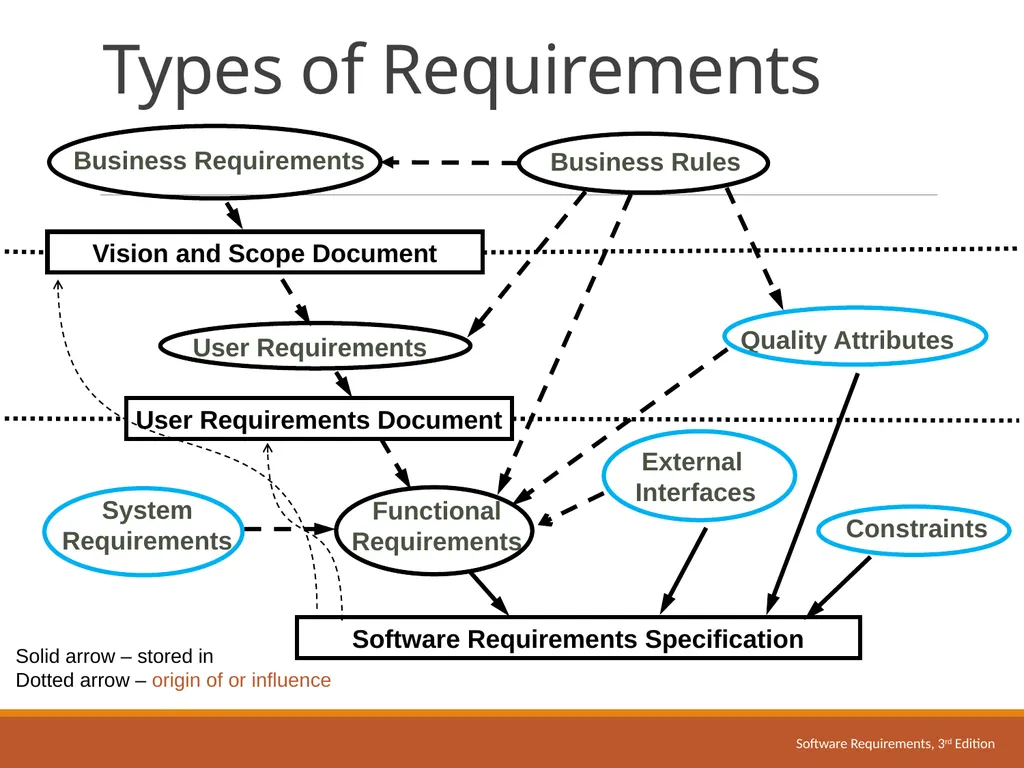
slide2. Types of Requirements Software Requirements, 3rd Edition<br>
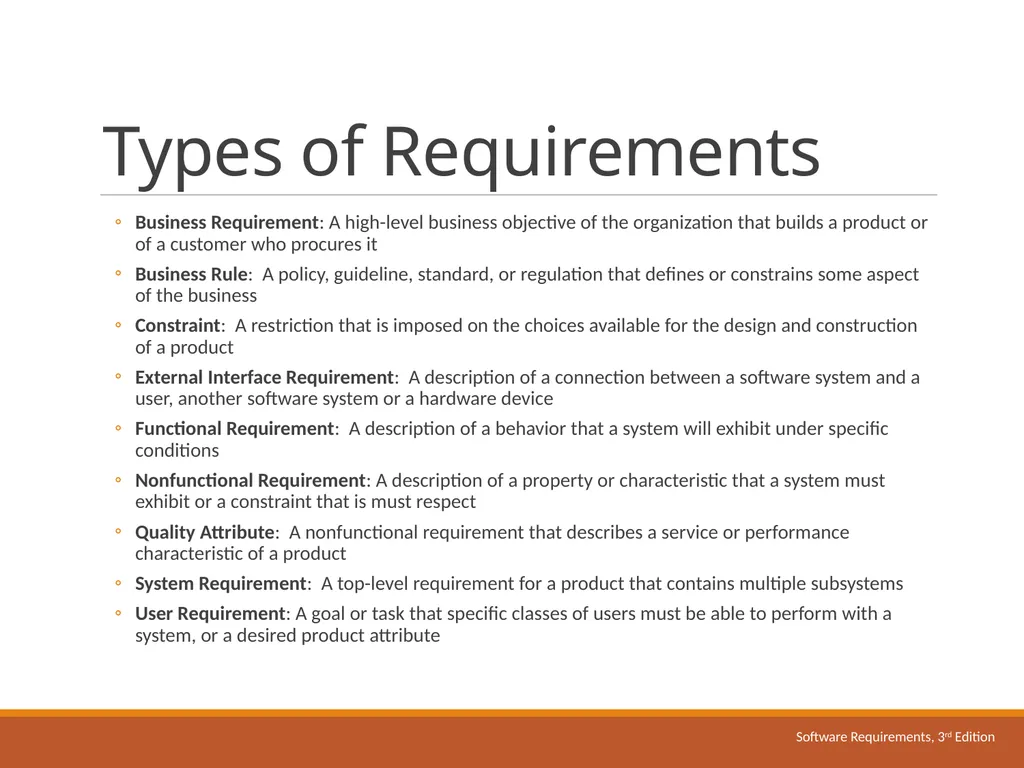
slide3. Types of Requirements Business Requirement: A high-level business objective of the organization that builds a product or of a customer who procures it
Business Rule: A policy, guideline, standard, or regulation that defines or constrains some aspect of the business
Constraint: A restriction that is imposed on the choices available for the design and construction of a product
External Interface Requirement: A description of a connection between a software system and a user, another software system or a hardware device
Functional Requirement: A description of a behavior that a system will exhibit under specific conditions
Nonfunctional Requirement: A description of a property or characteristic that a system must exhibit or a constraint that is must respect
Quality Attribute: A nonfunctional requirement that describes a service or performance characteristic of a product
System Requirement: A top-level requirement for a product that contains multiple subsystems
User Requirement: A goal or task that specific classes of users must be able to perform with a system, or a desired product attribute Software Requirements, 3rd Edition<br>
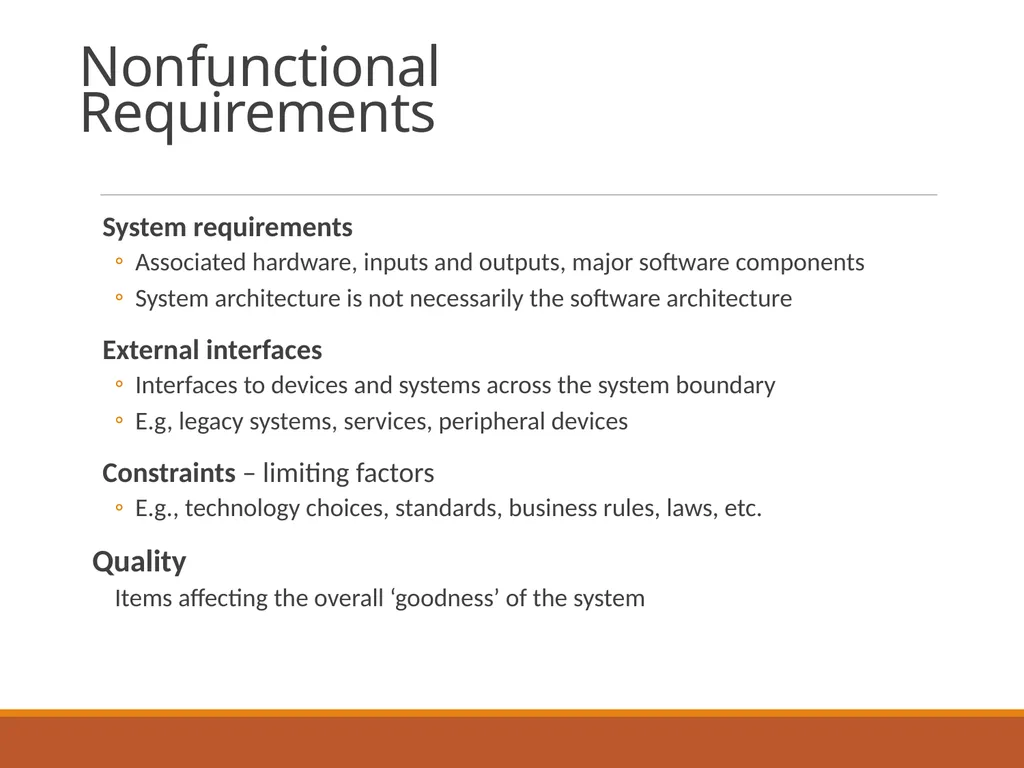
slide4. Nonfunctional Requirements System requirements
Associated hardware, inputs and outputs, major software components
System architecture is not necessarily the software architecture
External interfaces
Interfaces to devices and systems across the system boundary
E.g, legacy systems, services, peripheral devices
Constraints – limiting factors
E.g., technology choices, standards, business rules, laws, etc.
Quality
Items affecting the overall ‘goodness’ of the system<br>
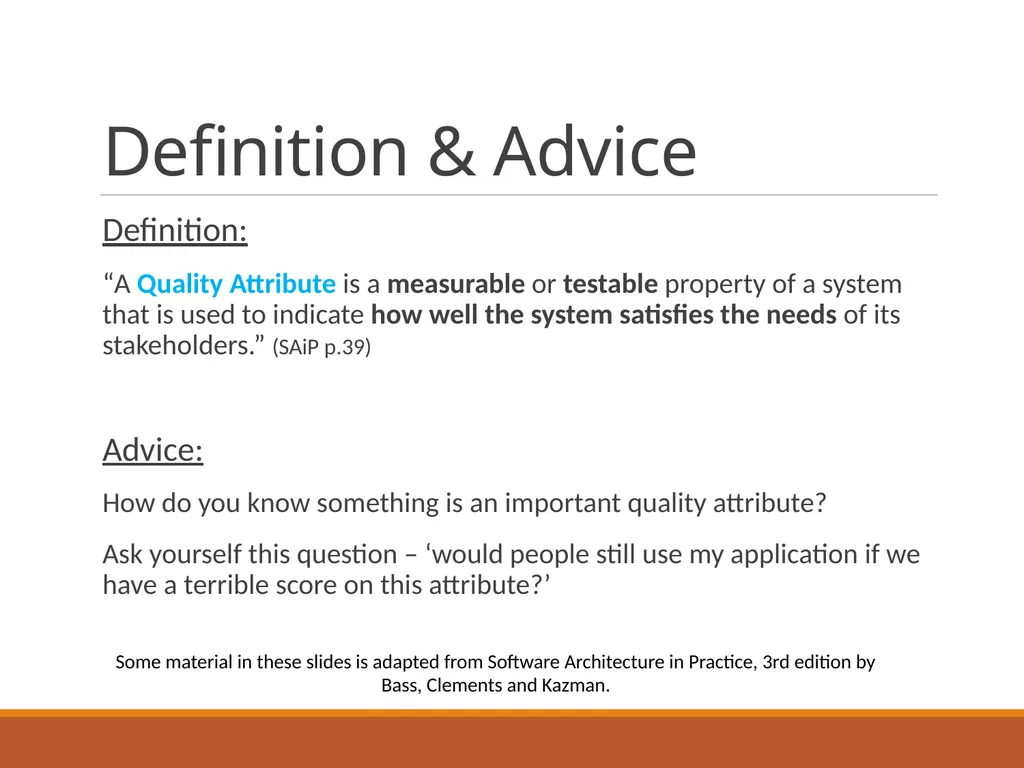
slide5. Definition & Advice Definition:
“A Quality Attribute is a measurable or testable property of a system that is used to indicate how well the system satisfies the needs of its stakeholders.” (SAiP p.39)
Advice:
How do you know something is an important quality attribute?
Ask yourself this question – ‘would people still use my application if we have a terrible score on this attribute?’ Some material in these slides is adapted from Software Architecture in Practice, 3rd edition by Bass, Clements and Kazman.<br>
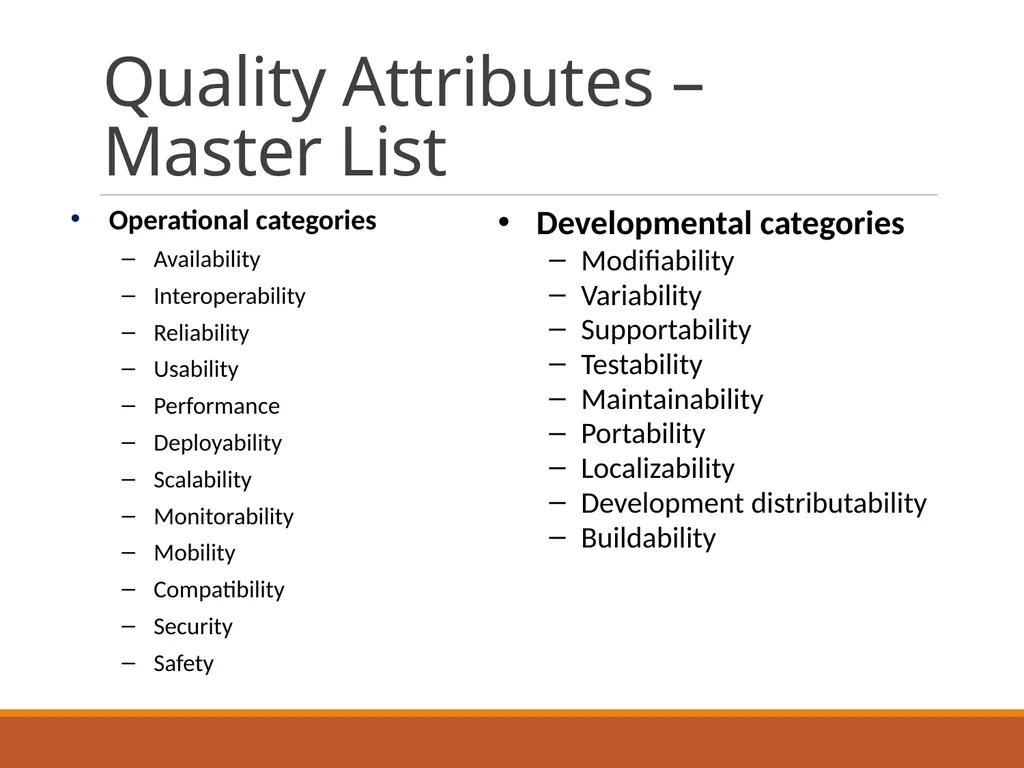
slide6. Operational categories
Availability
Interoperability
Reliability
Usability
Performance
Deployability
Scalability
Monitorability
Mobility
Compatibility
Security
Safety Developmental categories
Modifiability
Variability
Supportability
Testability
Maintainability
Portability
Localizability
Development distributability
Buildability Quality Attributes – Master List<br>
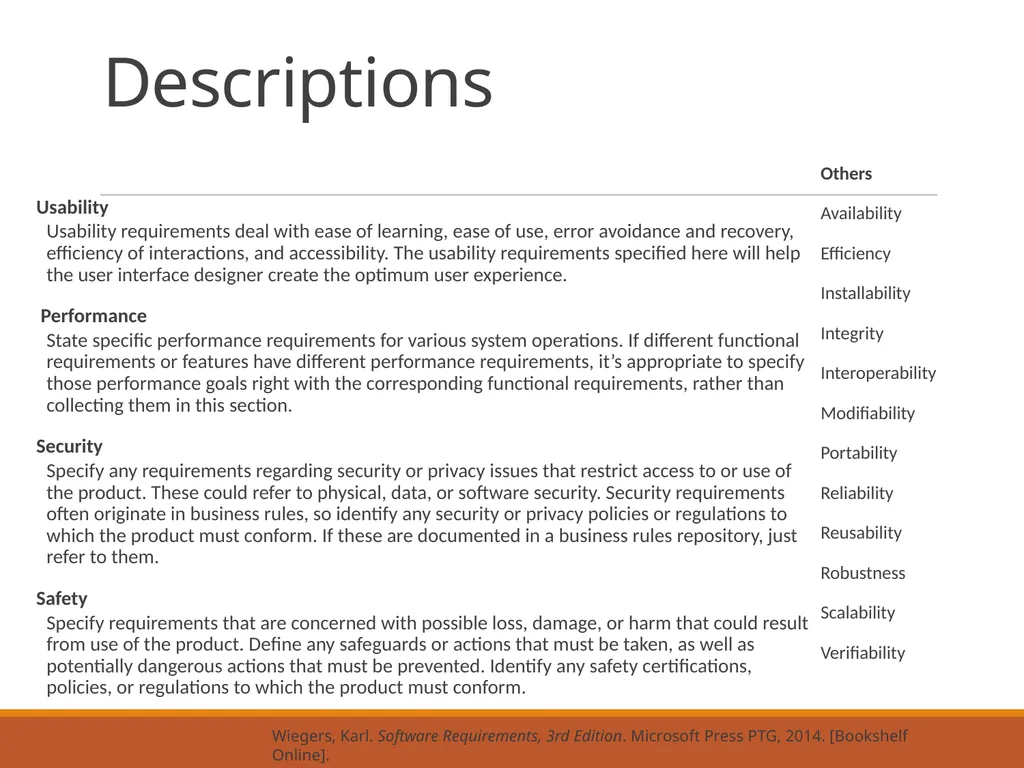
slide7. Descriptions Usability
Usability requirements deal with ease of learning, ease of use, error avoidance and recovery, efficiency of interactions, and accessibility. The usability requirements specified here will help the user interface designer create the optimum user experience.
Performance
State specific performance requirements for various system operations. If different functional requirements or features have different performance requirements, it’s appropriate to specify those performance goals right with the corresponding functional requirements, rather than collecting them in this section.
Security
Specify any requirements regarding security or privacy issues that restrict access to or use of the product. These could refer to physical, data, or software security. Security requirements often originate in business rules, so identify any security or privacy policies or regulations to which the product must conform. If these are documented in a business rules repository, just refer to them.
Safety
Specify requirements that are concerned with possible loss, damage, or harm that could result from use of the product. Define any safeguards or actions that must be taken, as well as potentially dangerous actions that must be prevented. Identify any safety certifications, policies, or regulations to which the product must conform. Others
Availability
Efficiency
Installability
Integrity
Interoperability
Modifiability
Portability
Reliability
Reusability
Robustness
Scalability
Verifiability Wiegers, Karl. Software Requirements, 3rd Edition. Microsoft Press PTG, 2014. [Bookshelf Online].<br>
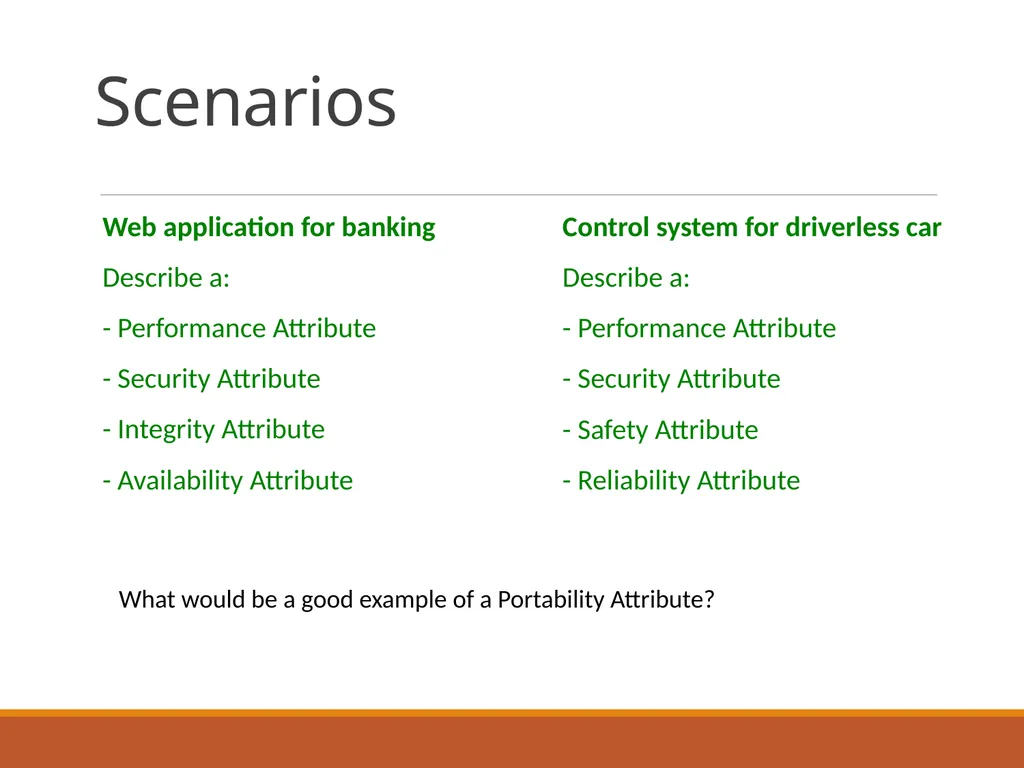
slide8. Scenarios Web application for banking
Describe a:
- Performance Attribute
- Security Attribute
- Integrity Attribute
- Availability Attribute Control system for driverless car
Describe a:
- Performance Attribute
- Security Attribute
- Safety Attribute
- Reliability Attribute What would be a good example of a Portability Attribute?<br>
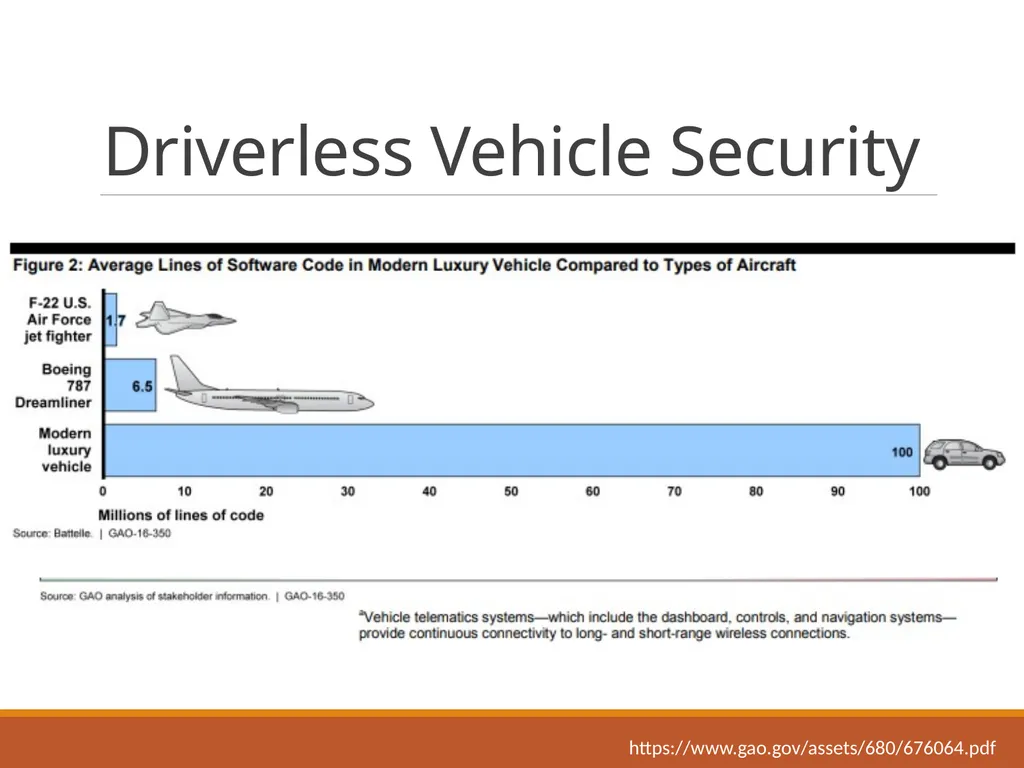
slide9. Driverless Vehicle Security https://www.gao.gov/assets/680/676064.pdf<br>
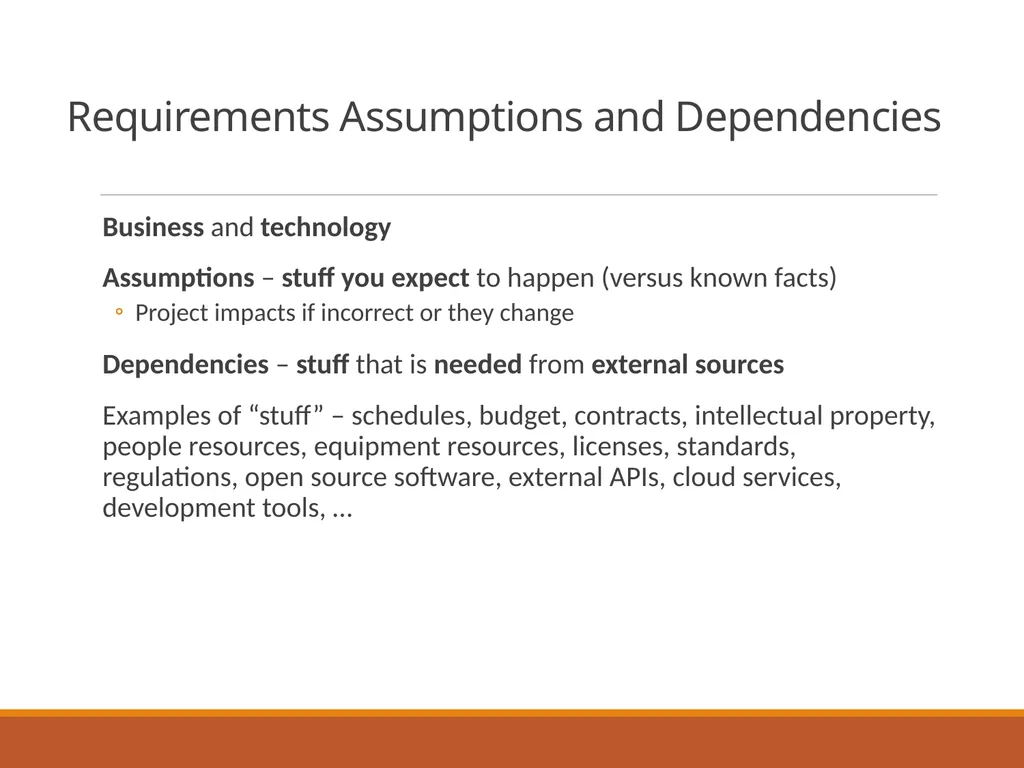
slide10. Requirements Assumptions and Dependencies Business and technology
Assumptions – stuff you expect to happen (versus known facts)
Project impacts if incorrect or they change
Dependencies – stuff that is needed from external sources
Examples of “stuff” – schedules, budget, contracts, intellectual property, people resources, equipment resources, licenses, standards, regulations, open source software, external APIs, cloud services, development tools, …<br>
slide11. Examples If you are building a desktop application
- Connects to online brokerage system
List some assumptions
List some dependencies<br>
slide2. Types of Requirements Software Requirements, 3rd Edition<br>
slide3. Types of Requirements Business Requirement: A high-level business objective of the organization that builds a product or of a customer who procures it
Business Rule: A policy, guideline, standard, or regulation that defines or constrains some aspect of the business
Constraint: A restriction that is imposed on the choices available for the design and construction of a product
External Interface Requirement: A description of a connection between a software system and a user, another software system or a hardware device
Functional Requirement: A description of a behavior that a system will exhibit under specific conditions
Nonfunctional Requirement: A description of a property or characteristic that a system must exhibit or a constraint that is must respect
Quality Attribute: A nonfunctional requirement that describes a service or performance characteristic of a product
System Requirement: A top-level requirement for a product that contains multiple subsystems
User Requirement: A goal or task that specific classes of users must be able to perform with a system, or a desired product attribute Software Requirements, 3rd Edition<br>
slide4. Nonfunctional Requirements System requirements
Associated hardware, inputs and outputs, major software components
System architecture is not necessarily the software architecture
External interfaces
Interfaces to devices and systems across the system boundary
E.g, legacy systems, services, peripheral devices
Constraints – limiting factors
E.g., technology choices, standards, business rules, laws, etc.
Quality
Items affecting the overall ‘goodness’ of the system<br>
slide5. Definition & Advice Definition:
“A Quality Attribute is a measurable or testable property of a system that is used to indicate how well the system satisfies the needs of its stakeholders.” (SAiP p.39)
Advice:
How do you know something is an important quality attribute?
Ask yourself this question – ‘would people still use my application if we have a terrible score on this attribute?’ Some material in these slides is adapted from Software Architecture in Practice, 3rd edition by Bass, Clements and Kazman.<br>
slide6. Operational categories
Availability
Interoperability
Reliability
Usability
Performance
Deployability
Scalability
Monitorability
Mobility
Compatibility
Security
Safety Developmental categories
Modifiability
Variability
Supportability
Testability
Maintainability
Portability
Localizability
Development distributability
Buildability Quality Attributes – Master List<br>
slide7. Descriptions Usability
Usability requirements deal with ease of learning, ease of use, error avoidance and recovery, efficiency of interactions, and accessibility. The usability requirements specified here will help the user interface designer create the optimum user experience.
Performance
State specific performance requirements for various system operations. If different functional requirements or features have different performance requirements, it’s appropriate to specify those performance goals right with the corresponding functional requirements, rather than collecting them in this section.
Security
Specify any requirements regarding security or privacy issues that restrict access to or use of the product. These could refer to physical, data, or software security. Security requirements often originate in business rules, so identify any security or privacy policies or regulations to which the product must conform. If these are documented in a business rules repository, just refer to them.
Safety
Specify requirements that are concerned with possible loss, damage, or harm that could result from use of the product. Define any safeguards or actions that must be taken, as well as potentially dangerous actions that must be prevented. Identify any safety certifications, policies, or regulations to which the product must conform. Others
Availability
Efficiency
Installability
Integrity
Interoperability
Modifiability
Portability
Reliability
Reusability
Robustness
Scalability
Verifiability Wiegers, Karl. Software Requirements, 3rd Edition. Microsoft Press PTG, 2014. [Bookshelf Online].<br>
slide8. Scenarios Web application for banking
Describe a:
- Performance Attribute
- Security Attribute
- Integrity Attribute
- Availability Attribute Control system for driverless car
Describe a:
- Performance Attribute
- Security Attribute
- Safety Attribute
- Reliability Attribute What would be a good example of a Portability Attribute?<br>
slide9. Driverless Vehicle Security https://www.gao.gov/assets/680/676064.pdf<br>
slide10. Requirements Assumptions and Dependencies Business and technology
Assumptions – stuff you expect to happen (versus known facts)
Project impacts if incorrect or they change
Dependencies – stuff that is needed from external sources
Examples of “stuff” – schedules, budget, contracts, intellectual property, people resources, equipment resources, licenses, standards, regulations, open source software, external APIs, cloud services, development tools, …<br>
slide11. Examples If you are building a desktop application
- Connects to online brokerage system
List some assumptions
List some dependencies<br>