
Nonhuman Primate Post Exposure Plan What should I

Description: Nonhuman Primate Post Exposure Plan What should I do? Post Exposure Management Employees at Wake Forest working with nonhuman primates should familiarize yourself with the following information in the event of an exposure
Related Topics
Download Presentation
"Nonhuman Primate Post Exposure Plan What should I" is the property of its rightful owner. Permission is granted to download and print the materials on this website for personal, non-commercial use only, and to display it on your personal computer provided you do not modify the materials and that you retain all copyright notices contained in the materials. By downloading content from our website, you accept the terms of this agreement.
Presentation Transcript
slide1. Nonhuman Primate Post Exposure Plan What should I do?<br>
slide2. Post Exposure Management Employees at Wake Forest working with nonhuman primates should familiarize yourself with the following information in the event of an exposure (Bite/Scratch/Splash):
Nonhuman Primate Exposure Kits and their locations
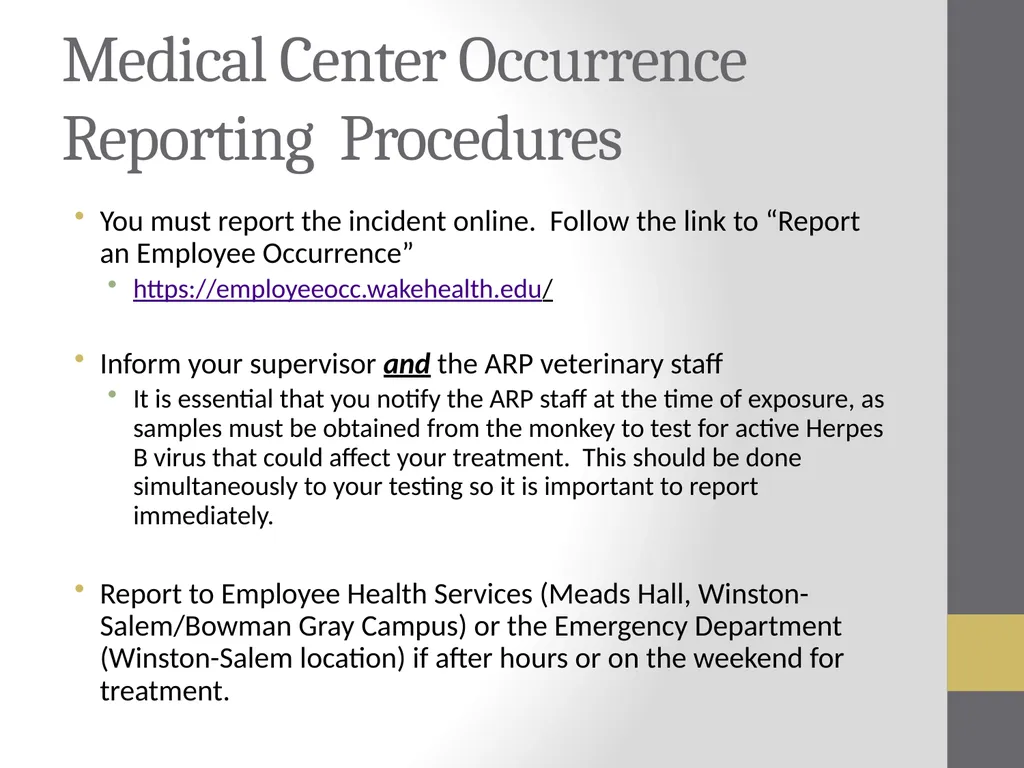
Medical Center Occurrence Reporting Procedures
Herpes B Virus Medical Alert Cards
Location of
Employee Health Services, Meads Hall, Winston-Salem/Bowman Gray Campus
Emergency Department – Winston-Salem location<br>
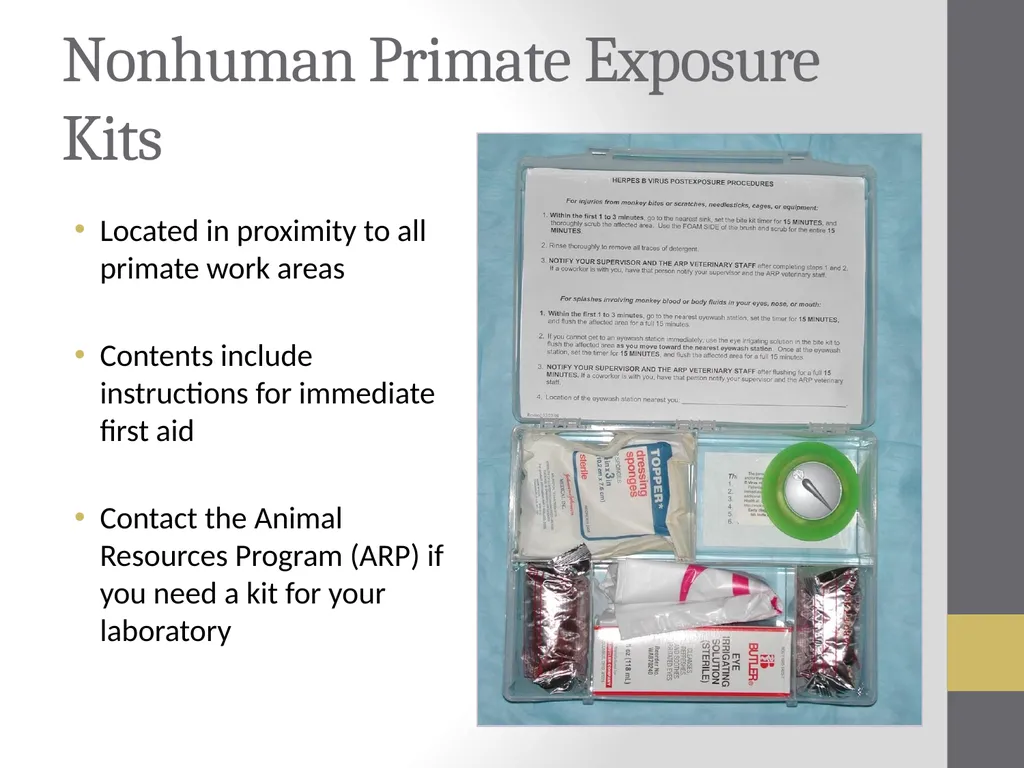
slide3. Nonhuman Primate Exposure Kits Located in proximity to all primate work areas
Contents include instructions for immediate first aid
Contact the Animal Resources Program (ARP) if you need a kit for your laboratory<br>
slide4. Medical Center Occurrence Reporting Procedures You must report the incident online. Follow the link to “Report an Employee Occurrence”
https://employeeocc.wakehealth.edu/
Inform your supervisor and the ARP veterinary staff
It is essential that you notify the ARP staff at the time of exposure, as samples must be obtained from the monkey to test for active Herpes B virus that could affect your treatment. This should be done simultaneously to your testing so it is important to report immediately.
Report to Employee Health Services (Meads Hall, Winston-Salem/Bowman Gray Campus) or the Emergency Department (Winston-Salem location) if after hours or on the weekend for treatment.<br>
slide5. Herpes B Virus Medical alert Cards The card is designed to:
Remind you of the symptoms of Herpes B
Provide contact information for a local health care provider
Contact ARP to obtain a card.
Carry the Medical Alert Card with you at all times.<br>
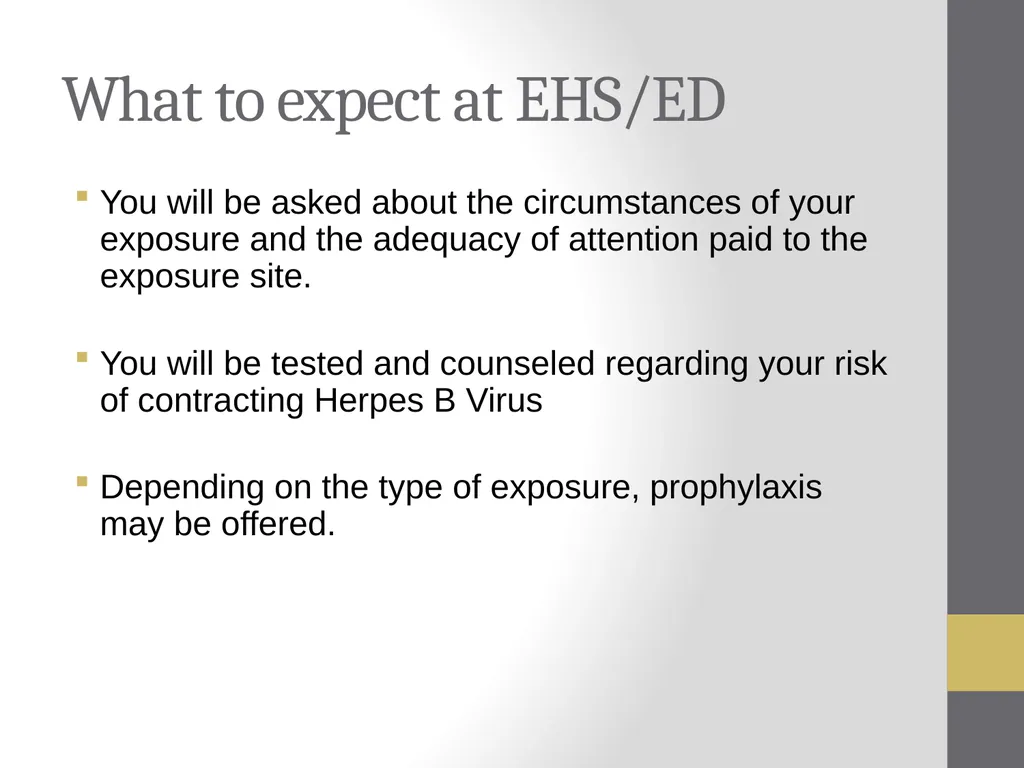
slide6. What to expect at EHS/ED You will be asked about the circumstances of your exposure and the adequacy of attention paid to the exposure site.
You will be tested and counseled regarding your risk of contracting Herpes B Virus
Depending on the type of exposure, prophylaxis may be offered.<br>
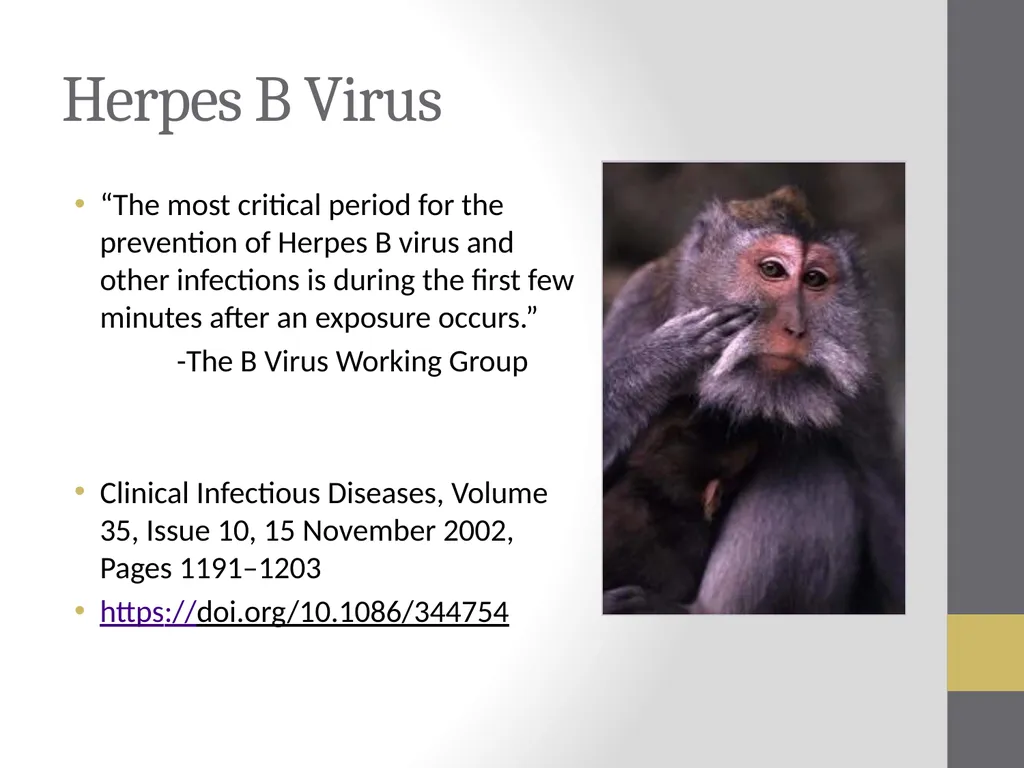
slide7. Herpes B Virus “The most critical period for the prevention of Herpes B virus and other infections is during the first few minutes after an exposure occurs.”
-The B Virus Working Group
Clinical Infectious Diseases, Volume 35, Issue 10, 15 November 2002, Pages 1191–1203
https://doi.org/10.1086/344754<br>
slide8. Contact Information WFU Medical Center Employee Health Services (Meads Hall, Winston-Salem/Bowman Gray Campus) 716-4801
WFU Animal Resources Program to report exposure for NHP testing
Bowman Gray 716-2900
Downtown 713-1174
Clarkson 716-1544
ARP Main Office 713-7394
CDC Website: http://www.cdc.gov/herpesbvirus/<br>
slide2. Post Exposure Management Employees at Wake Forest working with nonhuman primates should familiarize yourself with the following information in the event of an exposure (Bite/Scratch/Splash):
Nonhuman Primate Exposure Kits and their locations
Medical Center Occurrence Reporting Procedures
Herpes B Virus Medical Alert Cards
Location of
Employee Health Services, Meads Hall, Winston-Salem/Bowman Gray Campus
Emergency Department – Winston-Salem location<br>
slide3. Nonhuman Primate Exposure Kits Located in proximity to all primate work areas
Contents include instructions for immediate first aid
Contact the Animal Resources Program (ARP) if you need a kit for your laboratory<br>
slide4. Medical Center Occurrence Reporting Procedures You must report the incident online. Follow the link to “Report an Employee Occurrence”
https://employeeocc.wakehealth.edu/
Inform your supervisor and the ARP veterinary staff
It is essential that you notify the ARP staff at the time of exposure, as samples must be obtained from the monkey to test for active Herpes B virus that could affect your treatment. This should be done simultaneously to your testing so it is important to report immediately.
Report to Employee Health Services (Meads Hall, Winston-Salem/Bowman Gray Campus) or the Emergency Department (Winston-Salem location) if after hours or on the weekend for treatment.<br>
slide5. Herpes B Virus Medical alert Cards The card is designed to:
Remind you of the symptoms of Herpes B
Provide contact information for a local health care provider
Contact ARP to obtain a card.
Carry the Medical Alert Card with you at all times.<br>
slide6. What to expect at EHS/ED You will be asked about the circumstances of your exposure and the adequacy of attention paid to the exposure site.
You will be tested and counseled regarding your risk of contracting Herpes B Virus
Depending on the type of exposure, prophylaxis may be offered.<br>
slide7. Herpes B Virus “The most critical period for the prevention of Herpes B virus and other infections is during the first few minutes after an exposure occurs.”
-The B Virus Working Group
Clinical Infectious Diseases, Volume 35, Issue 10, 15 November 2002, Pages 1191–1203
https://doi.org/10.1086/344754<br>
slide8. Contact Information WFU Medical Center Employee Health Services (Meads Hall, Winston-Salem/Bowman Gray Campus) 716-4801
WFU Animal Resources Program to report exposure for NHP testing
Bowman Gray 716-2900
Downtown 713-1174
Clarkson 716-1544
ARP Main Office 713-7394
CDC Website: http://www.cdc.gov/herpesbvirus/<br>