NORTHWEST ENERGY EFFICIENCY ALLIANCE Continuous Energy Improvement (CEI) Getting Staying Energy Smart Your Facility Logo Goes Here Lets Start with a Pop Quiz TESTING YOUR ENERGY IQ True or False? Q: Beer was one of the first
"NORTHWEST ENERGY EFFICIENCY ALLIANCE Continuous" is the property of its rightful owner. Permission is granted to
download and print the materials on this website for personal, non-commercial use only, and to display it
on your personal computer provided you do not modify the materials and that you retain all copyright
notices contained in the materials. By downloading content from our website, you accept the terms of this
agreement.
Presentation Transcript
01
NORTHWEST ENERGY EFFICIENCY ALLIANCE Continuous Energy Improvement (CEI) Getting & Staying Energy Smart [Your Facility Logo Goes Here]<br>
02
Let’s Start with a Pop … Quiz TESTING YOUR ENERGY IQ<br>
03
True or False? Q: Beer was one of the first beverages ever refrigerated.
A: True. In 1894, German inventor Carl von Linde installed one of the first-ever commercial refrigeration units at the Guinness Brewery in Dublin, Ireland.
Q: The electric motor was invented in 1900.
A: False. Michael Farraday invented the electric motor in 1831.
Q: The average motor life is approximately five years.
A: Maybe, but with care, motors can last up to eight years before they have to be replaced.<br>
04
Q True or false: Saving energy costs money.<br>
05
A FALSE.
Saving energy can be free and easy. We can change our habits to:
look for opportunities to conserve energy
be more energy efficient<br>
06
Q Why is it important that we practice energy efficiency in our facility?<br>
07
A When we manage energy efficiently, we benefit by:
Saving money which
adds value to our bottom line which
keeps us competitive in our market.<br>
08
Test your systems’ smarts.<br>
09
Q What are three important systems that use A LOT of energy?<br>
10
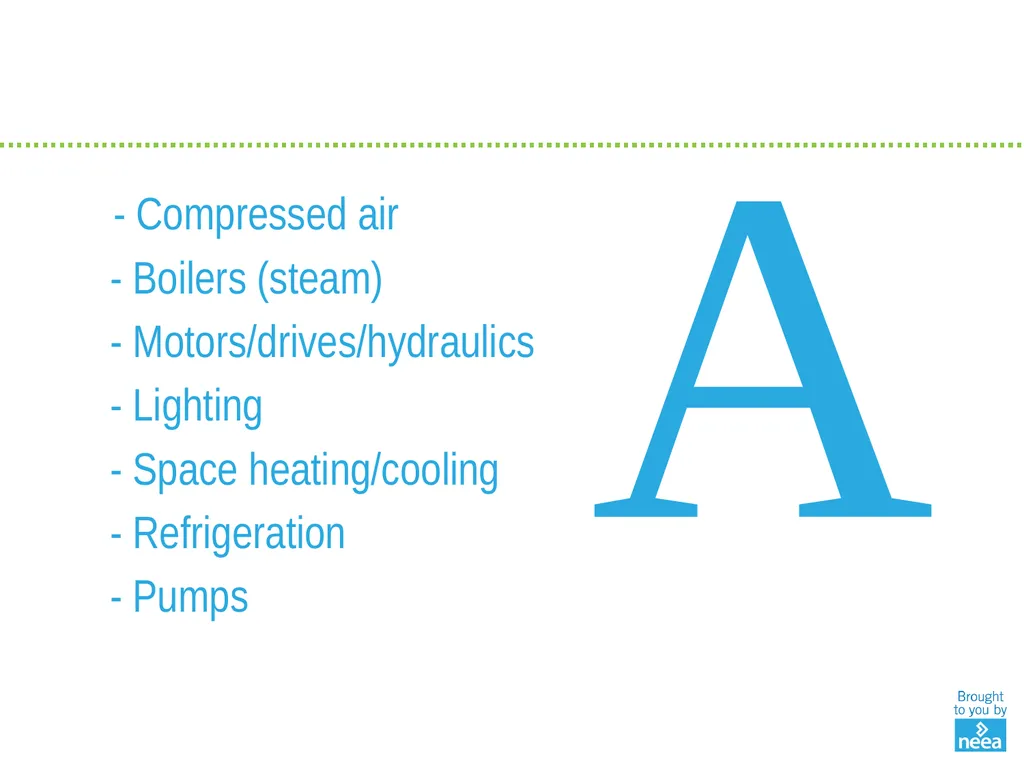
A - Compressed air
- Boilers (steam)
- Motors/drives/hydraulics
- Lighting
- Space heating/cooling
- Refrigeration
- Pumps<br>
11
Q What is the most significant cost of owning a motor?<br>
12
A Electricity. Though it has no up-front cost, electricity can account for as much as 98% of a motor’s eight-year cost.<br>
13
Q What are the four utilities used in this facility?<br>
14
A Electricity, gas, water and compressed air.<br>
15
Q What percentage of total compressed air produced is leaked air?<br>
16
A Up to 50%.<br>
17
Q What do you think our facility’s total annual energy costs will be this year?<br>
18
A [Fill in your estimated costs here]<br>
19
Energy Efficiency: Use Less and Get More If we save [xx]% of our total annual energy costs next year, we could increase our profitability by $[xx] The money we save as a result of energy efficiency can be reinvested in:
Technology improvements in our facility
Marketing and sales activities for our products
Production line efficiencies, which ultimately helps you do your job better<br>
20
Our Energy Reduction Goal [Fill in your reduction goal here]<br>
21
A Key Tool in Our Toolbox Production
Quality
Safety
Energy [Insert facility photo here]<br>
22
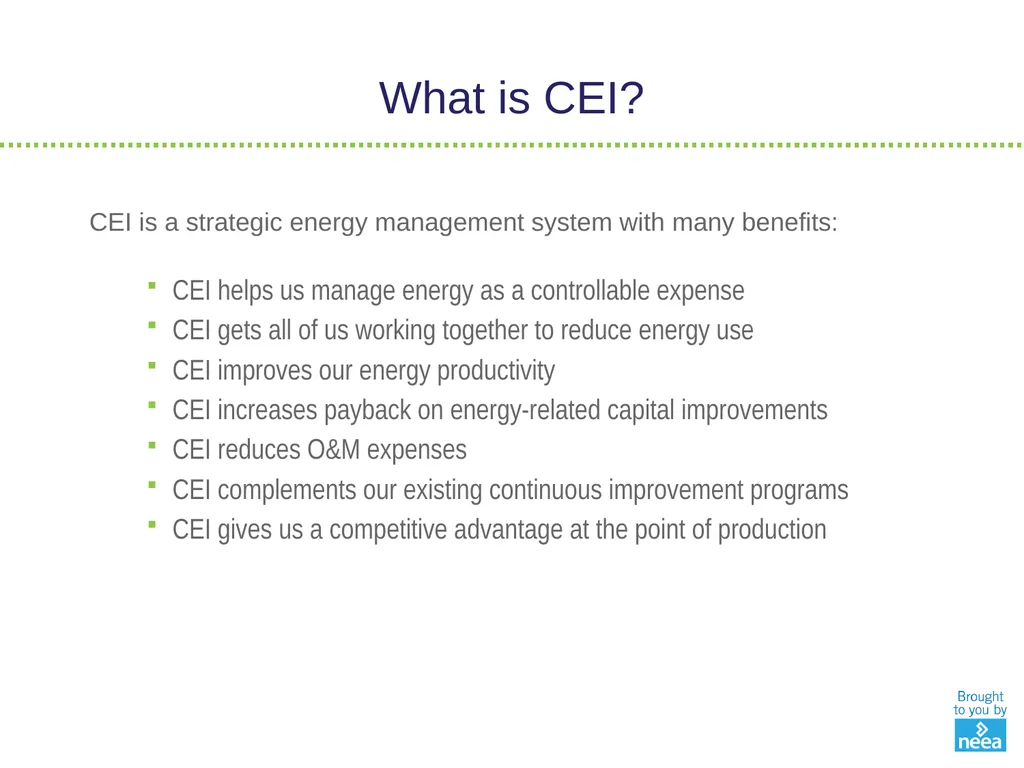
What is CEI? CEI is a strategic energy management system with many benefits:
CEI helps us manage energy as a controllable expense
CEI gets all of us working together to reduce energy use
CEI improves our energy productivity
CEI increases payback on energy-related capital improvements
CEI reduces O&M expenses
CEI complements our existing continuous improvement programs
CEI gives us a competitive advantage at the point of production<br>
23
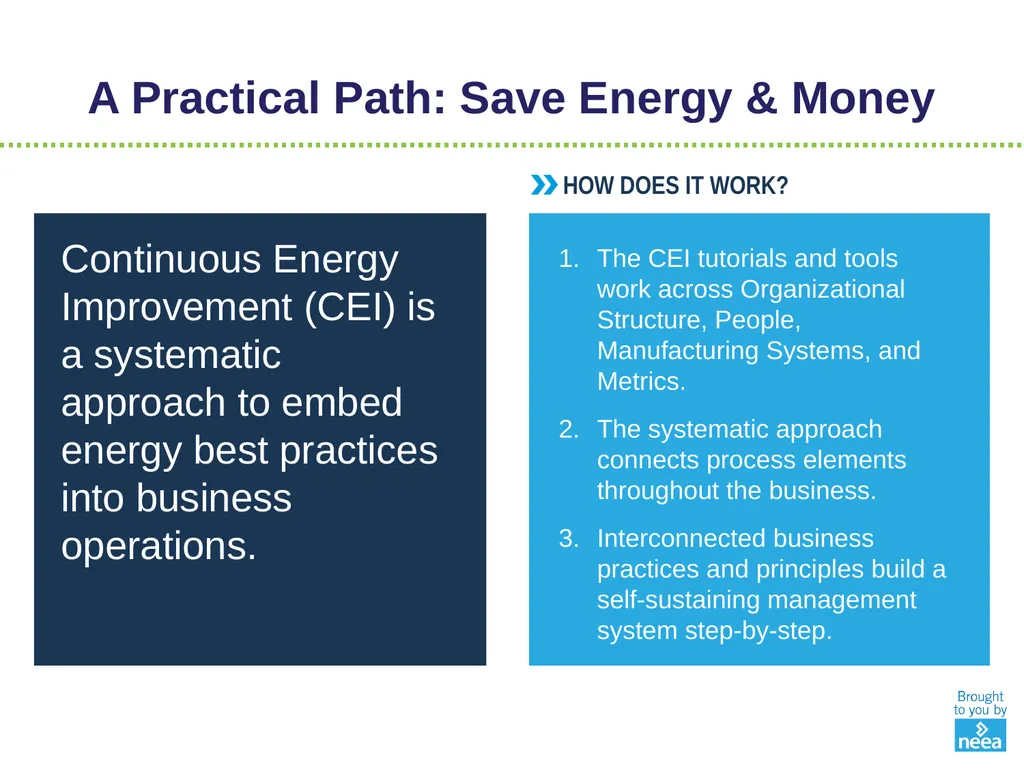
A Practical Path: Save Energy & Money Continuous Energy Improvement (CEI) is a systematic approach to embed energy best practices into business operations. HOW DOES IT WORK? The CEI tutorials and tools work across Organizational Structure, People, Manufacturing Systems, and Metrics.
The systematic approach connects process elements throughout the business.
Interconnected business practices and principles build a self-sustaining management system step-by-step.<br>
24
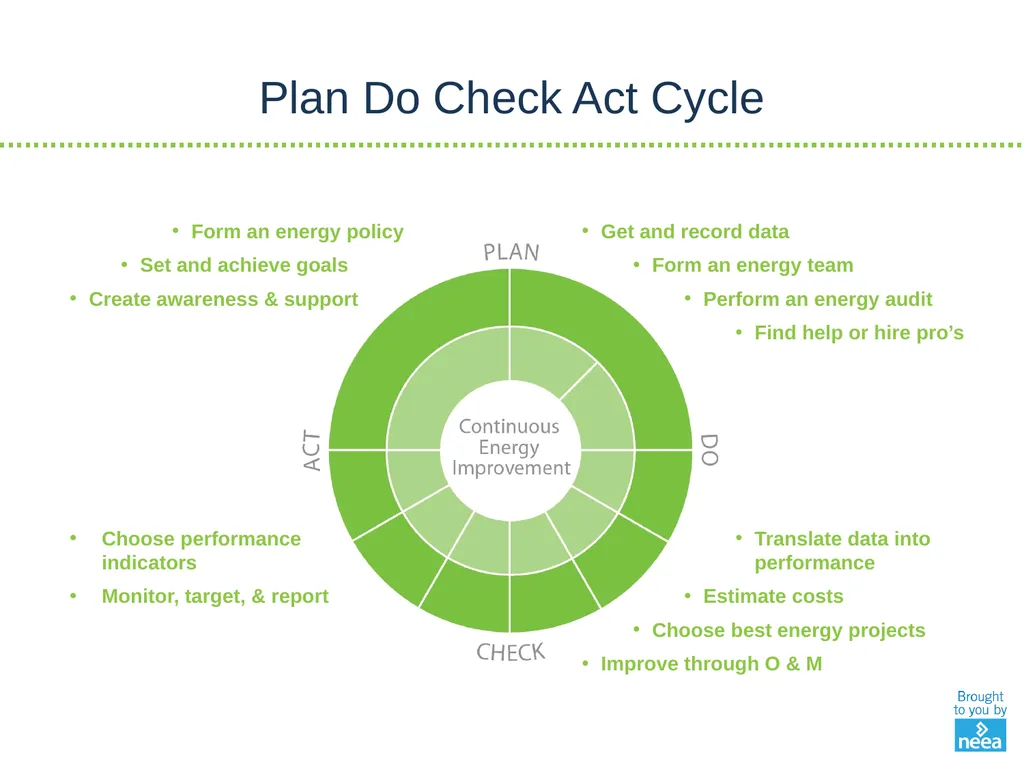
Plan Do Check Act Cycle Choose performance indicators
Monitor, target, & report Form an energy policy
Set and achieve goals
Create awareness & support Translate data into performance
Estimate costs
Choose best energy projects
Improve through O & M Get and record data
Form an energy team
Perform an energy audit
Find help or hire pro’s<br>
25
Getting to our Goal Support from leadership
A written energy policy that includes:
[Add details here]
Endorsed cross-functional energy team
[Add details here]<br>
26
Awareness and training
[Add details here]
Maintanence and operations
[Add details here] Getting to our Goal<br>
27
Review of facility performance
and opportunities
[Add details here] Getting to our Goal<br>
28
Reporting, feedback, control systems
[Add details here] Getting to our Goal<br>
29
Getting & Staying Energy Smart Led by our energy champion
Supported by our energy team
Involves energy assessments, employee feedback, and training
Supported by our local utility [energy champion photo goes here] [utility logo goes here] [energy team photo goes here]<br>
30
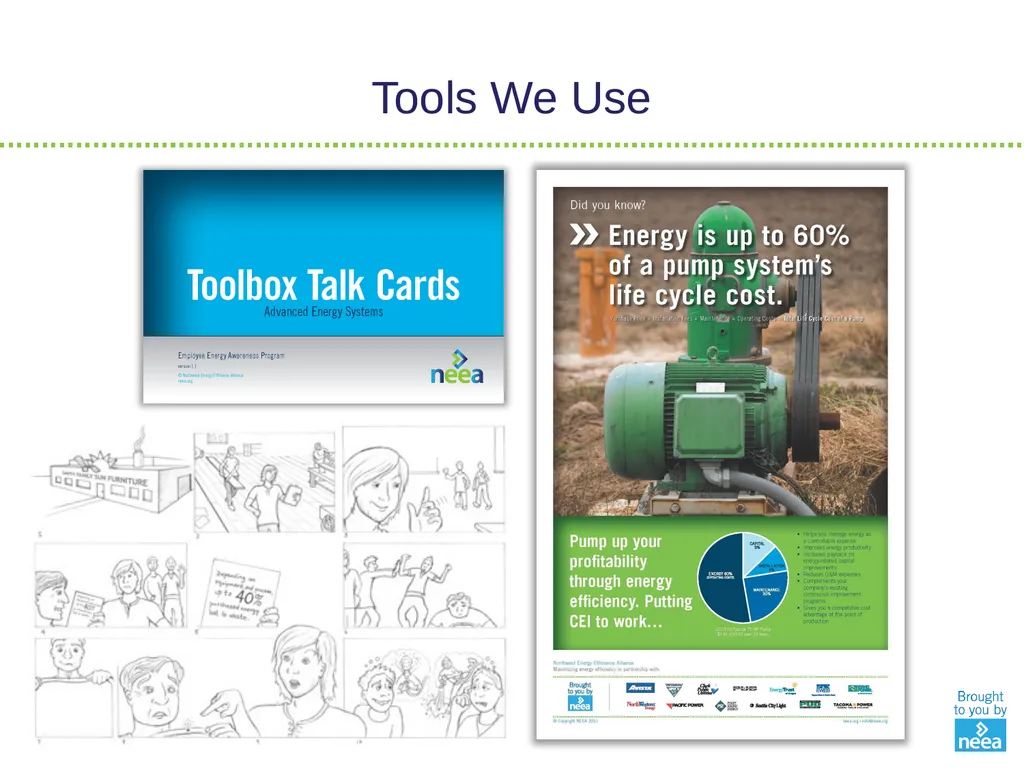
Tools We Use<br>
31
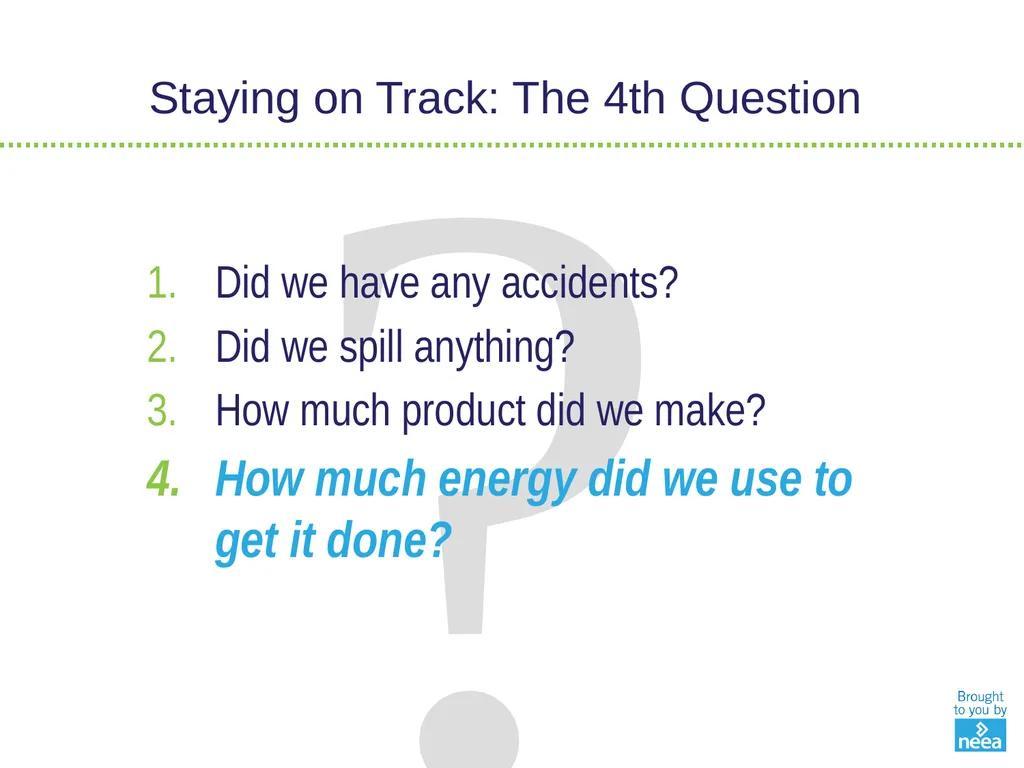
? Staying on Track: The 4th Question Did we have any accidents?
Did we spill anything?
How much product did we make?
How much energy did we use to get it done?<br>
32
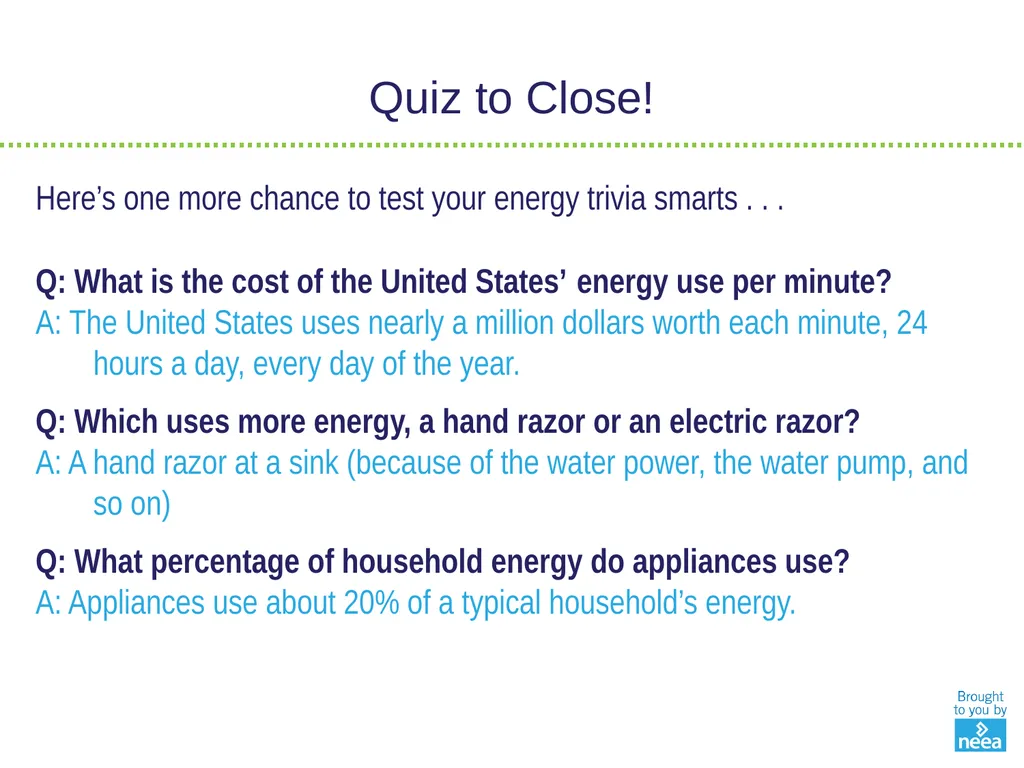
Quiz to Close! Here’s one more chance to test your energy trivia smarts . . .
Q: What is the cost of the United States’ energy use per minute?
A: The United States uses nearly a million dollars worth each minute, 24 hours a day, every day of the year.
Q: Which uses more energy, a hand razor or an electric razor?
A: A hand razor at a sink (because of the water power, the water pump, and so on)
Q: What percentage of household energy do appliances use?
A: Appliances use about 20% of a typical household’s energy.<br>