
Note: This hidden slide will not show in a slide
SN
Published · 46 slides · 0 views
1 / 1




Description
Note: This hidden slide will not show in a slide presentation. Remove before providing slide deck to sites. Tool Summary Sheet v2.0 - 2013-03-26 ICH E6 Good Clinical Practice Guidance and 45 CFR 46: Protection of Human Subjects Investigator
Related Topics
Share
Embed code
Download this presentation From Below
"Note: This hidden slide will not show in a slide" is the property of its rightful owner. Permission is granted to download and print the materials on this website for personal, non-commercial use only, and to display it on your personal computer provided you do not modify the materials and that you retain all copyright notices contained in the materials. By downloading content from our website, you accept the terms of this agreement.
Presentation Transcript
01
Note: This hidden slide will not show in a slide presentation. Remove before providing slide deck to sites. Tool Summary Sheet<br>
02
v2.0 - 2013-03-26 ICH E6 Good Clinical Practice Guidance and
45 CFR 46: Protection of Human Subjects Investigator Responsibilities
and Good Clinical Practice (GCP)<br>
03
Note that this is a general slide presentation designed for a broad audience of clinical researchers.
Accordingly, some sections may not apply to your protocol.
Information that may not be applicable for all studies is indicated via blue italics. Disclaimer 3<br>
Accordingly, some sections may not apply to your protocol.
Information that may not be applicable for all studies is indicated via blue italics. Disclaimer 3<br>
04
4 Examples include references to:
Investigational Product (IP), the Investigator’s Brochure (IB), or a study pharmacist
Safety reporting and adverse events
Randomization and unblinding procedures
Regulatory authorities
Clinical treatment (for a behavioral or study or a registry)
Information that may be helpful but does not come directly from ICH or 45 CFR 46 is identified by this icon. Disclaimer (continued)<br>
Investigational Product (IP), the Investigator’s Brochure (IB), or a study pharmacist
Safety reporting and adverse events
Randomization and unblinding procedures
Regulatory authorities
Clinical treatment (for a behavioral or study or a registry)
Information that may be helpful but does not come directly from ICH or 45 CFR 46 is identified by this icon. Disclaimer (continued)<br>
05
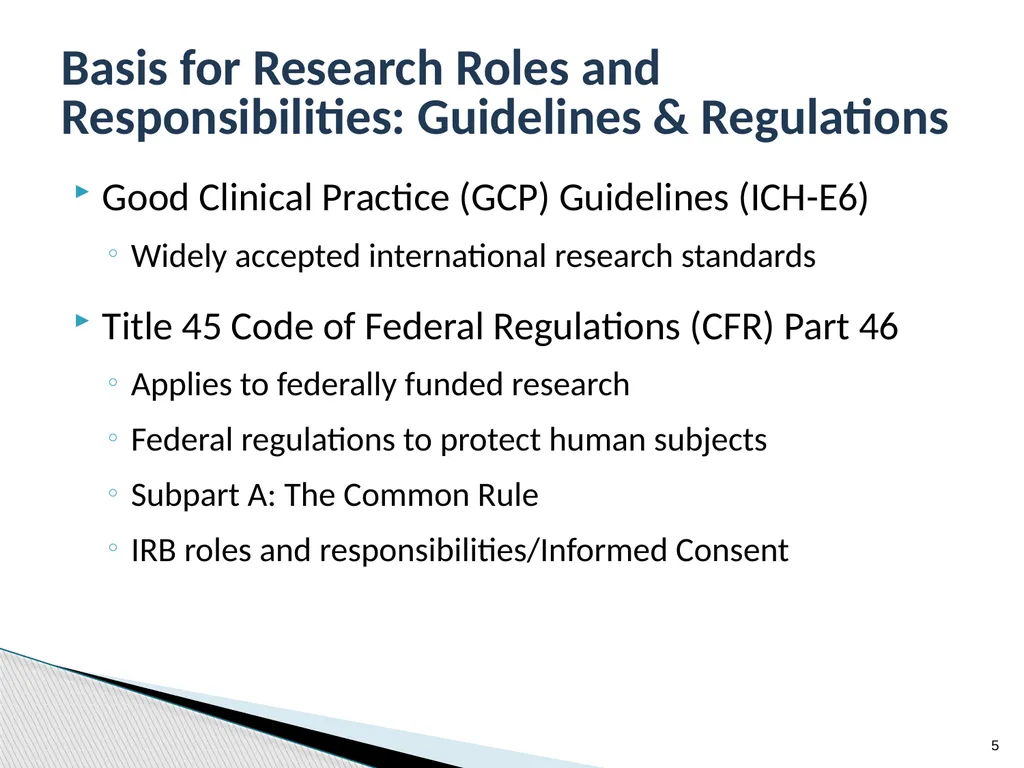
Good Clinical Practice (GCP) Guidelines (ICH-E6)
Widely accepted international research standards
Title 45 Code of Federal Regulations (CFR) Part 46
Applies to federally funded research
Federal regulations to protect human subjects
Subpart A: The Common Rule
IRB roles and responsibilities/Informed Consent Basis for Research Roles and Responsibilities: Guidelines & Regulations 5<br>
Widely accepted international research standards
Title 45 Code of Federal Regulations (CFR) Part 46
Applies to federally funded research
Federal regulations to protect human subjects
Subpart A: The Common Rule
IRB roles and responsibilities/Informed Consent Basis for Research Roles and Responsibilities: Guidelines & Regulations 5<br>
06
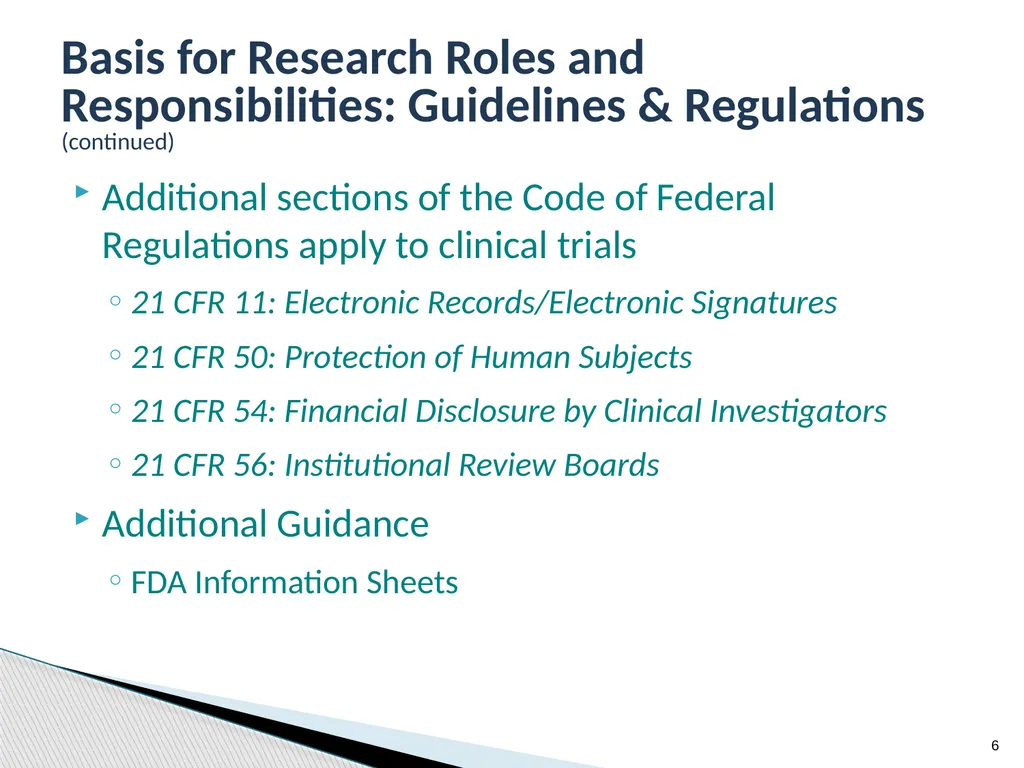
Additional sections of the Code of Federal Regulations apply to clinical trials
21 CFR 11: Electronic Records/Electronic Signatures
21 CFR 50: Protection of Human Subjects
21 CFR 54: Financial Disclosure by Clinical Investigators
21 CFR 56: Institutional Review Boards
Additional Guidance
FDA Information Sheets Basis for Research Roles and Responsibilities: Guidelines & Regulations (continued) 6<br>
21 CFR 11: Electronic Records/Electronic Signatures
21 CFR 50: Protection of Human Subjects
21 CFR 54: Financial Disclosure by Clinical Investigators
21 CFR 56: Institutional Review Boards
Additional Guidance
FDA Information Sheets Basis for Research Roles and Responsibilities: Guidelines & Regulations (continued) 6<br>
07
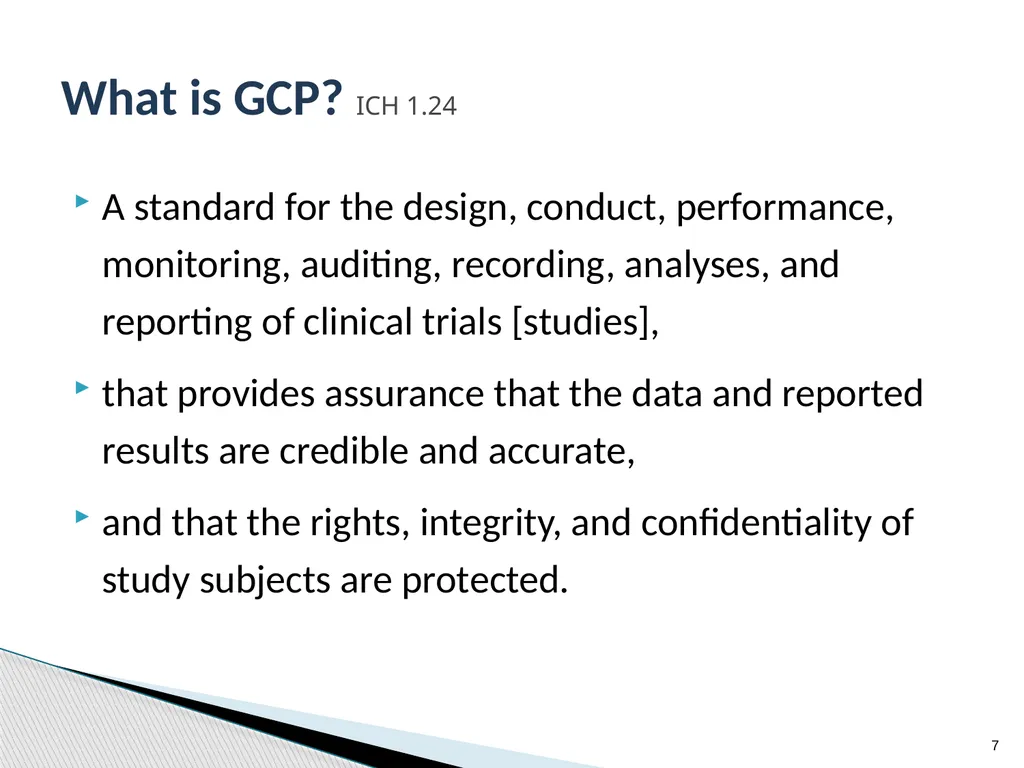
A standard for the design, conduct, performance, monitoring, auditing, recording, analyses, and reporting of clinical trials [studies],
that provides assurance that the data and reported results are credible and accurate,
and that the rights, integrity, and confidentiality of study subjects are protected. What is GCP? ICH 1.24 7<br>
that provides assurance that the data and reported results are credible and accurate,
and that the rights, integrity, and confidentiality of study subjects are protected. What is GCP? ICH 1.24 7<br>
08
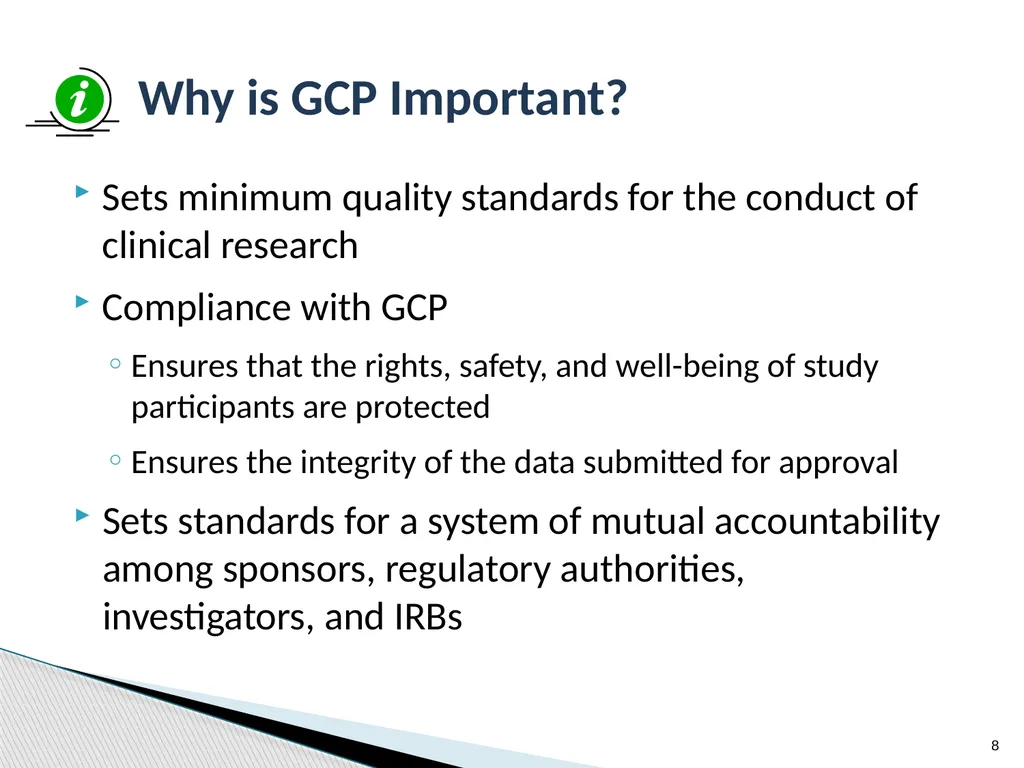
8 Sets minimum quality standards for the conduct of clinical research
Compliance with GCP
Ensures that the rights, safety, and well-being of study participants are protected
Ensures the integrity of the data submitted for approval
Sets standards for a system of mutual accountability among sponsors, regulatory authorities, investigators, and IRBs Why is GCP Important?<br>
Compliance with GCP
Ensures that the rights, safety, and well-being of study participants are protected
Ensures the integrity of the data submitted for approval
Sets standards for a system of mutual accountability among sponsors, regulatory authorities, investigators, and IRBs Why is GCP Important?<br>
09
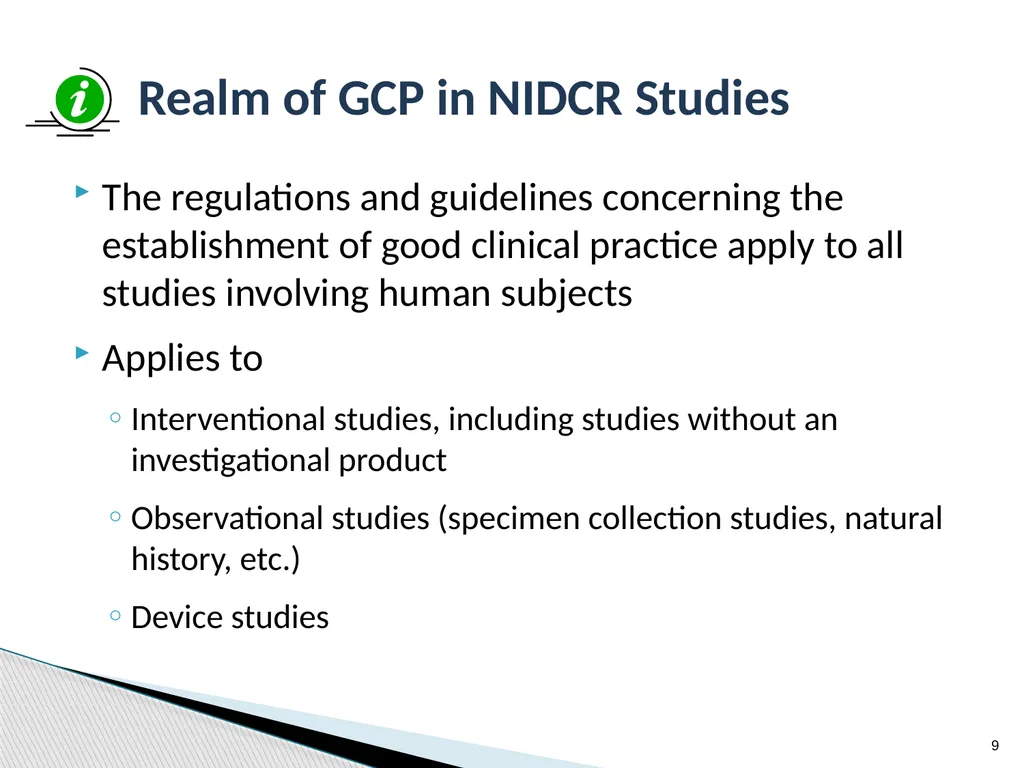
9 The regulations and guidelines concerning the establishment of good clinical practice apply to all studies involving human subjects
Applies to
Interventional studies, including studies without an investigational product
Observational studies (specimen collection studies, natural history, etc.)
Device studies Realm of GCP in NIDCR Studies<br>
Applies to
Interventional studies, including studies without an investigational product
Observational studies (specimen collection studies, natural history, etc.)
Device studies Realm of GCP in NIDCR Studies<br>
10
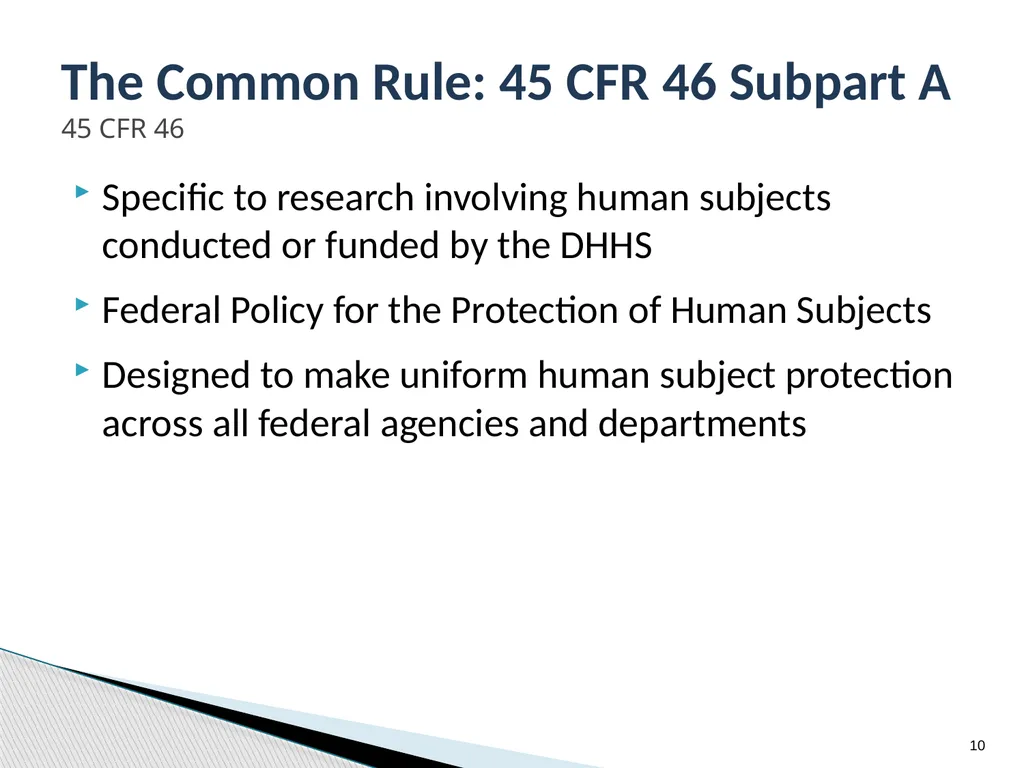
10 Specific to research involving human subjects conducted or funded by the DHHS
Federal Policy for the Protection of Human Subjects
Designed to make uniform human subject protection across all federal agencies and departments The Common Rule: 45 CFR 46 Subpart A 45 CFR 46<br>
Federal Policy for the Protection of Human Subjects
Designed to make uniform human subject protection across all federal agencies and departments The Common Rule: 45 CFR 46 Subpart A 45 CFR 46<br>
11
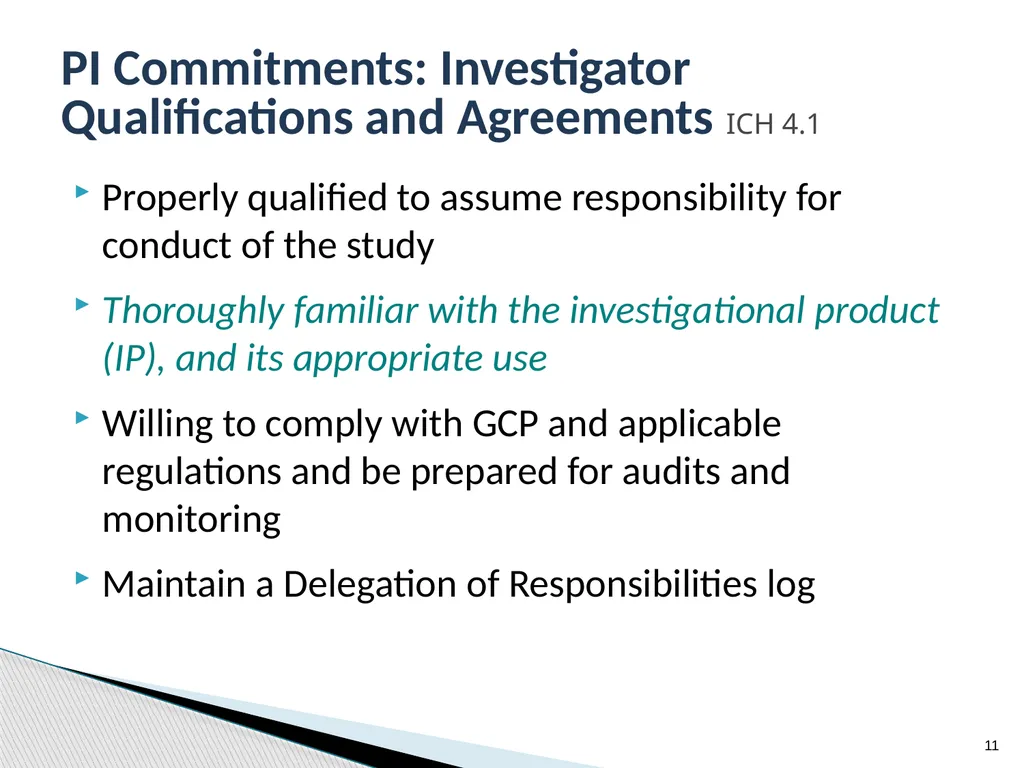
Properly qualified to assume responsibility for conduct of the study
Thoroughly familiar with the investigational product (IP), and its appropriate use
Willing to comply with GCP and applicable regulations and be prepared for audits and monitoring
Maintain a Delegation of Responsibilities log PI Commitments: Investigator Qualifications and Agreements ICH 4.1 11<br>
Thoroughly familiar with the investigational product (IP), and its appropriate use
Willing to comply with GCP and applicable regulations and be prepared for audits and monitoring
Maintain a Delegation of Responsibilities log PI Commitments: Investigator Qualifications and Agreements ICH 4.1 11<br>
12
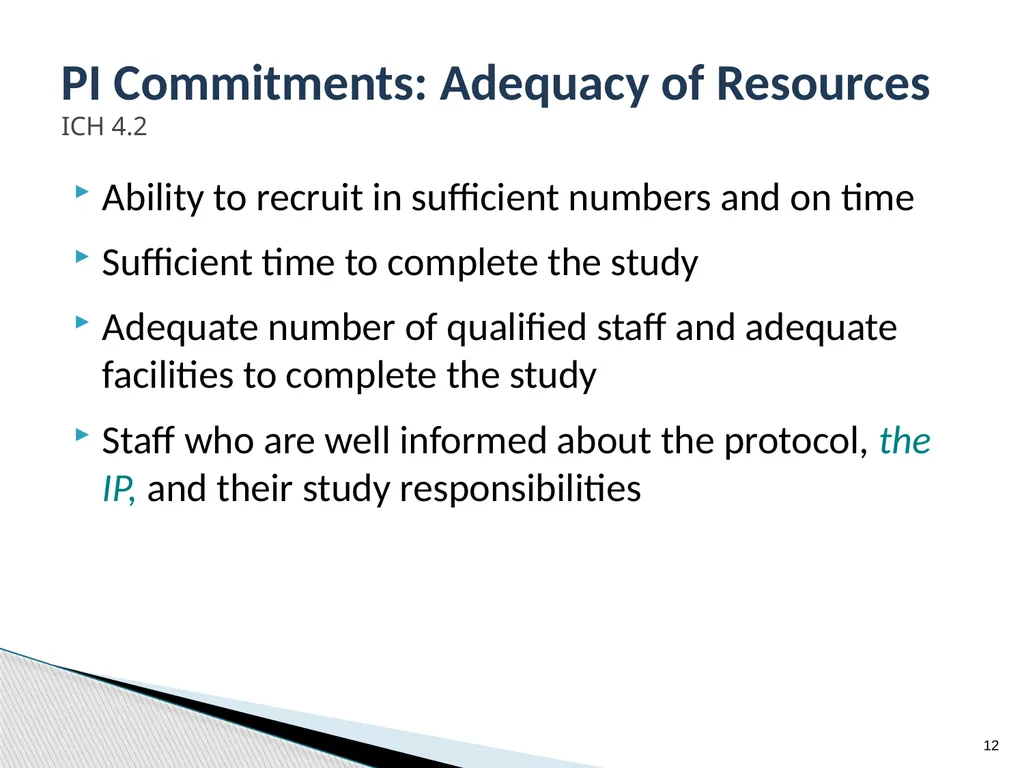
Ability to recruit in sufficient numbers and on time
Sufficient time to complete the study
Adequate number of qualified staff and adequate facilities to complete the study
Staff who are well informed about the protocol, the IP, and their study responsibilities PI Commitments: Adequacy of Resources ICH 4.2 12<br>
Sufficient time to complete the study
Adequate number of qualified staff and adequate facilities to complete the study
Staff who are well informed about the protocol, the IP, and their study responsibilities PI Commitments: Adequacy of Resources ICH 4.2 12<br>
13
Ensure that all trial-related medical decisions are made by an investigator who is a qualified physician
Provide adequate medical care for participants who experience adverse events
Notify the participant’s primary physician of his/her participation (as appropriate)
Make an effort to learn why participants withdraw PI Commitments: Medical Care of Trial Participants ICH 4.3 13<br>
Provide adequate medical care for participants who experience adverse events
Notify the participant’s primary physician of his/her participation (as appropriate)
Make an effort to learn why participants withdraw PI Commitments: Medical Care of Trial Participants ICH 4.3 13<br>
14
Obtain written approval before the study begins
Provide the IRB with the current Investigator’s Brochure
Provide the IRB/IEC with all documents subject to its review throughout the trial PI Commitments: Communication with the IRB/IEC ICH 4.4 14<br>
Provide the IRB with the current Investigator’s Brochure
Provide the IRB/IEC with all documents subject to its review throughout the trial PI Commitments: Communication with the IRB/IEC ICH 4.4 14<br>
15
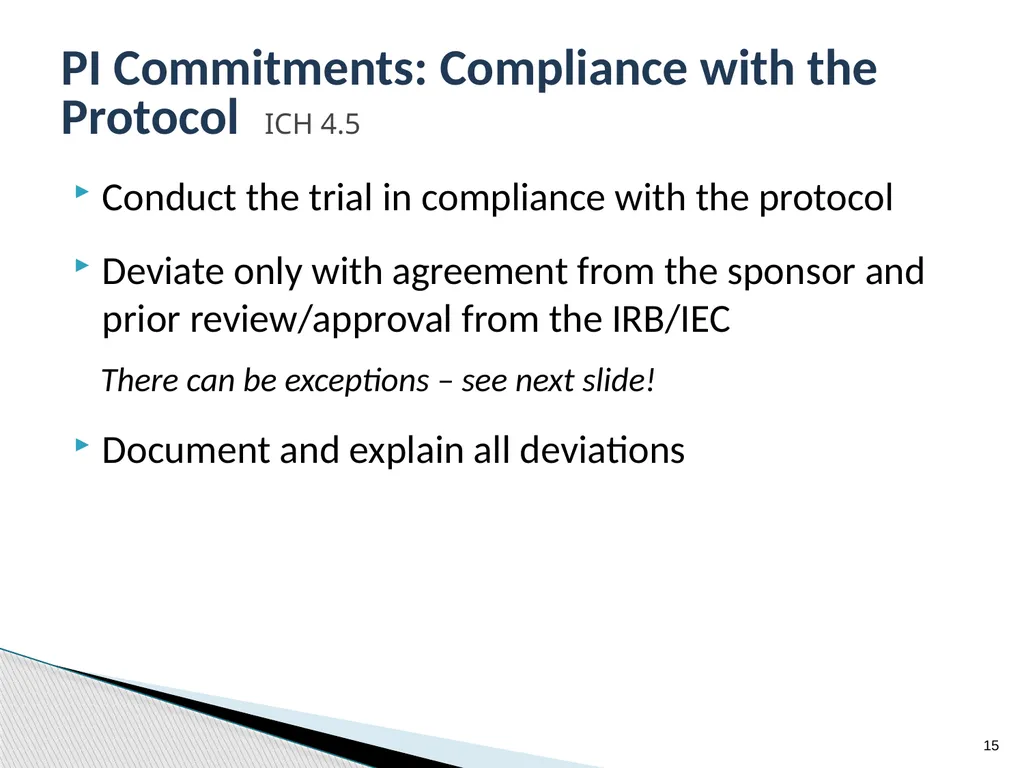
Conduct the trial in compliance with the protocol
Deviate only with agreement from the sponsor and prior review/approval from the IRB/IEC
There can be exceptions – see next slide!
Document and explain all deviations PI Commitments: Compliance with the Protocol ICH 4.5 15<br>
Deviate only with agreement from the sponsor and prior review/approval from the IRB/IEC
There can be exceptions – see next slide!
Document and explain all deviations PI Commitments: Compliance with the Protocol ICH 4.5 15<br>
16
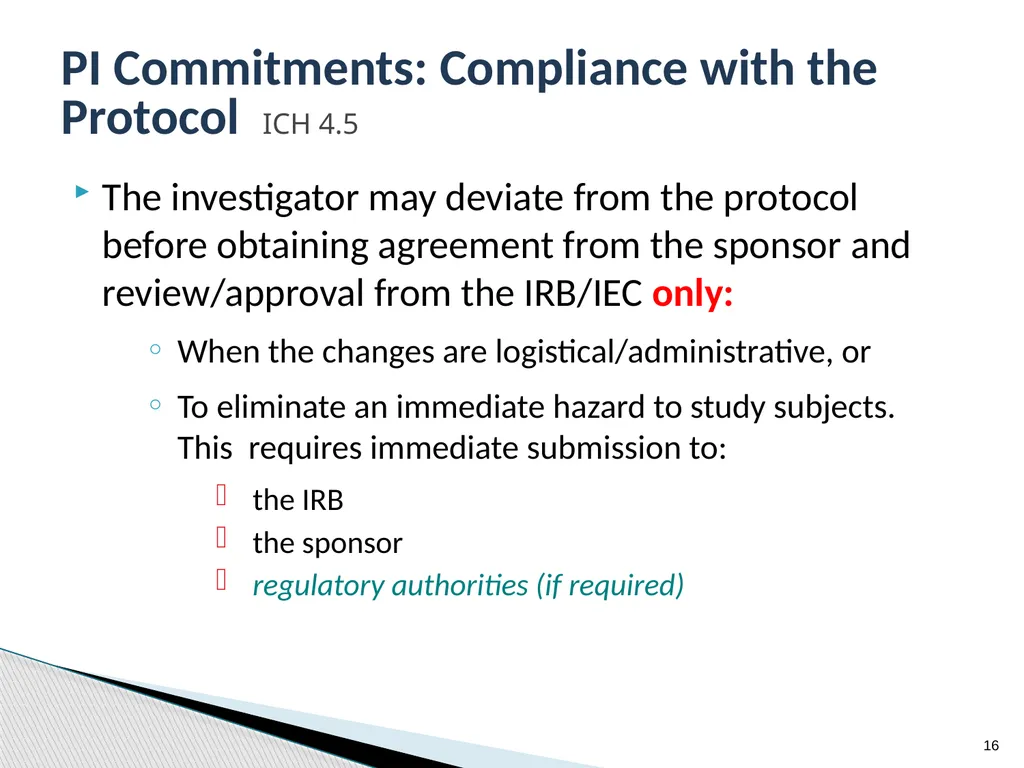
The investigator may deviate from the protocol before obtaining agreement from the sponsor and review/approval from the IRB/IEC only:
When the changes are logistical/administrative, or
To eliminate an immediate hazard to study subjects. This requires immediate submission to:
the IRB
the sponsor
regulatory authorities (if required) PI Commitments: Compliance with the Protocol ICH 4.5 16<br>
When the changes are logistical/administrative, or
To eliminate an immediate hazard to study subjects. This requires immediate submission to:
the IRB
the sponsor
regulatory authorities (if required) PI Commitments: Compliance with the Protocol ICH 4.5 16<br>
17
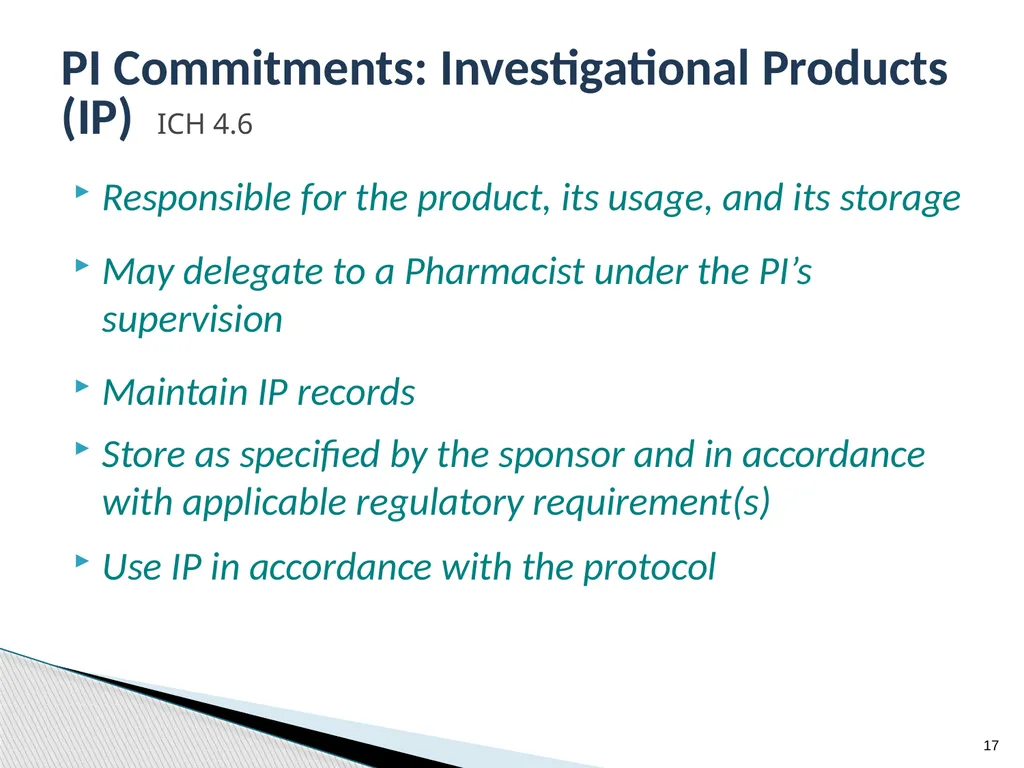
Responsible for the product, its usage, and its storage
May delegate to a Pharmacist under the PI’s supervision
Maintain IP records
Store as specified by the sponsor and in accordance with applicable regulatory requirement(s)
Use IP in accordance with the protocol PI Commitments: Investigational Products (IP) ICH 4.6 17<br>
May delegate to a Pharmacist under the PI’s supervision
Maintain IP records
Store as specified by the sponsor and in accordance with applicable regulatory requirement(s)
Use IP in accordance with the protocol PI Commitments: Investigational Products (IP) ICH 4.6 17<br>
18
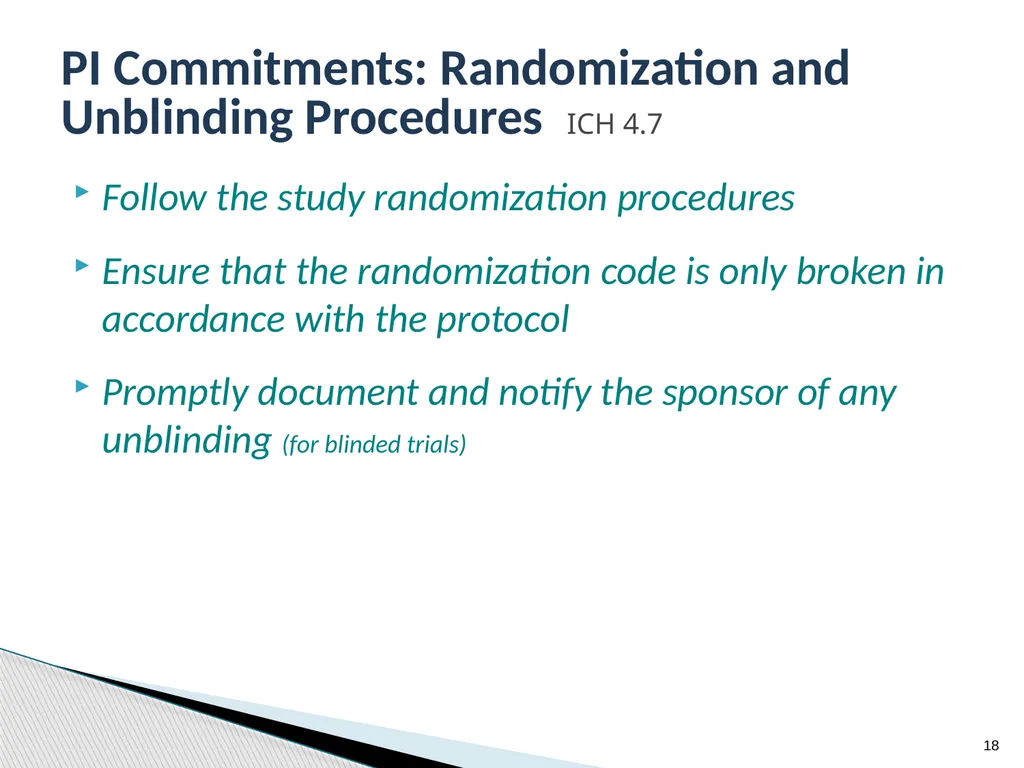
Follow the study randomization procedures
Ensure that the randomization code is only broken in accordance with the protocol
Promptly document and notify the sponsor of any unblinding (for blinded trials) PI Commitments: Randomization and Unblinding Procedures ICH 4.7 18<br>
Ensure that the randomization code is only broken in accordance with the protocol
Promptly document and notify the sponsor of any unblinding (for blinded trials) PI Commitments: Randomization and Unblinding Procedures ICH 4.7 18<br>
19
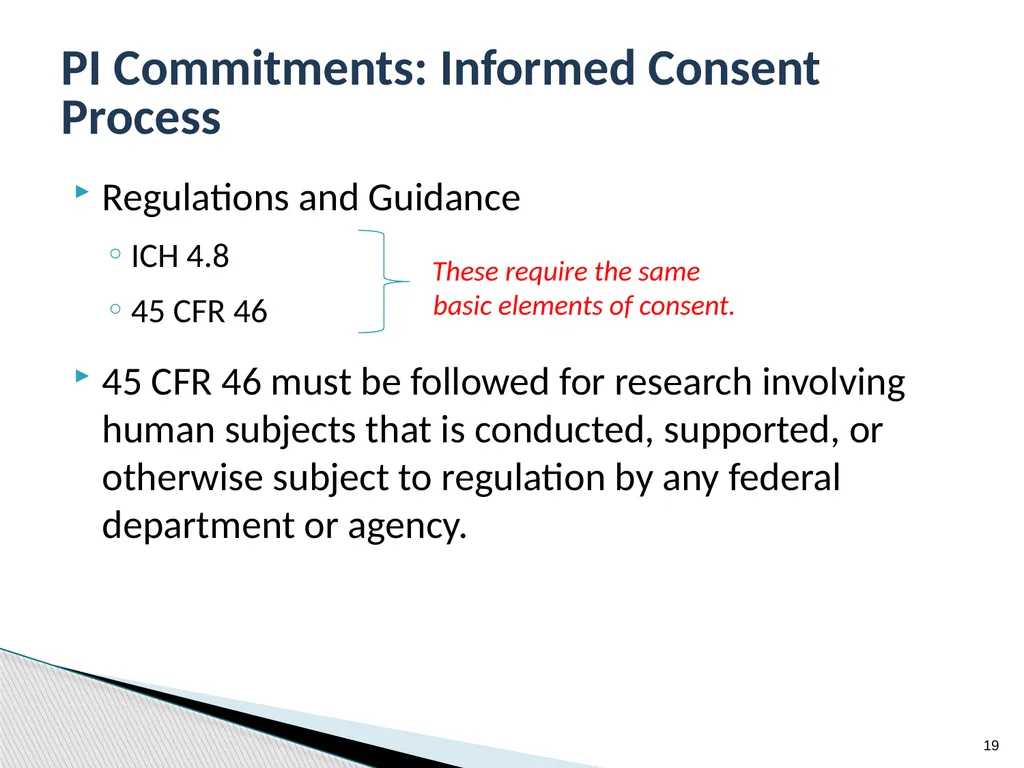
19 These require the same basic elements of consent. Regulations and Guidance
ICH 4.8
45 CFR 46
45 CFR 46 must be followed for research involving human subjects that is conducted, supported, or otherwise subject to regulation by any federal department or agency. PI Commitments: Informed Consent Process<br>
ICH 4.8
45 CFR 46
45 CFR 46 must be followed for research involving human subjects that is conducted, supported, or otherwise subject to regulation by any federal department or agency. PI Commitments: Informed Consent Process<br>
20
Adhere to GCP and the ethical principles that have their origin in the Declaration of Helsinki
Update consent document when new information becomes available
Avoid:
Coercion or undue influence
Language that causes the participant to waive any legal rights PI Commitments: Informed Consent ICH 4.8 20<br>
Update consent document when new information becomes available
Avoid:
Coercion or undue influence
Language that causes the participant to waive any legal rights PI Commitments: Informed Consent ICH 4.8 20<br>
21
21 Fully inform participant of all pertinent aspects of the trial
Use lay and non-technical language
Should be understandable to the subject
8th grade reading level
Translated to native language as applicable (IRB must approve translations)
Provide enough time for participant to review the consent document and ask questions PI Commitments: Informed Consent ICH 4.8<br>
Use lay and non-technical language
Should be understandable to the subject
8th grade reading level
Translated to native language as applicable (IRB must approve translations)
Provide enough time for participant to review the consent document and ask questions PI Commitments: Informed Consent ICH 4.8<br>
22
22 The consent document must be signed and dated
Obtain consent prior to start of any study-related activities. Initial phone screening can precede consenting.
If a participant or representative is unable to read, a witness should be present during the consenting process
Provide the participant with a copy of the signed and dated consent form PI Commitments: Informed Consent ICH 4.8<br>
Obtain consent prior to start of any study-related activities. Initial phone screening can precede consenting.
If a participant or representative is unable to read, a witness should be present during the consenting process
Provide the participant with a copy of the signed and dated consent form PI Commitments: Informed Consent ICH 4.8<br>
23
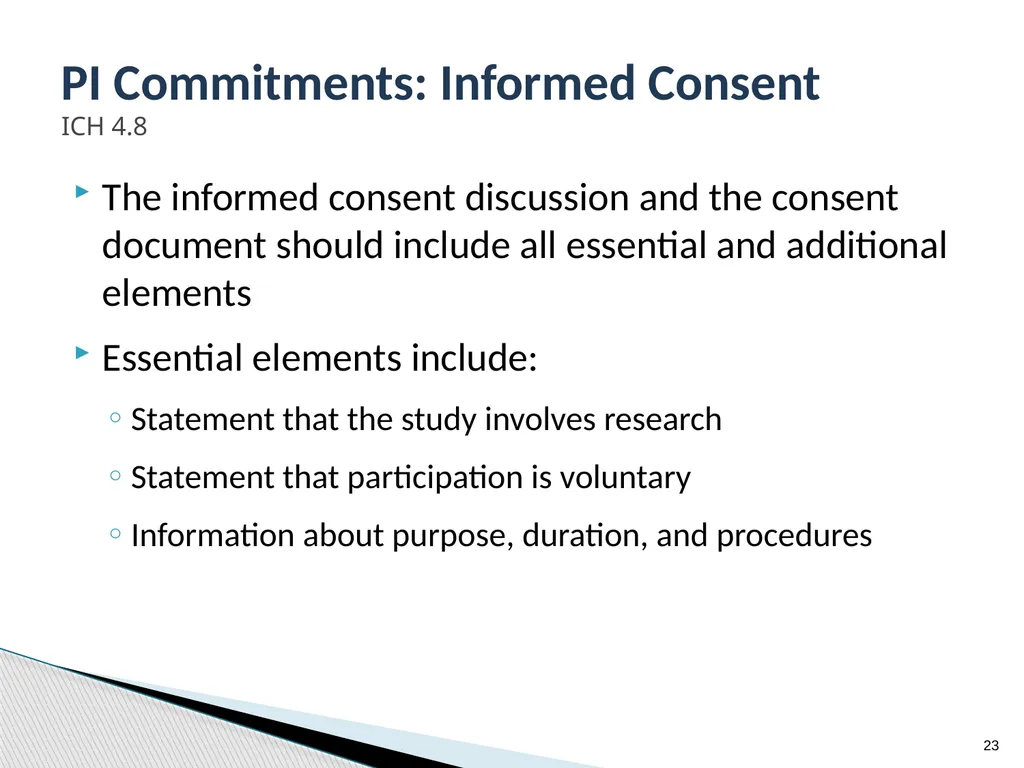
The informed consent discussion and the consent document should include all essential and additional elements
Essential elements include:
Statement that the study involves research
Statement that participation is voluntary
Information about purpose, duration, and procedures PI Commitments: Informed Consent ICH 4.8 23<br>
Essential elements include:
Statement that the study involves research
Statement that participation is voluntary
Information about purpose, duration, and procedures PI Commitments: Informed Consent ICH 4.8 23<br>
24
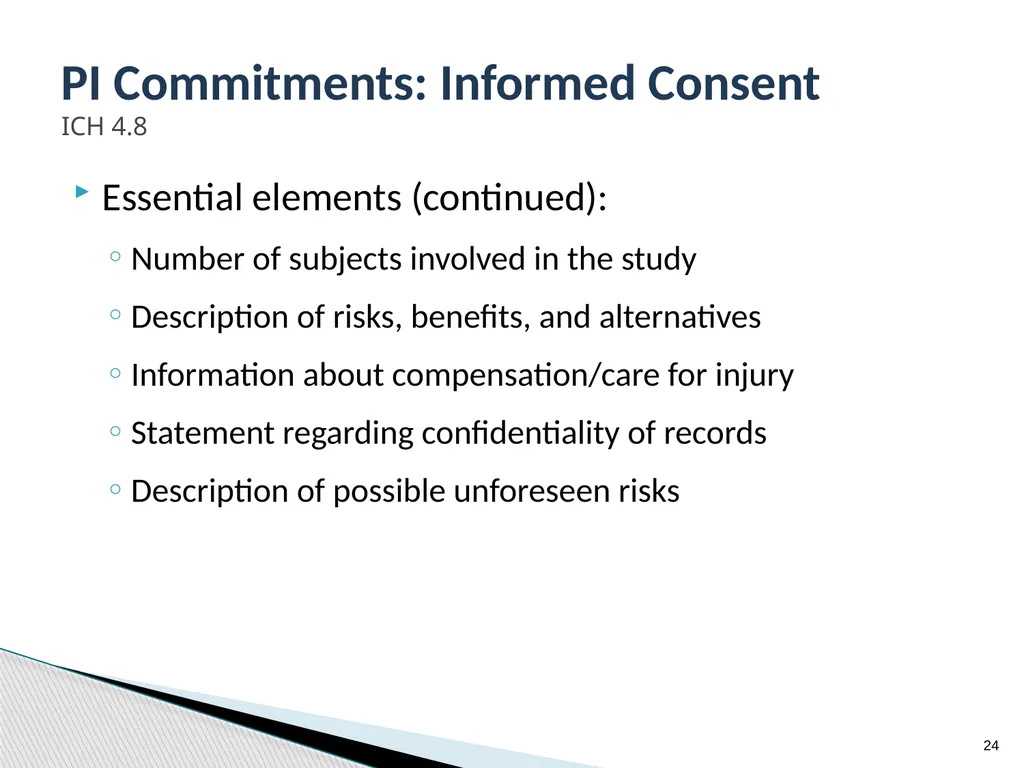
Essential elements (continued):
Number of subjects involved in the study
Description of risks, benefits, and alternatives
Information about compensation/care for injury
Statement regarding confidentiality of records
Description of possible unforeseen risks PI Commitments: Informed Consent ICH 4.8 24<br>
Number of subjects involved in the study
Description of risks, benefits, and alternatives
Information about compensation/care for injury
Statement regarding confidentiality of records
Description of possible unforeseen risks PI Commitments: Informed Consent ICH 4.8 24<br>
25
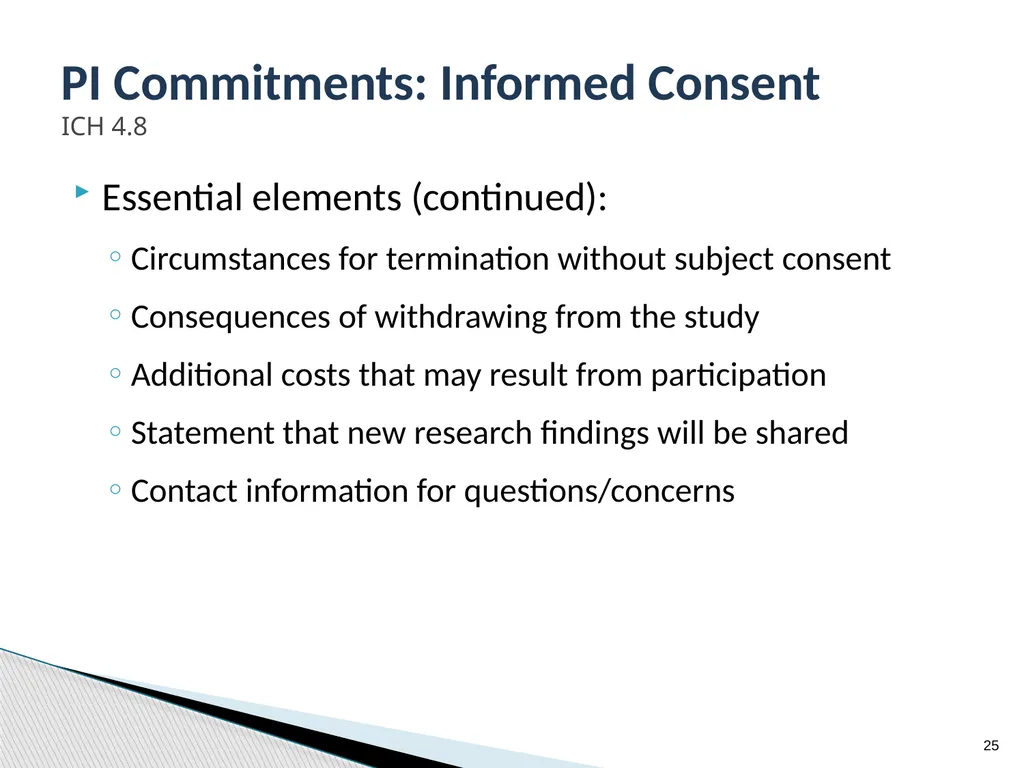
Essential elements (continued):
Circumstances for termination without subject consent
Consequences of withdrawing from the study
Additional costs that may result from participation
Statement that new research findings will be shared
Contact information for questions/concerns PI Commitments: Informed Consent ICH 4.8 25<br>
Circumstances for termination without subject consent
Consequences of withdrawing from the study
Additional costs that may result from participation
Statement that new research findings will be shared
Contact information for questions/concerns PI Commitments: Informed Consent ICH 4.8 25<br>
26
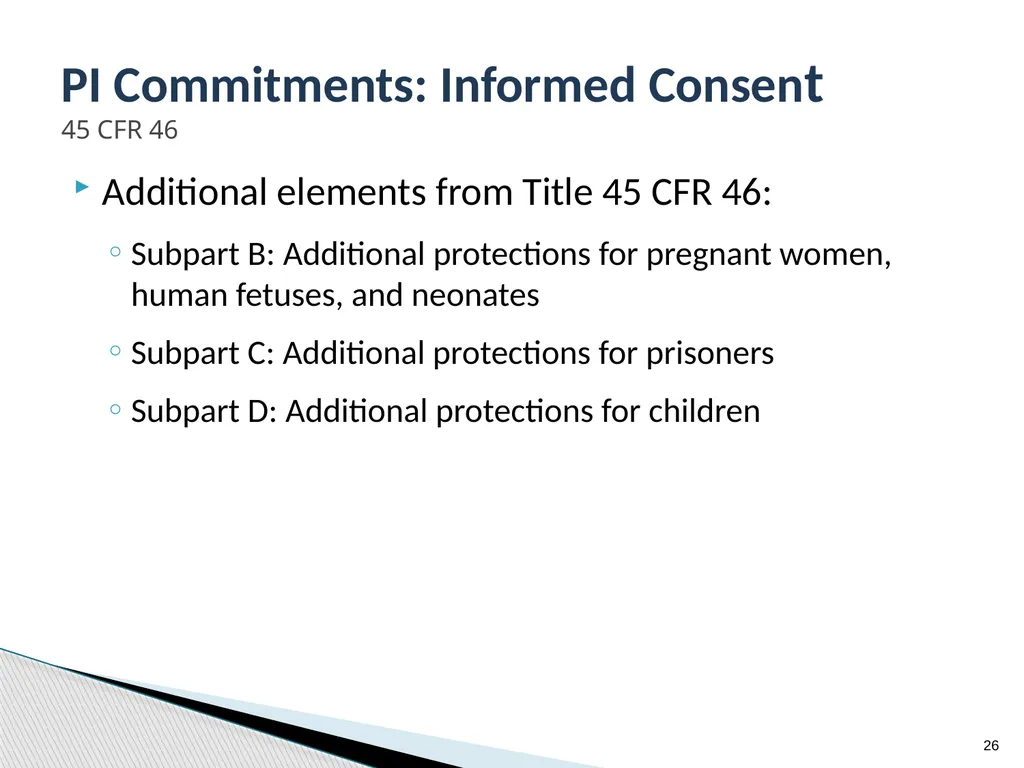
Additional elements from Title 45 CFR 46:
Subpart B: Additional protections for pregnant women, human fetuses, and neonates
Subpart C: Additional protections for prisoners
Subpart D: Additional protections for children PI Commitments: Informed Consent 45 CFR 46 26<br>
Subpart B: Additional protections for pregnant women, human fetuses, and neonates
Subpart C: Additional protections for prisoners
Subpart D: Additional protections for children PI Commitments: Informed Consent 45 CFR 46 26<br>
27
Explain the study to the extent it can be understood by participants who can only be enrolled with the consent of a legally acceptable representative (LAR)
Follow guidelines for nontherapeutic trials (trials in which there is no anticipated direct clinical benefit to the participant)
If participant and LAR can’t provide consent, follow measures described in the protocol PI Commitments: Informed Consent ICH 4.8 27<br>
Follow guidelines for nontherapeutic trials (trials in which there is no anticipated direct clinical benefit to the participant)
If participant and LAR can’t provide consent, follow measures described in the protocol PI Commitments: Informed Consent ICH 4.8 27<br>
28
ICH 4.9 (Records and Reports)
ICH 4.10 (Progress Reports) PI Commitments: Records and Reports 28<br>
ICH 4.10 (Progress Reports) PI Commitments: Records and Reports 28<br>
29
Data must be ALCOA (Accurate, Legible, Contemporaneous, Original, and Attributable) and complete
How and where the data is recorded is key!
If it is not documented, it does not exist
Data on CRFs should match the source documents (raw data) PI Commitments: Records and Reports ICH 4.9 29<br>
How and where the data is recorded is key!
If it is not documented, it does not exist
Data on CRFs should match the source documents (raw data) PI Commitments: Records and Reports ICH 4.9 29<br>
30
All changes to a CRF must be dated and signed such that the original data is not obscured
Retain essential documents for at least 2 years after the last approval of a marketing application
Provide monitors, auditors, IRB/IEC, or regulatory authorities with direct access to trial records PI Commitments: Records and Reports ICH 4.9 30<br>
Retain essential documents for at least 2 years after the last approval of a marketing application
Provide monitors, auditors, IRB/IEC, or regulatory authorities with direct access to trial records PI Commitments: Records and Reports ICH 4.9 30<br>
31
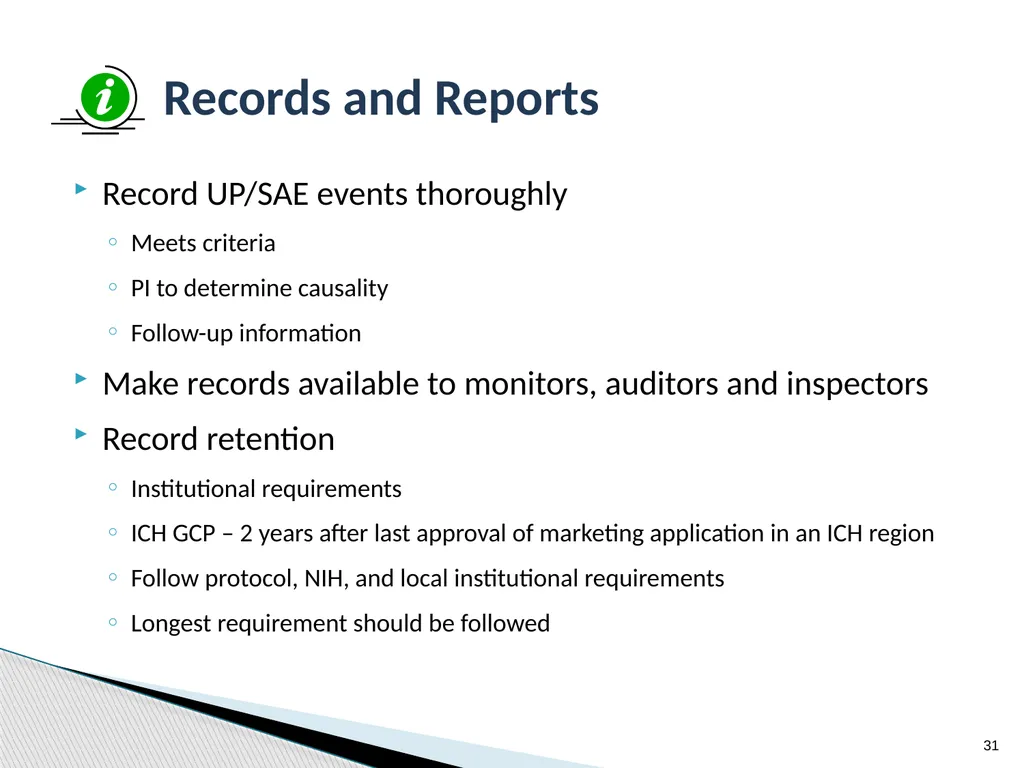
31 Record UP/SAE events thoroughly
Meets criteria
PI to determine causality
Follow-up information
Make records available to monitors, auditors and inspectors
Record retention
Institutional requirements
ICH GCP – 2 years after last approval of marketing application in an ICH region
Follow protocol, NIH, and local institutional requirements
Longest requirement should be followed Records and Reports<br>
Meets criteria
PI to determine causality
Follow-up information
Make records available to monitors, auditors and inspectors
Record retention
Institutional requirements
ICH GCP – 2 years after last approval of marketing application in an ICH region
Follow protocol, NIH, and local institutional requirements
Longest requirement should be followed Records and Reports<br>
32
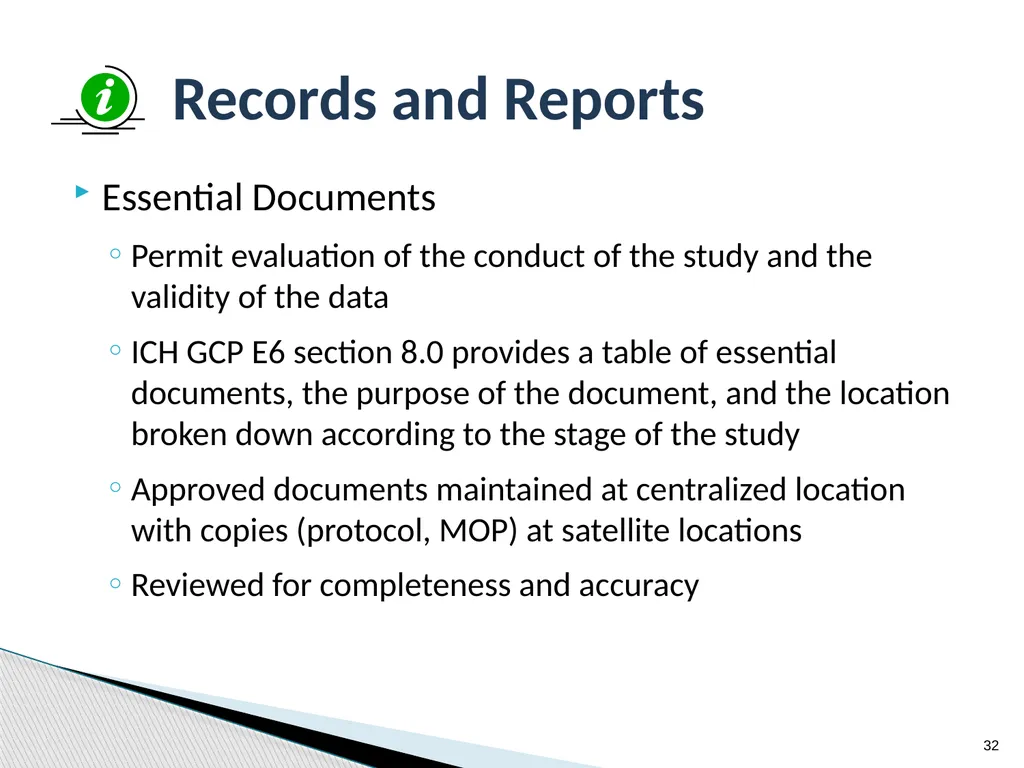
32 Essential Documents
Permit evaluation of the conduct of the study and the validity of the data
ICH GCP E6 section 8.0 provides a table of essential documents, the purpose of the document, and the location broken down according to the stage of the study
Approved documents maintained at centralized location with copies (protocol, MOP) at satellite locations
Reviewed for completeness and accuracy Records and Reports<br>
Permit evaluation of the conduct of the study and the validity of the data
ICH GCP E6 section 8.0 provides a table of essential documents, the purpose of the document, and the location broken down according to the stage of the study
Approved documents maintained at centralized location with copies (protocol, MOP) at satellite locations
Reviewed for completeness and accuracy Records and Reports<br>
33
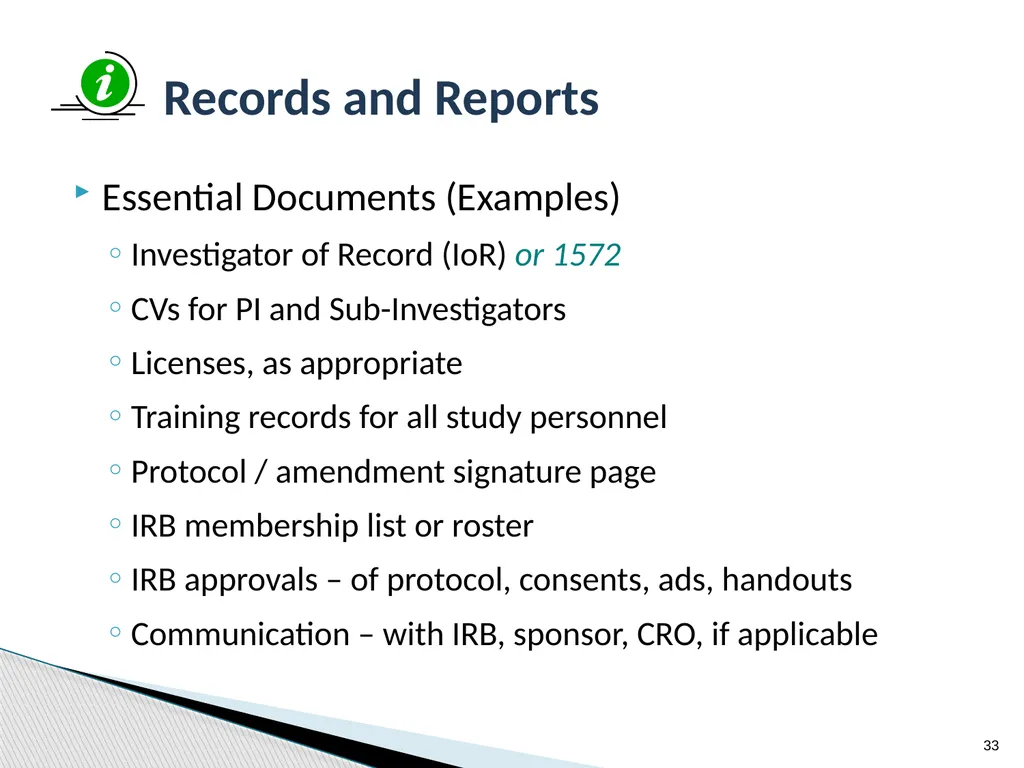
33 Essential Documents (Examples)
Investigator of Record (IoR) or 1572
CVs for PI and Sub-Investigators
Licenses, as appropriate
Training records for all study personnel
Protocol / amendment signature page
IRB membership list or roster
IRB approvals – of protocol, consents, ads, handouts
Communication – with IRB, sponsor, CRO, if applicable Records and Reports<br>
Investigator of Record (IoR) or 1572
CVs for PI and Sub-Investigators
Licenses, as appropriate
Training records for all study personnel
Protocol / amendment signature page
IRB membership list or roster
IRB approvals – of protocol, consents, ads, handouts
Communication – with IRB, sponsor, CRO, if applicable Records and Reports<br>
34
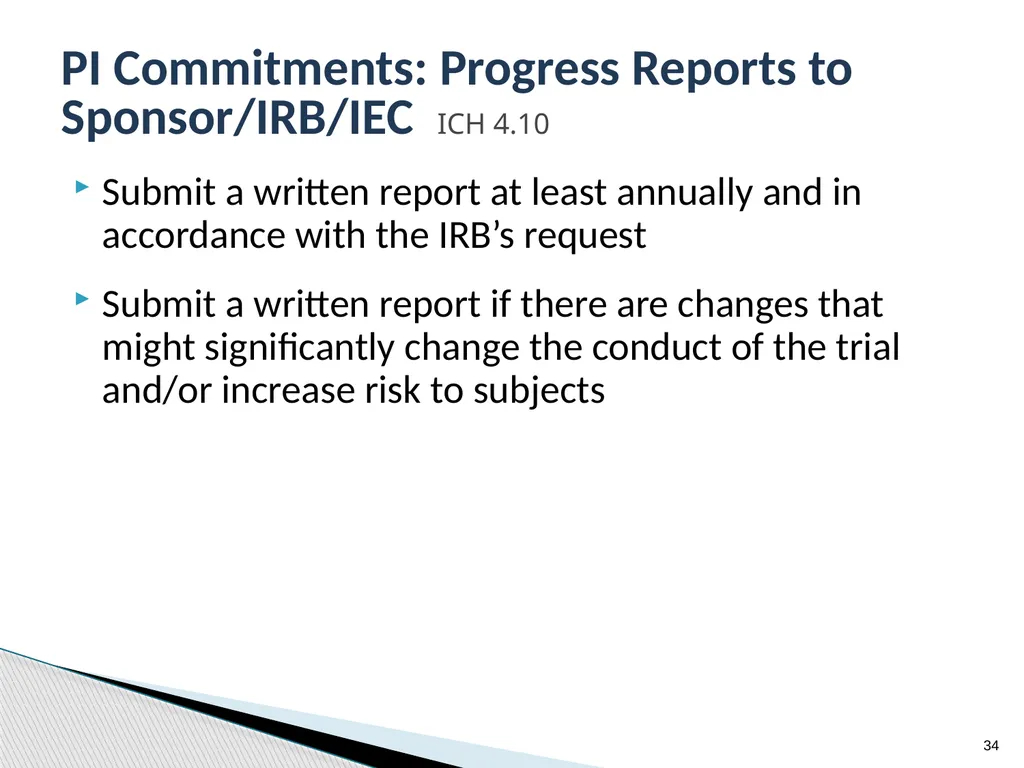
Submit a written report at least annually and in accordance with the IRB’s request
Submit a written report if there are changes that might significantly change the conduct of the trial and/or increase risk to subjects PI Commitments: Progress Reports to Sponsor/IRB/IEC ICH 4.10 34<br>
Submit a written report if there are changes that might significantly change the conduct of the trial and/or increase risk to subjects PI Commitments: Progress Reports to Sponsor/IRB/IEC ICH 4.10 34<br>
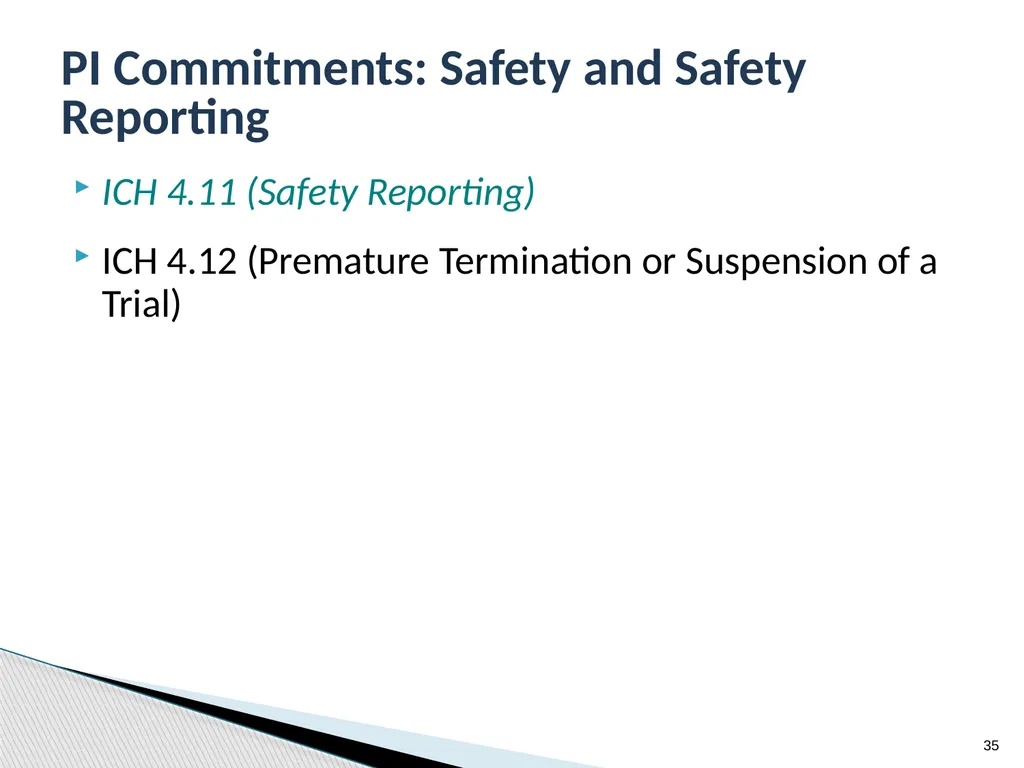
35
ICH 4.11 (Safety Reporting)
ICH 4.12 (Premature Termination or Suspension of a Trial) PI Commitments: Safety and Safety Reporting 35<br>
ICH 4.12 (Premature Termination or Suspension of a Trial) PI Commitments: Safety and Safety Reporting 35<br>
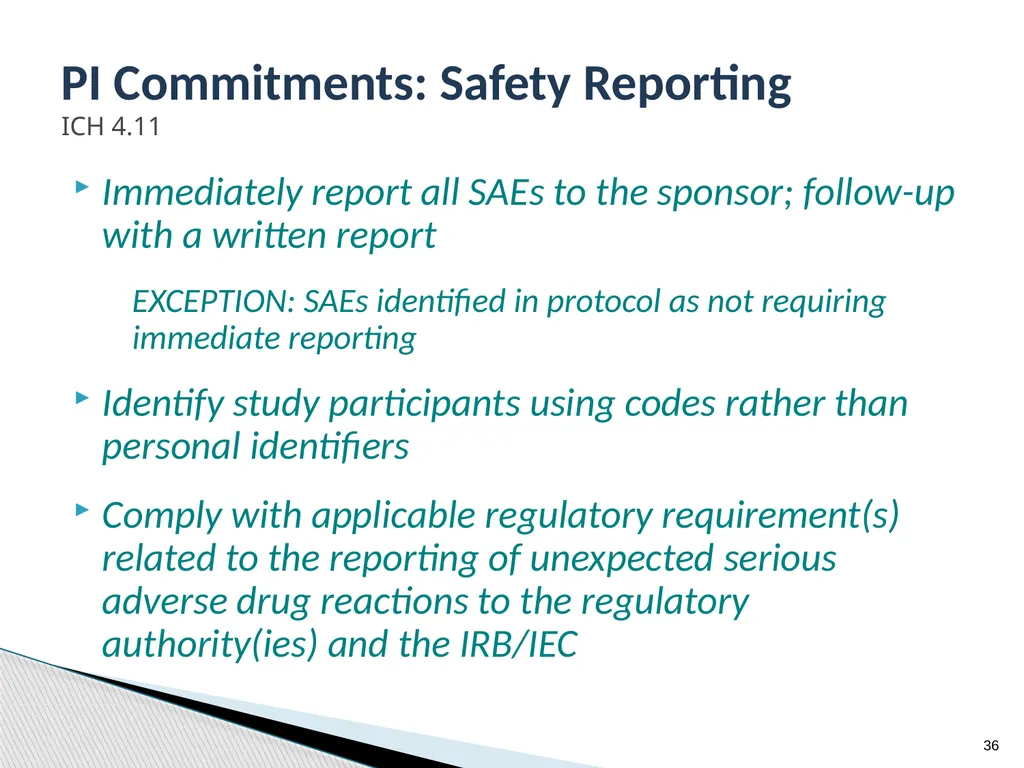
36
Immediately report all SAEs to the sponsor; follow-up with a written report
EXCEPTION: SAEs identified in protocol as not requiring immediate reporting
Identify study participants using codes rather than personal identifiers
Comply with applicable regulatory requirement(s) related to the reporting of unexpected serious adverse drug reactions to the regulatory authority(ies) and the IRB/IEC PI Commitments: Safety Reporting ICH 4.11 36<br>
EXCEPTION: SAEs identified in protocol as not requiring immediate reporting
Identify study participants using codes rather than personal identifiers
Comply with applicable regulatory requirement(s) related to the reporting of unexpected serious adverse drug reactions to the regulatory authority(ies) and the IRB/IEC PI Commitments: Safety Reporting ICH 4.11 36<br>
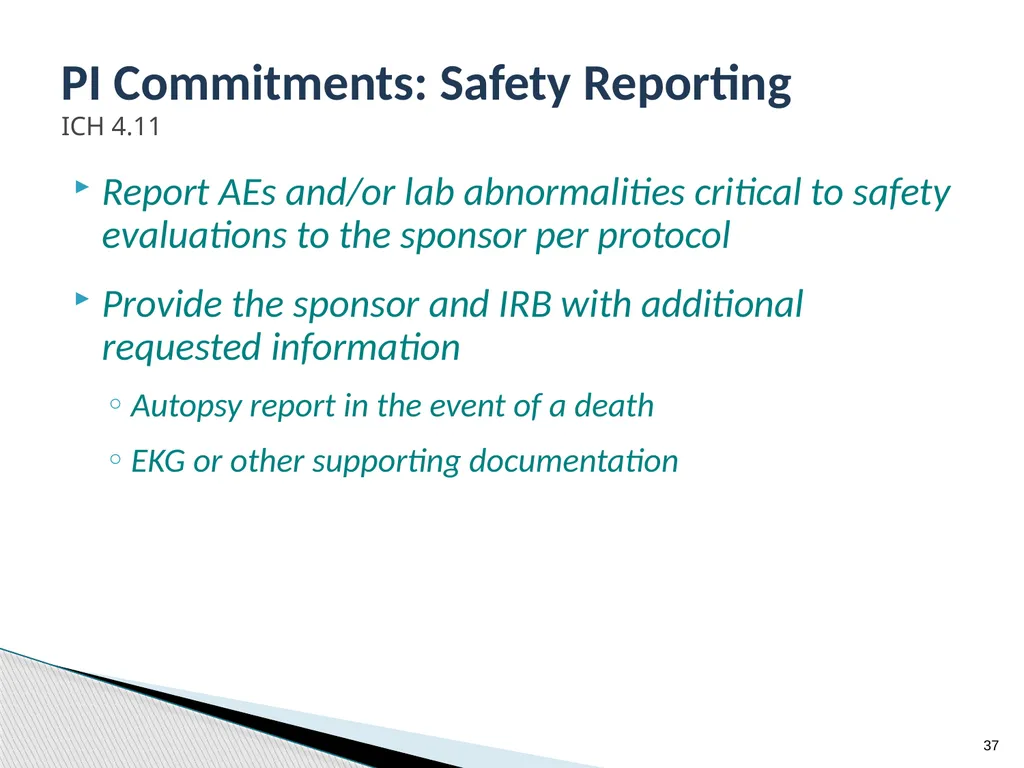
37
Report AEs and/or lab abnormalities critical to safety evaluations to the sponsor per protocol
Provide the sponsor and IRB with additional requested information
Autopsy report in the event of a death
EKG or other supporting documentation PI Commitments: Safety Reporting ICH 4.11 37<br>
Provide the sponsor and IRB with additional requested information
Autopsy report in the event of a death
EKG or other supporting documentation PI Commitments: Safety Reporting ICH 4.11 37<br>
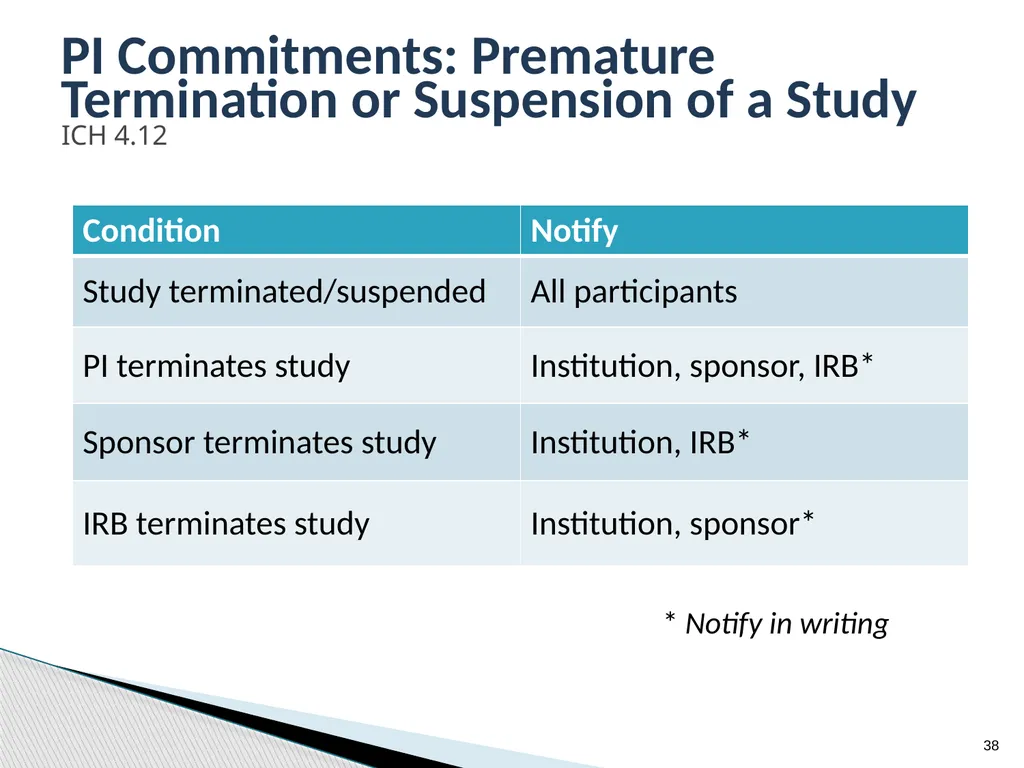
38
38 * Notify in writing PI Commitments: Premature Termination or Suspension of a Study ICH 4.12<br>
39
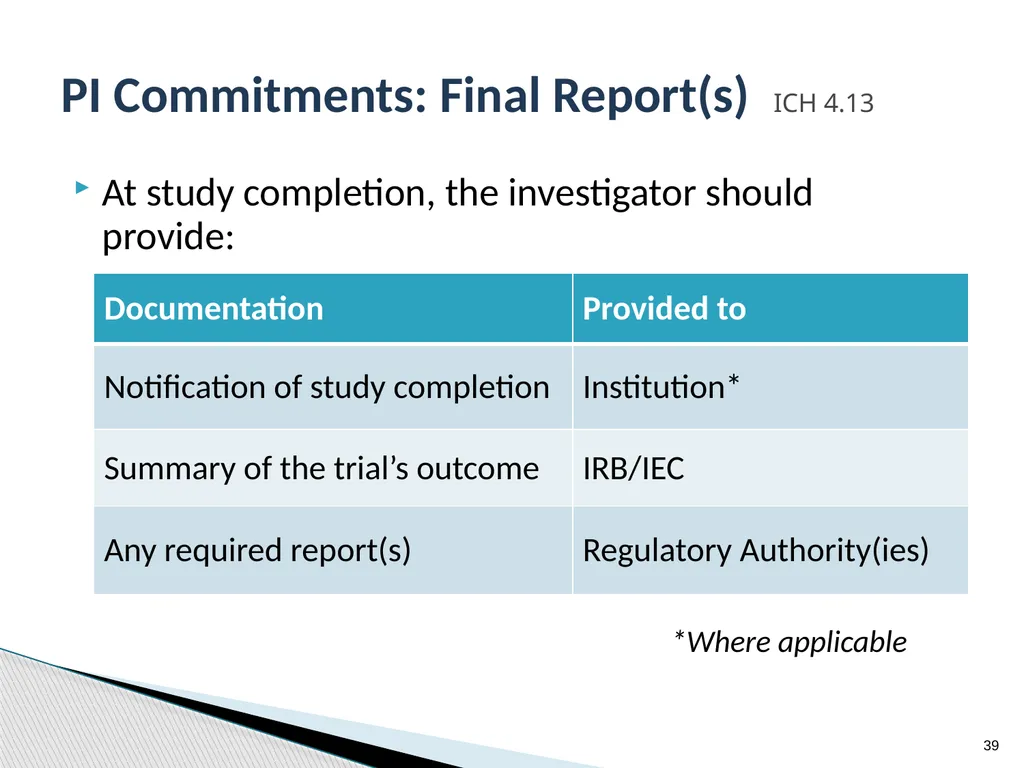
39 *Where applicable At study completion, the investigator should
provide: PI Commitments: Final Report(s) ICH 4.13<br>
40
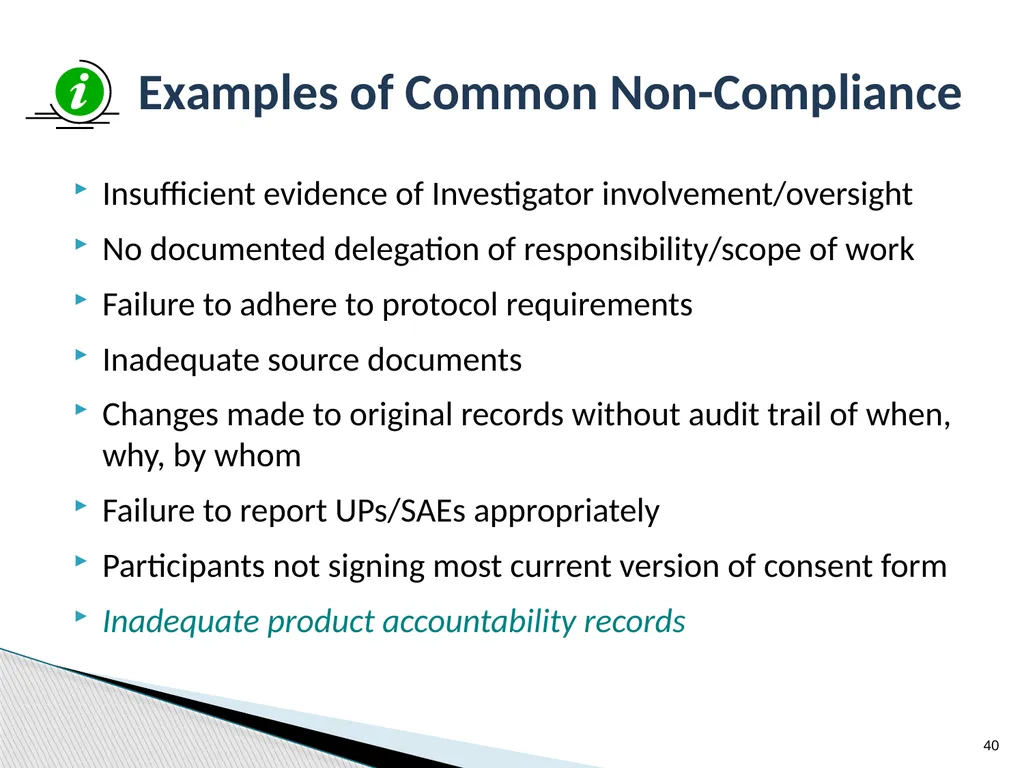
40 Insufficient evidence of Investigator involvement/oversight
No documented delegation of responsibility/scope of work
Failure to adhere to protocol requirements
Inadequate source documents
Changes made to original records without audit trail of when, why, by whom
Failure to report UPs/SAEs appropriately
Participants not signing most current version of consent form
Inadequate product accountability records Examples of Common Non-Compliance<br>
No documented delegation of responsibility/scope of work
Failure to adhere to protocol requirements
Inadequate source documents
Changes made to original records without audit trail of when, why, by whom
Failure to report UPs/SAEs appropriately
Participants not signing most current version of consent form
Inadequate product accountability records Examples of Common Non-Compliance<br>
41
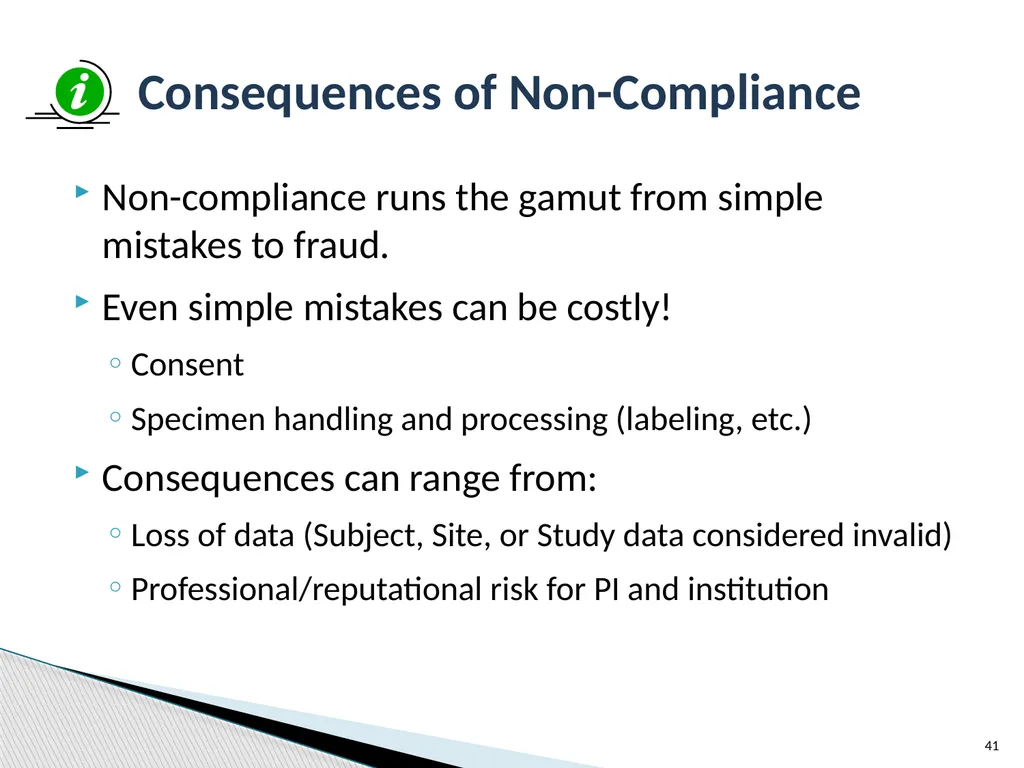
41 Non-compliance runs the gamut from simple mistakes to fraud.
Even simple mistakes can be costly!
Consent
Specimen handling and processing (labeling, etc.)
Consequences can range from:
Loss of data (Subject, Site, or Study data considered invalid)
Professional/reputational risk for PI and institution Consequences of Non-Compliance<br>
Even simple mistakes can be costly!
Consent
Specimen handling and processing (labeling, etc.)
Consequences can range from:
Loss of data (Subject, Site, or Study data considered invalid)
Professional/reputational risk for PI and institution Consequences of Non-Compliance<br>
42
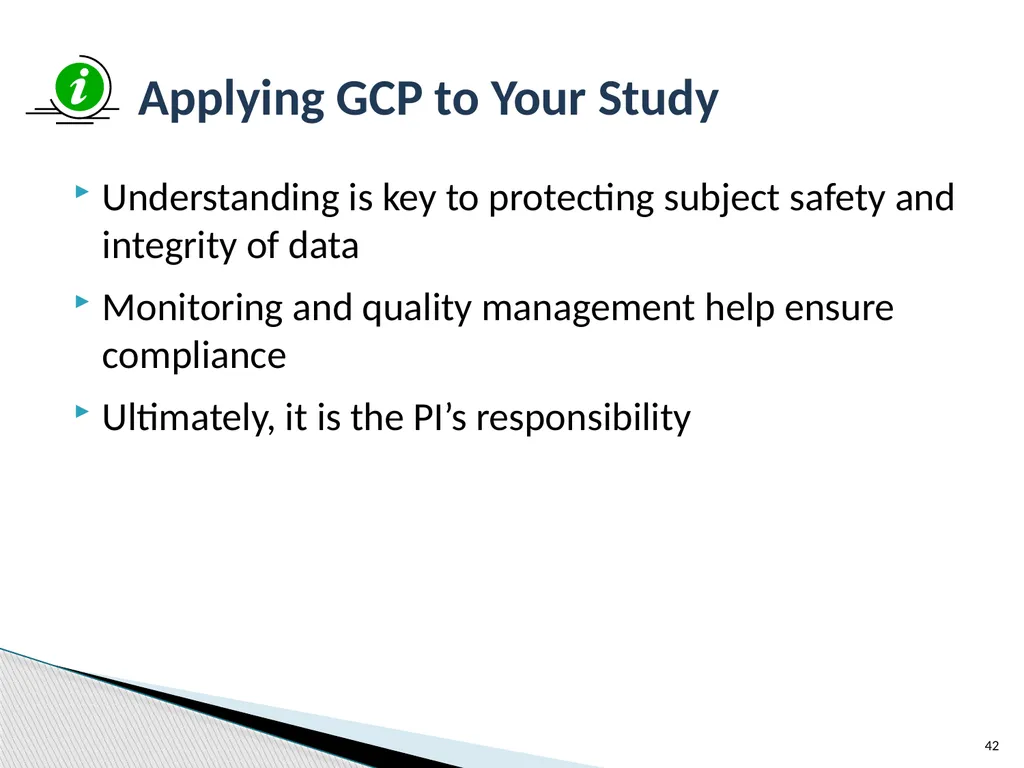
42 Understanding is key to protecting subject safety and integrity of data
Monitoring and quality management help ensure compliance
Ultimately, it is the PI’s responsibility Applying GCP to Your Study<br>
Monitoring and quality management help ensure compliance
Ultimately, it is the PI’s responsibility Applying GCP to Your Study<br>
43
Q&A
Resources
NIDCR Forms Wrapping It All Up 43<br>
Resources
NIDCR Forms Wrapping It All Up 43<br>
44
Questions? 44<br>
45
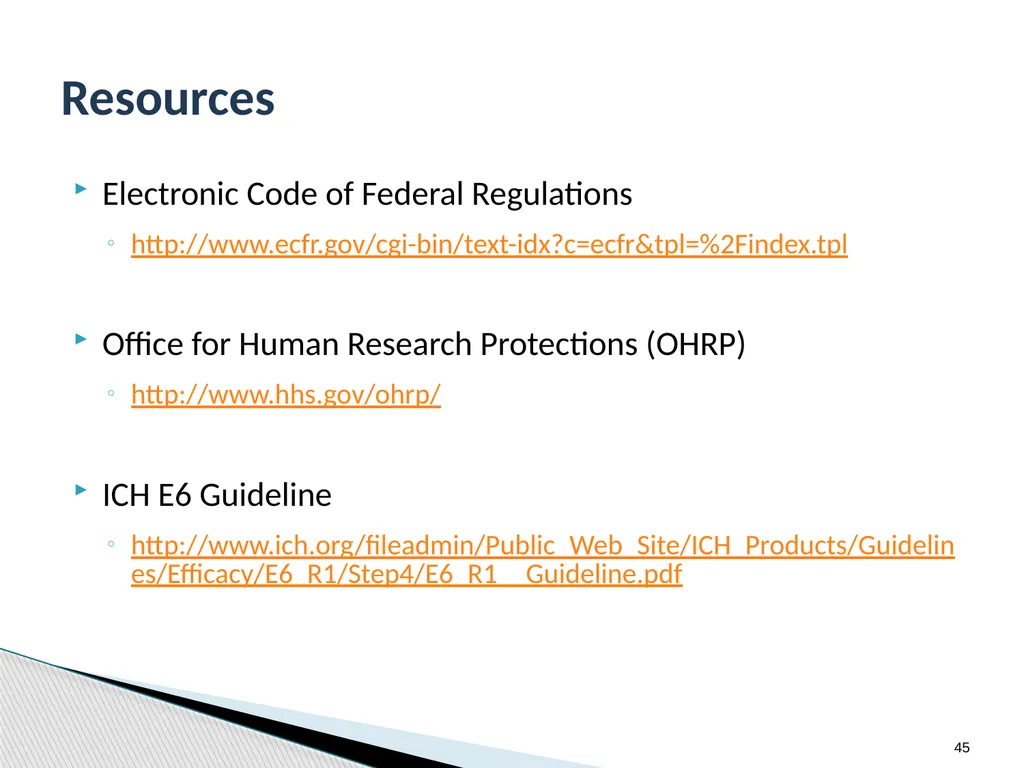
45 Electronic Code of Federal Regulations
http://www.ecfr.gov/cgi-bin/text-idx?c=ecfr&tpl=%2Findex.tpl
Office for Human Research Protections (OHRP)
http://www.hhs.gov/ohrp/
ICH E6 Guideline
http://www.ich.org/fileadmin/Public_Web_Site/ICH_Products/Guidelines/Efficacy/E6_R1/Step4/E6_R1__Guideline.pdf Resources<br>
http://www.ecfr.gov/cgi-bin/text-idx?c=ecfr&tpl=%2Findex.tpl
Office for Human Research Protections (OHRP)
http://www.hhs.gov/ohrp/
ICH E6 Guideline
http://www.ich.org/fileadmin/Public_Web_Site/ICH_Products/Guidelines/Efficacy/E6_R1/Step4/E6_R1__Guideline.pdf Resources<br>
46
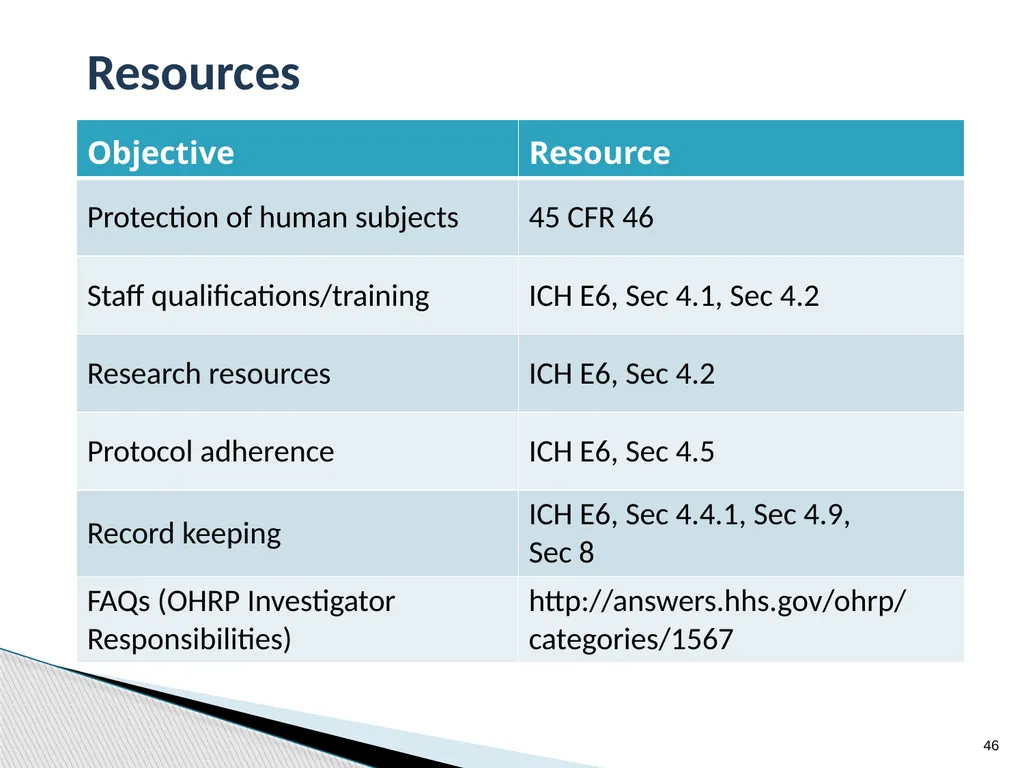
46 Resources<br>
47
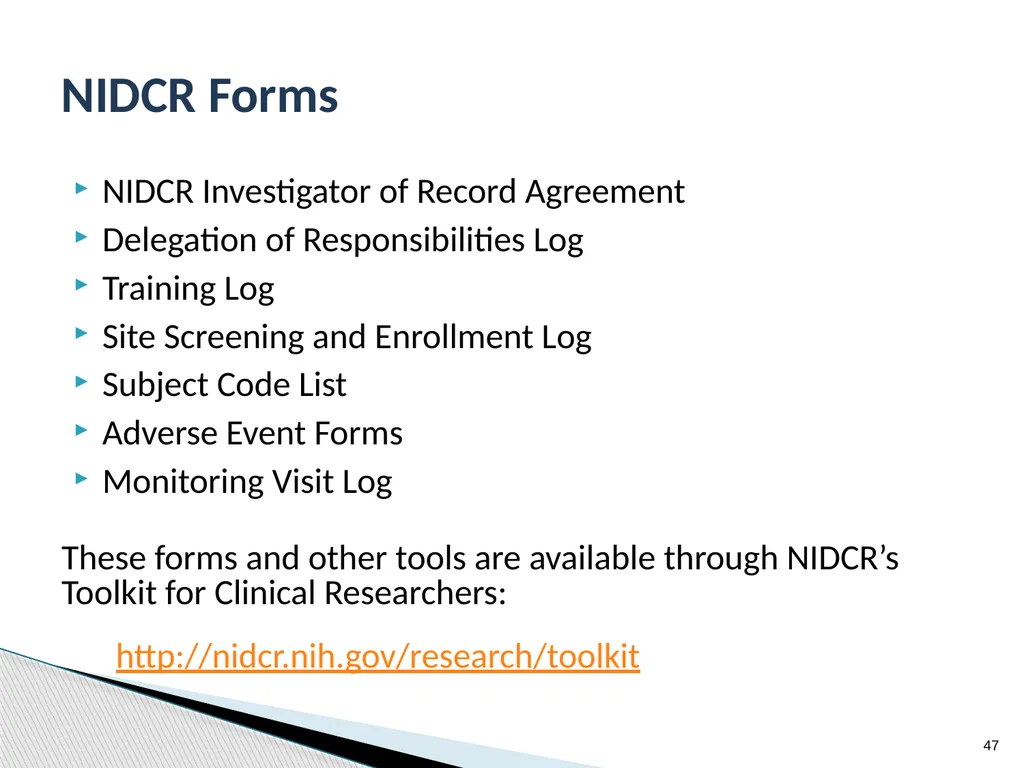
NIDCR Investigator of Record Agreement
Delegation of Responsibilities Log
Training Log
Site Screening and Enrollment Log
Subject Code List
Adverse Event Forms
Monitoring Visit Log
These forms and other tools are available through NIDCR’s Toolkit for Clinical Researchers:
http://nidcr.nih.gov/research/toolkit NIDCR Forms 47<br>
Delegation of Responsibilities Log
Training Log
Site Screening and Enrollment Log
Subject Code List
Adverse Event Forms
Monitoring Visit Log
These forms and other tools are available through NIDCR’s Toolkit for Clinical Researchers:
http://nidcr.nih.gov/research/toolkit NIDCR Forms 47<br>