
November 1, 2023 Agriculture Study Group
SB
Published · 28 slides · 0 views

1 / 1

Description
November 1, 2023 Agriculture Study Group Agriculture Study Group Participants Dr. David Cook President NDSU Mr. Jeffry Volk SBHE Mr. Jim Bahm ND Ag Coalition - ND Wheat Commission Mr. John Norgaard State Board of Agricultural
Related Topics
Share
Embed code
Download this presentation From Below
"November 1, 2023 Agriculture Study Group" is the property of its rightful owner. Permission is granted to download and print the materials on this website for personal, non-commercial use only, and to display it on your personal computer provided you do not modify the materials and that you retain all copyright notices contained in the materials. By downloading content from our website, you accept the terms of this agreement.
Presentation Transcript
01
November 1, 2023 Agriculture Study Group<br>
02
Agriculture Study Group Participants Dr. David Cook – President NDSU
Mr. Jeffry Volk – SBHE
Mr. Jim Bahm – ND Ag Coalition - ND Wheat Commission
Mr. John Norgaard – State Board of Agricultural Research & Education
Dr. Greg Lardy –Vice President Agriculture Affairs NDSU
Dr. Brian Darby – Associate Professor of Biology UND
Dr. Holly Gruhlke – Vice President DSC
Dr. Craig Zimprich – Chair Agriculture Department NDSCS
Dr. Marko Davinic – Associate Professor of Agriculture BSC<br>
Mr. Jeffry Volk – SBHE
Mr. Jim Bahm – ND Ag Coalition - ND Wheat Commission
Mr. John Norgaard – State Board of Agricultural Research & Education
Dr. Greg Lardy –Vice President Agriculture Affairs NDSU
Dr. Brian Darby – Associate Professor of Biology UND
Dr. Holly Gruhlke – Vice President DSC
Dr. Craig Zimprich – Chair Agriculture Department NDSCS
Dr. Marko Davinic – Associate Professor of Agriculture BSC<br>
03
Topic #1
Precision Agriculture and Data Analytics Identify if this is a Commend, Endorse, or Call to Action Dr. Greg Lardy and Mr. Jim Bahm<br>
04
Precision Agriculture and Data Analytics
Why This Topic? The world of agriculture and food production is moving rapidly to implementation of precision technology that is deployed on farms, ranches, and in food production. In addition, all these technologies hinge on data. It is important that agriculture students in the NDUS be exposed the various aspects of precision agriculture, how it fits into their specific disciplines, and how data and data analytics interact with job opportunities and careers they will have in the future.<br>
05
Precision Agriculture and Data Analytics
Research Methodology Committee members have contacted industry members for feedback and stakeholders feel this topic area is very important
Several campus offer coursework related to Precision Agriculture<br>
Several campus offer coursework related to Precision Agriculture<br>
06
Precision Agriculture and Data Analytics
Potential Overlap Legislature has invested in Grand Farm, a precision ag building at Lake Region State College, and other precision agriculture projects recently<br>
07
Precision Agriculture and Data Analytics
Future Work Conversations with employers and other stakeholders should be held
All campuses with Precision Agriculture coursework are encouraged to participate in the NDUS Ag Articulation Committee to ensure transferability of various coursework
Potential for survey of employers and other stakeholders to be sure workforce needs are met<br>
All campuses with Precision Agriculture coursework are encouraged to participate in the NDUS Ag Articulation Committee to ensure transferability of various coursework
Potential for survey of employers and other stakeholders to be sure workforce needs are met<br>
08
Precision Agriculture and Data Analytics
Gathering Support North Dakota is home to many companies involved in precision agriculture
Grand Farm may be a strategic partner
A number of precision agriculture companies have a presence in North Dakota
Ensure they are engaged in advisory boards and other means of engagement<br>
Grand Farm may be a strategic partner
A number of precision agriculture companies have a presence in North Dakota
Ensure they are engaged in advisory boards and other means of engagement<br>
09
Topic #2
Livestock Development Identify if this is a Commend, Endorse, or Call to Action Dr. Craig Zimprich and Dr. Greg Lardy<br>
10
Livestock Development
Why This Topic? The state of North Dakota is making a concerted effort to add value at the farm gate through livestock production and it is imperative that the NDUS be provided well educated students who are prepared for careers in the livestock industry. An important aspect of that training is exposure to modern facilities and production practices.<br>
11
Livestock Development
Research Methodology Consultation will be conducted with members of industry groups including but not limited to:
ND Stockmen’s Association, ND Dairy Coalition, ND Pork Producers Council, ND Lamb and Wool Growers<br>
ND Stockmen’s Association, ND Dairy Coalition, ND Pork Producers Council, ND Lamb and Wool Growers<br>
12
Livestock Development
Potential Overlap Legislature recently passed several bills related to livestock development including HB1371 which changed the corporate farming law to encourage livestock development<br>
13
Livestock Development
Future Work Conversations and input from representatives of the livestock industry, other associated groups, and employers will be needed
Key groups include: ND Pork Producers, ND Dairy Coalition, ND Livestock Alliance, ND Soybean Council, and ND Corn Utilization Council
All campuses with Animal Science coursework are encouraged to participate in the NDUS Ag Articulation Committee to ensure transferability of various coursework<br>
Key groups include: ND Pork Producers, ND Dairy Coalition, ND Livestock Alliance, ND Soybean Council, and ND Corn Utilization Council
All campuses with Animal Science coursework are encouraged to participate in the NDUS Ag Articulation Committee to ensure transferability of various coursework<br>
14
Livestock Development
Gathering Support With changes in corporate farming law there may be interest from private companies to fund scholarships, offer internships, and other student-focused opportunities<br>
15
Topic #3
Sustainability and Climate Resiliency Identify if this is a Commend, Endorse, or Call to Action Dr. Brian Darby and Dr. Marko Davinic<br>
16
Sustainability and Climate Resiliency
Why This Topic? This is a “call to action” for higher education in North Dakota
Agriculture in North Dakota depends on the Soil-Water-Food nexus, which relies on the successful functioning of our natural resources.
Our natural resources are abundant, but must be used sustainably in order to protect the future of agriculture.
Attention should be placed on training and marinating “soil health” principles to the students of the higher ed as well as general public.<br>
Agriculture in North Dakota depends on the Soil-Water-Food nexus, which relies on the successful functioning of our natural resources.
Our natural resources are abundant, but must be used sustainably in order to protect the future of agriculture.
Attention should be placed on training and marinating “soil health” principles to the students of the higher ed as well as general public.<br>
17
Sustainability and Climate Resiliency
Research Methodology Propose literature review and listening sessions with NRCS, county soil conservation districts, Grazing Lands Coalition, Landowners/Producers, NDSU extension and research faculty from academic institutions across ND to identify:
Identify key natural resource use that most threatens sustainability
Coordinated literature review on research data collected amongst extension services and field stations
Identifying the most promising solutions according to data from the North Dakota research studies.
Methods to incorporate solutions into Higher Ed and industry trainings and standards.<br>
Identify key natural resource use that most threatens sustainability
Coordinated literature review on research data collected amongst extension services and field stations
Identifying the most promising solutions according to data from the North Dakota research studies.
Methods to incorporate solutions into Higher Ed and industry trainings and standards.<br>
18
Sustainability and Climate Resiliency
Potential Overlap Potentially overlaps with these Envision2023 Working Groups:
Energy
Student of the Future
Values of the Future<br>
Energy
Student of the Future
Values of the Future<br>
19
Sustainability and Climate Resiliency
Future Work Bullet points outlining further work that needs to be done or indicate this work is final
Conduct literature and data review
Initiate listening session with local and statewide stakeholder groups
Summarizing the stakeholder feedback to identify priority recommendations<br>
Conduct literature and data review
Initiate listening session with local and statewide stakeholder groups
Summarizing the stakeholder feedback to identify priority recommendations<br>
20
Sustainability and Climate Resiliency
Gathering Support Partnering/consulting with local, regional and nationwide groups such as Soil & Water Conservation Society of North Dakota, Burleigh County Soil Conservation District, John Deer (Gooseneck Implement), Hess/Chevron Corporation, State Board of Ag Research Education & AgVise.<br>
21
Topic #4
Consumer Preferences Identify if this is a Commend, Endorse, or Call to Action Dr. Holly Gruhlke and Mr. John Norgaard<br>
22
Consumer Preferences
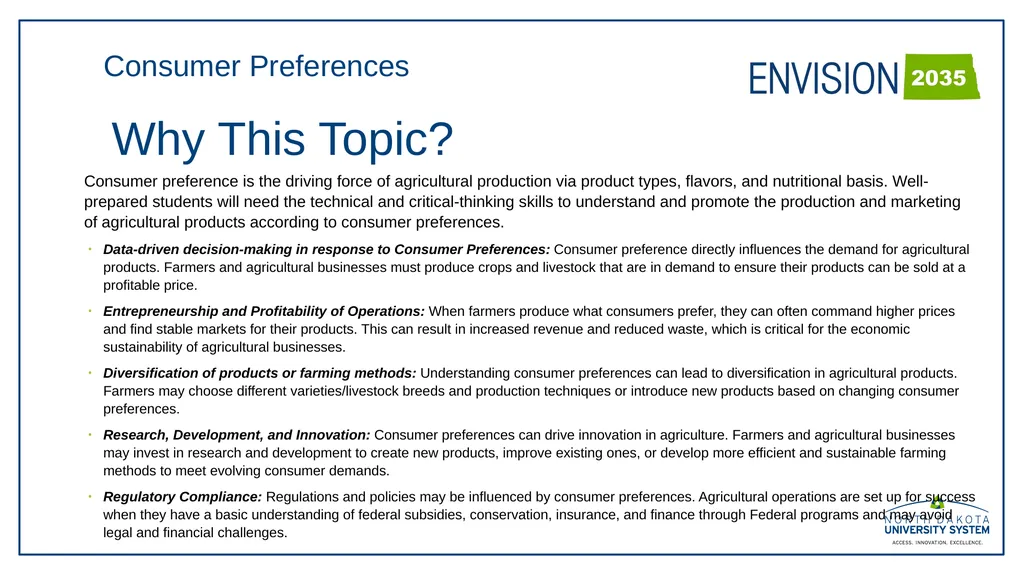
Why This Topic? Consumer preference is the driving force of agricultural production via product types, flavors, and nutritional basis. Well-prepared students will need the technical and critical-thinking skills to understand and promote the production and marketing of agricultural products according to consumer preferences.
Data-driven decision-making in response to Consumer Preferences: Consumer preference directly influences the demand for agricultural products. Farmers and agricultural businesses must produce crops and livestock that are in demand to ensure their products can be sold at a profitable price.
Entrepreneurship and Profitability of Operations: When farmers produce what consumers prefer, they can often command higher prices and find stable markets for their products. This can result in increased revenue and reduced waste, which is critical for the economic sustainability of agricultural businesses.
Diversification of products or farming methods: Understanding consumer preferences can lead to diversification in agricultural products. Farmers may choose different varieties/livestock breeds and production techniques or introduce new products based on changing consumer preferences.
Research, Development, and Innovation: Consumer preferences can drive innovation in agriculture. Farmers and agricultural businesses may invest in research and development to create new products, improve existing ones, or develop more efficient and sustainable farming methods to meet evolving consumer demands.
Regulatory Compliance: Regulations and policies may be influenced by consumer preferences. Agricultural operations are set up for success when they have a basic understanding of federal subsidies, conservation, insurance, and finance through Federal programs and may avoid legal and financial challenges.<br>
Data-driven decision-making in response to Consumer Preferences: Consumer preference directly influences the demand for agricultural products. Farmers and agricultural businesses must produce crops and livestock that are in demand to ensure their products can be sold at a profitable price.
Entrepreneurship and Profitability of Operations: When farmers produce what consumers prefer, they can often command higher prices and find stable markets for their products. This can result in increased revenue and reduced waste, which is critical for the economic sustainability of agricultural businesses.
Diversification of products or farming methods: Understanding consumer preferences can lead to diversification in agricultural products. Farmers may choose different varieties/livestock breeds and production techniques or introduce new products based on changing consumer preferences.
Research, Development, and Innovation: Consumer preferences can drive innovation in agriculture. Farmers and agricultural businesses may invest in research and development to create new products, improve existing ones, or develop more efficient and sustainable farming methods to meet evolving consumer demands.
Regulatory Compliance: Regulations and policies may be influenced by consumer preferences. Agricultural operations are set up for success when they have a basic understanding of federal subsidies, conservation, insurance, and finance through Federal programs and may avoid legal and financial challenges.<br>
23
Consumer Preferences
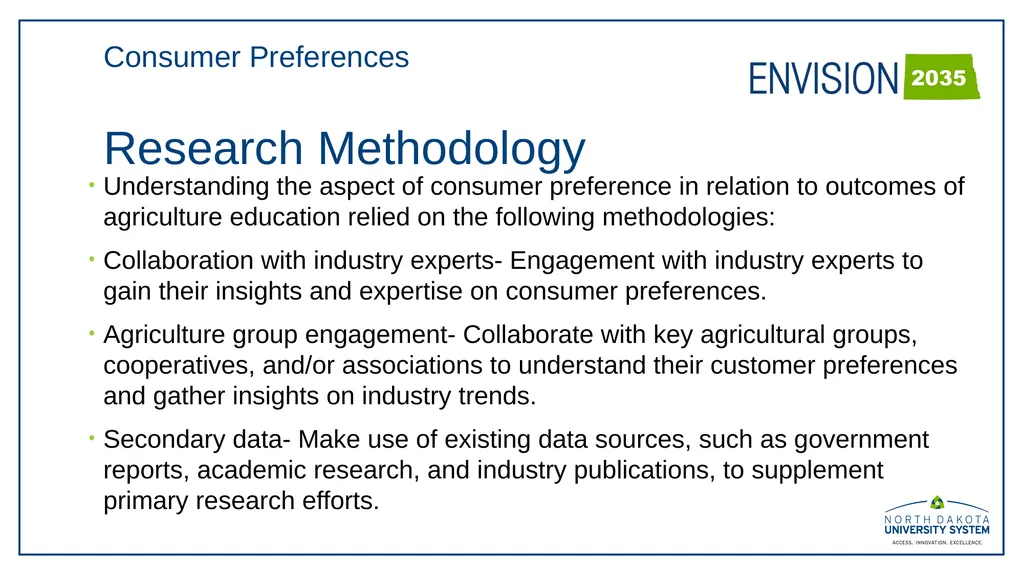
Research Methodology Understanding the aspect of consumer preference in relation to outcomes of agriculture education relied on the following methodologies:
Collaboration with industry experts- Engagement with industry experts to gain their insights and expertise on consumer preferences.
Agriculture group engagement- Collaborate with key agricultural groups, cooperatives, and/or associations to understand their customer preferences and gather insights on industry trends.
Secondary data- Make use of existing data sources, such as government reports, academic research, and industry publications, to supplement primary research efforts.<br>
Collaboration with industry experts- Engagement with industry experts to gain their insights and expertise on consumer preferences.
Agriculture group engagement- Collaborate with key agricultural groups, cooperatives, and/or associations to understand their customer preferences and gather insights on industry trends.
Secondary data- Make use of existing data sources, such as government reports, academic research, and industry publications, to supplement primary research efforts.<br>
24
Consumer Preferences
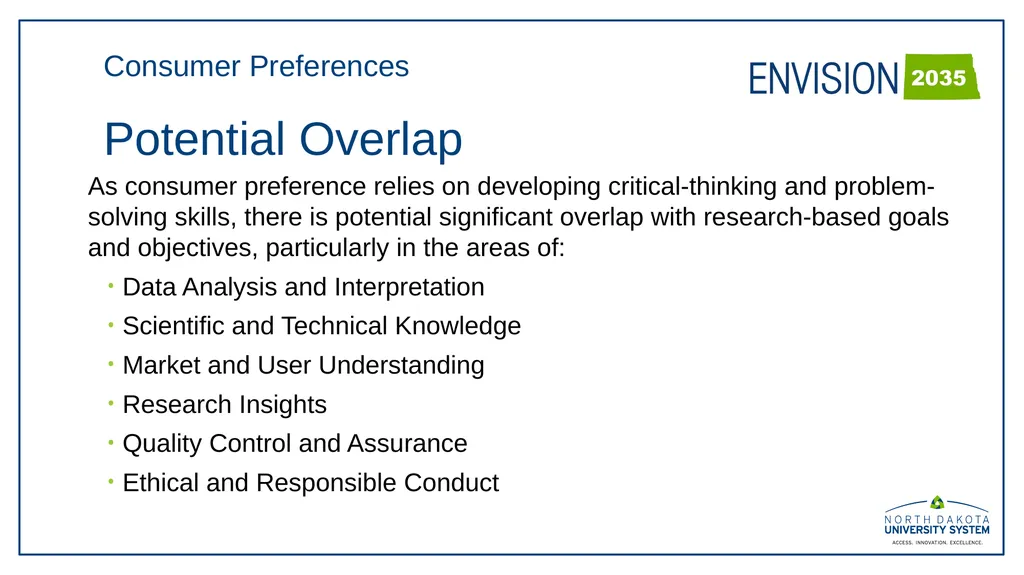
Potential Overlap As consumer preference relies on developing critical-thinking and problem-solving skills, there is potential significant overlap with research-based goals and objectives, particularly in the areas of:
Data Analysis and Interpretation
Scientific and Technical Knowledge
Market and User Understanding
Research Insights
Quality Control and Assurance
Ethical and Responsible Conduct<br>
Data Analysis and Interpretation
Scientific and Technical Knowledge
Market and User Understanding
Research Insights
Quality Control and Assurance
Ethical and Responsible Conduct<br>
25
Consumer Preferences
Future Work NDUS agriculture programming should review outcomes to ensure alignment with Envision 2035 goals as they relate to implementing consumer preference into the curriculum.<br>
26
Consumer Preferences
Gathering Support To gain long-term support, the following entities would be solicited for partnership or leadership of these efforts:
Industry Partners- including agriculture businesses, cooperatives, and associations
Government and legislature- including the North Dakota Department of Agriculture, Department of Instruction, and State Legislature
Non-profit organizations- including 4-H and FFA
Local agriculture businesses- including farmers and ranchers<br>
Industry Partners- including agriculture businesses, cooperatives, and associations
Government and legislature- including the North Dakota Department of Agriculture, Department of Instruction, and State Legislature
Non-profit organizations- including 4-H and FFA
Local agriculture businesses- including farmers and ranchers<br>
27
Topics considered, but ruled out as stand alone. Will most likely get addressed with selected topics. Future Agriculture workforce/talent
Role of Higher Education
K-12 pipeline<br>
Role of Higher Education
K-12 pipeline<br>
28
Questions, Discussion<br>