
Now this is how you should train yourselves here:
LD
Published · 32 slides · 0 views
1 / 1













Description
Now this is how you should train yourselves here: Our minds will remain unaffected, we shall utter no bad words, we shall abide friendly and compassionate, with thoughts of loving-kindness and no inner hate. We shall abide with
Related Topics
Share
Embed code
Download this presentation From Below
"Now this is how you should train yourselves here:" is the property of its rightful owner. Permission is granted to download and print the materials on this website for personal, non-commercial use only, and to display it on your personal computer provided you do not modify the materials and that you retain all copyright notices contained in the materials. By downloading content from our website, you accept the terms of this agreement.
Presentation Transcript
01
Now this is how you should train yourselves here: “Our minds will remain unaffected, we shall utter no bad words, we shall abide friendly and compassionate, with thoughts of loving-kindness and no inner hate. We shall abide with loving-kindness in our hearts extending to that person, and we shall dwell extending it to the entire world as our object, with our hearts abundant, exalted, measureless in loving-kindness, without hostility or ill-will.”
Majjhima Nikaya, Sutra 21 (spoken by the Buddha)<br>
Majjhima Nikaya, Sutra 21 (spoken by the Buddha)<br>
02
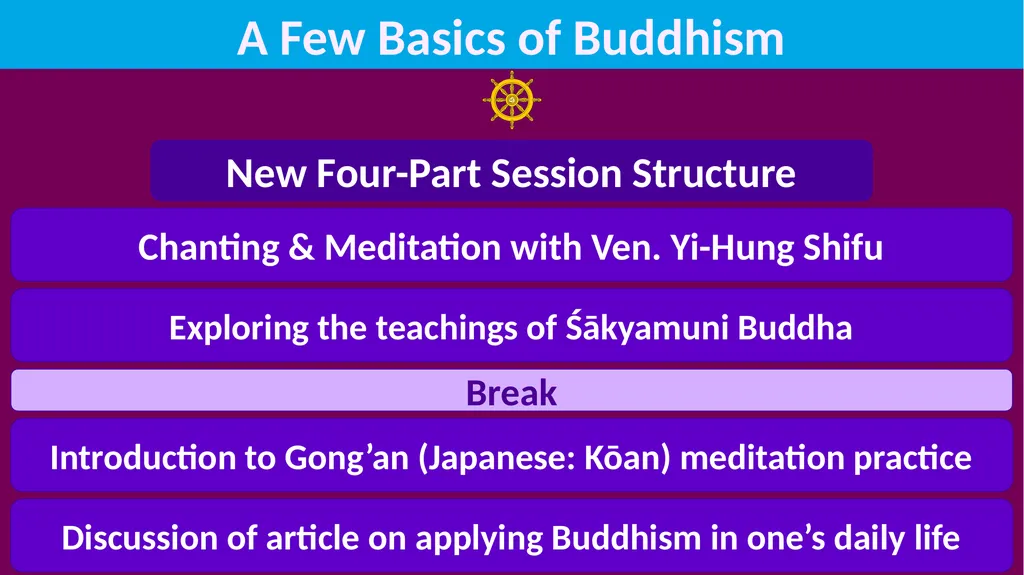
New Four-Part Session Structure A Few Basics of Buddhism Chanting & Meditation with Ven. Yi-Hung Shifu Exploring the teachings of Śākyamuni Buddha Discussion of article on applying Buddhism in one’s daily life Introduction to Gong’an (Japanese: Kōan) meditation practice Break<br>
03
Session 8 A Few Basics of Buddhism
and How to Integrate Them
into Our Daily Lives<br>
and How to Integrate Them
into Our Daily Lives<br>
04
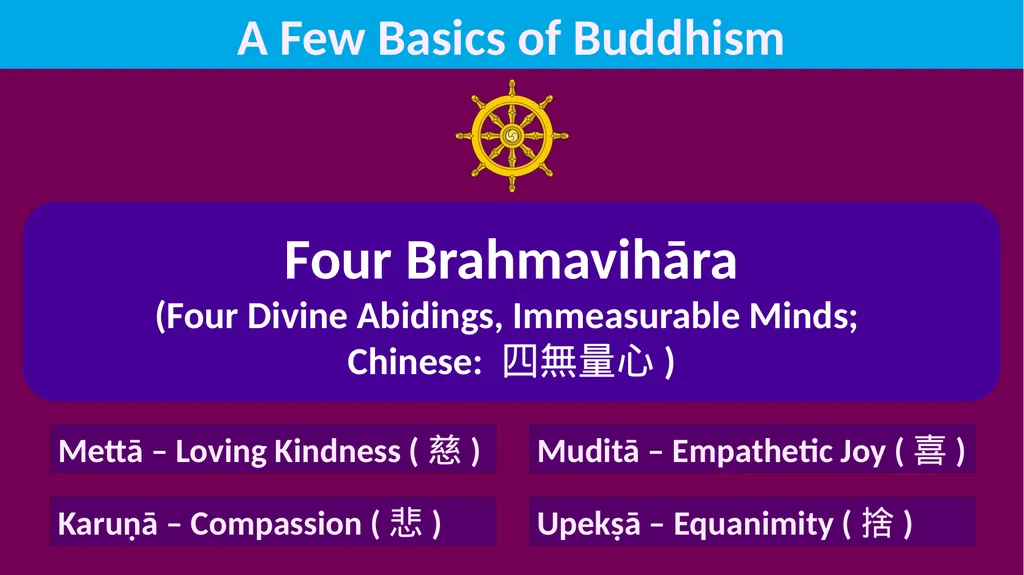
Four Brahmavihāra
(Four Divine Abidings, Immeasurable Minds;
Chinese: 四無量心) A Few Basics of Buddhism Mettā – Loving Kindness (慈) Karuṇā – Compassion (悲) Muditā – Empathetic Joy (喜) Upekṣā – Equanimity (捨)<br>
(Four Divine Abidings, Immeasurable Minds;
Chinese: 四無量心) A Few Basics of Buddhism Mettā – Loving Kindness (慈) Karuṇā – Compassion (悲) Muditā – Empathetic Joy (喜) Upekṣā – Equanimity (捨)<br>
05
Brahmavihāra (C. 四無量心) What’s in a name?<br>
06
Brahmavihāra (C. 四無量心) Brahmā Vihāra<br>
07
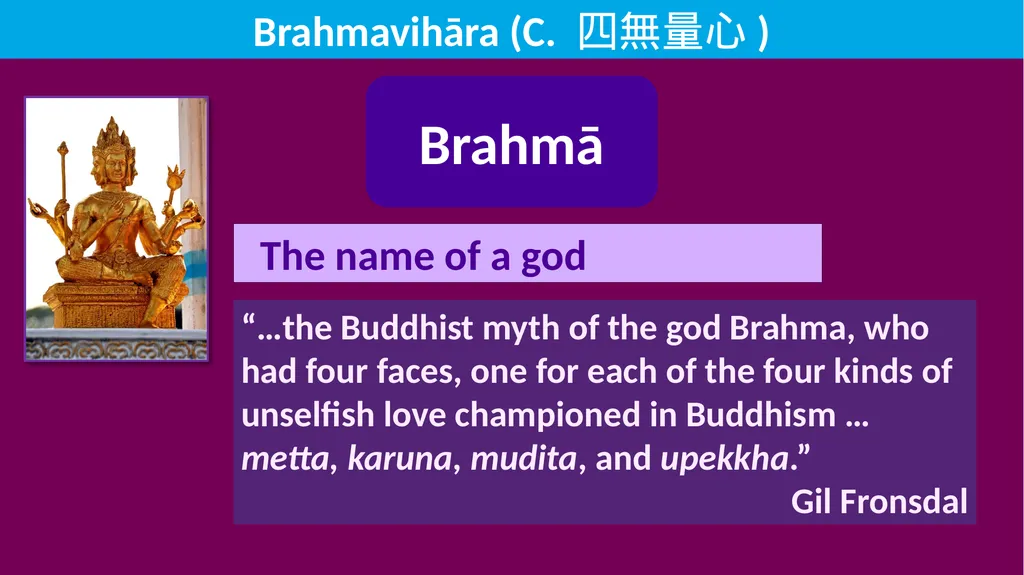
The name of a god Brahmavihāra (C. 四無量心) Brahmā “…the Buddhist myth of the god Brahma, who had four faces, one for each of the four kinds of unselfish love championed in Buddhism … metta, karuna, mudita, and upekkha.”
Gil Fronsdal<br>
Gil Fronsdal<br>
08
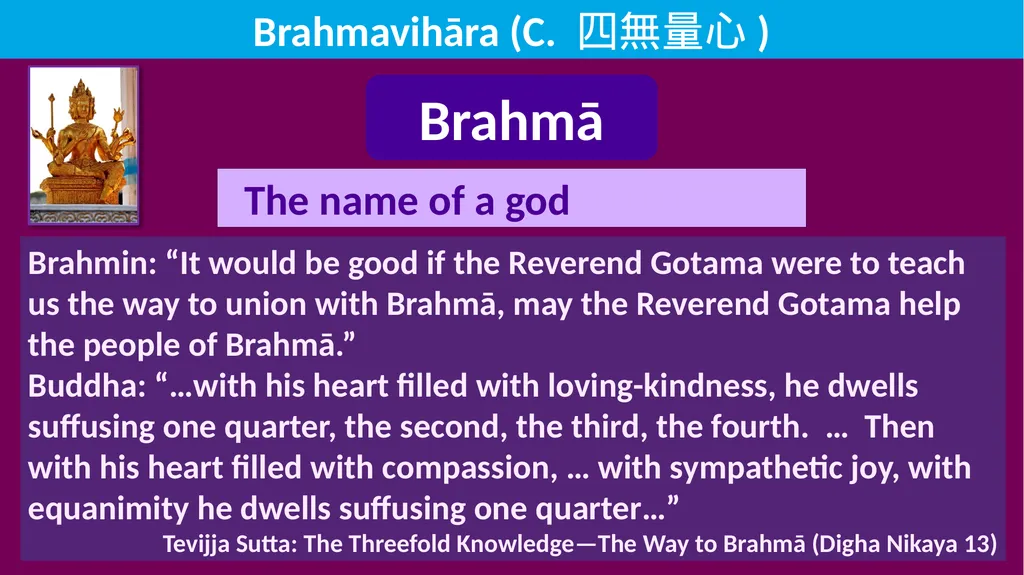
The name of a god Brahmavihāra (C. 四無量心) Brahmā Brahmin: “It would be good if the Reverend Gotama were to teach us the way to union with Brahmā, may the Reverend Gotama help the people of Brahmā.”
Buddha: “…with his heart filled with loving-kindness, he dwells suffusing one quarter, the second, the third, the fourth. … Then with his heart filled with compassion, … with sympathetic joy, with equanimity he dwells suffusing one quarter…”
Tevijja Sutta: The Threefold Knowledge—The Way to Brahmā (Digha Nikaya 13)<br>
Buddha: “…with his heart filled with loving-kindness, he dwells suffusing one quarter, the second, the third, the fourth. … Then with his heart filled with compassion, … with sympathetic joy, with equanimity he dwells suffusing one quarter…”
Tevijja Sutta: The Threefold Knowledge—The Way to Brahmā (Digha Nikaya 13)<br>
09
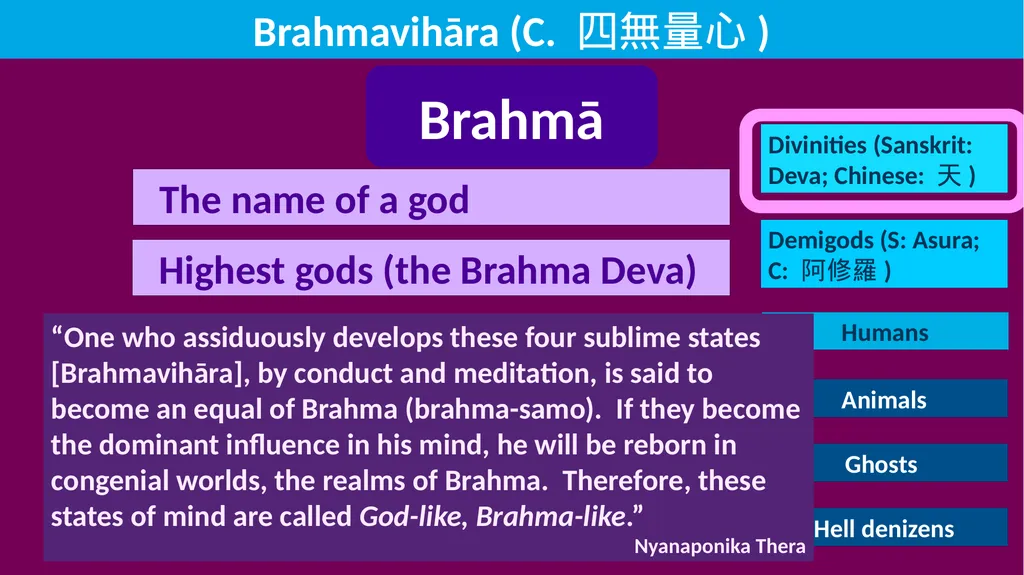
The name of a god Brahmavihāra (C. 四無量心) Brahmā Highest gods (the Brahma Deva) Divinities (Sanskrit: Deva; Chinese: 天) Demigods (S: Asura; C: 阿修羅) Humans Animals Ghosts Hell denizens “One who assiduously develops these four sublime states [Brahmavihāra], by conduct and meditation, is said to become an equal of Brahma (brahma-samo). If they become the dominant influence in his mind, he will be reborn in congenial worlds, the realms of Brahma. Therefore, these states of mind are called God-like, Brahma-like.”
Nyanaponika Thera<br>
Nyanaponika Thera<br>
10
The name of a god Brahmavihāra (C. 四無量心) Brahmā Highest gods (the Brahma Deva) Divine<br>
11
Brahmavihāra (C. 四無量心) Brahmā Vihāra<br>
12
Brahmavihāra (C. 四無量心) Vihāra Monastery, abiding/abode “[The Brahmavihāra] are called abodes (vihara) because they should become the mind’s constant dwelling-places where we feel ‘at home’; they should not remain merely places of rare and short visits soon forgotten.”
Nyanaponika Thera<br>
Nyanaponika Thera<br>
13
Boundless states, limitless qualities Brahmavihāra (C. 四無量心) Appammaññā
(Sanskrit: Apramāṇa) Chinese: 四無量心 (Sì wú liàng xīn)<br>
(Sanskrit: Apramāṇa) Chinese: 四無量心 (Sì wú liàng xīn)<br>
14
Brahmavihāra (C. 四無量心) Mettā – Loving Kindness (慈) Friendly person Feel friendly toward her, wish her to be happy? Mean person Feel friendly toward him, wish him to be happy?<br>
15
Brahmavihāra (C. 四無量心) Karuṇā – Compassion (悲) Sick child Feel compassion toward her? Homeless person who damaged park to power t.v. Feel compassion toward him/her?<br>
16
Brahmavihāra (C. 四無量心) Muditā – Empathetic Joy (喜) Baby first experiencing bubbles Feel the joy? Topper, the Biggest Braggart in the workplace If Topper gets a raise and you don’t, do you Feel joy for him?<br>
17
Boundless states Brahmavihāra (C. 四無量心) Appamañña Chinese: 四無量心 (sì wú liàng xīn) Without limits, nondiscriminatory<br>
18
Brahmavihāra (C. 四無量心) (Karaṇīya) Mettā Sutta: Good Will (Sutta Nipata 1.8) Happy, at rest,
may all beings be happy at heart.
Whatever beings there may be,
weak or strong, without exception,
long, large,
middling, short,
subtle, blatant,
seen & unseen,
near & far,
born & seeking birth:
May all beings be happy at heart.<br>
may all beings be happy at heart.
Whatever beings there may be,
weak or strong, without exception,
long, large,
middling, short,
subtle, blatant,
seen & unseen,
near & far,
born & seeking birth:
May all beings be happy at heart.<br>
19
“Just as I wish to be happy and free from suffering, so may that being, may all beings be happy and free from suffering.” Brahmavihāra (C. 四無量心) Mettā – Loving Kindness (慈) Comes from the Pali word “mitra,” which means “friend.” The Sanskrit word mitra also refers to the sun … the warmth and radiance of metta flows in the heart of all living beings.
Bhante Gunaratana. Mindfulness in plain English, p. 175<br>
Bhante Gunaratana. Mindfulness in plain English, p. 175<br>
20
Mettā is an antidote for ill-will Brahmavihāra (C. 四無量心) Mettā – Loving Kindness (慈) “From a Buddhist psychological perspective, ill will is rooted in fear—the fear of loss, the fear of harm.”
Feldman, Christina. 2017. Boundless heart: the Buddha’s path of kindness, compassion, joy, and equanimity, p. 14<br>
Feldman, Christina. 2017. Boundless heart: the Buddha’s path of kindness, compassion, joy, and equanimity, p. 14<br>
21
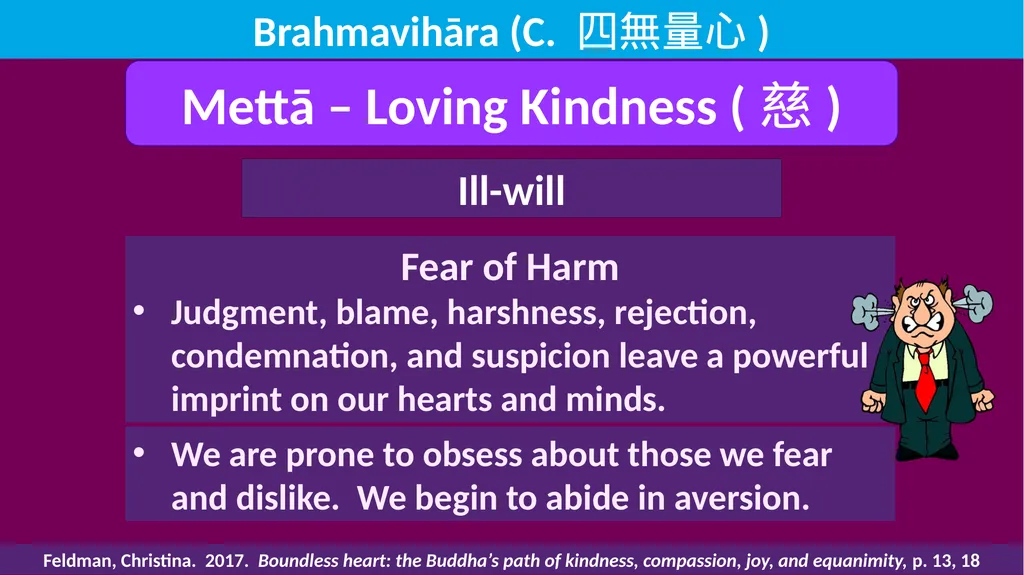
Ill-will Brahmavihāra (C. 四無量心) Mettā – Loving Kindness (慈) Fear of Harm
Judgment, blame, harshness, rejection, condemnation, and suspicion leave a powerful imprint on our hearts and minds. Feldman, Christina. 2017. Boundless heart: the Buddha’s path of kindness, compassion, joy, and equanimity, p. 13, 18 We are prone to obsess about those we fear and dislike. We begin to abide in aversion.<br>
Judgment, blame, harshness, rejection, condemnation, and suspicion leave a powerful imprint on our hearts and minds. Feldman, Christina. 2017. Boundless heart: the Buddha’s path of kindness, compassion, joy, and equanimity, p. 13, 18 We are prone to obsess about those we fear and dislike. We begin to abide in aversion.<br>
22
Ill-will Brahmavihāra (C. 四無量心) Mettā – Loving Kindness (慈) Negative Effects of Our Ill-Will toward Others
Inner pain when we judge, condemn, or are harsh to another in defense
Sickens us and leaves powerful footprint on the world
Sets in motion downward spirals of depression and debilitating anxiety
Isolation, mistrust, defensiveness toward others as well as self-loathing Feldman, Christina. 2017. Boundless heart: the Buddha’s path of kindness, compassion, joy, and equanimity.<br>
Inner pain when we judge, condemn, or are harsh to another in defense
Sickens us and leaves powerful footprint on the world
Sets in motion downward spirals of depression and debilitating anxiety
Isolation, mistrust, defensiveness toward others as well as self-loathing Feldman, Christina. 2017. Boundless heart: the Buddha’s path of kindness, compassion, joy, and equanimity.<br>
23
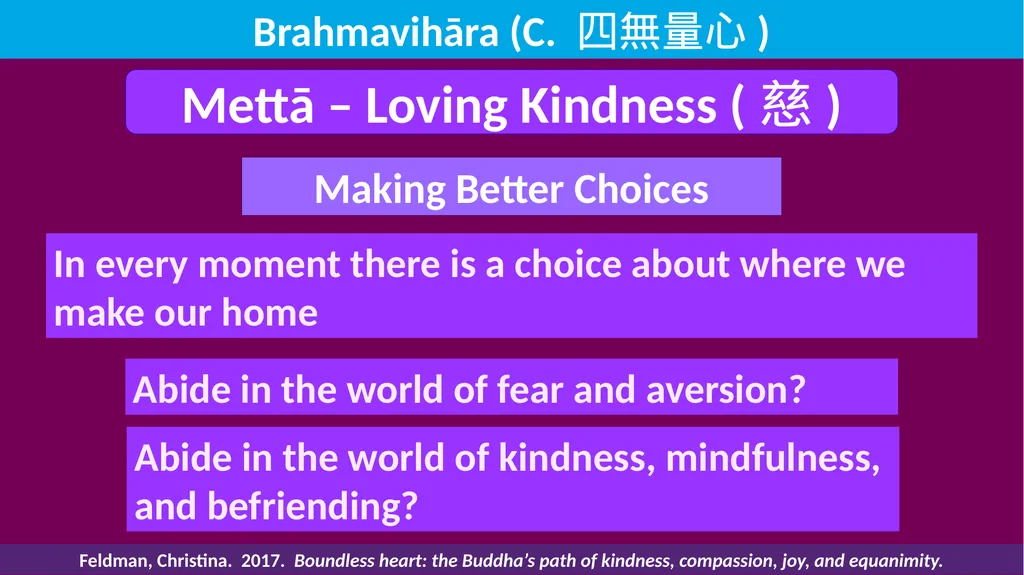
Making Better Choices Brahmavihāra (C. 四無量心) Mettā – Loving Kindness (慈) In every moment there is a choice about where we make our home Feldman, Christina. 2017. Boundless heart: the Buddha’s path of kindness, compassion, joy, and equanimity. Abide in the world of fear and aversion? Abide in the world of kindness, mindfulness, and befriending?<br>
24
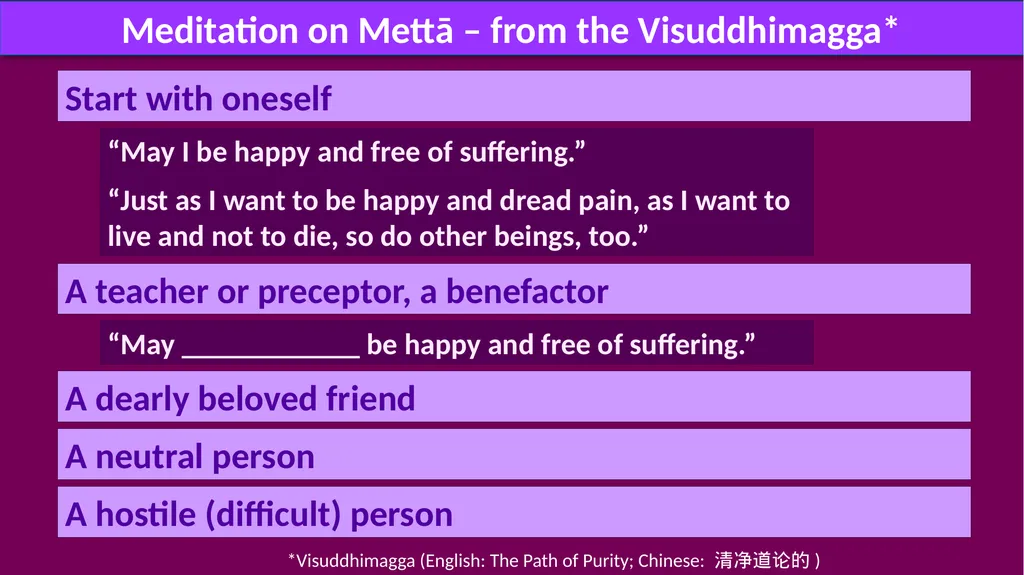
Start with oneself Meditation on Mettā – from the Visuddhimagga* *Visuddhimagga (English: The Path of Purity; Chinese: 清净道论的) “May I be happy and free of suffering.”
“Just as I want to be happy and dread pain, as I want to live and not to die, so do other beings, too.” A teacher or preceptor, a benefactor “May ____________ be happy and free of suffering.” A dearly beloved friend A neutral person A hostile (difficult) person<br>
“Just as I want to be happy and dread pain, as I want to live and not to die, so do other beings, too.” A teacher or preceptor, a benefactor “May ____________ be happy and free of suffering.” A dearly beloved friend A neutral person A hostile (difficult) person<br>
25
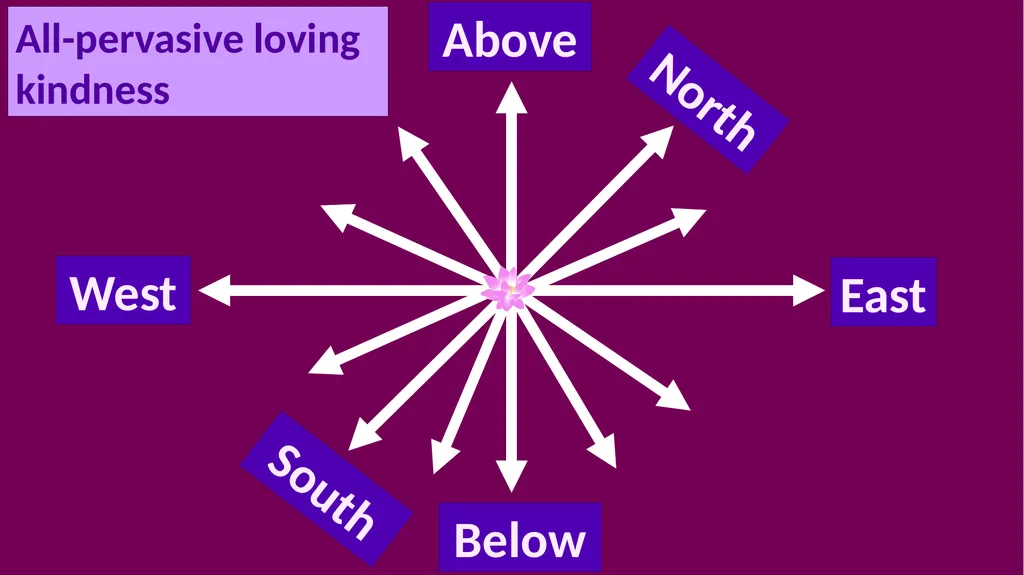
All-pervasive loving kindness East West North South Above Below<br>
26
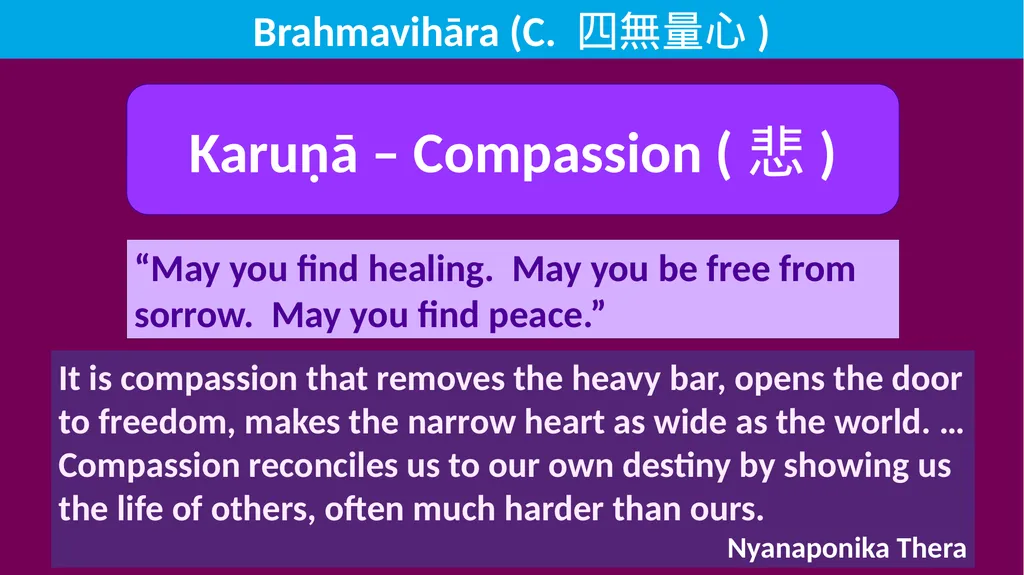
“May you find healing. May you be free from sorrow. May you find peace.” Brahmavihāra (C. 四無量心) Karuṇā – Compassion (悲) It is compassion that removes the heavy bar, opens the door to freedom, makes the narrow heart as wide as the world. … Compassion reconciles us to our own destiny by showing us the life of others, often much harder than ours.
Nyanaponika Thera<br>
Nyanaponika Thera<br>
27
Brahmavihāra (C. 四無量心) Karuṇā – Compassion (悲) Two parts Empathy – we care enough not to turn our gaze away from the suffering of others Impulse to help alleviate that suffering<br>
28
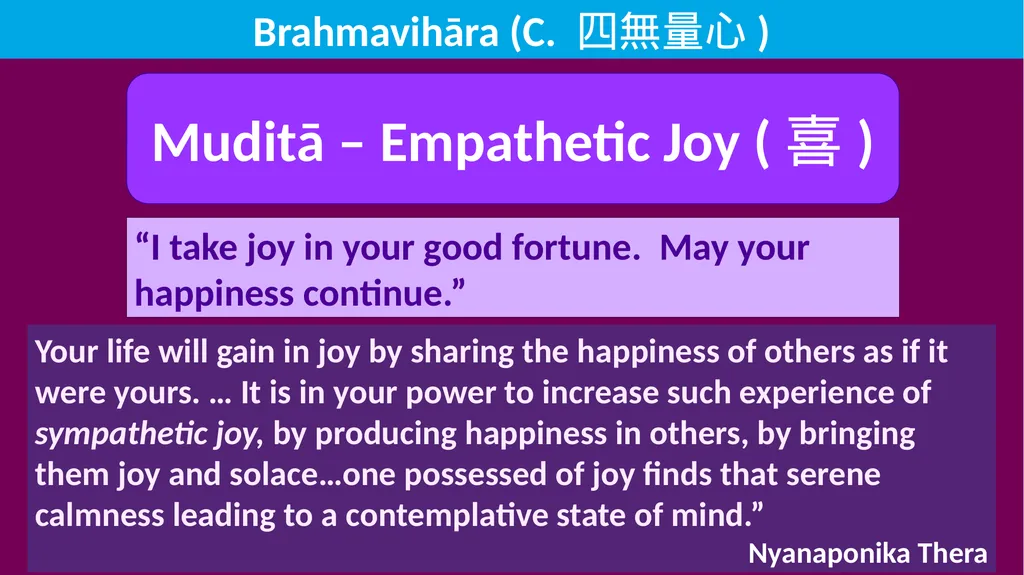
“I take joy in your good fortune. May your happiness continue.” Brahmavihāra (C. 四無量心) Muditā – Empathetic Joy (喜) Your life will gain in joy by sharing the happiness of others as if it were yours. … It is in your power to increase such experience of sympathetic joy, by producing happiness in others, by bringing them joy and solace…one possessed of joy finds that serene calmness leading to a contemplative state of mind.”
Nyanaponika Thera<br>
Nyanaponika Thera<br>
29
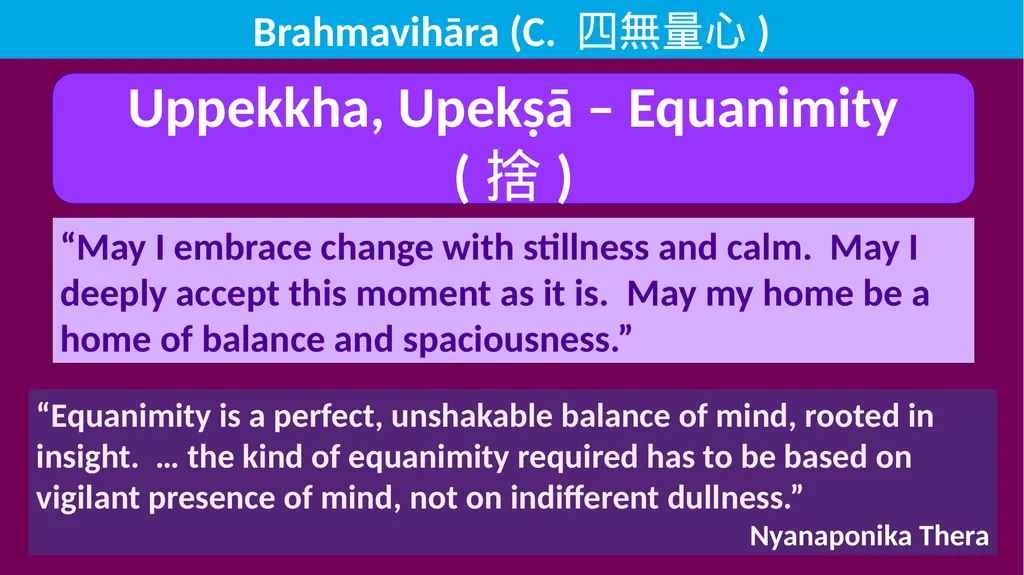
“May I embrace change with stillness and calm. May I deeply accept this moment as it is. May my home be a home of balance and spaciousness.” Brahmavihāra (C. 四無量心) Uppekkha, Upekṣā – Equanimity (捨) “Equanimity is a perfect, unshakable balance of mind, rooted in insight. … the kind of equanimity required has to be based on vigilant presence of mind, not on indifferent dullness.”
Nyanaponika Thera<br>
Nyanaponika Thera<br>
30
Brahmavihāra (C. 四無量心) Uppekkha, Upekṣā – Equanimity (捨) Karma – the various experiences we undergo result from our actions in thought, word, and deed performed in this life and in previous lives. Knowing this we can:
Take refuge from our fear by concentrating on confidence in good deeds in the past.
Summon the courage to perform more good deeds right now, despite the discouraging hardships of our present life
Nyanaponika Thera Two insights needed for equanimity<br>
Take refuge from our fear by concentrating on confidence in good deeds in the past.
Summon the courage to perform more good deeds right now, despite the discouraging hardships of our present life
Nyanaponika Thera Two insights needed for equanimity<br>
31
Brahmavihāra (C. 四無量心) Uppekkha, Upekṣā – Equanimity (捨) No-Self – … in the ultimate sense deeds are not performed by any self, nor do their results affect any self. … It is the delusion of a self that creates suffering and hinders or disturbs equanimity. If this or that quality of ours is blamed, one thinks: "I am blamed" and equanimity is shaken. If this or that work does not succeed, one thinks: "My work has failed and equanimity is shaken. If wealth or loved ones are lost, one thinks: "What is mine has gone" and equanimity is shaken. … To the degree we forsake thoughts of "mine" or "self"' equanimity will enter our hearts. Nyanaponika Thera Two insights needed for equanimity<br>
32
May all beings be happy and free of suffering. May they achieve enlightenment in this lifetime.<br>