
Nr. 1 05-10-2015 Maintaining and increasing
TA
Published · 24 slides · 0 views

1 / 1
Description
Nr. 1 05-10-2015 Maintaining and increasing proficiency in- and outside the classroom using IT tools: a look at electronic flashcards, serious gaming and app-based military wordlists Kristian Kolding, Kåre Kildevang-Jakobsen Allan Juhl
Related Topics
Share
Embed code
Download this presentation From Below
"Nr. 1 05-10-2015 Maintaining and increasing" is the property of its rightful owner. Permission is granted to download and print the materials on this website for personal, non-commercial use only, and to display it on your personal computer provided you do not modify the materials and that you retain all copyright notices contained in the materials. By downloading content from our website, you accept the terms of this agreement.
Presentation Transcript
01
Nr. 1 05-10-2015 Maintaining and increasing proficiency in- and outside the classroom using IT tools:
a look at electronic flashcards, serious gaming and app-based military wordlists
Kristian Kolding, Kåre Kildevang-Jakobsen & Allan Juhl Kristensen
Dept. of Languages and Cultures
Royal Danish Defence College (RDDC)<br>
a look at electronic flashcards, serious gaming and app-based military wordlists
Kristian Kolding, Kåre Kildevang-Jakobsen & Allan Juhl Kristensen
Dept. of Languages and Cultures
Royal Danish Defence College (RDDC)<br>
02
Nr. 2 05-10-2015 Technology and Language Learning aT RDDC BILC SEMINAR Demonstrate ways that the Dept. of Languages and Cultures is trying to use technology to enhance language learning in the face of:
a dictate that learning, including language learning, increasingly take place as blended and distance learning;
a general requirement to acquire, maintain and improve L2 MIL proficiency throughout military careers;
a need for easily acessible learning materials for self-directed study;
a professional conviction that vocabulary matters in SLA.<br>
a dictate that learning, including language learning, increasingly take place as blended and distance learning;
a general requirement to acquire, maintain and improve L2 MIL proficiency throughout military careers;
a need for easily acessible learning materials for self-directed study;
a professional conviction that vocabulary matters in SLA.<br>
03
Nr. 3 05-10-2015 Vocabulary and SLA BILC SEMINAR Increased attention within Second Language Acquisition (SLA) teaching and research to the relevance and importance of vocabulary/lexis since the mid-90s (Coady & Huckin (1997); Ellis (1997); Lewis (1993)):
‘…the ability to refer to concrete and conceptual entities is as fundamental to language as is the capacity provided by grammar to relate such entities to one another. Knowledge of a language [in our case the military domain] demands mastery of its vocabulary as much as of its grammar…’ (Wilkins, 1974)<br>
‘…the ability to refer to concrete and conceptual entities is as fundamental to language as is the capacity provided by grammar to relate such entities to one another. Knowledge of a language [in our case the military domain] demands mastery of its vocabulary as much as of its grammar…’ (Wilkins, 1974)<br>
04
Nr. 4 05-10-2015 Vocabulary and SLA cont’d BILC SEMINAR Vocabulary in the systemic lexical sense of words, phrases, chunks, collocations, formulaic sequences etc. is crucial to both communication and comprehension in a military context (cf. STANAG 6001), including interpreting and translation.
‘acquisition of a word’s semantic and conceptual properties, and the mapping of word form labels onto meaning representations, result from conscious (or explict) learning processes.’ (Ellis, 1997)
Vocabulary needs to be explicitly taught and learned (intentional/incidental); it will not develop quickly enough through simple exposure to written or spoken language. (Folse, 2004)<br>
‘acquisition of a word’s semantic and conceptual properties, and the mapping of word form labels onto meaning representations, result from conscious (or explict) learning processes.’ (Ellis, 1997)
Vocabulary needs to be explicitly taught and learned (intentional/incidental); it will not develop quickly enough through simple exposure to written or spoken language. (Folse, 2004)<br>
05
Nr. 5 05-10-2015 Learners & USERS BILC SEMINAR 1) Language Officer/Military Linguists programme (Arabic, Persian, Russian)
2) English courses at officer academies and junior staff course level.
3) French courses to meet operational demands for linguists and officers
4) Language support across the armed forces (reference works)<br>
2) English courses at officer academies and junior staff course level.
3) French courses to meet operational demands for linguists and officers
4) Language support across the armed forces (reference works)<br>
06
Nr. 6 05-10-2015 Learners’ needs BILC SEMINAR Proficiency levels: beginner-expert
Aims/ambitions: functional-expert; general-military
Circumstances: from round-the-clock language learners on Language Officer programme to part-time distance learning alongside active duty for junior officers
Motivation: from live-and-breathe languages among Language Officer cadets to junior officer’s need to pass exam to gain promotion/career progression<br>
Aims/ambitions: functional-expert; general-military
Circumstances: from round-the-clock language learners on Language Officer programme to part-time distance learning alongside active duty for junior officers
Motivation: from live-and-breathe languages among Language Officer cadets to junior officer’s need to pass exam to gain promotion/career progression<br>
07
Nr. 7 05-10-2015 common ground BILC SEMINAR Overarching requirement to acquire, maintain and improve L2 MIL proficiency throughout military careers
Dictate that learning, including language learning, increasingly takes place as blended and distance learning
L2 for military purposes = a domain with its own distinct vocabulary (as well as genres, text types, idioms etc.)
L2 MIL for both study and active duty whether in staff or operations<br>
Dictate that learning, including language learning, increasingly takes place as blended and distance learning
L2 for military purposes = a domain with its own distinct vocabulary (as well as genres, text types, idioms etc.)
L2 MIL for both study and active duty whether in staff or operations<br>
08
Nr. 8 05-10-2015 Technology tools - characteristics BILC SEMINAR Demonstrate ways that mobile technologies in the shape of flashcards, e-word lists and an app game may facilitate and support the language (vocabulary) learning process for learners:
structured, learner-centred materials and resources that allow learners to work on their own and encourage a greater degree of learner autonomy;
interactive, individualised and self-directed learning;
reinforce what students are working on or have already been exposed to in the classroom;
remedial tools to help learners refresh and maintain their language proficiency;
reference tools for solving on-the-job tasks;
easily accessible and portable;
content developed for specific military purposes.<br>
structured, learner-centred materials and resources that allow learners to work on their own and encourage a greater degree of learner autonomy;
interactive, individualised and self-directed learning;
reinforce what students are working on or have already been exposed to in the classroom;
remedial tools to help learners refresh and maintain their language proficiency;
reference tools for solving on-the-job tasks;
easily accessible and portable;
content developed for specific military purposes.<br>
09
ROYAL DANISH DEFENCE COLLEGE Department of Languages and Cultures<br>
10
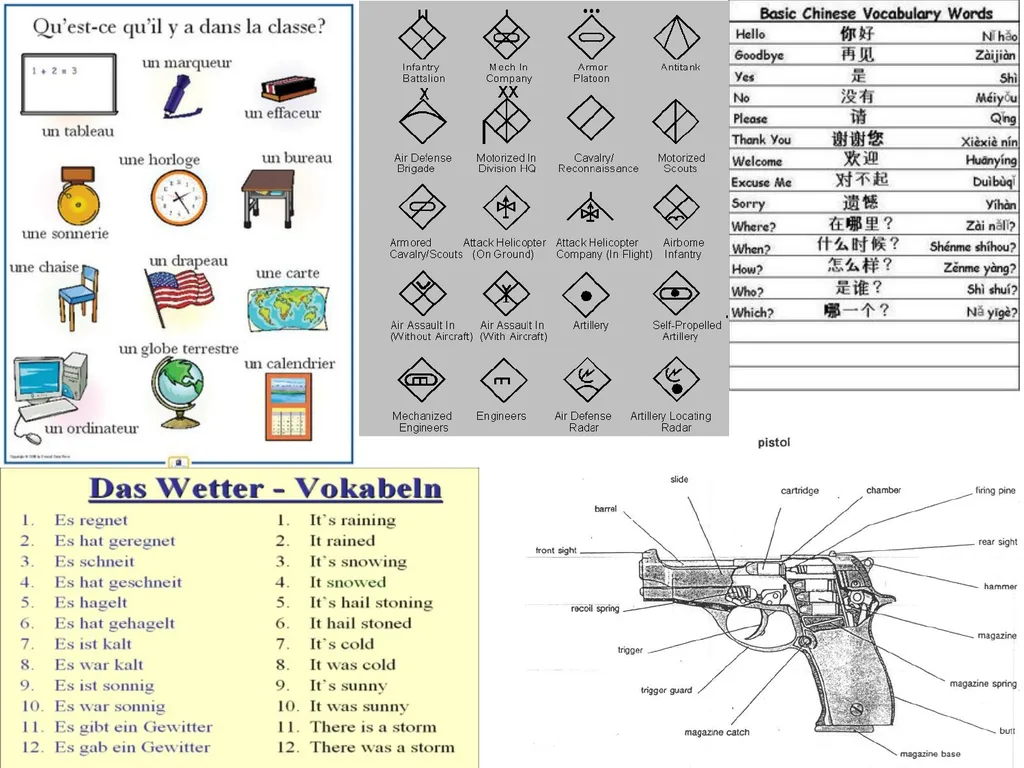
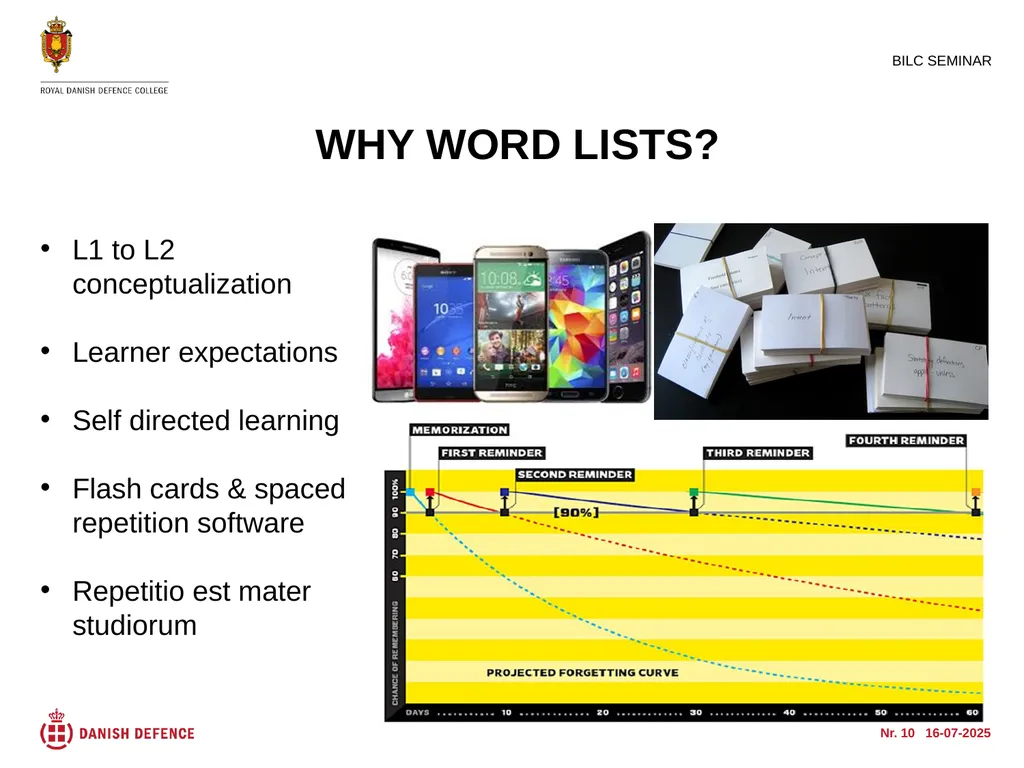
Nr. 10 05-10-2015 why Word lists? BILC SEMINAR L1 to L2 conceptualization
Learner expectations
Self directed learning
Flash cards & spaced repetition software
Repetitio est mater studiorum<br>
Learner expectations
Self directed learning
Flash cards & spaced repetition software
Repetitio est mater studiorum<br>
11
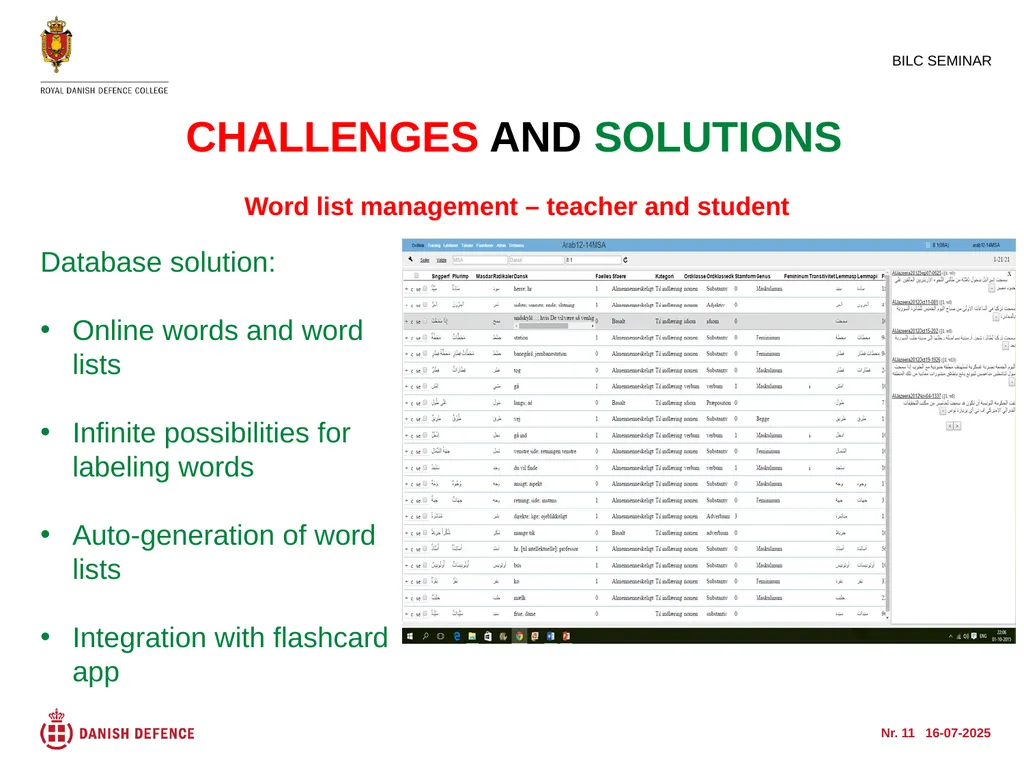
Nr. 11 05-10-2015 Challenges and solutions BILC SEMINAR Database solution:
Online words and word lists
Infinite possibilities for labeling words
Auto-generation of word lists
Integration with flashcard app Word list management – teacher and student<br>
Online words and word lists
Infinite possibilities for labeling words
Auto-generation of word lists
Integration with flashcard app Word list management – teacher and student<br>
12
Nr. 12 05-10-2015 NATO task verbs in RDMA English classes (STANAG 2287 ed 1) Three aims:
- introduce, practice, and consolidate essential orders terminology
- increase awareness of NATO task verbs vs national lexicons
- complement reading and understanding of UK/US army FMs<br>
- introduce, practice, and consolidate essential orders terminology
- increase awareness of NATO task verbs vs national lexicons
- complement reading and understanding of UK/US army FMs<br>
13
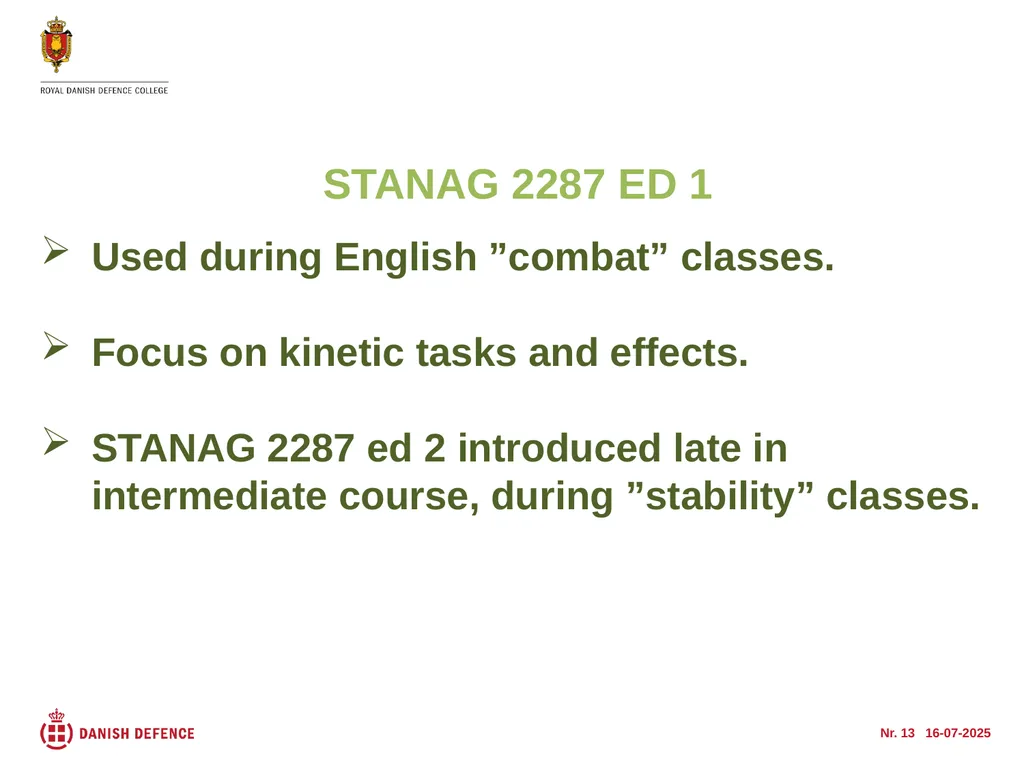
Nr. 13 05-10-2015 STANAG 2287 ed 1 Used during English ”combat” classes.
Focus on kinetic tasks and effects.
STANAG 2287 ed 2 introduced late in intermediate course, during ”stability” classes.<br>
Focus on kinetic tasks and effects.
STANAG 2287 ed 2 introduced late in intermediate course, during ”stability” classes.<br>
14
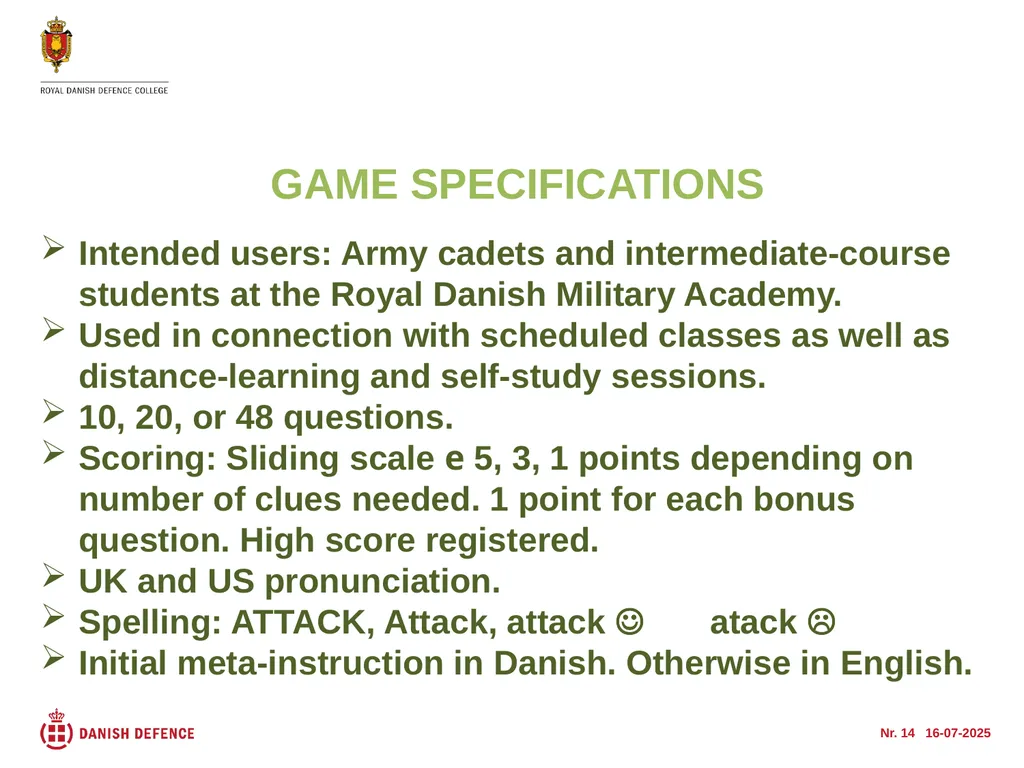
Nr. 14 05-10-2015 Game specifications Intended users: Army cadets and intermediate-course students at the Royal Danish Military Academy.
Used in connection with scheduled classes as well as distance-learning and self-study sessions.
10, 20, or 48 questions.
Scoring: Sliding scale e 5, 3, 1 points depending on number of clues needed. 1 point for each bonus question. High score registered.
UK and US pronunciation.
Spelling: ATTACK, Attack, attack atack
Initial meta-instruction in Danish. Otherwise in English.<br>
Used in connection with scheduled classes as well as distance-learning and self-study sessions.
10, 20, or 48 questions.
Scoring: Sliding scale e 5, 3, 1 points depending on number of clues needed. 1 point for each bonus question. High score registered.
UK and US pronunciation.
Spelling: ATTACK, Attack, attack atack
Initial meta-instruction in Danish. Otherwise in English.<br>
15
Nr. 15 05-10-2015 The task-verb game http://www.fels.dk/spil/<br>
16
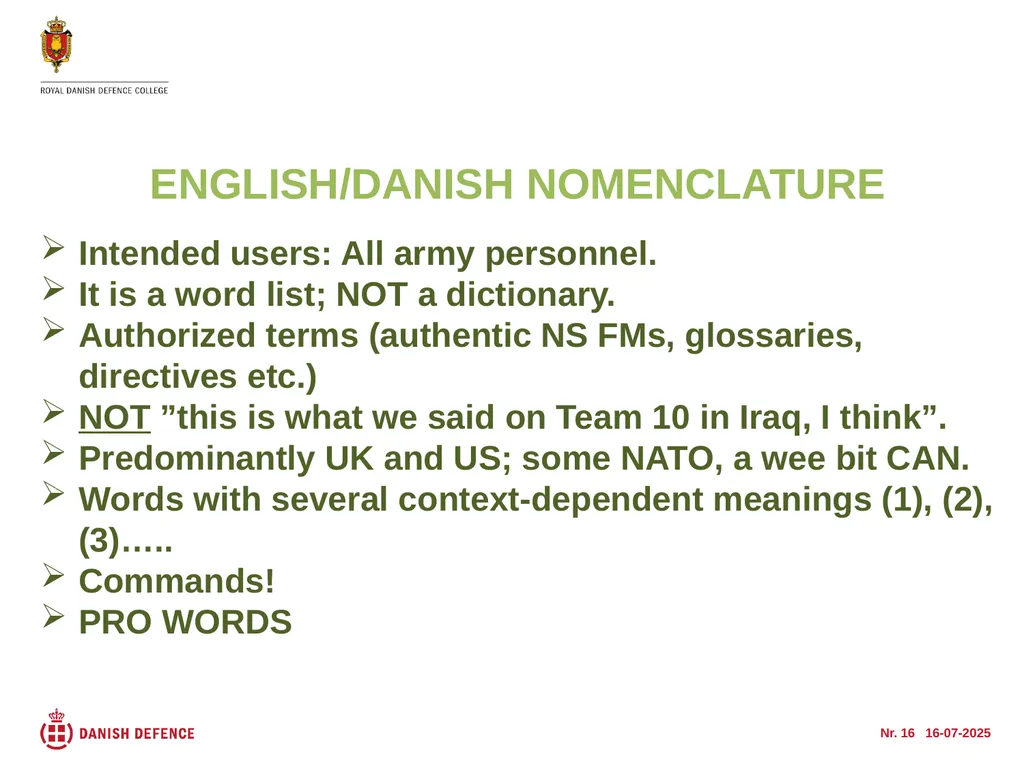
Nr. 16 05-10-2015 English/Danish nomenclature Intended users: All army personnel.
It is a word list; NOT a dictionary.
Authorized terms (authentic NS FMs, glossaries, directives etc.)
NOT ”this is what we said on Team 10 in Iraq, I think”.
Predominantly UK and US; some NATO, a wee bit CAN.
Words with several context-dependent meanings (1), (2), (3)…..
Commands!
PRO WORDS<br>
It is a word list; NOT a dictionary.
Authorized terms (authentic NS FMs, glossaries, directives etc.)
NOT ”this is what we said on Team 10 in Iraq, I think”.
Predominantly UK and US; some NATO, a wee bit CAN.
Words with several context-dependent meanings (1), (2), (3)…..
Commands!
PRO WORDS<br>
17
Nr. 17 05-10-2015 Army tactical terms http://dfo.fels.dk/<br>
18
A battle of words
developing a naval battle quiz
http://quizspil.fels.dk/ Nr. 18 05-10-2015<br>
developing a naval battle quiz
http://quizspil.fels.dk/ Nr. 18 05-10-2015<br>
19
Nr. 19 05-10-2015 Project goals build and retain core professional vocabulary among naval professionals
enable and encourage informal language learning outside formal training/education system currently in place in the Danish Defence/Navy
expand and consolidate general knowledge of naval culture and history<br>
enable and encourage informal language learning outside formal training/education system currently in place in the Danish Defence/Navy
expand and consolidate general knowledge of naval culture and history<br>
20
Nr. 20 05-10-2015 The case for vocabulary English is the (operational) language at sea and in NATO;
currently no structured maintenance/acquisition of vocabulary in RDN post Basic Officer Training;
as fluency and ability to express oneself in L2 grows, so does the need for productive vocabulary knowledge.<br>
currently no structured maintenance/acquisition of vocabulary in RDN post Basic Officer Training;
as fluency and ability to express oneself in L2 grows, so does the need for productive vocabulary knowledge.<br>
21
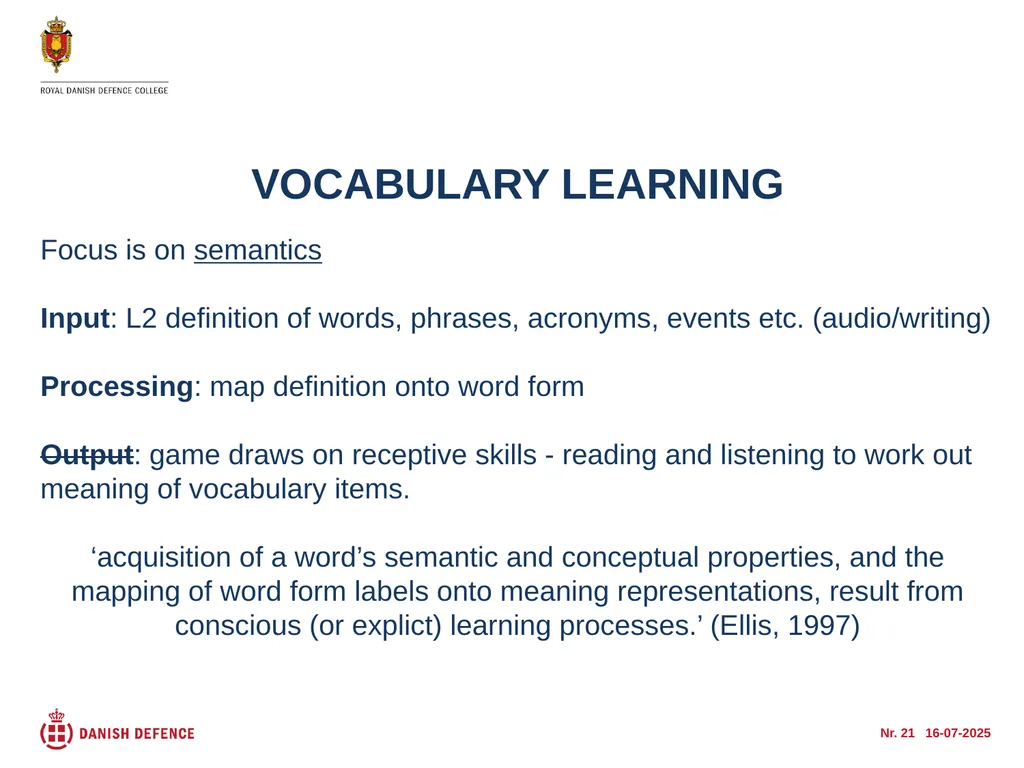
Nr. 21 05-10-2015 Vocabulary learning Focus is on semantics
Input: L2 definition of words, phrases, acronyms, events etc. (audio/writing)
Processing: map definition onto word form
Output: game draws on receptive skills - reading and listening to work out meaning of vocabulary items.
‘acquisition of a word’s semantic and conceptual properties, and the mapping of word form labels onto meaning representations, result from conscious (or explict) learning processes.’ (Ellis, 1997)<br>
Input: L2 definition of words, phrases, acronyms, events etc. (audio/writing)
Processing: map definition onto word form
Output: game draws on receptive skills - reading and listening to work out meaning of vocabulary items.
‘acquisition of a word’s semantic and conceptual properties, and the mapping of word form labels onto meaning representations, result from conscious (or explict) learning processes.’ (Ellis, 1997)<br>
22
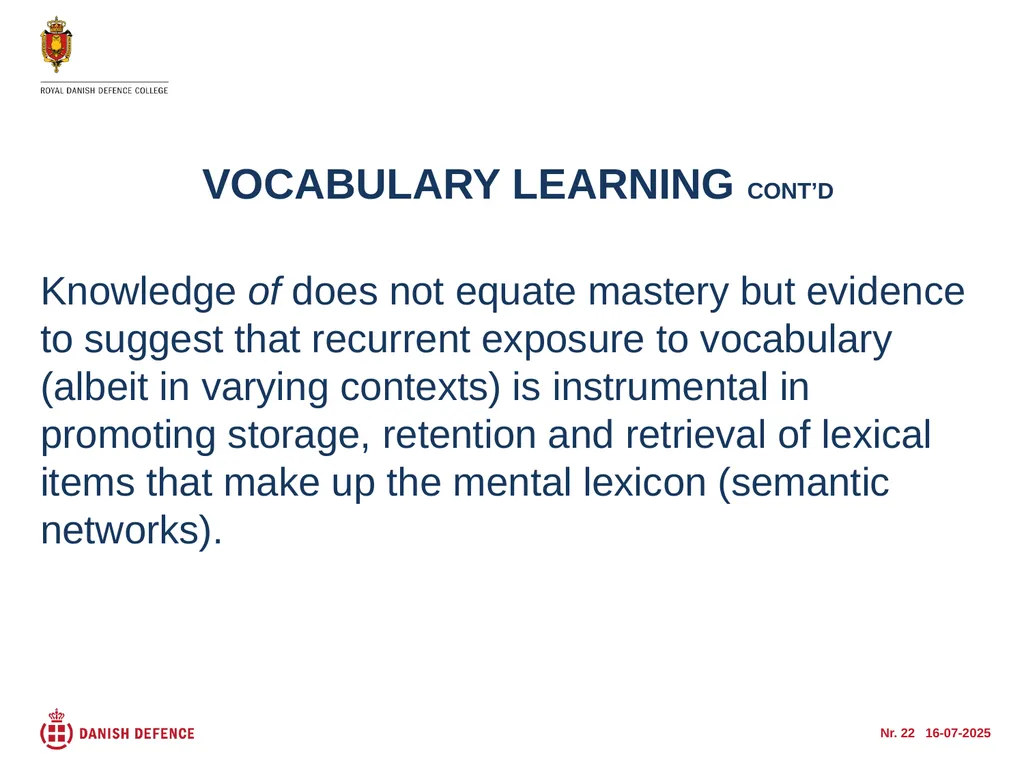
Nr. 22 05-10-2015 Vocabulary learning cont’d Knowledge of does not equate mastery but evidence to suggest that recurrent exposure to vocabulary (albeit in varying contexts) is instrumental in promoting storage, retention and retrieval of lexical items that make up the mental lexicon (semantic networks).<br>
23
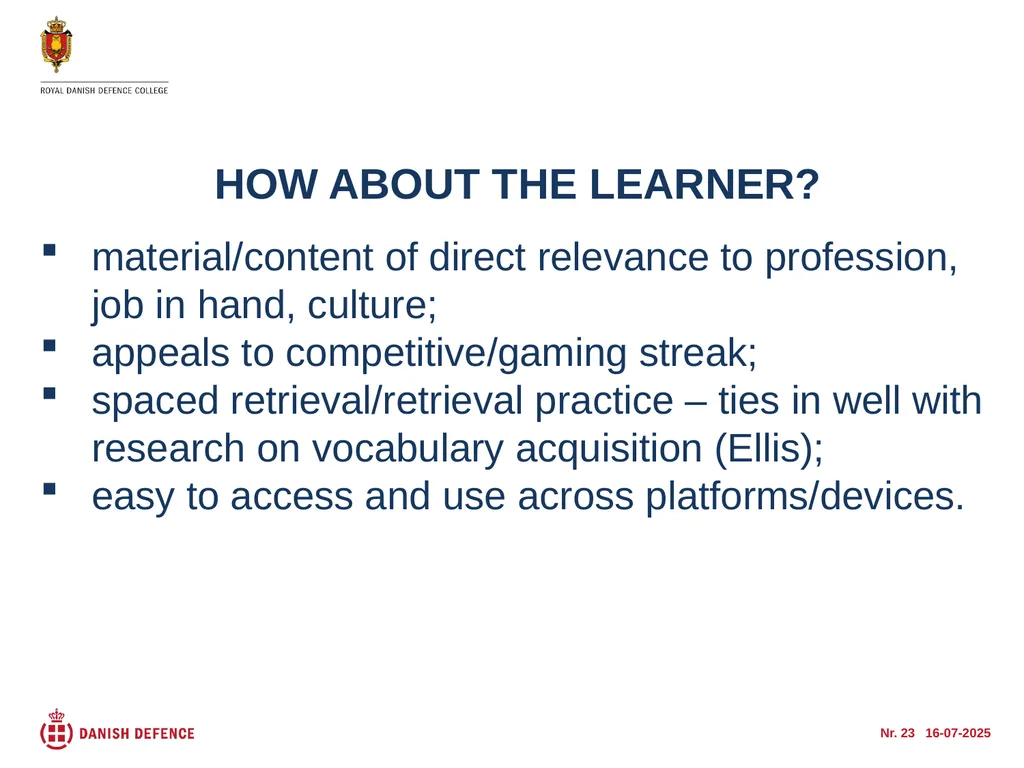
Nr. 23 05-10-2015 How about the learner? material/content of direct relevance to profession, job in hand, culture;
appeals to competitive/gaming streak;
spaced retrieval/retrieval practice – ties in well with research on vocabulary acquisition (Ellis);
easy to access and use across platforms/devices.<br>
appeals to competitive/gaming streak;
spaced retrieval/retrieval practice – ties in well with research on vocabulary acquisition (Ellis);
easy to access and use across platforms/devices.<br>
24
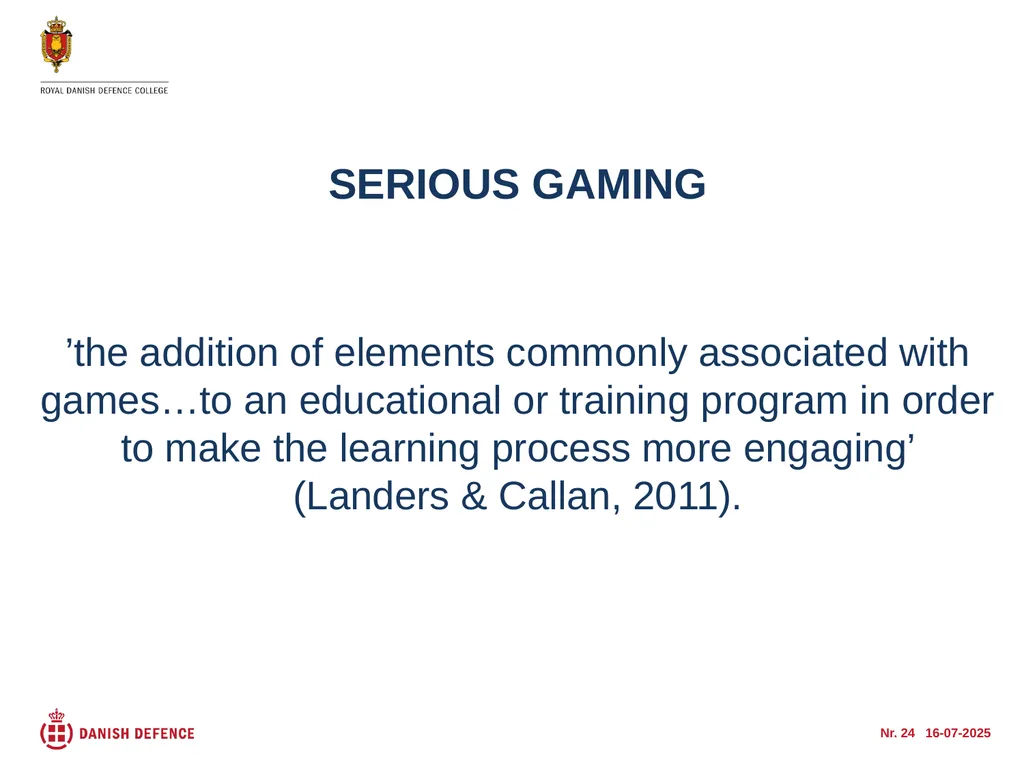
Nr. 24 05-10-2015 Serious gaming ’the addition of elements commonly associated with games…to an educational or training program in order to make the learning process more engaging’ (Landers & Callan, 2011).<br>