NSF GRFP FY 2025 Tim Dallas, PhD Associate Dean,
Description: NSF GRFP FY 2025 Tim Dallas, PhD Associate Dean, Graduate School Professor of Electrical and Computer Engineering The Why Student Research Funding Organization New Knowledge Trained Graduate Value Proposition Customer Graduate
Related Topics
Download Presentation
"NSF GRFP FY 2025 Tim Dallas, PhD Associate Dean," is the property of its rightful owner. Permission is granted to download and print the materials on this website for personal, non-commercial use only, and to display it on your personal computer provided you do not modify the materials and that you retain all copyright notices contained in the materials. By downloading content from our website, you accept the terms of this agreement.
Presentation Transcript
slide1. NSF GRFP
FY 2025 Tim Dallas, PhD
Associate Dean, Graduate School
Professor of Electrical and Computer Engineering<br>
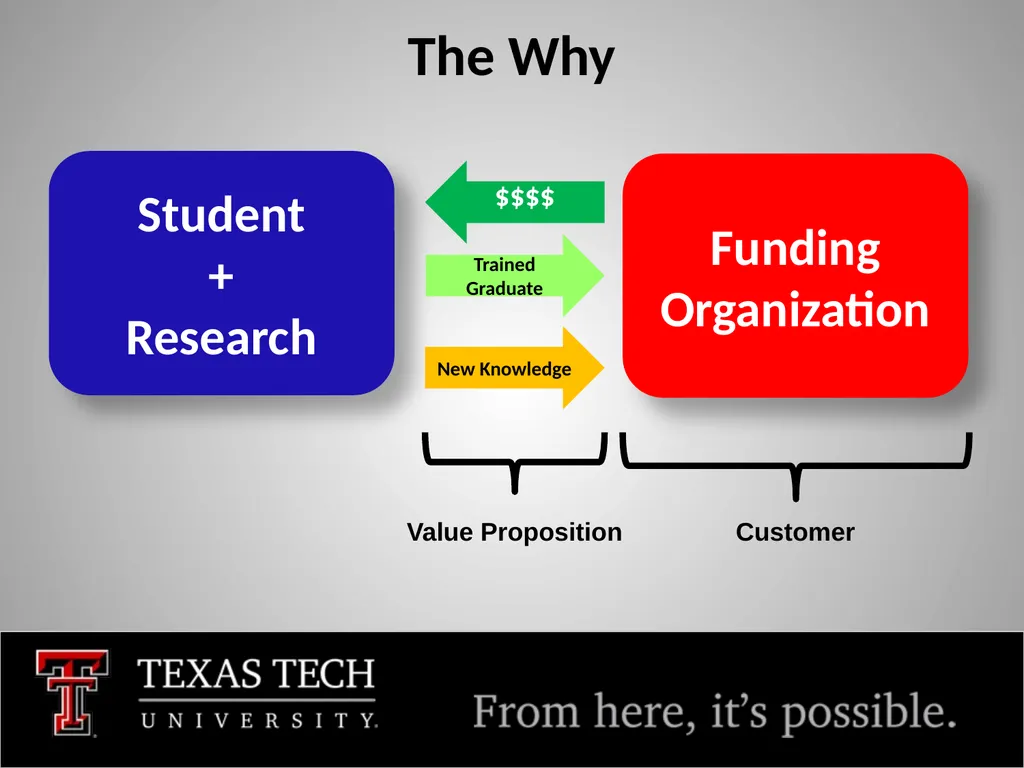
slide2. The Why Student
+
Research Funding Organization $$$$ New Knowledge Trained Graduate Value Proposition Customer<br>
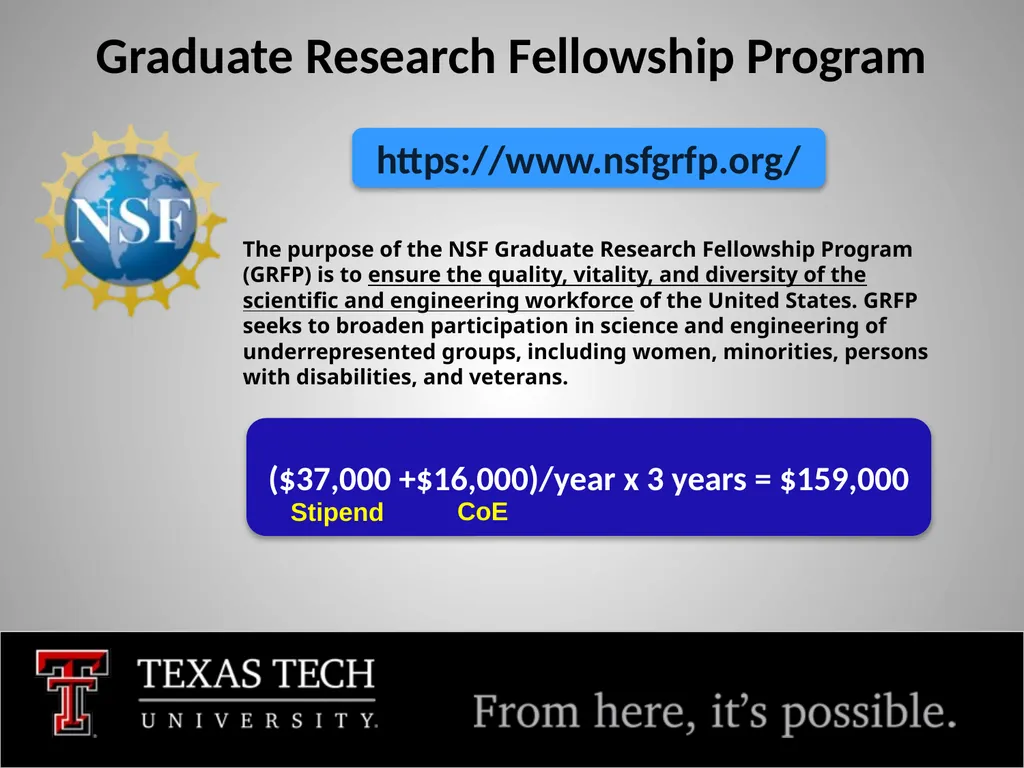
slide3. Graduate Research Fellowship Program https://www.nsfgrfp.org/ The purpose of the NSF Graduate Research Fellowship Program (GRFP) is to ensure the quality, vitality, and diversity of the scientific and engineering workforce of the United States. GRFP seeks to broaden participation in science and engineering of underrepresented groups, including women, minorities, persons with disabilities, and veterans.<br>
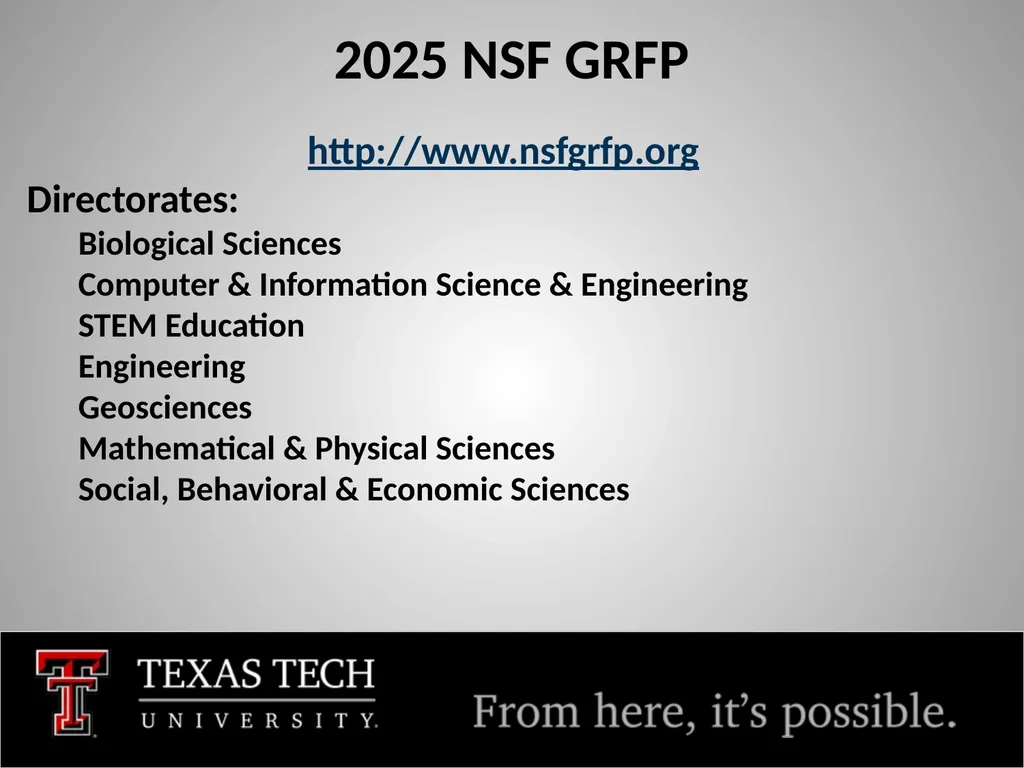
slide4. 2025 NSF GRFP http://www.nsfgrfp.org
Directorates:
Biological Sciences
Computer & Information Science & Engineering
STEM Education
Engineering
Geosciences
Mathematical & Physical Sciences
Social, Behavioral & Economic Sciences<br>
slide5. Eligibility Requirements:
Citizenship – US, nationals or permanent residents of the US
Degree Requirements (several)
Expected start date no later than Fall 2025
Senior year to second year of graduate school
No prior MS unless 2 year break in studies and not enrolled in a graduate school
Graduate study leading to research-based master’s and doctoral degrees in science and engineering. Review them all! NSF GRFP<br>
slide6. Program Information
Read and familiarize yourself with the GRFP Program Solicitation: https://www.nsf.gov/publications/pub_summ.jsp?WT.z_pims_id=6201&ods_key=nsf23605
Read and familiarize yourself with the GRFP application site: https://nsfgrfp.org/applicants/application-resources/ NSF GRFP<br>
slide7. NSF Submission Deadlines Fellowship Applications: October XX - XX, 2024
(varies by discipline)
Letters of Reference: October XX, 2024 [5:00 pm ET]<br>
slide8. NSF GRFP Applicants submit the following information:
Personal Information
Education and Other Experience
Field(s) of Study
Graduate School Information
Personal, Relevant Background and Future Goals Statement (3 pages max)
Graduate Research Plan Statement (2 pages max)
Eligibility Statement (extenuating circumstances)
Transcripts
Reference Letter writers (3) – must be strong<br>
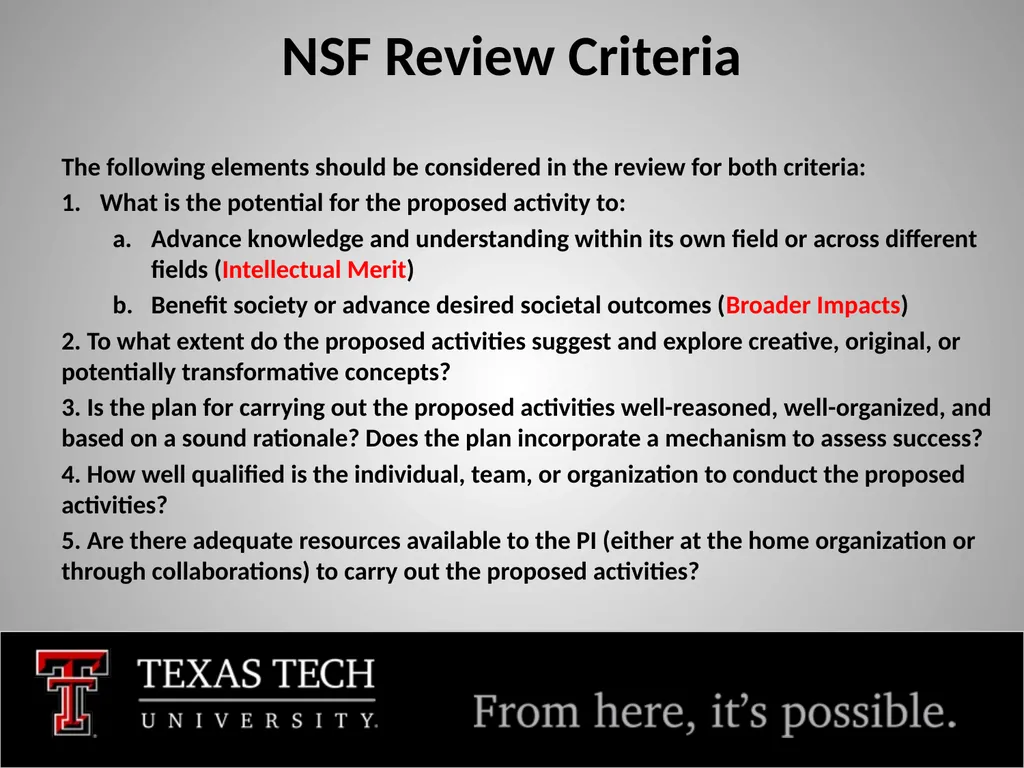
slide9. NSF Review Criteria The following elements should be considered in the review for both criteria:
What is the potential for the proposed activity to:
Advance knowledge and understanding within its own field or across different fields (Intellectual Merit)
Benefit society or advance desired societal outcomes (Broader Impacts)
2. To what extent do the proposed activities suggest and explore creative, original, or potentially transformative concepts?
3. Is the plan for carrying out the proposed activities well-reasoned, well-organized, and based on a sound rationale? Does the plan incorporate a mechanism to assess success?
4. How well qualified is the individual, team, or organization to conduct the proposed activities?
5. Are there adequate resources available to the PI (either at the home organization or through collaborations) to carry out the proposed activities?<br>
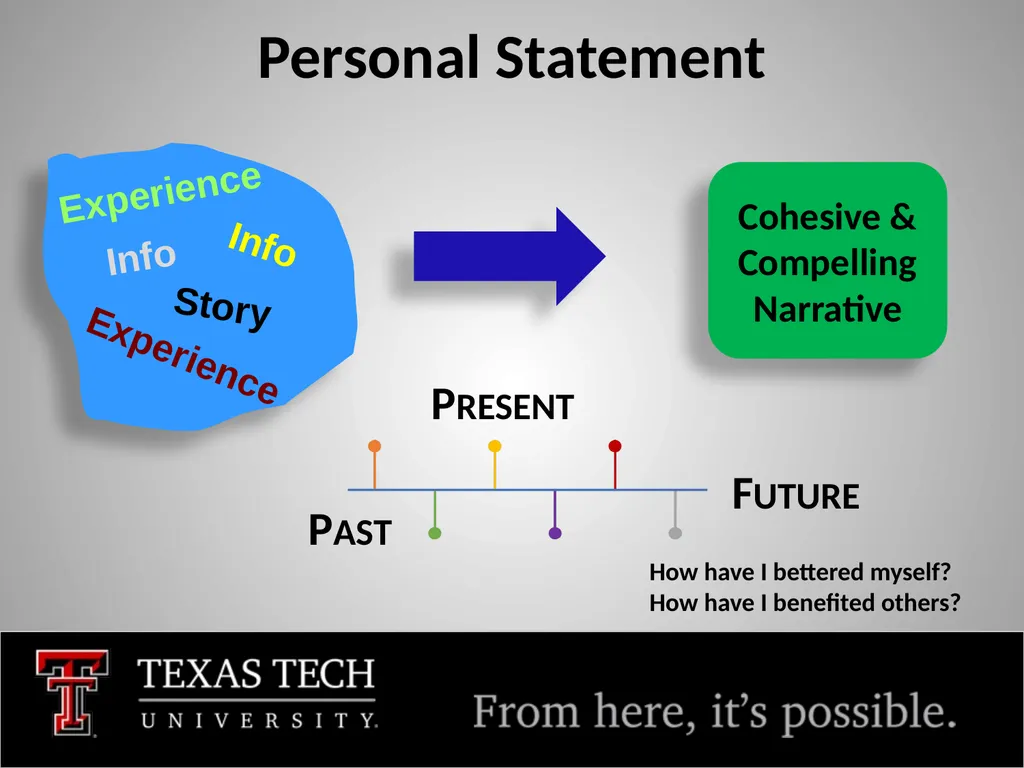
slide10. Info Story Cohesive & Compelling Narrative Info Experience Experience Past Present Future How have I bettered myself?How have I benefited others? Personal Statement<br>
slide11. In this section you are convincing the reviewers that you have the:
educational background
experience
leadership
motivation
other positive personal and professional characteristics to successfully carry out the research proposed Personal, Relevant Background and Future Goals<br>
slide12. Intellectual Merit
Why you?
What do you bring that will make you successful, a leader in your field?
Describe your previous research experience(s)
What did you contribute?
What did you learn (e.g., skills – experimental, software, hardware, inter-personal, etc.)?
Tie in your background (education and experiences) with what you plan to do (future goals). Personal, Relevant Background and Future Goals<br>
slide13. Broader Impacts
How did you, personally and/or through your past research, impact society beneficially?
Reviewers are impressed with what you ‘have done,’ rather than ‘will do.’
How do you plan to actively participate/give back to society?
Don’t exaggerate, be reasonable.
Have you had to overcome a unique challenge? Personal, Relevant Background and Future Goals<br>
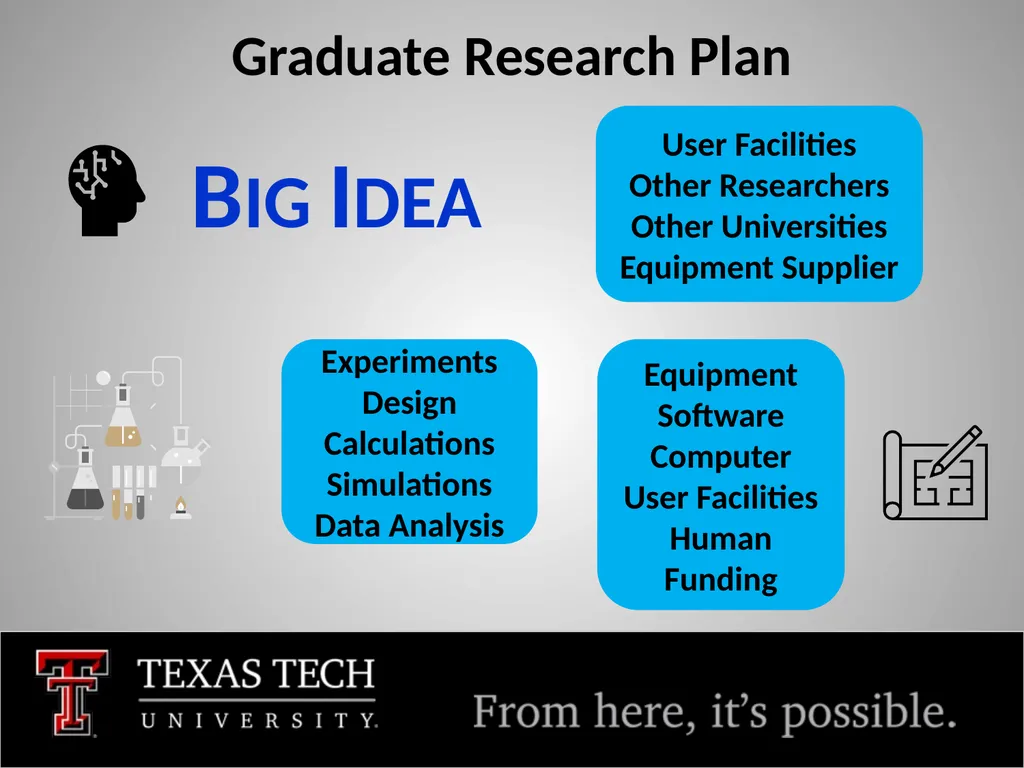
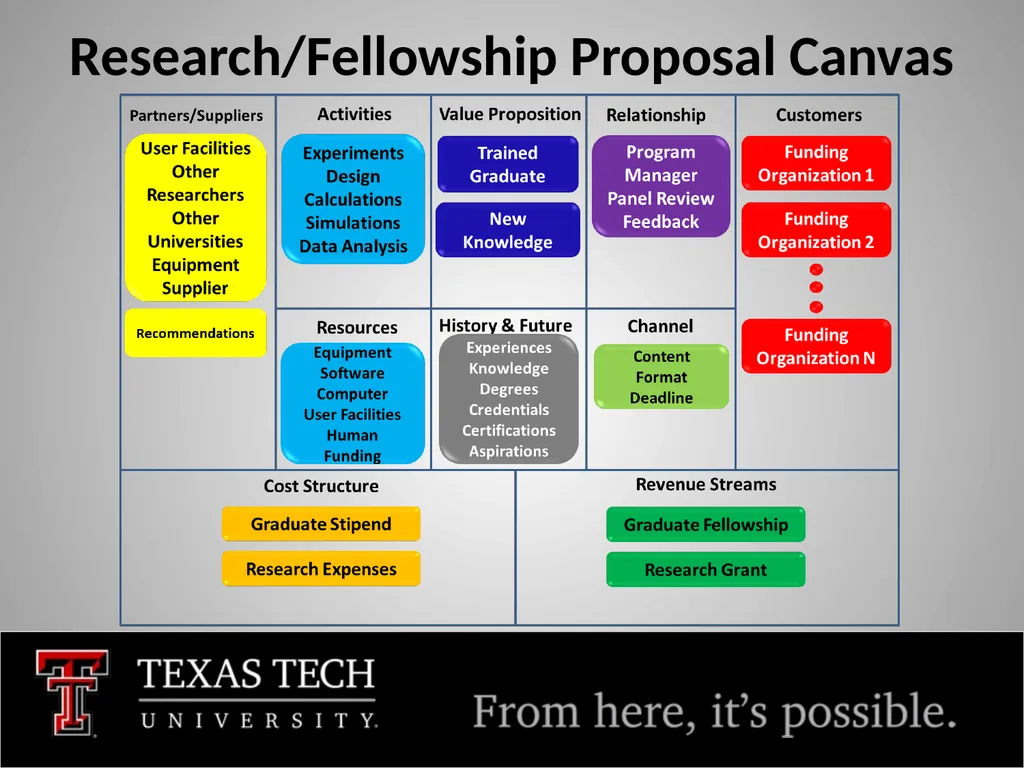
slide14. Graduate Research Plan Experiments
Design
Calculations
Simulations
Data Analysis Equipment
Software
Computer
User Facilities
Human
Funding User Facilities
Other Researchers
Other Universities
Equipment Supplier Big Idea<br>
slide15. Graduate Research Plan Statement Background
Topically relevant to the mission of NSF
Convey to reviewers that you know what has been done and the significance of the work proposed
Do your homework (i.e., literature review)
What is considered state-of-the-art or current thinking?
What is your motivation for performing the research?
Are there important benchmarks to be surpassed?
Why is this research important?<br>
slide16. Graduate Research Plan Statement Intellectual Merit
What is significant about the proposed research?
What problem will it solve?
How will it advance knowledge?
How will it impact science/engineering?
You are trying to convince a review panel of experts, though not necessarily in the area you are proposing, that your research area is important enough to award you money.<br>
slide17. Graduate Research Plan Statement Broader Impacts
You need to convince a panel that the proposed research will impact society and that you will impact society. Be reasonable and realistic.
Consider:
full participation of women, persons with disabilities, and underrepresented minorities in science, technology, engineering, and mathematics (STEM);
improved STEM education and educator development at any level;
increased public scientific literacy and public engagement with science and technology;
improved well-being of individuals in society;
development of a diverse, globally competitive STEM workforce;
applications of research
increased partnerships between academia, industry, and others;
improved national security;
increased economic competitiveness of the US; and
enhanced infrastructure for research and education<br>
slide18. Graduate Research Plan Statement Other suggestions:
Make the proposal easy to read with clearly defined sections.
Include a brief plan for accomplishing the research.
Divide the work into phases and describe the work to be performed in each phase (timeframe).<br>
slide19. Research/Fellowship Proposal Canvas<br>
slide20. Reference Letters Three reference letters required.
Important to ask someone who knows you well enough that they can cite specific examples of your work and/or personal characteristics that support your proposal
Ask for letters well in advance - Professors, Intern and Coop Supervisors, Research Supervisors
Provide a brief synopsis (no more than a couple of pages) of yourself to your references
Personal and academic achievements
Activities your references would not be aware of that support your personal characteristics and goals<br>

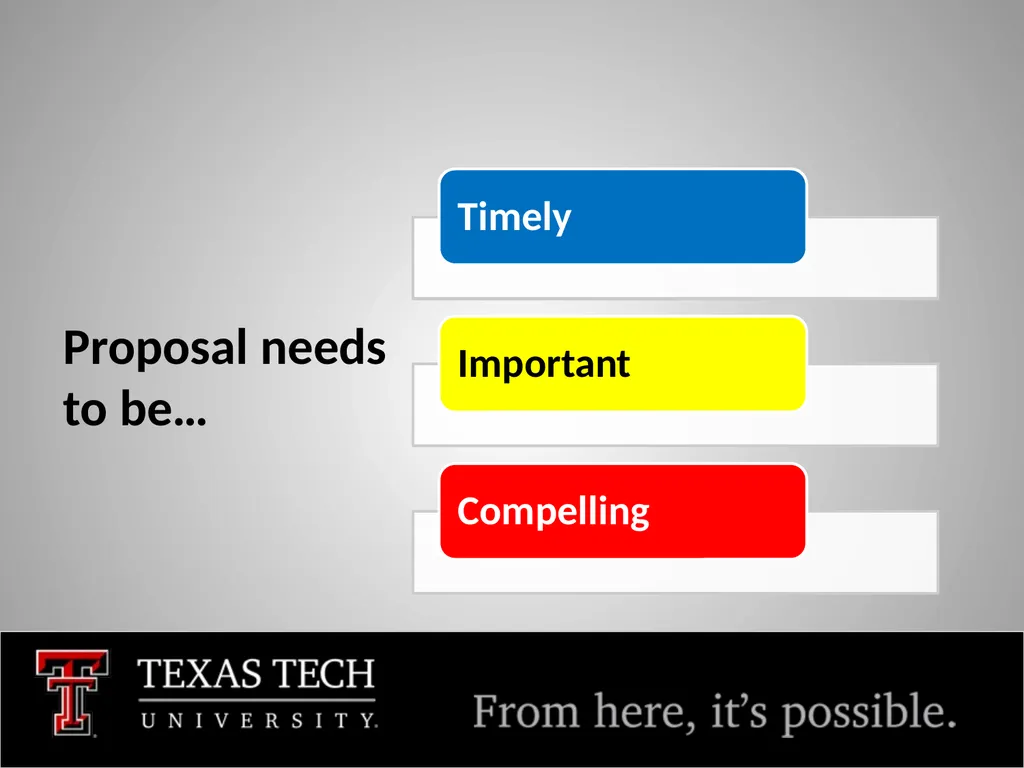
slide21. Proposal needs to be…<br>
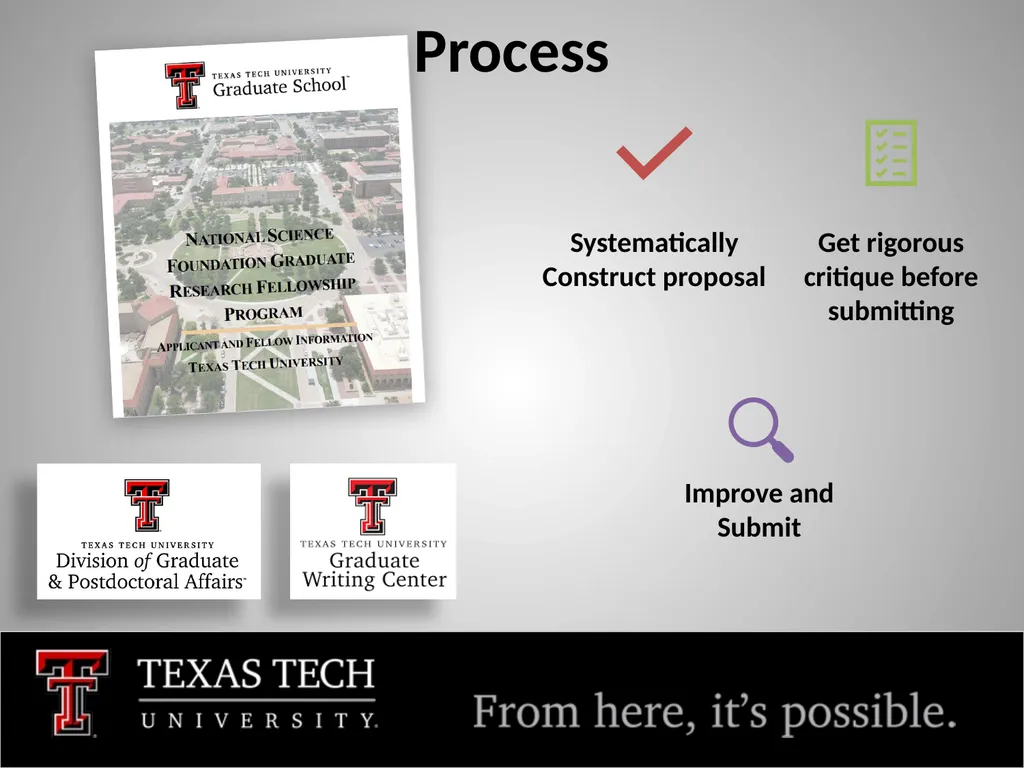
slide22. Process<br>
slide23. Tim.Dallas@ttu.edu<br>
FY 2025 Tim Dallas, PhD
Associate Dean, Graduate School
Professor of Electrical and Computer Engineering<br>
slide2. The Why Student
+
Research Funding Organization $$$$ New Knowledge Trained Graduate Value Proposition Customer<br>
slide3. Graduate Research Fellowship Program https://www.nsfgrfp.org/ The purpose of the NSF Graduate Research Fellowship Program (GRFP) is to ensure the quality, vitality, and diversity of the scientific and engineering workforce of the United States. GRFP seeks to broaden participation in science and engineering of underrepresented groups, including women, minorities, persons with disabilities, and veterans.<br>
slide4. 2025 NSF GRFP http://www.nsfgrfp.org
Directorates:
Biological Sciences
Computer & Information Science & Engineering
STEM Education
Engineering
Geosciences
Mathematical & Physical Sciences
Social, Behavioral & Economic Sciences<br>
slide5. Eligibility Requirements:
Citizenship – US, nationals or permanent residents of the US
Degree Requirements (several)
Expected start date no later than Fall 2025
Senior year to second year of graduate school
No prior MS unless 2 year break in studies and not enrolled in a graduate school
Graduate study leading to research-based master’s and doctoral degrees in science and engineering. Review them all! NSF GRFP<br>
slide6. Program Information
Read and familiarize yourself with the GRFP Program Solicitation: https://www.nsf.gov/publications/pub_summ.jsp?WT.z_pims_id=6201&ods_key=nsf23605
Read and familiarize yourself with the GRFP application site: https://nsfgrfp.org/applicants/application-resources/ NSF GRFP<br>
slide7. NSF Submission Deadlines Fellowship Applications: October XX - XX, 2024
(varies by discipline)
Letters of Reference: October XX, 2024 [5:00 pm ET]<br>
slide8. NSF GRFP Applicants submit the following information:
Personal Information
Education and Other Experience
Field(s) of Study
Graduate School Information
Personal, Relevant Background and Future Goals Statement (3 pages max)
Graduate Research Plan Statement (2 pages max)
Eligibility Statement (extenuating circumstances)
Transcripts
Reference Letter writers (3) – must be strong<br>
slide9. NSF Review Criteria The following elements should be considered in the review for both criteria:
What is the potential for the proposed activity to:
Advance knowledge and understanding within its own field or across different fields (Intellectual Merit)
Benefit society or advance desired societal outcomes (Broader Impacts)
2. To what extent do the proposed activities suggest and explore creative, original, or potentially transformative concepts?
3. Is the plan for carrying out the proposed activities well-reasoned, well-organized, and based on a sound rationale? Does the plan incorporate a mechanism to assess success?
4. How well qualified is the individual, team, or organization to conduct the proposed activities?
5. Are there adequate resources available to the PI (either at the home organization or through collaborations) to carry out the proposed activities?<br>
slide10. Info Story Cohesive & Compelling Narrative Info Experience Experience Past Present Future How have I bettered myself?How have I benefited others? Personal Statement<br>
slide11. In this section you are convincing the reviewers that you have the:
educational background
experience
leadership
motivation
other positive personal and professional characteristics to successfully carry out the research proposed Personal, Relevant Background and Future Goals<br>
slide12. Intellectual Merit
Why you?
What do you bring that will make you successful, a leader in your field?
Describe your previous research experience(s)
What did you contribute?
What did you learn (e.g., skills – experimental, software, hardware, inter-personal, etc.)?
Tie in your background (education and experiences) with what you plan to do (future goals). Personal, Relevant Background and Future Goals<br>
slide13. Broader Impacts
How did you, personally and/or through your past research, impact society beneficially?
Reviewers are impressed with what you ‘have done,’ rather than ‘will do.’
How do you plan to actively participate/give back to society?
Don’t exaggerate, be reasonable.
Have you had to overcome a unique challenge? Personal, Relevant Background and Future Goals<br>
slide14. Graduate Research Plan Experiments
Design
Calculations
Simulations
Data Analysis Equipment
Software
Computer
User Facilities
Human
Funding User Facilities
Other Researchers
Other Universities
Equipment Supplier Big Idea<br>
slide15. Graduate Research Plan Statement Background
Topically relevant to the mission of NSF
Convey to reviewers that you know what has been done and the significance of the work proposed
Do your homework (i.e., literature review)
What is considered state-of-the-art or current thinking?
What is your motivation for performing the research?
Are there important benchmarks to be surpassed?
Why is this research important?<br>
slide16. Graduate Research Plan Statement Intellectual Merit
What is significant about the proposed research?
What problem will it solve?
How will it advance knowledge?
How will it impact science/engineering?
You are trying to convince a review panel of experts, though not necessarily in the area you are proposing, that your research area is important enough to award you money.<br>
slide17. Graduate Research Plan Statement Broader Impacts
You need to convince a panel that the proposed research will impact society and that you will impact society. Be reasonable and realistic.
Consider:
full participation of women, persons with disabilities, and underrepresented minorities in science, technology, engineering, and mathematics (STEM);
improved STEM education and educator development at any level;
increased public scientific literacy and public engagement with science and technology;
improved well-being of individuals in society;
development of a diverse, globally competitive STEM workforce;
applications of research
increased partnerships between academia, industry, and others;
improved national security;
increased economic competitiveness of the US; and
enhanced infrastructure for research and education<br>
slide18. Graduate Research Plan Statement Other suggestions:
Make the proposal easy to read with clearly defined sections.
Include a brief plan for accomplishing the research.
Divide the work into phases and describe the work to be performed in each phase (timeframe).<br>
slide19. Research/Fellowship Proposal Canvas<br>
slide20. Reference Letters Three reference letters required.
Important to ask someone who knows you well enough that they can cite specific examples of your work and/or personal characteristics that support your proposal
Ask for letters well in advance - Professors, Intern and Coop Supervisors, Research Supervisors
Provide a brief synopsis (no more than a couple of pages) of yourself to your references
Personal and academic achievements
Activities your references would not be aware of that support your personal characteristics and goals<br>
slide21. Proposal needs to be…<br>
slide22. Process<br>
slide23. Tim.Dallas@ttu.edu<br>