03
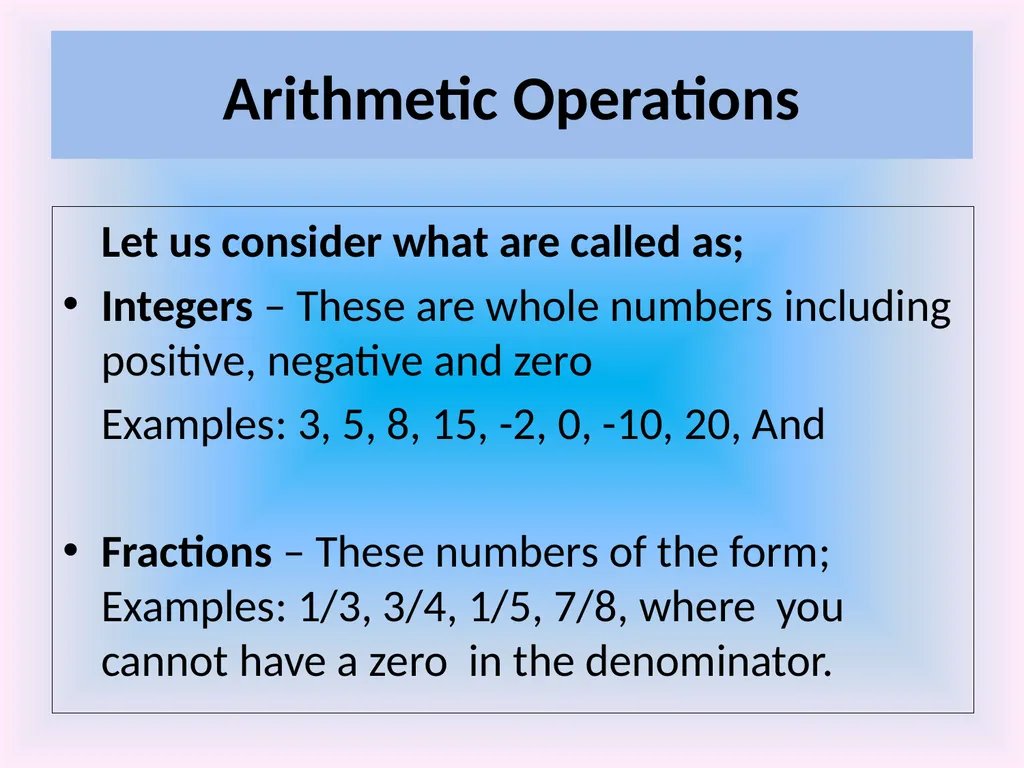
Arithmetic Operations Let us consider what are called as;
Integers – These are whole numbers including positive, negative and zero
Examples: 3, 5, 8, 15, -2, 0, -10, 20, And
Fractions – These numbers of the form; Examples: 1/3, 3/4, 1/5, 7/8, where you cannot have a zero in the denominator.<br>
04
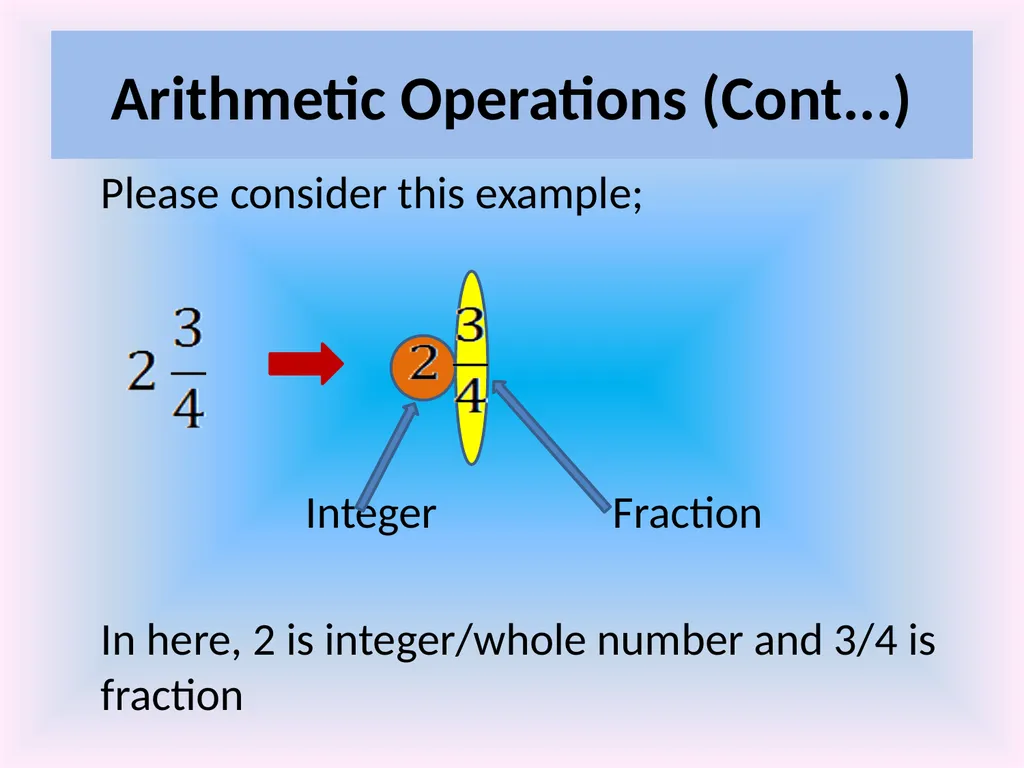
Arithmetic Operations (Cont...) Please consider this example;
Integer Fraction
In here, 2 is integer/whole number and 3/4 is fraction<br>
05
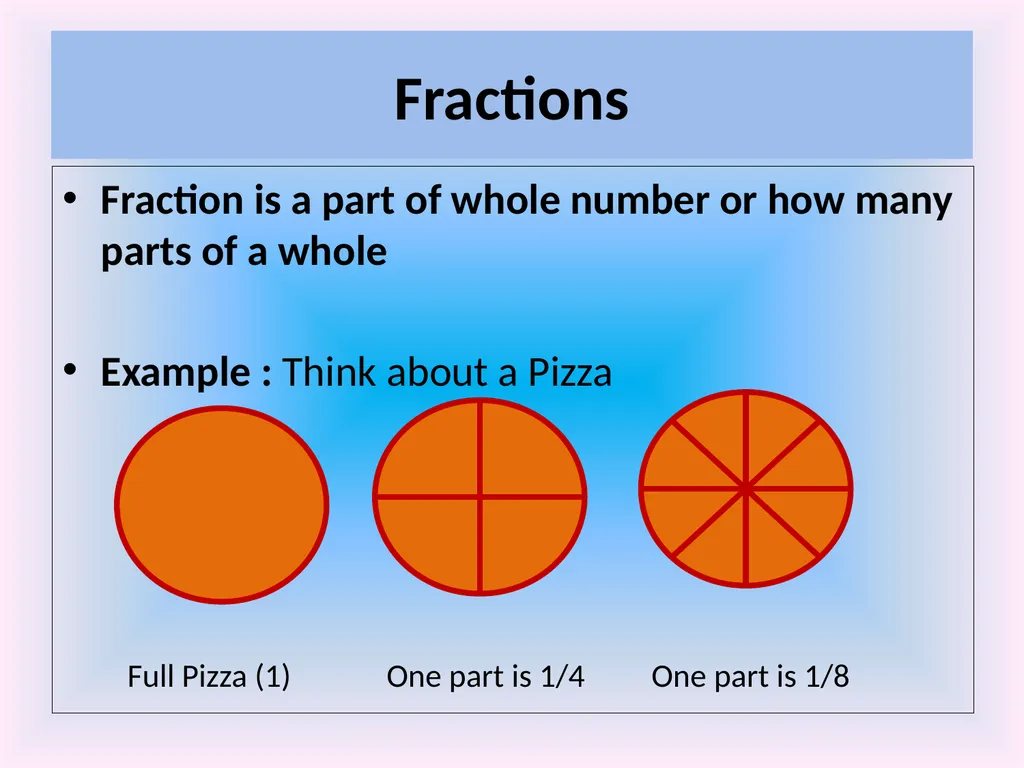
Fractions Fraction is a part of whole number or how many parts of a whole
Example : Think about a Pizza
Full Pizza (1) One part is 1/4 One part is 1/8<br>
06
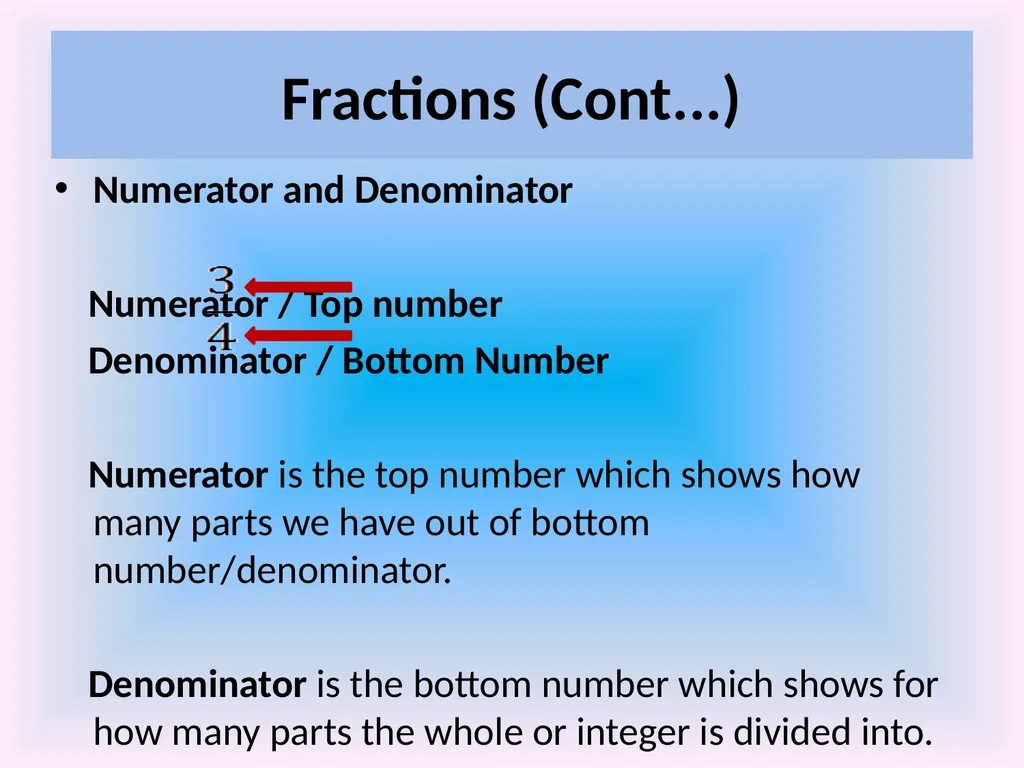
Fractions (Cont...) Numerator and Denominator
Numerator / Top number
Denominator / Bottom Number
Numerator is the top number which shows how many parts we have out of bottom number/denominator.
Denominator is the bottom number which shows for how many parts the whole or integer is divided into.<br>
07
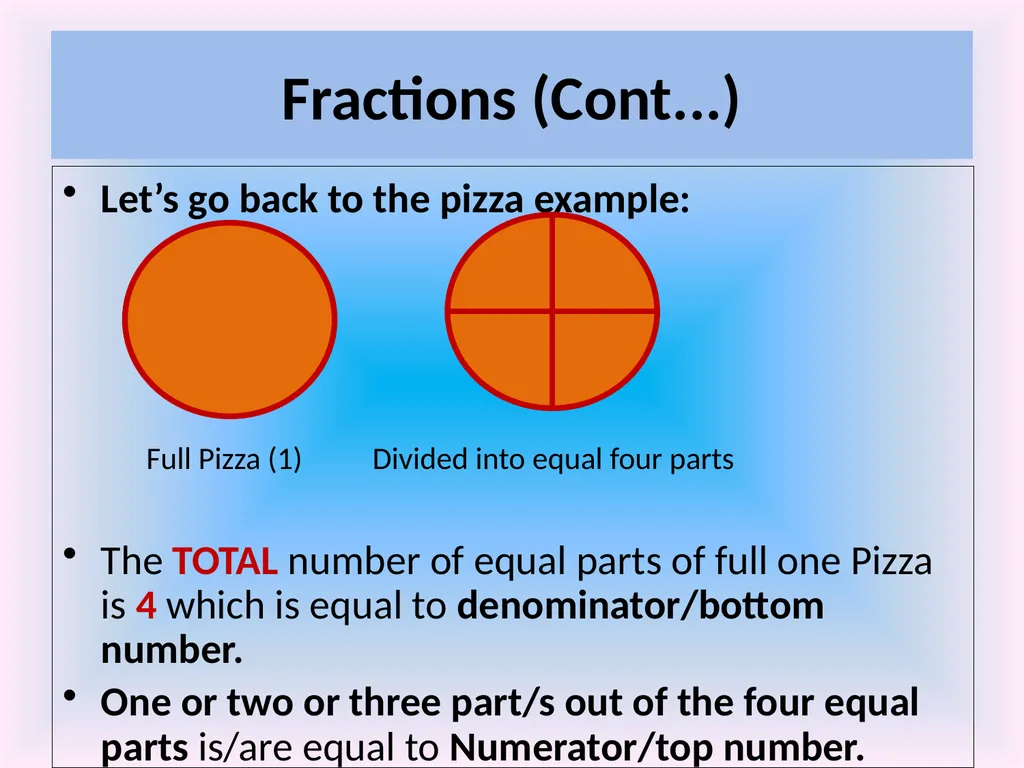
Fractions (Cont...) Let’s go back to the pizza example:
Full Pizza (1) Divided into equal four parts
The TOTAL number of equal parts of full one Pizza is 4 which is equal to denominator/bottom number.
One or two or three part/s out of the four equal parts is/are equal to Numerator/top number.<br>
08
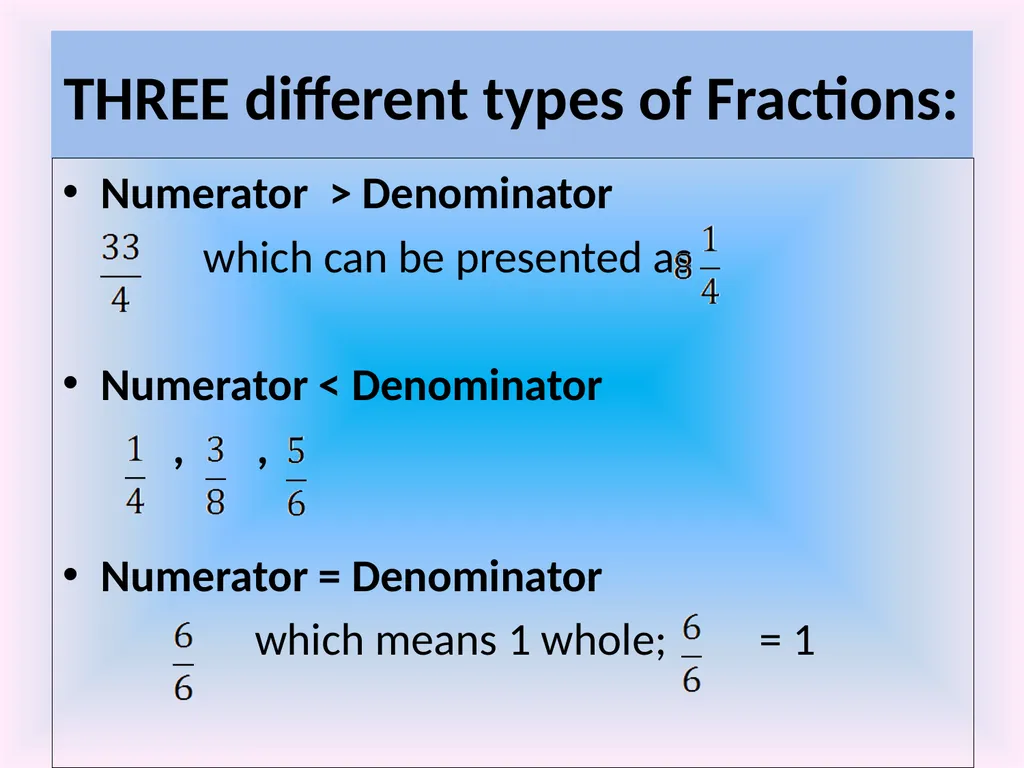
THREE different types of Fractions: Numerator > Denominator
which can be presented as
Numerator < Denominator
, ,
Numerator = Denominator
which means 1 whole; = 1<br>
09
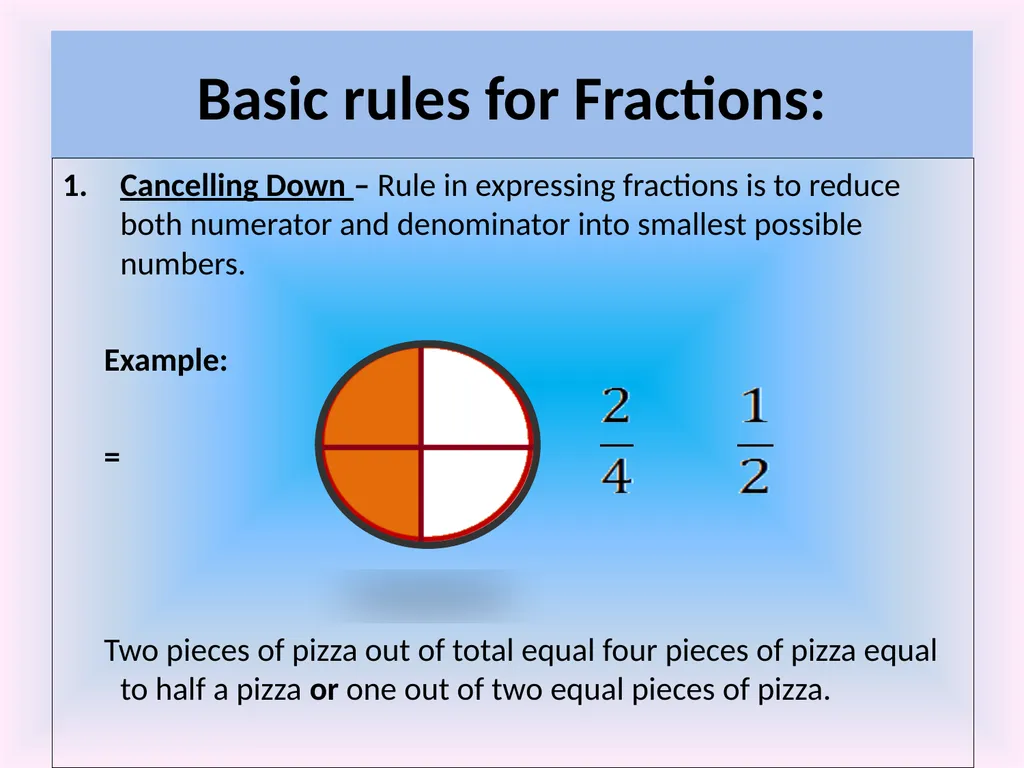
Basic rules for Fractions: Cancelling Down – Rule in expressing fractions is to reduce both numerator and denominator into smallest possible numbers.
Example:
=
Two pieces of pizza out of total equal four pieces of pizza equal to half a pizza or one out of two equal pieces of pizza.<br>
10
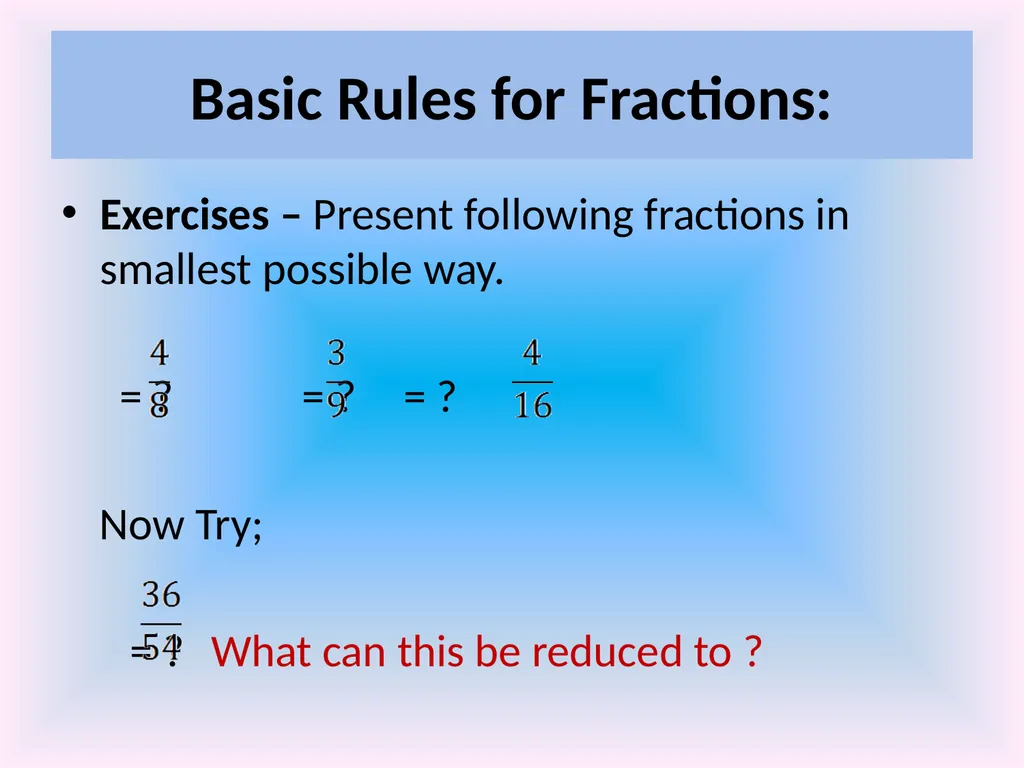
Basic Rules for Fractions: Exercises – Present following fractions in smallest possible way.
= ? = ? = ?
Now Try;
= ? What can this be reduced to ?<br>
11
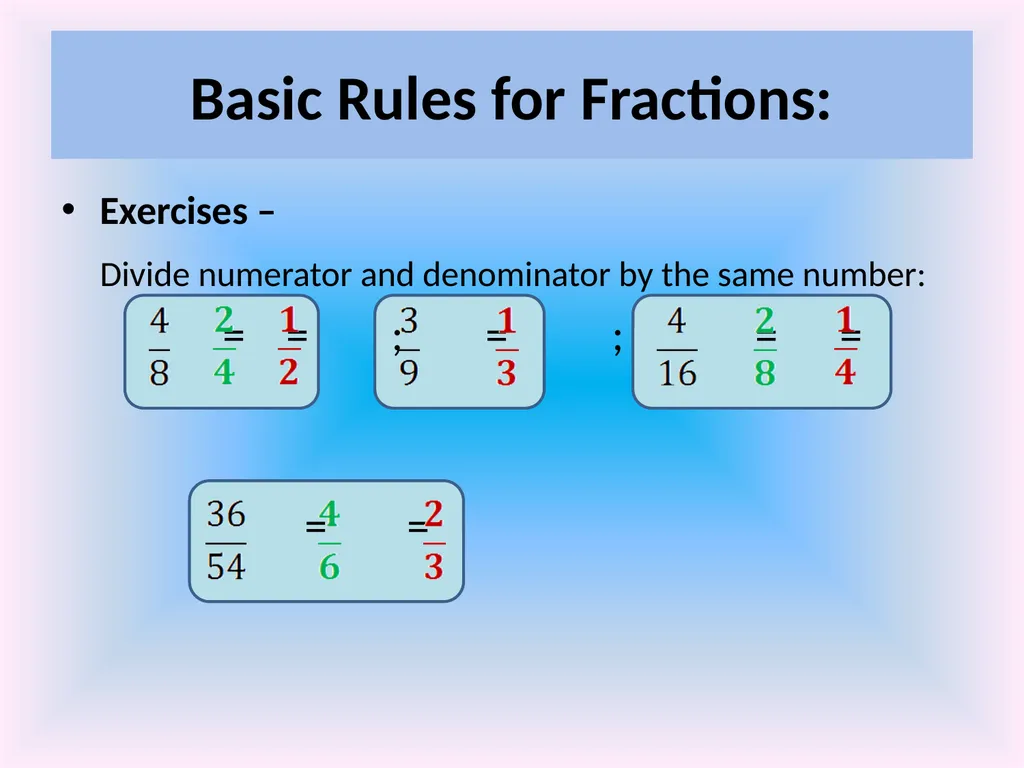
Basic Rules for Fractions: Exercises –
Divide numerator and denominator by the same number:
= = ; = ; = =
= =<br>
12
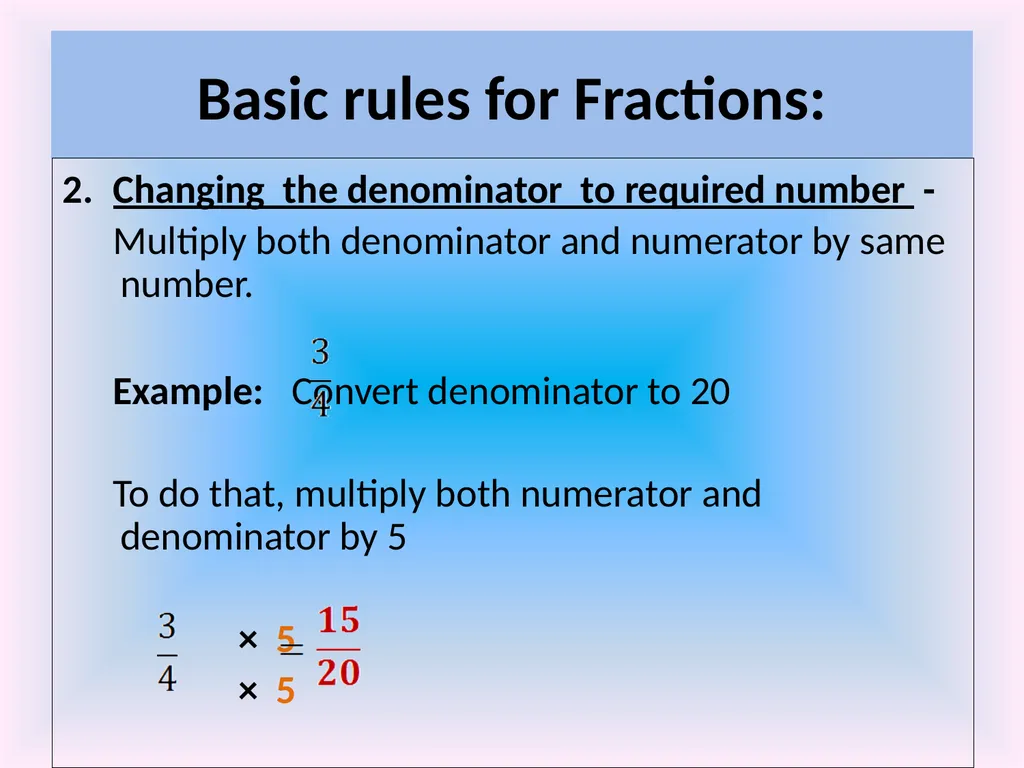
Basic rules for Fractions: 2. Changing the denominator to required number -
Multiply both denominator and numerator by same number.
Example: Convert denominator to 20
To do that, multiply both numerator and denominator by 5
× 5
× 5<br>
13
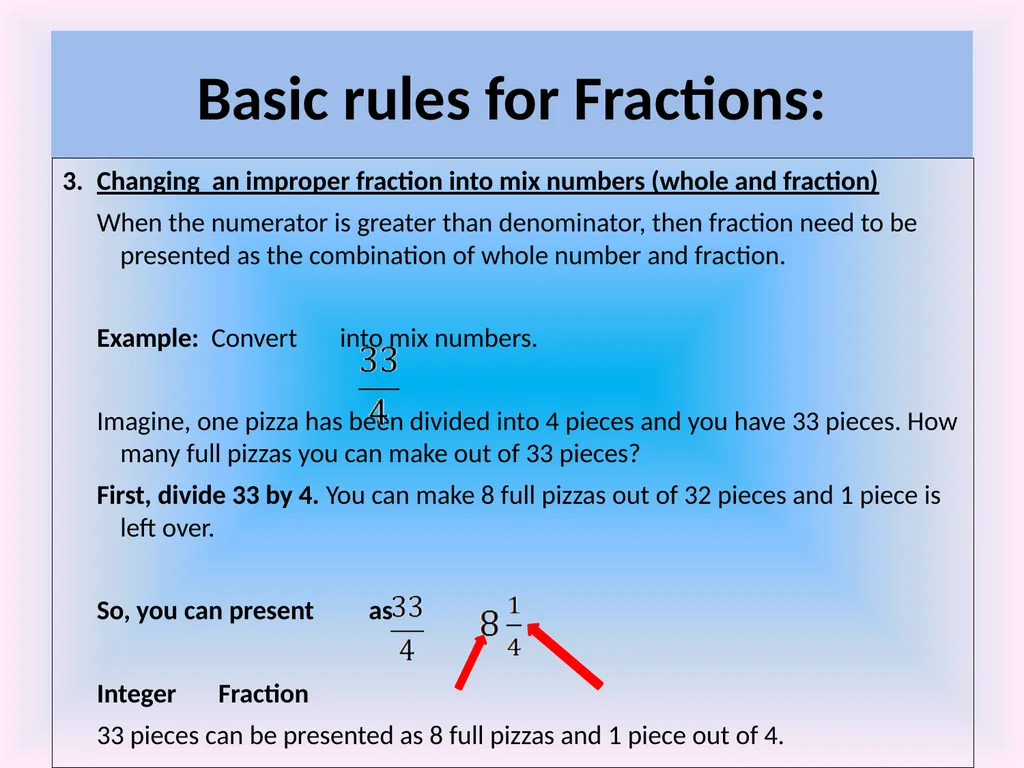
Basic rules for Fractions: 3. Changing an improper fraction into mix numbers (whole and fraction)
When the numerator is greater than denominator, then fraction need to be presented as the combination of whole number and fraction.
Example: Convert into mix numbers.
Imagine, one pizza has been divided into 4 pieces and you have 33 pieces. How many full pizzas you can make out of 33 pieces?
First, divide 33 by 4. You can make 8 full pizzas out of 32 pieces and 1 piece is left over.
So, you can present as
Integer Fraction
33 pieces can be presented as 8 full pizzas and 1 piece out of 4.<br>
14
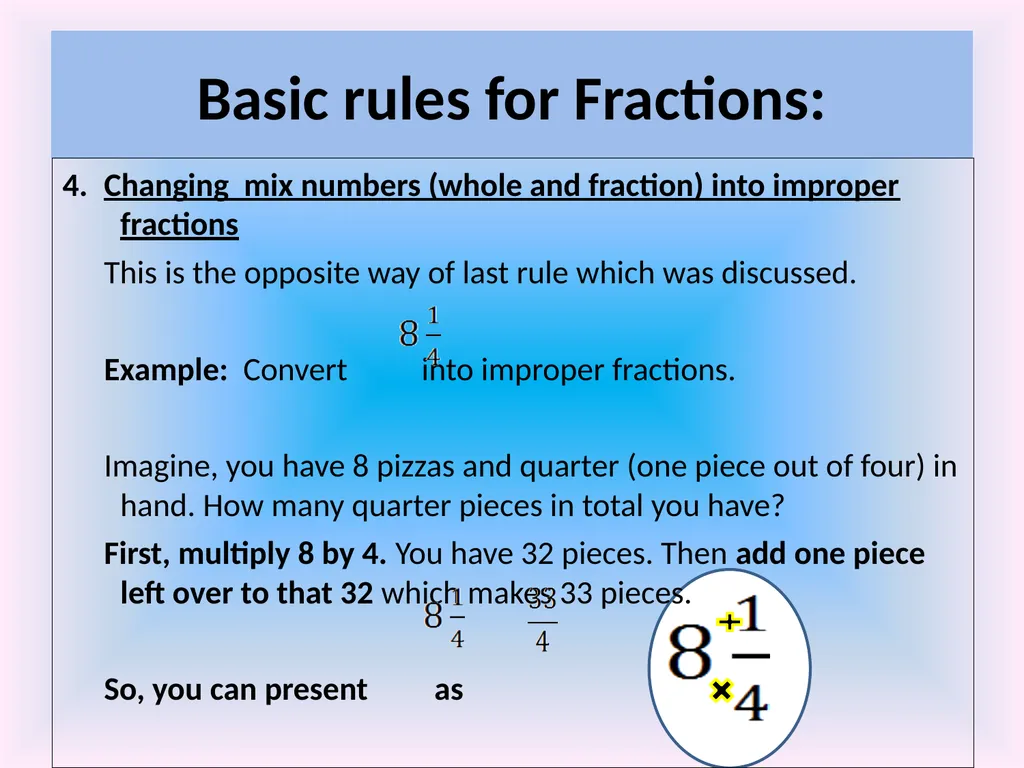
Basic rules for Fractions: 4. Changing mix numbers (whole and fraction) into improper fractions
This is the opposite way of last rule which was discussed.
Example: Convert into improper fractions.
Imagine, you have 8 pizzas and quarter (one piece out of four) in hand. How many quarter pieces in total you have?
First, multiply 8 by 4. You have 32 pieces. Then add one piece left over to that 32 which makes 33 pieces.
So, you can present as<br>
15
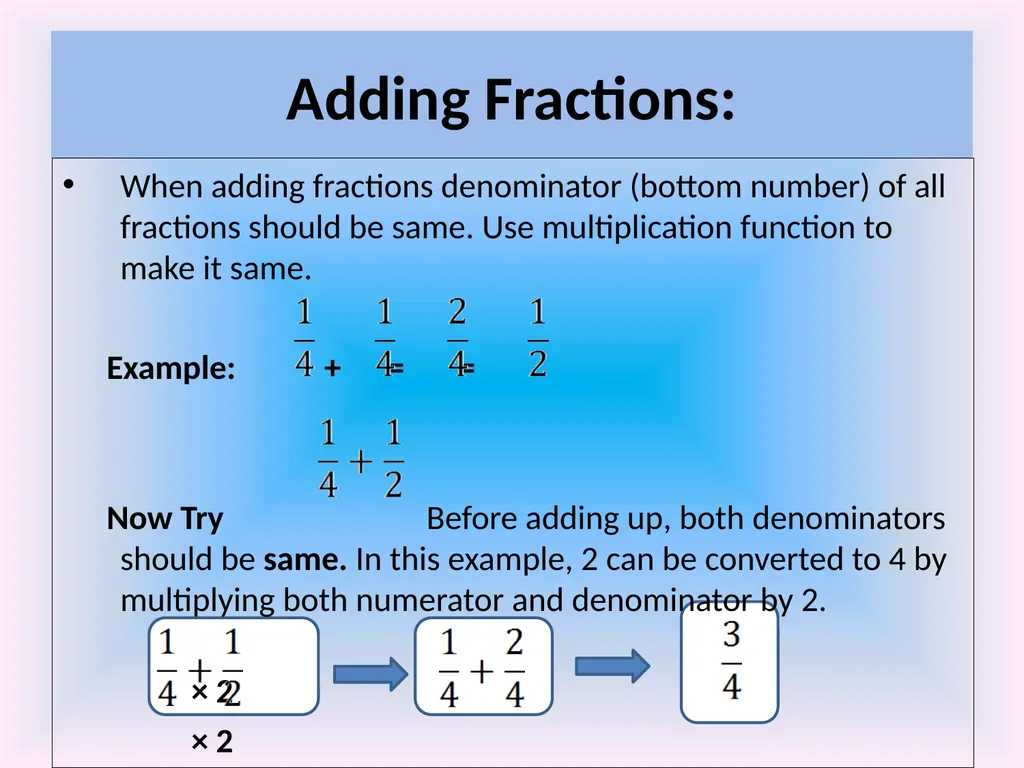
Adding Fractions: When adding fractions denominator (bottom number) of all fractions should be same. Use multiplication function to make it same.
Example: + = =
Now Try Before adding up, both denominators should be same. In this example, 2 can be converted to 4 by multiplying both numerator and denominator by 2.
× 2
× 2<br>
16
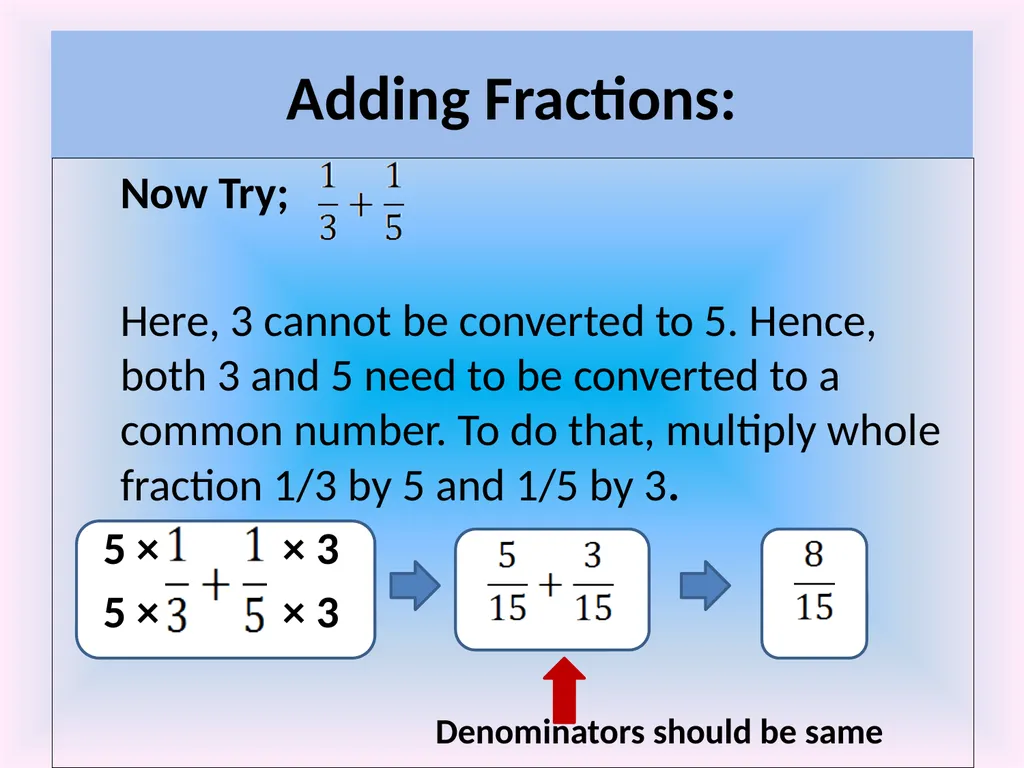
Adding Fractions: Now Try;
Here, 3 cannot be converted to 5. Hence, both 3 and 5 need to be converted to a common number. To do that, multiply whole fraction 1/3 by 5 and 1/5 by 3.
5 × × 3
5 × × 3
Denominators should be same<br>
17
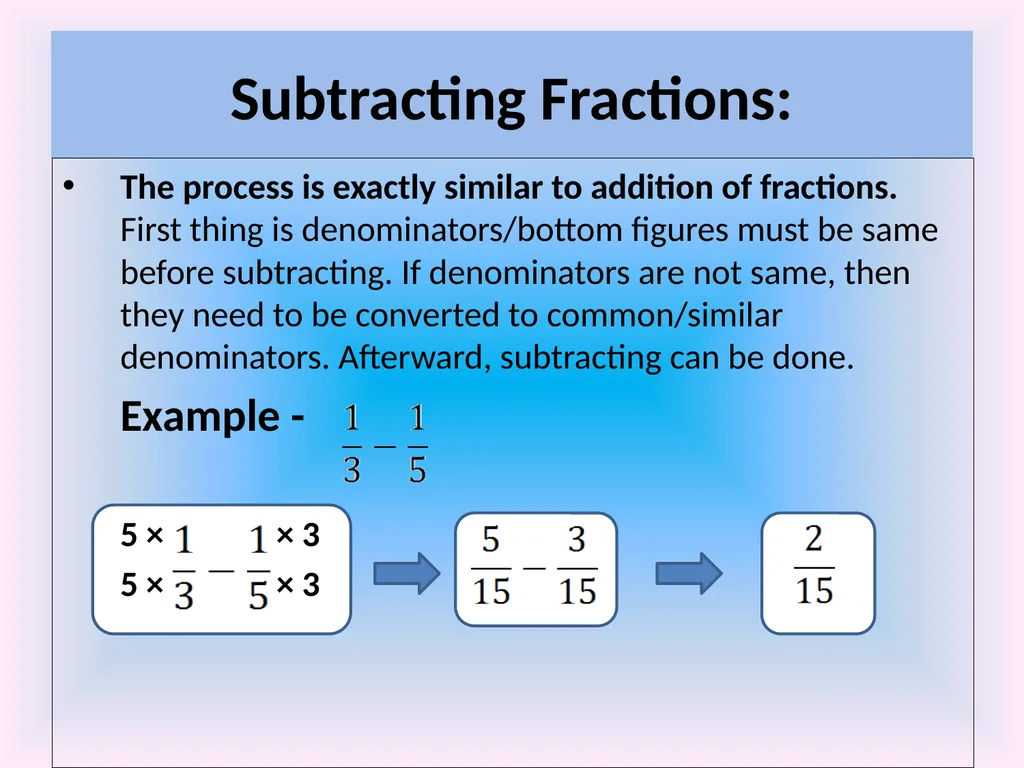
Subtracting Fractions: The process is exactly similar to addition of fractions. First thing is denominators/bottom figures must be same before subtracting. If denominators are not same, then they need to be converted to common/similar denominators. Afterward, subtracting can be done.
Example -
5 × × 3
5 × × 3<br>
18
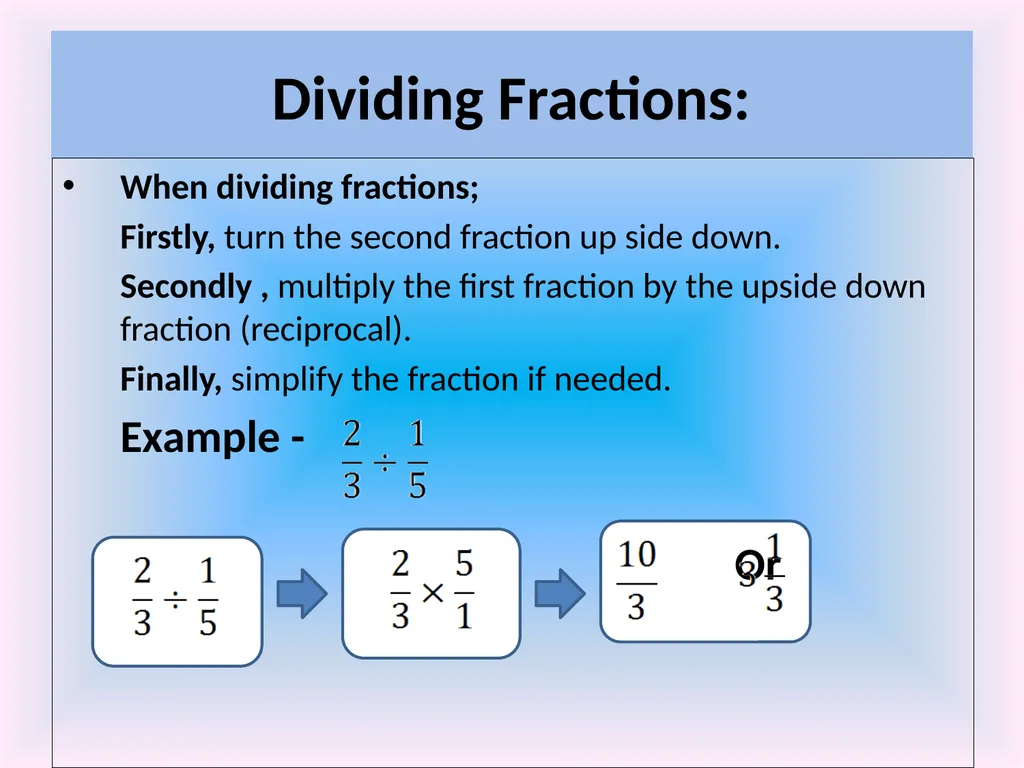
Dividing Fractions: When dividing fractions;
Firstly, turn the second fraction up side down.
Secondly , multiply the first fraction by the upside down fraction (reciprocal).
Finally, simplify the fraction if needed.
Example -
Or<br>
19
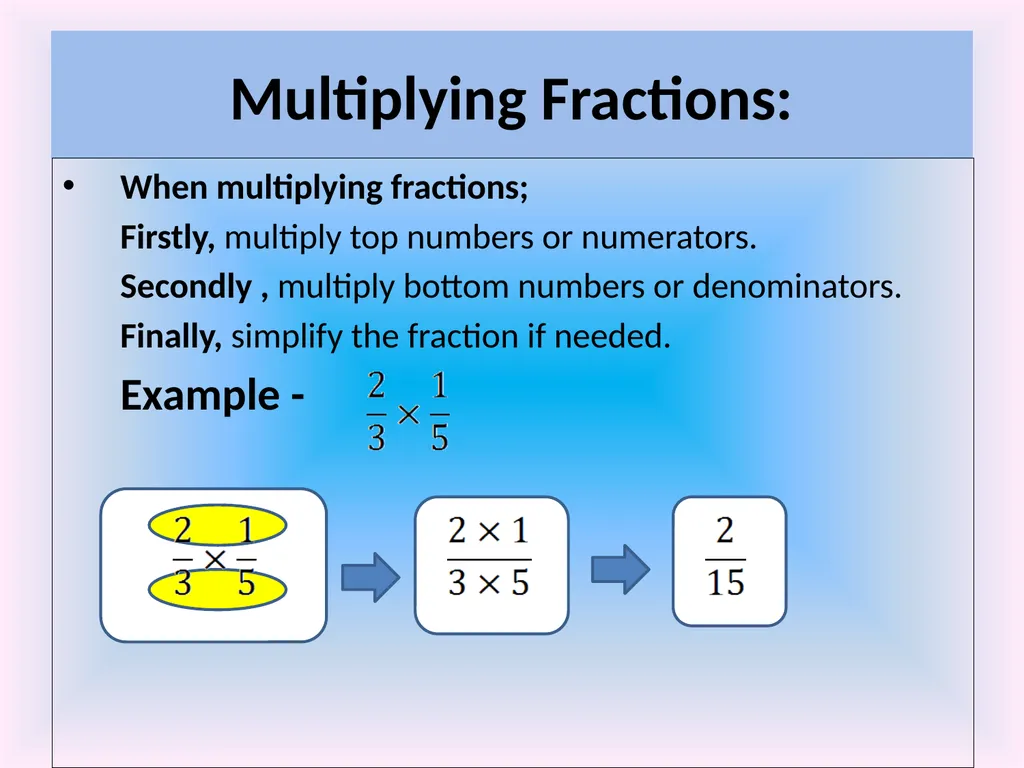
Multiplying Fractions: When multiplying fractions;
Firstly, multiply top numbers or numerators.
Secondly , multiply bottom numbers or denominators.
Finally, simplify the fraction if needed.
Example -<br>
20
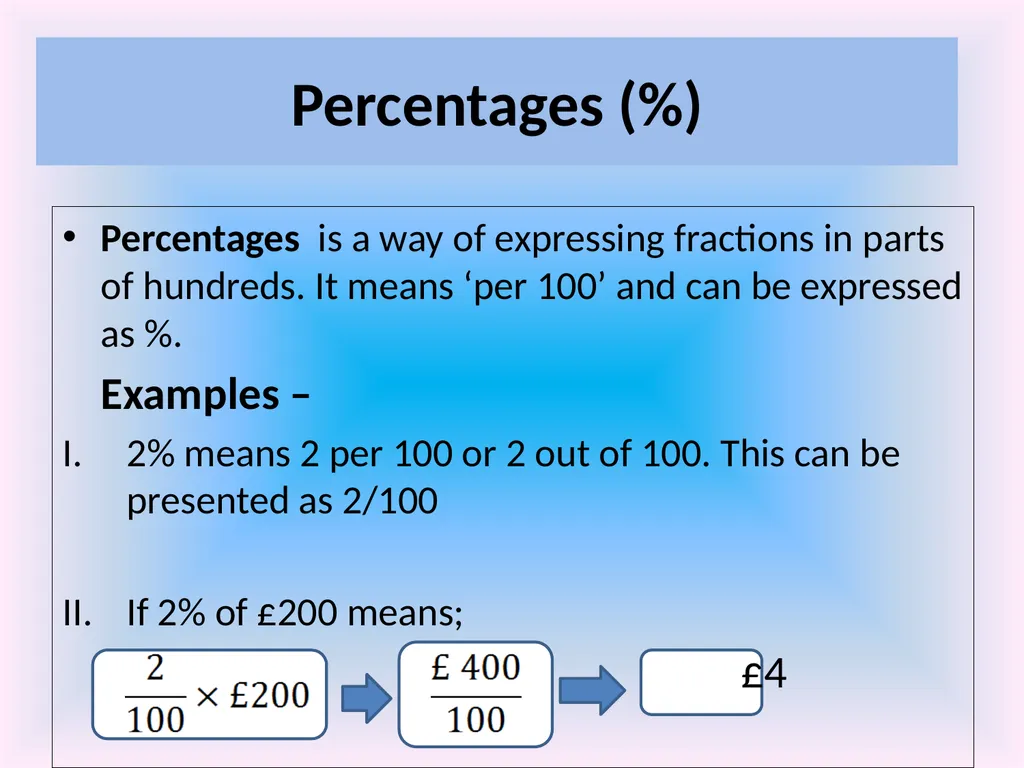
Percentages (%) Percentages is a way of expressing fractions in parts of hundreds. It means ‘per 100’ and can be expressed as %.
Examples –
2% means 2 per 100 or 2 out of 100. This can be presented as 2/100
If 2% of £200 means;
£4<br>
21
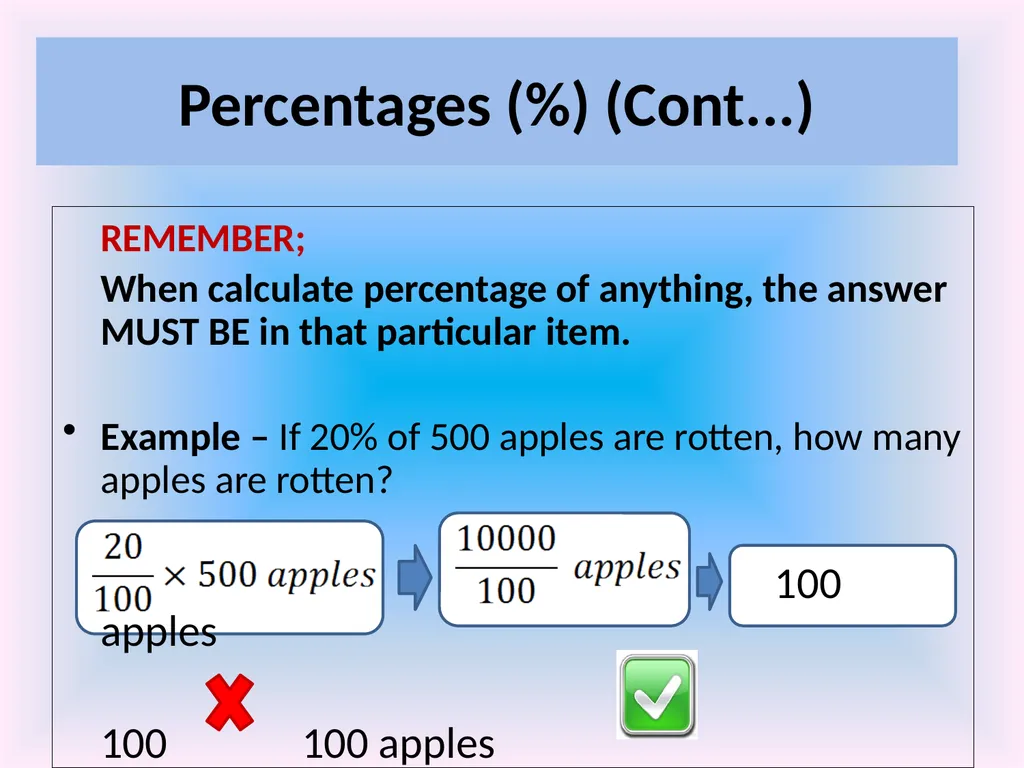
Percentages (%) (Cont...) REMEMBER;
When calculate percentage of anything, the answer MUST BE in that particular item.
Example – If 20% of 500 apples are rotten, how many apples are rotten?
100 apples
100 100 apples<br>
22
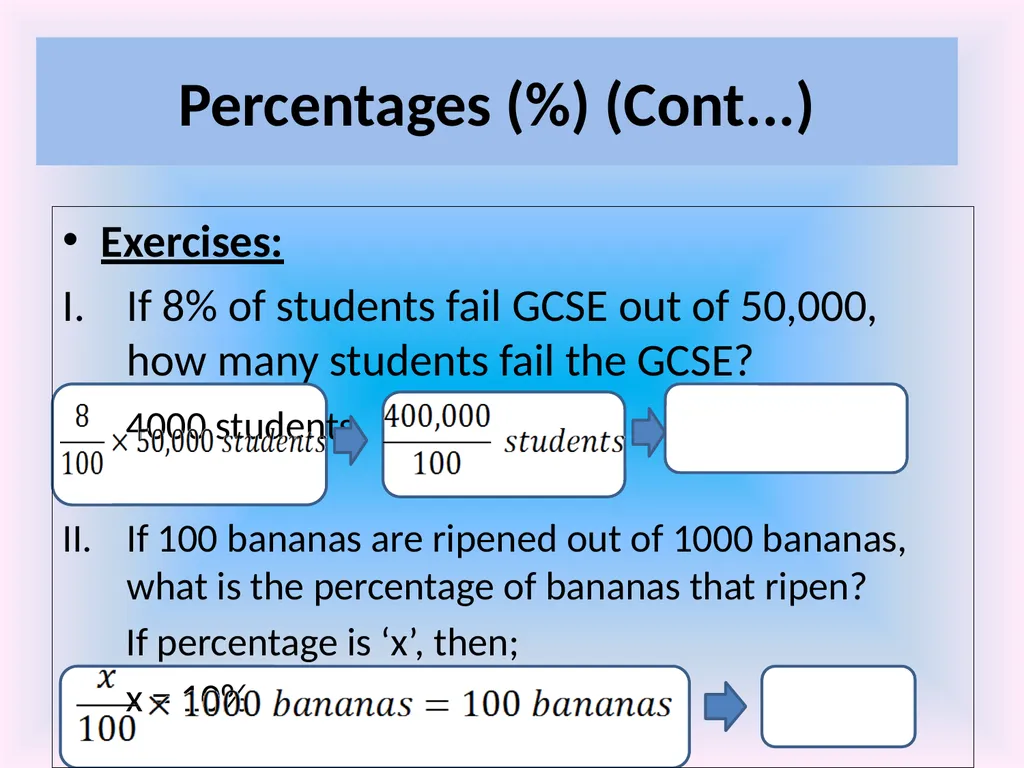
Percentages (%) (Cont...) Exercises:
If 8% of students fail GCSE out of 50,000, how many students fail the GCSE?
4000 students
If 100 bananas are ripened out of 1000 bananas, what is the percentage of bananas that ripen?
If percentage is ‘x’, then;
x = 10%<br>
23
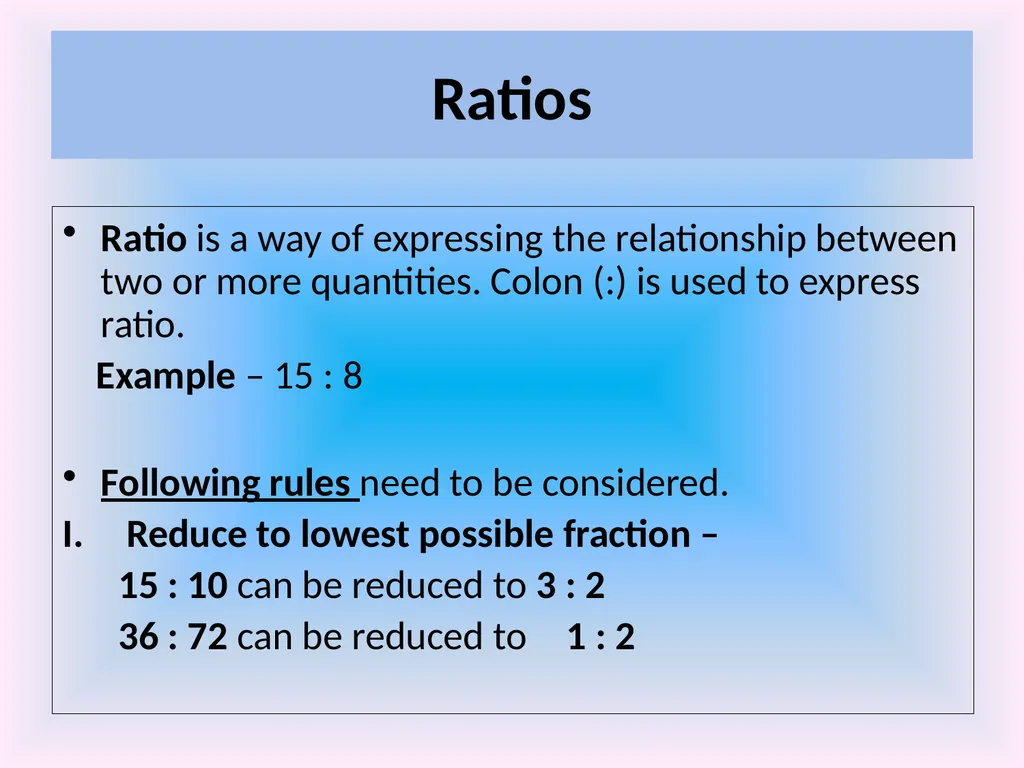
Ratios Ratio is a way of expressing the relationship between two or more quantities. Colon (:) is used to express ratio.
Example – 15 : 8
Following rules need to be considered.
Reduce to lowest possible fraction –
15 : 10 can be reduced to 3 : 2
36 : 72 can be reduced to 1 : 2<br>
24
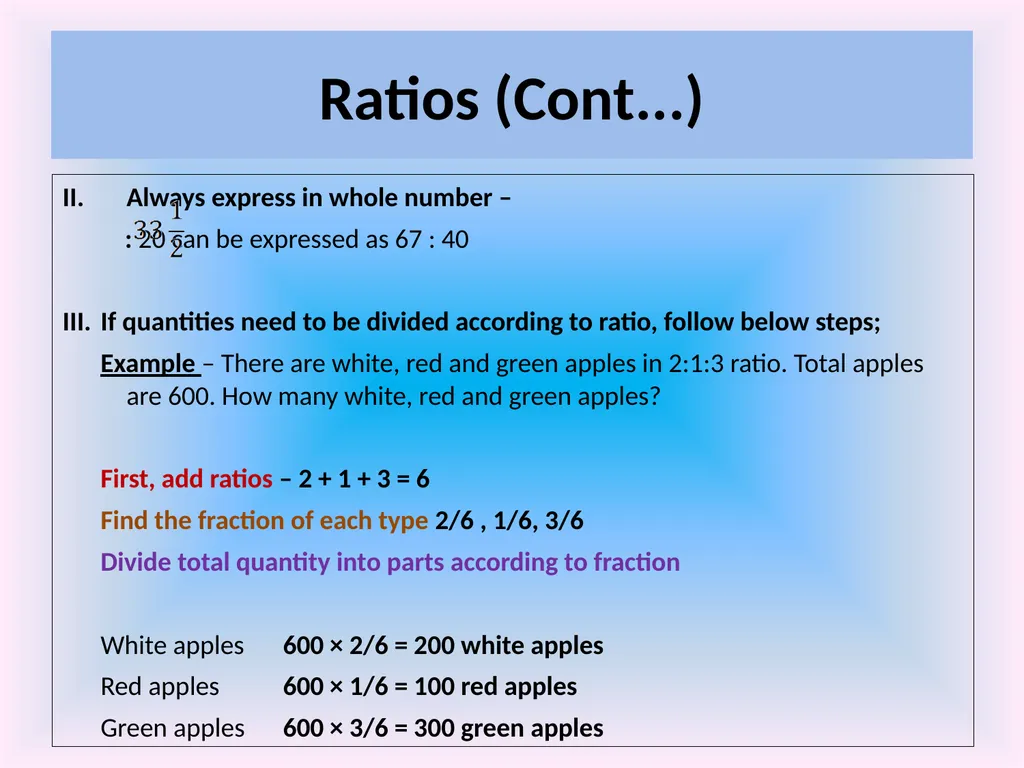
Ratios (Cont...) Always express in whole number –
: 20 can be expressed as 67 : 40
III. If quantities need to be divided according to ratio, follow below steps;
Example – There are white, red and green apples in 2:1:3 ratio. Total apples are 600. How many white, red and green apples?
First, add ratios – 2 + 1 + 3 = 6
Find the fraction of each type 2/6 , 1/6, 3/6
Divide total quantity into parts according to fraction
White apples 600 × 2/6 = 200 white apples
Red apples 600 × 1/6 = 100 red apples
Green apples 600 × 3/6 = 300 green apples<br>
25
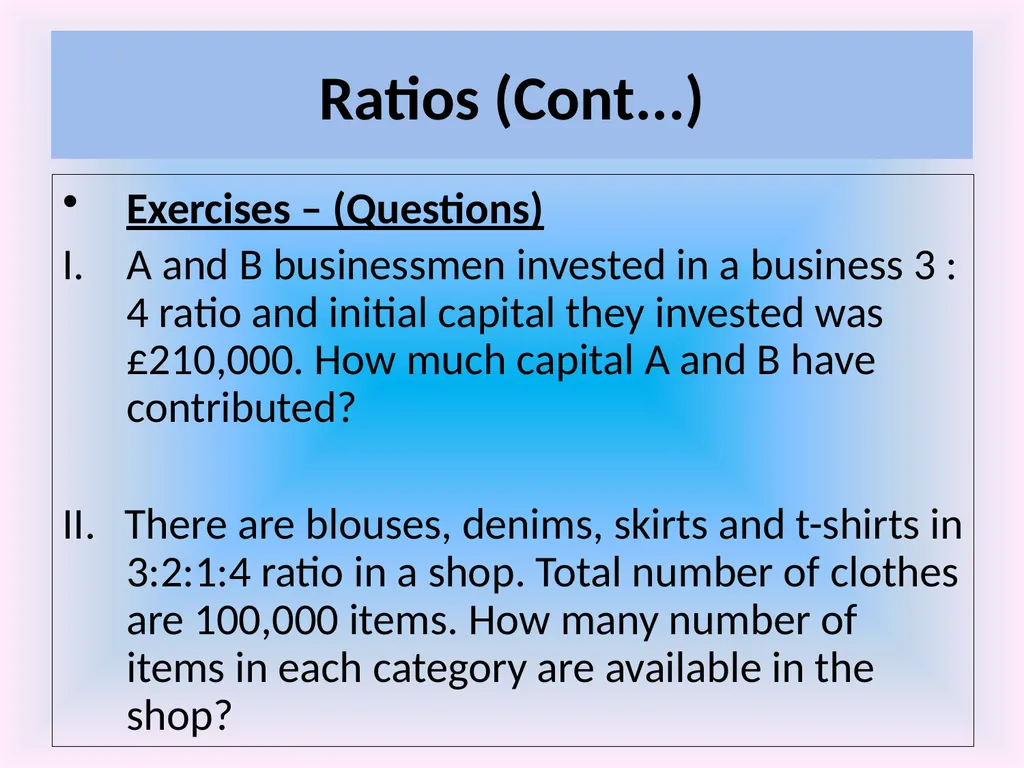
Ratios (Cont...) Exercises – (Questions)
A and B businessmen invested in a business 3 : 4 ratio and initial capital they invested was £210,000. How much capital A and B have contributed?
II. There are blouses, denims, skirts and t-shirts in 3:2:1:4 ratio in a shop. Total number of clothes are 100,000 items. How many number of items in each category are available in the shop?<br>
26
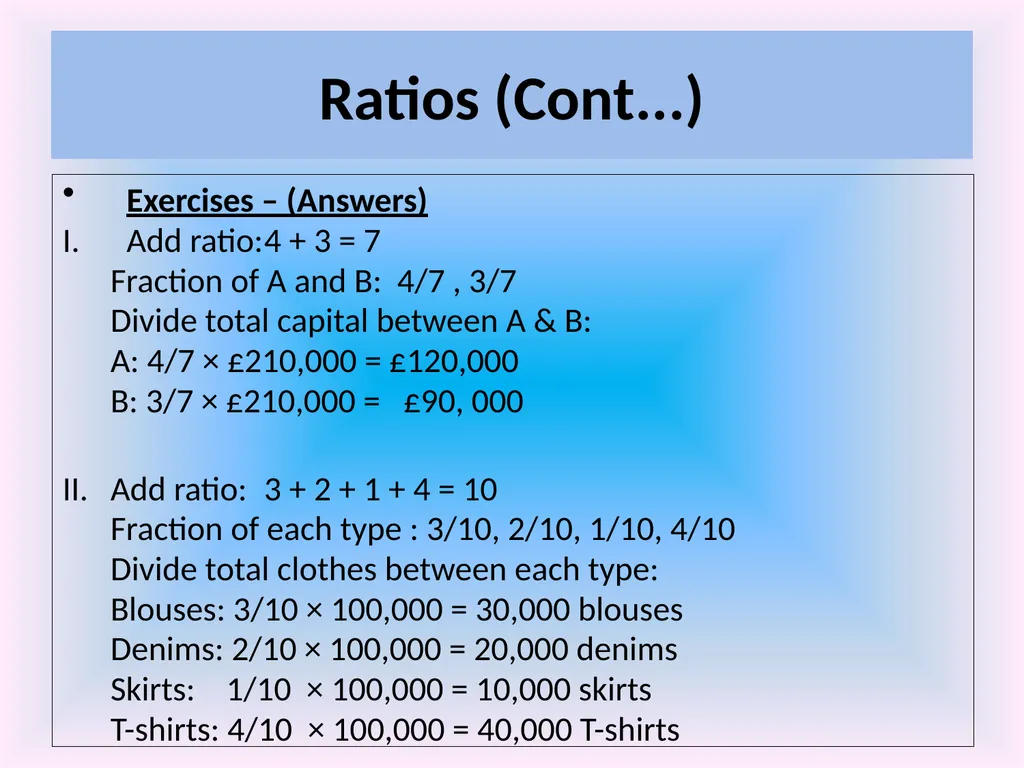
Ratios (Cont...) Exercises – (Answers)
Add ratio: 4 + 3 = 7
Fraction of A and B: 4/7 , 3/7
Divide total capital between A & B:
A: 4/7 × £210,000 = £120,000
B: 3/7 × £210,000 = £90, 000
II. Add ratio: 3 + 2 + 1 + 4 = 10
Fraction of each type : 3/10, 2/10, 1/10, 4/10
Divide total clothes between each type:
Blouses: 3/10 × 100,000 = 30,000 blouses
Denims: 2/10 × 100,000 = 20,000 denims
Skirts: 1/10 × 100,000 = 10,000 skirts
T-shirts: 4/10 × 100,000 = 40,000 T-shirts<br>
27
This is time for your questions...
-THANK YOU-<br>