
Nurturing Parenting Programs® Evidence-Based
NS
Published · 55 slides · 0 views

1 / 1


















Description
Nurturing Parenting Programs Evidence-Based Programs for the Prevention and Treatment of Child Abuse and Neglect Heather Kemp, National Trainer Providing Nurturing Parenting Programs since 2004 Trainer since 2007 Expectations HOPES What do
Related Topics
Share
Embed code
Download this presentation From Below
"Nurturing Parenting Programs® Evidence-Based" is the property of its rightful owner. Permission is granted to download and print the materials on this website for personal, non-commercial use only, and to display it on your personal computer provided you do not modify the materials and that you retain all copyright notices contained in the materials. By downloading content from our website, you accept the terms of this agreement.
Presentation Transcript
01
Nurturing Parenting Programs® Evidence-Based Programs for the Prevention and Treatment of Child Abuse and Neglect<br>
02
Heather Kemp,
National Trainer Providing Nurturing Parenting
Programs since 2004
Trainer since 2007<br>
Programs since 2004
Trainer since 2007<br>
03
Expectations HOPES What do you hope the families you work with will get from a parenting program? FEARS What are your concerns about parent education?<br>
04
Adult Learning is based on the
assumptions of andragogy. Andragogy: an-druh-goh-jee
“The art and science of helping adults learn”<br>
“The art and science of helping adults learn”<br>
05
The 5 Constructs of Nurturing Parenting<br>
06
6 Values of Nurturing Parenting<br>
07
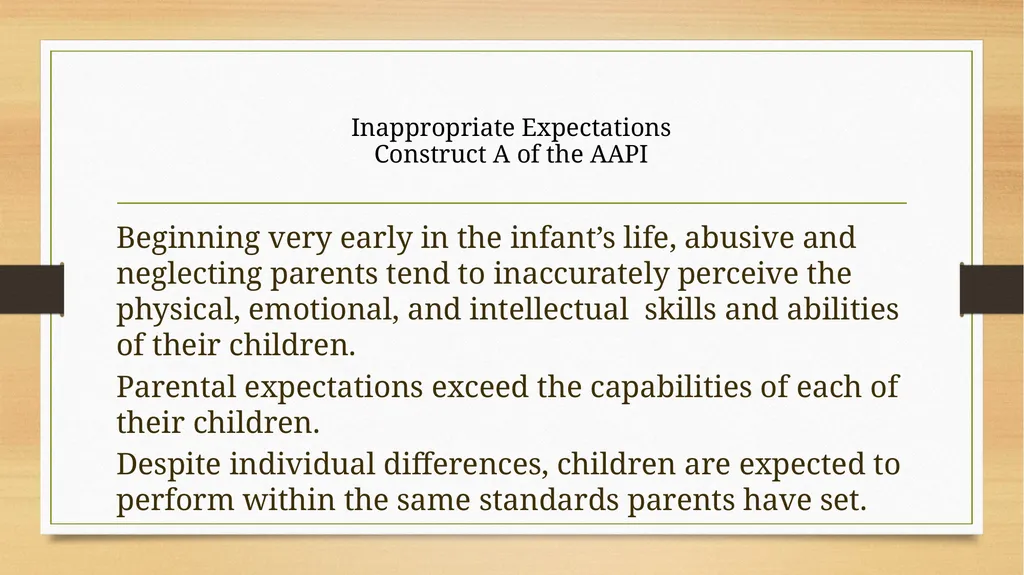
Inappropriate Expectations
Construct A of the AAPI Beginning very early in the infant’s life, abusive and neglecting parents tend to inaccurately perceive the physical, emotional, and intellectual skills and abilities of their children.
Parental expectations exceed the capabilities of each of their children.
Despite individual differences, children are expected to perform within the same standards parents have set.<br>
Parental expectations exceed the capabilities of each of their children.
Despite individual differences, children are expected to perform within the same standards parents have set.<br>
08
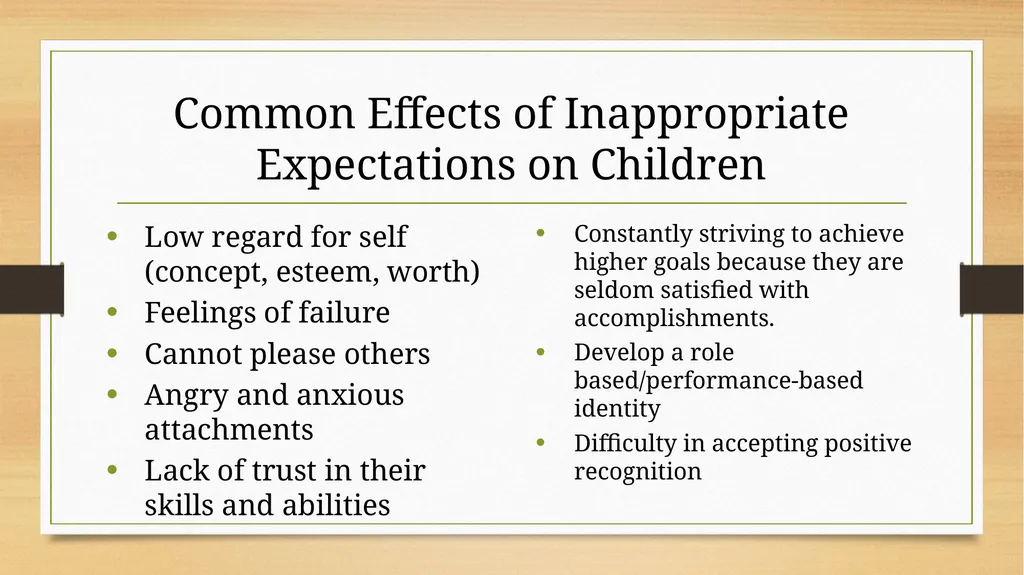
Common Effects of Inappropriate Expectations on Children Low regard for self (concept, esteem, worth)
Feelings of failure
Cannot please others
Angry and anxious attachments
Lack of trust in their skills and abilities Constantly striving to achieve higher goals because they are seldom satisfied with accomplishments.
Develop a role based/performance-based identity
Difficulty in accepting positive recognition<br>
Feelings of failure
Cannot please others
Angry and anxious attachments
Lack of trust in their skills and abilities Constantly striving to achieve higher goals because they are seldom satisfied with accomplishments.
Develop a role based/performance-based identity
Difficulty in accepting positive recognition<br>
09
Addressing Construct A: Inappropriate Expectations<br>
10
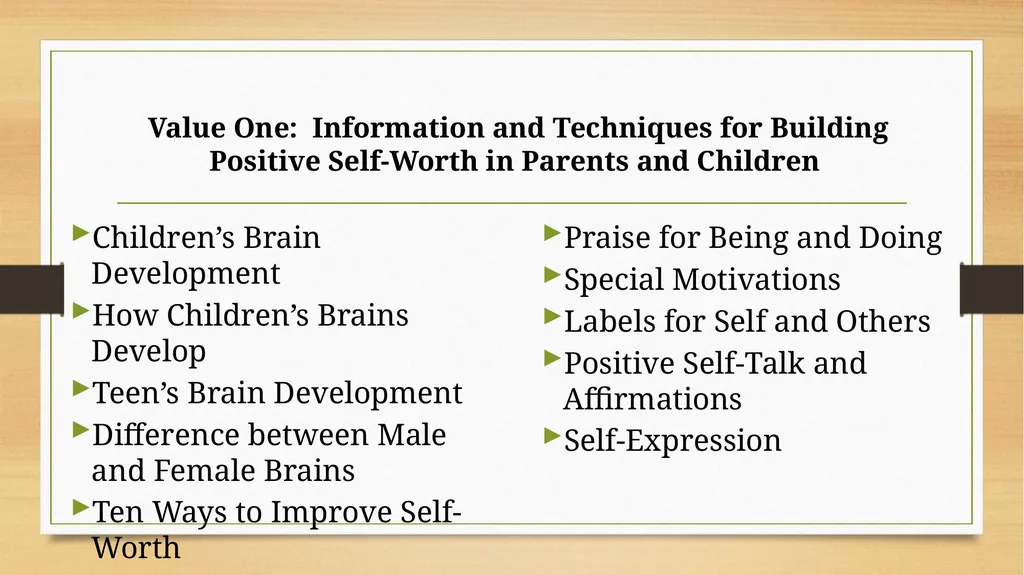
Value One: Information and Techniques for Building Positive Self-Worth in Parents and Children Children’s Brain Development
How Children’s Brains Develop
Teen’s Brain Development
Difference between Male and Female Brains
Ten Ways to Improve Self-Worth Praise for Being and Doing
Special Motivations
Labels for Self and Others
Positive Self-Talk and Affirmations
Self-Expression<br>
How Children’s Brains Develop
Teen’s Brain Development
Difference between Male and Female Brains
Ten Ways to Improve Self-Worth Praise for Being and Doing
Special Motivations
Labels for Self and Others
Positive Self-Talk and Affirmations
Self-Expression<br>
11
Consistent Lack of Parental Empathy
Construct B of the AAPI Abusive and neglecting parents display a consistent low level or lack of empathy towards children’s needs.
Insensitive to their children’s need as well as their own needs
Fail to create a caring environment that is conducive to promoting children’s emotional, social, intellectual, physical, spiritual, and creative growth.
Fail to bond and form early attachments.<br>
Insensitive to their children’s need as well as their own needs
Fail to create a caring environment that is conducive to promoting children’s emotional, social, intellectual, physical, spiritual, and creative growth.
Fail to bond and form early attachments.<br>
12
Common Effects of Low Parental Empathy Children develop:
Diminished ability to trust with fears of abandonment
Difficulty in taking care of one’s self
Develop clingy relationships
Focus is on self and easily led by others.
Possessive and smothering relationships
Inability to communicate feelings in healthy ways
Inability to bond with others and to form positive attachments<br>
Diminished ability to trust with fears of abandonment
Difficulty in taking care of one’s self
Develop clingy relationships
Focus is on self and easily led by others.
Possessive and smothering relationships
Inability to communicate feelings in healthy ways
Inability to bond with others and to form positive attachments<br>
13
Addressing Construct B: Lack of Parental Empathy<br>
14
Value Two: Techniques and Strategies for Developing a Sense of Caring and Compassion Defining Empathy
Bonding and Attachment
Needs and Behavior
Spoiling Children
Establishing Nurturing Routines
Personal Touch History
Body Map Recognizing, Understanding and Communicating Feelings
Suppressing Thoughts & Feelings
Recognizing and Handling Anger
Recognizing and Handling Stress
Strategies to Reduce Children’s Stress<br>
Bonding and Attachment
Needs and Behavior
Spoiling Children
Establishing Nurturing Routines
Personal Touch History
Body Map Recognizing, Understanding and Communicating Feelings
Suppressing Thoughts & Feelings
Recognizing and Handling Anger
Recognizing and Handling Stress
Strategies to Reduce Children’s Stress<br>
15
Strong Belief in Physical Punishment
Construct C of the AAPI Physical punishment is generally the preferred means of discipline used by abusive parents.
Spanking, hitting, whooping, beating, popping are all variations of the same theme: physical pain caused by hitting.<br>
Spanking, hitting, whooping, beating, popping are all variations of the same theme: physical pain caused by hitting.<br>
16
Common Effects of using Physical Punishment on Children: Children identify with the act of spanking as an act of caring.
Children hold repressed anger towards the one doing the hitting.
Children develop anxious and angry attachments.
Children use violence as a way of solving problems and replicate the CP as a parent.
Children learn CP is normal and pass the act on to another generation.<br>
Children hold repressed anger towards the one doing the hitting.
Children develop anxious and angry attachments.
Children use violence as a way of solving problems and replicate the CP as a parent.
Children learn CP is normal and pass the act on to another generation.<br>
17
Addressing Construct C: Strong Belief in Physical Punishment<br>
18
Value Three: Techniques and Strategies for Providing Children and Teens with Dignified Discipline Discipline, Punishments and Rewards
Managing, modifying and encouraging behavior
Danger proof the house
Establish Clear Family Rules
Choices and Consequences
Verbal and Physical Redirection Ignoring
Negotiation and Compromise
Praise for Being and Doing
Nurturing Touch
Privileges as Rewards
Objects as Rewards
Allowance as a Positive Consequence<br>
Managing, modifying and encouraging behavior
Danger proof the house
Establish Clear Family Rules
Choices and Consequences
Verbal and Physical Redirection Ignoring
Negotiation and Compromise
Praise for Being and Doing
Nurturing Touch
Privileges as Rewards
Objects as Rewards
Allowance as a Positive Consequence<br>
19
Value Three: Dignified Discipline (cont): Loss of Privilege
Being Grounded
Parental Disappointment
Restitution
Time Out
Reasons Why Parents Hit Children<br>
Being Grounded
Parental Disappointment
Restitution
Time Out
Reasons Why Parents Hit Children<br>
20
Parent-Child Role Reversal
Construct D of the AAPI Parent-child role reversal is an interchanging of traditional role behaviors between a parent and child.
Child adopts some of the behaviors traditionally associated with parents;
Common occurrence when parents lack the support of a partner;
Common among single parents;
Common among parents who are very needy themselves.<br>
Child adopts some of the behaviors traditionally associated with parents;
Common occurrence when parents lack the support of a partner;
Common among single parents;
Common among parents who are very needy themselves.<br>
21
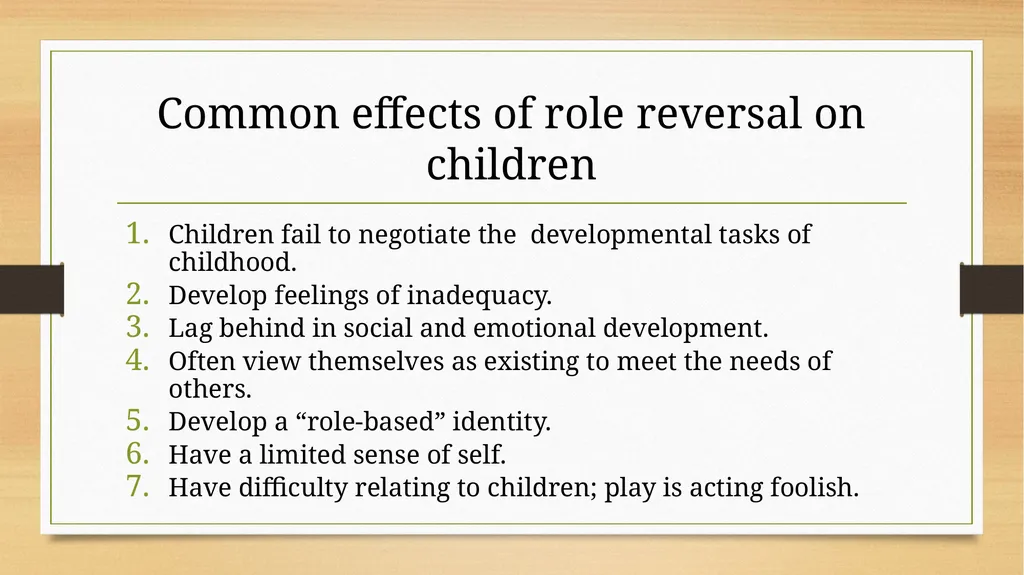
Common effects of role reversal on children Children fail to negotiate the developmental tasks of childhood.
Develop feelings of inadequacy.
Lag behind in social and emotional development.
Often view themselves as existing to meet the needs of others.
Develop a “role-based” identity.
Have a limited sense of self.
Have difficulty relating to children; play is acting foolish.<br>
Develop feelings of inadequacy.
Lag behind in social and emotional development.
Often view themselves as existing to meet the needs of others.
Develop a “role-based” identity.
Have a limited sense of self.
Have difficulty relating to children; play is acting foolish.<br>
22
Addressing Construct D: Parent Child Role Reversal<br>
23
Value Four: Techniques and Strategies for Increasing Self-Awareness and Proper Family Roles Anger, Alcohol & Abuse
Families and Alcohol
Violent & Possessive Relationships
Self Expression
Draw Yourself
Draw your Family Draw Your Parents
Draw Your Children
Examining My Touch History
My Cultural Parenting Traditions
Spirituality
Dating, Love and Rejection<br>
Families and Alcohol
Violent & Possessive Relationships
Self Expression
Draw Yourself
Draw your Family Draw Your Parents
Draw Your Children
Examining My Touch History
My Cultural Parenting Traditions
Spirituality
Dating, Love and Rejection<br>
24
Oppressing Power & Independence
Construct E of the AAPI Children are not allowed to challenge, to voice opinions, or to have choices.
Children are told to “do what they are told to do” without question; “are better seen and not heard”; “are too smart for their own good”; are “too big for their britches.”
Children have little to no voice in family activities.
Are consistently told “no” without the obligatory “yes”
Fail to learn the art and science of negotiating, compromise;
Are told “don’t make waves; and do what the others are doing”<br>
Children are told to “do what they are told to do” without question; “are better seen and not heard”; “are too smart for their own good”; are “too big for their britches.”
Children have little to no voice in family activities.
Are consistently told “no” without the obligatory “yes”
Fail to learn the art and science of negotiating, compromise;
Are told “don’t make waves; and do what the others are doing”<br>
25
Common effects of oppressing children’s power and independence This demand for compliance to parental authority has many limitations:
Obedience breeds powerlessness.
Obedience breeds inadequacy.
Obedience also breeds rebelliousness.
Obedience breeds compliance — to all.
Obedience breeds followers, not leaders.
- Are very vulnerable to peer group pressure.<br>
Obedience breeds powerlessness.
Obedience breeds inadequacy.
Obedience also breeds rebelliousness.
Obedience breeds compliance — to all.
Obedience breeds followers, not leaders.
- Are very vulnerable to peer group pressure.<br>
26
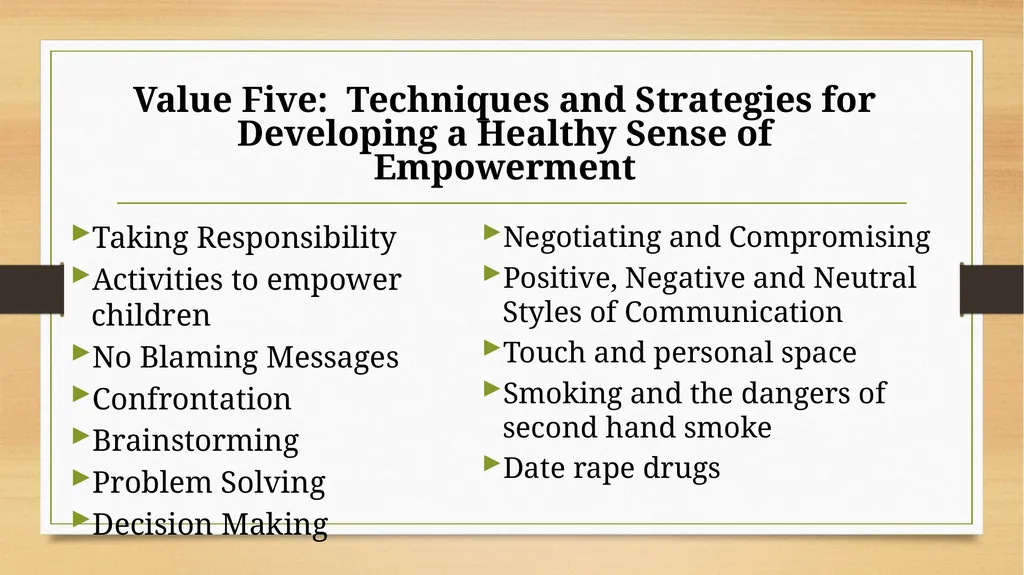
Value Five: Techniques and Strategies for Developing a Healthy Sense of Empowerment Taking Responsibility
Activities to empower children
No Blaming Messages
Confrontation
Brainstorming
Problem Solving
Decision Making Negotiating and Compromising
Positive, Negative and Neutral Styles of Communication
Touch and personal space
Smoking and the dangers of second hand smoke
Date rape drugs<br>
Activities to empower children
No Blaming Messages
Confrontation
Brainstorming
Problem Solving
Decision Making Negotiating and Compromising
Positive, Negative and Neutral Styles of Communication
Touch and personal space
Smoking and the dangers of second hand smoke
Date rape drugs<br>
27
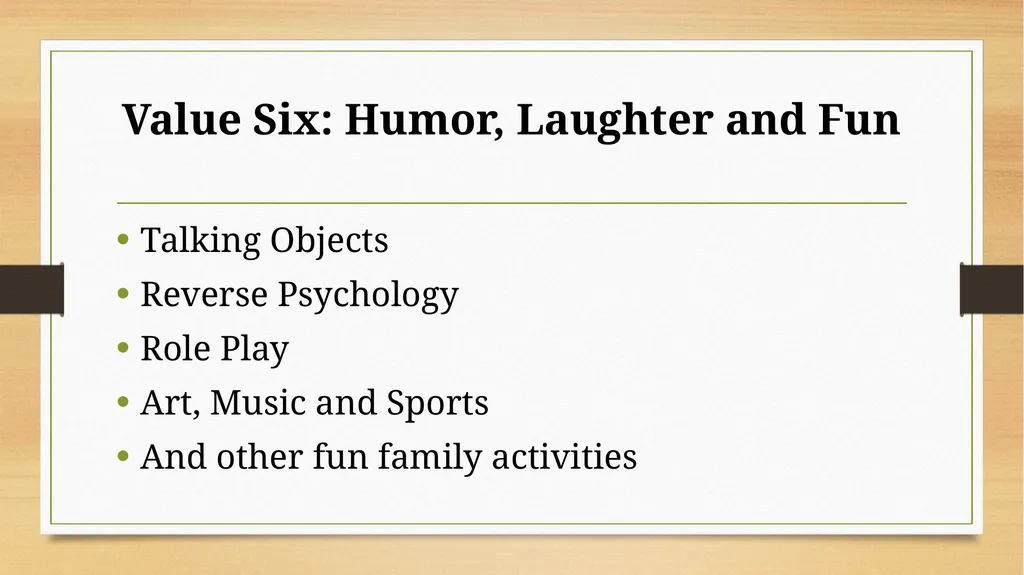
Value Six: Humor, Laughter and Fun Talking Objects
Reverse Psychology
Role Play
Art, Music and Sports
And other fun family activities<br>
Reverse Psychology
Role Play
Art, Music and Sports
And other fun family activities<br>
28
Nurturing Parenting Program Organization<br>
29
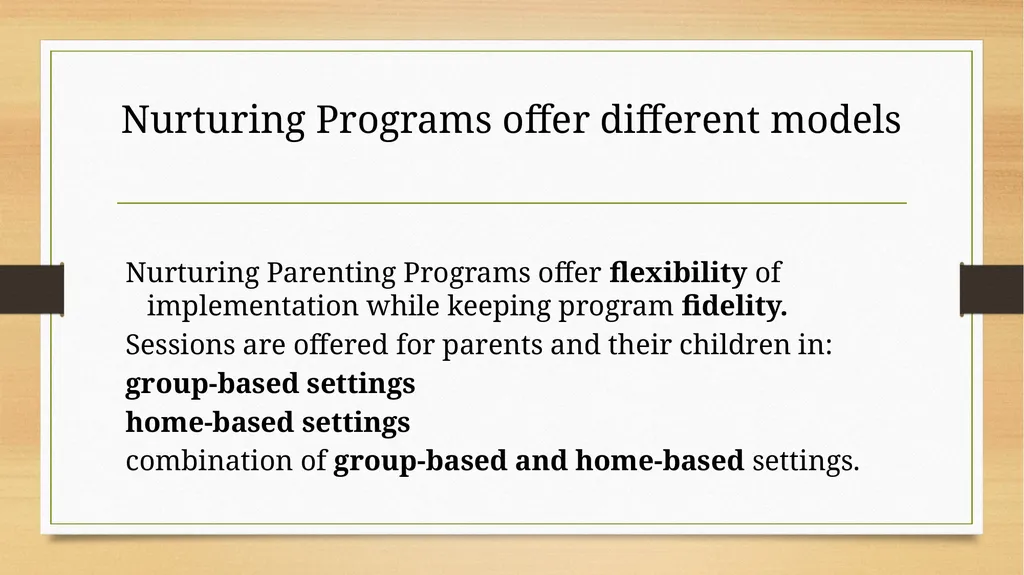
Nurturing Programs offer different models Nurturing Parenting Programs offer flexibility of implementation while keeping program fidelity.
Sessions are offered for parents and their children in:
group-based settings
home-based settings
combination of group-based and home-based settings.<br>
Sessions are offered for parents and their children in:
group-based settings
home-based settings
combination of group-based and home-based settings.<br>
30
Programs for Developmental Stages: Prenatal
Birth to Five years
School-aged Children
Adolescents
Young Parents (formerly Teen Parents)<br>
Birth to Five years
School-aged Children
Adolescents
Young Parents (formerly Teen Parents)<br>
31
Prenatal Families 9 week group program
18 week home-based program
Sessions focus on quality of life for the mom, her partner and the relationship
Parents learn about the dangers of smoking, drinking and use of legal and illegal drug use while pregnant
Parents learn about proper nutrition, fetal growth and development and healthy brain development<br>
18 week home-based program
Sessions focus on quality of life for the mom, her partner and the relationship
Parents learn about the dangers of smoking, drinking and use of legal and illegal drug use while pregnant
Parents learn about proper nutrition, fetal growth and development and healthy brain development<br>
32
Prenatal Topics Nurturing as a lifestyle
Physical, Emotional and Social Changes
Health & Nutrition
Fetal Development
Brain Development
Getting Needs Met
Developing Empathy Babies can never be spoiled
Delivery
Maintaining a healthy relationship with your partner
Alternatives to spanking
Nurturing touch
Understanding & handling stress<br>
Physical, Emotional and Social Changes
Health & Nutrition
Fetal Development
Brain Development
Getting Needs Met
Developing Empathy Babies can never be spoiled
Delivery
Maintaining a healthy relationship with your partner
Alternatives to spanking
Nurturing touch
Understanding & handling stress<br>
33
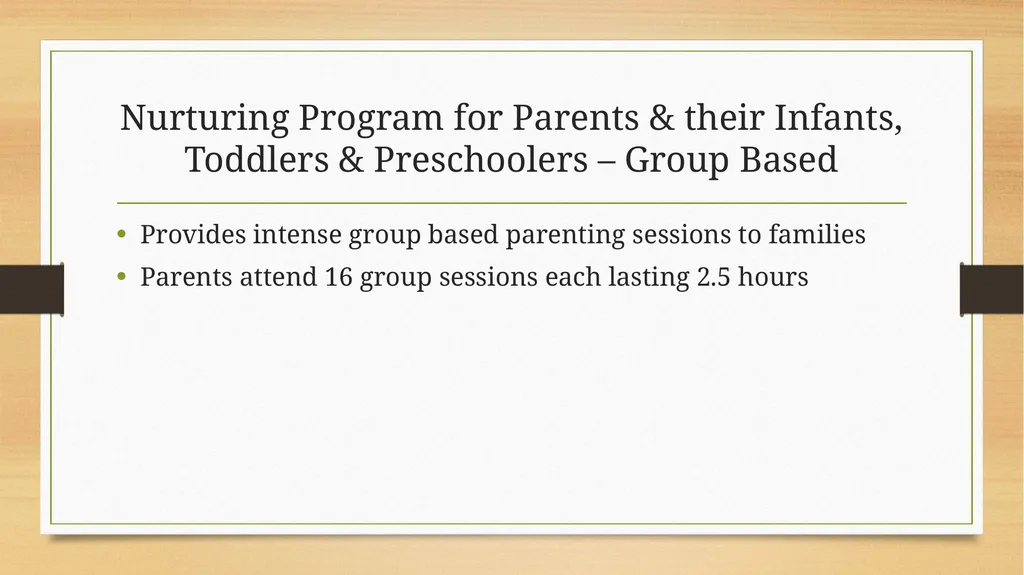
Nurturing Program for Parents & their Infants, Toddlers & Preschoolers – Group Based Provides intense group based parenting sessions to families
Parents attend 16 group sessions each lasting 2.5 hours<br>
Parents attend 16 group sessions each lasting 2.5 hours<br>
34
Infant, Toddler & Preschooler Topics Nurturing as A Lifestyle
Children’s Brain Development
Bonding and Attachment
Empathy
Expectations and Development
Meeting our Needs and the Needs of our Children Developing Personal Power
Improving Children’s Self Worth
Praise
Discipline
Family Morals and Values
Family Rules
Rewards and Punishments<br>
Children’s Brain Development
Bonding and Attachment
Empathy
Expectations and Development
Meeting our Needs and the Needs of our Children Developing Personal Power
Improving Children’s Self Worth
Praise
Discipline
Family Morals and Values
Family Rules
Rewards and Punishments<br>
35
Infant, Toddler & Preschool Topics (cont.) Recognizing and Understanding Feelings
Helping your children handle their feelings
Nurturing Routines
Possessive and Violent Relationships
Alternatives to Spanking Keeping Children Safe
Understanding and Handling Stress
Helping children manage their behavior
Managing Anger
Keeping Kids drug free
Families and Alcohol<br>
Helping your children handle their feelings
Nurturing Routines
Possessive and Violent Relationships
Alternatives to Spanking Keeping Children Safe
Understanding and Handling Stress
Helping children manage their behavior
Managing Anger
Keeping Kids drug free
Families and Alcohol<br>
36
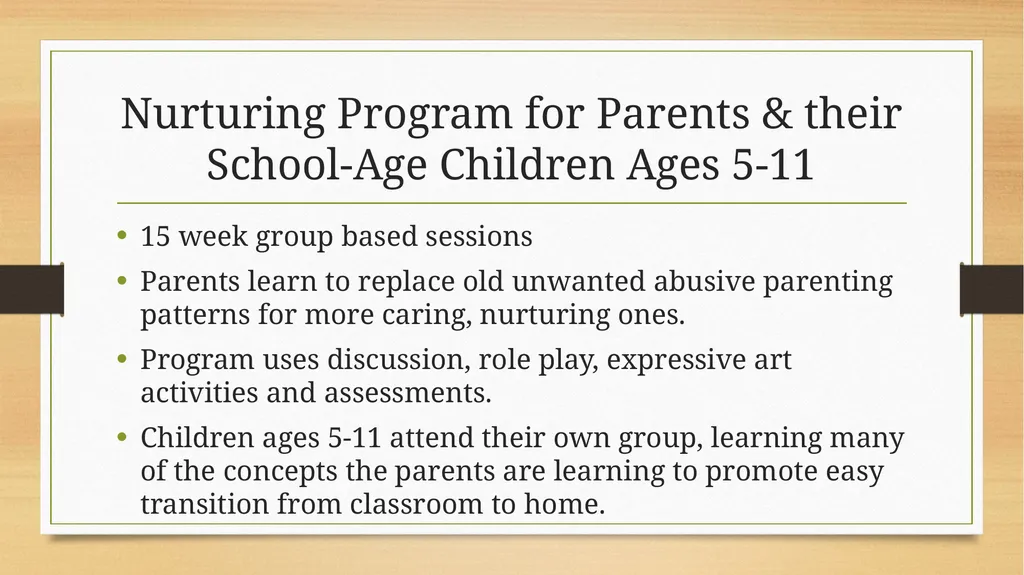
Nurturing Program for Parents & their School-Age Children Ages 5-11 15 week group based sessions
Parents learn to replace old unwanted abusive parenting patterns for more caring, nurturing ones.
Program uses discussion, role play, expressive art activities and assessments.
Children ages 5-11 attend their own group, learning many of the concepts the parents are learning to promote easy transition from classroom to home.<br>
Parents learn to replace old unwanted abusive parenting patterns for more caring, nurturing ones.
Program uses discussion, role play, expressive art activities and assessments.
Children ages 5-11 attend their own group, learning many of the concepts the parents are learning to promote easy transition from classroom to home.<br>
37
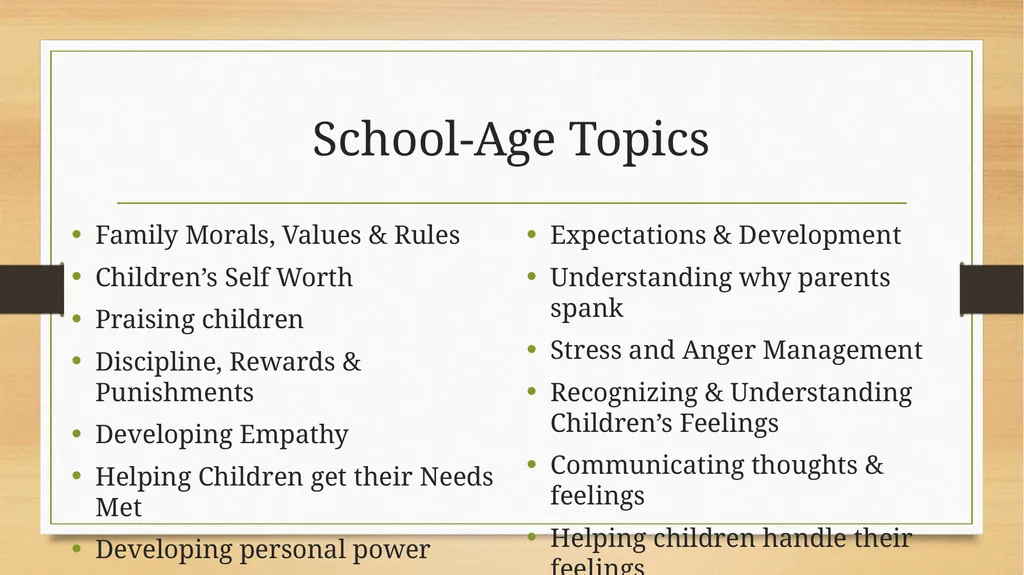
School-Age Topics Family Morals, Values & Rules
Children’s Self Worth
Praising children
Discipline, Rewards & Punishments
Developing Empathy
Helping Children get their Needs Met
Developing personal power Expectations & Development
Understanding why parents spank
Stress and Anger Management
Recognizing & Understanding Children’s Feelings
Communicating thoughts & feelings
Helping children handle their feelings<br>
Children’s Self Worth
Praising children
Discipline, Rewards & Punishments
Developing Empathy
Helping Children get their Needs Met
Developing personal power Expectations & Development
Understanding why parents spank
Stress and Anger Management
Recognizing & Understanding Children’s Feelings
Communicating thoughts & feelings
Helping children handle their feelings<br>
38
School-Age Topics (cont.) Establishing Nurturing Parenting Routines
Problem Solving & Decision-Making
Negotiation & Compromise
Sexuality, Personal Space and Respect
Ignoring as a Parenting Technique
Keeping Children Drug Free<br>
Problem Solving & Decision-Making
Negotiation & Compromise
Sexuality, Personal Space and Respect
Ignoring as a Parenting Technique
Keeping Children Drug Free<br>
39
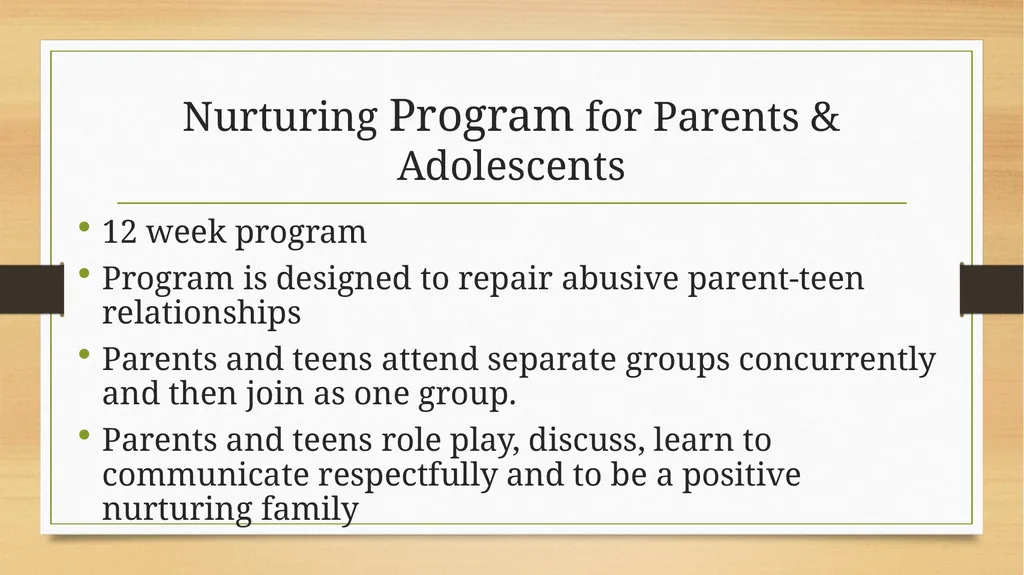
Nurturing Program for Parents & Adolescents 12 week program
Program is designed to repair abusive parent-teen relationships
Parents and teens attend separate groups concurrently and then join as one group.
Parents and teens role play, discuss, learn to communicate respectfully and to be a positive nurturing family<br>
Program is designed to repair abusive parent-teen relationships
Parents and teens attend separate groups concurrently and then join as one group.
Parents and teens role play, discuss, learn to communicate respectfully and to be a positive nurturing family<br>
40
Adolescent Program Topics Nurturing Parent & Teen Relationships
Teen Brains & their Behavior
Puberty & Adolescence
Meeting our Needs
Recognizing & Understanding Feelings
Teen Developmental Issues: Depression, Eating Disorders, Teen Suicide Personal Power
Negotiation & Compromise
Problem Solving & Decision Making
Discipline
Why teens stop talking and what you can do
Helping teens manage their behavior
Violent & Possessive Relationships<br>
Teen Brains & their Behavior
Puberty & Adolescence
Meeting our Needs
Recognizing & Understanding Feelings
Teen Developmental Issues: Depression, Eating Disorders, Teen Suicide Personal Power
Negotiation & Compromise
Problem Solving & Decision Making
Discipline
Why teens stop talking and what you can do
Helping teens manage their behavior
Violent & Possessive Relationships<br>
41
Nurturing Program Facilitators<br>
42
Who will implement the
Nurturing Program? Two facilitators for children or adolescent groups
Two facilitators for child care
One to two facilitators for the parent group<br>
Two facilitators for child care
One to two facilitators for the parent group<br>
43
Facilitators (cont.) Social Workers
Child Development Specialists
Teachers
Counselors
Parents
Child Care Providers<br>
Child Development Specialists
Teachers
Counselors
Parents
Child Care Providers<br>
44
Facilitator Characteristics Empathetic
Emotionally Stable
Accepting of their own personal background
Personal adherence to the Nurturing Parenting philosophy and practices
Self-Assurance to run activities with music, play and art Dependable
Knowledge and acceptance of alternatives to corporal punishment
Skills in behavior management
Appropriate expectations
Professionalism
Team Player<br>
Emotionally Stable
Accepting of their own personal background
Personal adherence to the Nurturing Parenting philosophy and practices
Self-Assurance to run activities with music, play and art Dependable
Knowledge and acceptance of alternatives to corporal punishment
Skills in behavior management
Appropriate expectations
Professionalism
Team Player<br>
45
Nurturing Program Implementation<br>
46
Referrals Community Partners
Department of Health & Welfare
School Counselors
School Resource Workers
Churches
Word of mouth<br>
Department of Health & Welfare
School Counselors
School Resource Workers
Churches
Word of mouth<br>
47
Incentives Dinner each week
Child care for kids under 6
Children’s Group for kids ages 6-12
Parent Group for education, discussion & support<br>
Child care for kids under 6
Children’s Group for kids ages 6-12
Parent Group for education, discussion & support<br>
48
Group Setting Each group is 2.5 to 3 hours per week
Groups at BYF are held in classroom settings with a separate room for parents, children and child care
A family meal is served before group for a half hour.
Parents and children in the School-Age and Adolescent Program meet separately for the first portion of class. They come together for the second portion to practice skills learned together.<br>
Groups at BYF are held in classroom settings with a separate room for parents, children and child care
A family meal is served before group for a half hour.
Parents and children in the School-Age and Adolescent Program meet separately for the first portion of class. They come together for the second portion to practice skills learned together.<br>
49
Length of Groups Prenatal Program: 9 weeks
Infant, Toddler & Preschooler Program: 16 weeks
School-Age Program: 15 weeks
Adolescent Program: 12 weeks<br>
Infant, Toddler & Preschooler Program: 16 weeks
School-Age Program: 15 weeks
Adolescent Program: 12 weeks<br>
50
How do we keep families coming? Dinner
Child Care
Empathy
Interesting and relevant discussions about childhood and parenting
Fun activities
Support<br>
Child Care
Empathy
Interesting and relevant discussions about childhood and parenting
Fun activities
Support<br>
51
Childhood Hours The following chart displays how personalities and behavior patterns are influenced early in life based on the quality of life in childhood portrayed in hours.
There are approximately
157,776 hours
in the first 18 years of life.<br>
There are approximately
157,776 hours
in the first 18 years of life.<br>
52
157,776 Hours in Childhood Positive % Negative % Dysfunctional Hours
20% 80% 126,221
30% 70% 110,443
50% 50% 78,888
70% 30% 47,333
80% 20% 31,555
90% 10% 15,778
95% 5% 7,889
99% 1% 1,578
100% 0% 0<br>
20% 80% 126,221
30% 70% 110,443
50% 50% 78,888
70% 30% 47,333
80% 20% 31,555
90% 10% 15,778
95% 5% 7,889
99% 1% 1,578
100% 0% 0<br>
53
Any Questions?<br>
54
Thank you for coming! If you have any questions you think of later…
Heather Kemp 208-234-1122 ext. 19<br>
Heather Kemp 208-234-1122 ext. 19<br>