
Nutrition and Menu Planning N4
PT
Published · 38 slides · 0 views
1 / 1
Description
Nutrition and Menu Planning N4 www.futuremanagers.com SOURCES OF NUTRITION The five basic food groups are foods that we need to eat from every day to stay healthy. The five basic food groups are: Group 1: Protein and meat group; Group 2:
Related Topics
Share
Embed code
Download this presentation From Below
"Nutrition and Menu Planning N4" is the property of its rightful owner. Permission is granted to download and print the materials on this website for personal, non-commercial use only, and to display it on your personal computer provided you do not modify the materials and that you retain all copyright notices contained in the materials. By downloading content from our website, you accept the terms of this agreement.
Presentation Transcript
01
Nutrition and Menu Planning
N4<br>
N4<br>
02
www.futuremanagers.com SOURCES OF NUTRITION
The five basic food groups are foods that we need to eat from every day to stay healthy. The five basic food groups are:
Group 1: Protein and meat group;
Group 2: Calcium and milk group;
Group 3: Fruit and vegetables group;
Group 4: Cereal group; and
Group 5: Fats and oils group. Module 1 – The five basic food groups<br>
The five basic food groups are foods that we need to eat from every day to stay healthy. The five basic food groups are:
Group 1: Protein and meat group;
Group 2: Calcium and milk group;
Group 3: Fruit and vegetables group;
Group 4: Cereal group; and
Group 5: Fats and oils group. Module 1 – The five basic food groups<br>
03
www.futuremanagers.com TERMINOLOGY
Food is any substance, liquid or solid which provides the body with materials necessary for important functions.
Nutrients are the components in food that must be supplied to the body in suitable amounts to be able to perform the important functions.
A balanced diet is a diet that contains adequate amounts of all the necessary nutrients required for the needs of an individual at a particular stage in his life. Module 2 – Nutrients<br>
Food is any substance, liquid or solid which provides the body with materials necessary for important functions.
Nutrients are the components in food that must be supplied to the body in suitable amounts to be able to perform the important functions.
A balanced diet is a diet that contains adequate amounts of all the necessary nutrients required for the needs of an individual at a particular stage in his life. Module 2 – Nutrients<br>
04
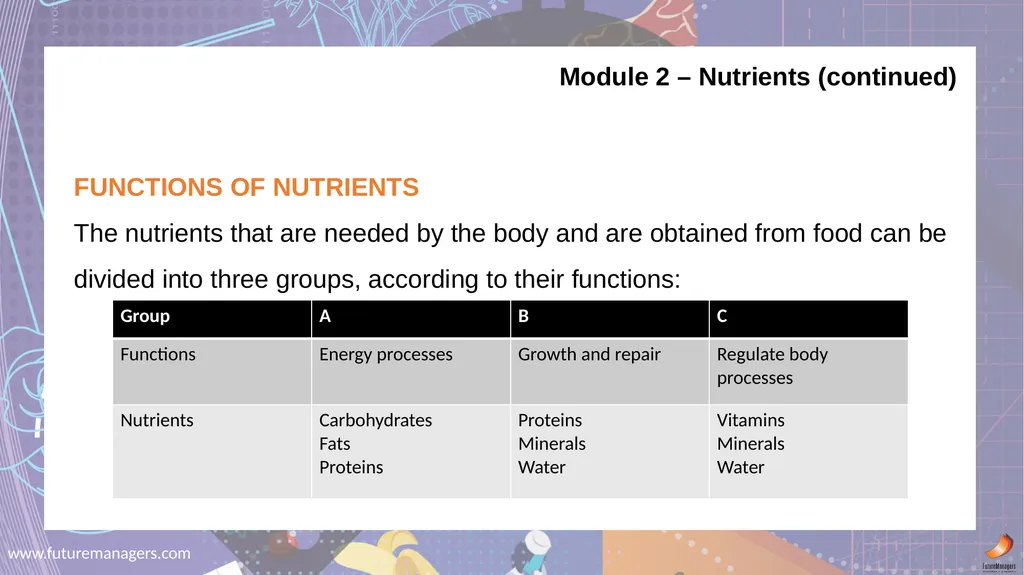
www.futuremanagers.com Module 2 – Nutrients (continued) FUNCTIONS OF NUTRIENTS
The nutrients that are needed by the body and are obtained from food can be divided into three groups, according to their functions:<br>
The nutrients that are needed by the body and are obtained from food can be divided into three groups, according to their functions:<br>
05
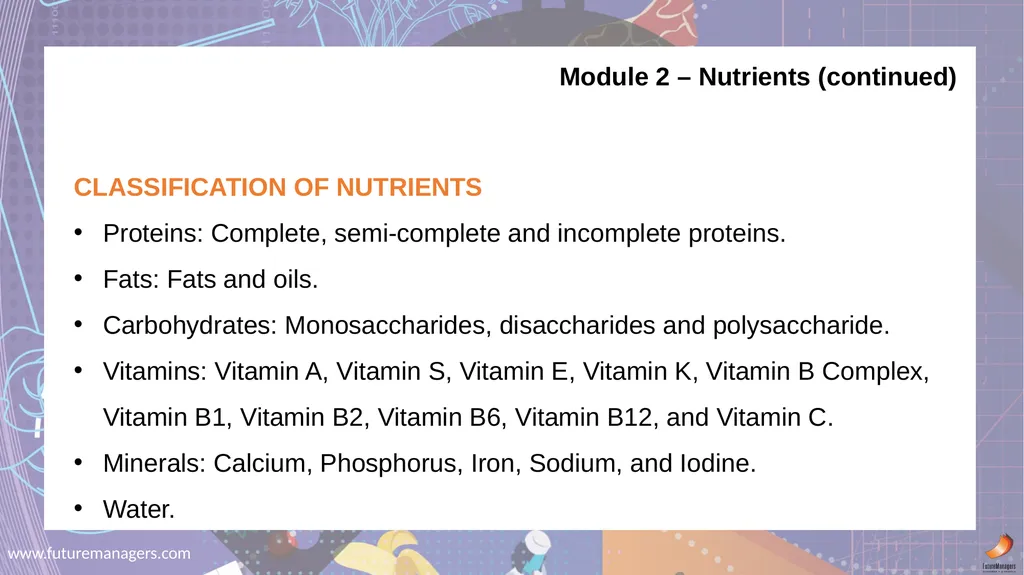
www.futuremanagers.com Module 2 – Nutrients (continued) CLASSIFICATION OF NUTRIENTS
Proteins: Complete, semi-complete and incomplete proteins.
Fats: Fats and oils.
Carbohydrates: Monosaccharides, disaccharides and polysaccharide.
Vitamins: Vitamin A, Vitamin S, Vitamin E, Vitamin K, Vitamin B Complex, Vitamin B1, Vitamin B2, Vitamin B6, Vitamin B12, and Vitamin C.
Minerals: Calcium, Phosphorus, Iron, Sodium, and Iodine.
Water.<br>
Proteins: Complete, semi-complete and incomplete proteins.
Fats: Fats and oils.
Carbohydrates: Monosaccharides, disaccharides and polysaccharide.
Vitamins: Vitamin A, Vitamin S, Vitamin E, Vitamin K, Vitamin B Complex, Vitamin B1, Vitamin B2, Vitamin B6, Vitamin B12, and Vitamin C.
Minerals: Calcium, Phosphorus, Iron, Sodium, and Iodine.
Water.<br>
06
www.futuremanagers.com Module 2 – Nutrients (continued) DIGESTION AND ABSORPTION
When food has been eaten, it must be broken down in the body by the process of digestion. Absorption occurs after the food has been broken down; the products are then passed through the walls of the digestive tract into the bloodstream.<br>
When food has been eaten, it must be broken down in the body by the process of digestion. Absorption occurs after the food has been broken down; the products are then passed through the walls of the digestive tract into the bloodstream.<br>
07
www.futuremanagers.com FOOD REQUIREMENTS OF THE DIFFERENT AGE GROUPS
Pregnant women: Needs nutrients for the foetus to develop properly.
Babies: Depends entirely on milk or the first four to six months of life.
Toddler: Milk, meat, fruit and vegetables groups are needed.
Children: Should include dark leafy greens and whole-wheat breads and cereals.
Teenagers: Nutrients to cope with growth and hormonal changes.
The elderly: Small, nutrient filled meals more often. Module 3 – Food requirements and nutritional guidelines<br>
Pregnant women: Needs nutrients for the foetus to develop properly.
Babies: Depends entirely on milk or the first four to six months of life.
Toddler: Milk, meat, fruit and vegetables groups are needed.
Children: Should include dark leafy greens and whole-wheat breads and cereals.
Teenagers: Nutrients to cope with growth and hormonal changes.
The elderly: Small, nutrient filled meals more often. Module 3 – Food requirements and nutritional guidelines<br>
08
www.futuremanagers.com Module 3 – Food requirements and nutritional guidelines (continued) VEGETARIANS
Vegetarianism is the practice of abstaining from consumption of meat (red meat, poultry and seafood). It may also include abstention from by-products of animal slaughter, such as animal derived rennet and gelatine.<br>
Vegetarianism is the practice of abstaining from consumption of meat (red meat, poultry and seafood). It may also include abstention from by-products of animal slaughter, such as animal derived rennet and gelatine.<br>
09
www.futuremanagers.com Module 3 – Food requirements and nutritional guidelines (continued) FOOD ALLERGIES
A true food allergy is a reaction of the immune system as a result of eating a specific food and can in many cases be tested clinically because of changes in the immune system.<br>
A true food allergy is a reaction of the immune system as a result of eating a specific food and can in many cases be tested clinically because of changes in the immune system.<br>
10
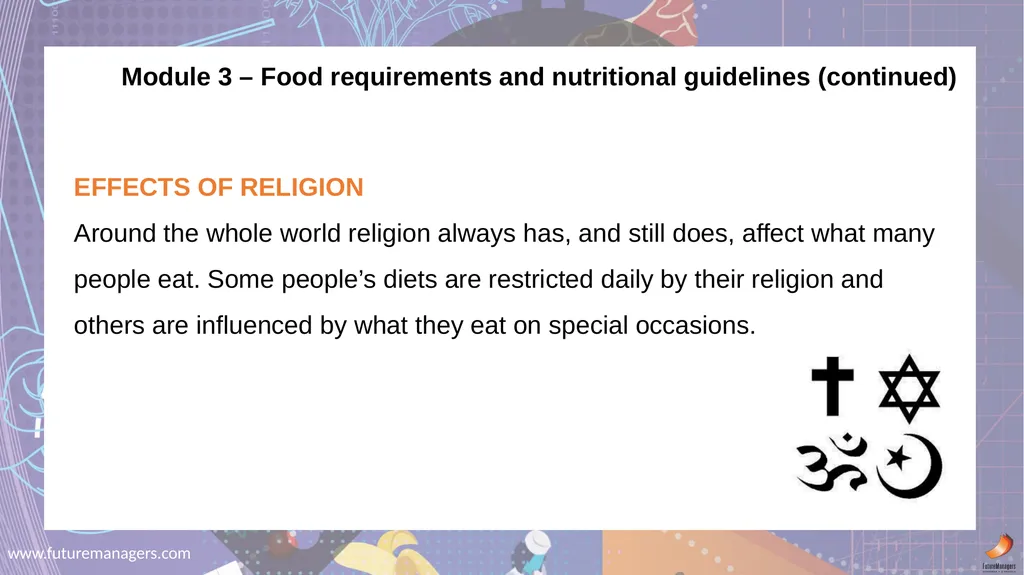
www.futuremanagers.com Module 3 – Food requirements and nutritional guidelines (continued) EFFECTS OF RELIGION
Around the whole world religion always has, and still does, affect what many people eat. Some people’s diets are restricted daily by their religion and others are influenced by what they eat on special occasions.<br>
Around the whole world religion always has, and still does, affect what many people eat. Some people’s diets are restricted daily by their religion and others are influenced by what they eat on special occasions.<br>
11
www.futuremanagers.com Module 3 – Food requirements and nutritional guidelines (continued) NUTRITIONAL GUIDELINES WHEN COMPILING MENUS FOR INSTITUTIONS
The South African Food-Based Dietary Guidelines: Enjoy a variety of foods;
Make starch the basis of meals;
Eat plenty of vegetable and fruit daily;
Eat legumes regularly;
Eat fats sparingly;
Meat, fish, chicken, milk or eggs can be eaten daily;
Use salt sparingly;
Drink lots of clean, safe water;
Drink alcohol sensibly.<br>
The South African Food-Based Dietary Guidelines: Enjoy a variety of foods;
Make starch the basis of meals;
Eat plenty of vegetable and fruit daily;
Eat legumes regularly;
Eat fats sparingly;
Meat, fish, chicken, milk or eggs can be eaten daily;
Use salt sparingly;
Drink lots of clean, safe water;
Drink alcohol sensibly.<br>
12
www.futuremanagers.com Module 3 – Food requirements and nutritional guidelines (continued) SOUTH AFRICAN LOCAL CULTURAL GROUPS
Most nations are composed of various sub-cultures with different preferences. Factors which influence traditional eating habits include:
Environmental factors;
Religious factors; and
Cultural factors.<br>
Most nations are composed of various sub-cultures with different preferences. Factors which influence traditional eating habits include:
Environmental factors;
Religious factors; and
Cultural factors.<br>
13
www.futuremanagers.com Module 3 – Food requirements and nutritional guidelines (continued) INTERNATIONAL CUISINE
African: Babotie, groundnut stew, ugali, ful medames;
Indian: Chapati, ghee, poppadums, bombay duck, vindaloo;
Middle-Eastern: Couscous, kebabs, keftdes, hummus, tahini;
Asian: Gado gado;
Japanese: Sushi, teriyaki, yakitori, mirin, tofu, sake;
European: Fried fish and chips, Welsh lamb pie, haggis, Irish stew;
American: Gumbo, chowder, cheesecake, jambalaya.<br>
African: Babotie, groundnut stew, ugali, ful medames;
Indian: Chapati, ghee, poppadums, bombay duck, vindaloo;
Middle-Eastern: Couscous, kebabs, keftdes, hummus, tahini;
Asian: Gado gado;
Japanese: Sushi, teriyaki, yakitori, mirin, tofu, sake;
European: Fried fish and chips, Welsh lamb pie, haggis, Irish stew;
American: Gumbo, chowder, cheesecake, jambalaya.<br>
14
www.futuremanagers.com MODIFICATION IN TEXTURE
Dietary modification means altering the consistency of foods and liquids.
Three types of modified-texture diets:
Puréed diet;
A minced, ground and chopped diet; and
A modified regular diet. Module 4 – Modified diets<br>
Dietary modification means altering the consistency of foods and liquids.
Three types of modified-texture diets:
Puréed diet;
A minced, ground and chopped diet; and
A modified regular diet. Module 4 – Modified diets<br>
15
www.futuremanagers.com Module 4 – Modified diets (continued) SPECIAL DIETS
Special diets include:
Low-fat diets;
Low-sodium diets;
Low protein diets.<br>
Special diets include:
Low-fat diets;
Low-sodium diets;
Low protein diets.<br>
16
www.futuremanagers.com Module 4 – Modified diets (continued) REDUCING DIETS: BASIC PRINCIPLES, FOOD ALLOWED AND FOOD TO AVOID
It takes more than just eating low-fat foods to lose weight –one must also watch how many calories one eats. Trans fats, cholesterol and sodium are recommended to avoid when dieting.<br>
It takes more than just eating low-fat foods to lose weight –one must also watch how many calories one eats. Trans fats, cholesterol and sodium are recommended to avoid when dieting.<br>
17
www.futuremanagers.com Module 4 – Modified diets (continued) HEALTH TRENDS IN NUTRITION
Different health trends include:
Lowering cholesterol content;
Lowering fat content;
Raising fibre content; and
Lowering fibre content.<br>
Different health trends include:
Lowering cholesterol content;
Lowering fat content;
Raising fibre content; and
Lowering fibre content.<br>
18
www.futuremanagers.com TERMINOLOGY
A menu is a detailed list of food to be served at a specific meal, in a specific order, offered by a food service unit, which inform the customer what the caterer has to offer.
A cycle menu is compiled over a given period of time and consists of a number of set menus that are rotated for a particular establishment. Module 5 – Menu planning<br>
A menu is a detailed list of food to be served at a specific meal, in a specific order, offered by a food service unit, which inform the customer what the caterer has to offer.
A cycle menu is compiled over a given period of time and consists of a number of set menus that are rotated for a particular establishment. Module 5 – Menu planning<br>
19
www.futuremanagers.com Module 5 – Menu planning (continued) THE MENU AS A TOOL OF MARKETING
The menu is used as a:
Purchasing guide;
Means of advertising food and beverages;
Form of merchandising and an important marketing tool;
A design to appeal to the guests and to stimulate sales;
Size easily handled, spotlessly clean and simple in format; highly legible and interesting in colour and design.<br>
The menu is used as a:
Purchasing guide;
Means of advertising food and beverages;
Form of merchandising and an important marketing tool;
A design to appeal to the guests and to stimulate sales;
Size easily handled, spotlessly clean and simple in format; highly legible and interesting in colour and design.<br>
20
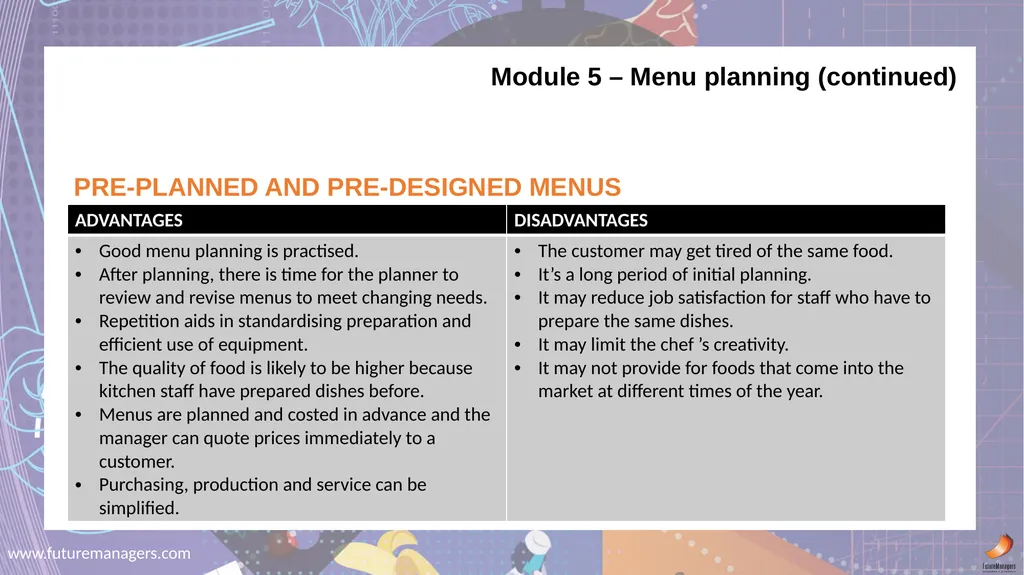
www.futuremanagers.com Module 5 – Menu planning (continued) PRE-PLANNED AND PRE-DESIGNED MENUS<br>
21
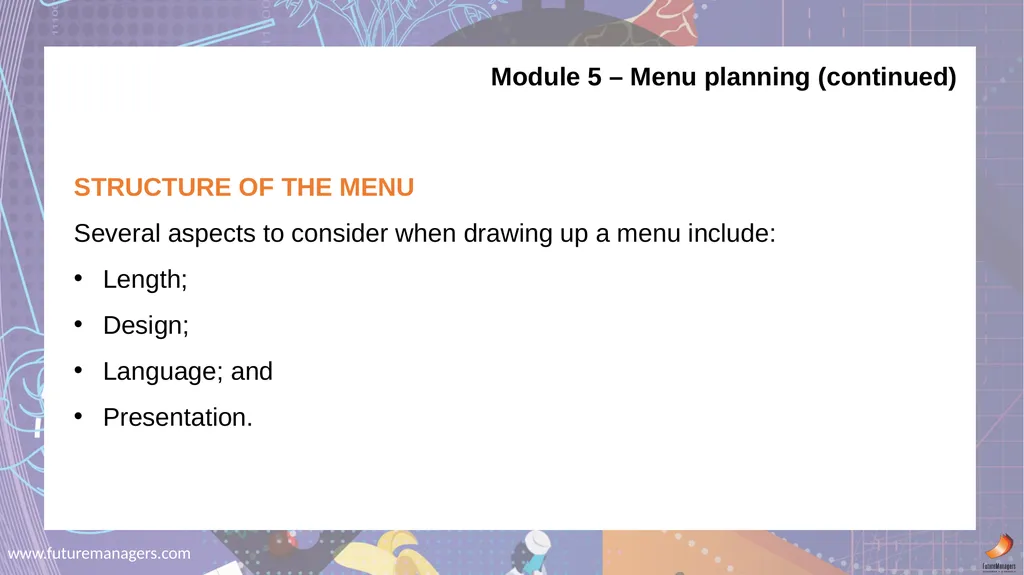
www.futuremanagers.com Module 5 – Menu planning (continued) STRUCTURE OF THE MENU
Several aspects to consider when drawing up a menu include:
Length;
Design;
Language; and
Presentation.<br>
Several aspects to consider when drawing up a menu include:
Length;
Design;
Language; and
Presentation.<br>
22
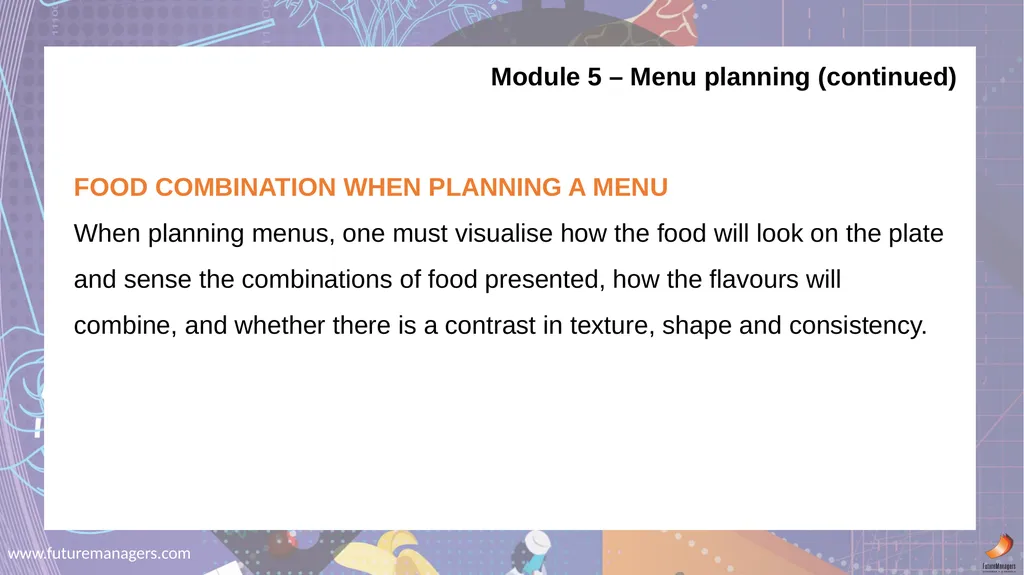
www.futuremanagers.com Module 5 – Menu planning (continued) FOOD COMBINATION WHEN PLANNING A MENU
When planning menus, one must visualise how the food will look on the plate and sense the combinations of food presented, how the flavours will combine, and whether there is a contrast in texture, shape and consistency.<br>
When planning menus, one must visualise how the food will look on the plate and sense the combinations of food presented, how the flavours will combine, and whether there is a contrast in texture, shape and consistency.<br>
23
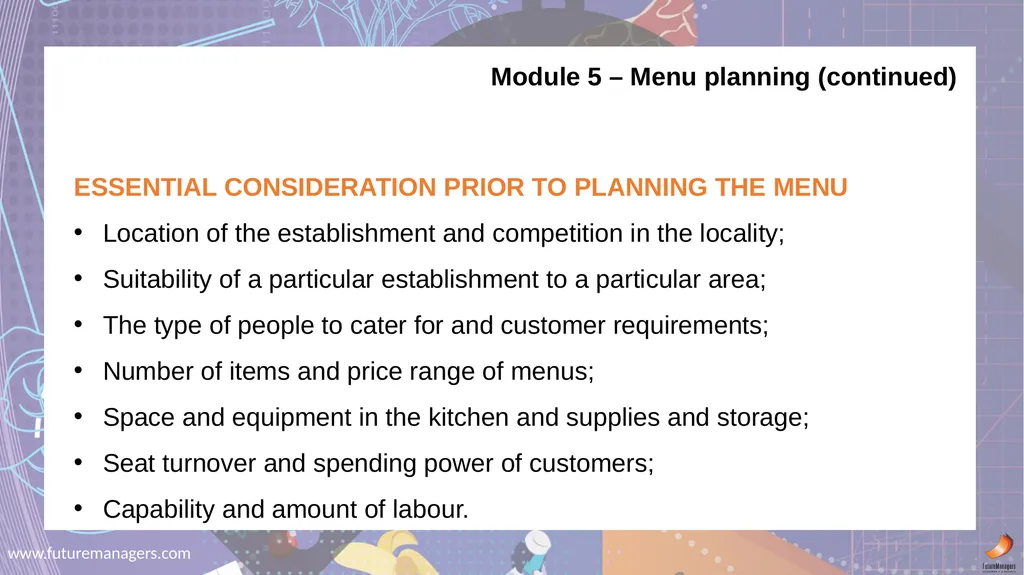
www.futuremanagers.com Module 5 – Menu planning (continued) ESSENTIAL CONSIDERATION PRIOR TO PLANNING THE MENU
Location of the establishment and competition in the locality;
Suitability of a particular establishment to a particular area;
The type of people to cater for and customer requirements;
Number of items and price range of menus;
Space and equipment in the kitchen and supplies and storage;
Seat turnover and spending power of customers;
Capability and amount of labour.<br>
Location of the establishment and competition in the locality;
Suitability of a particular establishment to a particular area;
The type of people to cater for and customer requirements;
Number of items and price range of menus;
Space and equipment in the kitchen and supplies and storage;
Seat turnover and spending power of customers;
Capability and amount of labour.<br>
24
www.futuremanagers.com Module 5 – Menu planning (continued) FACTORS TO BE CONSIDERED WHEN COMPILING A MENU Type of establishment;
Type of customer;
The religious rules if applicable;
Meat and non-meat preferences;
Timing;
Pricing;
Number of courses;
Appropriate language;
Nutritional balance;
The occasion;
The menu;
Leftover foods.<br>
Type of customer;
The religious rules if applicable;
Meat and non-meat preferences;
Timing;
Pricing;
Number of courses;
Appropriate language;
Nutritional balance;
The occasion;
The menu;
Leftover foods.<br>
25
www.futuremanagers.com Module 5 – Menu planning (continued) TYPES OF MENU Table d’hote menu;
Á la Carte menu;
Plat du jour;
Special function menu;
Breakfast menu;
Brunch menu;
Lunch menu;
Buffet menu;
High tea;
Dinner menu;
Supper menu;
Room service menu;
Canteen menu;
Cycle menu.<br>
Á la Carte menu;
Plat du jour;
Special function menu;
Breakfast menu;
Brunch menu;
Lunch menu;
Buffet menu;
High tea;
Dinner menu;
Supper menu;
Room service menu;
Canteen menu;
Cycle menu.<br>
26
www.futuremanagers.com COURSE, HORS D’OEUVRES, FARINACEOUS, ENTRÉE
A course is one of the sections of a meal.
Hors d’oeuvres is the name given to a wide variety of foods.
Farinaceous are foodstuffs that consist of a large amount of starch.
Entrées are generally small, well-garnished dishes that are plate-served individually. Module 6 – Modern service order<br>
A course is one of the sections of a meal.
Hors d’oeuvres is the name given to a wide variety of foods.
Farinaceous are foodstuffs that consist of a large amount of starch.
Entrées are generally small, well-garnished dishes that are plate-served individually. Module 6 – Modern service order<br>
27
www.futuremanagers.com Module 6 – Modern service order (continued) NORMAL ORDER IN WHICH DISHES ARE SERVED
The normal order in which dishes or courses appear on the classic menu is as follows: Hors d’oeuvres;
Soup;
Eggs;
Rice and pasta;
Fish;
Entrée;
Joint;
Vegetables;
Poultry/Game or Roast;
Salads;
Sweets;
Savoury;
Cheese;
Dessert;
Beverages.<br>
The normal order in which dishes or courses appear on the classic menu is as follows: Hors d’oeuvres;
Soup;
Eggs;
Rice and pasta;
Fish;
Entrée;
Joint;
Vegetables;
Poultry/Game or Roast;
Salads;
Sweets;
Savoury;
Cheese;
Dessert;
Beverages.<br>
28
www.futuremanagers.com Module 6 – Modern service order (continued) DIFFERENT BREAKFAST MENUS
Breakfast menus can be divided into TWO main categories:
Full English breakfast;
Continental breakfast.<br>
Breakfast menus can be divided into TWO main categories:
Full English breakfast;
Continental breakfast.<br>
29
www.futuremanagers.com Module 6 – Modern service order (continued) LUNCHEON MENUS: SEQUENCE OF DISHES
A traditional lunch menu might include the following courses:
Starter;
Fish;
Main;
Sweet;
Cheese;
Coffee.<br>
A traditional lunch menu might include the following courses:
Starter;
Fish;
Main;
Sweet;
Cheese;
Coffee.<br>
30
www.futuremanagers.com Module 6 – Modern service order (continued) ENTRÉES AND RELEVÉS
The entrée is the first of the meat courses. At dinner, usually, it is complete in itself, accompanied by its own vegetable or other garnish.
The relevé is a larger joint or ‘piéce de resistance’<br>
The entrée is the first of the meat courses. At dinner, usually, it is complete in itself, accompanied by its own vegetable or other garnish.
The relevé is a larger joint or ‘piéce de resistance’<br>
31
www.futuremanagers.com Module 6 – Modern service order (continued) SUPPER MENUS: SEQUENCE OF DISHES
Normally set supper menu consist of three courses only, with many choices in the second or main course. These choices include:
Second course: Fish, Entrées, Roasts, Grills, and Salads.
Third course: Hot and cold sweet desserts; Savoury, Cheeses, and Coffees.<br>
Normally set supper menu consist of three courses only, with many choices in the second or main course. These choices include:
Second course: Fish, Entrées, Roasts, Grills, and Salads.
Third course: Hot and cold sweet desserts; Savoury, Cheeses, and Coffees.<br>
32
www.futuremanagers.com Module 6 – Modern service order (continued) FUNCTION MENU PLANNING The different courses of a luncheon menu for a function could include: First course;
Fish;
Main course;
Cold buffet;
Vegetable dish or cold dish;
Sweet;
Cheese;
Dessert;
Coffee.<br>
Fish;
Main course;
Cold buffet;
Vegetable dish or cold dish;
Sweet;
Cheese;
Dessert;
Coffee.<br>
33
www.futuremanagers.com Module 6 – Modern service order (continued) PRE-BANQUET ORGANISATION
A banquet is a public or private meal for many people that have celebratory or ceremonious meaning.
There are many things to consider when planning a banquet:
Allergy information;
Details regarding the building’s facilities;
Potential food storage; and
Preparation areas.<br>
A banquet is a public or private meal for many people that have celebratory or ceremonious meaning.
There are many things to consider when planning a banquet:
Allergy information;
Details regarding the building’s facilities;
Potential food storage; and
Preparation areas.<br>
34
www.futuremanagers.com Module 6 – Modern service order (continued) AFTERNOON TEA
The order of service for afternoon tea is: Beverages
Hot snacks-bread and butter
Hot toasted items
Sandwiches
Buttered scones
Bread and butter
Preserves
Cakes and pastries<br>
The order of service for afternoon tea is: Beverages
Hot snacks-bread and butter
Hot toasted items
Sandwiches
Buttered scones
Bread and butter
Preserves
Cakes and pastries<br>
35
www.futuremanagers.com Module 6 – Modern service order (continued) SELECTING TABLE WINE AND A WINE LIST
The aim of the wine list is similar to that of the menu and should be regarded as a marketing tool for the restaurant. It should therefore be attractive and interesting. Prices should be indicated clearly.<br>
The aim of the wine list is similar to that of the menu and should be regarded as a marketing tool for the restaurant. It should therefore be attractive and interesting. Prices should be indicated clearly.<br>
36
www.futuremanagers.com TYPES OF FIXED MENUS
Cycle menus;
Traditional table d'hôte menu used in hotels and restaurants; and
Fixed menu with a limited choice. Module 7 – Fixed menus, menu specification, order forms and dispatch list<br>
Cycle menus;
Traditional table d'hôte menu used in hotels and restaurants; and
Fixed menu with a limited choice. Module 7 – Fixed menus, menu specification, order forms and dispatch list<br>
37
www.futuremanagers.com Module 7 – Fixed menus, menu specification, order forms and
dispatch list (continued) MENU SPECIFICATIONS
Menu specification indicates the manual that gives the chef all the technical information on how to plan a menu for the restaurant or catering function.
The specifications include:
Length;
Design;
Language; and
Presentation.<br>
dispatch list (continued) MENU SPECIFICATIONS
Menu specification indicates the manual that gives the chef all the technical information on how to plan a menu for the restaurant or catering function.
The specifications include:
Length;
Design;
Language; and
Presentation.<br>
38
www.futuremanagers.com Module 7 – Fixed menus, menu specification, order forms and
dispatch list (continued) THE FUNCTION ORDER FORM
The function order form, also called the function sheet, lists the details of the event in what will become an important document. The point of a well-written function order is to answer all questions at once, so it should carry every detail available.<br>
dispatch list (continued) THE FUNCTION ORDER FORM
The function order form, also called the function sheet, lists the details of the event in what will become an important document. The point of a well-written function order is to answer all questions at once, so it should carry every detail available.<br>