
Object-Based Audio: A Signal Processing Overview
T
Published · 34 slides · 0 views
1 / 1

Description
Object-Based Audio: A Signal Processing Overview Sachin Ghanekar Agenda A brief Overview History of Digital Audio Basic Concepts of Object Audio How it works Signal Processing in Object Based Audio on Headphones. Signal Processing in
Related Topics
Share
Embed code
Download this presentation From Below
"Object-Based Audio: A Signal Processing Overview" is the property of its rightful owner. Permission is granted to download and print the materials on this website for personal, non-commercial use only, and to display it on your personal computer provided you do not modify the materials and that you retain all copyright notices contained in the materials. By downloading content from our website, you accept the terms of this agreement.
Presentation Transcript
01
Object-Based Audio: A Signal Processing Overview Sachin Ghanekar<br>
02
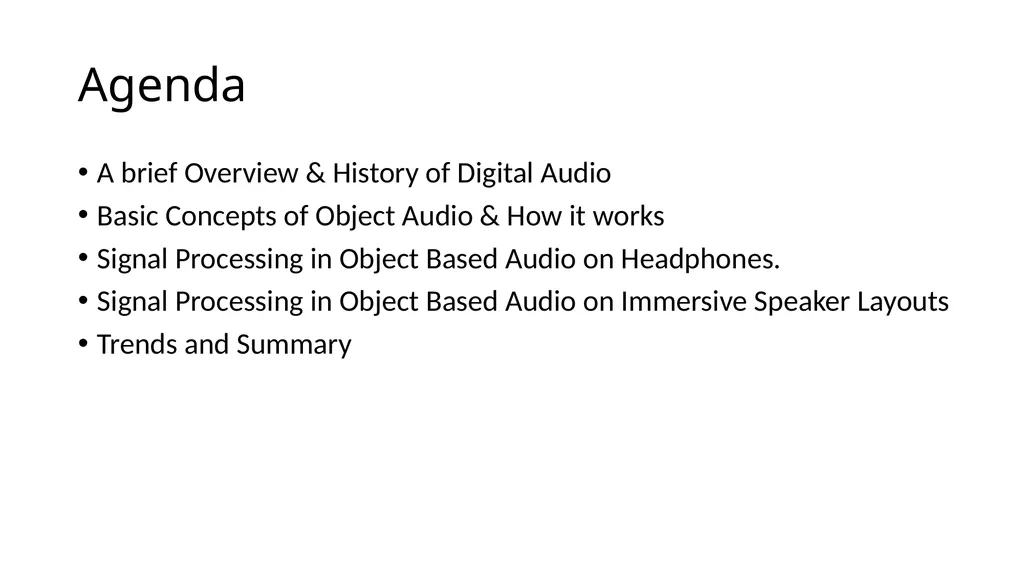
Agenda A brief Overview & History of Digital Audio
Basic Concepts of Object Audio & How it works
Signal Processing in Object Based Audio on Headphones.
Signal Processing in Object Based Audio on Immersive Speaker Layouts
Trends and Summary<br>
Basic Concepts of Object Audio & How it works
Signal Processing in Object Based Audio on Headphones.
Signal Processing in Object Based Audio on Immersive Speaker Layouts
Trends and Summary<br>
03
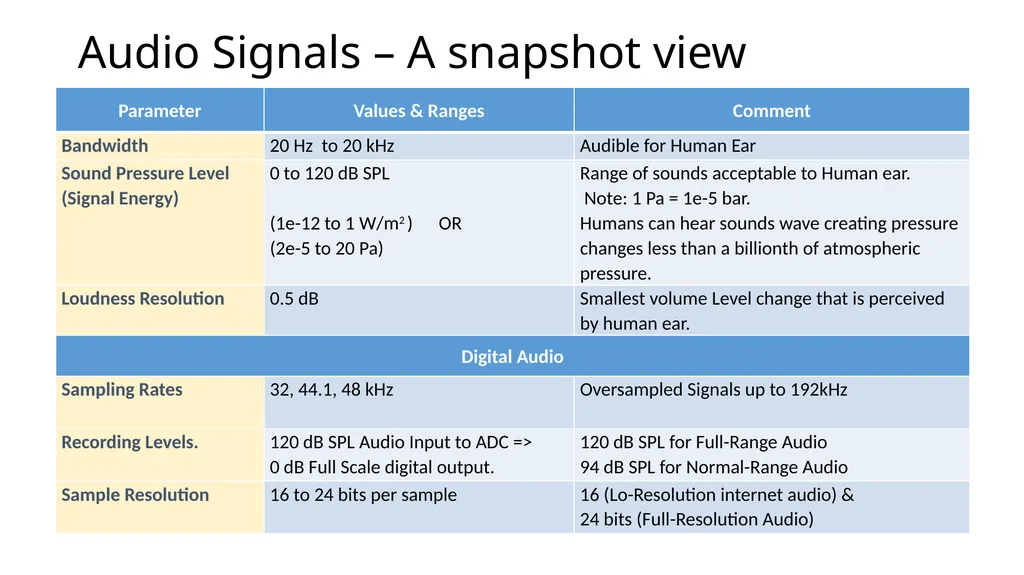
Audio Signals – A snapshot view<br>
04
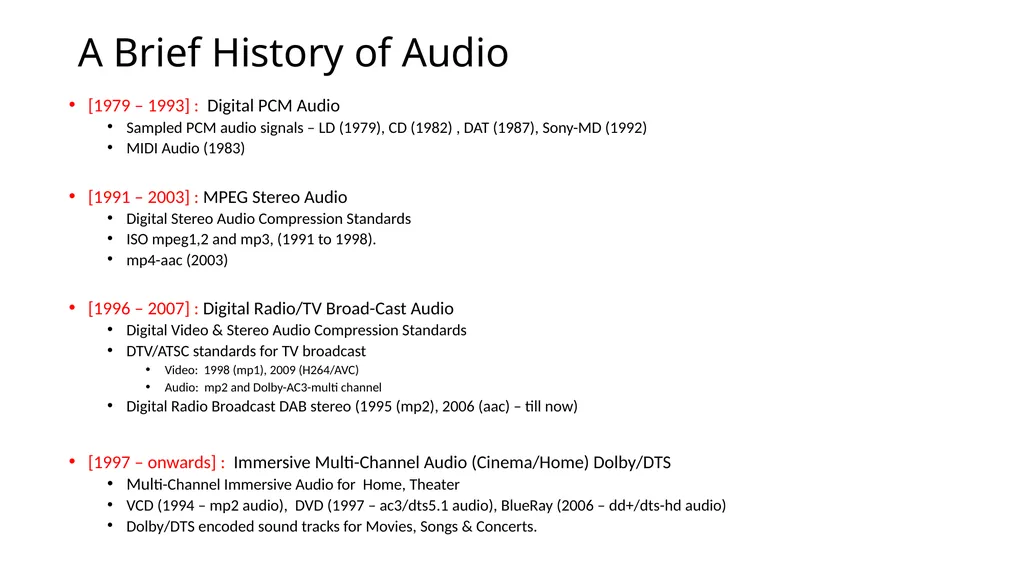
A Brief History of Audio [1979 – 1993] : Digital PCM Audio
Sampled PCM audio signals – LD (1979), CD (1982) , DAT (1987), Sony-MD (1992)
MIDI Audio (1983)
[1991 – 2003] : MPEG Stereo Audio
Digital Stereo Audio Compression Standards
ISO mpeg1,2 and mp3, (1991 to 1998).
mp4-aac (2003)
[1996 – 2007] : Digital Radio/TV Broad-Cast Audio
Digital Video & Stereo Audio Compression Standards
DTV/ATSC standards for TV broadcast
Video: 1998 (mp1), 2009 (H264/AVC)
Audio: mp2 and Dolby-AC3-multi channel
Digital Radio Broadcast DAB stereo (1995 (mp2), 2006 (aac) – till now)
[1997 – onwards] : Immersive Multi-Channel Audio (Cinema/Home) Dolby/DTS
Multi-Channel Immersive Audio for Home, Theater
VCD (1994 – mp2 audio), DVD (1997 – ac3/dts5.1 audio), BlueRay (2006 – dd+/dts-hd audio)
Dolby/DTS encoded sound tracks for Movies, Songs & Concerts.<br>
Sampled PCM audio signals – LD (1979), CD (1982) , DAT (1987), Sony-MD (1992)
MIDI Audio (1983)
[1991 – 2003] : MPEG Stereo Audio
Digital Stereo Audio Compression Standards
ISO mpeg1,2 and mp3, (1991 to 1998).
mp4-aac (2003)
[1996 – 2007] : Digital Radio/TV Broad-Cast Audio
Digital Video & Stereo Audio Compression Standards
DTV/ATSC standards for TV broadcast
Video: 1998 (mp1), 2009 (H264/AVC)
Audio: mp2 and Dolby-AC3-multi channel
Digital Radio Broadcast DAB stereo (1995 (mp2), 2006 (aac) – till now)
[1997 – onwards] : Immersive Multi-Channel Audio (Cinema/Home) Dolby/DTS
Multi-Channel Immersive Audio for Home, Theater
VCD (1994 – mp2 audio), DVD (1997 – ac3/dts5.1 audio), BlueRay (2006 – dd+/dts-hd audio)
Dolby/DTS encoded sound tracks for Movies, Songs & Concerts.<br>
05
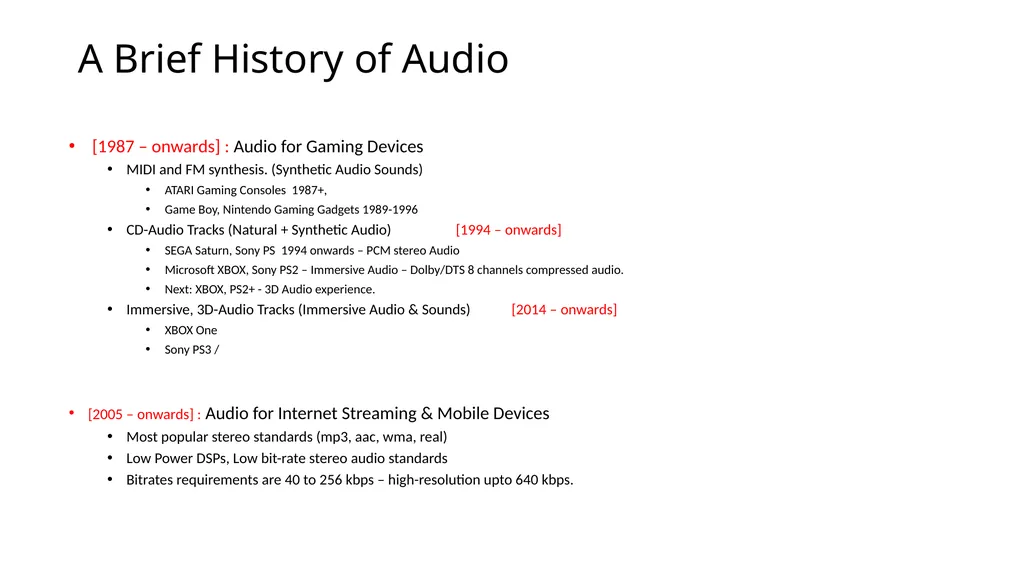
A Brief History of Audio [1987 – onwards] : Audio for Gaming Devices
MIDI and FM synthesis. (Synthetic Audio Sounds)
ATARI Gaming Consoles 1987+,
Game Boy, Nintendo Gaming Gadgets 1989-1996
CD-Audio Tracks (Natural + Synthetic Audio) [1994 – onwards]
SEGA Saturn, Sony PS 1994 onwards – PCM stereo Audio
Microsoft XBOX, Sony PS2 – Immersive Audio – Dolby/DTS 8 channels compressed audio.
Next: XBOX, PS2+ - 3D Audio experience.
Immersive, 3D-Audio Tracks (Immersive Audio & Sounds) [2014 – onwards]
XBOX One
Sony PS3 /
[2005 – onwards] : Audio for Internet Streaming & Mobile Devices
Most popular stereo standards (mp3, aac, wma, real)
Low Power DSPs, Low bit-rate stereo audio standards
Bitrates requirements are 40 to 256 kbps – high-resolution upto 640 kbps.<br>
MIDI and FM synthesis. (Synthetic Audio Sounds)
ATARI Gaming Consoles 1987+,
Game Boy, Nintendo Gaming Gadgets 1989-1996
CD-Audio Tracks (Natural + Synthetic Audio) [1994 – onwards]
SEGA Saturn, Sony PS 1994 onwards – PCM stereo Audio
Microsoft XBOX, Sony PS2 – Immersive Audio – Dolby/DTS 8 channels compressed audio.
Next: XBOX, PS2+ - 3D Audio experience.
Immersive, 3D-Audio Tracks (Immersive Audio & Sounds) [2014 – onwards]
XBOX One
Sony PS3 /
[2005 – onwards] : Audio for Internet Streaming & Mobile Devices
Most popular stereo standards (mp3, aac, wma, real)
Low Power DSPs, Low bit-rate stereo audio standards
Bitrates requirements are 40 to 256 kbps – high-resolution upto 640 kbps.<br>
06
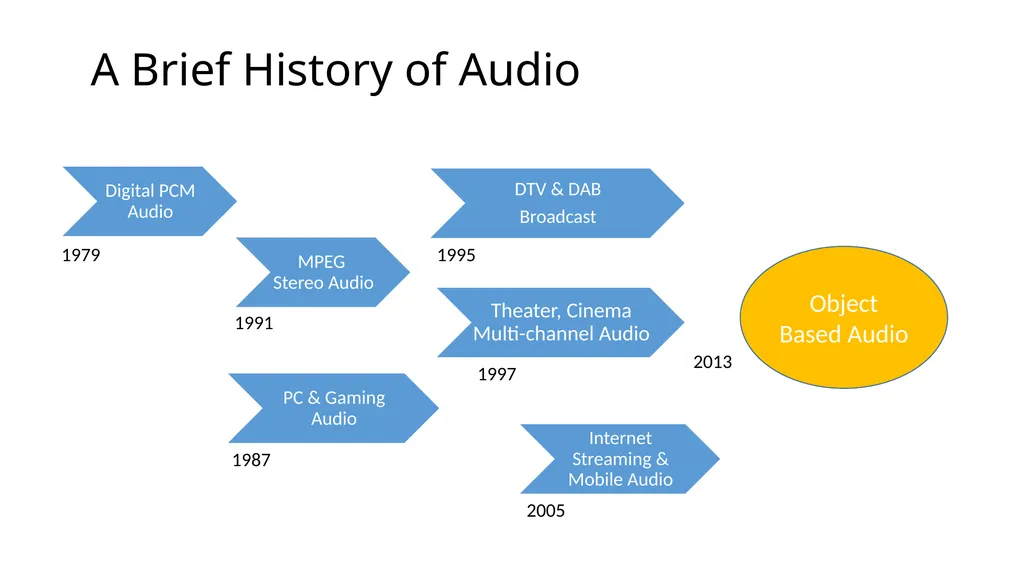
A Brief History of Audio Object Based Audio 1979 1991 1997 2013 1987 2005 1995<br>
07
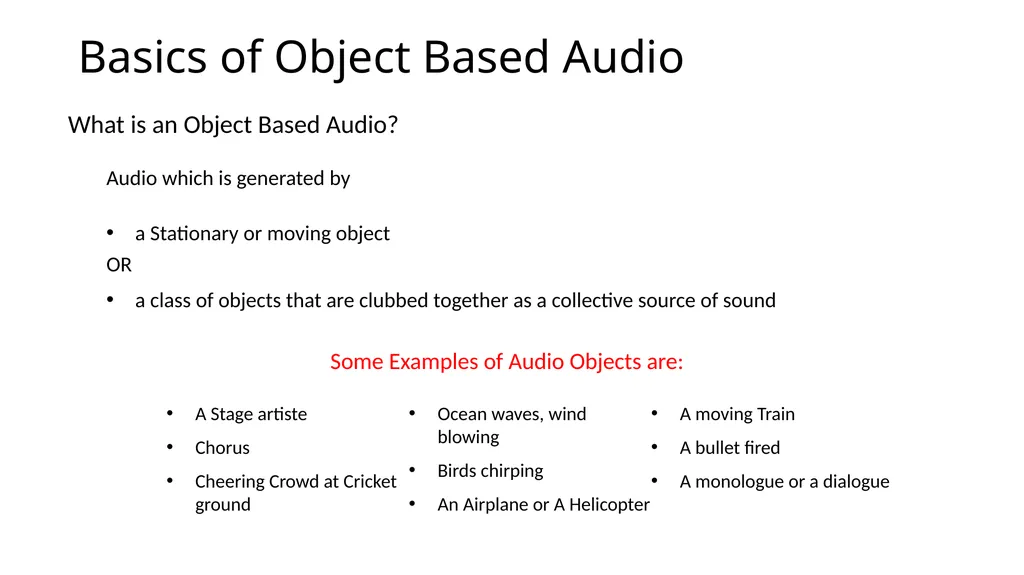
Basics of Object Based Audio What is an Object Based Audio?
Audio which is generated by
a Stationary or moving object
OR
a class of objects that are clubbed together as a collective source of sound
Some Examples of Audio Objects are: A Stage artiste
Chorus
Cheering Crowd at Cricket ground
Ocean waves, wind blowing
Birds chirping
An Airplane or A Helicopter
A moving Train
A bullet fired
A monologue or a dialogue<br>
Audio which is generated by
a Stationary or moving object
OR
a class of objects that are clubbed together as a collective source of sound
Some Examples of Audio Objects are: A Stage artiste
Chorus
Cheering Crowd at Cricket ground
Ocean waves, wind blowing
Birds chirping
An Airplane or A Helicopter
A moving Train
A bullet fired
A monologue or a dialogue<br>
08
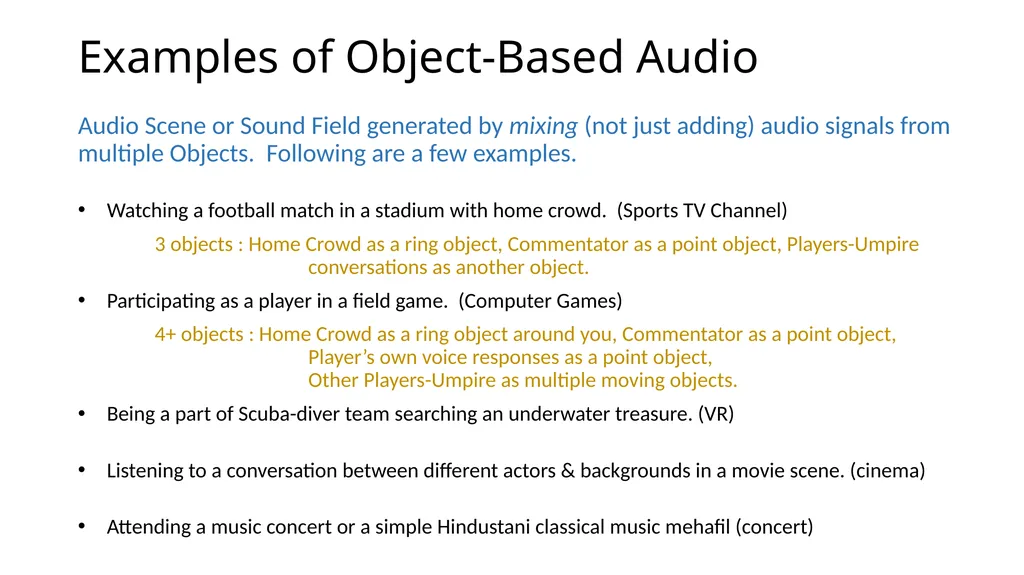
Examples of Object-Based Audio Audio Scene or Sound Field generated by mixing (not just adding) audio signals from multiple Objects. Following are a few examples.
Watching a football match in a stadium with home crowd. (Sports TV Channel)
3 objects : Home Crowd as a ring object, Commentator as a point object, Players-Umpire conversations as another object.
Participating as a player in a field game. (Computer Games)
4+ objects : Home Crowd as a ring object around you, Commentator as a point object, Player’s own voice responses as a point object, Other Players-Umpire as multiple moving objects.
Being a part of Scuba-diver team searching an underwater treasure. (VR)
Listening to a conversation between different actors & backgrounds in a movie scene. (cinema)
Attending a music concert or a simple Hindustani classical music mehafil (concert)<br>
Watching a football match in a stadium with home crowd. (Sports TV Channel)
3 objects : Home Crowd as a ring object, Commentator as a point object, Players-Umpire conversations as another object.
Participating as a player in a field game. (Computer Games)
4+ objects : Home Crowd as a ring object around you, Commentator as a point object, Player’s own voice responses as a point object, Other Players-Umpire as multiple moving objects.
Being a part of Scuba-diver team searching an underwater treasure. (VR)
Listening to a conversation between different actors & backgrounds in a movie scene. (cinema)
Attending a music concert or a simple Hindustani classical music mehafil (concert)<br>
09
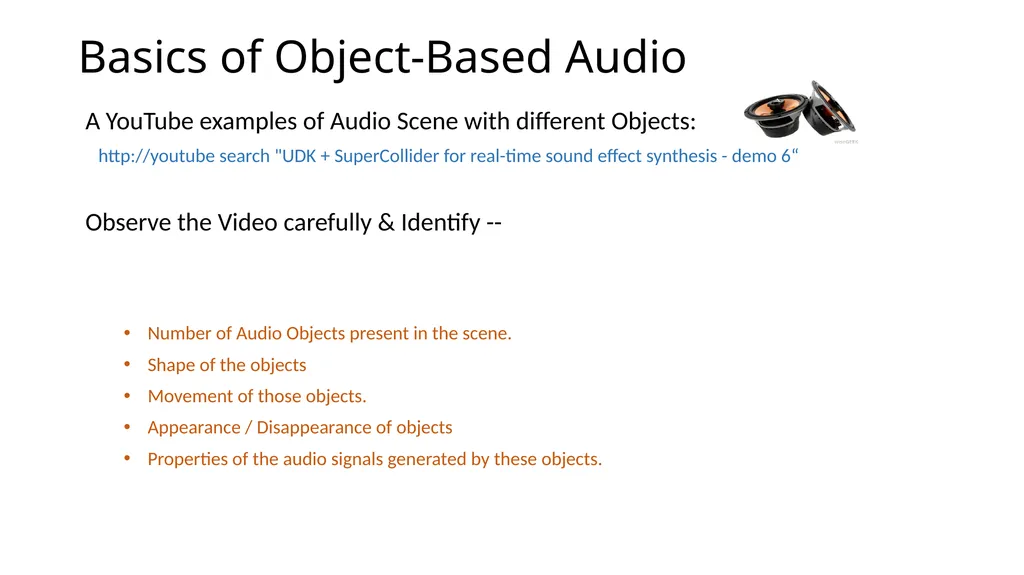
Basics of Object-Based Audio A YouTube examples of Audio Scene with different Objects:
http://youtube search "UDK + SuperCollider for real-time sound effect synthesis - demo 6“
Observe the Video carefully & Identify --
Number of Audio Objects present in the scene.
Shape of the objects
Movement of those objects.
Appearance / Disappearance of objects
Properties of the audio signals generated by these objects.<br>
http://youtube search "UDK + SuperCollider for real-time sound effect synthesis - demo 6“
Observe the Video carefully & Identify --
Number of Audio Objects present in the scene.
Shape of the objects
Movement of those objects.
Appearance / Disappearance of objects
Properties of the audio signals generated by these objects.<br>
10
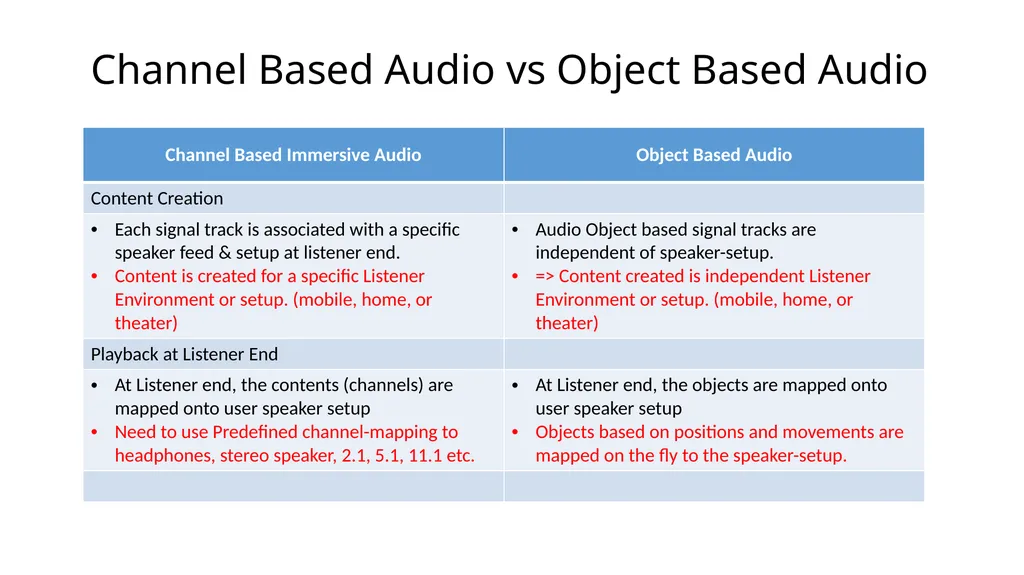
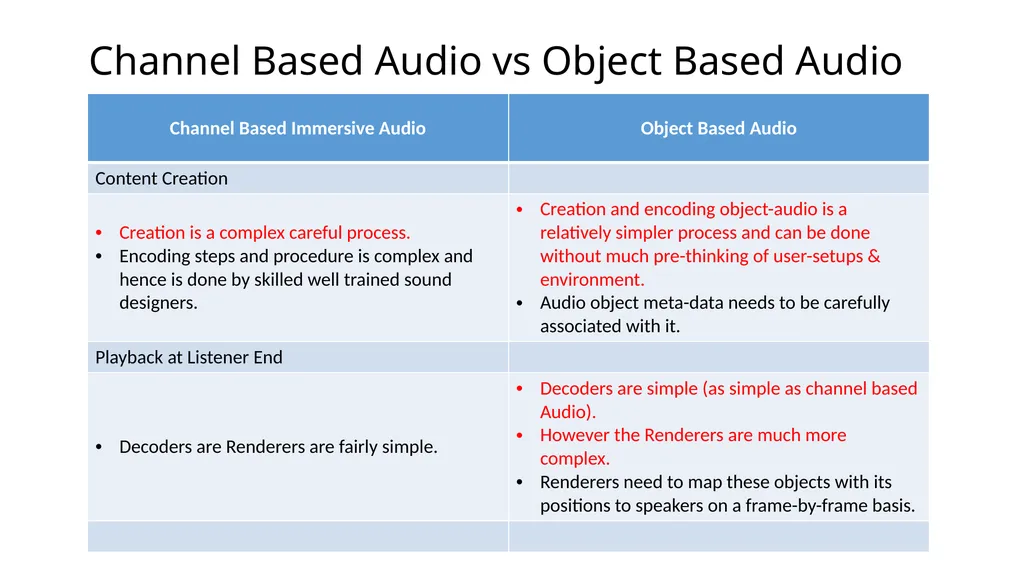
Channel Based Audio vs Object Based Audio<br>
11
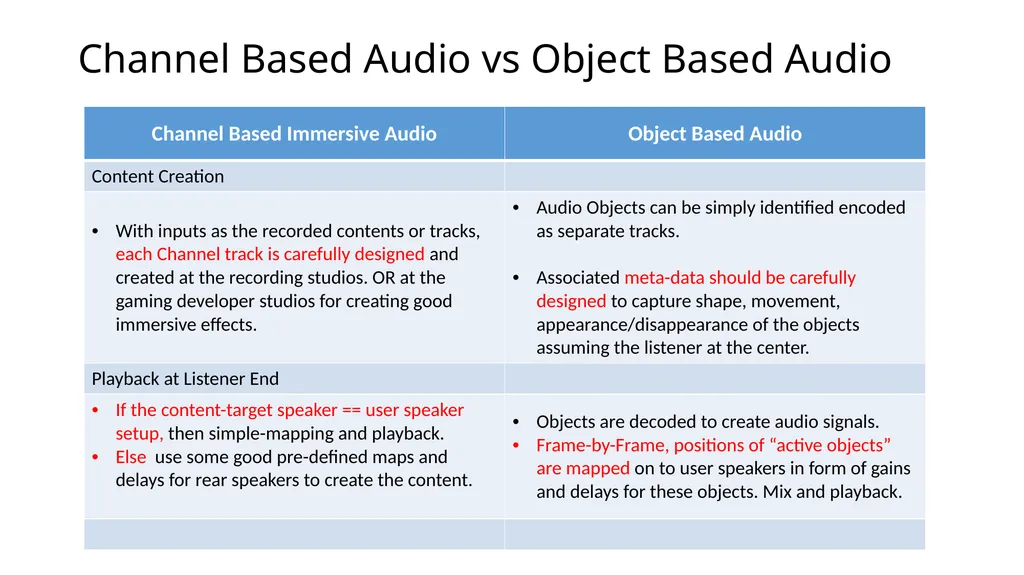
Channel Based Audio vs Object Based Audio<br>
12
Channel Based Audio vs Object Based Audio<br>
13
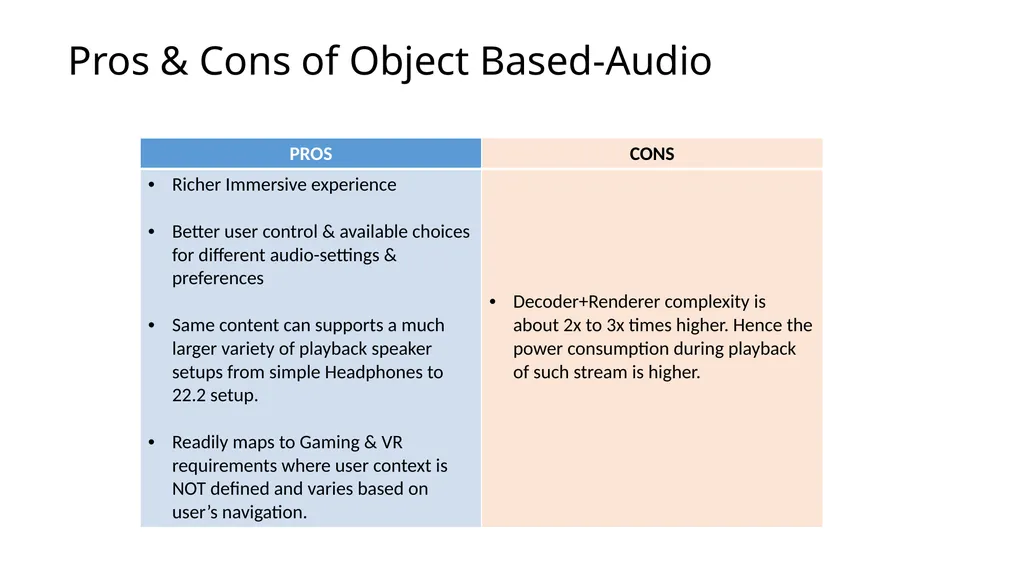
Pros & Cons of Object Based-Audio<br>
14
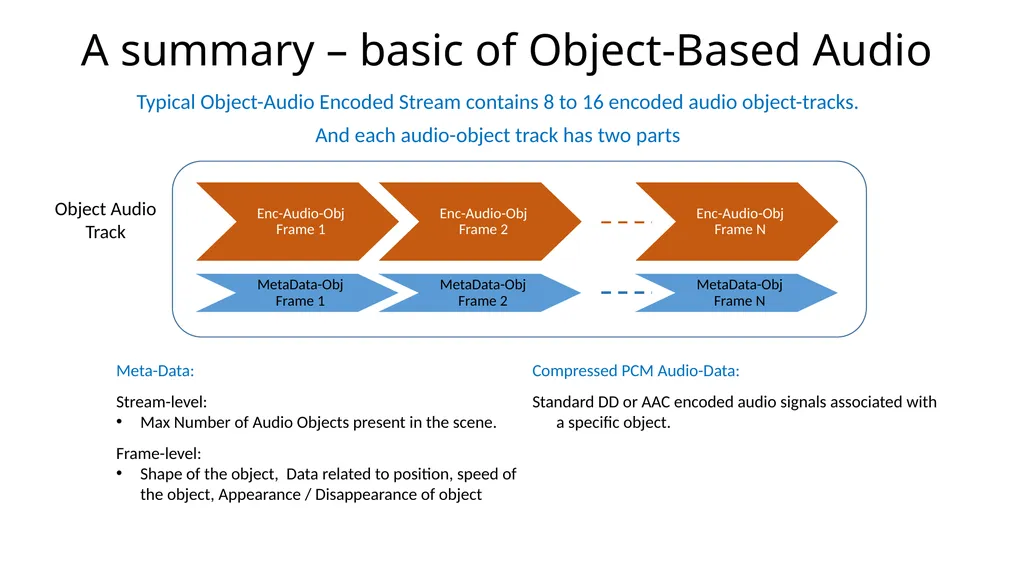
A summary – basic of Object-Based Audio Object Audio Track Typical Object-Audio Encoded Stream contains 8 to 16 encoded audio object-tracks.
And each audio-object track has two parts Meta-Data:
Stream-level:
Max Number of Audio Objects present in the scene.
Frame-level:
Shape of the object, Data related to position, speed of the object, Appearance / Disappearance of object
Compressed PCM Audio-Data:
Standard DD or AAC encoded audio signals associated with a specific object.<br>
And each audio-object track has two parts Meta-Data:
Stream-level:
Max Number of Audio Objects present in the scene.
Frame-level:
Shape of the object, Data related to position, speed of the object, Appearance / Disappearance of object
Compressed PCM Audio-Data:
Standard DD or AAC encoded audio signals associated with a specific object.<br>
15
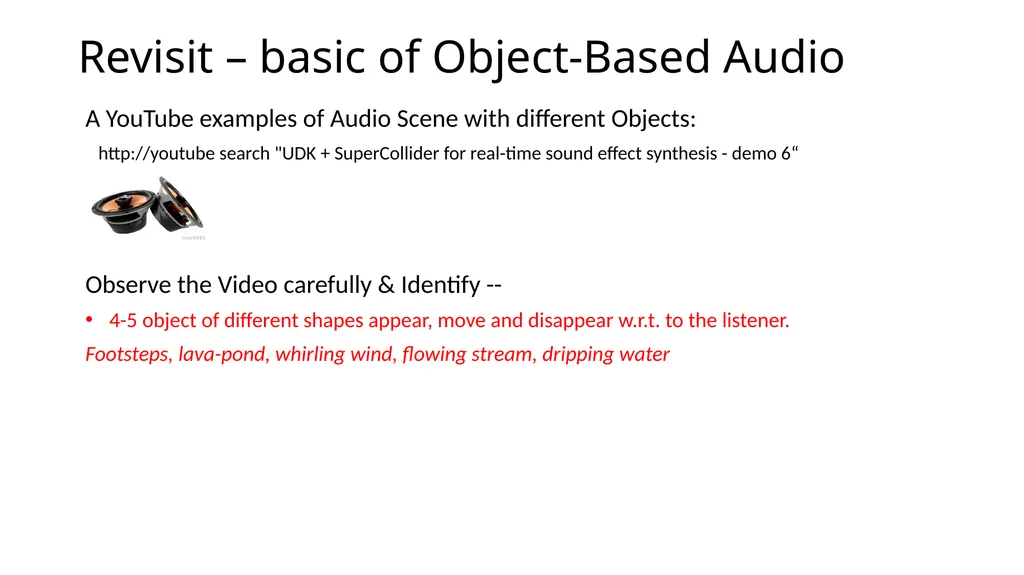
Revisit – basic of Object-Based Audio A YouTube examples of Audio Scene with different Objects:
http://youtube search "UDK + SuperCollider for real-time sound effect synthesis - demo 6“
Observe the Video carefully & Identify --
4-5 object of different shapes appear, move and disappear w.r.t. to the listener.
Footsteps, lava-pond, whirling wind, flowing stream, dripping water<br>
http://youtube search "UDK + SuperCollider for real-time sound effect synthesis - demo 6“
Observe the Video carefully & Identify --
4-5 object of different shapes appear, move and disappear w.r.t. to the listener.
Footsteps, lava-pond, whirling wind, flowing stream, dripping water<br>
16
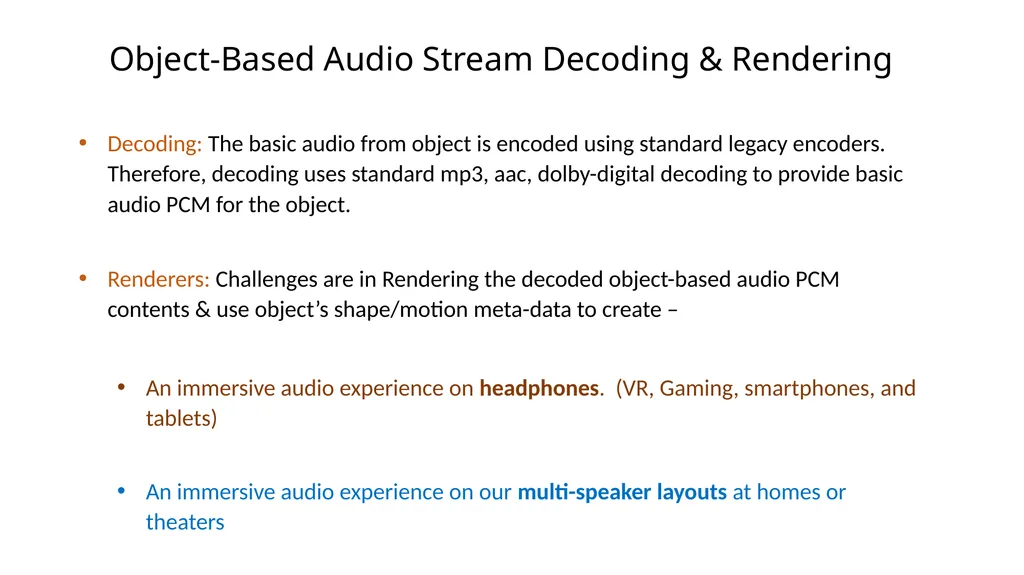
Object-Based Audio Stream Decoding & Rendering Decoding: The basic audio from object is encoded using standard legacy encoders. Therefore, decoding uses standard mp3, aac, dolby-digital decoding to provide basic audio PCM for the object.
Renderers: Challenges are in Rendering the decoded object-based audio PCM contents & use object’s shape/motion meta-data to create –
An immersive audio experience on headphones. (VR, Gaming, smartphones, and tablets)
An immersive audio experience on our multi-speaker layouts at homes or theaters<br>
Renderers: Challenges are in Rendering the decoded object-based audio PCM contents & use object’s shape/motion meta-data to create –
An immersive audio experience on headphones. (VR, Gaming, smartphones, and tablets)
An immersive audio experience on our multi-speaker layouts at homes or theaters<br>
17
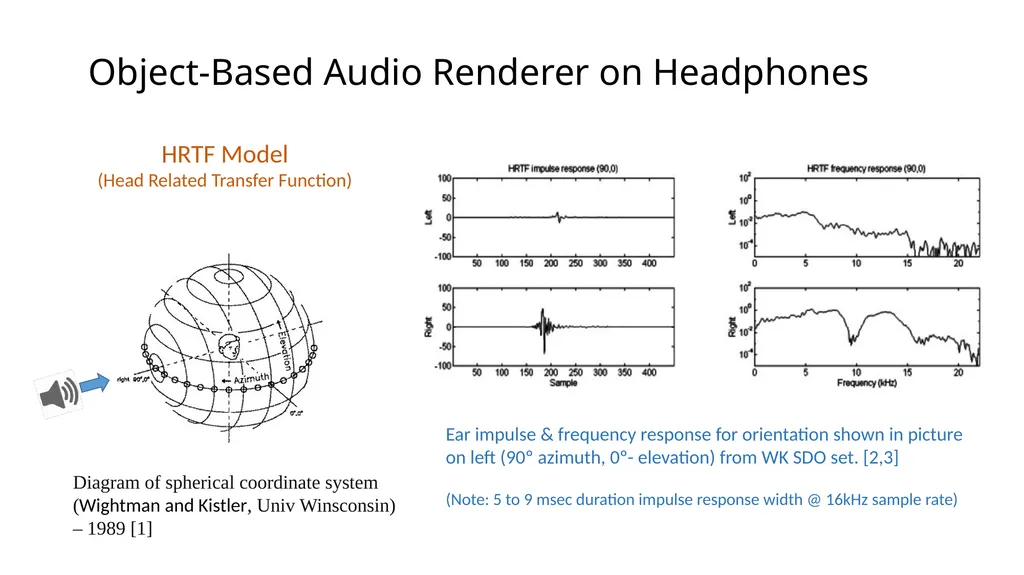
Object-Based Audio Renderer on Headphones Diagram of spherical coordinate system
(Wightman and Kistler, Univ Winsconsin) – 1989 [1] Ear impulse & frequency response for orientation shown in picture on left (90º azimuth, 0º- elevation) from WK SDO set. [2,3]
(Note: 5 to 9 msec duration impulse response width @ 16kHz sample rate) HRTF Model
(Head Related Transfer Function)<br>
(Note: 5 to 9 msec duration impulse response width @ 16kHz sample rate) HRTF Model
(Head Related Transfer Function)<br>
18
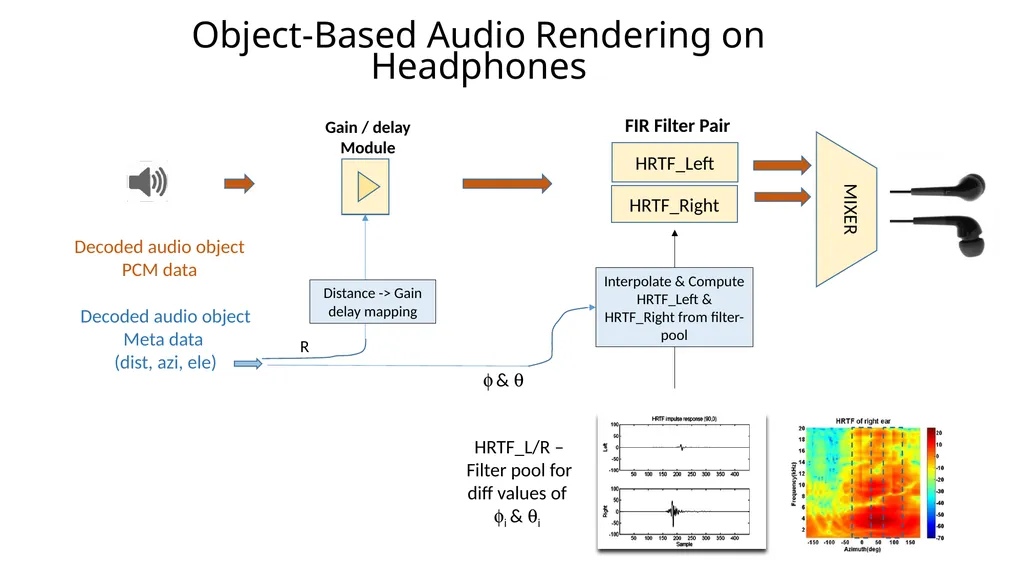
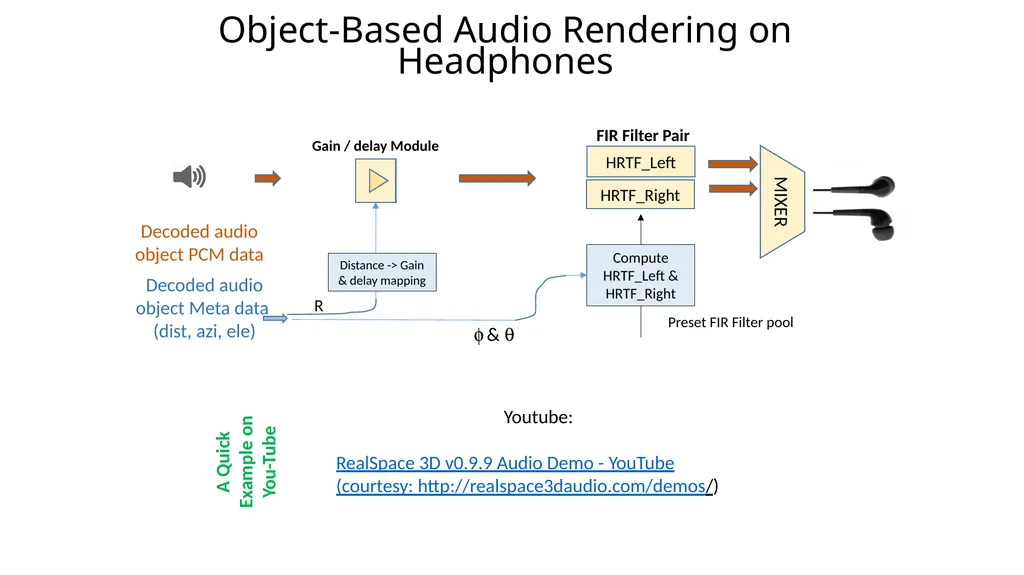
Object-Based Audio Rendering on Headphones Decoded audio object PCM data HRTF_L/R – Filter pool for diff values of
fi & qi Decoded audio object Meta data
(dist, azi, ele) Gain / delay Module Distance -> Gain delay mapping f & q Interpolate & Compute
HRTF_Left & HRTF_Right from filter-pool HRTF_Left HRTF_Right FIR Filter Pair R MIXER<br>
fi & qi Decoded audio object Meta data
(dist, azi, ele) Gain / delay Module Distance -> Gain delay mapping f & q Interpolate & Compute
HRTF_Left & HRTF_Right from filter-pool HRTF_Left HRTF_Right FIR Filter Pair R MIXER<br>
19
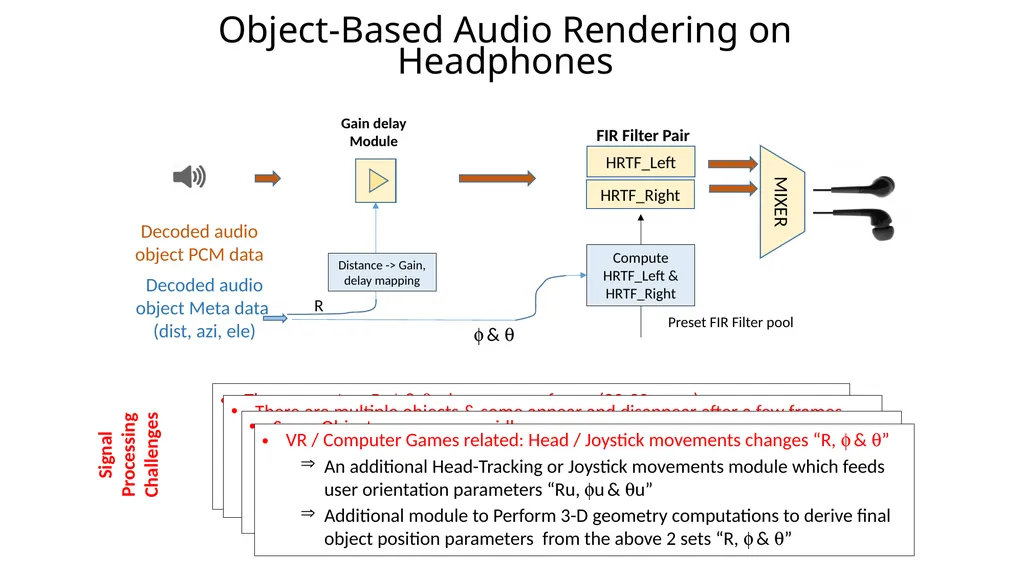
Object-Based Audio Rendering on Headphones Signal Processing Challenges The parameters R, f & q change every frame (20-30 msec)
filter coeffs, gain change every frame
This may cause glitches, distortions in the outputs.
Need for techniques to adaptively & smoothly change those coefficients There are multiple objects & some appear and disappear after a few frames.
Need for on the fly object pcm + associated meta-data memory
allocation, update and destruction
Need for fade-in / fade-out / mute of output PCM samples
Need for a well-designed multi-port PCM mixing module Some Objects move very rapidly
“R” changes w.r.t. time => the speed of the object is substantial causing Doppler effect on audio signal (e.g. a fast-train passing by)
Need for pitch shifting (variable-delay) module to be introduced on top of gain application Module. Oversampling & Interpolation would be required. VR / Computer Games related: Head / Joystick movements changes “R, f & q”
An additional Head-Tracking or Joystick movements module which feeds user orientation parameters “Ru, fu & qu”
Additional module to Perform 3-D geometry computations to derive final object position parameters from the above 2 sets “R, f & q”<br>
filter coeffs, gain change every frame
This may cause glitches, distortions in the outputs.
Need for techniques to adaptively & smoothly change those coefficients There are multiple objects & some appear and disappear after a few frames.
Need for on the fly object pcm + associated meta-data memory
allocation, update and destruction
Need for fade-in / fade-out / mute of output PCM samples
Need for a well-designed multi-port PCM mixing module Some Objects move very rapidly
“R” changes w.r.t. time => the speed of the object is substantial causing Doppler effect on audio signal (e.g. a fast-train passing by)
Need for pitch shifting (variable-delay) module to be introduced on top of gain application Module. Oversampling & Interpolation would be required. VR / Computer Games related: Head / Joystick movements changes “R, f & q”
An additional Head-Tracking or Joystick movements module which feeds user orientation parameters “Ru, fu & qu”
Additional module to Perform 3-D geometry computations to derive final object position parameters from the above 2 sets “R, f & q”<br>
20
Object-Based Audio Rendering on Headphones A Quick Example on You-Tube Youtube:
RealSpace 3D v0.9.9 Audio Demo - YouTube
(courtesy: http://realspace3daudio.com/demos/)<br>
RealSpace 3D v0.9.9 Audio Demo - YouTube
(courtesy: http://realspace3daudio.com/demos/)<br>
21
Object-Based Audio Rendering on
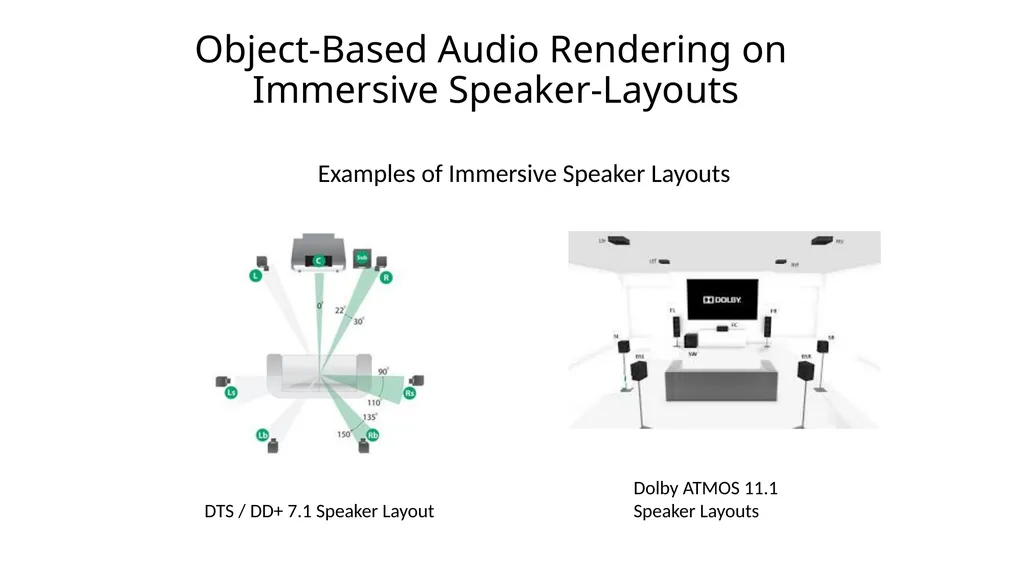
Immersive Speaker-Layouts DTS / DD+ 7.1 Speaker Layout Dolby ATMOS 11.1
Speaker Layouts Examples of Immersive Speaker Layouts<br>
Speaker Layouts Examples of Immersive Speaker Layouts<br>
22
Object-Based Audio Renderer on
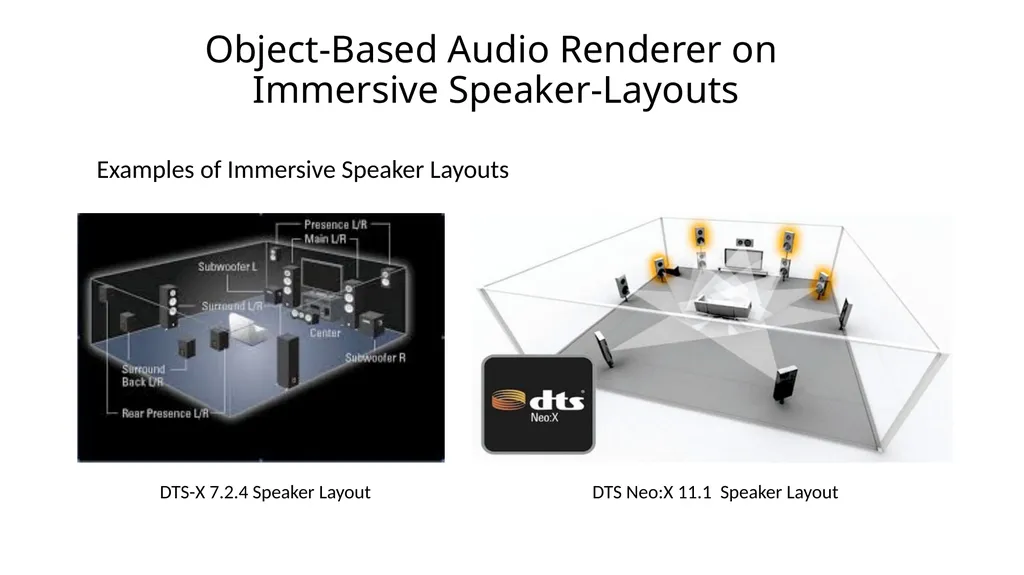
Immersive Speaker-Layouts DTS-X 7.2.4 Speaker Layout DTS Neo:X 11.1 Speaker Layout Examples of Immersive Speaker Layouts<br>
23
Object-Based Audio Renderer on
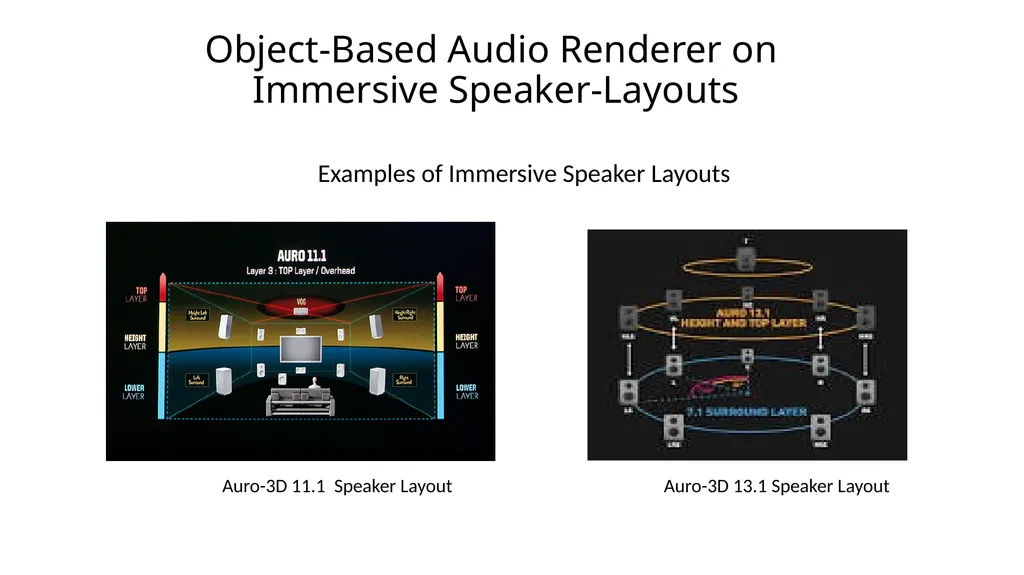
Immersive Speaker-Layouts Auro-3D 13.1 Speaker Layout Auro-3D 11.1 Speaker Layout Examples of Immersive Speaker Layouts<br>
24
Object-Based Audio Renderer on
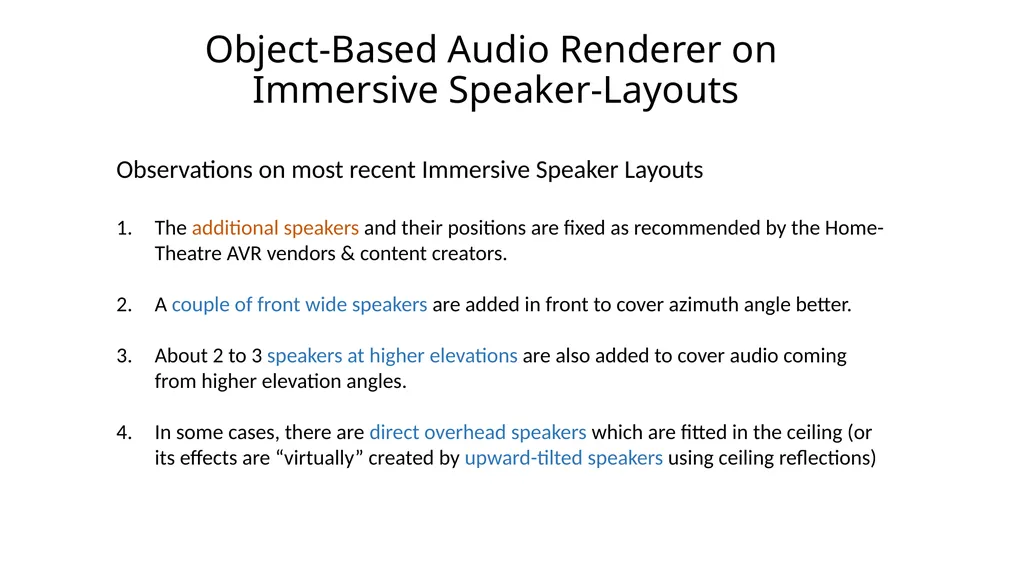
Immersive Speaker-Layouts Observations on most recent Immersive Speaker Layouts
The additional speakers and their positions are fixed as recommended by the Home-Theatre AVR vendors & content creators.
A couple of front wide speakers are added in front to cover azimuth angle better.
About 2 to 3 speakers at higher elevations are also added to cover audio coming from higher elevation angles.
In some cases, there are direct overhead speakers which are fitted in the ceiling (or its effects are “virtually” created by upward-tilted speakers using ceiling reflections)<br>
The additional speakers and their positions are fixed as recommended by the Home-Theatre AVR vendors & content creators.
A couple of front wide speakers are added in front to cover azimuth angle better.
About 2 to 3 speakers at higher elevations are also added to cover audio coming from higher elevation angles.
In some cases, there are direct overhead speakers which are fitted in the ceiling (or its effects are “virtually” created by upward-tilted speakers using ceiling reflections)<br>
25
Object-Based Audio Renderer on
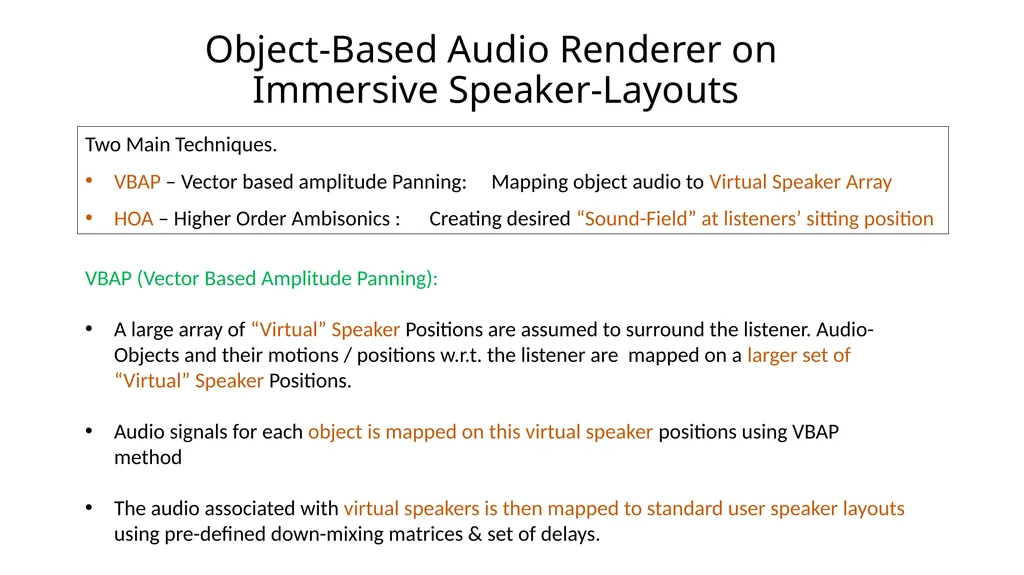
Immersive Speaker-Layouts VBAP (Vector Based Amplitude Panning):
A large array of “Virtual” Speaker Positions are assumed to surround the listener. Audio-Objects and their motions / positions w.r.t. the listener are mapped on a larger set of “Virtual” Speaker Positions.
Audio signals for each object is mapped on this virtual speaker positions using VBAP method
The audio associated with virtual speakers is then mapped to standard user speaker layouts using pre-defined down-mixing matrices & set of delays. Two Main Techniques.
VBAP – Vector based amplitude Panning: Mapping object audio to Virtual Speaker Array
HOA – Higher Order Ambisonics : Creating desired “Sound-Field” at listeners’ sitting position<br>
A large array of “Virtual” Speaker Positions are assumed to surround the listener. Audio-Objects and their motions / positions w.r.t. the listener are mapped on a larger set of “Virtual” Speaker Positions.
Audio signals for each object is mapped on this virtual speaker positions using VBAP method
The audio associated with virtual speakers is then mapped to standard user speaker layouts using pre-defined down-mixing matrices & set of delays. Two Main Techniques.
VBAP – Vector based amplitude Panning: Mapping object audio to Virtual Speaker Array
HOA – Higher Order Ambisonics : Creating desired “Sound-Field” at listeners’ sitting position<br>
26
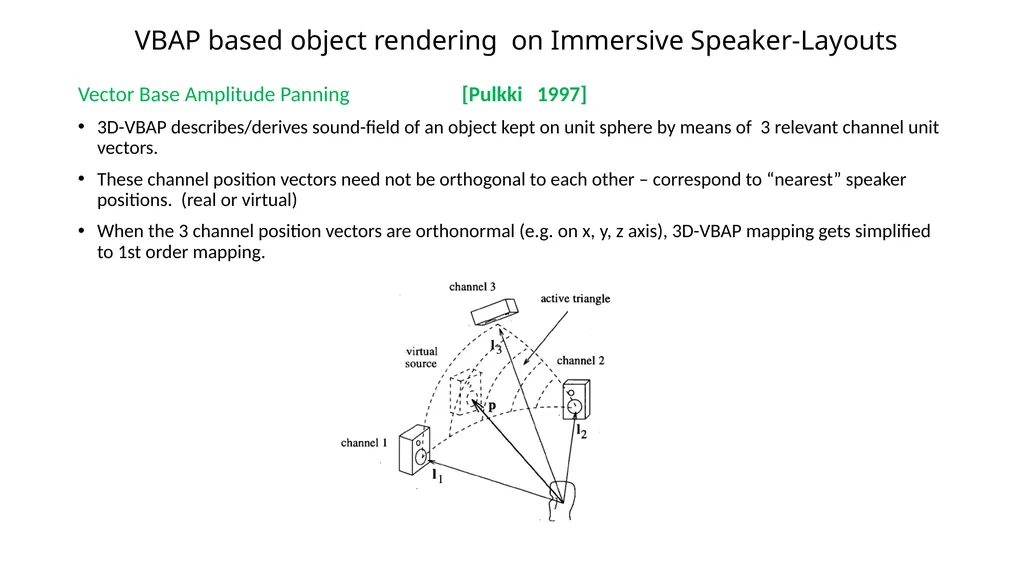
Vector Base Amplitude Panning [Pulkki 1997]
3D-VBAP describes/derives sound-field of an object kept on unit sphere by means of 3 relevant channel unit vectors.
These channel position vectors need not be orthogonal to each other – correspond to “nearest” speaker positions. (real or virtual)
When the 3 channel position vectors are orthonormal (e.g. on x, y, z axis), 3D-VBAP mapping gets simplified to 1st order mapping. VBAP based object rendering on Immersive Speaker-Layouts<br>
3D-VBAP describes/derives sound-field of an object kept on unit sphere by means of 3 relevant channel unit vectors.
These channel position vectors need not be orthogonal to each other – correspond to “nearest” speaker positions. (real or virtual)
When the 3 channel position vectors are orthonormal (e.g. on x, y, z axis), 3D-VBAP mapping gets simplified to 1st order mapping. VBAP based object rendering on Immersive Speaker-Layouts<br>
27
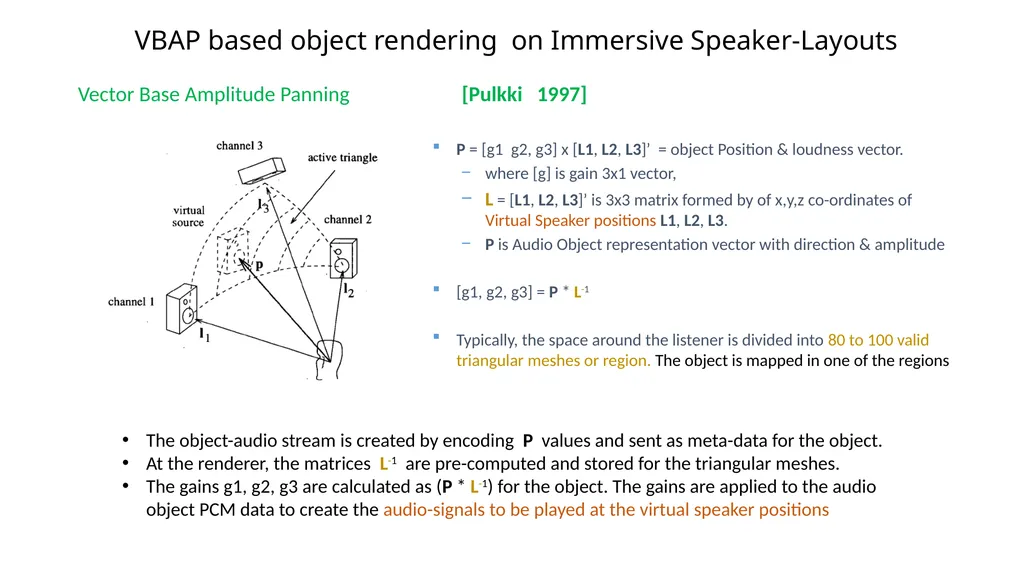
Vector Base Amplitude Panning [Pulkki 1997] VBAP based object rendering on Immersive Speaker-Layouts P = [g1 g2, g3] x [L1, L2, L3]’ = object Position & loudness vector.
where [g] is gain 3x1 vector,
L = [L1, L2, L3]’ is 3x3 matrix formed by of x,y,z co-ordinates of Virtual Speaker positions L1, L2, L3.
P is Audio Object representation vector with direction & amplitude
[g1, g2, g3] = P * L-1
Typically, the space around the listener is divided into 80 to 100 valid triangular meshes or region. The object is mapped in one of the regions The object-audio stream is created by encoding P values and sent as meta-data for the object.
At the renderer, the matrices L-1 are pre-computed and stored for the triangular meshes.
The gains g1, g2, g3 are calculated as (P * L-1) for the object. The gains are applied to the audio object PCM data to create the audio-signals to be played at the virtual speaker positions<br>
where [g] is gain 3x1 vector,
L = [L1, L2, L3]’ is 3x3 matrix formed by of x,y,z co-ordinates of Virtual Speaker positions L1, L2, L3.
P is Audio Object representation vector with direction & amplitude
[g1, g2, g3] = P * L-1
Typically, the space around the listener is divided into 80 to 100 valid triangular meshes or region. The object is mapped in one of the regions The object-audio stream is created by encoding P values and sent as meta-data for the object.
At the renderer, the matrices L-1 are pre-computed and stored for the triangular meshes.
The gains g1, g2, g3 are calculated as (P * L-1) for the object. The gains are applied to the audio object PCM data to create the audio-signals to be played at the virtual speaker positions<br>
28
Higher Order Ambisonics [Gerzon 1970]
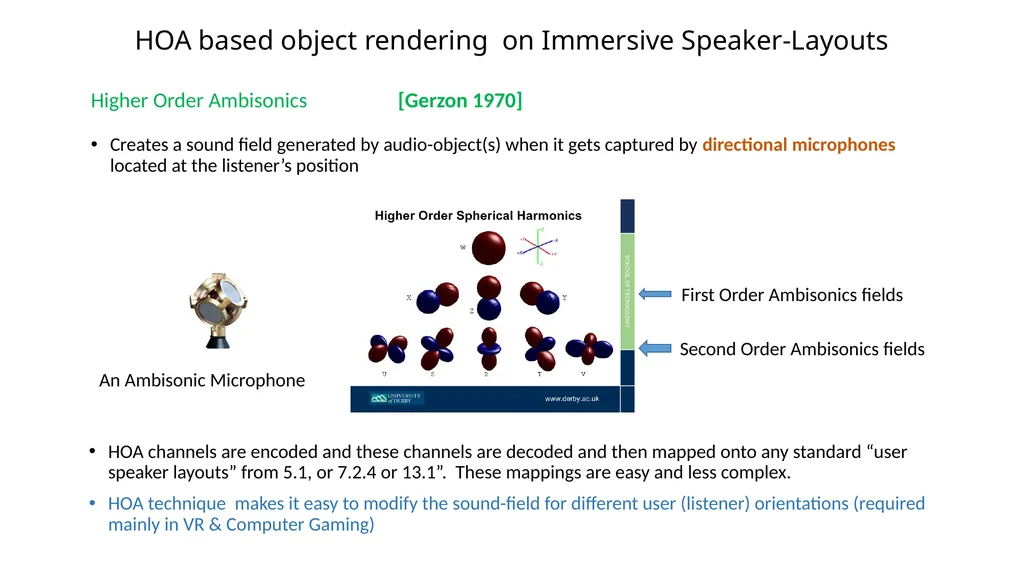
Creates a sound field generated by audio-object(s) when it gets captured by directional microphones located at the listener’s position HOA based object rendering on Immersive Speaker-Layouts First Order Ambisonics fields Second Order Ambisonics fields An Ambisonic Microphone HOA channels are encoded and these channels are decoded and then mapped onto any standard “user speaker layouts” from 5.1, or 7.2.4 or 13.1”. These mappings are easy and less complex.
HOA technique makes it easy to modify the sound-field for different user (listener) orientations (required mainly in VR & Computer Gaming)<br>
Creates a sound field generated by audio-object(s) when it gets captured by directional microphones located at the listener’s position HOA based object rendering on Immersive Speaker-Layouts First Order Ambisonics fields Second Order Ambisonics fields An Ambisonic Microphone HOA channels are encoded and these channels are decoded and then mapped onto any standard “user speaker layouts” from 5.1, or 7.2.4 or 13.1”. These mappings are easy and less complex.
HOA technique makes it easy to modify the sound-field for different user (listener) orientations (required mainly in VR & Computer Gaming)<br>
29
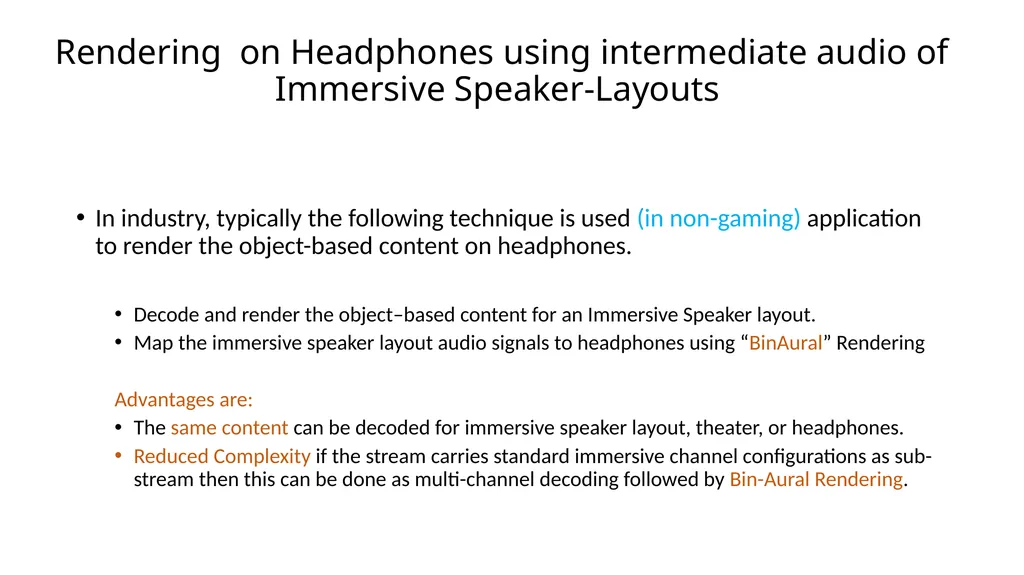
Rendering on Headphones using intermediate audio of Immersive Speaker-Layouts In industry, typically the following technique is used (in non-gaming) application to render the object-based content on headphones.
Decode and render the object–based content for an Immersive Speaker layout.
Map the immersive speaker layout audio signals to headphones using “BinAural” Rendering
Advantages are:
The same content can be decoded for immersive speaker layout, theater, or headphones.
Reduced Complexity if the stream carries standard immersive channel configurations as sub-stream then this can be done as multi-channel decoding followed by Bin-Aural Rendering.<br>
Decode and render the object–based content for an Immersive Speaker layout.
Map the immersive speaker layout audio signals to headphones using “BinAural” Rendering
Advantages are:
The same content can be decoded for immersive speaker layout, theater, or headphones.
Reduced Complexity if the stream carries standard immersive channel configurations as sub-stream then this can be done as multi-channel decoding followed by Bin-Aural Rendering.<br>
30
BinAural Rendering : Immersive Speakers -> Headphones. Depending upon the fixed f & q angles
of Front, Rear & Overhead Speakers
w.r.t. Left and Right ear of the listener
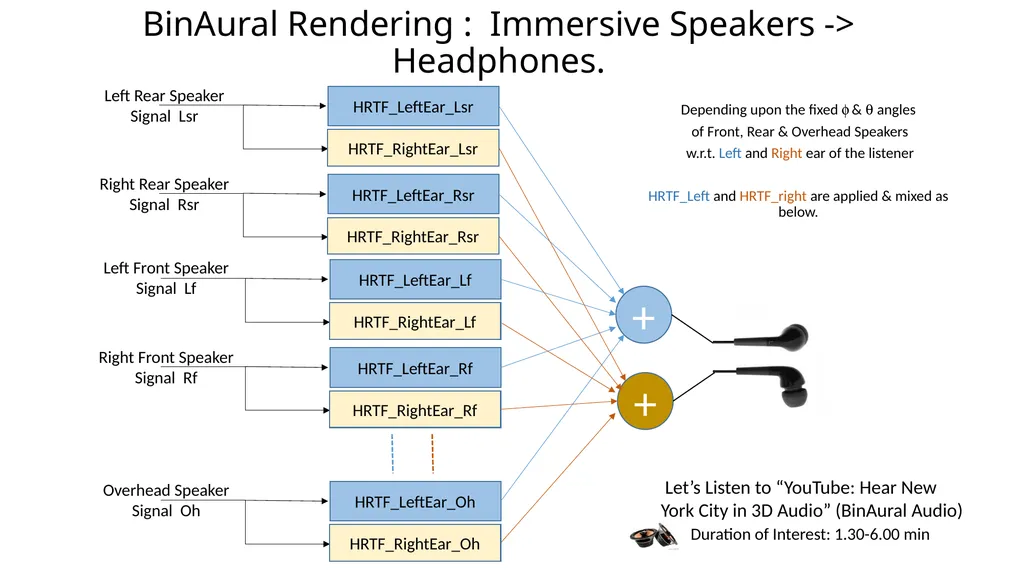
HRTF_Left and HRTF_right are applied & mixed as below. HRTF_LeftEar_Lf HRTF_RightEar_Lf Left Front Speaker Signal Lf HRTF_LeftEar_Rf HRTF_RightEar_Rf Right Front Speaker Signal Rf HRTF_LeftEar_Lsr HRTF_RightEar_Lsr Left Rear Speaker Signal Lsr HRTF_LeftEar_Rsr HRTF_RightEar_Rsr Right Rear Speaker Signal Rsr + HRTF_LeftEar_Oh HRTF_RightEar_Oh Overhead Speaker Signal Oh + Let’s Listen to “YouTube: Hear New York City in 3D Audio” (BinAural Audio)
Duration of Interest: 1.30-6.00 min<br>
of Front, Rear & Overhead Speakers
w.r.t. Left and Right ear of the listener
HRTF_Left and HRTF_right are applied & mixed as below. HRTF_LeftEar_Lf HRTF_RightEar_Lf Left Front Speaker Signal Lf HRTF_LeftEar_Rf HRTF_RightEar_Rf Right Front Speaker Signal Rf HRTF_LeftEar_Lsr HRTF_RightEar_Lsr Left Rear Speaker Signal Lsr HRTF_LeftEar_Rsr HRTF_RightEar_Rsr Right Rear Speaker Signal Rsr + HRTF_LeftEar_Oh HRTF_RightEar_Oh Overhead Speaker Signal Oh + Let’s Listen to “YouTube: Hear New York City in 3D Audio” (BinAural Audio)
Duration of Interest: 1.30-6.00 min<br>
31
Industry Trends for Object-Based Audio Reference Material based on Object-Audio:
Dolby, DTS and Fraunhofer are introducing their freshly designed audio standard reference IPs which support Object-based audio contents for Cinema, Home theater and Digital broadcasts.
Gaming industry and VR gadgets manufacturers are welcoming this trend in their domains. For listeners, this trend will provide
Better immersive experience for the latest movie releases and audio contents on their existing home theater setup.
Streaming contents & games on mobile phones / tablets would sound much richer.
The Sports channels & movies will carry more options for user controls to select audio environments for watching their favorite match.
Upgrading to the latest AVRs and SoundBars with “wide front” and ceiling with “overhead speakers” (actual or virtual) will provide the best effects. For DSP solution providers:
Higher computational burden on Audio DSPs to decode and especially rich post processing to render the content.
Audio DSP gets burdened with 3-D geometry computations, computes related to square-root, sine, cos, matrix operations are required.
Compute Power required to decode this content is going to be 2 to 3x higher, thus battery drain may be higher.<br>
Dolby, DTS and Fraunhofer are introducing their freshly designed audio standard reference IPs which support Object-based audio contents for Cinema, Home theater and Digital broadcasts.
Gaming industry and VR gadgets manufacturers are welcoming this trend in their domains. For listeners, this trend will provide
Better immersive experience for the latest movie releases and audio contents on their existing home theater setup.
Streaming contents & games on mobile phones / tablets would sound much richer.
The Sports channels & movies will carry more options for user controls to select audio environments for watching their favorite match.
Upgrading to the latest AVRs and SoundBars with “wide front” and ceiling with “overhead speakers” (actual or virtual) will provide the best effects. For DSP solution providers:
Higher computational burden on Audio DSPs to decode and especially rich post processing to render the content.
Audio DSP gets burdened with 3-D geometry computations, computes related to square-root, sine, cos, matrix operations are required.
Compute Power required to decode this content is going to be 2 to 3x higher, thus battery drain may be higher.<br>
32
Summary of Object-Based Audio Each sound source is captured as an object which is associated with “compressed audio” as payload and motion/shape information as meta-data. For listener using Headphones, objects along with its motions are mapped to left and right ear from a pool of pre-generated “HRTF (Head related transfer functions)” functions. For listener sitting in living room or cinema theaters, objects along with its motions are mapped onto an array of immersive speaker layouts, using
VBAP, HOA methods. The content creators also use combination of the above two methods called Bin-aural rendering to render the contents for creating immersive audio perception on the Headphones.<br>
VBAP, HOA methods. The content creators also use combination of the above two methods called Bin-aural rendering to render the contents for creating immersive audio perception on the Headphones.<br>
33
Thank you Q & A Session?<br>
34
References [1] http://youtube search "UDK + SuperCollider for real-time sound effect synthesis - demo 6“
[2] http://alumnus.caltech.edu/~franko/thesis/Chapter4.html (HRTF related discussions & details)
[3] Headphone simulation of free-field listening. I- Stimulus synthesis - J Acoust Soc Am 1989 - Wightman.pdf
("SDO" HRTF by Wightman and Kistler from Department of Psychology and Waisman Center, University of Wisconsin--Madison, Madison, provided a basis for HRTF research)
[4] http://youtube search " RealSpace 3D v0.9.9 Audio Demo – YouTube”
Ref: http://realspace3daudio.com/demos/
[5] http://slab3d.sourceforge.net/ - Simple HRTF code to try out simulations of moving audio-objects.
[6] Virtual Sound Source Positioning Using VBAP, Ville Pulkki, Journal of Audio Engg. Society, Vol 45, No 6, June 1997
[7] Spatial Sound – Technologies and Psychoacoustics, presentation by V. Pulkki in IEEE Winter School in 2012 at Crete, Greece.
[8] An Introduction to Higher Order Ambisonic, Florian Hollerweger, Oct 2008
[9] http://youtube search “Hear New York City in 3D Audio” (1st short clip)<br>
[2] http://alumnus.caltech.edu/~franko/thesis/Chapter4.html (HRTF related discussions & details)
[3] Headphone simulation of free-field listening. I- Stimulus synthesis - J Acoust Soc Am 1989 - Wightman.pdf
("SDO" HRTF by Wightman and Kistler from Department of Psychology and Waisman Center, University of Wisconsin--Madison, Madison, provided a basis for HRTF research)
[4] http://youtube search " RealSpace 3D v0.9.9 Audio Demo – YouTube”
Ref: http://realspace3daudio.com/demos/
[5] http://slab3d.sourceforge.net/ - Simple HRTF code to try out simulations of moving audio-objects.
[6] Virtual Sound Source Positioning Using VBAP, Ville Pulkki, Journal of Audio Engg. Society, Vol 45, No 6, June 1997
[7] Spatial Sound – Technologies and Psychoacoustics, presentation by V. Pulkki in IEEE Winter School in 2012 at Crete, Greece.
[8] An Introduction to Higher Order Ambisonic, Florian Hollerweger, Oct 2008
[9] http://youtube search “Hear New York City in 3D Audio” (1st short clip)<br>