04
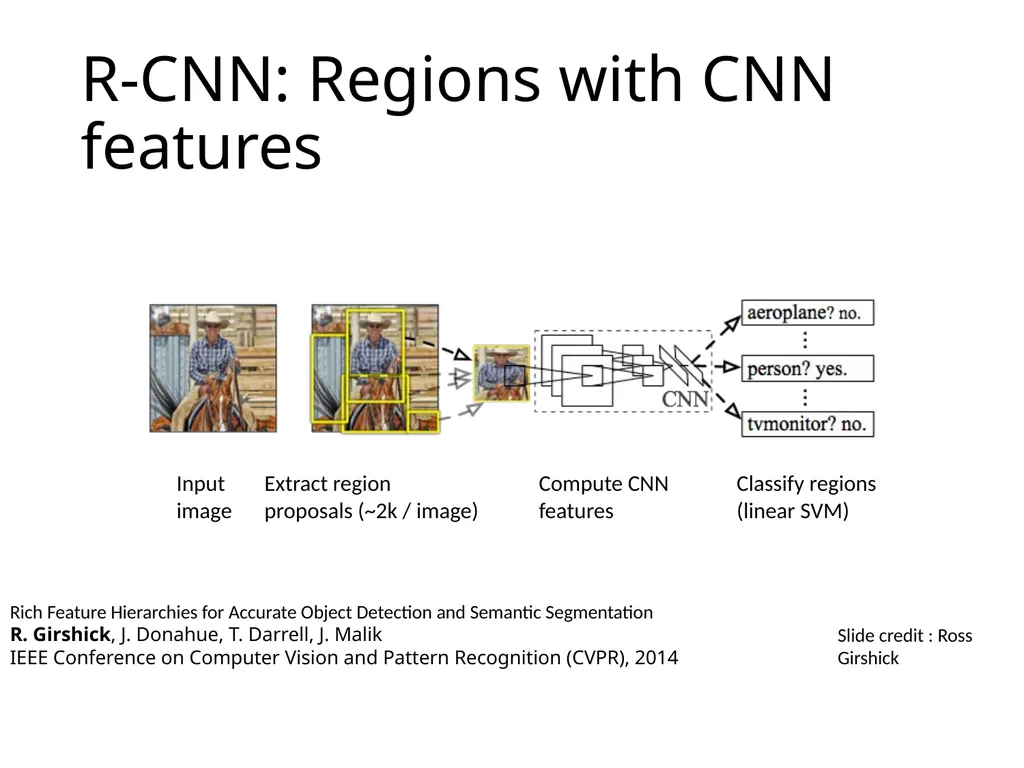
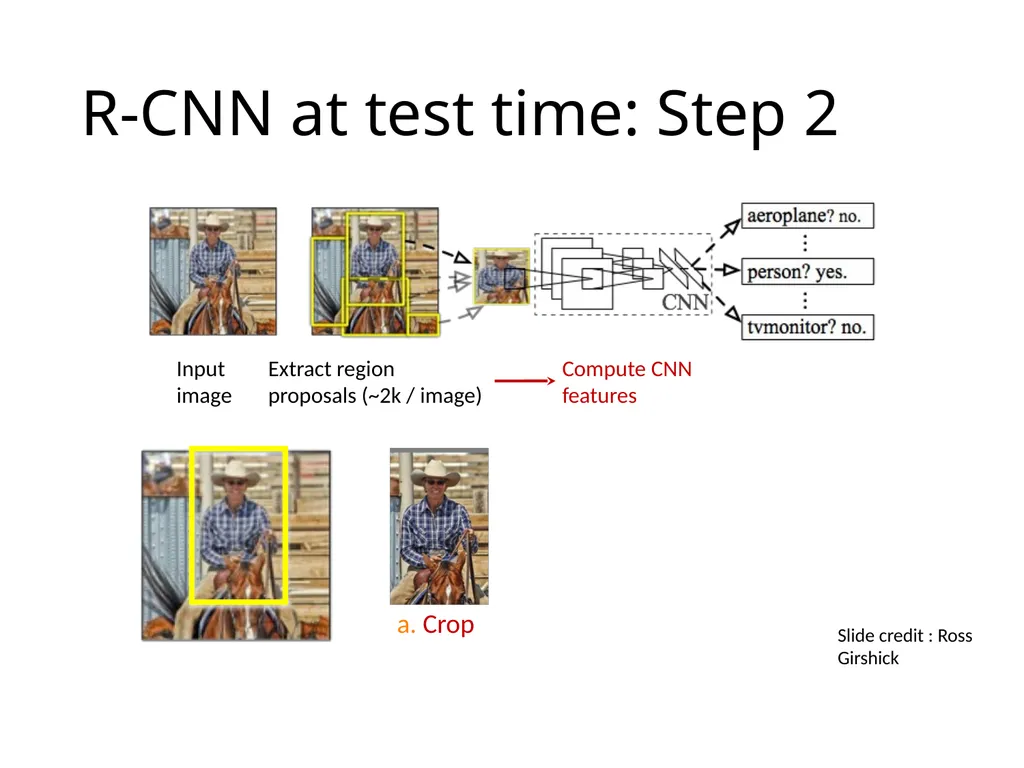
R-CNN at test time: Step 2 Input
image Extract region
proposals (~2k / image) Compute CNN
features a. Crop Slide credit : Ross Girshick<br>
05
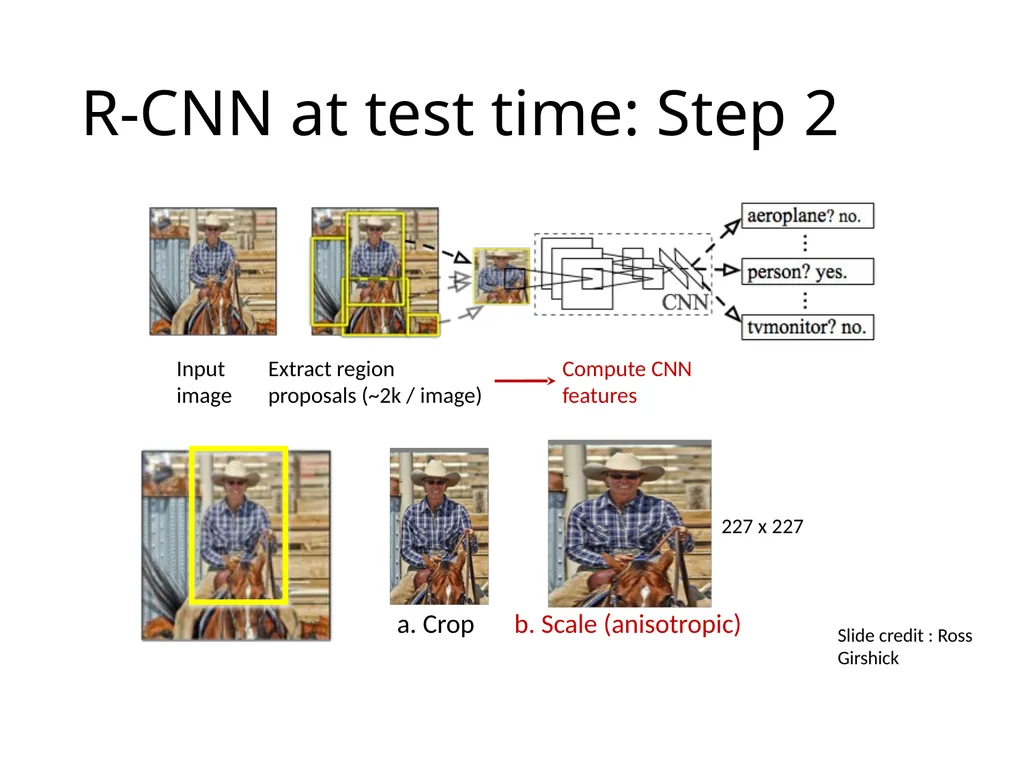
R-CNN at test time: Step 2 Input
image Extract region
proposals (~2k / image) Compute CNN
features a. Crop b. Scale (anisotropic) 227 x 227 Slide credit : Ross Girshick<br>
06
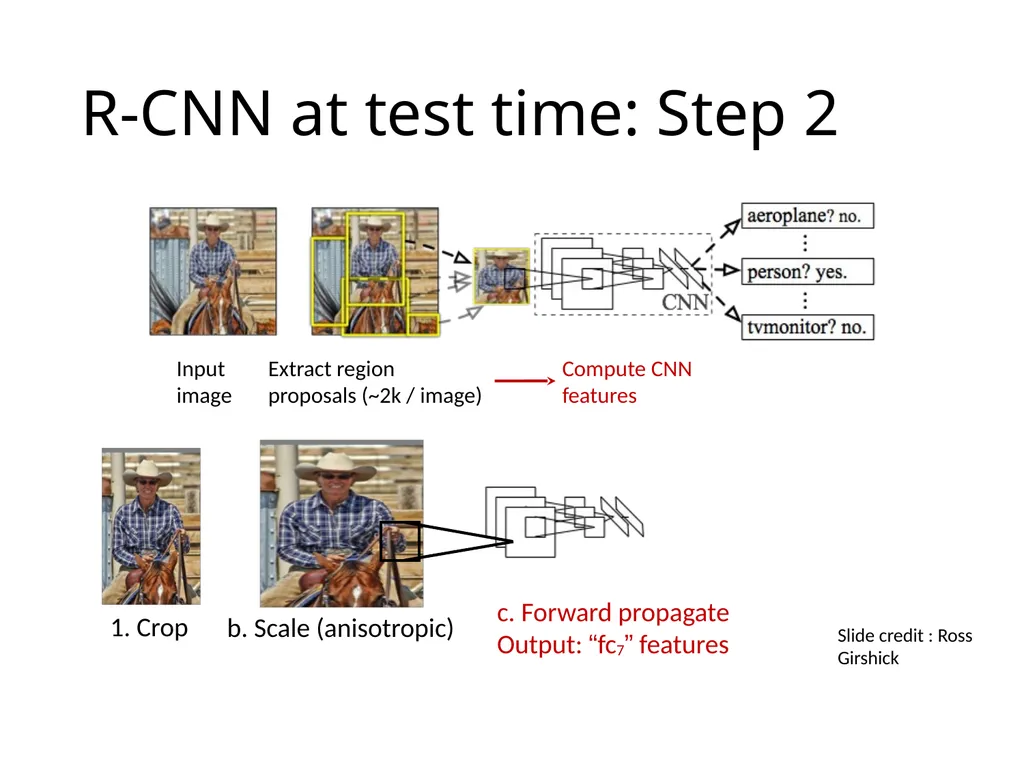
1. Crop b. Scale (anisotropic) R-CNN at test time: Step 2 Input
image Extract region
proposals (~2k / image) Compute CNN
features c. Forward propagate
Output: “fc7” features Slide credit : Ross Girshick<br>
07
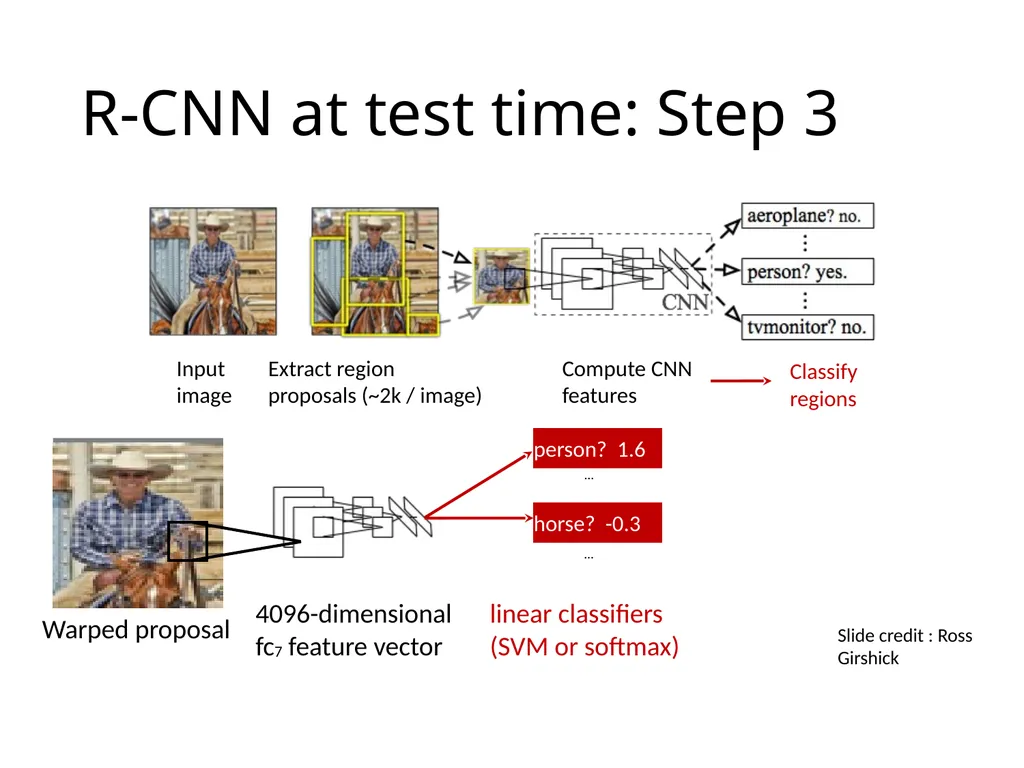
R-CNN at test time: Step 3 Input
image Extract region
proposals (~2k / image) Compute CNN
features Warped proposal 4096-dimensional
fc7 feature vector linear classifiers
(SVM or softmax) person? 1.6 horse? -0.3 ... ... Classify
regions Slide credit : Ross Girshick<br>
08
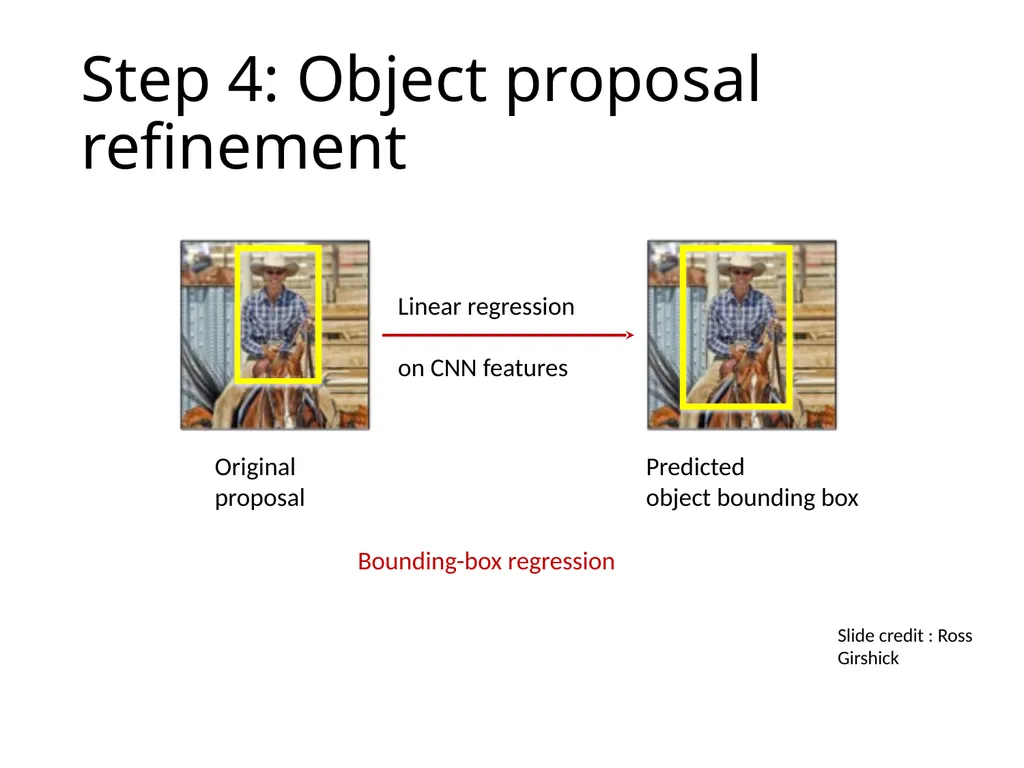
Linear regression
on CNN features Step 4: Object proposal refinement Original
proposal Predicted
object bounding box Bounding-box regression Slide credit : Ross Girshick<br>
09
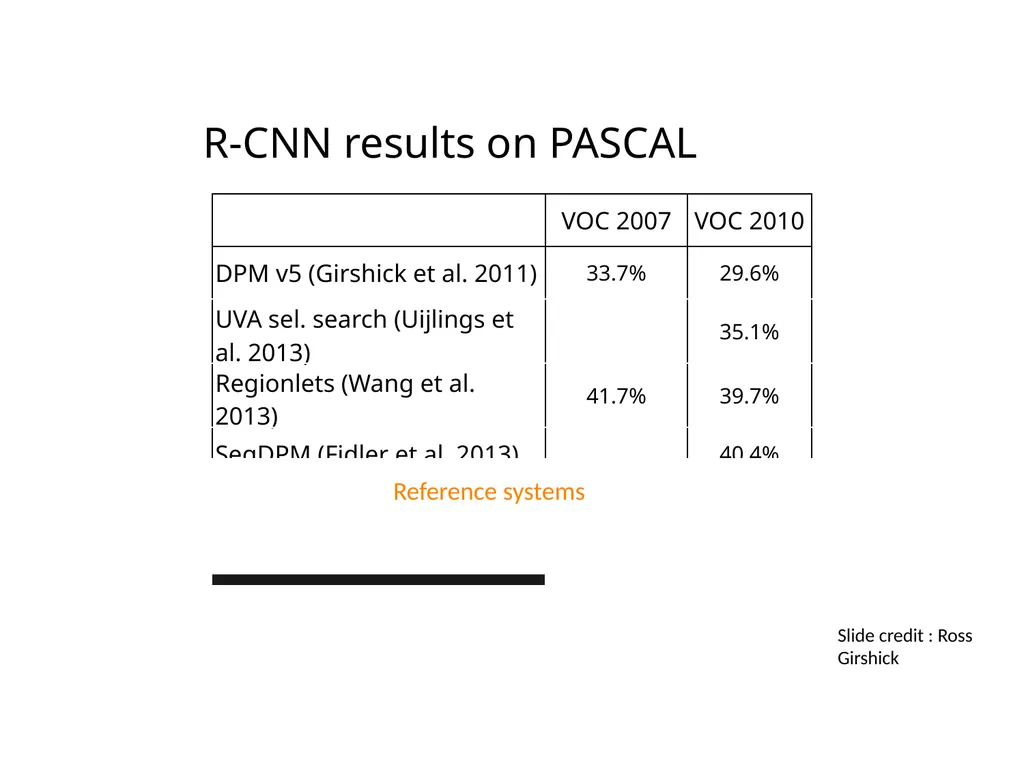
metric: mean average precision (higher is better) R-CNN results on PASCAL Reference systems Slide credit : Ross Girshick<br>
10
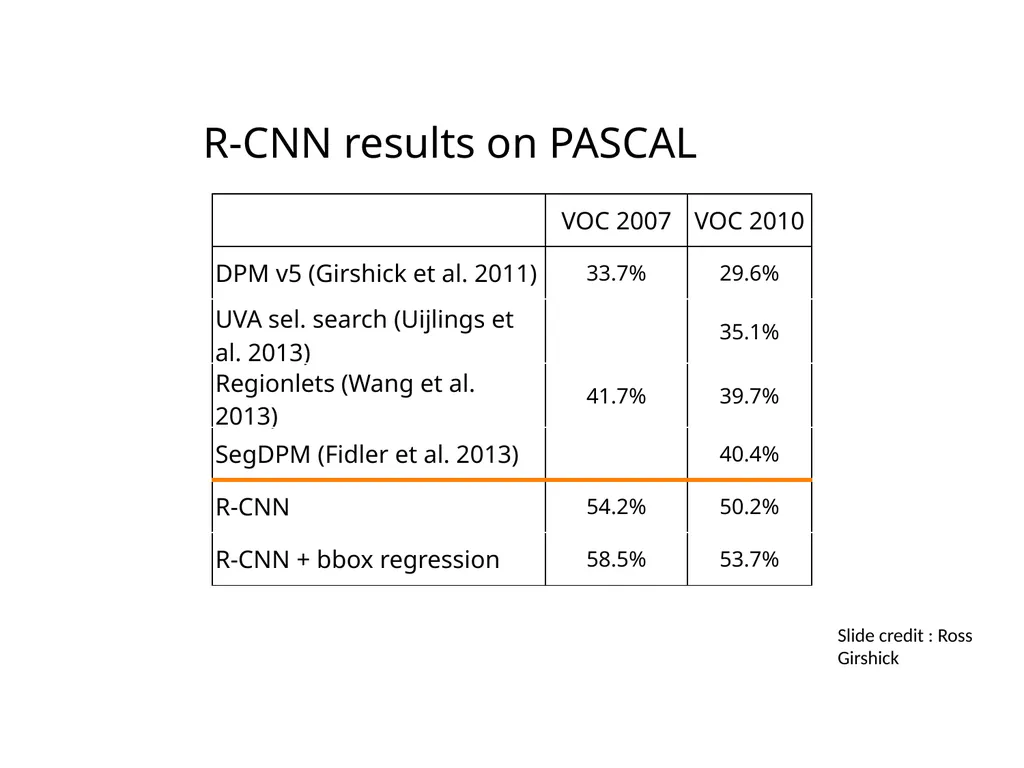
metric: mean average precision (higher is better) R-CNN results on PASCAL Slide credit : Ross Girshick<br>
11
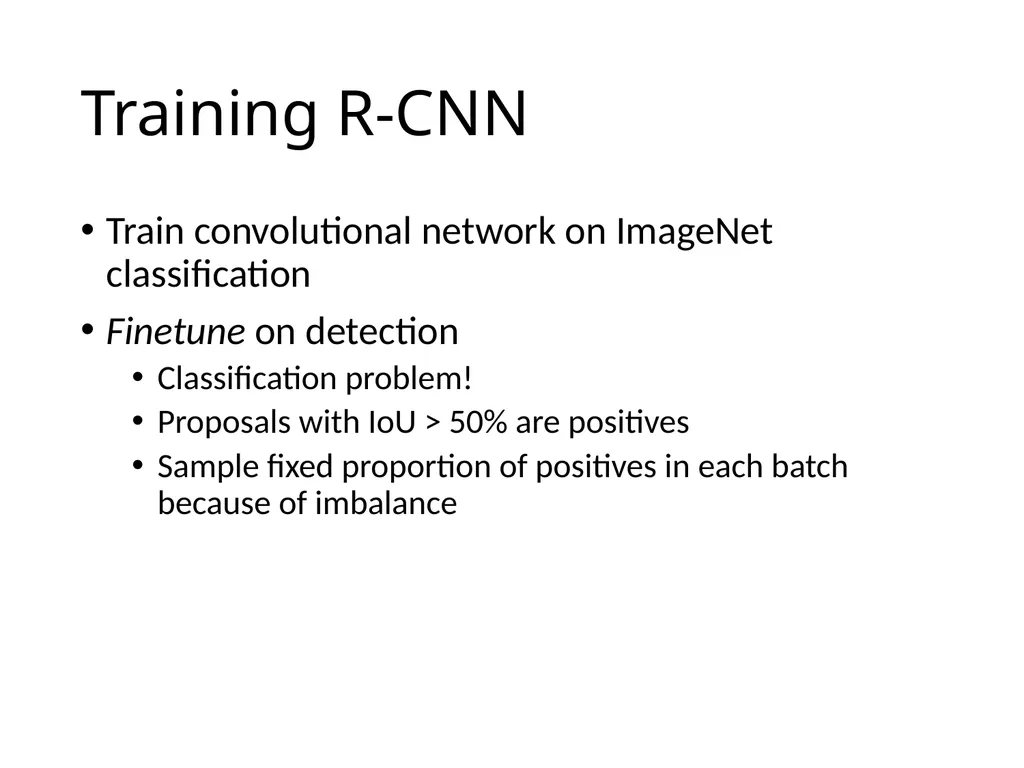
Training R-CNN Train convolutional network on ImageNet classification
Finetune on detection
Classification problem!
Proposals with IoU > 50% are positives
Sample fixed proportion of positives in each batch because of imbalance<br>
12
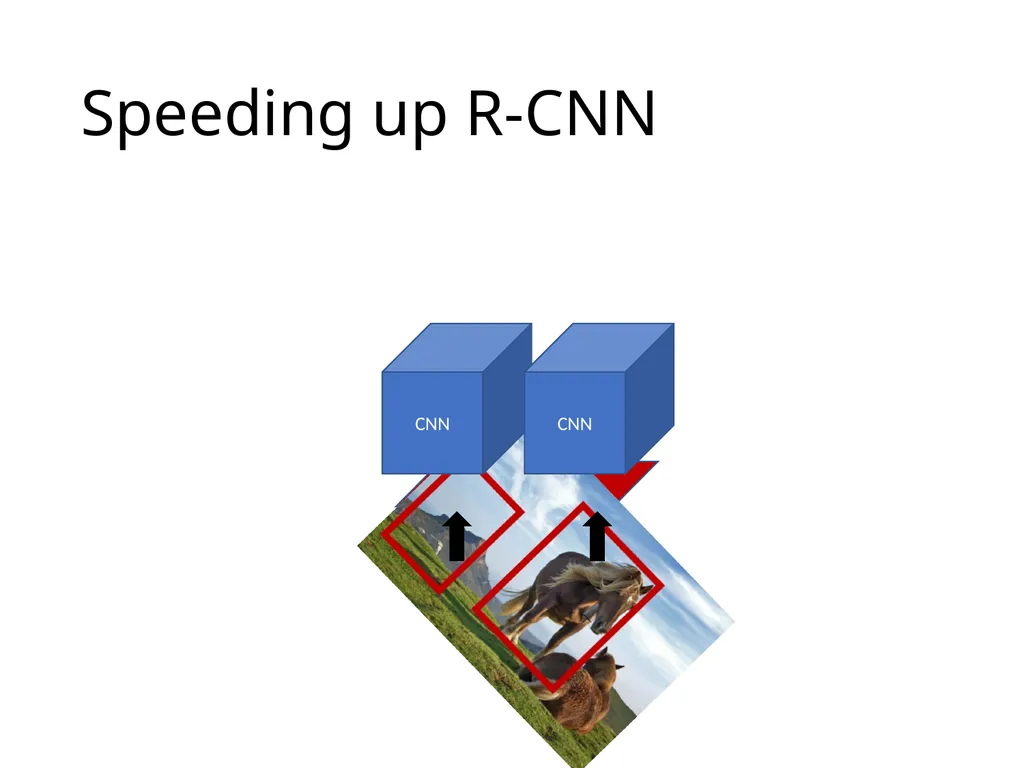
Speeding up R-CNN CNN CNN<br>
13
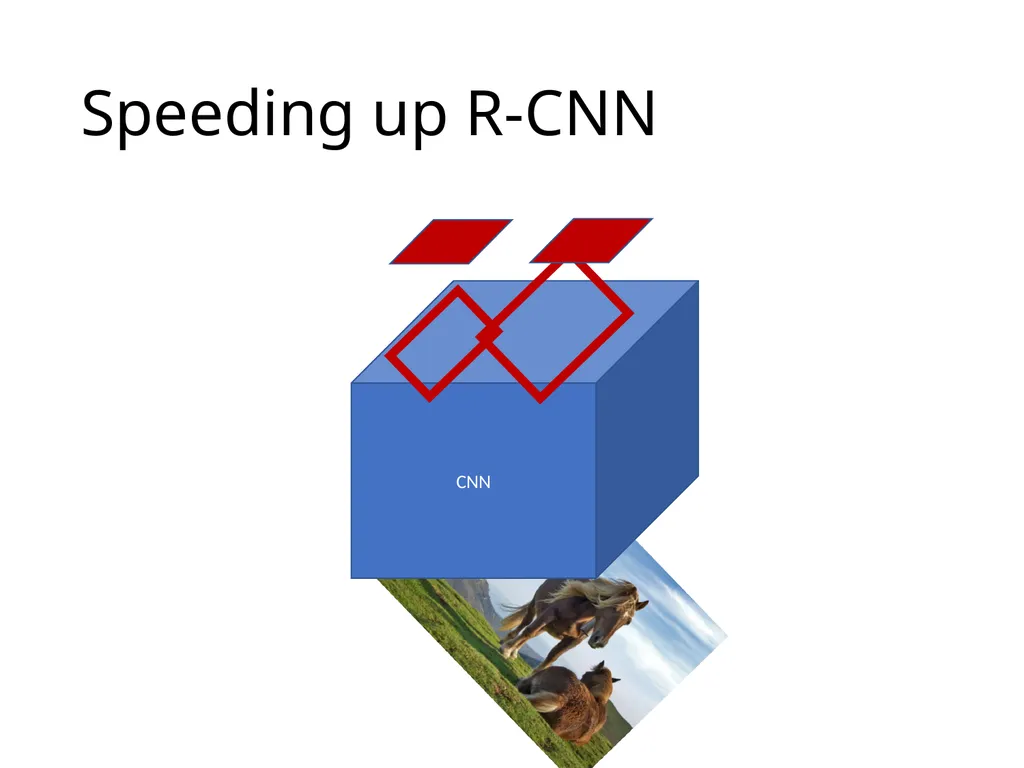
Speeding up R-CNN CNN<br>
14
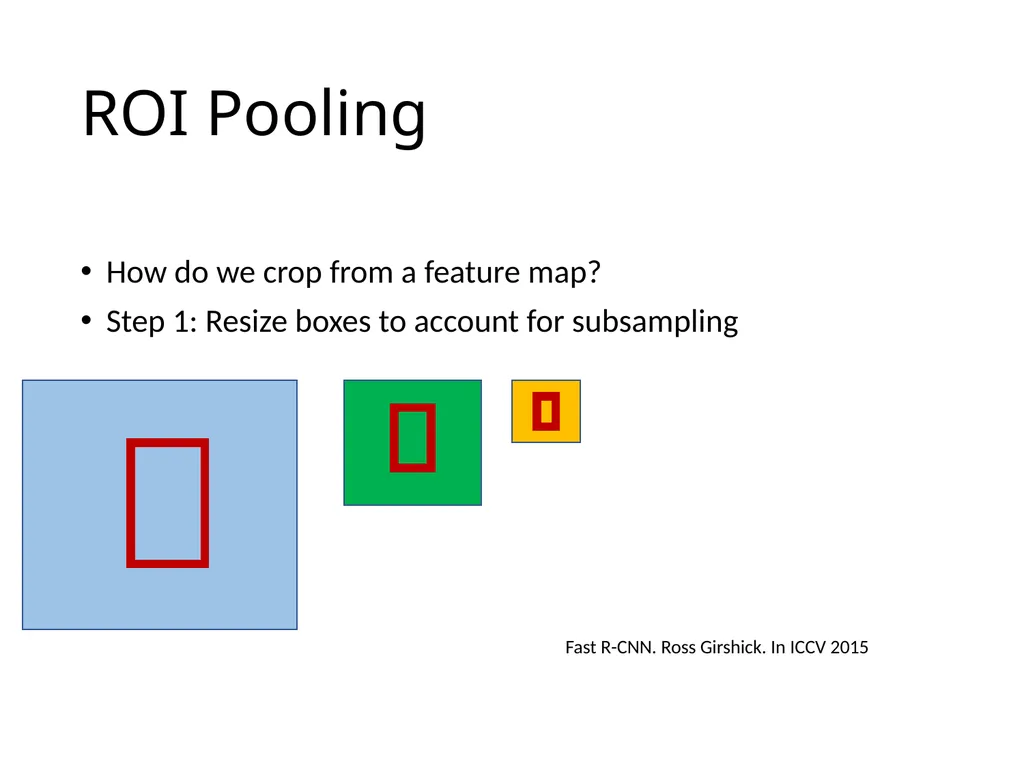
ROI Pooling How do we crop from a feature map?
Step 1: Resize boxes to account for subsampling Fast R-CNN. Ross Girshick. In ICCV 2015<br>
15
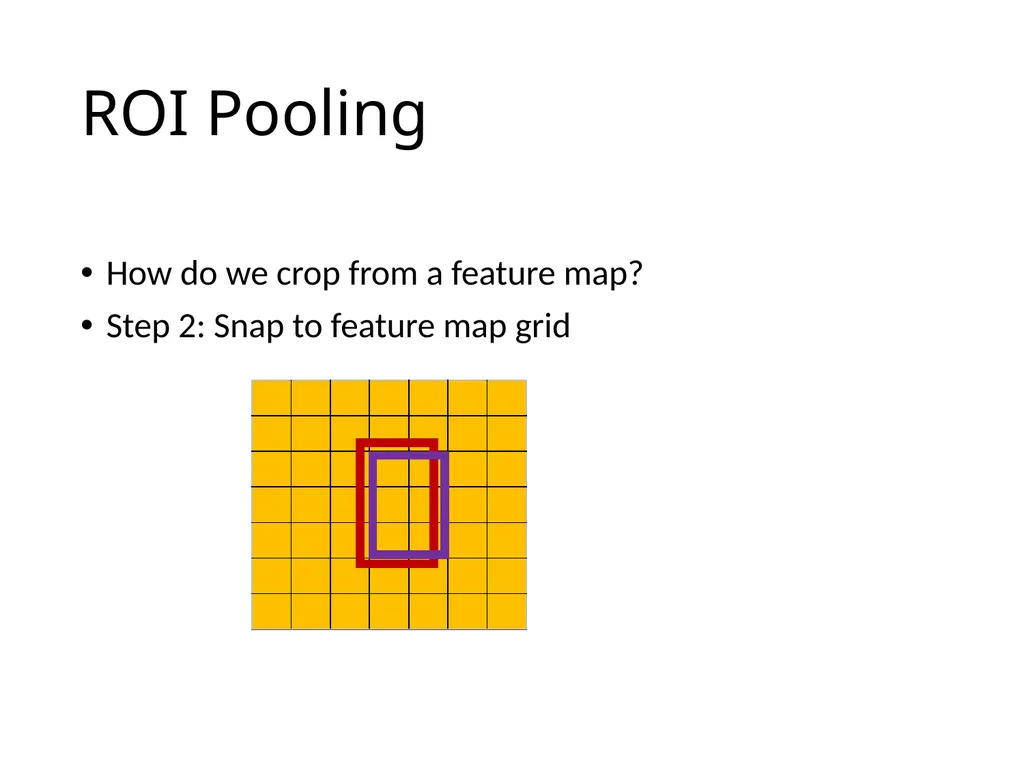
ROI Pooling How do we crop from a feature map?
Step 2: Snap to feature map grid<br>
16
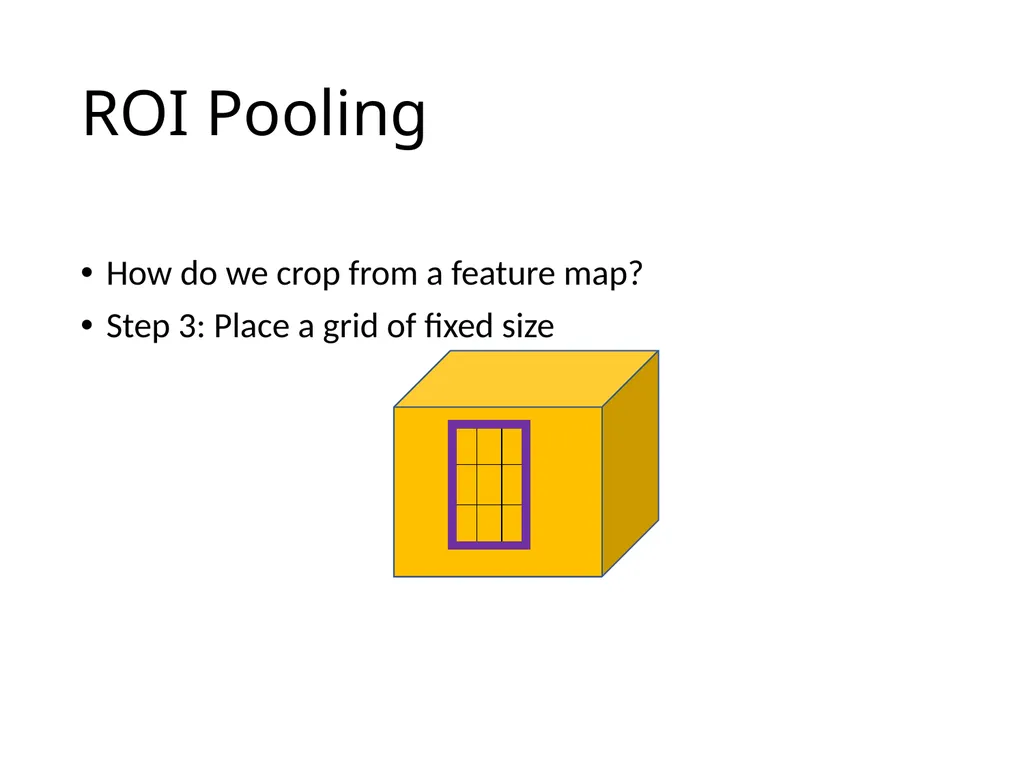
ROI Pooling How do we crop from a feature map?
Step 3: Place a grid of fixed size<br>
17
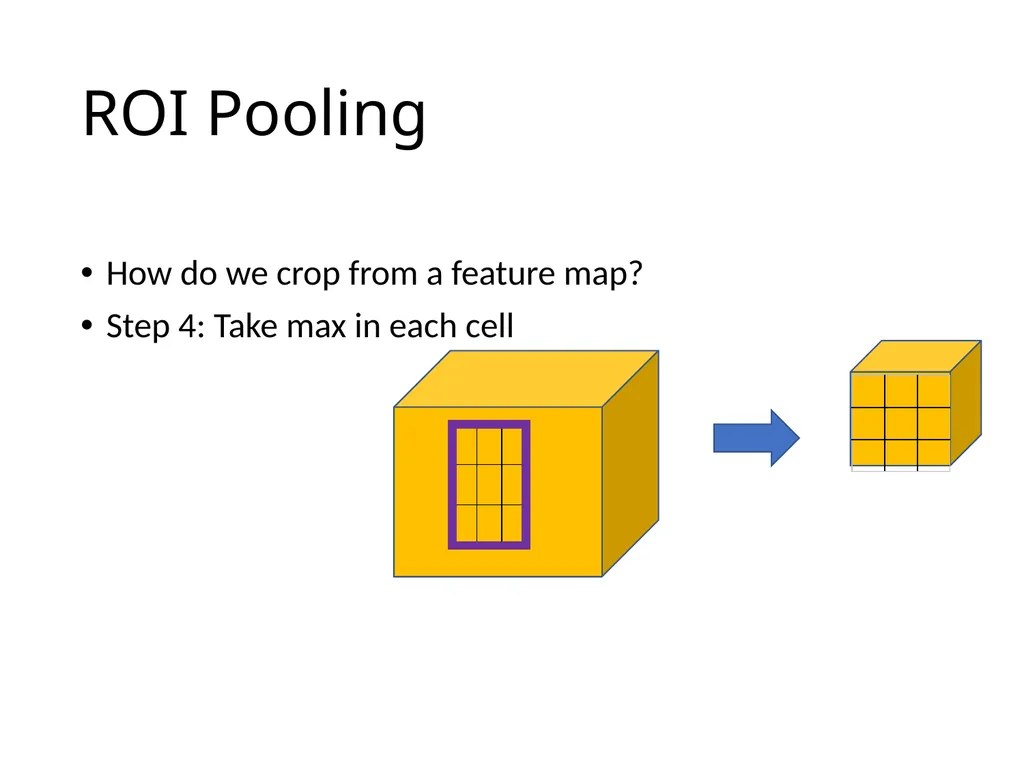
ROI Pooling How do we crop from a feature map?
Step 4: Take max in each cell<br>
19
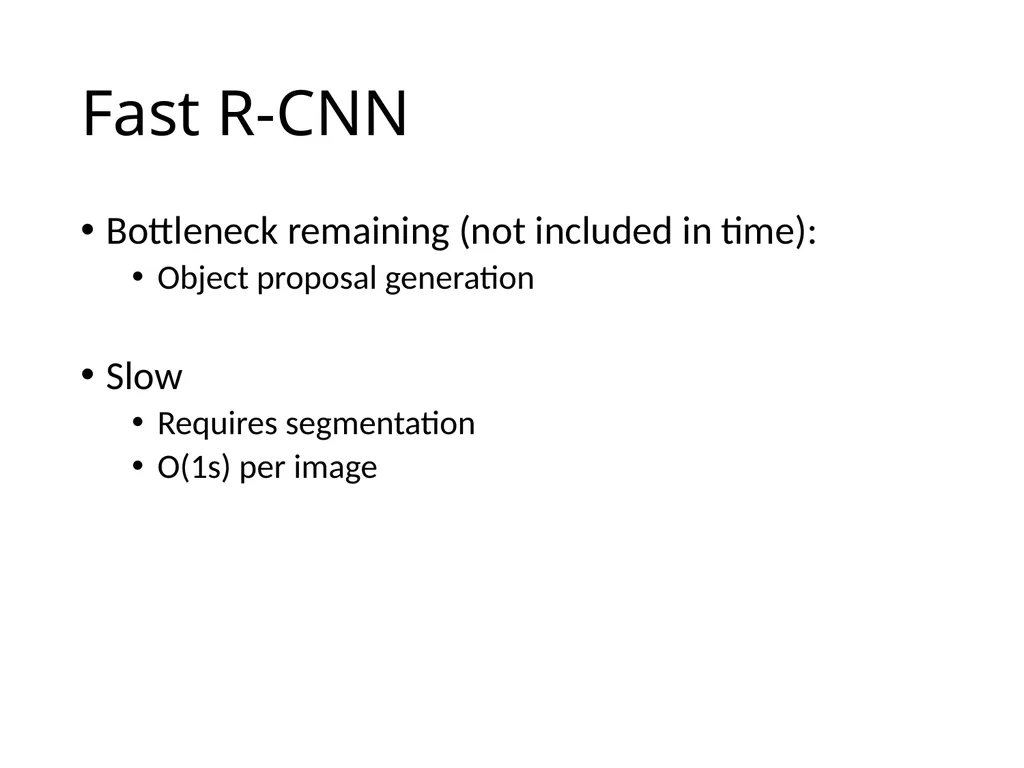
Fast R-CNN Bottleneck remaining (not included in time):
Object proposal generation
Slow
Requires segmentation
O(1s) per image<br>
20
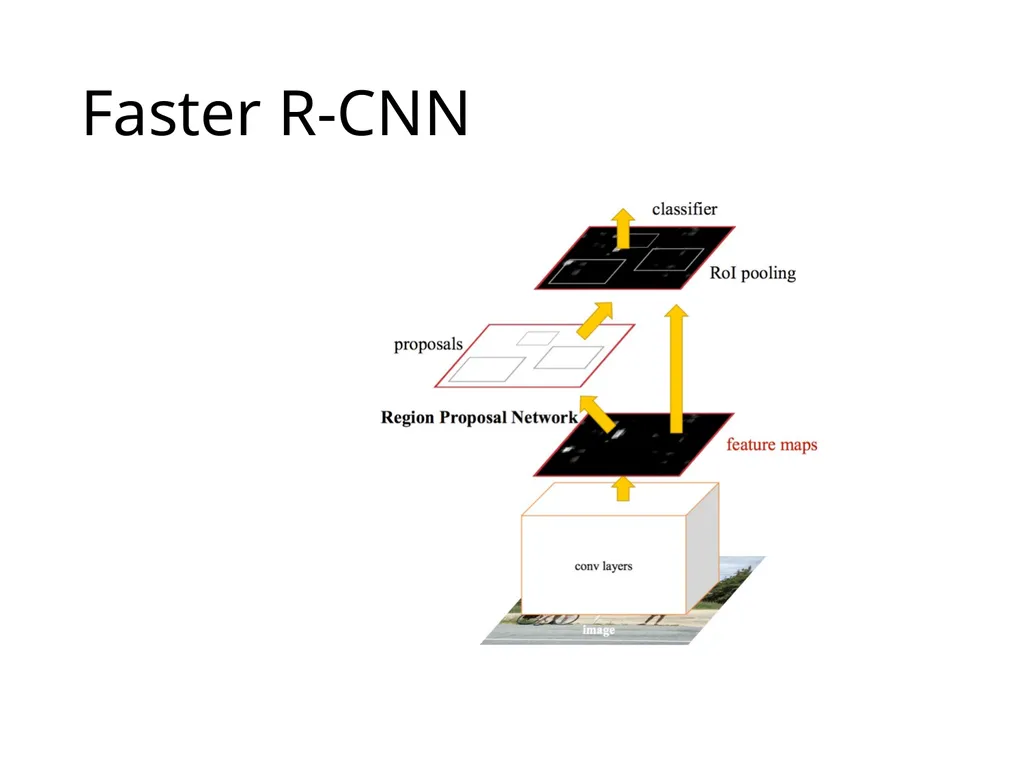
Faster R-CNN Can we produce object proposals from convolutional networks?
A change in intuition
Instead of using grouping
Recognize likely objects?
For every possible box, score if it is likely to correspond to an object Faster R-CNN: Towards Real-Time Object Detection with Region Proposal Networks. S. Ren, K. He, R. Girshick, J. Sun. In NIPS 2015.<br>
22
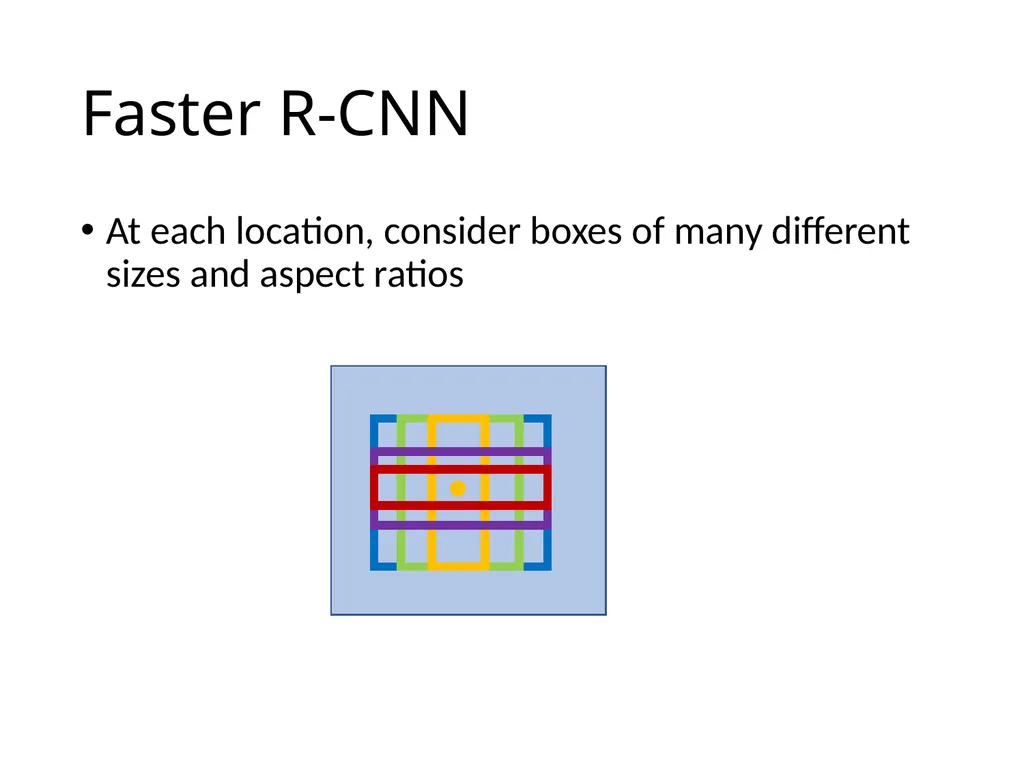
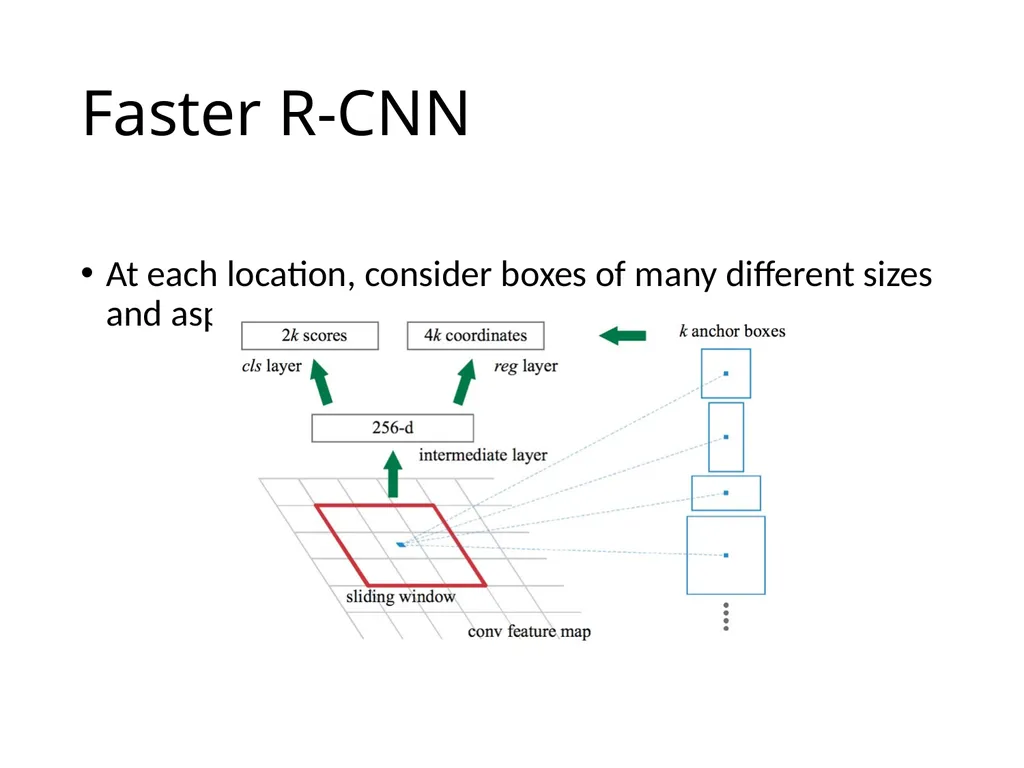
Faster R-CNN At each location, consider boxes of many different sizes and aspect ratios<br>
23
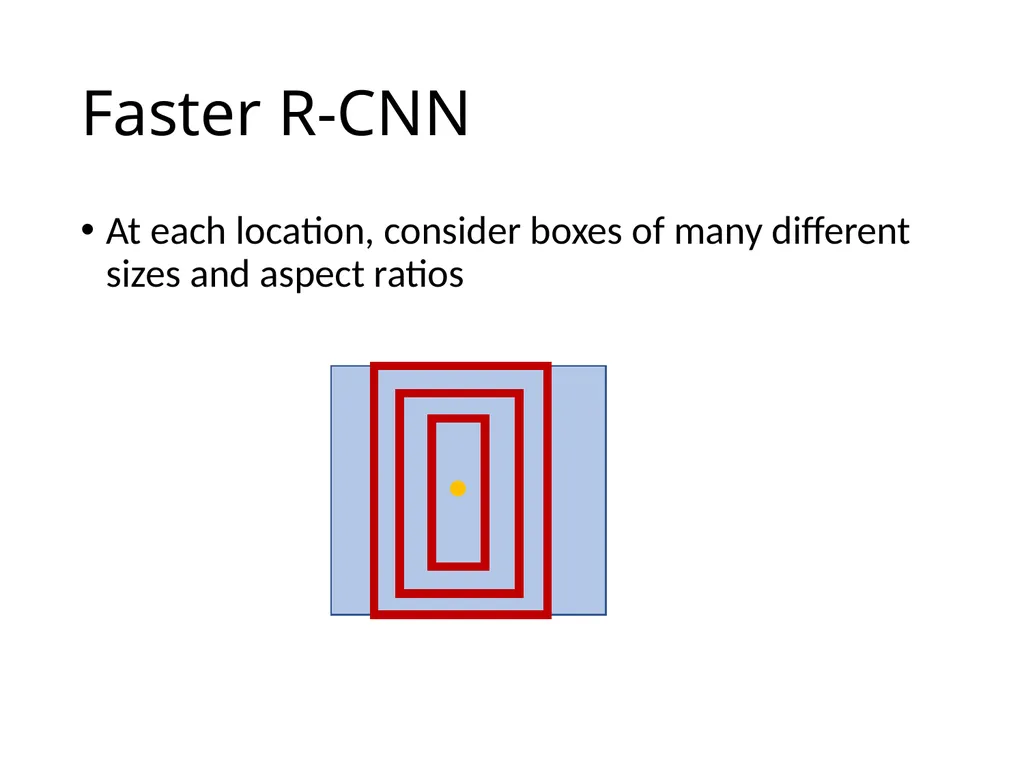
Faster R-CNN At each location, consider boxes of many different sizes and aspect ratios<br>
24
Faster R-CNN At each location, consider boxes of many different sizes and aspect ratios<br>
25
Faster R-CNN s scales * a aspect ratios = sa anchor boxes
Use convolutional layer on top of filter map to produce sa scores
Pick top few boxes as proposals<br>
27
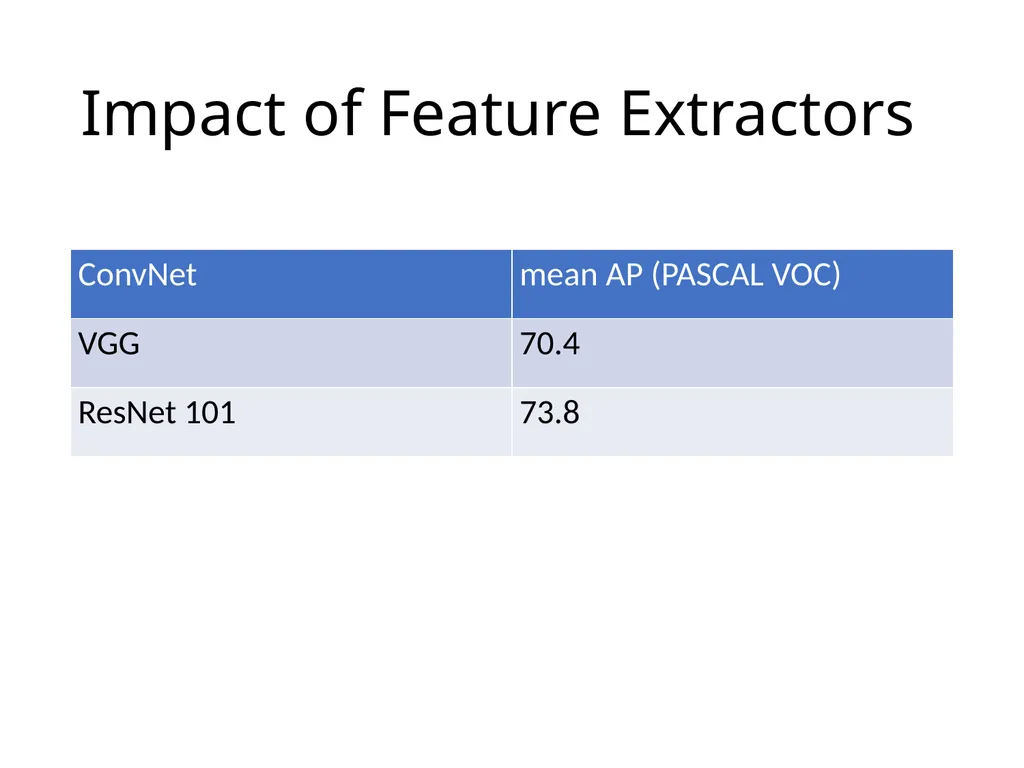
Impact of Feature Extractors<br>
28
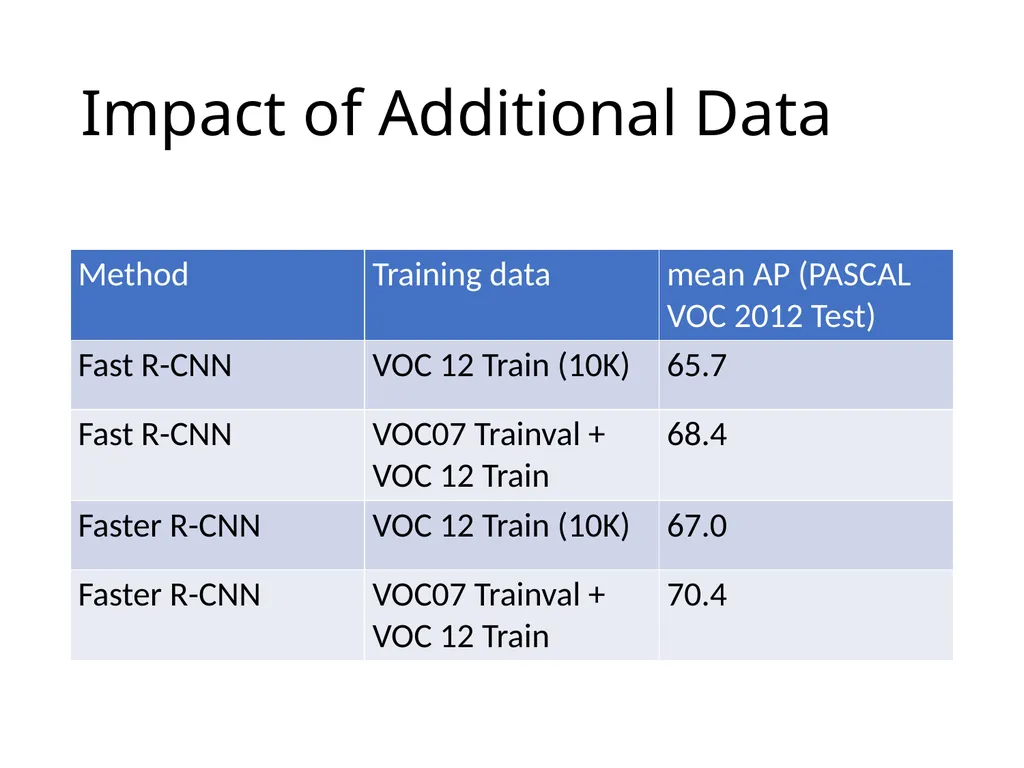
Impact of Additional Data<br>
29
The R-CNN family of detectors<br>
30
Semantic Segmentation<br>
32
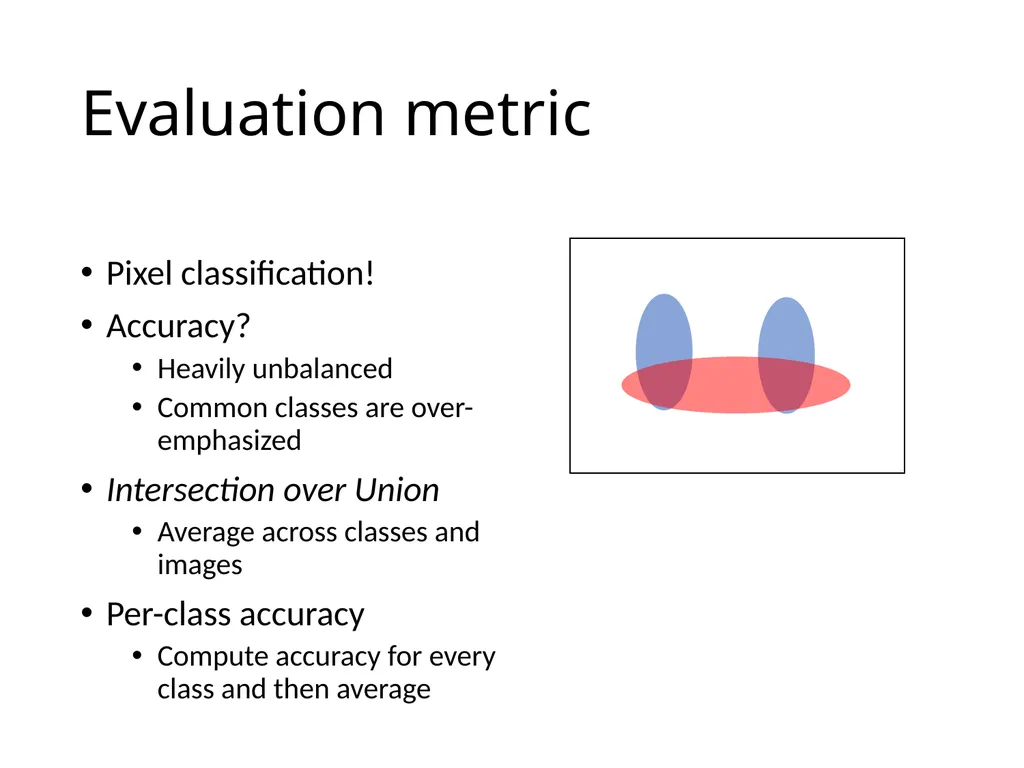
Evaluation metric Pixel classification!
Accuracy?
Heavily unbalanced
Common classes are over-emphasized
Intersection over Union
Average across classes and images
Per-class accuracy
Compute accuracy for every class and then average<br>
33
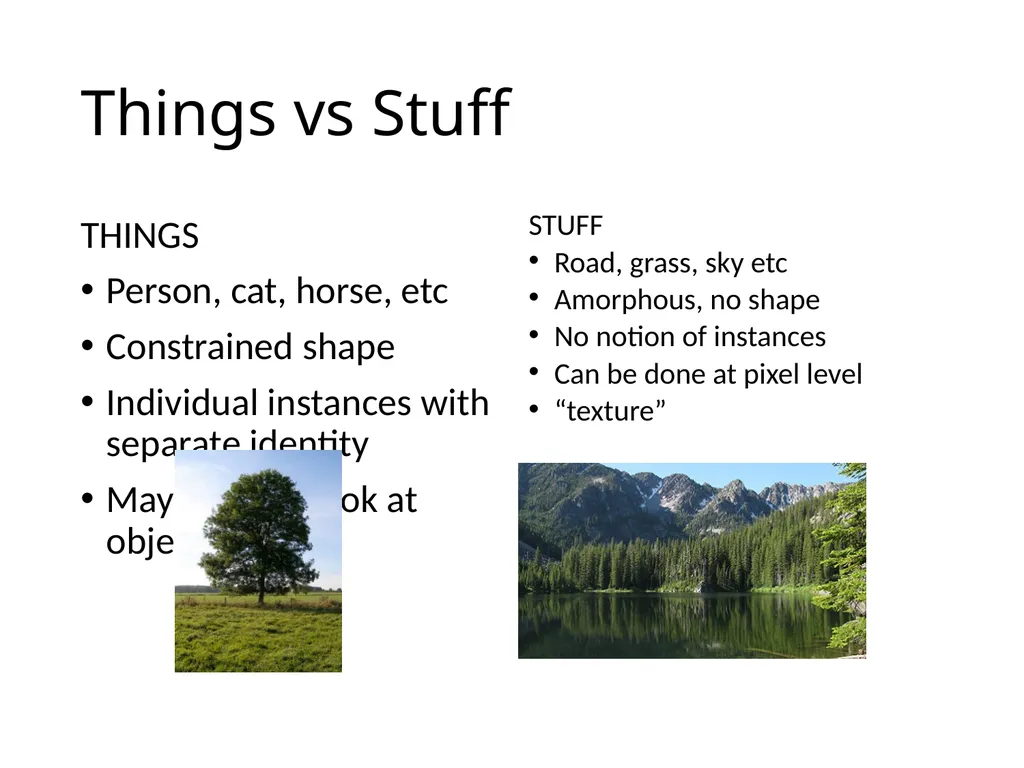
Things vs Stuff THINGS
Person, cat, horse, etc
Constrained shape
Individual instances with separate identity
May need to look at objects STUFF
Road, grass, sky etc
Amorphous, no shape
No notion of instances
Can be done at pixel level
“texture”<br>
34
Challenges in data collection Precise localization is hard to annotate
Annotating every pixel leads to heavy tails
Common solution: annotate few classes (often things), mark rest as “Other”
Common datasets: PASCAL VOC 2012 (~1500 images, 20 categories), COCO (~100k images, 20 categories)<br>
35
Pre-convnet semantic segmentation Things
Do object detection, then segment out detected objects
Stuff
”Texture classification”
Compute histograms of filter responses
Classify local image patches<br>
36
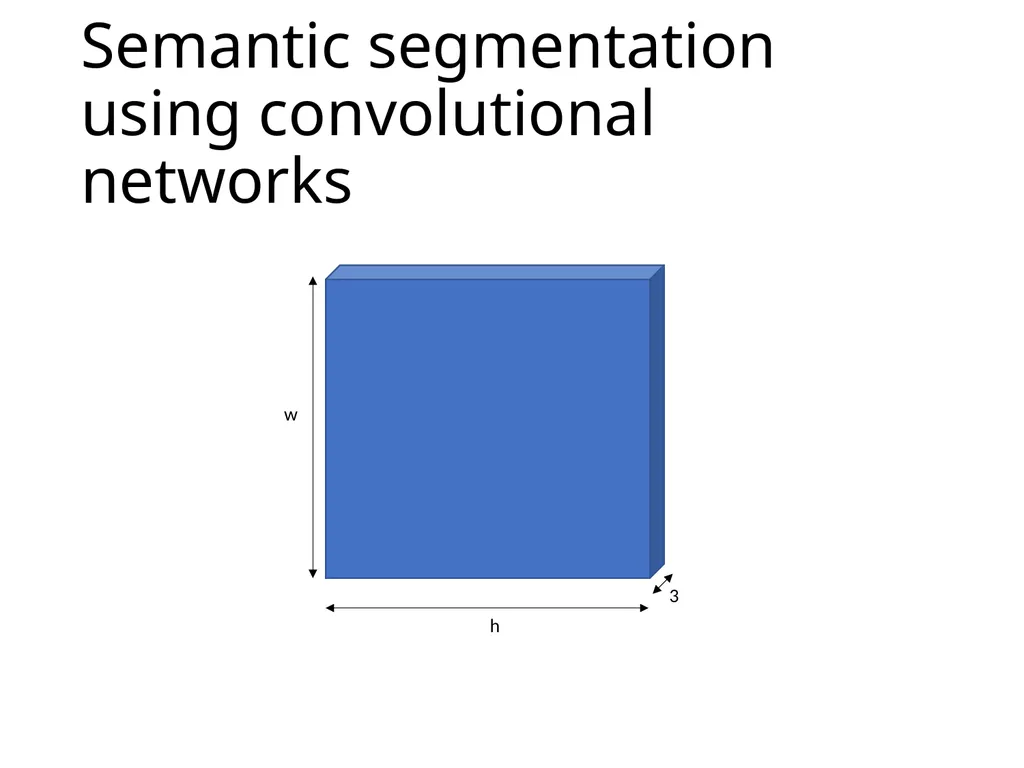
Semantic segmentation using convolutional networks h w 3<br>
37
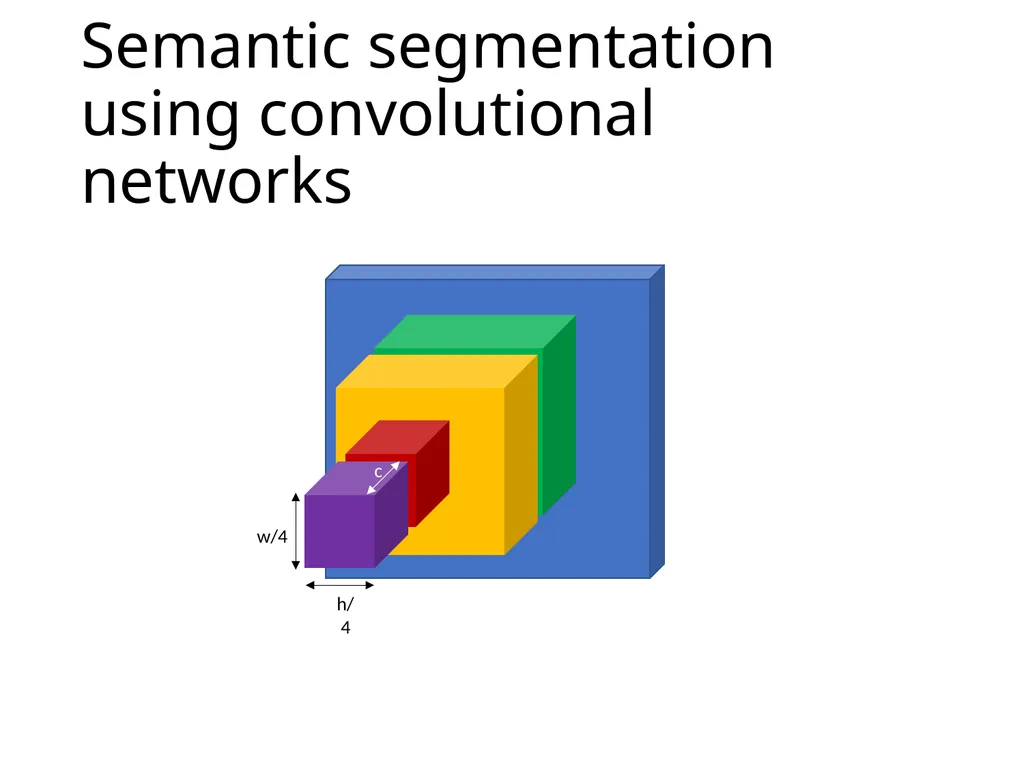
Semantic segmentation using convolutional networks h/4 w/4 c<br>
38
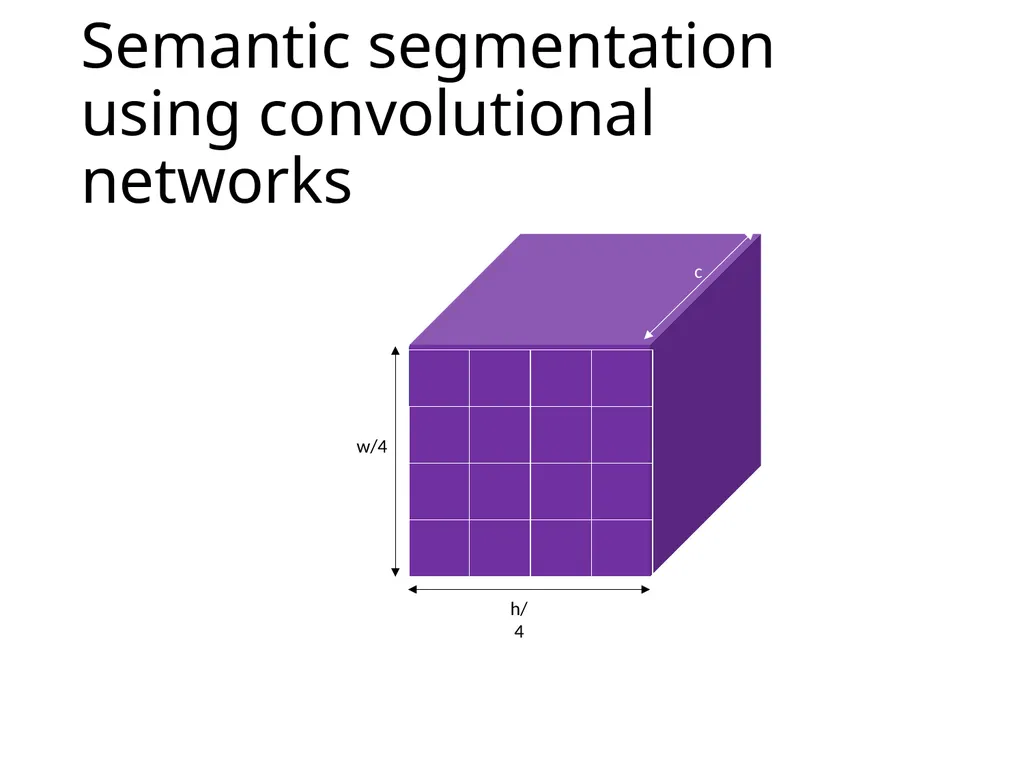
Semantic segmentation using convolutional networks h/4 w/4<br>
39
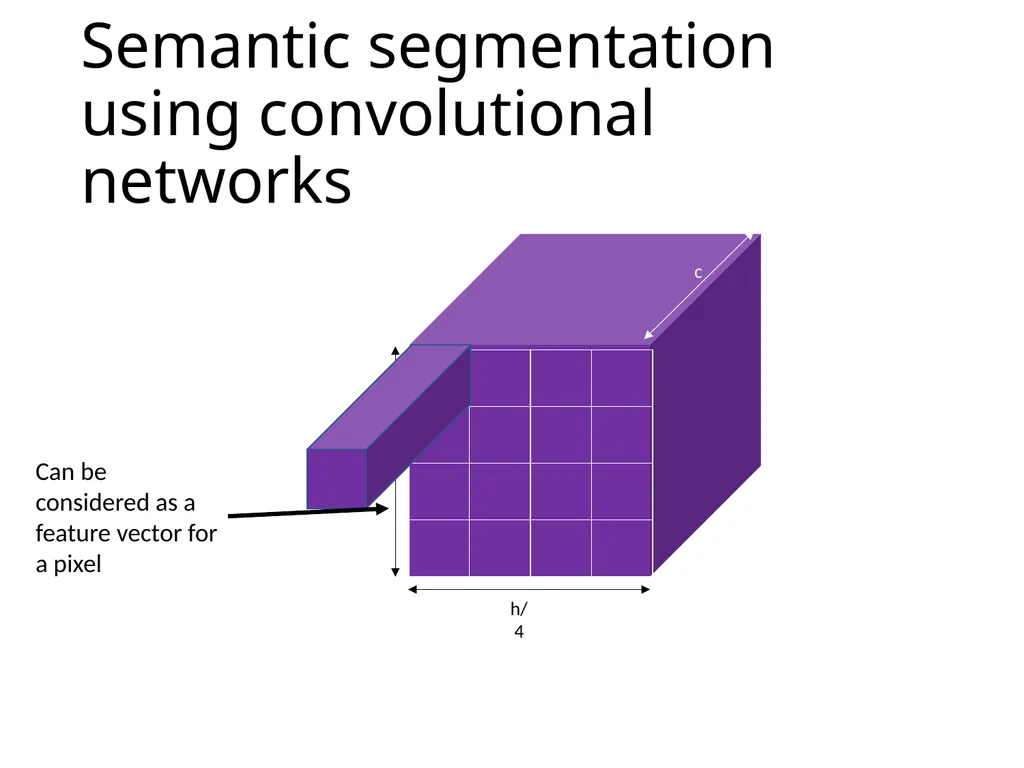
Semantic segmentation using convolutional networks h/4 w/4 Can be considered as a feature vector for a pixel<br>
40
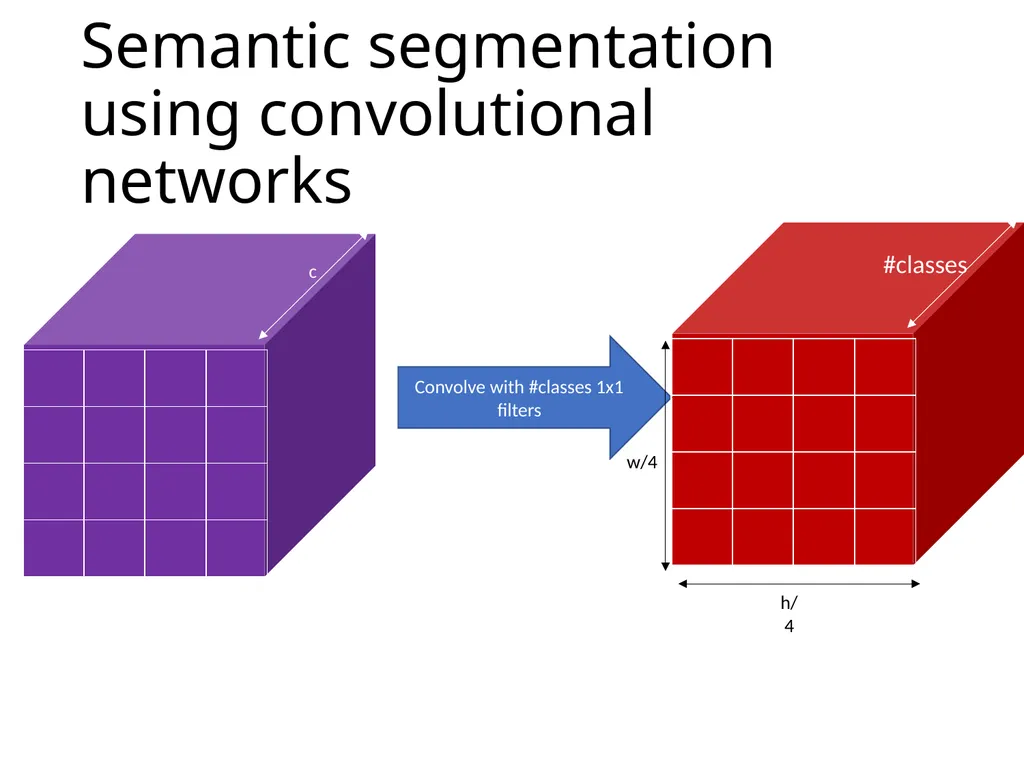
Semantic segmentation using convolutional networks Convolve with #classes 1x1 filters h/4 w/4<br>
41
Semantic segmentation using convolutional networks Pass image through convolution and subsampling layers
Final convolution with #classes outputs
Get scores for subsampled image
Upsample back to original size<br>
42
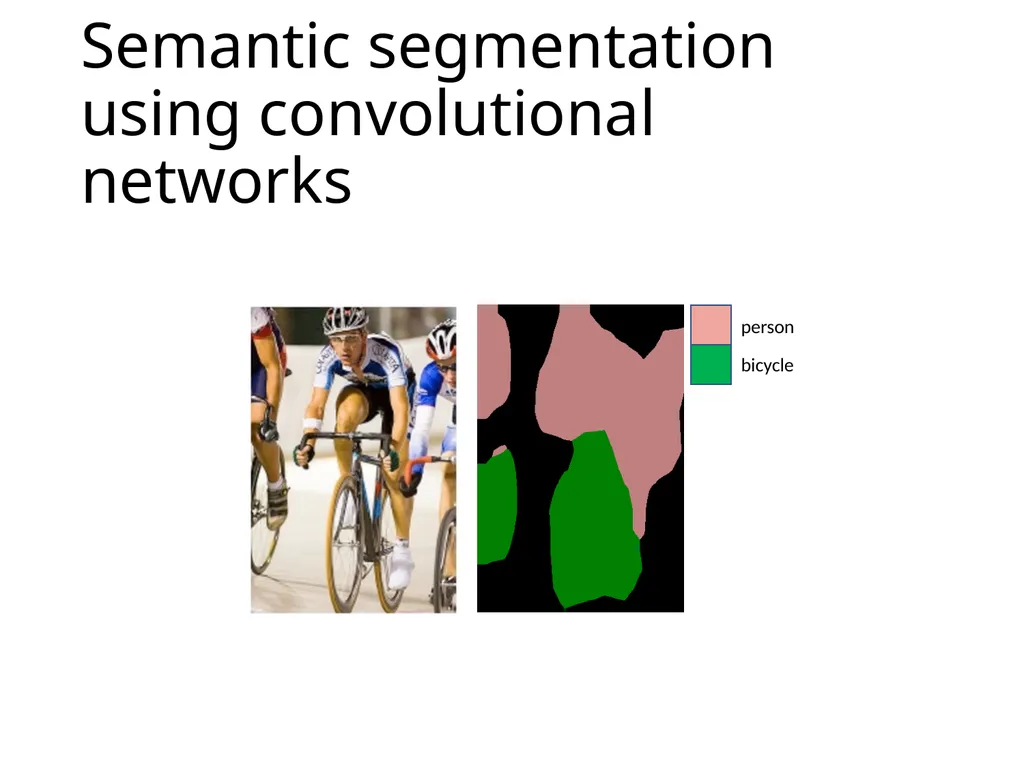
Semantic segmentation using convolutional networks person bicycle<br>
43
The resolution issue Problem: Need fine details!
Shallower network / earlier layers?
Deeper networks work better: more abstract concepts
Shallower network => Not very semantic!
Remove subsampling?
Subsampling allows later layers to capture larger and larger patterns
Without subsampling => Looks at only a small window!<br>
44
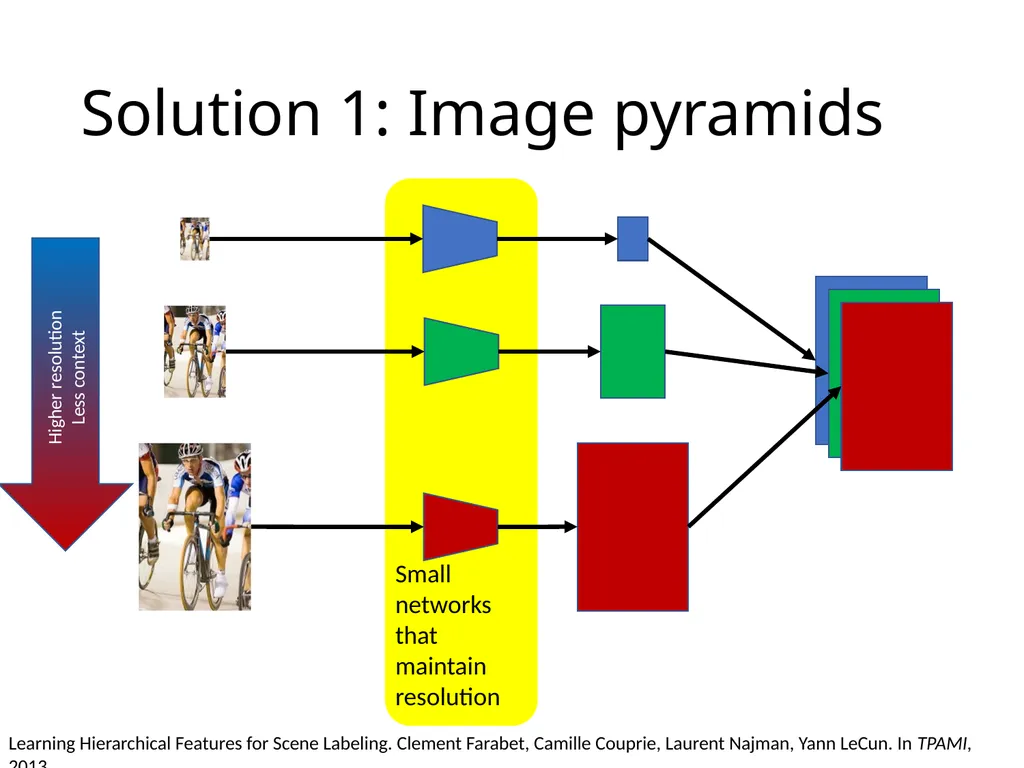
Solution 1: Image pyramids Learning Hierarchical Features for Scene Labeling. Clement Farabet, Camille Couprie, Laurent Najman, Yann LeCun. In TPAMI, 2013. Higher resolution�Less context Small networks that maintain resolution<br>
45
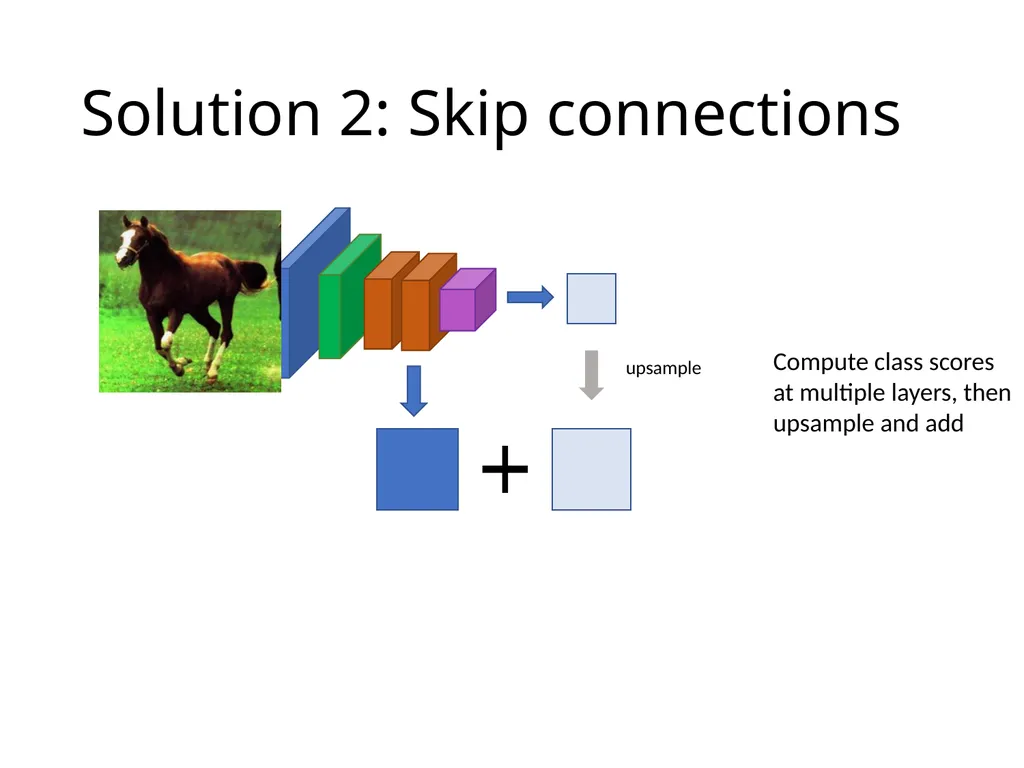
Solution 2: Skip connections upsample Compute class scores at multiple layers, then upsample and add<br>
46
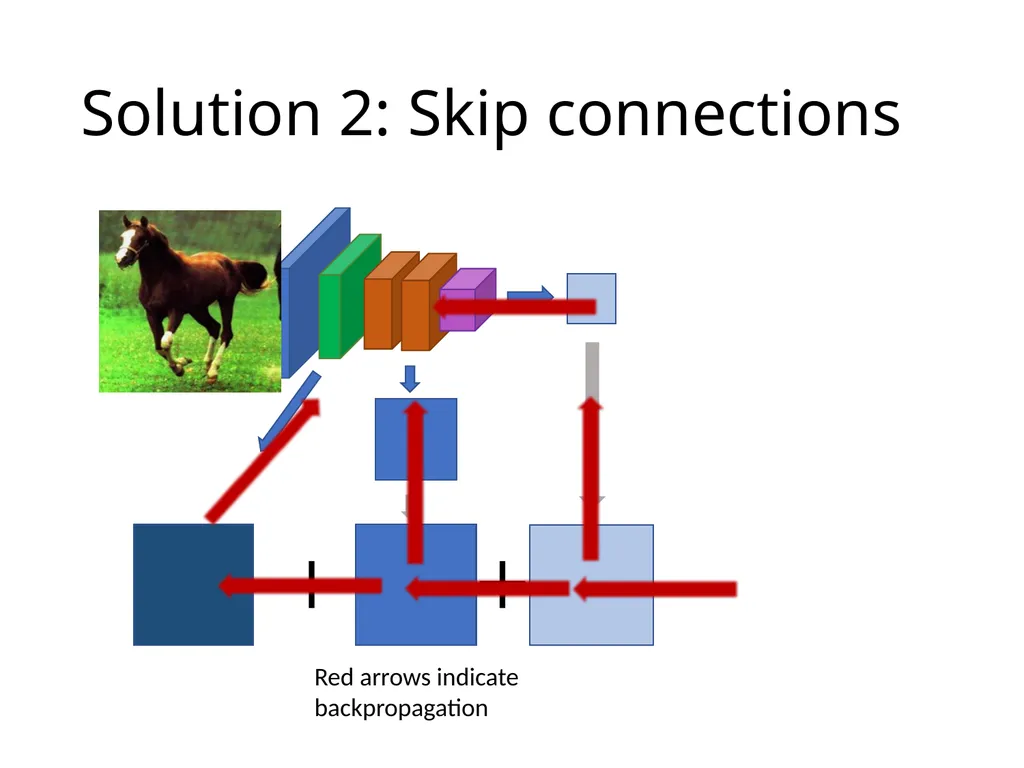
Solution 2: Skip connections Red arrows indicate backpropagation<br>
47
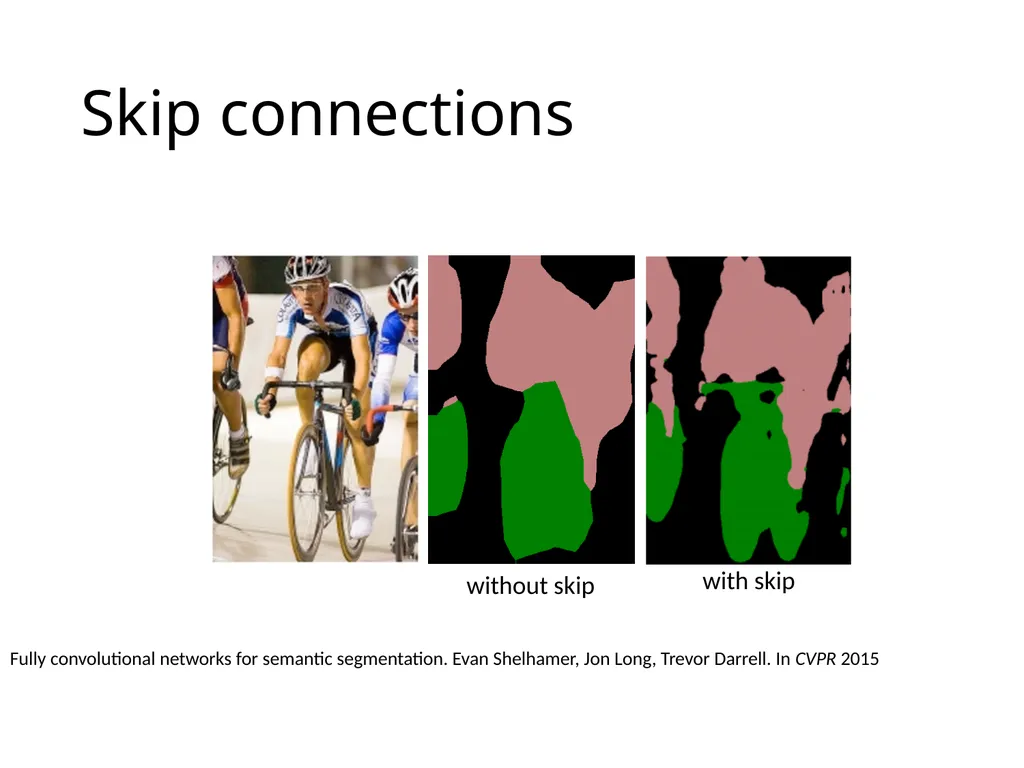
Skip connections Fully convolutional networks for semantic segmentation. Evan Shelhamer, Jon Long, Trevor Darrell. In CVPR 2015 without skip with skip<br>
48
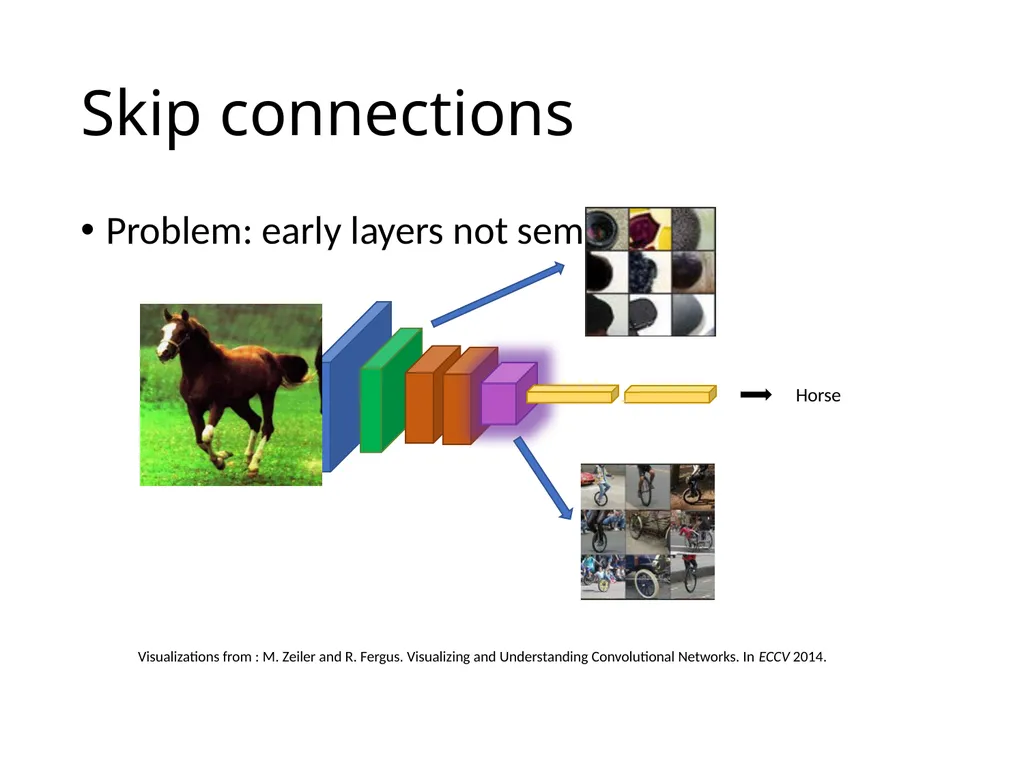
Skip connections Problem: early layers not semantic Visualizations from : M. Zeiler and R. Fergus. Visualizing and Understanding Convolutional Networks. In ECCV 2014.<br>
49
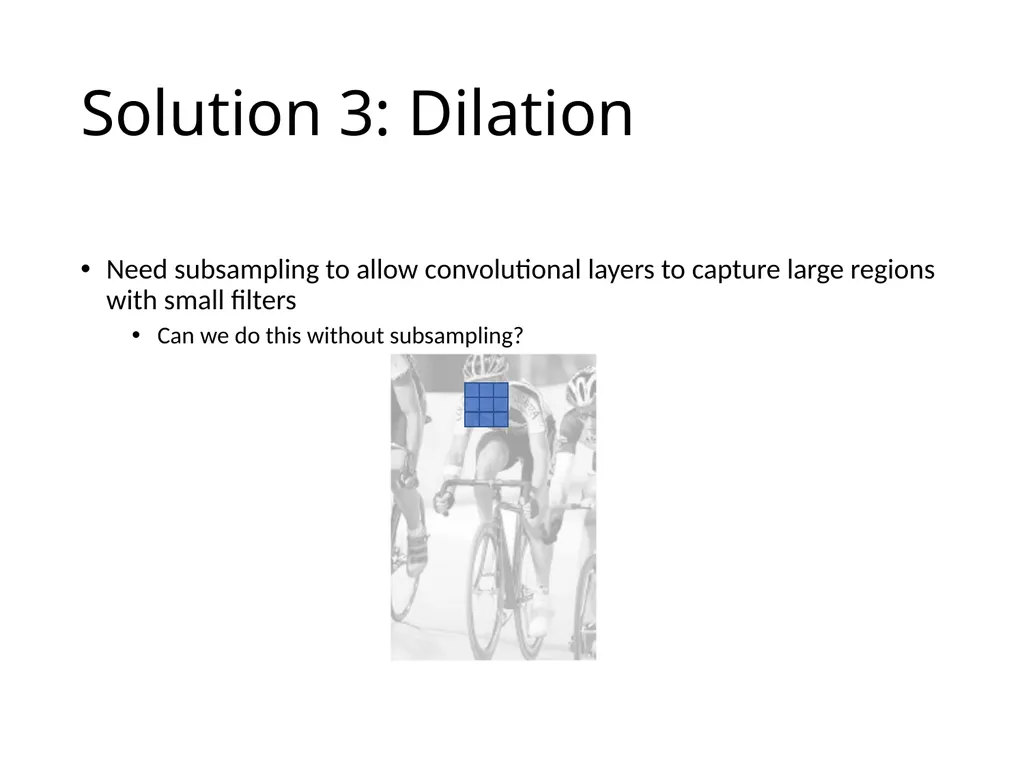
Solution 3: Dilation Need subsampling to allow convolutional layers to capture large regions with small filters
Can we do this without subsampling?<br>
50
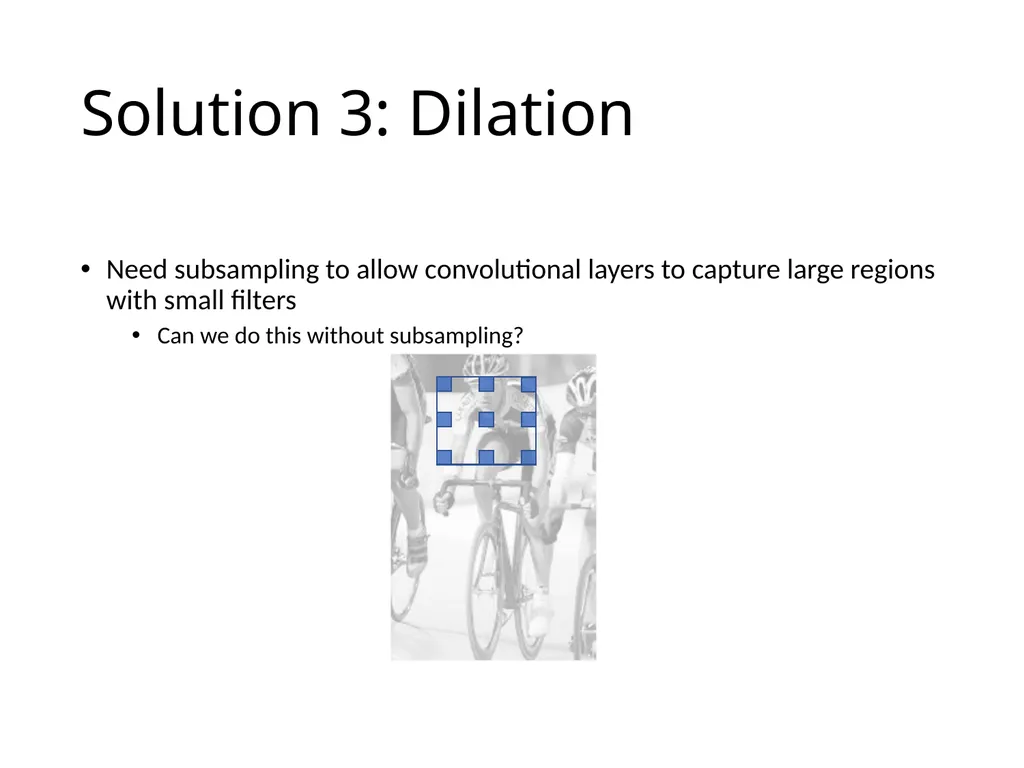
Solution 3: Dilation Need subsampling to allow convolutional layers to capture large regions with small filters
Can we do this without subsampling?<br>
51
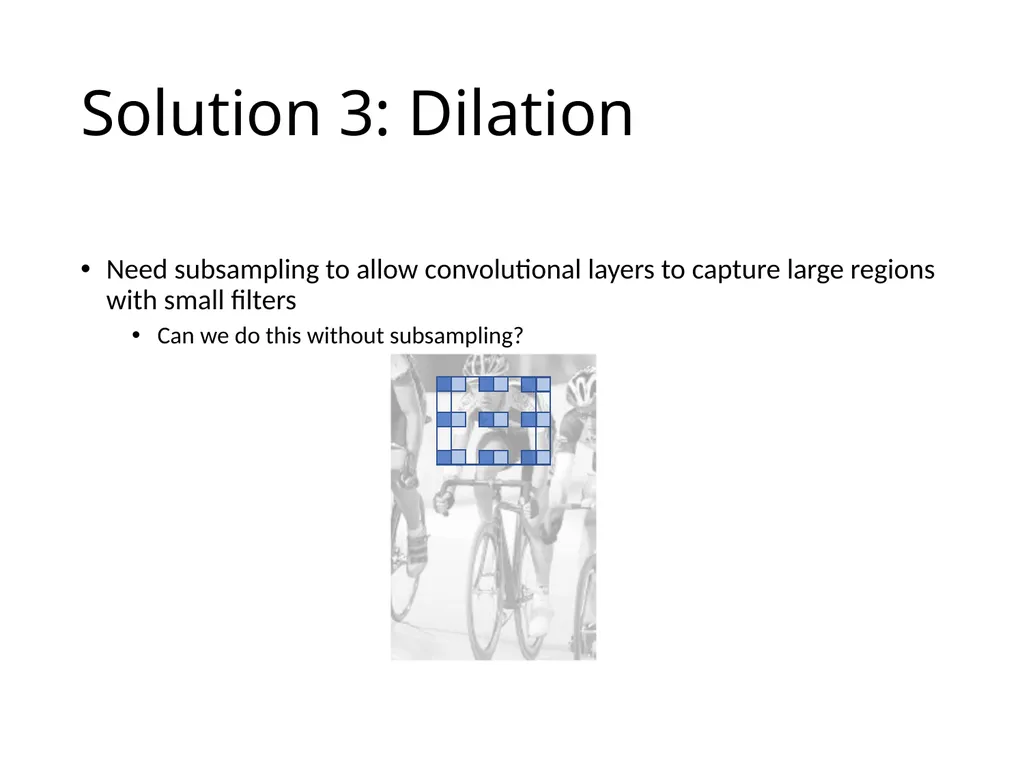
Solution 3: Dilation Need subsampling to allow convolutional layers to capture large regions with small filters
Can we do this without subsampling?<br>
52
Solution 3: Dilation Instead of subsampling by factor of 2: dilate by factor of 2
Dilation can be seen as:
Using a much larger filter, but with most entries set to 0
Taking a small filter and “exploding”/ “dilating” it
Not panacea: without subsampling, feature maps are much larger: memory issues<br>
53
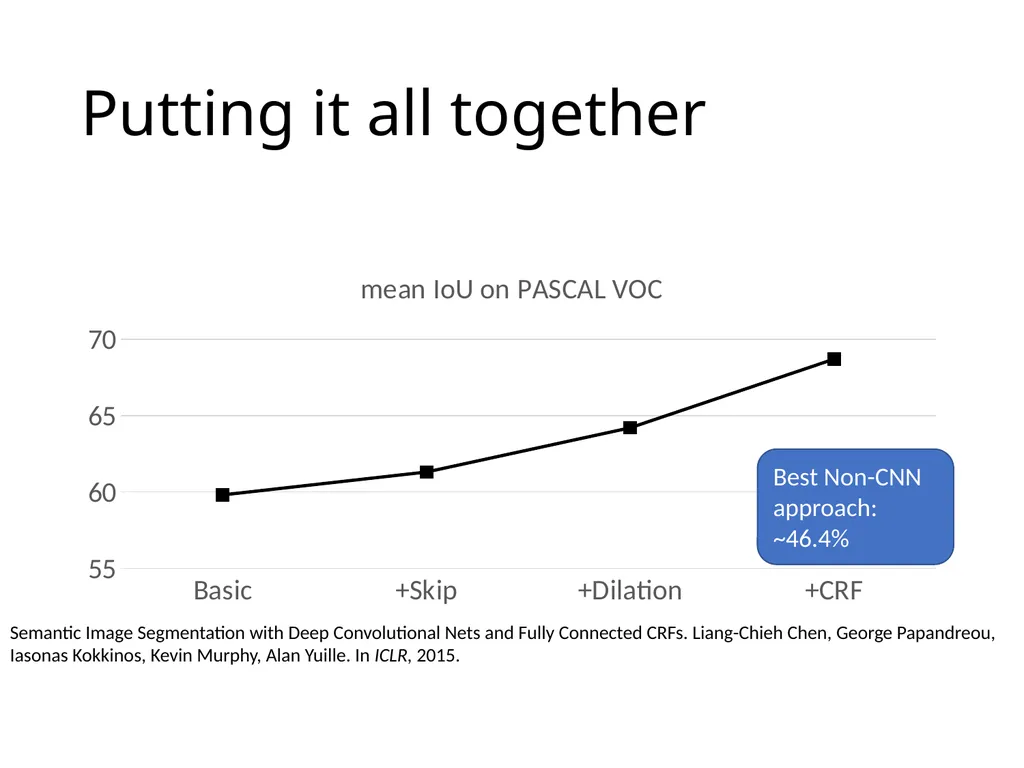
Putting it all together Best Non-CNN approach: ~46.4% Semantic Image Segmentation with Deep Convolutional Nets and Fully Connected CRFs. Liang-Chieh Chen, George Papandreou, Iasonas Kokkinos, Kevin Murphy, Alan Yuille. In ICLR, 2015.<br>
54
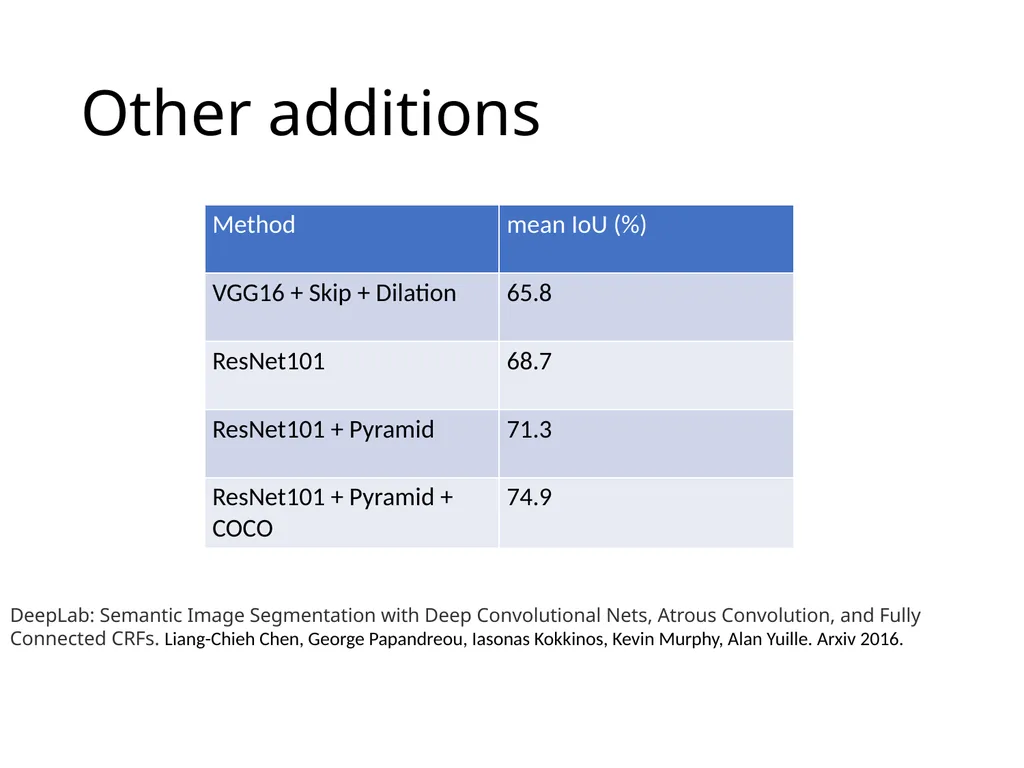
Other additions DeepLab: Semantic Image Segmentation with Deep Convolutional Nets, Atrous Convolution, and Fully Connected CRFs. Liang-Chieh Chen, George Papandreou, Iasonas Kokkinos, Kevin Murphy, Alan Yuille. Arxiv 2016.<br>
55
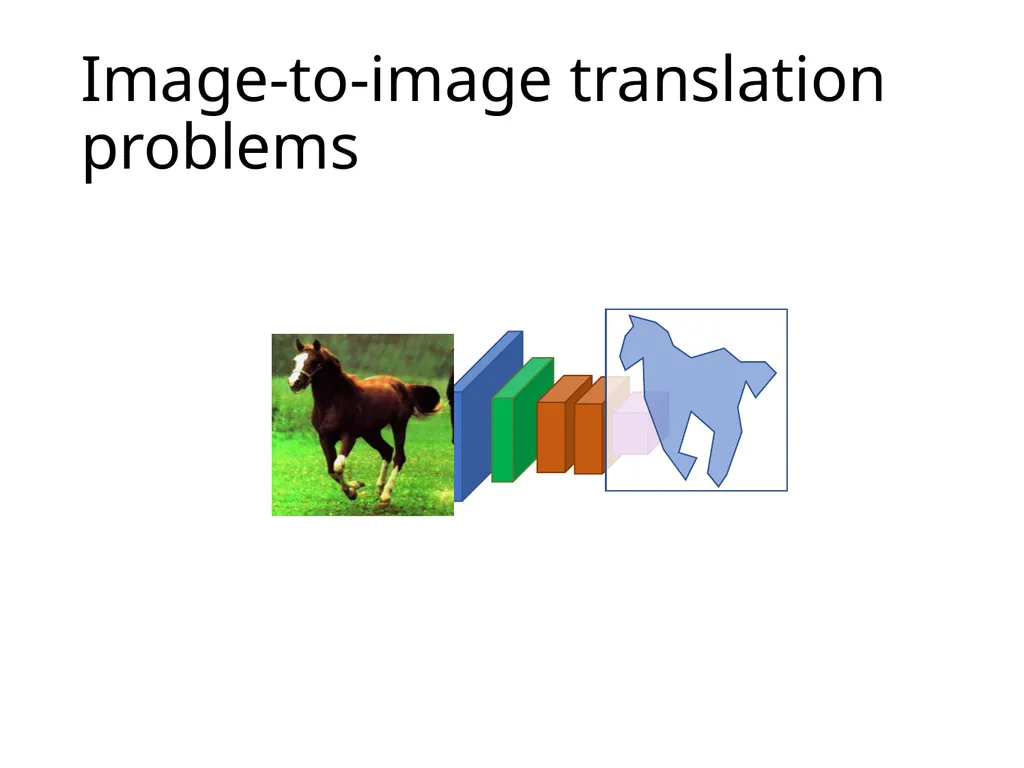
Image-to-image translation problems<br>
56
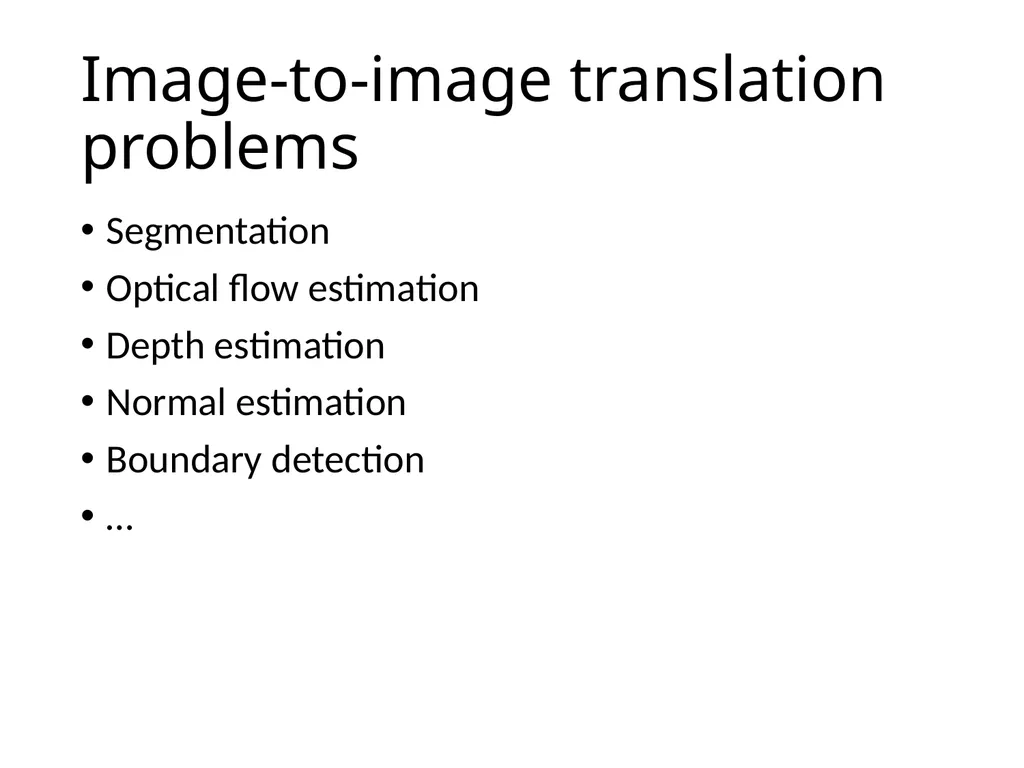
Image-to-image translation problems Segmentation
Optical flow estimation
Depth estimation
Normal estimation
Boundary detection
…<br>