
Objective of the session 1 Session 2.1 Overview of
JO
Published · 32 slides · 0 views

1 / 1



Description
Objective of the session 1 Session 2.1 Overview of measurement objectives and methods for producing statistics on the informal economy and SDG Indicators related to employment, decent work and inequality Regional Course on Informality:
Related Topics
Download this presentation From Below
"Objective of the session 1 Session 2.1 Overview of" is the property of its rightful owner. Permission is granted to download and print the materials on this website for personal, non-commercial use only, and to display it on your personal computer provided you do not modify the materials and that you retain all copyright notices contained in the materials. By downloading content from our website, you accept the terms of this agreement.
Share
Embed code
Presentation Transcript
01
Objective of the session 1 Session 2.1
Overview of measurement objectives and methods for producing statistics on the informal economy and SDG Indicators related to employment, decent work and inequality
Regional Course on Informality:
Definitions, Measurement, SDGs and Other Policy Indicators
16-20 October 2017, Chiba, Japan
F. Bonnet & T. Habiyakare<br>
Regional Course on Informality:
Definitions, Measurement, SDGs and Other Policy Indicators
16-20 October 2017, Chiba, Japan
F. Bonnet & T. Habiyakare<br>
02
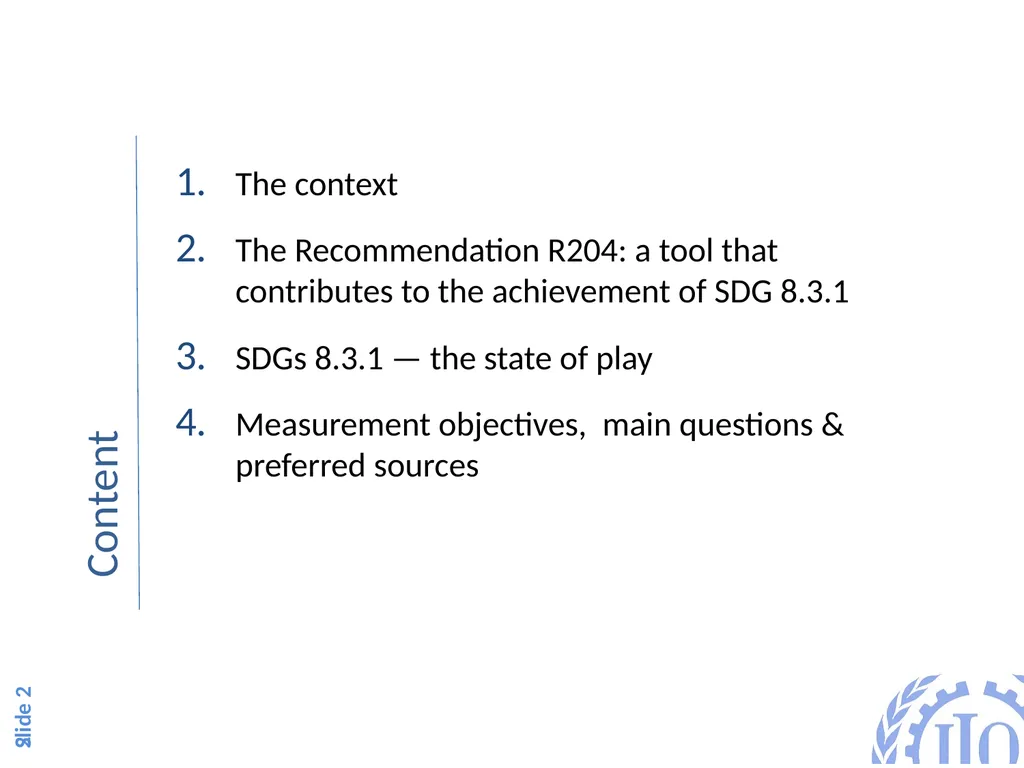
Content The context
The Recommendation R204: a tool that contributes to the achievement of SDG 8.3.1
SDGs 8.3.1 — the state of play
Measurement objectives, main questions & preferred sources 2<br>
The Recommendation R204: a tool that contributes to the achievement of SDG 8.3.1
SDGs 8.3.1 — the state of play
Measurement objectives, main questions & preferred sources 2<br>
03
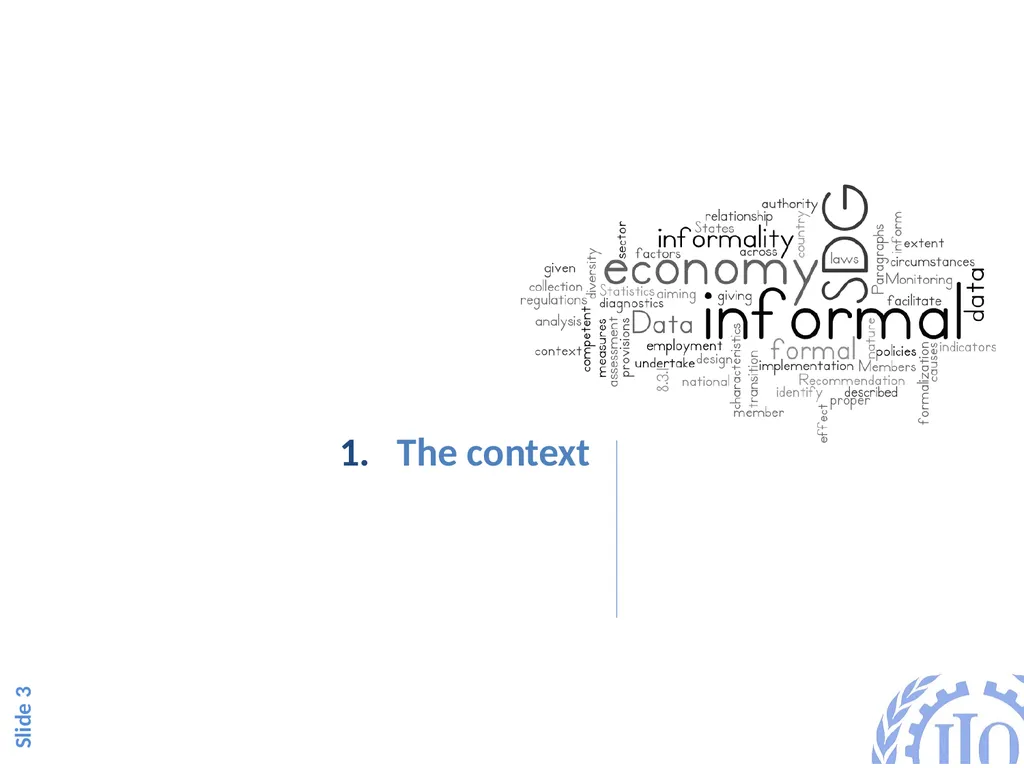
3 The context<br>
04
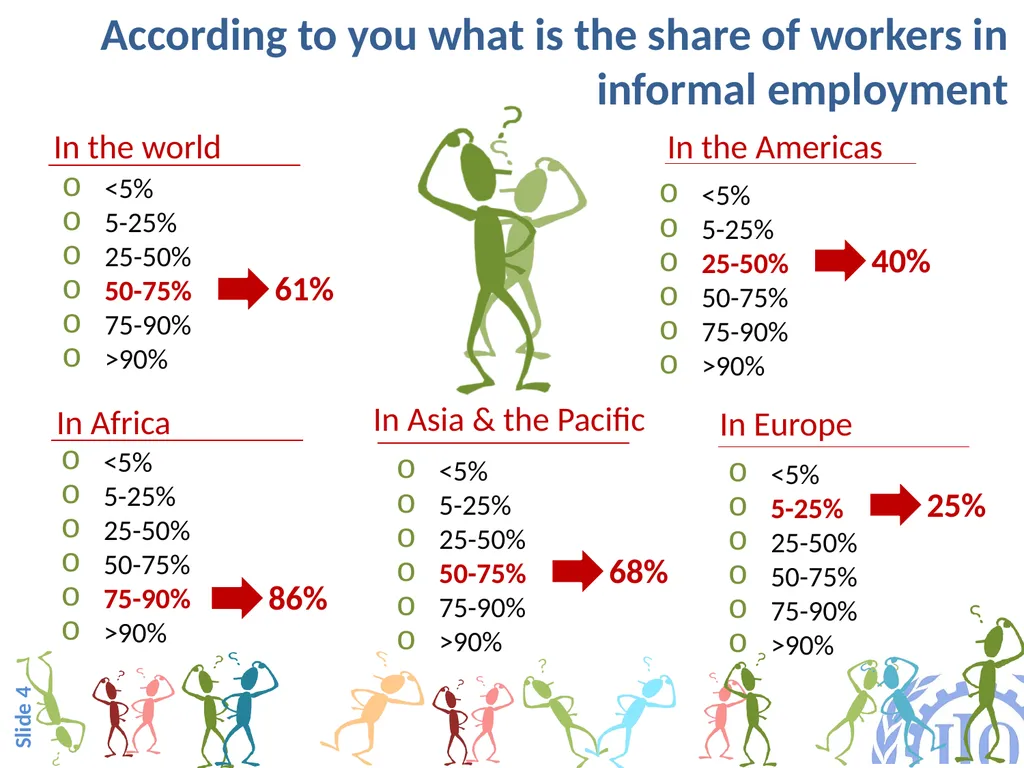
According to you what is the share of workers in informal employment In the world In the Americas In Africa <5%
5-25%
25-50%
50-75%
75-90%
>90% In Asia & the Pacific In Europe <5%
5-25%
25-50%
50-75%
75-90%
>90% <5%
5-25%
25-50%
50-75%
75-90%
>90% <5%
5-25%
25-50%
50-75%
75-90%
>90% <5%
5-25%
25-50%
50-75%
75-90%
>90% <5%
5-25%
25-50%
50-75%
75-90%
>90% <5%
5-25%
25-50%
50-75%
75-90%
>90% <5%
5-25%
25-50%
50-75%
75-90%
>90% <5%
5-25%
25-50%
50-75%
75-90%
>90% <5%
5-25%
25-50%
50-75%
75-90%
>90%<br>
5-25%
25-50%
50-75%
75-90%
>90% In Asia & the Pacific In Europe <5%
5-25%
25-50%
50-75%
75-90%
>90% <5%
5-25%
25-50%
50-75%
75-90%
>90% <5%
5-25%
25-50%
50-75%
75-90%
>90% <5%
5-25%
25-50%
50-75%
75-90%
>90% <5%
5-25%
25-50%
50-75%
75-90%
>90% <5%
5-25%
25-50%
50-75%
75-90%
>90% <5%
5-25%
25-50%
50-75%
75-90%
>90% <5%
5-25%
25-50%
50-75%
75-90%
>90% <5%
5-25%
25-50%
50-75%
75-90%
>90%<br>
05
According to you what is the share of workers in informal employment…. In the world In the Americas In Africa <5%
5-25%
25-50%
50-75%
75-90%
>90% In Asia & the Pacific In Europe <5%
5-25%
25-50%
50-75%
75-90%
>90% <5%
5-25%
25-50%
50-75%
75-90%
>90% <5%
5-25%
25-50%
50-75%
75-90%
>90% <5%
5-25%
25-50%
50-75%
75-90%
>90% <5%
5-25%
25-50%
50-75%
75-90%
>90% <5%
5-25%
25-50%
50-75%
75-90%
>90% <5%
5-25%
25-50%
50-75%
75-90%
>90% <5%
5-25%
25-50%
50-75%
75-90%
>90% <5%
5-25%
25-50%
50-75%
75-90%
>90% Excluding agriculture<br>
5-25%
25-50%
50-75%
75-90%
>90% In Asia & the Pacific In Europe <5%
5-25%
25-50%
50-75%
75-90%
>90% <5%
5-25%
25-50%
50-75%
75-90%
>90% <5%
5-25%
25-50%
50-75%
75-90%
>90% <5%
5-25%
25-50%
50-75%
75-90%
>90% <5%
5-25%
25-50%
50-75%
75-90%
>90% <5%
5-25%
25-50%
50-75%
75-90%
>90% <5%
5-25%
25-50%
50-75%
75-90%
>90% <5%
5-25%
25-50%
50-75%
75-90%
>90% <5%
5-25%
25-50%
50-75%
75-90%
>90% Excluding agriculture<br>
06
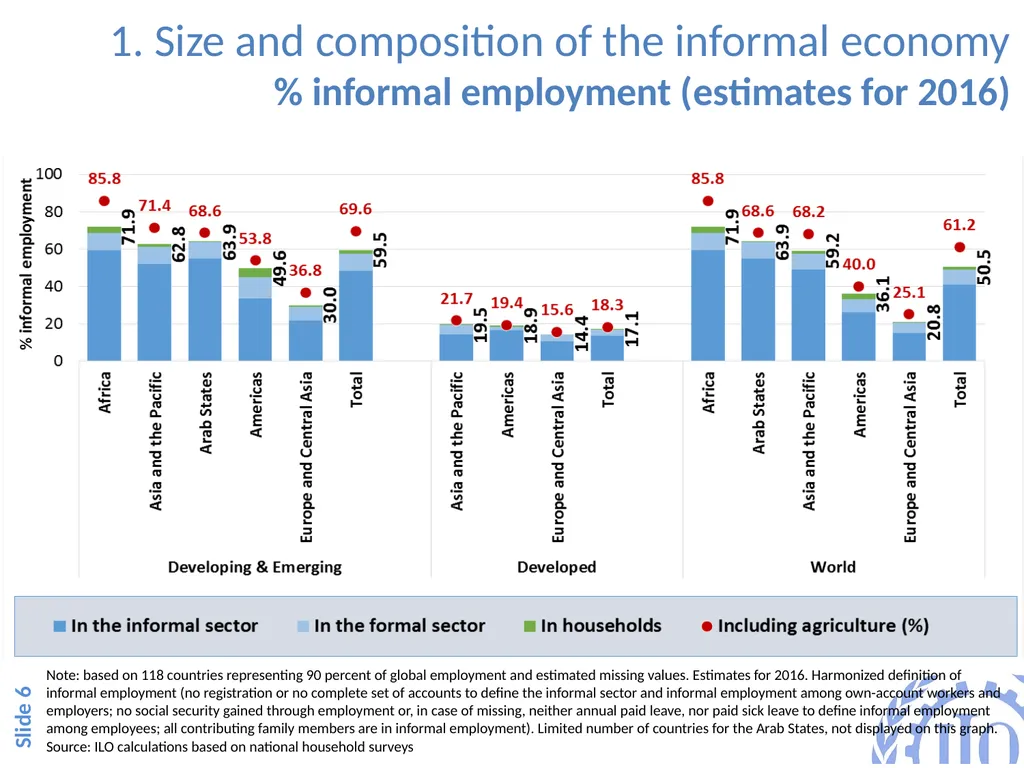
1. Size and composition of the informal economy
% informal employment (estimates for 2016) Note: based on 118 countries representing 90 percent of global employment and estimated missing values. Estimates for 2016. Harmonized definition of informal employment (no registration or no complete set of accounts to define the informal sector and informal employment among own-account workers and employers; no social security gained through employment or, in case of missing, neither annual paid leave, nor paid sick leave to define informal employment among employees; all contributing family members are in informal employment). Limited number of countries for the Arab States, not displayed on this graph. Source: ILO calculations based on national household surveys<br>
07
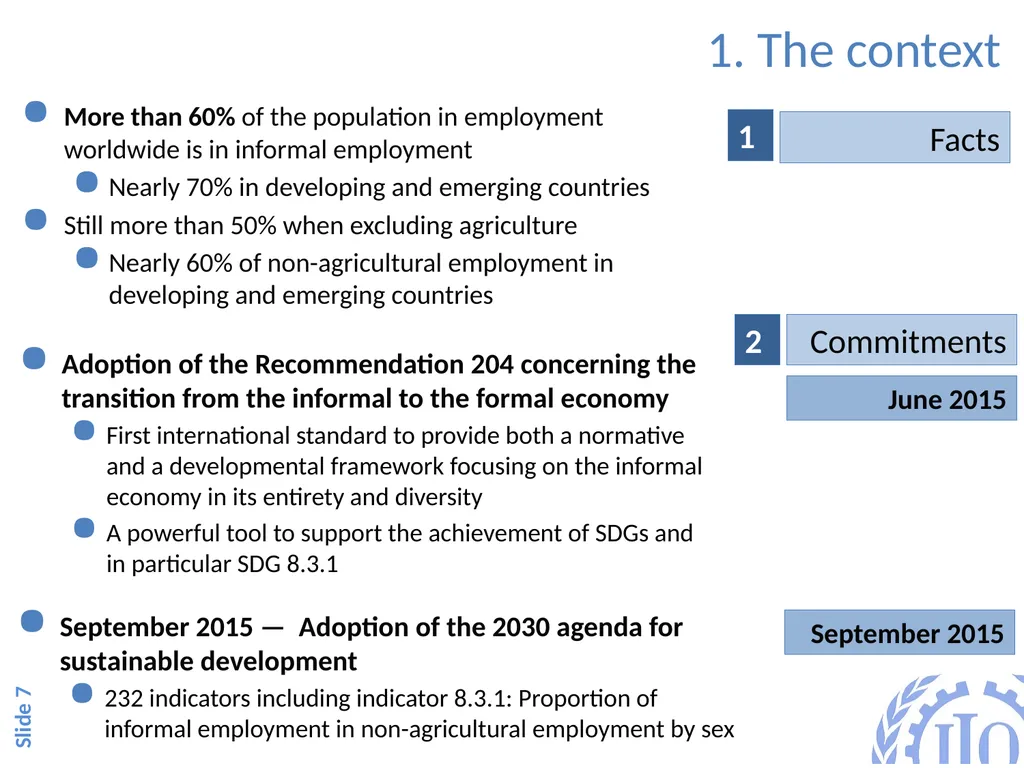
More than 60% of the population in employment worldwide is in informal employment
Nearly 70% in developing and emerging countries
Still more than 50% when excluding agriculture
Nearly 60% of non-agricultural employment in developing and emerging countries 1. The context Adoption of the Recommendation 204 concerning the transition from the informal to the formal economy
First international standard to provide both a normative and a developmental framework focusing on the informal economy in its entirety and diversity
A powerful tool to support the achievement of SDGs and in particular SDG 8.3.1 September 2015 — Adoption of the 2030 agenda for sustainable development
232 indicators including indicator 8.3.1: Proportion of informal employment in non-agricultural employment by sex September 2015<br>
Nearly 70% in developing and emerging countries
Still more than 50% when excluding agriculture
Nearly 60% of non-agricultural employment in developing and emerging countries 1. The context Adoption of the Recommendation 204 concerning the transition from the informal to the formal economy
First international standard to provide both a normative and a developmental framework focusing on the informal economy in its entirety and diversity
A powerful tool to support the achievement of SDGs and in particular SDG 8.3.1 September 2015 — Adoption of the 2030 agenda for sustainable development
232 indicators including indicator 8.3.1: Proportion of informal employment in non-agricultural employment by sex September 2015<br>
08
8 2. The R204:
Objectives and how data & statistics can support it?<br>
09
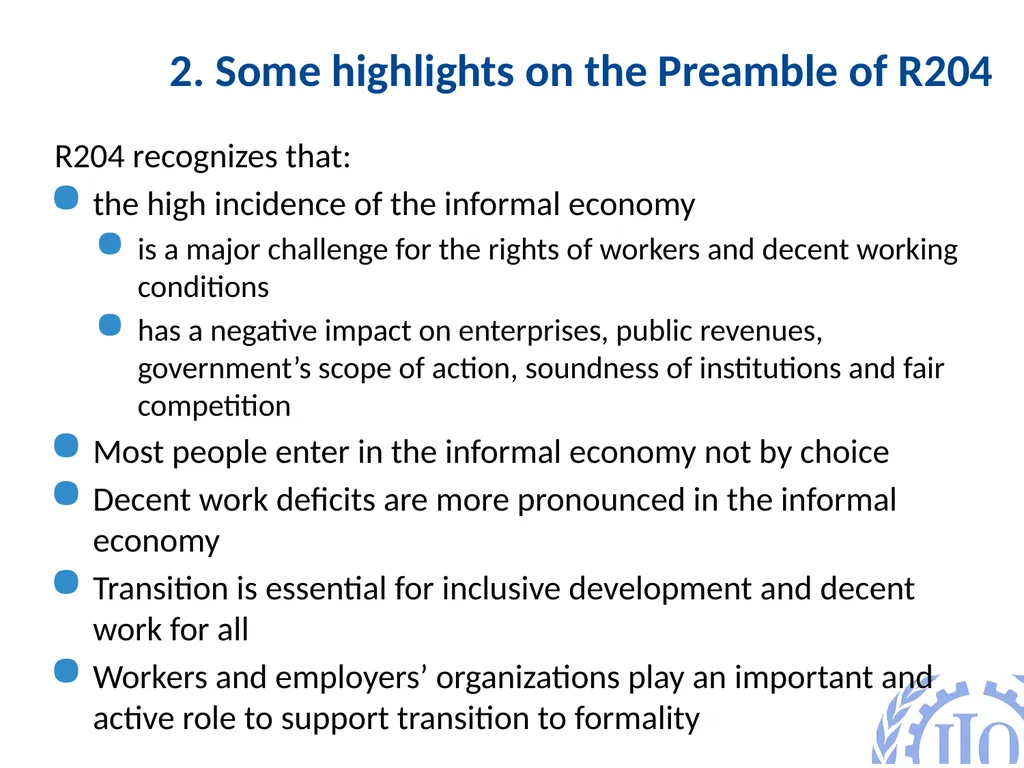
2. Some highlights on the Preamble of R204 R204 recognizes that:
the high incidence of the informal economy
is a major challenge for the rights of workers and decent working conditions
has a negative impact on enterprises, public revenues, government’s scope of action, soundness of institutions and fair competition
Most people enter in the informal economy not by choice
Decent work deficits are more pronounced in the informal economy
Transition is essential for inclusive development and decent work for all
Workers and employers’ organizations play an important and active role to support transition to formality<br>
the high incidence of the informal economy
is a major challenge for the rights of workers and decent working conditions
has a negative impact on enterprises, public revenues, government’s scope of action, soundness of institutions and fair competition
Most people enter in the informal economy not by choice
Decent work deficits are more pronounced in the informal economy
Transition is essential for inclusive development and decent work for all
Workers and employers’ organizations play an important and active role to support transition to formality<br>
10
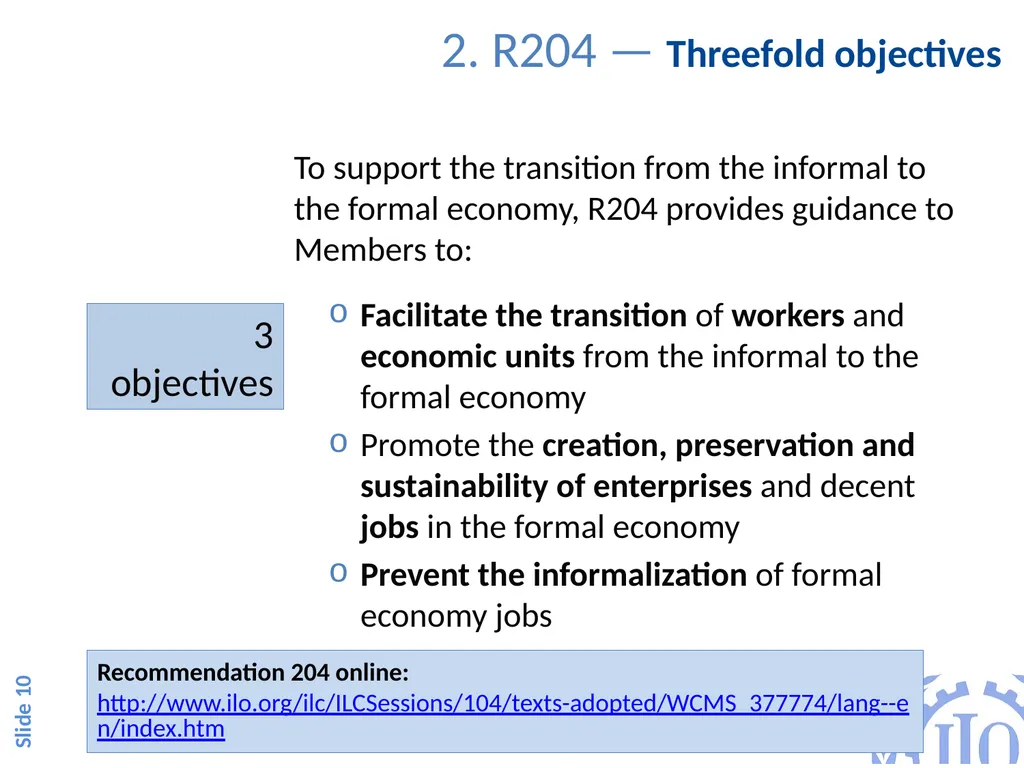
Facilitate the transition of workers and economic units from the informal to the formal economy
Promote the creation, preservation and sustainability of enterprises and decent jobs in the formal economy
Prevent the informalization of formal economy jobs 2. R204 — Threefold objectives 3 objectives To support the transition from the informal to the formal economy, R204 provides guidance to Members to: Recommendation 204 online: http://www.ilo.org/ilc/ILCSessions/104/texts-adopted/WCMS_377774/lang--en/index.htm<br>
Promote the creation, preservation and sustainability of enterprises and decent jobs in the formal economy
Prevent the informalization of formal economy jobs 2. R204 — Threefold objectives 3 objectives To support the transition from the informal to the formal economy, R204 provides guidance to Members to: Recommendation 204 online: http://www.ilo.org/ilc/ILCSessions/104/texts-adopted/WCMS_377774/lang--en/index.htm<br>
11
2. … and some multiple forms of formalization processes Formalization processes can take different forms: Formalization of economic units:
Existing economic units moving towards full formality or becoming fully formal:
Extending the scope of laws
Registration of economic units
increased compliance under commercial acts, with tax, labour and social security authorities + Prevention of informalization of formal employment + enabling factors (including reduction of decent work deficits in the IE)
No formalization per se but conditions created to enable formalization
e.g. extension of non-contributory social security; skills development; access to credit and to enterprise services; access to matkets, access to technology; etc…)<br>
Existing economic units moving towards full formality or becoming fully formal:
Extending the scope of laws
Registration of economic units
increased compliance under commercial acts, with tax, labour and social security authorities + Prevention of informalization of formal employment + enabling factors (including reduction of decent work deficits in the IE)
No formalization per se but conditions created to enable formalization
e.g. extension of non-contributory social security; skills development; access to credit and to enterprise services; access to matkets, access to technology; etc…)<br>
12
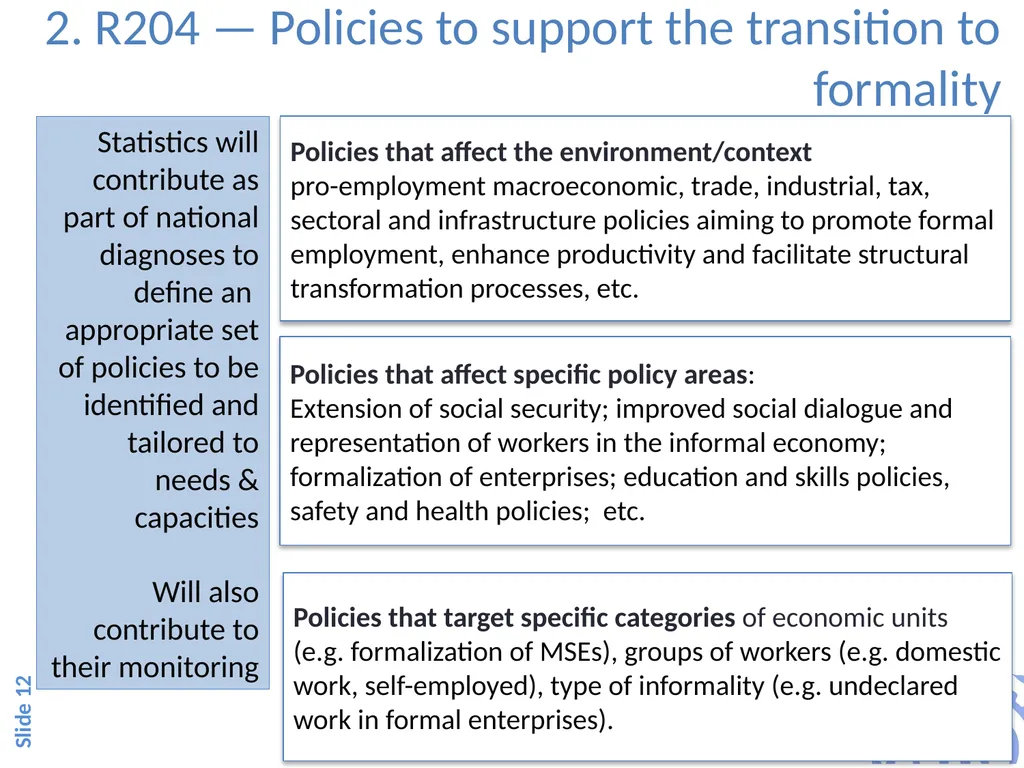
2. R204 — Policies to support the transition to formality Statistics will contribute as part of national diagnoses to define an appropriate set of policies to be identified and tailored to needs & capacities
Will also contribute to their monitoring Policies that affect the environment/context
pro-employment macroeconomic, trade, industrial, tax, sectoral and infrastructure policies aiming to promote formal employment, enhance productivity and facilitate structural transformation processes, etc. Policies that affect specific policy areas: Extension of social security; improved social dialogue and representation of workers in the informal economy; formalization of enterprises; education and skills policies, safety and health policies; etc. Policies that target specific categories of economic units (e.g. formalization of MSEs), groups of workers (e.g. domestic work, self-employed), type of informality (e.g. undeclared work in formal enterprises).<br>
Will also contribute to their monitoring Policies that affect the environment/context
pro-employment macroeconomic, trade, industrial, tax, sectoral and infrastructure policies aiming to promote formal employment, enhance productivity and facilitate structural transformation processes, etc. Policies that affect specific policy areas: Extension of social security; improved social dialogue and representation of workers in the informal economy; formalization of enterprises; education and skills policies, safety and health policies; etc. Policies that target specific categories of economic units (e.g. formalization of MSEs), groups of workers (e.g. domestic work, self-employed), type of informality (e.g. undeclared work in formal enterprises).<br>
13
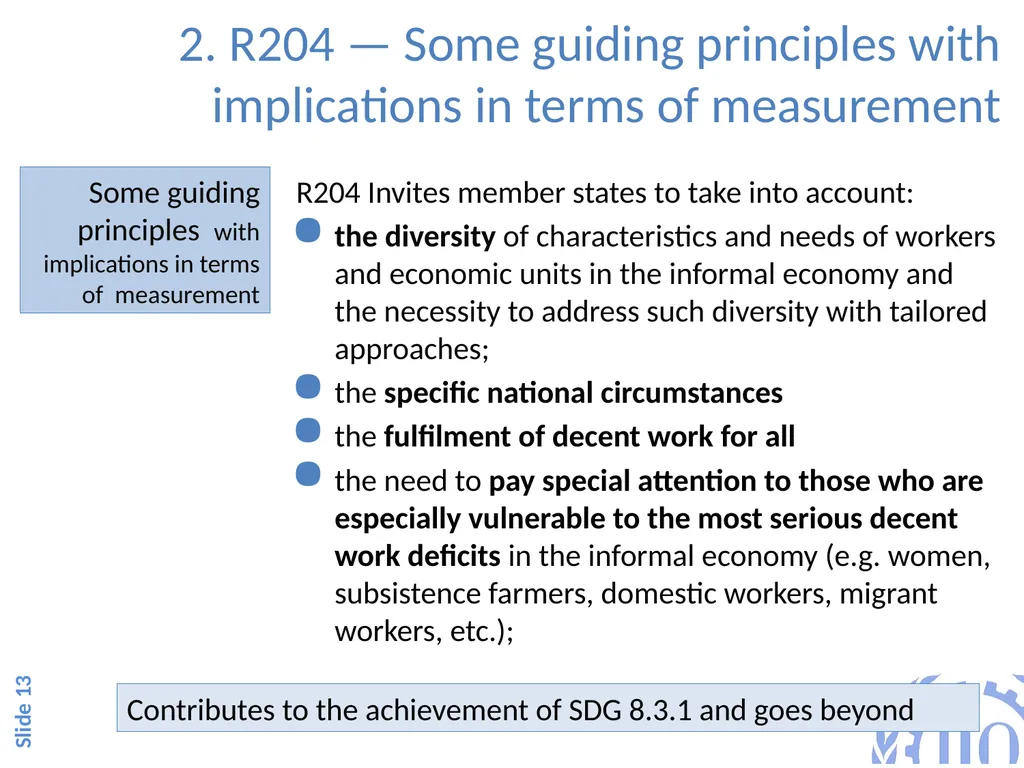
2. R204 — Some guiding principles with implications in terms of measurement Some guiding principles with implications in terms of measurement R204 Invites member states to take into account:
the diversity of characteristics and needs of workers and economic units in the informal economy and the necessity to address such diversity with tailored approaches;
the specific national circumstances
the fulfilment of decent work for all
the need to pay special attention to those who are especially vulnerable to the most serious decent work deficits in the informal economy (e.g. women, subsistence farmers, domestic workers, migrant workers, etc.); Contributes to the achievement of SDG 8.3.1 and goes beyond<br>
the diversity of characteristics and needs of workers and economic units in the informal economy and the necessity to address such diversity with tailored approaches;
the specific national circumstances
the fulfilment of decent work for all
the need to pay special attention to those who are especially vulnerable to the most serious decent work deficits in the informal economy (e.g. women, subsistence farmers, domestic workers, migrant workers, etc.); Contributes to the achievement of SDG 8.3.1 and goes beyond<br>
14
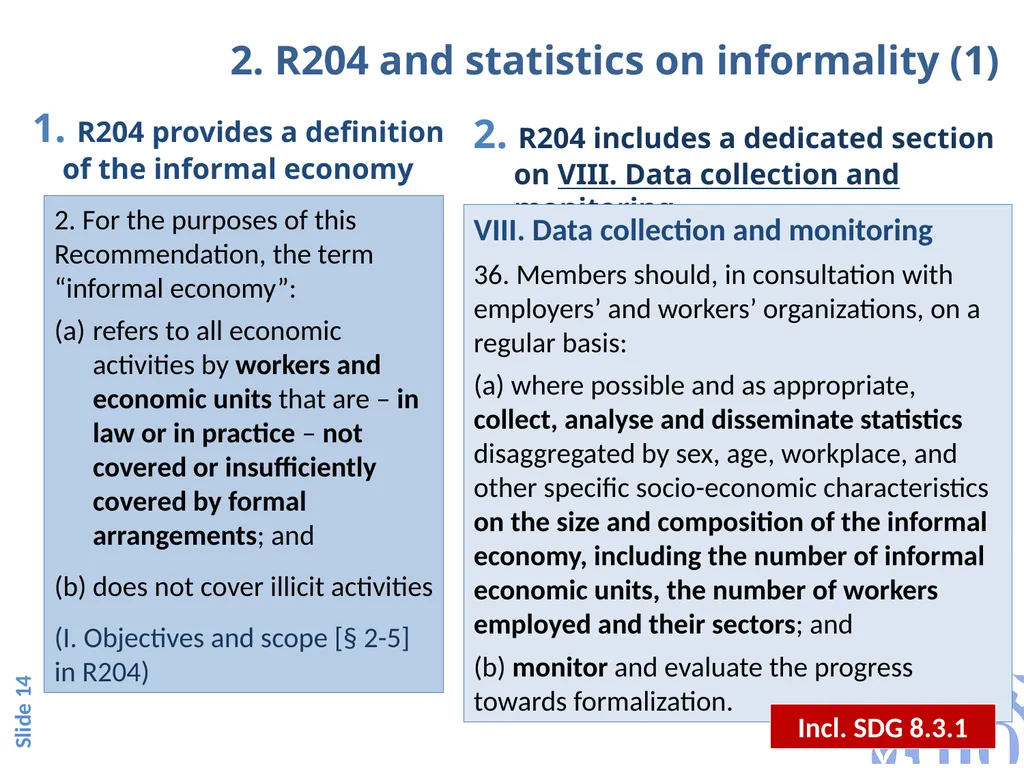
1. R204 provides a definition of the informal economy 2. R204 and statistics on informality (1) 2. For the purposes of this Recommendation, the term “informal economy”:
refers to all economic activities by workers and economic units that are – in law or in practice – not covered or insufficiently covered by formal arrangements; and
does not cover illicit activities
(I. Objectives and scope [§ 2-5] in R204) Incl. SDG 8.3.1<br>
refers to all economic activities by workers and economic units that are – in law or in practice – not covered or insufficiently covered by formal arrangements; and
does not cover illicit activities
(I. Objectives and scope [§ 2-5] in R204) Incl. SDG 8.3.1<br>
15
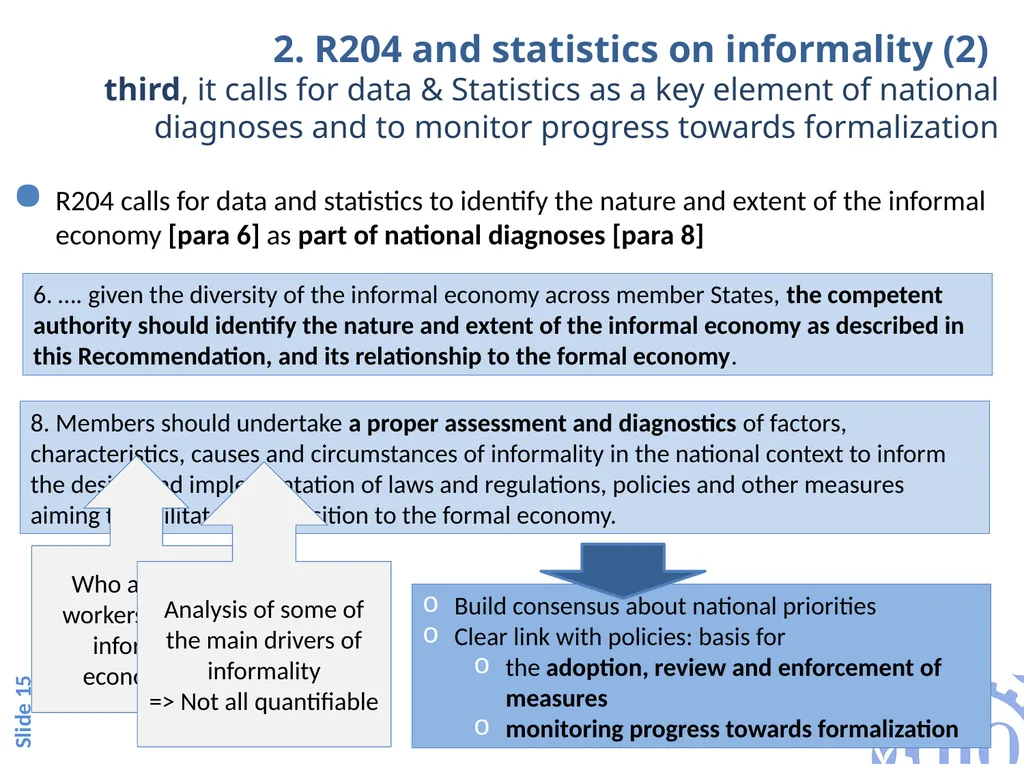
2. R204 and statistics on informality (2)
third, it calls for data & Statistics as a key element of national diagnoses and to monitor progress towards formalization 6. …. given the diversity of the informal economy across member States, the competent authority should identify the nature and extent of the informal economy as described in this Recommendation, and its relationship to the formal economy. R204 calls for data and statistics to identify the nature and extent of the informal economy [para 6] as part of national diagnoses [para 8] 15 8. Members should undertake a proper assessment and diagnostics of factors, characteristics, causes and circumstances of informality in the national context to inform the design and implementation of laws and regulations, policies and other measures aiming to facilitate the transition to the formal economy. Who are the workers in the informal economy? Analysis of some of the main drivers of informality
=> Not all quantifiable<br>
=> Not all quantifiable<br>
16
16 3. Decent Work in the 2030 Development Agenda &
SDGs Indicator 8.3.1.<br>
SDGs Indicator 8.3.1.<br>
17
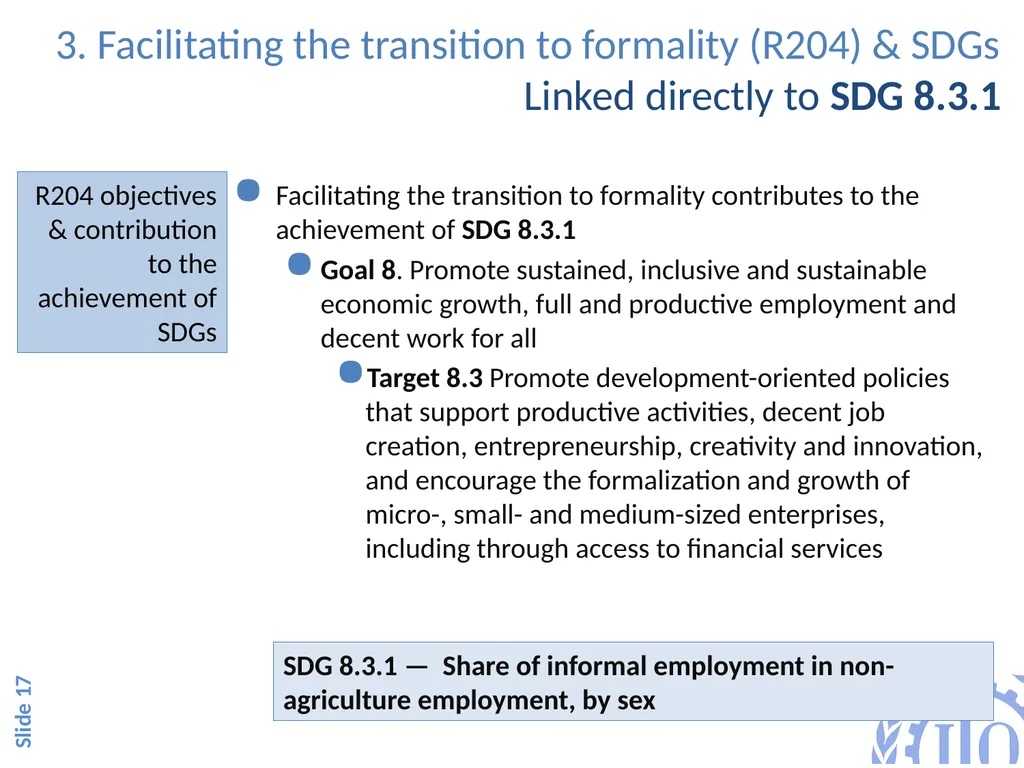
3. Facilitating the transition to formality (R204) & SDGs
Linked directly to SDG 8.3.1 R204 objectives & contribution to the achievement of SDGs Facilitating the transition to formality contributes to the achievement of SDG 8.3.1
Goal 8. Promote sustained, inclusive and sustainable economic growth, full and productive employment and decent work for all
Target 8.3 Promote development-oriented policies that support productive activities, decent job creation, entrepreneurship, creativity and innovation, and encourage the formalization and growth of micro-, small- and medium-sized enterprises, including through access to financial services SDG 8.3.1 — Share of informal employment in non-agriculture employment, by sex<br>
Goal 8. Promote sustained, inclusive and sustainable economic growth, full and productive employment and decent work for all
Target 8.3 Promote development-oriented policies that support productive activities, decent job creation, entrepreneurship, creativity and innovation, and encourage the formalization and growth of micro-, small- and medium-sized enterprises, including through access to financial services SDG 8.3.1 — Share of informal employment in non-agriculture employment, by sex<br>
18
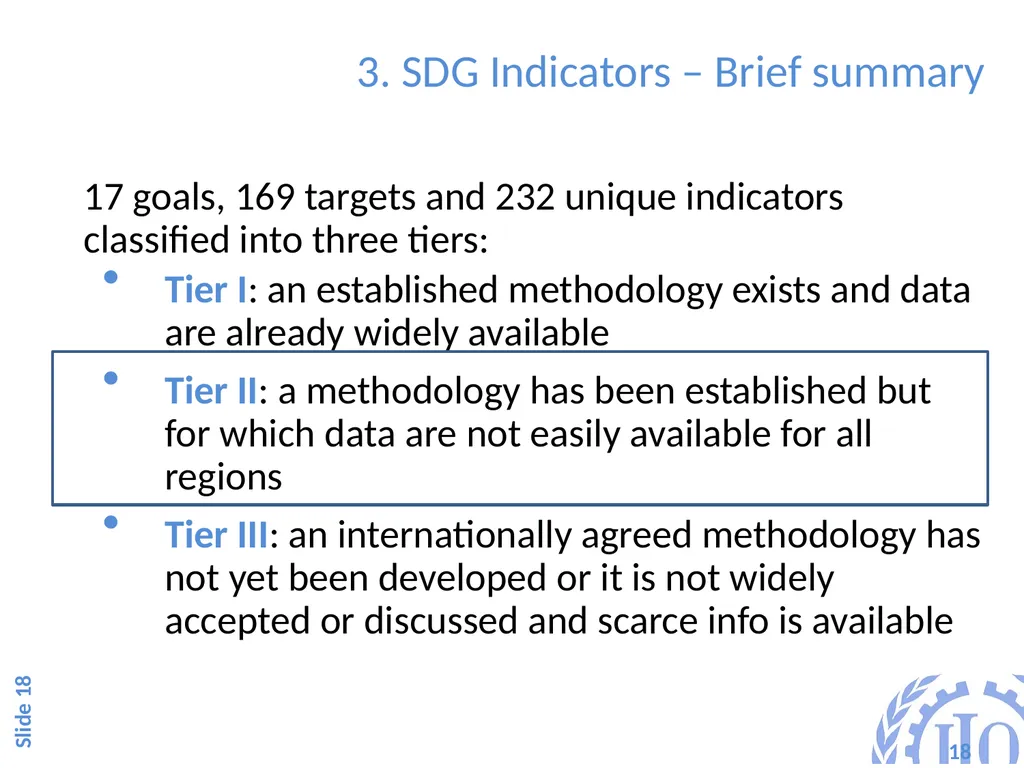
3. SDG Indicators – Brief summary 17 goals, 169 targets and 232 unique indicators classified into three tiers:
Tier I: an established methodology exists and data are already widely available
Tier II: a methodology has been established but for which data are not easily available for all regions
Tier III: an internationally agreed methodology has not yet been developed or it is not widely accepted or discussed and scarce info is available 18<br>
Tier I: an established methodology exists and data are already widely available
Tier II: a methodology has been established but for which data are not easily available for all regions
Tier III: an internationally agreed methodology has not yet been developed or it is not widely accepted or discussed and scarce info is available 18<br>
19
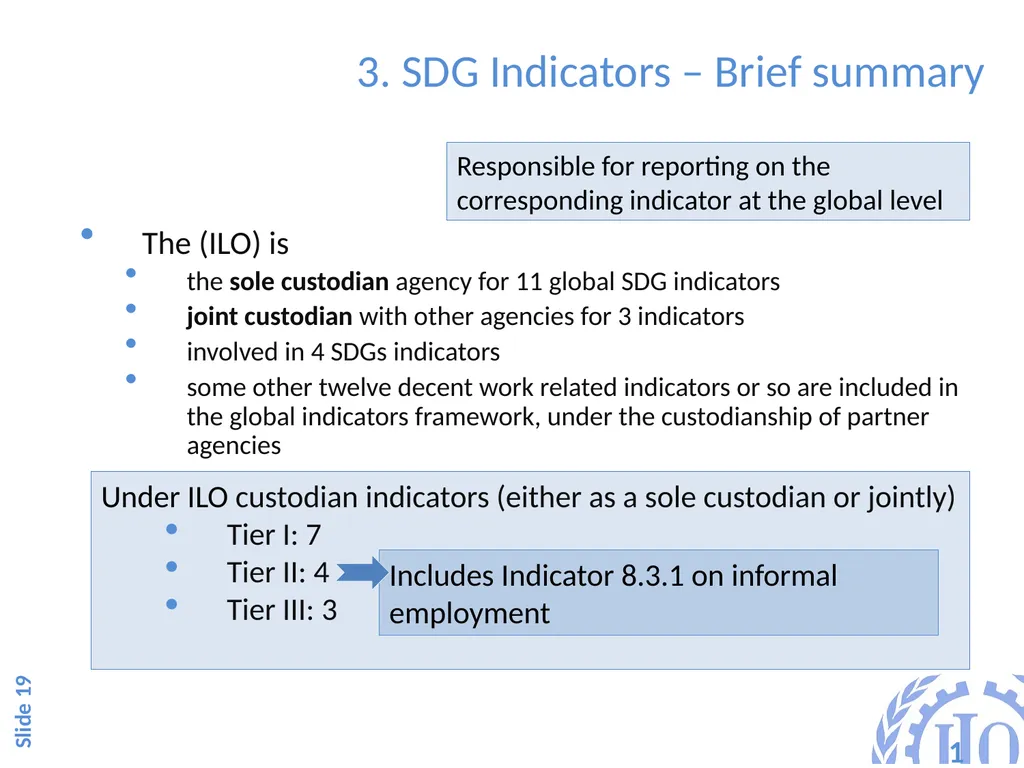
3. SDG Indicators – Brief summary The (ILO) is
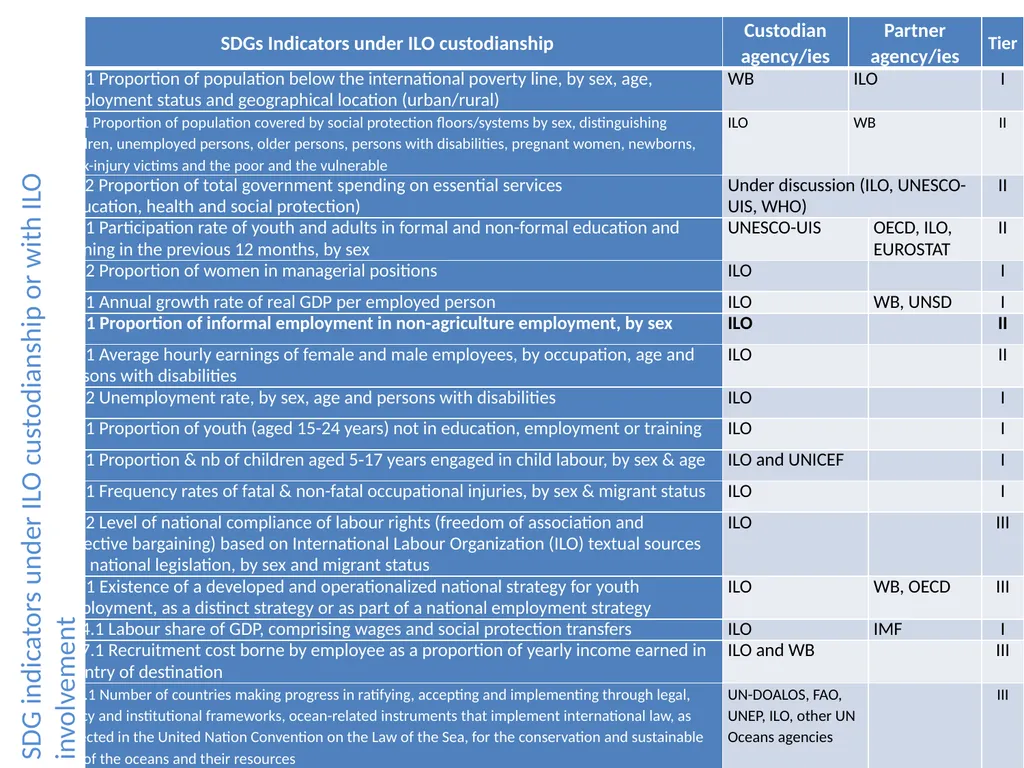
the sole custodian agency for 11 global SDG indicators
joint custodian with other agencies for 3 indicators
involved in 4 SDGs indicators
some other twelve decent work related indicators or so are included in the global indicators framework, under the custodianship of partner agencies 19 Responsible for reporting on the corresponding indicator at the global level Under ILO custodian indicators (either as a sole custodian or jointly)
Tier I: 7
Tier II: 4
Tier III: 3<br>
the sole custodian agency for 11 global SDG indicators
joint custodian with other agencies for 3 indicators
involved in 4 SDGs indicators
some other twelve decent work related indicators or so are included in the global indicators framework, under the custodianship of partner agencies 19 Responsible for reporting on the corresponding indicator at the global level Under ILO custodian indicators (either as a sole custodian or jointly)
Tier I: 7
Tier II: 4
Tier III: 3<br>
20
3. ILO as custodian agency
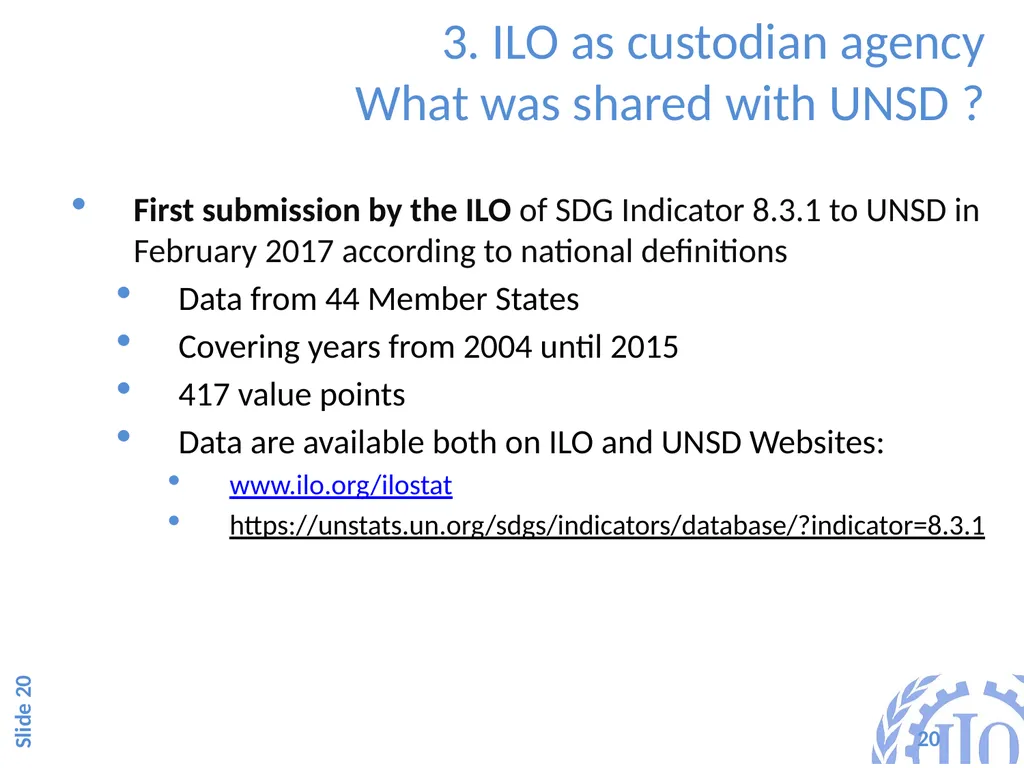
What was shared with UNSD ? 20 First submission by the ILO of SDG Indicator 8.3.1 to UNSD in February 2017 according to national definitions
Data from 44 Member States
Covering years from 2004 until 2015
417 value points
Data are available both on ILO and UNSD Websites:
www.ilo.org/ilostat
https://unstats.un.org/sdgs/indicators/database/?indicator=8.3.1<br>
Data from 44 Member States
Covering years from 2004 until 2015
417 value points
Data are available both on ILO and UNSD Websites:
www.ilo.org/ilostat
https://unstats.un.org/sdgs/indicators/database/?indicator=8.3.1<br>
21
Availability of data
Comparability of available indicators 3. R204 & SDGs — Summary of Challenges 1<br>
Comparability of available indicators 3. R204 & SDGs — Summary of Challenges 1<br>
22
22 4. Measurement objectives, main questions & preferred sources<br>
23
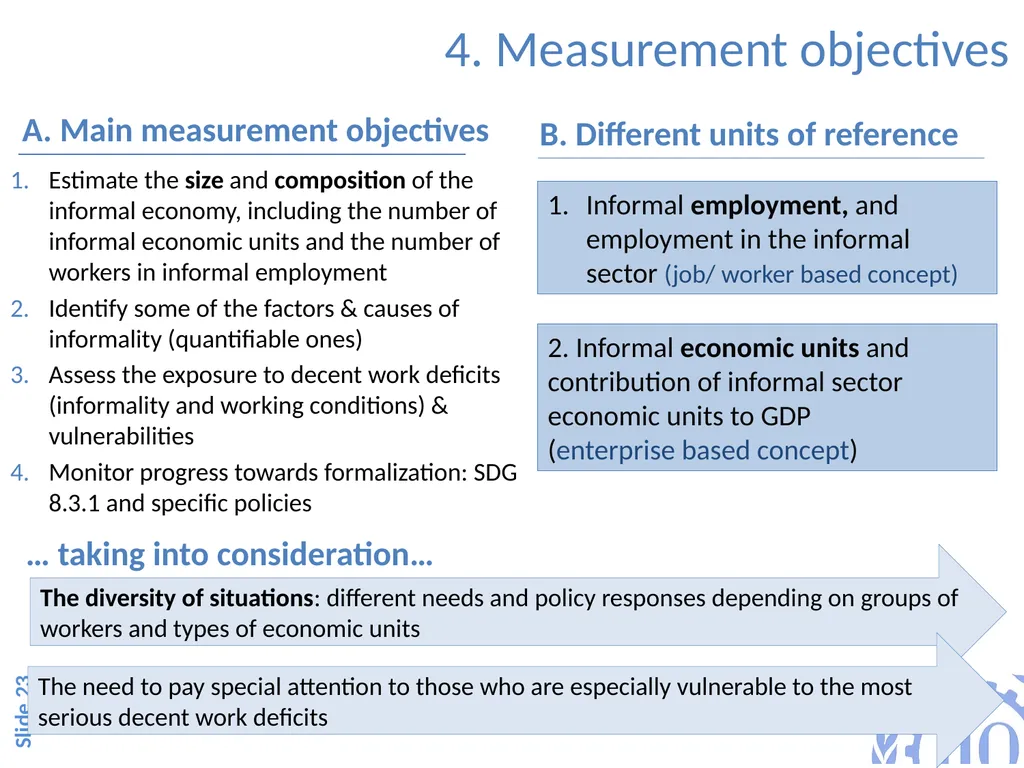
Estimate the size and composition of the informal economy, including the number of informal economic units and the number of workers in informal employment
Identify some of the factors & causes of informality (quantifiable ones)
Assess the exposure to decent work deficits (informality and working conditions) & vulnerabilities
Monitor progress towards formalization: SDG 8.3.1 and specific policies 4. Measurement objectives Informal employment, and employment in the informal sector (job/ worker based concept) 2. Informal economic units and contribution of informal sector economic units to GDP
(enterprise based concept) A. Main measurement objectives B. Different units of reference<br>
Identify some of the factors & causes of informality (quantifiable ones)
Assess the exposure to decent work deficits (informality and working conditions) & vulnerabilities
Monitor progress towards formalization: SDG 8.3.1 and specific policies 4. Measurement objectives Informal employment, and employment in the informal sector (job/ worker based concept) 2. Informal economic units and contribution of informal sector economic units to GDP
(enterprise based concept) A. Main measurement objectives B. Different units of reference<br>
24
4. Measurement objective 1
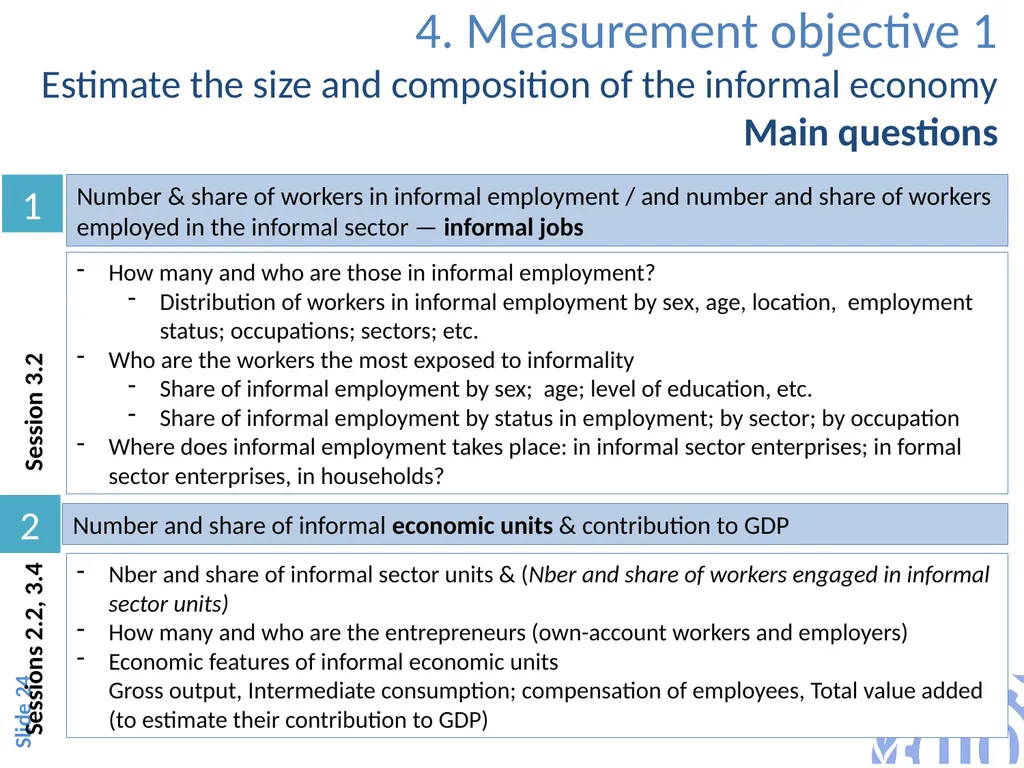
Estimate the size and composition of the informal economy
Main questions Number & share of workers in informal employment / and number and share of workers employed in the informal sector — informal jobs Number and share of informal economic units & contribution to GDP How many and who are those in informal employment?
Distribution of workers in informal employment by sex, age, location, employment status; occupations; sectors; etc.
Who are the workers the most exposed to informality
Share of informal employment by sex; age; level of education, etc.
Share of informal employment by status in employment; by sector; by occupation
Where does informal employment takes place: in informal sector enterprises; in formal sector enterprises, in households? Nber and share of informal sector units & (Nber and share of workers engaged in informal sector units)
How many and who are the entrepreneurs (own-account workers and employers)
Economic features of informal economic units Gross output, Intermediate consumption; compensation of employees, Total value added (to estimate their contribution to GDP) 1 2 Session 3.2 Sessions 2.2, 3.4<br>
Distribution of workers in informal employment by sex, age, location, employment status; occupations; sectors; etc.
Who are the workers the most exposed to informality
Share of informal employment by sex; age; level of education, etc.
Share of informal employment by status in employment; by sector; by occupation
Where does informal employment takes place: in informal sector enterprises; in formal sector enterprises, in households? Nber and share of informal sector units & (Nber and share of workers engaged in informal sector units)
How many and who are the entrepreneurs (own-account workers and employers)
Economic features of informal economic units Gross output, Intermediate consumption; compensation of employees, Total value added (to estimate their contribution to GDP) 1 2 Session 3.2 Sessions 2.2, 3.4<br>
25
4. Measurement objective 1
Estimate the size and composition of the informal economy
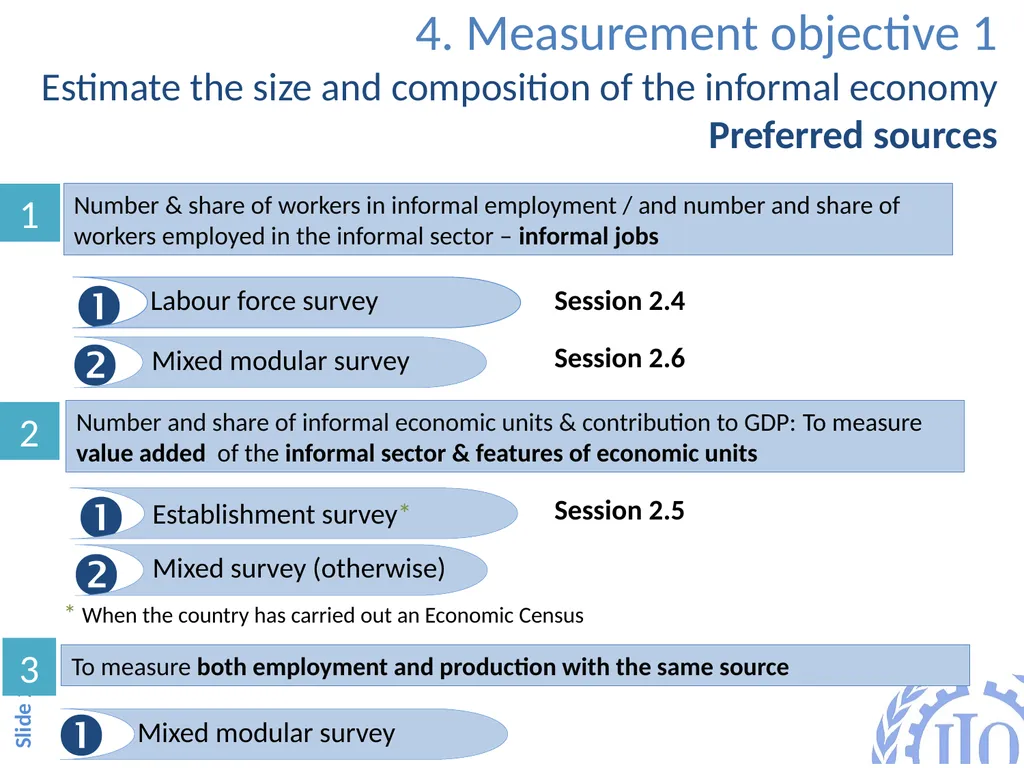
Preferred sources Number & share of workers in informal employment / and number and share of workers employed in the informal sector – informal jobs Number and share of informal economic units & contribution to GDP: To measure value added of the informal sector & features of economic units 1 2 To measure both employment and production with the same source 3<br>
26
4. Measurement objective 2
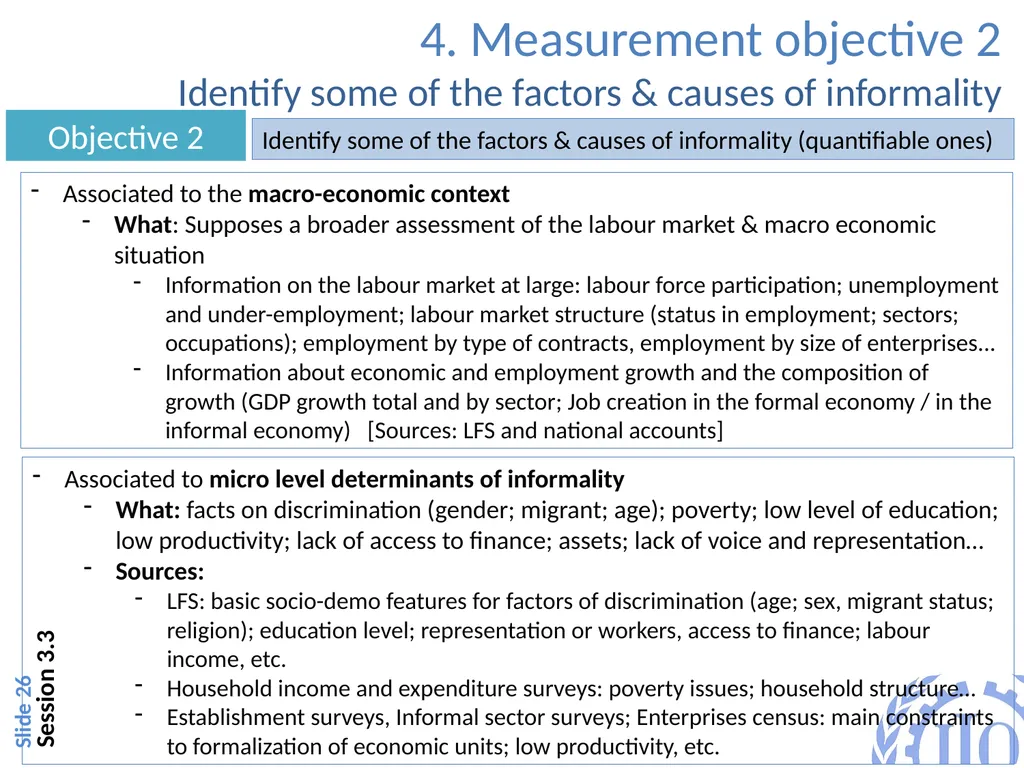
Identify some of the factors & causes of informality Identify some of the factors & causes of informality (quantifiable ones) Associated to the macro-economic context
What: Supposes a broader assessment of the labour market & macro economic situation
Information on the labour market at large: labour force participation; unemployment and under-employment; labour market structure (status in employment; sectors; occupations); employment by type of contracts, employment by size of enterprises...
Information about economic and employment growth and the composition of growth (GDP growth total and by sector; Job creation in the formal economy / in the informal economy) [Sources: LFS and national accounts] Objective 2 Associated to micro level determinants of informality
What: facts on discrimination (gender; migrant; age); poverty; low level of education; low productivity; lack of access to finance; assets; lack of voice and representation…
Sources:
LFS: basic socio-demo features for factors of discrimination (age; sex, migrant status; religion); education level; representation or workers, access to finance; labour income, etc.
Household income and expenditure surveys: poverty issues; household structure…
Establishment surveys, Informal sector surveys; Enterprises census: main constraints to formalization of economic units; low productivity, etc. Session 3.3<br>
What: Supposes a broader assessment of the labour market & macro economic situation
Information on the labour market at large: labour force participation; unemployment and under-employment; labour market structure (status in employment; sectors; occupations); employment by type of contracts, employment by size of enterprises...
Information about economic and employment growth and the composition of growth (GDP growth total and by sector; Job creation in the formal economy / in the informal economy) [Sources: LFS and national accounts] Objective 2 Associated to micro level determinants of informality
What: facts on discrimination (gender; migrant; age); poverty; low level of education; low productivity; lack of access to finance; assets; lack of voice and representation…
Sources:
LFS: basic socio-demo features for factors of discrimination (age; sex, migrant status; religion); education level; representation or workers, access to finance; labour income, etc.
Household income and expenditure surveys: poverty issues; household structure…
Establishment surveys, Informal sector surveys; Enterprises census: main constraints to formalization of economic units; low productivity, etc. Session 3.3<br>
27
4. Measurement objective 3
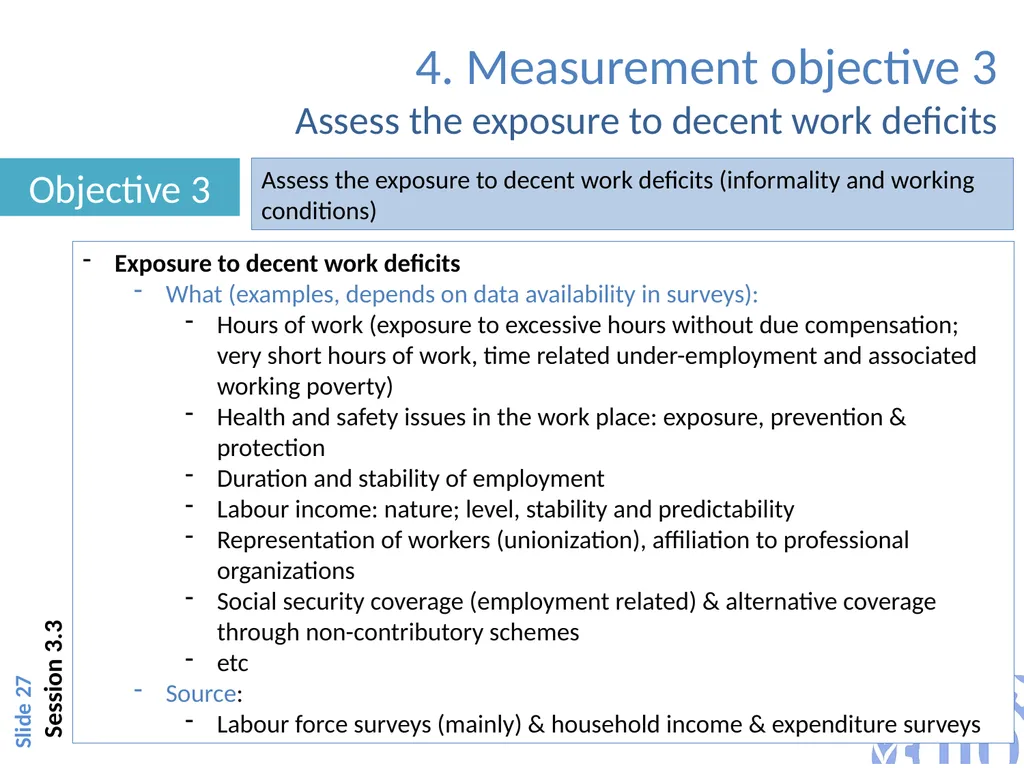
Assess the exposure to decent work deficits Assess the exposure to decent work deficits (informality and working conditions) Exposure to decent work deficits
What (examples, depends on data availability in surveys):
Hours of work (exposure to excessive hours without due compensation; very short hours of work, time related under-employment and associated working poverty)
Health and safety issues in the work place: exposure, prevention & protection
Duration and stability of employment
Labour income: nature; level, stability and predictability
Representation of workers (unionization), affiliation to professional organizations
Social security coverage (employment related) & alternative coverage through non-contributory schemes
etc
Source:
Labour force surveys (mainly) & household income & expenditure surveys Objective 3 Session 3.3<br>
What (examples, depends on data availability in surveys):
Hours of work (exposure to excessive hours without due compensation; very short hours of work, time related under-employment and associated working poverty)
Health and safety issues in the work place: exposure, prevention & protection
Duration and stability of employment
Labour income: nature; level, stability and predictability
Representation of workers (unionization), affiliation to professional organizations
Social security coverage (employment related) & alternative coverage through non-contributory schemes
etc
Source:
Labour force surveys (mainly) & household income & expenditure surveys Objective 3 Session 3.3<br>
28
4. Measurement objectives 4
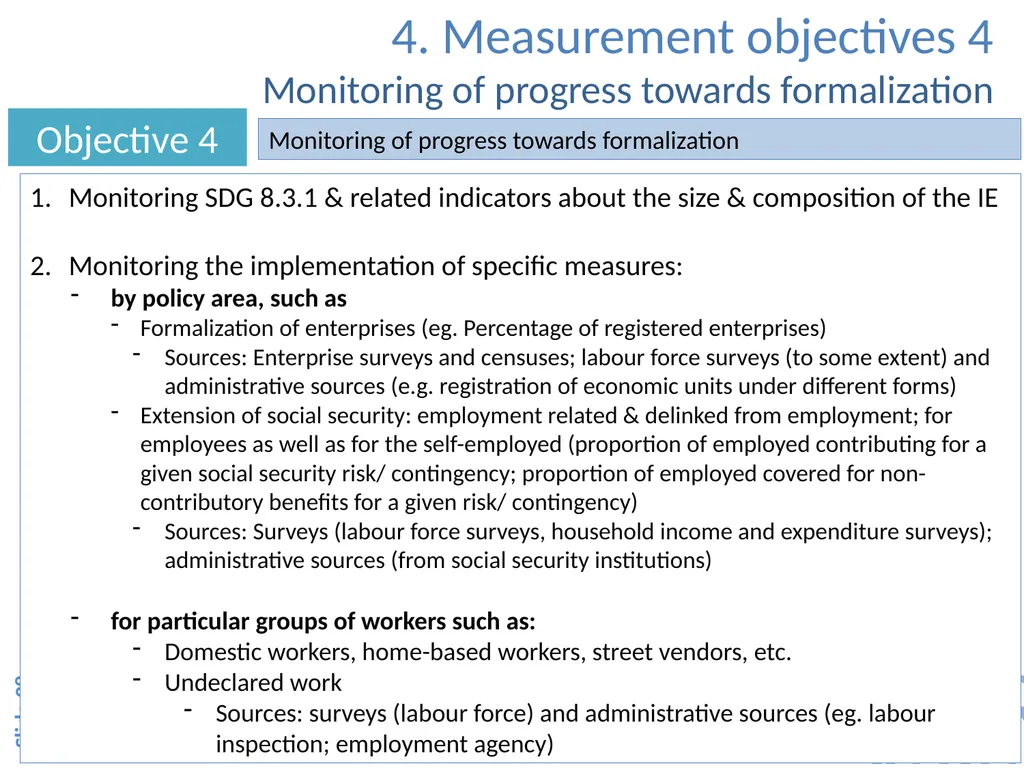
Monitoring of progress towards formalization Monitoring of progress towards formalization Objective 4 Monitoring SDG 8.3.1 & related indicators about the size & composition of the IE
Monitoring the implementation of specific measures:
by policy area, such as
Formalization of enterprises (eg. Percentage of registered enterprises)
Sources: Enterprise surveys and censuses; labour force surveys (to some extent) and administrative sources (e.g. registration of economic units under different forms)
Extension of social security: employment related & delinked from employment; for employees as well as for the self-employed (proportion of employed contributing for a given social security risk/ contingency; proportion of employed covered for non-contributory benefits for a given risk/ contingency)
Sources: Surveys (labour force surveys, household income and expenditure surveys); administrative sources (from social security institutions)
for particular groups of workers such as:
Domestic workers, home-based workers, street vendors, etc.
Undeclared work
Sources: surveys (labour force) and administrative sources (eg. labour inspection; employment agency)<br>
Monitoring the implementation of specific measures:
by policy area, such as
Formalization of enterprises (eg. Percentage of registered enterprises)
Sources: Enterprise surveys and censuses; labour force surveys (to some extent) and administrative sources (e.g. registration of economic units under different forms)
Extension of social security: employment related & delinked from employment; for employees as well as for the self-employed (proportion of employed contributing for a given social security risk/ contingency; proportion of employed covered for non-contributory benefits for a given risk/ contingency)
Sources: Surveys (labour force surveys, household income and expenditure surveys); administrative sources (from social security institutions)
for particular groups of workers such as:
Domestic workers, home-based workers, street vendors, etc.
Undeclared work
Sources: surveys (labour force) and administrative sources (eg. labour inspection; employment agency)<br>
29
Thank you<br>
30
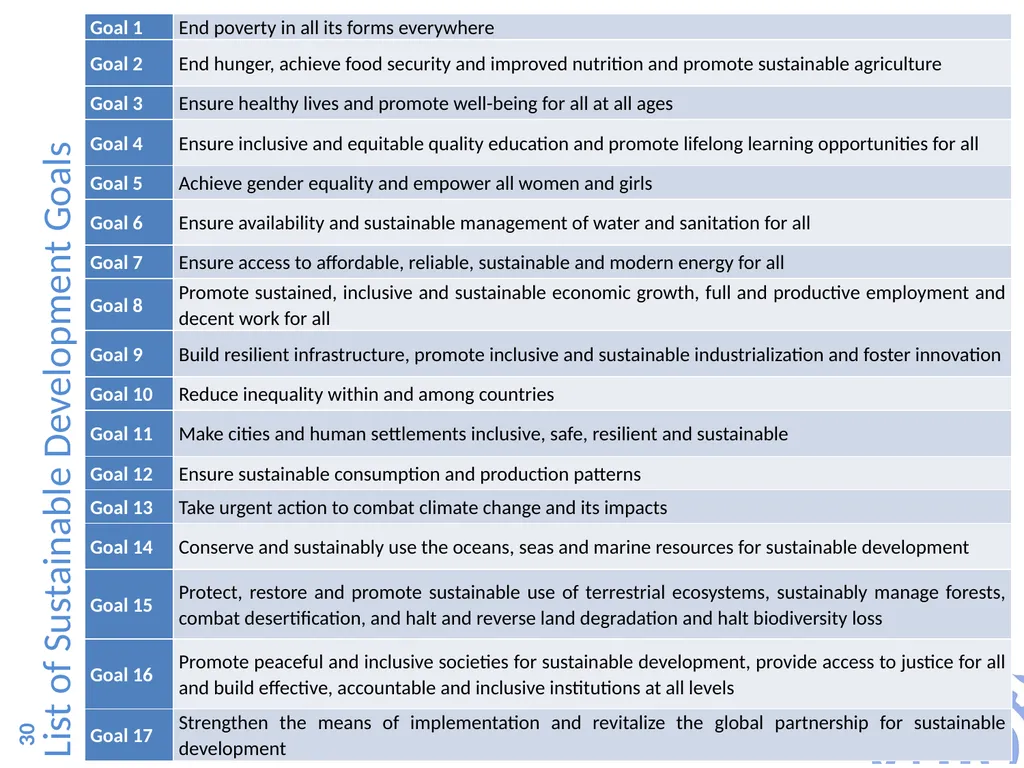
30 List of Sustainable Development Goals<br>
31
31 SDG indicators under ILO custodianship or with ILO involvement<br>
32
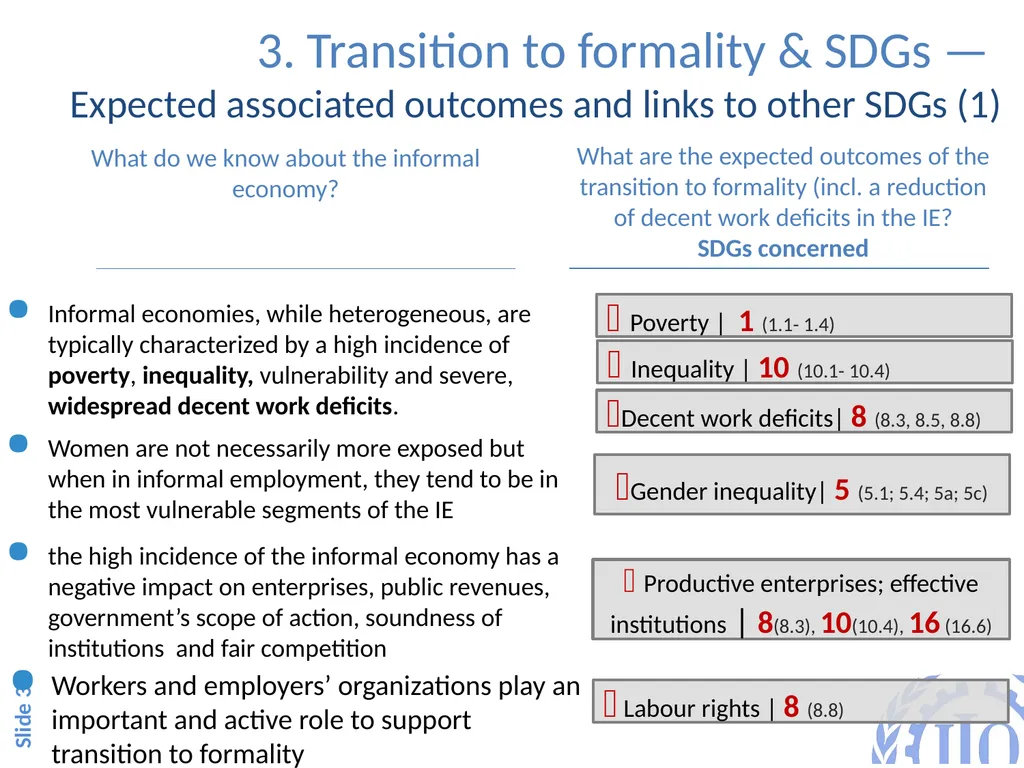
3. Transition to formality & SDGs —
Expected associated outcomes and links to other SDGs (1) Informal economies, while heterogeneous, are typically characterized by a high incidence of poverty, inequality, vulnerability and severe, widespread decent work deficits. Poverty | 1 (1.1- 1.4) Gender inequality| 5 (5.1; 5.4; 5a; 5c) Inequality | 10 (10.1- 10.4) Decent work deficits| 8 (8.3, 8.5, 8.8) What do we know about the informal economy? What are the expected outcomes of the transition to formality (incl. a reduction of decent work deficits in the IE?
SDGs concerned Women are not necessarily more exposed but when in informal employment, they tend to be in the most vulnerable segments of the IE the high incidence of the informal economy has a negative impact on enterprises, public revenues, government’s scope of action, soundness of institutions and fair competition Workers and employers’ organizations play an important and active role to support transition to formality Productive enterprises; effective institutions | 8(8.3), 10(10.4), 16 (16.6) Labour rights | 8 (8.8)<br>
SDGs concerned Women are not necessarily more exposed but when in informal employment, they tend to be in the most vulnerable segments of the IE the high incidence of the informal economy has a negative impact on enterprises, public revenues, government’s scope of action, soundness of institutions and fair competition Workers and employers’ organizations play an important and active role to support transition to formality Productive enterprises; effective institutions | 8(8.3), 10(10.4), 16 (16.6) Labour rights | 8 (8.8)<br>
33
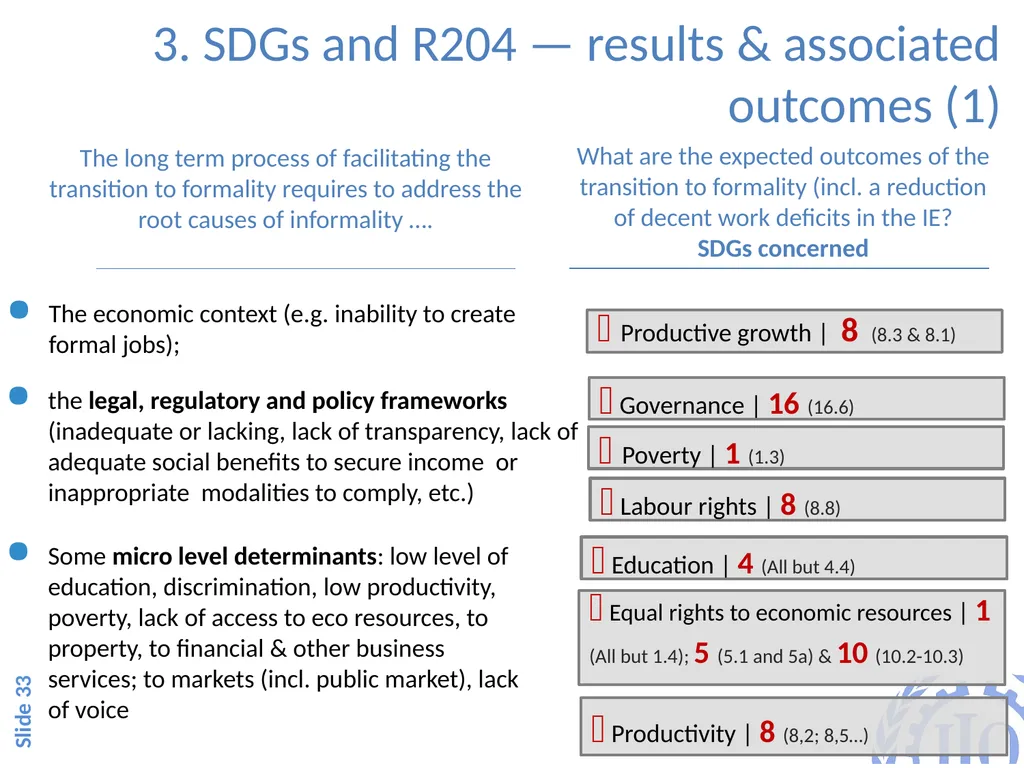
3. SDGs and R204 — results & associated outcomes (1) The economic context (e.g. inability to create formal jobs); Productive growth | 8 (8.3 & 8.1) Governance | 16 (16.6) Poverty | 1 (1.3) The long term process of facilitating the transition to formality requires to address the root causes of informality …. What are the expected outcomes of the transition to formality (incl. a reduction of decent work deficits in the IE?
SDGs concerned the legal, regulatory and policy frameworks (inadequate or lacking, lack of transparency, lack of adequate social benefits to secure income or inappropriate modalities to comply, etc.) Some micro level determinants: low level of education, discrimination, low productivity, poverty, lack of access to eco resources, to property, to financial & other business services; to markets (incl. public market), lack of voice Labour rights | 8 (8.8) Education | 4 (All but 4.4) Equal rights to economic resources | 1 (All but 1.4); 5 (5.1 and 5a) & 10 (10.2-10.3) Productivity | 8 (8,2; 8,5…)<br>
SDGs concerned the legal, regulatory and policy frameworks (inadequate or lacking, lack of transparency, lack of adequate social benefits to secure income or inappropriate modalities to comply, etc.) Some micro level determinants: low level of education, discrimination, low productivity, poverty, lack of access to eco resources, to property, to financial & other business services; to markets (incl. public market), lack of voice Labour rights | 8 (8.8) Education | 4 (All but 4.4) Equal rights to economic resources | 1 (All but 1.4); 5 (5.1 and 5a) & 10 (10.2-10.3) Productivity | 8 (8,2; 8,5…)<br>