
OCR A-level Sociology Socialisation, Culture and
TG
Published · 19 slides · 0 views

1 / 1
Description
OCR A-level Sociology Socialisation, Culture and Identity Component 01 Section A: Top 5 studies by specification point A revision and lesson-planning deck for building confident OCR answers. Each slide gives five reusable research anchors
Related Topics
Share
Embed code
Download this presentation From Below
"OCR A-level Sociology Socialisation, Culture and" is the property of its rightful owner. Permission is granted to download and print the materials on this website for personal, non-commercial use only, and to display it on your personal computer provided you do not modify the materials and that you retain all copyright notices contained in the materials. By downloading content from our website, you accept the terms of this agreement.
Presentation Transcript
01
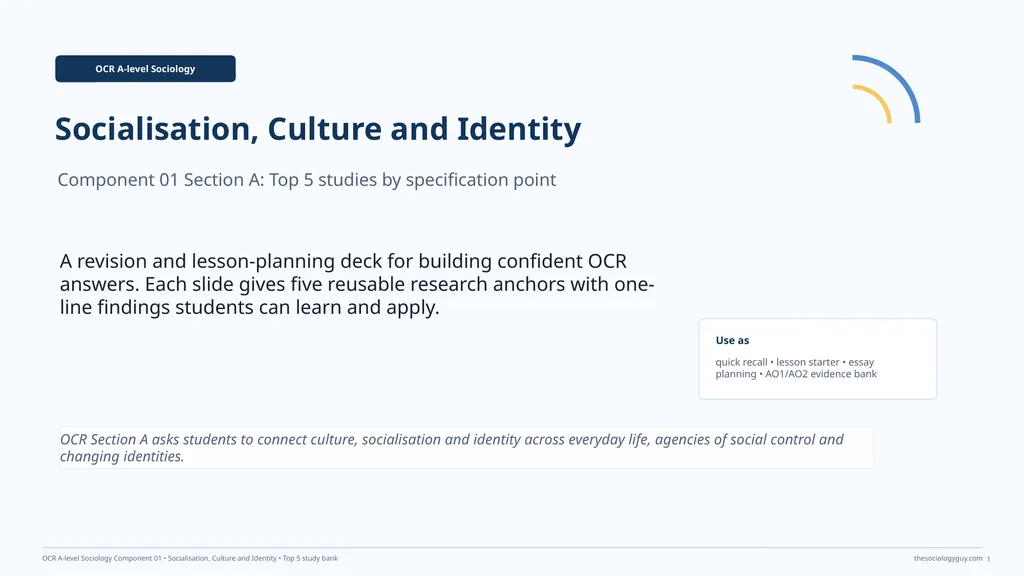
OCR A-level Sociology Socialisation, Culture and Identity Component 01 Section A: Top 5 studies by specification point A revision and lesson-planning deck for building confident OCR answers. Each slide gives five reusable research anchors with one-line findings students can learn and apply. Use as quick recall • lesson starter • essay planning • AO1/AO2 evidence bank OCR Section A asks students to connect culture, socialisation and identity across everyday life, agencies of social control and changing identities. 1<br>
02
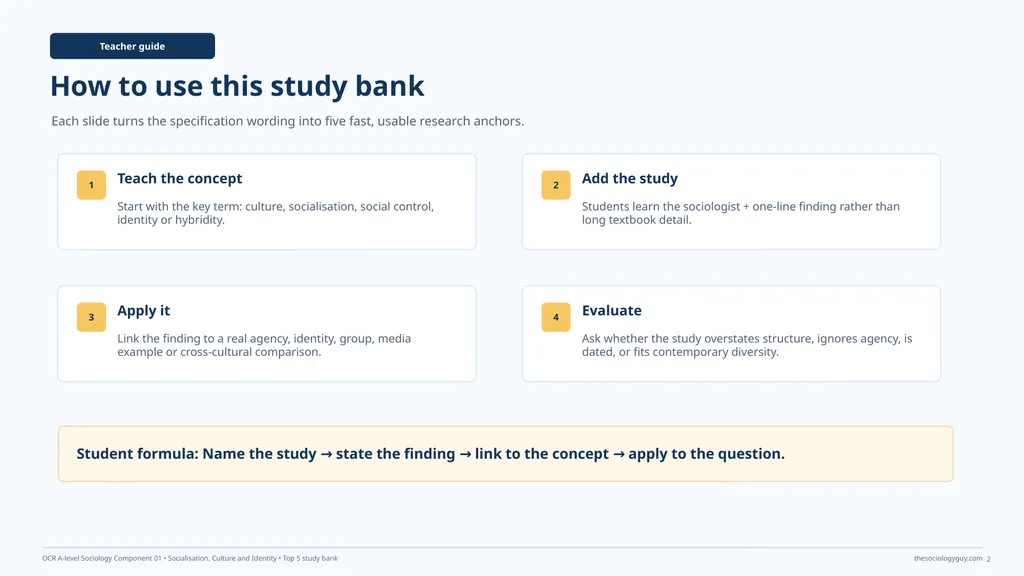
Teacher guide How to use this study bank Each slide turns the specification wording into five fast, usable research anchors. 1 Teach the concept Start with the key term: culture, socialisation, social control, identity or hybridity. 2 Add the study Students learn the sociologist + one-line finding rather than long textbook detail. 3 Apply it Link the finding to a real agency, identity, group, media example or cross-cultural comparison. 4 Evaluate Ask whether the study overstates structure, ignores agency, is dated, or fits contemporary diversity. Student formula: Name the study → state the finding → link to the concept → apply to the question. 2<br>
03
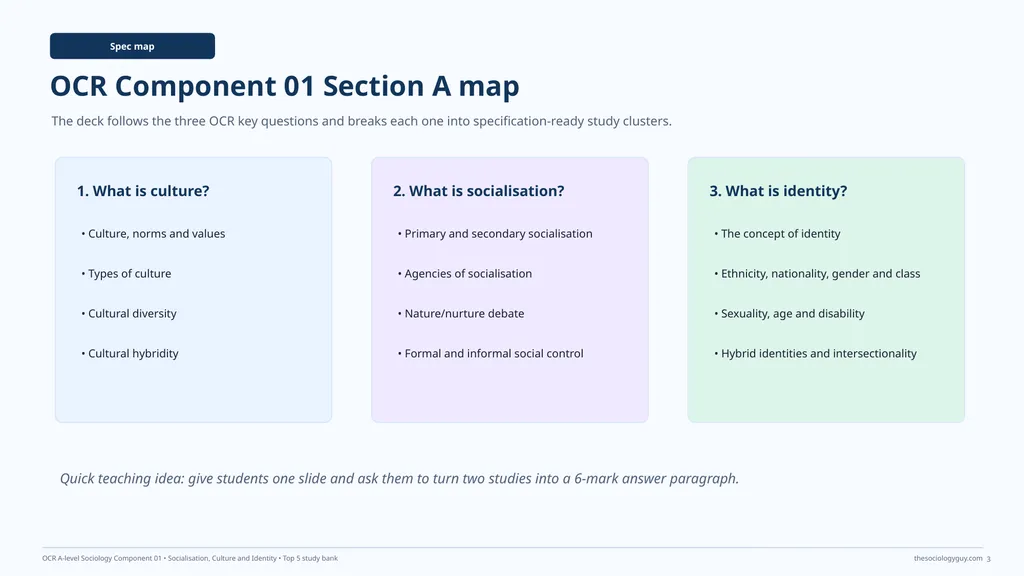
Spec map OCR Component 01 Section A map The deck follows the three OCR key questions and breaks each one into specification-ready study clusters. 1. What is culture? • Culture, norms and values • Types of culture • Cultural diversity • Cultural hybridity 2. What is socialisation? • Primary and secondary socialisation • Agencies of socialisation • Nature/nurture debate • Formal and informal social control 3. What is identity? • The concept of identity • Ethnicity, nationality, gender and class • Sexuality, age and disability • Hybrid identities and intersectionality Quick teaching idea: give students one slide and ask them to turn two studies into a 6-mark answer paragraph. 3<br>
04
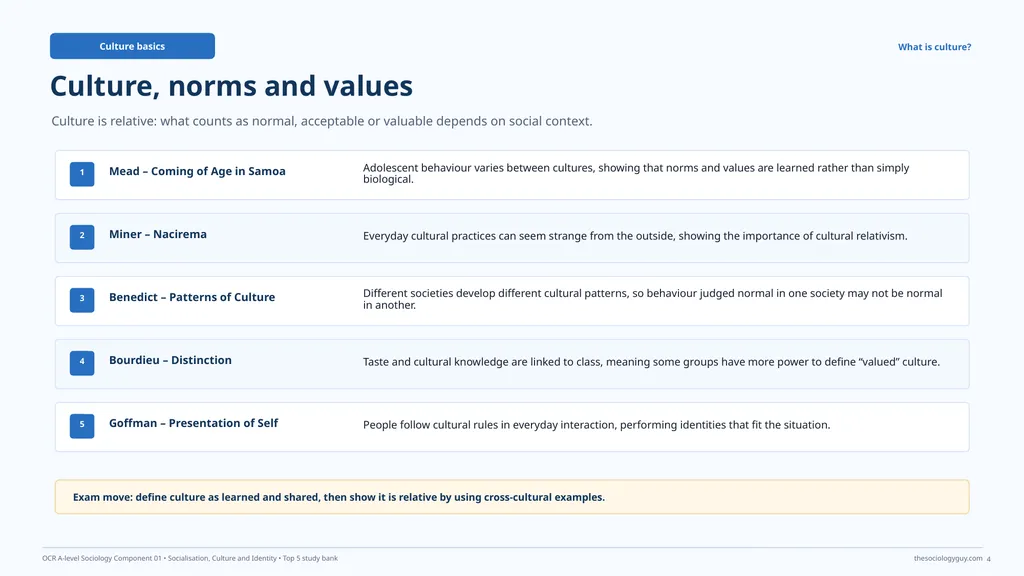
Culture basics Culture, norms and values Culture is relative: what counts as normal, acceptable or valuable depends on social context. What is culture? 1 Mead – Coming of Age in Samoa Adolescent behaviour varies between cultures, showing that norms and values are learned rather than simply biological. 2 Miner – Nacirema Everyday cultural practices can seem strange from the outside, showing the importance of cultural relativism. 3 Benedict – Patterns of Culture Different societies develop different cultural patterns, so behaviour judged normal in one society may not be normal in another. 4 Bourdieu – Distinction Taste and cultural knowledge are linked to class, meaning some groups have more power to define “valued” culture. 5 Goffman – Presentation of Self People follow cultural rules in everyday interaction, performing identities that fit the situation. Exam move: define culture as learned and shared, then show it is relative by using cross-cultural examples. 4<br>
05
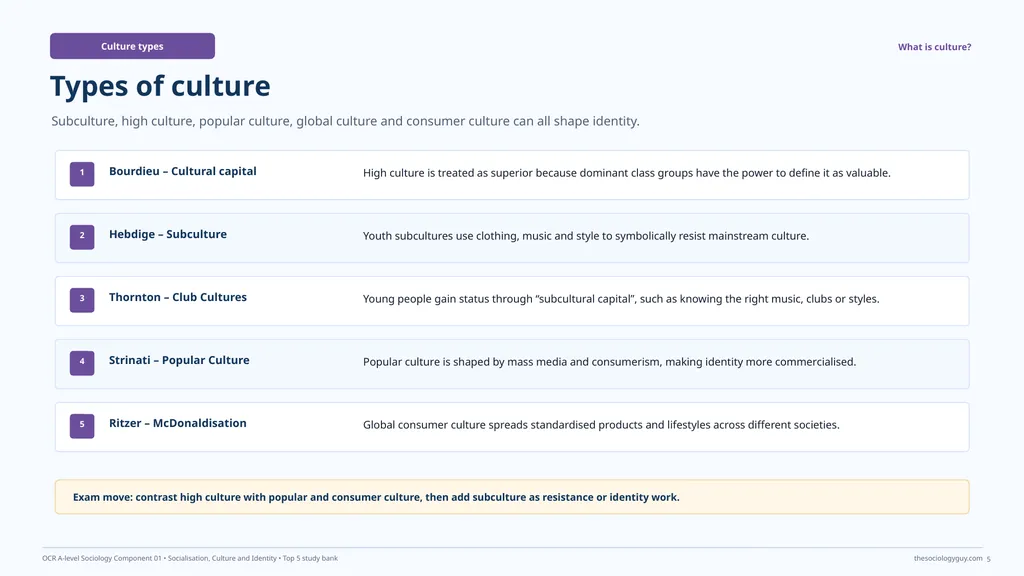
Culture types Types of culture Subculture, high culture, popular culture, global culture and consumer culture can all shape identity. What is culture? 1 Bourdieu – Cultural capital High culture is treated as superior because dominant class groups have the power to define it as valuable. 2 Hebdige – Subculture Youth subcultures use clothing, music and style to symbolically resist mainstream culture. 3 Thornton – Club Cultures Young people gain status through “subcultural capital”, such as knowing the right music, clubs or styles. 4 Strinati – Popular Culture Popular culture is shaped by mass media and consumerism, making identity more commercialised. 5 Ritzer – McDonaldisation Global consumer culture spreads standardised products and lifestyles across different societies. Exam move: contrast high culture with popular and consumer culture, then add subculture as resistance or identity work. 5<br>
06
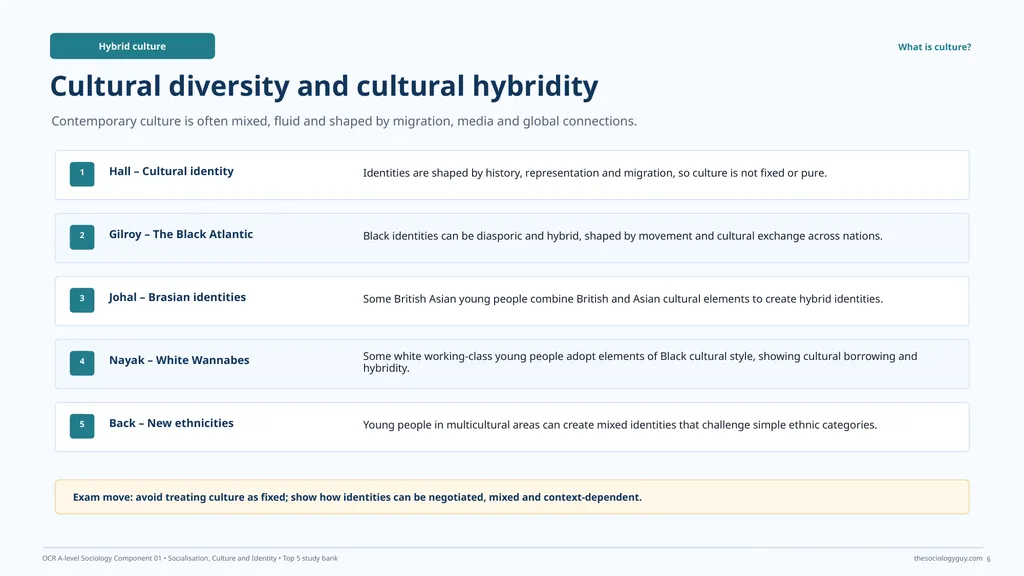
Hybrid culture Cultural diversity and cultural hybridity Contemporary culture is often mixed, fluid and shaped by migration, media and global connections. What is culture? 1 Hall – Cultural identity Identities are shaped by history, representation and migration, so culture is not fixed or pure. 2 Gilroy – The Black Atlantic Black identities can be diasporic and hybrid, shaped by movement and cultural exchange across nations. 3 Johal – Brasian identities Some British Asian young people combine British and Asian cultural elements to create hybrid identities. 4 Nayak – White Wannabes Some white working-class young people adopt elements of Black cultural style, showing cultural borrowing and hybridity. 5 Back – New ethnicities Young people in multicultural areas can create mixed identities that challenge simple ethnic categories. Exam move: avoid treating culture as fixed; show how identities can be negotiated, mixed and context-dependent. 6<br>
07
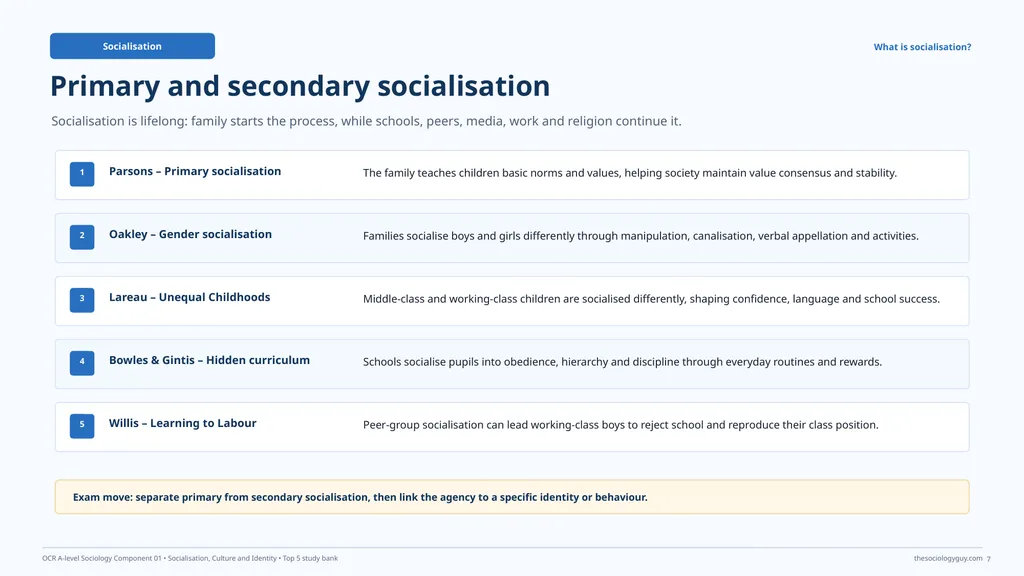
Socialisation Primary and secondary socialisation Socialisation is lifelong: family starts the process, while schools, peers, media, work and religion continue it. What is socialisation? 1 Parsons – Primary socialisation The family teaches children basic norms and values, helping society maintain value consensus and stability. 2 Oakley – Gender socialisation Families socialise boys and girls differently through manipulation, canalisation, verbal appellation and activities. 3 Lareau – Unequal Childhoods Middle-class and working-class children are socialised differently, shaping confidence, language and school success. 4 Bowles & Gintis – Hidden curriculum Schools socialise pupils into obedience, hierarchy and discipline through everyday routines and rewards. 5 Willis – Learning to Labour Peer-group socialisation can lead working-class boys to reject school and reproduce their class position. Exam move: separate primary from secondary socialisation, then link the agency to a specific identity or behaviour. 7<br>
08
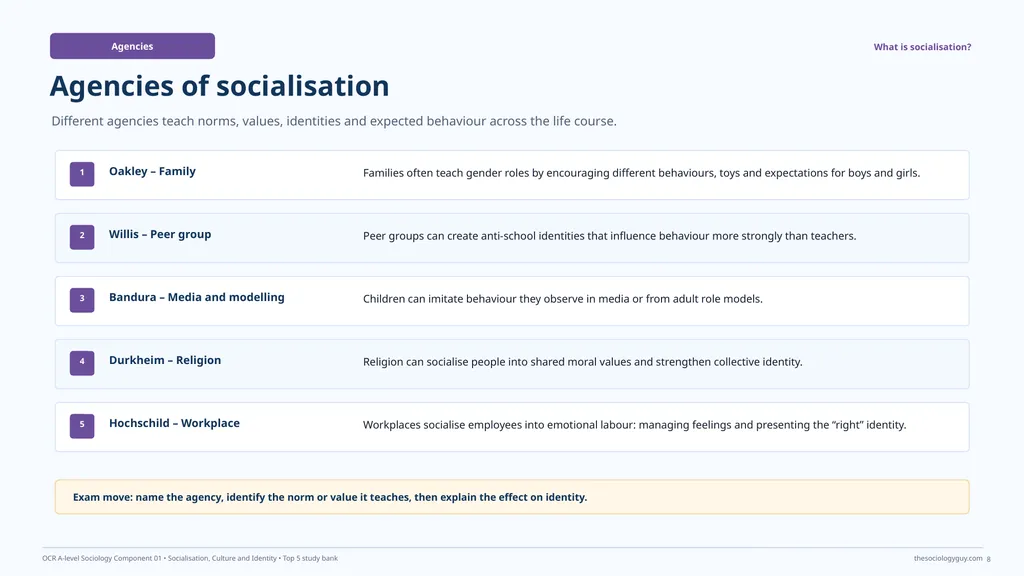
Agencies Agencies of socialisation Different agencies teach norms, values, identities and expected behaviour across the life course. What is socialisation? 1 Oakley – Family Families often teach gender roles by encouraging different behaviours, toys and expectations for boys and girls. 2 Willis – Peer group Peer groups can create anti-school identities that influence behaviour more strongly than teachers. 3 Bandura – Media and modelling Children can imitate behaviour they observe in media or from adult role models. 4 Durkheim – Religion Religion can socialise people into shared moral values and strengthen collective identity. 5 Hochschild – Workplace Workplaces socialise employees into emotional labour: managing feelings and presenting the “right” identity. Exam move: name the agency, identify the norm or value it teaches, then explain the effect on identity. 8<br>
09
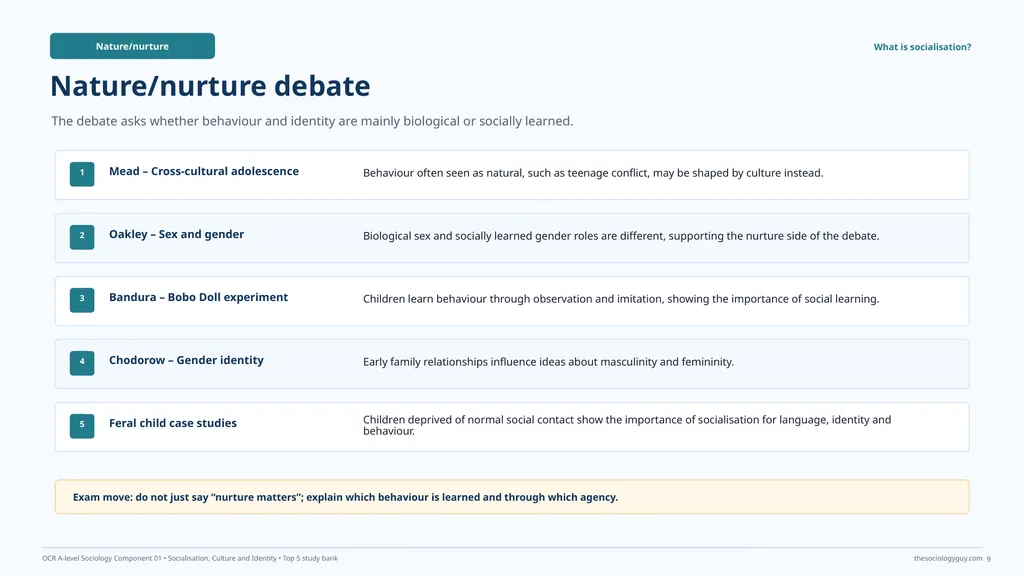
Nature/nurture Nature/nurture debate The debate asks whether behaviour and identity are mainly biological or socially learned. What is socialisation? 1 Mead – Cross-cultural adolescence Behaviour often seen as natural, such as teenage conflict, may be shaped by culture instead. 2 Oakley – Sex and gender Biological sex and socially learned gender roles are different, supporting the nurture side of the debate. 3 Bandura – Bobo Doll experiment Children learn behaviour through observation and imitation, showing the importance of social learning. 4 Chodorow – Gender identity Early family relationships influence ideas about masculinity and femininity. 5 Feral child case studies Children deprived of normal social contact show the importance of socialisation for language, identity and behaviour. Exam move: do not just say “nurture matters”; explain which behaviour is learned and through which agency. 9<br>
10
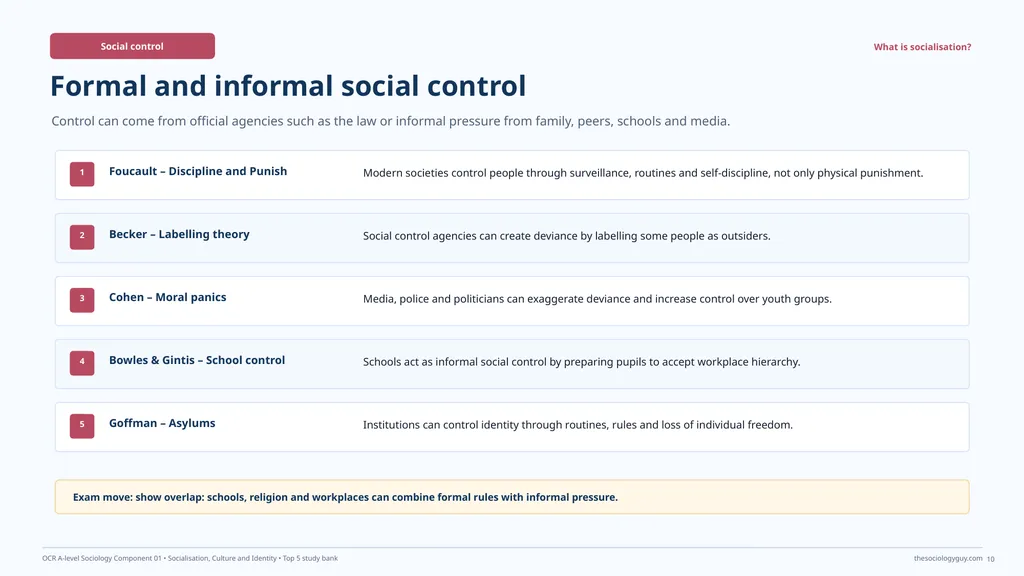
Social control Formal and informal social control Control can come from official agencies such as the law or informal pressure from family, peers, schools and media. What is socialisation? 1 Foucault – Discipline and Punish Modern societies control people through surveillance, routines and self-discipline, not only physical punishment. 2 Becker – Labelling theory Social control agencies can create deviance by labelling some people as outsiders. 3 Cohen – Moral panics Media, police and politicians can exaggerate deviance and increase control over youth groups. 4 Bowles & Gintis – School control Schools act as informal social control by preparing pupils to accept workplace hierarchy. 5 Goffman – Asylums Institutions can control identity through routines, rules and loss of individual freedom. Exam move: show overlap: schools, religion and workplaces can combine formal rules with informal pressure. 10<br>
11
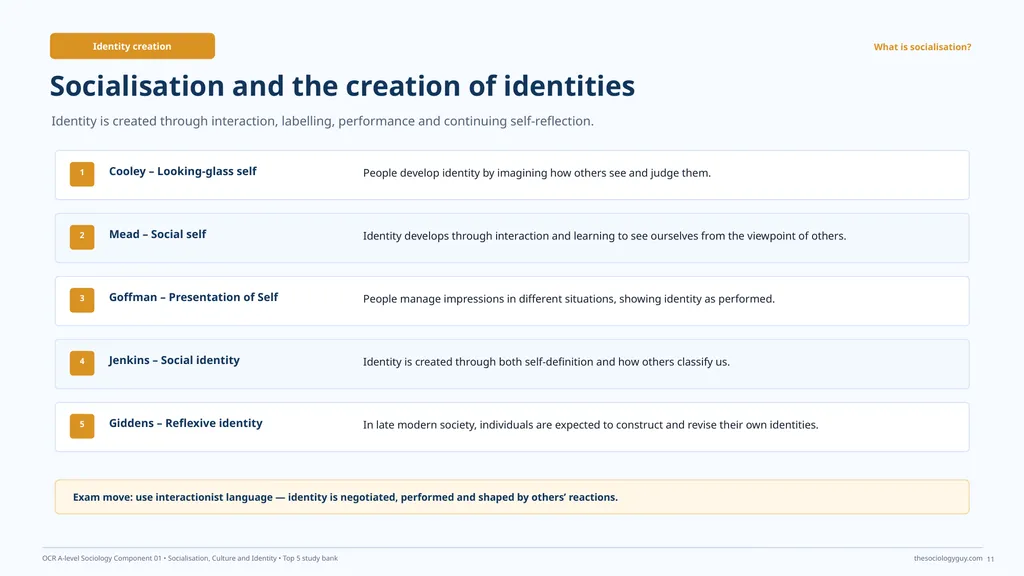
Identity creation Socialisation and the creation of identities Identity is created through interaction, labelling, performance and continuing self-reflection. What is socialisation? 1 Cooley – Looking-glass self People develop identity by imagining how others see and judge them. 2 Mead – Social self Identity develops through interaction and learning to see ourselves from the viewpoint of others. 3 Goffman – Presentation of Self People manage impressions in different situations, showing identity as performed. 4 Jenkins – Social identity Identity is created through both self-definition and how others classify us. 5 Giddens – Reflexive identity In late modern society, individuals are expected to construct and revise their own identities. Exam move: use interactionist language — identity is negotiated, performed and shaped by others’ reactions. 11<br>
12
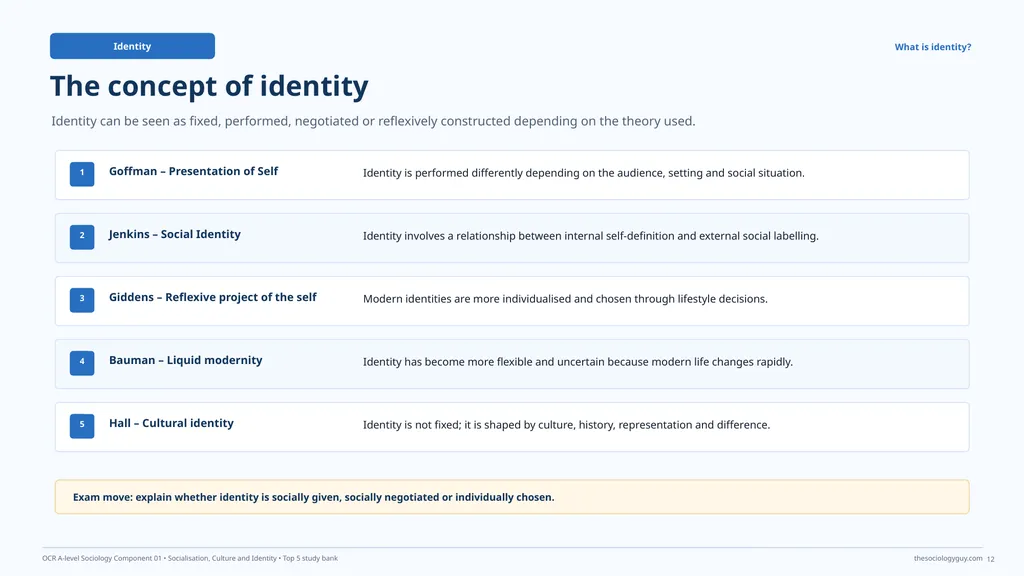
Identity The concept of identity Identity can be seen as fixed, performed, negotiated or reflexively constructed depending on the theory used. What is identity? 1 Goffman – Presentation of Self Identity is performed differently depending on the audience, setting and social situation. 2 Jenkins – Social Identity Identity involves a relationship between internal self-definition and external social labelling. 3 Giddens – Reflexive project of the self Modern identities are more individualised and chosen through lifestyle decisions. 4 Bauman – Liquid modernity Identity has become more flexible and uncertain because modern life changes rapidly. 5 Hall – Cultural identity Identity is not fixed; it is shaped by culture, history, representation and difference. Exam move: explain whether identity is socially given, socially negotiated or individually chosen. 12<br>
13
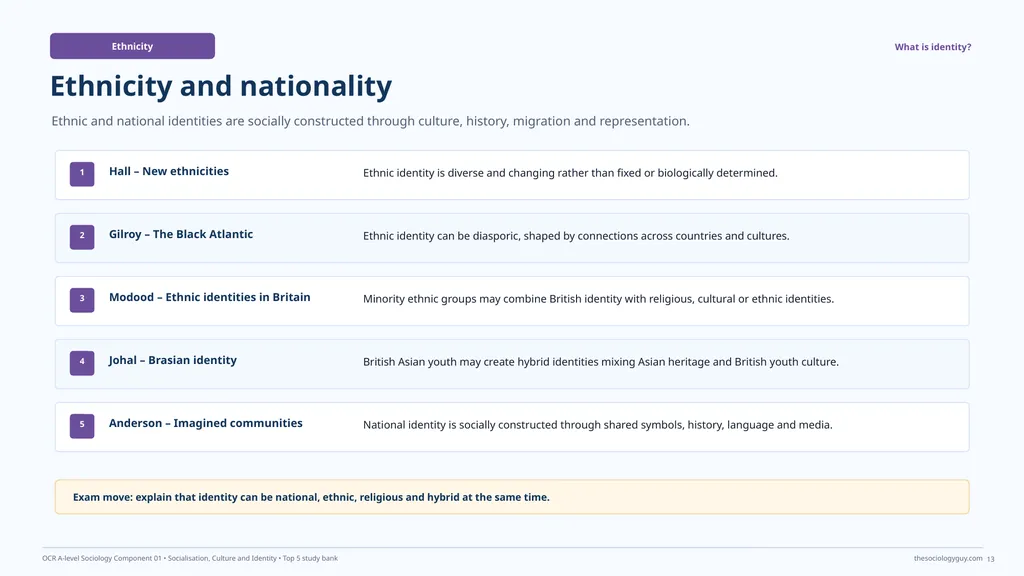
Ethnicity Ethnicity and nationality Ethnic and national identities are socially constructed through culture, history, migration and representation. What is identity? 1 Hall – New ethnicities Ethnic identity is diverse and changing rather than fixed or biologically determined. 2 Gilroy – The Black Atlantic Ethnic identity can be diasporic, shaped by connections across countries and cultures. 3 Modood – Ethnic identities in Britain Minority ethnic groups may combine British identity with religious, cultural or ethnic identities. 4 Johal – Brasian identity British Asian youth may create hybrid identities mixing Asian heritage and British youth culture. 5 Anderson – Imagined communities National identity is socially constructed through shared symbols, history, language and media. Exam move: explain that identity can be national, ethnic, religious and hybrid at the same time. 13<br>
14
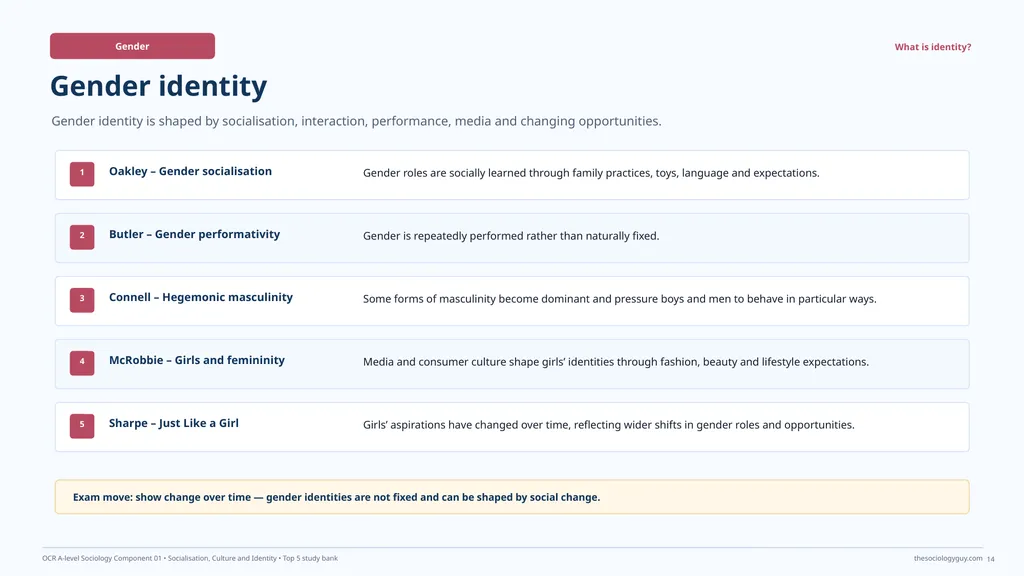
Gender Gender identity Gender identity is shaped by socialisation, interaction, performance, media and changing opportunities. What is identity? 1 Oakley – Gender socialisation Gender roles are socially learned through family practices, toys, language and expectations. 2 Butler – Gender performativity Gender is repeatedly performed rather than naturally fixed. 3 Connell – Hegemonic masculinity Some forms of masculinity become dominant and pressure boys and men to behave in particular ways. 4 McRobbie – Girls and femininity Media and consumer culture shape girls’ identities through fashion, beauty and lifestyle expectations. 5 Sharpe – Just Like a Girl Girls’ aspirations have changed over time, reflecting wider shifts in gender roles and opportunities. Exam move: show change over time — gender identities are not fixed and can be shaped by social change. 14<br>
15
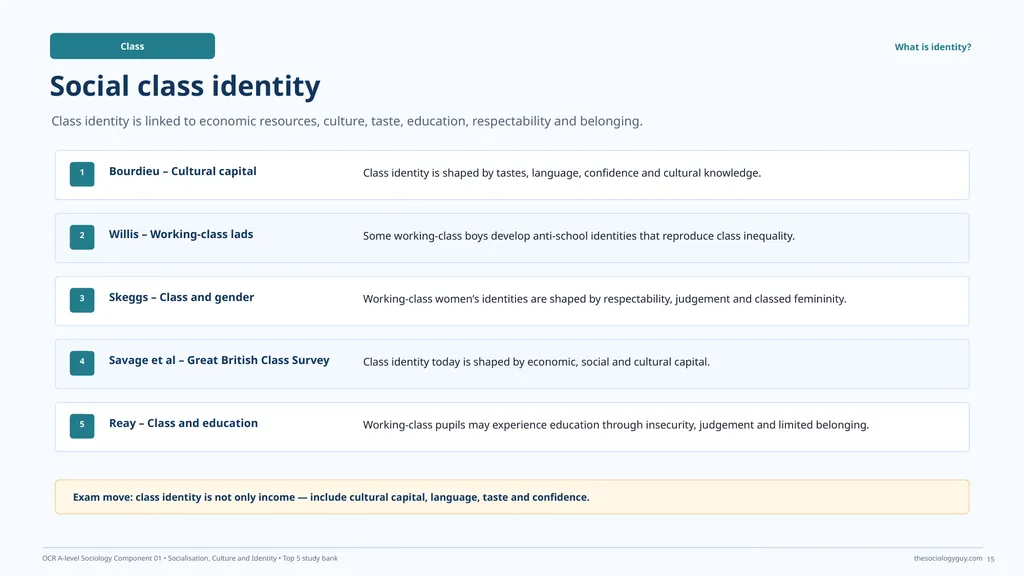
Class Social class identity Class identity is linked to economic resources, culture, taste, education, respectability and belonging. What is identity? 1 Bourdieu – Cultural capital Class identity is shaped by tastes, language, confidence and cultural knowledge. 2 Willis – Working-class lads Some working-class boys develop anti-school identities that reproduce class inequality. 3 Skeggs – Class and gender Working-class women’s identities are shaped by respectability, judgement and classed femininity. 4 Savage et al – Great British Class Survey Class identity today is shaped by economic, social and cultural capital. 5 Reay – Class and education Working-class pupils may experience education through insecurity, judgement and limited belonging. Exam move: class identity is not only income — include cultural capital, language, taste and confidence. 15<br>
16
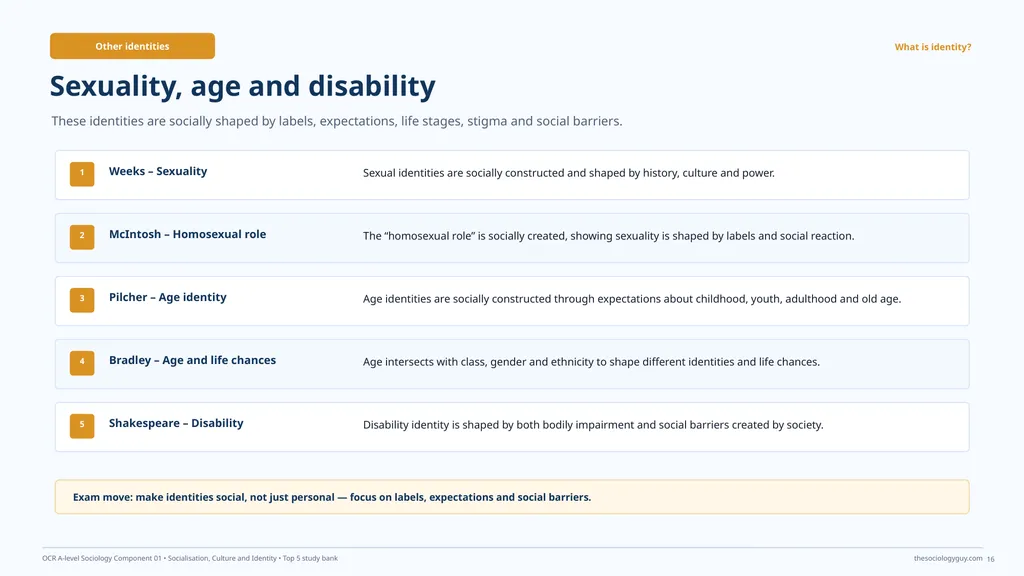
Other identities Sexuality, age and disability These identities are socially shaped by labels, expectations, life stages, stigma and social barriers. What is identity? 1 Weeks – Sexuality Sexual identities are socially constructed and shaped by history, culture and power. 2 McIntosh – Homosexual role The “homosexual role” is socially created, showing sexuality is shaped by labels and social reaction. 3 Pilcher – Age identity Age identities are socially constructed through expectations about childhood, youth, adulthood and old age. 4 Bradley – Age and life chances Age intersects with class, gender and ethnicity to shape different identities and life chances. 5 Shakespeare – Disability Disability identity is shaped by both bodily impairment and social barriers created by society. Exam move: make identities social, not just personal — focus on labels, expectations and social barriers. 16<br>
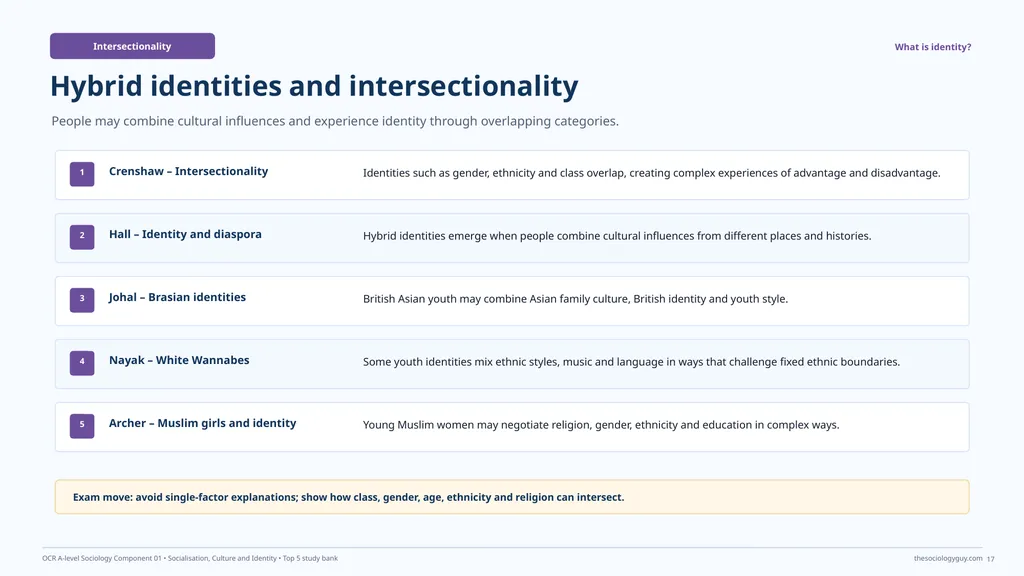
17
Intersectionality Hybrid identities and intersectionality People may combine cultural influences and experience identity through overlapping categories. What is identity? 1 Crenshaw – Intersectionality Identities such as gender, ethnicity and class overlap, creating complex experiences of advantage and disadvantage. 2 Hall – Identity and diaspora Hybrid identities emerge when people combine cultural influences from different places and histories. 3 Johal – Brasian identities British Asian youth may combine Asian family culture, British identity and youth style. 4 Nayak – White Wannabes Some youth identities mix ethnic styles, music and language in ways that challenge fixed ethnic boundaries. 5 Archer – Muslim girls and identity Young Muslim women may negotiate religion, gender, ethnicity and education in complex ways. Exam move: avoid single-factor explanations; show how class, gender, age, ethnicity and religion can intersect. 17<br>
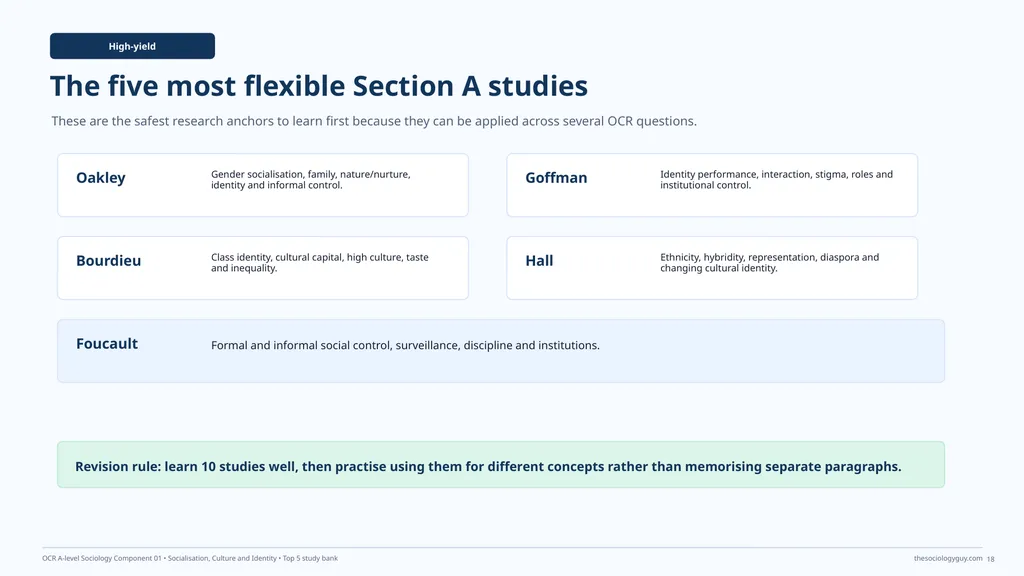
18
High-yield The five most flexible Section A studies These are the safest research anchors to learn first because they can be applied across several OCR questions. Oakley Gender socialisation, family, nature/nurture, identity and informal control. Goffman Identity performance, interaction, stigma, roles and institutional control. Bourdieu Class identity, cultural capital, high culture, taste and inequality. Hall Ethnicity, hybridity, representation, diaspora and changing cultural identity. Foucault Formal and informal social control, surveillance, discipline and institutions. Revision rule: learn 10 studies well, then practise using them for different concepts rather than memorising separate paragraphs. 18<br>
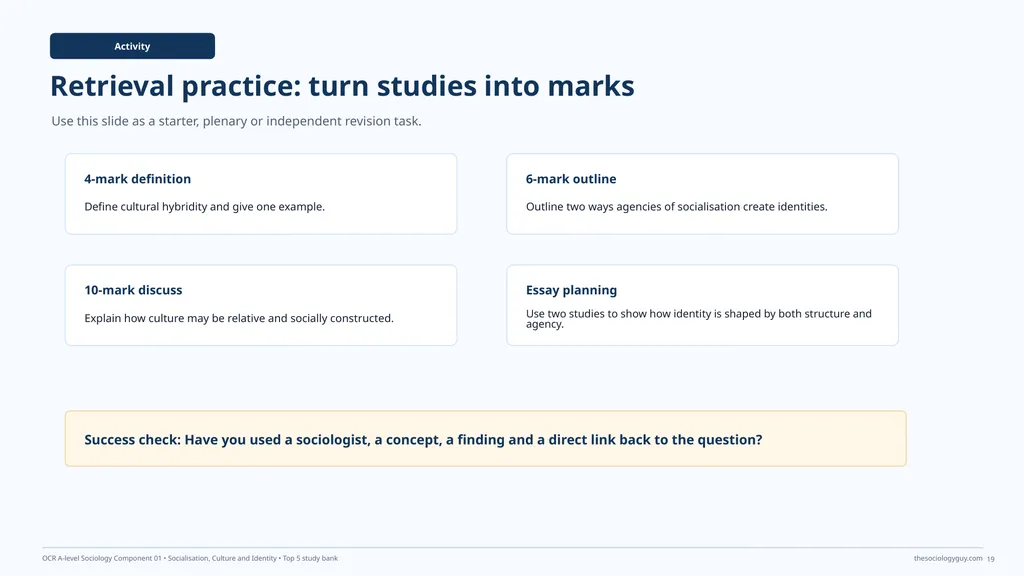
19
Activity Retrieval practice: turn studies into marks Use this slide as a starter, plenary or independent revision task. 4-mark definition Define cultural hybridity and give one example. 6-mark outline Outline two ways agencies of socialisation create identities. 10-mark discuss Explain how culture may be relative and socially constructed. Essay planning Use two studies to show how identity is shaped by both structure and agency. Success check: Have you used a sociologist, a concept, a finding and a direct link back to the question? 19<br>