
ODR in Developing Nations? This work by Amy J.

Description: ODR in Developing Nations? This work by Amy J. Schmitz is licensed under a Creative Commons Attribution-NonCommercial 4.0 International License and is subject to the terms and conditions of that license. The final version of this document
Related Topics
Download Presentation
"ODR in Developing Nations? This work by Amy J." is the property of its rightful owner. Permission is granted to download and print the materials on this website for personal, non-commercial use only, and to display it on your personal computer provided you do not modify the materials and that you retain all copyright notices contained in the materials. By downloading content from our website, you accept the terms of this agreement.
Presentation Transcript
slide1. ODR in Developing Nations? This work by Amy J. Schmitz is licensed under a Creative Commons Attribution-NonCommercial 4.0 International License and is subject to the terms and conditions of that license. The final version of this document is published on the University of Missouri School of Law Scholarship Repository.<br>
slide2. Questions or Comments? Using technology to leapfrog adr? Some have suggested that technology is growing so quickly in developing nations that odr will eclipse adr in these areas.
I am always open to your thoughts!
Extra writing requirement for those that need a writing intensive course?<br>
slide3. Uncitral revisited: Consider whether and how you would reinvigorate UNCITRAL?
Is it best that it ended, to allow private development to take over or should we invest in developing a global system?<br>
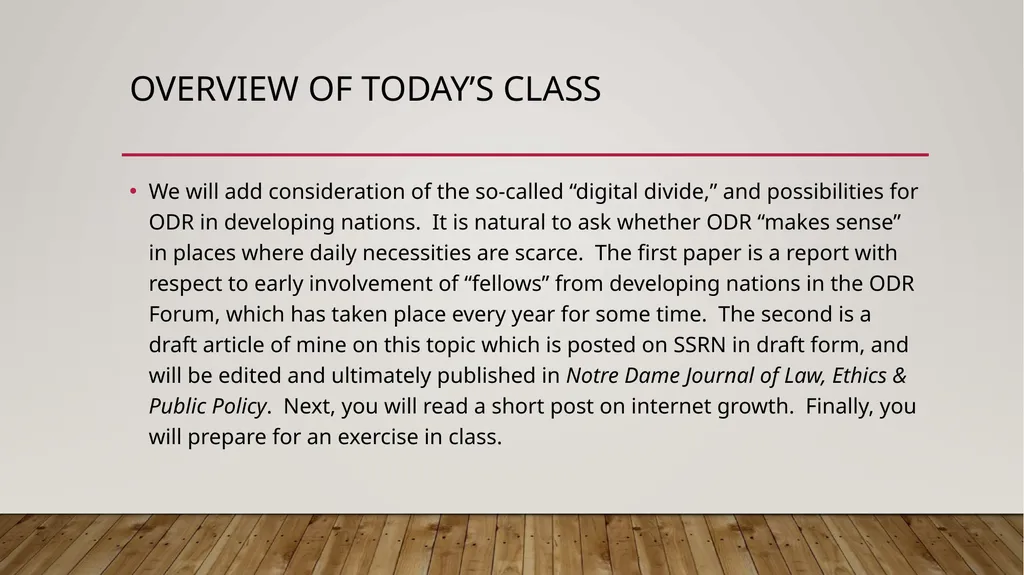
slide4. Overview of Today’s class We will add consideration of the so-called “digital divide,” and possibilities for ODR in developing nations. It is natural to ask whether ODR “makes sense” in places where daily necessities are scarce. The first paper is a report with respect to early involvement of “fellows” from developing nations in the ODR Forum, which has taken place every year for some time. The second is a draft article of mine on this topic which is posted on SSRN in draft form, and will be edited and ultimately published in Notre Dame Journal of Law, Ethics & Public Policy. Next, you will read a short post on internet growth. Finally, you will prepare for an exercise in class.<br>
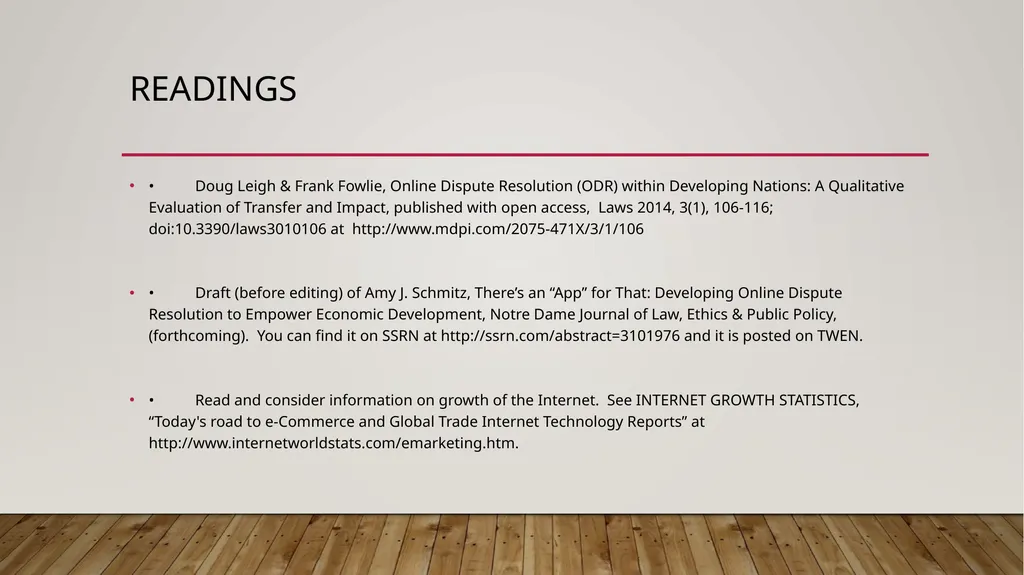
slide5. readings • Doug Leigh & Frank Fowlie, Online Dispute Resolution (ODR) within Developing Nations: A Qualitative Evaluation of Transfer and Impact, published with open access, Laws 2014, 3(1), 106-116; doi:10.3390/laws3010106 at http://www.mdpi.com/2075-471X/3/1/106
• Draft (before editing) of Amy J. Schmitz, There’s an “App” for That: Developing Online Dispute Resolution to Empower Economic Development, Notre Dame Journal of Law, Ethics & Public Policy, (forthcoming). You can find it on SSRN at http://ssrn.com/abstract=3101976 and it is posted on TWEN.
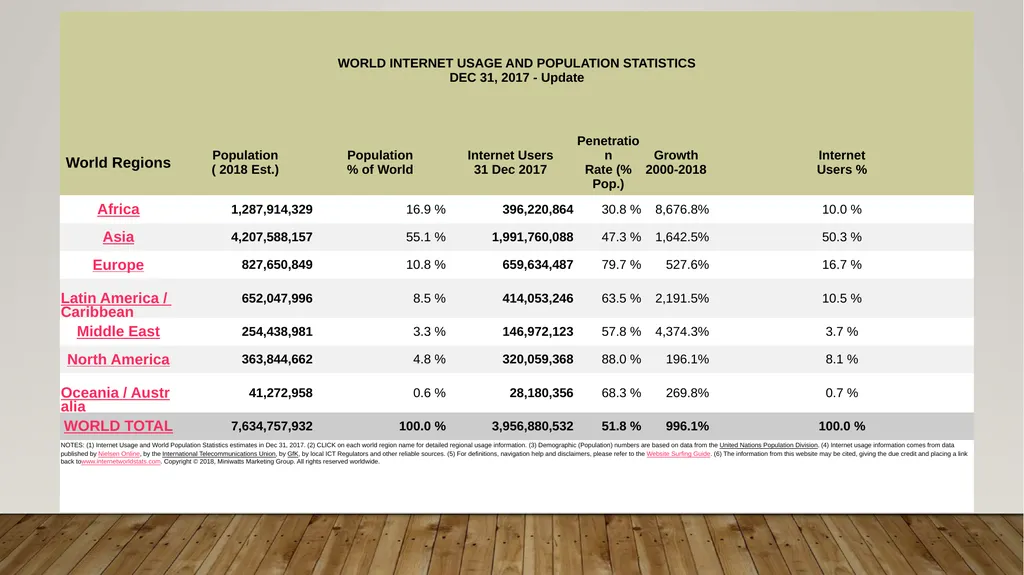
• Read and consider information on growth of the Internet. See INTERNET GROWTH STATISTICS, “Today's road to e-Commerce and Global Trade Internet Technology Reports” at http://www.internetworldstats.com/emarketing.htm.<br>
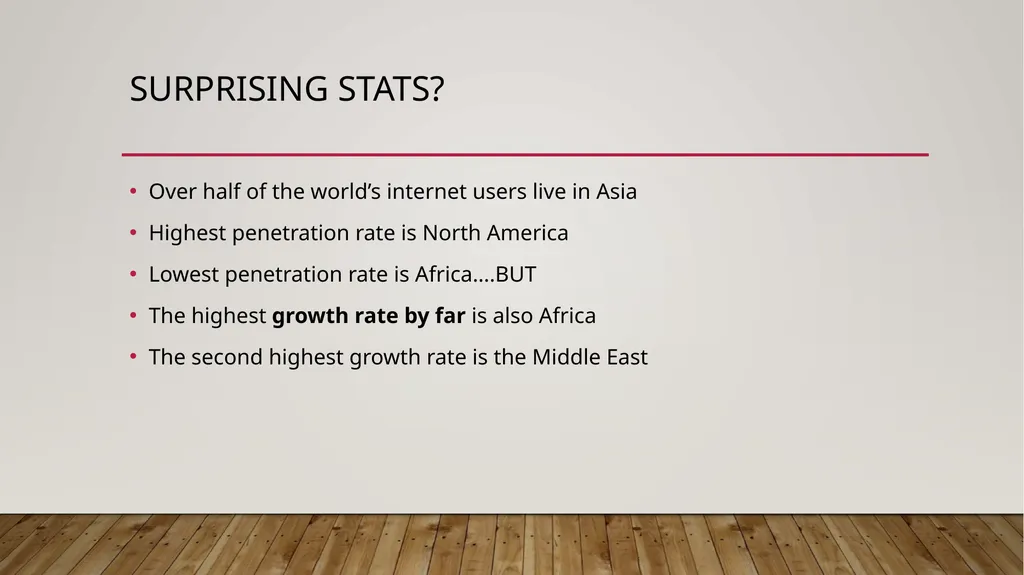
slide7. Surprising Stats? Over half of the world’s internet users live in Asia
Highest penetration rate is North America
Lowest penetration rate is Africa….BUT
The highest growth rate by far is also Africa
The second highest growth rate is the Middle East<br>
slide8. Internet and e-commerce growth “When I was your age…..”
Changes in Buying/Selling – Amazon > Brick-n-Mortar
Changes in Society – “Friends” has a new meaning
Changes in Law – Duty of Tech Competence is part of the oath
Changes in “Justice” – Expect quick remedies in areas like B2C<br>
slide9. Why move dispute resolution online? Litigation & Face-to-Face (F2F) arb/med are costly
Consumers prefer online access (85% vs. 15% by phone)
Use data & online neutrals to assist resolutions
Adapt to language, education, physical & time differences
Ease public costs with private collaborations
Avoid jurisdictional limits & legal complexities (mostly?) 9<br>
slide10. Why promote ODR in developing nations? Fastest growth of Internet usage
Exponential growth of mobile devices
Centrality of e-commerce in economic growth
Means for promoting consumer trust & sales
Aptitude for innovation and entrepreneurship<br>
slide11. Leigh & fowlie research paper ODR Forum 2008 in BC, Canada
16 selected guests from developing nations
Exit Evaluations
Importance of knowledge building and connections
Applications in human rights & peace building
Concern with basic needs > ODR<br>
slide12. Odr applications post-forum? Develop professional networks
Explore use of mobile devices for odr
Use odr in micro-finance & energy disputes
Launch adr centers to decrease influence of the Taliban and Al-Qaeda<br>
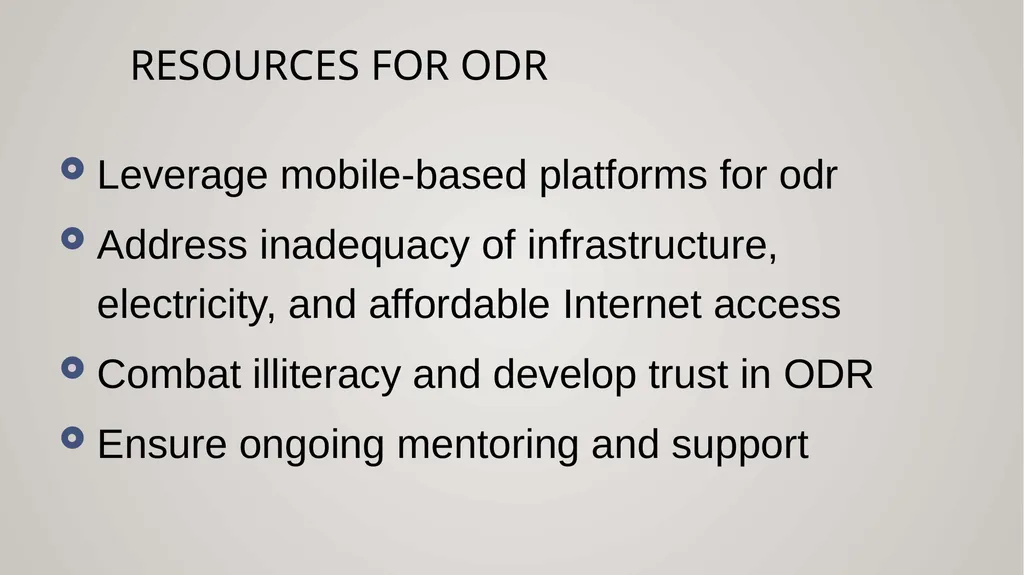
slide13. Resources for odr Leverage mobile-based platforms for odr
Address inadequacy of infrastructure, electricity, and affordable Internet access
Combat illiteracy and develop trust in ODR
Ensure ongoing mentoring and support<br>
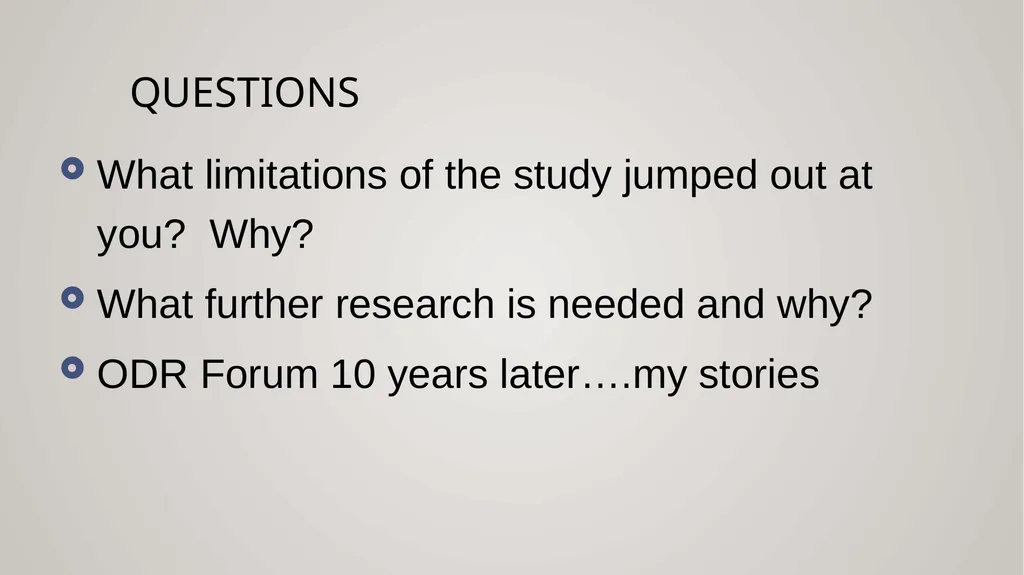
slide14. Questions What limitations of the study jumped out at you? Why?
What further research is needed and why?
ODR Forum 10 years later….my stories<br>
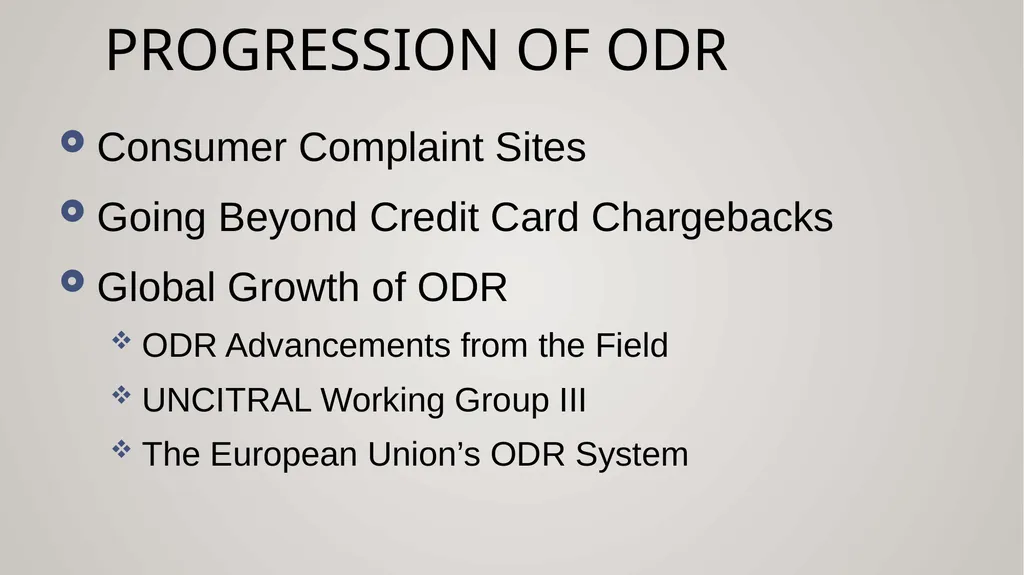
slide15. Progression of ODR Consumer Complaint Sites
Going Beyond Credit Card Chargebacks
Global Growth of ODR
ODR Advancements from the Field
UNCITRAL Working Group III
The European Union’s ODR System<br>
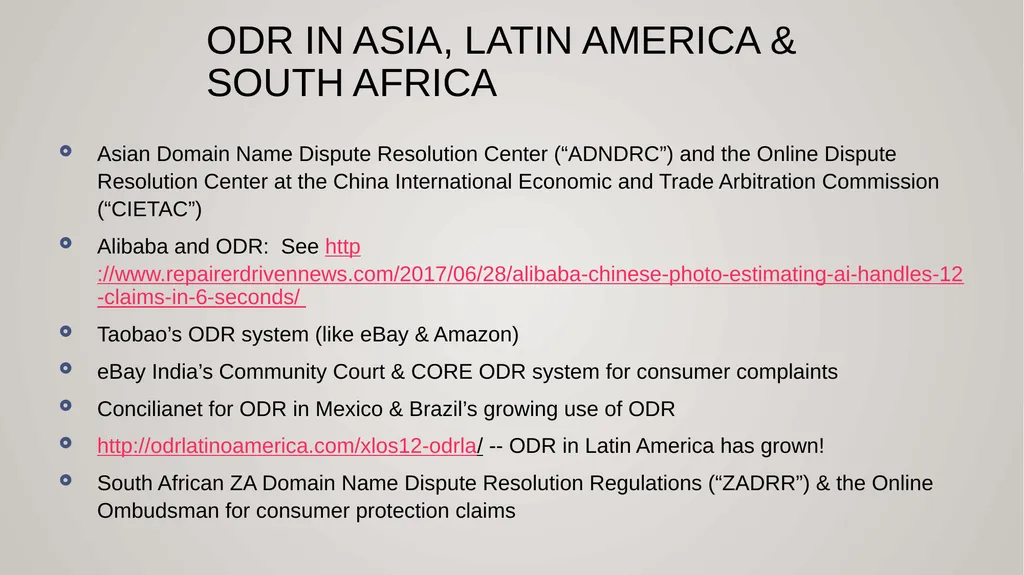
slide16. ODR in Asia, Latin America & South Africa Asian Domain Name Dispute Resolution Center (“ADNDRC”) and the Online Dispute Resolution Center at the China International Economic and Trade Arbitration Commission (“CIETAC”)
Alibaba and ODR: See http://www.repairerdrivennews.com/2017/06/28/alibaba-chinese-photo-estimating-ai-handles-12-claims-in-6-seconds/
Taobao’s ODR system (like eBay & Amazon)
eBay India’s Community Court & CORE ODR system for consumer complaints
Concilianet for ODR in Mexico & Brazil’s growing use of ODR
http://odrlatinoamerica.com/xlos12-odrla/ -- ODR in Latin America has grown!
South African ZA Domain Name Dispute Resolution Regulations (“ZADRR”) & the Online Ombudsman for consumer protection claims<br>
slide17. Designing a Mobile-Friendly global system Combatting asymmetries (repeat players)
Binding vs. non-binding (debates at UNCITRAL)
Ethics, due process & trustmarks
Automation & scalability
Enforceability (eBay had it easy with PayPal)<br>
slide18. Due Process considerations Clear Contract and Website Notice
Simplicity/Crafted for ALL Consumers
Accessible Guides & Demos
Adaptable for Physical and Lingual Differences 18<br>
slide19. ….More Considerations Consumer Choice & Control
Trustmark to Promote Security & Fairness
Trigger Mechanism for Regulatory Action
Timely & Enforceable Decisions 19<br>
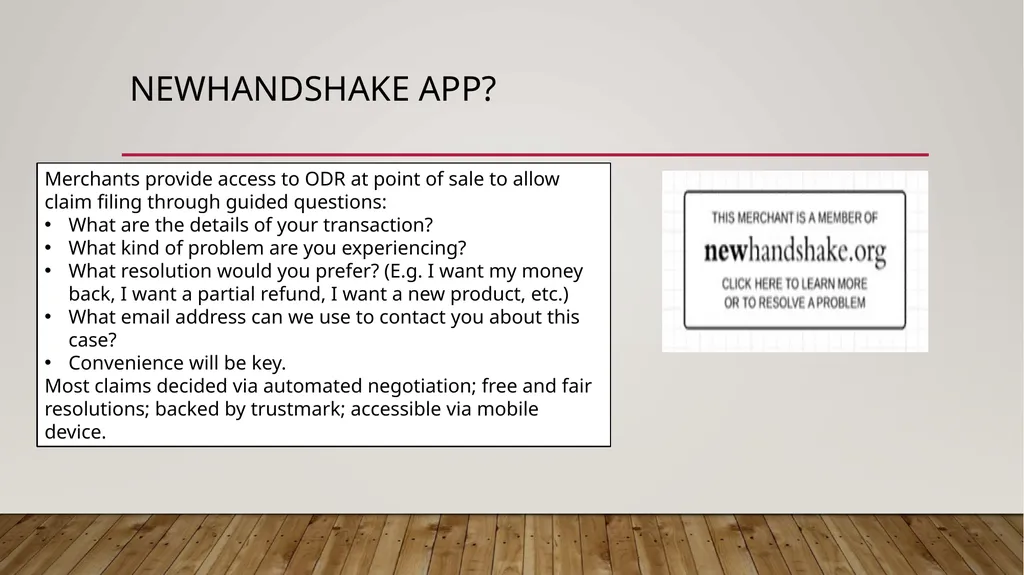
slide20. Newhandshake app? Merchants provide access to ODR at point of sale to allow claim filing through guided questions:
What are the details of your transaction?
What kind of problem are you experiencing?
What resolution would you prefer? (E.g. I want my money back, I want a partial refund, I want a new product, etc.)
What email address can we use to contact you about this case?
Convenience will be key.
Most claims decided via automated negotiation; free and fair resolutions; backed by trustmark; accessible via mobile device.<br>
slide21. Excercise No paper is due, but prepare to work in teams to consider and debate the use of ODR for refugee disputes. Consider the ODR for refugees application at http://www.odreurope.com/odr4refugees.
It is an app which enables refugees to have access to alternative dispute resolution services to give refugees an easy path to information and to actual mediation services.<br>
slide22. It does not focus on refugees permanently settled in the country of their final destination. Instead, it focuses on all those who are on the move or reside temporarily in refugee camps all over the world .
The app guides refugees to select the type of their dispute they seek to resolve, and processes all the data and appoints a mediator from a list of mediators (matching several criteria such as nationality, languages, area, topic, gender etc.) who communicates with both sides. The whole mediation process can be conducted online from their smartphones.<br>
slide23. How we will proceed You will be placed in groups representing:
ambassadors from nations with many refugee camps,
ODR developers, and
refugees (and their representatives/aid workers).<br>
slide24. Consider and be prepared to negotiate How could or should this app work? What about gaining trust?
What problems do you see with the concept and plans for the app (after reading the website)?
Be sure you truly look over the website and ask how this ODR system will address cultural difference?
Could ODR help with “tough conversations” and discrimination?<br>
slide25. Adding Sovereignty to the mix…. See the handout on INTERNETBAR.ORG’s blockchain project
See https://www.circa.com/story/2018/01/31/world/blockchain-technology-may-help-rohingyas-get-identification.
https://www.technologyreview.com/s/608764/how-blockchain-is-kickstarting-the-financial-lives-of-refugees/.
What if all one needed was an identity key linked to a blockchain that was safe from hackers and impossible to change? This is means for creating and securely storing a digital form of identification that can’t be corrupted and is easily accessible from anywhere. That’s why the United Nations is exploring using the technology in its effort to bring legal identification to the more than one billion people who don’t have official documents.<br>
slide26. Right to Identity using blockchain http://bitcoinmining.shop/how-blockchain-technology-can-help-refugees/
http://fortune.com/2018/01/25/bitcoin-blockchain-billionaire-george-soros/.
Blockchain could revolutionize everything from identity to property, to managing confidential information in every area of law!<br>
slide2. Questions or Comments? Using technology to leapfrog adr? Some have suggested that technology is growing so quickly in developing nations that odr will eclipse adr in these areas.
I am always open to your thoughts!
Extra writing requirement for those that need a writing intensive course?<br>
slide3. Uncitral revisited: Consider whether and how you would reinvigorate UNCITRAL?
Is it best that it ended, to allow private development to take over or should we invest in developing a global system?<br>
slide4. Overview of Today’s class We will add consideration of the so-called “digital divide,” and possibilities for ODR in developing nations. It is natural to ask whether ODR “makes sense” in places where daily necessities are scarce. The first paper is a report with respect to early involvement of “fellows” from developing nations in the ODR Forum, which has taken place every year for some time. The second is a draft article of mine on this topic which is posted on SSRN in draft form, and will be edited and ultimately published in Notre Dame Journal of Law, Ethics & Public Policy. Next, you will read a short post on internet growth. Finally, you will prepare for an exercise in class.<br>
slide5. readings • Doug Leigh & Frank Fowlie, Online Dispute Resolution (ODR) within Developing Nations: A Qualitative Evaluation of Transfer and Impact, published with open access, Laws 2014, 3(1), 106-116; doi:10.3390/laws3010106 at http://www.mdpi.com/2075-471X/3/1/106
• Draft (before editing) of Amy J. Schmitz, There’s an “App” for That: Developing Online Dispute Resolution to Empower Economic Development, Notre Dame Journal of Law, Ethics & Public Policy, (forthcoming). You can find it on SSRN at http://ssrn.com/abstract=3101976 and it is posted on TWEN.
• Read and consider information on growth of the Internet. See INTERNET GROWTH STATISTICS, “Today's road to e-Commerce and Global Trade Internet Technology Reports” at http://www.internetworldstats.com/emarketing.htm.<br>
slide7. Surprising Stats? Over half of the world’s internet users live in Asia
Highest penetration rate is North America
Lowest penetration rate is Africa….BUT
The highest growth rate by far is also Africa
The second highest growth rate is the Middle East<br>
slide8. Internet and e-commerce growth “When I was your age…..”
Changes in Buying/Selling – Amazon > Brick-n-Mortar
Changes in Society – “Friends” has a new meaning
Changes in Law – Duty of Tech Competence is part of the oath
Changes in “Justice” – Expect quick remedies in areas like B2C<br>
slide9. Why move dispute resolution online? Litigation & Face-to-Face (F2F) arb/med are costly
Consumers prefer online access (85% vs. 15% by phone)
Use data & online neutrals to assist resolutions
Adapt to language, education, physical & time differences
Ease public costs with private collaborations
Avoid jurisdictional limits & legal complexities (mostly?) 9<br>
slide10. Why promote ODR in developing nations? Fastest growth of Internet usage
Exponential growth of mobile devices
Centrality of e-commerce in economic growth
Means for promoting consumer trust & sales
Aptitude for innovation and entrepreneurship<br>
slide11. Leigh & fowlie research paper ODR Forum 2008 in BC, Canada
16 selected guests from developing nations
Exit Evaluations
Importance of knowledge building and connections
Applications in human rights & peace building
Concern with basic needs > ODR<br>
slide12. Odr applications post-forum? Develop professional networks
Explore use of mobile devices for odr
Use odr in micro-finance & energy disputes
Launch adr centers to decrease influence of the Taliban and Al-Qaeda<br>
slide13. Resources for odr Leverage mobile-based platforms for odr
Address inadequacy of infrastructure, electricity, and affordable Internet access
Combat illiteracy and develop trust in ODR
Ensure ongoing mentoring and support<br>
slide14. Questions What limitations of the study jumped out at you? Why?
What further research is needed and why?
ODR Forum 10 years later….my stories<br>
slide15. Progression of ODR Consumer Complaint Sites
Going Beyond Credit Card Chargebacks
Global Growth of ODR
ODR Advancements from the Field
UNCITRAL Working Group III
The European Union’s ODR System<br>
slide16. ODR in Asia, Latin America & South Africa Asian Domain Name Dispute Resolution Center (“ADNDRC”) and the Online Dispute Resolution Center at the China International Economic and Trade Arbitration Commission (“CIETAC”)
Alibaba and ODR: See http://www.repairerdrivennews.com/2017/06/28/alibaba-chinese-photo-estimating-ai-handles-12-claims-in-6-seconds/
Taobao’s ODR system (like eBay & Amazon)
eBay India’s Community Court & CORE ODR system for consumer complaints
Concilianet for ODR in Mexico & Brazil’s growing use of ODR
http://odrlatinoamerica.com/xlos12-odrla/ -- ODR in Latin America has grown!
South African ZA Domain Name Dispute Resolution Regulations (“ZADRR”) & the Online Ombudsman for consumer protection claims<br>
slide17. Designing a Mobile-Friendly global system Combatting asymmetries (repeat players)
Binding vs. non-binding (debates at UNCITRAL)
Ethics, due process & trustmarks
Automation & scalability
Enforceability (eBay had it easy with PayPal)<br>
slide18. Due Process considerations Clear Contract and Website Notice
Simplicity/Crafted for ALL Consumers
Accessible Guides & Demos
Adaptable for Physical and Lingual Differences 18<br>
slide19. ….More Considerations Consumer Choice & Control
Trustmark to Promote Security & Fairness
Trigger Mechanism for Regulatory Action
Timely & Enforceable Decisions 19<br>
slide20. Newhandshake app? Merchants provide access to ODR at point of sale to allow claim filing through guided questions:
What are the details of your transaction?
What kind of problem are you experiencing?
What resolution would you prefer? (E.g. I want my money back, I want a partial refund, I want a new product, etc.)
What email address can we use to contact you about this case?
Convenience will be key.
Most claims decided via automated negotiation; free and fair resolutions; backed by trustmark; accessible via mobile device.<br>
slide21. Excercise No paper is due, but prepare to work in teams to consider and debate the use of ODR for refugee disputes. Consider the ODR for refugees application at http://www.odreurope.com/odr4refugees.
It is an app which enables refugees to have access to alternative dispute resolution services to give refugees an easy path to information and to actual mediation services.<br>
slide22. It does not focus on refugees permanently settled in the country of their final destination. Instead, it focuses on all those who are on the move or reside temporarily in refugee camps all over the world .
The app guides refugees to select the type of their dispute they seek to resolve, and processes all the data and appoints a mediator from a list of mediators (matching several criteria such as nationality, languages, area, topic, gender etc.) who communicates with both sides. The whole mediation process can be conducted online from their smartphones.<br>
slide23. How we will proceed You will be placed in groups representing:
ambassadors from nations with many refugee camps,
ODR developers, and
refugees (and their representatives/aid workers).<br>
slide24. Consider and be prepared to negotiate How could or should this app work? What about gaining trust?
What problems do you see with the concept and plans for the app (after reading the website)?
Be sure you truly look over the website and ask how this ODR system will address cultural difference?
Could ODR help with “tough conversations” and discrimination?<br>
slide25. Adding Sovereignty to the mix…. See the handout on INTERNETBAR.ORG’s blockchain project
See https://www.circa.com/story/2018/01/31/world/blockchain-technology-may-help-rohingyas-get-identification.
https://www.technologyreview.com/s/608764/how-blockchain-is-kickstarting-the-financial-lives-of-refugees/.
What if all one needed was an identity key linked to a blockchain that was safe from hackers and impossible to change? This is means for creating and securely storing a digital form of identification that can’t be corrupted and is easily accessible from anywhere. That’s why the United Nations is exploring using the technology in its effort to bring legal identification to the more than one billion people who don’t have official documents.<br>
slide26. Right to Identity using blockchain http://bitcoinmining.shop/how-blockchain-technology-can-help-refugees/
http://fortune.com/2018/01/25/bitcoin-blockchain-billionaire-george-soros/.
Blockchain could revolutionize everything from identity to property, to managing confidential information in every area of law!<br>