
ODR in the Courts Logical next step? This work by
TF
Published · 31 slides · 0 views

1 / 1







Description
ODR in the Courts Logical next step? This work by Amy J. Schmitz is licensed under a Creative Commons Attribution-NonCommercial 4.0 International License and is subject to the terms and conditions of that license. The final version of this
Related Topics
Share
Embed code
Download this presentation From Below
"ODR in the Courts Logical next step? This work by" is the property of its rightful owner. Permission is granted to download and print the materials on this website for personal, non-commercial use only, and to display it on your personal computer provided you do not modify the materials and that you retain all copyright notices contained in the materials. By downloading content from our website, you accept the terms of this agreement.
Presentation Transcript
01
ODR in the Courts Logical next step? This work by Amy J. Schmitz is licensed under a Creative Commons Attribution-NonCommercial 4.0 International License and is subject to the terms and conditions of that license. The final version of this document is published on the University of Missouri School of Law Scholarship Repository.<br>
02
Before we get started….. Here is something you may not know! https://www.youtube.com/watch?v=YzexIIb0Ej0.
Blockchain courts?!<br>
Blockchain courts?!<br>
03
Today’s assignment Institute for the Advancement of the American Legal System, A Court Compass for Litigants: MAPPING THE FUTURE OF USER ACCESS THROUGH TECHNOLOGY (2017). This document is accessible by searching on the IAALS site at http://iaals.du.edu/honoring-families/publications/court-compass-mapping-future-user-access-through-technology.
Sam Muller, HiiL, Justice Innovation Lessons of 2017, at http://www.hiil.org/insight/justice-innovation-lessons-2017.
National Center for State Courts, “Case Studies in ODR for Courts: A view from the front lines,” Version 1.0 Nov. 2017, at http://www.ncsc.org. The document is also posted on ODR.info.<br>
Sam Muller, HiiL, Justice Innovation Lessons of 2017, at http://www.hiil.org/insight/justice-innovation-lessons-2017.
National Center for State Courts, “Case Studies in ODR for Courts: A view from the front lines,” Version 1.0 Nov. 2017, at http://www.ncsc.org. The document is also posted on ODR.info.<br>
04
Examples Matterhorn examples: https://getmatterhorn.com/video-north-texas-town-offers-ability-argue-cases-online-matterhorn/
Matterhorn in courts: https://getmatterhorn.com/court-connected-online-dispute-resolution-video-resources-saved-justice-served/<br>
Matterhorn in courts: https://getmatterhorn.com/court-connected-online-dispute-resolution-video-resources-saved-justice-served/<br>
05
Odr 2016 report
(you did not read) Innovation happens, but does not scale and improve end-user experience
ODR promises to improve user experience and effectiveness of judges (for high volume problems)– But we need to convince these users and judges!
ODR can help to create financial sustainability and scalability of the courts
Rules of procedure and financing have become an obstacle to due and fair process – how do we agree on procedures that balance fairness and efficiency?<br>
ODR promises to improve user experience and effectiveness of judges (for high volume problems)– But we need to convince these users and judges!
ODR can help to create financial sustainability and scalability of the courts
Rules of procedure and financing have become an obstacle to due and fair process – how do we agree on procedures that balance fairness and efficiency?<br>
06
ODR Report 2016 Attending to the “market” of odr providers (ngos) who are “selling” to the courts– incentivizing courts to hire outside providers to help innovation
Engaging and challenging the legal profession
Importance of forging partnerships and collaboration among courts and private interests to bring access to justice to fruition<br>
Engaging and challenging the legal profession
Importance of forging partnerships and collaboration among courts and private interests to bring access to justice to fruition<br>
07
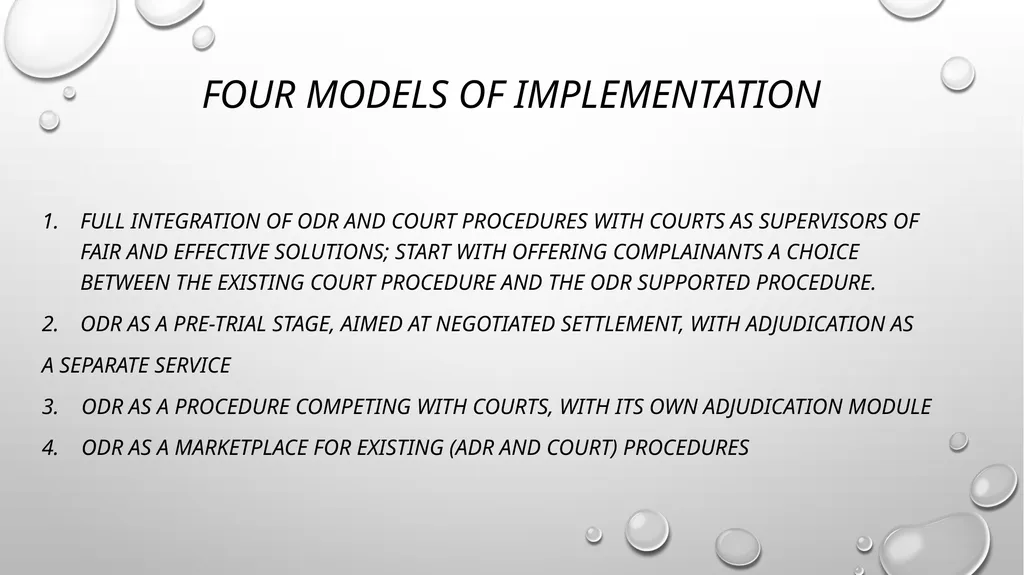
Four models of implementation Full integration of ODR and court procedures with courts as supervisors of fair and effective solutions; start with offering complainants a choice between the existing court procedure and the ODR supported procedure.
ODR as a pre-trial stage, aimed at negotiated settlement, with adjudication as
a separate service
3. ODR as a procedure competing with courts, with its own adjudication module
4. ODR as a marketplace for existing (ADR and court) procedures<br>
ODR as a pre-trial stage, aimed at negotiated settlement, with adjudication as
a separate service
3. ODR as a procedure competing with courts, with its own adjudication module
4. ODR as a marketplace for existing (ADR and court) procedures<br>
08
2016 report: THE PROMISE OF ODR Helping clients to navigate procedures
Designing justice journeys from the user perspective
The promise of fairness
The promise of humanizing the delivery of justice
The promise of financial sustainability and growth
The promise of partnership and scale<br>
Designing justice journeys from the user perspective
The promise of fairness
The promise of humanizing the delivery of justice
The promise of financial sustainability and growth
The promise of partnership and scale<br>
09
2016 report ISSUES TO BE RESOLVED Legislative space and framework
Investing, selling and buying by independent courts
risks of implementation
Engaging the legal profession
Can the challenges be overcome?<br>
Investing, selling and buying by independent courts
risks of implementation
Engaging the legal profession
Can the challenges be overcome?<br>
10
2016 report “A Court Compass for Litigants” What is “coordination” and why is that important and challenging for courts?
Why family law for the pilot proposal?
What did the “Cases Without Counsel” findings indicate? (p.6)
How does the Netherlands' process ensure fairness?
How would this create a “hub” for other processes?<br>
Why family law for the pilot proposal?
What did the “Cases Without Counsel” findings indicate? (p.6)
How does the Netherlands' process ensure fairness?
How would this create a “hub” for other processes?<br>
11
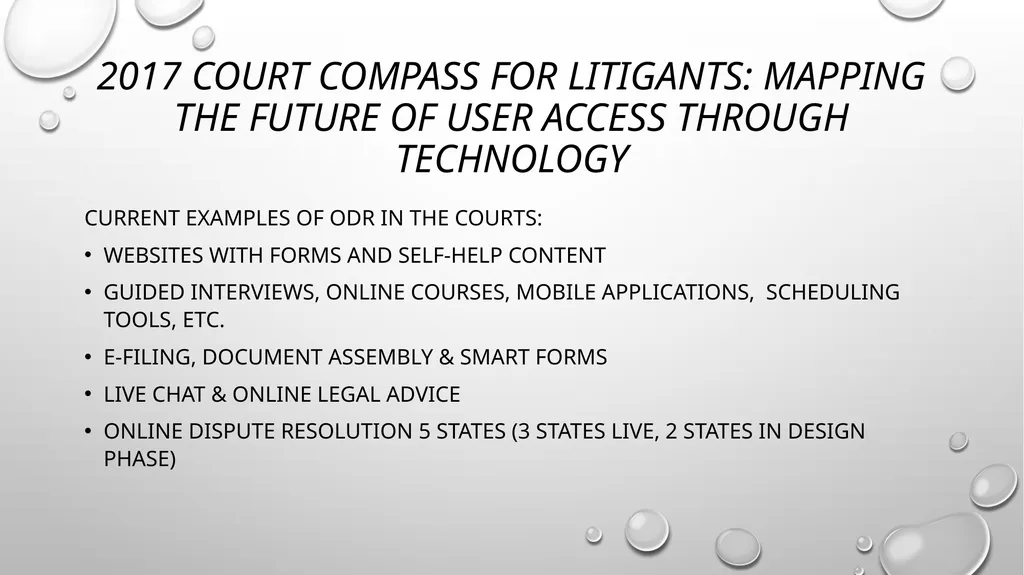
2017 Court Compass for Litigants: MAPPING THE FUTURE OF USER ACCESS THROUGH TECHNOLOGY Current Examples of ODR in the courts:
Websites with Forms and Self-Help Content
Guided Interviews, Online Courses, Mobile Applications, Scheduling Tools, etc.
E-Filing, Document Assembly & Smart Forms
Live Chat & Online Legal Advice
Online Dispute Resolution 5 States (3 States Live, 2 States in Design Phase)<br>
Websites with Forms and Self-Help Content
Guided Interviews, Online Courses, Mobile Applications, Scheduling Tools, etc.
E-Filing, Document Assembly & Smart Forms
Live Chat & Online Legal Advice
Online Dispute Resolution 5 States (3 States Live, 2 States in Design Phase)<br>
12
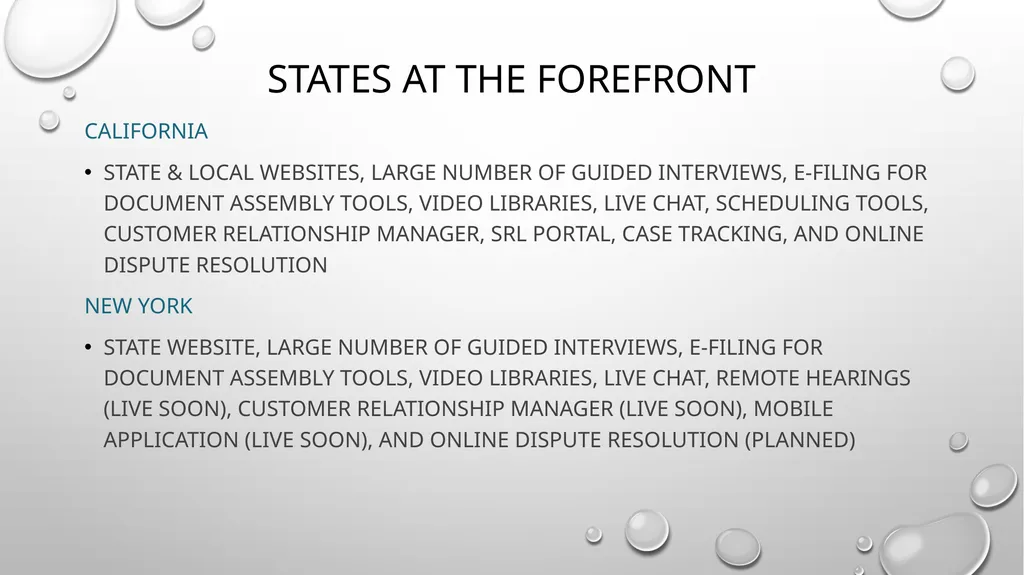
States at the forefront California
State & Local Websites, Large Number of Guided Interviews, E-Filing for Document Assembly Tools, Video Libraries, Live Chat, Scheduling Tools, Customer Relationship Manager, SRL Portal, Case Tracking, and Online Dispute Resolution
New York
State Website, Large Number of Guided Interviews, E-Filing for Document Assembly Tools, Video Libraries, Live Chat, Remote Hearings (Live Soon), Customer Relationship Manager (Live Soon), Mobile Application (Live Soon), and Online Dispute Resolution (Planned)<br>
State & Local Websites, Large Number of Guided Interviews, E-Filing for Document Assembly Tools, Video Libraries, Live Chat, Scheduling Tools, Customer Relationship Manager, SRL Portal, Case Tracking, and Online Dispute Resolution
New York
State Website, Large Number of Guided Interviews, E-Filing for Document Assembly Tools, Video Libraries, Live Chat, Remote Hearings (Live Soon), Customer Relationship Manager (Live Soon), Mobile Application (Live Soon), and Online Dispute Resolution (Planned)<br>
13
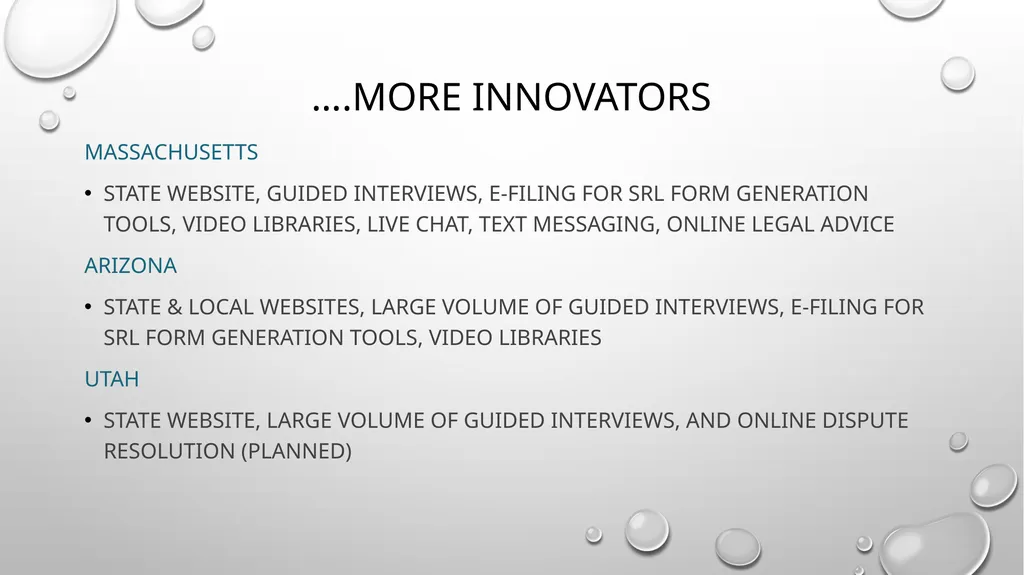
….more innovators Massachusetts
State Website, Guided Interviews, E-Filing for SRL Form Generation Tools, Video Libraries, Live Chat, Text Messaging, Online Legal Advice
Arizona
State & Local Websites, Large Volume of Guided Interviews, E-Filing for SRL Form Generation Tools, Video Libraries
Utah
State Website, Large Volume of Guided Interviews, and Online Dispute Resolution (Planned)<br>
State Website, Guided Interviews, E-Filing for SRL Form Generation Tools, Video Libraries, Live Chat, Text Messaging, Online Legal Advice
Arizona
State & Local Websites, Large Volume of Guided Interviews, E-Filing for SRL Form Generation Tools, Video Libraries
Utah
State Website, Large Volume of Guided Interviews, and Online Dispute Resolution (Planned)<br>
14
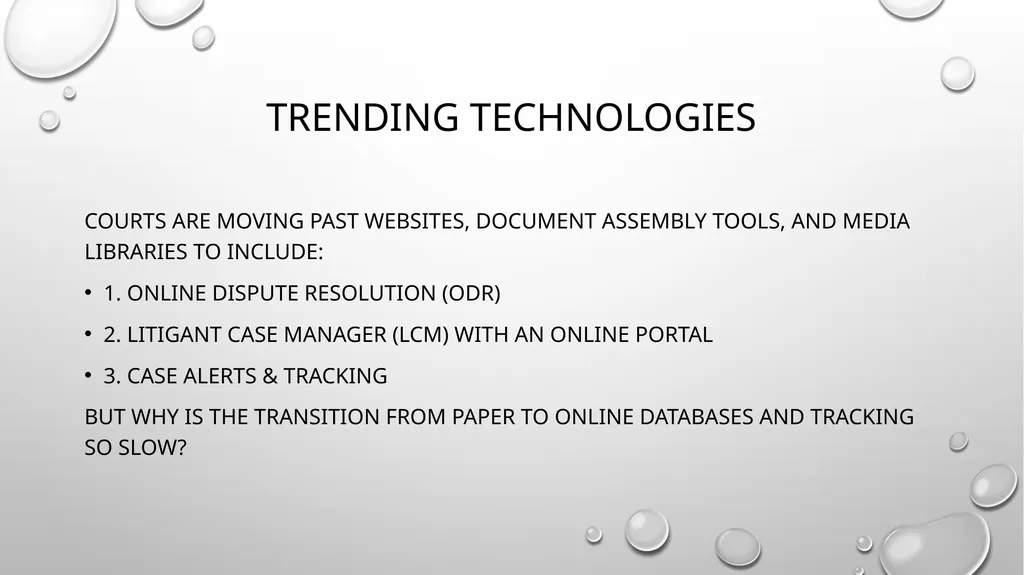
TRENDING TECHNOLOGIES Courts are moving past websites, document assembly tools, and media libraries to include:
1. Online Dispute Resolution (ODR)
2. Litigant Case Manager (LCM) with an Online Portal
3. Case Alerts & Tracking
But why is the transition from paper to online databases and tracking so slow?<br>
1. Online Dispute Resolution (ODR)
2. Litigant Case Manager (LCM) with an Online Portal
3. Case Alerts & Tracking
But why is the transition from paper to online databases and tracking so slow?<br>
15
In the United States, the following ODR initiatives are underway: 1. Consumer Complaints with Los Angeles County Department of Consumer and Business Affairs’ eComplaint System
2. Small Claims Mediation with Franklin County, Ohio, using Court Innovation, Inc.’s Matterhorn
3. Traffic Infractions in several Michigan County Courts using Court Innovation, Inc.’s Matterhorn
4. Consumer Debt Mediation in New York Courts using a proprietary system (in design phase)
5. Small Claims Mediation in Utah Courts using a proprietary system (in design phase)
6. Family Law Mediation in San Mateo, California, using a proprietary system (in planning phase)<br>
2. Small Claims Mediation with Franklin County, Ohio, using Court Innovation, Inc.’s Matterhorn
3. Traffic Infractions in several Michigan County Courts using Court Innovation, Inc.’s Matterhorn
4. Consumer Debt Mediation in New York Courts using a proprietary system (in design phase)
5. Small Claims Mediation in Utah Courts using a proprietary system (in design phase)
6. Family Law Mediation in San Mateo, California, using a proprietary system (in planning phase)<br>
16
Design needs: First, the platforms should allow non-technical resources to create new processes, update questionnaires, workflows, and documents through an intuitive user interface. A system that can only be updated or deployed by technical resources or through code change will become an obstacle to progress.
Second, the platforms should have an integration framework that allows a free flow and exchange of data and documents between the ODR solution and external systems, similar to court, legal aid, and case management systems.<br>
Second, the platforms should have an integration framework that allows a free flow and exchange of data and documents between the ODR solution and external systems, similar to court, legal aid, and case management systems.<br>
17
Dealing with costs!? 1. Public-private partnerships that encourage for-profit entities to develop more sophisticated solutions at low or no startup costs to courts.
2. Courts joining in developing solutions where the development cost is shared across participating courts and internal court resources are leveraged.
3. Recognizing that expanded and more effective e-technology solutions can reduce the need for in-court personnel to assist SRLs, they may also help convince funding entities to provide resources to develop or improve programs in exchange for slowed or reduced funding in future years.
4. Consider nominal transactional fees, sliding-scale fees, or means-tested fees, with fee waivers for low income filers to support development of programs or expansion of content or functionality.<br>
2. Courts joining in developing solutions where the development cost is shared across participating courts and internal court resources are leveraged.
3. Recognizing that expanded and more effective e-technology solutions can reduce the need for in-court personnel to assist SRLs, they may also help convince funding entities to provide resources to develop or improve programs in exchange for slowed or reduced funding in future years.
4. Consider nominal transactional fees, sliding-scale fees, or means-tested fees, with fee waivers for low income filers to support development of programs or expansion of content or functionality.<br>
18
Case Studies in ODR for Courts: A view from the front lines No one odr system has set a clear standard as a model
Odr systems in us courts have been highly contextual
Political and economic issues have created hurdles to court odr
Hope remains that courts will begin to embrace odr where appropriate
Odr may not be proper for complex cases and courts are still necessary!<br>
Odr systems in us courts have been highly contextual
Political and economic issues have created hurdles to court odr
Hope remains that courts will begin to embrace odr where appropriate
Odr may not be proper for complex cases and courts are still necessary!<br>
19
Franklin County, OH -- Small Claims Court Franklin’s ODR platform for small claims went live in 2016. The platform allows for the resolution of any civil dispute--including city tax, small claims, and landlord-tenant--under $6,000. Users have a “Negotiation Space” on the platform which allows them to send asynchronous messages and documents and to send or accept offers to reach agreement and send it to the court.
The City of Columbus is the highest volume user. Prior to implementation of ODR, 55% of defendants failed to appear. Now, of the 78% of cases handled through ODR, 55% result in a short-term payment solution that ends with 55% of cases being fully dismissed, and 23% result in a long-term payment plan. Data also shows that 30% of users access the platform outside of traditional business hours, and another 17% do so from locations that would have otherwise made traditional resolution impractical<br>
The City of Columbus is the highest volume user. Prior to implementation of ODR, 55% of defendants failed to appear. Now, of the 78% of cases handled through ODR, 55% result in a short-term payment solution that ends with 55% of cases being fully dismissed, and 23% result in a long-term payment plan. Data also shows that 30% of users access the platform outside of traditional business hours, and another 17% do so from locations that would have otherwise made traditional resolution impractical<br>
20
Washtenaw County, MI -- Traffic Pleading The platform allows qualified users to plead to a reduced infraction of “impeding traffic”, thus not impacting the user’s driving record or insurance. Pleading through the online platform takes less than 15 minutes, and more than 50% of users do so via cellphone. The results have been positive: lower court administrative costs, faster resolutions, and faster and more consistent payment of fines. Prior to the program, only 51% of fines were paid within 30 days; now, that number is 92%.
for bench warrants, warrants can be recalled, and the individual can be given a new date of appearance, which has resulted in increased appearances and less burdens for police officers. The warrant system has been so successful than 30 other counties are moving toward creating a similar program.<br>
for bench warrants, warrants can be recalled, and the individual can be given a new date of appearance, which has resulted in increased appearances and less burdens for police officers. The warrant system has been so successful than 30 other counties are moving toward creating a similar program.<br>
21
Ottawa County, MI -- Family Court Ottawa is using ODR to reduce show-cause hearings and resolve non-payment of child support. Prior to the 2016 implementation, the court dealt with 100+ show-cause hearings per week. The system gives secured communication capabilities to court staff, case managers, and involved parents. It also allows for automated notifications from the court via text or email, and allows for the resolution of problems prior to the court being needed. After the first year of the program, show-cause hearings were down by 27% and related failure to appear warrants were down by 36%. Show-cause hearings are now held at court only two days per week and discussion is being held with the Office of Child Support for a statewide system.<br>
22
Utah -- Small Claims A small claims ODR system is slated for an early 2018 pilot. Unlike most other states, Utah has a unified court system, and the program will therefore be statewide. Although no special law need be passed to use ODR, some amendment to civil procedure rules and for jurisdiction will need to be adopted. Once the program is implemented, it will be the sole resolution process for small claims.<br>
23
British Columbia, Canada -- Civil Resolution Tribunal (CRT) & “MyLawBC” The CTR went live in mid-2016, offering a free “Solution Explorer” to assist in resolving issues without a formal complaint. The Explorer has been used by 10,000 people. If a claim goes forward, information stored in the Explorer is forwarded to the CRT. About 600 of the explorations went to formal claims, and most of those ended in an agreement. The ODR system can serve notice, facilitate direct negotiation, and escalate to mediation. Originally the program was voluntary, but because this ended in one party vetoing the online choice and forcing the other into costly court proceedings, the law was amended in 2015 to made participation mandatory. In June 2017, the CTR expanded and began offering ODR for claims under $5,000 CAD, with a plan to increase the claims it will process to those under $25,000 CAD
Inspired by Rechtwijzer, MyLawBC was originally a front-end self-help website. It now offers negotiation for separation agreements, and also offers advice on will and estate planning and foreclosure avoidance. Additionally, it serves victims of domestic violence by providing resources, including a safety plan. In the first year, it was used by approximately 20,000 people; by the second year, it the same amount of people had used the site within the first six months.<br>
Inspired by Rechtwijzer, MyLawBC was originally a front-end self-help website. It now offers negotiation for separation agreements, and also offers advice on will and estate planning and foreclosure avoidance. Additionally, it serves victims of domestic violence by providing resources, including a safety plan. In the first year, it was used by approximately 20,000 people; by the second year, it the same amount of people had used the site within the first six months.<br>
24
United Kingdom Ministry of Justice -- Personal Injury The Personal Injury Portal handles claims between £1,000-25,000. The portal facilitates mandatory pre-action for personal injuries in car accident, employer liability, and public liability claims by providing online document delivery, secure communications, negotiation, and ensuring victim compensation. Although the portal is mandatory, it does not preclude victims from going to court. If the victim does not agree with the settlement, he can go to court, and he will still receive the last settlement offer.
Insurance companies paid for the initial development and implementation of the system, believing it would be cheaper than court; it is currently free to users but may move to a user-payer model in the future. 85% of the claims are initiated by lawyers, and although insurance companies originally foot the bill for lawyers, that has now been amended so that users must pay up to 25% of the settlement for legal fees. Reforms have capped the legal fees at £500, and that is likely to be reduced even further in the future. Because of the legal caps, it seems likely that the system will move toward being pro se, but it is currently used mainly by insurance agents and solicitors. As of September 30, 2017 more than 5,875,000 claims have been created through the portal. Interestingly, the portal also encourages 3rd party innovation and supports a developer-tab<br>
Insurance companies paid for the initial development and implementation of the system, believing it would be cheaper than court; it is currently free to users but may move to a user-payer model in the future. 85% of the claims are initiated by lawyers, and although insurance companies originally foot the bill for lawyers, that has now been amended so that users must pay up to 25% of the settlement for legal fees. Reforms have capped the legal fees at £500, and that is likely to be reduced even further in the future. Because of the legal caps, it seems likely that the system will move toward being pro se, but it is currently used mainly by insurance agents and solicitors. As of September 30, 2017 more than 5,875,000 claims have been created through the portal. Interestingly, the portal also encourages 3rd party innovation and supports a developer-tab<br>
25
Netherlands Rechtwijzer -- Social Issues Launched in 2007, Rechtwizjer was used to facilitate self-help and mediation settlements. Originally, it was an advice and information program, but in 2014 it added an ODR component to help resolve divorce/separation, landlord-tenant, and employer issue claims. After 3 years, the program was found financially unsustainable and it dissolved. The program inspired another company to rebuild a divorce ODR system in September 2017 known as “Apart” (uitelkaar.nl).<br>
26
Online Dispute Resolution Platform in NYC I was on Steering Committee for an access to justice grant assisting nyc in creating an odr processes for debt collection cases. We considered: negotiation, mediation, and arbitration online.
In courts of limited jurisdiction, 35% of cases are consumer debt claims, and majority defendants do not answer or appear. The state received a grant from State Justice Institute to develop an ODR platform for consumer debt, however legal service providers have protested, claiming that vulnerable populations would be at risk from careless or unscrupulous creditors. The resistance to the ODR platform was so intense that the consumer program was abandoned and now the ODR pilot will feature a different case type.
What would you propose for an online dispute resolution platform, with triaging capabilities, to connect litigants with the services and resources needed to resolve their matters? Consider means for encouraging more respondents to: (1) participate in the process, thus avoiding default judgments; (2) raise objections about the validity of the debt and present legal defenses; and (3) reach a more just agreement.<br>
In courts of limited jurisdiction, 35% of cases are consumer debt claims, and majority defendants do not answer or appear. The state received a grant from State Justice Institute to develop an ODR platform for consumer debt, however legal service providers have protested, claiming that vulnerable populations would be at risk from careless or unscrupulous creditors. The resistance to the ODR platform was so intense that the consumer program was abandoned and now the ODR pilot will feature a different case type.
What would you propose for an online dispute resolution platform, with triaging capabilities, to connect litigants with the services and resources needed to resolve their matters? Consider means for encouraging more respondents to: (1) participate in the process, thus avoiding default judgments; (2) raise objections about the validity of the debt and present legal defenses; and (3) reach a more just agreement.<br>
27
… but after a great deal of work…. Legal aid attorneys quashed the project, declaring that even the use of volunteer mediators, combined with the ability of the CDRCs to file stipulations on behalf of the parties, would be “unfair” to litigant.
This was a surprise, as we believed odr would alleviate the pressure on local courts by equitably resolving matters without the need for court appearances.
Why did they conclude that this would not assist New Yorkers, particularly in the more rural and remote areas of the state? How could it harm them?<br>
This was a surprise, as we believed odr would alleviate the pressure on local courts by equitably resolving matters without the need for court appearances.
Why did they conclude that this would not assist New Yorkers, particularly in the more rural and remote areas of the state? How could it harm them?<br>
28
Missouri Exercise Be prepared to work in teams representing: MO judges; MO Bar Association; MO attorney general’s office; MO legislators; MO legal aid groups; and private tech firms interested in selling their ODR products to courts in MO. You will be negotiating to create a “plan” for how MO should and could best incorporate ODR in its courts. Consider your group’s interests, budgets, assisting society, due process concerns, etc. Be prepared for robust debates and negotiations during the class!<br>
29
Consider:
CONTOURS OF AN ACCESS TO JUSTICE DEAL KC already is a smart city: http://kcmo.gov/smartcity/
MO courts are not tech-advanced: https://www.courts.mo.gov/page.jsp?id=46542.
Which model (from those listed above) do you deem best?
What should the Elements of an access to justice covenant include?
How would stakeholders benefit and what would they lose?<br>
MO courts are not tech-advanced: https://www.courts.mo.gov/page.jsp?id=46542.
Which model (from those listed above) do you deem best?
What should the Elements of an access to justice covenant include?
How would stakeholders benefit and what would they lose?<br>
30
More questions… How should the courts and other stakeholders deal with the digital divide?
Are there constitutional issues to consider regarding public dispute resolution?
Could a project in mo serve as model for replication in other jurisdictions and subject matter areas?<br>
Are there constitutional issues to consider regarding public dispute resolution?
Could a project in mo serve as model for replication in other jurisdictions and subject matter areas?<br>