OECD - MAPS Methodology for Assessment of Procurement Systems - Assessment Tool Arun Kumar Kolsur Senior Procurement Specialist January 3, 2018 Assessment of Procurement Systems Public procurement is a crucial component of public services
"OECD - MAPS Methodology for Assessment of" is the property of its rightful owner. Permission is granted to
download and print the materials on this website for personal, non-commercial use only, and to display it
on your personal computer provided you do not modify the materials and that you retain all copyright
notices contained in the materials. By downloading content from our website, you accept the terms of this
agreement.
Presentation Transcript
01
OECD - MAPS Methodology for Assessment of Procurement Systems - Assessment Tool Arun Kumar Kolsur
Senior Procurement Specialist January 3, 2018<br>
02
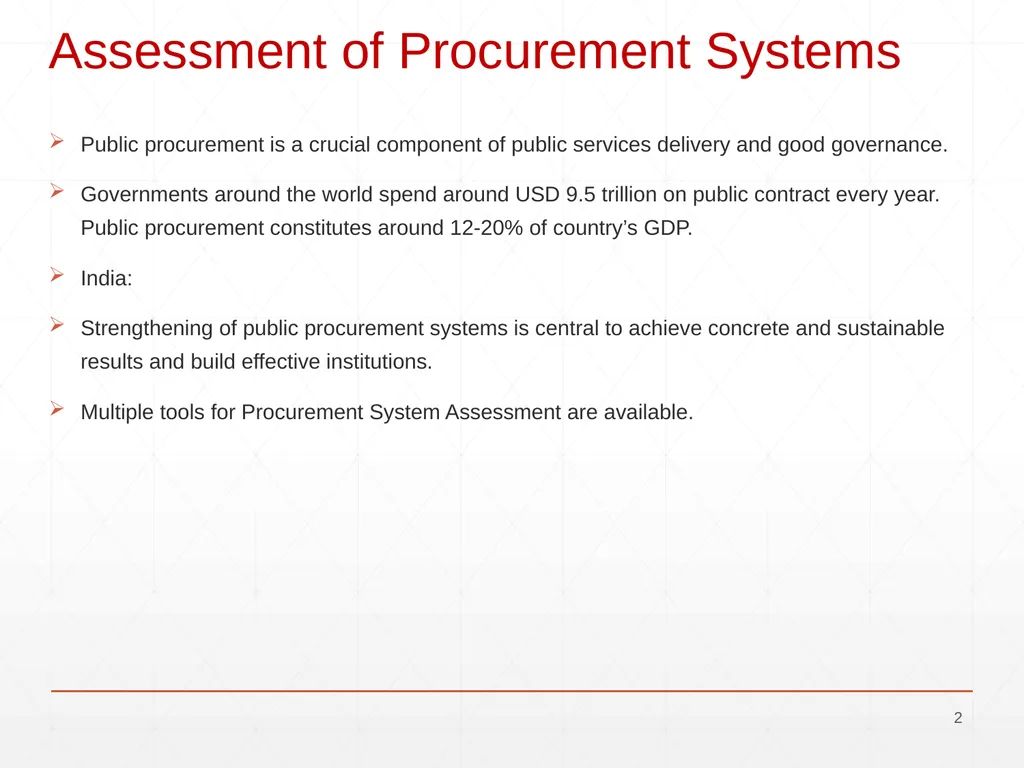
Assessment of Procurement Systems Public procurement is a crucial component of public services delivery and good governance.
Governments around the world spend around USD 9.5 trillion on public contract every year. Public procurement constitutes around 12-20% of country’s GDP.
India:
Strengthening of public procurement systems is central to achieve concrete and sustainable results and build effective institutions.
Multiple tools for Procurement System Assessment are available. 1<br>
03
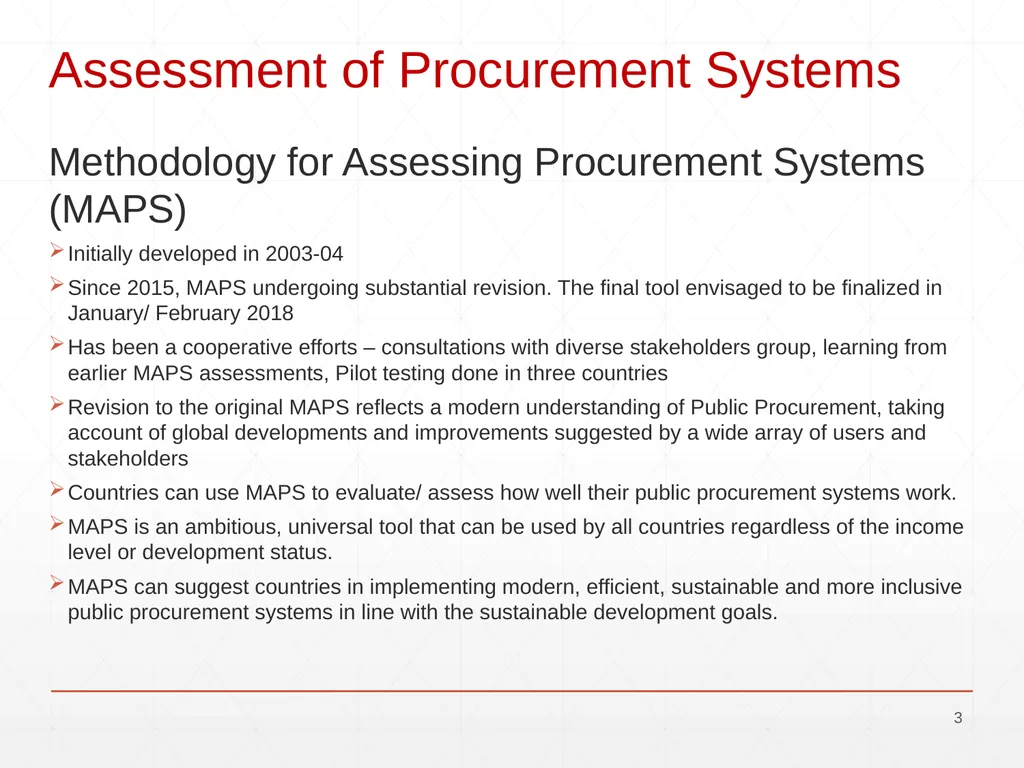
Assessment of Procurement Systems Methodology for Assessing Procurement Systems (MAPS)
Initially developed in 2003-04
Since 2015, MAPS undergoing substantial revision. The final tool envisaged to be finalized in January/ February 2018
Has been a cooperative efforts – consultations with diverse stakeholders group, learning from earlier MAPS assessments, Pilot testing done in three countries
Revision to the original MAPS reflects a modern understanding of Public Procurement, taking account of global developments and improvements suggested by a wide array of users and stakeholders
Countries can use MAPS to evaluate/ assess how well their public procurement systems work.
MAPS is an ambitious, universal tool that can be used by all countries regardless of the income level or development status.
MAPS can suggest countries in implementing modern, efficient, sustainable and more inclusive public procurement systems in line with the sustainable development goals. 2<br>
04
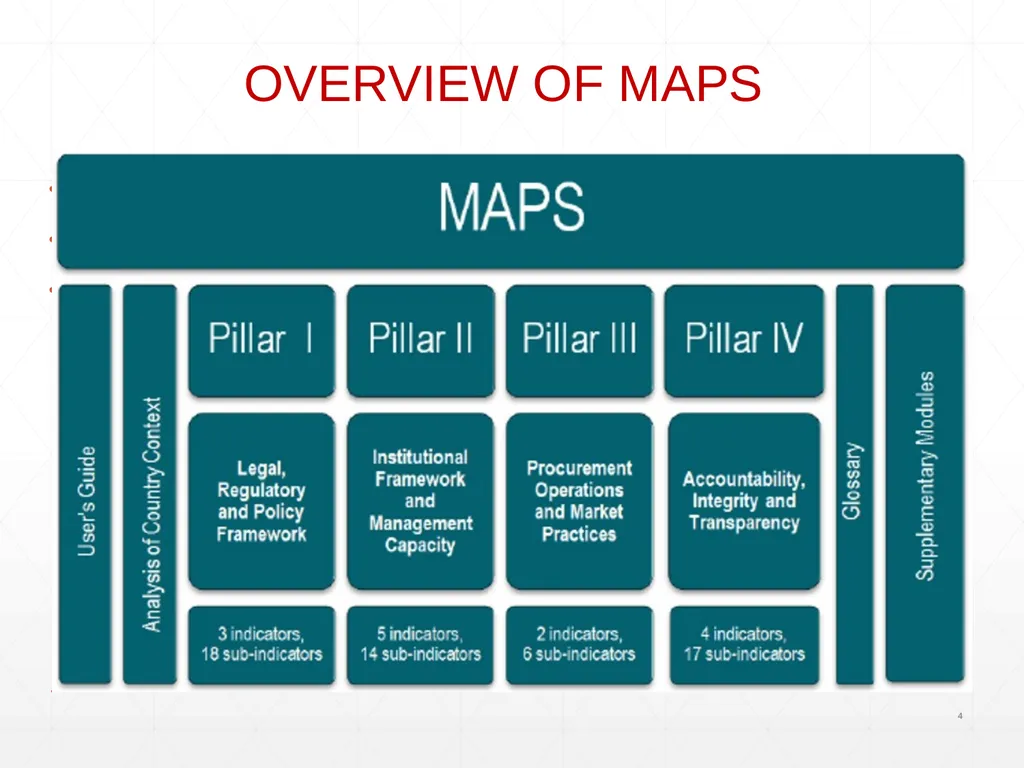
OVERVIEW OF MAPS Lorem ipsum dolor sit amet, consectetur adipiscing elit. Donec condimentum.
Lorem ipsum dolor sit amet, consectetur adipiscing elit. Donec condimentum.
Lorem ipsum dolor sit amet, consectetur adipiscing elit. Donec condimentum. 3<br>
05
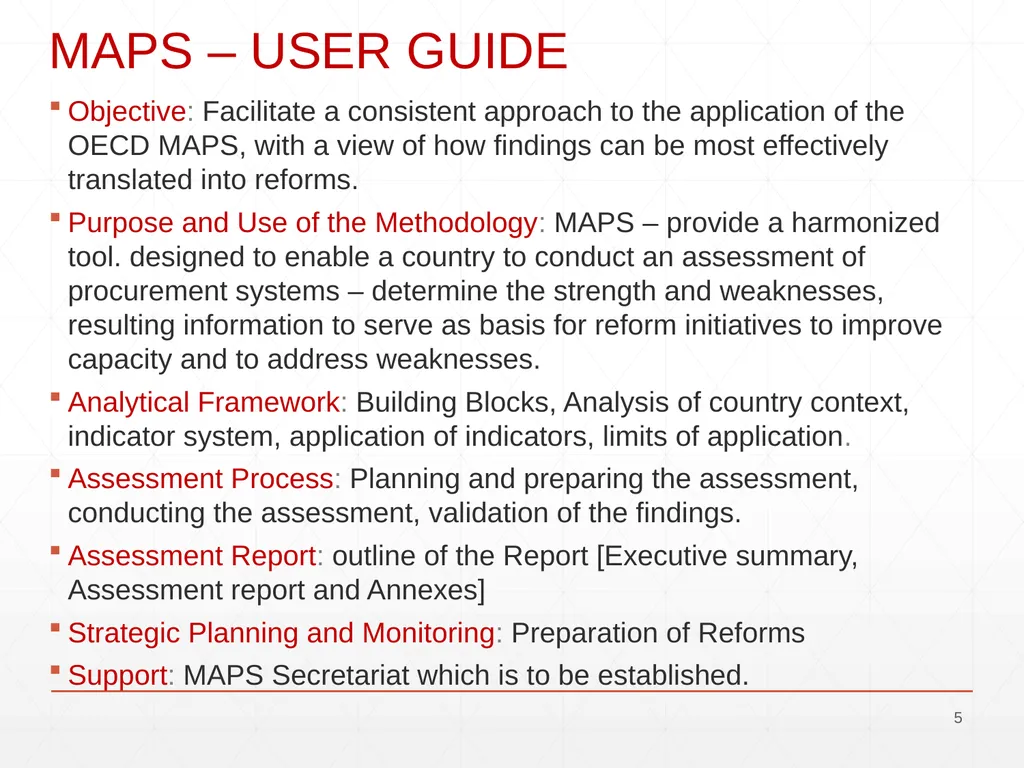
MAPS – USER GUIDE Objective: Facilitate a consistent approach to the application of the OECD MAPS, with a view of how findings can be most effectively translated into reforms.
Purpose and Use of the Methodology: MAPS – provide a harmonized tool. designed to enable a country to conduct an assessment of procurement systems – determine the strength and weaknesses, resulting information to serve as basis for reform initiatives to improve capacity and to address weaknesses.
Analytical Framework: Building Blocks, Analysis of country context, indicator system, application of indicators, limits of application.
Assessment Process: Planning and preparing the assessment, conducting the assessment, validation of the findings.
Assessment Report: outline of the Report [Executive summary, Assessment report and Annexes]
Strategic Planning and Monitoring: Preparation of Reforms
Support: MAPS Secretariat which is to be established. 4<br>
06
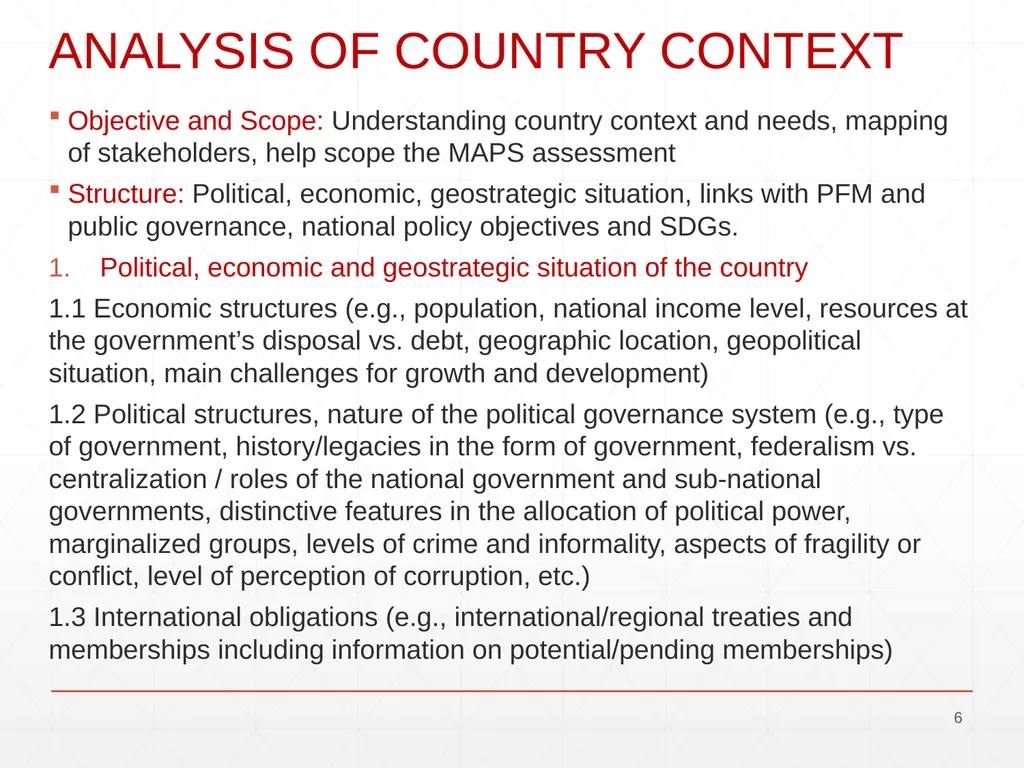
ANALYSIS OF COUNTRY CONTEXT Objective and Scope: Understanding country context and needs, mapping of stakeholders, help scope the MAPS assessment
Structure: Political, economic, geostrategic situation, links with PFM and public governance, national policy objectives and SDGs.
Political, economic and geostrategic situation of the country
1.1 Economic structures (e.g., population, national income level, resources at the government’s disposal vs. debt, geographic location, geopolitical situation, main challenges for growth and development)
1.2 Political structures, nature of the political governance system (e.g., type of government, history/legacies in the form of government, federalism vs. centralization / roles of the national government and sub-national governments, distinctive features in the allocation of political power, marginalized groups, levels of crime and informality, aspects of fragility or conflict, level of perception of corruption, etc.)
1.3 International obligations (e.g., international/regional treaties and memberships including information on potential/pending memberships) 5<br>
07
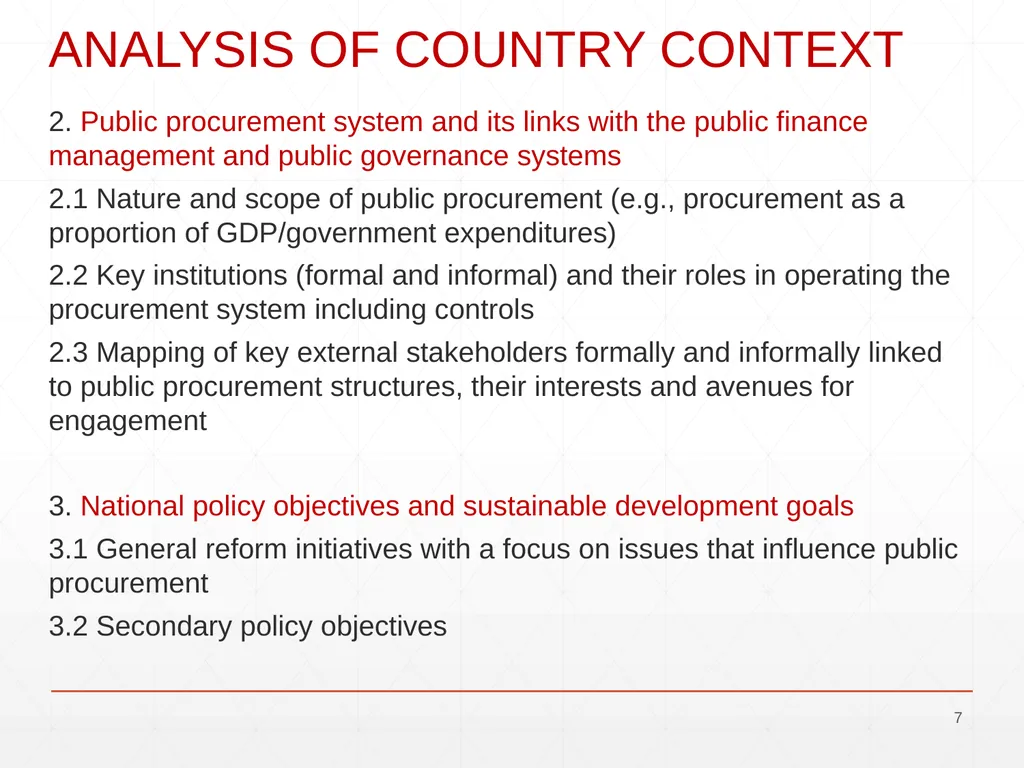
ANALYSIS OF COUNTRY CONTEXT 2. Public procurement system and its links with the public finance management and public governance systems
2.1 Nature and scope of public procurement (e.g., procurement as a proportion of GDP/government expenditures)
2.2 Key institutions (formal and informal) and their roles in operating the procurement system including controls
2.3 Mapping of key external stakeholders formally and informally linked to public procurement structures, their interests and avenues for engagement
3. National policy objectives and sustainable development goals
3.1 General reform initiatives with a focus on issues that influence public procurement
3.2 Secondary policy objectives 6<br>
08
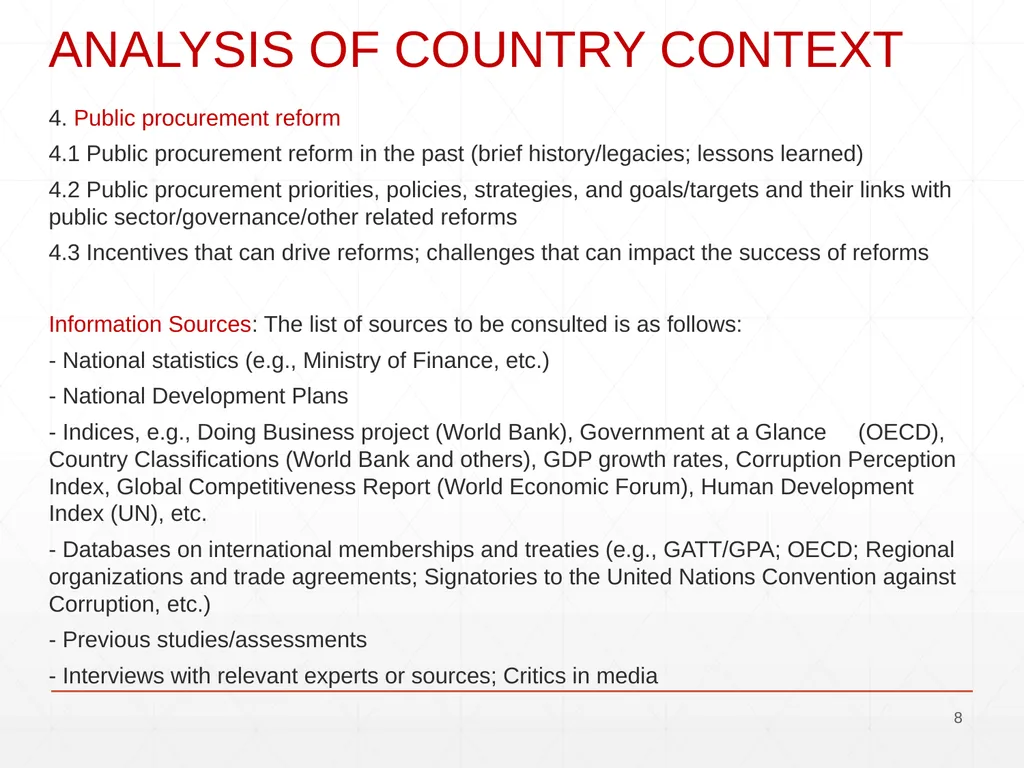
ANALYSIS OF COUNTRY CONTEXT 4. Public procurement reform
4.1 Public procurement reform in the past (brief history/legacies; lessons learned)
4.2 Public procurement priorities, policies, strategies, and goals/targets and their links with public sector/governance/other related reforms
4.3 Incentives that can drive reforms; challenges that can impact the success of reforms
Information Sources: The list of sources to be consulted is as follows:
- National statistics (e.g., Ministry of Finance, etc.)
- National Development Plans
- Indices, e.g., Doing Business project (World Bank), Government at a Glance (OECD), Country Classifications (World Bank and others), GDP growth rates, Corruption Perception Index, Global Competitiveness Report (World Economic Forum), Human Development Index (UN), etc.
- Databases on international memberships and treaties (e.g., GATT/GPA; OECD; Regional organizations and trade agreements; Signatories to the United Nations Convention against Corruption, etc.)
- Previous studies/assessments
- Interviews with relevant experts or sources; Critics in media 7<br>
09
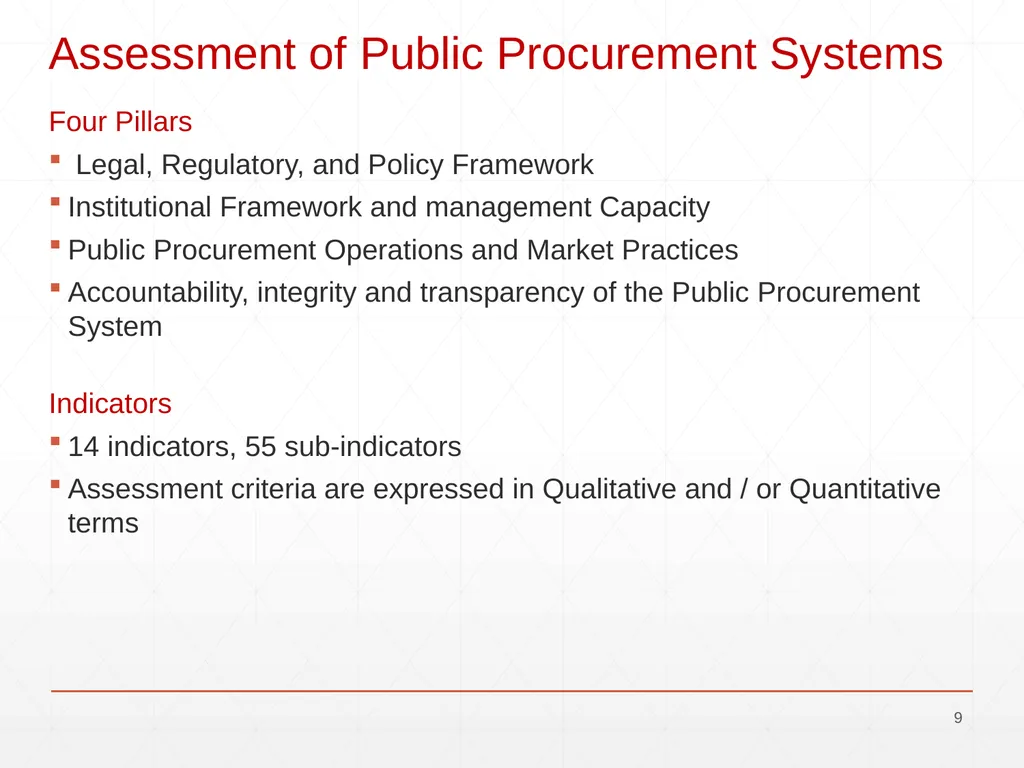
Assessment of Public Procurement Systems Four Pillars
Legal, Regulatory, and Policy Framework
Institutional Framework and management Capacity
Public Procurement Operations and Market Practices
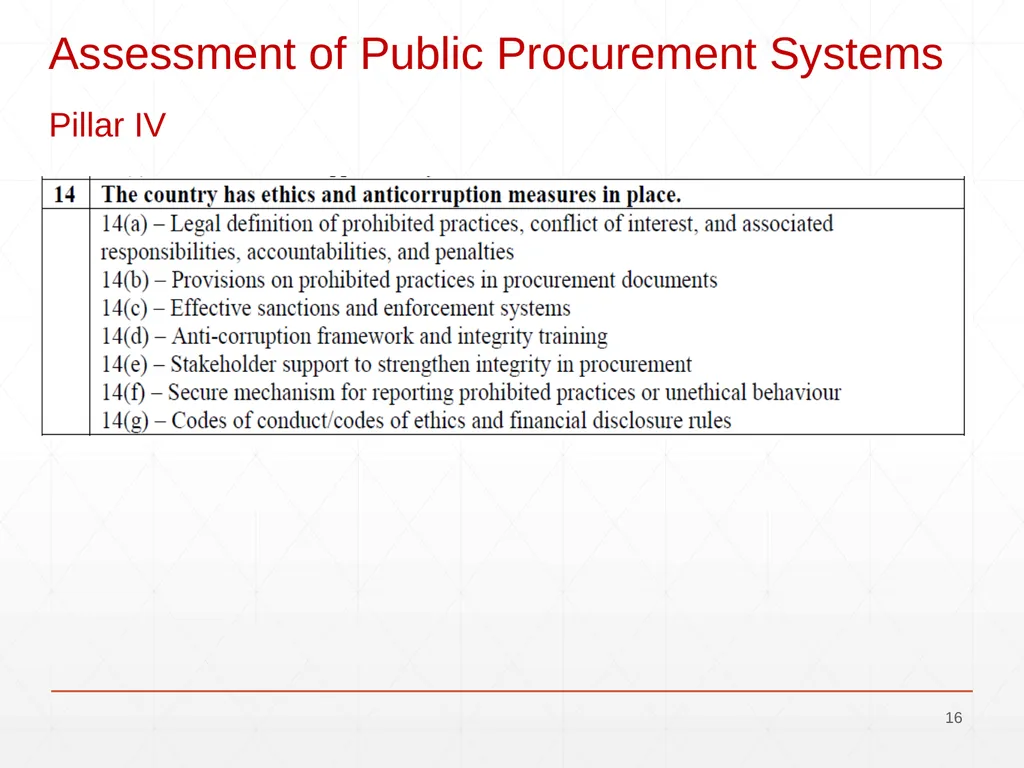
Accountability, integrity and transparency of the Public Procurement System
Indicators
14 indicators, 55 sub-indicators
Assessment criteria are expressed in Qualitative and / or Quantitative terms 8<br>
10
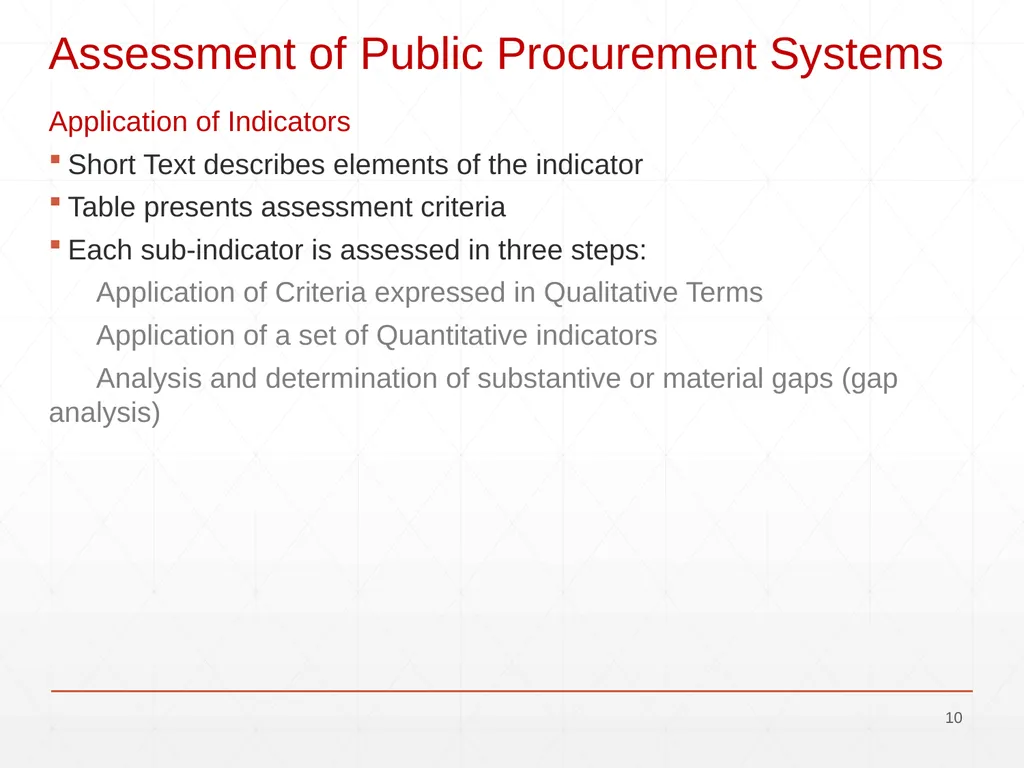
Assessment of Public Procurement Systems Application of Indicators
Short Text describes elements of the indicator
Table presents assessment criteria
Each sub-indicator is assessed in three steps:
Application of Criteria expressed in Qualitative Terms
Application of a set of Quantitative indicators
Analysis and determination of substantive or material gaps (gap analysis) 9<br>
11
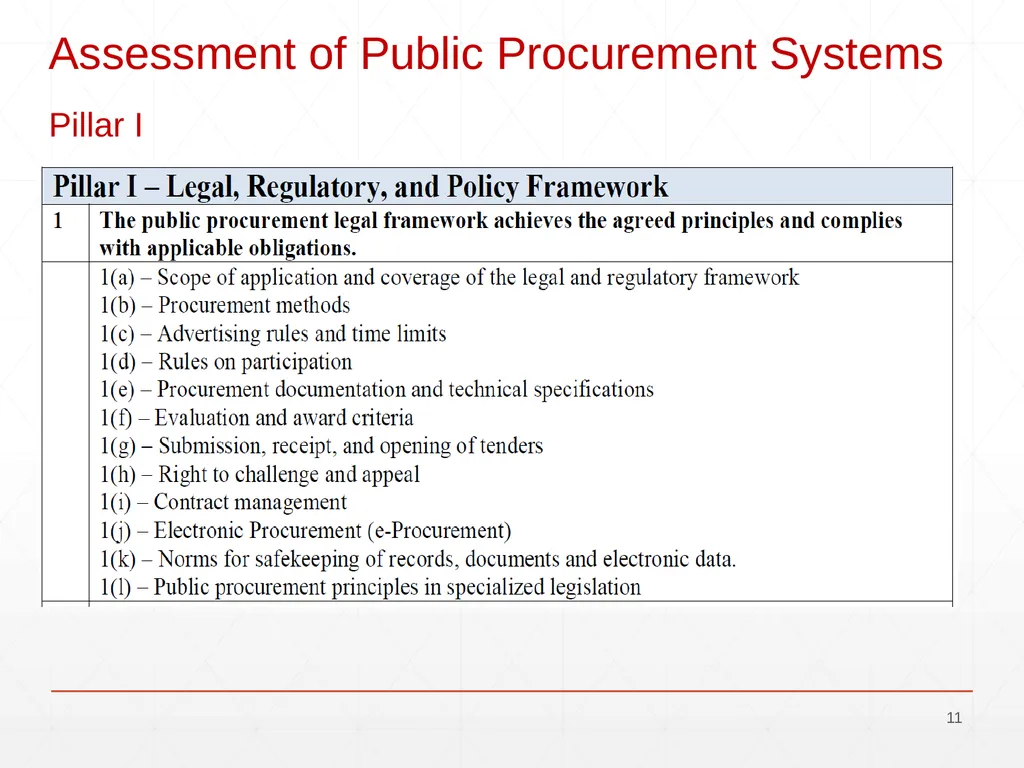
Assessment of Public Procurement Systems Pillar I 10<br>
12
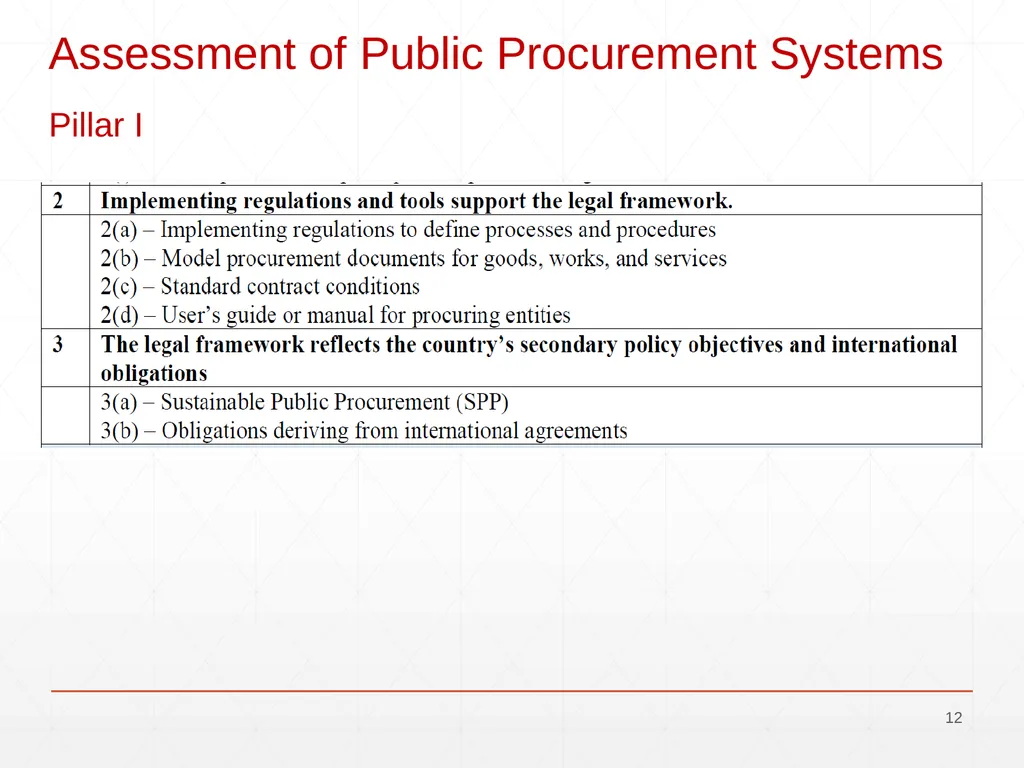
Assessment of Public Procurement Systems Pillar I 11<br>
13
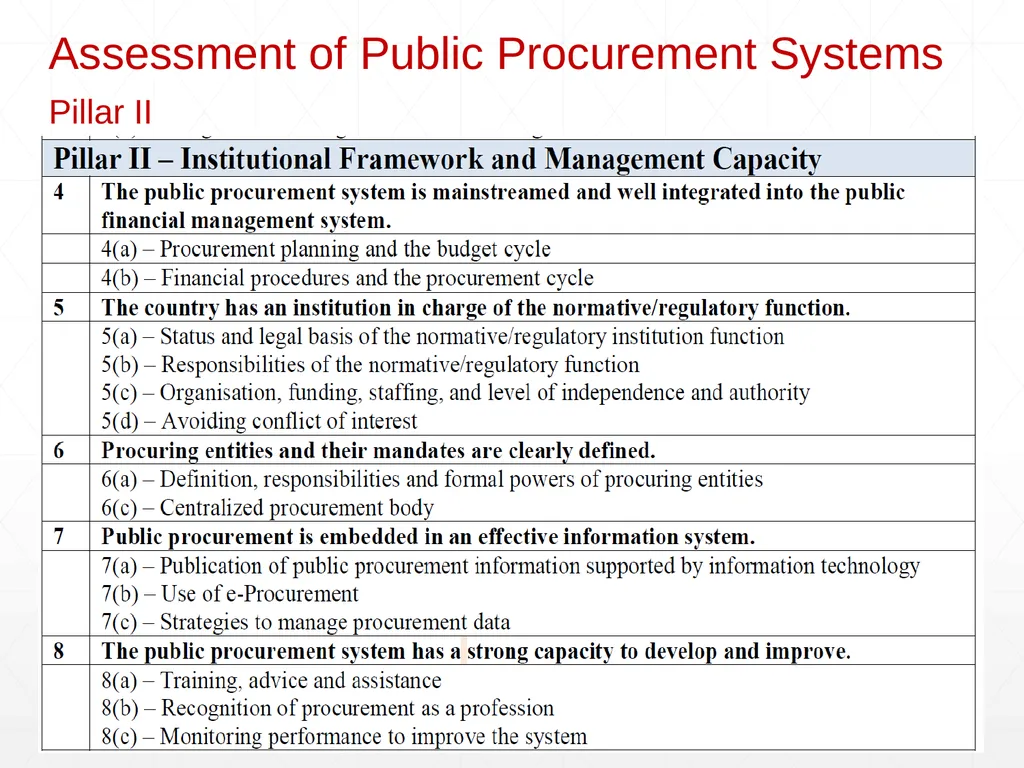
Assessment of Public Procurement Systems Pillar II 12<br>
14
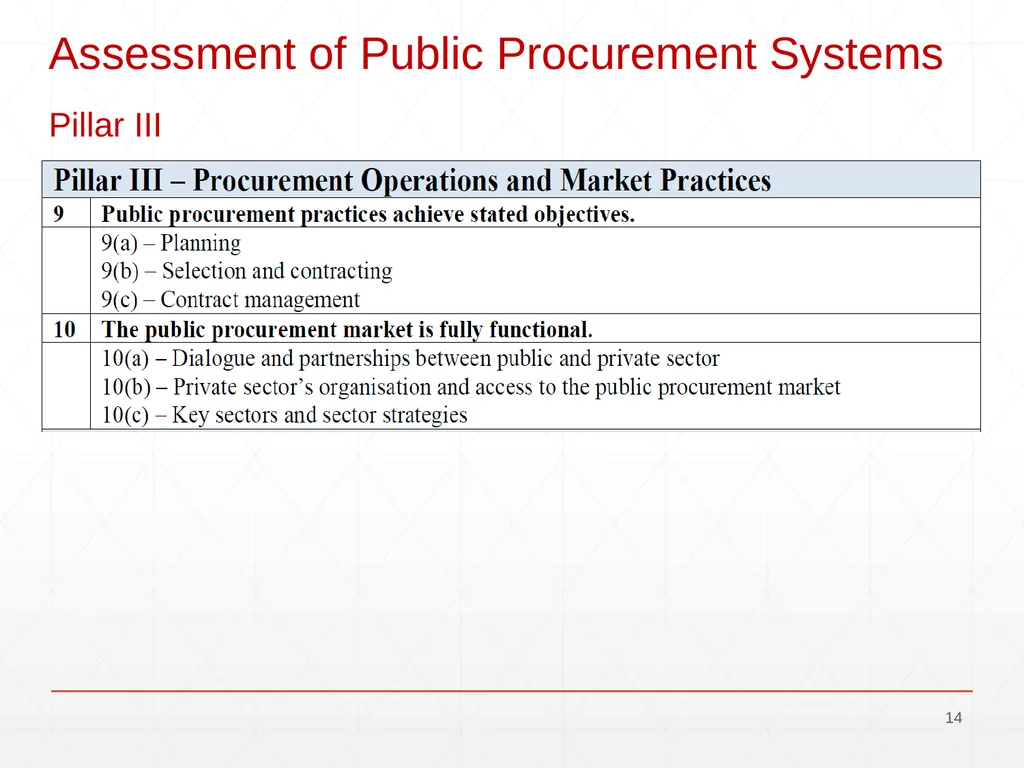
Assessment of Public Procurement Systems Pillar III 13<br>
15
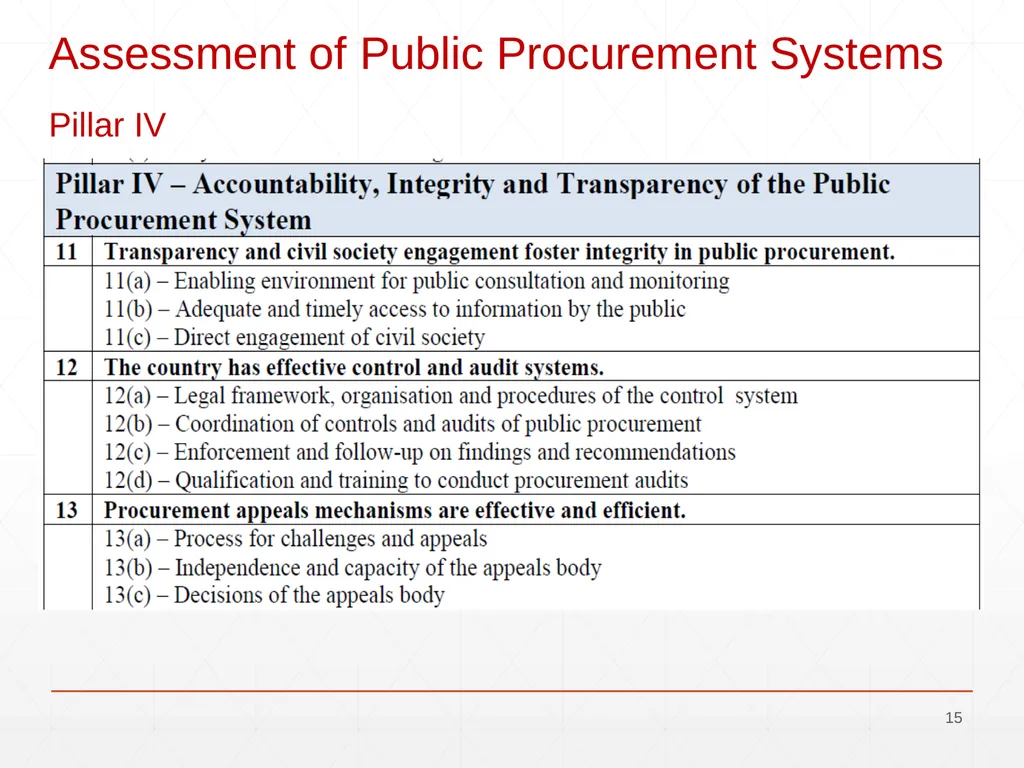
Assessment of Public Procurement Systems Pillar IV 14<br>
16
Assessment of Public Procurement Systems Pillar IV 15<br>