
Oklahoma Incentive Evaluation Commission Criteria
MS
Published · 33 slides · 0 views
1 / 1
Description
Oklahoma Incentive Evaluation Commission Criteria for Evaluation and Project Update PFM Group Consulting LLC. 1735 Market St. 43rd Floor Philadelphia, PA 19103 (267) 713-0700 pfm.com January 20, 2022 Randall Bauer, Director Todays Agenda
Related Topics
Share
Embed code
Download this presentation From Below
"Oklahoma Incentive Evaluation Commission Criteria" is the property of its rightful owner. Permission is granted to download and print the materials on this website for personal, non-commercial use only, and to display it on your personal computer provided you do not modify the materials and that you retain all copyright notices contained in the materials. By downloading content from our website, you accept the terms of this agreement.
Presentation Transcript
01
Oklahoma Incentive Evaluation Commission Criteria for Evaluation and Project Update PFM Group Consulting LLC. 1735 Market St.
43rd Floor
Philadelphia, PA 19103 (267) 713-0700
pfm.com January 20, 2022 Randall Bauer, Director<br>
43rd Floor
Philadelphia, PA 19103 (267) 713-0700
pfm.com January 20, 2022 Randall Bauer, Director<br>
02
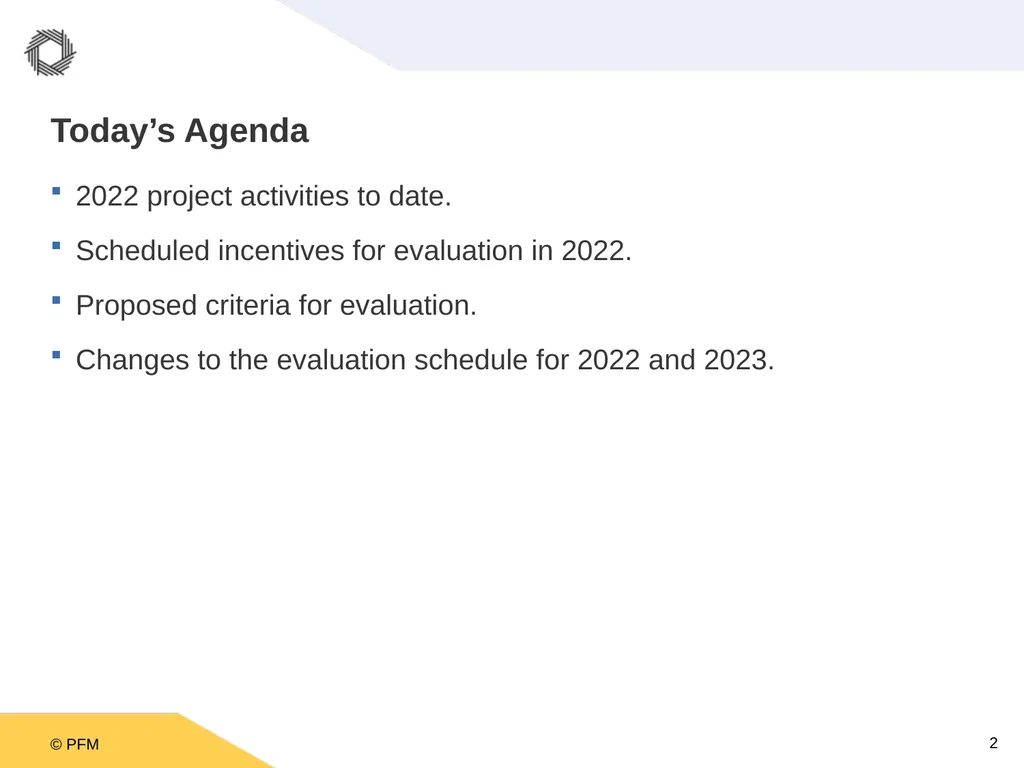
Today’s Agenda 2022 project activities to date.
Scheduled incentives for evaluation in 2022.
Proposed criteria for evaluation.
Changes to the evaluation schedule for 2022 and 2023.<br>
Scheduled incentives for evaluation in 2022.
Proposed criteria for evaluation.
Changes to the evaluation schedule for 2022 and 2023.<br>
03
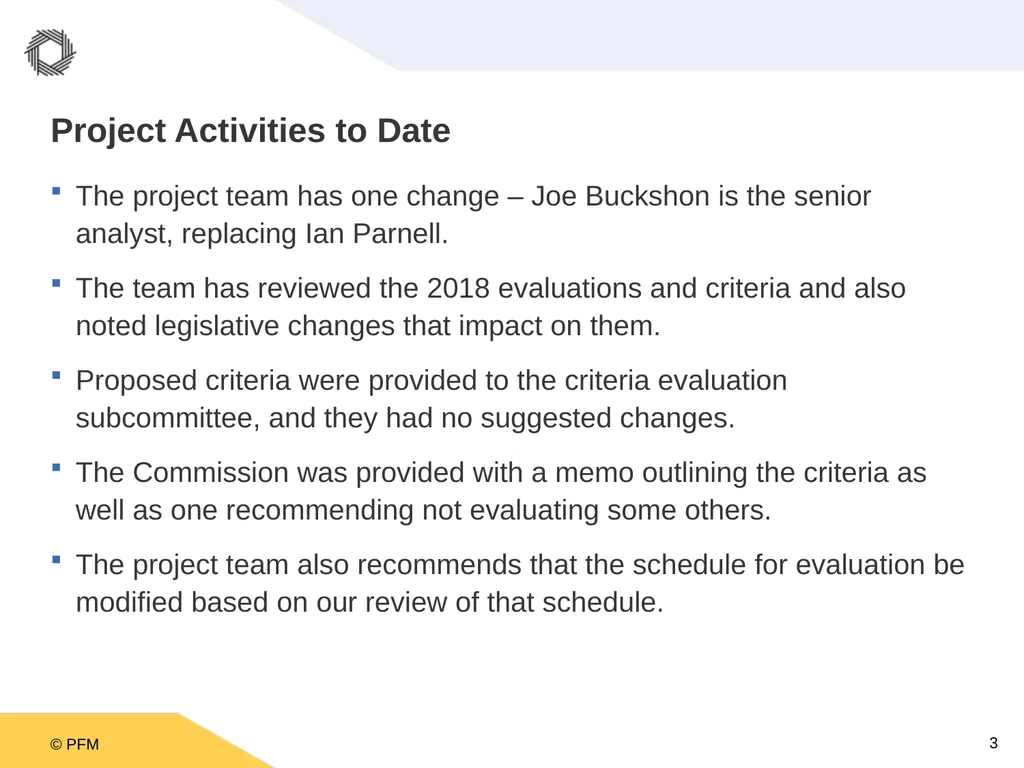
Project Activities to Date The project team has one change – Joe Buckshon is the senior analyst, replacing Ian Parnell.
The team has reviewed the 2018 evaluations and criteria and also noted legislative changes that impact on them.
Proposed criteria were provided to the criteria evaluation subcommittee, and they had no suggested changes.
The Commission was provided with a memo outlining the criteria as well as one recommending not evaluating some others.
The project team also recommends that the schedule for evaluation be modified based on our review of that schedule.<br>
The team has reviewed the 2018 evaluations and criteria and also noted legislative changes that impact on them.
Proposed criteria were provided to the criteria evaluation subcommittee, and they had no suggested changes.
The Commission was provided with a memo outlining the criteria as well as one recommending not evaluating some others.
The project team also recommends that the schedule for evaluation be modified based on our review of that schedule.<br>
04
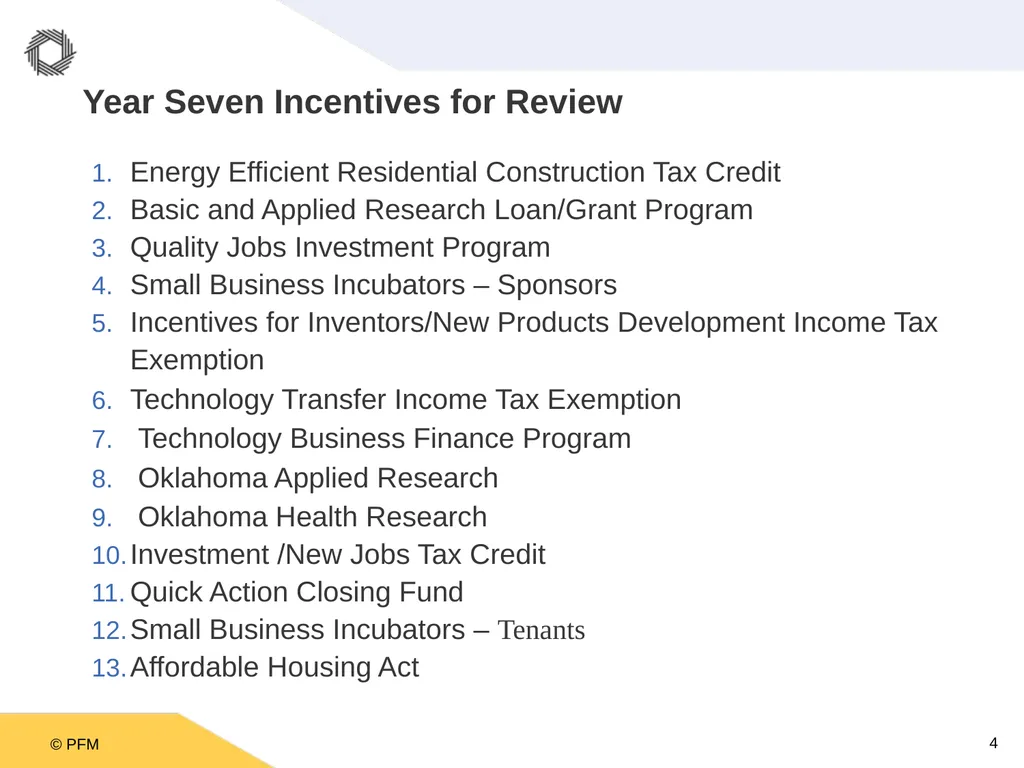
Year Seven Incentives for Review Energy Efficient Residential Construction Tax Credit
Basic and Applied Research Loan/Grant Program
Quality Jobs Investment Program
Small Business Incubators – Sponsors
Incentives for Inventors/New Products Development Income Tax Exemption
Technology Transfer Income Tax Exemption
Technology Business Finance Program
Oklahoma Applied Research
Oklahoma Health Research
Investment /New Jobs Tax Credit
Quick Action Closing Fund
Small Business Incubators – Tenants
Affordable Housing Act<br>
Basic and Applied Research Loan/Grant Program
Quality Jobs Investment Program
Small Business Incubators – Sponsors
Incentives for Inventors/New Products Development Income Tax Exemption
Technology Transfer Income Tax Exemption
Technology Business Finance Program
Oklahoma Applied Research
Oklahoma Health Research
Investment /New Jobs Tax Credit
Quick Action Closing Fund
Small Business Incubators – Tenants
Affordable Housing Act<br>
05
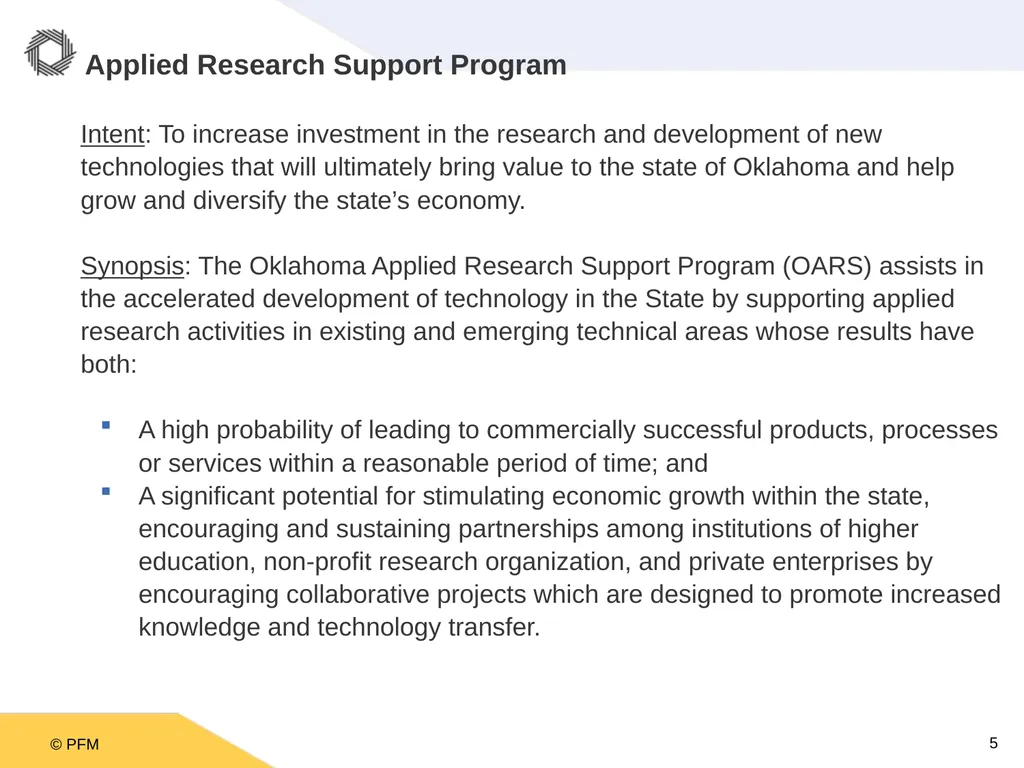
Applied Research Support Program Intent: To increase investment in the research and development of new technologies that will ultimately bring value to the state of Oklahoma and help grow and diversify the state’s economy.
Synopsis: The Oklahoma Applied Research Support Program (OARS) assists in the accelerated development of technology in the State by supporting applied research activities in existing and emerging technical areas whose results have both:
A high probability of leading to commercially successful products, processes or services within a reasonable period of time; and
A significant potential for stimulating economic growth within the state, encouraging and sustaining partnerships among institutions of higher education, non-profit research organization, and private enterprises by encouraging collaborative projects which are designed to promote increased knowledge and technology transfer.<br>
Synopsis: The Oklahoma Applied Research Support Program (OARS) assists in the accelerated development of technology in the State by supporting applied research activities in existing and emerging technical areas whose results have both:
A high probability of leading to commercially successful products, processes or services within a reasonable period of time; and
A significant potential for stimulating economic growth within the state, encouraging and sustaining partnerships among institutions of higher education, non-profit research organization, and private enterprises by encouraging collaborative projects which are designed to promote increased knowledge and technology transfer.<br>
06
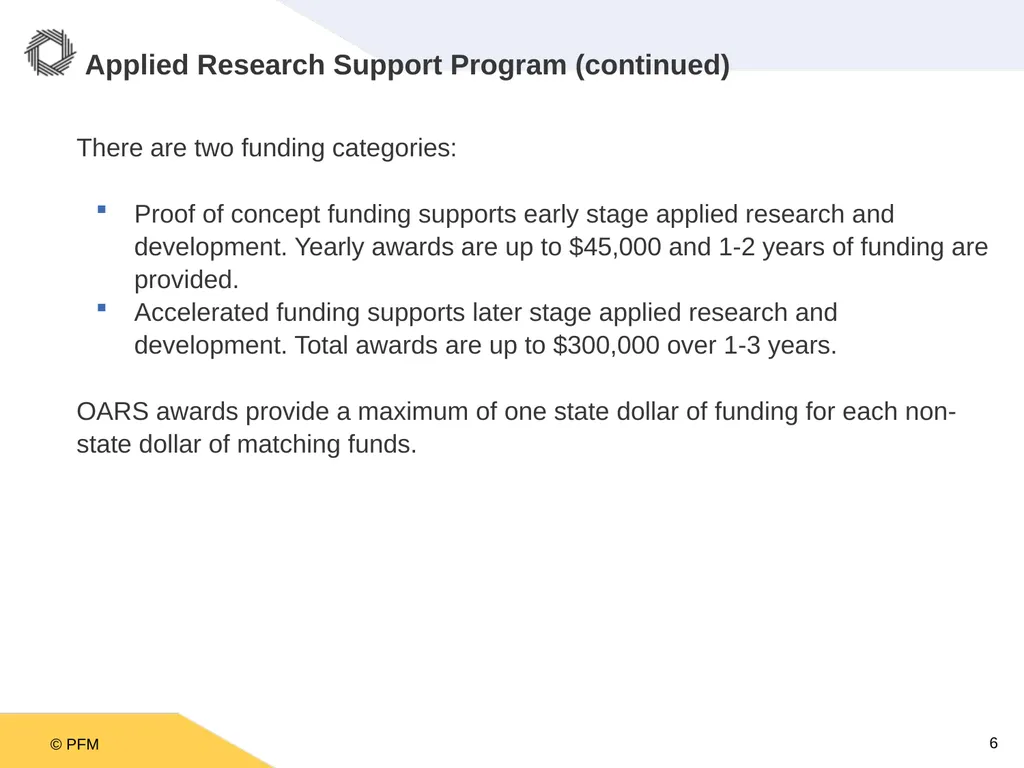
Applied Research Support Program (continued) There are two funding categories:
Proof of concept funding supports early stage applied research and development. Yearly awards are up to $45,000 and 1-2 years of funding are provided.
Accelerated funding supports later stage applied research and development. Total awards are up to $300,000 over 1-3 years.
OARS awards provide a maximum of one state dollar of funding for each non-state dollar of matching funds.<br>
Proof of concept funding supports early stage applied research and development. Yearly awards are up to $45,000 and 1-2 years of funding are provided.
Accelerated funding supports later stage applied research and development. Total awards are up to $300,000 over 1-3 years.
OARS awards provide a maximum of one state dollar of funding for each non-state dollar of matching funds.<br>
07
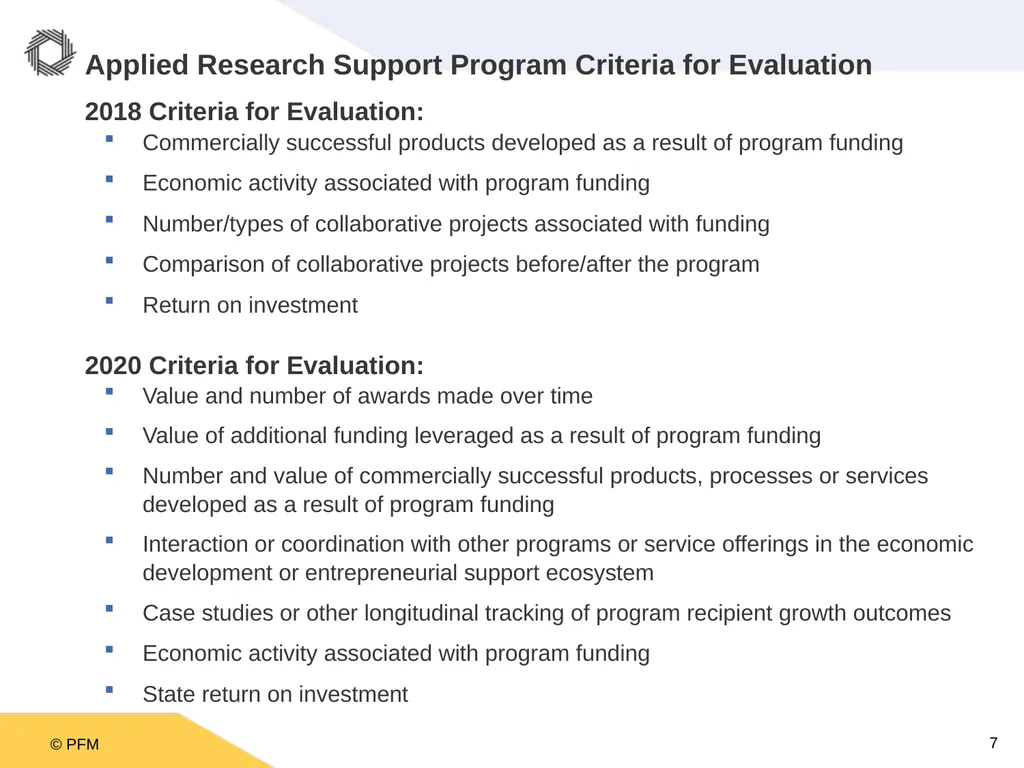
Applied Research Support Program Criteria for Evaluation 2018 Criteria for Evaluation:
Commercially successful products developed as a result of program funding
Economic activity associated with program funding
Number/types of collaborative projects associated with funding
Comparison of collaborative projects before/after the program
Return on investment
2020 Criteria for Evaluation:
Value and number of awards made over time
Value of additional funding leveraged as a result of program funding
Number and value of commercially successful products, processes or services developed as a result of program funding
Interaction or coordination with other programs or service offerings in the economic development or entrepreneurial support ecosystem
Case studies or other longitudinal tracking of program recipient growth outcomes
Economic activity associated with program funding
State return on investment<br>
Commercially successful products developed as a result of program funding
Economic activity associated with program funding
Number/types of collaborative projects associated with funding
Comparison of collaborative projects before/after the program
Return on investment
2020 Criteria for Evaluation:
Value and number of awards made over time
Value of additional funding leveraged as a result of program funding
Number and value of commercially successful products, processes or services developed as a result of program funding
Interaction or coordination with other programs or service offerings in the economic development or entrepreneurial support ecosystem
Case studies or other longitudinal tracking of program recipient growth outcomes
Economic activity associated with program funding
State return on investment<br>
08
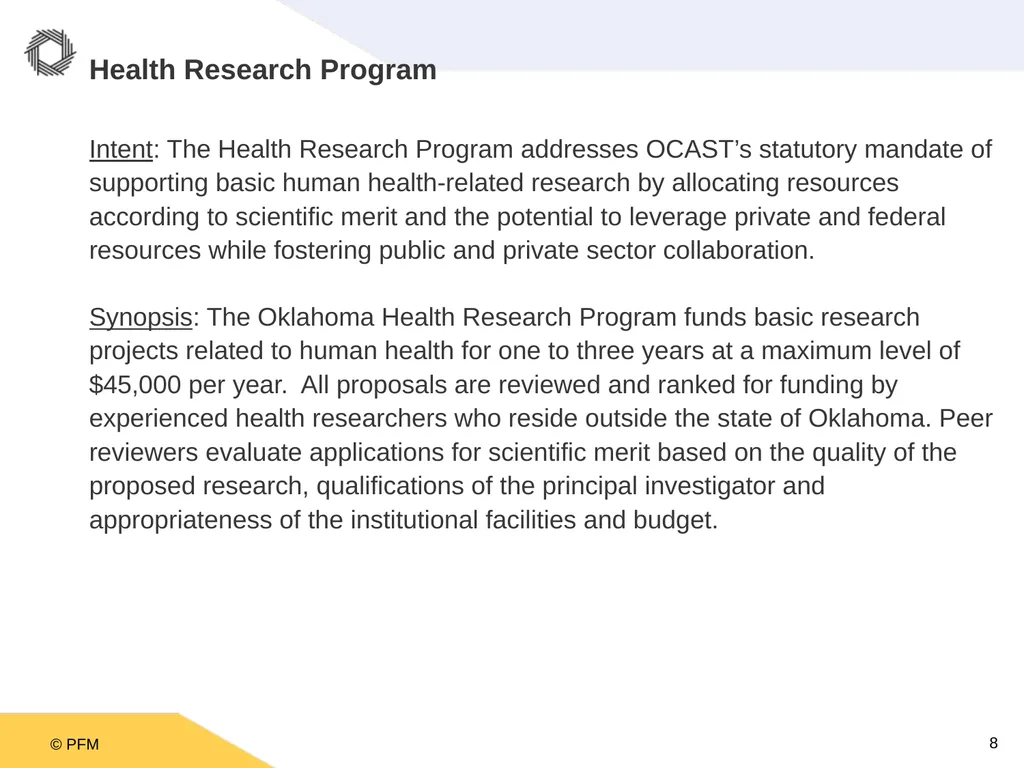
Health Research Program Intent: The Health Research Program addresses OCAST’s statutory mandate of supporting basic human health-related research by allocating resources according to scientific merit and the potential to leverage private and federal resources while fostering public and private sector collaboration.
Synopsis: The Oklahoma Health Research Program funds basic research projects related to human health for one to three years at a maximum level of $45,000 per year. All proposals are reviewed and ranked for funding by experienced health researchers who reside outside the state of Oklahoma. Peer reviewers evaluate applications for scientific merit based on the quality of the proposed research, qualifications of the principal investigator and appropriateness of the institutional facilities and budget.<br>
Synopsis: The Oklahoma Health Research Program funds basic research projects related to human health for one to three years at a maximum level of $45,000 per year. All proposals are reviewed and ranked for funding by experienced health researchers who reside outside the state of Oklahoma. Peer reviewers evaluate applications for scientific merit based on the quality of the proposed research, qualifications of the principal investigator and appropriateness of the institutional facilities and budget.<br>
09
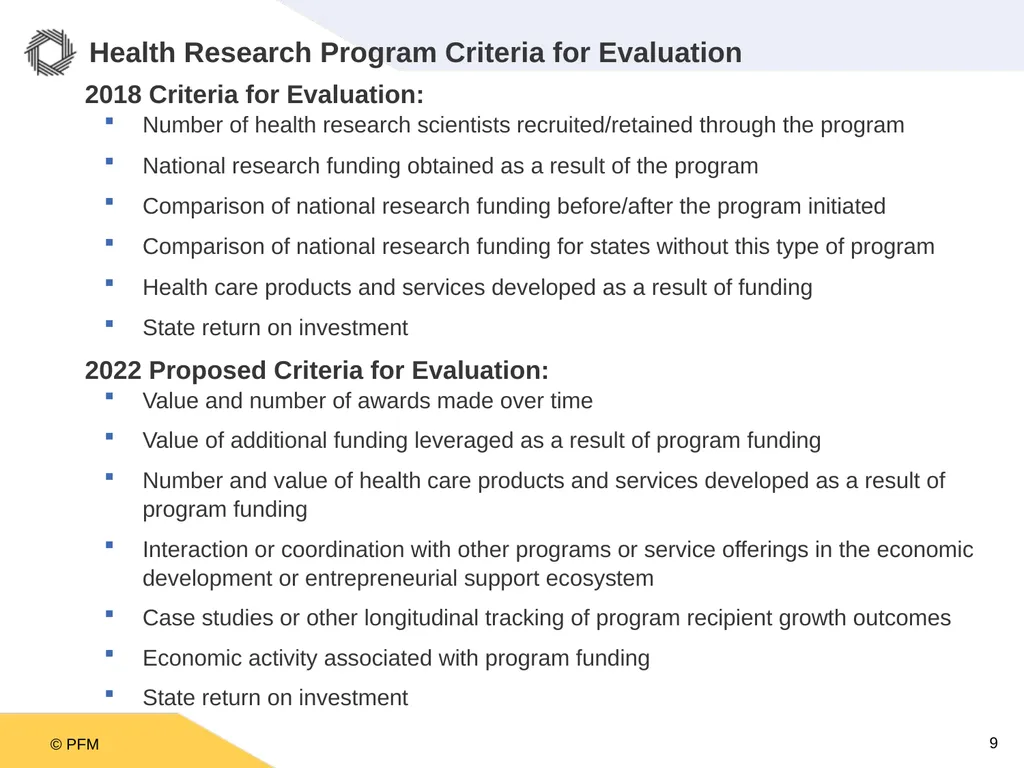
Health Research Program Criteria for Evaluation 2018 Criteria for Evaluation:
Number of health research scientists recruited/retained through the program
National research funding obtained as a result of the program
Comparison of national research funding before/after the program initiated
Comparison of national research funding for states without this type of program
Health care products and services developed as a result of funding
State return on investment
2022 Proposed Criteria for Evaluation:
Value and number of awards made over time
Value of additional funding leveraged as a result of program funding
Number and value of health care products and services developed as a result of program funding
Interaction or coordination with other programs or service offerings in the economic development or entrepreneurial support ecosystem
Case studies or other longitudinal tracking of program recipient growth outcomes
Economic activity associated with program funding
State return on investment<br>
Number of health research scientists recruited/retained through the program
National research funding obtained as a result of the program
Comparison of national research funding before/after the program initiated
Comparison of national research funding for states without this type of program
Health care products and services developed as a result of funding
State return on investment
2022 Proposed Criteria for Evaluation:
Value and number of awards made over time
Value of additional funding leveraged as a result of program funding
Number and value of health care products and services developed as a result of program funding
Interaction or coordination with other programs or service offerings in the economic development or entrepreneurial support ecosystem
Case studies or other longitudinal tracking of program recipient growth outcomes
Economic activity associated with program funding
State return on investment<br>
10
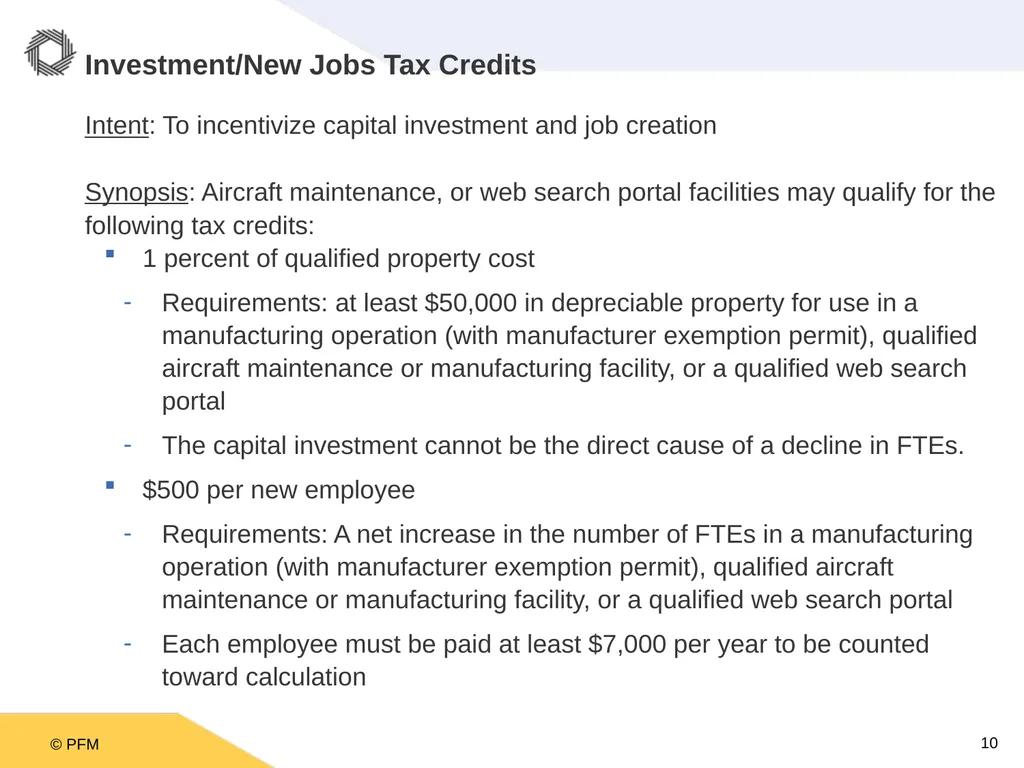
Investment/New Jobs Tax Credits Intent: To incentivize capital investment and job creation
Synopsis: Aircraft maintenance, or web search portal facilities may qualify for the following tax credits:
1 percent of qualified property cost
Requirements: at least $50,000 in depreciable property for use in a manufacturing operation (with manufacturer exemption permit), qualified aircraft maintenance or manufacturing facility, or a qualified web search portal
The capital investment cannot be the direct cause of a decline in FTEs.
$500 per new employee
Requirements: A net increase in the number of FTEs in a manufacturing operation (with manufacturer exemption permit), qualified aircraft maintenance or manufacturing facility, or a qualified web search portal
Each employee must be paid at least $7,000 per year to be counted toward calculation<br>
Synopsis: Aircraft maintenance, or web search portal facilities may qualify for the following tax credits:
1 percent of qualified property cost
Requirements: at least $50,000 in depreciable property for use in a manufacturing operation (with manufacturer exemption permit), qualified aircraft maintenance or manufacturing facility, or a qualified web search portal
The capital investment cannot be the direct cause of a decline in FTEs.
$500 per new employee
Requirements: A net increase in the number of FTEs in a manufacturing operation (with manufacturer exemption permit), qualified aircraft maintenance or manufacturing facility, or a qualified web search portal
Each employee must be paid at least $7,000 per year to be counted toward calculation<br>
11
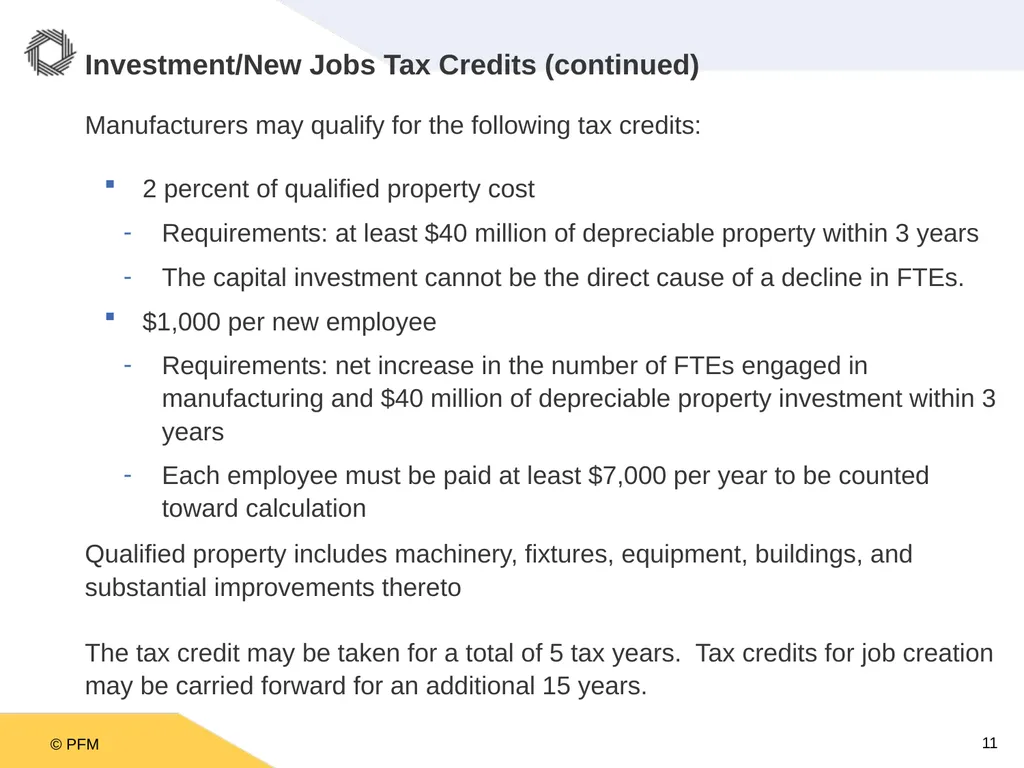
Investment/New Jobs Tax Credits (continued) Manufacturers may qualify for the following tax credits:
2 percent of qualified property cost
Requirements: at least $40 million of depreciable property within 3 years
The capital investment cannot be the direct cause of a decline in FTEs.
$1,000 per new employee
Requirements: net increase in the number of FTEs engaged in manufacturing and $40 million of depreciable property investment within 3 years
Each employee must be paid at least $7,000 per year to be counted toward calculation
Qualified property includes machinery, fixtures, equipment, buildings, and substantial improvements thereto
The tax credit may be taken for a total of 5 tax years. Tax credits for job creation may be carried forward for an additional 15 years.<br>
2 percent of qualified property cost
Requirements: at least $40 million of depreciable property within 3 years
The capital investment cannot be the direct cause of a decline in FTEs.
$1,000 per new employee
Requirements: net increase in the number of FTEs engaged in manufacturing and $40 million of depreciable property investment within 3 years
Each employee must be paid at least $7,000 per year to be counted toward calculation
Qualified property includes machinery, fixtures, equipment, buildings, and substantial improvements thereto
The tax credit may be taken for a total of 5 tax years. Tax credits for job creation may be carried forward for an additional 15 years.<br>
12
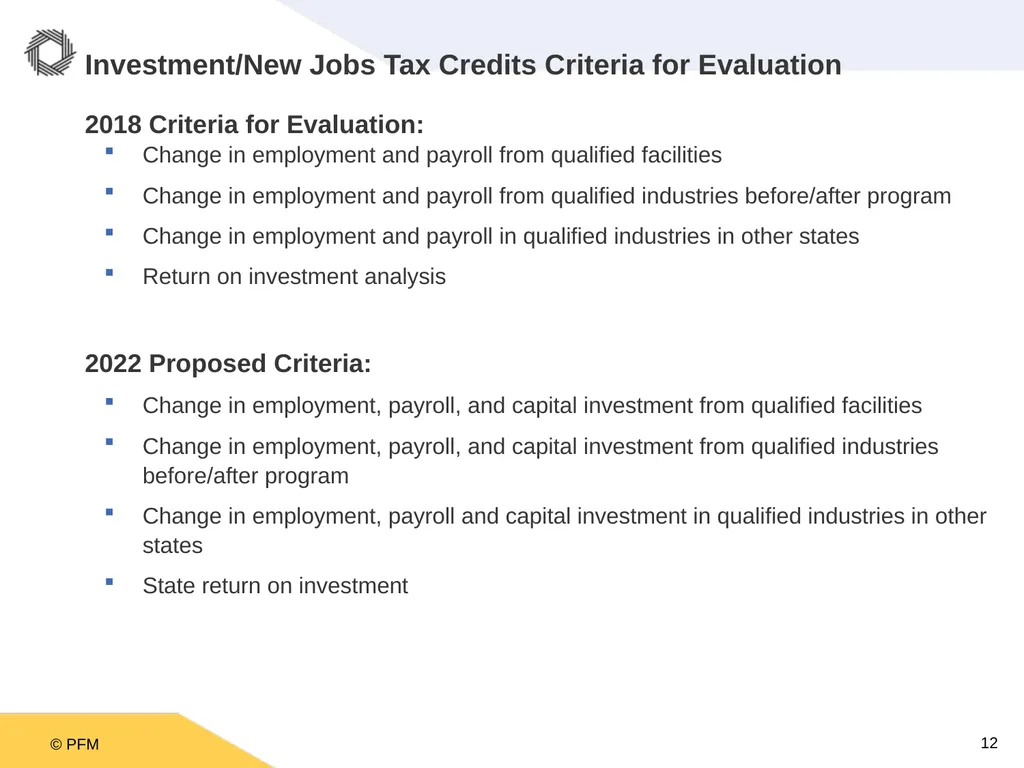
Investment/New Jobs Tax Credits Criteria for Evaluation 2018 Criteria for Evaluation:
Change in employment and payroll from qualified facilities
Change in employment and payroll from qualified industries before/after program
Change in employment and payroll in qualified industries in other states
Return on investment analysis
2022 Proposed Criteria:
Change in employment, payroll, and capital investment from qualified facilities
Change in employment, payroll, and capital investment from qualified industries before/after program
Change in employment, payroll and capital investment in qualified industries in other states
State return on investment<br>
Change in employment and payroll from qualified facilities
Change in employment and payroll from qualified industries before/after program
Change in employment and payroll in qualified industries in other states
Return on investment analysis
2022 Proposed Criteria:
Change in employment, payroll, and capital investment from qualified facilities
Change in employment, payroll, and capital investment from qualified industries before/after program
Change in employment, payroll and capital investment in qualified industries in other states
State return on investment<br>
13
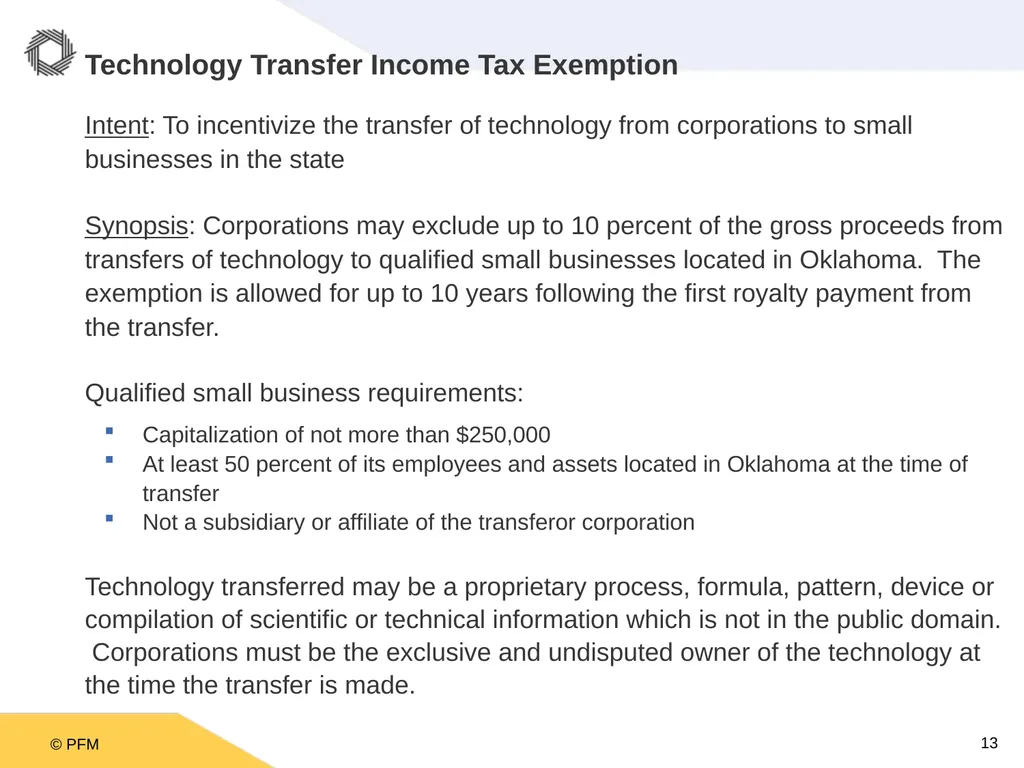
Technology Transfer Income Tax Exemption Intent: To incentivize the transfer of technology from corporations to small businesses in the state
Synopsis: Corporations may exclude up to 10 percent of the gross proceeds from transfers of technology to qualified small businesses located in Oklahoma. The exemption is allowed for up to 10 years following the first royalty payment from the transfer.
Qualified small business requirements:
Capitalization of not more than $250,000
At least 50 percent of its employees and assets located in Oklahoma at the time of transfer
Not a subsidiary or affiliate of the transferor corporation
Technology transferred may be a proprietary process, formula, pattern, device or compilation of scientific or technical information which is not in the public domain. Corporations must be the exclusive and undisputed owner of the technology at the time the transfer is made.<br>
Synopsis: Corporations may exclude up to 10 percent of the gross proceeds from transfers of technology to qualified small businesses located in Oklahoma. The exemption is allowed for up to 10 years following the first royalty payment from the transfer.
Qualified small business requirements:
Capitalization of not more than $250,000
At least 50 percent of its employees and assets located in Oklahoma at the time of transfer
Not a subsidiary or affiliate of the transferor corporation
Technology transferred may be a proprietary process, formula, pattern, device or compilation of scientific or technical information which is not in the public domain. Corporations must be the exclusive and undisputed owner of the technology at the time the transfer is made.<br>
14
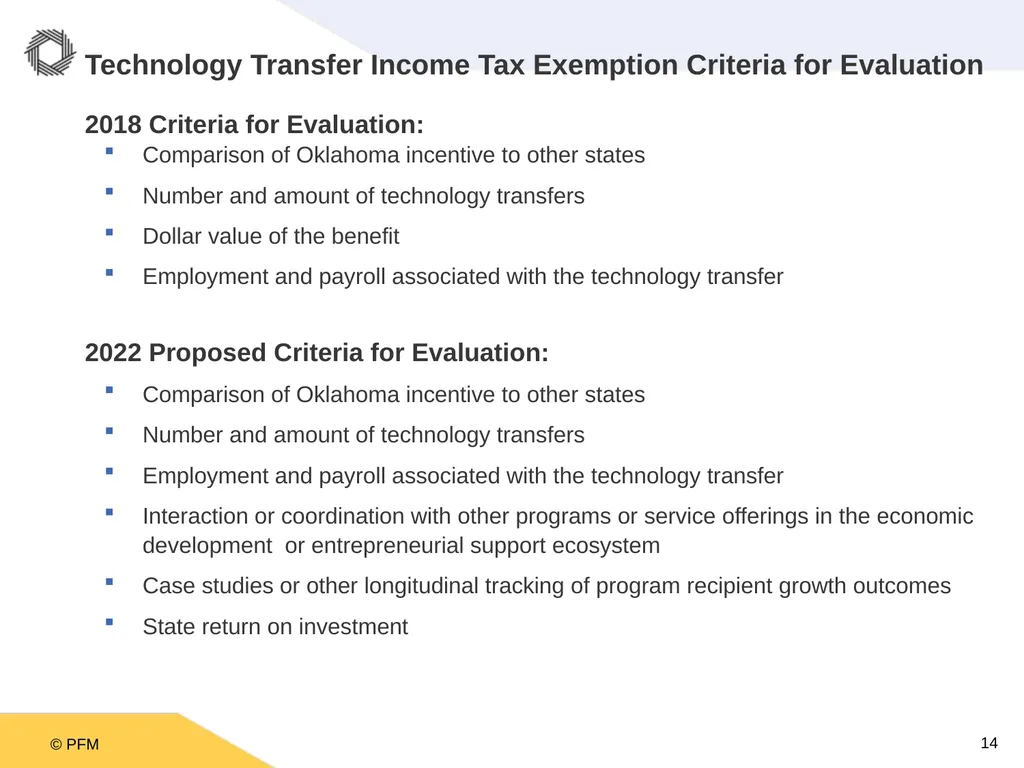
Technology Transfer Income Tax Exemption Criteria for Evaluation 2018 Criteria for Evaluation:
Comparison of Oklahoma incentive to other states
Number and amount of technology transfers
Dollar value of the benefit
Employment and payroll associated with the technology transfer
2022 Proposed Criteria for Evaluation:
Comparison of Oklahoma incentive to other states
Number and amount of technology transfers
Employment and payroll associated with the technology transfer
Interaction or coordination with other programs or service offerings in the economic development or entrepreneurial support ecosystem
Case studies or other longitudinal tracking of program recipient growth outcomes
State return on investment<br>
Comparison of Oklahoma incentive to other states
Number and amount of technology transfers
Dollar value of the benefit
Employment and payroll associated with the technology transfer
2022 Proposed Criteria for Evaluation:
Comparison of Oklahoma incentive to other states
Number and amount of technology transfers
Employment and payroll associated with the technology transfer
Interaction or coordination with other programs or service offerings in the economic development or entrepreneurial support ecosystem
Case studies or other longitudinal tracking of program recipient growth outcomes
State return on investment<br>
15
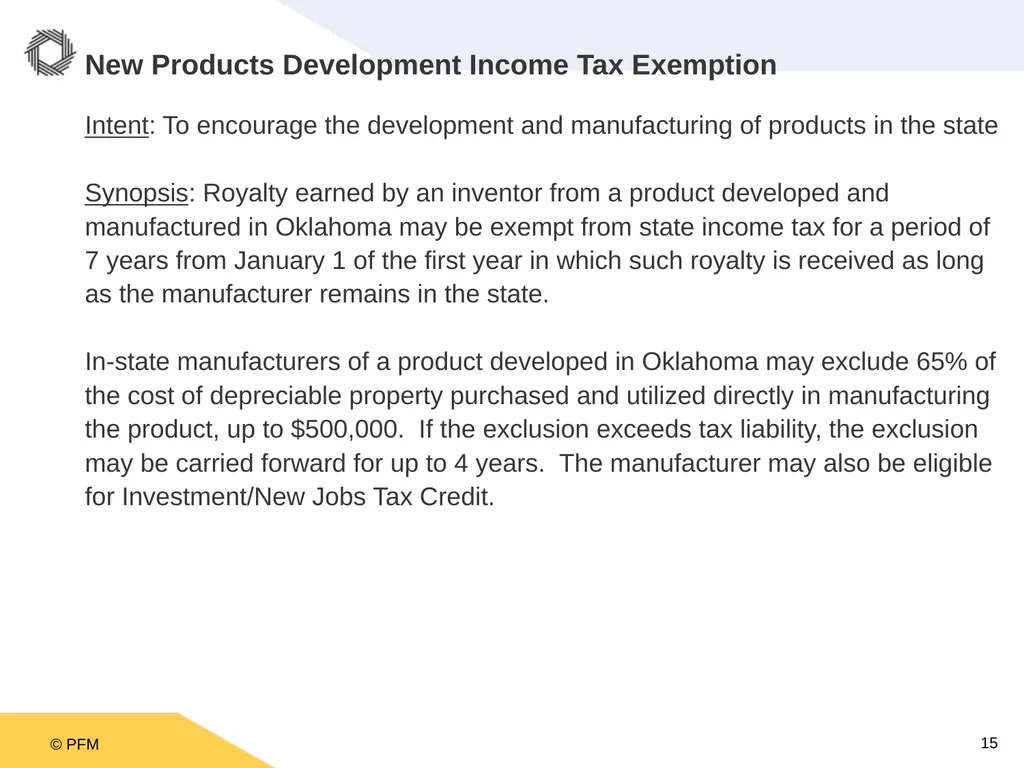
New Products Development Income Tax Exemption Intent: To encourage the development and manufacturing of products in the state
Synopsis: Royalty earned by an inventor from a product developed and manufactured in Oklahoma may be exempt from state income tax for a period of 7 years from January 1 of the first year in which such royalty is received as long as the manufacturer remains in the state.
In-state manufacturers of a product developed in Oklahoma may exclude 65% of the cost of depreciable property purchased and utilized directly in manufacturing the product, up to $500,000. If the exclusion exceeds tax liability, the exclusion may be carried forward for up to 4 years. The manufacturer may also be eligible for Investment/New Jobs Tax Credit.<br>
Synopsis: Royalty earned by an inventor from a product developed and manufactured in Oklahoma may be exempt from state income tax for a period of 7 years from January 1 of the first year in which such royalty is received as long as the manufacturer remains in the state.
In-state manufacturers of a product developed in Oklahoma may exclude 65% of the cost of depreciable property purchased and utilized directly in manufacturing the product, up to $500,000. If the exclusion exceeds tax liability, the exclusion may be carried forward for up to 4 years. The manufacturer may also be eligible for Investment/New Jobs Tax Credit.<br>
16
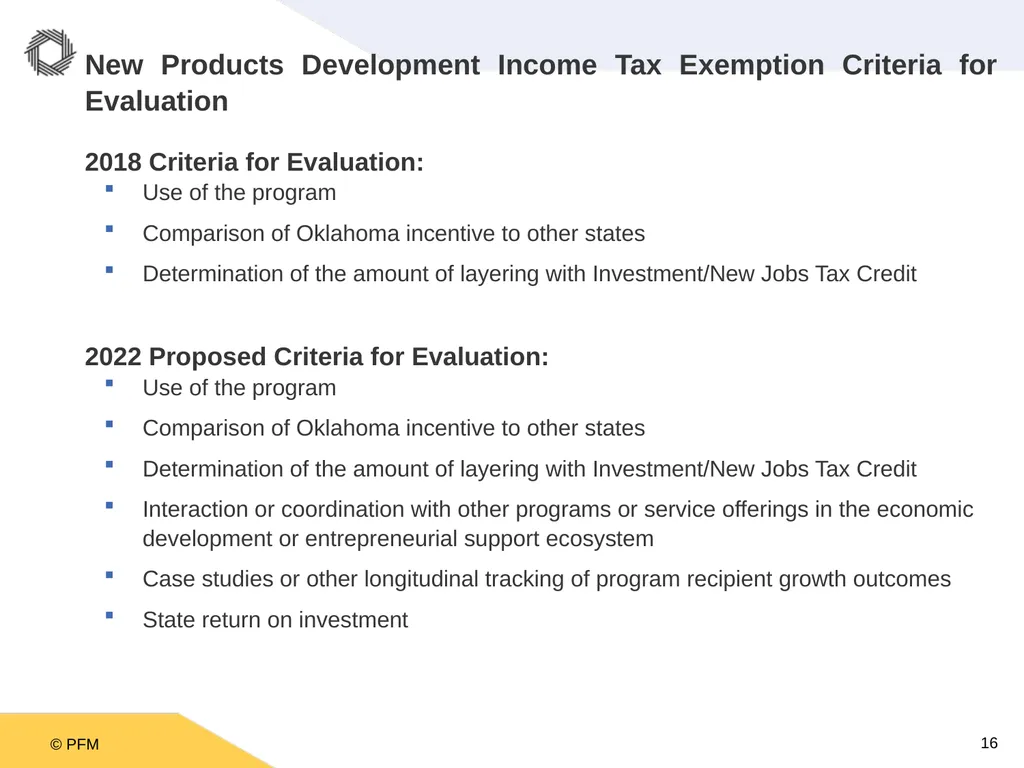
New Products Development Income Tax Exemption Criteria for Evaluation 2018 Criteria for Evaluation:
Use of the program
Comparison of Oklahoma incentive to other states
Determination of the amount of layering with Investment/New Jobs Tax Credit
2022 Proposed Criteria for Evaluation:
Use of the program
Comparison of Oklahoma incentive to other states
Determination of the amount of layering with Investment/New Jobs Tax Credit
Interaction or coordination with other programs or service offerings in the economic development or entrepreneurial support ecosystem
Case studies or other longitudinal tracking of program recipient growth outcomes
State return on investment<br>
Use of the program
Comparison of Oklahoma incentive to other states
Determination of the amount of layering with Investment/New Jobs Tax Credit
2022 Proposed Criteria for Evaluation:
Use of the program
Comparison of Oklahoma incentive to other states
Determination of the amount of layering with Investment/New Jobs Tax Credit
Interaction or coordination with other programs or service offerings in the economic development or entrepreneurial support ecosystem
Case studies or other longitudinal tracking of program recipient growth outcomes
State return on investment<br>
17
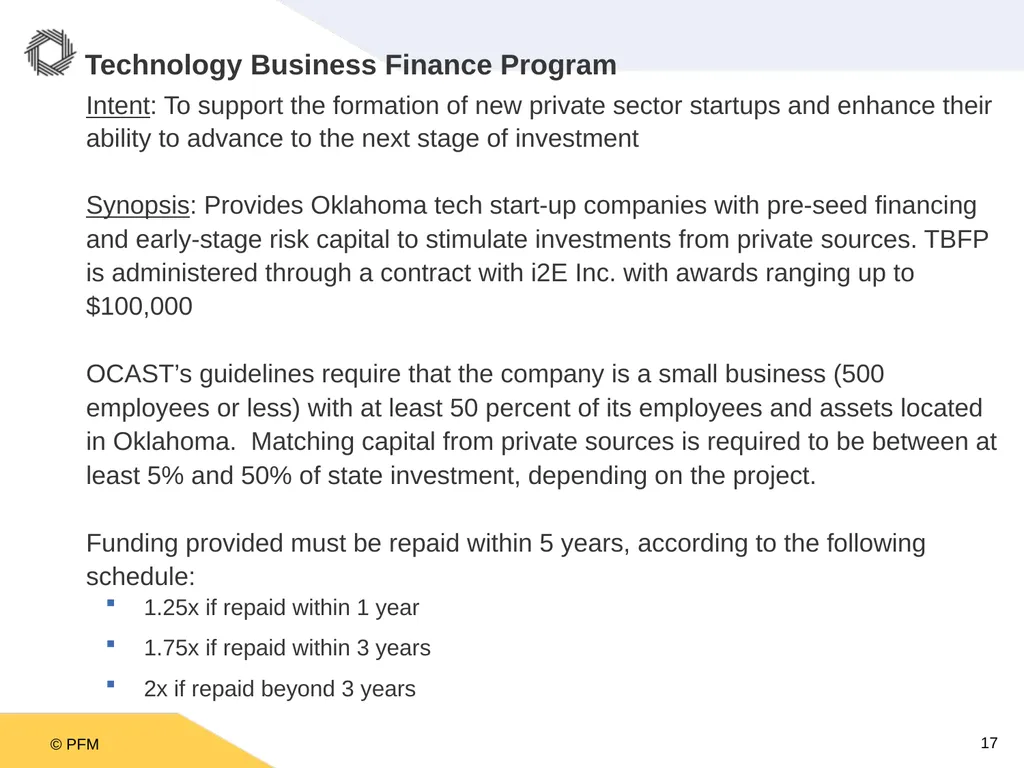
Technology Business Finance Program Intent: To support the formation of new private sector startups and enhance their ability to advance to the next stage of investment
Synopsis: Provides Oklahoma tech start-up companies with pre-seed financing and early-stage risk capital to stimulate investments from private sources. TBFP is administered through a contract with i2E Inc. with awards ranging up to $100,000
OCAST’s guidelines require that the company is a small business (500 employees or less) with at least 50 percent of its employees and assets located in Oklahoma. Matching capital from private sources is required to be between at least 5% and 50% of state investment, depending on the project.
Funding provided must be repaid within 5 years, according to the following schedule:
1.25x if repaid within 1 year
1.75x if repaid within 3 years
2x if repaid beyond 3 years<br>
Synopsis: Provides Oklahoma tech start-up companies with pre-seed financing and early-stage risk capital to stimulate investments from private sources. TBFP is administered through a contract with i2E Inc. with awards ranging up to $100,000
OCAST’s guidelines require that the company is a small business (500 employees or less) with at least 50 percent of its employees and assets located in Oklahoma. Matching capital from private sources is required to be between at least 5% and 50% of state investment, depending on the project.
Funding provided must be repaid within 5 years, according to the following schedule:
1.25x if repaid within 1 year
1.75x if repaid within 3 years
2x if repaid beyond 3 years<br>
18
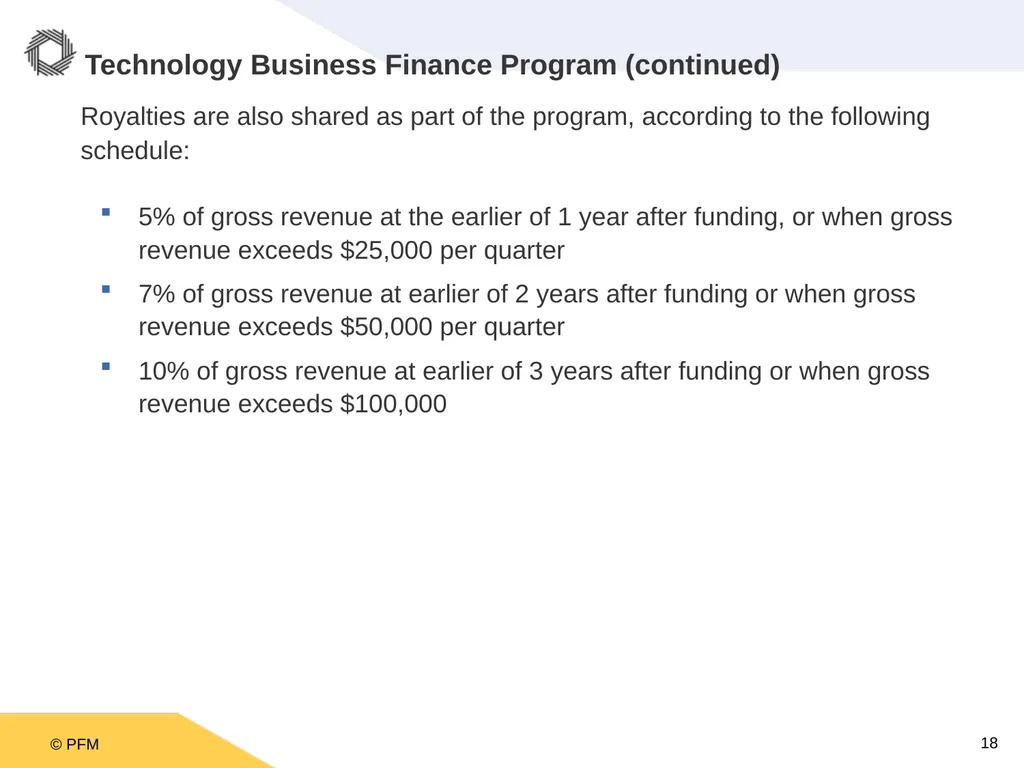
Technology Business Finance Program (continued) Royalties are also shared as part of the program, according to the following schedule:
5% of gross revenue at the earlier of 1 year after funding, or when gross revenue exceeds $25,000 per quarter
7% of gross revenue at earlier of 2 years after funding or when gross revenue exceeds $50,000 per quarter
10% of gross revenue at earlier of 3 years after funding or when gross revenue exceeds $100,000<br>
5% of gross revenue at the earlier of 1 year after funding, or when gross revenue exceeds $25,000 per quarter
7% of gross revenue at earlier of 2 years after funding or when gross revenue exceeds $50,000 per quarter
10% of gross revenue at earlier of 3 years after funding or when gross revenue exceeds $100,000<br>
19
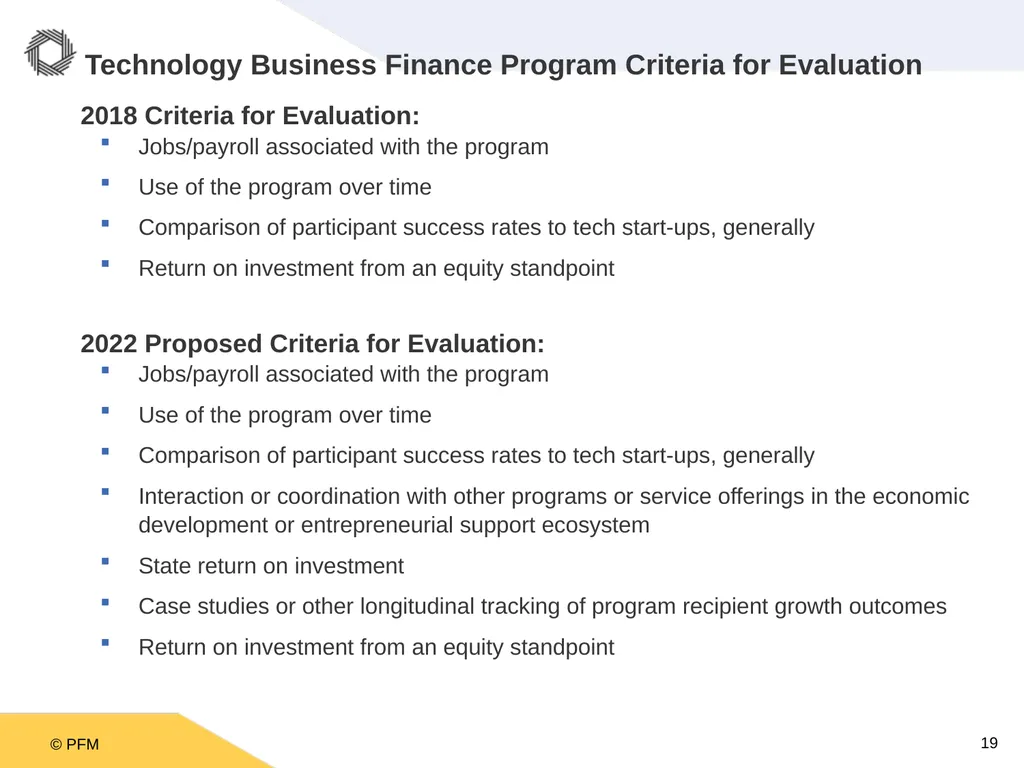
Technology Business Finance Program Criteria for Evaluation 2018 Criteria for Evaluation:
Jobs/payroll associated with the program
Use of the program over time
Comparison of participant success rates to tech start-ups, generally
Return on investment from an equity standpoint
2022 Proposed Criteria for Evaluation:
Jobs/payroll associated with the program
Use of the program over time
Comparison of participant success rates to tech start-ups, generally
Interaction or coordination with other programs or service offerings in the economic development or entrepreneurial support ecosystem
State return on investment
Case studies or other longitudinal tracking of program recipient growth outcomes
Return on investment from an equity standpoint<br>
Jobs/payroll associated with the program
Use of the program over time
Comparison of participant success rates to tech start-ups, generally
Return on investment from an equity standpoint
2022 Proposed Criteria for Evaluation:
Jobs/payroll associated with the program
Use of the program over time
Comparison of participant success rates to tech start-ups, generally
Interaction or coordination with other programs or service offerings in the economic development or entrepreneurial support ecosystem
State return on investment
Case studies or other longitudinal tracking of program recipient growth outcomes
Return on investment from an equity standpoint<br>
20
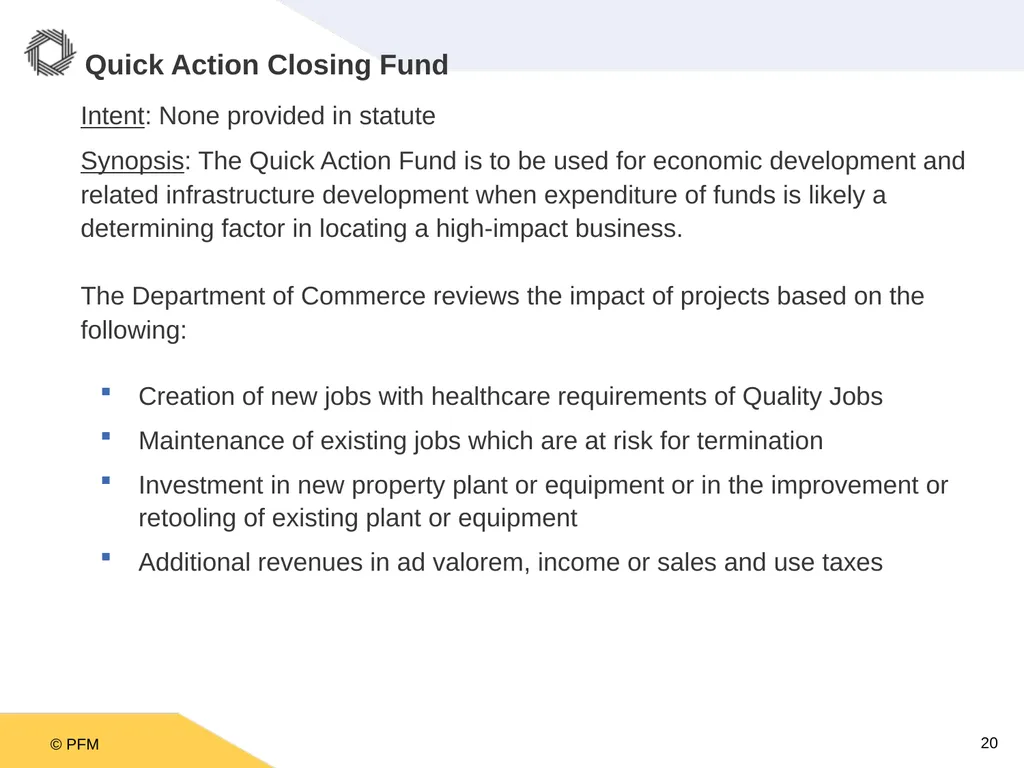
Quick Action Closing Fund Intent: None provided in statute
Synopsis: The Quick Action Fund is to be used for economic development and related infrastructure development when expenditure of funds is likely a determining factor in locating a high-impact business.
The Department of Commerce reviews the impact of projects based on the following:
Creation of new jobs with healthcare requirements of Quality Jobs
Maintenance of existing jobs which are at risk for termination
Investment in new property plant or equipment or in the improvement or retooling of existing plant or equipment
Additional revenues in ad valorem, income or sales and use taxes<br>
Synopsis: The Quick Action Fund is to be used for economic development and related infrastructure development when expenditure of funds is likely a determining factor in locating a high-impact business.
The Department of Commerce reviews the impact of projects based on the following:
Creation of new jobs with healthcare requirements of Quality Jobs
Maintenance of existing jobs which are at risk for termination
Investment in new property plant or equipment or in the improvement or retooling of existing plant or equipment
Additional revenues in ad valorem, income or sales and use taxes<br>
21
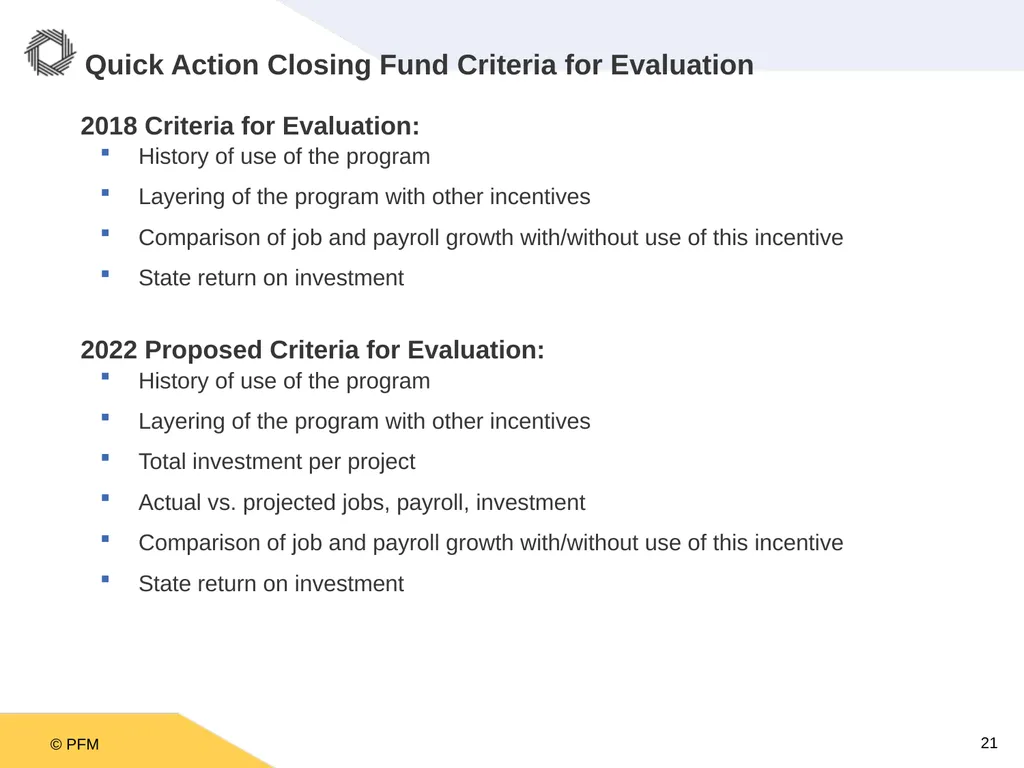
Quick Action Closing Fund Criteria for Evaluation 2018 Criteria for Evaluation:
History of use of the program
Layering of the program with other incentives
Comparison of job and payroll growth with/without use of this incentive
State return on investment
2022 Proposed Criteria for Evaluation:
History of use of the program
Layering of the program with other incentives
Total investment per project
Actual vs. projected jobs, payroll, investment
Comparison of job and payroll growth with/without use of this incentive
State return on investment<br>
History of use of the program
Layering of the program with other incentives
Comparison of job and payroll growth with/without use of this incentive
State return on investment
2022 Proposed Criteria for Evaluation:
History of use of the program
Layering of the program with other incentives
Total investment per project
Actual vs. projected jobs, payroll, investment
Comparison of job and payroll growth with/without use of this incentive
State return on investment<br>
22
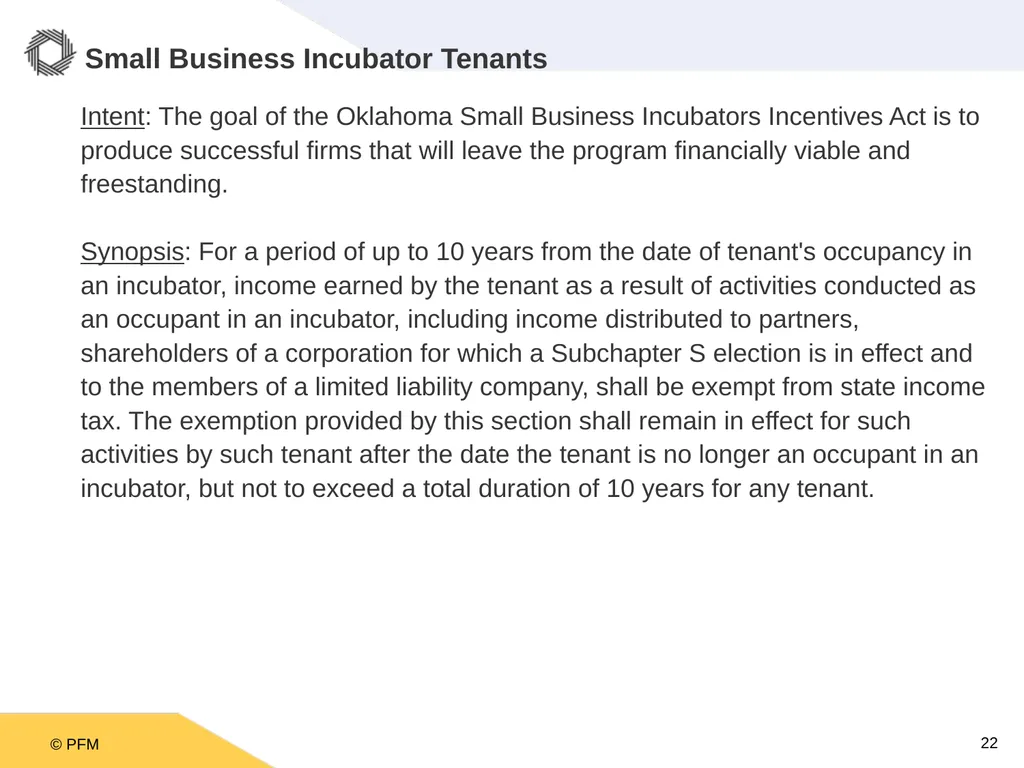
Small Business Incubator Tenants Intent: The goal of the Oklahoma Small Business Incubators Incentives Act is to produce successful firms that will leave the program financially viable and freestanding.
Synopsis: For a period of up to 10 years from the date of tenant's occupancy in an incubator, income earned by the tenant as a result of activities conducted as an occupant in an incubator, including income distributed to partners, shareholders of a corporation for which a Subchapter S election is in effect and to the members of a limited liability company, shall be exempt from state income tax. The exemption provided by this section shall remain in effect for such activities by such tenant after the date the tenant is no longer an occupant in an incubator, but not to exceed a total duration of 10 years for any tenant.<br>
Synopsis: For a period of up to 10 years from the date of tenant's occupancy in an incubator, income earned by the tenant as a result of activities conducted as an occupant in an incubator, including income distributed to partners, shareholders of a corporation for which a Subchapter S election is in effect and to the members of a limited liability company, shall be exempt from state income tax. The exemption provided by this section shall remain in effect for such activities by such tenant after the date the tenant is no longer an occupant in an incubator, but not to exceed a total duration of 10 years for any tenant.<br>
23
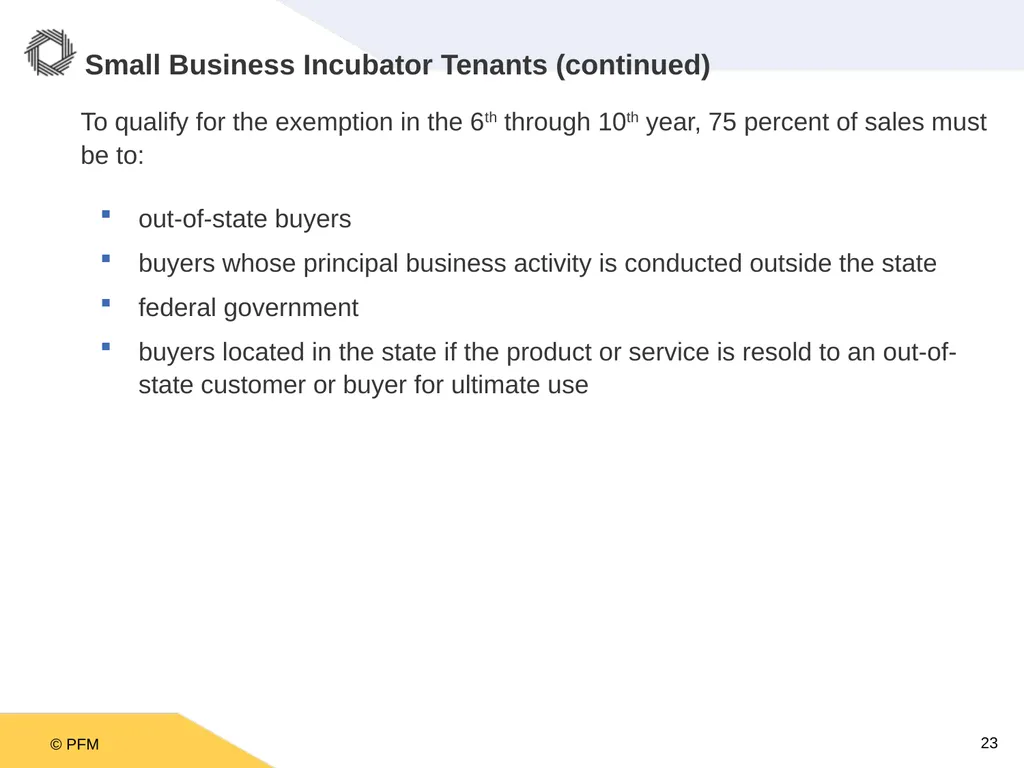
Small Business Incubator Tenants (continued) To qualify for the exemption in the 6th through 10th year, 75 percent of sales must be to:
out-of-state buyers
buyers whose principal business activity is conducted outside the state
federal government
buyers located in the state if the product or service is resold to an out-of-state customer or buyer for ultimate use<br>
out-of-state buyers
buyers whose principal business activity is conducted outside the state
federal government
buyers located in the state if the product or service is resold to an out-of-state customer or buyer for ultimate use<br>
24
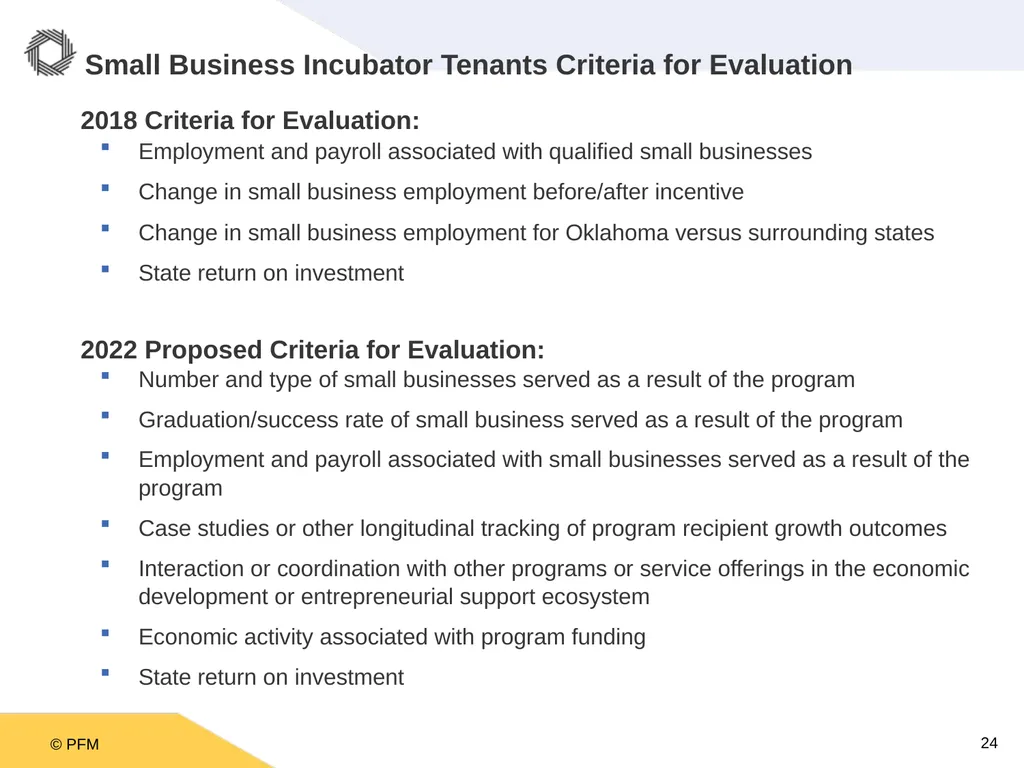
Small Business Incubator Tenants Criteria for Evaluation 2018 Criteria for Evaluation:
Employment and payroll associated with qualified small businesses
Change in small business employment before/after incentive
Change in small business employment for Oklahoma versus surrounding states
State return on investment
2022 Proposed Criteria for Evaluation:
Number and type of small businesses served as a result of the program
Graduation/success rate of small business served as a result of the program
Employment and payroll associated with small businesses served as a result of the program
Case studies or other longitudinal tracking of program recipient growth outcomes
Interaction or coordination with other programs or service offerings in the economic development or entrepreneurial support ecosystem
Economic activity associated with program funding
State return on investment<br>
Employment and payroll associated with qualified small businesses
Change in small business employment before/after incentive
Change in small business employment for Oklahoma versus surrounding states
State return on investment
2022 Proposed Criteria for Evaluation:
Number and type of small businesses served as a result of the program
Graduation/success rate of small business served as a result of the program
Employment and payroll associated with small businesses served as a result of the program
Case studies or other longitudinal tracking of program recipient growth outcomes
Interaction or coordination with other programs or service offerings in the economic development or entrepreneurial support ecosystem
Economic activity associated with program funding
State return on investment<br>
25
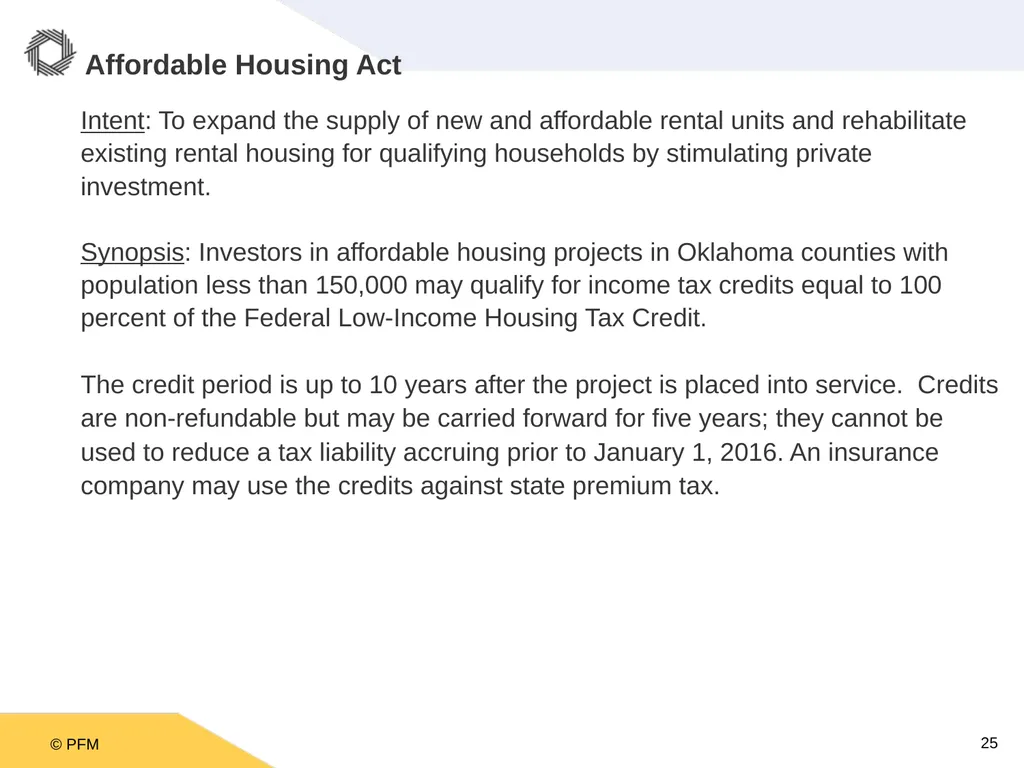
Affordable Housing Act Intent: To expand the supply of new and affordable rental units and rehabilitate existing rental housing for qualifying households by stimulating private investment.
Synopsis: Investors in affordable housing projects in Oklahoma counties with population less than 150,000 may qualify for income tax credits equal to 100 percent of the Federal Low-Income Housing Tax Credit.
The credit period is up to 10 years after the project is placed into service. Credits are non-refundable but may be carried forward for five years; they cannot be used to reduce a tax liability accruing prior to January 1, 2016. An insurance company may use the credits against state premium tax.<br>
Synopsis: Investors in affordable housing projects in Oklahoma counties with population less than 150,000 may qualify for income tax credits equal to 100 percent of the Federal Low-Income Housing Tax Credit.
The credit period is up to 10 years after the project is placed into service. Credits are non-refundable but may be carried forward for five years; they cannot be used to reduce a tax liability accruing prior to January 1, 2016. An insurance company may use the credits against state premium tax.<br>
26
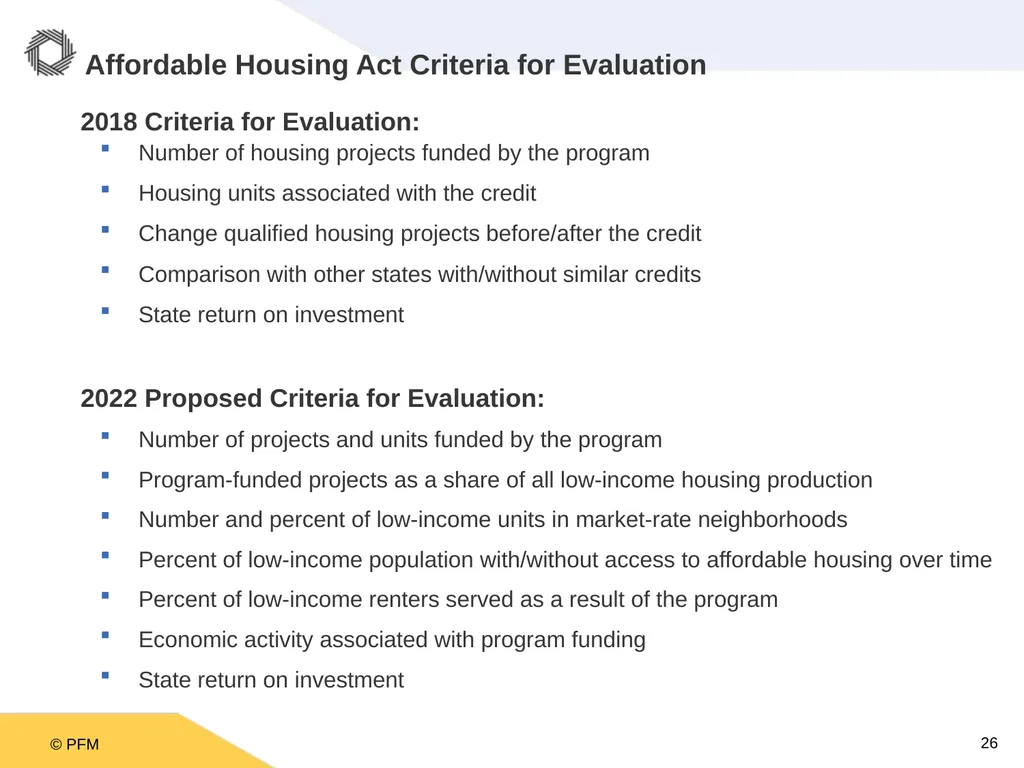
Affordable Housing Act Criteria for Evaluation 2018 Criteria for Evaluation:
Number of housing projects funded by the program
Housing units associated with the credit
Change qualified housing projects before/after the credit
Comparison with other states with/without similar credits
State return on investment
2022 Proposed Criteria for Evaluation:
Number of projects and units funded by the program
Program-funded projects as a share of all low-income housing production
Number and percent of low-income units in market-rate neighborhoods
Percent of low-income population with/without access to affordable housing over time
Percent of low-income renters served as a result of the program
Economic activity associated with program funding
State return on investment<br>
Number of housing projects funded by the program
Housing units associated with the credit
Change qualified housing projects before/after the credit
Comparison with other states with/without similar credits
State return on investment
2022 Proposed Criteria for Evaluation:
Number of projects and units funded by the program
Program-funded projects as a share of all low-income housing production
Number and percent of low-income units in market-rate neighborhoods
Percent of low-income population with/without access to affordable housing over time
Percent of low-income renters served as a result of the program
Economic activity associated with program funding
State return on investment<br>
27
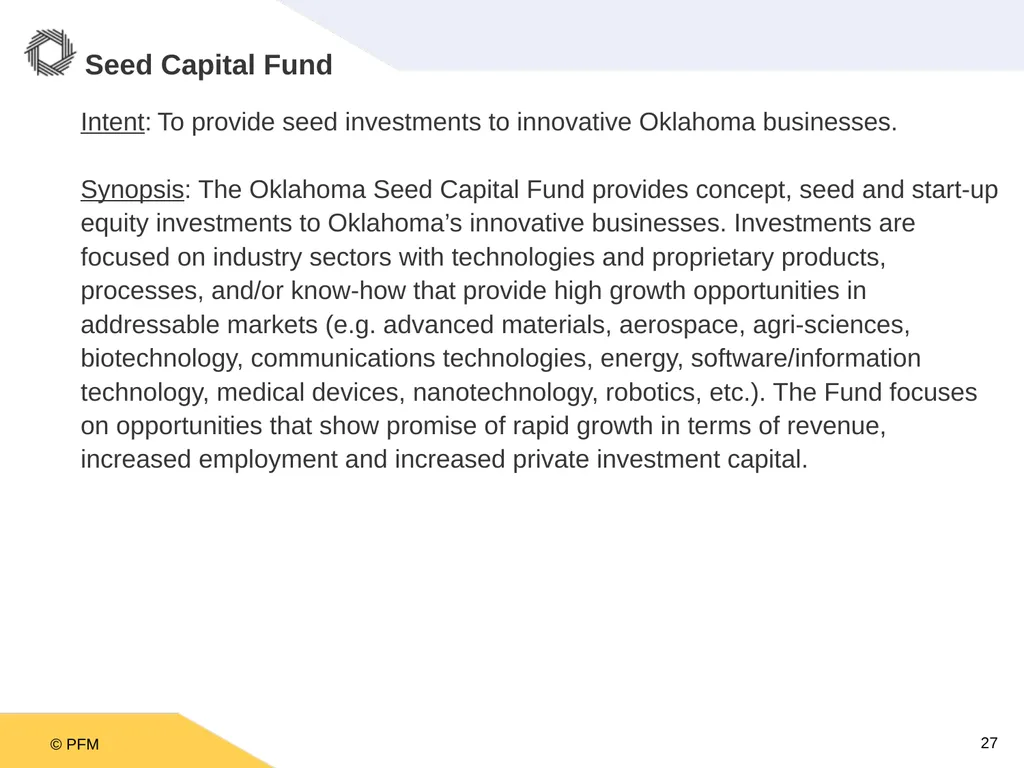
Seed Capital Fund Intent: To provide seed investments to innovative Oklahoma businesses.
Synopsis: The Oklahoma Seed Capital Fund provides concept, seed and start-up equity investments to Oklahoma’s innovative businesses. Investments are focused on industry sectors with technologies and proprietary products, processes, and/or know-how that provide high growth opportunities in addressable markets (e.g. advanced materials, aerospace, agri-sciences, biotechnology, communications technologies, energy, software/information technology, medical devices, nanotechnology, robotics, etc.). The Fund focuses on opportunities that show promise of rapid growth in terms of revenue, increased employment and increased private investment capital.<br>
Synopsis: The Oklahoma Seed Capital Fund provides concept, seed and start-up equity investments to Oklahoma’s innovative businesses. Investments are focused on industry sectors with technologies and proprietary products, processes, and/or know-how that provide high growth opportunities in addressable markets (e.g. advanced materials, aerospace, agri-sciences, biotechnology, communications technologies, energy, software/information technology, medical devices, nanotechnology, robotics, etc.). The Fund focuses on opportunities that show promise of rapid growth in terms of revenue, increased employment and increased private investment capital.<br>
28
Seed Capital Fund (continued) To be eligible for the Seed Fund, an entrepreneur must be a small business located in Oklahoma.
The use of funds depends on each company’s business plan. This may include such activities as developing intellectual property, completing market assessments, implementing business operations, recruiting key members of the management team and expanding into new products or markets.
Investments typically range from $100,000 to $1,000,000 and require participating co-investors. Investment terms are typically convertible debt or preferred equity.<br>
The use of funds depends on each company’s business plan. This may include such activities as developing intellectual property, completing market assessments, implementing business operations, recruiting key members of the management team and expanding into new products or markets.
Investments typically range from $100,000 to $1,000,000 and require participating co-investors. Investment terms are typically convertible debt or preferred equity.<br>
29
Seed Capital Fund Criteria for Evaluation 2019 Criteria for Evaluation:
Program use
Amount of capital investment
Comparison of capital investment in general to capital investment in eligible projects
Oklahoma jobs created by firms receiving incentive
Financial performance of the fund
State return on investment
2022 Proposed Criteria for Evaluation
Program use
Amount of capital investment
Comparison of capital investment in general to capital investment in eligible projects
Oklahoma jobs created by firms receiving incentive
Financial performance of the fund
Interaction or coordination with other programs or service offerings in the economic development or entrepreneurial support ecosystem
Case studies or other longitudinal tracking of program recipient growth outcomes
State return on investment<br>
Program use
Amount of capital investment
Comparison of capital investment in general to capital investment in eligible projects
Oklahoma jobs created by firms receiving incentive
Financial performance of the fund
State return on investment
2022 Proposed Criteria for Evaluation
Program use
Amount of capital investment
Comparison of capital investment in general to capital investment in eligible projects
Oklahoma jobs created by firms receiving incentive
Financial performance of the fund
Interaction or coordination with other programs or service offerings in the economic development or entrepreneurial support ecosystem
Case studies or other longitudinal tracking of program recipient growth outcomes
State return on investment<br>
30
Scheduled Incentives with Change Recommendations Energy Efficient Residential Construction Tax Credit.
This credit had a June 30, 2016 sunset and has not been re-enacted.
This was reviewed in 2018 because the credit can be carried forward for four years.
The sunset and carry forward provision were confirmed in the Oklahoma Tax Commission’s 2020 Tax Expenditure Report.
Given that the credit is no longer in use, there is no reason to further evaluate it.
We recommend it be removed from the list of incentives for evaluation.
Basic and Applied Research Loan/Grant Program.
This is the agriculture research loan/grant program.
PFM wrote a memo to the Commission in 2018 noting that the program had hardly been used (many years no financial impact and in no year more than $100,000).
The Commission voted at its April 26, 2018 meeting to exempt it from evaluation.
In this case, the project team did not move it into the exempt category.
We would again suggest that it be moved into that category, and we will, should this recommendation be adopted, update the 2022-2025 schedule to reflect that.<br>
This credit had a June 30, 2016 sunset and has not been re-enacted.
This was reviewed in 2018 because the credit can be carried forward for four years.
The sunset and carry forward provision were confirmed in the Oklahoma Tax Commission’s 2020 Tax Expenditure Report.
Given that the credit is no longer in use, there is no reason to further evaluate it.
We recommend it be removed from the list of incentives for evaluation.
Basic and Applied Research Loan/Grant Program.
This is the agriculture research loan/grant program.
PFM wrote a memo to the Commission in 2018 noting that the program had hardly been used (many years no financial impact and in no year more than $100,000).
The Commission voted at its April 26, 2018 meeting to exempt it from evaluation.
In this case, the project team did not move it into the exempt category.
We would again suggest that it be moved into that category, and we will, should this recommendation be adopted, update the 2022-2025 schedule to reflect that.<br>
31
Scheduled Incentives with Change Recommendations Quality Jobs Investment Program.
This was repealed in 2019.
The Commission recommended repealing the program in the 2018 evaluation, and the Oklahoma Development Finance Authority agreed with that recommendation – no loans had been made in the program since 2007.
There is no point in re-stating those conclusions, as nothing has changed since its repeal in 2019.
Small Business Incubators – Sponsors.
This was also repealed in 2019 (in the same bill that repealed the Quality Jobs Investment Program).
This was also a recommendation of the Commission in 2018.
The Small Business Incubators tax exemption for tenants remains in place, and we will evaluate it.
In 2018, we combined the two into a single evaluation, so that will not change, but there isn’t any point in keeping the sponsor exemption on the schedule.<br>
This was repealed in 2019.
The Commission recommended repealing the program in the 2018 evaluation, and the Oklahoma Development Finance Authority agreed with that recommendation – no loans had been made in the program since 2007.
There is no point in re-stating those conclusions, as nothing has changed since its repeal in 2019.
Small Business Incubators – Sponsors.
This was also repealed in 2019 (in the same bill that repealed the Quality Jobs Investment Program).
This was also a recommendation of the Commission in 2018.
The Small Business Incubators tax exemption for tenants remains in place, and we will evaluate it.
In 2018, we combined the two into a single evaluation, so that will not change, but there isn’t any point in keeping the sponsor exemption on the schedule.<br>
32
Scheduled Incentives with Change Recommendations Incentives for Inventors/New Products Development Income Tax Exemption.
These are the same program and should be combined on the spreadsheet.
We will evaluate it/them, but the spreadsheet needs to be revised to combine them.<br>
These are the same program and should be combined on the spreadsheet.
We will evaluate it/them, but the spreadsheet needs to be revised to combine them.<br>
33
Scheduled Incentives with Change Recommendations Seed Capital Fund
Given the recommended removals, we also recommend moving the evaluation of the Seed Capital Fund to 2022 from 2023
This will help balance work load, as there are 14 incentives scheduled for evaluation in 2023
This would mean there would be 10 incentives evaluated this year and 13 next year<br>
Given the recommended removals, we also recommend moving the evaluation of the Seed Capital Fund to 2022 from 2023
This will help balance work load, as there are 14 incentives scheduled for evaluation in 2023
This would mean there would be 10 incentives evaluated this year and 13 next year<br>