Open-Channel Flow and Its Classification CH-1 Basic Principles The flow of water in a conduit may be either open channel open channel flow or pipe flow Basic Principles Types of Flow: Steady Flow and Unsteady flow Flow is said to be steady
"Open-Channel Flow and Its Classification CH-1" is the property of its rightful owner. Permission is granted to
download and print the materials on this website for personal, non-commercial use only, and to display it
on your personal computer provided you do not modify the materials and that you retain all copyright
notices contained in the materials. By downloading content from our website, you accept the terms of this
agreement.
Presentation Transcript
01
Open-Channel Flow and Its Classification CH-1<br>
02
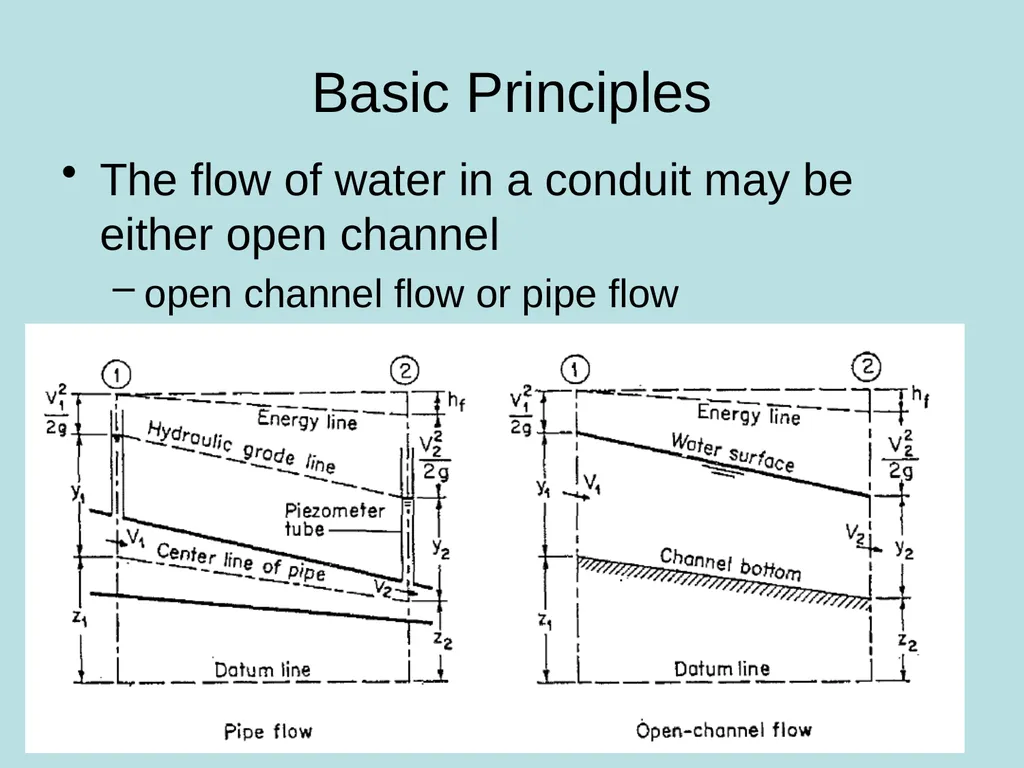
Basic Principles The flow of water in a conduit may be either open channel
open channel flow or pipe flow<br>
03
Basic Principles Types of Flow:
Steady Flow and Unsteady flow
Flow is said to be steady if the depth of flow does not change during the time interval
The flow is unsteady if the depth changes with time.
In most open-channel problems it is necessary to study flow behavior only under steady conditions.<br>
04
Basic Principles Uniform Flow and Varied Flow:
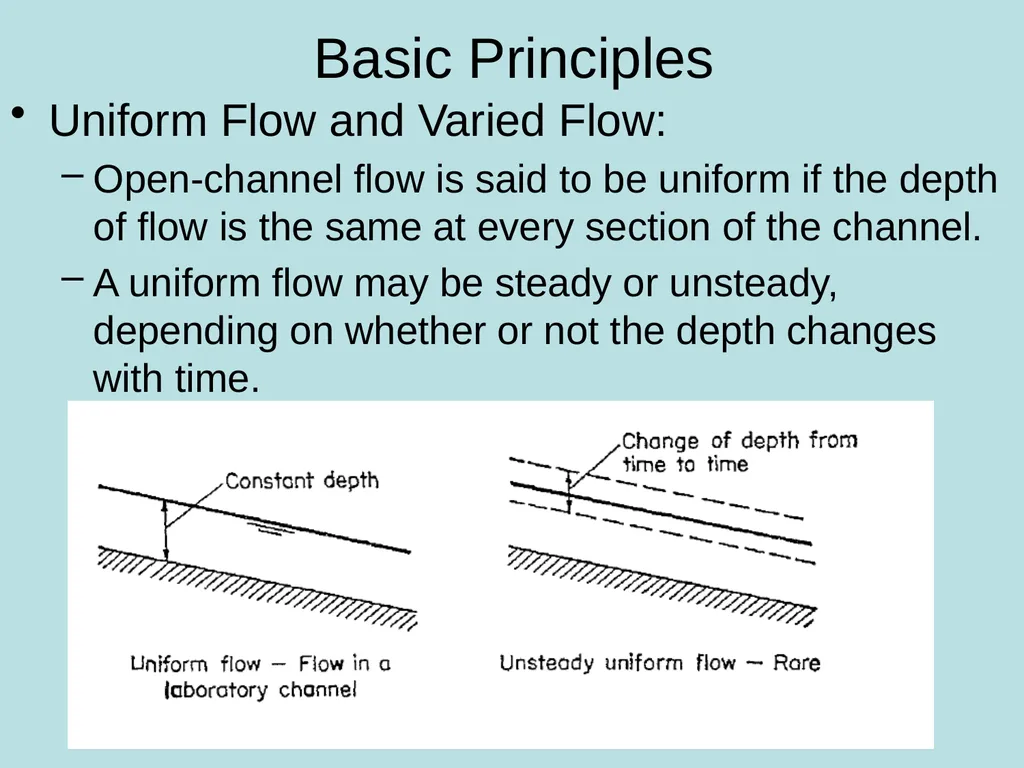
Open-channel flow is said to be uniform if the depth of flow is the same at every section of the channel.
A uniform flow may be steady or unsteady, depending on whether or not the depth changes with time.<br>
05
Basic Principles Uniform Flow and Varied Flow:
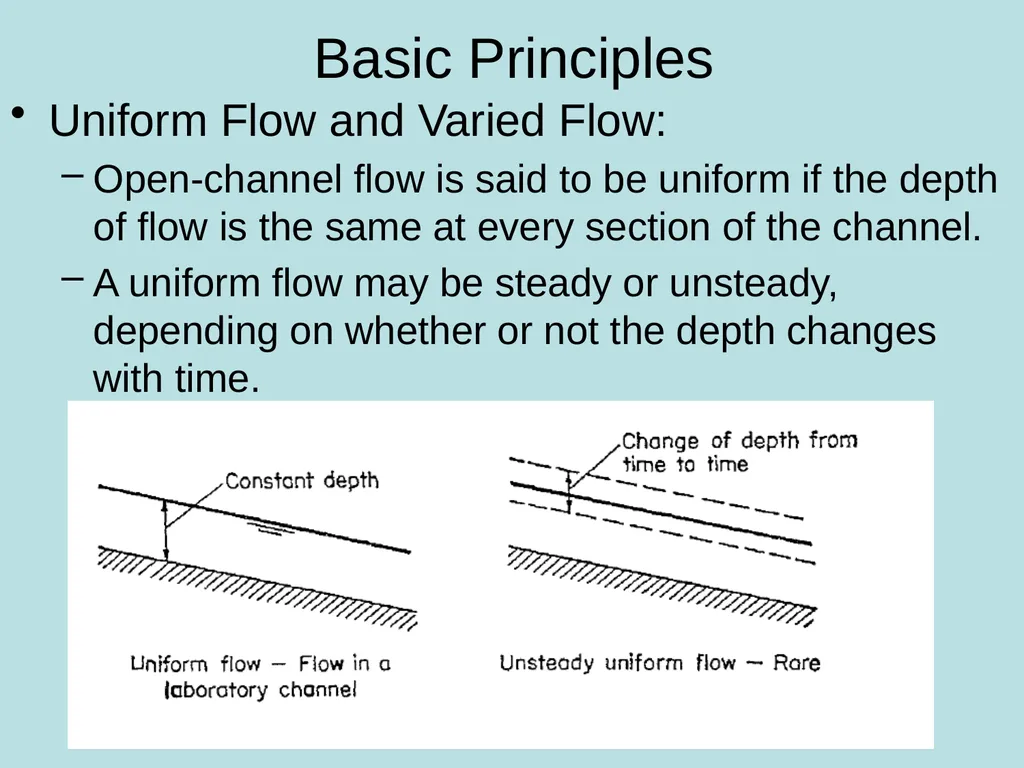
Open-channel flow is said to be uniform if the depth of flow is the same at every section of the channel.
A uniform flow may be steady or unsteady, depending on whether or not the depth changes with time.<br>
06
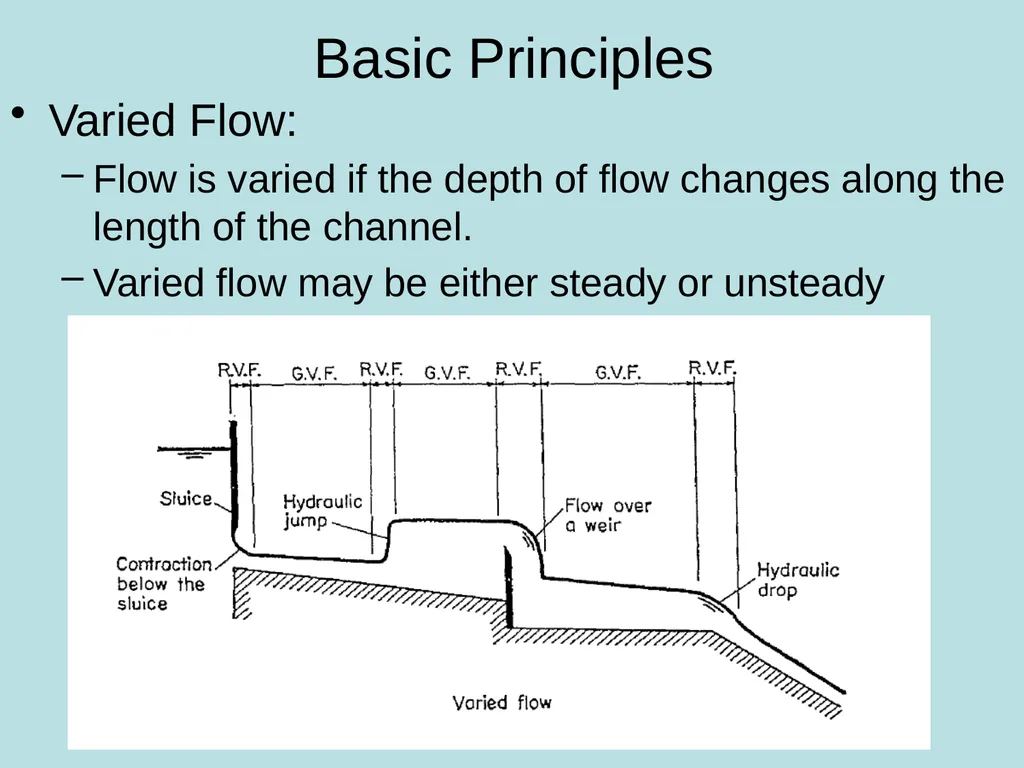
Basic Principles Varied Flow:
Flow is varied if the depth of flow changes along the length of the channel.
Varied flow may be either steady or unsteady<br>
07
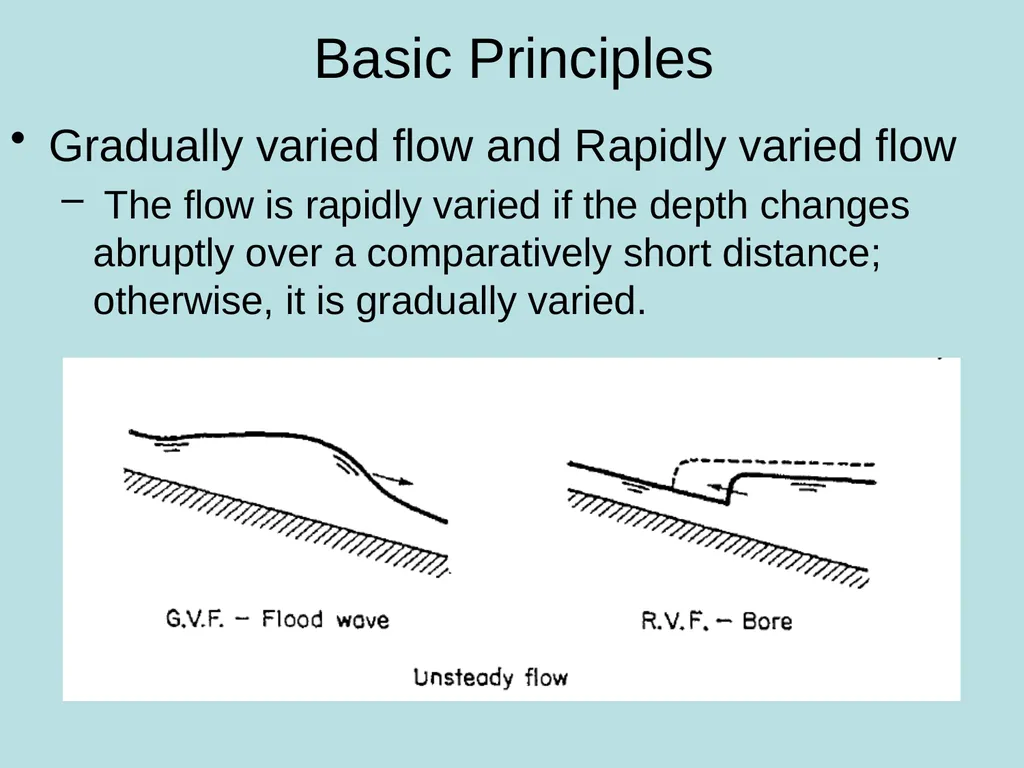
Basic Principles Gradually varied flow and Rapidly varied flow
The flow is rapidly varied if the depth changes abruptly over a comparatively short distance; otherwise, it is gradually varied.<br>
08
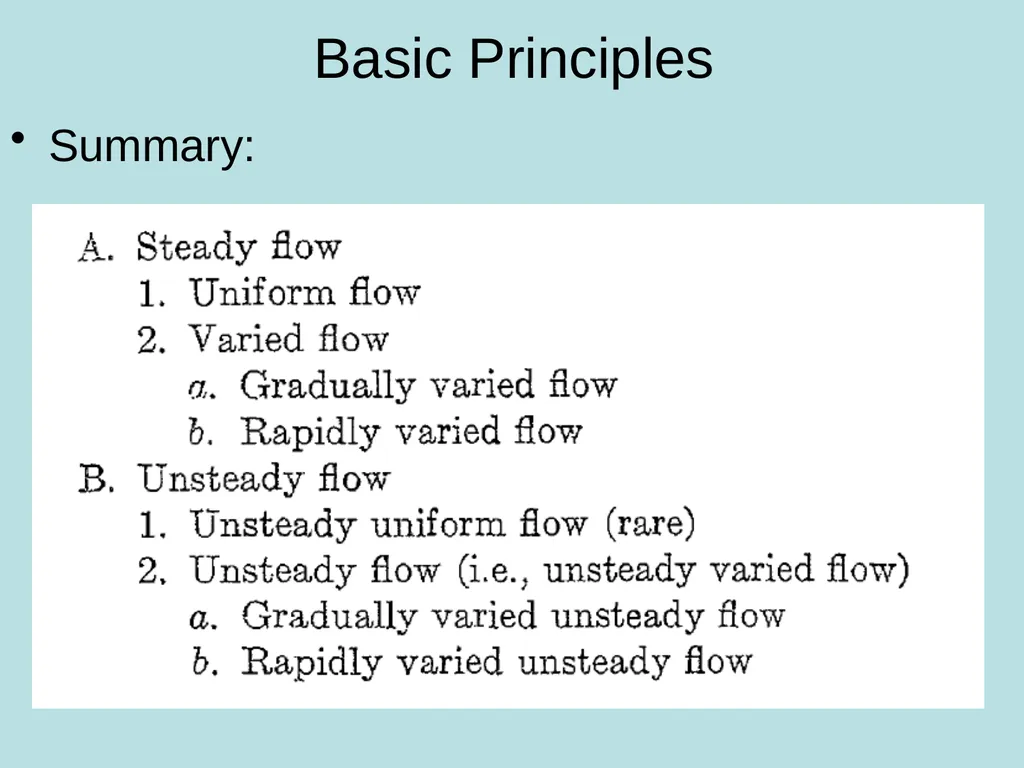
Basic Principles Summary:<br>
09
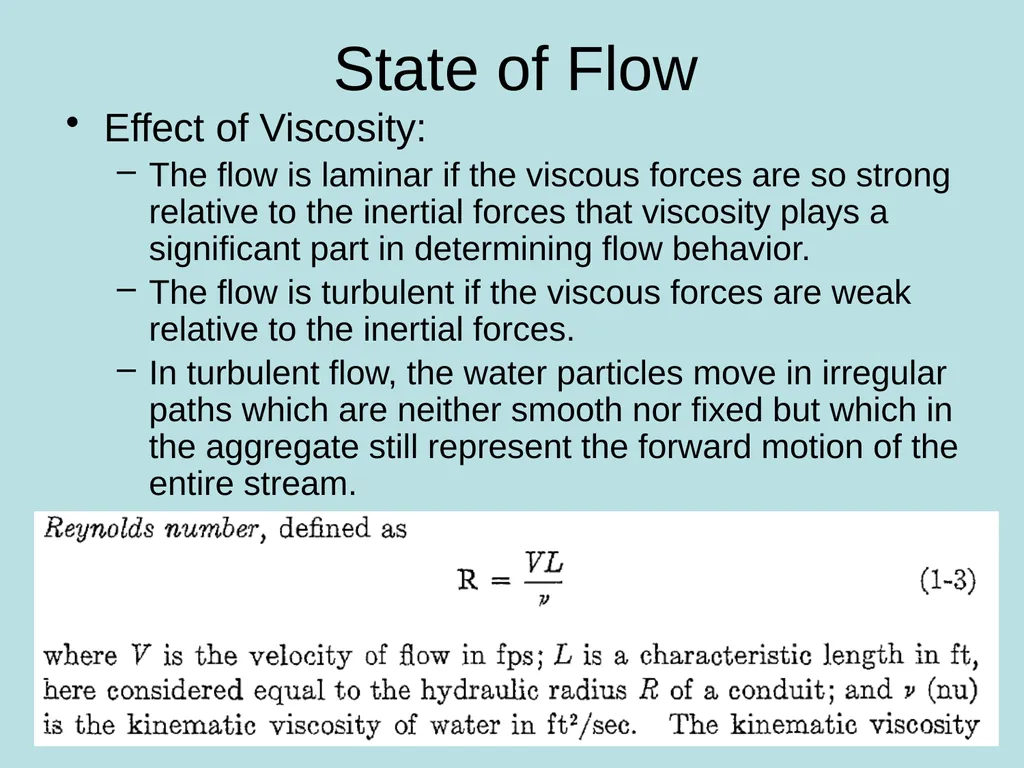
State of Flow Effect of Viscosity:
The flow is laminar if the viscous forces are so strong relative to the inertial forces that viscosity plays a significant part in determining flow behavior.
The flow is turbulent if the viscous forces are weak relative to the inertial forces.
In turbulent flow, the water particles move in irregular paths which are neither smooth nor fixed but which in the aggregate still represent the forward motion of the entire stream.<br>
10
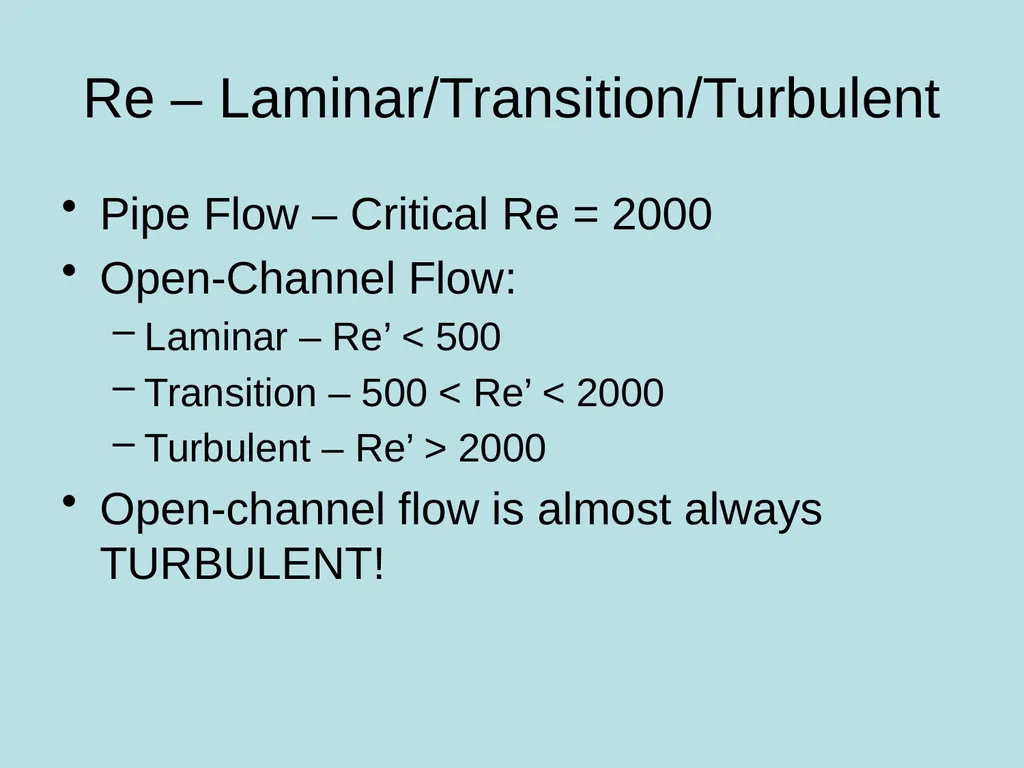
Re – Laminar/Transition/Turbulent Pipe Flow – Critical Re = 2000
Open-Channel Flow:
Laminar – Re’ < 500
Transition – 500 < Re’ < 2000
Turbulent – Re’ > 2000
Open-channel flow is almost always TURBULENT!<br>
11
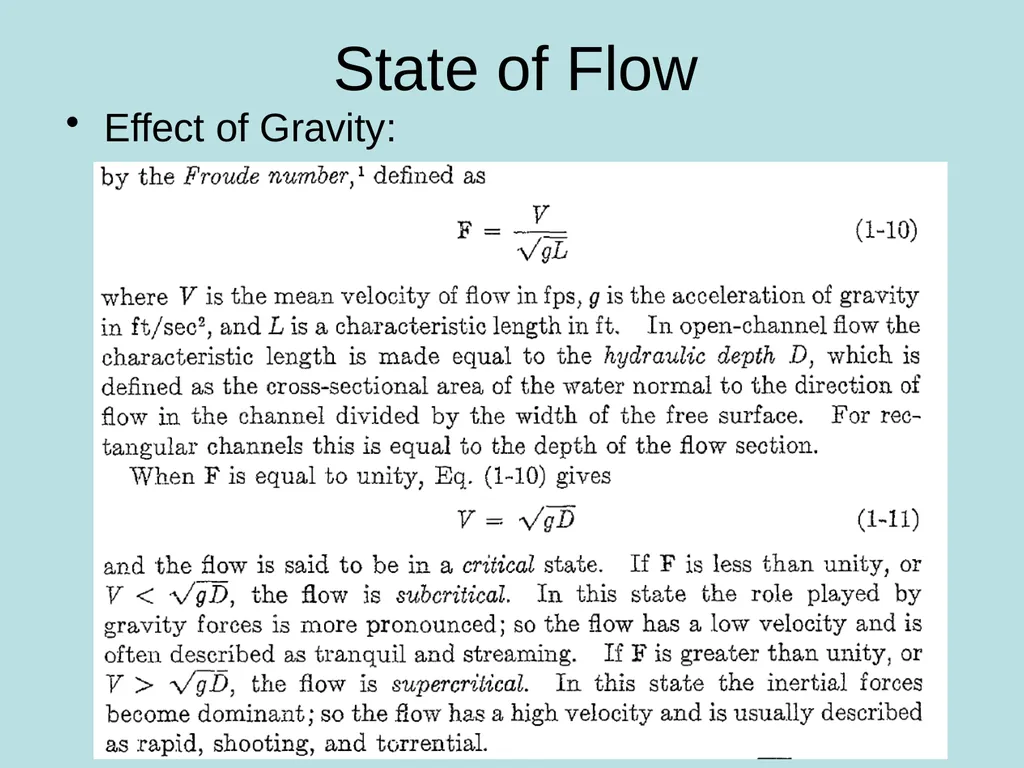
State of Flow Effect of Gravity:<br>
12
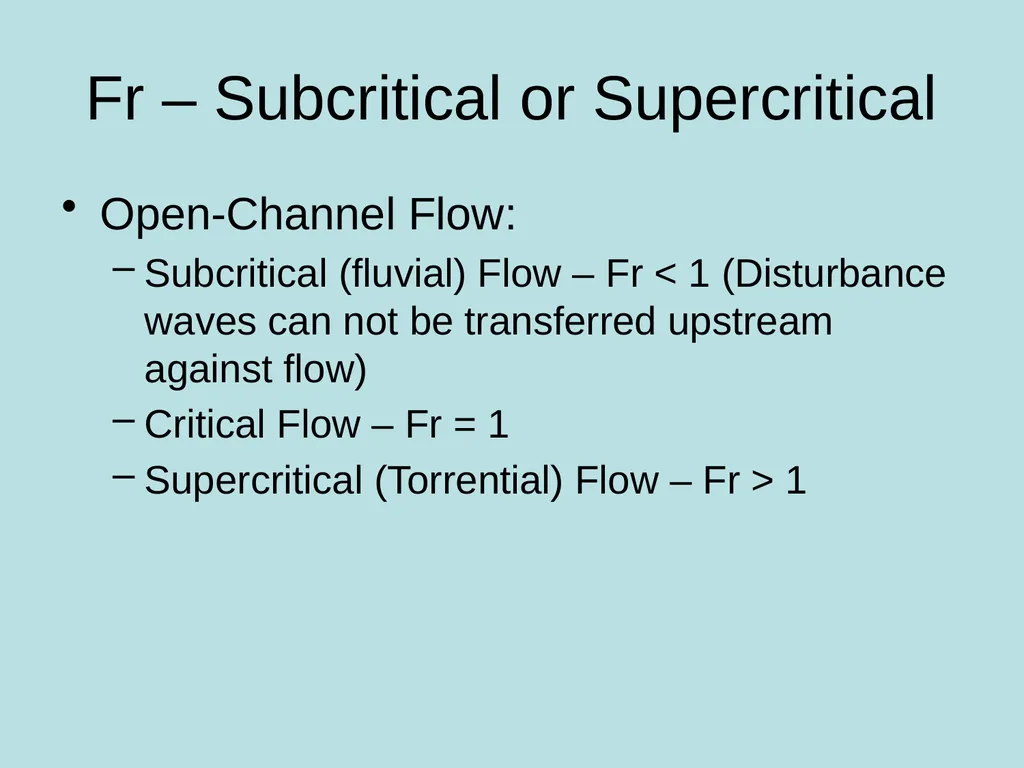
Fr – Subcritical or Supercritical Open-Channel Flow:
Subcritical (fluvial) Flow – Fr < 1 (Disturbance waves can not be transferred upstream against flow)
Critical Flow – Fr = 1
Supercritical (Torrential) Flow – Fr > 1<br>