Opioid Substitution Therapy (OST) toolkits:
Description: Opioid Substitution Therapy (OST) toolkits: Advocacy for a scaled-up OST programme in the region Dr M Suresh Kumar Outline of presentation Model of integrated OST and HIV care: evidence Current status of OST in Asia: the response in the
Related Topics
Download Presentation
"Opioid Substitution Therapy (OST) toolkits:" is the property of its rightful owner. Permission is granted to download and print the materials on this website for personal, non-commercial use only, and to display it on your personal computer provided you do not modify the materials and that you retain all copyright notices contained in the materials. By downloading content from our website, you accept the terms of this agreement.
Presentation Transcript
slide1. Opioid Substitution Therapy (OST) toolkits: Advocacy for a scaled-up OST programme in the region Dr M Suresh Kumar<br>
slide2. Outline of presentation Model of integrated OST and HIV care: evidence
Current status of OST in Asia: the response in the region
Gaps in response: Opportunity for improvement
Methadone and Buprenorphine Toolkits
Summary<br>
slide3. 1. Model of Integrated OST and HIV care: Evidence<br>
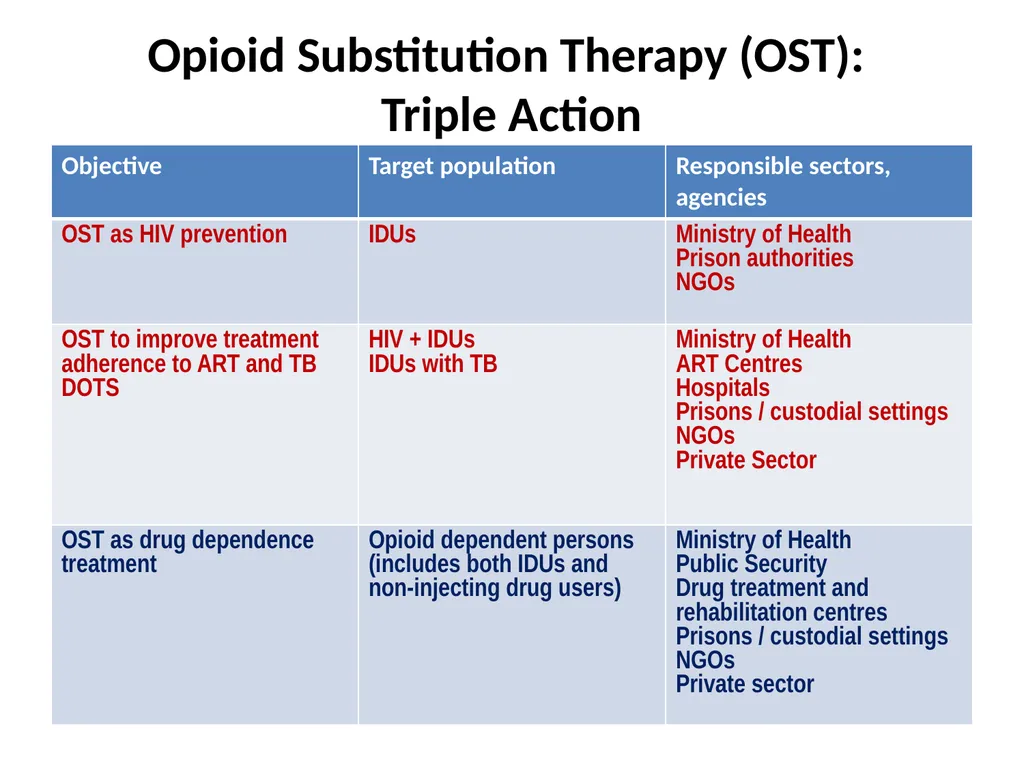
slide4. Opioid Substitution Therapy (OST): Triple Action<br>
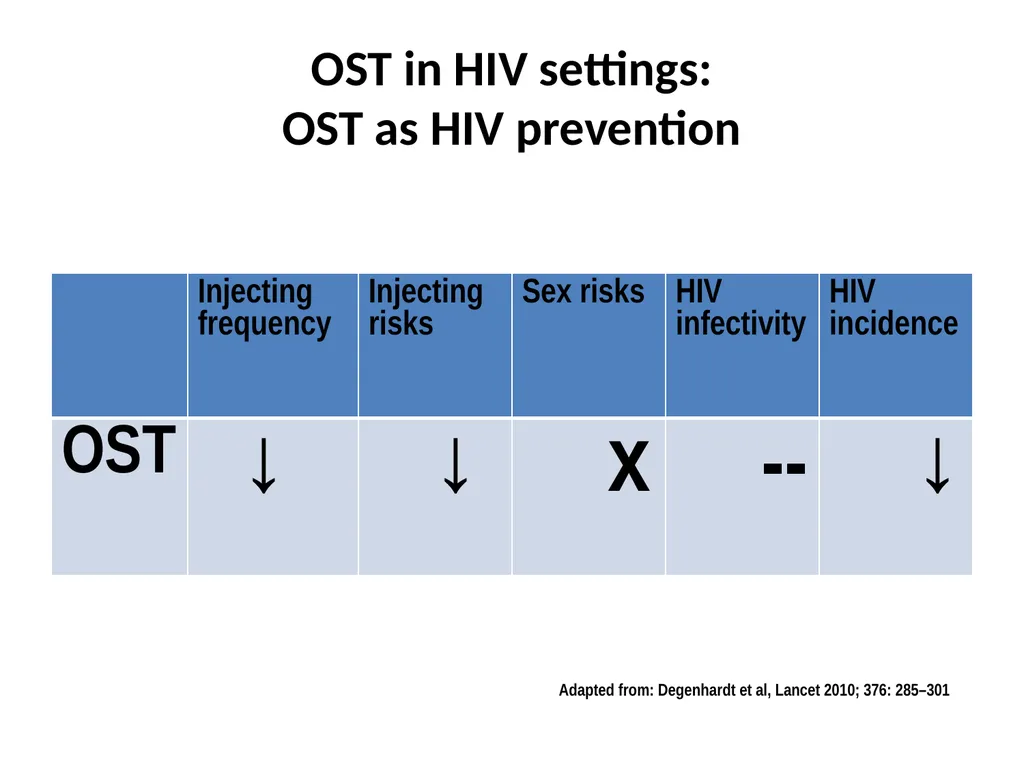
slide5. OST in HIV settings:OST as HIV prevention Adapted from: Degenhardt et al, Lancet 2010; 376: 285–301<br>
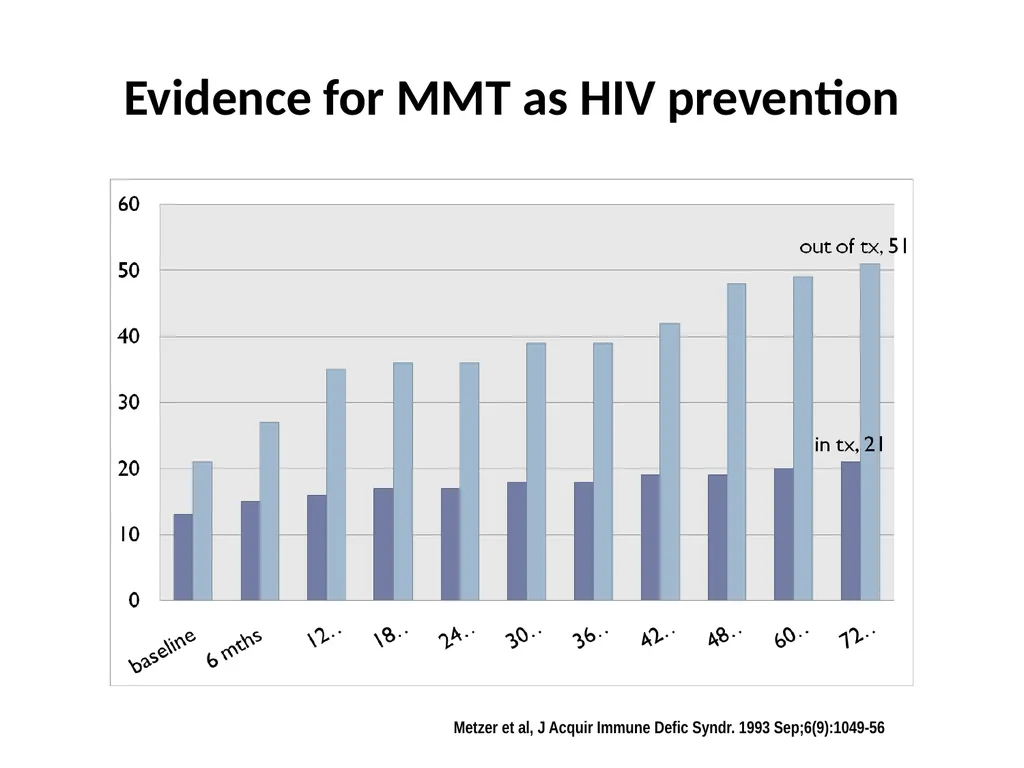
slide6. Evidence for MMT as HIV prevention Metzer et al, J Acquir Immune Defic Syndr. 1993 Sep;6(9):1049-56<br>
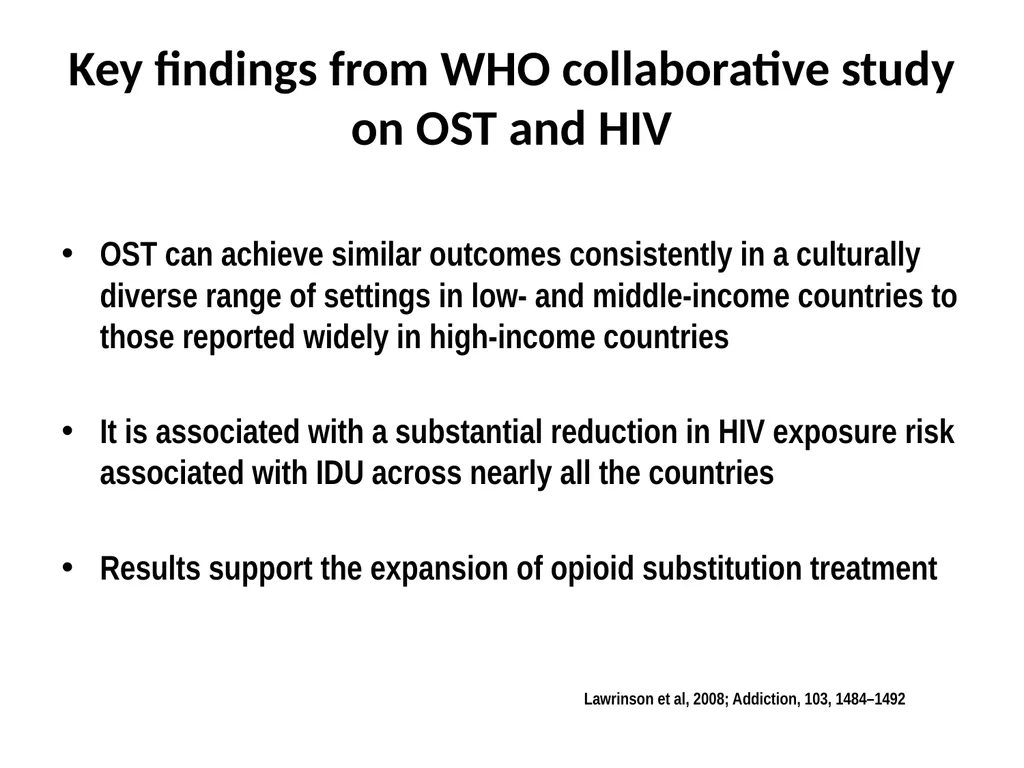
slide7. Key findings from WHO collaborative study on OST and HIV OST can achieve similar outcomes consistently in a culturally diverse range of settings in low- and middle-income countries to those reported widely in high-income countries
It is associated with a substantial reduction in HIV exposure risk associated with IDU across nearly all the countries
Results support the expansion of opioid substitution treatment Lawrinson et al, 2008; Addiction, 103, 1484–1492<br>
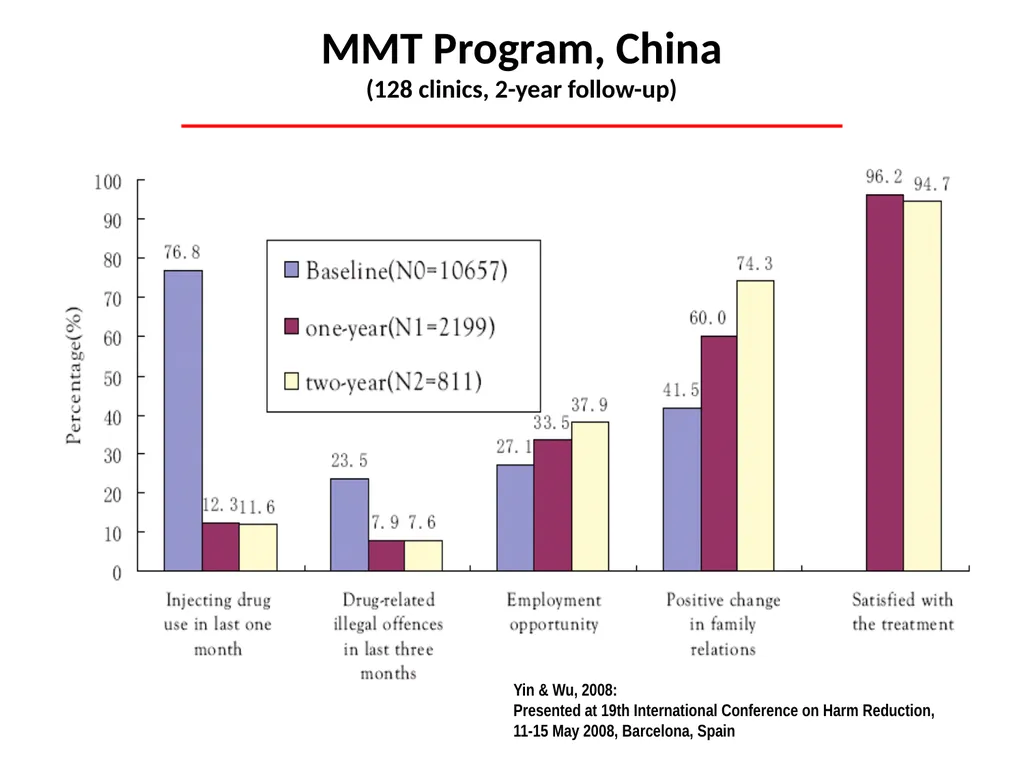
slide8. MMT Program, China
(128 clinics, 2-year follow-up) Yin & Wu, 2008:
Presented at 19th International Conference on Harm Reduction, 11-15 May 2008, Barcelona, Spain<br>
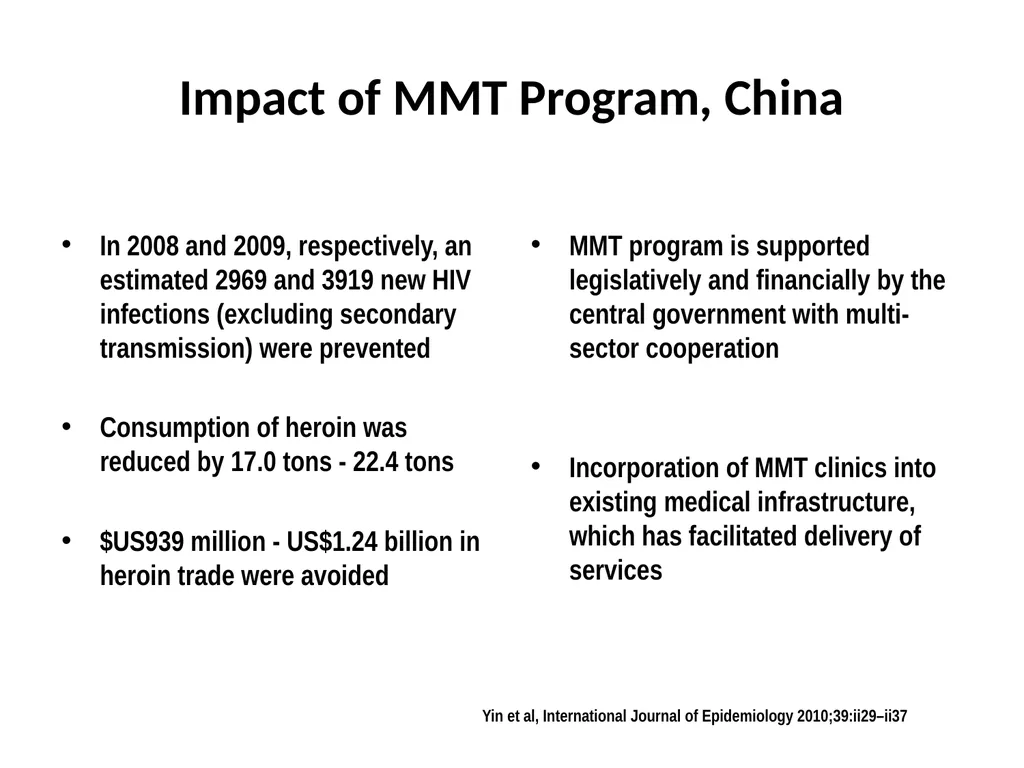
slide9. Impact of MMT Program, China In 2008 and 2009, respectively, an estimated 2969 and 3919 new HIV infections (excluding secondary transmission) were prevented
Consumption of heroin was reduced by 17.0 tons - 22.4 tons
$US939 million - US$1.24 billion in heroin trade were avoided MMT program is supported legislatively and financially by the central government with multi-sector cooperation
Incorporation of MMT clinics into existing medical infrastructure, which has facilitated delivery of services Yin et al, International Journal of Epidemiology 2010;39:ii29–ii37<br>
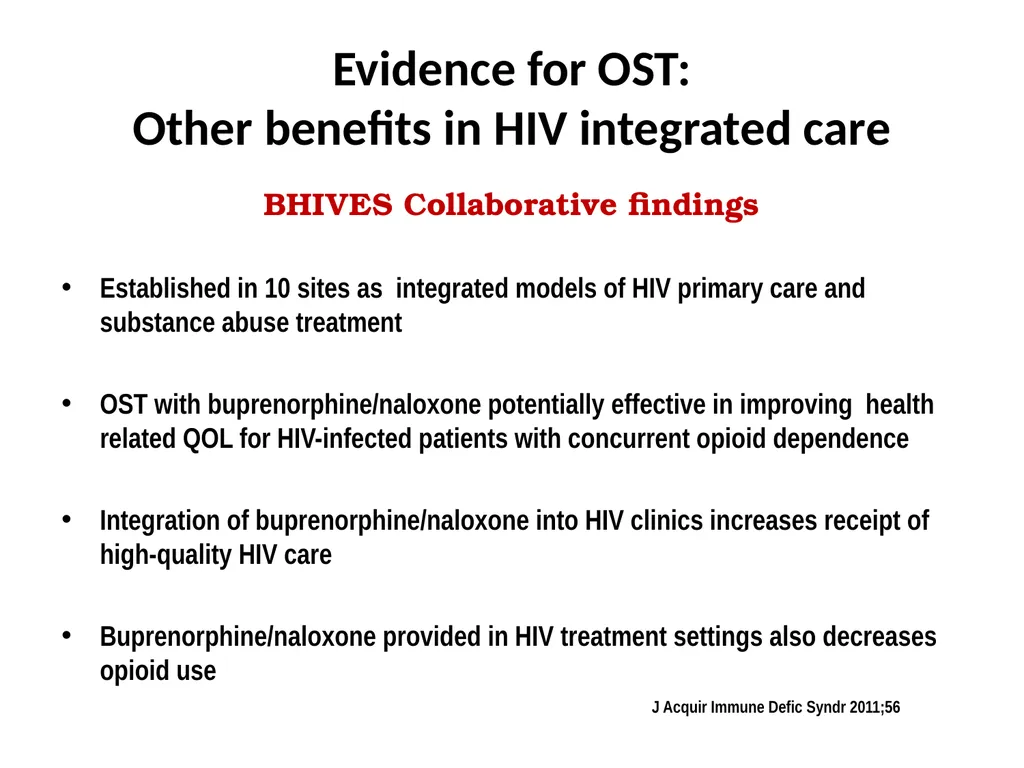
slide10. Evidence for OST:Other benefits in HIV integrated care BHIVES Collaborative findings
Established in 10 sites as integrated models of HIV primary care and substance abuse treatment
OST with buprenorphine/naloxone potentially effective in improving health related QOL for HIV-infected patients with concurrent opioid dependence
Integration of buprenorphine/naloxone into HIV clinics increases receipt of high-quality HIV care
Buprenorphine/naloxone provided in HIV treatment settings also decreases opioid use J Acquir Immune Defic Syndr 2011;56<br>
slide11. 2. CURRENT STATUS OF OST:THE RESPONSE IN THE REGION<br>
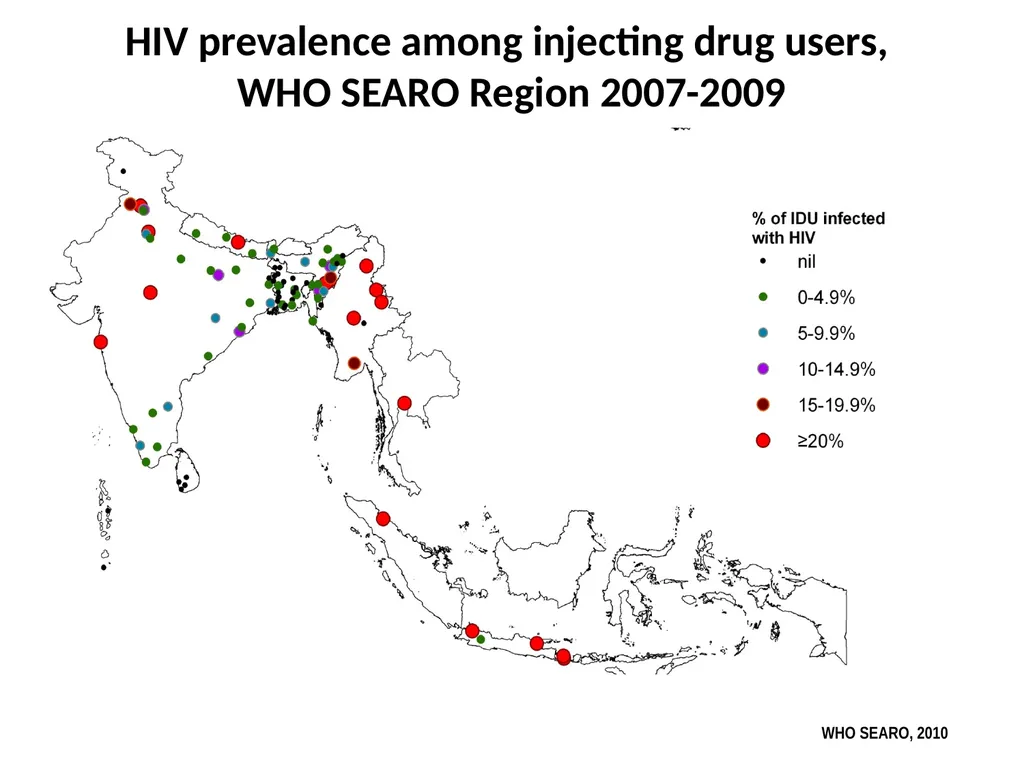
slide12. HIV prevalence among injecting drug users, WHO SEARO Region 2007-2009 WHO SEARO, 2010<br>
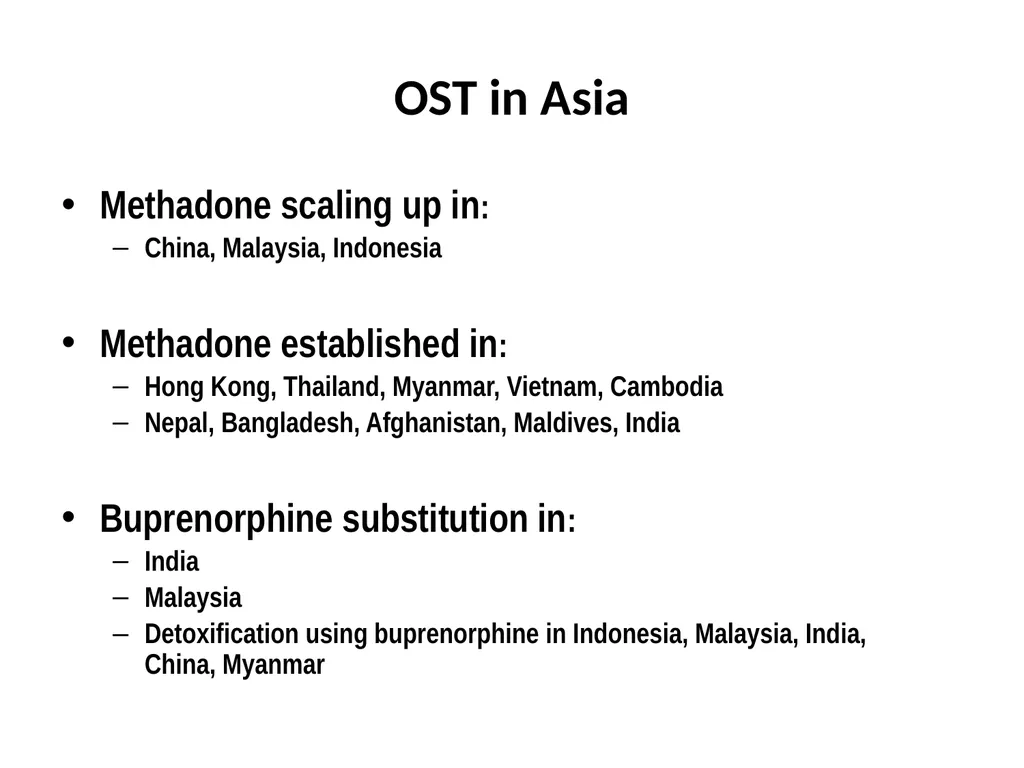
slide13. OST in Asia Methadone scaling up in:
China, Malaysia, Indonesia
Methadone established in:
Hong Kong, Thailand, Myanmar, Vietnam, Cambodia
Nepal, Bangladesh, Afghanistan, Maldives, India
Buprenorphine substitution in:
India
Malaysia
Detoxification using buprenorphine in Indonesia, Malaysia, India, China, Myanmar<br>
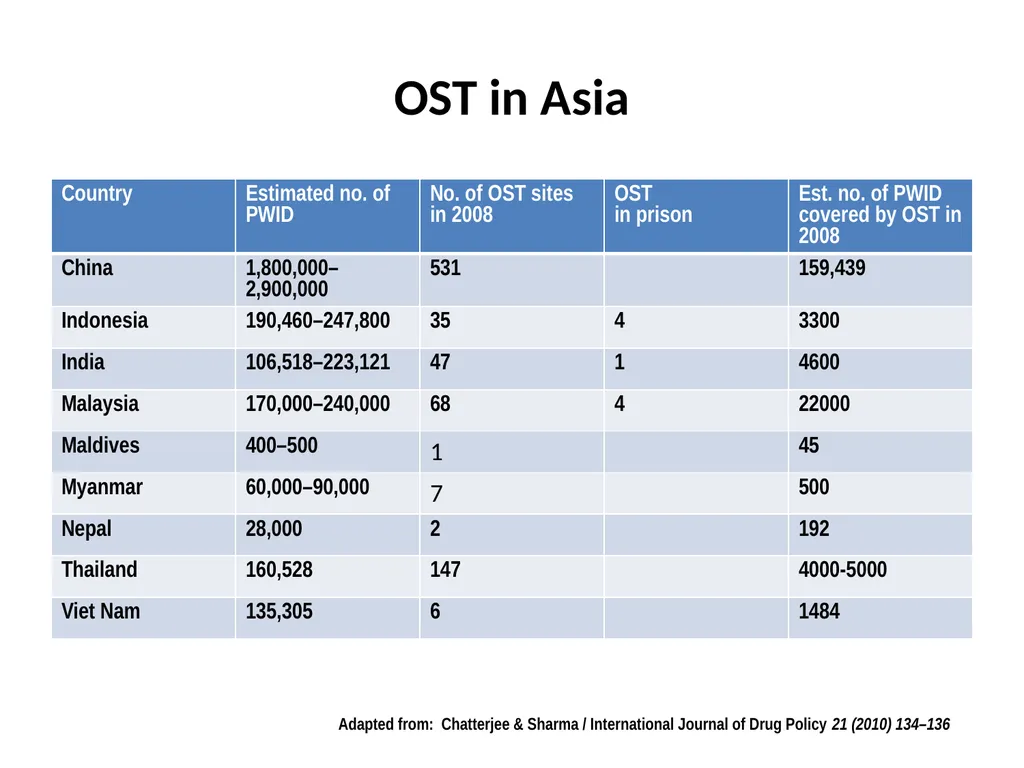
slide14. OST in Asia Adapted from: Chatterjee & Sharma / International Journal of Drug Policy 21 (2010) 134–136<br>
slide15. OST in AsiaMalaysia Pilot methadone maintenance therapy (MMT) programme in 2005 under the Ministry of Health
Government hospitals were pressed into service as therapy centres for the programme
The initial success led to a widening of the coverage in 2007 to 5000 drug users Narayanan et al. / International Journal of Drug Policy 22 (2011) 311– 317<br>
slide16. OST in AsiaMalaysia As of June 2010, 211 MMT free MMT service outlets with 13471 registered clients
Additional 20000 individuals accessing fee based OST through private practitioners
The initial success led to a widening of the coverage in 2007 to 5000 drug users Good practices in Asia, WHO WPRO & Min of Health Malaysia, 2011<br>
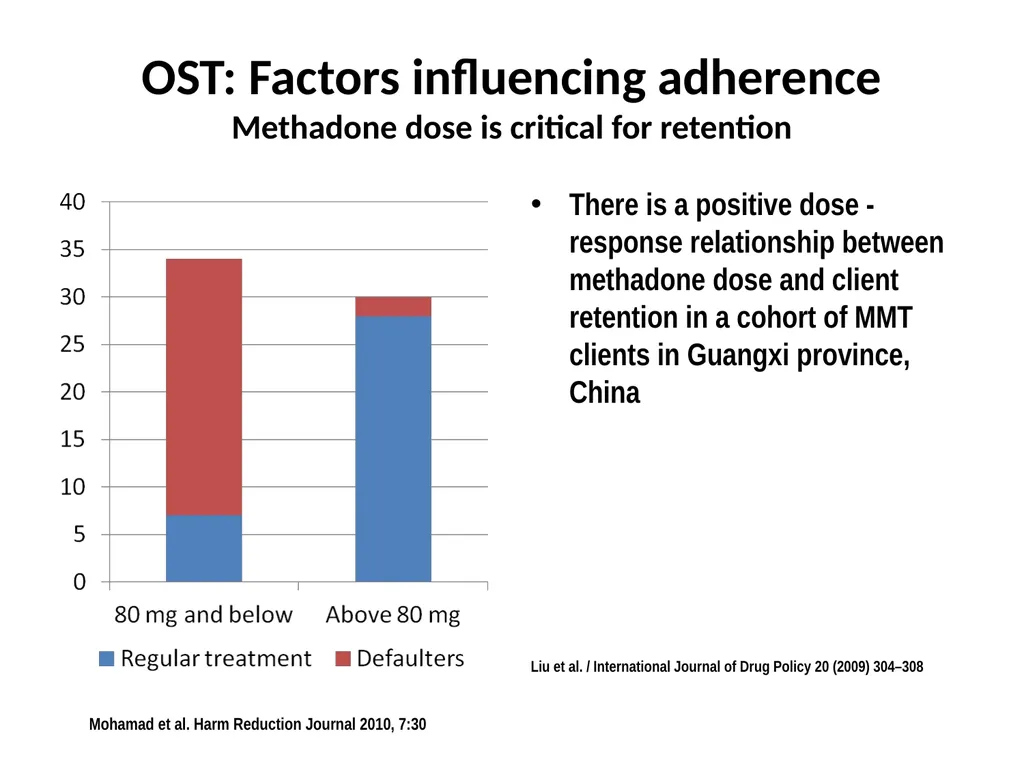
slide17. OST: Factors influencing adherenceMethadone dose is critical for retention There is a positive dose - response relationship between methadone dose and client retention in a cohort of MMT clients in Guangxi province, China
Liu et al. / International Journal of Drug Policy 20 (2009) 304–308 Mohamad et al. Harm Reduction Journal 2010, 7:30<br>
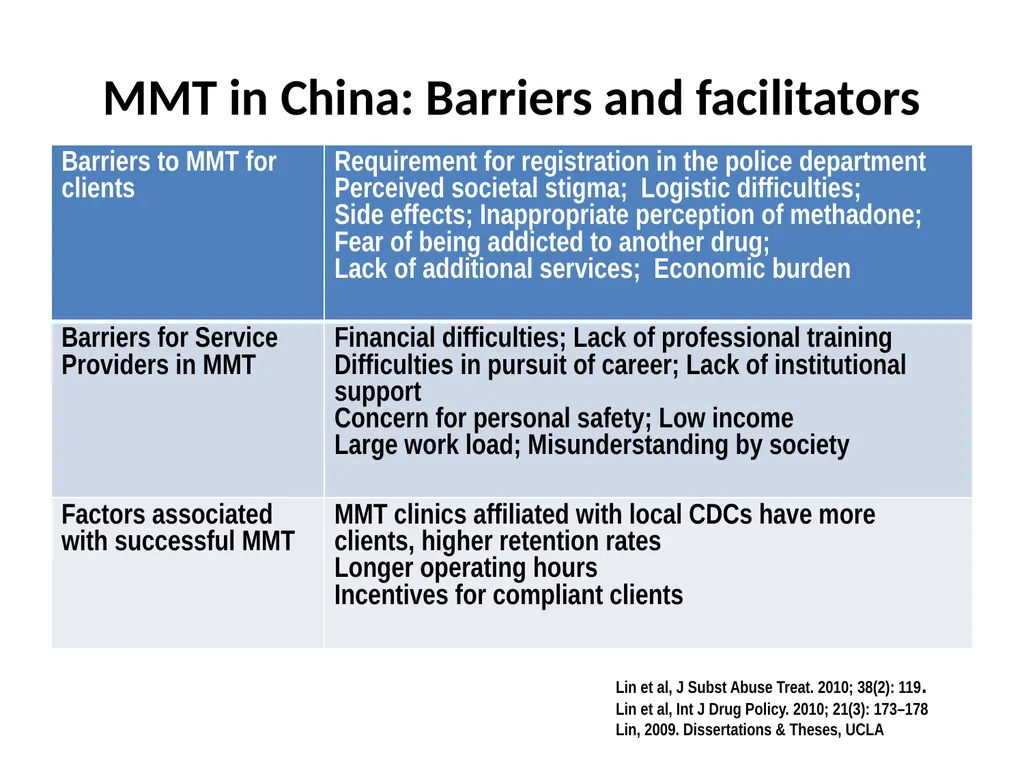
slide18. MMT in China: Barriers and facilitators Lin et al, J Subst Abuse Treat. 2010; 38(2): 119.
Lin et al, Int J Drug Policy. 2010; 21(3): 173–178
Lin, 2009. Dissertations & Theses, UCLA<br>
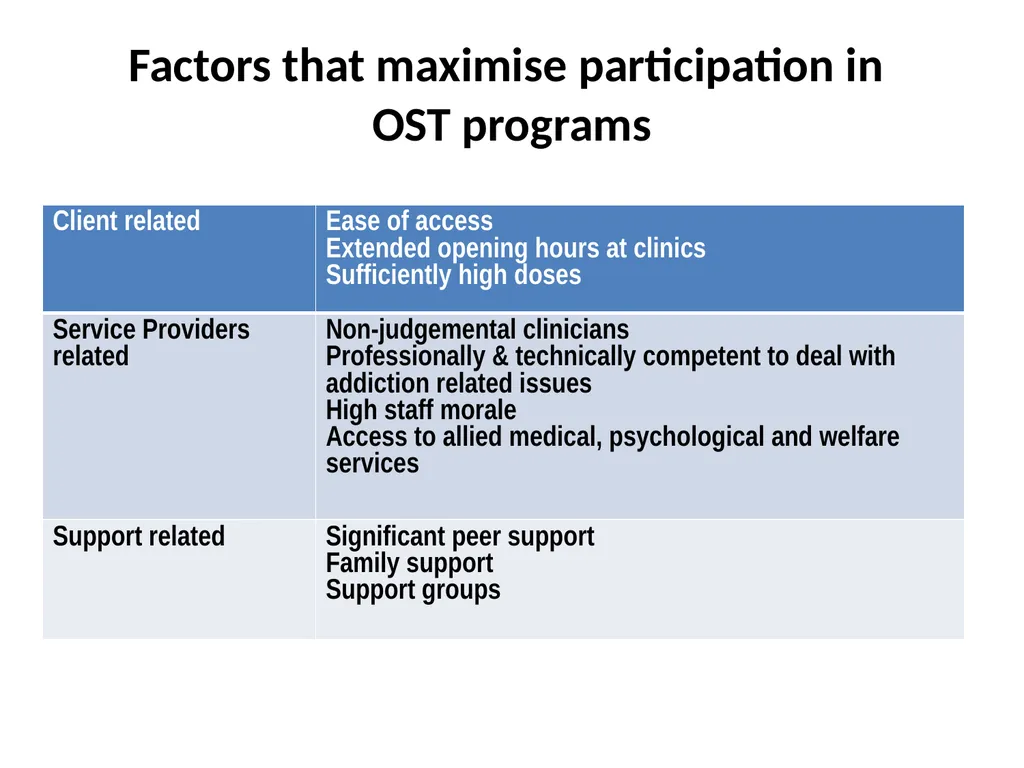
slide19. Factors that maximise participation in OST programs<br>
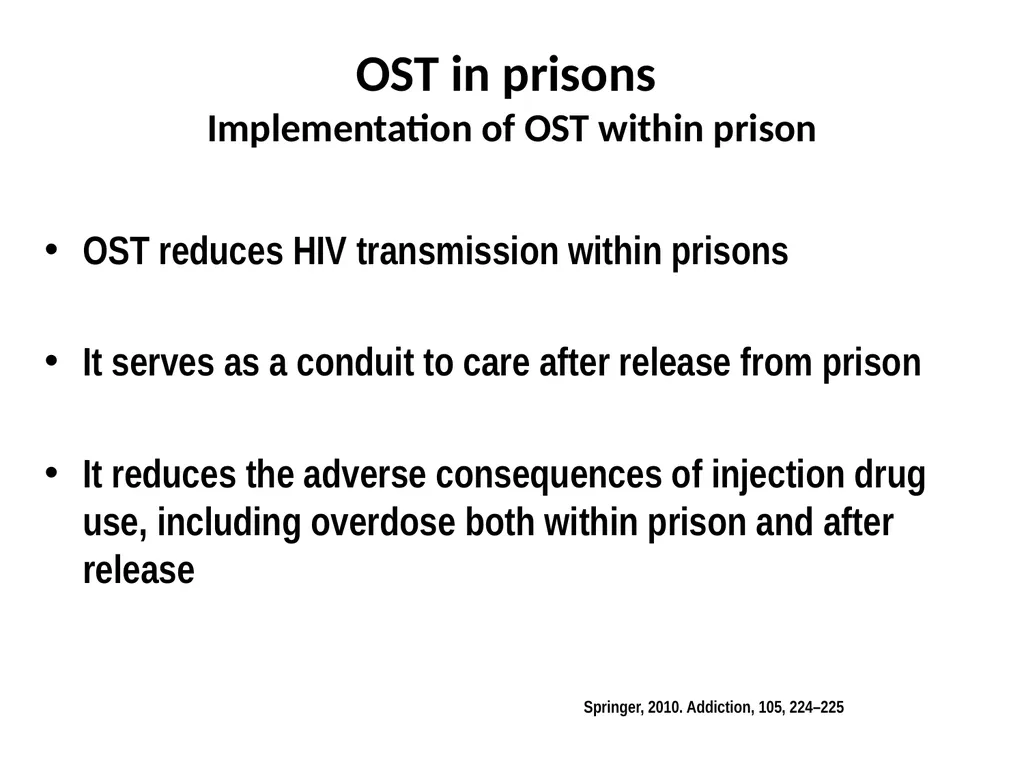
slide20. OST in prisons Implementation of OST within prison OST reduces HIV transmission within prisons
It serves as a conduit to care after release from prison
It reduces the adverse consequences of injection drug use, including overdose both within prison and after release Springer, 2010. Addiction, 105, 224–225<br>
slide21. 3. Gaps in response: opportunity for improvement<br>
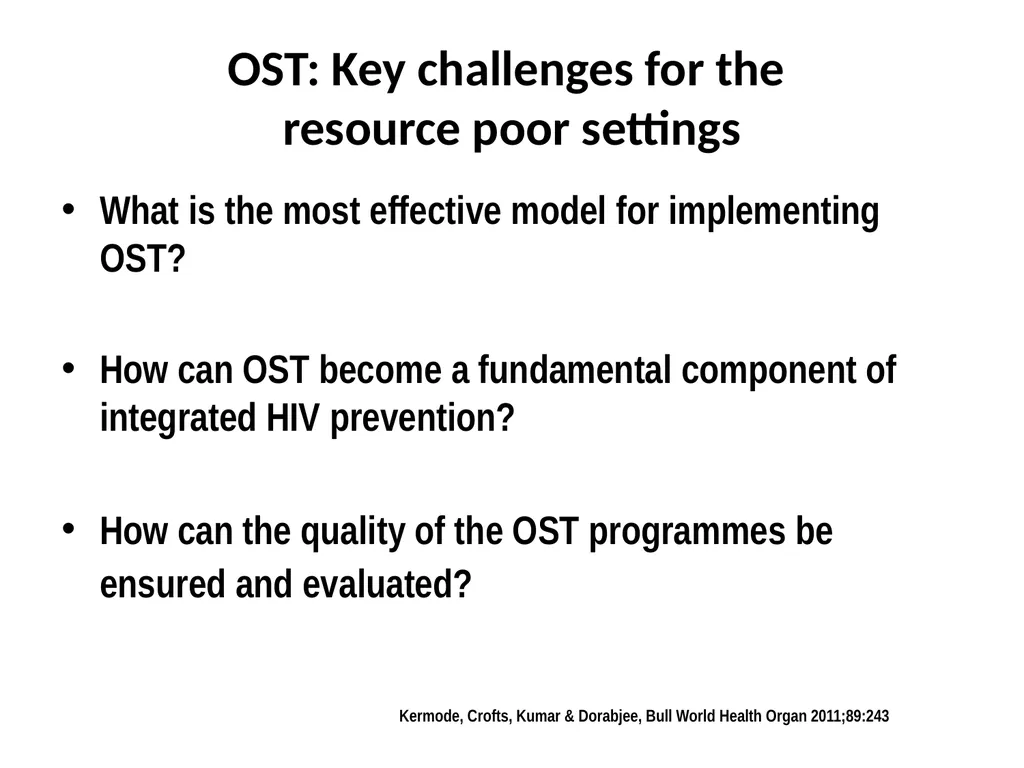
slide22. OST: Key challenges for the resource poor settings What is the most effective model for implementing OST?
How can OST become a fundamental component of integrated HIV prevention?
How can the quality of the OST programmes be ensured and evaluated? Kermode, Crofts, Kumar & Dorabjee, Bull World Health Organ 2011;89:243<br>
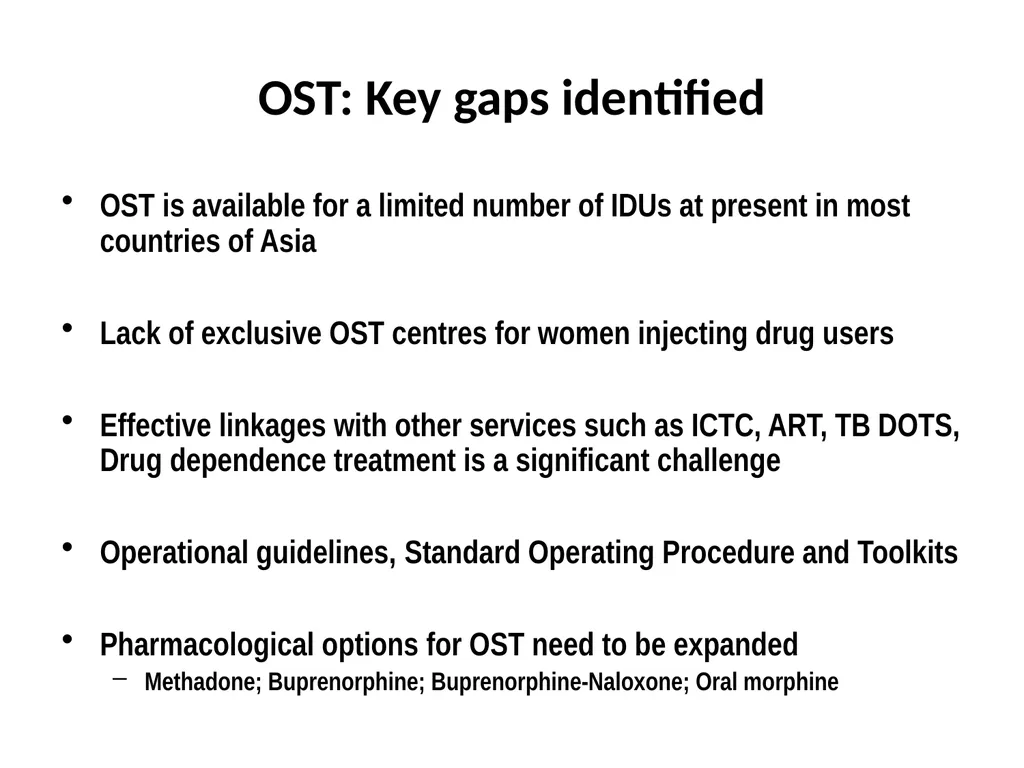
slide23. OST: Key gaps identified OST is available for a limited number of IDUs at present in most countries of Asia
Lack of exclusive OST centres for women injecting drug users
Effective linkages with other services such as ICTC, ART, TB DOTS, Drug dependence treatment is a significant challenge
Operational guidelines, Standard Operating Procedure and Toolkits
Pharmacological options for OST need to be expanded
Methadone; Buprenorphine; Buprenorphine-Naloxone; Oral morphine<br>
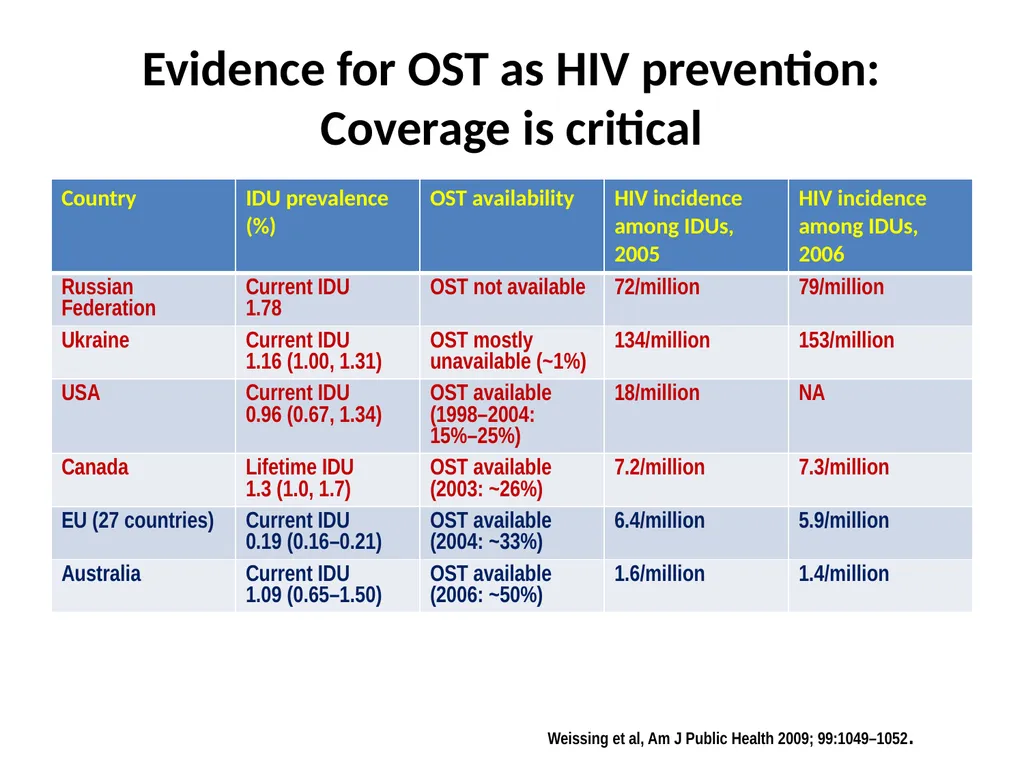
slide24. Evidence for OST as HIV prevention:Coverage is critical Weissing et al, Am J Public Health 2009; 99:1049–1052.<br>
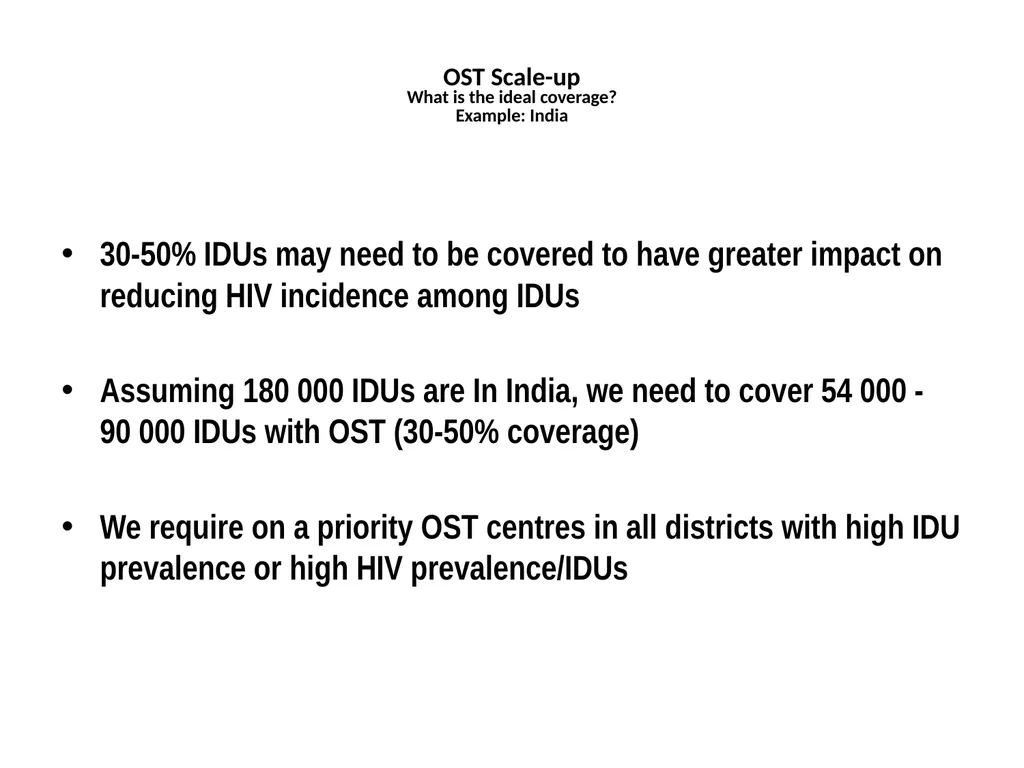
slide25. OST Scale-upWhat is the ideal coverage?Example: India 30-50% IDUs may need to be covered to have greater impact on reducing HIV incidence among IDUs
Assuming 180 000 IDUs are In India, we need to cover 54 000 - 90 000 IDUs with OST (30-50% coverage)
We require on a priority OST centres in all districts with high IDU prevalence or high HIV prevalence/IDUs<br>
slide26. Degenhardt et al, Lancet 2010; 376: 285–301 Combining interventions:
Greater impact on the reduction in HIV incidence<br>
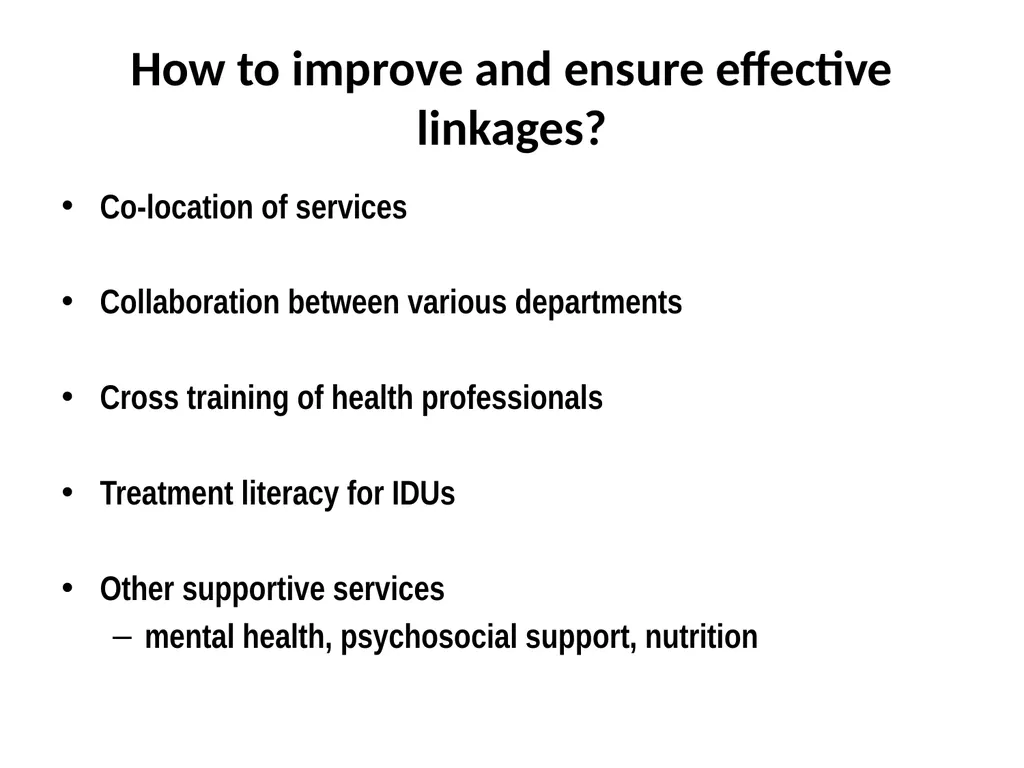
slide27. How to improve and ensure effective linkages? Co-location of services
Collaboration between various departments
Cross training of health professionals
Treatment literacy for IDUs
Other supportive services
mental health, psychosocial support, nutrition<br>
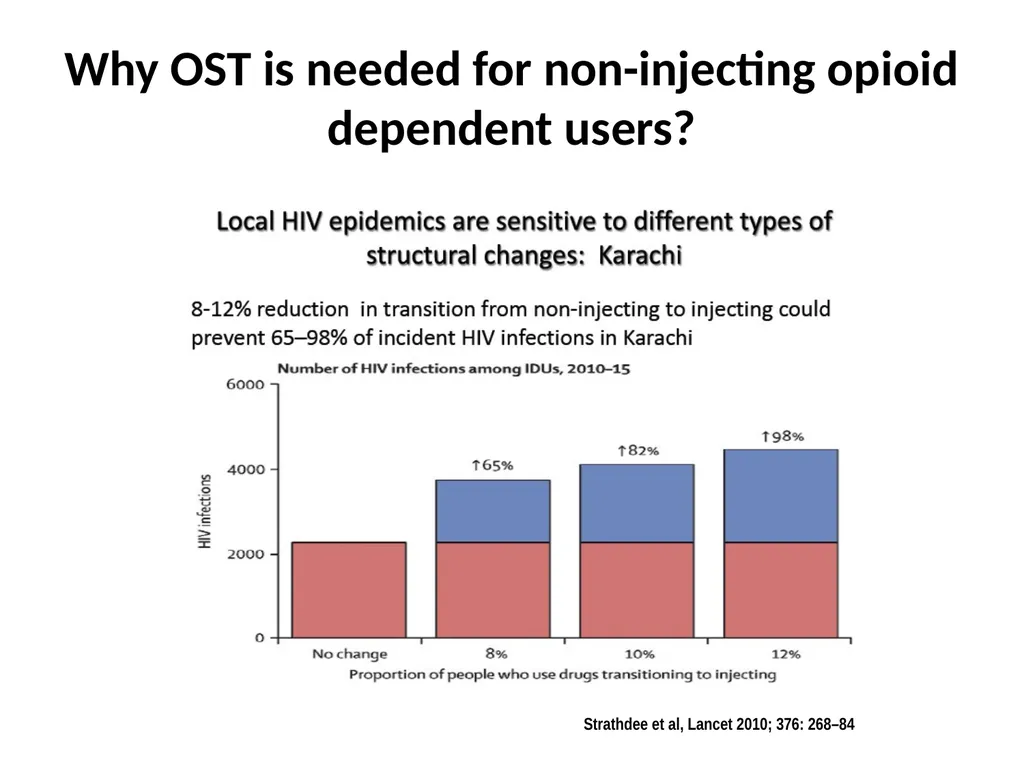
slide28. Why OST is needed for non-injecting opioid dependent users? Strathdee et al, Lancet 2010; 376: 268–84<br>
slide29. 4. OST TOOLKITS<br>
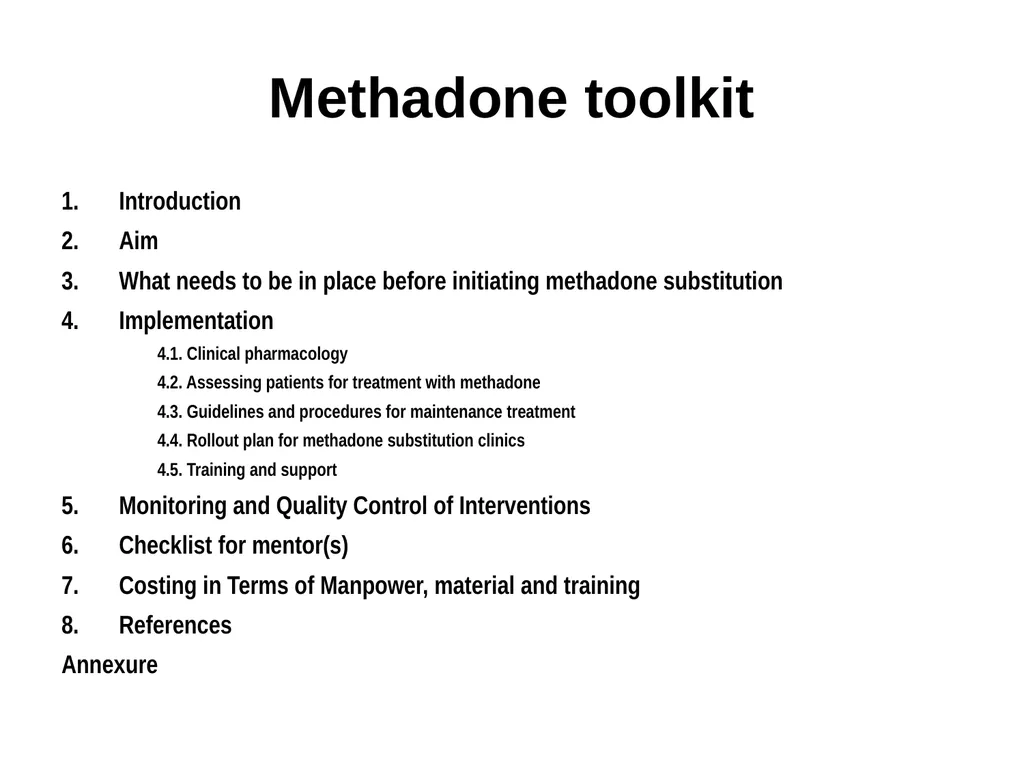
slide30. Methadone toolkit Introduction
Aim
What needs to be in place before initiating methadone substitution
Implementation
4.1. Clinical pharmacology
4.2. Assessing patients for treatment with methadone
4.3. Guidelines and procedures for maintenance treatment
4.4. Rollout plan for methadone substitution clinics
4.5. Training and support
Monitoring and Quality Control of Interventions
Checklist for mentor(s)
Costing in Terms of Manpower, material and training
References
Annexure<br>
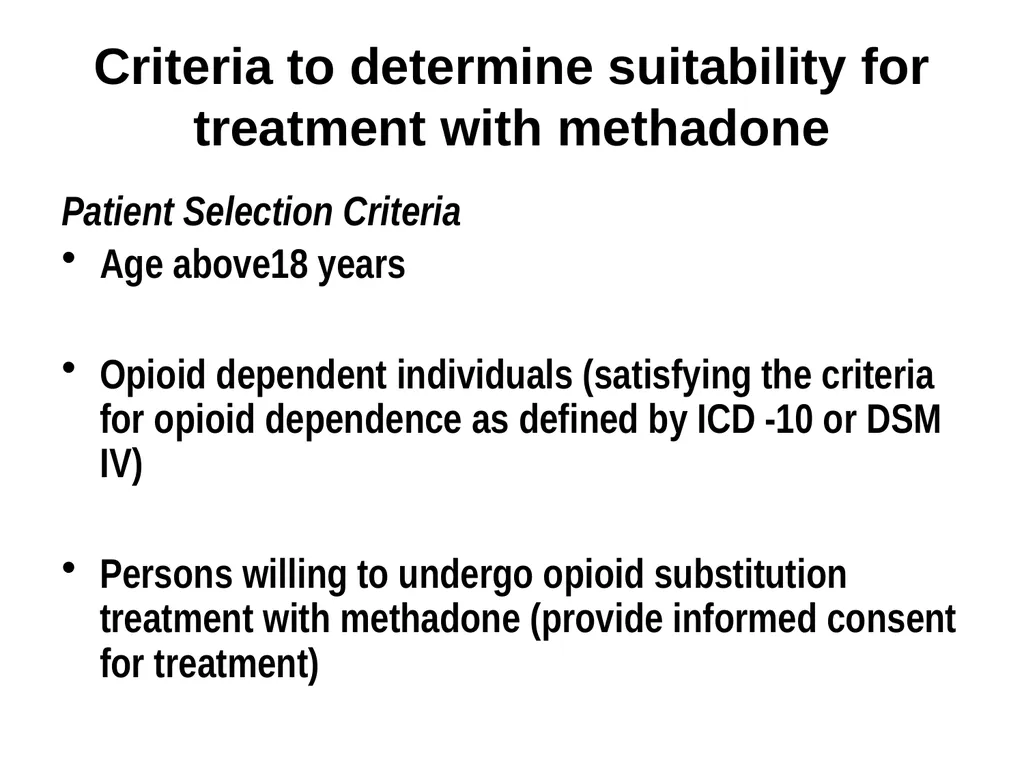
slide31. Criteria to determine suitability fortreatment with methadone Patient Selection Criteria
Age above18 years
Opioid dependent individuals (satisfying the criteria for opioid dependence as defined by ICD -10 or DSM IV)
Persons willing to undergo opioid substitution treatment with methadone (provide informed consent for treatment)<br>
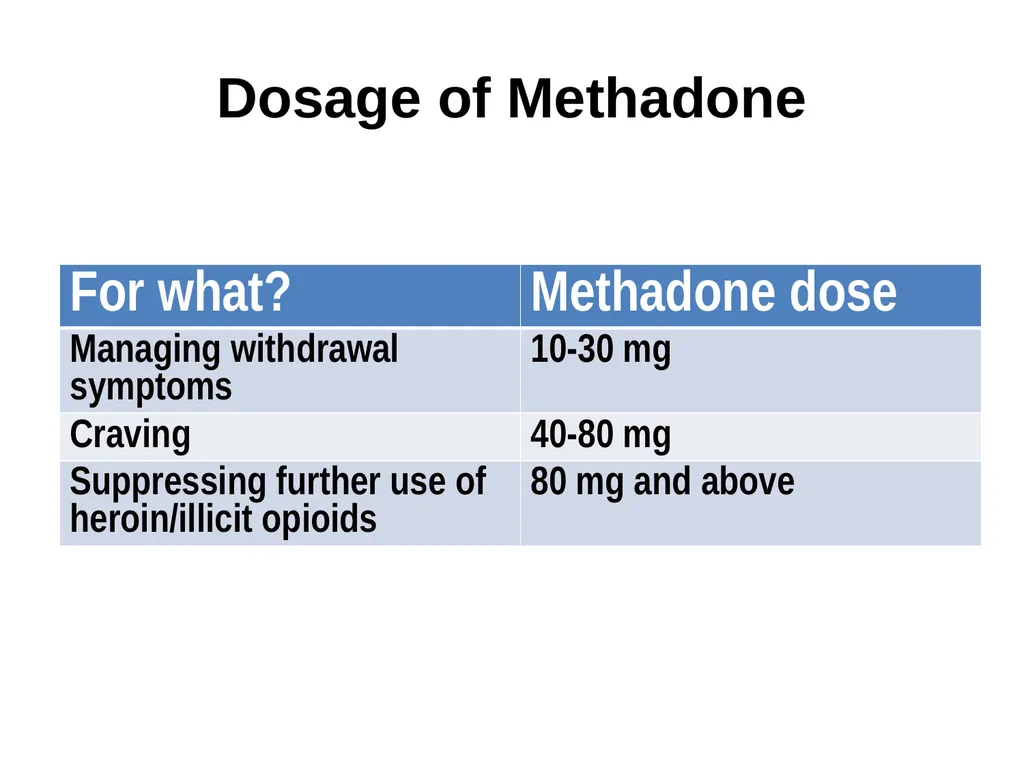
slide32. Dosage of Methadone<br>
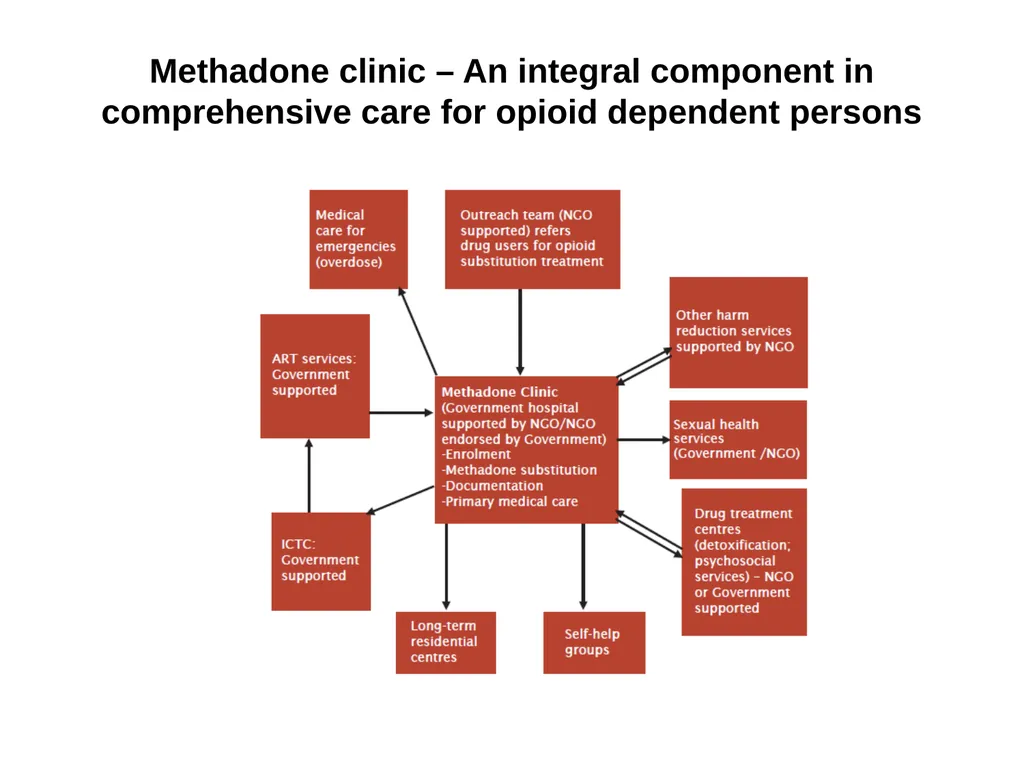
slide33. Methadone clinic – An integral component in comprehensive care for opioid dependent persons<br>
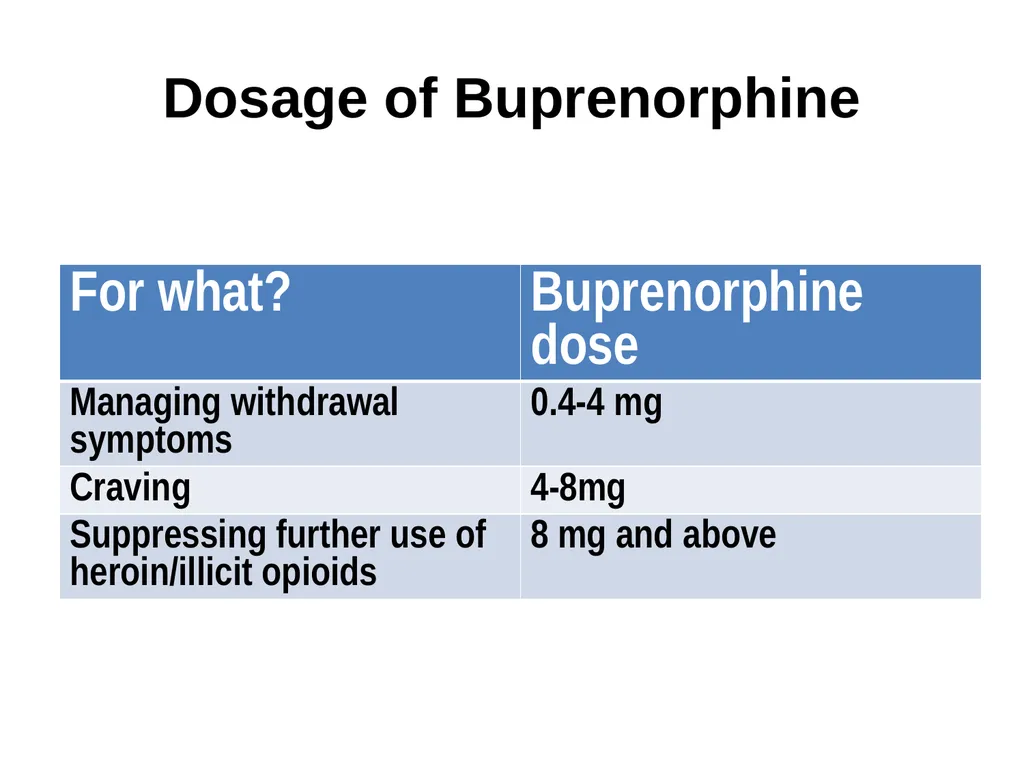
slide34. Dosage of Buprenorphine<br>
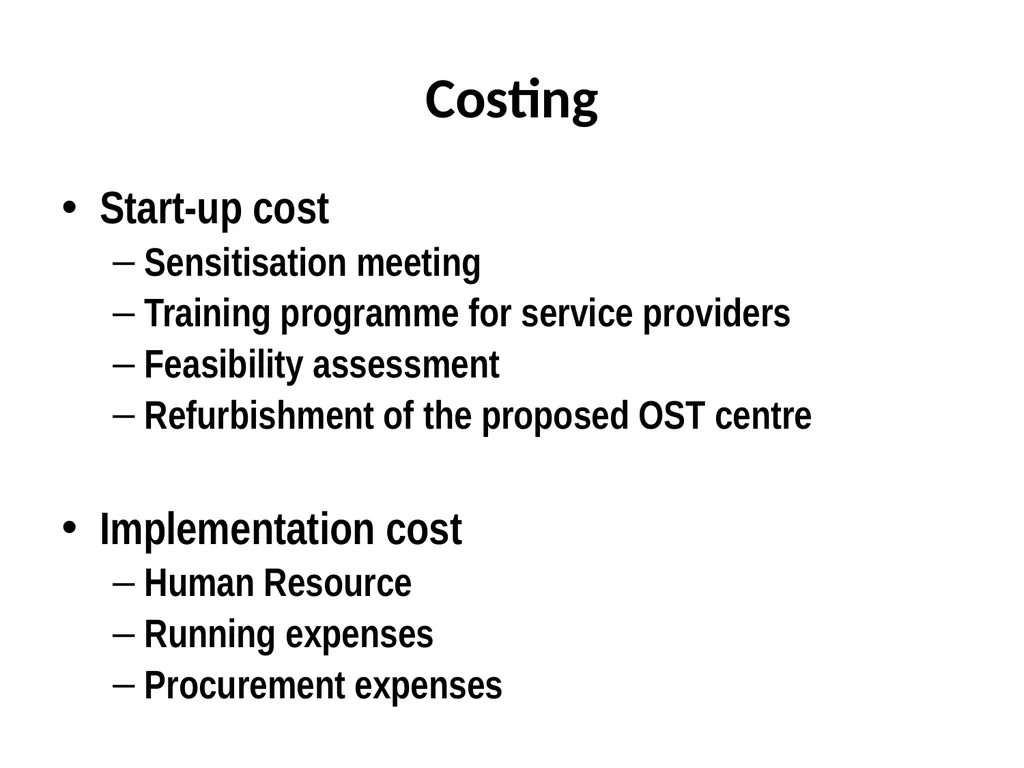
slide35. Costing Start-up cost
Sensitisation meeting
Training programme for service providers
Feasibility assessment
Refurbishment of the proposed OST centre
Implementation cost
Human Resource
Running expenses
Procurement expenses<br>
slide36. 5. summary<br>
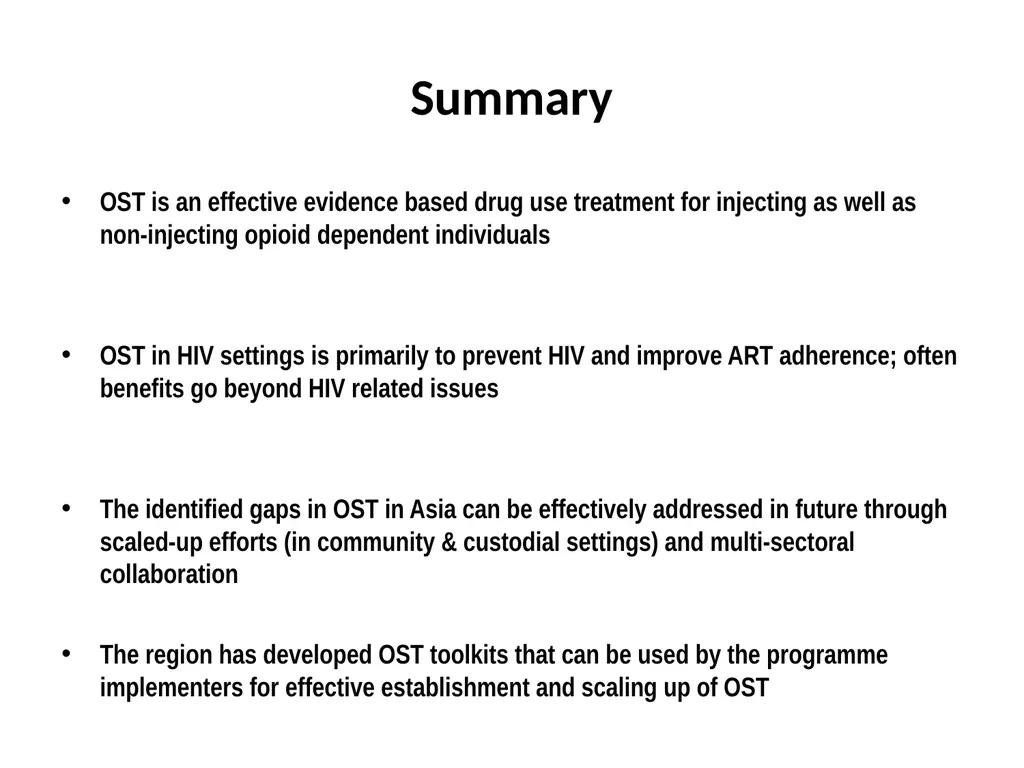
slide37. Summary OST is an effective evidence based drug use treatment for injecting as well as non-injecting opioid dependent individuals
OST in HIV settings is primarily to prevent HIV and improve ART adherence; often benefits go beyond HIV related issues
The identified gaps in OST in Asia can be effectively addressed in future through scaled-up efforts (in community & custodial settings) and multi-sectoral collaboration
The region has developed OST toolkits that can be used by the programme implementers for effective establishment and scaling up of OST<br>

slide2. Outline of presentation Model of integrated OST and HIV care: evidence
Current status of OST in Asia: the response in the region
Gaps in response: Opportunity for improvement
Methadone and Buprenorphine Toolkits
Summary<br>
slide3. 1. Model of Integrated OST and HIV care: Evidence<br>
slide4. Opioid Substitution Therapy (OST): Triple Action<br>

slide5. OST in HIV settings:OST as HIV prevention Adapted from: Degenhardt et al, Lancet 2010; 376: 285–301<br>
slide6. Evidence for MMT as HIV prevention Metzer et al, J Acquir Immune Defic Syndr. 1993 Sep;6(9):1049-56<br>
slide7. Key findings from WHO collaborative study on OST and HIV OST can achieve similar outcomes consistently in a culturally diverse range of settings in low- and middle-income countries to those reported widely in high-income countries
It is associated with a substantial reduction in HIV exposure risk associated with IDU across nearly all the countries
Results support the expansion of opioid substitution treatment Lawrinson et al, 2008; Addiction, 103, 1484–1492<br>
slide8. MMT Program, China
(128 clinics, 2-year follow-up) Yin & Wu, 2008:
Presented at 19th International Conference on Harm Reduction, 11-15 May 2008, Barcelona, Spain<br>
slide9. Impact of MMT Program, China In 2008 and 2009, respectively, an estimated 2969 and 3919 new HIV infections (excluding secondary transmission) were prevented
Consumption of heroin was reduced by 17.0 tons - 22.4 tons
$US939 million - US$1.24 billion in heroin trade were avoided MMT program is supported legislatively and financially by the central government with multi-sector cooperation
Incorporation of MMT clinics into existing medical infrastructure, which has facilitated delivery of services Yin et al, International Journal of Epidemiology 2010;39:ii29–ii37<br>
slide10. Evidence for OST:Other benefits in HIV integrated care BHIVES Collaborative findings
Established in 10 sites as integrated models of HIV primary care and substance abuse treatment
OST with buprenorphine/naloxone potentially effective in improving health related QOL for HIV-infected patients with concurrent opioid dependence
Integration of buprenorphine/naloxone into HIV clinics increases receipt of high-quality HIV care
Buprenorphine/naloxone provided in HIV treatment settings also decreases opioid use J Acquir Immune Defic Syndr 2011;56<br>
slide11. 2. CURRENT STATUS OF OST:THE RESPONSE IN THE REGION<br>
slide12. HIV prevalence among injecting drug users, WHO SEARO Region 2007-2009 WHO SEARO, 2010<br>
slide13. OST in Asia Methadone scaling up in:
China, Malaysia, Indonesia
Methadone established in:
Hong Kong, Thailand, Myanmar, Vietnam, Cambodia
Nepal, Bangladesh, Afghanistan, Maldives, India
Buprenorphine substitution in:
India
Malaysia
Detoxification using buprenorphine in Indonesia, Malaysia, India, China, Myanmar<br>
slide14. OST in Asia Adapted from: Chatterjee & Sharma / International Journal of Drug Policy 21 (2010) 134–136<br>
slide15. OST in AsiaMalaysia Pilot methadone maintenance therapy (MMT) programme in 2005 under the Ministry of Health
Government hospitals were pressed into service as therapy centres for the programme
The initial success led to a widening of the coverage in 2007 to 5000 drug users Narayanan et al. / International Journal of Drug Policy 22 (2011) 311– 317<br>
slide16. OST in AsiaMalaysia As of June 2010, 211 MMT free MMT service outlets with 13471 registered clients
Additional 20000 individuals accessing fee based OST through private practitioners
The initial success led to a widening of the coverage in 2007 to 5000 drug users Good practices in Asia, WHO WPRO & Min of Health Malaysia, 2011<br>
slide17. OST: Factors influencing adherenceMethadone dose is critical for retention There is a positive dose - response relationship between methadone dose and client retention in a cohort of MMT clients in Guangxi province, China
Liu et al. / International Journal of Drug Policy 20 (2009) 304–308 Mohamad et al. Harm Reduction Journal 2010, 7:30<br>
slide18. MMT in China: Barriers and facilitators Lin et al, J Subst Abuse Treat. 2010; 38(2): 119.
Lin et al, Int J Drug Policy. 2010; 21(3): 173–178
Lin, 2009. Dissertations & Theses, UCLA<br>
slide19. Factors that maximise participation in OST programs<br>
slide20. OST in prisons Implementation of OST within prison OST reduces HIV transmission within prisons
It serves as a conduit to care after release from prison
It reduces the adverse consequences of injection drug use, including overdose both within prison and after release Springer, 2010. Addiction, 105, 224–225<br>
slide21. 3. Gaps in response: opportunity for improvement<br>
slide22. OST: Key challenges for the resource poor settings What is the most effective model for implementing OST?
How can OST become a fundamental component of integrated HIV prevention?
How can the quality of the OST programmes be ensured and evaluated? Kermode, Crofts, Kumar & Dorabjee, Bull World Health Organ 2011;89:243<br>
slide23. OST: Key gaps identified OST is available for a limited number of IDUs at present in most countries of Asia
Lack of exclusive OST centres for women injecting drug users
Effective linkages with other services such as ICTC, ART, TB DOTS, Drug dependence treatment is a significant challenge
Operational guidelines, Standard Operating Procedure and Toolkits
Pharmacological options for OST need to be expanded
Methadone; Buprenorphine; Buprenorphine-Naloxone; Oral morphine<br>
slide24. Evidence for OST as HIV prevention:Coverage is critical Weissing et al, Am J Public Health 2009; 99:1049–1052.<br>
slide25. OST Scale-upWhat is the ideal coverage?Example: India 30-50% IDUs may need to be covered to have greater impact on reducing HIV incidence among IDUs
Assuming 180 000 IDUs are In India, we need to cover 54 000 - 90 000 IDUs with OST (30-50% coverage)
We require on a priority OST centres in all districts with high IDU prevalence or high HIV prevalence/IDUs<br>
slide26. Degenhardt et al, Lancet 2010; 376: 285–301 Combining interventions:
Greater impact on the reduction in HIV incidence<br>
slide27. How to improve and ensure effective linkages? Co-location of services
Collaboration between various departments
Cross training of health professionals
Treatment literacy for IDUs
Other supportive services
mental health, psychosocial support, nutrition<br>
slide28. Why OST is needed for non-injecting opioid dependent users? Strathdee et al, Lancet 2010; 376: 268–84<br>
slide29. 4. OST TOOLKITS<br>
slide30. Methadone toolkit Introduction
Aim
What needs to be in place before initiating methadone substitution
Implementation
4.1. Clinical pharmacology
4.2. Assessing patients for treatment with methadone
4.3. Guidelines and procedures for maintenance treatment
4.4. Rollout plan for methadone substitution clinics
4.5. Training and support
Monitoring and Quality Control of Interventions
Checklist for mentor(s)
Costing in Terms of Manpower, material and training
References
Annexure<br>
slide31. Criteria to determine suitability fortreatment with methadone Patient Selection Criteria
Age above18 years
Opioid dependent individuals (satisfying the criteria for opioid dependence as defined by ICD -10 or DSM IV)
Persons willing to undergo opioid substitution treatment with methadone (provide informed consent for treatment)<br>
slide32. Dosage of Methadone<br>
slide33. Methadone clinic – An integral component in comprehensive care for opioid dependent persons<br>
slide34. Dosage of Buprenorphine<br>
slide35. Costing Start-up cost
Sensitisation meeting
Training programme for service providers
Feasibility assessment
Refurbishment of the proposed OST centre
Implementation cost
Human Resource
Running expenses
Procurement expenses<br>
slide36. 5. summary<br>
slide37. Summary OST is an effective evidence based drug use treatment for injecting as well as non-injecting opioid dependent individuals
OST in HIV settings is primarily to prevent HIV and improve ART adherence; often benefits go beyond HIV related issues
The identified gaps in OST in Asia can be effectively addressed in future through scaled-up efforts (in community & custodial settings) and multi-sectoral collaboration
The region has developed OST toolkits that can be used by the programme implementers for effective establishment and scaling up of OST<br>