
Optimizing GME Pass Through Reimbursement for



Description: Optimizing GME Pass Through Reimbursement for Residency Training Programs Thomas W. Woller, M.S., FASHP Senior Vice President, Pharmacy Services Aurora Health Care Milwaukee, Wisconsin Disclaimer ASHP and Mr. Woller provide general
Related Topics
Download Presentation
"Optimizing GME Pass Through Reimbursement for" is the property of its rightful owner. Permission is granted to download and print the materials on this website for personal, non-commercial use only, and to display it on your personal computer provided you do not modify the materials and that you retain all copyright notices contained in the materials. By downloading content from our website, you accept the terms of this agreement.
Presentation Transcript
slide1. Optimizing GME Pass Through Reimbursement for Residency Training Programs Thomas W. Woller, M.S., FASHP
Senior Vice President, Pharmacy Services
Aurora Health Care
Milwaukee, Wisconsin<br>
slide2. Disclaimer ASHP and Mr. Woller provide general information on the subject matter of GME pass-through funding mechanics.
This information is not meant to substitute for your own research into applicability to obtain GME pass-through funding at your organization, a thorough review of direct and indirect costs associated with GME pass- through funding, or a discussion with your finance office.<br>
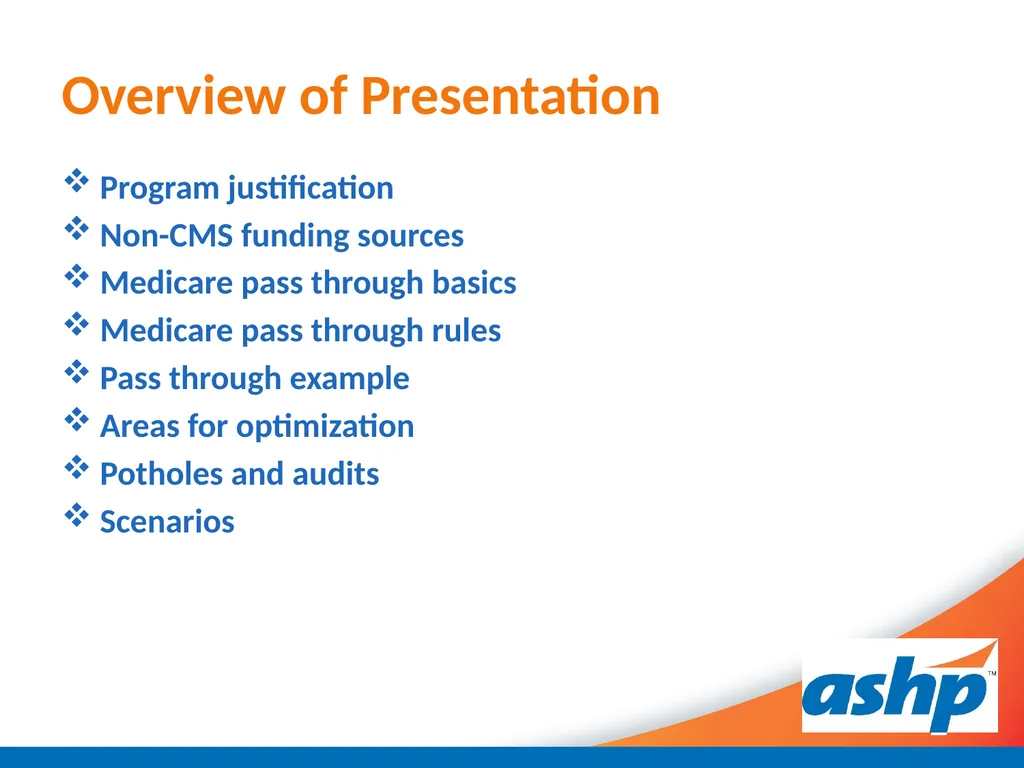
slide3. Overview of Presentation Program justification
Non-CMS funding sources
Medicare pass through basics
Medicare pass through rules
Pass through example
Areas for optimization
Potholes and audits
Scenarios<br>
slide4. Residency Programs Justification CMS GME reimbursement
Direct and indirect
Non-CMS funding sources
Staffing
Projects/services
Qualitative benefits
Enhance overall teaching
Challenge staff to excel
Recruitment advantage<br>
slide5. Non-CMS Sources of Residency Funding States (historically Texas, Minnesota)
VA Hospitals
Colleges of Pharmacy
Pharmaceutical Industry
Hospitals and Health Systems
Note that PGY-2 programs are not eligible for pass-through funding
Department of Defense
ASHP Foundation, NACDS, other organizations
Others<br>
slide6. Other Contributions by Residents Projects to improve quality of care
New services
Provision of patient care
Participation in the teaching of Pharm.D. students
Cost reduction strategies
Learning environment
Recruitment
Staffing<br>
slide7. Staffing Contributions of Residents 6 residents in the example
2 shifts every other weekend (1.2 FTE)
Not quite 1.2 FTE due to training
Replace pharmacists on the schedule
Pharmacist average salary $120,000 + FB (30%)
Value of resident staffing = $187,200
Careful with this justification; finance might want to reduce your RPh allotment correspondingly<br>
slide8. Medicare cost report basics All Medicare certified hospitals are required to file a cost report annually
Filed with a fiscal intermediary or Medicare Administrative Contractor (MAC)
History of cost reports adds to confusion
Intended to define allowable costs and the “share” of those costs to be covered by the federal government
Subject to review and audit by MAC
In contemporary terms, most reimbursement by Medicare is determined through means other than the cost report; Direct Medical Education remains as an element determined through the cost report<br>
slide9. Medicare funding of pharmacy residencies Direct costs of medical education are excluded from operating costs under PPS and other payment provisions
Reimbursement is on a reasonable cost basis
COBRA 1986 changed Medicare payment for medical, dental, osteopathic and podiatry residencies; Not pharmacy and other paramedical programs
Pastoral care, ultrasound, rad tech, etc.
Indirect costs are also reimbursed; roughly 30% but varies based on number of medical residents/interns<br>
slide10. CMS Reimbursement-basic requirements Approved educational program-- PGY-1 programs only
Accreditation by ASHP
Based on percentage of inpatient Medicare pharmacy revenue
Retroactive reimbursement is possible (with caution)
CMS cost report filed for the fiscal year in question
Cost report is the tool used for the reimbursement
Direct and indirect costs included
Includes provision for Medicare Plus Choice patients
Entity filing cost report must be the operator of the program
August 1, 1998 AJHP<br>
slide11. Definition of approved educational activities Nursing or allied health program
Formally organized and planned program of study
Operated by provider submitting cost report
Enhance the quality of inpatient care at the provider
Licensed (if applicable) or accredited by the recognized national professional organization for the particular activity.
ASHP is specifically listed as the organization for pharmacy 42CFR §413.85<br>
slide12. Operator of the Program Directly incur the training costs
Have direct control over the “curriculum”
Have direct control over the administration of the program
Employ the teaching/training staff
Provide classroom instruction (where required) and clinical training * 42CFR §413.85(f)<br>
slide13. “Absent evidence to the contrary, the provider that issues the degree, diploma, or other certificate upon successful completion of an approved education program is assumed to meet all of the criteria set forth in paragraph (F)(1) of this section and to be the operator of the program” 42CFR §413.85(f)<br>
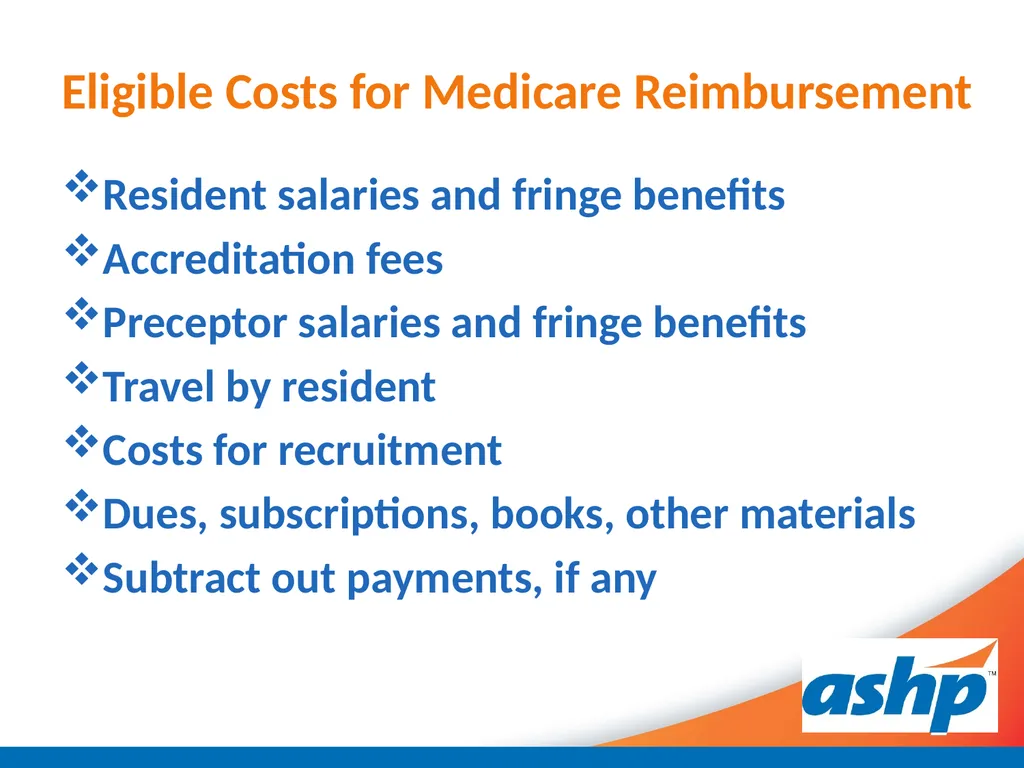
slide14. Eligible Costs for Medicare Reimbursement Resident salaries and fringe benefits
Accreditation fees
Preceptor salaries and fringe benefits
Travel by resident
Costs for recruitment
Dues, subscriptions, books, other materials
Subtract out payments, if any<br>
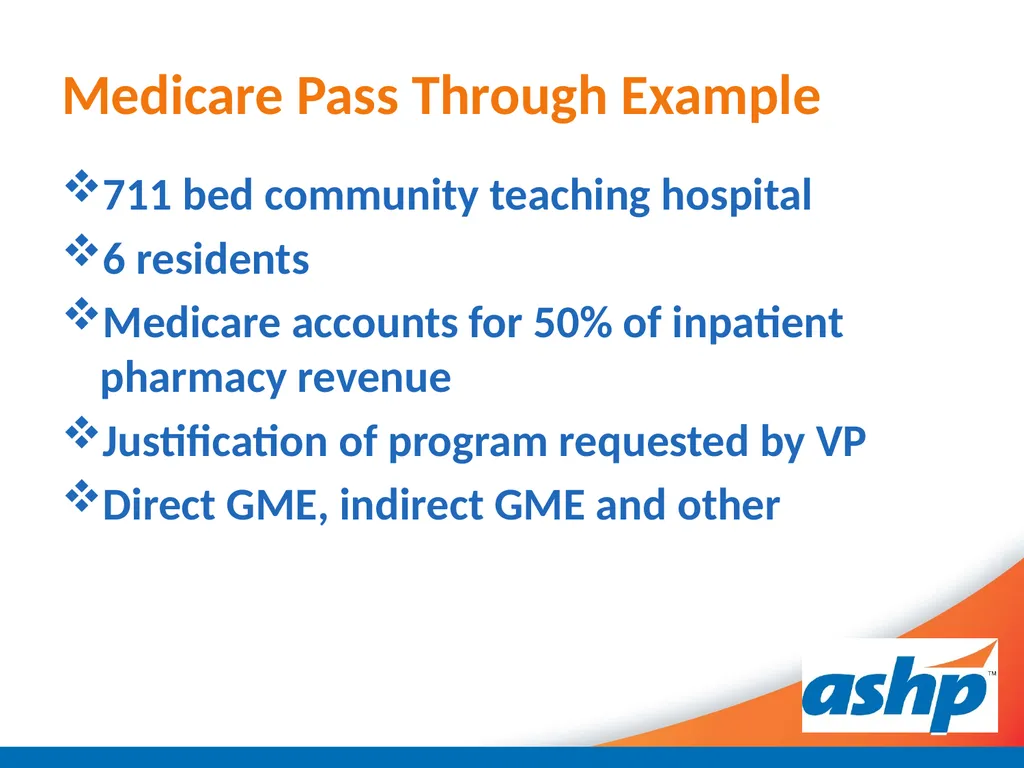
slide15. Medicare Pass Through Example 711 bed community teaching hospital
6 residents
Medicare accounts for 50% of inpatient pharmacy revenue
Justification of program requested by VP
Direct GME, indirect GME and other<br>
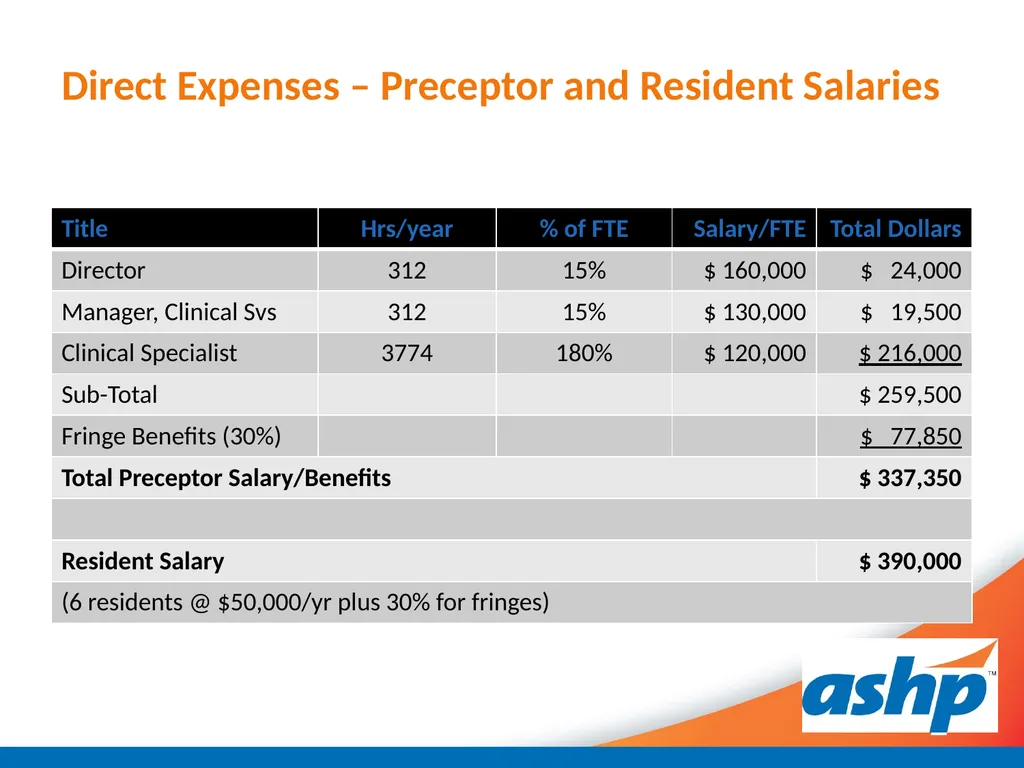
slide16. Direct Expenses – Preceptor and Resident Salaries<br>
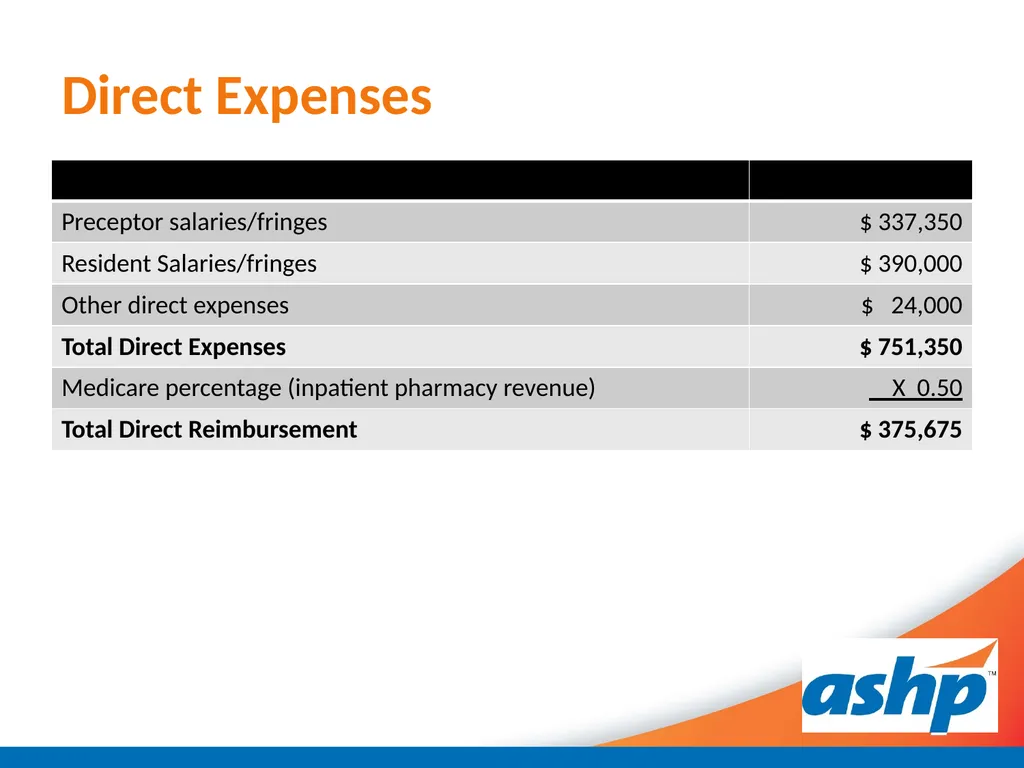
slide17. Direct Expenses<br>
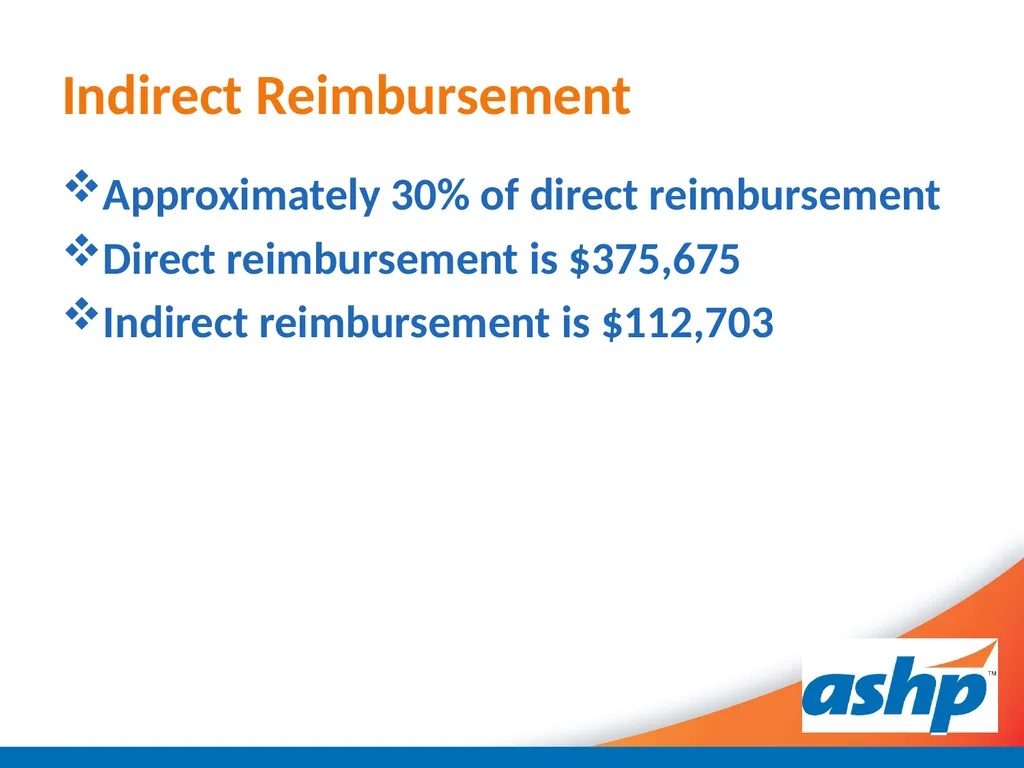
slide18. Indirect Reimbursement Approximately 30% of direct reimbursement
Direct reimbursement is $375,675
Indirect reimbursement is $112,703<br>
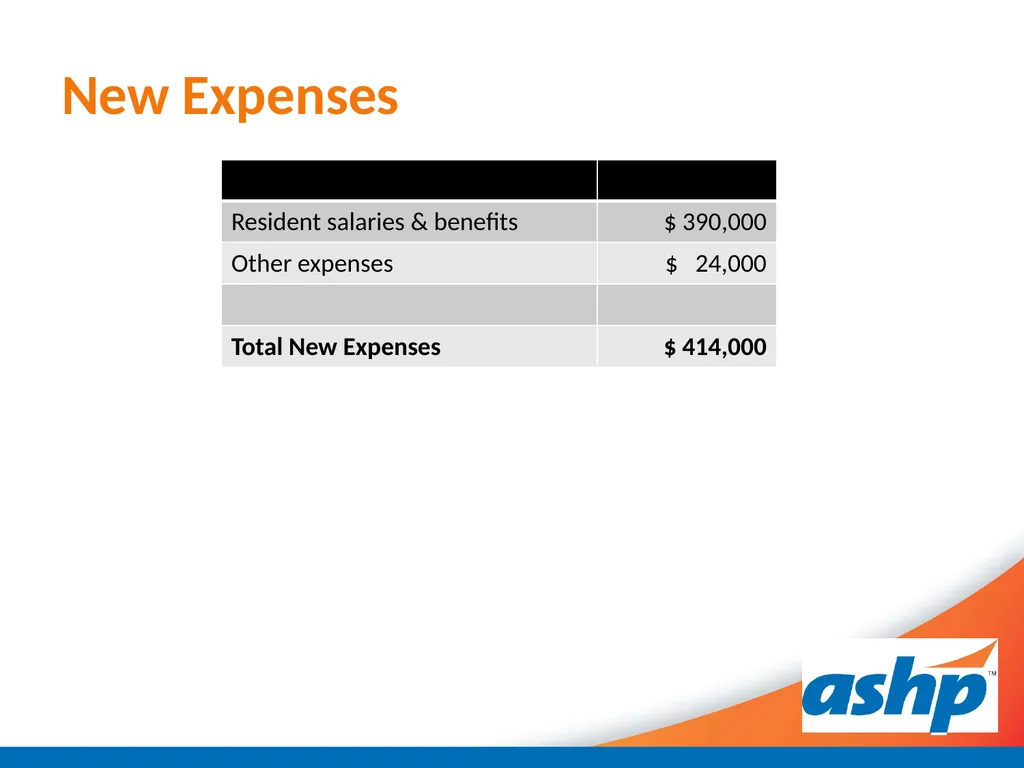
slide19. New Expenses<br>
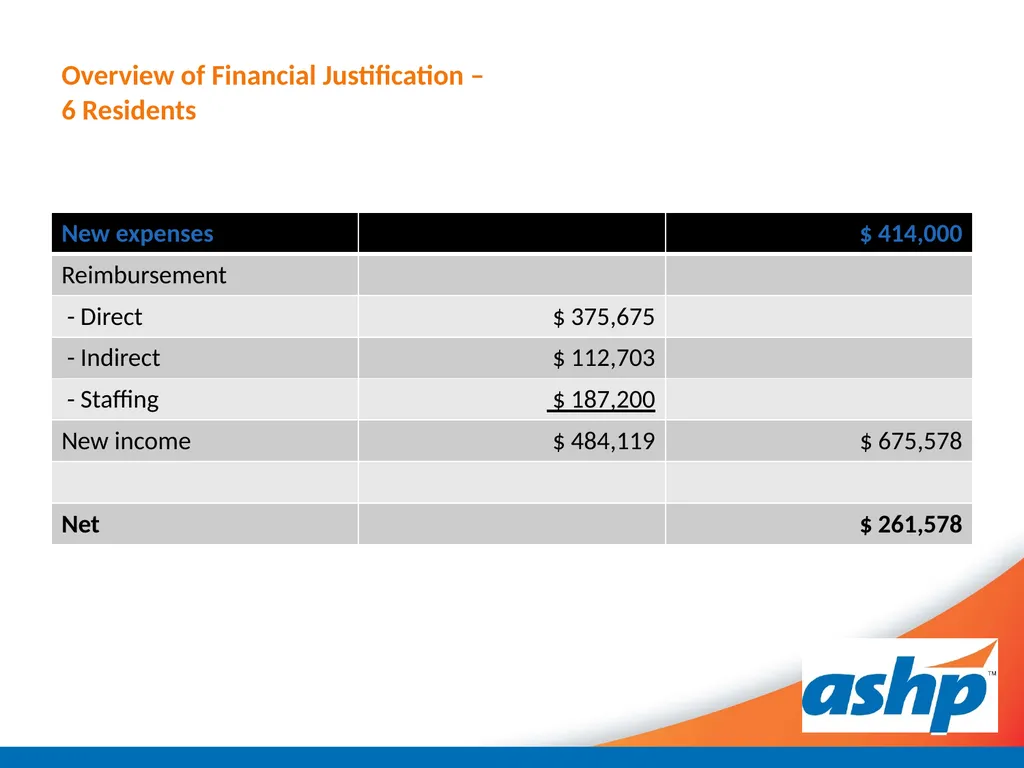
slide20. Overview of Financial Justification – 6 Residents<br>
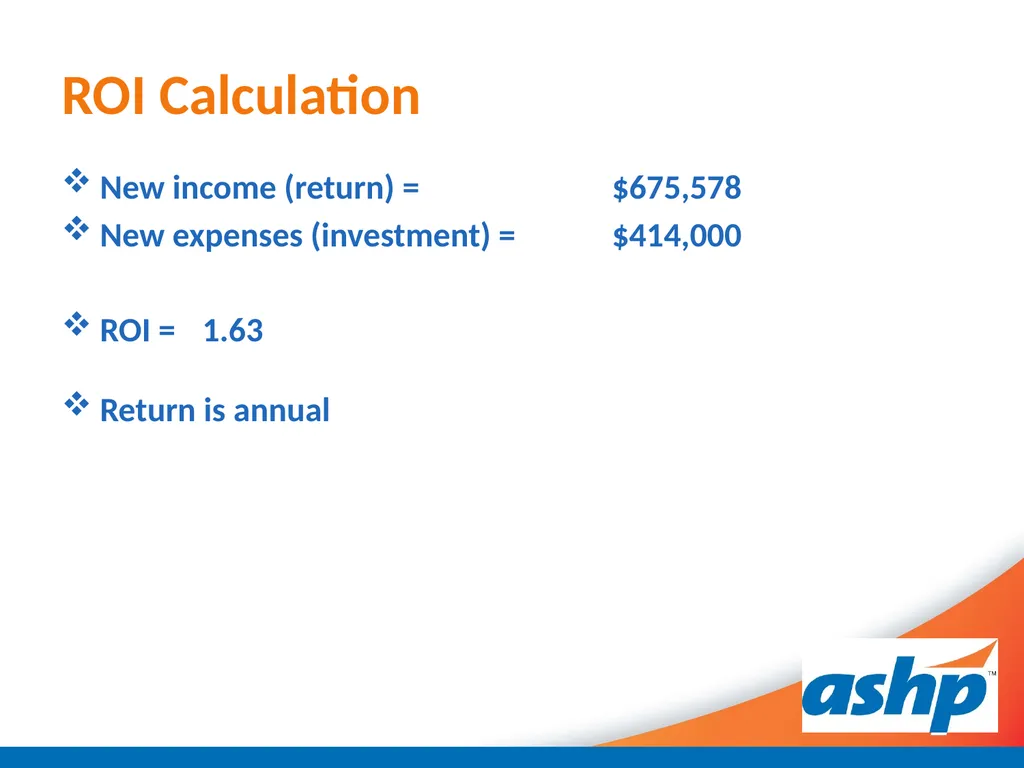
slide21. ROI Calculation New income (return) = $675,578
New expenses (investment) = $414,000
ROI = 1.63
Return is annual<br>
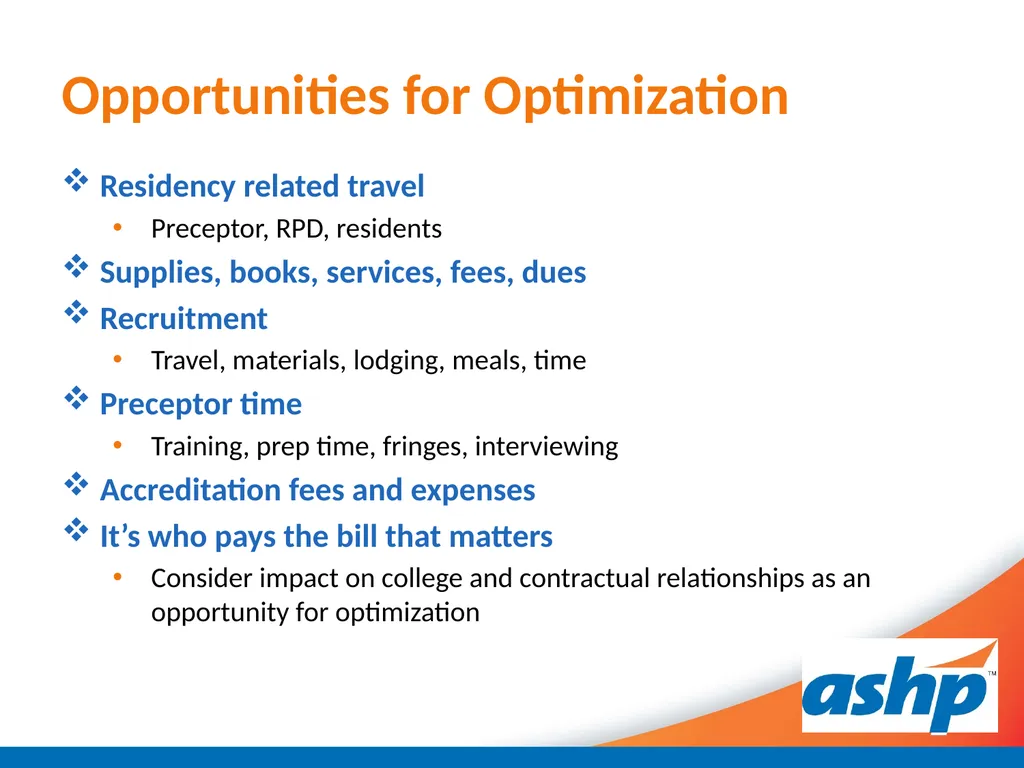
slide22. Opportunities for Optimization Residency related travel
Preceptor, RPD, residents
Supplies, books, services, fees, dues
Recruitment
Travel, materials, lodging, meals, time
Preceptor time
Training, prep time, fringes, interviewing
Accreditation fees and expenses
It’s who pays the bill that matters
Consider impact on college and contractual relationships as an opportunity for optimization<br>
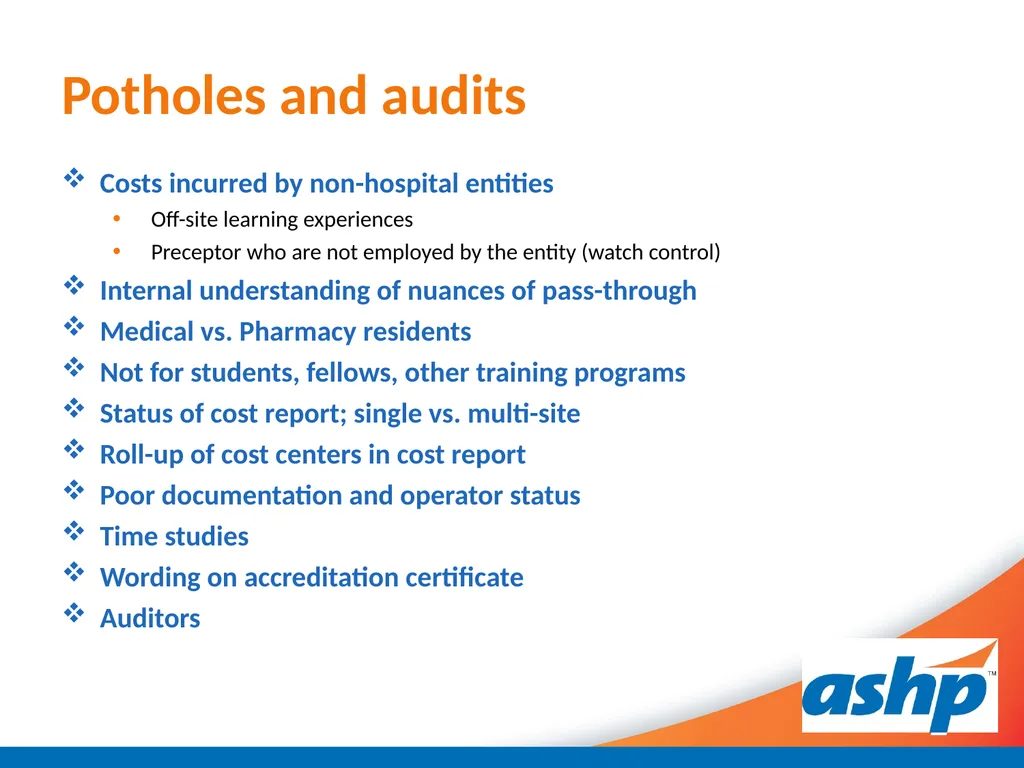
slide23. Potholes and audits Costs incurred by non-hospital entities
Off-site learning experiences
Preceptor who are not employed by the entity (watch control)
Internal understanding of nuances of pass-through
Medical vs. Pharmacy residents
Not for students, fellows, other training programs
Status of cost report; single vs. multi-site
Roll-up of cost centers in cost report
Poor documentation and operator status
Time studies
Wording on accreditation certificate
Auditors<br>
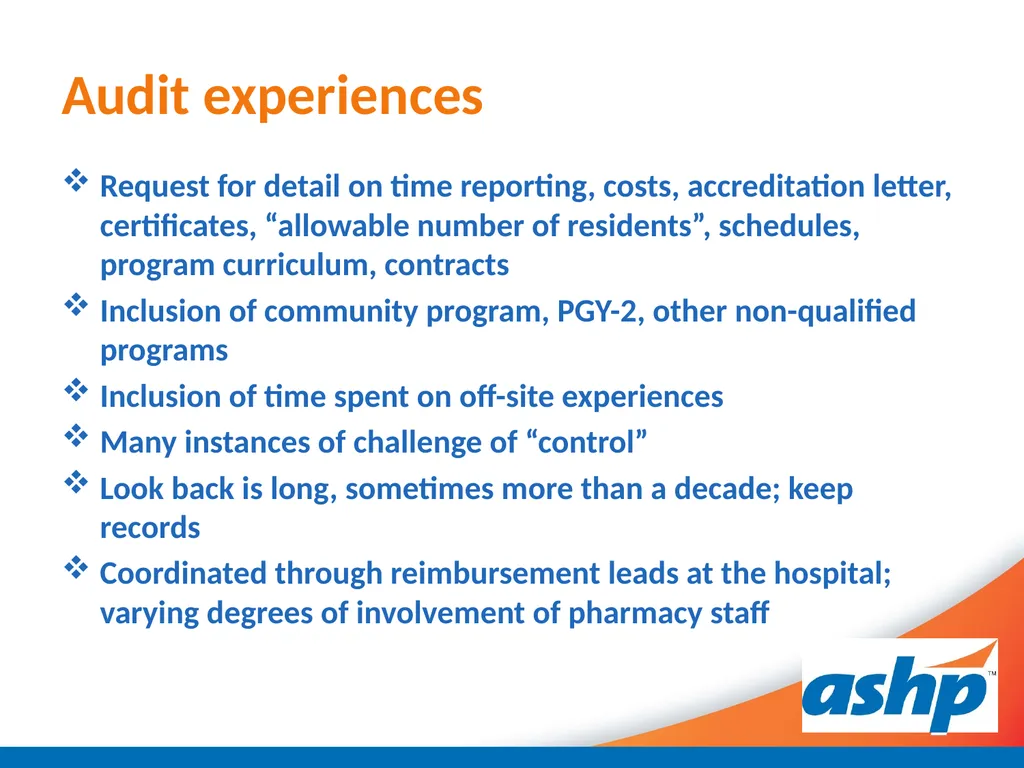
slide24. Audit experiences Request for detail on time reporting, costs, accreditation letter, certificates, “allowable number of residents”, schedules, program curriculum, contracts
Inclusion of community program, PGY-2, other non-qualified programs
Inclusion of time spent on off-site experiences
Many instances of challenge of “control”
Look back is long, sometimes more than a decade; keep records
Coordinated through reimbursement leads at the hospital; varying degrees of involvement of pharmacy staff<br>
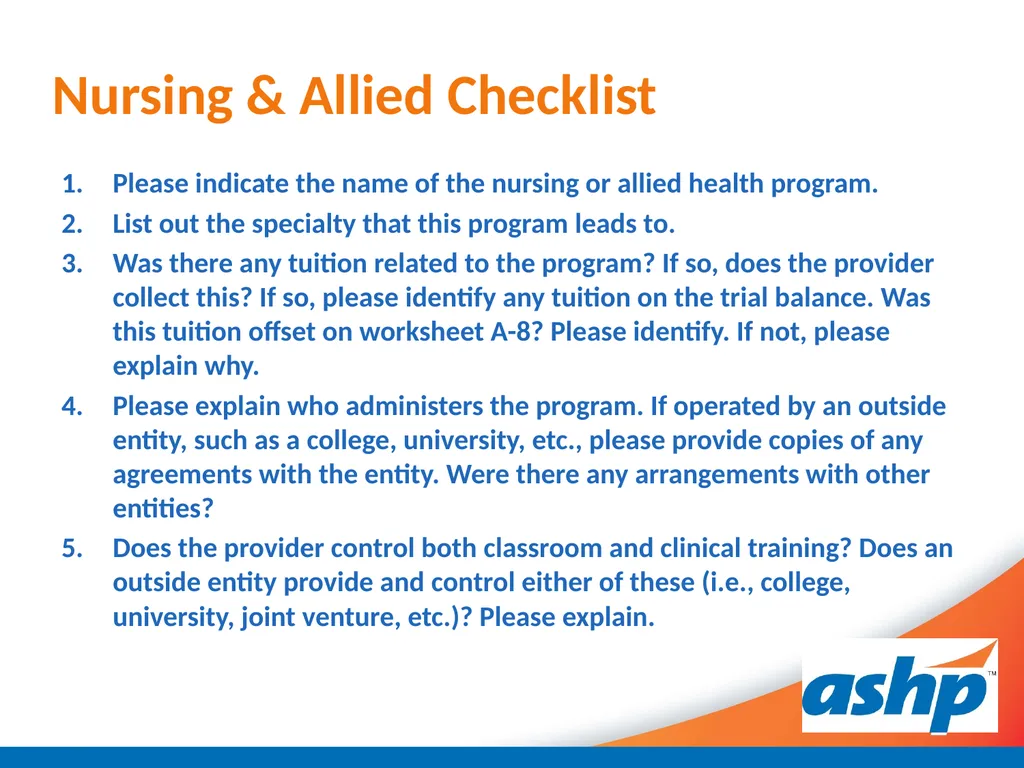
slide25. Nursing & Allied Checklist Please indicate the name of the nursing or allied health program.
List out the specialty that this program leads to.
Was there any tuition related to the program? If so, does the provider collect this? If so, please identify any tuition on the trial balance. Was this tuition offset on worksheet A-8? Please identify. If not, please explain why.
Please explain who administers the program. If operated by an outside entity, such as a college, university, etc., please provide copies of any agreements with the entity. Were there any arrangements with other entities?
Does the provider control both classroom and clinical training? Does an outside entity provide and control either of these (i.e., college, university, joint venture, etc.)? Please explain.<br>
slide26. Nursing & Allied Checklist (cont’d) Please provide a listing of students for the FYE 12/31/03. Does the provider issue the degree (certification) for the program? If so, please submit a copy for the students who received this in FYE 12/31/03. If not, please explain who does issue the degree, and their relationship with the hospital.
Please provide a copy of the syllabus with a list and description of the classes provided.
Please provide a copy of the program catalog.
Please provide a copy of the admission policy to get into the program.
Please provide a copy of the program curriculum. Does any other entity provide the training for any part of the curriculum?
Does any of the cost claimed for pass through payment relate to direct hands-on patient care? If so, please explain.
Please identify who employs the teaching staff.<br>
slide2. Disclaimer ASHP and Mr. Woller provide general information on the subject matter of GME pass-through funding mechanics.
This information is not meant to substitute for your own research into applicability to obtain GME pass-through funding at your organization, a thorough review of direct and indirect costs associated with GME pass- through funding, or a discussion with your finance office.<br>
slide3. Overview of Presentation Program justification
Non-CMS funding sources
Medicare pass through basics
Medicare pass through rules
Pass through example
Areas for optimization
Potholes and audits
Scenarios<br>
slide4. Residency Programs Justification CMS GME reimbursement
Direct and indirect
Non-CMS funding sources
Staffing
Projects/services
Qualitative benefits
Enhance overall teaching
Challenge staff to excel
Recruitment advantage<br>
slide5. Non-CMS Sources of Residency Funding States (historically Texas, Minnesota)
VA Hospitals
Colleges of Pharmacy
Pharmaceutical Industry
Hospitals and Health Systems
Note that PGY-2 programs are not eligible for pass-through funding
Department of Defense
ASHP Foundation, NACDS, other organizations
Others<br>
slide6. Other Contributions by Residents Projects to improve quality of care
New services
Provision of patient care
Participation in the teaching of Pharm.D. students
Cost reduction strategies
Learning environment
Recruitment
Staffing<br>
slide7. Staffing Contributions of Residents 6 residents in the example
2 shifts every other weekend (1.2 FTE)
Not quite 1.2 FTE due to training
Replace pharmacists on the schedule
Pharmacist average salary $120,000 + FB (30%)
Value of resident staffing = $187,200
Careful with this justification; finance might want to reduce your RPh allotment correspondingly<br>
slide8. Medicare cost report basics All Medicare certified hospitals are required to file a cost report annually
Filed with a fiscal intermediary or Medicare Administrative Contractor (MAC)
History of cost reports adds to confusion
Intended to define allowable costs and the “share” of those costs to be covered by the federal government
Subject to review and audit by MAC
In contemporary terms, most reimbursement by Medicare is determined through means other than the cost report; Direct Medical Education remains as an element determined through the cost report<br>
slide9. Medicare funding of pharmacy residencies Direct costs of medical education are excluded from operating costs under PPS and other payment provisions
Reimbursement is on a reasonable cost basis
COBRA 1986 changed Medicare payment for medical, dental, osteopathic and podiatry residencies; Not pharmacy and other paramedical programs
Pastoral care, ultrasound, rad tech, etc.
Indirect costs are also reimbursed; roughly 30% but varies based on number of medical residents/interns<br>
slide10. CMS Reimbursement-basic requirements Approved educational program-- PGY-1 programs only
Accreditation by ASHP
Based on percentage of inpatient Medicare pharmacy revenue
Retroactive reimbursement is possible (with caution)
CMS cost report filed for the fiscal year in question
Cost report is the tool used for the reimbursement
Direct and indirect costs included
Includes provision for Medicare Plus Choice patients
Entity filing cost report must be the operator of the program
August 1, 1998 AJHP<br>
slide11. Definition of approved educational activities Nursing or allied health program
Formally organized and planned program of study
Operated by provider submitting cost report
Enhance the quality of inpatient care at the provider
Licensed (if applicable) or accredited by the recognized national professional organization for the particular activity.
ASHP is specifically listed as the organization for pharmacy 42CFR §413.85<br>
slide12. Operator of the Program Directly incur the training costs
Have direct control over the “curriculum”
Have direct control over the administration of the program
Employ the teaching/training staff
Provide classroom instruction (where required) and clinical training * 42CFR §413.85(f)<br>
slide13. “Absent evidence to the contrary, the provider that issues the degree, diploma, or other certificate upon successful completion of an approved education program is assumed to meet all of the criteria set forth in paragraph (F)(1) of this section and to be the operator of the program” 42CFR §413.85(f)<br>
slide14. Eligible Costs for Medicare Reimbursement Resident salaries and fringe benefits
Accreditation fees
Preceptor salaries and fringe benefits
Travel by resident
Costs for recruitment
Dues, subscriptions, books, other materials
Subtract out payments, if any<br>
slide15. Medicare Pass Through Example 711 bed community teaching hospital
6 residents
Medicare accounts for 50% of inpatient pharmacy revenue
Justification of program requested by VP
Direct GME, indirect GME and other<br>
slide16. Direct Expenses – Preceptor and Resident Salaries<br>
slide17. Direct Expenses<br>
slide18. Indirect Reimbursement Approximately 30% of direct reimbursement
Direct reimbursement is $375,675
Indirect reimbursement is $112,703<br>
slide19. New Expenses<br>
slide20. Overview of Financial Justification – 6 Residents<br>
slide21. ROI Calculation New income (return) = $675,578
New expenses (investment) = $414,000
ROI = 1.63
Return is annual<br>
slide22. Opportunities for Optimization Residency related travel
Preceptor, RPD, residents
Supplies, books, services, fees, dues
Recruitment
Travel, materials, lodging, meals, time
Preceptor time
Training, prep time, fringes, interviewing
Accreditation fees and expenses
It’s who pays the bill that matters
Consider impact on college and contractual relationships as an opportunity for optimization<br>
slide23. Potholes and audits Costs incurred by non-hospital entities
Off-site learning experiences
Preceptor who are not employed by the entity (watch control)
Internal understanding of nuances of pass-through
Medical vs. Pharmacy residents
Not for students, fellows, other training programs
Status of cost report; single vs. multi-site
Roll-up of cost centers in cost report
Poor documentation and operator status
Time studies
Wording on accreditation certificate
Auditors<br>
slide24. Audit experiences Request for detail on time reporting, costs, accreditation letter, certificates, “allowable number of residents”, schedules, program curriculum, contracts
Inclusion of community program, PGY-2, other non-qualified programs
Inclusion of time spent on off-site experiences
Many instances of challenge of “control”
Look back is long, sometimes more than a decade; keep records
Coordinated through reimbursement leads at the hospital; varying degrees of involvement of pharmacy staff<br>
slide25. Nursing & Allied Checklist Please indicate the name of the nursing or allied health program.
List out the specialty that this program leads to.
Was there any tuition related to the program? If so, does the provider collect this? If so, please identify any tuition on the trial balance. Was this tuition offset on worksheet A-8? Please identify. If not, please explain why.
Please explain who administers the program. If operated by an outside entity, such as a college, university, etc., please provide copies of any agreements with the entity. Were there any arrangements with other entities?
Does the provider control both classroom and clinical training? Does an outside entity provide and control either of these (i.e., college, university, joint venture, etc.)? Please explain.<br>
slide26. Nursing & Allied Checklist (cont’d) Please provide a listing of students for the FYE 12/31/03. Does the provider issue the degree (certification) for the program? If so, please submit a copy for the students who received this in FYE 12/31/03. If not, please explain who does issue the degree, and their relationship with the hospital.
Please provide a copy of the syllabus with a list and description of the classes provided.
Please provide a copy of the program catalog.
Please provide a copy of the admission policy to get into the program.
Please provide a copy of the program curriculum. Does any other entity provide the training for any part of the curriculum?
Does any of the cost claimed for pass through payment relate to direct hands-on patient care? If so, please explain.
Please identify who employs the teaching staff.<br>