Optional Teaching Slides For Instructional Routine: Act Out, Represent, and Solve Word Problems Word Problems Module Optional Slides for Teaching the Instructional Routine: Act Out, Represent, and Solve Word Problems Information for
"Optional Teaching Slides For Instructional" is the property of its rightful owner. Permission is granted to
download and print the materials on this website for personal, non-commercial use only, and to display it
on your personal computer provided you do not modify the materials and that you retain all copyright
notices contained in the materials. By downloading content from our website, you accept the terms of this
agreement.
Presentation Transcript
01
Optional Teaching Slides For Instructional Routine: Act Out, Represent, and Solve Word Problems Word Problems Module Optional Slides for Teaching the Instructional Routine: Act Out, Represent, and Solve Word Problems Information for Teachers
The slides are set up for problem set 2, which is in the video.
To use a different problem set, change the word problems on the slides.
The Routine Teaching Guide has a choice of three problem sets.
These slides are optional. You can display the directions and problems on a whiteboard, chart paper, and/or handouts. Source: Routine from Toolkit Authors 0 Mathematics Intervention Toolkit Word Problems
Routine Teaching Slides<br>
02
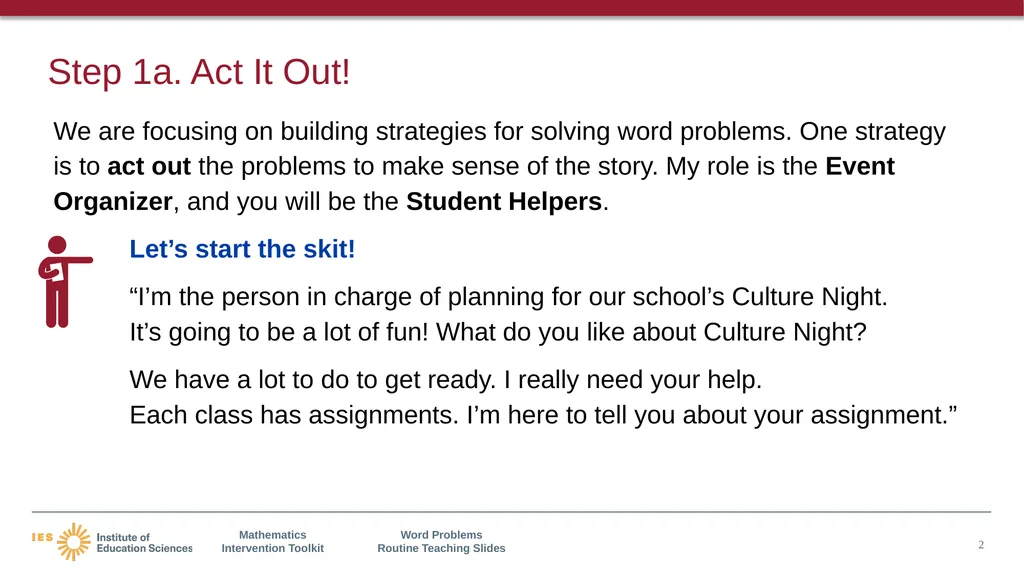
Step 1a. Act It Out! We are focusing on building strategies for solving word problems. One strategy is to act out the problems to make sense of the story. My role is the Event Organizer, and you will be the Student Helpers.
Let’s start the skit!
“I’m the person in charge of planning for our school’s Culture Night.
It’s going to be a lot of fun! What do you like about Culture Night?
We have a lot to do to get ready. I really need your help.
Each class has assignments. I’m here to tell you about your assignment.” Mathematics Intervention Toolkit Word Problems
Routine Teaching Slides 1<br>
03
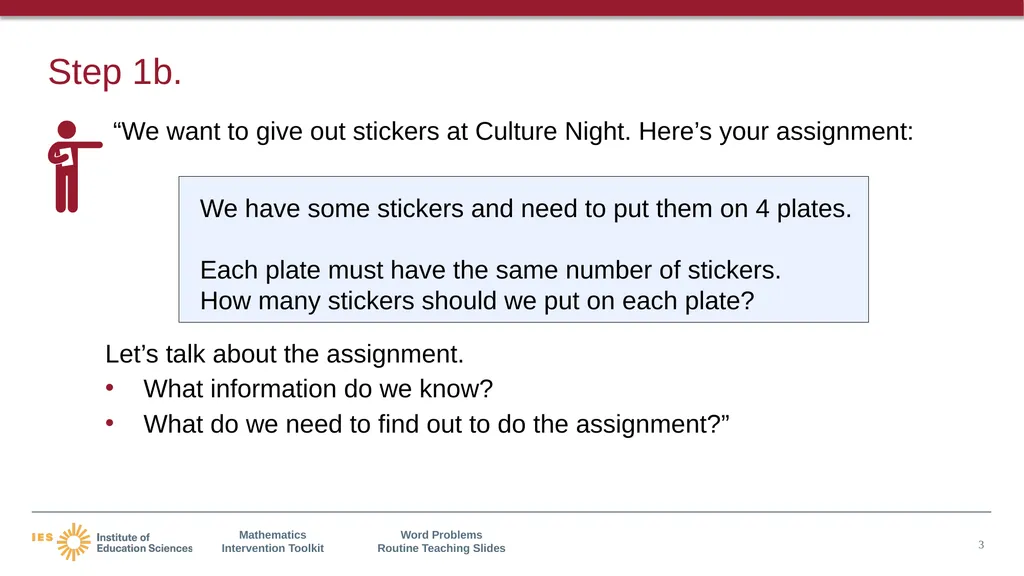
Step 1b. “We want to give out stickers at Culture Night. Here’s your assignment: We have some stickers and need to put them on 4 plates.
Each plate must have the same number of stickers.
How many stickers should we put on each plate? Let’s talk about the assignment.
What information do we know?
What do we need to find out to do the assignment?” Mathematics Intervention Toolkit Word Problems
Routine Teaching Slides 2<br>
04
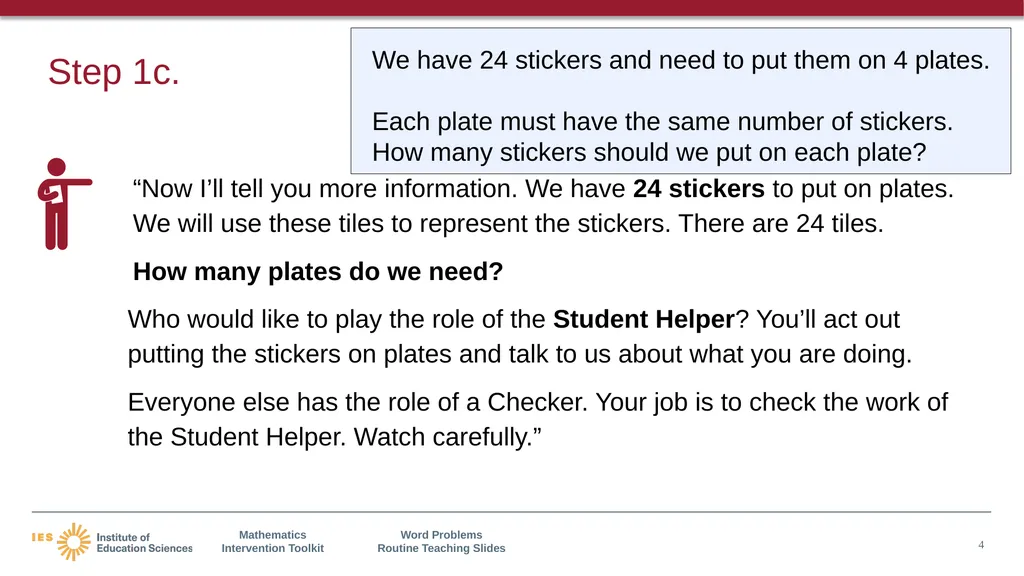
Step 1c. We have 24 stickers and need to put them on 4 plates.
Each plate must have the same number of stickers.
How many stickers should we put on each plate? “Now I’ll tell you more information. We have 24 stickers to put on plates.
We will use these tiles to represent the stickers. There are 24 tiles.
How many plates do we need?
Who would like to play the role of the Student Helper? You’ll act out putting the stickers on plates and talk to us about what you are doing.
Everyone else has the role of a Checker. Your job is to check the work of the Student Helper. Watch carefully.” Mathematics Intervention Toolkit Word Problems
Routine Teaching Slides 3<br>
05
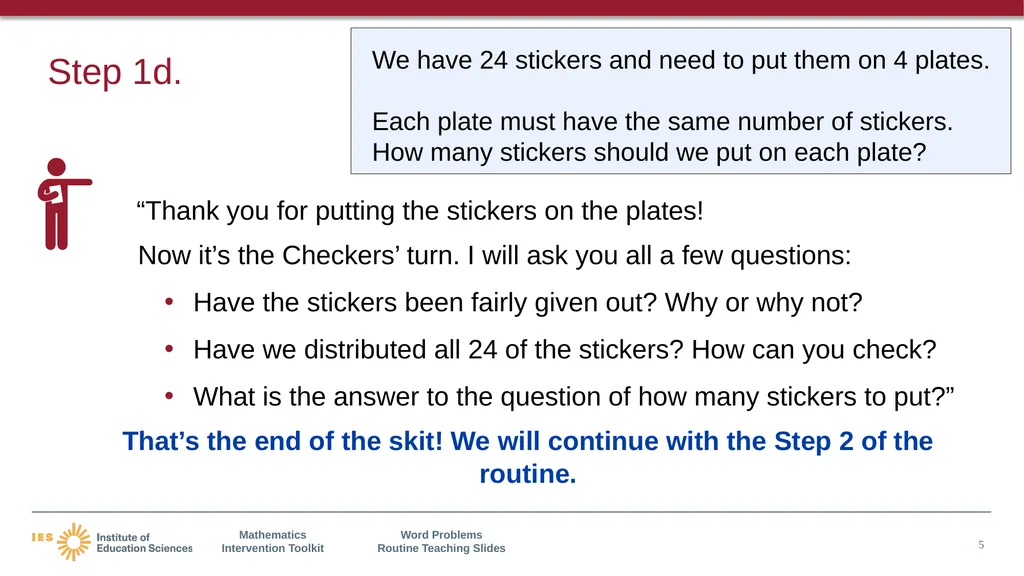
Step 1d. We have 24 stickers and need to put them on 4 plates.
Each plate must have the same number of stickers.
How many stickers should we put on each plate? “Thank you for putting the stickers on the plates!
Now it’s the Checkers’ turn. I will ask you all a few questions:
Have the stickers been fairly given out? Why or why not?
Have we distributed all 24 of the stickers? How can you check?
What is the answer to the question of how many stickers to put?”
That’s the end of the skit! We will continue with the Step 2 of the routine. Mathematics Intervention Toolkit Word Problems
Routine Teaching Slides 4<br>
06
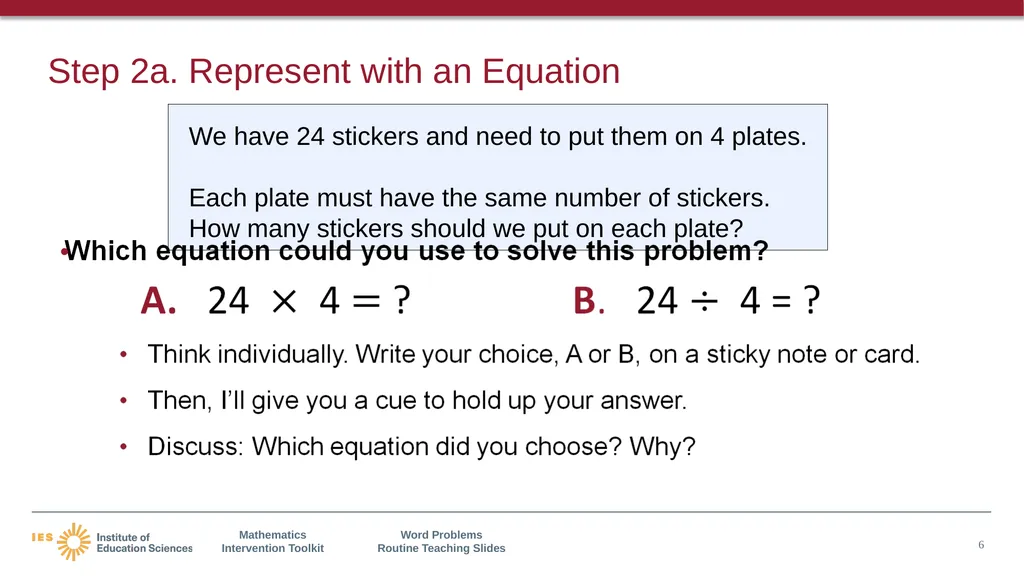
Step 2a. Represent with an Equation We have 24 stickers and need to put them on 4 plates.
Each plate must have the same number of stickers.
How many stickers should we put on each plate? Mathematics Intervention Toolkit Word Problems
Routine Teaching Slides 5<br>
07
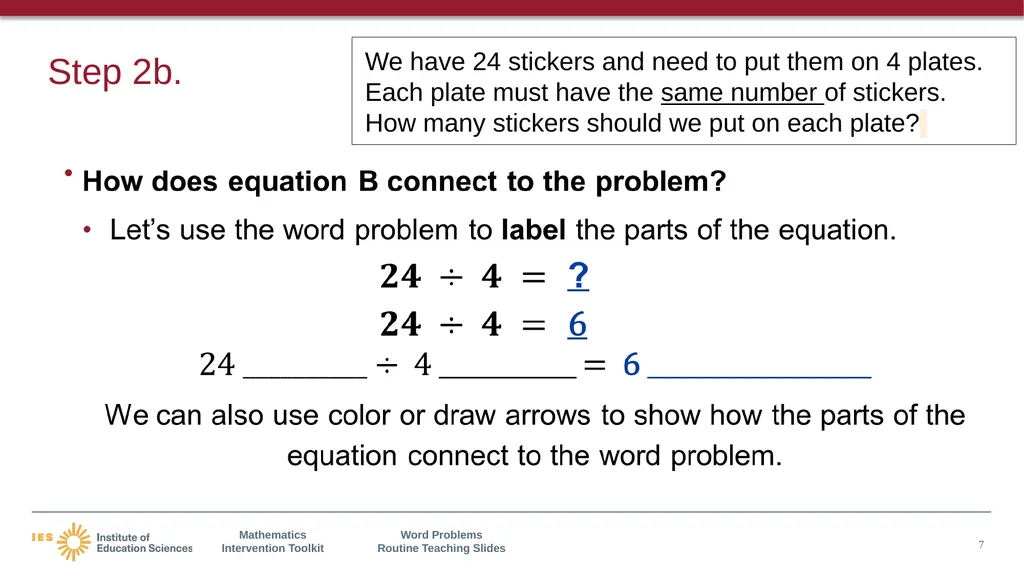
Step 2b. Mathematics Intervention Toolkit Word Problems
Routine Teaching Slides 6 We have 24 stickers and need to put them on 4 plates.
Each plate must have the same number of stickers.
How many stickers should we put on each plate?<br>
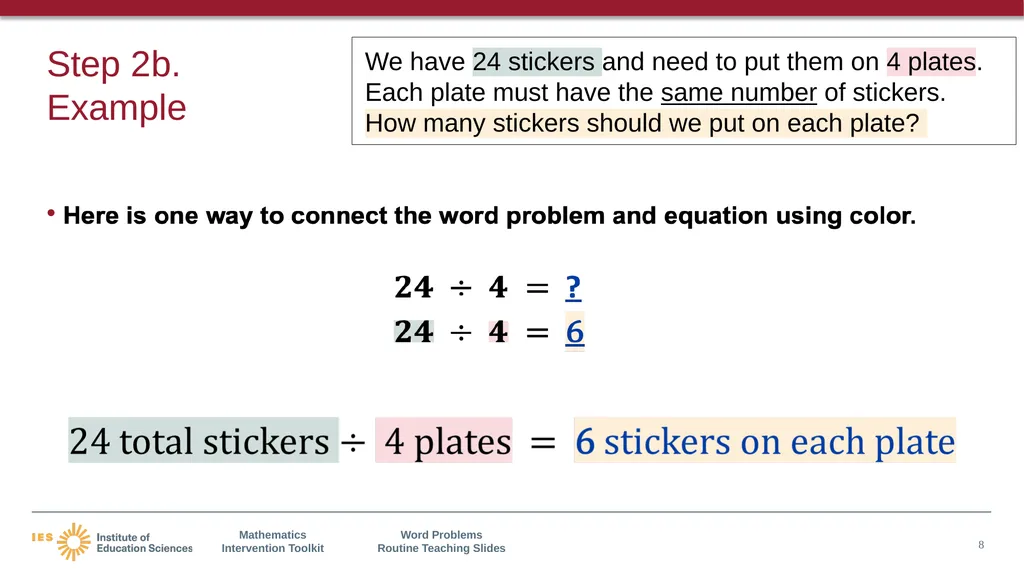
08
Step 2b. Example We have 24 stickers and need to put them on 4 plates.
Each plate must have the same number of stickers.
How many stickers should we put on each plate? Mathematics Intervention Toolkit Word Problems
Routine Teaching Slides 7<br>
09
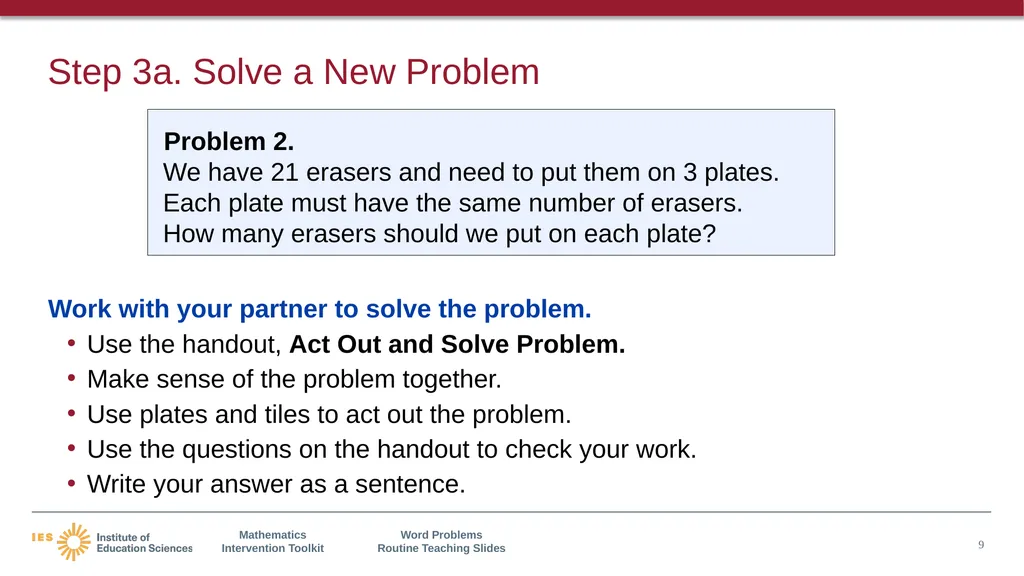
Step 3a. Solve a New Problem Problem 2.
We have 21 erasers and need to put them on 3 plates.
Each plate must have the same number of erasers.
How many erasers should we put on each plate? Work with your partner to solve the problem.
Use the handout, Act Out and Solve Problem.
Make sense of the problem together.
Use plates and tiles to act out the problem.
Use the questions on the handout to check your work.
Write your answer as a sentence. Mathematics Intervention Toolkit Word Problems
Routine Teaching Slides 8<br>
10
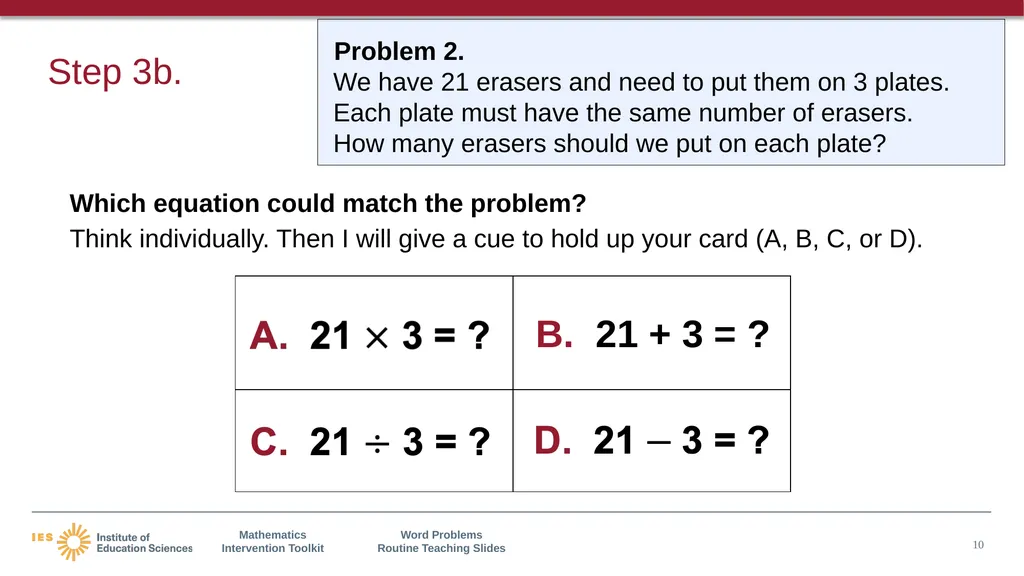
Step 3b. Problem 2.
We have 21 erasers and need to put them on 3 plates.
Each plate must have the same number of erasers.
How many erasers should we put on each plate? Which equation could match the problem?
Think individually. Then I will give a cue to hold up your card (A, B, C, or D). B. 21 + 3 = ? Mathematics Intervention Toolkit Word Problems
Routine Teaching Slides 9<br>
11
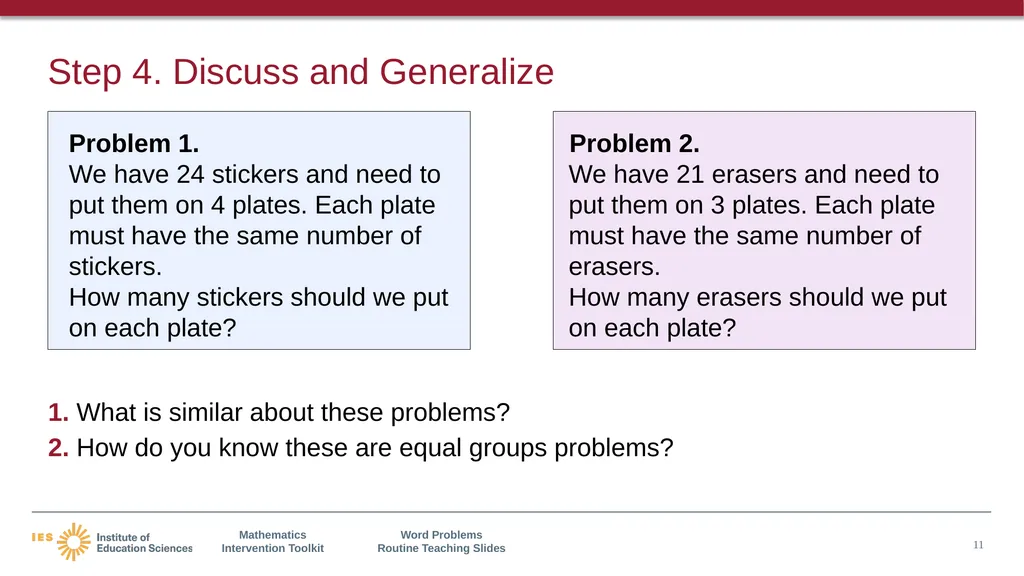
Step 4. Discuss and Generalize Problem 1.
We have 24 stickers and need to put them on 4 plates. Each plate must have the same number of stickers.
How many stickers should we put on each plate? Problem 2.
We have 21 erasers and need to put them on 3 plates. Each plate must have the same number of erasers.
How many erasers should we put on each plate? 1. What is similar about these problems?
2. How do you know these are equal groups problems? Mathematics Intervention Toolkit Word Problems
Routine Teaching Slides 10<br>
12
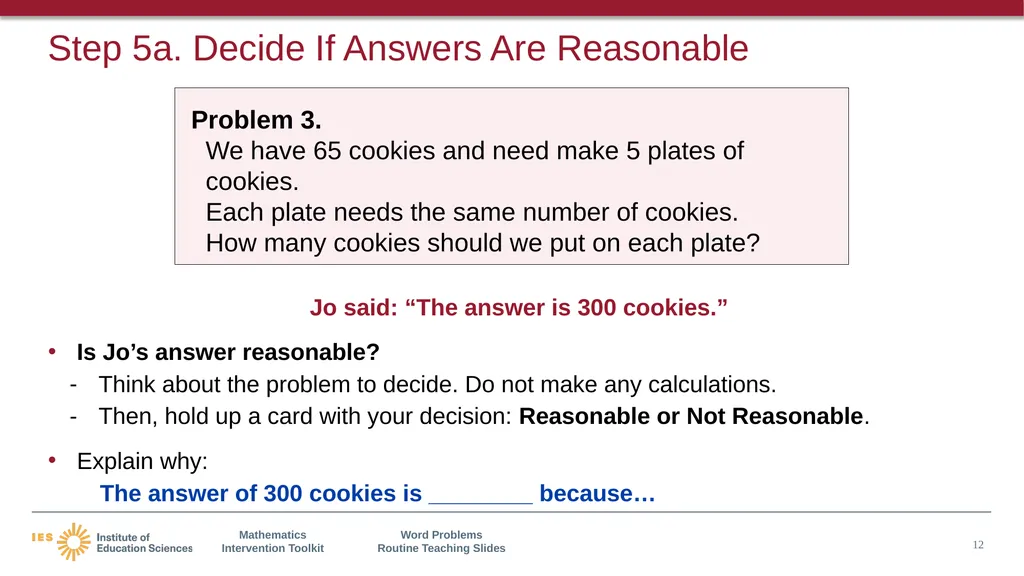
Step 5a. Decide If Answers Are Reasonable Problem 3.
We have 65 cookies and need make 5 plates of cookies.
Each plate needs the same number of cookies.
How many cookies should we put on each plate? Jo said: “The answer is 300 cookies.”
Is Jo’s answer reasonable?
Think about the problem to decide. Do not make any calculations.
Then, hold up a card with your decision: Reasonable or Not Reasonable.
Explain why:
The answer of 300 cookies is ________ because… Mathematics Intervention Toolkit Word Problems
Routine Teaching Slides 11<br>
13
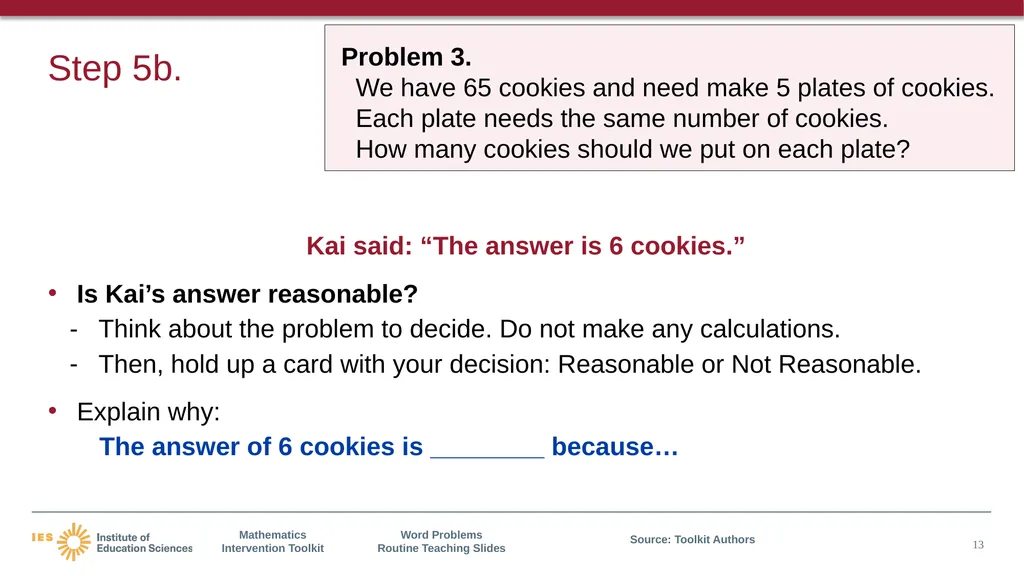
Step 5b. Problem 3.
We have 65 cookies and need make 5 plates of cookies.
Each plate needs the same number of cookies.
How many cookies should we put on each plate? Kai said: “The answer is 6 cookies.”
Is Kai’s answer reasonable?
Think about the problem to decide. Do not make any calculations.
Then, hold up a card with your decision: Reasonable or Not Reasonable.
Explain why:
The answer of 6 cookies is ________ because… 12 Mathematics Intervention Toolkit Word Problems
Routine Teaching Slides Source: Toolkit Authors<br>
14
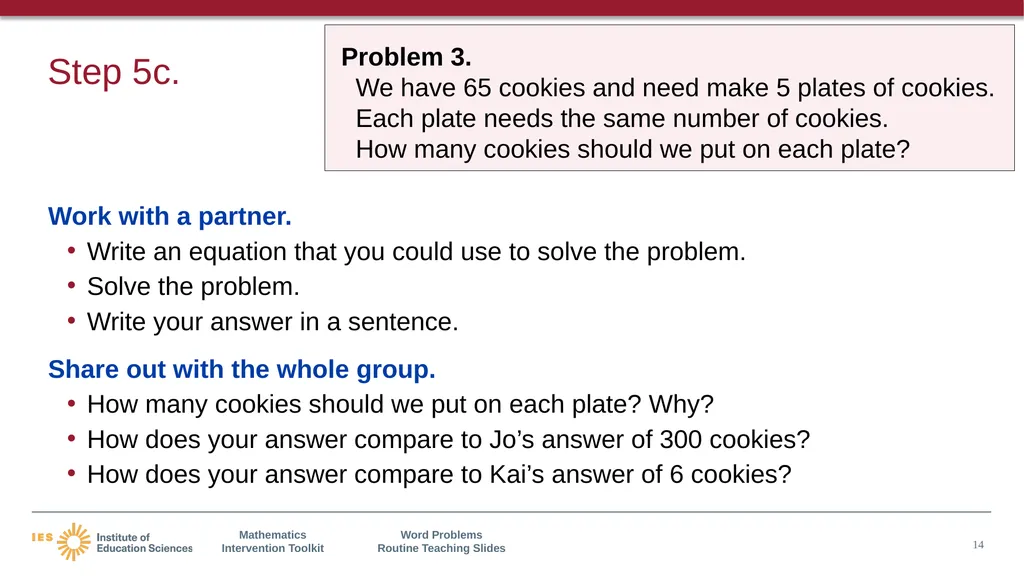
Step 5c. Work with a partner.
Write an equation that you could use to solve the problem.
Solve the problem.
Write your answer in a sentence.
Share out with the whole group.
How many cookies should we put on each plate? Why?
How does your answer compare to Jo’s answer of 300 cookies?
How does your answer compare to Kai’s answer of 6 cookies? Mathematics Intervention Toolkit Word Problems
Routine Teaching Slides 13 Problem 3.
We have 65 cookies and need make 5 plates of cookies.
Each plate needs the same number of cookies.
How many cookies should we put on each plate?<br>
15
Website Information and Disclaimer
Mathematics Intervention Toolkit Website: https://ies.ed.gov/ncee/rel/math-support-grades-3-6 These slides were prepared under Contract 91990022C0013 by Regional Educational Laboratory Northeast & Islands, administered by Education Development Center. The content does not necessarily reflect the views or policies of IES or the U.S. Department of Education, nor does mention of trade names, commercial products, or organizations imply endorsement by the U.S. Government. Mathematics Intervention Toolkit Word Problems
Routine Teaching Slides 14<br>