
Ordinary Differential Equation The methods for
Description: Ordinary Differential Equation The methods for Initial Value Problems (IVPs): Multi-step Methods Explicit: Euler Forward, Adams-Bashforth Implicit: Euler Backward, Trapezoidal and Adams-Moulton Backward Difference Formulae (BDF) Runge-Kutta
Related Topics
Download Presentation
"Ordinary Differential Equation The methods for" is the property of its rightful owner. Permission is granted to download and print the materials on this website for personal, non-commercial use only, and to display it on your personal computer provided you do not modify the materials and that you retain all copyright notices contained in the materials. By downloading content from our website, you accept the terms of this agreement.
Presentation Transcript
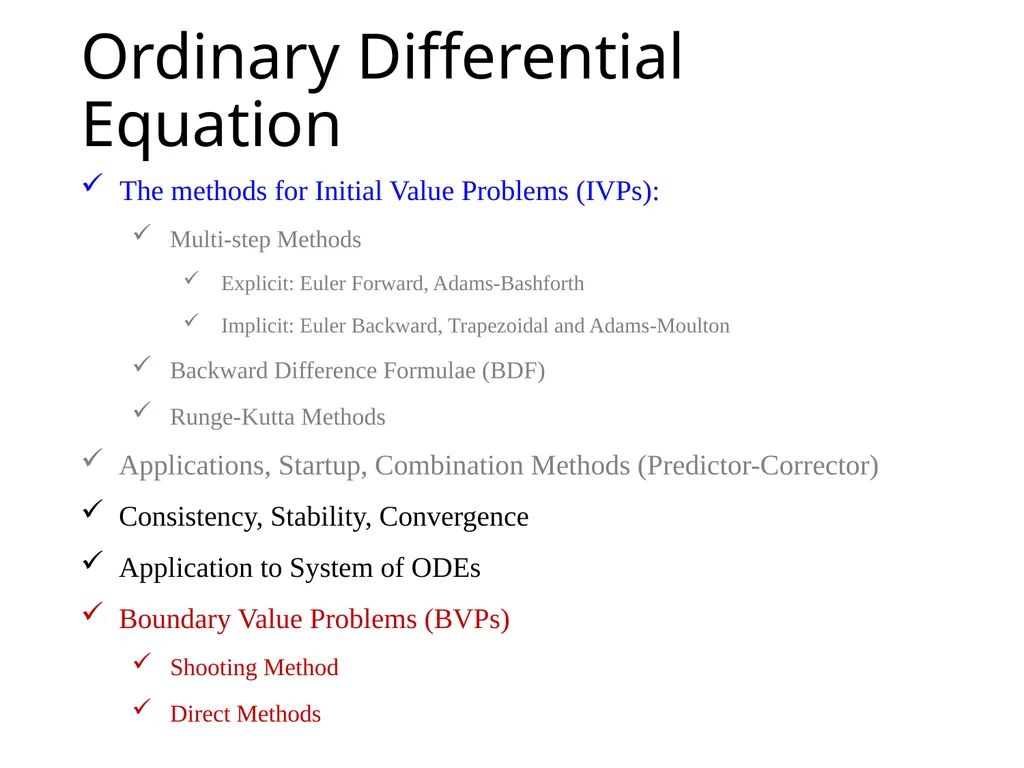
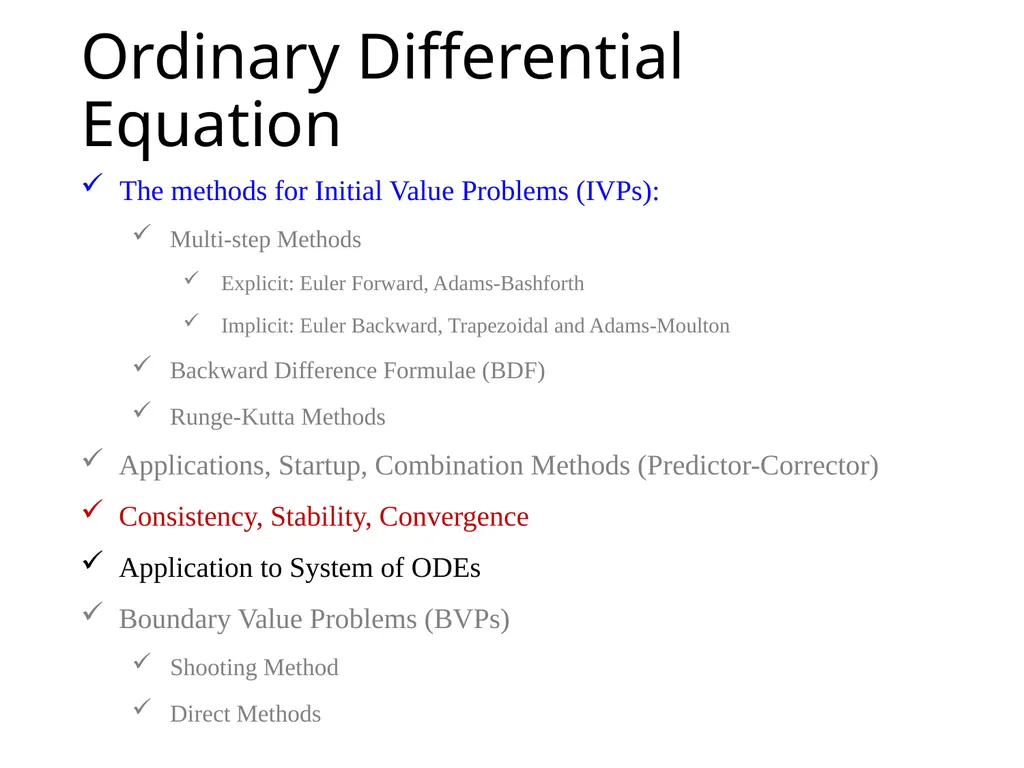
slide1. Ordinary Differential Equation The methods for Initial Value Problems (IVPs):
Multi-step Methods
Explicit: Euler Forward, Adams-Bashforth
Implicit: Euler Backward, Trapezoidal and Adams-Moulton
Backward Difference Formulae (BDF)
Runge-Kutta Methods
Applications, Startup, Combination Methods (Predictor-Corrector)
Consistency, Stability, Convergence
Application to System of ODEs
Boundary Value Problems (BVPs)
Shooting Method
Direct Methods<br>
slide2. ESO 208A: Computational Methods in Engineering Ordinary Differential Equation: Boundary Value Problems Abhas Singh
Department of Civil Engineering
IIT Kanpur Acknowledgements: Profs. Saumyen Guha and Shivam Tripathi (CE)<br>
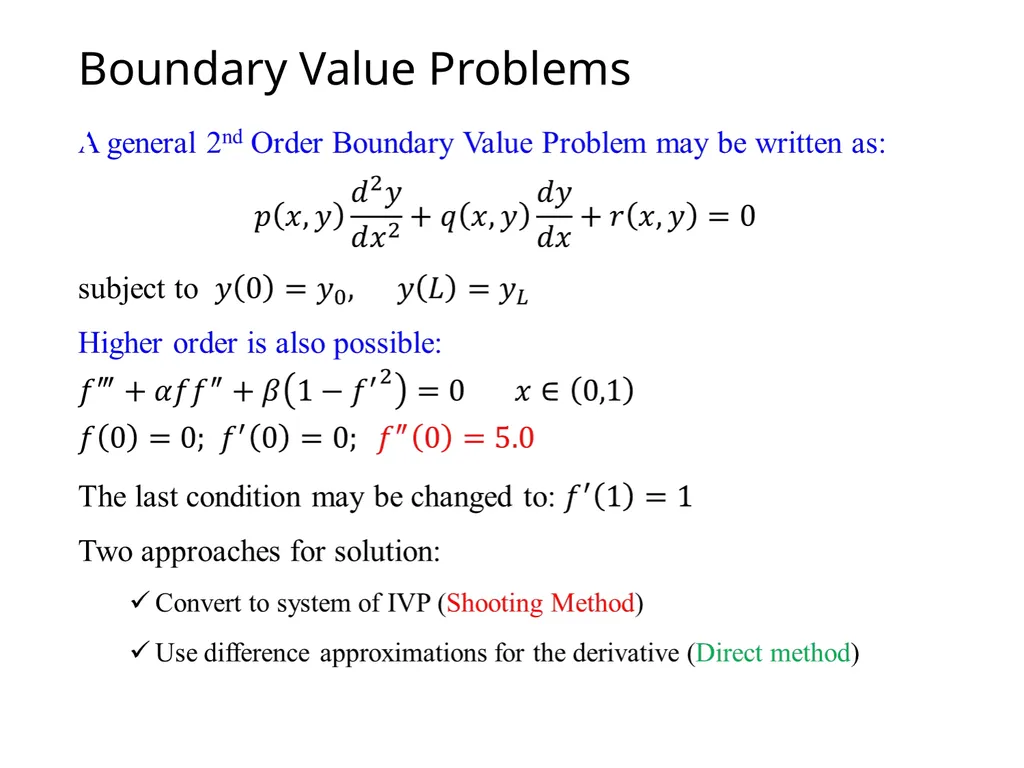
slide3. Boundary Value Problems<br>
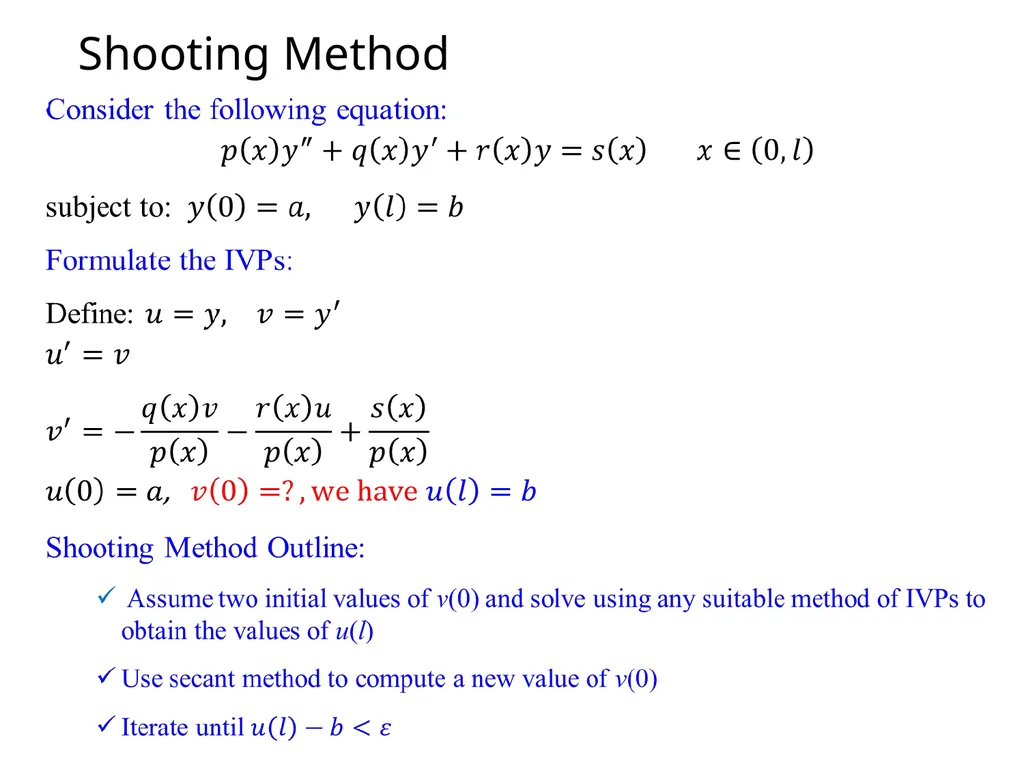
slide4. Shooting Method<br>
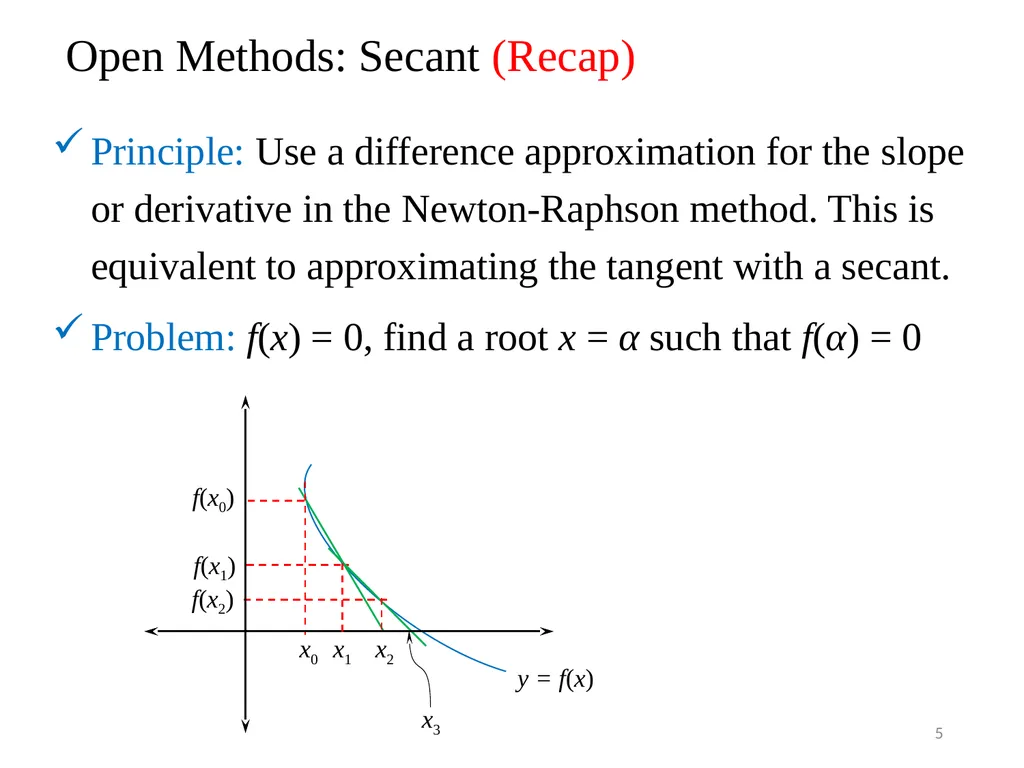
slide5. Open Methods: Secant (Recap) Principle: Use a difference approximation for the slope or derivative in the Newton-Raphson method. This is equivalent to approximating the tangent with a secant.
Problem: f(x) = 0, find a root x = α such that f(α) = 0 5<br>
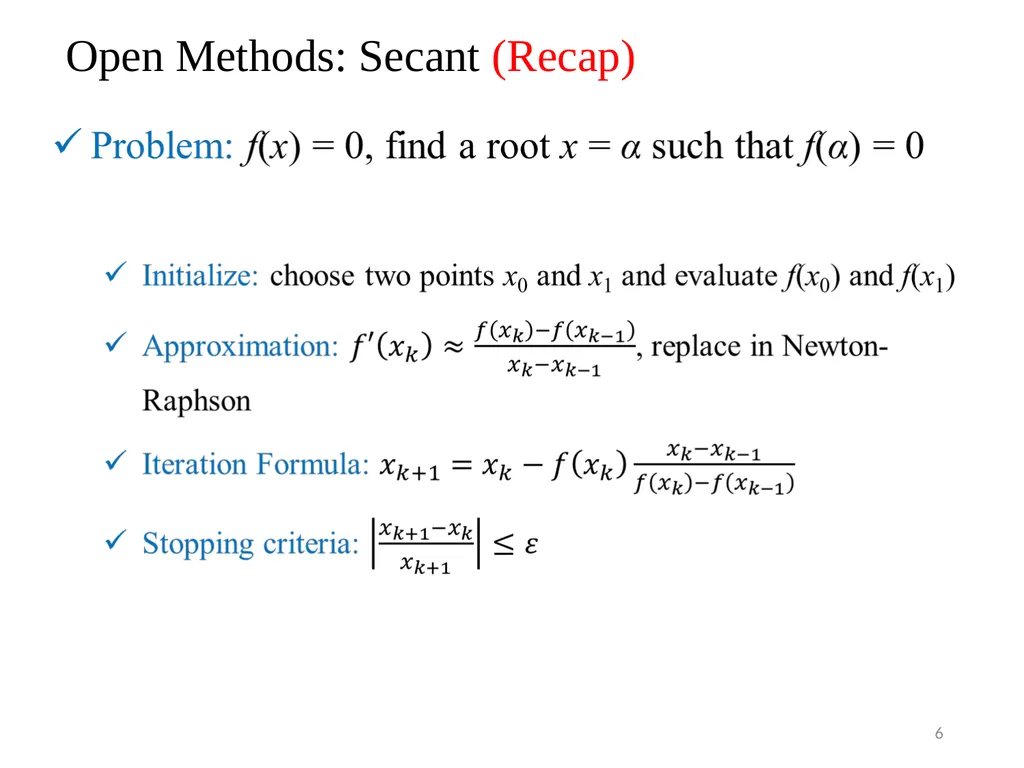
slide6. Open Methods: Secant (Recap) 6<br>
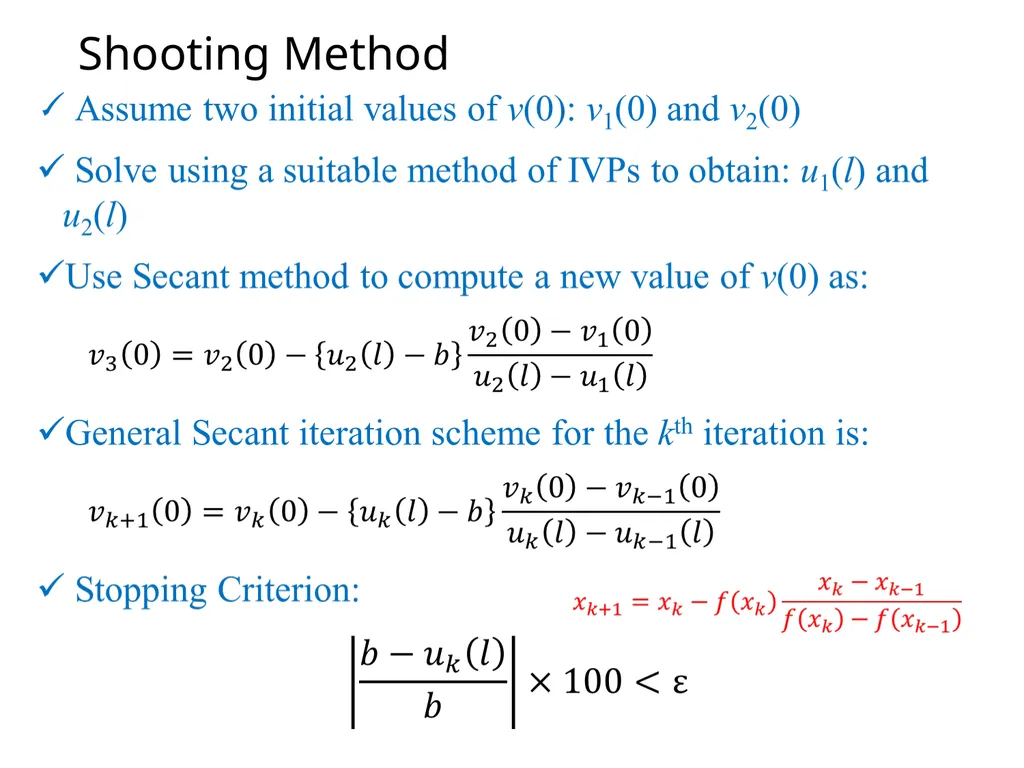
slide7. Shooting Method<br>
slide8. Direct Method<br>
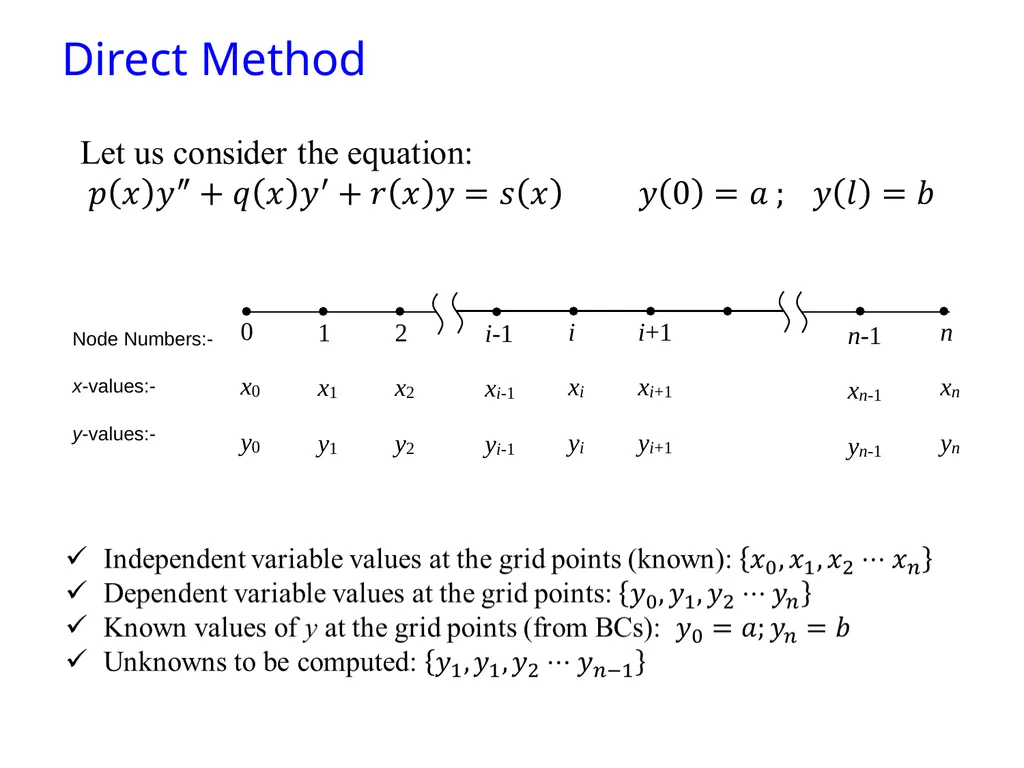
slide9. Direct Method<br>
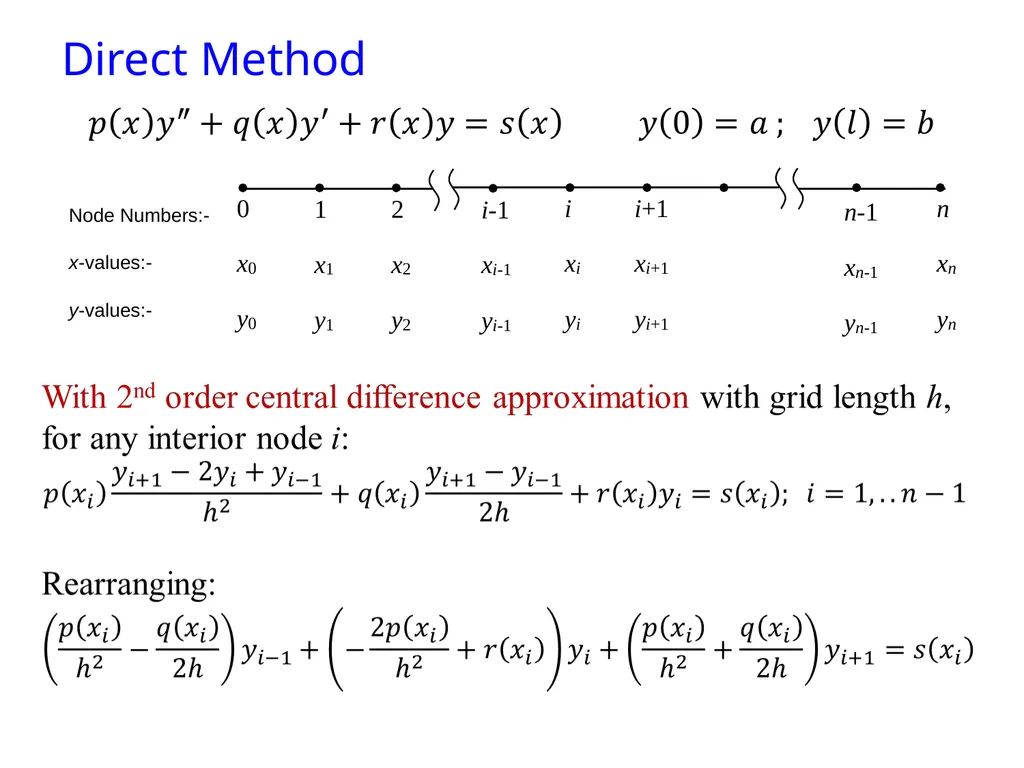
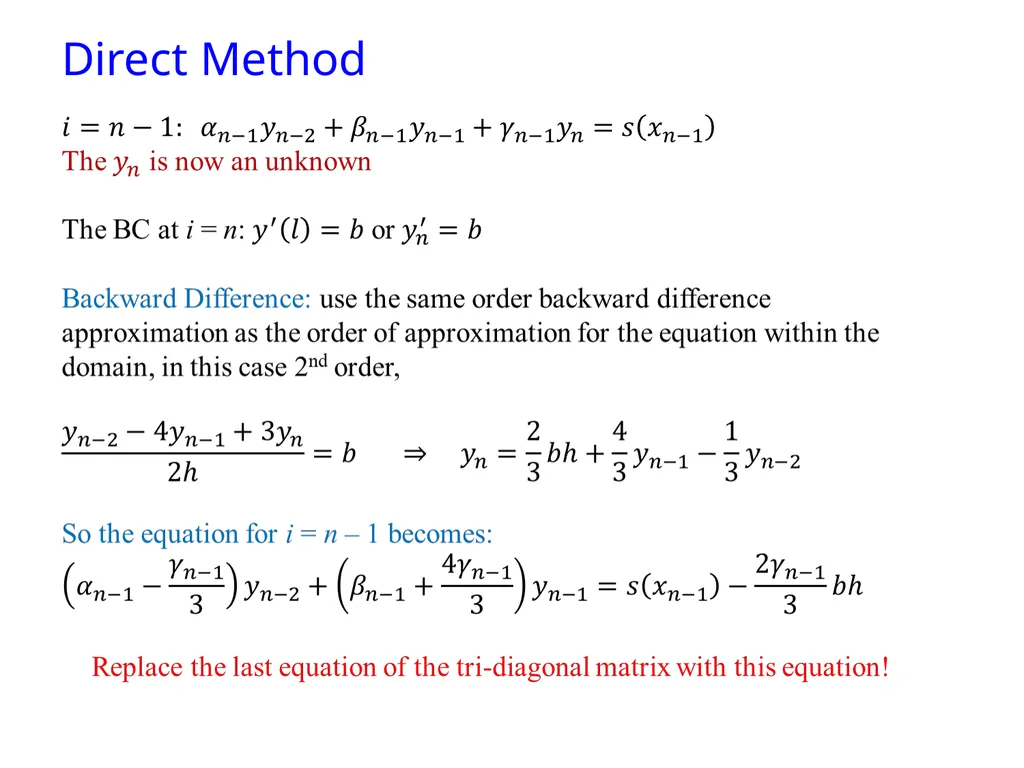
slide10. Direct Method<br>
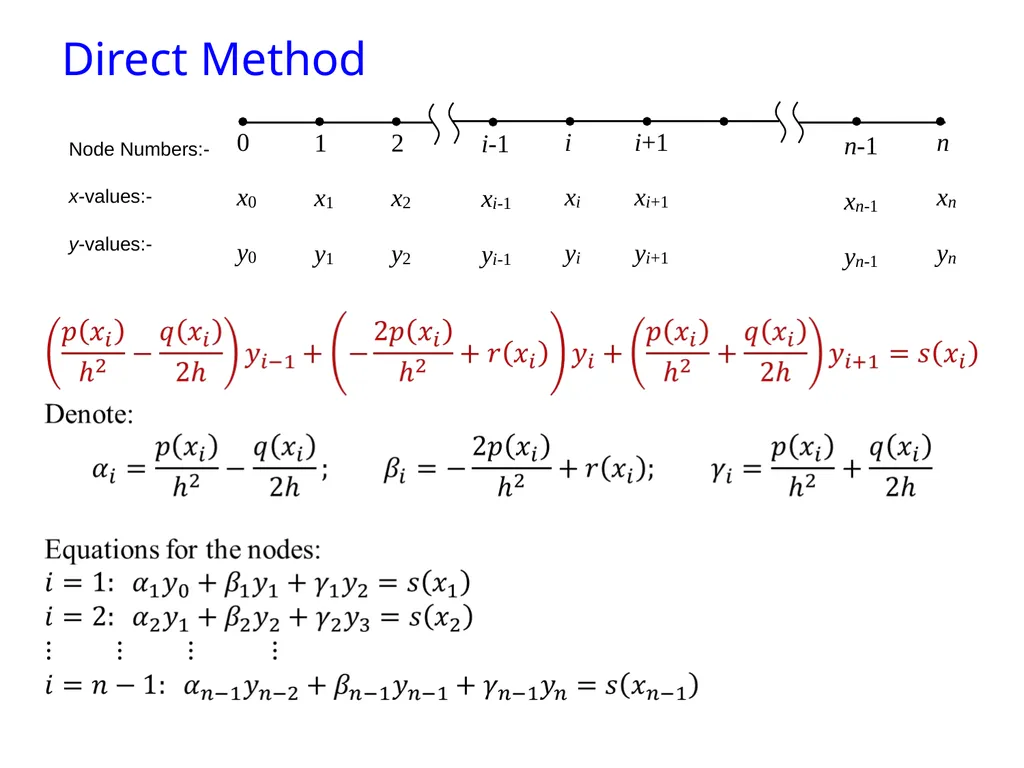
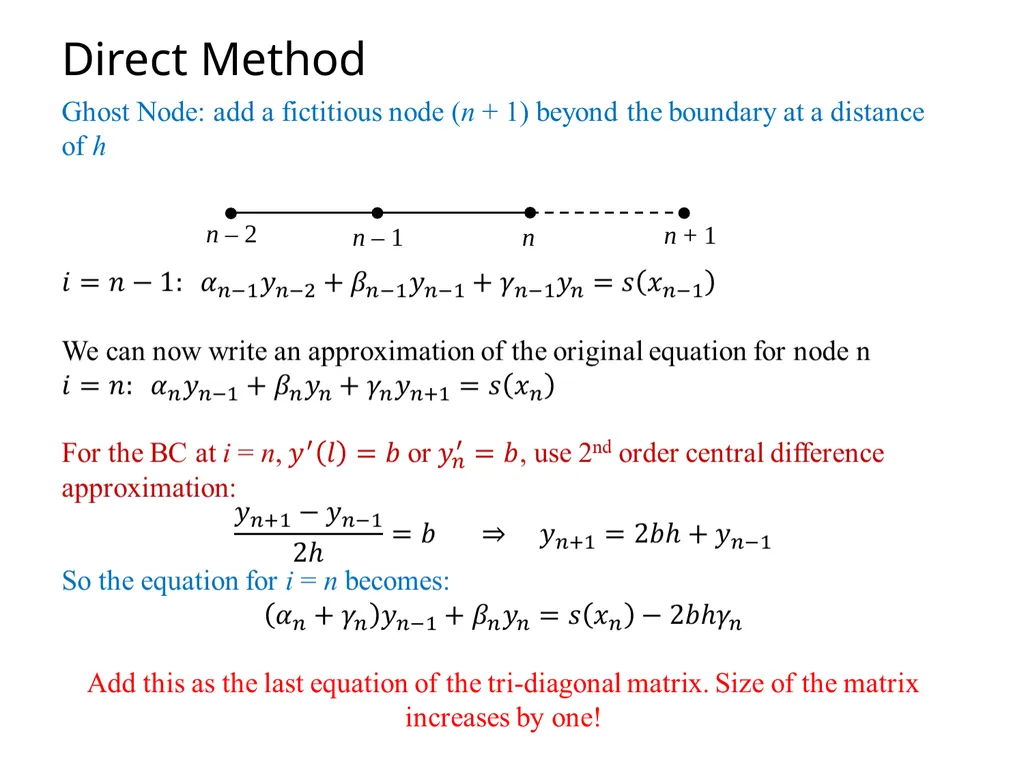
slide11. Direct Method<br>
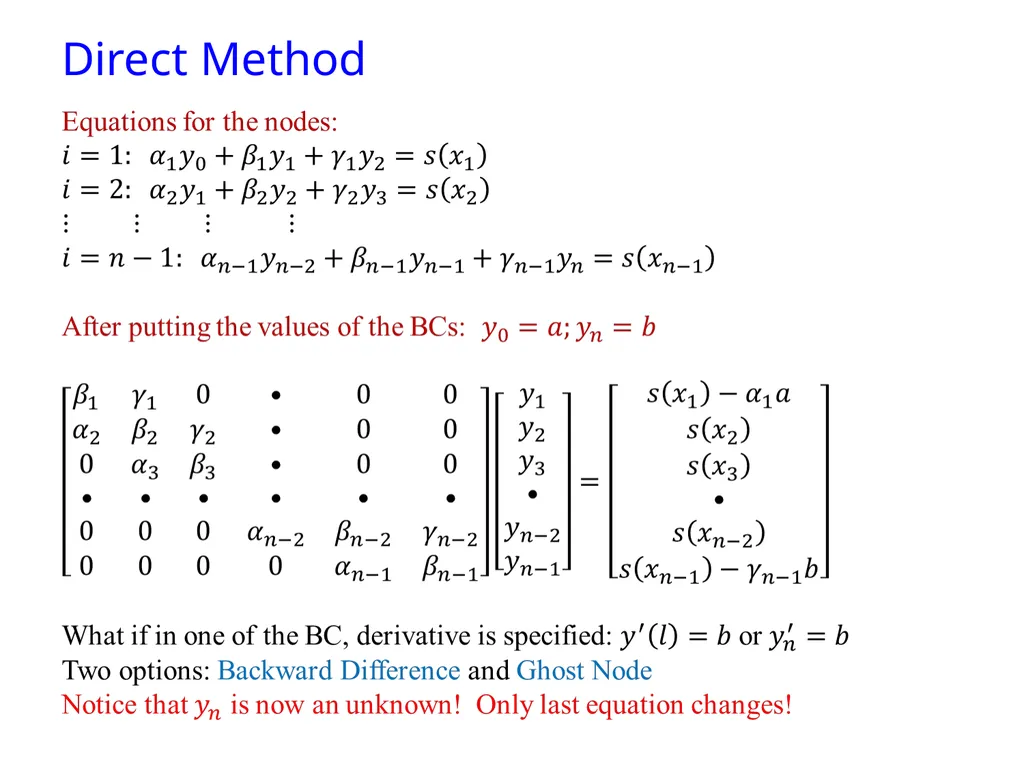
slide12. Direct Method<br>
slide13. Direct Method<br>
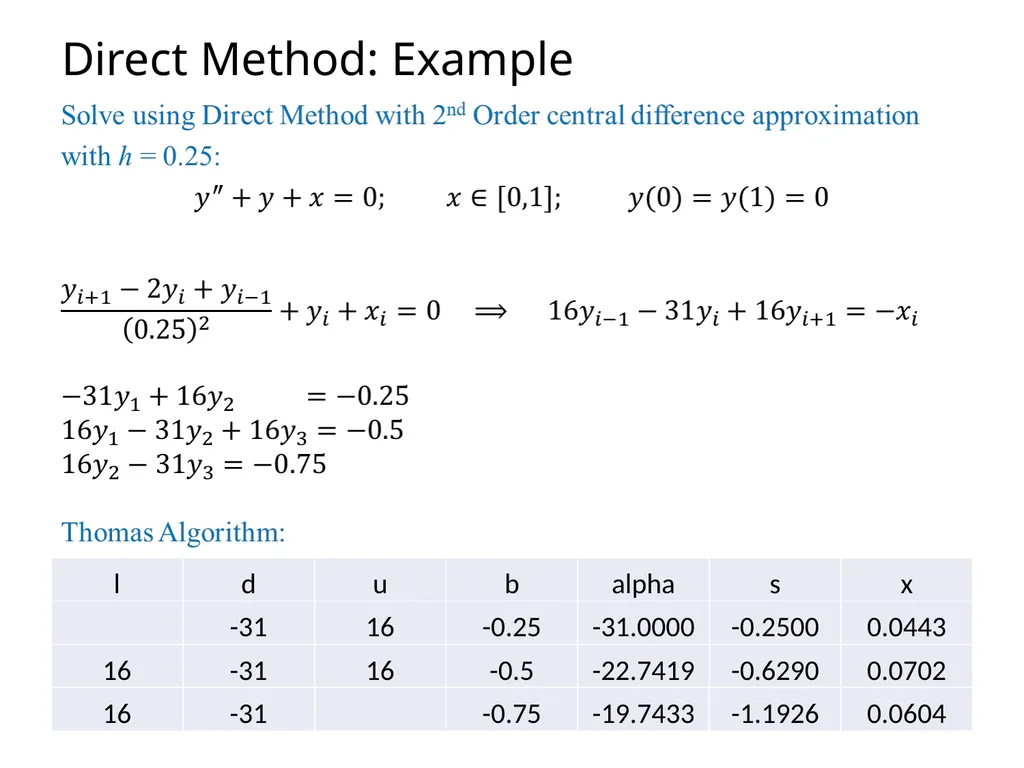
slide14. Direct Method: Example<br>
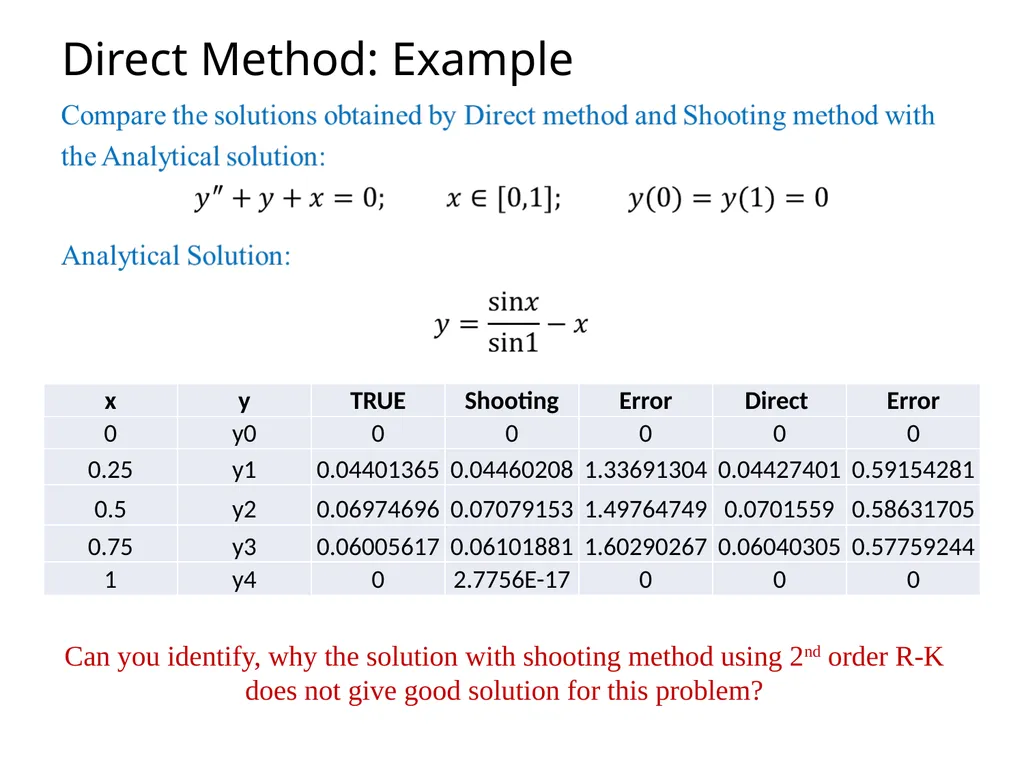
slide15. Direct Method: Example Can you identify, why the solution with shooting method using 2nd order R-K does not give good solution for this problem?<br>
slide16. Ordinary Differential Equation The methods for Initial Value Problems (IVPs):
Multi-step Methods
Explicit: Euler Forward, Adams-Bashforth
Implicit: Euler Backward, Trapezoidal and Adams-Moulton
Backward Difference Formulae (BDF)
Runge-Kutta Methods
Applications, Startup, Combination Methods (Predictor-Corrector)
Consistency, Stability, Convergence
Application to System of ODEs
Boundary Value Problems (BVPs)
Shooting Method
Direct Methods<br>
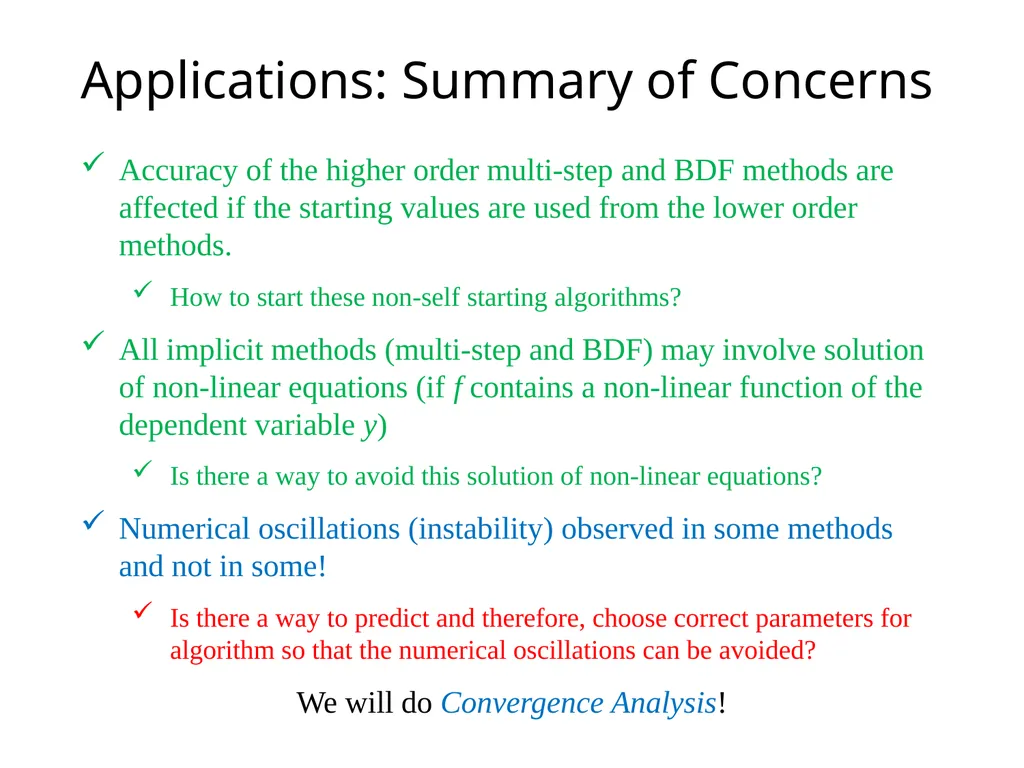
slide17. Applications: Summary of Concerns Accuracy of the higher order multi-step and BDF methods are affected if the starting values are used from the lower order methods.
How to start these non-self starting algorithms?
All implicit methods (multi-step and BDF) may involve solution of non-linear equations (if f contains a non-linear function of the dependent variable y)
Is there a way to avoid this solution of non-linear equations?
Numerical oscillations (instability) observed in some methods and not in some!
Is there a way to predict and therefore, choose correct parameters for algorithm so that the numerical oscillations can be avoided?
We will do Convergence Analysis!<br>
slide18. ESO 208A: Computational Methods in Engineering Ordinary Differential Equation: Consistency, Stability, Convergence Abhas Singh
Department of Civil Engineering
IIT Kanpur Acknowledgements: Profs. Saumyen Guha and Shivam Tripathi (CE)<br>
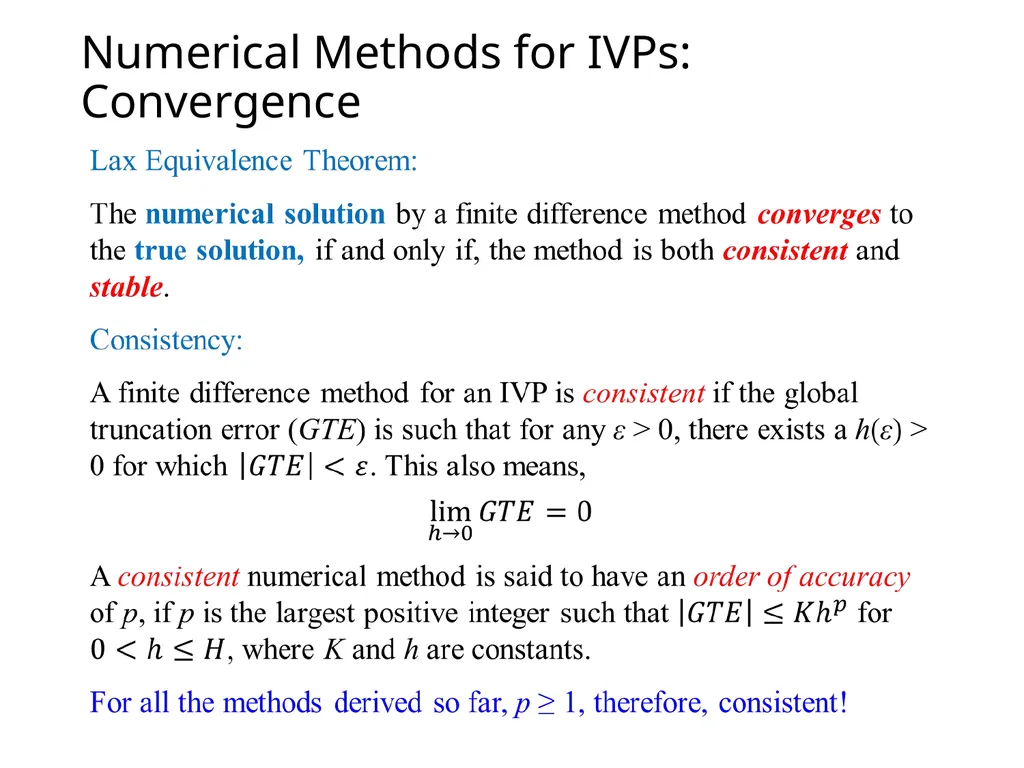
slide19. Numerical Methods for IVPs: Convergence<br>
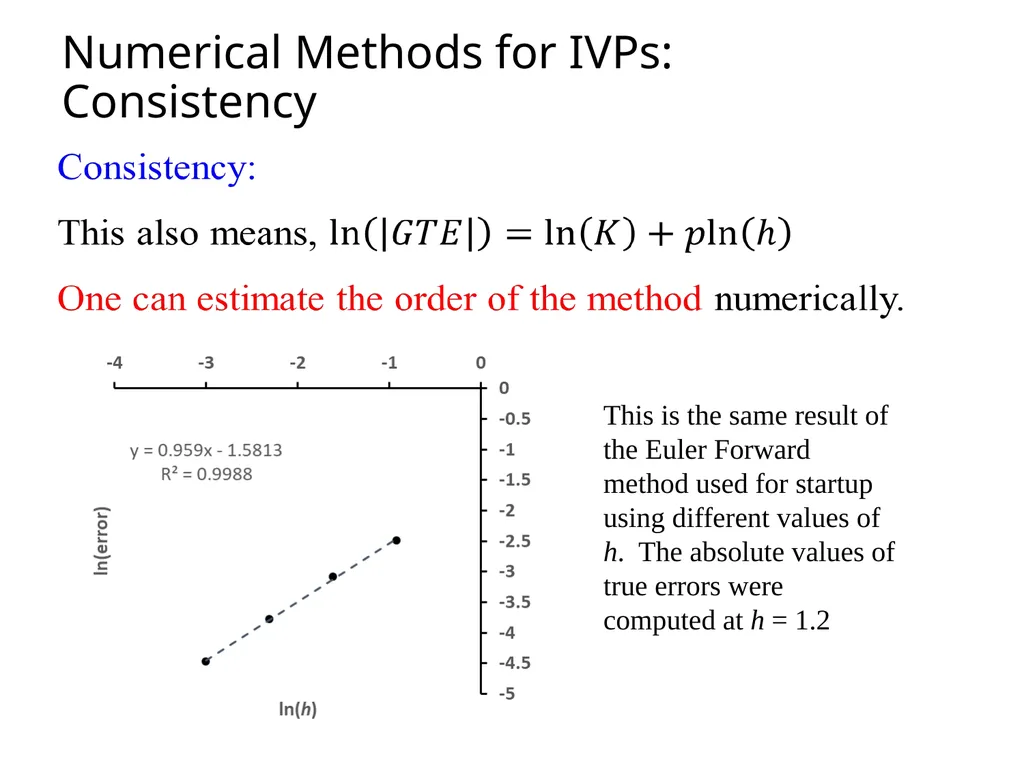
slide20. Numerical Methods for IVPs: Consistency This is the same result of the Euler Forward method used for startup using different values of h. The absolute values of true errors were computed at h = 1.2<br>
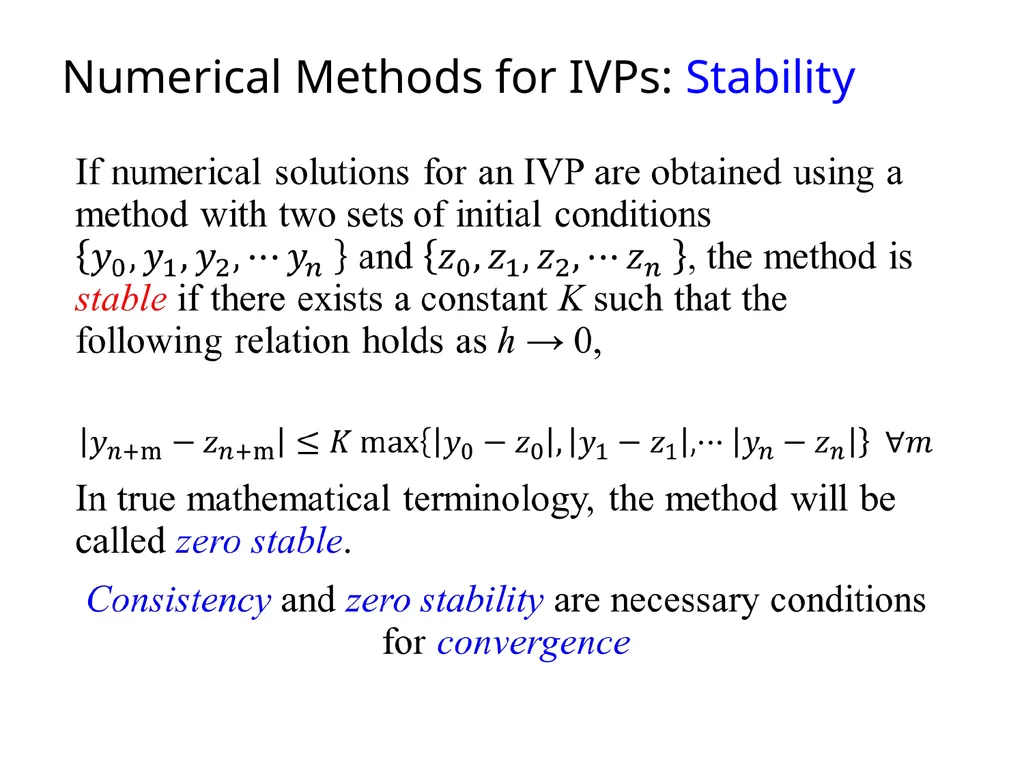
slide21. Numerical Methods for IVPs: Stability<br>
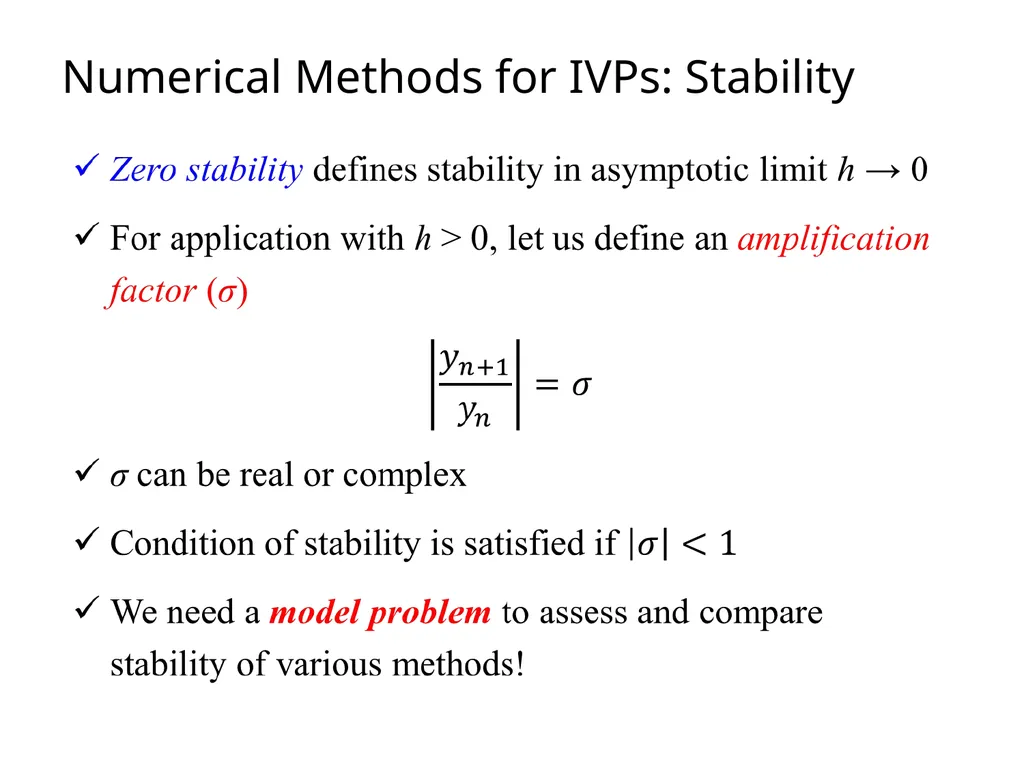
slide22. Numerical Methods for IVPs: Stability<br>
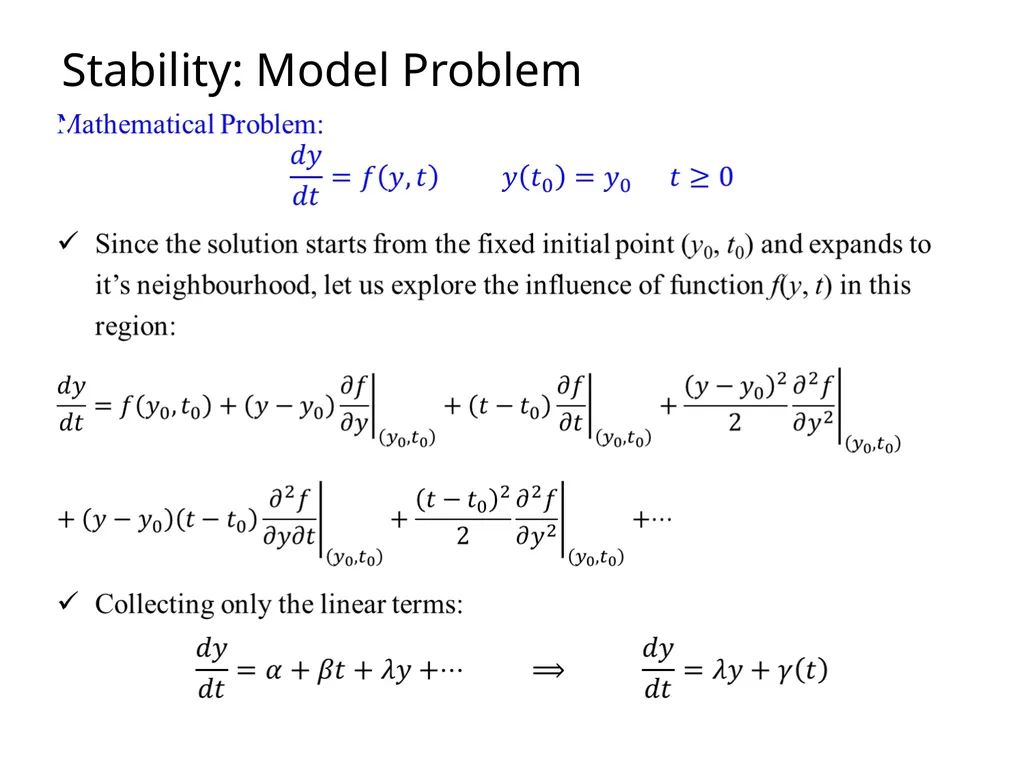
slide23. Stability: Model Problem<br>
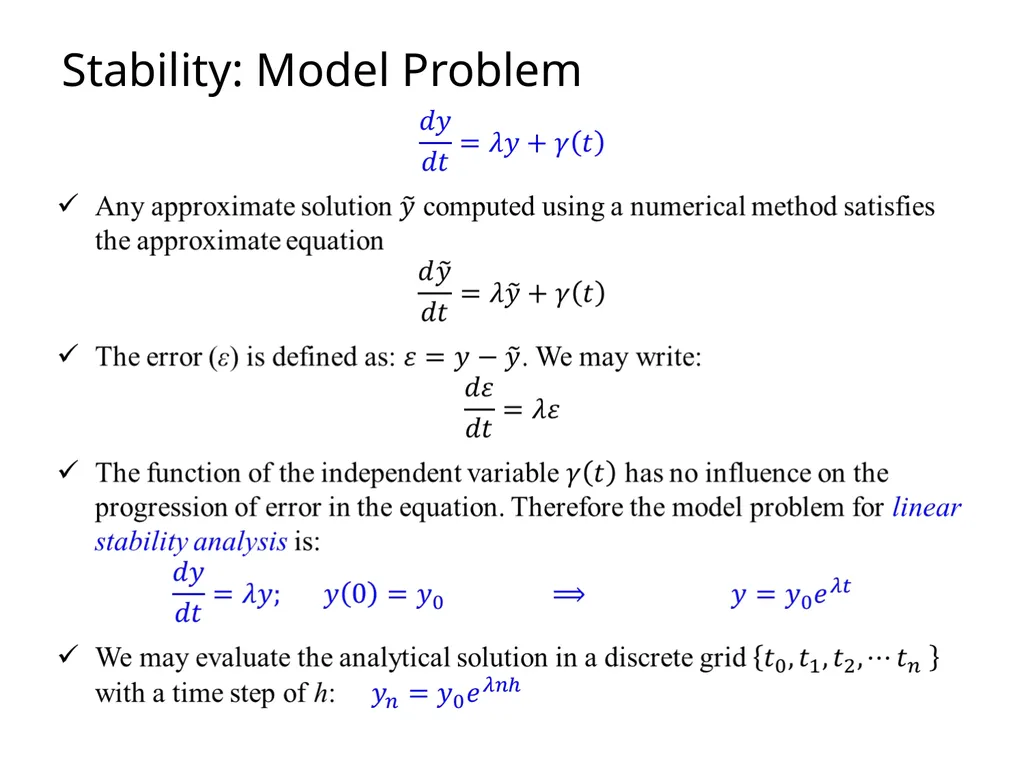
slide24. Stability: Model Problem<br>
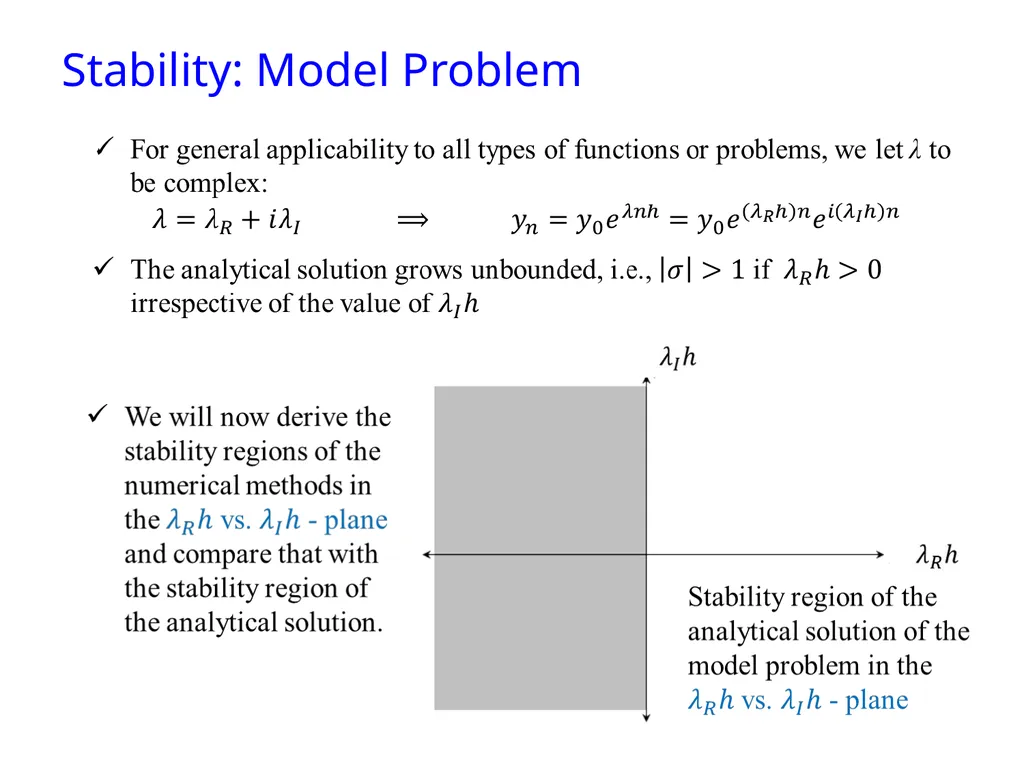
slide25. Stability: Model Problem<br>
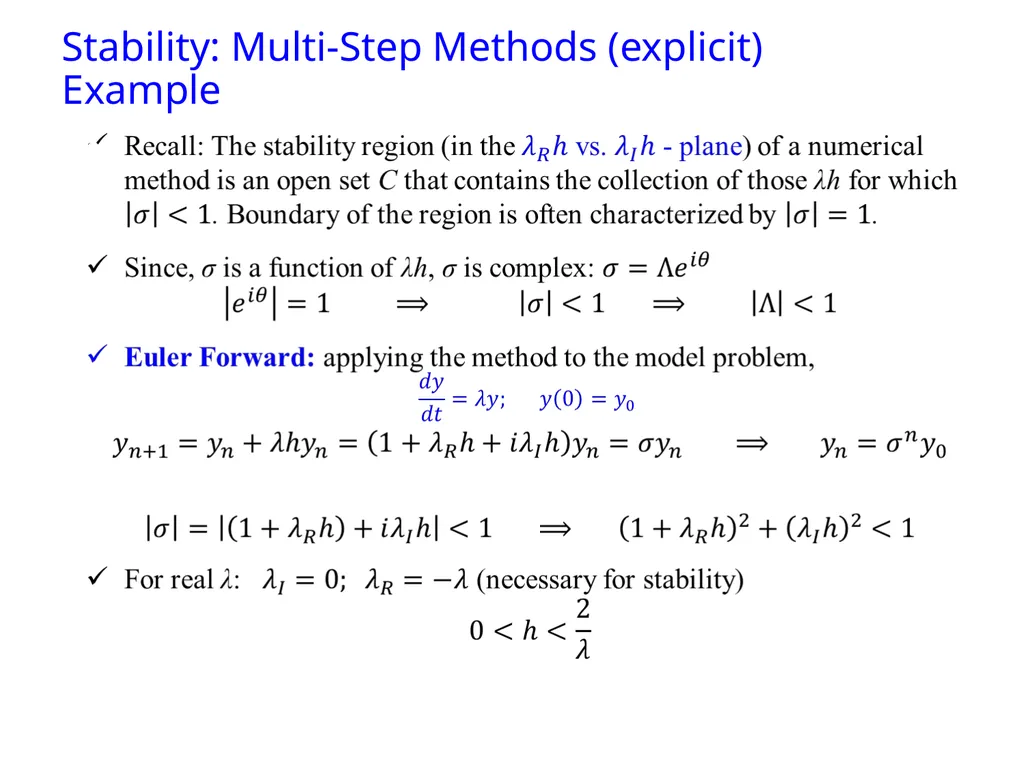
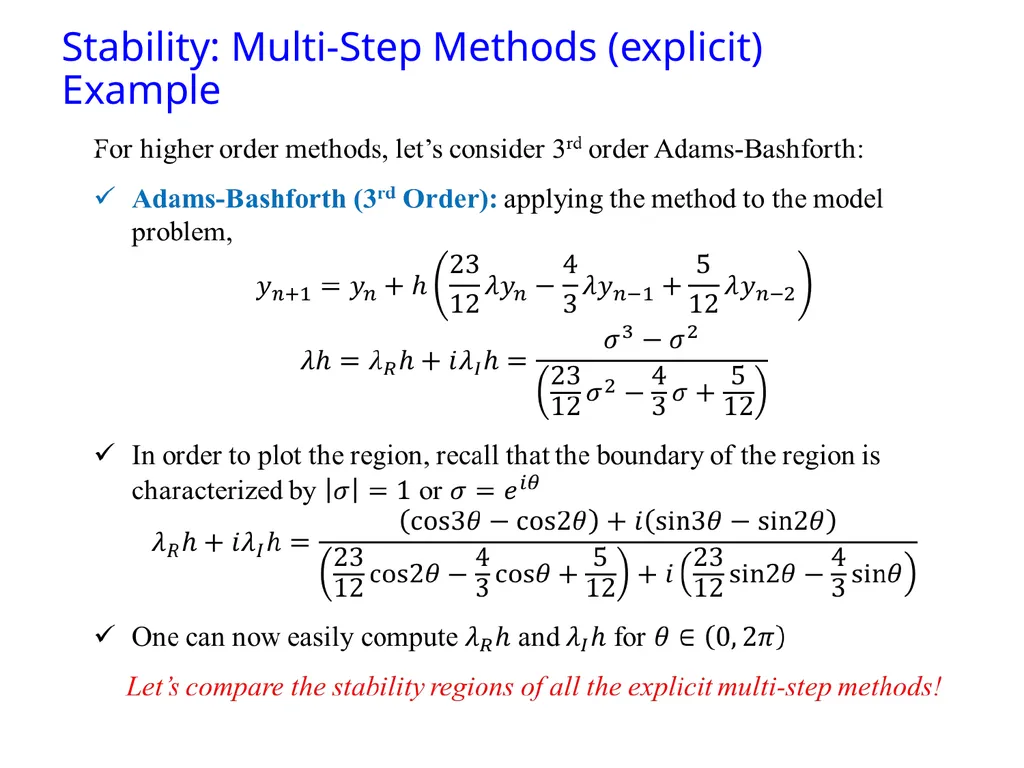
slide26. Stability: Multi-Step Methods (explicit) Example<br>
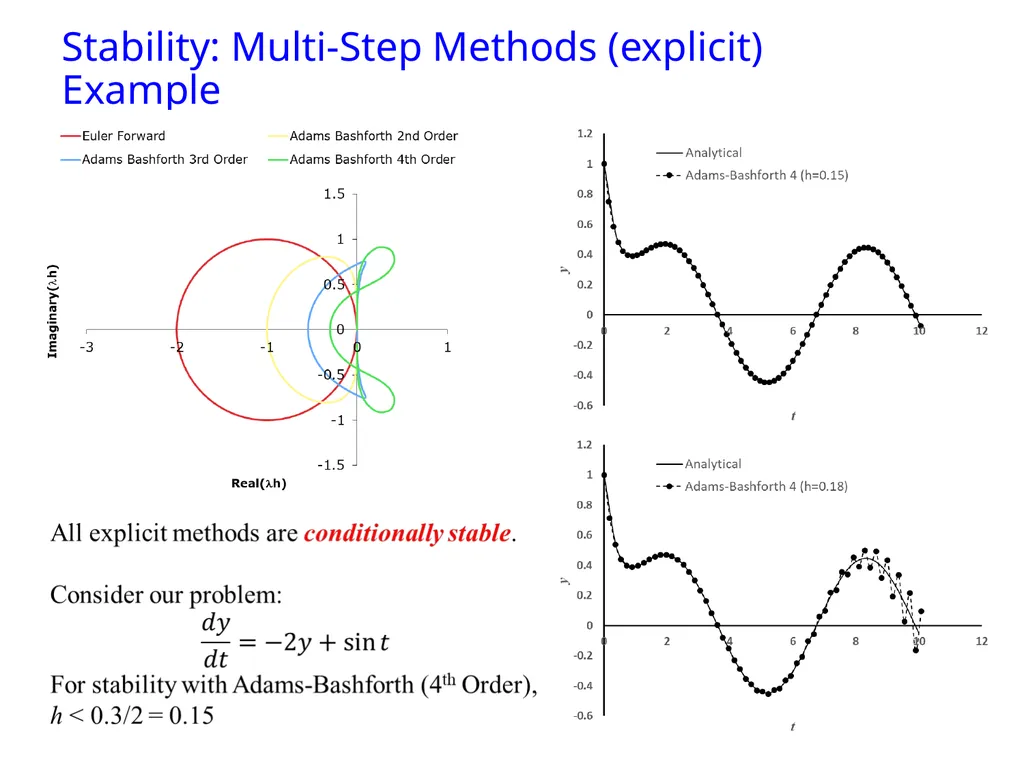
slide27. Stability: Multi-Step Methods (explicit) Example<br>
slide28. Stability: Multi-Step Methods (explicit) Example<br>
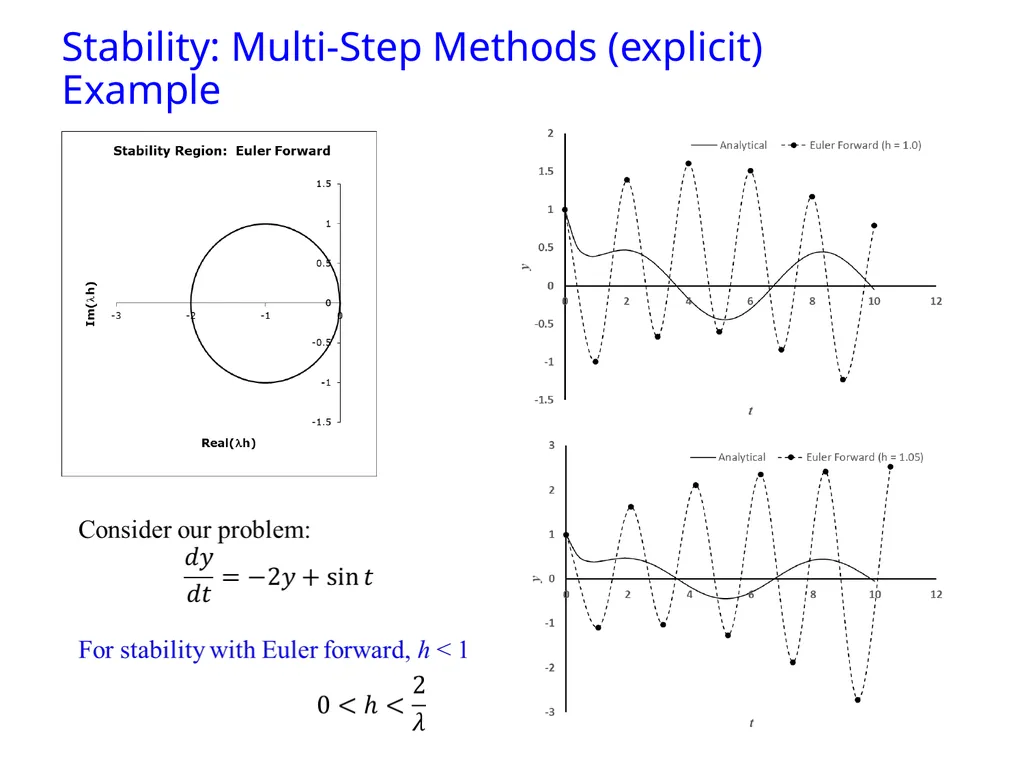
slide29. Stability: Multi-Step Methods (explicit) Example<br>
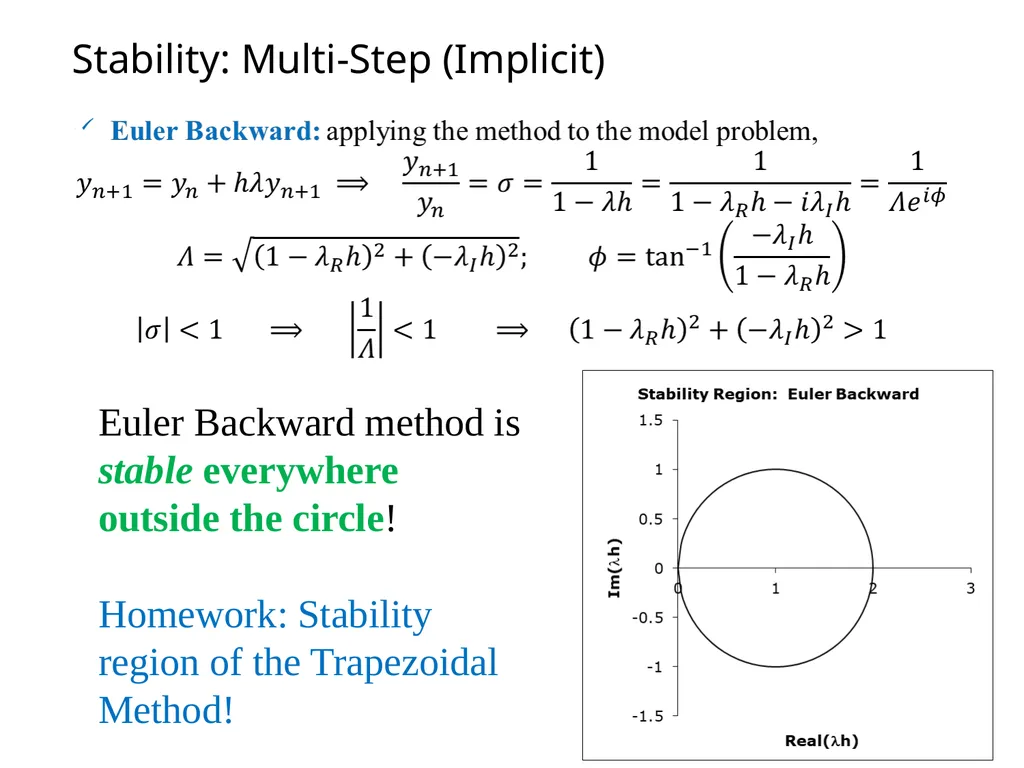
slide30. Stability: Multi-Step (Implicit) Euler Backward method is stable everywhere outside the circle!
Homework: Stability region of the Trapezoidal Method!<br>
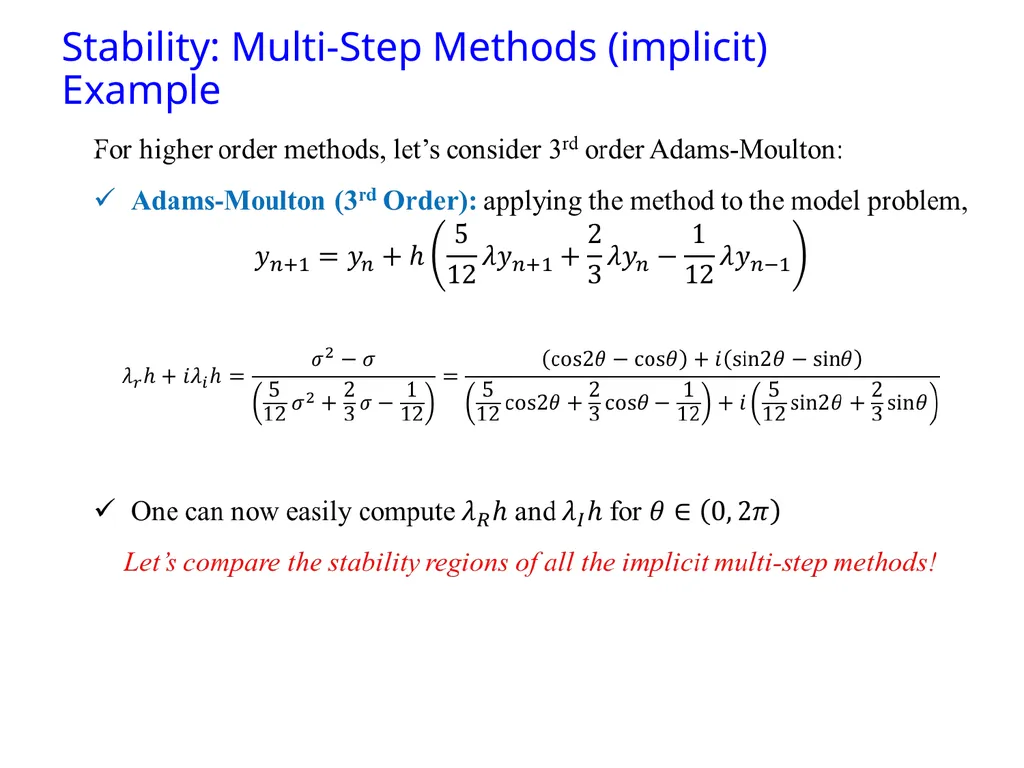
slide31. Stability: Multi-Step Methods (implicit) Example<br>
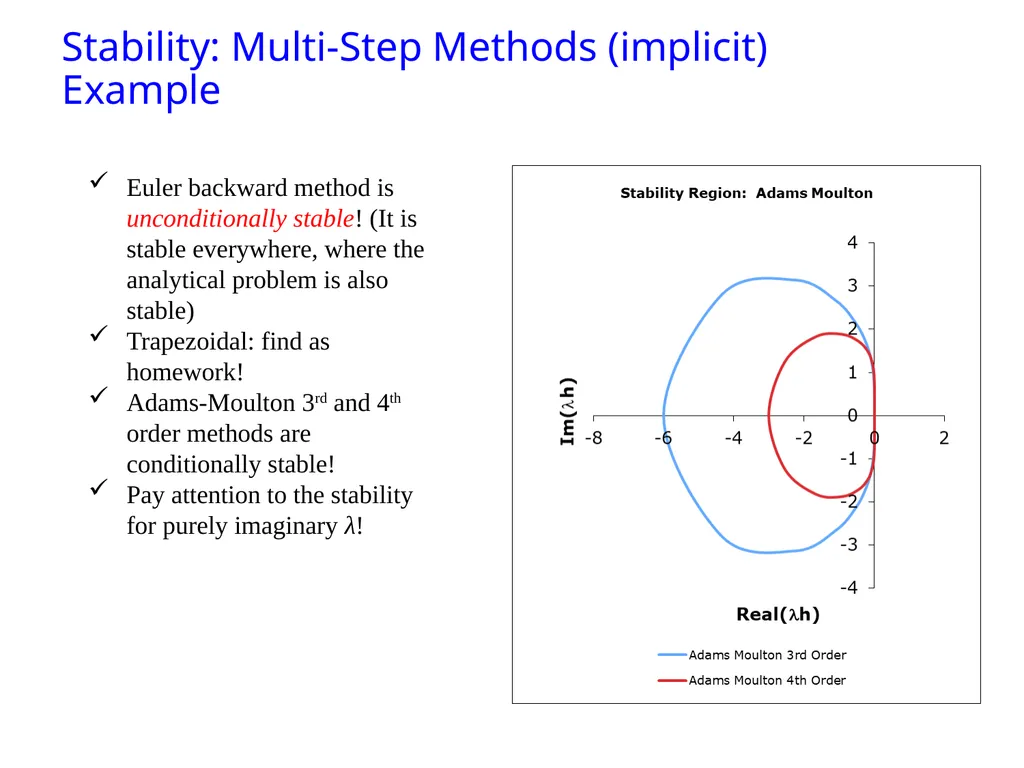
slide32. Stability: Multi-Step Methods (implicit) Example Euler backward method is unconditionally stable! (It is stable everywhere, where the analytical problem is also stable)
Trapezoidal: find as homework!
Adams-Moulton 3rd and 4th order methods are conditionally stable!
Pay attention to the stability for purely imaginary λ!<br>
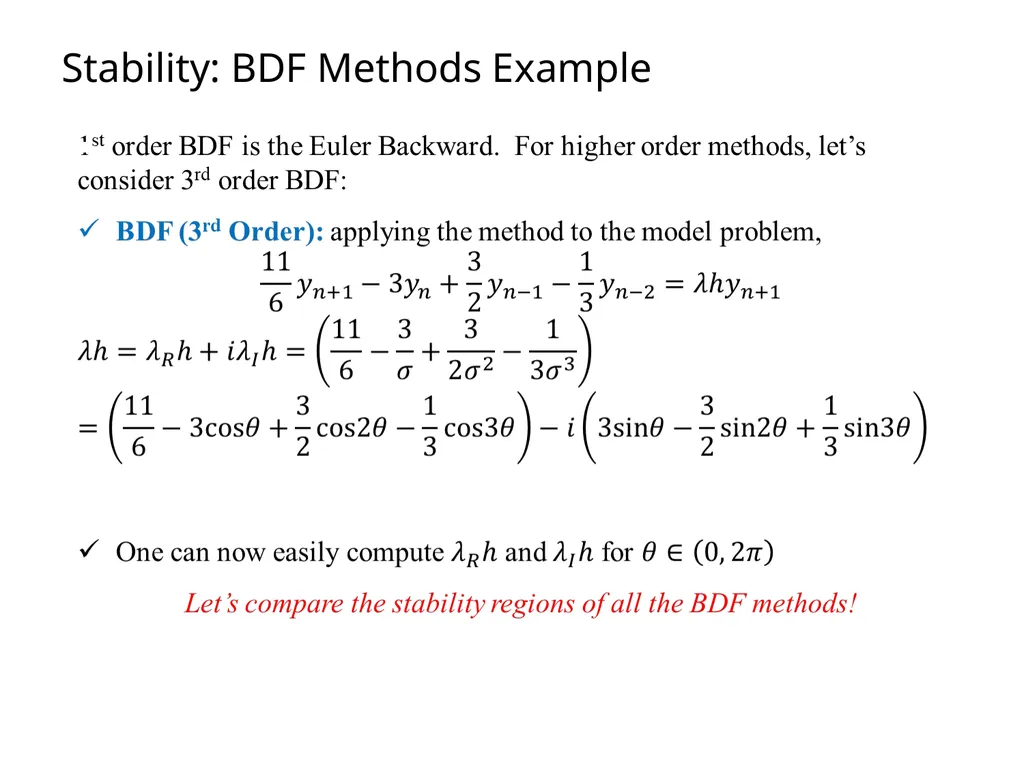
slide33. Stability: BDF Methods Example<br>
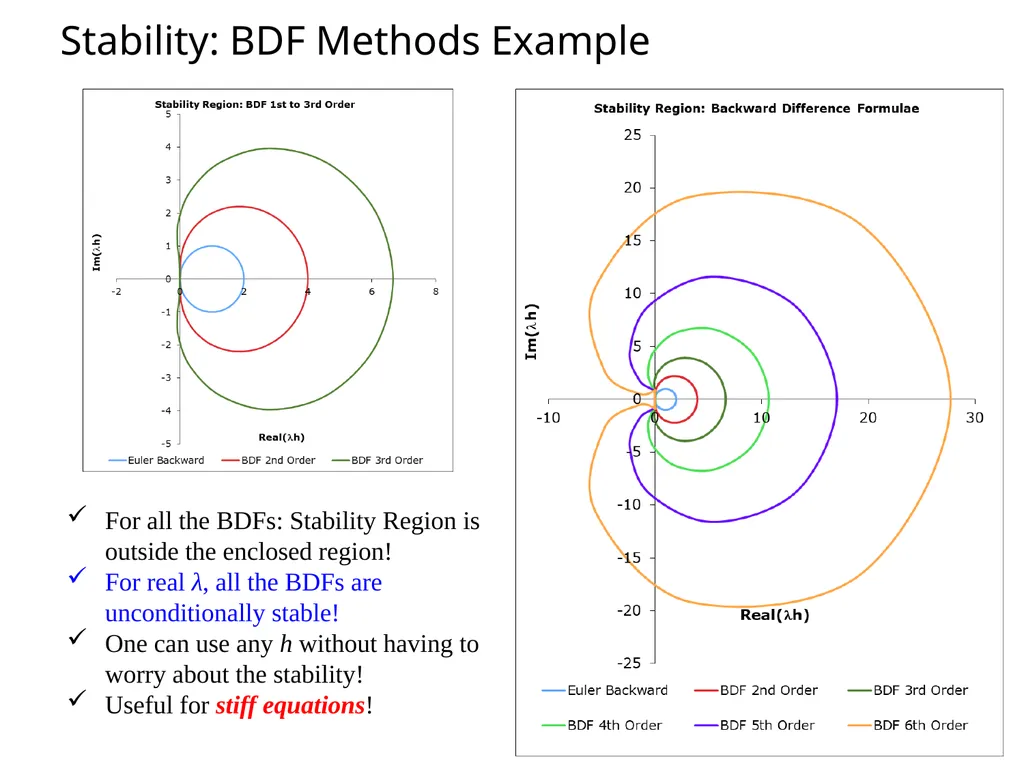
slide34. Stability: BDF Methods Example For all the BDFs: Stability Region is outside the enclosed region!
For real λ, all the BDFs are unconditionally stable!
One can use any h without having to worry about the stability!
Useful for stiff equations!<br>
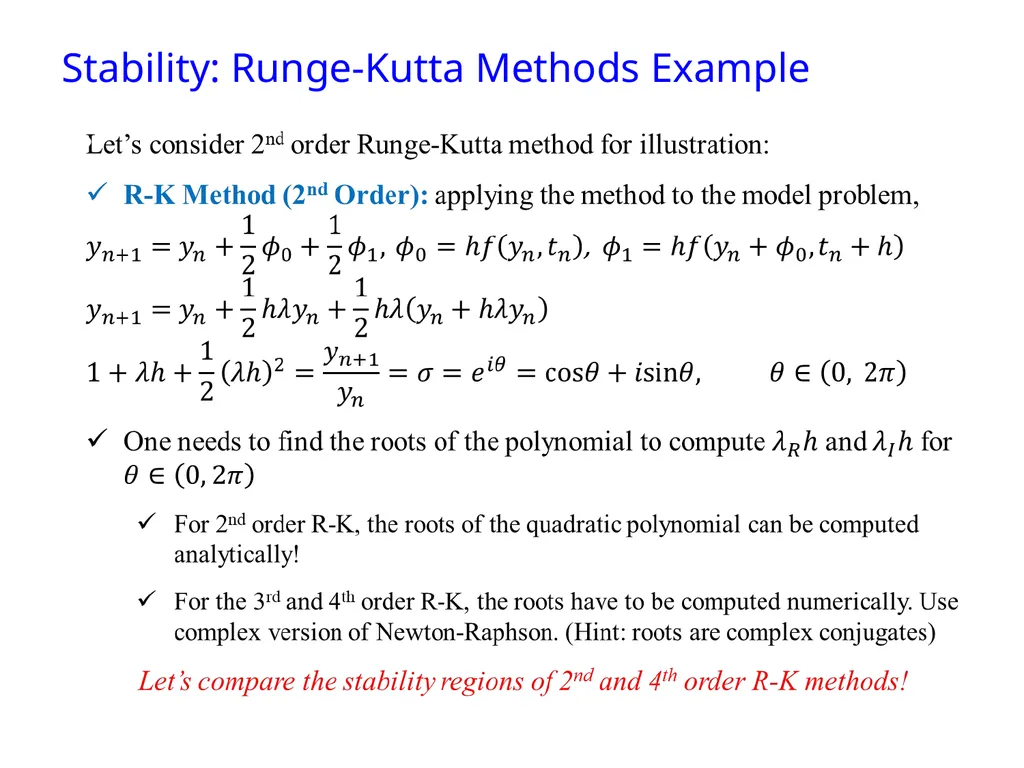
slide35. Stability: Runge-Kutta Methods Example<br>
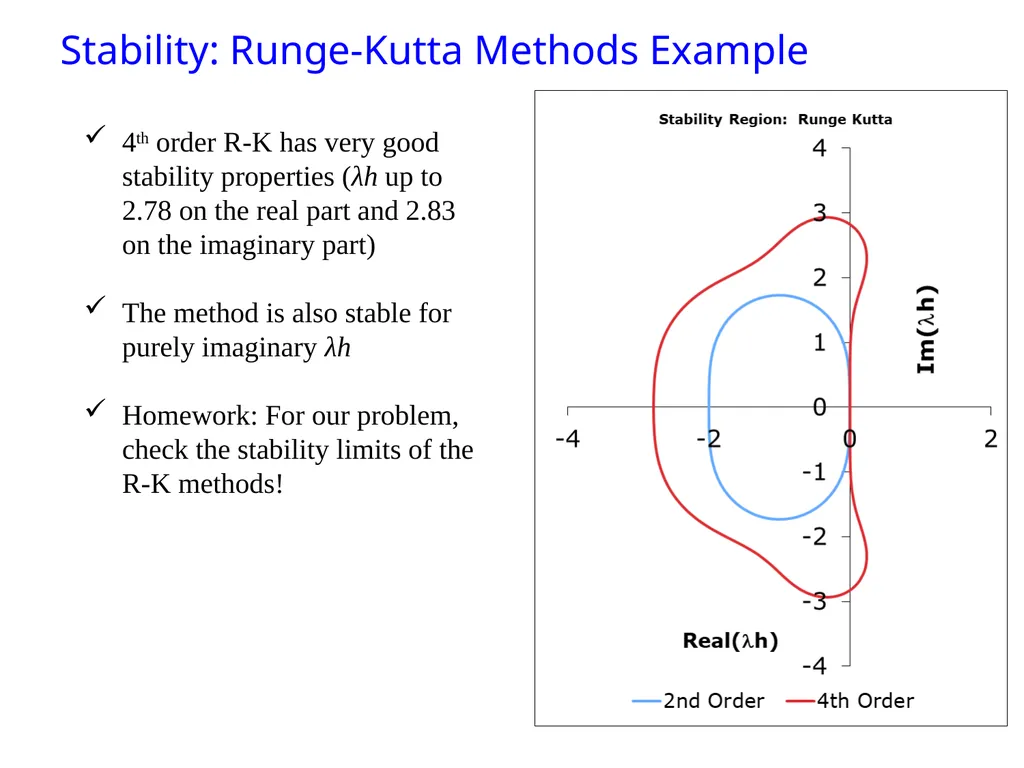
slide36. Stability: Runge-Kutta Methods Example 4th order R-K has very good stability properties (λh up to 2.78 on the real part and 2.83 on the imaginary part)
The method is also stable for purely imaginary λh
Homework: For our problem, check the stability limits of the R-K methods!<br>
Multi-step Methods
Explicit: Euler Forward, Adams-Bashforth
Implicit: Euler Backward, Trapezoidal and Adams-Moulton
Backward Difference Formulae (BDF)
Runge-Kutta Methods
Applications, Startup, Combination Methods (Predictor-Corrector)
Consistency, Stability, Convergence
Application to System of ODEs
Boundary Value Problems (BVPs)
Shooting Method
Direct Methods<br>
slide2. ESO 208A: Computational Methods in Engineering Ordinary Differential Equation: Boundary Value Problems Abhas Singh
Department of Civil Engineering
IIT Kanpur Acknowledgements: Profs. Saumyen Guha and Shivam Tripathi (CE)<br>
slide3. Boundary Value Problems<br>
slide4. Shooting Method<br>
slide5. Open Methods: Secant (Recap) Principle: Use a difference approximation for the slope or derivative in the Newton-Raphson method. This is equivalent to approximating the tangent with a secant.
Problem: f(x) = 0, find a root x = α such that f(α) = 0 5<br>
slide6. Open Methods: Secant (Recap) 6<br>
slide7. Shooting Method<br>
slide8. Direct Method<br>
slide9. Direct Method<br>
slide10. Direct Method<br>
slide11. Direct Method<br>
slide12. Direct Method<br>
slide13. Direct Method<br>
slide14. Direct Method: Example<br>
slide15. Direct Method: Example Can you identify, why the solution with shooting method using 2nd order R-K does not give good solution for this problem?<br>
slide16. Ordinary Differential Equation The methods for Initial Value Problems (IVPs):
Multi-step Methods
Explicit: Euler Forward, Adams-Bashforth
Implicit: Euler Backward, Trapezoidal and Adams-Moulton
Backward Difference Formulae (BDF)
Runge-Kutta Methods
Applications, Startup, Combination Methods (Predictor-Corrector)
Consistency, Stability, Convergence
Application to System of ODEs
Boundary Value Problems (BVPs)
Shooting Method
Direct Methods<br>
slide17. Applications: Summary of Concerns Accuracy of the higher order multi-step and BDF methods are affected if the starting values are used from the lower order methods.
How to start these non-self starting algorithms?
All implicit methods (multi-step and BDF) may involve solution of non-linear equations (if f contains a non-linear function of the dependent variable y)
Is there a way to avoid this solution of non-linear equations?
Numerical oscillations (instability) observed in some methods and not in some!
Is there a way to predict and therefore, choose correct parameters for algorithm so that the numerical oscillations can be avoided?
We will do Convergence Analysis!<br>
slide18. ESO 208A: Computational Methods in Engineering Ordinary Differential Equation: Consistency, Stability, Convergence Abhas Singh
Department of Civil Engineering
IIT Kanpur Acknowledgements: Profs. Saumyen Guha and Shivam Tripathi (CE)<br>
slide19. Numerical Methods for IVPs: Convergence<br>
slide20. Numerical Methods for IVPs: Consistency This is the same result of the Euler Forward method used for startup using different values of h. The absolute values of true errors were computed at h = 1.2<br>
slide21. Numerical Methods for IVPs: Stability<br>
slide22. Numerical Methods for IVPs: Stability<br>
slide23. Stability: Model Problem<br>
slide24. Stability: Model Problem<br>
slide25. Stability: Model Problem<br>
slide26. Stability: Multi-Step Methods (explicit) Example<br>
slide27. Stability: Multi-Step Methods (explicit) Example<br>
slide28. Stability: Multi-Step Methods (explicit) Example<br>
slide29. Stability: Multi-Step Methods (explicit) Example<br>
slide30. Stability: Multi-Step (Implicit) Euler Backward method is stable everywhere outside the circle!
Homework: Stability region of the Trapezoidal Method!<br>
slide31. Stability: Multi-Step Methods (implicit) Example<br>
slide32. Stability: Multi-Step Methods (implicit) Example Euler backward method is unconditionally stable! (It is stable everywhere, where the analytical problem is also stable)
Trapezoidal: find as homework!
Adams-Moulton 3rd and 4th order methods are conditionally stable!
Pay attention to the stability for purely imaginary λ!<br>
slide33. Stability: BDF Methods Example<br>
slide34. Stability: BDF Methods Example For all the BDFs: Stability Region is outside the enclosed region!
For real λ, all the BDFs are unconditionally stable!
One can use any h without having to worry about the stability!
Useful for stiff equations!<br>
slide35. Stability: Runge-Kutta Methods Example<br>
slide36. Stability: Runge-Kutta Methods Example 4th order R-K has very good stability properties (λh up to 2.78 on the real part and 2.83 on the imaginary part)
The method is also stable for purely imaginary λh
Homework: For our problem, check the stability limits of the R-K methods!<br>