Ore Deposits Formed By Metamorphism Process Metamorphic and metamorphosed ore deposits Metamorphic ore deposits is a class that owes its economic largely isochemical metamorphic equilibration and recrystallization interest to re of
"Ore Deposits Formed By Metamorphism Process" is the property of its rightful owner. Permission is granted to
download and print the materials on this website for personal, non-commercial use only, and to display it
on your personal computer provided you do not modify the materials and that you retain all copyright
notices contained in the materials. By downloading content from our website, you accept the terms of this
agreement.
Presentation Transcript
01
Ore Deposits Formed By Metamorphism Process<br>
02
Metamorphic and metamorphosed ore deposits Metamorphic ore deposits is a class that owes its economic largely isochemical metamorphic equilibration and recrystallization interest to
re of pre-existing material which had no use in its original state. (e.g., transformation of alumina-rich claystones to kyanite/sillimanite deposits, or graphite flakes formed from dispersed bitumen).
Contact metamorphism of ore in the heated zone around magmatic bodies is usually static (i.e., in the absence of dynamic deformation). Exposure to high 750°C) affects fabric, mineralogy temperatures (with a maximum of
and mineral chemistry (e.g. by driving off water and other volatiles). Fabric changes increase are confined to in grain size temperature. Monomineralic a general with rising
ores recrystallize into triple grain boundary junctions at angles of 120°.<br>
03
Increase of grain size by metamorphism is important in practice, because processing of coarse ore is less energy intensive.
Sulphur release (e.g. from pyrite) may induce formation of metamorphic pyrrhotite or even magnetite. Iron oxide ore at contacts may recrystallize to a different oxidation state (e.g. haematite to magnetite) controlled by the oxygen activity imposed by magma or by heated country rocks. Oxidation/reduction sulphidation/desulphidation during metamorphism: and reactions<br>
04
Skarn and contact-metasomatic ore deposits are intimately related to thermal aureoles of magmatic intrusions. They may be said to be products of contact metamorphism, but the causal agent is the interaction with magmatic fluids and not simple change by heating. Therefore, it was discussed in the magmatic domain.<br>
05
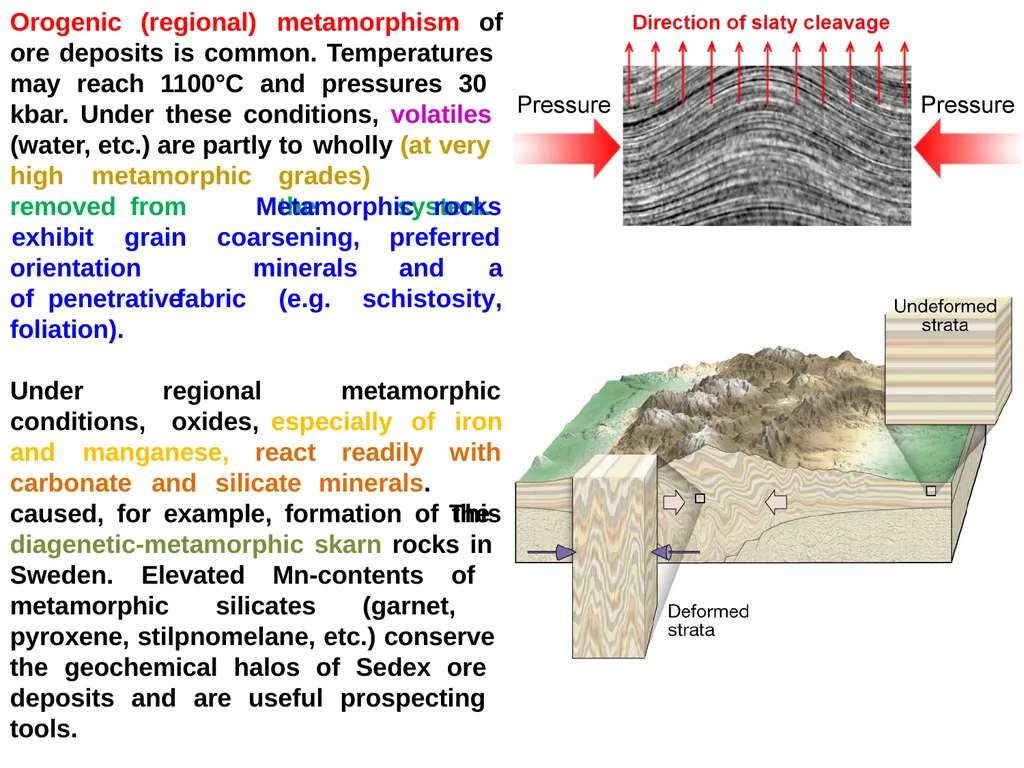
Orogenic (regional) metamorphism of ore deposits is common. Temperatures may reach 1100°C and pressures 30 kbar. Under these conditions, volatiles (water, etc.) are partly to wholly (at very high metamorphic grades) removed from the system. Metamorphic rocks preferred exhibit grain coarsening,
minerals and a fabric (e.g. schistosity, orientation of penetrative foliation). metamorphic Under conditions, regional oxides, especially and manganese, react carbonate and silicate readily minerals. of iron
with This caused, for example, formation of the diagenetic-metamorphic skarn rocks in Sweden. Elevated Mn-contents of metamorphic silicates (garnet, pyroxene, stilpnomelane, etc.) conserve the geochemical halos of Sedex ore deposits and are useful prospecting tools.<br>
06
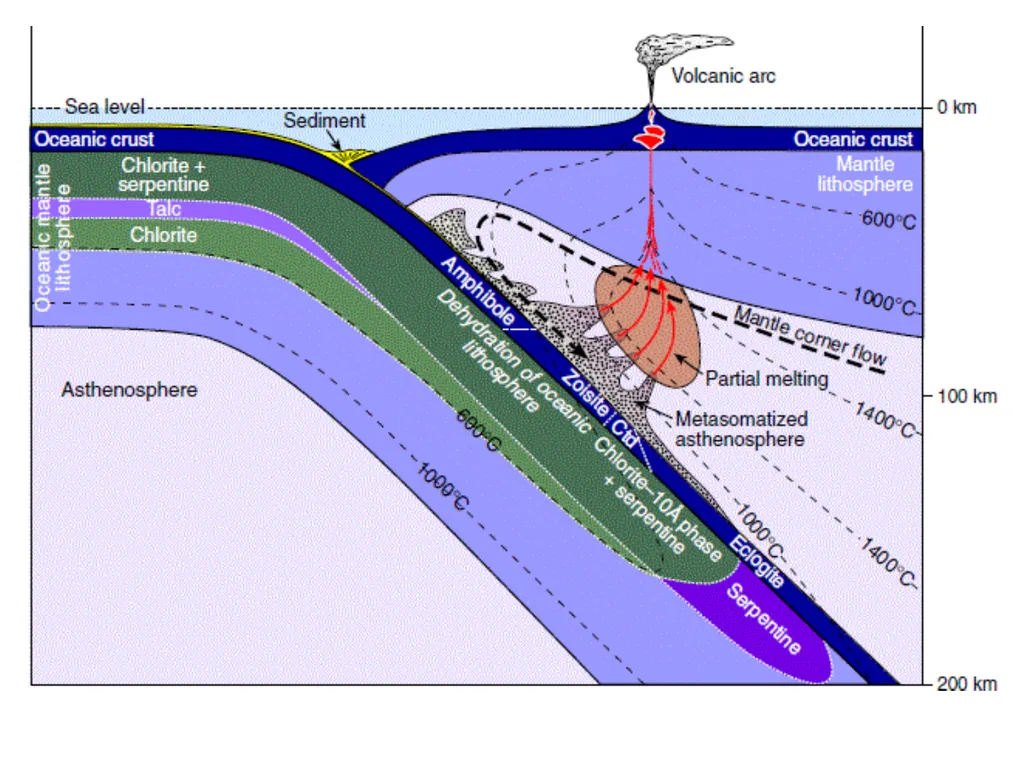
Ores could also be formed from metamorphic fluids. The metamorphic fluids can be considered as solutions that are in equilibrium with host rocks, and although they are dilute, their sheer mass allows significant transfer of dissolved matter. Metamorphic fluids originate primarily by chemical release (devolatilization). Increasing metamorphism, from sub- greenschist facies to anatexis, produces a steady flow of metamorphic dehydration fluids and a decrease of volatiles in the respective metamorphic rocks.
Shales contain 4 wt.% water in contrast to mica schist with 2%. By exothermic reactions, basalt assimilates water during the formation of greenschists to a maximum of 13%. Siliceous carbonates lose CO2 due to generation of metamorphic calcsilicate minerals. Example of dehydration reactions at the transition from greenschist to amphibolite: Water in mainly in metamorphic OH-groups rocks occurs of hydrous minerals and in fluid inclusions. Grain boundaries also host tiny inclusions. Some fluids fill open fissures and the pore space.
Fluids liberated from rocks undergoing prograde metamorphism economically interesting trace acquire metals (e.g. gold) or other elements (arsenic), either together with the volatiles H2O, F and Cl from the lattice of transforming minerals.<br>
07
Diagram illustrating the relationship between different fluid types and various hydrothermal ore deposit types<br>