
ORS Task List Classification - Topic Modeling
Description: ORS Task List Classification - Topic Modeling Drake Gibson Data Scientist Office of Compensation and Working Conditions April 6, 2022 Outline ONET and ORS background Purpose of the project Leveraging task data and methods Topic Modeling
Related Topics
Download Presentation
"ORS Task List Classification - Topic Modeling" is the property of its rightful owner. Permission is granted to download and print the materials on this website for personal, non-commercial use only, and to display it on your personal computer provided you do not modify the materials and that you retain all copyright notices contained in the materials. By downloading content from our website, you accept the terms of this agreement.
Presentation Transcript
slide1. ORS Task List Classification - Topic Modeling Drake Gibson
Data Scientist
Office of Compensation and Working Conditions
April 6, 2022<br>
slide2. Outline O*NET and ORS background
Purpose of the project
Leveraging task data and methods
Topic Modeling<br>
slide3. Occupational Information Network (O*NET) The nation's primary source of occupational information
Highlights changes in workforce
Helps people find the training needed for jobs
Generalized Work Activities (GWA) classify workers’ tasks in the data source<br>
slide4. Occupational Requirements Survey (ORS) Establishment survey collected on behalf of the Social Security Administration (SSA)
ORS supports adjudication of SSA’s disability program
Captures the requirements for a job like:
Physical Demands
Environmental Conditions
Captures minimally structured task data<br>
slide5. Purpose Why?
Publish ORS task data
How?
Using O*NET as a taxonomy, we may be able to classify and structure ORS task data<br>
slide6. ORS Task List Classification Topic Modeling
Type of statistical model for discovering the abstract “topics” that occur in a collection of documents (Li, Susan. 2018. Topic Modeling and Latent Dirichlet Allocation (LDA) in Python.)
“is a method for unsupervised classification of such documents, similar to clustering on numeric data, which finds natural groups of items even when we’re not sure what we’re looking for.”( Silge, Julia and David Robinson. 2021. Text Mining with R: A Tidy Approach)<br>
slide7. ORS Task List Classification Topic Modeling
Latent Dirichlet Allocation (LDA)
Each task falls into a topic
Each word in each task falls into a topic
Topic models for both ORS and O*NET<br>
slide8. ORS Task List Classification Models were built with 8, 16, 32, 48 and 64 topics
Models with common words and verbs with O*NET were also built
Currently, working on evaluating results for final suggestion<br>
slide9. O*NET Topic Modeling First, a 4-topic model is used to compare log likelihoods for each topic in the model
Compared common words in tasks between topics in O*NET and ORS
Compared common verbs in tasks between topics in O*NET and ORS<br>
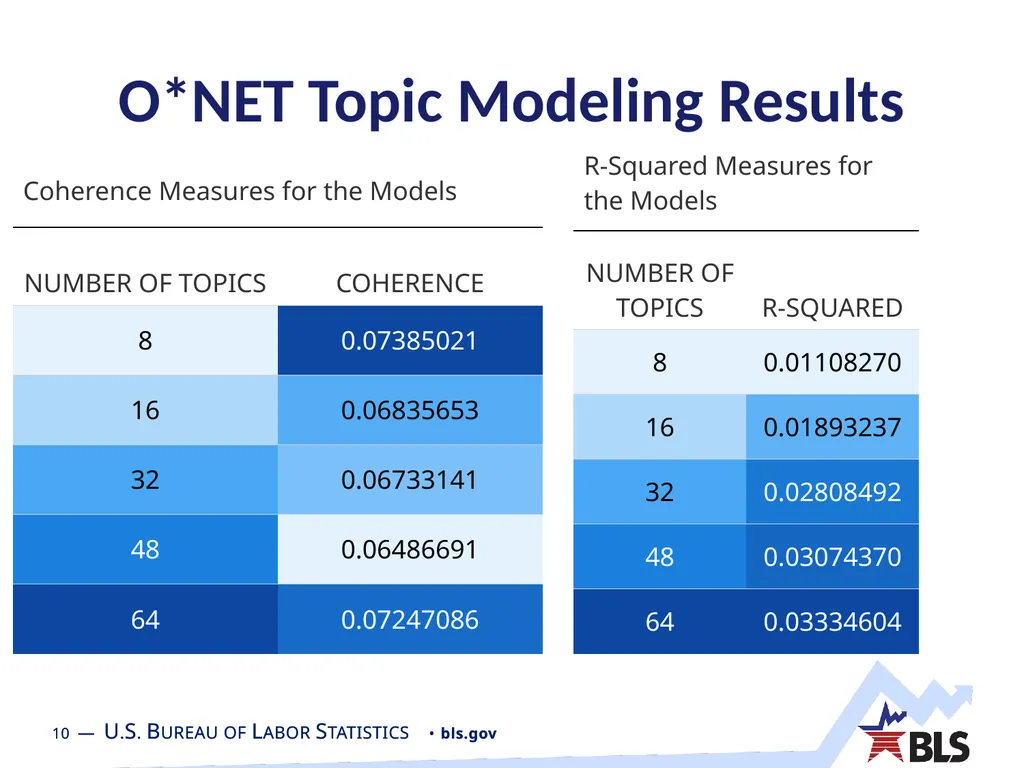
slide10. O*NET Topic Modeling Results<br>
slide11. Topic 5 has the highest coherence in this model
Topic 33 has the highest coherence in this model<br>
slide12. Topic Modeling Analysis ORS and O*NET tasks are classified
Optimal number of topics for this exercise?
Coherence vs Log likelihood vs R-Squared
The structure of the results
Are tasks following the Standard Occupation Classification(SOC)?
Still need to further explore other models for better results<br>
slide13. The Team Nicole Nestoriak & David Oh<br>
slide14. Drake Gibson
Operations Research Analyst(Data Scientist)
Bureau of Labor Statistics
Gibson.Drake@bls.gov Contact Information<br>
Data Scientist
Office of Compensation and Working Conditions
April 6, 2022<br>
slide2. Outline O*NET and ORS background
Purpose of the project
Leveraging task data and methods
Topic Modeling<br>
slide3. Occupational Information Network (O*NET) The nation's primary source of occupational information
Highlights changes in workforce
Helps people find the training needed for jobs
Generalized Work Activities (GWA) classify workers’ tasks in the data source<br>
slide4. Occupational Requirements Survey (ORS) Establishment survey collected on behalf of the Social Security Administration (SSA)
ORS supports adjudication of SSA’s disability program
Captures the requirements for a job like:
Physical Demands
Environmental Conditions
Captures minimally structured task data<br>
slide5. Purpose Why?
Publish ORS task data
How?
Using O*NET as a taxonomy, we may be able to classify and structure ORS task data<br>
slide6. ORS Task List Classification Topic Modeling
Type of statistical model for discovering the abstract “topics” that occur in a collection of documents (Li, Susan. 2018. Topic Modeling and Latent Dirichlet Allocation (LDA) in Python.)
“is a method for unsupervised classification of such documents, similar to clustering on numeric data, which finds natural groups of items even when we’re not sure what we’re looking for.”( Silge, Julia and David Robinson. 2021. Text Mining with R: A Tidy Approach)<br>
slide7. ORS Task List Classification Topic Modeling
Latent Dirichlet Allocation (LDA)
Each task falls into a topic
Each word in each task falls into a topic
Topic models for both ORS and O*NET<br>
slide8. ORS Task List Classification Models were built with 8, 16, 32, 48 and 64 topics
Models with common words and verbs with O*NET were also built
Currently, working on evaluating results for final suggestion<br>
slide9. O*NET Topic Modeling First, a 4-topic model is used to compare log likelihoods for each topic in the model
Compared common words in tasks between topics in O*NET and ORS
Compared common verbs in tasks between topics in O*NET and ORS<br>
slide10. O*NET Topic Modeling Results<br>
slide11. Topic 5 has the highest coherence in this model
Topic 33 has the highest coherence in this model<br>
slide12. Topic Modeling Analysis ORS and O*NET tasks are classified
Optimal number of topics for this exercise?
Coherence vs Log likelihood vs R-Squared
The structure of the results
Are tasks following the Standard Occupation Classification(SOC)?
Still need to further explore other models for better results<br>
slide13. The Team Nicole Nestoriak & David Oh<br>
slide14. Drake Gibson
Operations Research Analyst(Data Scientist)
Bureau of Labor Statistics
Gibson.Drake@bls.gov Contact Information<br>