
Oslo Group Energy Statistics 8-11 May 2017 ESS
DP
Published · 46 slides · 0 views

1 / 1

Description
Oslo Group Energy Statistics 8-11 May 2017 ESS Data Validation and exchange (SDMX) Bart De Norre Unit E.5: Energy European Commission DG Eurostat 1 Overview Context ESS shared validation SDMX DSD Energy Eurostat ESS Future 2 Context
Related Topics
Share
Embed code
Download this presentation From Below
"Oslo Group Energy Statistics 8-11 May 2017 ESS" is the property of its rightful owner. Permission is granted to download and print the materials on this website for personal, non-commercial use only, and to display it on your personal computer provided you do not modify the materials and that you retain all copyright notices contained in the materials. By downloading content from our website, you accept the terms of this agreement.
Presentation Transcript
01
Oslo Group Energy Statistics
8-11 May 2017
ESS Data Validation and exchange (SDMX) Bart De Norre
Unit E.5: Energy
European Commission – DG Eurostat 1<br>
Unit E.5: Energy
European Commission – DG Eurostat 1<br>
02
Overview Context
ESS shared validation
SDMX
DSD Energy
Eurostat ESS Future 2<br>
ESS shared validation
SDMX
DSD Energy
Eurostat ESS Future 2<br>
03
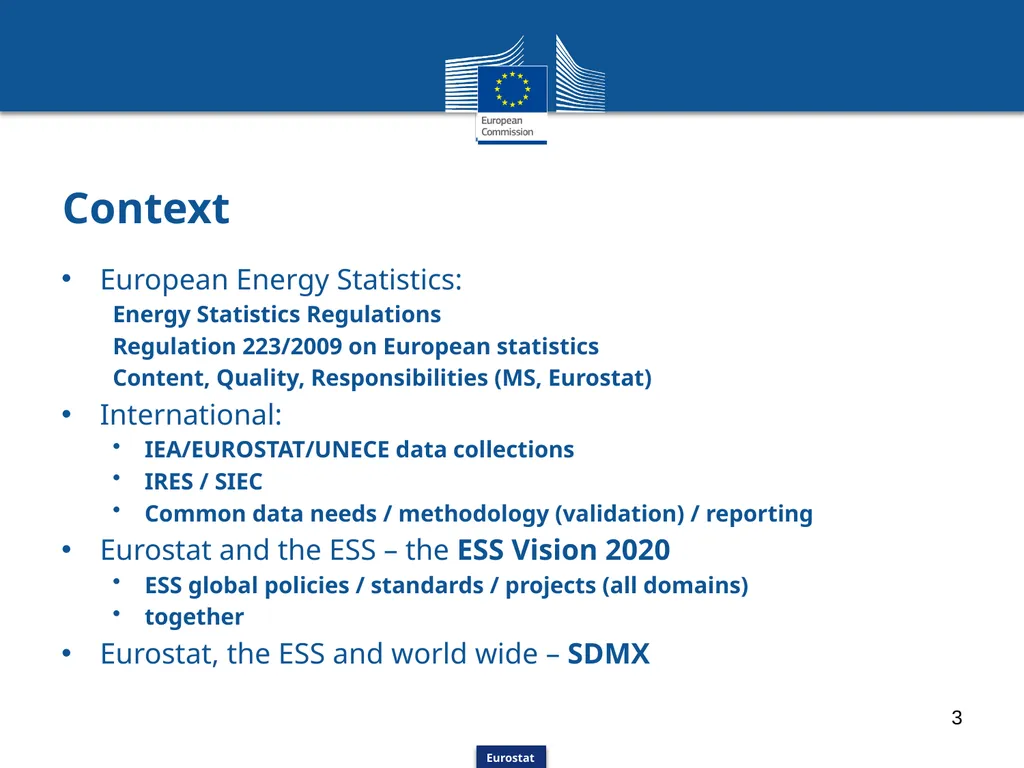
Context European Energy Statistics:
Energy Statistics Regulations
Regulation 223/2009 on European statistics
Content, Quality, Responsibilities (MS, Eurostat)
International:
IEA/EUROSTAT/UNECE data collections
IRES / SIEC
Common data needs / methodology (validation) / reporting
Eurostat and the ESS – the ESS Vision 2020
ESS global policies / standards / projects (all domains)
together
Eurostat, the ESS and world wide – SDMX 3<br>
04
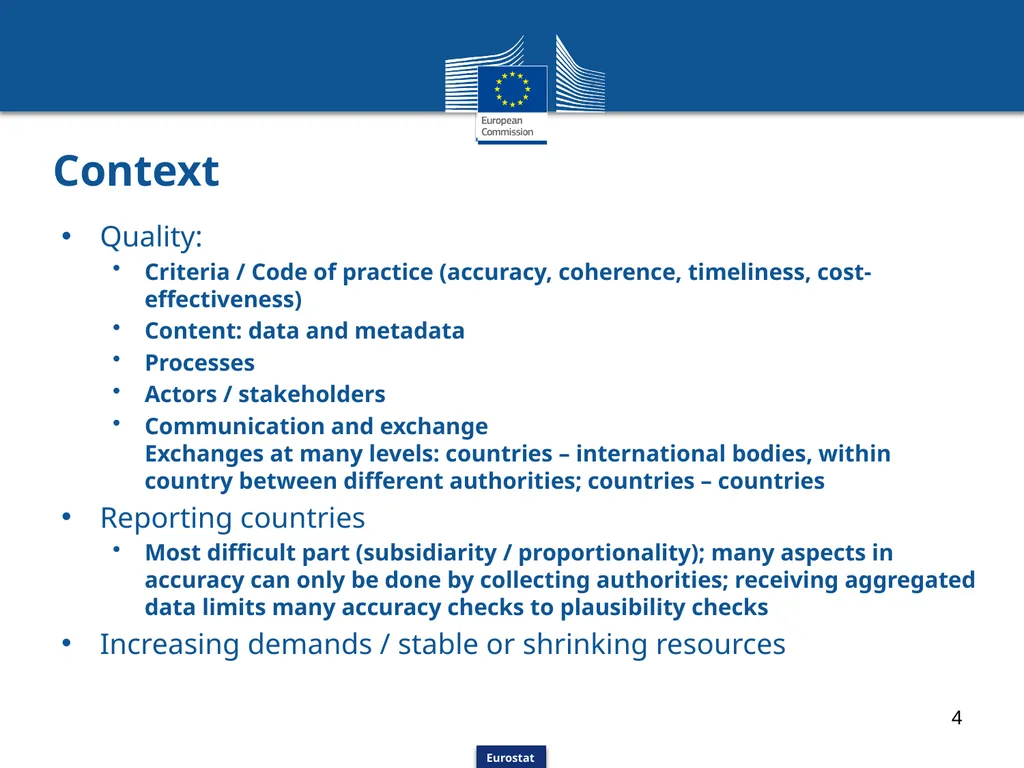
Context Quality:
Criteria / Code of practice (accuracy, coherence, timeliness, cost-effectiveness)
Content: data and metadata
Processes
Actors / stakeholders
Communication and exchange Exchanges at many levels: countries – international bodies, within country between different authorities; countries – countries
Reporting countries
Most difficult part (subsidiarity / proportionality); many aspects in accuracy can only be done by collecting authorities; receiving aggregated data limits many accuracy checks to plausibility checks
Increasing demands / stable or shrinking resources 4<br>
05
Context Quality, the role of:
Collaboration and mutual common understanding
Formalising knowledge (data, metadata and validation logic)
Who does what (formalising responsibilities)
Information processing (IT)
Facilitating exchange at collection, at dissemination (push/pull)
Standardisation 5<br>
Collaboration and mutual common understanding
Formalising knowledge (data, metadata and validation logic)
Who does what (formalising responsibilities)
Information processing (IT)
Facilitating exchange at collection, at dissemination (push/pull)
Standardisation 5<br>
06
Context 6 Standardisation:
content (data, code lists, definitions and other domain methodology)
methodology (validation typology and logic)
business processes (GSBPM)
generic outcomes (validation reports)
information system design, IT "technology"
within a domain / across domains (using/comparing data across several domains)
understanding and applying similar "standardised" approaches is especially useful for NSI and Eurostat working in many domains ("industrial statistical processing"; metadata driven generic IT processes)
Economics of scale<br>
07
Context 7 Eurostat / ESS global objectives for ESS shared validation and SDMX: increase
Effectiveness (result)
Efficiency (process)
Related projects to a higher quality at a lower cost:
less errors, more certainty and more timely outcomes
reduction in resources and elimination of redundant actions.
A few examples of targeted changes:
validation comprising rules which are formally adopted by all ESS stakeholders;
sharing the same understanding via standards and more formalised knowledge;
a more automatized validation process with clear responsibilities and avoiding multiple iterations (ping-pong)<br>
08
ESS shared validation The idea: collaborative approach of sharing validation between countries and Eurostat
in fact, is this principle so new?
Major objectives: increasing
transparency and clarity (shared and easily accessible documentation on validation procedures);
effectiveness of the validation (the appropriate rules by the responsible authority close at the source, awareness of all possible errors and warnings, avoiding validation gaps, avoiding double work)
efficiency (avoiding the number of iterations between sending – validating – requesting new sending)
efficiency in the information processing and communication (The lack of common standards for validation solutions leads to a duplication of IT development and integration costs in the ESS). 8<br>
09
ESS shared validation ESSC May 2016:
"agreement and documentation at Working Group level of validation rules and responsibilities" Mandatory!
"Use of shareable and reusable ESS services to validate data"
What does this imply
Common validation policy / methodology / typology validation levels
Validation responsibilities
Validation rules and severity
Improving inter-operability 9<br>
10
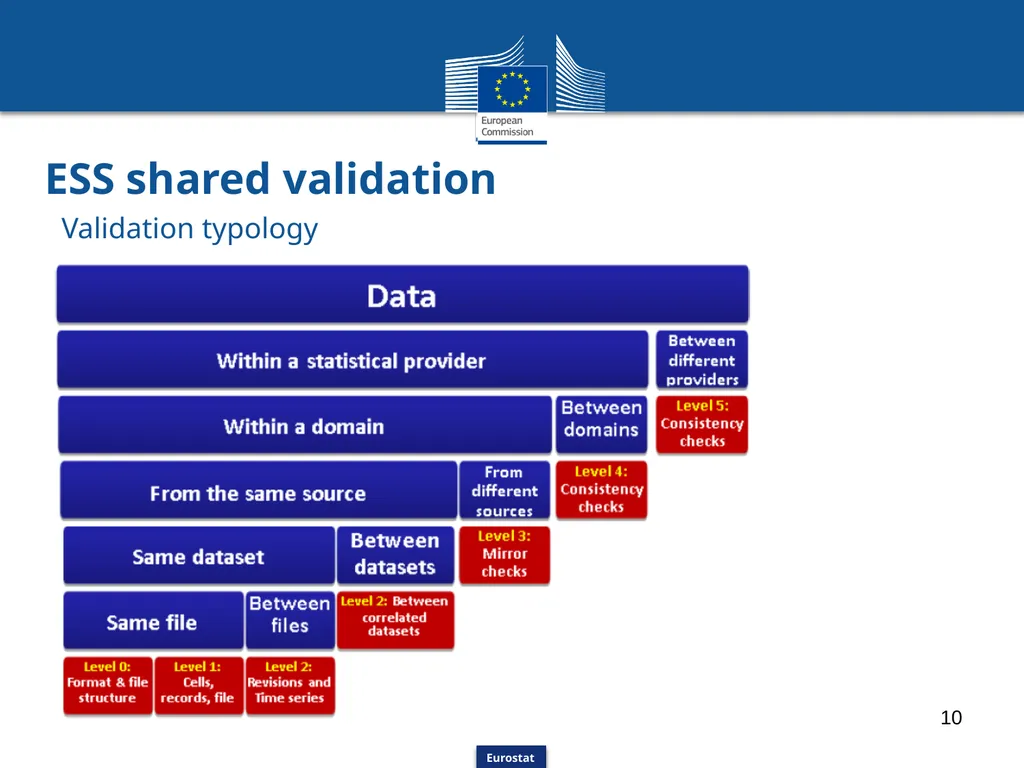
ESS shared validation Validation typology 10<br>
11
ESS shared validation How and who
Basic principles
Design data structures
Design validation rules (and severity level) A full description and agreement on the validation rules and their associated severity for each data collection
Validate data: 2 major steps/ actors (reporting country, Eurostat) An agreement on the responsibility of each national reporting organisation to perform the agreed validation rules before
Long term process / in steps / Taskforce 11<br>
12
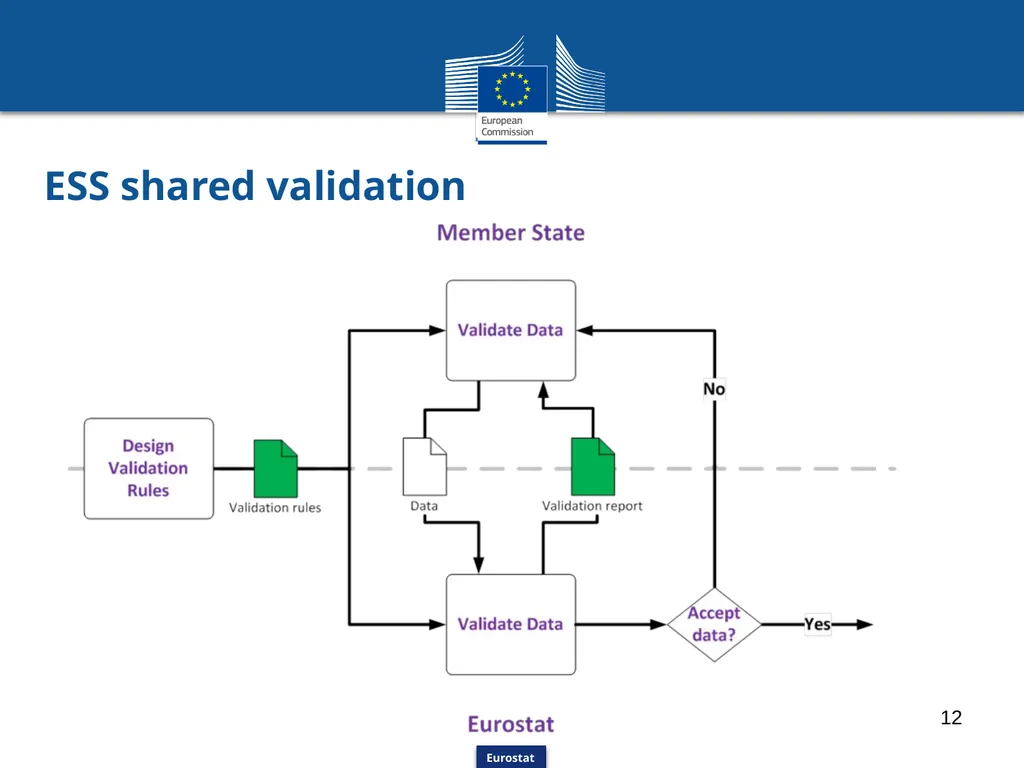
12 ESS shared validation<br>
13
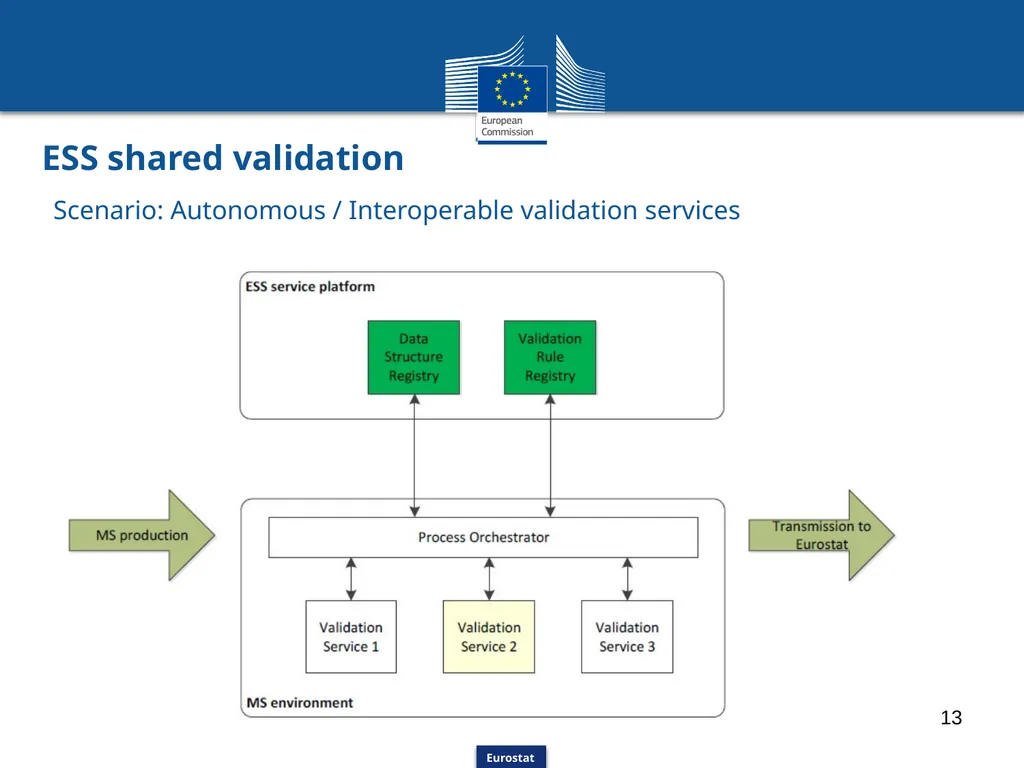
13 ESS shared validation Scenario: Autonomous / Interoperable validation services<br>
14
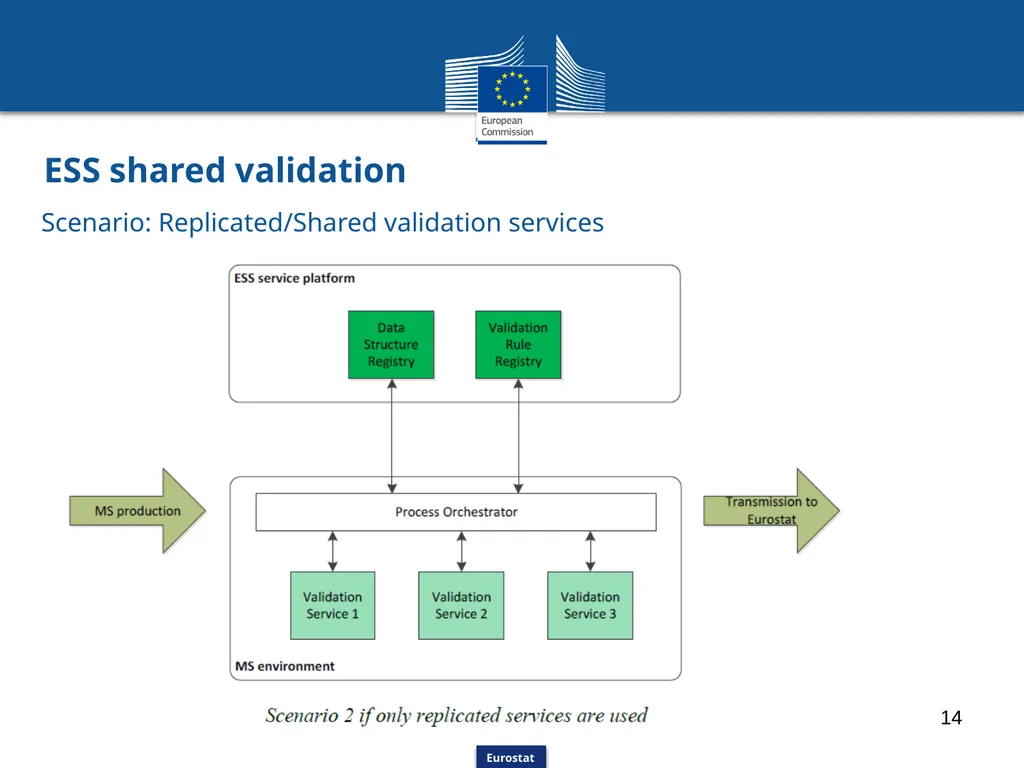
14 ESS shared validation Scenario: Replicated/Shared validation services<br>
15
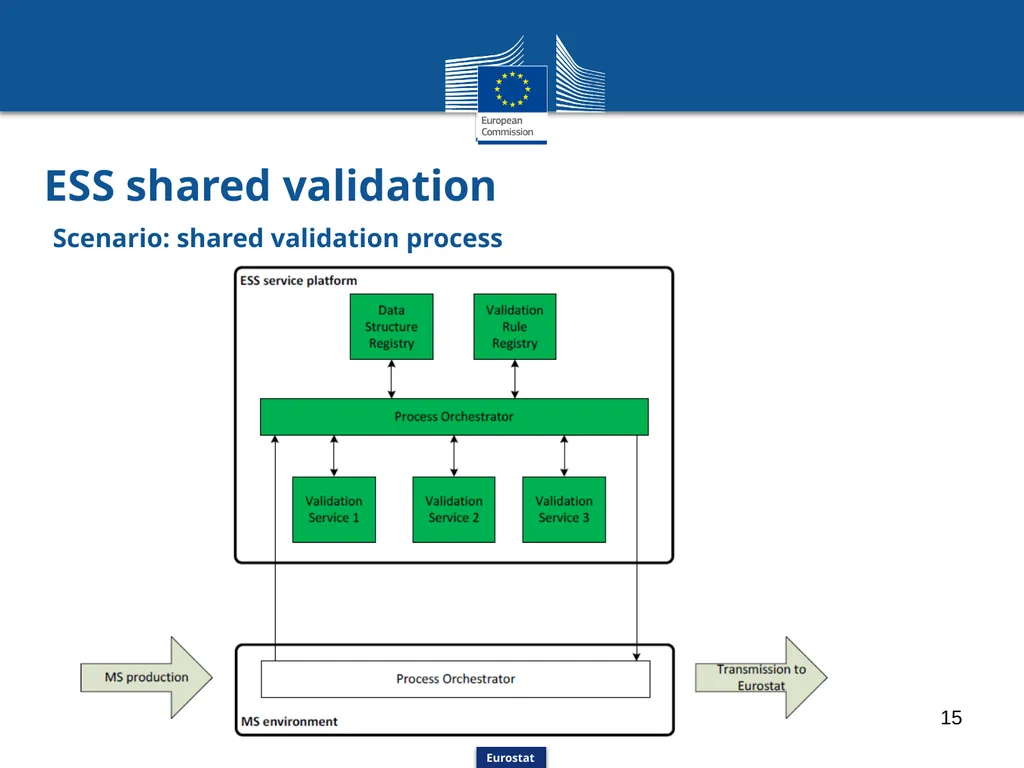
15 ESS shared validation Scenario: shared validation process<br>
16
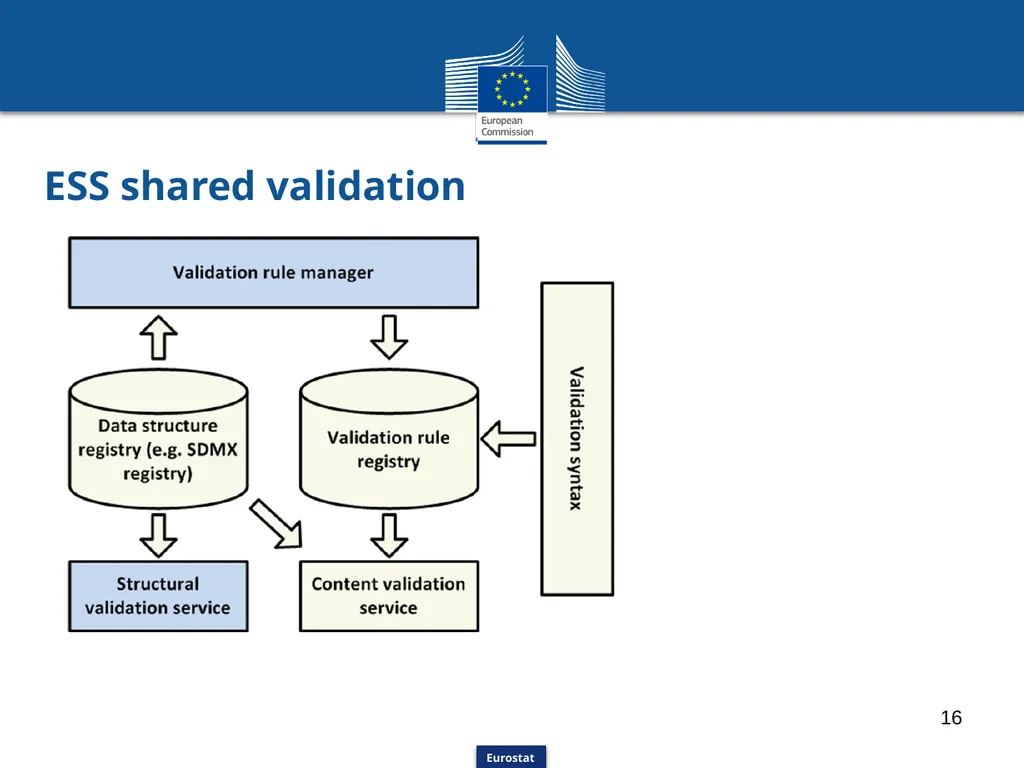
16 ESS shared validation<br>
17
SDMX Statistical data and metadata exchange
SDMX – adopted and used more and more in ESS
Organisational context and logistics
Developments for energy statistics (Supply – transformation – consumption; Electricity and gas prices) 17<br>
SDMX – adopted and used more and more in ESS
Organisational context and logistics
Developments for energy statistics (Supply – transformation – consumption; Electricity and gas prices) 17<br>
18
SDMX Common open standards for data and metadata
accepted worldwide for exchanging and sharing statistical information
and as a general basis for statistical infrastructures.
Started in 2001 by seven international organisations (BIS, ECB, Eurostat, IMF, OECD, UN and World Bank)
ISO standard (ISO 17369:2013)
SDMX Roadmap 2020 (March 2016):
Strengthening implementation of SDMX
Making data usage easier via SDMX
Using SDMX to modernise statistical processes
Better communication and capacity-building (including interaction with ESS Vision 2020 and UNECE modernisation of official statistics) 18<br>
19
SDMX Promoted by the European Statistical System Policy and big enabler for the ESS VISION 2020
reduce data errors
improve timeliness
improve accessibility
improve interpretability
improve coherence
reduce the reporting burden
reduce IT development and maintenance costs (with open source approach, shared toolbox and improved interpretability).
For future IT development: standards independent of domain specific structures
"If each partner system were to use SDMX data structures and common IT building blocks, international information systems would be able to communicate ‘machine-to-machine’ as in industrial production processes."
ESSC: SDMX one of the non-legislative normative documents to be recognised as ESS standards 19<br>
20
SDMX Use of SDMX in Eurostat – ESS statistical domains
40% of European statistical production processes are now describing their data structures using the SDMX standards and concepts.
ESS: 26 SDMX implementation projects, related to about ⅖ (38%) of all the data sets that Eurostat receives through EDAMIS
Further increase: 2016: +10; 2017: +4
GLOBAL DSD: 5
https://webgate.ec.europa.eu/fpfis/mwikis/sdmx/index.php/SDMX_DSD_availability 20<br>
21
SDMX statistical content and the information processing (IT) perspectives
Standards on logical and technical level:
"Content"
"Container"
Development of SDMX artefacts according SDMX methodology, guidelines and concepts
For example information model, content oriented guidelines, cross-domain concepts
Use of SDMX objects by generic programs/services
"Embed logic in data objects" 21<br>
22
SDMX Organisation and logistics
International agreement <= SDMX secretariat
Support and management by SDMX IT architecture and tools for example a central repository (Euro SDMX registry)
Maintenance responsibility by a selected international agency 22<br>
International agreement <= SDMX secretariat
Support and management by SDMX IT architecture and tools for example a central repository (Euro SDMX registry)
Maintenance responsibility by a selected international agency 22<br>
23
SDMX For Energy Statistics:
Supply-consumption chain => "semi-global" DSD development with IEA
Firstly collection/validation/production process Afterwards dissemination
Eurostat DSD on Prices
Firstly DSD (data structure definition) Afterwards MSD (metadata structure definition)
Still later: use of VTL (Validation and Transformation Language) 23<br>
24
DSD Energy statistics Supply-Consumption chain:
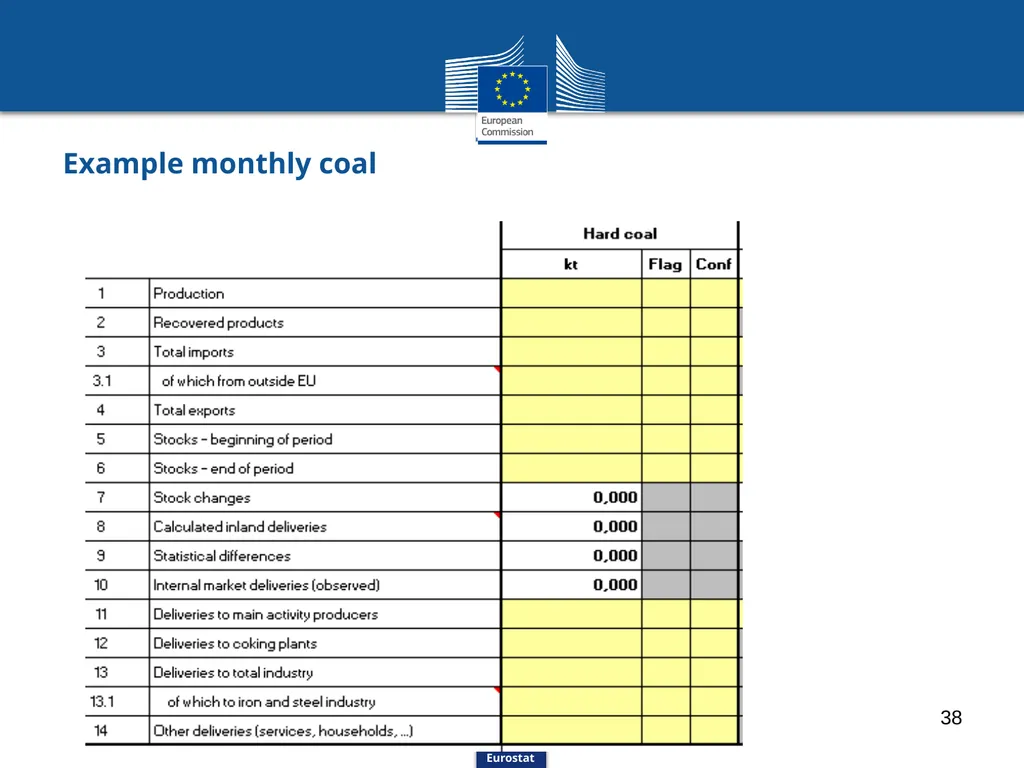
Joint annual data collections (JAQ) of IEA-Eurostat-UNECE; monthly data collections (joint, IEA, Eurostat)
IRES and SIEC
International / Standards / Classification(s)
SDMX guidelines:
MODELLING A STATISTICAL DMAIN FOR DATA EXCHANGE IN SDMX https://sdmx.org/wp-content/uploads/Modelling-domain-SDMX-discussion-paper-v1-201503.pdf
THE DESIGN OF DATA STRUCTURE DEFINITIONS https://sdmx.org/wp-content/uploads/SDMX_Guidelines_for_DSDs_1.0.pdf
THE CREATION AND MANAGEMENT OF SDMX CODE LISTS http://sdmx.org/wp-content/uploads/SDMX_Guidelines_for_CDCL.doc 24<br>
25
DSD Energy statistics Joint development Eurostat - IEA
IEA had done work in 2009-2012
Eurostat proposed IEA in May 2015 to take up together DSD development
Series of video conferences / mail exchanges since October 2015
Explanatory document + Inventory code lists
Testing DSD mapping with some questionnaires on-going
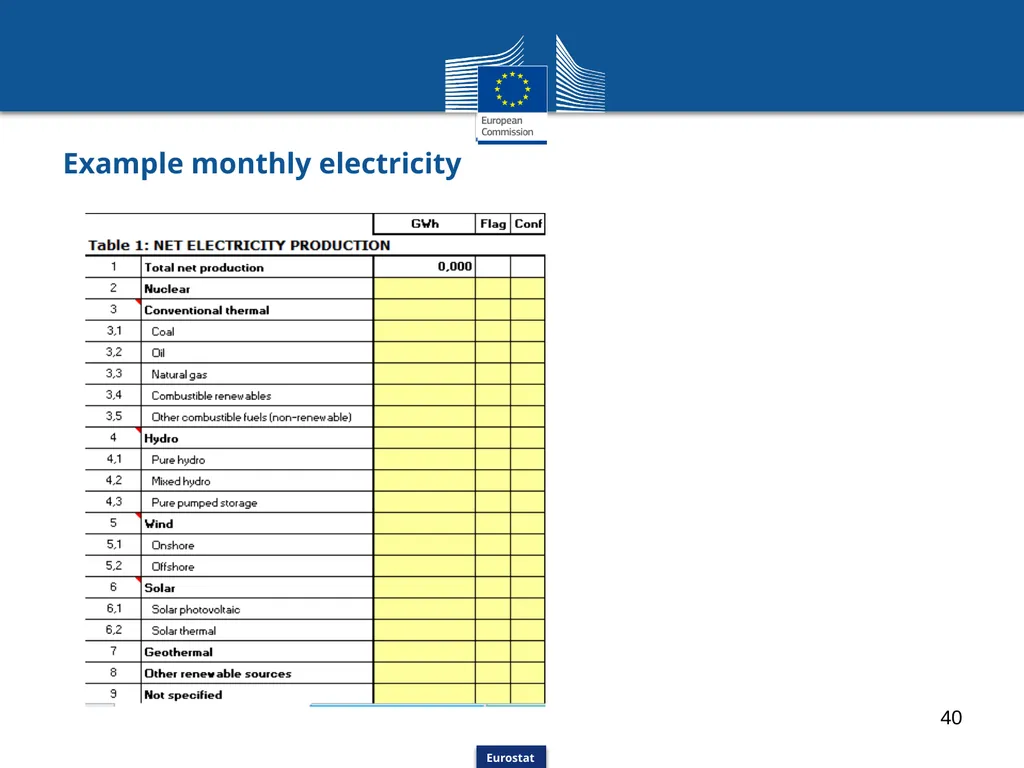
Gradual verification/update (revised monthly coal, new monthly electricity, revised JAQ 2017) 25<br>
26
DSD Energy statistics Concepts in the energy domain
Definition (concept code name and description)
Role (dimension, primary measure, attribute)
Level (attribute relevant at observation, series or dataset level)
usage status (mandatory or conditional/optional attributes)
code list / format 26<br>
Definition (concept code name and description)
Role (dimension, primary measure, attribute)
Level (attribute relevant at observation, series or dataset level)
usage status (mandatory or conditional/optional attributes)
code list / format 26<br>
27
DSD Energy statistics Dimensions / structural principles (SDMX guidelines)
Parsimony: no redundant dimensions for identifying
Simplicity: keep identifiers short / keep number of dimensions low
Purity: dimensions relate to one pure concept, not to a combination
Density and sparseness ("not available" values in the dimension combinations)
Unambiguousness (avoid one observation to be expressed by multiple combinations of dimension values (keys))
Exhaustiveness (includes every piece of information that is required to unambiguously represent a data point and to correctly interpret it outside its usual context) 27<br>
28
DSD Energy statistics Orthogonality:
independence of the meaning of a value of one dimension from the values of any other dimensions
User friendliness (While a simple DSD consisting of a few dimensions only may be easier to understand by a human data consumer, a more complex, but purer DSD is typically more flexible in terms of further usage in automated processes.)
Fitness for use throughout the entire statistical business process
Re-use concepts / code lists (frequency, observation status)
Extensible for potential future needs 28<br>
29
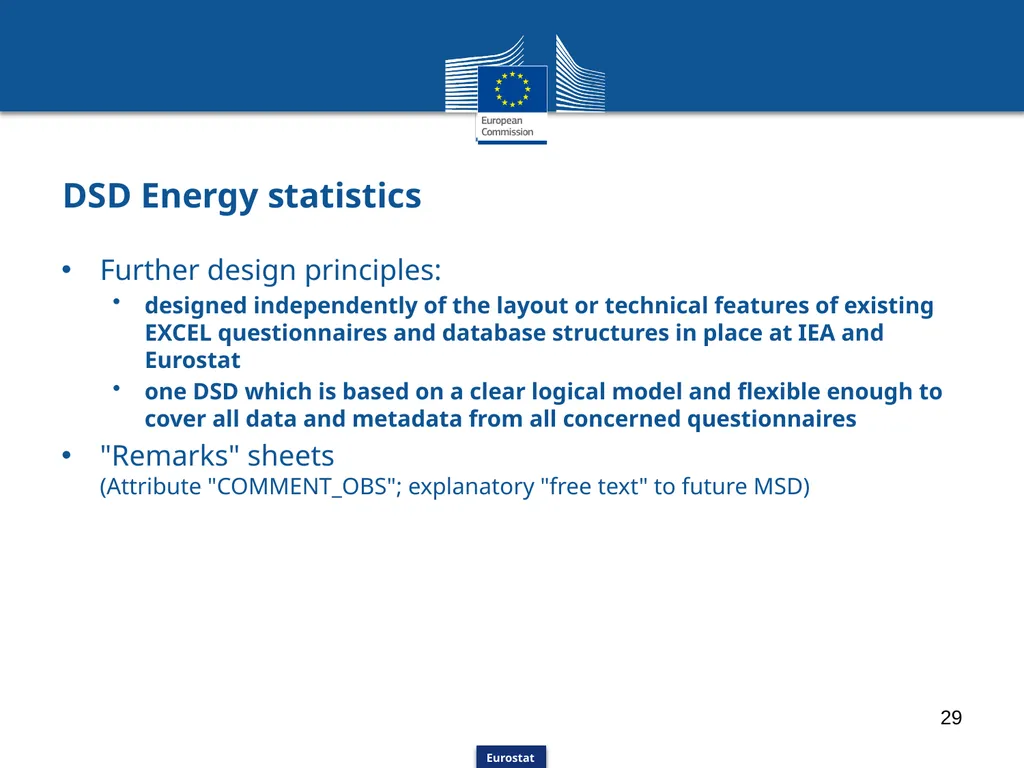
DSD Energy statistics Further design principles:
designed independently of the layout or technical features of existing EXCEL questionnaires and database structures in place at IEA and Eurostat
one DSD which is based on a clear logical model and flexible enough to cover all data and metadata from all concerned questionnaires
"Remarks" sheets (Attribute "COMMENT_OBS"; explanatory "free text" to future MSD) 29<br>
30
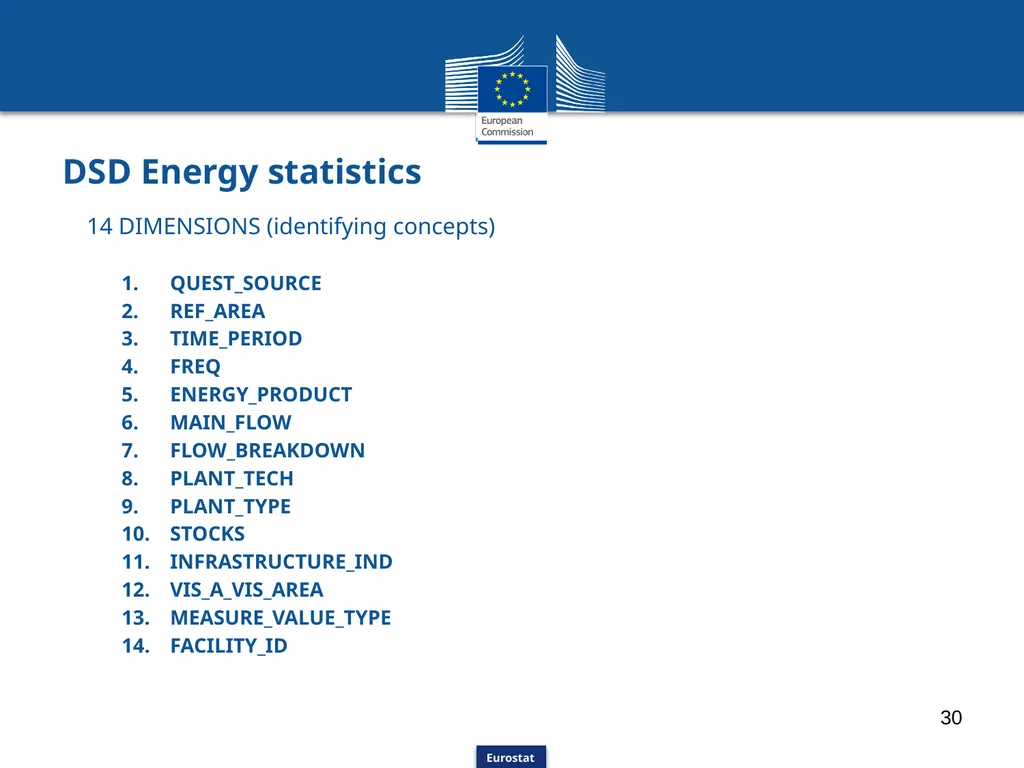
DSD Energy statistics 14 DIMENSIONS (identifying concepts)
QUEST_SOURCE
REF_AREA
TIME_PERIOD
FREQ
ENERGY_PRODUCT
MAIN_FLOW
FLOW_BREAKDOWN
PLANT_TECH
PLANT_TYPE
STOCKS
INFRASTRUCTURE_IND
VIS_A_VIS_AREA
MEASURE_VALUE_TYPE
FACILITY_ID 30<br>
QUEST_SOURCE
REF_AREA
TIME_PERIOD
FREQ
ENERGY_PRODUCT
MAIN_FLOW
FLOW_BREAKDOWN
PLANT_TECH
PLANT_TYPE
STOCKS
INFRASTRUCTURE_IND
VIS_A_VIS_AREA
MEASURE_VALUE_TYPE
FACILITY_ID 30<br>
31
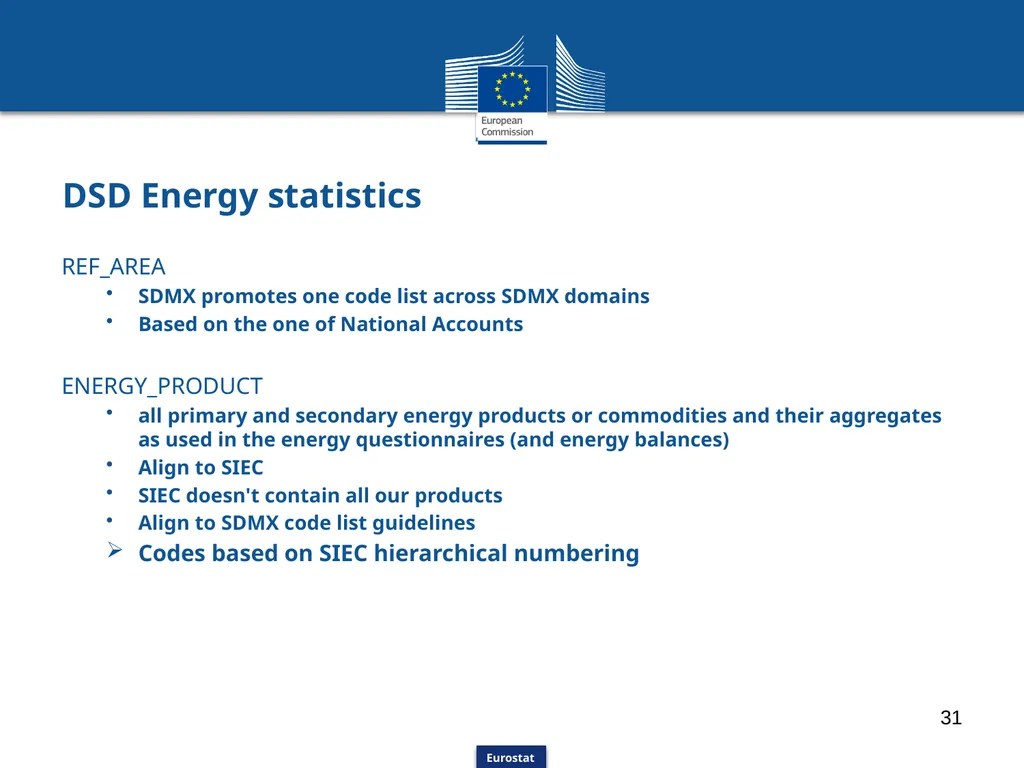
DSD Energy statistics REF_AREA
SDMX promotes one code list across SDMX domains
Based on the one of National Accounts
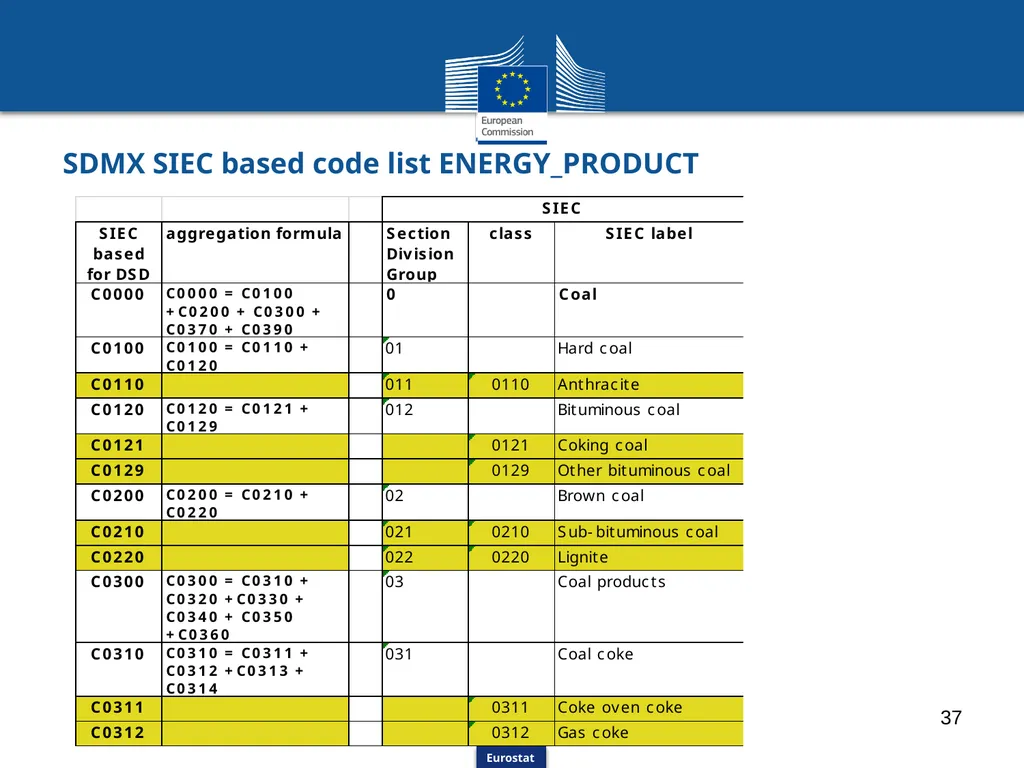
ENERGY_PRODUCT
all primary and secondary energy products or commodities and their aggregates as used in the energy questionnaires (and energy balances)
Align to SIEC
SIEC doesn't contain all our products
Align to SDMX code list guidelines
Codes based on SIEC hierarchical numbering 31<br>
32
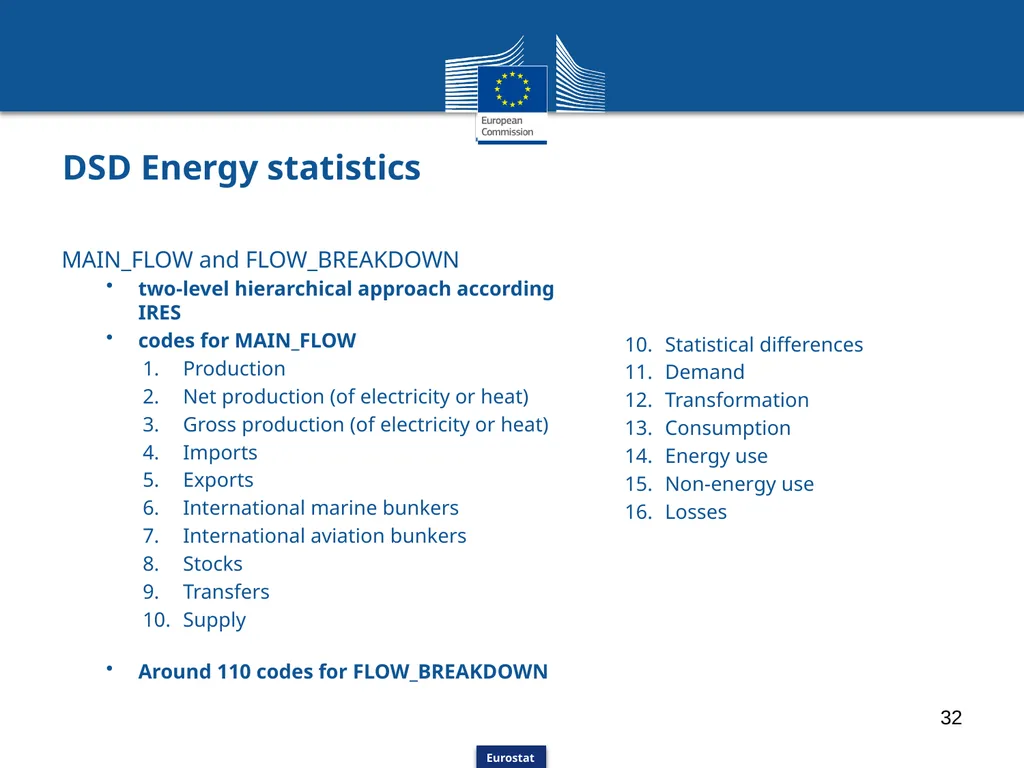
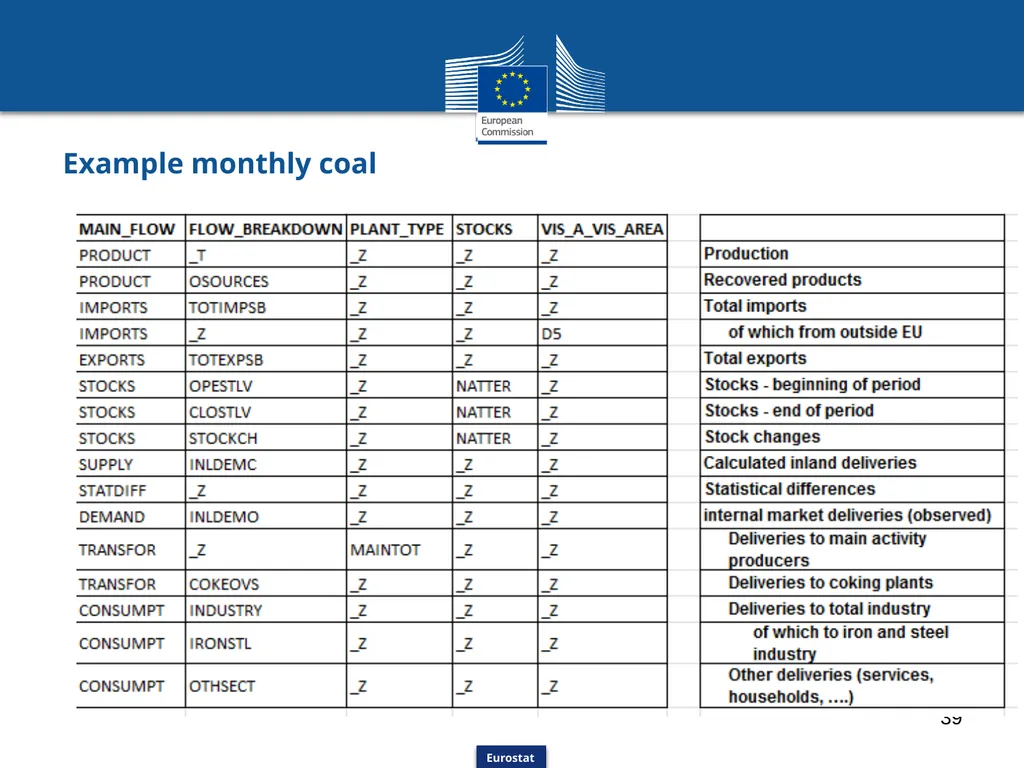
DSD Energy statistics MAIN_FLOW and FLOW_BREAKDOWN
two-level hierarchical approach according IRES
codes for MAIN_FLOW
Production
Net production (of electricity or heat)
Gross production (of electricity or heat)
Imports
Exports
International marine bunkers
International aviation bunkers
Stocks
Transfers
Supply
Around 110 codes for FLOW_BREAKDOWN 32 Statistical differences
Demand
Transformation
Consumption
Energy use
Non-energy use
Losses<br>
33
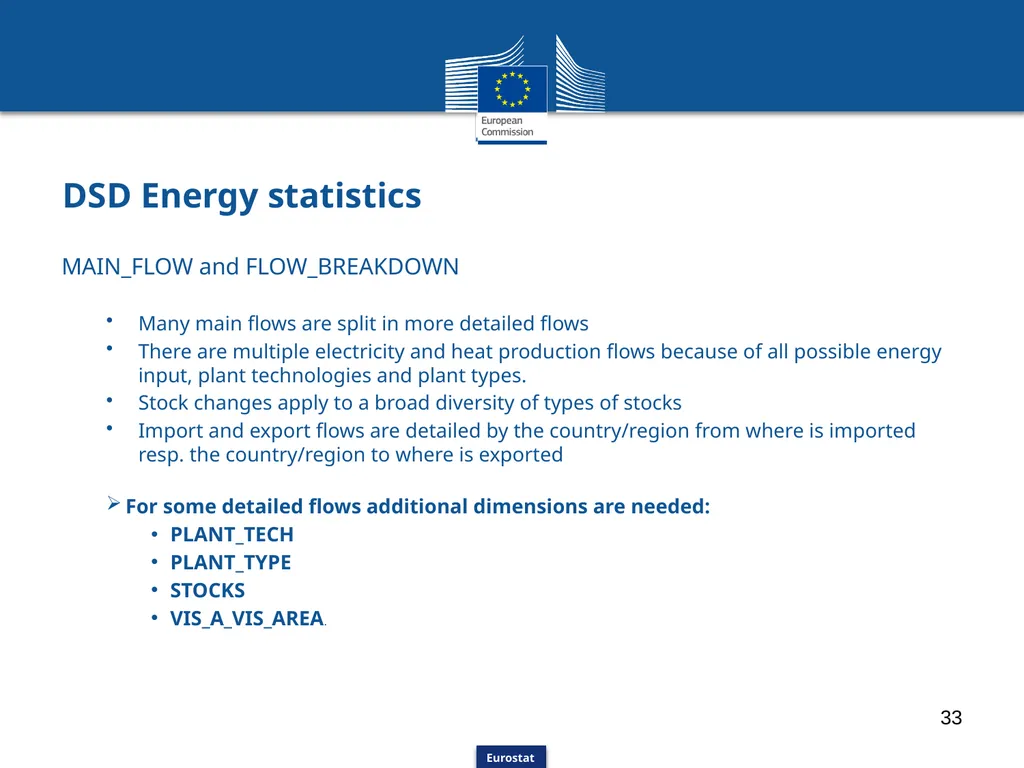
DSD Energy statistics MAIN_FLOW and FLOW_BREAKDOWN
Many main flows are split in more detailed flows
There are multiple electricity and heat production flows because of all possible energy input, plant technologies and plant types.
Stock changes apply to a broad diversity of types of stocks
Import and export flows are detailed by the country/region from where is imported resp. the country/region to where is exported
For some detailed flows additional dimensions are needed:
PLANT_TECH
PLANT_TYPE
STOCKS
VIS_A_VIS_AREA. 33<br>
34
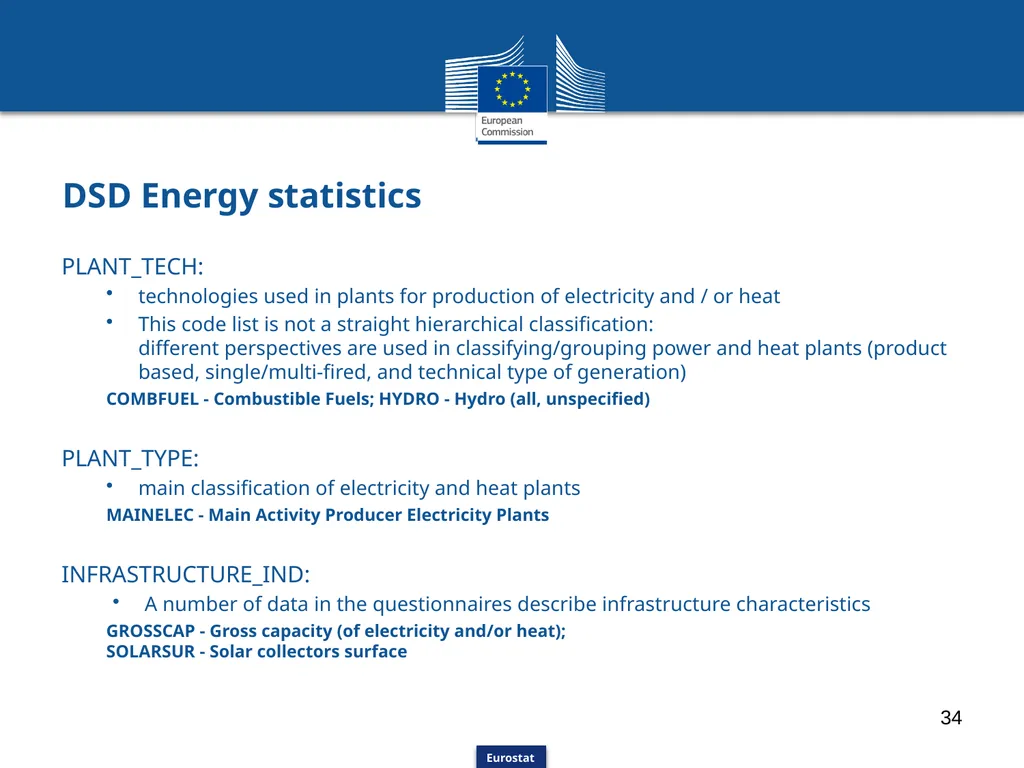
DSD Energy statistics PLANT_TECH:
technologies used in plants for production of electricity and / or heat
This code list is not a straight hierarchical classification: different perspectives are used in classifying/grouping power and heat plants (product based, single/multi-fired, and technical type of generation)
COMBFUEL - Combustible Fuels; HYDRO - Hydro (all, unspecified)
PLANT_TYPE:
main classification of electricity and heat plants
MAINELEC - Main Activity Producer Electricity Plants
INFRASTRUCTURE_IND:
A number of data in the questionnaires describe infrastructure characteristics
GROSSCAP - Gross capacity (of electricity and/or heat); SOLARSUR - Solar collectors surface 34<br>
35
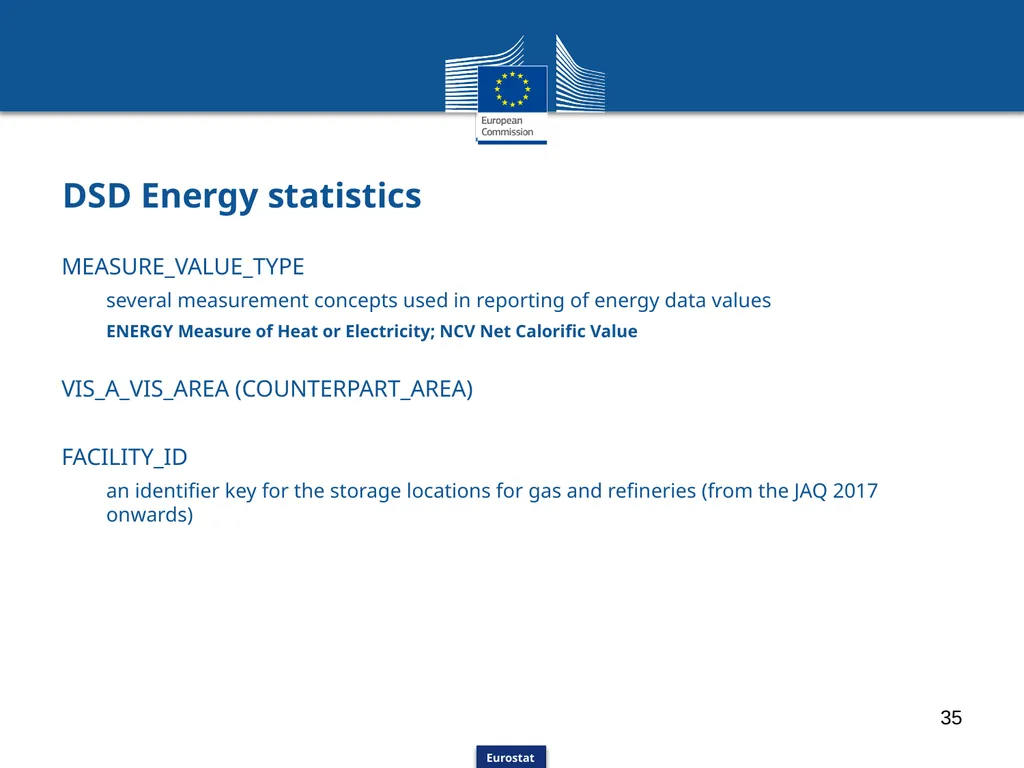
DSD Energy statistics MEASURE_VALUE_TYPE
several measurement concepts used in reporting of energy data values
ENERGY Measure of Heat or Electricity; NCV Net Calorific Value
VIS_A_VIS_AREA (COUNTERPART_AREA)
FACILITY_ID
an identifier key for the storage locations for gas and refineries (from the JAQ 2017 onwards) 35<br>
several measurement concepts used in reporting of energy data values
ENERGY Measure of Heat or Electricity; NCV Net Calorific Value
VIS_A_VIS_AREA (COUNTERPART_AREA)
FACILITY_ID
an identifier key for the storage locations for gas and refineries (from the JAQ 2017 onwards) 35<br>
36
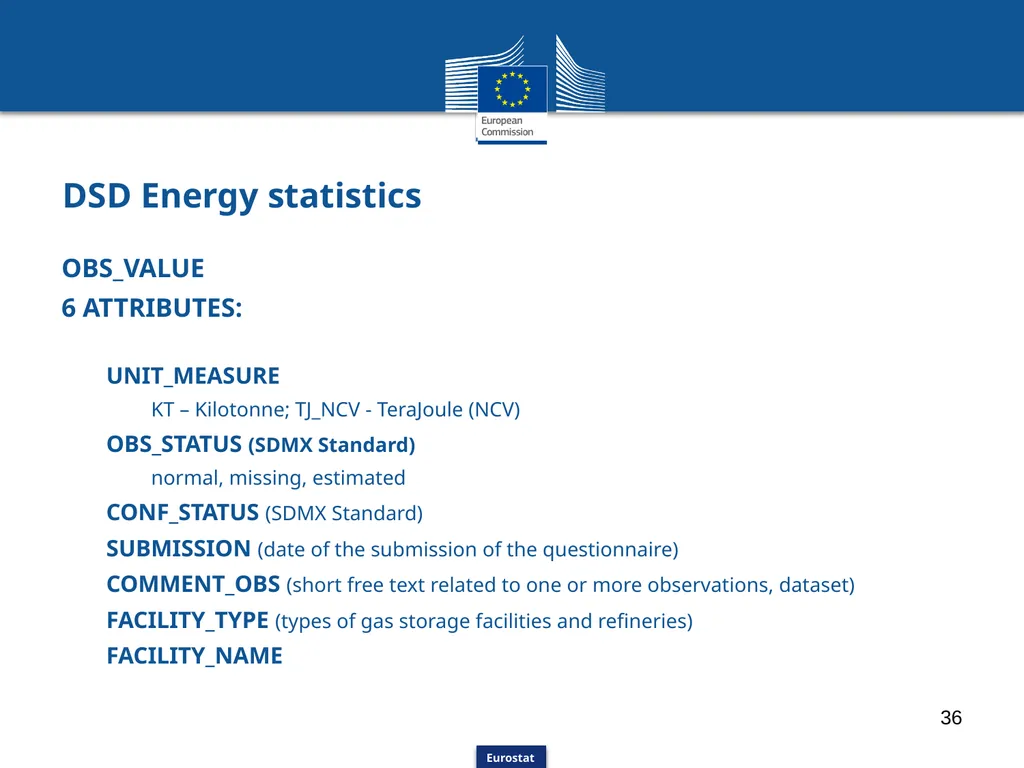
DSD Energy statistics OBS_VALUE
6 ATTRIBUTES:
UNIT_MEASURE
KT – Kilotonne; TJ_NCV - TeraJoule (NCV)
OBS_STATUS (SDMX Standard)
normal, missing, estimated
CONF_STATUS (SDMX Standard)
SUBMISSION (date of the submission of the questionnaire)
COMMENT_OBS (short free text related to one or more observations, dataset)
FACILITY_TYPE (types of gas storage facilities and refineries)
FACILITY_NAME 36<br>
37
SDMX SIEC based code list ENERGY_PRODUCT 37<br>
38
Example monthly coal 38<br>
39
Example monthly coal 39<br>
40
Example monthly electricity 40<br>
41
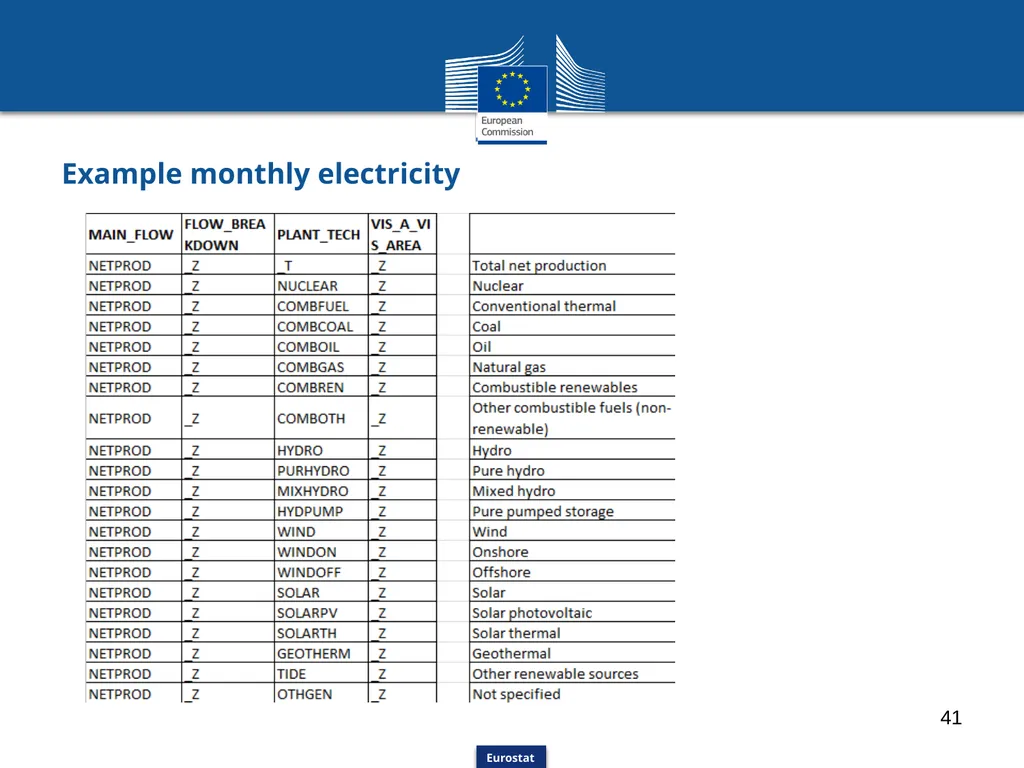
Example monthly electricity 41<br>
42
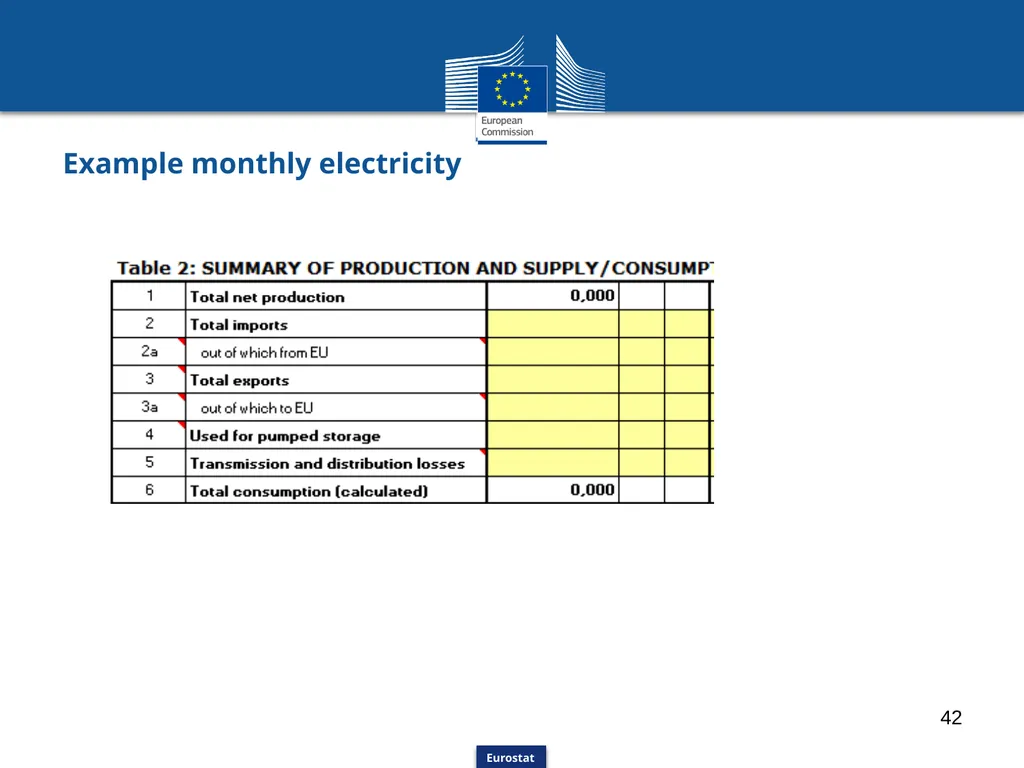
Example monthly electricity 42<br>
43
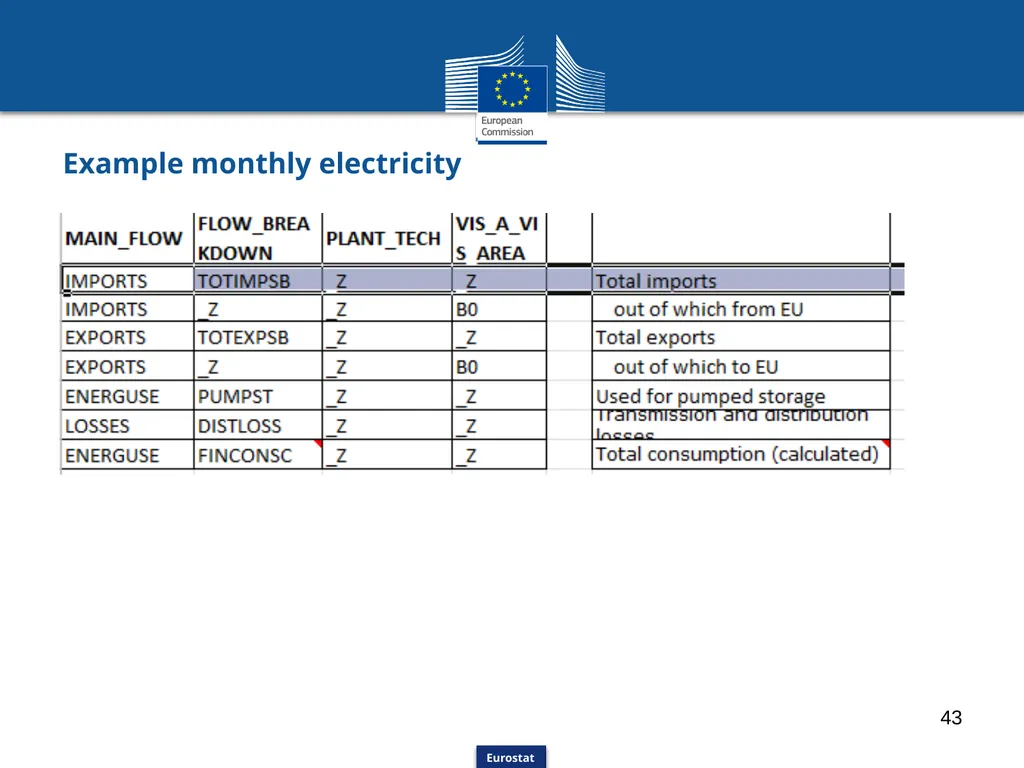
Example monthly electricity 43<br>
44
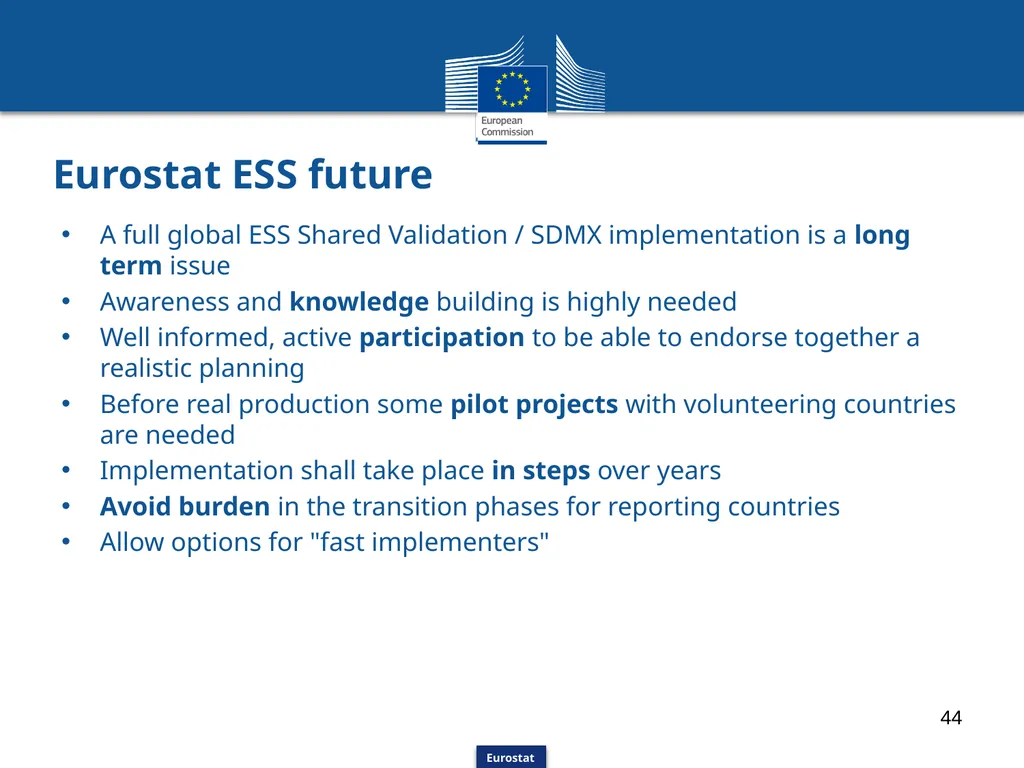
Eurostat ESS future 44 A full global ESS Shared Validation / SDMX implementation is a long term issue
Awareness and knowledge building is highly needed
Well informed, active participation to be able to endorse together a realistic planning
Before real production some pilot projects with volunteering countries are needed
Implementation shall take place in steps over years
Avoid burden in the transition phases for reporting countries
Allow options for "fast implementers"<br>
45
Eurostat ESS future 45 "ESWG Task Force on the implementation of ESS shared validation and SDMX "
the development and review of data structures definitions, code lists and other SDMX artefacts (including their validation and testing)
development and assessment of the implementation (including timeline for the implementation)
establishment of specific operational guidelines for the energy domain, including links to the ESS shared validation
prepare and advise on recommended actions and implementations for the ESWG meetings<br>
46
Bart.Denorre@ec.europa.eu 46<br>