
Our report in summary Prevention, population








Description: Our report in summary Prevention, population health and prosperity: a new era in devolution Exploring the priorities, opportunities and challenges in bringing together health and local government devolution Michael Wood, Head of Health
Related Topics
Download Presentation
"Our report in summary Prevention, population" is the property of its rightful owner. Permission is granted to download and print the materials on this website for personal, non-commercial use only, and to display it on your personal computer provided you do not modify the materials and that you retain all copyright notices contained in the materials. By downloading content from our website, you accept the terms of this agreement.
Presentation Transcript
slide1. Our report in summary
Prevention, population health and prosperity: a new era in devolution
Exploring the priorities, opportunities and challenges in bringing together health and local government devolution
Michael Wood, Head of Health Economic Partnerships
@NHSLocalGrowth<br>
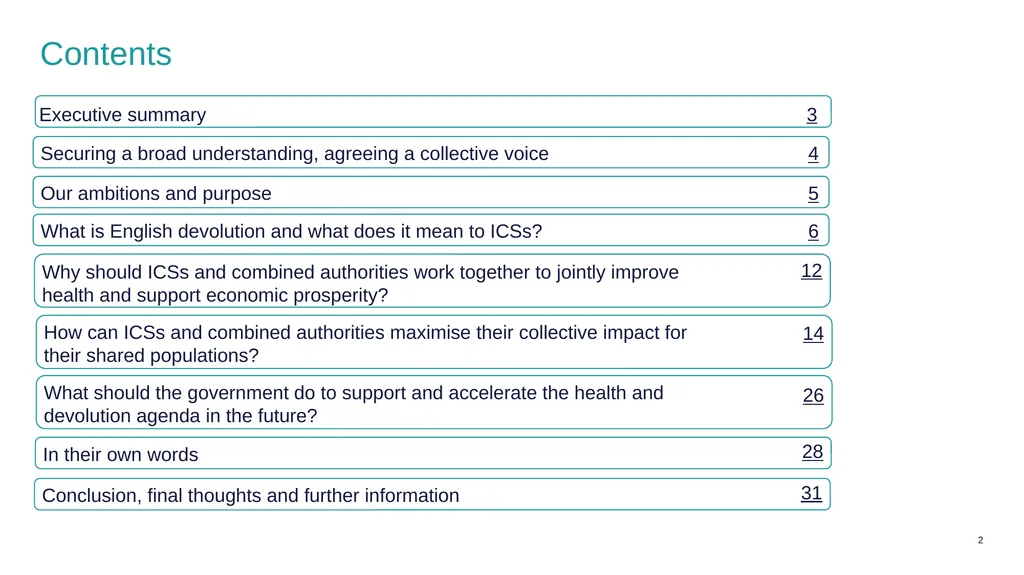
slide2. 2 Unlocking the NHS’s social and economic potential: creating a productive system Contents<br>
slide3. Prevention, population health and prosperity: a new era in devolution 3 Executive summary Key points
This report highlights the growing parallels between local government devolution and integrated care systems (ICSs), in terms of a genuine and shared interest in geography, place, role, purpose and outcomes. Devolution is already integral to many ICSs, with leaders now asking how they can deepen their work to best serve populations.
It is important leaders are able to visualise, comprehend and explain what closer, more effective integrated working could feel like for colleagues on the front line and what it would mean for local populations. This report articulates a new central vision for the shared future for health and devolution.
Local leaders will be required to implement this vision according to their own context and nuance. We believe making this new vision for health and devolution a reality will require a phased, three-stage approach, developed through coordinated local leadership and sustained national support.
These three steps include: focusing on people and the places where they live and work; supporting populations to improve their own health; and recognising that everything has an impact on health. For each step, the report sets out context, findings, national recommendations, local priorities and case studies.
Delivering on these steps will involve stretching what we can do within existing frameworks, duties and powers, before understanding what is needed to go further; increasing and resourcing local capacity and capability; focusing on community engagement and empowerment; understanding and using soft power and system working; and above all, consistently engaging and co-developing a future of shared thinking, projects and positions.
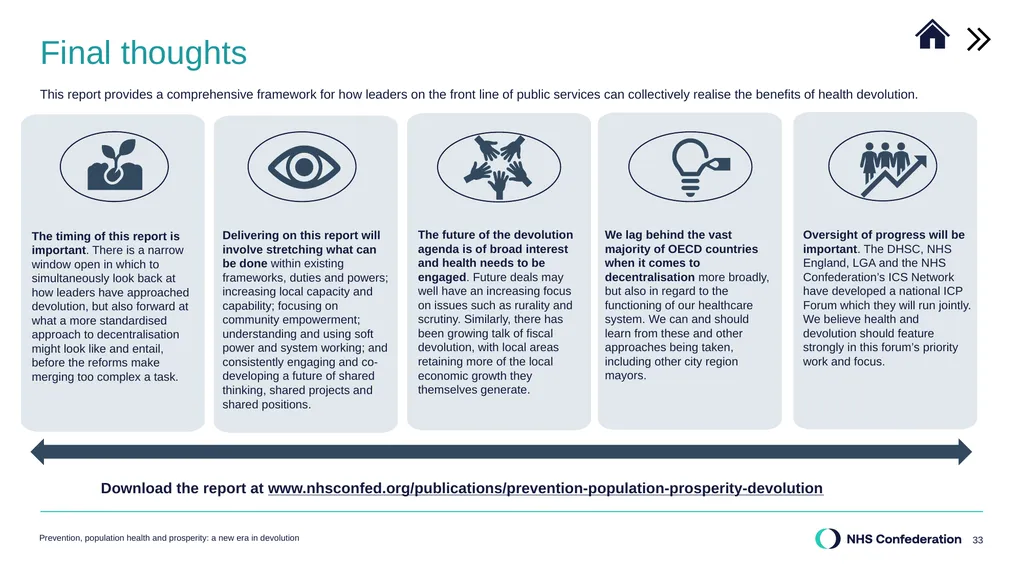
The timing of this report is important. There is a narrow window open in which to simultaneously look back and learn from past approaches to devolution, but also look forward at what a more standardised approach to decentralisation might look like, before various reforms make merging these areas too complex.<br>
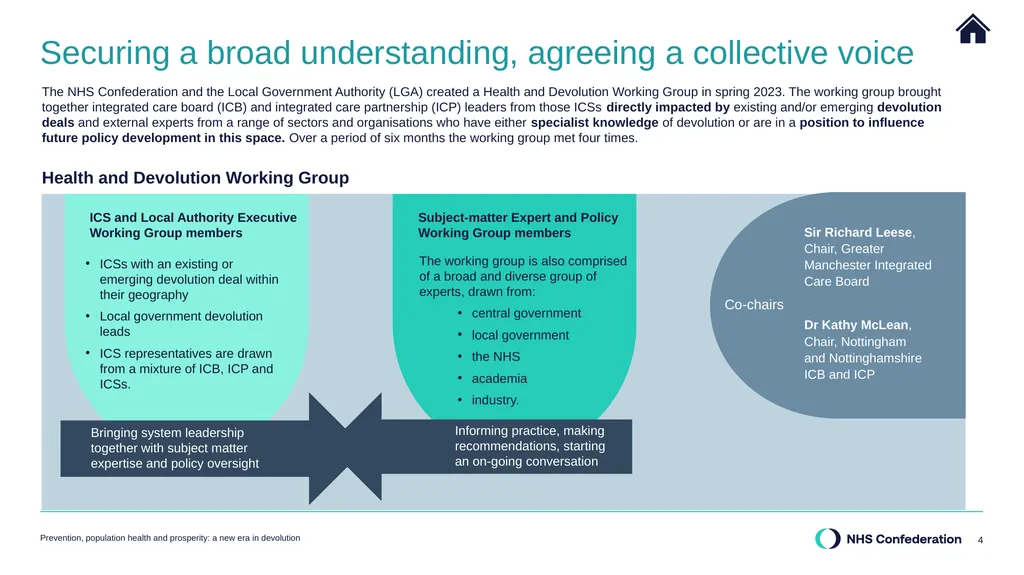
slide4. 4 The NHS Confederation and the Local Government Authority (LGA) created a Health and Devolution Working Group in spring 2023. The working group brought together integrated care board (ICB) and integrated care partnership (ICP) leaders from those ICSs directly impacted by existing and/or emerging devolution deals and external experts from a range of sectors and organisations who have either specialist knowledge of devolution or are in a position to influence future policy development in this space. Over a period of six months the working group met four times.
Health and Devolution Working Group Prevention, population health and prosperity: a new era in devolution Dr Kathy McLean, Chair, Nottingham and Nottinghamshire ICB and ICP Sir Richard Leese, Chair, Greater Manchester Integrated Care Board Co-chairs Securing a broad understanding, agreeing a collective voice<br>
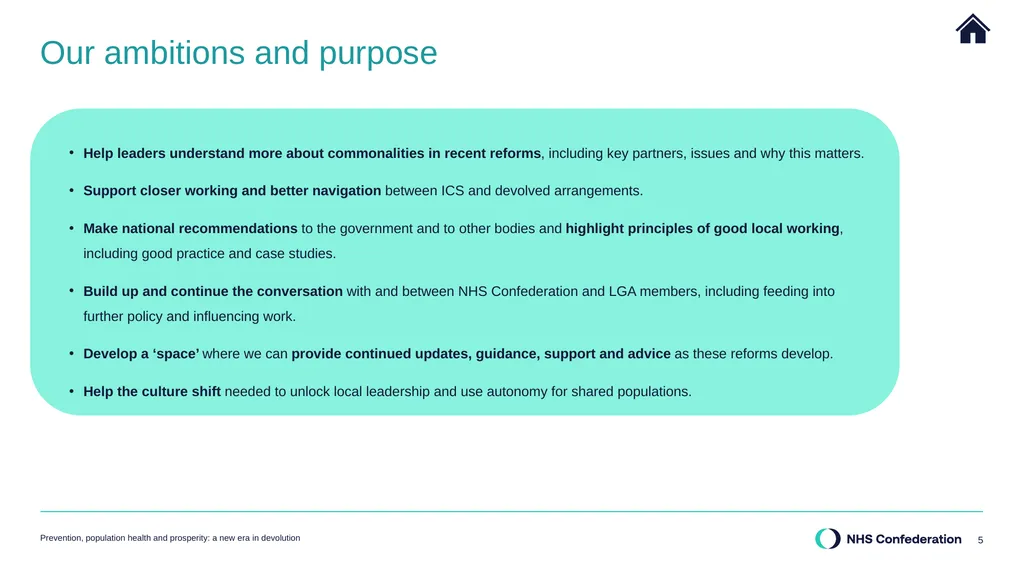
slide5. Our ambitions and purpose 5 Prevention, population health and prosperity: a new era in devolution<br>
slide6. What? What is English devolution and what does it mean for an ICS?<br>
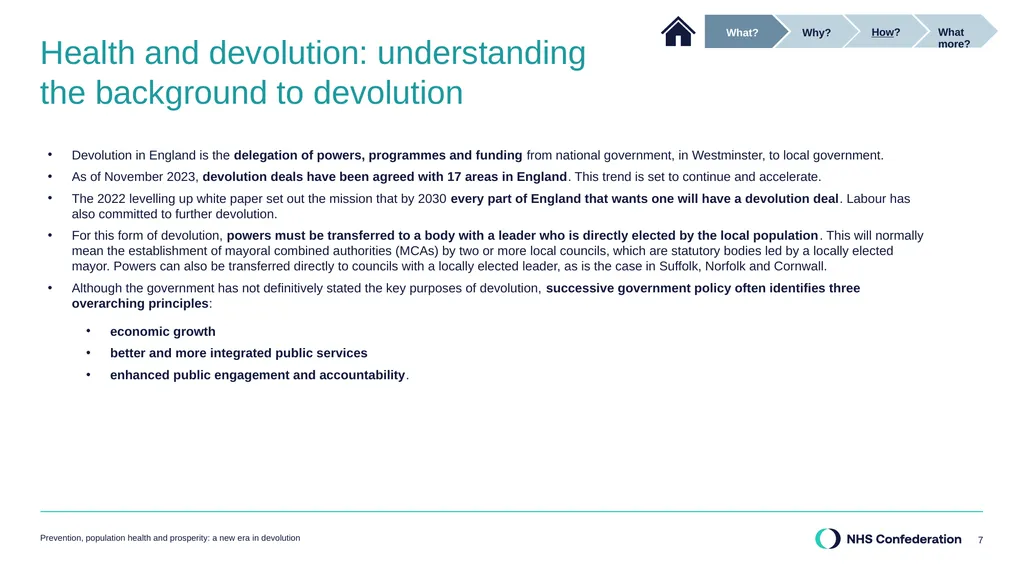
slide7. Health and devolution: understanding the background to devolution 7 Devolution in England is the delegation of powers, programmes and funding from national government, in Westminster, to local government.
As of November 2023, devolution deals have been agreed with 17 areas in England. This trend is set to continue and accelerate.
The 2022 levelling up white paper set out the mission that by 2030 every part of England that wants one will have a devolution deal. Labour has also committed to further devolution.
For this form of devolution, powers must be transferred to a body with a leader who is directly elected by the local population. This will normally mean the establishment of mayoral combined authorities (MCAs) by two or more local councils, which are statutory bodies led by a locally elected mayor. Powers can also be transferred directly to councils with a locally elected leader, as is the case in Suffolk, Norfolk and Cornwall.
Although the government has not definitively stated the key purposes of devolution, successive government policy often identifies three overarching principles:
economic growth
better and more integrated public services
enhanced public engagement and accountability. Prevention, population health and prosperity: a new era in devolution<br>
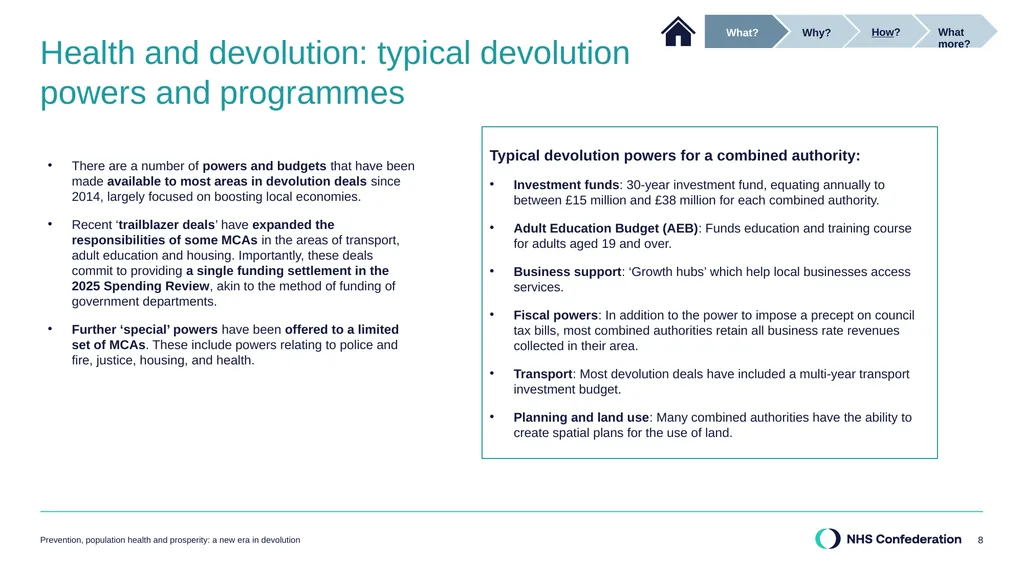
slide8. Health and devolution: typical devolution powers and programmes 8 There are a number of powers and budgets that have been made available to most areas in devolution deals since 2014, largely focused on boosting local economies.
Recent ‘trailblazer deals’ have expanded the responsibilities of some MCAs in the areas of transport, adult education and housing. Importantly, these deals commit to providing a single funding settlement in the 2025 Spending Review, akin to the method of funding of government departments.
Further ‘special’ powers have been offered to a limited set of MCAs. These include powers relating to police and fire, justice, housing, and health. Typical devolution powers for a combined authority:
Investment funds: 30-year investment fund, equating annually to between £15 million and £38 million for each combined authority.
Adult Education Budget (AEB): Funds education and training course for adults aged 19 and over.
Business support: ‘Growth hubs’ which help local businesses access services.
Fiscal powers: In addition to the power to impose a precept on council tax bills, most combined authorities retain all business rate revenues collected in their area.
Transport: Most devolution deals have included a multi-year transport investment budget.
Planning and land use: Many combined authorities have the ability to create spatial plans for the use of land. Prevention, population health and prosperity: a new era in devolution<br>
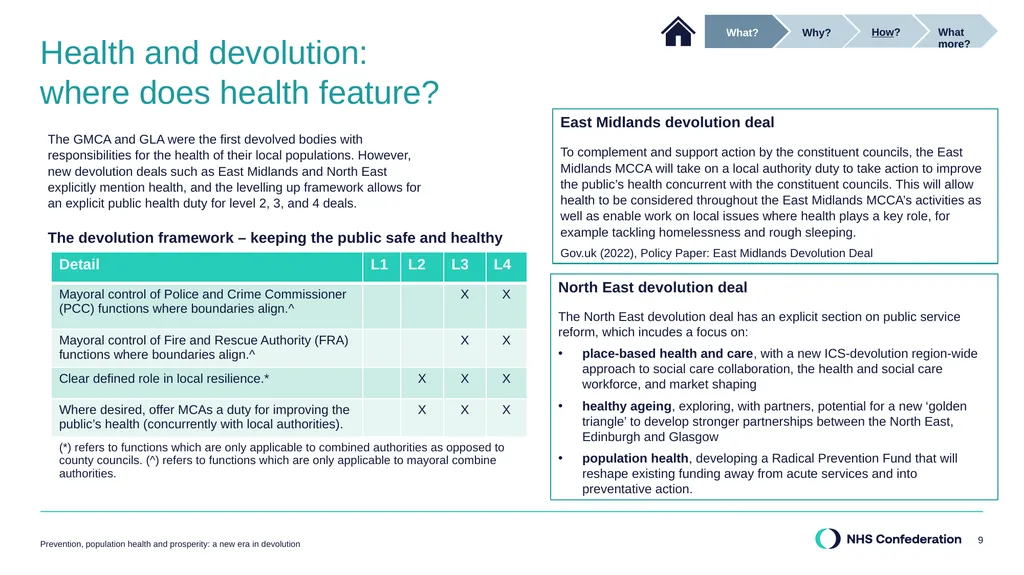
slide9. Health and devolution: where does health feature? 9 The GMCA and GLA were the first devolved bodies with responsibilities for the health of their local populations. However, new devolution deals such as East Midlands and North East explicitly mention health, and the levelling up framework allows for an explicit public health duty for level 2, 3, and 4 deals. North East devolution deal
The North East devolution deal has an explicit section on public service reform, which incudes a focus on:
place-based health and care, with a new ICS-devolution region-wide approach to social care collaboration, the health and social care workforce, and market shaping
healthy ageing, exploring, with partners, potential for a new ‘golden triangle’ to develop stronger partnerships between the North East, Edinburgh and Glasgow
population health, developing a Radical Prevention Fund that will reshape existing funding away from acute services and into preventative action. East Midlands devolution deal
To complement and support action by the constituent councils, the East Midlands MCCA will take on a local authority duty to take action to improve the public’s health concurrent with the constituent councils. This will allow health to be considered throughout the East Midlands MCCA’s activities as well as enable work on local issues where health plays a key role, for example tackling homelessness and rough sleeping.
Gov.uk (2022), Policy Paper: East Midlands Devolution Deal Prevention, population health and prosperity: a new era in devolution The devolution framework – keeping the public safe and healthy<br>
slide10. English sub-national governance: an ever-changing patchwork 10 Prevention, population health and prosperity: a new era in devolution<br>
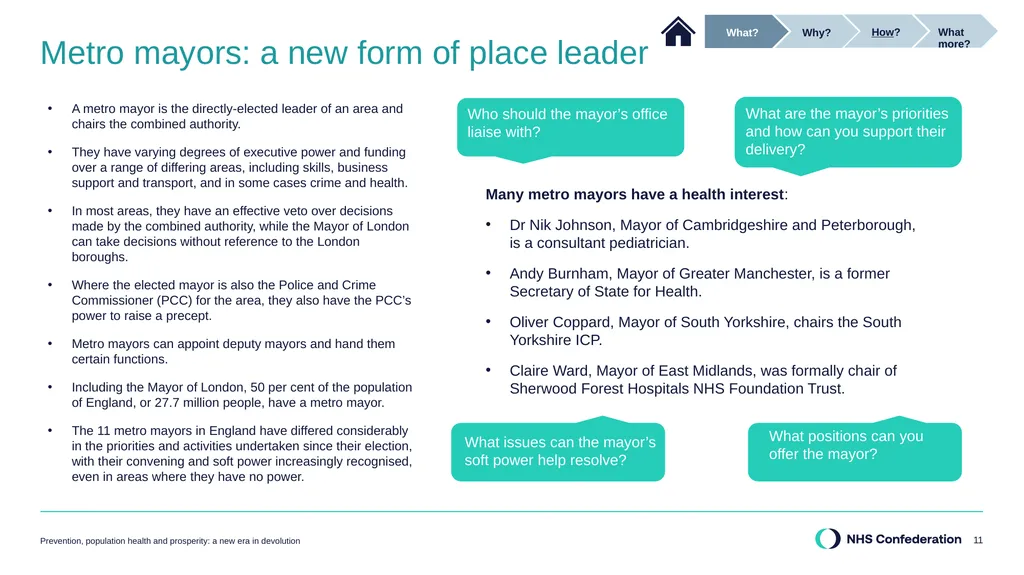
slide11. Metro mayors: a new form of place leader 11 Prevention, population health and prosperity: a new era in devolution A metro mayor is the directly-elected leader of an area and chairs the combined authority.
They have varying degrees of executive power and funding over a range of differing areas, including skills, business support and transport, and in some cases crime and health.
In most areas, they have an effective veto over decisions made by the combined authority, while the Mayor of London can take decisions without reference to the London boroughs.
Where the elected mayor is also the Police and Crime Commissioner (PCC) for the area, they also have the PCC’s power to raise a precept.
Metro mayors can appoint deputy mayors and hand them certain functions.
Including the Mayor of London, 50 per cent of the population of England, or 27.7 million people, have a metro mayor.
The 11 metro mayors in England have differed considerably in the priorities and activities undertaken since their election, with their convening and soft power increasingly recognised, even in areas where they have no power. Many metro mayors have a health interest:
Dr Nik Johnson, Mayor of Cambridgeshire and Peterborough, is a consultant pediatrician.
Andy Burnham, Mayor of Greater Manchester, is a former Secretary of State for Health.
Oliver Coppard, Mayor of South Yorkshire, chairs the South Yorkshire ICP.
Claire Ward, Mayor of East Midlands, was formally chair of Sherwood Forest Hospitals NHS Foundation Trust. Who should the mayor’s office liaise with? What are the mayor’s priorities and how can you support their delivery? What issues can the mayor’s soft power help resolve? What positions can you offer the mayor?<br>
slide12. Why? Why should ICSs and combined authorities work together to jointly improve health and support economic prosperity?<br>
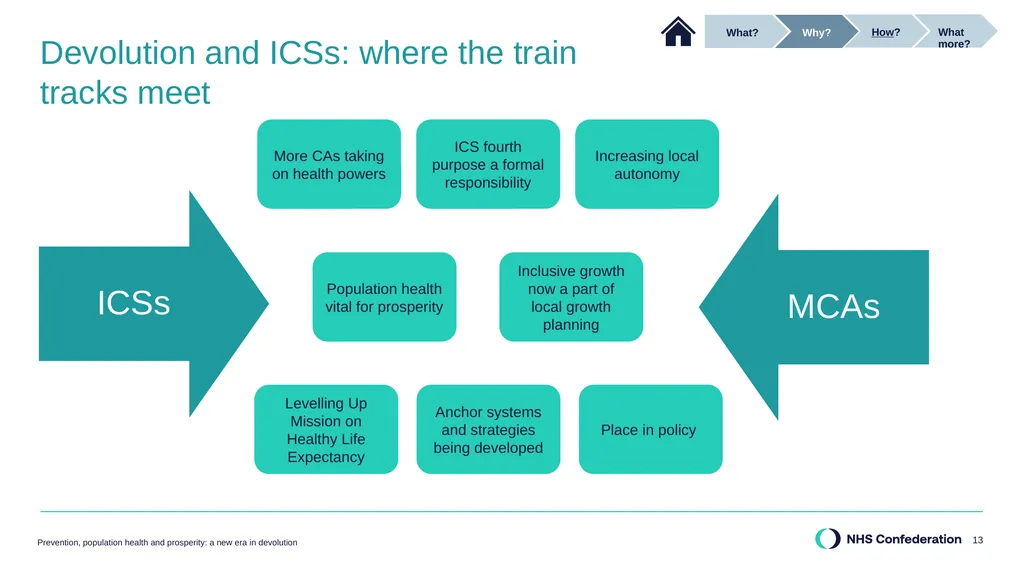
slide13. Devolution and ICSs: where the train tracks meet ICSs MCAs 13 More CAs taking on health powers ICS fourth purpose a formal responsibility Population health vital for prosperity Increasing local autonomy Anchor systems and strategies being developed Inclusive growth now a part of local growth planning Prevention, population health and prosperity: a new era in devolution Levelling Up Mission on Healthy Life Expectancy Place in policy<br>
slide14. How? How can ICSs and combined authorities maximise their collective impact for their shared populations?<br>
slide15. A new vision for health and devolution 1. Working together for our shared populations can deliver greater impact than the sum of our parts
The spirit required to bind closely systems must be one of ‘stronger together’. In this context, aligning health and devolution enables organisations and individuals to push into the areas that matter to keep people healthy and prosperous, and where they previously may have felt ‘permission’ was needed to engage. 15 2. Aligning health and devolution can reconcile the differing national and local perspectives of the future of health and care
Resolving contradictions in national and local prioritisation will require deliberately open and careful local partnership working, particularly through the ICS-devo relationship, to support new approaches to place-based service planning and delivery, to advocate collectively across and within areas, to facilitate the sharing of resources and ideas, and to build trust between traditional and new partners that challenge protectionist behaviour or policy failures. 3. Being clear what the ICS-devo relationship can offer national government can secure our future
At the core of the ICS-devo offer to national leaders should be a richer understanding of place-based connections, the supplementary evidence and nuanced understanding of what works over a longer time period of between ten and 20 years and in different local economies, and a greater insight into the nature of the interactions between separate policy areas and government departments. Prevention, population health and prosperity: a new era in devolution It is important when seeking to understand the connections between health and devolution that leaders are able to visualise, comprehend and explain what closer, more effective integrated working could feel like for colleagues on the front line and would mean for local populations, whether in rural or urban settings. This increased autonomy begs the question of what it is you want to achieve?
The roundtable discussions that informed this report were clear that a new vision was the timely, first step in reimagining the ICS-combined authority relationship and in articulating the shared future for health and devolution.<br>
slide16. A new vision for health and devolution 5. Understanding the counterfactual of not aligning health and devolution will escalate the pace of change
The ICS-devo relationship is perhaps the most important lever in escalating the pace of change at which we operate and through which we can truly move on prevention and population health. This will require real will and challenge from leaders, including being more vocal with each other, with local partners and with national government about the consequences of not acting to deliver this future. An empowered ICS and combined authority partnership is vital in ensuring the sustainability of our public services, but also that they engage and support communities in new, thought-provoking ways that make clear the choices involved. 16 4. Modelling a new way of working which places health and care at the heart of broad strategy can help our populations and our partnerships prosper
Further calls for increased autonomy for ICSs will need a strong evidence basis on which to build. Alignment on health and devolution will enable ICS leaders to showcase the potential of this tier of administration, themselves modelling new ways of working, including peer-to-peer support and learning, and co-developing strategy that is health related and cross-Whitehall, rather than simply isolated NHS policy. In doing this, the model of English devolution can be shifted away from its explicitly economy-based roots. Prevention, population health and prosperity: a new era in devolution<br>
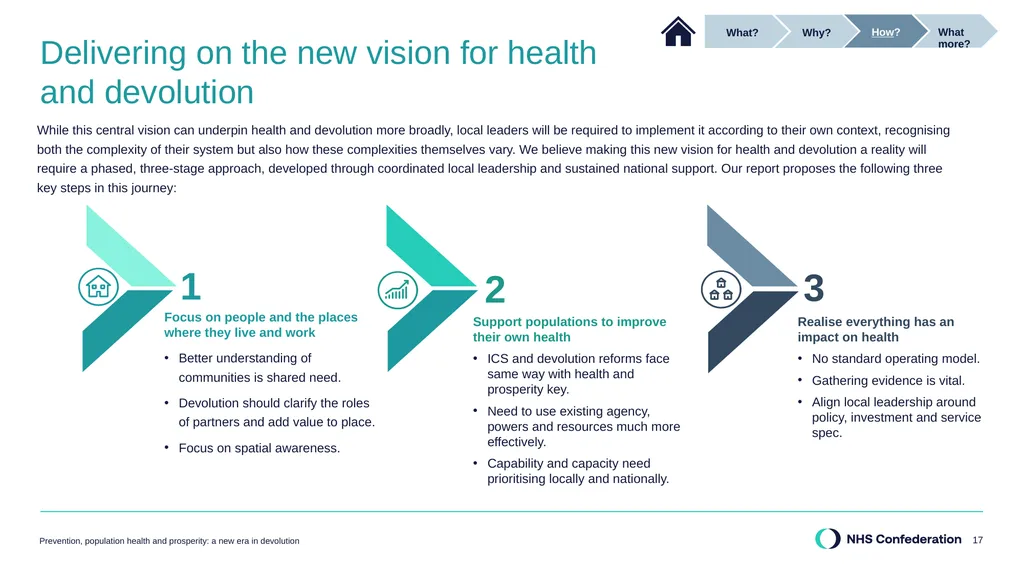
slide17. Delivering on the new vision for health and devolution 17 While this central vision can underpin health and devolution more broadly, local leaders will be required to implement it according to their own context, recognising both the complexity of their system but also how these complexities themselves vary. We believe making this new vision for health and devolution a reality will require a phased, three-stage approach, developed through coordinated local leadership and sustained national support. Our report proposes the following three key steps in this journey: Focus on people and the places where they live and work
Better understanding of communities is shared need.
Devolution should clarify the roles of partners and add value to place.
Focus on spatial awareness. 1 Support populations to improve their own health
ICS and devolution reforms face same way with health and prosperity key.
Need to use existing agency, powers and resources much more effectively.
Capability and capacity need prioritising locally and nationally. Realise everything has an impact on health
No standard operating model.
Gathering evidence is vital.
Align local leadership around policy, investment and service spec. 2 3 Prevention, population health and prosperity: a new era in devolution<br>
slide18. Step 1: Focus on people and the places where they live and work 18 The starting point is a real and sustained focus on the centrality of place and the people within. Geographies may not always be co-terminus, but there will be shared places and populations that an ICS and CA collectively serve and/or represent. This one constant can bind the local focus and prioritisation and unite an ambition, around which a compelling case for devolution to best support them can be made. Key points
There is a requirement to better understand communities and to focus work alongside place, people and partners, rather than from an organisational or sector perspective. In doing so, a new sub-national approach to spatial issues such as accountability, financing and regulation may emerge.
Devolution can clarify the roles and reach of individual partners, including how ICSs and CAs can add value to place-based partnerships, and their contribution to building a long-term route-map for integrating public services and empowering citizens. It also can help understand what more is needed to accelerate local progress.
There is a need to be much smarter with the spatial understanding of what can best be done at which level. Prevention, population health and prosperity: a new era in devolution<br>
slide19. Step 1: Focus on people and the places where they live and work 19 People
In the continued absence of a robust, standardised place approach to development or measurement, a focus on shared local outcomes can anchor joint discussions around strategy, priorities and delivery, and support constituent partners to be less protectionist.
The new structures themselves can also suffer from a lack of public awareness. Better engagement and a stronger focus on storytelling, including through local media, can help explain to populations what devolution and integrated care means for them, bringing people on the journey and improving outcomes.
There is often a tendency when setting up new structures to ‘start again’, overlooking what is already working well or simply requires support, readjustment or gradual evolution. Prevention, population health and prosperity: a new era in devolution Place
Place is still where much of the actual delivery of public service provision happens and where integration, or the lack of it, is most noticeable to colleagues and communities. The very principle, and test, of subsidiarity is place by default and this should underline all policies, decisions and delivery.
In some cases, places are building on anchor networks local partners have established, in others using missions-based approaches. Integral to the success of these methods are innovative forms of community engagement and data through which to better understand each other and the locality.
While some combined authorities are seeking legal responsibilities for public health this does not mean that a duty necessarily needs to be taken away from elsewhere. Combined and local authorities, public health directors and ICSs can concurrently, and successfully, hold related powers, but it is important they understand the differing spatial values involved and agree how they will best use them.<br>
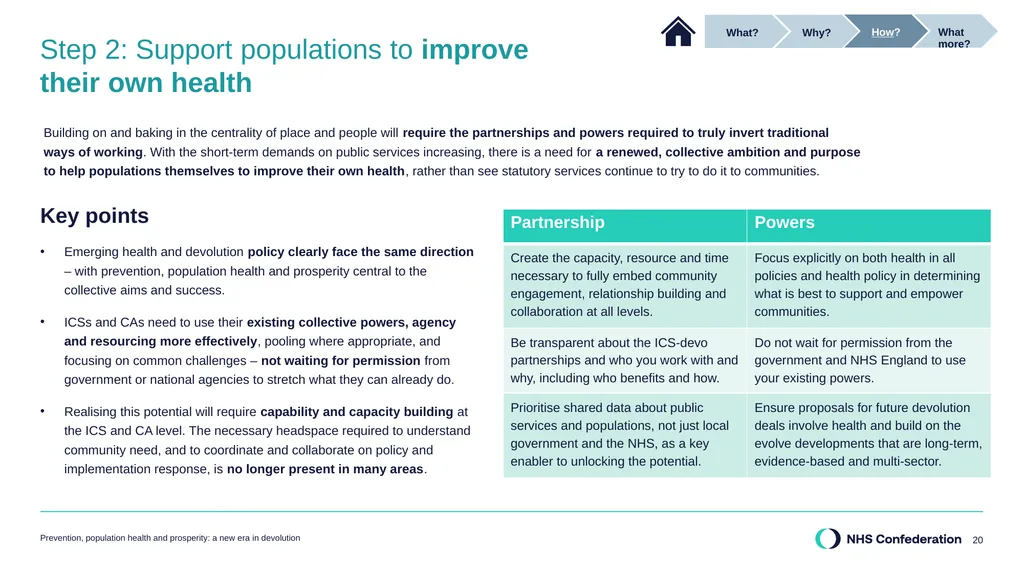
slide20. Step 2: Support populations to improve their own health Key points
Emerging health and devolution policy clearly face the same direction – with prevention, population health and prosperity central to the collective aims and success.
ICSs and CAs need to use their existing collective powers, agency and resourcing more effectively, pooling where appropriate, and focusing on common challenges – not waiting for permission from government or national agencies to stretch what they can already do.
Realising this potential will require capability and capacity building at the ICS and CA level. The necessary headspace required to understand community need, and to coordinate and collaborate on policy and implementation response, is no longer present in many areas. 20 Building on and baking in the centrality of place and people will require the partnerships and powers required to truly invert traditional ways of working. With the short-term demands on public services increasing, there is a need for a renewed, collective ambition and purpose to help populations themselves to improve their own health, rather than see statutory services continue to try to do it to communities. Prevention, population health and prosperity: a new era in devolution<br>
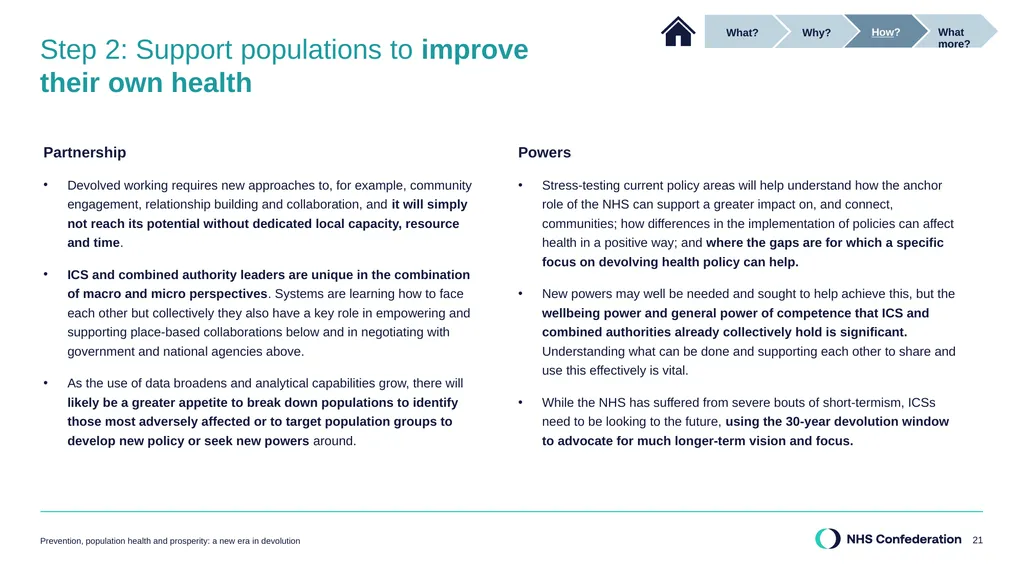
slide21. Step 2: Support populations to improve their own health 21 Prevention, population health and prosperity: a new era in devolution Powers
Stress-testing current policy areas will help understand how the anchor role of the NHS can support a greater impact on, and connect, communities; how differences in the implementation of policies can affect health in a positive way; and where the gaps are for which a specific focus on devolving health policy can help.
New powers may well be needed and sought to help achieve this, but the wellbeing power and general power of competence that ICS and combined authorities already collectively hold is significant. Understanding what can be done and supporting each other to share and use this effectively is vital.
While the NHS has suffered from severe bouts of short-termism, ICSs need to be looking to the future, using the 30-year devolution window to advocate for much longer-term vision and focus. Partnership
Devolved working requires new approaches to, for example, community engagement, relationship building and collaboration, and it will simply not reach its potential without dedicated local capacity, resource and time.
ICS and combined authority leaders are unique in the combination of macro and micro perspectives. Systems are learning how to face each other but collectively they also have a key role in empowering and supporting place-based collaborations below and in negotiating with government and national agencies above.
As the use of data broadens and analytical capabilities grow, there will likely be a greater appetite to break down populations to identify those most adversely affected or to target population groups to develop new policy or seek new powers around.<br>
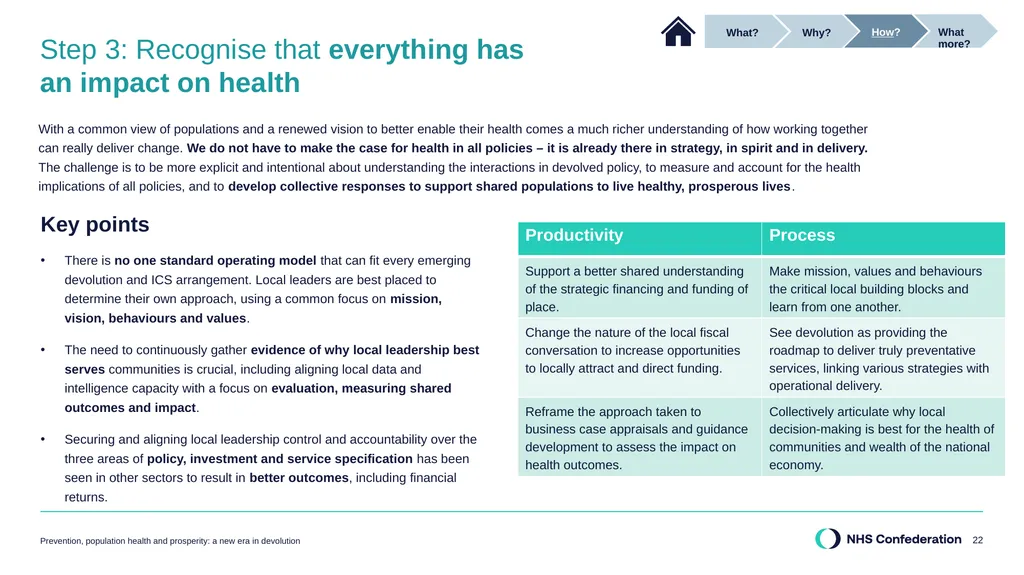
slide22. Step 3: Recognise that everything has an impact on health 22 With a common view of populations and a renewed vision to better enable their health comes a much richer understanding of how working together can really deliver change. We do not have to make the case for health in all policies – it is already there in strategy, in spirit and in delivery. The challenge is to be more explicit and intentional about understanding the interactions in devolved policy, to measure and account for the health implications of all policies, and to develop collective responses to support shared populations to live healthy, prosperous lives. Key points
There is no one standard operating model that can fit every emerging devolution and ICS arrangement. Local leaders are best placed to determine their own approach, using a common focus on mission, vision, behaviours and values.
The need to continuously gather evidence of why local leadership best serves communities is crucial, including aligning local data and intelligence capacity with a focus on evaluation, measuring shared outcomes and impact.
Securing and aligning local leadership control and accountability over the three areas of policy, investment and service specification has been seen in other sectors to result in better outcomes, including financial returns. Prevention, population health and prosperity: a new era in devolution<br>
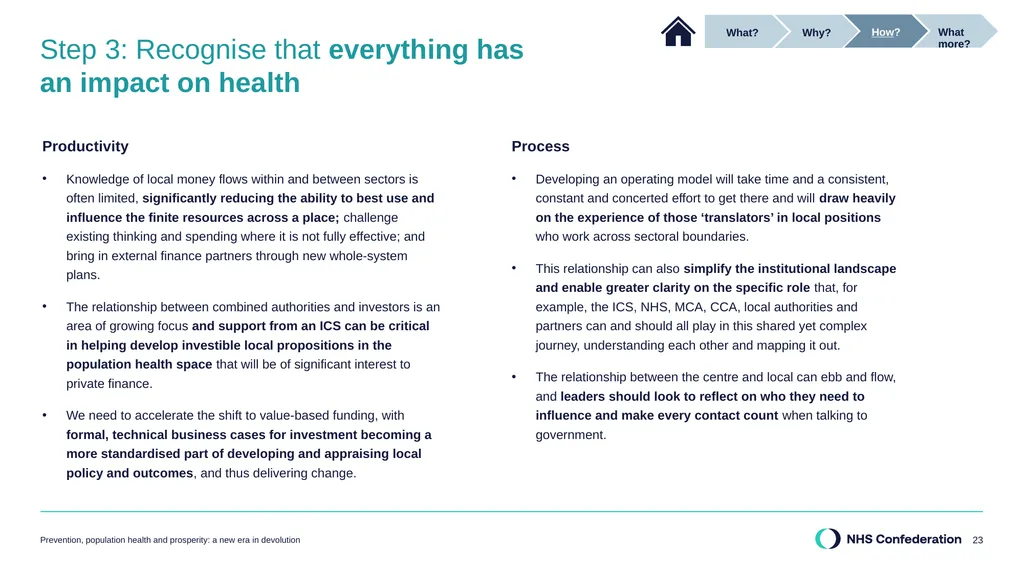
slide23. Step 3: Recognise that everything has an impact on health 23 Prevention, population health and prosperity: a new era in devolution Process
Developing an operating model will take time and a consistent, constant and concerted effort to get there and will draw heavily on the experience of those ‘translators’ in local positions who work across sectoral boundaries.
This relationship can also simplify the institutional landscape and enable greater clarity on the specific role that, for example, the ICS, NHS, MCA, CCA, local authorities and partners can and should all play in this shared yet complex journey, understanding each other and mapping it out.
The relationship between the centre and local can ebb and flow, and leaders should look to reflect on who they need to influence and make every contact count when talking to government. Productivity
Knowledge of local money flows within and between sectors is often limited, significantly reducing the ability to best use and influence the finite resources across a place; challenge existing thinking and spending where it is not fully effective; and bring in external finance partners through new whole-system plans.
The relationship between combined authorities and investors is an area of growing focus and support from an ICS can be critical in helping develop investible local propositions in the population health space that will be of significant interest to private finance.
We need to accelerate the shift to value-based funding, with formal, technical business cases for investment becoming a more standardised part of developing and appraising local policy and outcomes, and thus delivering change.<br>
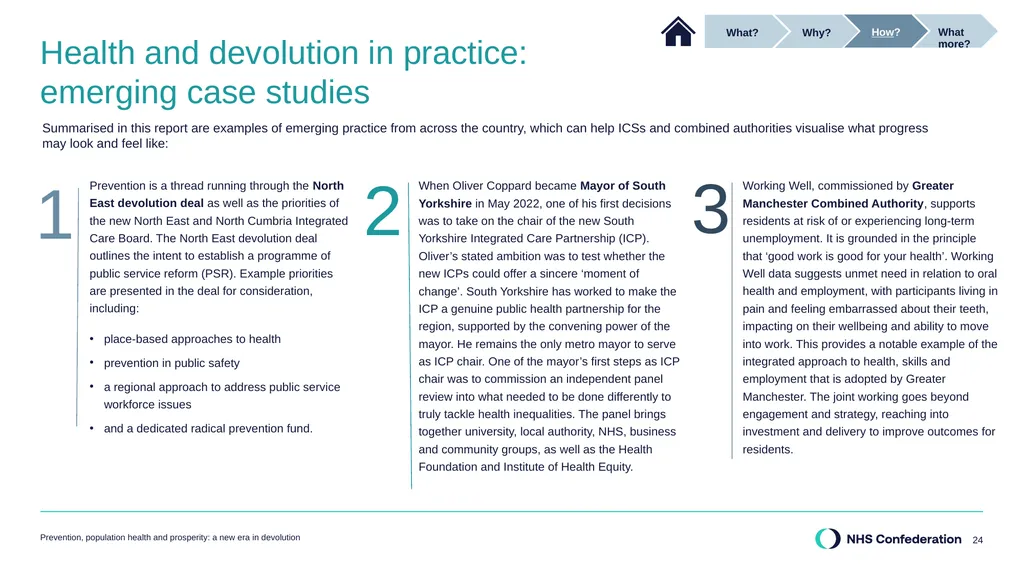
slide24. Health and devolution in practice: emerging case studies 24 Summarised in this report are examples of emerging practice from across the country, which can help ICSs and combined authorities visualise what progress may look and feel like: Prevention, population health and prosperity: a new era in devolution<br>
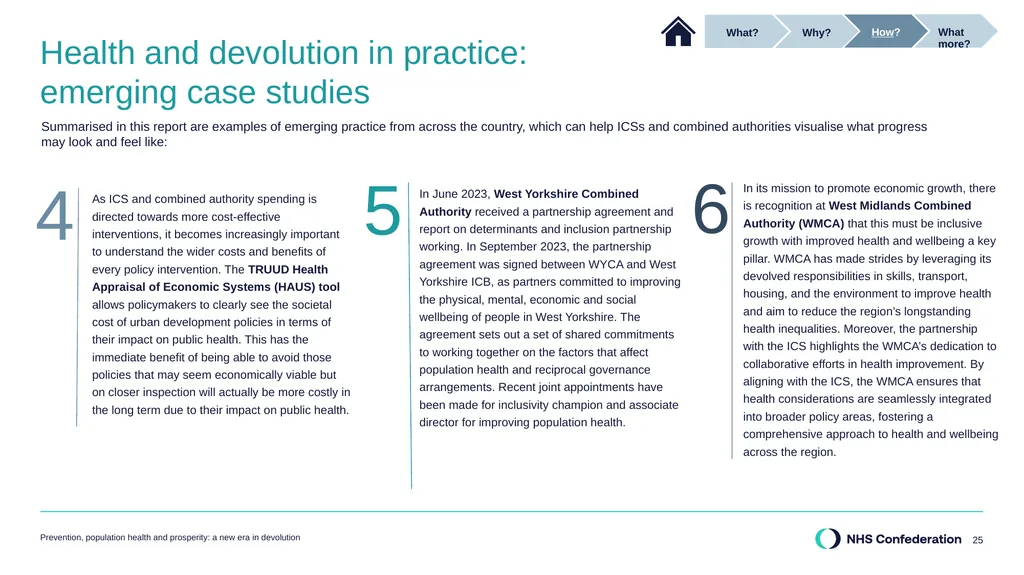
slide25. Health and devolution in practice: emerging case studies 25 Prevention, population health and prosperity: a new era in devolution Summarised in this report are examples of emerging practice from across the country, which can help ICSs and combined authorities visualise what progress may look and feel like:<br>
slide26. What more? What should the government do to support and accelerate the health and devolution agenda in future?<br>
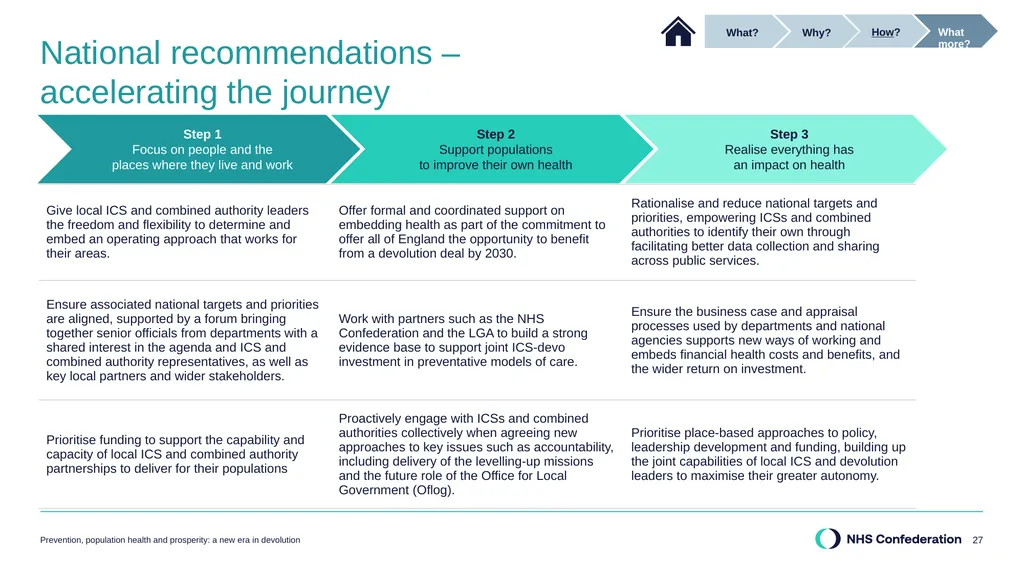
slide27. National recommendations – accelerating the journey 27 Prevention, population health and prosperity: a new era in devolution<br>
slide28. In their own words<br>
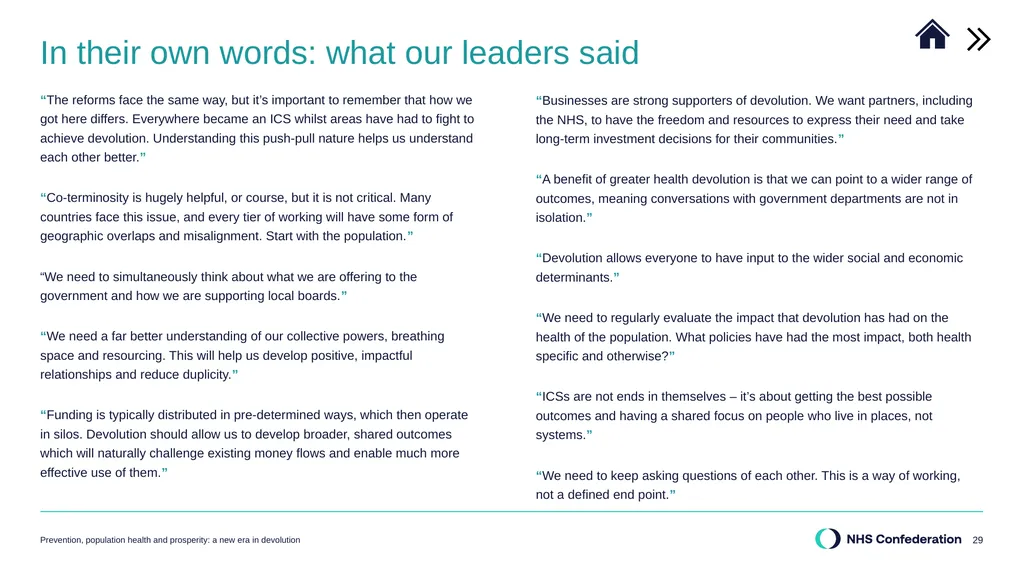
slide29. In their own words: what our leaders said “The reforms face the same way, but it’s important to remember that how we got here differs. Everywhere became an ICS whilst areas have had to fight to achieve devolution. Understanding this push-pull nature helps us understand each other better.”
“Co-terminosity is hugely helpful, or course, but it is not critical. Many countries face this issue, and every tier of working will have some form of geographic overlaps and misalignment. Start with the population.”
“We need to simultaneously think about what we are offering to the government and how we are supporting local boards.”
“We need a far better understanding of our collective powers, breathing space and resourcing. This will help us develop positive, impactful relationships and reduce duplicity.”
“Funding is typically distributed in pre-determined ways, which then operate in silos. Devolution should allow us to develop broader, shared outcomes which will naturally challenge existing money flows and enable much more effective use of them.” 29 “Businesses are strong supporters of devolution. We want partners, including the NHS, to have the freedom and resources to express their need and take long-term investment decisions for their communities.”
“A benefit of greater health devolution is that we can point to a wider range of outcomes, meaning conversations with government departments are not in isolation.”
“Devolution allows everyone to have input to the wider social and economic determinants.”
“We need to regularly evaluate the impact that devolution has had on the health of the population. What policies have had the most impact, both health specific and otherwise?”
“ICSs are not ends in themselves – it’s about getting the best possible outcomes and having a shared focus on people who live in places, not systems.”
“We need to keep asking questions of each other. This is a way of working, not a defined end point.” Prevention, population health and prosperity: a new era in devolution<br>
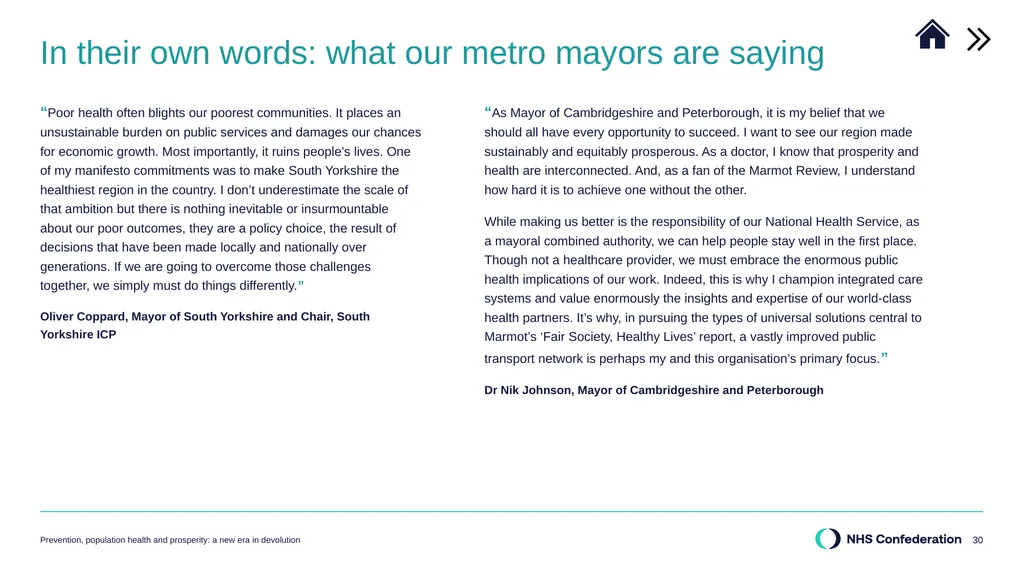
slide30. In their own words: what our metro mayors are saying “Poor health often blights our poorest communities. It places an unsustainable burden on public services and damages our chances for economic growth. Most importantly, it ruins people’s lives. One of my manifesto commitments was to make South Yorkshire the healthiest region in the country. I don’t underestimate the scale of that ambition but there is nothing inevitable or insurmountable about our poor outcomes, they are a policy choice, the result of decisions that have been made locally and nationally over generations. If we are going to overcome those challenges together, we simply must do things differently.”
Oliver Coppard, Mayor of South Yorkshire and Chair, South Yorkshire ICP 30 “As Mayor of Cambridgeshire and Peterborough, it is my belief that we should all have every opportunity to succeed. I want to see our region made sustainably and equitably prosperous. As a doctor, I know that prosperity and health are interconnected. And, as a fan of the Marmot Review, I understand how hard it is to achieve one without the other.
While making us better is the responsibility of our National Health Service, as a mayoral combined authority, we can help people stay well in the first place. Though not a healthcare provider, we must embrace the enormous public health implications of our work. Indeed, this is why I champion integrated care systems and value enormously the insights and expertise of our world-class health partners. It’s why, in pursuing the types of universal solutions central to Marmot’s ‘Fair Society, Healthy Lives’ report, a vastly improved public transport network is perhaps my and this organisation’s primary focus.”
Dr Nik Johnson, Mayor of Cambridgeshire and Peterborough Prevention, population health and prosperity: a new era in devolution<br>
slide31. Conclusion, final thoughts and further information<br>
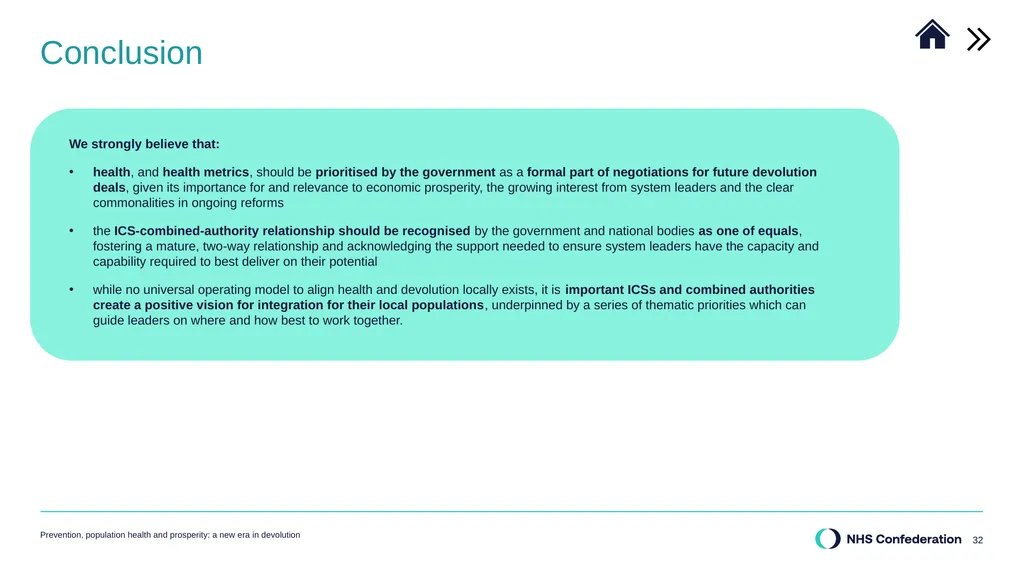
slide32. Conclusion 32 Prevention, population health and prosperity: a new era in devolution<br>
slide33. Final thoughts 33 This report provides a comprehensive framework for how leaders on the front line of public services can collectively realise the benefits of health devolution. Download the report at www.nhsconfed.org/publications/prevention-population-prosperity-devolution Prevention, population health and prosperity: a new era in devolution<br>
slide34. 34 Further information The NHS Confederation’s health economic partnerships work programme supports the NHS to understand its growing role in the local economy and in developing anchor strategies at institutional, place and system level.
Visit us on the NHS Confederation website and contact Michael.Wood@nhsconfed.org, @NHSLocalGrowth for more information. Prevention, population health and prosperity: a new era in devolution<br>
Prevention, population health and prosperity: a new era in devolution
Exploring the priorities, opportunities and challenges in bringing together health and local government devolution
Michael Wood, Head of Health Economic Partnerships
@NHSLocalGrowth<br>
slide2. 2 Unlocking the NHS’s social and economic potential: creating a productive system Contents<br>
slide3. Prevention, population health and prosperity: a new era in devolution 3 Executive summary Key points
This report highlights the growing parallels between local government devolution and integrated care systems (ICSs), in terms of a genuine and shared interest in geography, place, role, purpose and outcomes. Devolution is already integral to many ICSs, with leaders now asking how they can deepen their work to best serve populations.
It is important leaders are able to visualise, comprehend and explain what closer, more effective integrated working could feel like for colleagues on the front line and what it would mean for local populations. This report articulates a new central vision for the shared future for health and devolution.
Local leaders will be required to implement this vision according to their own context and nuance. We believe making this new vision for health and devolution a reality will require a phased, three-stage approach, developed through coordinated local leadership and sustained national support.
These three steps include: focusing on people and the places where they live and work; supporting populations to improve their own health; and recognising that everything has an impact on health. For each step, the report sets out context, findings, national recommendations, local priorities and case studies.
Delivering on these steps will involve stretching what we can do within existing frameworks, duties and powers, before understanding what is needed to go further; increasing and resourcing local capacity and capability; focusing on community engagement and empowerment; understanding and using soft power and system working; and above all, consistently engaging and co-developing a future of shared thinking, projects and positions.
The timing of this report is important. There is a narrow window open in which to simultaneously look back and learn from past approaches to devolution, but also look forward at what a more standardised approach to decentralisation might look like, before various reforms make merging these areas too complex.<br>
slide4. 4 The NHS Confederation and the Local Government Authority (LGA) created a Health and Devolution Working Group in spring 2023. The working group brought together integrated care board (ICB) and integrated care partnership (ICP) leaders from those ICSs directly impacted by existing and/or emerging devolution deals and external experts from a range of sectors and organisations who have either specialist knowledge of devolution or are in a position to influence future policy development in this space. Over a period of six months the working group met four times.
Health and Devolution Working Group Prevention, population health and prosperity: a new era in devolution Dr Kathy McLean, Chair, Nottingham and Nottinghamshire ICB and ICP Sir Richard Leese, Chair, Greater Manchester Integrated Care Board Co-chairs Securing a broad understanding, agreeing a collective voice<br>
slide5. Our ambitions and purpose 5 Prevention, population health and prosperity: a new era in devolution<br>
slide6. What? What is English devolution and what does it mean for an ICS?<br>
slide7. Health and devolution: understanding the background to devolution 7 Devolution in England is the delegation of powers, programmes and funding from national government, in Westminster, to local government.
As of November 2023, devolution deals have been agreed with 17 areas in England. This trend is set to continue and accelerate.
The 2022 levelling up white paper set out the mission that by 2030 every part of England that wants one will have a devolution deal. Labour has also committed to further devolution.
For this form of devolution, powers must be transferred to a body with a leader who is directly elected by the local population. This will normally mean the establishment of mayoral combined authorities (MCAs) by two or more local councils, which are statutory bodies led by a locally elected mayor. Powers can also be transferred directly to councils with a locally elected leader, as is the case in Suffolk, Norfolk and Cornwall.
Although the government has not definitively stated the key purposes of devolution, successive government policy often identifies three overarching principles:
economic growth
better and more integrated public services
enhanced public engagement and accountability. Prevention, population health and prosperity: a new era in devolution<br>
slide8. Health and devolution: typical devolution powers and programmes 8 There are a number of powers and budgets that have been made available to most areas in devolution deals since 2014, largely focused on boosting local economies.
Recent ‘trailblazer deals’ have expanded the responsibilities of some MCAs in the areas of transport, adult education and housing. Importantly, these deals commit to providing a single funding settlement in the 2025 Spending Review, akin to the method of funding of government departments.
Further ‘special’ powers have been offered to a limited set of MCAs. These include powers relating to police and fire, justice, housing, and health. Typical devolution powers for a combined authority:
Investment funds: 30-year investment fund, equating annually to between £15 million and £38 million for each combined authority.
Adult Education Budget (AEB): Funds education and training course for adults aged 19 and over.
Business support: ‘Growth hubs’ which help local businesses access services.
Fiscal powers: In addition to the power to impose a precept on council tax bills, most combined authorities retain all business rate revenues collected in their area.
Transport: Most devolution deals have included a multi-year transport investment budget.
Planning and land use: Many combined authorities have the ability to create spatial plans for the use of land. Prevention, population health and prosperity: a new era in devolution<br>
slide9. Health and devolution: where does health feature? 9 The GMCA and GLA were the first devolved bodies with responsibilities for the health of their local populations. However, new devolution deals such as East Midlands and North East explicitly mention health, and the levelling up framework allows for an explicit public health duty for level 2, 3, and 4 deals. North East devolution deal
The North East devolution deal has an explicit section on public service reform, which incudes a focus on:
place-based health and care, with a new ICS-devolution region-wide approach to social care collaboration, the health and social care workforce, and market shaping
healthy ageing, exploring, with partners, potential for a new ‘golden triangle’ to develop stronger partnerships between the North East, Edinburgh and Glasgow
population health, developing a Radical Prevention Fund that will reshape existing funding away from acute services and into preventative action. East Midlands devolution deal
To complement and support action by the constituent councils, the East Midlands MCCA will take on a local authority duty to take action to improve the public’s health concurrent with the constituent councils. This will allow health to be considered throughout the East Midlands MCCA’s activities as well as enable work on local issues where health plays a key role, for example tackling homelessness and rough sleeping.
Gov.uk (2022), Policy Paper: East Midlands Devolution Deal Prevention, population health and prosperity: a new era in devolution The devolution framework – keeping the public safe and healthy<br>
slide10. English sub-national governance: an ever-changing patchwork 10 Prevention, population health and prosperity: a new era in devolution<br>
slide11. Metro mayors: a new form of place leader 11 Prevention, population health and prosperity: a new era in devolution A metro mayor is the directly-elected leader of an area and chairs the combined authority.
They have varying degrees of executive power and funding over a range of differing areas, including skills, business support and transport, and in some cases crime and health.
In most areas, they have an effective veto over decisions made by the combined authority, while the Mayor of London can take decisions without reference to the London boroughs.
Where the elected mayor is also the Police and Crime Commissioner (PCC) for the area, they also have the PCC’s power to raise a precept.
Metro mayors can appoint deputy mayors and hand them certain functions.
Including the Mayor of London, 50 per cent of the population of England, or 27.7 million people, have a metro mayor.
The 11 metro mayors in England have differed considerably in the priorities and activities undertaken since their election, with their convening and soft power increasingly recognised, even in areas where they have no power. Many metro mayors have a health interest:
Dr Nik Johnson, Mayor of Cambridgeshire and Peterborough, is a consultant pediatrician.
Andy Burnham, Mayor of Greater Manchester, is a former Secretary of State for Health.
Oliver Coppard, Mayor of South Yorkshire, chairs the South Yorkshire ICP.
Claire Ward, Mayor of East Midlands, was formally chair of Sherwood Forest Hospitals NHS Foundation Trust. Who should the mayor’s office liaise with? What are the mayor’s priorities and how can you support their delivery? What issues can the mayor’s soft power help resolve? What positions can you offer the mayor?<br>
slide12. Why? Why should ICSs and combined authorities work together to jointly improve health and support economic prosperity?<br>
slide13. Devolution and ICSs: where the train tracks meet ICSs MCAs 13 More CAs taking on health powers ICS fourth purpose a formal responsibility Population health vital for prosperity Increasing local autonomy Anchor systems and strategies being developed Inclusive growth now a part of local growth planning Prevention, population health and prosperity: a new era in devolution Levelling Up Mission on Healthy Life Expectancy Place in policy<br>
slide14. How? How can ICSs and combined authorities maximise their collective impact for their shared populations?<br>
slide15. A new vision for health and devolution 1. Working together for our shared populations can deliver greater impact than the sum of our parts
The spirit required to bind closely systems must be one of ‘stronger together’. In this context, aligning health and devolution enables organisations and individuals to push into the areas that matter to keep people healthy and prosperous, and where they previously may have felt ‘permission’ was needed to engage. 15 2. Aligning health and devolution can reconcile the differing national and local perspectives of the future of health and care
Resolving contradictions in national and local prioritisation will require deliberately open and careful local partnership working, particularly through the ICS-devo relationship, to support new approaches to place-based service planning and delivery, to advocate collectively across and within areas, to facilitate the sharing of resources and ideas, and to build trust between traditional and new partners that challenge protectionist behaviour or policy failures. 3. Being clear what the ICS-devo relationship can offer national government can secure our future
At the core of the ICS-devo offer to national leaders should be a richer understanding of place-based connections, the supplementary evidence and nuanced understanding of what works over a longer time period of between ten and 20 years and in different local economies, and a greater insight into the nature of the interactions between separate policy areas and government departments. Prevention, population health and prosperity: a new era in devolution It is important when seeking to understand the connections between health and devolution that leaders are able to visualise, comprehend and explain what closer, more effective integrated working could feel like for colleagues on the front line and would mean for local populations, whether in rural or urban settings. This increased autonomy begs the question of what it is you want to achieve?
The roundtable discussions that informed this report were clear that a new vision was the timely, first step in reimagining the ICS-combined authority relationship and in articulating the shared future for health and devolution.<br>
slide16. A new vision for health and devolution 5. Understanding the counterfactual of not aligning health and devolution will escalate the pace of change
The ICS-devo relationship is perhaps the most important lever in escalating the pace of change at which we operate and through which we can truly move on prevention and population health. This will require real will and challenge from leaders, including being more vocal with each other, with local partners and with national government about the consequences of not acting to deliver this future. An empowered ICS and combined authority partnership is vital in ensuring the sustainability of our public services, but also that they engage and support communities in new, thought-provoking ways that make clear the choices involved. 16 4. Modelling a new way of working which places health and care at the heart of broad strategy can help our populations and our partnerships prosper
Further calls for increased autonomy for ICSs will need a strong evidence basis on which to build. Alignment on health and devolution will enable ICS leaders to showcase the potential of this tier of administration, themselves modelling new ways of working, including peer-to-peer support and learning, and co-developing strategy that is health related and cross-Whitehall, rather than simply isolated NHS policy. In doing this, the model of English devolution can be shifted away from its explicitly economy-based roots. Prevention, population health and prosperity: a new era in devolution<br>
slide17. Delivering on the new vision for health and devolution 17 While this central vision can underpin health and devolution more broadly, local leaders will be required to implement it according to their own context, recognising both the complexity of their system but also how these complexities themselves vary. We believe making this new vision for health and devolution a reality will require a phased, three-stage approach, developed through coordinated local leadership and sustained national support. Our report proposes the following three key steps in this journey: Focus on people and the places where they live and work
Better understanding of communities is shared need.
Devolution should clarify the roles of partners and add value to place.
Focus on spatial awareness. 1 Support populations to improve their own health
ICS and devolution reforms face same way with health and prosperity key.
Need to use existing agency, powers and resources much more effectively.
Capability and capacity need prioritising locally and nationally. Realise everything has an impact on health
No standard operating model.
Gathering evidence is vital.
Align local leadership around policy, investment and service spec. 2 3 Prevention, population health and prosperity: a new era in devolution<br>
slide18. Step 1: Focus on people and the places where they live and work 18 The starting point is a real and sustained focus on the centrality of place and the people within. Geographies may not always be co-terminus, but there will be shared places and populations that an ICS and CA collectively serve and/or represent. This one constant can bind the local focus and prioritisation and unite an ambition, around which a compelling case for devolution to best support them can be made. Key points
There is a requirement to better understand communities and to focus work alongside place, people and partners, rather than from an organisational or sector perspective. In doing so, a new sub-national approach to spatial issues such as accountability, financing and regulation may emerge.
Devolution can clarify the roles and reach of individual partners, including how ICSs and CAs can add value to place-based partnerships, and their contribution to building a long-term route-map for integrating public services and empowering citizens. It also can help understand what more is needed to accelerate local progress.
There is a need to be much smarter with the spatial understanding of what can best be done at which level. Prevention, population health and prosperity: a new era in devolution<br>
slide19. Step 1: Focus on people and the places where they live and work 19 People
In the continued absence of a robust, standardised place approach to development or measurement, a focus on shared local outcomes can anchor joint discussions around strategy, priorities and delivery, and support constituent partners to be less protectionist.
The new structures themselves can also suffer from a lack of public awareness. Better engagement and a stronger focus on storytelling, including through local media, can help explain to populations what devolution and integrated care means for them, bringing people on the journey and improving outcomes.
There is often a tendency when setting up new structures to ‘start again’, overlooking what is already working well or simply requires support, readjustment or gradual evolution. Prevention, population health and prosperity: a new era in devolution Place
Place is still where much of the actual delivery of public service provision happens and where integration, or the lack of it, is most noticeable to colleagues and communities. The very principle, and test, of subsidiarity is place by default and this should underline all policies, decisions and delivery.
In some cases, places are building on anchor networks local partners have established, in others using missions-based approaches. Integral to the success of these methods are innovative forms of community engagement and data through which to better understand each other and the locality.
While some combined authorities are seeking legal responsibilities for public health this does not mean that a duty necessarily needs to be taken away from elsewhere. Combined and local authorities, public health directors and ICSs can concurrently, and successfully, hold related powers, but it is important they understand the differing spatial values involved and agree how they will best use them.<br>
slide20. Step 2: Support populations to improve their own health Key points
Emerging health and devolution policy clearly face the same direction – with prevention, population health and prosperity central to the collective aims and success.
ICSs and CAs need to use their existing collective powers, agency and resourcing more effectively, pooling where appropriate, and focusing on common challenges – not waiting for permission from government or national agencies to stretch what they can already do.
Realising this potential will require capability and capacity building at the ICS and CA level. The necessary headspace required to understand community need, and to coordinate and collaborate on policy and implementation response, is no longer present in many areas. 20 Building on and baking in the centrality of place and people will require the partnerships and powers required to truly invert traditional ways of working. With the short-term demands on public services increasing, there is a need for a renewed, collective ambition and purpose to help populations themselves to improve their own health, rather than see statutory services continue to try to do it to communities. Prevention, population health and prosperity: a new era in devolution<br>
slide21. Step 2: Support populations to improve their own health 21 Prevention, population health and prosperity: a new era in devolution Powers
Stress-testing current policy areas will help understand how the anchor role of the NHS can support a greater impact on, and connect, communities; how differences in the implementation of policies can affect health in a positive way; and where the gaps are for which a specific focus on devolving health policy can help.
New powers may well be needed and sought to help achieve this, but the wellbeing power and general power of competence that ICS and combined authorities already collectively hold is significant. Understanding what can be done and supporting each other to share and use this effectively is vital.
While the NHS has suffered from severe bouts of short-termism, ICSs need to be looking to the future, using the 30-year devolution window to advocate for much longer-term vision and focus. Partnership
Devolved working requires new approaches to, for example, community engagement, relationship building and collaboration, and it will simply not reach its potential without dedicated local capacity, resource and time.
ICS and combined authority leaders are unique in the combination of macro and micro perspectives. Systems are learning how to face each other but collectively they also have a key role in empowering and supporting place-based collaborations below and in negotiating with government and national agencies above.
As the use of data broadens and analytical capabilities grow, there will likely be a greater appetite to break down populations to identify those most adversely affected or to target population groups to develop new policy or seek new powers around.<br>
slide22. Step 3: Recognise that everything has an impact on health 22 With a common view of populations and a renewed vision to better enable their health comes a much richer understanding of how working together can really deliver change. We do not have to make the case for health in all policies – it is already there in strategy, in spirit and in delivery. The challenge is to be more explicit and intentional about understanding the interactions in devolved policy, to measure and account for the health implications of all policies, and to develop collective responses to support shared populations to live healthy, prosperous lives. Key points
There is no one standard operating model that can fit every emerging devolution and ICS arrangement. Local leaders are best placed to determine their own approach, using a common focus on mission, vision, behaviours and values.
The need to continuously gather evidence of why local leadership best serves communities is crucial, including aligning local data and intelligence capacity with a focus on evaluation, measuring shared outcomes and impact.
Securing and aligning local leadership control and accountability over the three areas of policy, investment and service specification has been seen in other sectors to result in better outcomes, including financial returns. Prevention, population health and prosperity: a new era in devolution<br>
slide23. Step 3: Recognise that everything has an impact on health 23 Prevention, population health and prosperity: a new era in devolution Process
Developing an operating model will take time and a consistent, constant and concerted effort to get there and will draw heavily on the experience of those ‘translators’ in local positions who work across sectoral boundaries.
This relationship can also simplify the institutional landscape and enable greater clarity on the specific role that, for example, the ICS, NHS, MCA, CCA, local authorities and partners can and should all play in this shared yet complex journey, understanding each other and mapping it out.
The relationship between the centre and local can ebb and flow, and leaders should look to reflect on who they need to influence and make every contact count when talking to government. Productivity
Knowledge of local money flows within and between sectors is often limited, significantly reducing the ability to best use and influence the finite resources across a place; challenge existing thinking and spending where it is not fully effective; and bring in external finance partners through new whole-system plans.
The relationship between combined authorities and investors is an area of growing focus and support from an ICS can be critical in helping develop investible local propositions in the population health space that will be of significant interest to private finance.
We need to accelerate the shift to value-based funding, with formal, technical business cases for investment becoming a more standardised part of developing and appraising local policy and outcomes, and thus delivering change.<br>
slide24. Health and devolution in practice: emerging case studies 24 Summarised in this report are examples of emerging practice from across the country, which can help ICSs and combined authorities visualise what progress may look and feel like: Prevention, population health and prosperity: a new era in devolution<br>
slide25. Health and devolution in practice: emerging case studies 25 Prevention, population health and prosperity: a new era in devolution Summarised in this report are examples of emerging practice from across the country, which can help ICSs and combined authorities visualise what progress may look and feel like:<br>
slide26. What more? What should the government do to support and accelerate the health and devolution agenda in future?<br>
slide27. National recommendations – accelerating the journey 27 Prevention, population health and prosperity: a new era in devolution<br>
slide28. In their own words<br>
slide29. In their own words: what our leaders said “The reforms face the same way, but it’s important to remember that how we got here differs. Everywhere became an ICS whilst areas have had to fight to achieve devolution. Understanding this push-pull nature helps us understand each other better.”
“Co-terminosity is hugely helpful, or course, but it is not critical. Many countries face this issue, and every tier of working will have some form of geographic overlaps and misalignment. Start with the population.”
“We need to simultaneously think about what we are offering to the government and how we are supporting local boards.”
“We need a far better understanding of our collective powers, breathing space and resourcing. This will help us develop positive, impactful relationships and reduce duplicity.”
“Funding is typically distributed in pre-determined ways, which then operate in silos. Devolution should allow us to develop broader, shared outcomes which will naturally challenge existing money flows and enable much more effective use of them.” 29 “Businesses are strong supporters of devolution. We want partners, including the NHS, to have the freedom and resources to express their need and take long-term investment decisions for their communities.”
“A benefit of greater health devolution is that we can point to a wider range of outcomes, meaning conversations with government departments are not in isolation.”
“Devolution allows everyone to have input to the wider social and economic determinants.”
“We need to regularly evaluate the impact that devolution has had on the health of the population. What policies have had the most impact, both health specific and otherwise?”
“ICSs are not ends in themselves – it’s about getting the best possible outcomes and having a shared focus on people who live in places, not systems.”
“We need to keep asking questions of each other. This is a way of working, not a defined end point.” Prevention, population health and prosperity: a new era in devolution<br>
slide30. In their own words: what our metro mayors are saying “Poor health often blights our poorest communities. It places an unsustainable burden on public services and damages our chances for economic growth. Most importantly, it ruins people’s lives. One of my manifesto commitments was to make South Yorkshire the healthiest region in the country. I don’t underestimate the scale of that ambition but there is nothing inevitable or insurmountable about our poor outcomes, they are a policy choice, the result of decisions that have been made locally and nationally over generations. If we are going to overcome those challenges together, we simply must do things differently.”
Oliver Coppard, Mayor of South Yorkshire and Chair, South Yorkshire ICP 30 “As Mayor of Cambridgeshire and Peterborough, it is my belief that we should all have every opportunity to succeed. I want to see our region made sustainably and equitably prosperous. As a doctor, I know that prosperity and health are interconnected. And, as a fan of the Marmot Review, I understand how hard it is to achieve one without the other.
While making us better is the responsibility of our National Health Service, as a mayoral combined authority, we can help people stay well in the first place. Though not a healthcare provider, we must embrace the enormous public health implications of our work. Indeed, this is why I champion integrated care systems and value enormously the insights and expertise of our world-class health partners. It’s why, in pursuing the types of universal solutions central to Marmot’s ‘Fair Society, Healthy Lives’ report, a vastly improved public transport network is perhaps my and this organisation’s primary focus.”
Dr Nik Johnson, Mayor of Cambridgeshire and Peterborough Prevention, population health and prosperity: a new era in devolution<br>
slide31. Conclusion, final thoughts and further information<br>
slide32. Conclusion 32 Prevention, population health and prosperity: a new era in devolution<br>
slide33. Final thoughts 33 This report provides a comprehensive framework for how leaders on the front line of public services can collectively realise the benefits of health devolution. Download the report at www.nhsconfed.org/publications/prevention-population-prosperity-devolution Prevention, population health and prosperity: a new era in devolution<br>
slide34. 34 Further information The NHS Confederation’s health economic partnerships work programme supports the NHS to understand its growing role in the local economy and in developing anchor strategies at institutional, place and system level.
Visit us on the NHS Confederation website and contact Michael.Wood@nhsconfed.org, @NHSLocalGrowth for more information. Prevention, population health and prosperity: a new era in devolution<br>